Birth days (and other kinds)

‘Birth, and copulation, and death.
That’s all the facts when you come to brass tacks:
Birth, and copulation, and death.’
            (Fragment of an Agon)[1]

Is T. S. Eliot’s Sweeney a little too concise here? You may be thinking, in some moods yes, in some moods no. You may even be thinking it a little too expansive. But most people, I suspect, might want to add a bit.

Take today, for instance, 17 December. The celebrated translator of Russian literature, Constance Garnett, died at 03:00 on this day in 1946. Over 70 English versions, of Turgenev, Dostoevsky, Chekhov, Goncharov, Tolstoy. Dorothy Sayers, author of superb detective stories and translator of Dante, died in 1957, also on this day.

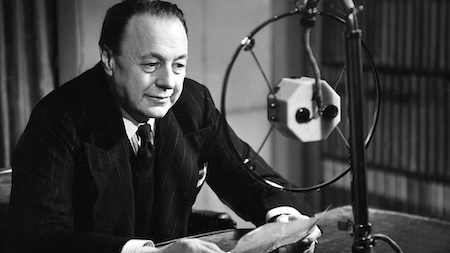
The middle term: throw in a wedding (and assume a positive). On 17 December 1914, the painter Paul Nash and Margaret Odeh—‘Bunty’—were married in St Martin-in-the-Fields by ‘the young pacifist vicar the Reverend Dick Sheppard.’[2] Cue the opening stanza of W. H. Auden’s Letter to Lord Byron:

Excuse, my lord, the liberty I take
   In thus addressing you. I know that you
Will pay the price of authorship and make
   The allowances an author has to do.
   A poet’s fan-mail will be nothing new.
And then a lord—Good Lord, you must be peppered,
Like Gary Cooper, Coughlin, or Dick Sheppard.[3]

Gary Cooper, at least, will still be a familiar name; the other two, these days, rather less so, though not to historians of the 1920s and 1930s: Sheppard, the priest whose sermons, broadcast by the BBC, made him a national figure, and who later founded the Peace Pledge Union; Charles Coughlin, the Catholic priest who was also a widely-known broadcaster, though his anti-Semitic and pro-Fascist sympathies made his output rather different.

(Dick Sheppard broadcasting from St Martin-in-the-Fields: BBC)

On 17 December 1941, Sylvia Townsend Warner wrote to her friend Paul Nordoff: ‘Luckily, I have a tough memory for what I like, and I have most of it tucked away somewhere behind my ears.’[4] Just ten days after the attack on Pearl Harbor, then, a reminder if one were needed that on another 17 December—1903—Wilbur Wright’s fourth and last flight carried him  852 feet in 59 seconds.

The implications of that pioneering effort emerged with gradually increasing force and clarity a decade or so later. In 1915, Ezra Pound wrote to his parents (17 December): ‘Lewis has enlisted. That about takes the lot.’ He added: ‘I suppose we will go to France after the war. if it ever ends.’[5] Bombardier Wyndham Lewis would later recall that: ‘The war was a sleep, deep and animal, in which I was visited by images of an order very new to me. Upon waking I found an altered world: and I had changed, too, very much.’[6]

A few years on (17 December 1958) and the great Australian novelist Patrick White was writing to his friend and publisher Ben Huebsch—the rock on which White’s career was built, David Marr remarks—about his novel, Riders in the Chariot. ‘I shall want somebody here to check the Jewish parts after a second writing. I feel I may have given myself away a good deal, although passages I have been able to check for myself, seem to have come through either by instinct or good luck, so perhaps I shall survive. After all, I did survive the deserts of Voss.’ And in another letter to Huebsch, five months later, he returned to this: ‘What I want to emphasise through my four “Riders” – an orthodox refugee intellectual Jew, a mad Erdgeist [Earth spirit] of an Australian spinster, an evangelical laundress, and a half-caste aboriginal painter – is that all faiths, whether religious, humanistic, instinctive, or the creative artist’s act of praise, are in fact one.’[7] (I reread all Patrick White’s books seven years ago and I’m damned if I don’t feel almost ready to do it again. . .)

(Ford via New York Review of Books)

But then – why not celebrate? 17 December birthdays, yes: Humphry Davy, John Greenleaf Whittier, Erskine Caldwell, Paul Cadmus, Penelope Fitzgerald, Jacqueline Wilson, John Kennedy Toole – and the primary focus, or beginning spark, of all this anniversary rambling, Ford Madox Ford, 152 today.

His birthdays weren’t always joyous: at a party in 1901, he nearly choked on a chicken bone ‘and was prostrate for some days’.[8] In 1916, he was in a Red Cross Hospital in Rouen, writing to Joseph Conrad a couple of days later: ‘As for me—c’est fini de moi, I believe, at least as far as fighting is concerned—my lungs are all charred up & gone—they appeared to be quite healed, but exposure day after day has ended in the usual stretchers and ambulance trains’. In 1920, he spent at least a small portion of his birthday writing to Thomas Hardy, asking him to sign a manifesto protesting against British government policy in Ireland. It was published on 1 January 1921 in the Manchester Guardian and other papers. Fifty writers, artists and academics signed it but Thomas Hardy was not among them.

Past lives, past struggles, victories, defeats. Surely there is comfort to be found there, that they were faced with things we recognise only too well—not only the individual battles but the more general ones, against Fascism, vicious racism, authoritarianism, the hijacking of news, of the sources of information, the assaults on free speech, on civil liberties, on democratic rights—and came through. And we?

Optimism, pessimism. One up, one down; Monday, Tuesday; left hand; right hand. I liked Guy Davenport on the judicious estimate of his own make-up, reporting to Hugh Kenner that his friend Steve Diamant’s photographs included one that served as the author photograph on the dust jacket of Tatlin!, Davenport’s first collection of stories, or assemblages: ‘Guy beaming in the Dionysian priest’s chair, the Theatre, Athens. I had no notion such a radiant smile was in me. It cured a third of my paranoia and an eighth of my Calvinist pessimism to see it.’[9]

A whole eighth. Some photograph, some smile.


Notes

[1] T. S. Eliot, The Complete Poems and Plays (London: Faber and Faber, 1969), 122.

[2] Ronald Blythe, First Friends: Paul and Bunty, John and Christine – and Carrington (London: Viking, 1999), 77; David Boyd Haycock, A Crisis of Brilliance (London: Old Street Publishing, 2009), 238-9.

[3] W. H. Auden, The English Auden: Poems, Essays and Dramatic Writings, 1927-1939, edited by Edward Mendelson (London: Faber, 1977), 169.

[4] Sylvia Townsend Warner, Letters, edited by William Maxwell (London: Chatto & Windus, 1982), 76.

[5] Ezra Pound, Ezra Pound to His Parents: Letters 1895–1929, edited by Mary de Rachewiltz, David Moody and Joanna Moody (Oxford: Oxford University Press, 2010), 358.

[6] Wyndham Lewis, Rude Assignment: A narrative of my career up-to-date (London: Hutchinson, 1950), 129.

[7] Patrick White, Letters, edited by David Marr (London: Jonathan Cape, 1994), 151, 153. Marr’s remark about Huebsch’s importance is in ‘The Cast of Correspondents’, 638.

[8] Arthur Mizener, The Saddest Story: A Biography of Ford Madox Ford (London: The Bodley Head, 1972), 73.

[9] Questioning Minds: The Letters of Guy Davenport and Hugh Kenner, edited by Edward M. Burns, two volumes (Berkeley: Counterpoint Press, 2018), I, 630.

‘The Weeping and the Laughter’


Almost August. Record–breaking temperatures in South Korea and Japan but a dull, grey morning here today. Even the saxophonist who practises in the small wood in the park may postpone his session for a while.

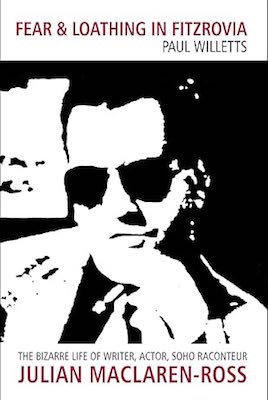
Emerging from Paul Willetts’ biography of Julian Maclaren-Ross, I was a little dizzy from the extraordinary sequences of work done, or proposed, or rewritten, of contracts honoured or let slip, of rooms and suites and flats rented and left in a series of moonlight flits or evictions, of creditors and lawsuits, landladies, hoteliers, retailers (a pram for his son Alex) and the post office (for telephone bills), of separations from, and reconciliations with, wives and girlfriends.[1] It’s difficult not to have a sense of being slightly bruised by contact with the innumerable knocks that the writer underwent. He was incurably extravagant and wasteful with money, nor did the alcoholism, heavy smoking, bad diet, amphetamine use and lack of exercise help much, and the fatal heart attack at the age of fifty-two is not wholly unexpected.

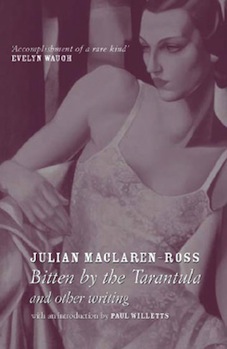
The two undeniable positives, though, are the biography itself, a prodigious feat of research and writing; and Maclaren-Ross’s own staggering fecundity. The novels, short stories, sketches, radio dramas, adaptations, autobiographies, screenplays, parodies, memoirs, reviews and essays emerge at an astonishing rate. Writing often through the night, he seems to turn out entire radio drama series in days, reviews and sketches in hours, year after year through the 1940s, 1950s and into the early 1960s, always in financial distress and increasingly aware that the impact made by some of his early work had not been maintained and had ebbed away. It’s remarkable, given the rate of production and the conditions in which most of it was written, that so much of it is so good. Some of the stories, the novel, Of Love and Hunger, the memoirs, many of the superb parodies and critical writings (on cinema as well as literature) in Bitten By the Tarantula, are assured, often very funny, and hugely impressive. 


Endless monologues on a barstool in Fitzrovia. The teddy-bear coat, the sharp suit, the cigarette-holder, the silver-topped malacca cane, the snuff box, the eternal dark glasses: ‘From an early age’, Paul Willetts writes, ‘Julian put as much effort into propagating his personal myth as perfecting his prose style’ (306), going on to mention the many characters in poems and novels that are based on him, as well as the memoirs in which he features. Pubs and clubs, magazines and anthologies, are threaded through the story as much as boxers and bullfighters are in Hemingway’s, and Maclaren-Ross encountered an extraordinary range of writers, editors, publishers, painters and BBC producers. One of these, who became increasingly important in his desperate pursuit of commissions and payments, was Reginald Donald ‘Reggie’ Smith (born on this day, 31 July, 1914), whose name rang a bell because he’d cropped up in a couple of other stories. Married to the novelist Olivia Manning, he’s familiar to readers of her Balkan Trilogy as the model for her central character Guy Pringle (to viewers of the superb adaptation, it is, of course, Kenneth Branagh). Smith crops up on more than thirty pages of Willetts’ biography because he was hugely supportive of Maclaren-Ross for some years. He was a friend of the novelist and critic Walter Allen and of Louis MacNeice, and had been to King Edward Grammar School in Aston, Birmingham, with poet Henry Reed and George D. Painter, future biographer of Marcel Proust. When he married Olivia Manning in August 1939 at Marylebone Registrar’s Office, their witnesses included Stevie Smith and Walter Allen. Their best man had been written into the certificate as ‘Louise MacNeice’—both bride and groom noticed but said nothing—and Olivia seems to have taken the opportunity to shave a few years off her age, her birthdate recorded there as 1911 (in fact it was 1908).[2]


I may briefly take refuge now in something calmer, less harassed—perhaps a Simenon. Not that the world of Inspector Jules Maigret is entirely detached from that of Julian Maclaren-Ross, one of whose many publications was a translation, published by Penguin Books in association with Hamish Hamilton in 1959: Maigret and the Burglar’s Wife. . .


Notes

[1] Paul Willetts, Fear & Loathing in Fitzrovia: The Bizarre Life of Writer, Actor, Soho Raconteur Julian Maclaren-Ross, revised edition (London: Dewi Lewis, 2013). Willetts also introduces Collected Memoirs (London: Black Spring Press, 2004) and Bitten By the Tarantula and other writing (London: Black Spring Press, 2005). Penguin Books published Of Love and Hunger, with an introduction by D. J. Taylor, in 2002. ‘The Weeping and the Laughter’ is subtitled ‘A Chapter of Autobiography’ in Collected Memoirs (1-110).

[2] Neville & June Braybrooke, Olivia Manning: A Life (London: Chatto & Windus, 2004), 54, 58, 59.

Cookery: war, cavalry: rice

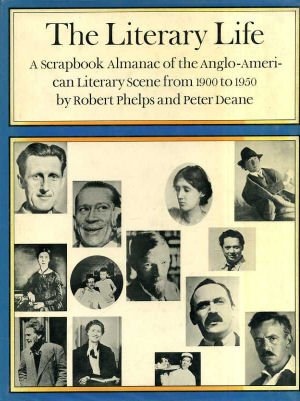
Browsing the tirelessly interesting The Literary Life: A Scrapbook Almanac of the Anglo-American Literary Scene from 1900 to 1950, I come across (‘In the Wings’ section of 1913): ‘“Eager for any sort of adventure,” Joyce Cary serves as a cook in the Montenegrin Army in the First Balkan War, receiving a gold medal for his participation in the final campaign.’[1] Montenegro! It reminded me that F. Scott Fitzgerald’s Major Jay Gatsby had been decorated by every Allied government, ‘even Montenegro, little Montenegro down on the Adriatic Sea!’[2]

And a cook! Intriguing, especially when poking about in various sources to confirm it but coming up against Red Cross nurse, stretcher bearer, Red Cross orderly, and finally: stretcher bearer and cook, which I promptly accept as definitive.

Cary (1888-1957) was born in Derry but, when he settled in England, this was where he largely stayed. He attended Clifton College in Bristol (as did L. P. Hartley, Sir Arthur Quiller-Couch, Henry Newbolt, Geoffrey Household, Montague Summers, actors, musicians and an astonishing array of military, scientific and political notables). He joined the colonial service in Africa and fought in the First World War – with a Nigerian regiment in the Cameroon campaign. He seems to have largely dropped from view but was pretty well-known for a while, particularly for his novel The Horse’s Mouth, published in 1944 and reprinted as a Penguin book four years later.

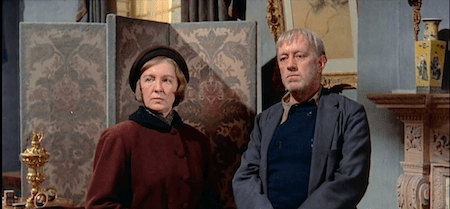
(Alec Guinness and Kay Walsh in the 1958 film, The Horse’s Mouth)

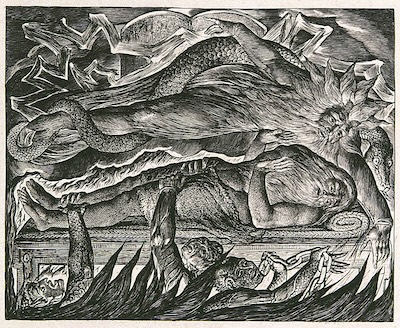
I did read several of his other novels but that’s the one I remember best. It’s about a painter, Gulley Jimson, who has some diverting comments about the art that he practises. One day, he remembers, ‘I happened to see a Manet. Because some chaps were laughing at it. And it gave me the shock of my life. Like a flash of lightning. It skinned my eyes for me and when I came out I was a different man. And I saw the world again, the world of colour. By Gee and Jay, I said, I was dead, and I didn’t know it.’ A little later, ‘And then I began to make a few little pencil sketches, studies, and I took Blake’s Job drawings out of somebody’s bookshelf and peeped into them and shut them up again. Like a chap who’s fallen down the cellar steps and knocked his skull in and opens a window too quick, on something too big.’ But to a boy who keeps turning up, saying he wants to be a painter himself, Jimson tells him ‘“something for your good. All art is bad, but modern art is the worst. Just like the influenza. The newer it is, the more dangerous. And modern art is not only a public danger – it’s insidious. You never know what may happen when it’s got loose.”’[3]

(William Blake, engraving for The Book of Job)

Cookery and war, though. Conflict in the kitchen is familiar fare in several strenuous television series of recent years but there are other offscreen instances enough.

Joan Didion recalled being taught to cook by someone from Louisiana. ‘We lived together for some years, and I think we most fully understood each other when once I tried to kill him with a kitchen knife.’[4] And M. F. K. Fisher remembered a Mrs Cheever at Miss Huntingdon’s School for Girls: ‘She ran her kitchens with such skill that in spite of ordinary domestic troubles like flooded basements and soured cream, and even an occasional extraordinary thing like the double murder and hara-kiri committed by the head boy one Good Friday, our meals were never late and never bad.’[5]

In the First World War, as in so many other wars, cookhouses and dining halls were central to the military effort, both at home and abroad. If your medical category was C1, then cookhouse fatigues were likely to feature on your work rota, along with clerking, cleaning and gardening. The poet F. S. Flint did precisely that although towards the end of his war service in England and Scotland—brief enough since he was only called up in August 1918—he taught French to officers who were awaiting demobilisation. The novelist Edgar Jepson wrote of attempting ‘to diminish the gluttony of the British people.’ His masterpiece drew, he said, on the experiments of Mrs Peel in the basement kitchen: ‘I dwell at this length on the Cookery Book [The Win the War Cookery Book of May 1917] because I wish to make it wholly clear that it shares equally with the United States the glory of having won the war.’ He added: ‘Not that I would have it supposed that I reckon the months I spent at the Ministry of Food wasted: I acquired there a faith in human stupidity, which nothing will ever shake.’[6]

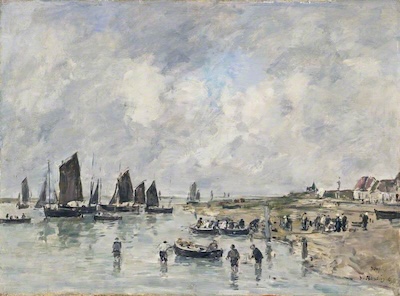
(Eugène Louis Bourdin, Étaples)

Closer to the scenes of combat, the young Wilfred Owen would discover in December 1916 that meals in the officers’ mess at Étaples in northern France—where a series of mutinies the following year resulted in executions and prison sentences—‘were cooked by a former chef to the Duke of Connaught and presided over by a baronet.’[7]

Midway through that war, in the same year as Owen’s sumptuous dinners, poet and novelist Robert Graves bought a small cottage from his mother. He wrote, a decade later: ‘I bought it in defiance of the war, as something to look forward to when the guns stopped (“when the guns stop” was how we always thought of the end of the war). I whitewashed the cottage and put in a table, a chair, a bed and a few dishes and cooking utensils. I had decided to live there by myself on bread and butter, bacon and eggs, lettuce in season, cabbage and coffee; and to write poetry.’[8]

War and the kitchen. Really not in my case; perhaps the nearest would be peeling a butternut squash, the culinary equivalent, I suppose, of fell walking or hill climbing, requiring as it does both stamina and occasional brute strength. And war has changed out of all recognition in the last hundred-odd years, sometimes seeming to be called ‘war’ only to spare the feelings of those on one side who are slaughtering, almost without resistance or effective means of defence, the other. And there was a time, after all, when ‘war’ meant men on horseback. . .

‘It was from the cavalry that the nation’s military leaders were drawn. They believed in the cavalry charge as they believed in the Church of England.’ Perhaps unsurprisingly, then, when the future General Sir Ian Hamilton, as an English observer in the Russo-Japanese War of 1904-1905, reported that ‘the only thing the cavalry could do in the face of entrenched machine guns was to cook rice for the infantry’, his statement had the effect of ‘causing the War Office to wonder if his months in the Orient had not affected his mind.’[9]

Never underestimate the value to the world of getting the cooking time of your rice just right.

Notes


[1] Robert Phelps and Peter Deane, The Literary Life: A Scrapbook Almanac of the Anglo-American Literary Scene from 1900 to 1950 (New York: Farrar, Straus and Giroux, 1968), 54.

[2] F. Scott Fitzgerald, The Great Gatsby (1926; edited by Tony Tanner, London: Penguin Books, 2000), 65.

[3] Joyce Cary, The Horse’s Mouth (Harmondsworth: Penguin Books, 1948), 70-71, 72, 24-25.

[4] Joan Didion, South and West: From a Notebook, foreword by Nathaniel Rich (London: Fourth Estate, 2017), 8.

[5] M. F. K.  Fisher, ‘The First Oyster’ (1924), in Gastronomical Me (1943; London: Daunt Books, 2017), 26.

[6] Edgar Jepson, Memories of an Edwardian and Neo-Georgian (London: Richards, 1937), 193, 196. Mrs C. S. Peel was a prolific author of books about thrifty cookery, including The Eat-Less-Meat Book: War Ration Housekeeping (1917).

[7] Dominic Hibberd, Wilfred Owen: A New Biography (London: Weidenfeld & Nicolson, 2002), 203.

[8] Robert Graves, Good-bye to All That: An Autobiography (1929; Harmondsworth: Penguin, 2014), 252.

[9] Barbara Tuchman, The Guns of August and The Proud Tower, edited by Margaret MacMillan (New York: Library of America, 2012), 593, 214.

Pilots, poets, bays

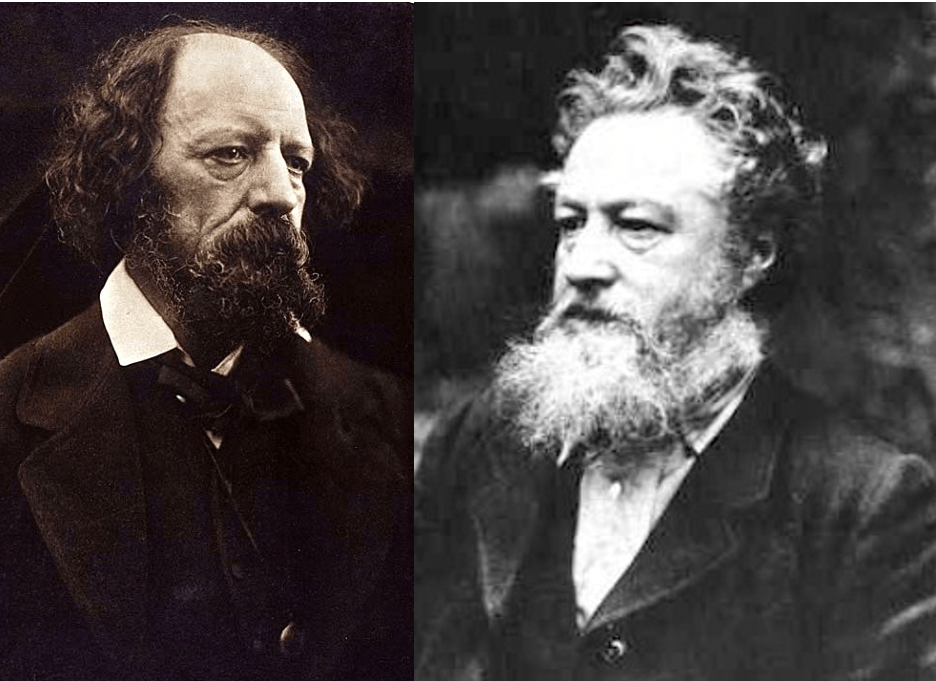
Alfred Lord Tennyson died on 6 October 1892, having served as Queen Victoria’s Poet Laureate for over forty years, the longest ever tenure – though a later octogenarian, John Masefield, came very close. Tennyson’s funeral, which took place six days after his death, was a pretty grand affair. His remains were, the Times reported, ‘consigned to their last resting-place in Poets’ Corner, Westminster’ – the grave of Robert Browning, who had died three years previously, is immediately adjacent to Tennyson’s. All the leading members of the royal family sent representatives (Sir Henry Ponsonby, Sir Dighton Probyn, Lord Edward Cecil) and the place was thronged with bishops, lords and ladies, the pall-bearers including the Duke of Argyll and Lord Kelvin. Conan Doyle, Ellen Terry, John Burns, Frederic Harrison and Henry Irving were among the mourners. In the street outside, vendors were offering, for a penny, copies of the poet’s 1889 lyric, ‘Crossing the Bar’ (author portrait included):

Sunset and evening star,
   And one clear call for me!
And may there be no moaning of the bar,
   When I put out to sea,

But such a tide as moving seems asleep,
   Too full for sound and foam,
When that which drew from out the boundless deep
Turns again home.

Twilight and evening bell,
   And after that the dark!
And may there be no sadness of farewell,
   When I embark;

For though from out our bourne of Time and Place
   The flood may bear me far,
I hope to see my Pilot face to face
When I have crost the bar.[1]

Tennyson was 80 when he wrote it, so unsurprisingly aware that the encounter with his ‘Pilot’ was not that far off.

Edward Burne-Jones was particularly excited that the city of Mantua ‘had sent bay from Virgil’s birthplace to lay in the tomb.’ In fact, ‘bay’ and ‘pilot’ occurred in another ‘literary’ interment context a few years later, though William Morris’s ‘country funeral’, Fiona MacCarthy observes, ‘was the absolute antithesis of Tennyson’s burial in Westminster Abbey in 1892.’[2]

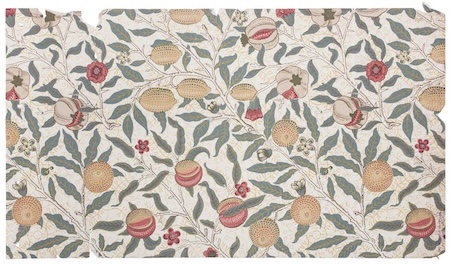
(William Morris, Fruit (Wallpaper): William Morris Society: Kelmscott House)

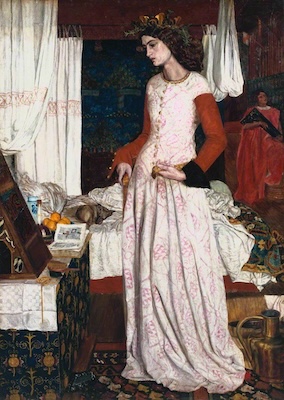
Morris died on 3 October 1896. He was only 62 but such a tireless worker, such a tireless maker, of pictures, poems, translations, tapestries, stained-glass windows, fabrics, carpets, furniture, illuminated books, wallpapers, prose romances and more that, as is often remarked, the primary cause of his death was simply being William Morris. His funeral took place on 6 October, exactly four years after the death of Tennyson. The body had to be transported from Paddington to Lechlade by train (a form of transport that Morris disliked intensely), then taken by cart to Kelmscott Church.

It was a cold wet morning, and the day turned stormy later. In that week’s issue of the Saturday Review (10 October 1896), there were pieces on Morris by George Bernard Shaw, Arthur Symons – and R. B. Cunninghame Graham, whose account of the day on which ‘the most striking figure of our times’ was buried, began with that weather. ‘As we never associated William Morris with fine weather, rather taking him to be a pilot poet lent by the Vikings to steer us from the doldrums in which we now lie all becalmed in smoke to some Valhalla of his own creation beyond the world’s end, it seemed appropriate that on his burial day the rain descended and the wind blew half a gale from the north-west.’ He noted of the arrival at Lechlade: ‘There, unlike Oxford, the whole town was out’, and added that the open haycart on which the coffin was transported to Kelmscott Church was ‘driven by a man who looked coeval with the Saxon Chronicle.’[3]

‘Over the coffin were thrown two pieces of Oriental embroidered brocade, and a wreath of bays was laid at his head’, the Daily News reported. The mourners included, alongside painters, publishers and printers, workmen from Merton Abbey (where the tapestry, weaving and fabric printing workshops were sited), Kelmscott villagers and members of the Art Workers’ Guild, all in their daily working clothes. The architect William Lethaby wrote: ‘It was the only funeral I have ever seen that did not make me ashamed to have to be buried.’[4]

(William Morris, Kelmscott Press Edition of ‘Godefrey of Boloyne’ by William Caxton: William Morris Society: Kelmscott House)

Morris continues to attract enormous biographical and scholarly interest, and warrants it all. So many arts, so many crafts, so many connections, so widespread and generative an influence, cropping up in all manner of places, often the expected ones, sometimes less so. Ezra Pound read Morris to the young Hilda Doolittle, ‘in an orchard under blossoming—yes, they must have been blossoming—apple trees.’ And: ‘It was Ezra who really introduced me to William Morris. He literally shouted “The Gilliflower of Gold” in the orchard. How did it go? Hah! hah! La belle jaune giroflée. And there was “Two Red Roses across the Moon” and “The Defence of Guenevere.”’[5] Pound read Morris to Yeats too, in Stone Cottage at the edge of Ashdown Forest, his translations of the Icelandic sagas.[6] Yeats would later recall of Morris’s prose romances that they were ‘the only books I was ever to read slowly that I might not come too quickly to the end.’[7]

(William Morris, La Belle Iseult: Tate)

Fiona MacCarthy remarks that ‘There was a neurotic basis to his fluency. On a good day he could write 1,000 lines of verse’, and some readers will find some of the longer poems soporific.[8] Penelope Fitzgerald wrote that the lyrics, in her opinion were ‘far the most important part’ of his  poetry and, ‘If I could keep them I would cheerfully sweep all the sagas and Earthly Paradises under the carpet.’[9] Other readers, in Morris’s own time, and since, have felt quite differently. Yeats continued to be one of them. In October 1933, he reported to his old friend (and ex-lover) Olivia Shakespear (Pound’s mother-in-law) his attempt to read Morris’s long poem The Story of Sigurd the Volsung to his daughter and then to his wife: ‘and last night when I came to the description of the birth of Sigurd and that wonderful first nursing of the child, I could hardly read for my tears. Then when Anne had gone to bed I tried to read it to George and it was just the same.’[10]

This is probably the passage he refers to, early in Book II:

Then she held him a little season on her weary and happy breast
And she told him of Sigmund and Volsung and the best sprung forth from the best:
She spake to the new-born baby as one who might understand,
And told him of Sigmund’s battle, and the dead by the sea-flood’s strand,
And of all the wars passed over, and the light with darkness blent.

So she spake, and the sun rose higher, and her speech at last was spent,
And she gave him back to the women to bear forth to the people’s kings,
That they too may rejoice in her glory and her day of happy things.[11]

For other admirers of Morris, it may be the campaigner, the Socialist, or perhaps the designer and producer of stained-glass, fabrics, stories, the late romances, the lectures and the essays:

‘To give people pleasure in the things they must perforce use, that is one great office of decoration; to give people pleasure in the things they must perforce make. That is the other use of it.’
     ‘Does not our subject look important enough now? I say that without those arts, our rest would be vacant and uninteresting, our labour mere endurance, mere wearing away of body and mind.’[12]

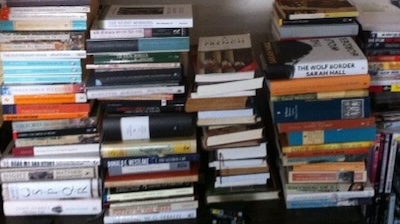
Yes, the allusions to damaging and artificial divisions are often wonderfully suggestive of other divisions causing much wider harms – as, of course, they continue to do. And, though I may be prejudiced in this regard, I like his idea, in ‘The Beauty of Life’, of ‘the fittings necessary to the sitting-room of a healthy person’. The first of these is ‘a book-case with a great many books in it’. Oddly, he never seems to mention, let alone recommend, piles of books everywhere else. . .


Notes

[1] Tennyson: A Selected Edition, edited by Christopher Ricks (Harlow: Longman Group, 1989), 665-666.

[2] Fiona MacCarthy, William Morris: A Life for Our Time (London: Faber & Faber, 1994), 631, 673-675.

[3] R. B. Cunninghame Graham, ‘With the North-West Wind’, Saturday Review (10 October 1896), Vol. 82, Issue 2137, 389-390.

[4] Quoted by Philip Henderson, William Morris: His Life, Work and Friends (Harmondsworth: Pelican Books, 1973), 429.

[5] H. D., End to Torment: A Memoir of Ezra Pound, edited by Norman Holmes Pearson and Michael King (Manchester: Carcanet Press, 1980), 22-23.

[6] James Longenbach, Stone Cottage: Pound, Yeats and Modernism (New York: Oxford University Press, 1990), 142-143.

[7] W. B. Yeats, ‘The Trembling of the Veil [1922]: Four Years’, in Autobiographies (London: Macmillan, 1955), 141.

[8] MacCarthy, William Morris, ix.

[9] Penelope Fitzgerald to Dorothy Coles, 5 June [1992], So I Have Thought of You: The Letters of Penelope Fitzgerald, edited by Terence Dooley (London: Fourth Estate, 2008), 460.

[10] The Letters of W. B. Yeats, edited by Allan Wade (London: Rupert Hart-Davis, 1954), 816.

[11] William Morris, The story of Sigurd the Volsung and the fall of the Niblungs (London: Ellis & White, 1877), 80-81.

[12] ‘The Lesser Arts’, in William Morris: The Selected Writings, edited by G. D. H. Cole (London: The Nonesuch Press, 1934), 496.

The one after the one after that: 1924

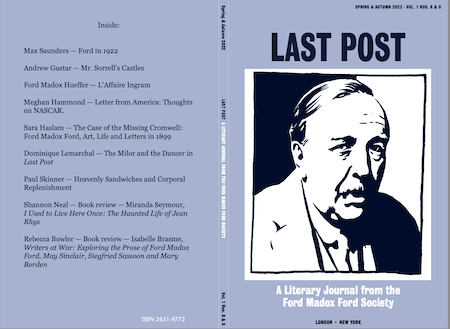
In a recent issue of Last Post, writing of Ford Madox Ford in 1924, Max Saunders remarked that it ‘certainly is an annus mirabilis for Ford; a year in which he launched the transatlantic review, and published two masterpieces: Some Do Not . . ., the first novel of his postwar Parade’s End tetralogy; and the brilliant critical memoir of his collaborator Joseph Conrad’.[1] He was pointing out the objections to the often feverish concentration upon that now-conventional annus mirabilis of modernism, 1922, in literary criticism and history, which has sometimes narrowed down to two particular gleamings in the gloaming, Ulysses and The Waste Land. It’s true that there were dozens of other remarkable works published in that year; lists can easily be constructed and I’ve been guilty of at least one myself. Tempted to do the same thing for 1924, I sailed past a couple of dozen before accepting that 1924 was also guilty of producing an absurd number of interesting items, in addition to the previously mentioned Fordian masterworks.

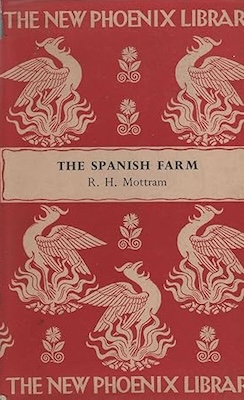
I leave aside, for the moment, Aldous Huxley, Katherine Mansfield, W. B. Yeats, a posthumous Herman Melville, T. E. Hulme, Ernest Hemingway, Glenway Wescott,  Marianne Moore and the bestselling The Green Hat by Michael Arlen (formerly Dikrān Kuyumjian) to mention, among my personal favourites, R. H. Mottram’s The Spanish Farm, first volume of a trilogy (the second and third followed in successive years) and winner of that year’s Hawthornden Prize. It focuses primarily not on trench warfare but rather on the narrator’s dealings with the local inhabitants, their claims for loss and damage against the British forces, and the relationship between an English officer and the daughter of the Ferme d’Espagnole. The trilogy was deservedly successful—and published in an omnibus volume in 1927—but has since seemed to drift out of view, only scholars of the period paying much attention to it lately. The one-volume edition was published as a Penguin Modern Classic in 1979 but is long out of print and the only editions currently on offer all look pretty nasty. Mottram was closely identified with Norfolk and sometimes nudged by the familiar British ‘regional novelist’ elbow into some cultural annexe or other. But see Craig Gibson’s piece here: https://norfolkrecordofficeblog.org/2021/04/14/forgotten-r-h-mottram/

Also in this year: John Buchan’s The Three Hostages (Dr Greenslade to Richard Hannay: ‘“Have you ever realized, Dick, the amount of stark craziness that the War has left in the world? . . . I hardly meet a soul who hasn’t got some slight kink in his brain as a consequence of the last seven years”’). There was D. H. Lawrence’s long ‘Introduction’ to Memoirs of the Foreign Legion by Maurice Magnus; Rudyard Kipling wrote four fascinating stories, ‘The Wish House’, ‘The Eye of Allah’, ‘The Bull That Thought’ and ‘A Madonna of the Trenches’ (especially the first two), and Stanley Spencer began The Resurrection in Cookham Churchyard in February 1924 (finished in 1926, it was shown at his first one-man exhibition in 1927).

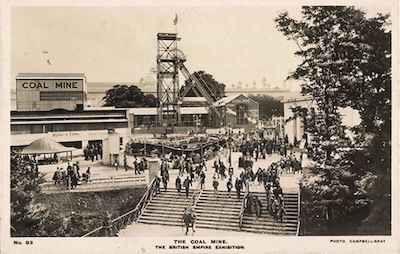
In April, before a crowd of 120,000 people, George V opened the British Empire Exhibition at Wembley, put together by 18,000 workmen: Palace of Art (and Palace of Beauty), Never Stop Railway, Queen’s Doll’s House, butter sculptures, elephants, Mary Pickford and Douglas Fairbanks, massed choirs in white surplices. Poet and publisher Harold Monro was, apparently, impressed by its patriotic glitter and ‘in one of his satiric dream poems he envisaged an exhibition of the future, where the last Georgian Nature Poet would be on show, dressed in tweed and sipping beer, in a specially designed case.’[2]

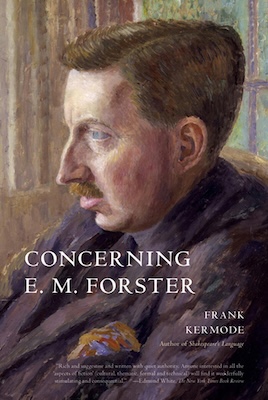
The narrator of Edith Wharton’s ‘The Spark’ comments that ‘People, I had by this time found, all stopped living at one time or another, however many years longer they continued to be alive’.[3] D. H. Lawrence announced to Middleton Murry that he wanted ‘to go south, where there is no autumn, where the cold doesn’t crouch over one like a snow-leopard, waiting to pounce. The heart of the North is dead’.[4] Ezra Pound, well-embarked upon The Cantos by now, was looking back as well as forward, writing in a letter of 3 December to Wyndham Lewis: ‘We were hefty guys in them days; an of what has come after us, we seem to have survived without a great mass of successors’.[5] E. M. Forster published A Passage to India: his next novel, Maurice, would appear 47 years later, following its author’s death. In February 1924, acknowledging Forster’s Pharos and Pharillon, Lawrence wrote to him: ‘To me you are the last Englishman. And I am the one after that.’[6]

In the journal that he kept for a short period, the poet John Clare wrote (30 November 1824): ‘Read the Literary Souvenir for 1825 in all its gilt & finery what a number of candidates for fame are smiling on its pages – what a pity it is that time should be such a destroyer of our hopes & anxiety for the best of us but doubts on fame’s promises & a century will thin the myriad worse than a plague.’[7]

One hundred years on from 1924, the authors and titles of that period present a dazzling image of astonishing abilities and achievements. As to whether, another century on (assuming the continued existence of books, readers or, indeed, people), any of the current ‘candidates for fame’ will be visible to (some version of) literary historians, I have no settled opinion. Let me get back to you.

Notes


[1] Max Saunders, ‘Ford in 1922’, Last Post: A Literary Journal from the Ford Madox Ford Society, 1, 8 & 9 (Spring & Autumn, 2022), 1-19 (2). His essay concentrates on what Ford was writing, rather than publishing, in 1922.

[2] Penelope Fitzgerald, Charlotte Mew And Her Friends (1984; London: Flamingo, 2002), 209.

[3] Edith Wharton, Old New York (1924), in Novellas and Other Writings, edited by Cynthia Griffin Wolff (New York: Library of America, 1990), 467.

[4] The Selected Letters of D. H. Lawrence, compiled and edited by James T. Boulton (Cambridge: Cambridge University Press, 1996), 284.

[5] Pound/Lewis: The Letters of Ezra Pound and Wyndham Lewis, edited by Timothy Materer (London: Faber and Faber, 1985), 138. His possible exceptions to this statement were the composer George Antheil and the writer Robert McAlmon.

[6] The Letters of D. H. Lawrence IV, June 1921–March 1924, edited by Warren Roberts, James T. Boulton and Elizabeth Mansfield (Cambridge: Cambridge University Press, 1987), 584. The term has since been applied to Arthur Ransome and J. L. Carr by their biographers, and to Lieutenant-Colonel Alfred Daniel Wintle by himself. The day the other Lawrence (T. E., ‘of Arabia’) died, Forster was on his way to see him.

[7] John Clare, Journals, Essays, Journey from Essex, edited by Anne Tibble (Manchester: Carcanet New Press, 1980), 54.

Dusting the monument


Let not a monument give you or me hopes,
Since not a pinch of dust remains of Cheops.
(Byron, Don Juan, I, 219)

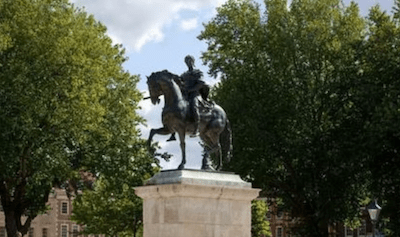
Walking to and from the Watershed, meeting my elder daughter, prior to her birthday, and her travels to Germany and France, we cross Queen Square. It’s a famous Bristol feature, dating in its present form from 1700 and named after the queen two years later. The statue of William III, ‘Dutch William’, by John Michael Rysbrack (originally Jan Michiel Rijsbrack), stands in the centre. The Bristol riots of October 1831, following the House of Lords blocking a Reform Bill, left nearly a hundred buildings in the square burned to the ground, their cellars looted, including the Mansion House. Four rioters were hanged and scores sent to prison. Estimates of those who actually died in the riots ranged up to 250. The rebuilding went on for decades.

Approaching the monument, I felt a flicker of uncertainty as to whether I would pass it on the left or the right. It really doesn’t matter to me but it certainly did to William Faulkner’s Benjy Compson, 33 years old but with the mind of a child and no sense of time. The closing pages portray, you might say, Benjy’s sound and his brother Jason’s fury. Luster, 14 year old son of the Compson family’s black servant Dilsey, in the driving seat, swings the horse, Queenie, to the left at the Confederate monument. ‘For an instant Ben sat in an utter hiatus. Then he bellowed. Bellow on bellow, his voice mounted, with scarce interval for breath. There was more than astonishment in it, it was horror; shock; agony eyeless, tongueless; just sound’ – provoking Jason to rush furiously across the square and on to the step. ‘With a backhanded blow he hurled Luster aside and caught the reins and sawed Queenie about and doubled the reins back and slashed her across the hips. He cut her again and again, into a plunging gallop,  while Ben’s hoarse agony roared about them, and swung her about to the right of the monument. Then he struck Luster over the head with his fist.
‘“Don’t you know any better than to take him to the left?” he said.’
When the horse moves again Ben hushes at once. ‘The broken flower drooped over Ben’s feet and his eyes were empty and blue and serene again as cornice and façade flowed smoothly once more from left to right; post and tree, window and doorway, and signboard, each in its ordered place.’[1]

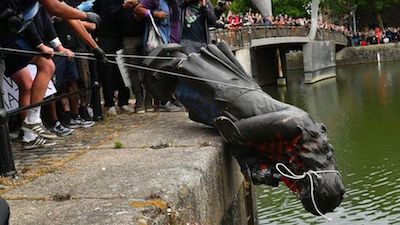
(The Colston statue taking a dip, Bristol, June 2020)

Monuments (not just Confederate ones) are a tricky business, of course. Rysbrack also produced a sculpture of Edward Colston, the Bristol slave trader and philanthropist, another statue of whom, created in 1895 by John Cassidy, was toppled into Bristol Harbour by protesters in June 2020. There have been many other contested monuments, Cecil Rhodes, Columbus and James Cook among them.

But other figures, perhaps in other ages, provoke quite different, and often more positive, emotions and reactions. Of the stone monument of Tsubo-no-ishibumi on the ancient site of the Taga castle in the village of Ichikawa (about six feet tall and three feet wide), Bashō wrote:

‘In this ever-changing world where mountains crumble, rivers change their courses, roads are deserted, rocks are buried, and old trees yield to young shoots, it was nothing short of a miracle that this monument alone had survived the battering of a thousand years to be the living memory of the ancients. I felt as if I were in the presence of the ancients themselves, and forgetting all the troubles I had suffered on the road, rejoiced in the utter happiness of this joyful moment, not without tears in my eyes.’[2]

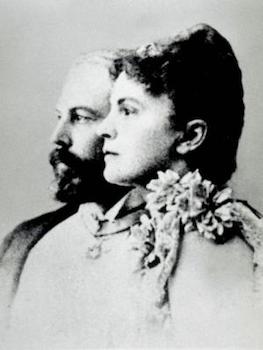
Also in Japan is the monument to Ernest Fenollosa, in Uyeno Park, Tokyo. He had suffered his final, fatal heart attack in September 1908, at his home in London, while his step-daughter Erwin Scott (‘Noshi’, aged sixteen), was reading Dante Gabriel Rossetti’s  ‘The Blessed Damozel’ to him. His ashes remained for a short while in Highgate cemetery but were then transported to Japan, to the hills overlooking Lake Biwa and the gardens of Miidera Temple, where they were reburied on the first anniversary of his death. The inscription, chosen by his students, read: ‘To the merit of our Sensei [teacher], high like the mountains and eternal like the water.’[3]


(Ernest and Mary Fenollosa)

It is not always a case of a specified and designated monument, but may be something that becomes so, such as the Esnoga synagogue that Steven Nadler wrote of: ‘Almost alone among the synagogues of Holland, this unmistakeable monument to Jewish achievement was left standing, undamaged, by the Nazis. Inside the hechal [ark of the Torah] is a Torah said to be the one brought to Amsterdam from Emden in 1602 by Moses Uri Halevi.’[4]

A monument might also serve as a complex representation of parallels and comparisons, whether discerned or imposed, as in Ezra Pound’s focus upon—or obsession with—the condottiere Sigismondo Malatesta’s monument to his wife Isotta. Pound was writing the Malatesta Cantos in the early 1920s and, Lawrence Rainey writes, ‘On the simplest level Pound seeks to suggest that the Tempio’s construction heralds a new cultural era, the dawn of the Renaissance and the spring of a neopagan revival.’ Of more urgent personal interest, though, he wished ‘to discern a parallel between himself and Sigismondo Malatesta’, and ‘between the magnum opus he wished to write and the unfinished monument of Rimini.’[5] That the Cantos (like the Tempio) ultimately remained unfinished was not then envisaged, and remains a curious historical irony.

‘Exegi monumentum aere perennius’, Horace wrote (Odes, Book III), and Pound translated it:

This monument will outlast metal and I made it
More durable than the king’s seat, higher than pyramids.
Gnaw of the wind and rain?
                                    Impotent
The flow of the years to break it, however many.[6]

One might argue of some of these names that it’s a bit soon to tell – but Horace (Quintus Horatius Flaccus) has lasted over 2030 years so far, and seems to be holding on quite well. . .


Notes

[1] William Faulkner, The Sound and the Fury (1929), in Novels 1926-1929, edited by Joseph Blotner and Noel Polk (New York: Library of America, 2006), 1123-1124. In ‘Appendix. Compson: 1699-1945’ (1141), Faulkner wrote of Luster that he was ‘a man, aged 14’, who was ‘not only capable of the complete care and security’ of Benjy, a man ‘twice his age and three times his size, but could keep him entertained.’

[2] Matsuo Bashō, The Narrow Road to the Deep North and other travel sketches, translated by Nobuyuki Yuasa (London: Penguin Books, 1966), 113.

[3] Lawrence W. Chisolm, Fenollosa: The Far East and American Culture (New Haven: Yale University Press, 1963), 211, 35.

[4] Steven Nadler, Rembrandt’s Jews (Chicago: University of Chicago Press, 2003), 162.

[5] Lawrence S. Rainey, Ezra Pound and the Monument of Culture: Text, History, and the Malatesta Cantos (Chicago: University of Chicago Press, 1991), 38, 43.

[6] Ezra Pound: Poems and Translations, edited by Richard Sieburth (New York: Library of America, 2003), 1146.

Burden of proofs


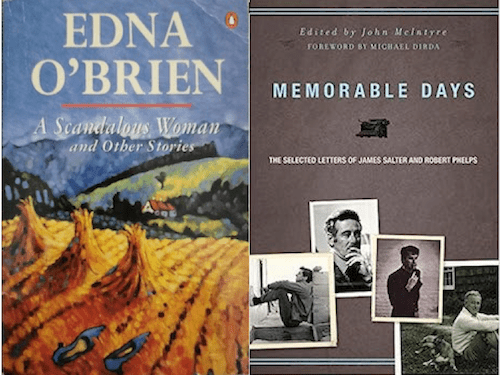
In the past couple of weeks, I’ve read a lot of tributes to, and memories of, Edna O’Brien, who died on 27 July. I know some of her books but clearly not enough of them. My favourite story about her is probably that in one of James Salter’s letters to Robert Phelps (a wonderful volume), dated 2 November 1972. Salter mentions at the top of the letter that Ezra Pound has died (it had happened the previous day) and reports on ‘Dinner last night with Edna O’Brien and her son.’ She was nervous about the play opening that night, A Pagan Place, from her novel of the same title. ‘She ate everything with her fingers’, Salter wrote, ‘lamb, clumps of spinach, they didn’t even have to wash her fork.’ O’Brien told him about a long story, ‘Over’, which the New Yorker was publishing. ‘She was marvelous, she could recite great passages, long pieces of her story, there was one sentence saying something like: I liked your voice and the way you poured things and your fingering.’ Her editor, ‘in the vastly inquisitorial galleys, wrote: “Mr Shawn [editor of the magazine, 1952-87] thinks this is a little too strong for us.” So Edna changed it to “and your fucking.”’[1]

Alas, ‘fingering’ seem to have made a comeback, certainly when the story was collected in A Scandalous Woman and other stories (1974): ‘Do you still use the same words exactly, and exactly the same caresses, the same touch, the same hesitation, the same fingering? Are you as shy with her as with me? If only you had had courage and a braver heart.’[2]

As for the change, was it made around that time, by reluctant but common consent, or later – perhaps at the proof stage? Proofs!

Looking for the umpteenth time at the draft of a Ford Madox Ford letter (its notes, rather), I wondered about an ‘enormous slap of cake’ and was dispirited by my glimpse of a poet named ‘William Worsworth’. In the first instance, I looked back to the original article and found—almost regretfully because I was warming to a ‘slap of cake’—that it was indeed ‘slab’. I didn’t need to check on the poet but simply inserted the missing letter. Any offended descendants of the poet Worsworth should write in.

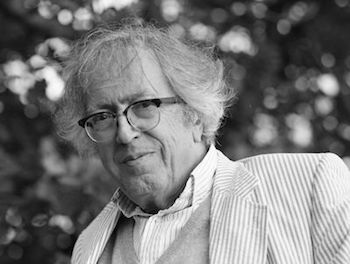
Reporting on his struggle with the page proofs of The Pound Era (probably—but only probably—a longer book than this volume of letters will turn out to be), Hugh Kenner wrote to Guy Davenport: ‘It is demoralizing to find “viligance” for “vigilance” in a line one has already read 4 times.’[3] And any writer, editor or proofreader will be familiar with that feeling.


(Hugh Kenner via The National Post; photo by the scholar Walter Baumann)

Of an earlier book (on Samuel Beckett), Kenner had confided: ‘In accordance with my normal policy of imitating the specimen’s style, I rigorously trained myself to write dead-pan declarative sentences page after page, with here and there flickers of irony gleaming through the performance. I hope you like the effect.’ And proofs were not always an ordeal: fun was there for the taking, as he added to Davenport a week later: ‘I forget whether I told you that I have spliced bits of Happy Days into my Beckett proofs, so adroitly (I think) that no one will be able to tell they were not there all along.’[4]

In turn, Davenport mentioned, in his ‘Pergolesi’s Dog’—‘We are never so certain of our knowledge as when we’re dead wrong’—that ‘The New York Review of Books once referred to The Petrarch Papers of Dickens and a nodding proofreader for the TLS once let Margery Allingham create a detective named Albert Camus.’[5]

Sylvia Beach recalled the printer of Ulysses, Monsieur Dalantière, supplying as many sets of proofs as James Joyce wanted—‘he was insatiable’—and they were all ‘adorned with the Joycean rockets and myriads of stars guiding the printers to words and phrases all around the margins. Joyce told me that he had written a third of  Ulysses on the proofs.’ Right up to the last minute, ‘the long-suffering printers in Dijon were getting back these proofs, with new things to be inserted somehow, whole paragraphs, even, dislocating pages.’[6] My Viking Press edition of Finnegans Wake (New York: 4th printing, 1945) contains a list of corrections of misprints, made by Joyce: fifteen closely printed pages of double columns, in which such phrases as ‘insert comma’ and ‘delete stop’ abound.[7] The book was published in 1939, less than two years before Joyce’s death, after decades of eye trouble, cataracts, glaucoma and much else.


(Thomas Hardy, early 1920s via The Guardian)

For the professional writer, of course, proofs are a constant, whether burden or blessing. . ‘I am bringing out a stodgy novel this autumn’, E. M. Forster wrote to his friend Malcolm Darling (22 August 1910) ‘but I think I told you this. It’s called Howards End, and dealeth dully with many interesting matters. I am correcting proofs now.’[8] Sylvia Townsend Warner reported in her diary: ‘Proofs and ten thousand letters.’ She added the more specific news that: ‘Thomas Hardy has died. Dorset will mourn – a more rare and antique state of things than England mourning.’[9]

As yet, a very long way from reaching the proof stage, I am still inching through Word documents. As for the errors that other people have missed in the proofs of their texts, errors I come across almost daily in my reading, that would be altogether too long a tale to tell. . .


Notes

[1] Memorable Days: The Selected Letters of James Salter and Robert Phelps, edited by John McIntyre, foreword by Michael Dirda (Berkeley, California: Counterpoint, 2010), 95-96. Phelps, in his letter of 10 November, commented: ‘I’ll never forget Miss O’Brien’s way with spinach’ (97). ‘Over’ appeared in The New Yorker (24 November 1972).

[2] Penguin Books edition (Harmondsworth, 1976), 56.

[3] Letter of 21 June 1971: Questioning Minds: The Letters of Guy Davenport and Hugh Kenner, edited by Edward M. Burns, two volumes (Berkeley: Counterpoint Press, 2018), II, 1357.

[4] Letters of 27 September 1961 and 6 October 1961: Questioning Minds, I, 37, 39.

[5] Guy Davenport, Every Force Evolves a Form (San Francisco: North Point Press, 1987), 145. Allingham’s Albert Campion would probably have been amused.

[6] Sylvia Beach, Shakespeare and Company, new edition (Lincoln: University of Nebraska Press, 1991), 58.

[7] See, on Joyce ‘adding commas’, Richard Ellmann, James Joyce (new edition, Oxford: Oxford University Press, 1983), 731, 734.

[8] Selected Letters of E. M. Forster, Volume One: 1879-1920, edited by Mary Lago and P. N. Furbank (London: Collins, 1983), 114.

[9] The Diaries of Sylvia Townsend Warner, edited by Claire Harman (London: Virago Press, 1995), 11: entry for 12 January 1928. Hardy had died in Dorchester the previous day, at the age of 87.

Scholars and storytellers


(J. R. R. Tolkien: Reuters via The Guardian)

The incomparable Guy Davenport was born on 23 November 1927 (he died in 2005). I remember making some notes about him in connection with J. R. R. Tolkien some years back, when the company I worked for represented Cornell University Press. In 2013 the press reissued a book first published in 1979, six years after Tolkien’s death, a collection of pieces entitled J. R. R. Tolkien, Scholar and Storyteller: Essays in Memoriam. It included contributions from a wide range of friends, colleagues and former students. The first part contains the Times obituary; Tolkien’s 1959 ‘Valedictory Address’ to the University of Oxford; and a personal remembrance by a friend of forty years’ standing. The second part consists of critical essays concerned with the literatures of Old Norse, Old English and Middle English, Tolkien’s own main scholarly interests. The last part comprises three pieces on Tolkien’s famous fictions and concludes with a bibliography of his writings, compiled by Humphrey Carpenter (Tolkien’s biographer).[1]

‘The first professor to harrow me with the syntax and morphology of Old English,’ Davenport writes, ‘had a speech impediment, wandered in his remarks, and seemed to think that we, his baffled scholars, were well up in Gothic, Erse, and Welsh, the grammar of which he freely alluded to. How was I to know that he had one day written on the back of one of our examination papers, “In a hole in the ground there lived a hobbit”?’[2]


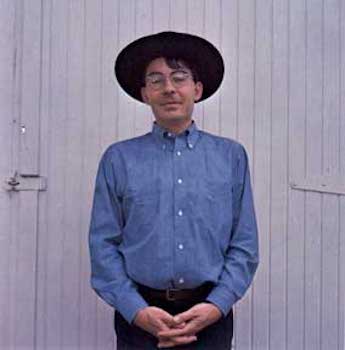
(One genius by another; or, Jonathan Williams’ photograph of Guy Davenport – ‘in Quakerish garb’ – Lexington, 1964: Portrait Photographs (London: Coracle Press, 1979).

After graduating from Duke University, Davenport was awarded a Rhodes Scholarship and studied at Merton College, Oxford, from 1948 to 1950. His thesis on James Joyce was directed by J. I. M. Stewart; his examiner was David Cecil. Davenport was drafted into the army on his return to the United States and served two years before taking a job at Washington University, St Louis. At Harvard, he worked as graduate assistant to Archibald MacLeish and wrote his dissertation, Cities on Hills, on the first thirty of Pound’s Cantos, under Harry Levin’s direction. It was published a little over twenty years later.

Davenport finished reading Lord of the Rings in March 1963, writing to Hugh Kenner that it was ‘a major work’. He went on: ‘What imagination! Never does his invention run out, on and on. I have a feeling that he has summed up 500 years of literature from the Mabinogion through Von Essenbach to the High Victorians. He has done well in prose what Spenser probably could not have finished in verse. It makes the “realistic” novel look like a skinned knee criss-crossed with band-aids.’[3]

In October 1963, Kenner was two-thirds of the way through the trilogy, remarking of the plans to reissue the work in paperback, ‘It could not fail to do good to anyone who read it through! one of the few books for which there is point in winning a larger public’ (I, 427). Davenport responded three days later: ‘I glow that you like Tolkien. He provides a vocabulary, both of phrases and imagery. Gandalf began life, in The Hobbit, as Sherlock [Holmes] in an astrologer’s gown. Frank Meyer [book review and cultural editor of National Review],[4] who is not uninfluenced in his fight with the Bolsheviki by Gandalf’s war upon the Orcs, got me onto Tolkien. [Stan] Brakhage heavily influenced by Tolkien, his other influence being Pound’ (I, 430)


In ‘Hobbitry’, Davenport noted that he’d talked to Tolkien’s son, Christopher—under whose steady hand the published Tolkien canon has expanded significantly—as well as to his friend ‘Hugo’ Dyson, who said of Tolkien, ‘His was not a true imagination, you know. He made it all up.’ ‘I have tried for fifteen years’, Davenport comments, ‘to figure out what Dyson meant by that remark.’ And he talked to a history teacher, Allen Barnett, who had been a classmate of Tolkien’s and remembered how he ‘could never get enough of my names of Kentucky folk. He used to make me repeat family names like Barefoot and Boffin and Baggins and good country names like that.’

Ah.

Tolkien’s readers run into millions, of course, the viewers of the films based on his books surely running into tens of millions by now. An intriguing if unanswerable question is what proportion of those readers and viewers have a sense of the main focus of his scholarly work.

 ‘Practically all the names of Tolkien’s hobbits are listed in my Lexington phone book’, Davenport writes, ‘and those that aren’t can be found over in Shelbyville.’ He concludes: ‘I despaired of trying to tell Barnett what his talk of Kentucky folk became in Tolkien’s imagination. I urged him to read The Lord of the Rings but as our paths have never crossed again, I don’t know that he did. Nor if he knew that he created by an Oxford fire and in walks along the Cherwell and Isis the Bagginses, Boffins, Tooks, Brandybucks, Grubbs, Burrowses, Goodbodies, and Proudfoots (or Proudfeet, as a branch of the family will have it) who were, we are told, the special study of Gandalf the Grey, the only wizard who was interested in their bashful and countrified ways.’


Notes

[1] J. R. R. Tolkien, Scholar and Storyteller: Essays in Memoriam, edited by Mary Salu and Robert T. Farrell (Cornell University Press, 9780801478871, 325pp, paperback).

[2] ‘Hobbitry’, in The Guy Davenport Reader, edited by Erik Reese (Berkeley: Counterpoint, 2013), 273.

[3] Questioning Minds: The Letters of Guy Davenport and Hugh Kenner, edited by Edward M. Burns, two volumes (Berkeley: Counterpoint Press, 2018), I, 287. I’ve lifted several details of Davenport’s biography from this superb edition.

[4] As Erik Reece, who knew Davenport well and is his literary executor, wrote, ‘And though he reviewed books for right-wing National Review, he did so simply because Hugh Kenner got him the job, not because he felt any allegiance to William F. Buckley or the conservative movement’: ‘Afterword, Remembering Guy Davenport’,  Reader, 440.

‘Swinburne my only miss’

EP-Pisa-viaWallStJournalNPG x81998; Algernon Charles Swinburne by Elliott & Fry

(Pound in the dispensary at the DTC via Wall Street Journal; Algernon Charles Swinburne by John McLanachan: Wikipedia Commons)

It’s the first day of official lockdown in the UK, a little looser as yet than in some other countries but a large stride in what had become a necessary direction.

In an earlier and rather different instance of containment—the Disciplinary Training Center near Pisa in 1945—remembering those days ‘before the world was given over to wars’, Ezra Pound wrote: ‘Swinburne my only miss’. To his parents, in the Spring of 1909, the literary traveller (who would seek out W. B. Yeats, meet most other leading writers and ‘glare’ at Henry James across a room) had remarked that ‘Swinburne happens to be stone deaf with a temper a bit the worse for wear, so I haven’t continued investigation in that direction.’[1]

Less than three weeks after that letter, on 10 April 1909, Swinburne died. ‘He grafted on to epic volume a Berserker rage: he was a man of fine frenzies’, Ford Madox Ford wrote in the May 1909 issue of The English Review,[2] seeming to allude to Shakespeare’s A Midsummer Night’s Dream, in which Theseus asserts that ‘The lunatic, the lover, and the poet/ Are of imagination all compact’:

The poet’s eye, in a fine frenzy rolling,
Doth glance from heaven to earth, from earth to heaven,
And as imagination bodies forth
The forms of things unknown, the poet’s pen
Turns them to shapes, and gives to airy nothing
A local habitation and a name. (V.i.12-17)

Fuseli, Henry, 1741-1825; Titania and Bottom

(Henry Fuseli, A Midsummer Night’s Dream: Tate)

Ford’s obituary note on Swinburne is generous – but he certainly didn’t regard rage and frenzy as ideal writerly qualities. He once described what he termed ‘the view of their profession held by what it is convenient to call the Typical English Writer of the pre-Moonrise period. You sit down; you write; the vine leaves are in your hair; you forget mundane tribulations; gradually intoxication steals over you. Sometimes you stumble into sense; sometimes you do not.’[3] Nearly thirty years later, borrowing Jean Cocteau’s remark about Victor Hugo, Ford would describe the painful progress of his ‘weary eyes’ and ‘enfeebled mind’ through ‘rivulets of print between top and bottom of a page’ of Swinburne’s verse: ‘And then in exasperated protest: “That page is mad. . . . It thinks it’s Swinburne!”’[4]

Ford disliked the notion of the inspired, even intoxicated poet; he disliked inversions, needless profusions of rhymewords and, with regard to Victorian poets in particular, was dismayed by the sheer quantity of stuff that they disgorged. His doubts about Swinburne at least were shared wholly or in part by other writers, including Browning, Matthew Arnold and A. E. Housman.[5]

‘Love of sound and especially of rhyme persuaded [Swinburne] to a somewhat lighter use of words than is common among great poets’, Edward Thomas wrote, a couple of years after Swinburne’s death. ‘Space would be wasted by examples of words produced apparently by submission to rhyme, not mastery over it. The one line in “Hesperia”: “Shrill shrieks in our faces the blind bland air that was mute as a maiden”, is enough to illustrate the poet’s carelessness of the fact that alliteration is not a virtue in itself.’[6]

In Ford’s The Good Soldier, the narrator, John Dowell, recalls of Edward Ashburnham that: ‘Once, in the hall, when Leonora was going out, Edward said, beneath his breath—but I just caught the words: “Thou hast conquered, O pale Galilean.”’ Interestingly, Dowell then adds: ‘It was like his sentimentality to quote Swinburne.’[7]

The line is from Swinburne’s ‘Hymn to Proserpine’, which laments the ousting of the pagan gods and goddesses by the Christian faith:

Thou hast conquered, O pale Galilean; the world has grown grey from thy breath;
We have drunk of things Lethean, and fed on the fullness of death.
Laurel is green for a season, and love is sweet for a day;
But love grows bitter with treason, and laurel outlives not May.[8]

FMF-Good-Soldier

‘Sentimental’ or ‘sentimentalist’ is applied to Edward Ashburnham more than two dozen times in this short novel. Early on, speculating on what so many people, particularly women, see in Ashburnham, Dowell wonders too what he even talks to them about. ‘Ah, well, suddenly, as if by a flash of inspiration, I know. For all good soldiers are sentimentalists—all good soldiers of that type. Their profession, for one thing is full of the big words, courage, loyalty, honour, constancy’ (28).

That phrase ‘a flash of inspiration’ may prompt us to caution but I think there is a parallel between what Edward Thomas called ‘submission to rhyme, not mastery over it’, and an unthinking adherence to preferences or forms of thought or behaviour without review or scrutiny. We grow out of things, we adapt, develop and change: this may mean leaving behind some youthful tastes and assumptions, not clinging to them for wrong reasons. John Buchan, late in life, reflected on those ‘oddments’ which are ‘carried over from youth’, the memory of them recalling ‘blessed moments’ with which we associate them. He terms it ‘pure sentimentality, but how many of us are free from it?’ He goes on: ‘My memory is full of such light baggage. Stanzas of Swinburne, whom I do not greatly admire, remind me of summer mornings when I shouted them on a hill-top, and still please, because of the hill-top, not the poetry.’[9]

VH_FMF_Selsey

(Ford and Violet Hunt at Selsey)

Ford is one of the recurrent figures in Pound’s Pisan Cantos and elsewhere in Canto 80, after the mention of ‘the mass of preraphaelite reliques/ in a trunk in a walled-up cellar in Selsey’—a reference to the West Sussex cottage, owned by Violet Hunt, where she and, very often, Ford spent a good deal of time—we read: ‘“Tyke ’im up to the bawth” (meaning Swinburne)’ (80/508).

In ‘Swinburne versus his Biographers’ (1918), Pound had launched with even more orthographic gusto into his Cockney performance, citing: ‘Swinburne at the Madox Browns’ door in a cab, while the house-keeper lectures the cabman: “Wot! No, sir, my marster is at the ’ead of ’is table carving the j’int. That’s Mr. Swinburne—tike ’im up to the barth”’.[10]

Through his grandfather, Ford knew both Swinburne and Theodore Watts-Dunton, who cared for Swinburne during the last thirty years of the poet’s life. Pound’s line derives from Ford’s writing—or, more likely, conversation—recalling the anecdotes about his grandfather’s housemaid, Charlotte Kirby. In Ancient Lights, Ford recalls her telling him: ‘“I was down in the kitchen waiting to carry up the meat, when a cabman comes down the area steps and says: ‘I’ve got your master in my cab. He’s very drunk.’ I says to him— “and an immense intonation of pride would come into Charlotte’s voice—” ‘My master’s a-sitting at the head of his table entertaining his guests. That’s Mr. —. Carry him upstairs and lay him in the bath.’”

A later version has Ford overhearing the conversation himself – and the blank is filled in: ‘At last she brought out composedly the words:
“That’s Mr. Swinburne. Help me carry him upstairs and put him in the bath.”
And that was done.’[11]

Ford_Madox_Brown

(Ford Madox Brown)

Ford explains that his grandfather, the painter Ford Madox Brown, ‘whose laudable desire it was at many stages of his career to redeem poets and others from dipsomania, was in the habit of providing several of them with labels upon which were inscribed his own name and address. Thus, when any of these geniuses were found incapable in the neighbourhood they would be brought by cabmen or others to Fitzroy Square’ (Ancient Lights 12).

In his essay on Swinburne—one of Pound’s early enthusiasms but one which he now felt he could see in a clearer perspective[12]—Pound is frank about what he sees as Swinburne’s defects while also extolling his virtues: ‘we can, whatever our verbal fastidiousness, be thankful for any man who kept alive some spirit of paganism and of revolt in a papier-mâché era’. While he remarks that ‘No man who cares for his art can be deaf to the rhythms of Swinburne, deaf to their splendour, deaf also to their bathos’, there are signs of familiar—and not, perhaps, strictly ‘literary’—Poundian preoccupations of that period. One is that ‘paganism’ (and lack of enthusiasm for the Christian faith) of ‘Hymn to Proserpine’; another is made clear by the assertion that his essays ends on: Swinburne’s ‘magnificent passion for liberty—a passion dead as mutton in a people who allow their literature to be blanketed by a Comstock and his successors; for liberty is not merely a catchword of politics, nor a right to shove little slips of paper through a hole. The passion not merely for political, but also for personal, liberty is the bedrock of Swinburne’s writing’ (Literary Essays 294).

LR-Oct-17

(The Modernist Journals Project (Searchable database). Brown and Tulsa Universities, ongoing)

Pound’s long essay on Henry James, published a few months later, would praise James in part along the same lines: ‘the hater of tyranny’, author of ‘book after early book against oppression’, with ‘outbursts in The Tragic Muse, the whole of The Turn of the Screw, human liberty, personal liberty, the rights of the human individual against all sorts of intangible bondage!’ (Literary Essays 296). D. H. Lawrence’s The Rainbow had been suppressed in 1915; in October 1917, the issue of the Little Review containing Wyndham Lewis’s ‘Cantleman’s Spring Mate’ had been seized by the U.S. postal authorities and the same periodical’s serialising of Joyce’s Ulysses would soon lead to more censorship difficulties, culminating in a trial in early 1921.[13] In that climate, Pound’s celebration of a ‘passion for liberty’ in artists he admires is hardly surprising but the tribute to Swinburne is nevertheless a genuine and powerful one.

 
Notes

[1] The Cantos of Ezra Pound, fourth collected edition (London: Faber and Faber, 1987), 82/523, 80/506; letters dated 21 February 1912 and c. 24 March 1909: Ezra Pound to His Parents: Letters 1895–1929, edited by Mary de Rachewiltz, David Moody and Joanna Moody (Oxford: Oxford University Press, 2010), 273, 165.

[2] The English Review (May 1909), 193-194: reprinted in Ford Madox Ford, Critical Essays, edited by Max Saunders and Richard Stang (Manchester: Carcanet Press, 2002), 71-72. Ford wrote a two-part essay entitled ‘The Poet’s Eye’ in 1913.

[3] Ford Madox Ford, Thus to Revisit (London: Chapman & Hall, 1921), 9.

[4] Ford Madox Ford, Portraits from Life (Boston: Houghton Mifflin, 1937), 194.

[5] All mentioned by Kenneth Haynes in his edition of Swinburne’s Poems and Ballads & Atalanta in Calydon (London: Penguin Books, 2000), xiv-xv.

[6] Edward Thomas, A Language not to be Betrayed: Selected Prose, edited by Edna Longley (Manchester: Carcanet Press, 1985), 43.

[7] Ford Madox Ford, The Good Soldier: A Tale of Passion (1915; edited by Max Saunders, Oxford: Oxford University Press, 2012), 190. A nice detail here is that Swinburne’s maternal grandfather was the third Earl of Ashburnham.

[8] ‘Hymn to Proserpine (After the Proclamation in Rome of the Christian Faith)’, Haynes, Poems, 55-61. Daniel R. Barnes comments that ‘Leonora, as the agent of orthodox Catholicism, has triumphed over [Edward Ashburnham’s] own paganism’. See ‘Ford and the “Slaughtered Saints”: A New Reading of The Good Soldier’, Modern Fictions Studies, XIV, 2 (Summer 1968), 168.

[9] John Buchan, Memory Hold-the-Door (London: Hodder & Stoughton, 1940), 202-203.

[10] Literary Essays of Ezra Pound, edited by T. S. Eliot (London: Faber and Faber, 1960), 290.

[11] Ford Madox Ford, Ancient Lights and Certain New Reflections (London: Chapman and Hall, 1911), 11-12; Portraits from Life, 187.

[12] For the youthful enthusiasm, see Collected Early Poems of Ezra Pound, edited by Michael John King (London: Faber and Faber, 1977), 40-43, 261; and Christoph de Nagy, The Poetry of Ezra Pound: The Pre-Imagist Stage (Bern: Francke, 1960), on Pound seeing Swinburne as ‘the poet of human destiny’, who asked ‘the final questions about the fate of man’ rather than the erotic or perverse poet; also as the poet of ‘liberation’ (73, 74).

[13] That ‘pale Galilean’ crops up in Ulysses, as do a good many other Swinburne references: see index to Don Gifford, with Robert J. Seidman, Ulysses Annotated: Notes for James Joyce’s Ulysses, revised and expanded edition (Berkeley: University of California Press, 1989). There’s also a lot of Swinburne in Lawrence’s work, not least in Lady Chatterley’s Lover, largely because of his constant recurrence to the Persephone myth.


Camelot and St Cecilia

Sea-2

You don’t need an alarm clock in a pitch-dark Dorset bedroom if you can draw on the services of a cat with breakfast on his mind. Tucked away a little here but fifteen minutes’ walk brings you down to the sea, dead calm early in the week, less so later.

A little under seventy miles across the English Channel is Alderney, in the Bailiwick of Guernsey. The northernmost of the Channel Islands, it was the home from 1946 of T. H. White, author of The Goshawk and The Once and Future King, plus more than twenty other books, even though he died at the age of fifty-seven.

From 3 Connaught Square, Alderney, on 22 November 1950, White wrote to his friend David Garnett: ‘The reason why I am sober is that last Friday the 1st lieutenant of our local submarine threw me out of a window while we were amiably conversing about ju-jitsu. He did not mean any harm, and in fact has done nothing but good, as I fell on my head. It has altered something inside. I was unconscious for hours.’[1]


White

(T. H. White)

My Fridays are not like that – though I’m not a total stranger to ‘amiably conversing’. Garnett was a friend of long standing and plays a large part in the biography of White by Sylvia Townsend Warner, also a friend of Garnett. In 1949, a man called Wren Howard of Jonathan Cape visited White and, feeling a bulky object under the settee cushion on which he was sitting, extracted the typescript of The Goshawk, a record of White’s attempt to train a hawk in the mid-1930s. Howard read it, took it back to London and wanted Cape to publish it. White was reluctant; Garnett then read it and agreed that it should be published, whereupon White wrote to Howard: ‘If Bunny Garnett says that the Hawk book is really good, I will consent to publishing. I have not read it since I wrote it, long before the war.’[2]

David-Garnett

(David ‘Bunny’ Garnett)

White and his Hawk book are a major thread running through Helen Macdonald’s H is for Hawk. She refers to the period in which White drafted the book, the collective impulse to recover and draw upon England’s history and domestic culture. ‘It was a movement that celebrated ancient sites and folk traditions. It delighted in Shakespeare and Chaucer, in Druids, in Arthurian legend. It believed that something essential about the nation had been lost and could be returned, if only in the imagination. White, caught up on this conservative, antiquarian mood, walked with his hawk and wrote of ghosts, of starry Orion naked and resplendent in the English sky, of all the imaginary lines men and time had drawn upon the landscape. By the fire, his hawk by his side, he brooded on the fate of nations.’[3]

Richard_Burton_and_Julie_Andrews_Camelot

(Richard Burton and Julie Andrews in Camelot: Wikipedia Commons)

The fate of nations. White’s Arthurian stories reminded me of the Alan Jay Lerner and Frederick Loewe musical based on them, Camelot, directed by Moss Hart and hugely successful on Broadway, starring Richard Burton and Julie Andrews. In turn, ‘Camelot’ became inextricable from the administration of John F. Kennedy, following Jackie Kennedy’s 1963 Life interview, when she quoted lyrics from the Lerner-Loewe production. And today is, of course, the 56th anniversary of Kennedy’s assassination, the day on which Aldous Huxley and C. S. Lewis both died too, though a little overshadowed then by events in Dallas. Just thirty years later, it was Anthony Burgess’s turn (he was born in the same year as Kennedy).

It’s also Saint Cecilia’s Day, she being the patron saint of musicians. On 25 July 1914, in his regular column in Outlook, Ford Madox Ford quoted John Dryden’s ‘Less than a god they said there could not dwell…’[4]
This is from the third stanza of ‘Song for St Cecilia’s Day, 1687’:

What passion cannot Music raise and quell?
When Jubal struck the chorded shell
His listening brethren stood around,
And, wondering, on their faces fell
To worship that celestial sound.
Less than a god they thought there could not dwell
Within the hollow of that shell
That spoke so sweetly and so well.
What passion cannot Music raise and quell?

Woodville, Richard Caton, 1856-1927; Marshal Ney at Eylau

(Richard Caton Woodville, Marshal Ney at Eylau: Tate)

In 1928, Ford would publish a novel called A Little Less Than Gods, about Marshal Ney and Napoleon’s hundred days, its writing intimately involved with the history of the Ford–Joseph Conrad relationship. The Dryden poem is quoted, or rather, slightly misquoted, in Chapter V.[5] In his final book, The March of Literature, Ford quoted the whole stanza and commented that, for him, it was ‘the most pleasurable verse in all English poetry’, adding: ‘It further confirms our argument that English poetry depends upon music and died when music died in England.’[6]

That’s a nice example of the Ford who so admired the ‘sweeping dicta’ of his friend Arthur Marwood, partial model for Christopher Tietjens in Parade’s End. And T. H. White was not immune to the habit, writing in 1950:

‘I believe that the peak of British culture was reached in the latter years of George III: that the rot began to set in with the “Romantics”: that the apparent prosperity of Victoria’s reign was autumnal, not vernal: and that now we are done for.’[7]

Hmm. . . ‘now we are done for’. Still, make a note of that. Just in case.

 
Notes

[1] David Garnett, editor, The White/Garnett Letters (London: Jonathan Cape, 1968), 246.

[2] Sylvia Townsend Warner, T. H. White: A Biography (New York: Viking, 1968), 243.

[3] Helen Macdonald, H is for Hawk (London: Jonathan Cape, 2014), 104.

[4] Ford Madox Ford, ‘Literary Portraits—XLVI. Professor Cowl and “The Theory of Poetry in England”’, Outlook, XXXIV (25 July, 1914), 110.

[5] Ford Madox Ford, A Little Less Than Gods (London: Duckworth, 1928), 108.

[6] Ford Madox Ford, The March of Literature: From Confucius to Modern Times (London: Allen & Unwin, 1939), 605.

[7] T. H. White, The Age of Scandal (1950; Harmondsworth: Penguin Books, 2000), 17.