
Reliably unreliable


(Horatio McCulloch, Loch Katrine: Perth Art Gallery; managed by Culture Perth and Kinross)

(‘Bussoftlhee, mememormee!’ James Joyce, Finnegans Wake)

I was reading Rosemary Hill’s review of a recent book by Steven Brindle, Architecture in Britain and Ireland: 1530-1830, and the extent to which Henry VIII’s break with Rome was an ‘unmitigated disaster’ for architecture. ‘“The dissolution of the religious houses”, Steven Brindle writes, “tore the heart out of the patronage of … the arts” as it had existed for nine centuries and brought about “the largest redistribution of land since the Norman Conquest”. It would take three generations to begin to recover from this “colossal self-inflicted cultural catastrophe”’.[1]

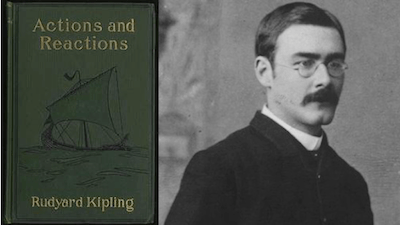
In the current painful condition of the United Kingdom, the notion of colossal self-inflicted catastrophes brings to mind most readily the ill-conceived and dishonestly presented referendum of 2016, although, with the example in mind of Kipling’s phrase in ‘With the Night Mail’, ‘the traffic and all it implies’,[2] we tend to reflect on Brexit and all it implies. The implications are not pretty. A part-time television critic of my acquaintance, who’d watched a series called ‘The Rise and Fall of Boris Johnson’, observes that it’s very easy to forget how simply and thoroughly ‘a small group of men fucked this country over’. Indeed it is.

Memory is fickle, quite easily manipulated (as is blindingly obvious in our time) but, in any case, a fiction writer of great, if sometimes wayward, abilities. It can also perform extraordinary feats. Katherine Rundell, writing of John Donne’s age, describes how‘ [a] school system which hinged on colossal amounts of memorisation had built a population with the kind of mammoth recall which is, in retrospect, breathtaking’ – listeners returning home to argue over sermons, plagiarise them, make them ‘part of the fabric of their days.’[3] Sylvia Beach recalled reading a line at random from “The Lady of the Lake” – and James Joyce then reciting the whole page and the next ‘without a single mistake’.[4] Scott’s poem is in six cantos, the first of which has 35 stanzas, the second 37 – and the stanzas are not short ones. As for its author’s own powers of recall, James Hogg, in his Domestic Manners and Private Life of Sir Walter Scott, ‘tells of how he once went fishing with Scott and Skene [James Skene of Rubislaw]. He was asked to sing the ballad of “Gilmanscleuch” which he had once sung to Scott, but stuck at the ninth verse, whereupon Scott repeated the whole eighty-eight stanzas without a mistake.’[5]

Jenny Diski wrote that ‘there is nothing so unreliable or delicious as one’s rackety memories of oneself.’[6] And we certainly hear and read a lot about ‘unreliable narrators’. Memory is, of course, both narrator and reliably unreliable. This applies both to ourselves and the wider world (perceived and processed by those same selves). In the ‘Foreword’ to Joan Didion’s South and West: From a Notebook, centred on her trip through the deep South in 1970, Nathaniel Rich discussed how a view of ‘the past’ had been relegated to the aesthetic realm and Didion herself remarked on ‘[t]he time warp: the Civil War was yesterday, but 1960 is spoken of as if it were about three hundred years ago.’[7]

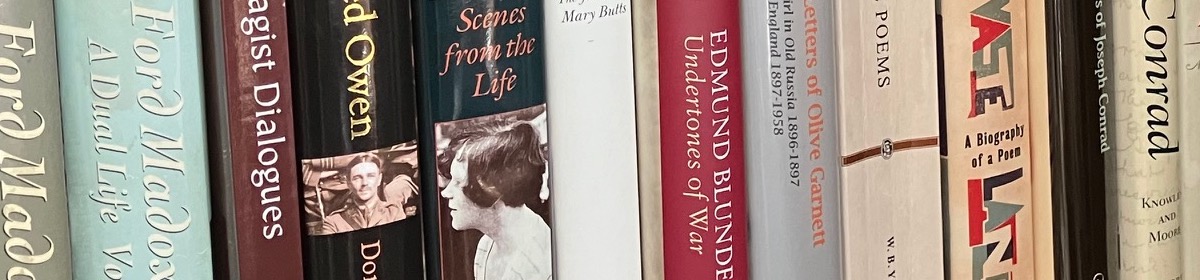
Oddly (though probably not), memory delayed a little in reminding me that my remark about unreliable narrators may be more or less purloined from an essay by Frank Kermode, revisited when I went back to a Conrad novel last year. Nearly one-third of the books I read in 2023 I’d read before, largely due to working on Ford Madox Ford, of course; they were either his own books or Ford-related, directly or tangentially.
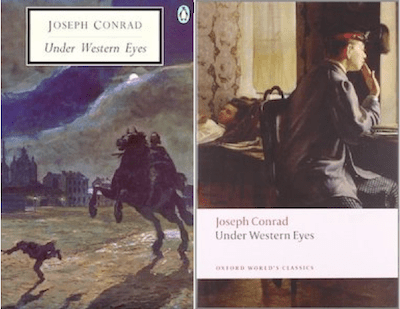

Unsurprisingly, they included ‘that finest novel in the English language’, as Ford once described it. And again: ‘[F]or me, Under Western Eyes is a long way the greatest—as it is the latest—of all Conrad’s great novels.’[8] Once more: ‘That is to say, in common with myself, he regarded the writing of novels as the only occupation for a proper man and he thought that those novels should usually concern themselves with the life of great cities.’ There were two such novels. ‘But although The Secret Agent was relatively a failure, Under Western Eyes with its record of political intrigue and really aching passion has always seemed to me by a long way Conrad’s finest achievement.’[9]

I had read Conrad’s novel of pre-revolutionary politics, betrayal and assassination so long ago that it might almost have been for the first time – almost. It is, no doubt, a tribute to the writing that I found myself consciously offering advice to the student Razumov during his interview with Councillor Mikulin: Shut up! Don’t say another word! Hold your tongue! He can’t, of course. And Ford saw the driving force of much of the book to be personal honour. Of Razumov’s ploy to ‘add a touch of verisimilitude’, having a foolish boy rob his own rich father but then tossing the money from a train window, Ford comments: ‘And the same unimaginative cruelty of a man blindly pursuing his lost honour dignifies Razumov to the end.’[10]

My surviving sense of the book had included Conrad’s known antipathy to Russia (hardly surprising in a Pole born in the Ukraine, part of the Russian Empire but once part of Poland) and his contempt for revolutionaries, which was evident in The Secret Agent. Under Western Eyes was written between two Russian revolutions, published (1911) exactly midway, in fact. But notions of nationality, allegiance and bafflement also shouted aloud ‘Conrad’! Or, perhaps, ‘Konrad Korzeniowski!’ Much of this was to do with that complex process of holding onto a strong sense of one’s native country and culture, while adopting a second language (retaining fluency in the first) – and then a third, while settling in another country and choosing to write in that third language. None of this was made much easier for Conrad by his being attacked on occasion by Polish compatriots for deserting both language and country. Not that migration is ever only a matter of language. H. G. Wells had a couple of digs at Conrad, not only that he spoke English ‘strangely’ but also that ‘[o]ne could always baffle Conrad by saying “humour.” It was one of our damned English tricks he had never learned to tackle.’[11] Under-westernised?

Kermode’s celebrated essay, ‘Secrets and Narrative Sequence’, I’d also read a long time ago.[12] Briefly, he argues that Conrad’s text shows itself obsessed with certain words and images which wholly evade orthodox, ‘common sense’ readings. More, he suggests that the book’s ‘secrets’ are in fact ‘all but blatantly advertised’ (99) and from which, by a curious process of collusion, ‘we avert our attention’ (95). He is pointing to the novel’s constant references to ghosts or phantoms, souls, eyes and, perhaps above all, to the art of writing, more, the materials of writing: black on white, ink on paper, shadows on snow, notebooks, a journal wrapped in a veil. I went back to the essay after reading the novel. It’s true that I found it difficult to see how critics had not seen and grasped – or sought – the significance of the astonishing frequency of such images. Souls, ghosts and related words occur a hundred times, references to eyes more than sixty times, and so on. This is bound to snag the attention of a reader of Ford’s The Good Soldier, an even shorter novel, I think, in which the verb ‘to know’ in its various forms, occurs not far short of three hundred times. ‘What I ask you to believe’, Kermode writes, ‘is that such oddities are not merely local; they are, perhaps, the very “spirit” of the novel’ (97). Difficult not to notice, I said, but cannot be sure of how much that noticeability is related to residual memories of his essay. With a fistful of exceptions, I’m unacquainted with the secondary literature on Conrad which is, I’ve learned, ‘huge, approximately 800 monographs, biographies, edited collections, volumes of letters and catalogues, without counting the hundreds of peer-reviewed papers in the general and specialist literary journals, the untranslated material and the unpublished doctoral theses.’[13]


Richard Parkes Bonington, La Place du Molard, Geneva (Victoria & Albert Museum)

St Petersburg, Geneva. The book is centrally concerned, of course, with Russia: its psychology, Conrad himself suggested, more than its politics. There is also the essential complicating factor of the narrator—‘all narrators are unreliable, but some are more expressly so than others’, as Kermode remarks (yes, that’s the one).[14] A language teacher, English, in love with Natalia Haldin, sister of the executed assassin Victor Haldin, and friendly with their mother. Speaking sometimes in his own voice (whatever the extent to which it’s borrowed) and sometimes through the medium of Razumov’s journal, he repeatedly asserts an inability to understand the Russian character, the Russian soul. He glances down at the letter Natalia is holding, ‘the flimsy blackened pages whose very handwriting seemed cabalistic, incomprehensible to the experience of Western Europe.’ At one point, ‘I could not forget that, standing by Miss Haldin’s side, I was like a traveller in a strange country.’ Again, ‘The Westerner in me was discomposed’ and: ‘I felt profoundly my European remoteness and said nothing, but I made up my mind to play my part of helpless spectator to the end.’ And: ‘To my Western eyes she seemed to be getting farther and farther from me, quite beyond my reach now, but undiminished in the increasing distance.’ One more:  ‘And this story, too, I received without comment in my character of a mute witness of things Russian, unrolling their Eastern logic under my Western eyes.’

Continually asserting his incomprehension, the unfamiliarity of what he is observing, he does, of course recall Ford’s John Dowell, to whom it is all a darkness and who repeatedly asserts: ‘I don’t know’. And yet, and yet. There are many suspicious readings of The Good Soldier, some of which ask if Dowell is as unknowing as he appears to be and also, perhaps, what kind of knowledge he does not possess. It is, unusually for Ford, narrated in the first person. In any case, it is fatally easy, waltzing among thornbushes, to catch one’s sleeve on that knowledge of knowing nothing, to recall the famous moment in Eliot’s The Waste Land—‘I knew nothing,/Looking into the heart of light, the silence’—and, remembering his interest in eastern thought and religion, wonder if that knew should be stressed infinitely more than the nothing.

(J. M. W. Turner, Sunrise with a Boat between Headlands: Tate)

Kermode notes that, when Conrad began the book, he called it Razumov: ‘but when it was done (on the last page of the manuscript, in fact) he changed the title to Under Western Eyes. He had found out what he was doing’ (98). I remember the pleasure with which I came across that last sentence: the recognition of the fact that, so often, we find out not only how to do something but what it is we are actually doing – only by doing it. And this, certainly, not just in art.

The novelist and playwright Enid Bagnold described how: ‘Beauty never hit me until I was nine.’ When she arrived in Jamaica as a child: ‘this was the first page of my life as someone who can “see”. It was like a man idly staring at a field suddenly finding he had Picasso’s eyes. In the most startling way I never felt young again. I remember myself then just as I feel myself now.’ She adds, a little later: ‘And what you remember is richer than the thing itself.’[15]

Well, sometimes.


Notes

[1] Rosemary Hill, ‘Des briques, des briques’, London Review of Books, 46, 6 (21 March 2024), 13.

[2] Rudyard Kipling, Actions and Reactions (New York: Scribner’s 1909), 148.

[3] Katherine Rundell, Super-Infinite: The Transformations of John Donne (London: Faber, 2023), 223.

[4] Sylvia Beach, Shakespeare and Company, new edition (Lincoln: University of Nebraska Press, 1991), 71.

[5] John Buchan, Sir Walter Scott (London: Cassell, 1932), 131. The ballad was included in Hogg’s first book, The Mountain Bard (1807).

[6] Jenny Diski, In Gratitude (London: Bloomsbury, 2017), 187.

[7] Joan Didion, South and West: From a Notebook, foreword by Nathaniel Rich (London: 4th Estate, 2017), xviii, 104.

[8] Ford, Thus to Revisit (London: Chapman & Hall, 1921), 90-91; Return to Yesterday: Reminiscences 1894-1914 (London: Victor Gollancz, 1931), 193.

[9] Ford, ‘Introduction’ to Joseph Conrad, The Sisters, edited by Ugo Mursia (Milan: U. Mursia & Co., 1968), 11-30 (14).

[10] Ford, ‘Joseph Conrad’, English Review, X (December 1911), 68-83 (71).

[11] H. G. Wells, Experiment in Autobiography (1934; London: Faber, 1984), 616, 622.

[12] Frank Kermode, ‘Secrets and Narrative Sequence’, Critical Inquiry, 7, 1 (Autumn 1980), 83-101 (references are to this); reprinted in Essays on Fiction, 1971-1982 (London: Routledge and Kegan Paul, 1983), 133-155.

[13] Helen Chambers, review of Robert Hampson, Joseph Conrad (London: Reaktion Books,  2020), Last Post: A Literary Journal from the Ford Madox Ford Society, I, 4 (Autumn 2020), 124.

[14] Kermode, 89-90; and see footnote 7: ‘The trouble is not that there are unreliable narrators but that we have endorsed as reality the fiction of the “reliable” narrator.’

[15] Enid Bagnold, Autobiography (London: Century Publishing, 1985), 14, 100.

Advice Notes


(Marianne North, Foliage and Flowers of a Madagascar Tree at Singapore, Marianne North Gallery; photo credit: Board of Trustees of the Royal Botanic Gardens, Kew)

I see that Mick Jagger—Sir Michael Philip Jagger, rather—is eighty this year. We lived abroad for a few years because of my father’s job while the Beatles and the Rolling Stones were getting going. ‘Not Fade Away’ must have been the first Stones song I heard when we came back to England; and it was another year before Jagger sang: ‘Well I told you once and I told you twice, But you never listen to my advice’—a slight friction there between ‘telling’ and ‘advice’? Unsurprising, perhaps, that it could have been the last time.

I’ve always been wary of advice, both giving and receiving. ‘I never myself took anyone’s advice’, Ford Madox Ford remarked, ‘and I do not imagine that many people will take mine.’[1] Robert Lowell appears to have taken it, though with mixed results, telling Flannery O’Connor in 1952: ‘Ford used to say that you could tell if a writer was any good from the first sentence—I found this advice useful when manuscript-reading for Sheed and Ward, though it led to fatal misunderstandings in my interviews with students at Iowa . . . ’[2]

I wouldn’t say ‘never’, I’m sure I’ve taken it from time to time but rarely with enthusiasm. Giving it as well, being too conscious of the tendency in many people, myself not excluded, to react negatively to such gestures, even embracing the opposite, sometimes ending up, metaphorically or literally, in a rainstorm without an umbrella. Though, it now occurs to me, I can advise, or at least suggest, that eating beetroot for lunch while reading a book you care about is best avoided.

Politicians, newspapers, television channels and radio stations are profligate dispensers of the stuff. I can recall the days when doctors and the BBC, anyway, were viewed with near-unanimity as reliable sources. Now people unwilling or unable to distinguish between blanket mistrust and informed scepticism are easy prey. Some conversations, to be sure, are best kept private when so much of the world appears to have gone mad-dog. To be appalled by so many governments is hardly a novelty, though, and my intake of news bulletins remains. . . careful.


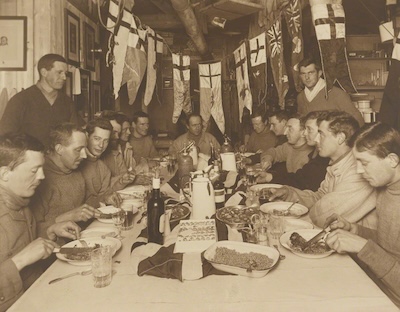
(Herbert George Ponting, ‘Captain Scott’s Birthday, 6 June 1911’, National Portrait Gallery, London; photo credit, NPG. Cherry is the third seated man along on the left)

‘Defeats on the Western Front in March catapulted the nation into shock’, Sara Wheeler wrote in her biography of Apsley Cherry-Garrard, recalling the period of the First World War. ‘The Times rallied as usual to shore up public confidence, issuing advice on all fronts, including the stern “Don’t think you know better than Haig”, even though most people over the age of ten probably did.’[3]

On all fronts, not just the Western one.

In Penelope Fitzgerald’s The Blue Flower, a novel based on the life of the 18th century writer  Novalis, Fritz meets Sophie’s elder sister Friederike (‘the Mandelsloh’): ‘“I thank you for your advice,” said Fritz. “I think, indeed, that women have a better grasp on the whole business of life than we men have. We are morally better than they are, but they can reach perfection, we can’t. And that is in spite of the fact that they particularise, we generalise.”
   “That I have heard before. What is wrong with particulars? Someone has to look after them.”’[4]

Yes, those particulars. Colette was a generous dispenser of advice, not least to the young Georges Simenon when she was literary editor at Le Matin, telling him that, though on the right track, ‘he should drop “the literature”. “Pas de littérature!” she said. “Supprimez toute la littérature et ça ira!”’[5] To a young woman writer who had sought her advice, she replied: ‘When you are capable of certifying that today’s work is equal to yesterday’s, you will have earned your stripes. For I am convinced that talent is nothing other than the possibility of resembling oneself from one day to the next, whatever else befalls you.’[6] But she also served as a magazine’s regular agony aunt, sharing her expertise in matters of dress, cosmetics and, always, love.


(Colette, plus—of course—a cat)

On dress and cosmetics, I am probably unreliable; but I was writing recently about aeroplanes, though hardly straying from my usual temporal zone, the first two or three decades of the twentieth century. The context was Ford Madox Ford’s war but a lot of the material I had to draw on related to Guy Davenport—some of which has gone into blog posts here—as well as other writers of Ford’s time, references to whom had to be whittled down or eliminated. Every time I approached the suggested word limit, things spiralled out of control again as some other alleyway beckoned. I remembered that line of W. B. Yeats: ‘My thoughts were a great excitement, but when I tried to do anything with them, it was like trying to pack a balloon into a shed in a high wind.’[7]

The Davenport material went, leaving only a faint shadow of his 1991 response to Laurence Zachar’s remark that: ‘A proportionately large part of your work is Utopian. It deals with happy people, in an ideal place where there is no violence’, when Davenport commented of  “The Aeroplanes at Brescia”, ‘there’s the implicit sense that aeroplanes were going to stop all wars; the Wright brothers wrote a famous letter to the War Department which paid no attention to it, saying: with the aeroplane, there can be no more troop movements because they can be observed from the air, and therefore no more wars.’[8]

When his story, or assemblage—drawing on Franz Kafka’s first published work, a report on the 1909 air show—appeared in the Hudson Review, a paragraph on the final page put the assertion that wars would cease with the coming of the aeroplane into the mouth of Max Brod’s engineer brother Otto but Davenport may have felt that such an unbearably painful irony was too easy, too heavy-handed. It was omitted when revised for book publication.[9]


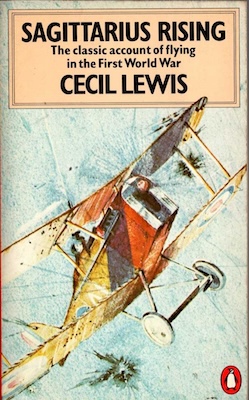
Another twist on that occurred to me when I was rereading the memoir by Cecil Lewis, Sagittarius Rising, who was in his teens when he joined the Royal Flying Corps. By the time he was posted to Home Establishment, he had survived eight months overseas, including four months of the Somme battle, and spent 350 hours in the air, during a period when pilots were lasting, on average, three weeks. Within little more than a month after the Armistice, he had been demobilised and secured a civilian job with Vickers. He was then twenty years old.

Writing in the mid-1930s, he looked back to the failure of the postwar conferences, aimed at ensuring peace, to take note of air power, finally waking to the significance of that power with a shudder of horror. ‘No wonder. Frontiers were gone. Security was gone. No man could hope for peace or prosperity under the threat of a violent death. The days of war were over: massacre had taken their place, wholesale massacre of the community in which children would retch their lives away, women would be blinded and men powerless to protect or succour. The end of civilization was in sight.’[10]


Notes

[1] Ford Madox Ford, Return to Yesterday: Reminiscences 1894-1914 (London: Victor Gollancz, 1931), 251-252.

[2] The Letters of Robert Lowell, edited by Saskia Hamilton (New York: Farrar, Straus and Giroux, 2005), 187.

[3] Sara Wheeler, Cherry: A Life of Apsley Cherry-Garrard (London: Jonathan Cape, 2001), 199.

[4] Penelope Fitzgerald, The Blue Flower (1995; London: Everyman, 2001), 364.

[5] Patrick Marnham, The Man Who Wasn’t Maigret: A Portrait of Georges Simenon (San Diego: Harcourt Brace & Company 1994), 112.

[6] Judith Thurman, Secrets of the Flesh: A Life of Colette (London: Bloomsbury Publishing, 2000), 409.

[7] W. B. Yeats, Autobiographies (London: Macmillan, 1955), 41.

[8] Laurence Zachar, ‘Guy Davenport. Lexington, Kentucky: December 1991’, Effets de voix (Tours: Presses universitaires François Rabelais, 1994).
See: http://books.openedition.org/pufr/3904 (accessed 20 January 2021).

[9] Guy Davenport, ‘The Aeroplanes at Brescia’, Hudson Review, 22, 4 (Winter, 1969-1970), 567-585; Tatlin! Six Stories (New York: Scribner’s, 1974), 52-70.

[10] Cecil Lewis, Sagittarius Rising (1936; Harmondsworth: Penguin, 1977), 152-153.

Sleeping mowers


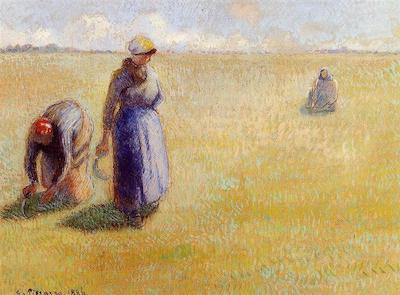
(Camille Pissarro, Three Women Cutting Grass)

It rains, it rains,
From gutters and drains
And gargoyles and gables
It drips from the tables
That tell us the tolls upon grains.
Oxen, asses, sheep, turkeys and fowls
Set into the rain-soaked wall
Of  the old Town Hall.[1]

While much of the world is on fire, some of it quite literally, we have been frequently awash with summer rains, though complaining about it less than usual. The United Kingdom as a whole recorded the sixth highest July rainfall since those records began in 1836; Northern Ireland recorded its highest July rainfall ever. In the United States, heat-related deaths are confidently predicted to exceed those of previous years. Beijing reports the heaviest rainfall in 140 years, with many deaths and disappearances. In the Antarctic, sea ice levels are at record lows as we veer towards the final tipping point.

In response to all this, as if mindful of Samuel Beckett’s famous formulation in Worstward Ho—‘Try again. Fail again. Fail better’—politicians are skipping the trying bit and simply failing again, though labouring to fail even worse than before, reaching new depths of dangerous irresponsibility. Are the voters they paw at really as selfish and unthinking as they assume? Or is it just their usual contempt for the proles? Answers on a lump of coal please, tossed into a rising and soon to be overwhelming sea.

At 05:45, the vegetable boxes are already delivered and I bring them in; by 06:30 the light has deteriorated enough to warrant flipping switches in the kitchen. Surely it’s not that many days back that, in balmy weather, the mowers were out in the park and the air heavy with the distinctive and evocative scent of freshly cut grass. ‘Do you ever feel the smell of freshly cut grass is a cry for help from the grass?’ the (dead) Lily asks Finn in Lorrie Moore’s new novel.[2]


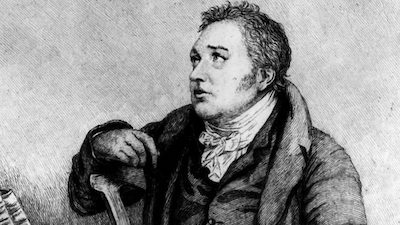
In Alethea Hayter’s fine book—but then she wrote only fine books—Voyage in Vain, she describes how Samuel Taylor Coleridge, en route to Malta, ‘identified himself’ with a sheep in a pen, destined, like the ducks and chickens, ‘to figure on the ship’s menu’. ‘He imagined it as coming from a countryside of flat peaceable meadows, and when he saw it cheerfully eating hay, he pictured its sensations, taking the brightness and sweet murmur of the sea for “dewy grass in sunshine, and the murmur of the trees”.’[3]

On another, more hazardous voyage, late in Moby Dick, Ahab’s anguished raving to the mate has: ‘“and the air smells now, as if it blew from a far-away meadow; they have been making hay somewhere under the slopes of the Andes, Starbuck, and the mowers are sleeping among the new-mown hay. Sleeping? Aye, toil we how we may, we all sleep at last on the field.”’[4]

Sensory commerce between ship and shore.

Helen, thy beauty is to me
   Like those Nicéan barks of yore,
That gently, o’er a perfumed sea,
   The weary, way-worn wanderer bore
   To his own native shore.

Of Edgar Allan Poe’s poem ‘To Helen’, Guy Davenport remarked: ‘We can defend perfumed seas, which has been called silly, by noting that classical ships never left sight of land, and could smell orchards on shore, that perfumed oil was an extensive industry in classical times and that ships laden with it would smell better than your shipload of sheep. Poe is normally far more exact than he is given credit for.’[5]


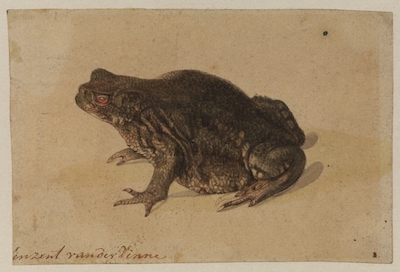
(Vincent Laurentsz van der Vinne, Toad: © The Courtauld)

Wet weather tends to steer us to the nearby park, a couple of circuits by varying paths. On drier days, we still head to Arnos Vale, pausing to pluck some rosemary from the bushes in Perrett Park, eyeing in several of our usual locations the blackberries which are nearly, nearly ready. Our walk back from Arnos Vale is along Cemetery Road. At home, I sit down with a cup of tea and a Mick Herron novel called, ah, Down Cemetery Road. And there is Zoë Boehm, thinking of Joe: ‘Larkin, she thought. He’d always been fond of Philip Larkin. Give me your arm, old toad; Help me down Cemetery Road. . .[6]

Yes, not the famous ‘Toads’:

Why should I let the toad work
Squat on my life?
Can’t I use my wit as a pitchfork
And drive the brute off?

But ‘Toads Revisited’:

What else can I answer,

When the lights come on at four
At the end of another year?
Give me your arm, old toad;
Help me down Cemetery Road.[7]

(Naturally, having drafted this, I see a tweet from Noreen Masud, author of the excellent A Flat Place—‘We can’t live in this world without damaging or being damaged. The point is to be deliberate about which damage to give and take’[8]—with a photograph of the street sign for Cemetery Road and, for heading, that same quote from Larkin: ‘Give me your arm, old toad’. If you believe in coincidences, this is one; if not, not.)


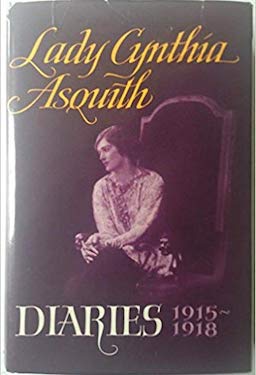
So the news of seemingly endless grotesque and malign misgovernment grinds on, and I think of D. H. Lawrence’s letter to Lady Cynthia Asquith in February 1917: ‘You mustn’t think I haven’t cared about England. I have cared deeply and bitterly. But something is broken.’[9]

I have too – and something is.


Notes

[1] Ford Madox Ford, ‘In the Little Old Market-Place’, Collected Poems (London: Max Goschen, 1913), 36.

[2] Lorrie Moore, I Am Homeless If This Is Not My Home (London: Faber & Faber, 2023), 149.

[3] Alethea Hayter, Voyage in Vain: Coleridge’s Journey to Malta in 1804 (1973; London: Robin Clark, 1993), 70.

[4] Herman Melville, Moby Dick (1851; edited by Harold Beaver, Harmondsworth: Penguin Books, 1972), 653.

[5] Guy Davenport, The Geography of the Imagination (Boston: David R. Godine, 1997), 7.

[6] Mick Herron, Down Cemetery Road (London: John Murray, 2020), 353.

[7] Philip Larkin, Collected Poems, edited by Anthony Thwaite (East St Kilda: The Marvell Press and London: Faber, 2003), 62, 90.

[8] Noreen Masud. A Flat Place: A Memoir (London: Hamish Hamilton, 2023), 210.

[9] Letters of D. H. Lawrence III, October 1916–June 1921, edited by James T. Boulton and Andrew Robertson (Cambridge: Cambridge University Press, 1984), 91.

Sirens and syrens


(Herbert James Draper, Ulysses and the Sirens: Ferens Art Gallery)

—I know you think I’m obsessed with sirens.
—Yes.
—But there were three at once just now. And at least a dozen or more, so far today.
—Think of where we are.
—Arterial junction on this side of the city. But still . . .

But still. Sirens. Or Syrens? The meaning of which, the Merriam-Webster Dictionary sternly pronounces, is ‘chiefly British spelling of siren’. Elsewhere, ‘syren’ is simply termed ‘old-fashioned’.

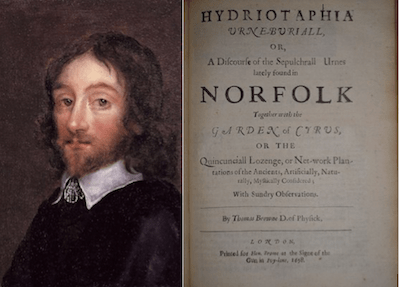
‘What song the sirens sang, or what name Achilles assumed when he hid himself among women, though puzzling questions, are not beyond conjecture’, Sir Thomas Browne wrote in chapter 5 of his Urn Burial.[1] His editor points out that those questions had been put by the emperor Tiberius to test the grammarians. Or, according to Suetonius, in his life of that strikingly unpleasant Roman, ‘his greatest passion was for mythology, to the extent that he made himself seem foolish and absurd; for he used to make trial of scholars, a class of men on whom [ . . . ] he was especially keen: “Who was Hecuba’s mother? What was Achilles’ name when he was among the virgins? What songs used the Sirens to sing?”’[2]


Sleight of hand, yes, siren to siren: but both rub shoulders under the one dictionary heading. A beckoning and a warning; a come-on and a note of caution. The mythological nymphs whose singing required Homer’s hero to be bound to his ship’s mast while his crew had their ears stuffed with beeswax; but also a signalling or warning instrument, as well as an American genus of eel-like amphibians (typically living in muddy pools). The proposed derivation is suitably tortuous: Middle English from Old French from Late Latin from Greek (Seirēn).

‘I imagine’, Ford Madox Ford wrote, ‘that I should prefer to be where Christobel low-lieth and to listen to the song the syrens sang. But I am in London of the nineteen tens, and I am content to endure the rattles and the bangs—and I hope to see them rendered.’[3] He had used the phrase—‘what songs the Sirens sang’—a year earlier; and would use it, or a variant of it, on several later occasions.[4]  In 1931, reporting fierce storms in the South of France to the novelist Caroline Gordon, one of which had drowned seventeen men, he added: ‘the Mediterranean being a treacherous syren’.[5]

Ford also recalled, from his days of editing the English Review, a piece by Norman Douglas called Syrens, ‘which was, I think, the most beautiful thing we printed.’ That Douglas essay begins: ‘It was the Emperor Tiberius who startled his grammarians with the question, what songs the Sirens sang.’[6]

Not that Ford and Douglas were the only ones with Sirens on their mind. E. M. Forster was at it too. In his ‘The Story of the Siren’, a Sicilian boatman tells the English narrator the story of his brother’s sighting of the Siren, when he dives for silver coins. Permanently changed, he marries a woman similarly bewitched, who is murdered by a priest while pregnant, religion and popular superstition having conspired to produce the conviction among the villagers that the couple’s child would empower the Siren, that the Pope would then die and the world be turned upside down.[7]


Also in 1920, the writer John Rodker’s recently created Ovid Press issued an edition of 200 copies of Ezra Pound’s Hugh Selwyn Mauberley, with initials and colophon by Edward Wadsworth, who had been briefly associated with the Omega Workshops, then with the Vorticists, contributing five illustrations and a review of Kandinsky’s On the Spiritual in Art to the first issue of Blast.

The third stanza of Mauberley:

ἴδμεν γάρ τοι πάνθ᾽ ὅσ᾽ ἐνὶ Τροίῃ εὐρείῃ
Caught in the unstopped ear;
Giving the rocks small lee-way
The chopped seas held him, therefore, that year.

The first line, from Homer’s Odyssey (Bk.XII, 189), ‘For we know all the toils that are in wide Troy’, is, precisely, from the Sirens’ song, its transmission unimpeded by that ‘unstopped ear’ (while ‘lee-way’ is Pound’s bilingual rhyme with Τροίῃ, and those choppy seas or, rather, that ‘therefore’, suitably disturbs the rhythm of the final line).[8]


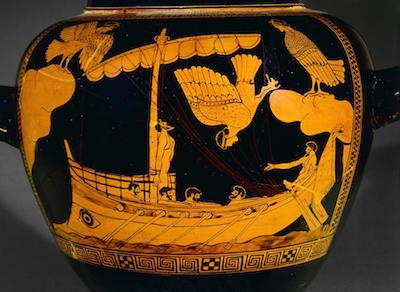
Richard Buxton notes that the Sirens are ‘depicted by post-Homeric sources as women above the waist and birds below it’ and prints the image of an Attic vase, which the British Museum dates to c.480-470 BC, one of the Sirens having thrown herself off a cliff onto the ship, ‘perhaps because the safe passage of Odysseus’ vessel marks a defeat for the Sirens’ power’. [9]

https://www.britishmuseum.org/collection/object/G_1843-1103-31

In May 1940, after the Nazi invasion of the Lowlands, Mollie Panter-Downes noted that ‘the bus changing gear at the corner sounds ridiculously like a siren for a second, as it used to do in the first edgy days of the war.’[10] But even those of us (now most of us) not old enough to recall the originals have been made familiar with the sound of air raid sirens by film and television dramas.

Things were a little more makeshift in the earlier war. When the Gothas, heavy wide-spanned biplanes, virtually took over from Zeppelins the attacks on London in the summer of 1917, E. S. Turner wrote: ‘Belatedly the Government introduced a proper warning system of maroons [fireworks used as signals or warnings]; one of the earlier methods had been to send out a fast open car with a bugler (sometimes a Boy Scout) standing in the back, or a policeman hard-pedalling a cycle with a ‘Take Cover’ notice. Engine drivers had their own way of sounding “All Clear”; they blew a cock-a-doodle-do on their whistles.’[11] Hard luck if your attention was elsewhere when that policeman cycled by.

Dropping off the car on returning from Somerset, we are almost deafened by a rush and cacophony of wailing vehicles, both ambulance and police. I suspect I know what song those sirens sing.


Notes

[1] Browne, Selected Writings, edited by Claire Preston (Manchester: Carcanet Press, 1995), 105. Thetis sent her son Achilles to the court of King Lycomedes on Skyros to avoid his being sent to war with Troy, where he was destined to die. He disguised himself as a girl under the name of Pyrrha but was tracked down by Odysseus.

[2] Suetonius, Live of the Caesars, edited and translated by Catharine Edwards (Oxford: Oxford University Press, 2000), 132.

[3] Ford, ‘On a Notice of “Blast”’, Outlook, XXXVI (31 July 1915), 144. Coleridge’s ‘Christabel’ may have wantonly embraced Tennyson’s 1830 poem ‘Claribel’ (‘Where Claribel low-lieth’) here.

[4] Ford, ‘Literary Portraits XXVIII—Mr Morley Roberts and Time and Thomas Waring’, Outlook, XXXIII (21 March 1914), 390; Thus to Revisit (London: Chapman & Hall, 1921), 7; The Marsden Case (London: Duckworth, 1923), 44; and ‘Somewhere the sirens smiled’, in The Rash Act (1933; Manchester: Carcanet Press, 1982), 187.

[5] Brita Lindbergh-Seyersted, A Literary Friendship: Correspondence Between Caroline Gordon & Ford Madox Ford (Knoxville: The University of Tennessee Press, 1999), 11-12.

[6] Ford Madox Ford, Return to Yesterday (London: Gollancz, 1931), 408-409; Norman Douglas, ‘Sirens’, English Review, II, ii (May 1909), 202-214.

[7] Forster’s story was ‘hand-printed by the Woolfs’ and published in a limited edition in July 1920: The Diary of Virginia Woolf, Volume 2: 1920-24, edited by Anne Olivier Bell, assisted by Andrew McNeillie (Harmondsworth: Penguin, 1981), 51-52 and n.; E. M. Forster, Collected Short Stories (London: Penguin Books, 1954), 179-187.

[8] Hugh Selwyn Mauberley, in Ezra Pound: Poems and Translations, edited by Richard Sieburth (New York: Library of America, 2003), 549.

[9] Richard Buxton, The Complete World of Greek Mythology (London: Thames & Hudson, 2004), 142.

[10] Mollie Panter-Downes, London War Notes (1971; edited by William Shawn, new preface by David Kynaston, London: Persephone Books, 2014), 64.

[11] E. S. Turner, Dear Old Blighty (London: Michael Joseph 1980), 123.

Past presents, present pasts


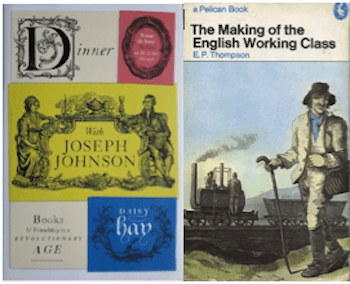
Reading Daisy Hay’s Dinner With Joseph Johnson: Books & Friendship in a Revolutionary Age, I came to the pages dealing with the contortions of William Pitt’s increasingly repressive administration in its attempts to shut down protest in the 1790s, particularly the recasting of the 1351 Act, which had made it a crime to ‘compass and imagine’ the death of the King, that is, to intend the death of the king, as it was commonly understood. ‘Pitt’s lawyers redefined it, so that an act of imagining alone became a crime. To commit treason one needed merely to have imagined the King’s death, not to have acted to advance it. Writing and speaking thus became treasonable.’ Since the government was appointed in the King’s name, any action which threatened ‘the security and stability of government legally constituted an attempt to “levy war” on the King himself. Political protest thus became treasonable by its very nature.’[1]

I was reminded, unsurprisingly, of a very much more recent decline and fall—but reminded  also of the first undergraduate essay I wrote on my History course, about the French Revolution or, rather, the domestic effects in this country of the dramatic events in France. The marker’s comments included the suggestion, I recall, that I try to refrain from running before I could walk (but also queried my use of the word ‘climactic’, about which I was right and they were wrong, not that I ever dwell on that at all). I’d read fairly widely, and, I suspect not unusually, the book I found most stimulating—and exciting—was E. P. Thompson’s The Making of the English Working Class. I didn’t make a habit of reading 900-page history books but made an exception for this one. At that time, Margaret Thatcher’s government tended to behave as though anything that couldn’t be measured, weighed and, ideally, made a profit from, didn’t exist, so I was strongly drawn to such sentiments as followed Thompson’s assertion that definitive answers to such a controversy as that over the effect on standards of living of the Industrial Revolution still evaded us. ‘For beneath the word “standard” we must always find judgements of value as well as questions of fact. Values, we hope to have shown, are not “imponderables” which the historian may safely dismiss with the reflection that, since they are not amenable to measurement, anyone’s opinion is as good as anyone else’s. They are, on the contrary, those questions of human satisfaction, and of the direction of social change, which the historian ought to ponder if history is to claim a position among the significant humanities.’

Still, the quotation most familiar to readers of the book, certainly the last few words of it, is the intention stated in the ‘Preface’: ‘I am seeking to rescue the poor stockinger, the Luddite cropper, the “obsolete” hand-loom weaver, the “utopian” artisan, and even the deluded follower of Joanna Southcott, from the enormous condescension of posterity.’ That last phrase is often quoted and recalled but sometimes as if it simply refers to the assumption that, coming later, we simply know and understand more. As Thompson notes further on, though, ‘for those who live through it, history is neither “early” nor “late”. “Forerunners” are also the inheritors of another past.’[2]


(James Longenbach, poet, teacher and fine scholar, died 29 July this year)

Tricky business, the past. That familiar quotation briefly conjured up another, William Faulkner’s ‘The past is never dead. It’s not even past’, which he puts into the mouth of one of his recurring characters, the lawyer (and occasional amateur sleuth), Gavin Stevens, in Requiem for a Nun. I noticed a few days ago how many literary anniversaries cropped up on 19 December: Constance Garnett’s ‘heroic life’ began at 11 a.m. on that day in 1861;[3] the French writer Colette was married to Henry de Jouvenel in 1912, a simple civil ceremony in the mairie of the sixteenth arrondissement: ‘Madame Colette Willy, woman of letters, notorious lesbian, bare-breasted music-hall star, and social pariah, was now the baroness de Jouvenel des Ursins, and the wife of one of Paris’s most influential political journalists.’[4] From Coleman’s Hatch the following year, Ezra Pound wrote to William Carlos Williams, in a letter that reads with great poignancy now: ‘I am very placid and happy and busy. Dorothy is learning Chinese. I’ve all old Fenollosa’s treasures in mss.’ And: ‘Have just bought two statuettes from the coming sculptor, Gaudier-Brzeska. I like him very much [ . . . ] We are getting our little gang together after five years of waiting.’[5] A little over seven months before German forces cross the Belgian frontier near a place called Gemmenich. . .

But I was thinking, particularly, of David Jones: poet, painter and, for a while, soldier, enlisted in the 15th (London Welsh) Battalion of the Royal Welsh Fusiliers. For two weeks, his battalion was billeted in farm outbuildings in Warne, a mile south of Rocquetoire, ‘all this time the cold rain continuing, more rain than in any December for 39 years.’ On 19 December they boarded ‘grey-painted London buses for La Gorgue, near Estaires.’ They were headed for the front line at Neuve Chapelle.


(David Jones via The Spectator)

‘In the trenches’, Thomas Dilworth wrote of Jones, ‘he became convinced that any distinction between past and present was superficial, accidental, largely unreal. History had not ended; it continued.’[6] In his  ‘Autobiographical Talk’ (1954), Jones said: ‘You see by what close shaves some of us are what we are, and you see how accidents of long past history can be of importance to us in the most intimate sense, and can determine integral things about us.’[7] Like other literary soldiers—Blunden, Sassoon, Ford, Graves among them—the war haunted his later life and writing, perhaps to a greater extent than most of the others. ‘Decades afterwards, a door slamming or a car backfiring would startle him back to the trenches. In distant thunder, he heard artillery.’[8]

Close shaves and roads not taken. Year’s end, year’s turning: there’s a strong tendency to look both forward and back, reviewing what’s past and anticipating, hoping or—increasingly, these days—dreading what’s to come. For some, such reviews have a tendency to ripple outwards, to include peripheral as well as central figures, the gone as well as the present, not only the dead but the lost, the ghosts of those still living, somewhere, but in places either no longer known to us or just inaccessible, for varied reasons: neglect, forgetfulness, estrangement – or those unexceptional divergences in the trajectories of all individuals’ lives. There in their hundreds, perhaps thousands: friends, colleagues, acquaintances, fellow students, fellow teachers, lovers, almost-lovers, antagonists, the watchers and the watched, the lives that touched us, held us, struck us, changed us, missed us by inches—or by a country mile. ‘If I thought I was not thinking about the past’, Deborah Levy wrote, ‘the past was thinking about me.’[9]


Yes. We are not only subjects but objects, not only observers but observed. That’s the sort of thing that can easily slip a person’s mind as they look about themselves, so much to see, so much to learn, so much to talk about, read about, write about, think about. Recounting his work on an illustrated history of exploration, an impossibly huge task, the contributions sent to his publishers routinely thousands of words too long, Eric Newby comments: ‘I had, and still have, the conviction that I must let the reader know if I discover anything interesting, and unfortunately so many things are interesting. At least they are to me.’[10]

Things certainly look grim just now – and have done this past year, three years, decade, steadily worsening. And not only individuals get lost. The things we—some of us—care about are under threat and under attack, some are already gone and we won’t be getting them back. But after all it isn’t after all, not yet all, anyway. We are still here, still there, the more energetic actively resisting while others, on occasion, discover something interesting, at least to us – and let others know.

So: a wave from the bunker to any passer-by. And, to various friends who, in Auden’s phrase, ‘show an affirming flame’: Joyeux Noël, Buon Natale, Feliz Navidad, Nadolig Llawen – and Happy Holidays.


Notes

[1] Daisy Hay, Dinner With Joseph Johnson: Books and Friendship in a Revolutionary Age (London: Chatto & Windus, 2022),

[2] E. P. Thompson, The Making of the English Working Class (1963; revised edition with new preface, Harmondsworth: Penguin Books, 1980), 485, 12, 648.

[3] Richard Garnett, Constance Garnett: A Heroic Life (London: Sinclair-Stevenson, 1991), 11.

[4] Judith Thurman, Secrets of the Flesh: A Life of Colette (London: Bloomsbury Publishing, 2000), 247.

[5] Letters of Ezra Pound, 1907-1941, edited by D. D. Paige (London: Faber and Faber, 1951), 65.

[6] Thomas Dilworth, David Jones in the Great War (London: Enitharmon Press, 2012), 62, 63, 93.

[7] In Epoch and Artist (London: Faber and Faber, 1973), 25.

[8] Thomas Dilworth, David Jones: Engraver, Soldier, Painter, Poet (London: Jonathan Cape, 2017), 54

[9] Deborah Levy, Things I Don’t Want to Know (London: Penguin Books, 2018), 162.

[10] Eric Newby, ‘Walking the Plank’, in Departures and Arrivals (London: Harper Collins, 1999), 39.

Parrot or Bevan; or, wagging the beards

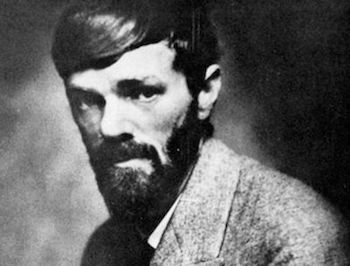
(D. H. Lawrence)

‘Please compress your last dozen unwritten—or unpublished—blog posts, into a single phrase.’

I think I’d be tempted to go with what are often referred to as D. H. Lawrence’s last words, (which they weren’t, though pretty close to the end): ’This place no good.’[1] He was referring to the Ad Astra sanatorium in Vence, of course. And he was referring to something much wider, of course. I would be referring, not to this house—last refuge of common sense and sweet reasonableness that I can truly rely on—but to the wider world that is being laid waste, particularly this country, where we live and love among the ruins that these dreadful people have reduced us to, are reducing us to. Here, at any rate, we are. Where is that? Phrases like ‘post-apocalypse’ and, yes, ‘among the ruins’ occur more often that they should, possibly because I’ve been reading Lara Feigel’s hugely impressive book on D. H. Lawrence,[2] possibly because I keep getting glimpses of the daily news.

I was reminded somehow (somehow) of Hugh Kenner’s letter to Guy Davenport (13 October 1967). They’d been discussing the name of the couple in whose house Ludwig Wittgenstein had died: was it Parrot or Bevan? Davenport was quoting the 1958 memoir by Norman Malcolm, Kenner citing the viva voce testimony of artist and writer Michael Ayrton. Kenner wrote: ‘Ayrton is in Chicago for 10 days (opening a show) but on his return I shall press him re discrepancies between Parrot and Bevan. Maybe, being English, they spell it Bevan but pronounce it Parrot. He did confirm Parrot the other day.’[3]

(For those not familiar with some of the oddities of English pronunciation of names, try Featherstonehaugh, Auchinlech, Marjoribanks, Woolfhardisworthy or Cholmondley.)[4]

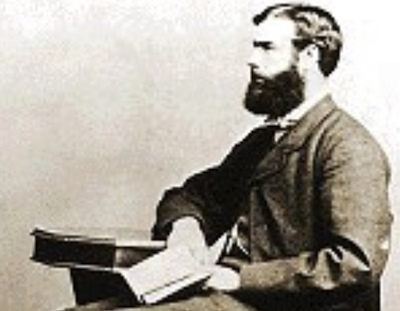
(The Reverend Francis Kilvert – including beard)

But I digress – old joke, shared among Fordians, Ford’s ‘digressions’ generally being anything but – yes, of course. Yesterday I was thinking of the Reverend Francis Kilvert, writing in October 1873: ‘This morning I went to Bath with my Father and Mother to attend the Church Congress Service at the Abbey at 11. When I got to the West door a stream of fools rushed out crying, “No room, you can’t get in!” I knew they were liars by the way they wagged their beards and as this crew of asses rushed out we rushed in and after waiting awhile worked our way up the north aisle till we reached the open transept and got an excellent place near the pulpit.’[5]

He shows here an impressive confidence in discerning the purveyors of untruths. He himself was undeniably bearded, and there was, clearly, an illegitimate manner in which beards were wagged. ‘But’, as Olive Schreiner once remarked, ‘there is another method.’ Kilvert, no doubt, had the key to it. Or perhaps God—conventionally assumed, certainly then, to resemble a man with a beard—sympathised and  helped out a little.

Schreiner had discussed the two methods by which ‘[h]uman life may be painted’, ‘the stage method’ in which characters were ‘duly marshalled at first and ticketed; we know with an immutable certainty that at the right crises each one will reappear and act his part, and, when the curtain falls, all will stand before it bowing.’ And there is, she admits, ‘a sense of satisfaction in this, and of completeness.’ Then: ‘But there is another method—the method of the life we all lead. Here nothing can be prophesied’ and ‘[w]hen the curtain falls no one is ready.’[6]

(Olive Schreiner, via the Irish Times)

It’s an argument for a greater realism, for a narrative reflecting more recognisably the ordinary human experience, echoed, if only in part, by a great many writers subsequently. Perhaps it leans far enough towards ‘mere life’ that the conscious artist might wonder where he or she actually comes in; but, in any case, the talk of stages and footlights and curtains certainly imply that she has in mind Thackeray’s Vanity Fair (1847-8), which begins ‘Before the Curtain’ and ends: ‘Come children, let us shut up the box and the puppets, for our play is played out.’[7]

The attitude to fiction exemplified by that beginning and that conclusion also exercised Ford Madox Ford – on more than one occasion and over some thirty years. He wrote in his ‘Dedicatory Letter’ to Last Post: ‘I have always jeered at authors who sentimentalised over their characters, and after finishing a book exclaim like, say, Thackeray: “Roll up the curtains; put the puppets in their boxes; quench the tallow footlights” . . . something like that.’[8] The following year, in his book on the English novel, he remarked of Thackeray that he ‘must needs write his epilogue as to the showman rolling up his marionettes in green baize and the rest of it’.[9] His final book had a final jab: ‘But what must Mr. Thackeray do but begin or end up his books with paragraphs running: “Reader, the puppet play is ended; let down the curtain; put the puppets back into their boxes. . . ”’[10]

(James Elder Christie, Vanity Fair: Glasgow Museums Resource Centre)

Ford’s main criticisms of Thackeray (and other English novelists) were, firstly, that they were always interpolating moral apothegms or making sly comments about their characters; and secondly, that they committed these, and other misdemeanours while eschewing serious consideration of literary techniques because those were foreign, in short, because they were often too concerned with demonstrating that they were, in the first and most important place, English gentlemen.

I sometimes suspect a bastard version of this in the current, and recent, political situation. Anybody who offers intelligent, knowledgeable or insightful criticism of government policies on the economy, defence, immigration, education, health, social care or, indeed, just about anything else, is termed, by Conservative politicians, commentators, right-wing media hacks, opaquely-funded think tanks and the rest as ‘unpatriotic’ or ‘un-English’ or ‘doing the country down’. Irony-hunters – look no further.

Most of these characters—‘this crew of asses’—are, of course, clean-shaven – but, I suspect, would not have fooled the Reverend Kilvert for a moment.

Notes

[1] At the end of a letter to Maria Huxley [21 February 1930], in The Letters of D. H. Lawrence, Volume VII: November 1928-February 1930, edited by Keith Sagar and James Boulton (Cambridge: Cambridge University Press, 1993), 651.

[2] Lara Feigel, Look! We Have Come Through!: Living with D. H. Lawrence (London: Bloomsbury Publishing, 2022).

[3] Questioning Minds: The Letters of Guy Davenport and Hugh Kenner, edited by Edward M. Burns, two volumes (Berkeley: Counterpoint Press, 2018), II, 948. It was in fact at the home of Dr Edward Bevan and his wife Joan, as detailed in Ray Monk’s Ludwig Wittgenstein: The Duty of Genius (London: Vintage, 1991), 576ff.

[4] Examples from the often invaluable Schott’s Original Miscellany, by Ben Schott ((London: Bloomsbury, 2002), 17.

[5] Kilvert’s Diary, edited by William Plomer, Three volumes (London: Jonathan Cape, 1938, reissued 1969). Volume Two (23 August 1871–13 May 1874), 381.

[6] The Story of an African Farm (1883, under the name Ralph Iron; new edition, Chapman & Hall, 1892), vii-viii.

[7] William Makepeace Thackeray, Vanity Fair: A Novel without a Hero (1848; edited by John Carey, London: Penguin Books, 2003), 5, 809.

[8] Ford Madox Ford, Last Post (1928; edited by Paul Skinner, Manchester: Carcanet Press, 2011), 4-5.

[9] Ford Madox Ford, The English Novel (London: Constable, 1930), 7 (with its slight amendments, this followed the American edition of the previous year).

[10] Ford Madox Ford, The March of Literature: From Confucius to Modern Times (London: Allen & Unwin, 1939), 587.

Seventy years and more


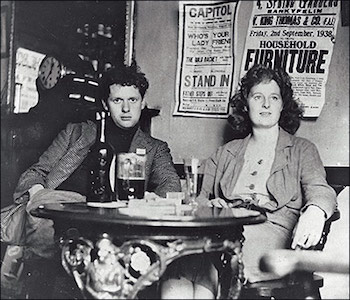
Thinking of Queens, as you do on some weekends, I couldn’t help recalling the story of Dylan Thomas taking part in a public reading during the Second World War. The Queen Mother, who’d been in the audience, expressed a wish to meet the performers. Dylan’s wife Caitlin was at a nearby pub with friends, growing fretful at Dylan’s non-appearance. ‘Somebody explained to her that he was talking to the Queen. Caitlin said, morosely, that she did not approve of Dylan spending so much time with all these old queens. “But it’s the English Queen,” the friend explained. “English queens,” she grumbled, “Irish queens, American queens, it’s all the same. They’re bad for Dylan. They upset him.”’[1]

Indeed, Thomas was hardly unusual among male writers in feeling uncomfortable around gay men: individual ambivalences or smokescreens aside, it was surely sometimes connected with the history of English suspicion that writing was somehow ‘unmanly’ (long list of candidates: the French, the Aesthetic Movement, Decadents, Oscar Wilde, Edward Carpenter). ‘It was [W. E.] Henley and his friends’, Ford Madox Ford asserted, ‘who introduced into the English writing mind the idea that a man of action was something fine and a man of letters a sort of castrato.’[2]

There have been official celebrations in this country, anyway, Elizabeth II having acceded to the throne seventy years ago. I’d guess that a minority of people hated all the razzamatazz, a larger minority revelled in it, more people dipped in for a programme, a party, a bit of social media – and, for another large group, it really didn’t register much at all. A couple of days off? Okay!

My knowledge of royal history is patchy, stronger on some incumbents than others but still largely a series of notes and scraps. I see that fifty-five years back from that accession, the great jubilee pageant of 1897 turned London into the imperial metropolis, according to G. R. Searle. ‘The refronting of Buckingham Palace, the widening of the Mall, the construction of Admiralty Arch, and the building of the Victoria Memorial outside Buckingham Palace were similarly intended to create a theatrical setting suitable for monarchical pageantry and imperial celebrations’, he observed, adding that, ‘in the music halls the irreverently Radical tone commonly found in the 1870s and early 1880s had been largely replaced by the end of the century by open displays of patriotism.’[3]


A bit further on – royally speaking – and King George and Queen Mary were present at the wedding, in the Chapel Royal, 11 May 1920, of Oswald Mosley and Cynthia Curzon, ‘as were the King and Queen of the Belgians, who had been flown across the channel in two two-seater aeroplanes specially for the occasion.’[4] Then, on 4 April 1924, the royal couple opened the ‘most striking imperial spectacle of the period’, the British Empire Exhibition at Wembley Stadium, where ‘[t]he material and symbolic aspects of Empire were neatly blended by a life-size model of the Prince of Wales sculpted in Canadian butter.’[5] Apparently, he was on horseback (and in a refrigerated case, luckily).

In my lifetime, there have been jubilees of various precious stones and metals: sapphires, rubies, gold. The silver jubilee year will still be vivid in a great many current memories, with its mugs for schoolchildren, street parties and a great deal of bunting, though, as Lavinia Greenlaw observed of June 1977, ‘England was no longer England, at least not the England it persisted in believing itself to be.’[6] Multiply that now by, what, ten? A hundred?


But lately I have the Virgin Queen rather more in mind, having just read Alan Judd’s splendid novel, A Fine Madness, inspired, as it announces at the outset, by the life and death of Christopher Marlowe—‘“Reality lacks reality,” he said more than once in later years, “until it is imagined.”’[7] Though the book’s present is nearly thirty years after Marlowe’s death, it looks back to Thomas Phelippes’ work with Sir Francis Walsingham, the queen’s spymaster-general. Phelippes, who narrates the novel from confinement in the Tower, in the course of his questioning by an emissary from James I, was indeed a linguist and cryptographer, instrumental in deciphering the coded letters involved in the Babington plot, a breakthrough which led to the execution of Mary, Queen of Scots (mother of the present king, not an ideal situation for Phelippes).

Sir Walter Ralegh crops up in the novel because of his association with freethinkers and Marlowe’s possible connections with that group through his acquaintance with Ralegh. In the year of Marlowe’s death, 1593, soon after his own release from prison, Ralegh entered his new home, Sherborne Castle, on the banks of the River Yeo, a 99-year lease at £200 per annum. This was a gift from the queen and, as Charles Nicholl remarks, ‘The transaction was finally signed by her in July 1592, shortly before his despatch to the Tower. She did not withdraw this last favour, one infers, because she meant Sherborne to be his place of exile.’ Elsewhere, Nicholl comments that such motifs as the ‘golden world’, the idea of ‘chaste’ colonizing, the idea of ‘virgin territory’ as related to the ‘Virgin Queen cult – spring in general from [John] Dee’s occultist musings on the new British Empire (as he was the first to call it).’[8]

(British School; c.1594; Ashmolean, Oxford)

One of my favourite Dr Dee snippets is that the only one of his astrological interpretations ‘of any length that survives concerns his pupil’, Sir Philip Sidney. It was a 62-page nativity ‘which made several tentative predictions. He foretold that Sidney would enjoy a wonderful career between the ages of fifteen and thirty-one. Then he faced mortal danger from a sword or gunshot injury which, if survived, would inaugurate even greater glories and a long life. Sidney was killed in battle in the Low Countries on 17 October 1586, aged thirty-one.’[9]

There is always a temptation to compare historical periods, not always resisted even by those that can reliably distinguish apples from oranges. The first Elizabethan age glitters extraordinarily brightly yet it was not, as Henry James might say, all gas and gingerbread. The cryptographers, spies, torturers and executioners were kept as busy as the explorers, playwrights and privateers. And, as Stephen Alford observed, ‘the heightened vigilance of Queen Elizabeth’s advisers was in fact potentially corrosive of the security they craved. It is a cruel but perhaps a common historical paradox. The more obsessively a state watches, the greater the dangers it perceives. Suspicions of enemies at home and abroad become more extreme, even self-fulfilling. Balance and perspective are lost. Indeed such a state is likely as a consequence to misconceive or misunderstand the scale of any real threat it faces.’[10]

No historical parallels there, to be sure, and ‘“It’s a poor sort of memory that only works backwards,” the Queen remarked.’ But that, of course, was through the looking-glass.[11]


Notes

[1] Constantine FitzGibbon, The Life of Dylan Thomas  (London: J. M. Dent, 1965), 97.

[2] Ford Madox Ford, Ancient Lights and Certain New Reflections (London: Chapman and Hall, 1911), 241-242.

[3] G. R. Searle, A New England? Peace and War 1886-1918 (Oxford: Oxford University Press, 2004), 39.

[4] Nicholas Mosley, Rules of the Game: 1896-1933; Beyond the Pale: Memoirs of Sir Oswald Mosley and Family (London: Pimlico, 1994), 24.

[5] Martin Pugh, ‘We Danced All Night’: A Social History of Britain Between the Wars (London: The Bodley Head, 2008), 400, 401.

[6] Lavinia Greenlaw, The Importance of Music to Girls (London: Faber & Faber, 2017), 114. Ford wrote a piece entitled ‘A Jubilee’ but that was a review of Some Imagist Poets: Outlook, XXXVI (10 July 1915), 46-48.

[7] Alan Judd, A Fine Madness (London: Simon & Schuster, 2022), 62.

[8] Charles Nicholl, The Creature in the Map: Sir Walter Ralegh’s Quest for El Dorado (London: Vintage, 1996), 45, 311-312.

[9] Benjamin Woolley, The Queen’s Conjuror: The Life and Magic of Dr Dee (London: Flamingo, 2002), 9.

[10] Stephen Alford, The Watchers: A Secret History of the Reign of Elizabeth I (London:  Penguin, 2013), 11-12.

[11] Lewis Carroll, Through the Looking-Glass, in The Annotated Alice: The Definitive Edition, edited by Martin Gardner (London: Allen Lane, 2000), 206.

Noted

(George Cattermole, The Scribe, Cooper Gallery)

I am working on a footnote. It’s a note to a Ford Madox Ford letter, one that was previously published but which needs a few emendations – and some footnotes. Lots of footnotes. I realise that not everybody loves footnotes: if you do, there is no possibility of excuse or explanation – it simply means that the rest of the world is out of kilter, is missing out on a huge expanse of the world’s fascination, beauty, richness. A section headed, austerely, ‘References’ – that’s a man on a barstool, guarding his pint; a heading of ‘Notes’ holds out at least the promise of a welcome, offers of drinks, snacks and stimulating conversation.

My footnotes to this long letter are, necessarily, extensive. Some were worked out weeks or even months ago, added to the typed draft before the working notes, scraps and scribbles were discarded. I’m on the last footnote, a complicated one involving—as well as Ford, Ezra Pound and Wyndham Lewis—at least two serial publications, a couple of published volumes, a couple of other letters cross-referenced and some explanatory background. With a note like this, you could pack a picnic and set off for a day’s walk; you could write about it to friends in distant countries to whom you have, these days, too little to say. Armed with such a note, you could set out to seduce the man or woman of your dreams, your fingers resting lightly on their wrist as you murmur: ‘Listen to this. . .’

I’ve almost finished it but momentarily glance away in contemplation – you know that moment when the film script reads: ‘He [or, more likely, she] glances away, thoughtful, rapt, absorbed.’ When I look back at the screen – something has happened, yes, Something has Happened and my notes – all of them – have gone, have been inexplicably replaced by 1s and 2s, some bloody binary code that laughs – that jeers, maniacally and electronically – at my painfully crafted footnotes, that says, in effect: ‘Nothing lasts. Transience! All that was solid melts into air. Do it all over again. Begin again.’

So I begin again. There is no moral lesson here. Back it up? I was sure I had. No doubt there were positive things to do, steps to take. I found none of them. When I looked online, it told me to press keys and open menus that the latest version of Word might have allowed me to open. I had that version on my laptop – but the file was open on my desktop upstairs, with an earlier version. Save or not save? Copy, revise, delete? What are you thinking? I think we are in rats’ alley where the dead men left their bones. . . .

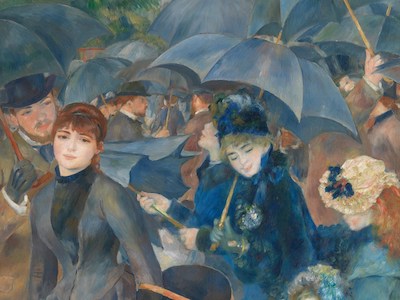
(Pierre-Auguste Renoir, Umbrellas, National Gallery)

In fact, by way of contrast, I’m now thinking about mackintoshes, naturally enough, since I was reading Evelyn Waugh, who writes of Lucy Simmonds and her friend Muriel Meikeljohn: ‘They had shared a passion for a leading tenor, and had once got into his dressing-room at the Opera House by wearing mackintoshes and pretending to be reporters sent to interview him.’[1] That set me wondering about how often literary mackintoshes signal comedy, absurdity or general strangeness, something slightly off (and this without so much as an explicit lingering over Dylan Thomas’s imagined press interview in which he would claim to have come to America to continue his ‘lifelong search for naked women in wet mackintoshes’).[2] When Enid Bagnold went to Marburg for three months, she recalled that: ‘There was something called a “Bummel”. I have stored the word and perhaps it doesn’t exist. It seemed to mean men walking up and down the street in the evening, wearing mackintoshes and looking for girls.’[3] The word did indeed exist. Jerome K. Jerome’s Three Men on the Bummel had appeared in 1900 but the ten-year-old Miss Bagnold might well have missed it, then and later. German for ‘a ramble’, the word is enlarged upon by the narrator in the final paragraph: ‘“a journey, long or short, without an end; the only thing regulating it being the necessity of getting back within a given time to the point from which one started. Sometimes it is through busy streets, and sometimes through the fields and lanes; sometimes we can be spared for a few hours and sometimes for a few days. But long or short, but here or there, our thoughts are ever on the running of the sand. We nod and smile to many as we pass; with some we stop and talk awhile; and with a few we walk a little way. We have been much interested, and often a little tired. But on the whole we have a pleasant time, and are sorry when ’tis over.”’[4] Which, yes, sounds very like the outline of an entire life of a certain kind, while still in close contact with the comic mode.

Women, mackintoshes. Less than fifty years after Charles Macintosh had patented his process of waterproofing cloth with rubber, the Reverend Francis Kilvert, who certainly liked girls—on occasion quite young ones, in that particular nineteenth-century way—and wrote of them often, arrived at the Chapel on Septuagesima Sunday, St Valentine’s Eve, 13 February 1870, in ‘the hardest frost we have had yet’, and recalled that ‘my beard moustaches and whiskers were so stiff with ice that I could hardly open my mouth and my beard was frozen on to my mackintosh.’[5] Plenty of ice; plenty of facial hair.

Footnote: There’s a neat metafictional touch towards the end of Waugh’s ‘Scott-King’s Modern Europe’ where the author reflects on the genre of the story he is writing: ‘This is the story of a summer holiday; a light tale. It treats, at the worst, with solid discomfort and intellectual doubt. It would be inappropriate to speak here of those depths of the human spirit, the agony and despair, of the next few days of Scott-King’s life. To even the Comic Muse, the gadabout, the adventurous one of those heavenly sisters, to whom so little that is human comes amiss, who can mix in almost any company and find a welcome at almost every door – even to her there are forbidden places’ (387-388).

In The Heart of the Country, Ford Madox Ford considers ‘an English country-house party’ on ‘a really torrential day’. Think, he says, ‘of the intolerable boredom of it. There is absolutely nothing to be done.’ If you’re not in the mood for a mechanical piano, more letter-writing or flirting in the drawing-room, there is just the persistent rain. ‘At last something really exciting occurs. Two self-sacrificing persons, the son of the house and his fiancée, having in desperation put on shiny mackintoshes and sou’-westers, stand, wind-blown and laughing figures, putting at clock-golf on the lawn just beneath the billiard-room window.’[6]

(‘Joyce’s Dublin’ via The Irish Times)

In a less privileged setting—1904 Dublin—we might hear this voice: ‘Golly, whatten tunket’s yon guy in the mackintosh? Dusty Rhodes. Peep at his wearables. By mighty! What’s he got? Jubilee mutton. Bovril, by James. Wants it real bad. D’ye ken bare socks? Seedy cuss in the Richmond? Rawthere! Thought he had a deposit of lead in his penis. Trumpery insanity. Bartle the Bread we calls him. That, sir, was once a prosperous cit. Man all tattered and torn that married a maiden all forlorn. Slung her hook, she did. Here see lost love. Walking Mackintosh of lonely canyon.’[7]

Back at the kitchen table, work proceeds on those other footnotes, on a grander scale and in a more determined vein. As for that final note: when it’s done you’ll be able to charter a boat with it . . .


Notes

[1] ‘Work Suspended: Two Chapters of an Unfinished Novel’, in Evelyn Waugh, The Complete Short Stories (London: Penguin Books, 2011), 281.

[2] John Malcolm Brinnin, Dylan Thomas in America (1955; New York: Paragon Press, 1989), 14-15.

[3] Enid Bagnold’s Autobiography (from 1889) (London: Century, 1989), 33.

[4] Jerome K. Jerome, Three Men in a Boat; Three Men on the Bummel (1889, 1900; edited by Geoffrey Harvey, Oxford: Oxford University Press, 1998), xx-xxi, 324. The book was published in late Spring; Bagnold was born in 1889 but her birthday was in October, so ten not eleven. . .

[5] Francis Kilvert, Kilvert’s Diary, edited by William Plomer, Three volumes (London: Jonathan Cape, 1938, reissued 1969). Volume One (1 January 1870—19 August 1871), 34.

[6] Ford Madox Ford, The Heart of the Country, in England and the English, edited by Sara Haslam (Manchester: Carcanet Press, 2003), 204-205.

[7] James Joyce, Ulysses (1922; London: The Bodley Head, revised edition, 1969), 560.

Archiving the opposites


I was thinking about opposites: or no—‘I would meet you upon this honestly’—for some reason, remembering the opening of Easy Rider, which I saw twice soon after its release, once straight and once. . . not, probably recklessly taking advice from a friend of that time (‘You have to see it stoned, man, otherwise you’re just wasting time and money’). The opening sequence has the soundtrack of a Steppenwolf song, its refrain being: ‘God damn the pusher’. I was reminded of it only because of its opposite, not curse but benediction, since I was thinking, after an exchange of emails yesterday and this morning: ‘God bless the archivist.’

That sentiment is common enough among researchers, I know. There is darkness; an archivist fiddles with the solar system and – there’s light. Accept the miracle, send the lavishly grateful email, know your place in an ordered universe. . .But I was thinking about opposites.

‘I reacted violently against him at first on the grounds that he was a militarist. But I soon found that if he was a militarist, he was at the same time the exact opposite.’ This is the Australian painter Stella Bowen writing, not long after his death, of her partner of ten years and father of her child, Ford Madox Ford.[1] When she met him in 1917, he was in uniform, as almost all Stella’s other friends and acquaintances at that time—poets, painters, dancers, musicians, translators—were not. The least likely candidate for an organisation such as the British Army, one might think, yet, when he was given a commission, he wrote to Lucy Masterman, ‘I can assure you, for what it is worth, that it is as if the peace of God had descended on me—that sounds absurd—but there it is! Man is a curious animal.’[2] Indeed.

(Stella Bowen, ‘Ford Playing Solitaire’)

Opposites are routinely employed or deployed in all manner of writers’ work and are integral to some. F. O. Matthiessen wrote of Ralph Waldo Emerson’s ‘inveterate habit of stating things in opposites’, while Guy Davenport noted of John Ruskin that he ‘quite early began to use the digression as a major device of style, and later saw in his infinitely branching digressions (Fors Clavigera is a long work of nothing but) “Gothic generosity” – the polar opposite of classical restraint.’[3] Of Penelope Fitzgerald, fellow-novelist Julian Barnes wrote: ‘Many writers start by inventing away from their lives, and then, when their material runs out, turn back to more familiar sources. Fitzgerald did the opposite, and by writing away from her own life she liberated herself into greatness.’[4] Reflecting on her Booker Prize winning novel, Offshore, Fitzgerald remarked: ‘It was a pity that the title was translated into various European languages with words meaning “far away” or “far from the shore,” which meant the exact opposite of what I intended. By “offshore” I meant to suggest the boats at anchor, still in touch with the land, and also the emotional restlessness of my characters, halfway between the need for security and the doubtful attraction of danger. Their indecision is a kind of reflection of the rising and falling tide, which the craft at anchor must, of course, follow.’[5]

(Thomas Rowlandson cartoon , ‘Walking up the High Street’: Messrs Johnson and Boswell in Edinburgh)

The idea of the opposite is indispensable to the firm contradiction of a prevailing trend or assumption, as essential a tool in the biographer’s or historian’s bag as a plunger in a plumber’s. Adam Sisman’s absorbing book on James Boswell observes of the famous trip to the Hebrides that this was, for most Britons, ‘still a wild and exotic region, one of the least explored in Europe. The Grand Tour was very much the fashion in the mid-eighteenth century, but the route directed the sons of the aristocracy to the sites of classical European civilization. Johnson and Boswell, by heading for the barbarian North, were going in the opposite direction.’[6] (The story-board for the animated short, ‘Sam and Jim Go Up Not Down’, is currently in draft form.) The great historian Fernand Braudel was also in a contradictory mood when he stated that, between 1350 and 1550, Europe ‘probably experienced a favourable period as far as individual living standards were concerned.’ Manpower was relatively scarce after the ravages of the Black Death. ‘Real salaries have never been as high as they were then.’ And he adds: ‘The paradox must be emphasized since it is often thought that hardship increases the farther back towards the middle ages one goes In fact the opposite is true of the standard of living of the common people – the majority.’[7] Moving on (chronologically), Alexandra Harris suggested that ‘The Georgian revival was in important ways precisely the opposite of Little Englandism: it was an investigation of England’s cultural relations with Europe and an effort to promote an audaciously international version of Englishness.’[8] If that’s the case, we clearly need another one.

The saying that ‘opposites attract’ will be true enough, no doubt, in many instances; but so too will the assertion that ‘opposites repel’, more so than ever at the current juncture when societies and nations seem to have cracked down the middle or lost their collective minds. Some ideals are being held so fiercely that they are breathlessly expiring; but then, as Robert Musil wrote: ‘Ideals have curious properties, and one of them is that they turn into their opposites when one tries to live up to them.’[9]

Sometimes. Still, God bless the archivist: that statement will brook no opposition.


Notes

[1] Stella Bowen, Drawn From Life (London: Collins, 1941), 62.

[2] Ford Madox Ford, Letters of Ford Madox Ford, edited by Richard M. Ludwig (Princeton: Princeton University Press, 1965), 61.

[3] F. O. Matthiessen, American Renaissance: Art and Expression in the Age of Emerson and Whitman (1941; New York: Oxford University Press, 1968), 3; Guy Davenport, ‘Ruskin According to Proust’, in The Hunter Gracchus and Other Papers on Literature and Art (Washington: Counterpoint, 1996), 334.

[4] Julian Barnes, ‘The Deceptiveness of Penelope Fitzgerald’, Through the Window: Seventeen Essays (And One Short Story) (London: Vintage, 2012), 4.

[5] Penelope Fitzgerald, ‘Curriculum Vitae’, in A House of Air: Selected Writings, edited by Terence Dooley with Mandy Kirkby and Chris Carduff (London: Harper Perennial, 2005), 478.

[6] Adam Sisman, Boswell’s Presumptuous Task (London: Hamish Hamilton, 2000), 89.

[7] Fernand Braudel, Civilization and Capitalism, 15th – 18th Century. Volume I: The Structures of Everyday Life: The Limits of the Possible, translated from the French; revised by Sîan Reynolds (London: Fontana Books 1985), 193, 194.

[8] Alexandra Harris, Romantic Moderns: English Writers, Artists and the Imagination from Virginia Woolf to John Piper (London, Thames & Hudson 2010), 70.

[9] Robert Musil, The Man Without Qualities, translated by Sophie Wilkins and Burton Pike (London: Picador, 1997), 247.

Bowling mangel-wurzels across the lawn

(James Eckford Lauder, The Parable of Forgiveness: Walker Art Gallery, National Museums Liverpool)

‘It was Janet’s view’, Elspeth Barker wrote of her stubbornly individual young heroine, ‘that forgetting was the only possible way of forgiving. She did not believe in forgiveness; the word had no meaning.’[1] Janet has, you might say, a lot to put up with – and the Calvinist harangues of Mr McConochie are hardly designed to stimulate the more generous Christian virtues in the bosoms of his flock. Still, other approaches are, as they say, available.

‘After such knowledge, what forgiveness?’, T. S. Eliot wrote.[2] It’s a question that’s cropped up several times in the news just lately. In Ukraine, unsurprisingly, they ask if they can ever forgive Russia, though that question often focuses more specifically on Putin. Some Russians are themselves wondering whether they can ever forgive their President for what he has done to their country, its neighbours, its standing in the world. In England, many of the relatives of those who died in hospitals and care homes in the earlier stages of the Covid-19 pandemic, unvisited, isolated from their families because of the rules made by a government that itself habitually failed to keep them, have stated that they will not forgive the man ultimately responsible for the whole lethal mess: the Prime Minister.

Forgiveness can also be given, or withheld, on a rather smaller scale. Of their gardener—until the family moved to another house—Henry Green wrote: ‘Poole, so they say, could never forgive my mother when soon after marriage she made him bowl mangel wurzels across one lawn for her to shoot at.’[3] Smaller or more frequent, up to that final point, as Ali Smith observed: ‘many things get forgiven in the course of a life: nothing is finished or unchangeable except death and even death will bend a little if what you tell of it is told right’.[4]

The news at the moment—none of it good—is of large events on a large canvas. But those events, whatever their size and nature, began elsewhere: in a room, in a bed, on a screen, in a garden, in a bar, in a grave. The direction of travel may vary. In Ezra Pound’s Confucius, he has this:

The men of old wanting to clarify and diffuse throughout the empire that light which comes from looking straight into the heart and then acting, first set up good government in their own states; wanting good government in their states, they first established order in their own families; wanting order in the home, they first disciplined themselves; desiring self-discipline, they rectified their own hearts; and wanting to rectify their hearts, they sought precise verbal definitions of their inarticulate thoughts [the tones given off by the heart]; wishing to attain precise verbal definitions, they set to extend their knowledge to the utmost. This completion of knowledge is rooted in sorting things into organic categories.[5]

In the bath with Elizabeth Bowen (so to speak), I read about Jefferies listening to Jameson as he declaims about the New Jerusalem to the aunt and the young mother, as they wait for the young husband who will not, perhaps, come home. ‘After all, it all came back to this – individual outlook; the emotional factors of environment; houses that were homes; living-rooms; people going out and coming in again; people not coming in; other people waiting for them in rooms that were little guarded squares of light walled in carefully against the hungry darkness, the ultimately all-devouring darkness. After all, here was the stage of every drama.’[6]

Walking briefly on the main road before turning off again into quieter places, at seven o’clock in the morning, I watch car after car go by, each containing one person, and am reminded of the final question that the New Statesman asks of its interviewee on the Q & A page each week: ‘Are we all doomed?’ The answers are sometimes considered, sometimes flippant. Here, now, the world presents itself as a peculiar version of, say, a golf course produced by a team of deranged designers or architects: they create some hazards, to make the course a little more difficult or challenging or exciting or unpredictable – bunkers, some cunning slopes, water (ideally a lake deep enough to drown in), a few awkward corners where many players will slice or hook into undergrowth or trees. Then they take away all those smooth greens and fairways, leaving only the hazards. No, wait, they put back a couple of greens and call them, what, foreign holidays or television streaming services or barbecues on somebody’s terrace. Then tee off. Fore! Playing is, of course, mandatory. As Pascal didn’t quite say: you must bet; you are in the game. But you might get lucky. So – you have to ask yourself – do you feel lucky? Well, do you?[7]

(Charles Lees, ‘A Golf Match’: National Galleries of Scotland, Scottish National Portrait Gallery)

It’s often, as they say, relative. The conduct of the present English government generally disgusts me – but I live in a wealthy country which is privileged by position, climate, history and the rest. So I hold the country and its government to high standards, with correspondingly high expectations of liberal, enlightened, equitable governance – and they fall woefully short. By almost every measure of a civilized nation, the current state of the country is a disgrace. Yet I’m still hugely – relatively – lucky by many measures. I would far rather be here, an angry and disappointed Englishman, than in a score of countries that come only too swiftly to mind, where having the wrong religion, skin colour, racial heritage or gender can all too easily leave you dead in a ditch.

‘Darknesse and light divide the course of time’, Sir Thomas Browne wrote, ‘and oblivion shares with memory a great part even of our living beings; we slightly remember our felicities, and the smartest stroaks of affliction leave but short smart upon us.’[8] I don’t know. We have machines and social media to help us remember our grievances now and those strokes of affliction leave long-lasting scars, while slightly remembered felicities probably reside on Instagram or crop up as random and unprompted ‘memories’.

‘The uncritical mind is a prey to credulity’, Guy Davenport commented, ‘and without skepticism there can be no democracy.’[9] Yes, there’s that, the gullibility which people seem oddly reluctant to admit to, retrospectively. But there comes a point, certainly in those countries that have any pretensions to a democratic system, when voters can no longer claim ignorance since they know now the nature of the ones they opted for last time. And it comes to this, that huge numbers of citizens, in many countries, say, in effect: yes, these people are corrupt, hypocritical, untruthful bastards but we’re giving them our support, so they can continue to wage war against democratic freedoms or public services or immigrants or women or universities or the poor. . .

After such knowledge, what forgiveness?


Notes

[1] Elspeth Barker, O Caledonia (London: Weidenfeld & Nicolson, 2021), 116.

[2] T. S. Eliot, ‘Gerontion’, The Poems of T. S. Eliot. Volume I: Collected and Uncollected Poems, edited by Christopher Ricks and Jim McCue (London: Faber & Faber, 2015), 32.

[3] Henry Green, Pack My Bag: A Self-Portrait (1940; London: The Hogarth Press, 1992), 3.

[4] Ali Smith, How to be both (London: Hamish Hamilton, 2014), 95.

[5] Ezra Pound, Confucius. The Unwobbling Pivot; The Great Digest; The Analects (New York: New Directions, 1969), 29-31.

[6] Elizabeth Bowen, ‘Human Habitation’, in The Collected Stories of Elizabeth Bowen, with an introduction by Angus Wilson (London: Vintage, 1999), 166.

[7] Blaise Pascal, Pensées and Other Writings, translated by Honor Levi (Oxford: Oxford University Press, 2008), 154; as rendered, or polished, by John Fowles, in The Aristos (London: Pan Books, 1968), 220.

[8] Sir Thomas Browne, Hydriotaphia, or Urn-Buriall, in Selected Writings, edited by Geoffrey Keynes (London: Faber  and Faber, 1970), 152.

[9] Guy Davenport, ‘Wheel Ruts’, in The Hunter Gracchus and Other Papers on Literature and Art (Washington: Counterpoint, 1996), 133.