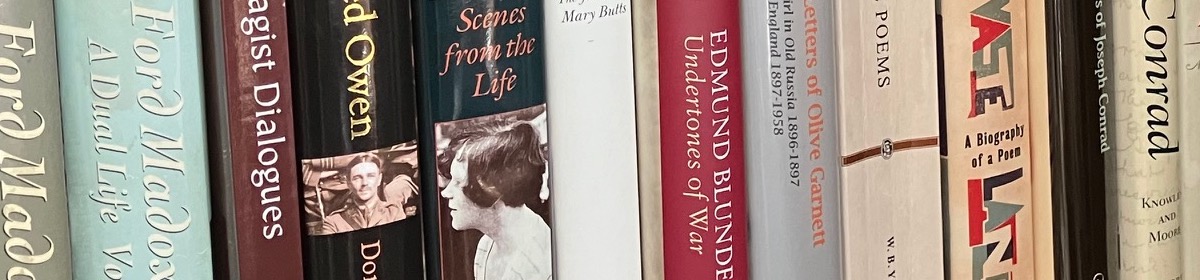
‘The Weeping and the Laughter’


Almost August. Record–breaking temperatures in South Korea and Japan but a dull, grey morning here today. Even the saxophonist who practises in the small wood in the park may postpone his session for a while.

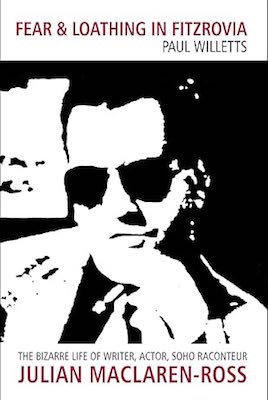
Emerging from Paul Willetts’ biography of Julian Maclaren-Ross, I was a little dizzy from the extraordinary sequences of work done, or proposed, or rewritten, of contracts honoured or let slip, of rooms and suites and flats rented and left in a series of moonlight flits or evictions, of creditors and lawsuits, landladies, hoteliers, retailers (a pram for his son Alex) and the post office (for telephone bills), of separations from, and reconciliations with, wives and girlfriends.[1] It’s difficult not to have a sense of being slightly bruised by contact with the innumerable knocks that the writer underwent. He was incurably extravagant and wasteful with money, nor did the alcoholism, heavy smoking, bad diet, amphetamine use and lack of exercise help much, and the fatal heart attack at the age of fifty-two is not wholly unexpected.

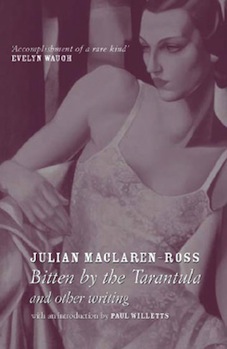
The two undeniable positives, though, are the biography itself, a prodigious feat of research and writing; and Maclaren-Ross’s own staggering fecundity. The novels, short stories, sketches, radio dramas, adaptations, autobiographies, screenplays, parodies, memoirs, reviews and essays emerge at an astonishing rate. Writing often through the night, he seems to turn out entire radio drama series in days, reviews and sketches in hours, year after year through the 1940s, 1950s and into the early 1960s, always in financial distress and increasingly aware that the impact made by some of his early work had not been maintained and had ebbed away. It’s remarkable, given the rate of production and the conditions in which most of it was written, that so much of it is so good. Some of the stories, the novel, Of Love and Hunger, the memoirs, many of the superb parodies and critical writings (on cinema as well as literature) in Bitten By the Tarantula, are assured, often very funny, and hugely impressive. 

Endless monologues on a barstool in Fitzrovia. The teddy-bear coat, the sharp suit, the cigarette-holder, the silver-topped malacca cane, the snuff box, the eternal dark glasses: ‘From an early age’, Paul Willetts writes, ‘Julian put as much effort into propagating his personal myth as perfecting his prose style’ (306), going on to mention the many characters in poems and novels that are based on him, as well as the memoirs in which he features. Pubs and clubs, magazines and anthologies, are threaded through the story as much as boxers and bullfighters are in Hemingway’s, and Maclaren-Ross encountered an extraordinary range of writers, editors, publishers, painters and BBC producers. One of these, who became increasingly important in his desperate pursuit of commissions and payments, was Reginald Donald ‘Reggie’ Smith (born on this day, 31 July, 1914), whose name rang a bell because he’d cropped up in a couple of other stories. Married to the novelist Olivia Manning, he’s familiar to readers of her Balkan Trilogy as the model for her central character Guy Pringle (to viewers of the superb adaptation, it is, of course, Kenneth Branagh). Smith crops up on more than thirty pages of Willetts’ biography because he was hugely supportive of Maclaren-Ross for some years. He was a friend of the novelist and critic Walter Allen and of Louis MacNeice, and had been to King Edward Grammar School in Aston, Birmingham, with poet Henry Reed and George D. Painter, future biographer of Marcel Proust. When he married Olivia Manning in August 1939 at Marylebone Registrar’s Office, their witnesses included Stevie Smith and Walter Allen. Their best man had been written into the certificate as ‘Louise MacNeice’—both bride and groom noticed but said nothing—and Olivia seems to have taken the opportunity to shave a few years off her age, her birthdate recorded there as 1911 (in fact it was 1908).[2]


I may briefly take refuge now in something calmer, less harassed—perhaps a Simenon. Not that the world of Inspector Jules Maigret is entirely detached from that of Julian Maclaren-Ross, one of whose many publications was a translation, published by Penguin Books in association with Hamish Hamilton in 1959: Maigret and the Burglar’s Wife. . .


Notes

[1] Paul Willetts, Fear & Loathing in Fitzrovia: The Bizarre Life of Writer, Actor, Soho Raconteur Julian Maclaren-Ross, revised edition (London: Dewi Lewis, 2013). Willetts also introduces Collected Memoirs (London: Black Spring Press, 2004) and Bitten By the Tarantula and other writing (London: Black Spring Press, 2005). Penguin Books published Of Love and Hunger, with an introduction by D. J. Taylor, in 2002. ‘The Weeping and the Laughter’ is subtitled ‘A Chapter of Autobiography’ in Collected Memoirs (1-110).

[2] Neville & June Braybrooke, Olivia Manning: A Life (London: Chatto & Windus, 2004), 54, 58, 59.
Blackberries, cats and a tilly


And every tree is a tree of branches
And every wood is a wood of trees growing
     And what has been contributes to what is.
So I am glad to have known them,
     The people or events apparently withdrawn;
The world is round and there is always dawn
     Undeniably somewhere.[1]

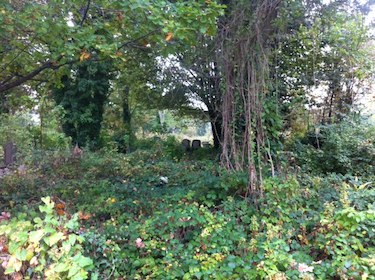
Some days, if you’re early enough, you can walk all the way round a huge Victorian cemetery and not see even a single dogwalker—though you might catch sight of a fox, if you’re lucky. The blackberries have got ahead of themselves to such an extent that  they’ll barely last the month: but once in the freezer drawer, they’ll see us well into winter.  Cow parsley, Anthriscus sylvestris, or Queen Anne’s lace (or, I gather, keck) still hangs on in places. A mistle thrush and a song thrush seem to answer one another and there’s a goldcrest somewhere near.

We are well past midsummer now. Glastonbury Festival is over (I shall probably get The Cure’s ‘Friday I’m in Love’ out of my head soon), the Wimbledon tennis tournament finished, the Bristol Harbour Festival has happened and the Balloon Fiesta is just a couple of weeks away. The wider canvas still largely features arterial blood and heavy boots on infant faces though even some Western politicians have now begun to wonder if deliberately starving thousands of innocent civilians and then shooting them down in cold blood day after day when they try to secure food might be just a bit over the top. Even so, to demonstrate that they know what’s terrorism and what isn’t, our government is prosecuting people who object to their country’s complicity in war crimes.

But pass on, pass on. Books, music, food, wine, love, cats.

When I surface from Ford’s letters, I have waiting for me Paul Willetts’ remarkable reconstruction of the life of Julian Maclaren-Ross, Ronald Blythe, Sarah Moss, early Ernest Hemingway. Otherwise, I just revel in Anne Carson:


‘My mother forbad us to walk backwards. That is how the dead walk, she would say. Where did she get this idea? Perhaps from a bad translation. The dead, after all, do not walk backwards but they do walk behind us. They have no lungs and cannot call out but would love for us to turn around. They are victims of love, many of them.’[2]

Yes. Meanwhile, the weather, or much of it, prompts me to recognise my increasing intolerance to higher temperatures (and to much else: I know I’m widely assumed to become more conservative politically as I age but something’s clearly gone wrong). Earlier walks, more water, more cursing – I know all the tricks.

As to cats – yes, I like to remember that ‘Balthus painted himself once as a cat dining on fish, and once as the King of the Cats.’[3] Sylvia Townsend Warner mentioned, in a letter to William Maxwell (9 April 1952) , the northern Scottish traveller’s tale of seeing the cat funeral. ‘And the cat of the house, lying on the hearth, started up at these words, and exclaimed, “Then I am the King of the Cats”, and vanished up the chimney.’[4] When Swinburne died in 1909, William Butler Yeats said to his sister Lily, ‘Now I am king of the cats.’[5]

.

(John Butler Yeats, portrait of embroiderer, and co-founder (with her sister Lolly) of Cuala Industries, Susan Mary (Lily) Yeats (1901): National Gallery of Ireland)

The novelist, suffragist and partner—for several fraught years—of Ford Madox Ford had a good many of them: ‘Violet’s parrots—part of a menagerie that included an  owl (named Anne Veronica after Wells’s novel), a bulldog and nine Persian cats—shrieked “Ezra! Ezra!” whenever they saw him bouncing up the walk.’[6]

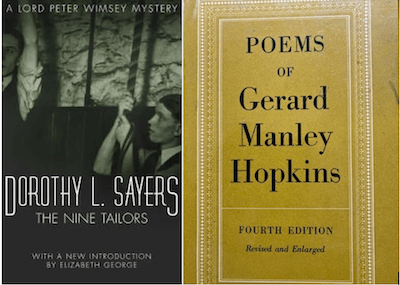
I can, alas, only half-agree with Lord Peter Wimsey when he says to Parker at the end of that bell-ringing mystery, The Nine Tailors, ‘“Bells are like cats and mirrors – they’re always queer, and it doesn’t do to think too much about them.”’[7] Queer they may be but I think about them a good deal and seem none the worse for it.

There was a collection of essays published ‘on the Occasion of the 25th Anniversary of Finnegans Wake’, which included pieces by Padraic Colum, Frank Budgen, Vivian Mercier, Fritz Senn, A. Walton Litz and other distinguished Joyceans. It was called Twelve and a Tilly.[8]

For ‘tilly’, my Shorter Oxford has: ‘In Ireland and places of Irish settlement, an additional article or amount unpaid for by the purchaser as a gift from the vendor.’ Joyce’s nocturnal masterpiece offers four occurrences and the splendid online glossary – http://finwake.com – adds to ‘the thirteenth of a baker’s dozen’ the derivation from Irish tuilleadh, added measure.

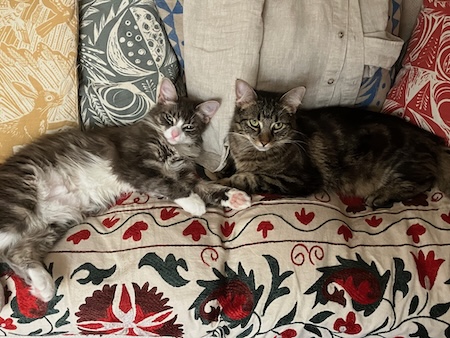
Opening my eyes to uncertain light, I can hear the table-tennis ball moving in the kitchen and the hall, knocking against skirting-boards and doorframes. I get up for a pee and a small grey tabby runs in to check on my progress and brush against my legs. Getting back into bed, I see that it’s 03:50. Moments later, the table-tennis ball is on the move again.

Yes, we have our own Tilly now, not an added measure but one-half of a pair. Her brother is named Max, which I like in part because it was the name of the very first pet I remember, in Gillingham, Kent, a black cocker spaniel—but also because of the occasional fleeting uncertainty which attends such phrases as ‘I said to Max’ or, more plausibly, ‘I asked Max’, which might conceivably be a reference to either a handsome tabby or our leading Ford Madox Ford scholar.

Scholars, though, at least as a general rule, do not sit in the kitchen sink, talk to toy mice or suck their tails. . .

Notes


[1] Louis MacNeice, ‘Autumn Journal: XXI’, Collected Poems, edited by Peter McDonald (London: Faber, 2007), 153.

[2] Anne Carson, ‘On Walking Backwards’, Plainwater: Essays and Poetry (New York: Vintage, 2000), 36.

[3] Guy Davenport,  A Balthus Notebook (New York: Norton, 1989), 7. Le Roi des Chats (1935). Balthus identified strongly with cats: in the year of this self-portrait, he began signing his letters to his future wife Antoinette as ‘King of Cats’. ‘Jeune fille’ occurs many times in the titles of his paintings—but so does ‘chat’ (sometimes together).

[4] Sylvia Townsend Warner, Letters, edited by William Maxwell (London: Chatto & Windus, 1982), 133.

[5] Yeats to Susan Mary (‘Lily’) Yeats, 12 Apr. 1909: R. F. Foster, W. B. Yeats: A Life. I: The Apprentice Mage: 1865–1914 (Oxford: Oxford University Press, 1997), 616n.69.

[6] Pound, of course. Barbara Belford, Violet: The Story of the Irrepressible Violet Hunt and her Circle of Lovers and Friends—Ford Madox Ford, H. G. Wells, Somerset Maugham, and Henry James (New York: Simon and Schuster, 1990), 166-7.

[7] Dorothy L. Sayers, The Nine Tailors (1934; with an introduction by Elizabeth George, London: New English Library, 2003), 305.

[8] Twelve and a Tilly: Essays on the Occasion of the 25th Anniversary of Finnegans Wake, edited by Jack P. Dalton and Clive Hart (Evanston: Northwestern University Press, 1965).

Words made flesh, flash, at a trumpet crash


(‘The Ash Yggdrasil’ from Aasgard and the Gods, by Wilhelm Wägner)

‘I remember going on to think that Ragnarök seemed “truer” than the Resurrection’, the narrator of A. S. Byatt’s story, ‘Sugar’, writes, having known, as a child, the 1880 book Asgard and the Gods.[1]

There’s a peculiar fascination about those moments in a work of art when other practitioners are evoked, quoted or alluded to, especially when the source is altered. Often enough, this is because the writer is quoting from memory: while George Orwell usually announces that he’s about to do so, others engage in the same practice without any such explicit statement, not infrequently getting things almost—but not quite—right. In a letter to G. K. Chesterton (6 July 1928), T. S. Eliot wrote: ‘The last time that I ventured to quote from memory in print, a correspondent [ . . . ] pointed out that I had made twelve distinct mistakes in well-known passages of Shakespeare.’[2] Joseph Conrad used lines from Spenser’s Faerie Queene (I, ix, 359-360) as the epigraph to his novel The Rover (1923), and the same lines were  later incised on his gravestone at Canterbury: ‘Sleep after toyle, port after stormie seas,/ Ease after warre, death after life does greatly please’. When they reappeared at the close of the ‘English’ text of Ford Madox Ford’s No Enemy (there is an appendix with the original French version of an earlier chapter in English), there were a few differences. ‘Sleep’ becomes ‘rest’ (a resonant word in Ford’s writings), ‘ease after warre’ is excluded, even though Ford wrote much of the book in 1919, having just been gazetted out of the British army after serving both at home and in France and Flanders, ‘death after life’ goes too, since he is celebrating survival, if among a number of ghosts. This is far from simple ‘misquoting’ or ‘misremembering’.[3]


There’s a moment in Dorothy Sayers’ 1934 novel, The Nine Tailors—‘O my, what a lovely piece of work’, Guy Davenport commented, having just read Sayers’ book—when Lord Peter Wimsey, watching a coffin go off up the road, slips into reverie, or stream of consciousness, and suddenly comes up with a chunk of what was immediately familiar to me, though it took a minute or two to identify it as a poem by Gerard Manley Hopkins called ‘That Nature is a Heraclitean Fire’:

                            ‘In a flash, at a trumpet crash,
I am all at once what Christ is, | since he was what I am, and
This Jack, joke, poor potsherd, | patch, matchwood, immortal diamond,
                            Is immortal diamond.’[4]

These are characteristically arresting lines, but the poem’s full title is ‘That Nature is a Heraclitean Fire and of the Comfort of the Resurrection’, and there is a striking gap, an elision, in the passage that occurs in Wimsey’s thoughts: the line, ‘I am all at once what Christ is, | since he was what I am, and’, is missing.[5]

Hopkins wrote to his friend, the poet Robert Bridges, on 25 September 1888, that, while the sonnet he’d recently sent Bridges on the Heraclitean fire had distilled a lot of early Greek philosophical thought, perhaps ‘the liquor of the distillation did not taste very Greek’. He added: ‘The effect of studying masterpieces is to make me admire and do otherwise’—which seems eminently reasonable.[6]


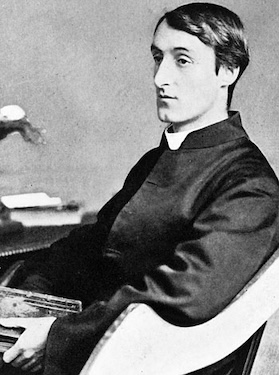
(Gerard Manley Hopkins)

Hopkins—Jesuit priest, classics professor—is, as W. H. Gardner wrote, ‘a religious, not merely a devotional, poet. Religion, for him, was the total reaction of the whole man to the whole of life’ (‘Introduction’ to Poems, xxxv). A good many of his poems are addressed directly and vividly to God, as in the first stanza of the first major poem, ‘The Wreck of the Deutschland’:

Thou mastering me
God! giver of breath and bread
World’s strand, sway of the sea;
Lord of living and dead
Thou has bound bones and veins in me, fastened me flesh,
And after it almost unmade, what with dread,
Thy doing: and dost thou touch me afresh?
Over again I feel thy finger and find thee.

‘The Windhover’ is dedicated ‘To Christ our Lord’, ‘Pied Beauty’ begins: ‘Glory be to God for dappled things’, ‘The Loss of the Eurydice’ is addressed ‘O Lord’ and a late sonnet begins: ‘Thou art indeed just, Lord, if I contend/ With thee’. The ‘terrible sonnets’, evidence of great stress, even ‘desolation’, also centrally concern his relationship with God:

I am gall, I am heartburn. God’s most deep decree
Bitter would have me taste: my taste was me;
Bones built in me, flesh filled, blood brimmed the curse.[7]


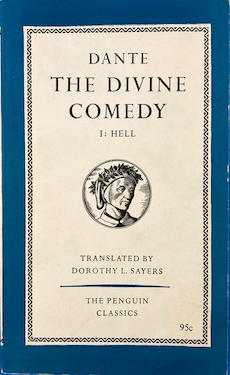
Religious themes featured early in Sayers’ writing life and became more central later, in her many plays and her translation of Dante’s Divine Comedy. This rector’s daughter may have had both father and rectory in mind when she wrote The Nine Tailors. Mr Venables is scholarly, very amiable and extremely absent-minded, and Lord Peter Wimsey comes to regard him with affection and respect. Could Sayers have felt that the line she omitted from Hopkins’ poem might have seemed blasphemous to some readers, an issue further complicated by its occurring in her hero’s thoughts? At one point, Wimsey is confronted by a visiting card on a wreath, purporting to be from him but actually supplied by his manservant Bunter (who had been Sergeant to Major Wimsey in the First World War). The card includes a biblical reference, Luke xii, 6. ‘“Very appropriate,” said his lordship, identifying the text after a little thought (for he had been carefully brought up)’ (The Nine Tailors, 133). It’s probably safe to assume that Sayers too had been ‘carefully brought up’ in that respect.


Notes

[1] A. S. Byatt, Medusa’s Ankles: Selected Stories (London: Vintage, 2023), 37. Her Ragnarok: The End of the Gods was published in 2011.

[2] Quoted in a note to the epigraph of ‘Gerontion’, in The Poems of T. S. Eliot. Volume I: Collected and Uncollected Poems, edited by Christopher Ricks and Jim McCue (London: Faber & Faber, 2015), 469.

[3] Paul Skinner, ‘Just Ford – an Appreciation of No Enemy: A Tale of Reconstruction’, Agenda, edited by Max Saunders, 27, 4/ 28, 1 (Winter 1989/ Spring 1990), 103-109 (105).

[4] Poems of Gerard Manley Hopkins, Fourth edition, revised and enlarged, edited by W. H. Gardner and N. H. Mackenzie (London: Oxford University Press, 1967), 105-106. These are the last lines of the poem.

[5] The Nine Tailors (1934; with an introduction by Elizabeth George, London: New English Library, 2003), 122. Davenport’s enthusiasm (he writes the title as The Nine Taylors) is expressed in a letter to Hugh Kenner, 10 April 1967: Questioning Minds: The Letters of Guy Davenport and Hugh Kenner, edited by Edward M. Burns, two volumes (Berkeley: Counterpoint Press, 2018), II, 888.

[6] The Letters of Gerard Manley Hopkins to Robert Bridges, edited by Claude Colleer Abbott (Oxford: Oxford University Press, 1955), 291.

[7] ‘I wake and feel the fell of dark’, Poems, 101.

Burden of proofs


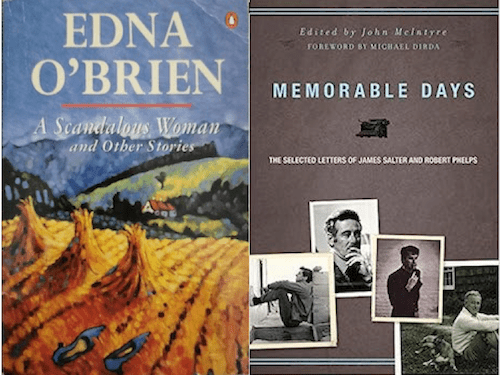
In the past couple of weeks, I’ve read a lot of tributes to, and memories of, Edna O’Brien, who died on 27 July. I know some of her books but clearly not enough of them. My favourite story about her is probably that in one of James Salter’s letters to Robert Phelps (a wonderful volume), dated 2 November 1972. Salter mentions at the top of the letter that Ezra Pound has died (it had happened the previous day) and reports on ‘Dinner last night with Edna O’Brien and her son.’ She was nervous about the play opening that night, A Pagan Place, from her novel of the same title. ‘She ate everything with her fingers’, Salter wrote, ‘lamb, clumps of spinach, they didn’t even have to wash her fork.’ O’Brien told him about a long story, ‘Over’, which the New Yorker was publishing. ‘She was marvelous, she could recite great passages, long pieces of her story, there was one sentence saying something like: I liked your voice and the way you poured things and your fingering.’ Her editor, ‘in the vastly inquisitorial galleys, wrote: “Mr Shawn [editor of the magazine, 1952-87] thinks this is a little too strong for us.” So Edna changed it to “and your fucking.”’[1]

Alas, ‘fingering’ seem to have made a comeback, certainly when the story was collected in A Scandalous Woman and other stories (1974): ‘Do you still use the same words exactly, and exactly the same caresses, the same touch, the same hesitation, the same fingering? Are you as shy with her as with me? If only you had had courage and a braver heart.’[2]

As for the change, was it made around that time, by reluctant but common consent, or later – perhaps at the proof stage? Proofs!

Looking for the umpteenth time at the draft of a Ford Madox Ford letter (its notes, rather), I wondered about an ‘enormous slap of cake’ and was dispirited by my glimpse of a poet named ‘William Worsworth’. In the first instance, I looked back to the original article and found—almost regretfully because I was warming to a ‘slap of cake’—that it was indeed ‘slab’. I didn’t need to check on the poet but simply inserted the missing letter. Any offended descendants of the poet Worsworth should write in.

Reporting on his struggle with the page proofs of The Pound Era (probably—but only probably—a longer book than this volume of letters will turn out to be), Hugh Kenner wrote to Guy Davenport: ‘It is demoralizing to find “viligance” for “vigilance” in a line one has already read 4 times.’[3] And any writer, editor or proofreader will be familiar with that feeling.


(Hugh Kenner via The National Post; photo by the scholar Walter Baumann)

Of an earlier book (on Samuel Beckett), Kenner had confided: ‘In accordance with my normal policy of imitating the specimen’s style, I rigorously trained myself to write dead-pan declarative sentences page after page, with here and there flickers of irony gleaming through the performance. I hope you like the effect.’ And proofs were not always an ordeal: fun was there for the taking, as he added to Davenport a week later: ‘I forget whether I told you that I have spliced bits of Happy Days into my Beckett proofs, so adroitly (I think) that no one will be able to tell they were not there all along.’[4]

In turn, Davenport mentioned, in his ‘Pergolesi’s Dog’—‘We are never so certain of our knowledge as when we’re dead wrong’—that ‘The New York Review of Books once referred to The Petrarch Papers of Dickens and a nodding proofreader for the TLS once let Margery Allingham create a detective named Albert Camus.’[5]

Sylvia Beach recalled the printer of Ulysses, Monsieur Dalantière, supplying as many sets of proofs as James Joyce wanted—‘he was insatiable’—and they were all ‘adorned with the Joycean rockets and myriads of stars guiding the printers to words and phrases all around the margins. Joyce told me that he had written a third of  Ulysses on the proofs.’ Right up to the last minute, ‘the long-suffering printers in Dijon were getting back these proofs, with new things to be inserted somehow, whole paragraphs, even, dislocating pages.’[6] My Viking Press edition of Finnegans Wake (New York: 4th printing, 1945) contains a list of corrections of misprints, made by Joyce: fifteen closely printed pages of double columns, in which such phrases as ‘insert comma’ and ‘delete stop’ abound.[7] The book was published in 1939, less than two years before Joyce’s death, after decades of eye trouble, cataracts, glaucoma and much else.


(Thomas Hardy, early 1920s via The Guardian)

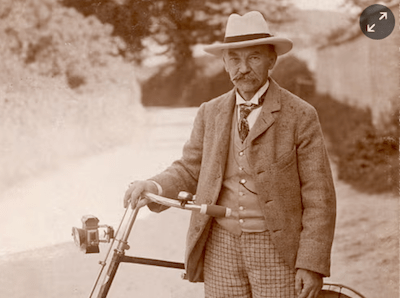
For the professional writer, of course, proofs are a constant, whether burden or blessing. . ‘I am bringing out a stodgy novel this autumn’, E. M. Forster wrote to his friend Malcolm Darling (22 August 1910) ‘but I think I told you this. It’s called Howards End, and dealeth dully with many interesting matters. I am correcting proofs now.’[8] Sylvia Townsend Warner reported in her diary: ‘Proofs and ten thousand letters.’ She added the more specific news that: ‘Thomas Hardy has died. Dorset will mourn – a more rare and antique state of things than England mourning.’[9]

As yet, a very long way from reaching the proof stage, I am still inching through Word documents. As for the errors that other people have missed in the proofs of their texts, errors I come across almost daily in my reading, that would be altogether too long a tale to tell. . .


Notes

[1] Memorable Days: The Selected Letters of James Salter and Robert Phelps, edited by John McIntyre, foreword by Michael Dirda (Berkeley, California: Counterpoint, 2010), 95-96. Phelps, in his letter of 10 November, commented: ‘I’ll never forget Miss O’Brien’s way with spinach’ (97). ‘Over’ appeared in The New Yorker (24 November 1972).

[2] Penguin Books edition (Harmondsworth, 1976), 56.

[3] Letter of 21 June 1971: Questioning Minds: The Letters of Guy Davenport and Hugh Kenner, edited by Edward M. Burns, two volumes (Berkeley: Counterpoint Press, 2018), II, 1357.

[4] Letters of 27 September 1961 and 6 October 1961: Questioning Minds, I, 37, 39.

[5] Guy Davenport, Every Force Evolves a Form (San Francisco: North Point Press, 1987), 145. Allingham’s Albert Campion would probably have been amused.

[6] Sylvia Beach, Shakespeare and Company, new edition (Lincoln: University of Nebraska Press, 1991), 58.

[7] See, on Joyce ‘adding commas’, Richard Ellmann, James Joyce (new edition, Oxford: Oxford University Press, 1983), 731, 734.

[8] Selected Letters of E. M. Forster, Volume One: 1879-1920, edited by Mary Lago and P. N. Furbank (London: Collins, 1983), 114.

[9] The Diaries of Sylvia Townsend Warner, edited by Claire Harman (London: Virago Press, 1995), 11: entry for 12 January 1928. Hardy had died in Dorchester the previous day, at the age of 87.

Remembering, or forgetting, 4 August


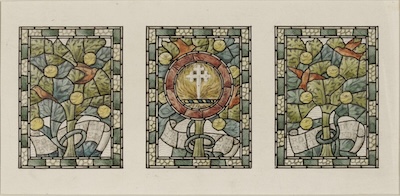
(Selwyn Image, ‘Stained Glass Design’, 1887: © Victoria & Albert Museum)

Looking at the news this 4 August, it’s sobering to reflect that one of the candidates for the Tory leadership recently vowed to ‘turn the tide of Liberalism’, when it is painfully obvious that what is actually – and urgently – needed is to turn the tide of fascism and racist violence.

Today is the 110th anniversary of Britain’s declaration of war, which will be old news to anyone who reads or writes around the First World War, or simply has an average grasp of history, and it has tended rather to dwarf other, personal, events and anniversaries – though not, perhaps, for the individuals concerned.

Walter de la Mare (‘Jack’) and Elfrida Ingpen (‘Elfie’) were married privately in the parish church at Battersea on 4 August 1899. D. H. Lawrence’s sister Ada married William Edward Clarke on 4 August 1913.[1] Julian Barnes noted that his grandparents were married on 4 August 1914, the day itself,[2] which also marked the birth of Anthony, Rebecca West’s son by H. G. Wells. It was the birthday of Florence, Stanley Spencer’s sister: she married J. M. Image, Cambridge don and brother to Selwyn Image.[3] Ezra Pound, quite recently arrived in London, went in February 1909 to see Selwyn, ‘who does stained glass. & has writ a book of poems. & was one of the gang with Dowson – Jonson – Symons – Yeats etc. – talks of “when ‘old Verlaine’ came over etc.’[4]


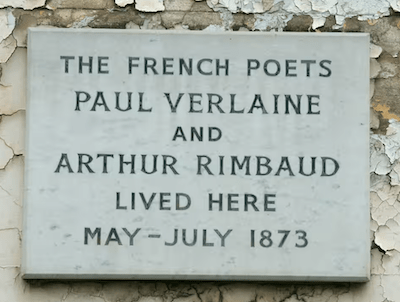
(Plaque, Royal College Street, Camden, via The Guardian: photograph by Frank Baron)

‘Old Verlaine’ came over more than once, firstly in 1872, in the company of Arthur Rimbaud (whom he later shot and wounded, in Brussels, another story), settling for a while in rooms in Howland Street off the Tottenham Court Road and, on a second visit shortly afterwards, in Camden Town. They seem to have dropped in on one of the soirées at the Fitzroy Square home of Ford’s maternal grandfather, the painter Ford Madox Brown and his second wife Emma.[5] In October 1893, at the suggestion of William Rothenstein, Verlaine arrived to lecture and read his poetry, in London and in Oxford. Ernest Dowson recorded that, arriving in the small hours of the morning, Verlaine was greeted by the poet and critic Arthur Symons, ‘bearing a packet of biscuits and a bottle of gin’. He gave his first lecture at Barnard’s Inn on 21 November and two days later arrived in Oxford, to be met by Rothenstein and a man named York Powell, of Christ Church (Icelandic scholar, authority on Roman Law, boxing and Middle High Dutch. He also knew Hebrew and Old Irish). Verlaine lectured on contemporary French poetry ‘in the room behind Mr Blackwell’s shop’ and was so enamoured of the city—‘Ô toi, cité charmante et mémorable, Oxford!’— that prising him out of it necessitated both escorting him to the train and withholding his lecture fee until he was safely on the train for London.[6]

Famously (if not quite famously enough), 4 August is the date threaded through Ford Madox Ford’s The Good Soldier—seventeen occurrences in all—and also the birthdate (4 August 1841) of W. H. Hudson, one of Ford’s most consistently admired writers, to whose work he recurred over more than thirty years, sometimes singling out Nature in Downland but more generally stressing that Hudson’s writing had ‘a tranquillity, a clearness of epithet, and an utter absence of affectation or strain that renders his pages like balm for tired souls’, adding that, as with Turgenev, ‘it is all one whether these writers treat of birds or of South American revolutions, of peasants singing, or of Nihilists at their debates. It is simply that the pages of their books reveal a personality, restful soothing, and itself quite at ease.’[7]


(Edward Heron-Allen in 1927, via The Edward Heron-Allen Society)

On 4 August 1918, the polymath (writer, scientist, linguist, historian) Edward Heron-Allen—very much not a friend of Ford’s—wrote in his journal that: ‘One thing stands out and is certain, and that is, that mentally and physically we are changed, changed as we never dreamed a whole nation could be changed.’ He noted that he had ‘escaped the “Spanish Influenza” of which we hear so much, but it seems to be a real menace. We are told that the German Army is “decimated” by it, and that this accounts for the delay and failure’ of the recent offensive.[8]

A decade and a bit further on, the poet and artist David Jones was making his third visit to his friend Helen Sutherland at Rock Hall, Northumberland, 4 August 1931. At the start and end of each visit, Jones would be driven past the Duke of Northumberland’s castle. Helen told him that this was on the site of Lancelot’s castle, Joyous Guard – and the supposed place of his burial. ‘With this association in mind, Jones referred to the church at Rock as “the Chapel Perilous”, the place of terrifying enchantment that Lancelot enters –­ an episode in Malory that reminded him of his experience at night in Mametz Wood.’[9]

The Battle of Mametz Wood, during the First Battle of the Somme, involved British attacks on 7 and 10-12 July, centrally involving the 38th (Welsh) Division and resulting in huge losses: their casualties were one-fifth of their total strength. David Jones was wounded in the early hours of 11 July, and his great poem In Parenthesis, stops at that point.[10]


(David Jones via The Poetry Foundation)

Lie still under the oak
next to the Jerry
and Sergeant Jerry Coke.
   The feet of the reserves going up tread level with your fore-
head; and no word for you; they whisper one with another;
pass on, inward;
these latest succours:
green Kimmerii to bear up the war.[11]

Ford Madox Ford left Cardiff with the 3rd Battalion on 13 July; and departed for France from Waterloo on 17 July. When 4 August came around this time, he was in a Casualty Clearing Station at Corbie, having been blown into the air and severely concussed by a high explosive shell, ‘so that, as I have said, three weeks of my life are completely dead to me though I seem to have gone about my duties as usual. But, by the first of September I had managed to remember at least my own name…’[12]

Quite a few public figures (not least newspaper columnists) seem to have lost their memories lately – quite selectively and with markedly less excuse.


Notes

[1] Letters of D. H. Lawrence II, June 1913–October 1916, edited by George J. Zytaruk and James T. Boulton (Cambridge: Cambridge University Press, 1981), 38n.

[2] Julian Barnes, Nothing to be Frightened of (Cape 2008), 28.

[3] Kenneth Pople, Stanley Spencer: A Biography (London: Harper Collins, 1991), 55, 49.

[4] Ezra Pound to His Parents: Letters 1895–1929, edited by Mary de Rachewiltz, David Moody and Joanna Moody (Oxford: Oxford University Press, 2010), 160.

[5] Angela Thirlwell, Into the Frame: The Four Loves of Ford Madox Brown (London: Chatto & Windus, 2010), 100. On a later visit, Verlaine lodged at 10, London Street, Fitzroy Square, very close to Howland Street.

[6] Joanna Richardson, ‘’The English Connection: French Writers and England, 1800-1900’, in Richard Faber, editor, Essays by Divers Hands: being the transactions of the Royal Society of Literature. New Series: Volume XLV (Woodbridge: The Boydell Press, 1988), 33-35; Joanna Richardson, Verlaine (London: Weidenfeld and Nicholson, 1971), 317-320.

[7] Ford Madox Ford, ‘Literary Portraits: XXV. The Face of the Country’, Tribune (11 January 1908), 2.

[8] Edward Heron-Allen’s Journal of the Great War: From  Sussex Shore to Flanders Fields, edited by Brian W. Harvey and Carol Fitzgerald (Lewes: Sussex Record Society, 2002), 203. A footnote adds that there were approximately 70 million deaths worldwide in 1918-19, compared to the estimated total of 7.8 million killed in action in the war.

[9] Thomas Dilworth, David Jones: Engraver, Soldier, Painter, Poet (London: Jonathan Cape, 2017), 140-142.

[10] Anthony Hyne, David Jones: A Fusilier at the Front (Bridgend: Seren Books 1995), 37.

[11] David Jones, In Parenthesis (1937; London: Faber, 1963), 187.

[12] Ford Madox Ford, It Was the Nightingale (London: Heinemann, 1934), 175.

Taking liberties


(A. Webster, ‘An Oriental Harbour’, National Trust for Scotland, Castle Fraser, Garden & Estate)

Walking back from the long round of the Victorian cemetery, still early, the Librarian remarks that this would be ‘a good Harry day’. As it would: the sun already high, little or no cloud, barely a breath of wind, soon to be around 26 degrees or so – as high as 30 (that’s 86 degrees in American money). The back garden will be warm and calm, idyllically so for animals that worship sun and sleep.

Not much later, I am aboard the Al Raza, not a classic dhow, locally known as ‘a launch’, some sixty feet long, ‘decidedly stubby, and her single mast was more like a twig than a tree and carried no sails.’ The craft is ‘a working launch of 100 tons and looked it.’ A crew of eight, including the nakhoda, the ship’s master, all Baluchis except one Indian-born and one Iranian. When engine trouble forces them to drop anchor off the coast of Iran, Gavin Young, whose earlier reading on the trip has included Ford Madox Ford’s Memories and Impressions, and who repeatedly cites Joseph Conrad, turns to his copy of Helen MacInnes’s Decision at Delphi.[1]

Just then, a white rabbit passed me, plucking a pocket watch from his waistcoat and audibly murmuring that he mustn’t be late, before popping down a large rabbit-hole under the hedge. Naturally, having recently reread the Alice books for Fordian purposes, I followed.

Now, MacInnes. Surely Hammond? Scottish, 30-odd novels and other books. Had I not read one or two? The Wreck of the Mary Deare, perhaps? Levkas Man? The rabbit rolled its eyes. Of course – I was misremembering, actually thinking of Innes, Hammond Innes. Helen MacInnes (1907-1985), whom I then looked up, did an MA at Glasgow University in French and German and added a diploma in librarianship from University College, London. She married, translated from the German with her husband, travelled widely in 1930s Europe, taking copious notes along the way, and moved to the United States when her husband, a fellow of St John’s College, University of Oxford, was offered a chair at Columbia University, teaching Latin and Greek. She published more than 20 books, mainly espionage novels, and several were filmed. Decision at Delphi was her 11th published novel.


(Helen MacInnes in 1941)

Her husband was Gilbert Highet, classicist – and MI6 intelligence agent. That name rang a bell. Careful to avoid the white rabbit’s gaze, I leafed through various mental pages and turned up Ezra Pound and Sextus Propertius.

Pound’s Homage to Sextus Propertius appeared in part in Poetry (March 1919) and in volume form seven months later, though he’d written to his parents as early as 1910: ‘I’ve taken to Propertius’.[2] And, decades later, it was Highet who wrote, in Horizon (January 1961), that Pound’s Homage was ‘an insult both to poetry and to scholarship and to common sense.’[3]

It’s true that, beginning with Professor William Gardner Hale of Chicago, against whose emphatic protests Harriet Monroe reluctantly published four of twelve sections in Poetry, a good many classical scholars have clutched their pearls in outrage at this iconoclastic American taking such liberties with a canonical writer—one of theirs.

Annalists will continue to record Roman reputations,
Celebrities from the Trans-Caucasus will belaud Roman celebrities
And expound the distensions of Empire,
But for something to read in normal circumstances?
For a few pages brought down from the forked hill unsullied?
I ask a wreath which will not crush my head.
            And there is no hurry about it

The poet Charles Tomlinson headed his selection from the poem ‘A travesty of Propertius’ Latin’, but his grasp of what Pound was doing meant that there was no contradiction between that heading and his terming the poem a masterpiece.[4] In another Oxford anthology, Adrian Poole and Jeremy Maule quote Pound’s ‘rampant defence’ of his poem in a letter to A. R. Orage on the first page of their introduction: ‘My job was to bring a dead man to life, to present a living figure’ and begin their Part 7, ‘Propertius to Hadrian’, with Pound’s superb section VII.

Though you give all your kisses
                                    you give but few.

Nor can I shift my pains to other,
            Hers will I be dead,
If she confer such nights upon me,
                                    long is my life, long in years,
If she give me many,
                        God am I for the time.

As Poole and Maule rightly say, ‘Translators must take liberties. They are in any case bound to be accused of having done so.’[5] Indeed, the history of translation and its reception is littered with the husks of those who knew the classical texts but had no sense of living English. George Steiner writes in his introduction: ‘A first look at nearly any translation in this anthology is enough to show whether it comes before or after’ the Homage, adding: ‘But the “making new” of translation had already occurred in Personae (1909) and Provença (1910). After “The River Merchant’s Wife” (1915) the art of translation had entered its modern phase.’[6]


The critic F. R. Leavis, highly influential in his time, wrote appreciatively of Hugh Selwyn Mauberley but Hugh Kenner, in ‘The Making of the Modernist Canon’ (1984), remarks on how Henry James’s ‘habits of diction were refracted throughout a poem Leavis nowhere mentions, Pound’s Homage to Sextus Propertius. That was a central modernist discovery, that distinctions between “prose” and “verse” vanish before distinctions between firm writing and loose’.[7] Kenner also touches there on  Imaginary Letters (1917-18), a series in the Little Review, begun by Wyndham Lewis and continued by Pound when Lewis was transferred to France. One striking feature of Pound’s ‘Imaginary Letters’ is the extent to which their texts would not look out of place in the Homage. Much of this is to do with the varied registers of language, mixing contemporary diction, poeticisms, large-mouthed polysyllables and the careful use of plain often monosyllabic words for some of Propertius’ reflections on love, death or fate. To that extent, his poem’s real subject is language, the intimate relation between a country’s language and its cultural health, the differences between public and private pronouncements, the strategies of a ruling class entrenched behind fortifications of rhetoric and generality. The disorientation that a reading of the poem can produce results in part from the multiplicity of voices Pound employs: Propertius as conventionally heard and as Pound hears and presents him; Victorian or earlier translators; contemporary English poets (in that last year of the war). Perhaps unsurprisingly, not a few readers these days rate the Homage even above Mauberley. It was, and remains, an astonishing achievement, by turns provocative, moving and funny.

I have, of course, ordered a copy of MacInnes’s Decision at Delphi – and also a copy of Assignment in Brittany, her second book, which became, apparently, required reading for British agents joining forces with the French resistance.


Notes

[1] Gavin Young, Slow Boats to China (1981; London: Picador, 1995), 269, 278. His In Search of Conrad, published in 1991, won the Thomas Cook Travel Book Award.

[2] Ezra Pound to His Parents: Letters 1895–1929, edited by Mary de Rachewiltz, David Moody and Joanna Moody (Oxford: Oxford University Press, 2010), 239. His letter of 3 November 1918 has: ‘Also done a new oeuvre on Propertius’ (423).

[3] Quoted by J. P. Sullivan, Ezra Pound and Sextus Propertius: A Study in Creative Translation (London: Faber and Faber, 1965), ix.

[4] The Oxford Book of Verse in English Translation, Chosen and Edited by Charles Tomlinson (Oxford: Oxford University Press, 1980), 443; Tomlinson, Poetry and Metamorphosis (Cambridge: Cambridge University Press, 1983), 59. The book contains the four 1982 Clark Lectures, delivered at Trinity College, Cambridge.

[5] The Oxford Book of Classical Verse, edited by Adrian Poole and Jeremy Maule (Oxford: Oxford University Press, 2000), xxxv, 423.

[6] George Steiner, editor, The Penguin Book of Modern Verse Translation (Harmondsworth: Penguin Books, 1966), 33. In his introduction to The Translations of Ezra Pound (enlarged edition, London: Faber and Faber, 1970), Hugh Kenner remarks: ‘Pound calls the Propertius sequence a Homage, largely in a futile attempt to keep it from being mistaken for an attempt at translation’ (12-13). He does not include the poem in that volume.

[7] Reprinted in Hugh Kenner, Mazes (Athens: University of Georgia Press, 1995), 31. ‘Major snow job in western education is concealment of the hit & miss state of Graeco-Roman texts, all but a few’, Kenner wrote to Guy Davenport (8 June 1962).  ‘Ez rearranged Propertius fragments in the spirit of the scholarship that gave us the standard texts by—arranging fragments’: Questioning Minds: The Letters of Guy Davenport and Hugh Kenner, edited by Edward M. Burns, two volumes (Berkeley: Counterpoint Press, 2018), I, 137.

Things going better, bitte


(Not a Sequoia)

‘We drove up once to the Sequoia forest’, Christopher Isherwood told W. I. Scobie, ‘and I remember Stravinsky, so tiny, looking up at this enormous giant Sequoia and standing there for a long time in meditation and then turning to me and saying: “That’s serious.”’[1]

Sometimes, even for those long-practised in weathering it, the news becomes so distressing—and the public pronouncements of senior politicians so disgusting—that it’s best to pause, assuming you’re in the luxurious position of being able to do so.

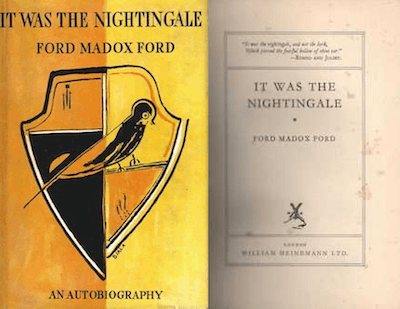
Ford Madox Ford or, let’s say, the narrator, does just that on page fifteen of It Was the Nightingale, which I’m currently reading for—let’s say the fifth time, not to sound too crazy. He pauses ‘with one foot off the kerb at the corner of the Campden Hill waterworks’. He is ‘about to cross the road. But, whilst I stood with one foot poised in air, suddenly I recognised my unfortunate position. . . .’ His rendering of the reflections that occur to him in that position appear to end, or pause, around page 88.


A few years back, I was writing about Ford and comedy, about genres and how comic writing is not viewed using the same critical criteria as ‘serious’ writing, discussing mostly the novels by Ford that might be regarded as comic: farces, satires for the most part. I was struck by a passage in a Guy Davenport essay:

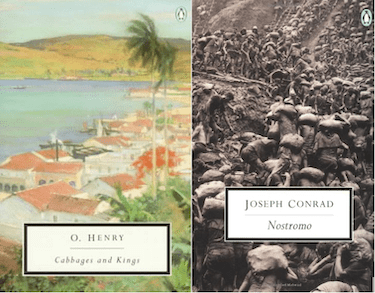
‘When Nostromo and Cabbages and Kings were published in 1904, we were beginning to make a distinction not among the four large types of literature which Northrop Frye has named comedy, romance, tragedy, and satire, or spring, summer, autumn, and winter spirits of the imagination, but between comic and serious. Some writers, like Shakespeare, Mark Twain, and Bernard Shaw, were allowed to be both at once, but with the understanding that the comic was being put in the service of the serious. The seriousness of the comic writer could only be sentimentality, and his business was to entertain, not to instruct’.[2]


Davenport writes as an admirer of O. Henry, a fat selection of whose stories he edited and introduced for Penguin Books. ‘To those friends who knew his past’, he writes there, ‘O. Henry always compared himself to Lord Jim.’ His introduction ranges over the classics—unsurprisingly, Davenport being both classicist and modernist—and some of the writers, possibly unexpected, who have admired O. Henry’s stories, among them Cesare Pavese, the Russians of the Constructivist movement, Yevgeny Zamyatin. Alluding to practitioners of the New Comedy, he remarks: ‘Miserable as our century is, we can still boast that for seventy years of it we had P. G. Wodehouse, the Menander de nos jours, and for ten years O. Henry.’[3]

Ford being one of those who was surely ‘allowed to be both at once’, I tried to convey how many comic moments—certainly passages that made me laugh—there were in the ‘serious’ books, not excluding The Good Soldier and Parade’s End.[4] I’ve wondered since whether I shouldn’t simply have said: Well, just read It Was the Nightingale. But no. It’s perfectly possible to explain, or attempt in accepted ways to do so, why you think a writer or a painter is good, what they succeed in, their distinctive personal characteristics. But explaining why someone is funny? Can it be done? You might explain why you personally find something funny but that may sound, to a reluctant or sceptical listener, as interesting and persuasive as your last night’s dream.

I quoted the estimable Frank Budgen on his friend, author of the comic masterpiece, Ulysses: ‘one day Joyce laughed and said to me: “Some people were up at our flat last night and we were talking about Irish wit and humour. And this morning my wife said to me, “[w]hat is all this about Irish wit and humour? Have we any book in the house with any of it in? I’d like to read a page or two.”’[5]

If the reader doesn’t find Ulysses funny, I suspect it’s because it feels intimidating too: this huge book, full of words, phrases, constructions, comparisons, images and symbols that you’re never come across before. Not, anyway, in those contexts and those combinations. Worse, it’s the Greatest Novel of the century or one that defined an era or the justification for the whole modern movement or—but is it funny? Well, yes, probably not if you go through it on tiptoe or hands and knees, peering warily about you as you go. But if you can relax, telling yourself that you’ll come back to it with a pick and shovel at some later date but just not now – pour a glass (leave the bottle) and sit back in that comfortable chair – things may go better.

I linger over that phrase—‘things may go better’—just for a moment, you understand. How could I not?

Notes


[1] Writers at Work. The Paris Review Interviews: 4th Series, edited by George Plimpton (Harmondsworth: Penguin Books, 1977), 232.

[2] ‘The Artist as Critic’, in Every Force Evolves a Form (Berkeley: North Point Press, 1987), 79.

[3] ‘Introduction’ to O. Henry, Selected Stories (New York: Penguin Books, 1993), xi, xv. Possible additions to these inheritors of the New Comedy are ‘the exotic and manic S. J. Perelman and the gentle, whimsical Thurber’.

[4] ‘Ford and Comedy’, Sara Haslam, Laura Colombino and Seamus O’Malley, editors, The Routledge Research Companion to Ford Madox Ford (London: Routledge, 2019), 427-440.

[5] Frank Budgen, James Joyce and the Making of ‘Ulysses’ and other writings, enlarged edition (1934; London: Oxford University Press, 1972), 38.

Notes to self


(Lily Delissa Joseph, Teatime, Birchington Ben Uri Gallery & Museum)

‘Are you writing?’ my elder daughter asks, when the Librarian and I meet her for tea at the Watershed café.
‘Mainly footnotes’, I answer.
Footnotes! We have been here before.

In Last Post, the final volume of Ford Madox Ford’s Parade’s End tetralogy, Sylvia Tietjens reflects on the damage she has managed to inflict on her estranged husband Christopher. The ancestral home, Groby, has been let to rich Americans and Mrs de Bray Pape, in the course of her ‘improvements’, has brought down Groby Great Tree and has also mangled the dovecote:

But apparently it was going to mangle the de Bray Papes to the tune of a pretty penny, and apparently Mr. Pape might be expected to give his wife no end of a time…. Well, you can’t expect to be God’s Vice-gerent of England without barking your shins on old, hard things.[1]

‘Vice-gerent’? Not something I’d come across, as far as I could recall. I consulted a reference book or two and the resultant footnote read: ‘Properly not hyphenated, though in practice it often is. Applied to priests and, specifically, to the Pope, it does mean representative of God or Christ. The Papist Ford may be punning on Popes and Papes here.’ Under the more familiar ‘viceregent’, one of the dictionaries I peered into had: ‘often blunderingly for vicegerent’. A fairly easy mistake to make, I’d have thought: if annotating at all, the decision to footnote the word was hardly controversial. But the key phrase there is probably ‘if annotating at all’.

I suspect that quite a few readers still object to annotation on principle: how can you familiarise yourself with, and come to know, the language of Shakespeare if you stop for a footnote and a species of translation into modern English every couple of words? But such a question, posed on a quiet country road, is soon drowned out by traffic on a highway which can lead to unsettling termini. What? You’re reading The Tale of Genji, War and Peace and the Icelandic Sagas in translation? Are you planning simply to waste the next two hundred years of your life?

But then plays and poetry perhaps present slightly different criteria for discussion than do novels. Narrative, story, that determined forward movement, certainly a quicker reading – do you really want to pause for footnotes there, lose momentum, weaken the impetus, misplace a thread or two? And there are, after all, different kinds of footnote. A term likely to be unfamiliar to some, even most, readers can be briefly illuminated. But here’s a scene from Ford’s A Man Could Stand Up—, the third volume of his Parade’s End tetralogy. Christopher Tietjens, in the trenches during Ludendorff’s great offensive of Spring 1918, waits amidst the strafe for the enemy attack:

Noise increased. The orchestra was bringing in all the brass, all the strings, all the woodwind, all the percussion instruments. The performers threw about biscuit tins filled with horse-shoes; they emptied sacks of coal on cracked gongs, they threw down forty-storey iron houses. It was comic to the extent that an operatic orchestra’s crescendo is comic. Crescendo! …. Crescendo! CRRRRRESC…. The Hero must be coming! He didn’t![2]

In an earlier scene, two volumes (and a World War) back, Tietjens had walked on a path across a Kentish field with, ahead of him, the young suffragette Valentine Wannop:

“God’s England!” Tietjens exclaimed to himself in high good humour. “Land of Hope and Glory!” —F natural descending to tonic, C major: chord of 6-4, suspension over dominant seventh to common chord of C major. . . . All absolutely correct! Double basses, cellos, all violins: all wood wind: all brass. Full grand organ: all stops: special vox humana and key-bugle effect…”[3]


(Francis Sydney Muschamp, Scarborough Spa at Night, Scarborough Art Gallery

In 1939, in one of the last pieces he wrote before his death, certainly one of the very last he published, we see this: ‘Now then, the full orchestra of all the seven arts, all brass, all percussion, all wind, all strings, all wood wind, is away.’[4]

One kind of reader will respond: ‘So what?’ Another kind of reader: ‘Annotate it to within an inch of its life.’ I’m somewhere in between though a good deal—a great deal—closer to the inch-mob than to the so whats?

Ah, but annotate one, two or all (disregarding the option of ‘none’)? If one, which one? The first because chronologically earlier? The second, then the third, because they look back to the first? And is the point of doing so that he repeats himself – or likely to be taken as such by a reader less familiar with the Ford canon? All writers repeat themselves, to a greater or lesser degree, a fact often made apparent only by – annotation. Repetition is rarely exact repetition and is, in any case, often a part of a deliberate artistic programme or policy. Ask Miss Gertrude Stein. And, while not everyone finds recurrence of interest, some of us do (to a worrying degree, perhaps). A phrase or a moment recalled twenty, thirty or more years later; a play or a poem referred to repeatedly – I’m curious to know why. The writer, painter, composer may be the most admired, so the poet or novelist refers over and over to Dante, to Joyce, to Donne, to Cézanne, to Bach. T. S. Eliot, composing or assembling The Waste Land, draws on Shakespeare’s The Tempest at least half a dozen times, as Matthew Hollis reminded me over breakfast this morning.[5]

But, briefly, the arguments for my annotation habit in the arena of Fordian letters are three. Firstly, words drop from sight or change their usage and may present to a reader blank spots in a text which can be simply and painlessly repaired by a note, as can the names of now-forgotten writers and editors and society figures, defunct periodicals and the like; secondly, many critical texts are intended to be read by several kinds of reader, from the casual browser to the professional scholar, who can ignore them or pore over them, according to taste and occasion – and some of them will be extremely glad to know of echoes, recurrences, patterns and connections; thirdly, you have to take your fun where you can find it.

On Tuesday, half the recycling was not collected – for no explicable reason. Yesterday, a Spring month, here in the south of England, snow was falling. Mere anarchy is loosed upon the world.

Should I annotate that last sentence? Probably not.


Notes

[1] Ford Madox Ford, Last Post (1928; edited by Paul Skinner, Manchester: Carcanet Press, 2011), 163.

[2] Ford Madox Ford, A Man Could Stand Up— (1926; edited by Sara Haslam, Manchester: Carcanet Press, 2011), 79.

[3] Ford Madox Ford, Some Do Not. . . (1924; edited by Max Saunders, Manchester: Carcanet Press, 2010), 133.

[4] Ford Madox Ford, ‘A Paris Letter’, Kenyon Review, I (Winter 1939), 20.

[5] Matthew Hollis, The Waste Land: A Biography of a Poem (London: Faber, 2022), 282. Elsewhere, he discusses the afterlife of the notes that Eliot was obliged to add to meet the publisher Liveright’s demands for a volume of a certain length: ‘For all Eliot’s ambivalence, the notes are now forever fused with the poem’ (376). As they are. But I don’t see that as a clear and present danger in this case.

Small pleasures, wary smiles, beautiful trees

(Thomas Kyd, The Spanish Tragedy)

Tramping through the park, I mention to the Librarian that small pleasures are underrated. Her sideways glance says—or do I misread it?—‘Why then Ile fit you/ Hieronymo’s mad againe.’ I explain that I’m thinking of the scheme of the Cantos that Ezra Pound conveyed to his father in a letter of April 1927, which begins: ‘A. A. Live man goes down into world of Dead’.[1]

I’d seen this for, what, the twentieth time, more? when rereading an essay by Walter Baumann,[2] that same sentence having turned up in volumes of letters and who knows how many commentaries on the Cantos, beginnings of, progress of, schema of. ‘In another place’, I said, ‘he talks about Odysseus as a live man among duds.’[3] She eyes me warily, though she’s fairly used to this stuff. ‘It finally occurred to me’, I say, ‘the aural closeness of “dead” and “duds”. I’m just wondering if there’s any etymological connection.’ (If it were really of any interest, dozens of Pound scholars would already have noted this, of course: they probably have but I just missed it; they certainly seem to have noticed everything else. But – small pleasures. . . )
She nods. ‘The trees are looking really beautiful at the moment.’
So they are, so they are.

At home, naturally enough, I look up ‘dud’ – and the first dictionary to which I turn offers: ‘Origin unknown’; the second, ‘Middle English, of unknown origin’. Clearly, this won’t do. But here is the blessed Eric Partridge:[4] ‘dud’ is probably influenced by the 17th-20th century dialect term ‘dudman’, a scarecrow – ah, ‘but the word may derive ultimately ex Dutch dood, dead.’ His entry points to Ernest Weekley’s Etymological Dictionary of Modern English. And yes, rather wonderfully, it is that Weekley, Professor of Modern Languages at the University of Nottingham for forty years and husband of Frieda Weekley until a chap called D. H. Lawrence happened by. Weekley was compiler of this often-referred to dictionary plus many other works and lived until 1954, almost a quarter of a century after the death of the man who decamped with his wife.

(https://picturenottingham.co.uk/image-library/image-details/poster/ntgm007755/posterid/ntgm007755.html)

Small pleasures– or pleasures generally. As Emma Woodhouse explains to her puzzled father: ‘“That is the case with us all, papa. One half of the world cannot understand the pleasures of the other.”’[5]

Three calendar months too late, I remember the words of ‘the Compiler’, in Ford Madox Ford’s No Enemy: ‘And, truly, in all the gardening year – which is all pleasure except for such lets and hindrances as God decrees to you in order that you may remember that you are human – there is no pleasure to equal the pleasures of a mid-September day.’[6] Looking back in 1924 to the far side of the war, further, to the period of collaboration with Joseph Conrad, Ford wrote: ‘one got in those days those small, cheerful pleasures out of life.’[7] And, two years later: ‘there is a really sensuous pleasure in uttering a correct French sentence, as there is in eating good French cookery, the pleasures being very nearly akin.’[8] A man who took his pleasures seriously and knew their precise nature. . .

Perhaps unsurprisingly, Flannery O’Connor’s view of pleasures had, let’s say, a slightly different angle. In a 1952 letter to Sally and Robert Fitzgerald, she wrote: ‘I had to go have my picture taken for the purposes of Harcourt Brace. They were all bad. (The Pictures.) The one I sent looked as if I had just bitten my grandmother and that this was one of my few pleasures, but all the rest were worse.’[9]

(Flannery O’Connor: via https://ugapress.wordpress.com/ )

This was a woman who knew precisely where – on the scale of pleasures – biting your grandmother should be placed.

The other morning, I woke around 04:30, was joined by the cat shortly afterwards and didn’t really get back to sleep before 06:00 arrived, with Harry’s well-established expectations of breakfast. The ninety-minute interlude occasionally strayed into that area of semi-doze in which nonsense confidently presents itself as insight. And yet, and yet, somewhere there is the border, on the other side of which insight and rationality wait with bottled water, sandwiches and encouragement. Which side are you on?

DA, I found myself thinking—as in Datta, Dayadhvam, Damyata—why, those are the initials of Dante Alighieri, who is quoted on The Waste Land‘s very next page.[10]

It hardly needs saying that this is either of world-shattering importance or mere evidence of a man having trouble getting back to sleep. Obviously, I haven’t mentioned it just yet. I am waiting for the next walk – ideally, while the trees are still looking extravagantly beautiful.


Notes

[1] Letters of Ezra Pound, 1907-1941, edited by D. D. Paige (London: Faber and Faber, 1951), 285.

[2] Walter Baumann, ‘Ezra Pound and Magic: Old World Tricks in a New World Poem’, in Roses from the Steel Dust: Collected Essays on Ezra Pound (Orono: National Poetry Foundation, 2000), 29.

[3] Ezra Pound, ‘Hell’, a review of Laurence Binyon’s translation of Dante’s Inferno: Literary Essays of Ezra Pound, edited by T. S. Eliot (London: Faber and Faber, 1960), 212.

[4] Eric Partridge, A Dictionary of Slang and Unconventional English, 8th edition, edited by Paul Beale (London: Routledge, 1984).

[5] Jane Austen, Emma (1816; edited by James Kinsley, Oxford: Oxford University Press, 1990), 74.

[6] Ford Madox Ford, No Enemy (1929; edited by Paul Skinner Manchester: Carcanet Press, 2002), 116-117.

[7] Ford Madox Ford, Joseph Conrad: A Personal Remembrance (London: Duckworth, 1924), 39.

[8] Ford Madox Ford, A Mirror to France (London: Duckworth, 1926), 250.

[9] Flannery O’Connor, Collected Works, edited by Sally Fitzgerald (New York: Library of America, 1988), 895.

[10] T. S. Eliot, The Waste Land, lines 400ff and 427, The Complete Poems and Plays (London: Faber and Faber, 1969), 74-75.

Perversity, perhaps

(Francis Carco; Jean Rhys)

In ‘A Feeling for Ice’, Jenny Diski describes the moment in her trip to Antarctica when the ship approaches St Andrew’s Bay, ‘the great penguin treat of the trip.’ She notes the ‘legion of black faces and orange beaks pointed out to sea facing in our direction, seeming to observe our arrival.’

‘One day, once a year or so, black rubber dinghies approach, and a handful of people come to the Bay, believing that the penguins are watching them arrive. For the penguins, it’s just another day of standing and staring. They parted slightly to make way for us, but they still stood looking out to sea.’[1]

Looking out to sea, looking in to see. Out there, of course, the days go by, sometimes galloping, sometimes on hands and knees – but generally not hanging around. ‘Time is different at different times in one’s life’, Doris Lessing observed. ‘A year in your thirties is much shorter than a child’s year – which is almost endless – but long compared with a year in your forties; whereas a year in your seventies is a mere blink.’[2]

(Photography by Edward Curtis)

Yes, those earlier days are denser, more numerous. There was a time in the United States when the buffalo numbered tens of millions; by the late nineteenth century, they could be counted in hundreds. In 1849, Francis Parkman had observed of the Western Dakota that the buffalo ‘supplies them with almost all the necessaries of life’, adding: ‘When the buffalo are extinct, they too must dwindle away.’[3] Peter Benson’s Isabel’s Skin is not upbeat on the matter of days— ‘Days come and days pass, and it is too easy to think you know what happened. People change and you think you knew who they were, who you were and how you reached the place you find yourself in, but you know nothing’—but more so when it comes to books, which ‘sleep, awake, open, and sometimes even change a life. They move like herds of animals across dust plains and leave clouds in the sky.’[4]

Red letter days, black letter days, some anonymous, some named. Last Friday was my mother’s one hundredth birthday – or would have been had she hung on just seven more years. When she had trouble recalling which day of the week it was, we hung a calendar on her wall. Now, since I retired, I can usually answer a query of that kind correctly – as long as I don’t have to give too snappy a response.

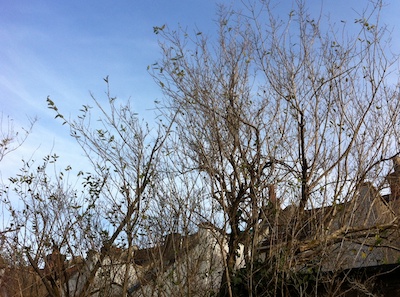
Named days. On All Hallows’ Eve, and on All Saints’ Day—I suspect that they won’t be marching in, and certainly not here—we walked between the showers, often accompanied by a furious wind as we began the long circuit of the cemetery. Then a few days of wetter weather, the grass of the park beginning to feel spongy, never quite drying out. And this morning a misleading blaze of blue through almost leafless branches at the back of the house where the tortoiseshell cat high-steps along our fence.


‘How odd Memory is – in her sorting arrangements’, the narrator of Walter de la Mare’s unsettling story ‘All Hallows’ remarks, ‘How perverse her pigeon-holes.’[5]

Perverse! The very word is like a bell, tolling me back. . . Well, here’s Guy Davenport, admirer of—and expert on—Ezra Pound’s poetry: ‘Pound’s strategy in choosing the materia and dynamics for The Cantos is at least consistent: reduced to a law it is this: In every subject to be treated, choose the matter which most perversely exemplifies it.’ He adds that it’s a good rule for a poet determined to be original. ‘When, however, the rule tyrannizes its manipulator, its perversity ceases to be strategic, and much in the poem that rings false can be traced to this simple rule.’[6]

Patrick White has a character resolving a theological dispute: ‘Then the old man, who had been cornered long enough [by the young evangelist], saw, through perversity perhaps, but with his own eyes. He was illuminated.  
‘He pointed with his stick at the gob of spittle.  
‘“That is God,” he said.’[7]

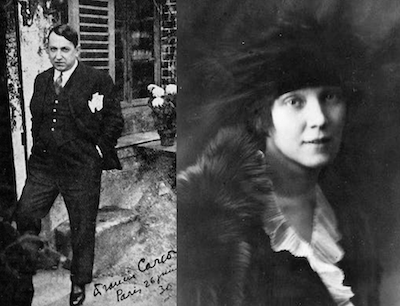
Still, the word’s primary nudge, for a Ford Madox Ford reader, is towards Perversité by Francis Carco or, rather, the vexed history of its translation. Carco was a poet, dramatist and novelist, and a pilot during the First World War, when he had an affair with Katherine Mansfield, who stayed with him in the spring of 1915 and drew on that time for at least two of her stories, one of them Je ne parle pas français.

Ford’s affair with Jean Rhys had various consequences for both parties: one of them was his securing for Rhys the job of translating Carco’s novel. As Carole Angier records, ‘This last kindness Ford had done her ended no better than the others: for when Perversity was published in 1928, the translation was credited not to Jean but to Ford. She was angry and upset about this for a long time, convinced that once again he had deliberately exploited and betrayed her. In fact, in this affair she hadn’t been Ford’s victim but that of the publisher, Pascal Covici. Ford had clearly named her as translator from the start, both to Covici and to others; but Covici had evidently decided that the book would sell better with Ford’s name on it.’[8]

Rhys’s own version, nearly forty years after its publication, emerged in a letter to Francis Wyndham, to whom she mentioned that she’d received a letter from Arthur Mizener, asking if she had any letters from Ford—which Cornell University would willingly buy—and also about the translation of Perversité. ‘I did that ages ago’, Rhys wrote to Wyndham, ‘and when it appeared my agent wrote to ask about it, for I hadn’t been told that I was “ghosting”. It was Covici the publisher’s fault, and I know Ford did his best to put things right. Then the book was banned and I heard no more about it. Mr Mizener said that a lot of ink had been spilled, which surprised me, for several people knew I was doing it at the time. I wasn’t very pleased with the translation for it had to be done in a hurry and there was a good deal of slang.’[9]


Arthur Mizener—not in person but by way of his biography of Ford—cropped up in a recent walk. Conversation with the Librarian in parks and cemeteries tends to begin with—or recur to—those perennial themes and questions: is this the worst government that either of us can remember? Yes. How was it news to so many people that the present administration is thoroughly corrupt? Don’t know. Can the country ever recover from the damage they’ve done, are doing, will continue to do to it? Probably not. But then there are trees, birds, other people, weather, food, wine and books.

On this occasion, I rambled on for a while about Arthur Mizener’s biography of Ford, which I’d been re-reading. Although frequently assailed by anecdotes, alleged insights, snippets of research and the like, the Librarian’s interest in Ford is primarily, let’s say, by association, though she was getting along swimmingly with Parade’s End until she reached the final volume, Last Post – the one I edited, of course. Still, the fresh air, the surroundings, the rhythm of walking, together fostered a tolerant attention, so I rattled on.

Fordians tend to have a problem with Mizener. He did a lot of research and produced a great deal of valuable information – but ended up not liking Ford very much, often put the worst possible construction on his actions and reactions, and rarely believed a word he said. But what had struck me on reading the book again after a long hiatus was that Mizener seemed unfamiliar with what a novelist actually does—and, in fact, what anybody does to a greater or lesser degree. When he pointed out, rather censoriously, Ford’s recasting of experiences, rearranging the elements of a story, lightening or darkening materials, retelling an anecdote with variations, I found myself pencilling in the margins ‘But – Art!’ or ‘Fiction! Fiction!’ or silently shouting: That’s his job! or He’s a writer! or even (appallingly appropriative, I know) Me too!

None of which, obviously, will prevent my snaffling whatever useful details I can glean for my own purposes from his—or, indeed, anybody else’s—endnotes.

Not to do so would be sheer perversité.


Notes

[1] Jenny Diski, Why Didn’t You Just Do What You Were Told? (London: Bloomsbury, 2020), 103, 104. The essay was first published in January 1997.

[2] Doris Lessing, Walking in the Shade (1997; London: Fourth Estate, 2013), 32-33.

[3] Francis Parkman, The Oregon Trail (1849; edited by David Levin, Harmondsworth: Penguin Books, 1982), 199.

[4] Peter Benson, Isabel’s Skin (Richmond: Alma Books, 2013), 19, 123.

[5] Walter de la Mare, Short Stories, 1895-1926, edited by Giles de la Mare (London: Giles de la Mare Publishers Limited, 1996), 339.

[6] Guy Davenport, Cities on Hills: A Study of I–XXX of Ezra Pound’s Cantos (Ann Arbor, Michigan: UMI Research Press, 1983), 257. The book was a revision of Davenport’s 1961 PhD thesis.

[7] Patrick White, The Tree of Man (1955; Harmondsworth: Penguin Books, 1961), 476.

[8] Carole Angier, Jean Rhys: Life and Work (London: Andre Deutsch, 1990), 164.

[9] Rhys to Wyndham, 28 January [1966]: Jean Rhys: Letters, 1931-1966, edited by Francis Wyndham and Diana Melly (London: André Deutsch, 1984), 294-295.