Bunting Nodding

Lawrence, Thomas, 1769-1830; Homer Reciting his Poems

(Homer Reciting His Poems: Thomas Lawrence, Tate)

Francis Wyndham once observed that what he’d always wanted to do in his fiction was ‘to write about the hours and hours and hours, the enormous proportion of life which is spent in a kind of limbo, even in people’s active years. It seems to me that it isn’t sufficiently celebrated.’[1]

He meant it, I think, in a secular sense: an uncertain period of waiting, for decisions or resolutions, rather than the borderlands of Hell, unbaptised infants and the rest; nor, presumably, a Caribbean dance. My Chambers dictionary adds the helpful ‘unsatisfactory state of consignment or oblivion’.

Ah, oblivion. Yes, I’d apply that to many people passed in the street, plugged in to various devices, oblivious at least to the world through which they’re walking. Oblivious too are some of the passing motorists, a few of whom are busily and hazardously engaged with their mobile phones or make-up or breakfast, all the while keeping their speed up to 50 m.p.h. to avoid bits of themselves dropping off.

‘Dropping off’ recalls me to a deeper state than limbo: actually nodding off. Having nodded off, actually or almost, at staff meetings and conferences, in cinemas and theatres, readings, lectures and presentations, I think of Homer nodding. (A lot of links assume that ‘Homer’ means ‘Simpson’ rather than ‘dead, blind Greek epic poet’ but the latter is meant here.) The phrase, ‘even Homer nods’, deriving originally from Horace, is now pressed into service often and in wildly divergent contexts. There was, naturally, a band called ‘Even Homer Nods’ — though the soporific qualities of such a lengthy name presumably prompted them to the snappier version which succeeded it: ‘The Nods’. There is also a racehorse, I gather, an Irish chestnut gelding (with the full-length moniker).

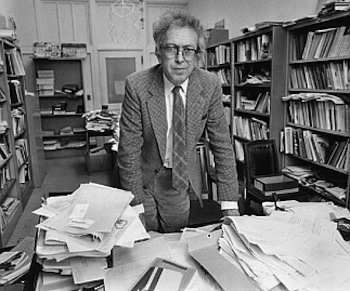
Bunting_Poems

My worst instance of dropping off—certainly the occasion when I least wanted to—was at a reading by Basil Bunting (to whom birthday wishes are due: born 1 March 1900) a few years before he died. Not having taken the precaution of writing down detailed directions to the venue, I wandered around unfamiliar parts of the city for a couple of hours. Early on, I established the habit of popping into a pub for advice every so often and downing a quick drink. The various bar staff that I consulted had conflicting views on where the small theatre was, so I arrived late and the worse for wear. The attendance was appalling but would not have surprised Bunting, I suspect. He read a number of translations from the Persian and some early poems, certainly his ‘Villon’, but I may have slumbered through at least a third of the incomparable ‘Briggflatts’. I have two recordings of the poem (both by Bunting) but that live performance must have been one of his last—one of the true last chances.

As the player’s breath warms the fipple the tone clears.
It is time to consider how Domenico Scarlatti
condensed so much music into so few bars
with never a crabbed turn or congested cadence,
never a boast or a see-here; and stars and lakes
echo him and the copse drums out his measure,
snow peaks are lifted up in moonlight and twilight
and the sun rises on an acknowledged land.[2]

Later, though, I read an account of how Bunting had attended a lecture by Robert Duncan, slept through the greater part of it, snoring audibly, then woken at the end to exclaim how much he’d enjoyed it: ‘I like talks like that.’[3] So yes, even Bunting nodded.

References

[1] Quoted in the text of Rachel Cooke’s interview with Wyndham (The Observer, August 2008):  http://www.guardian.co.uk/books/2008/aug/17/francis.wyndham.interview

[2] Briggflatts, IV: The Poems of Basil Bunting, edited by Don Share(London: Faber and Faber, 2016), 56.

[3] J. M. Edelstein, in Madeira & Toasts for Basil Bunting’s 75th Birthday, edited by Jonathan Williams (Highlands, North Carolina: Jargon Society, 1977), unpaginated, but see also Richard Burton, A Strong Song Tows Us: The Life of Basil Bunting ((Oxford: Infinite Ideas, 2013), 419.


Put it more simply, Larry

durrell.via.theamericanreader.com

(Lawrence Durrell via theamericanreader.com )

When I went to the Ford Madox Ford conference in Swansea in September 2013, I remember thinking, as the train entered Wales, that the change was physically apparent. Could I really look out of a train window and say ‘that’s Wales’? I felt I could but would have been hard put to it if I were challenged to say precisely how and why. But I did, quite abruptly, recall the opening lines of a poem by R. S. Thomas, whose title I could not then remember, and sat leaning against the window, listening to the voice in my head:

To live in Wales is to be conscious
At dusk of the spilled blood
That went into the making of the wild sky,
Dyeing the immaculate rivers
In all their courses.
It is to be aware,
Above the noisy tractor
And hum of the machine
Of strife in the strung woods,
Vibrant with sped arrows.[1]

No, that’s not quite what I heard. The third line had ‘to’ instead of ‘into’, the fourth and fifth lines had vanished from my memory, I had ‘the noise of the tractor’ and ‘the hum’. But not too bad since I hadn’t read the poem for a good thirty years. At home, seeming not to have any R. S. Thomas, I took down from the shelves four or five anthologies of post-1945 poetry, all containing poems by Thomas but not that one. Then I remembered that the hugely important and influential series of Penguin Modern Poets had featured Thomas in the very first volume. I’d owned that, more, at least the first ten volumes in the series, for years. Penguin Modern Poets 10: The Mersey Sound—Roger McGough, Adrian Henri and Brian Patten—was the bestseller, which took everyone by surprise. Where did my copies go? I’m not sure. Perhaps they didn’t go anywhere. It was just me that went. In any case, the Thomas poem, ‘A Welsh Landscape’, yes, was in the initial volume.

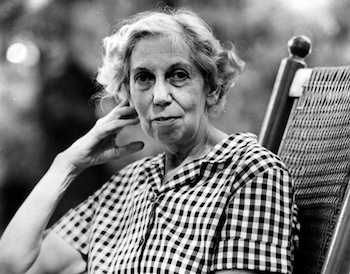
RST-via-Telegraph

(R. S. Thomas via The Telegraph)

It was in April 1962 that Penguin Books launched Penguin Modern Poets. Each volume contained representative selections from three poets and that first volume included, together with Thomas, Elizabeth Jennings – and Lawrence Durrell (born on this day, 27 February 1912, in Jalandhar, India). I don’t know how far the series had gone before I came to it but there was a handful of poems of which I recalled parts, sometimes only a few lines, for years.

PMP1

The Thomas was one and another, in the same volume, was by Durrell. It was called ‘The Parthenon’, dedicated ‘For T. S. Eliot’, and it was the direct, colloquial beginning that stuck in my head:

Put it more simply: say the city
Swam up here swan-like to the shallows,
Or whiteness from an overflowing jar
Settled into this grassy violet space,
Theorem for three hills,

Went soft with brickdust, clay and whitewash,
On a plastered porch one morning wrote
Human names, think of it, men became the roads.[2]

Looking at it now, of course, I’m struck by more details: the conversational opening phrase followed by the word ‘say’; the artful sibilants, ‘swam’ to ‘swan’ then, with the modifying ‘like’, shifting to ‘shallows’. The word ‘jar’ in a grassy space would prompt me to look back at Keats’s ‘Ode on a Grecian Urn’ via Wallace Stevens, whose ‘Anecdote of the Jar’ begins:

I placed a jar in Tennessee,
And round it was upon a hill.
It made the slovenly wilderness
Surround that hill.[3]

This is purely because of the strong recollection of one of my lecturers—surely John Reid?—reading the Stevens poem and looking encouragingly out at his audience: ‘What does that remind you of? What’s Stevens doing there?’ Pause. Then, with a kind of resonant despair: ‘It’s Keats! The urn!’ Packed rows of blank faces gave back whatever was the equivalent then of ‘Yeah, whatever’.

Durrell’s insertion of the word ‘Theorem’ is a nice touch too. He refers often to scientific or mathematical matters, a continuum or simultaneity here, a Freudian slap there, his range of interests always extended beyond the narrowly ‘artistic’. Firmly established in Sommières, he played with the ideas of opposing characteristics of North and South, discerning in France’s great figures ‘a pattern of talents: for scientists, philosophers and thinkers tend to be of northern stock, while the poets, artists and men of action come from the Mediterranean southern fringes.’[4] From Corfu in the mid-1930s, he wrote to his friend Alan Thomas, ‘What do you read when you spend a wet Monday alone? Myself I read one of the sciences.’ But he slyly added: ‘The most exact one to date is demonology. It is fun to follow the growth of science out of magic and demonology, and see it declining again in our time back to magic, its parent.’[5]

Whenever I find myself quoting one of those ‘Cypriot Greek proverbs’ that Durrell used as epigraphs to several chapters in Bitter Lemons, such as ‘A fool throws a stone into the sea and a hundred wise men cannot pull it out’, I’m reminded that, a little further on, he casually notes that, ‘No Greek can resist aphorism; its form will make him believe it to be true, even if it is false.’[6]

A bit more R. S. Thomas followed that early reading of the poems—and a lot more Durrell. The novels, the travel books, essays, letters; plus the connected stuff, the related writers, the sacred places. Greece, Alexandria, Provence. Miller, Cavafy, Seferis, Anaïs Nin. And, of course, the stimulus of conversation, a decade and a half in the office with my friend Andrew, a thoroughgoing Durrellian.
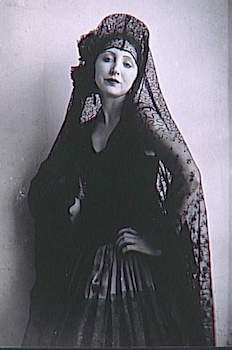
Nin-Brassai

(‘Darling Anaïs, I do feel for you in your cutoffness, and there seems nothing to say to you that will make you less conscious of the distance of light and air which lies between us; the war goes bitter and deep in me – it makes everything taste of ash.’—Letter from Durrell in Greece, quoted in The Journals of Anaïs Nin: Volume Three, 15.
Portrait of Anaïs Nin by the wonderful Brassaï [Gyula Halász, 1899-1984], 1932.)

Durrell was so prolific that, inevitably, some of the writing is a bit hit and miss. But with that range of cultures and countries and curiosities there are plenty of highlights, often cropping up in unexpected places or small-scale pieces or, say, in departures and returns. He writes of April 1941 when, lying ‘on the pitch-dark deck of a caique nosing past Matapan towards Crete’, he thinks back to ‘that green rain upon a white balcony, in the shadow of Albania’, with ‘a regret so luxurious and so deep that it did not stir the emotions at all. Seen through the transforming lens of memory the past seemed so enchanted that even thought would be unworthy of it.’[7] And revisiting Corfu, long afterwards: ‘As for the people . . . Memory does not grow older by a second per thousand years in Greece. Step off the ship and everywhere you will fall upon remembered faces, be instantly recognized and embraced: and I don’t mean only by friends, but by everyone who remembers you in that once, nearly twenty years ago, you gave his son a lesson or let him shine your shoes. Because they remember you they possess you, and you belong to them.’ And then, ‘there is nothing to do but surrender yourself. Strong-willed men break down and cry like babies. No good. The steady flow of hospitality ends only when you are lovingly hospitalized or carried aboard a departing ship on a stretcher.’[8]

Again, rereading The Alexandria Quartet a while back, with that slight nervousness attendant on a revisiting of a past favourite, was as provoking and pleasurable as I hoped it would be. Durrell’s rarely less than diverting, even when he’s being exasperating, a thought that occurred to me when deeply implicated in the more than 1300 pages of The Avignon Quintet, with its maddening hall of mirrors, characters repeatedly dissolving into novelists writing other characters, who are then revealed to be characters in someone else’s novel, while I mutter, ‘Cut it out, Larry’, every ten pages – but read on. ‘There is only trial and error on a journey like this, and no signposts’, as Durrell wrote on another occasion.[9]

Joyeux anniversaire, Larry. Or even, Aürós aniversari.

The International Lawrence Durrell Society site is here: http://www.lawrencedurrell.org/


References

[1] R. S. Thomas, ‘Welsh Landscape’, Collected Poems: 1945-1990 (London: Dent, 1993), 37.

[2] Lawrence Durrell, Collected Poems 1931-1974 (London: Faber and Faber, 1985), 134.

[3] Wallace Stevens, The Collected Poems (New York: Vintage Books, 1982), 76.

[4] Lawrence Durrell, Caesar’s Vast Ghost: Aspects of Provence (London: Faber and Faber, 1990), 26.

[5] Alan G. Thomas, editor, Spirit of Place: Mediterranean Writings (1969; London : Faber and Faber, 1988), 47.

[6] Lawrence Durrell, Bitter Lemons (London: Faber and Faber, 1959), 152, 235.

[7] Lawrence Durrell, Prospero’s Cell (1945; London: Faber and Faber, 1962), 133.

[8] Lawrence Durrell, ‘Oil for the Saint: Return to Corfu’, Holiday, Philadelphia, (October 1966), in Spirit of Place, 286, 290.

[9] Lawrence Durrell, The Black Book (1938; London: Faber and Faber, 1977), 233.
 

Foxes, Graces, Fatal Flowers

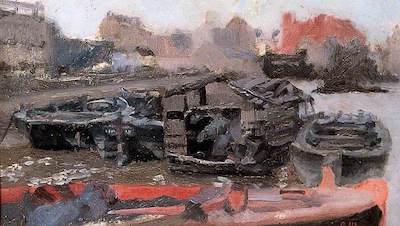
Maitland, Paul Fordyce, 1863-1909; Boats Moored on the Thames

(Paul Fordyce Maitland, Boats Moored on the Thames: York Museums Trust)

On a cold and blue and almost cloudless day, I pass through the park, between the bobbing magpies. Once you recognise the sight and sound of them, they’re everywhere. In our small garden yesterday, I watched a magpie take into its beak three, four, five suet pellets, and was put in mind of the fox.

Six or seven years ago, looking out of the window of my mother’s first-floor flat in Sutton, I would sometimes see foxes jogging along beside the railway line, about fifty metres away. At the end of the short garden was a garage with a flat roof and the downstairs neighbour used to throw food up onto it. One morning a fox appeared there – the roof was accessible from a low wall nearby. It took up items of food into its long jaws, meat and vegetables, five, six, seven pieces and, at the last, added a whole egg. Then it made its way down off the roof and emerged at the side of the track, all the food still apparently in place, undamaged, before padding off in the direction of home where, presumably, its cubs were waiting.

There are times when something occupying our minds or strongly present for a while—and it might be anything, from a car, a song or a woman’s name to a painting, a terrace of houses or a body of writing—exerts a powerful centripetal force. Details of things seen or heard fly to it and stick like burrs. Sounds and sights, images, phrases, connect with an audible click.

Since I’m reading or, mostly, rereading Penelope Fitzgerald’s books at present, when I walked in the park yesterday and heard the skirl of bagpipes launching into ‘Amazing Grace’, it was enough to recall the novel I’d just finished. Offshore, which won the Booker Prize in 1979, is set on the barges moored on Chelsea Reach and is dedicated ‘To Grace and all who sailed in her’. Grace is the name of the central character Nenna James’s barge, as it was the name of Fitzgerald’s, ‘a battered, patched, caulked, tar-blackened hulk’. The ‘great consolation was that a Thames barge, because of the camber of the deck, never sinks completely.’ On this point, Fitzgerald remarked, she could ‘give evidence, because we went down twice, and on both occasions the deck stayed just above water’, although Grace was finally ‘towed away to the Essex marshes to be broken up.’[1] After one of those disasters, Fitzgerald ‘went back to her teaching the next day, looking more than usually dishevelled, and said to her class: “I’m sorry I’m late, but my house sank.”’[2]

Bavarian-Gentian

Similarly, thoughts of that fox recalled Fitzgerald’s letter in response to Frank Kermode’s review of her final novel, The Blue Flower, which centres on the life of the German Romantic poet Friedrich von Hardenberg, who wrote as ‘Novalis’. ‘I hope you won’t mind me writing to thank you for your review of The Blue Flower. I started from D. H. Lawrence’s “fatal flower of happiness” at the end of The Fox, having always wondered how DHL knew it was blue, and never quite managed to find out all I wanted to, partly because Novalis’ letters to Sophie have disappeared, buried in her grave I daresay.’[3]

Kermode had written of Fitzgerald: ‘She has the gift of knowing, or seeming to know, everything necessary, and as it were knowing it from the inside, conveying it by gleams and fractions, leaving those who feel so disposed to make it explicit.’ And, of the object of Fritz’s quest, ‘The visionary blue flower dominates his imagination, but in the waking life of Fritz von Hardenberg the part of the flower was played by Sophie von Kühn’.[4]

Sophie was the twelve-year-old girl with whom the poet fell in love. They became engaged on her thirteenth birthday but she died of tuberculosis just two years later. Novalis himself died before reaching thirty.

The end of ‘The Fox’ has ‘poor March’ musing on how, ‘The more you reached after the fatal flower of happiness, which trembles so blue and lovely in a crevice just beyond your grasp, the more fearfully you became aware of the ghastly and awful gulf of the precipice below you, into which you will inevitably plunge, as into the bottomless pit, if you reach any further. You pluck flower after flower – it is never the flower.’[5]

And the ending of Offshore? The two weakest characters, drunk and more than usually incapable, drift off in the storm, when the anchor comes clear and the mooring-ropes pull free under the strain. ‘It was in this way that Maurice, with the two of them clinging on for dear life, put out on the tide.’[6]

A craft that should be firmly linked to those of its close neighbours becoming unmoored and drifting off into the open sea because of intoxicated incompetence. Not a fable for our time, obviously.

References

[1] Penelope Fitzgerald, ‘Curriculum Vitae’, in A House of Air: Selected Writings, edited by Terence Dooley with Mandy Kirkby and Chris Carduff (London: Harper Perennial, 2005), 477-478.

[2] Hermione Lee, Penelope Fitzgerald: A Life (London: Chatto and Windus, 2013), 158.

[3] Penelope Fitzgerald to Frank Kermode, 3 October [1995], in So I Have Thought of You: The Letters of Penelope Fitzgerald, edited by Terence Dooley (London: Fourth Estate, 2008), 453.

[4] Frank Kermode, ‘Dark Fates’, review of The Blue Flower, London Review of Books, 17, 19 (5 October, 1995), 7.

[5] D. H. Lawrence, ‘The Fox’, in The Complete Short Novels, edited by Keith Sagar and Melissa Partridge (London: Penguin Books, 2000), 203.

[6] Penelope Fitzgerald, Offshore (1979; London: Everyman, 2003), 131.


Education, chaos, Henry Adams

Henry_Adams__Marian_Hooper_Adams_1883

(Henry Adams at his desk. Massachusetts Historical Society via Wikipedia: photograph by Marion Hooper Adams, 1883.)

‘Said Mr Adams, of the education,
Teach? at Harvard?
Teach? It cannot be done.
and this I had from the monument’

So Ezra Pound, in the first and longest of The Pisan Cantos.[1] That ‘monument’ was the philosopher George Santayana: born in Spain, he went to the United States at the age of eight, later studied at Harvard and taught there for many years before returning to Europe for the last forty years of his long life.

‘Mr Adams’ was not the John Adams to whom Pound so frequently referred, often pairing him with Thomas Jefferson; nor the historian Brooks Adams but his elder brother Henry Adams (born 16 February 1838), also historian—and novelist, and autobiographer.

In early 1939, Pound had put together four quotations, from John Adams, Jefferson, Abraham Lincoln and section 8 of the American Constitution, as an Introductory Text Book, which he asserted ‘should be taught in all American universities as the basis of a true American culture.’[2] Towards the end of that year, he called on Santayana when the latter was in Venice. As David Moody surmises, ‘Possibly feeling rather talked at as by an over-excited teacher’, he told Pound the anecdote about Henry Adams which found its way into the Cantos.[3] But Noel Stock is surely correct in saying that, while Pound seems to make the story apply to Harvard in particular, Santayana in his autobiography implies a more general statement about teaching.[4]

‘Never before had Adams been able to discern the working of law in history, which was the reason of his failure in teaching it, for chaos cannot be taught.’[5] So Adams—writing of himself in the third person, as he does throughout his book—defines the problem. Santayana looked back to that meeting in Persons and Places: ‘“So you are trying to teach philosophy at Harvard,” Mr Adams said’, adding ‘“I once tried to teach history there but it can’t be done. It isn’t really possible to teach anything.”’ Santayana commented dryly, ‘This may be true, if we give very exacting meanings to our terms; but it was not encouraging.’[6]

Fenollosa-and-Mary

(Ernest and Mary Fenollosa, via https://otakusenvenezuela.wordpress.com/ )

For Pound, the main link with Henry Adams—about whom he is not particularly complimentary—is the figure of Ernest Fenollosa, whose notes and direct translations, given to Pound by Fenollosa’s widow, Mary, enabled both the Noh plays and the poems of Cathay; and whose ideas expressed in The Chinese Written Character as a Medium for Poetry had a lasting influence upon Pound.

Chapter XX of Adams’ Education is headed ‘Failure (1871); Chapter XXI is headed ‘Twenty Years After (1892). In that large and gaping temporal space, Adams was married to Marion Hooper, known as ‘Clover’ (a talented amateur photographer), in 1872; she committed suicide in December 1885. In the late spring of 1886, Adams, in company with the artist John La Farge, set off westward to Japan. After a week in Tokyo, they moved to a small house, belonging to a Buddhist priest, in the hills, close to the summer villa of Ernest and Mary Fenollosa in Nikko. La Farge emerged from his stay with drawings, sketches and other material for future use—the book, An Artist’s Letters from Japan, and a printed version in the same year of a talk centred on Hokusai—but Adams seems never to have really engaged with Japan.

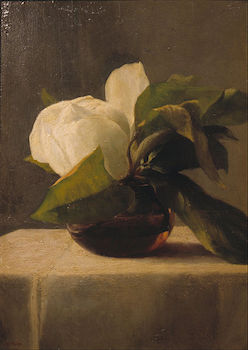
John_LaFarge_Magnolia_1860

(Magnolia by John La Farge, 1860)

In September, Adams and La Farge sailed back across the Pacific to San Francisco. Lawrence Chisolm remarks that, ‘For Adams, return was a prelude to years of wandering, until at last, in The Education of Henry Adams, he transformed the story of his personal searches into a history of Western man.’[7]

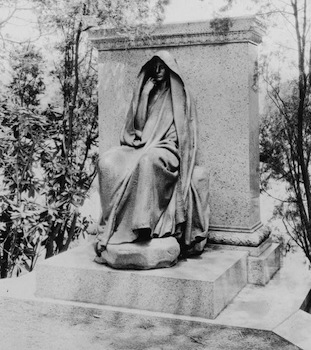
‘His first step, on returning to Washington’, Adams wrote, ‘took him out to the cemetery known as Rock Creek, to see the bronze figure which St. Gaudens had made for him in his absence’ (329). This was the sculptor Augustus Saint-Gaudens; and that ‘bronze figure’ was a memorial to Adams’ wife Clover. Adams discusses his own, and others’, responses to the figure but doesn’t allude to the reason for its being there at all. Robert Hughes suggests that this may in fact have been one legacy of Japan: its inspiration ‘seems to have been a sixth-century wooden figure sheathed in bronze which he saw in the convent of Chugu-ji’.[8]

Marian_Hooper_Adams_Monument

(Augustus Saint-Gaudens, Adams Memorial (1886-1891), Rock Creek, Washington)

Adams once noted that ‘One sees what one brings’ (387)—and he brought an extensive knowledge of artistic and religious history to the moment when ‘he found himself lying in the Gallery of Machines at the Great Exposition of 1900, his historical neck broken by the sudden irruption of forces totally new’ (382). He had seen, at the Louvre and at Chartres, what he judged ‘the highest energy ever known to man’, exercising ‘vastly more attraction over the human mind than all the steam-engines and dynamos ever dreamed of’ (384-385), yet the unprecedented speed and extent of new scientific and technological developments represented now, in 1900, ‘a new avalanche of unknown forces’ which would require ‘new mental powers to control. If this view was correct, the mind could gain nothing by flight or by fight; it must merge in its sensual multiverse, or succumb to it’ (463).

Familiar modernist concerns: speed, fragmentation, instability, multiplicity – but Adams gets in quite early.

(There was an intriguing novel called Panama by Eric Zencey, which sets Henry Adams in Paris in 1892, investigating the disappearance of a young woman connected with the Panama Canal bribery scandal. I’m slightly alarmed to see that it’s over twenty years since I read it.)

References

[1] The Cantos of Ezra Pound, fourth collected edition (London: Faber and Faber, 1987), 433.

[2] Ezra Pound, Selected Prose 1909-1965, edited by William Cookson (London: Faber and Faber, 1973), 129; A. David Moody, Ezra Pound: Poet: A Portrait of the Man and His Work: Volume II: The Epic Years 1921–1939 (Oxford: Oxford University Press, 2014), 299.

[3] A. David Moody, Ezra Pound: Poet: A Portrait of the Man and His Work: Volume III: The Tragic Years 1939-1972 (Oxford: Oxford University Press, 2015), 7.

[4] Noel Stock, The Life of Ezra Pound (Harmondsworth: Penguin Books, 1974), 478.

[5] Henry Adams, The Education of Henry Adams (1918; New York: The Modern Library, 1931), 363: page numbers in brackets refer to this edition.

[6] George Santayana, Persons and Places: The Background of My Life (New York: Charles Scribner’s Sons, 1944), 234.

[7] Lawrence W. Chisolm, Fenollosa, the Far East and American Culture (New Haven: Yale University Press, 1963), 75.

[8] Robert Hughes, American Visions: The Epic History of Art in America (London: The Harvill Press, 1997), 244.


That public-school frame of mind – perhaps

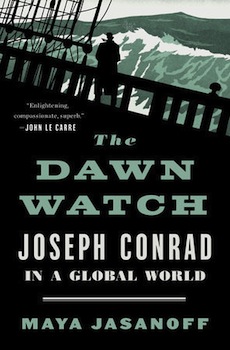
Dawn-Watch

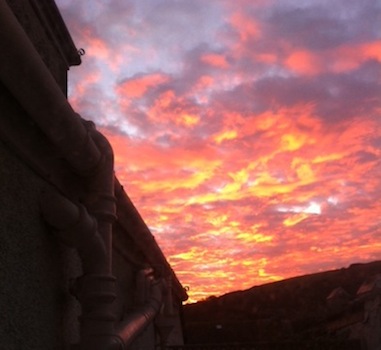
‘So the great need of our time being the saving of time, any soul that can give us very quick, irrefutable and consummate pictures confers a great boon on humanity’, Ford Madox Ford wrote. ‘Joseph Conrad gave you Malaysia, South American republics, the Secret Service, the pre-Soviet efforts of Russian revolutionaries, the Congo, the Sea — and above all the English public school frame of mind.’[1]

Ah yes, that frame of mind. Conrad was a little less than six months dead when this essay appeared but a decade earlier, in the first year of the Great War, Ford had written of how he was ‘in a sense an unfortunate man—unfortunate in the sense that all men of forty and less, the world over, are unfortunate. For I came into, and took very seriously, English public-school life at a time when the English public-school spirit—in many ways the finest product of a civilisation—was already on the wane. I took its public traditions with extraordinary seriousness—the traditions of responsibilities, duties, privileges, and no rights.’[2] This was in a work of propaganda, written for his friend, the Liberal politician Charles Masterman, then in charge of the War Propaganda Bureau at Wellington House, its team of writers primarily concerned to oppose German propaganda in the United States. Ford had in fact attended a boarding-school in Folkestone, then, as a day-boy, University College School in Gower Street—but that tradition, that frame of mind, yes, he was probably familiar enough with it, one way or another.

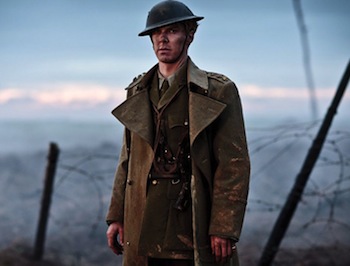
Cumberbatch-Tietjens

(Benedict Cumberbatch as Christopher Tietjens in the BBC/HBO series of Parade’s End)

Christopher Tietjens, in his rather unhinged exchange with General Campion, states that ‘it is not a good thing to belong to the seventeenth or eighteenth centuries in the twentieth. Or really, because it is not good to have taken one’s public-school’s ethical system seriously. I am really, sir, the English public schoolboy. That’s an eighteenth-century product.’[3]

‘Have you read The Dawn Watch?’ my wife’s sister asked as we circled the piles of books in Waterstones. I said I hadn’t, though I’d looked at it several times, most recently in the past few minutes, and seen a couple of reviews. ‘I just don’t know if I’d read it’, I said, ‘I think it’s a bit peripheral to what really interests me at the moment.’ She regarded me steadily. ‘You’ve already bought it, haven’t you?’ I said, hearing the laboured grinding of my brain’s gears and wondering why I’d been so slow. And, when she nodded, ‘Well, that’s different’, I said hurriedly, ‘if it’s a present.’ She said helpfully: ‘It absolves you of the responsibility—’ ‘Exactly’, I said, ‘exactly.’

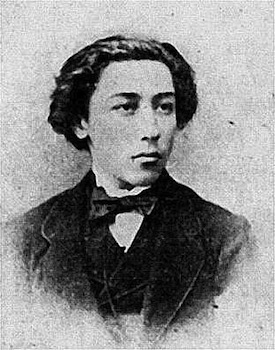
Conrad_1874

(Conrad, aged sixteen, 1874)

My slight reluctance might seem odd, given my intense interest in the period of history in which Conrad flourished, the writers with whom he associated, the themes that his work is concerned with, the fact that some of my Fordian friends are also card-carrying Conradians. Because of those things, in turn, I’ve read, over many years, all of Conrad’s fiction and some of his other writings too; plus a handful of biographical and critical works. Come to think of it, I’m pretty sure that I actually taught a Conrad text once—inevitably Heart of Darkness, which is, I have to say, an ideal seminar text: how can you not have an opinion about it? Still, the fact remains that he’s one of those writers that I’ve never liked quite as much as I think I should—given all the reasons for reading him in the first place. Entirely my fault, no doubt, no doubt. And there’s another thing. . .

After a certain age—it must vary wildly, depending on character—one begins to think in finite terms. Not calculating at every point, I mean, but in certain contexts, trips, holidays, meetings with friends or relatives who live inconveniently far off. . . books. Some book people, mainly but not exclusively male, I suppose, have lists. Books to read, books to reread, books to buy or borrow. They estimate, approximate, do sums. This many a year and say, this many years, that means. . . To those not similarly afflicted—or those that have not yet reached that certain age—such appraisal and conjecture can seem a little morbid. So it’s best not to say, when a title is suggested,  well I have a list of one thousand seven hundred and ninety-three titles and that’s not on it. There are books that will be published over the next ten or fifteen or twenty years and you need a margin. But it’s a fine balance. Like those people who are inundated with invitations at Christmas or New Year, hold out for even better offers, miscalculate and spend the evening at home with a bottle of indifferent wine, you must take care not to overplay your hand. . .

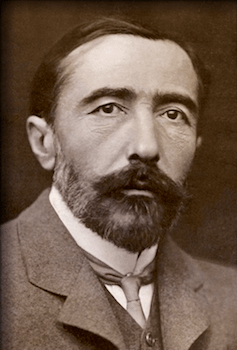
Joseph_Conrad

And so I’ve just begun to read Maya Jasanoff’s The Dawn Watch: Joseph Conrad in a Global World. And, needless to say, I am already hooked. Jasanoff is an award-winning historian—‘History is like therapy for the present: it makes it talk about its parents’—and you can see why: so I feel I’m in safe hands. And, early on, she remarks that ‘Conrad’s novels are ethical injunctions. They meditate on how to behave in a globalizing world, where old rulebooks are becoming obsolete, but nobody’s yet written new ones.’[4] And that ‘ethical injunctions’ is pretty close to some of Ford’s pronouncements about his old friend and collaborator. So, now embarked with Jasanoff, I still feel within hailing distance of Fordian shores. But there’s a goodish distance to go and I may yet find myself in quite uncharted waters. . .

References

[1] Ford Madox Ford, ‘From a Paris Quay (II)’, New York Evening Post Literary Review, 3 January 1925, 1-2, reprinted in Critical Essays, edited by Max Saunders and Richard Stang (Manchester: Carcanet Press, 2002), 269-271 (269).

[2] Ford Madox Ford, When Blood is Their Argument: An Analysis of Prussian Culture (London: Hodder and Stoughton, 1915), 301.

[3] Ford Madox Ford, No More Parades (1925; edited by Joseph Wiesenfarth, Manchester: Carcanet Press, 2011), 236.

[4] Maya Jasanoff, The Dawn Watch: Joseph Conrad in a Global World (London: William Collins, 2017), 6, 9.

Happy Birthday, Mr Ford

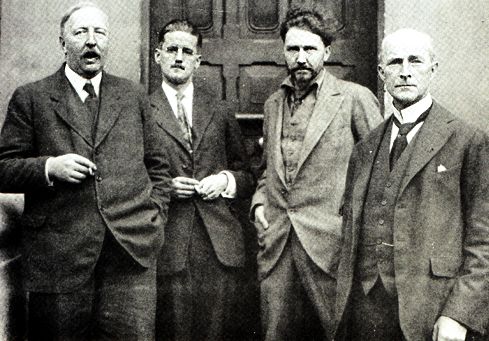
ford-joyce-pound-quinn

(Messrs Ford, Joyce, Pound and Quinn: Paris, 1923)

Today is the birthday of Ford Madox Ford, born Ford Madox Hueffer in Merton, Surrey, 17th December 1873. Even excluding the several pseudonyms he used, there are plenty of other versions of his name, many of them—such as ‘Forty-Mad-Dogs Hueffer’—traceable to the always inventive Ezra Pound.[1]

I tend to mention Ford a lot because he comes easily to mind, my mind anyway (among an increasing number of other minds). But then anyone interested in modern literature will probably have read his The Good Soldier; anyone really interested in modern literature will probably have read, or intended to read, or at least know something about, Parade’s End, his superb tetralogy about England before, during and after the Great War. ‘About England’—that is to say, about landscape, class, gender, love, sex, history, politics, social conventions, religion, psychological breakdown—and other things.

Ford was always attentive to anniversaries, Saints’ days—and birthdays, not excluding his own. According to the dates given at the back of the book, he began writing When the Wicked Man—not one of his best novels, by a country mile—in Paris, on 17 December 1928 (he went on with it in New York and finished it aboard R.M.S. Mauretania, off the Scillies, 1 December 1930.) More famously, we find this claim in the ‘Dedicatory Letter’, addressed to Stella Bowen, which first appeared in the 1927 Albert & Charles Boni edition of The Good Soldier: A Tale of Passion:

‘Until I sat down to write this book—on the 17th December 1913—I had never attempted to extend myself, to use a phrase of race-horse training. Partly because I had always entertained very fixedly the idea that—whatever may be the case with other writers—I at least should not be able to write a novel by which I should care to stand before reaching the age of forty; partly because I very definitely did not want to come into competition with other writers whose claim or whose need for recognition and what recognitions bring were greater than my own. I had never really tried to put into any novel of mine all that I knew about writing. I had written rather desultorily a number of books—a great number—but they had all been in the nature of pastiches, of pieces of rather precious writing, or of tours de force. But I have always been mad about writing—about the way writing should be done and partly alone, partly with the companionship of Conrad, I had even at that date made exhaustive studies into how words should be handled and novels constructed.
‘So, on the day I was forty I sat down to show what I could do—and The Good Soldier resulted.’[2]

FMF_SB_Corr

In his lifetime, Ford published almost eighty books: say seventy-eight if we don’t count The Panel and its slight revision for American publication, Ring for Nancy, as separate items. For numerologists, 2017 has been the seventy-eighth year since his death. (Ford studies take many forms, some of them a little worrying. Mais passons.)

And I see that I read my first Ford book – good grief! – forty years ago. (Acutely numerate Ford scholars might narrow their eyes at this point, suspecting a massaging of the figures—‘Really? Exactly forty?’—but you can trust me on this.)

People occasionally ask, ‘Are there any others that are really good?’ I try to be scrupulous in separating the ones that I think are ‘really good’, say a dozen or so, maybe more, from those that have points of interest for the Ford specialist (just about all of them). Keeping it tight: if historical novels, particularly set in the Tudor period, are your thing, you may already have come across The Fifth Queen trilogy. It centres on Katharine Howard and on a chap called Thomas Cromwell, not an unfamiliar name these days. Then I’ve always had a fondness for The Young Lovell, set in 1486, concerning magic and a belle dame sans merci; and Ladies Whose Bright Eye, set in the fourteenth century (though with one foot in the twentieth), which might just edge it, because of its high spirits.

FMF_EE

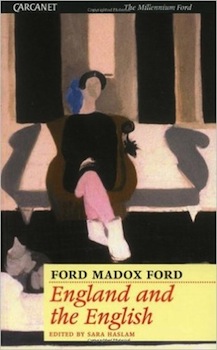
Then England and the English, which is cheating slightly since this is another trilogy, comprising The Soul of London, The Heart of the Country and The Spirit of the People. Joseph Conrad: A Personal Remembrance was written at speed in the months following Conrad’s death. Ford refers to it as a novel but it gives a much more vivid sense of how Conrad actually was than many scrupulous biographies of him. No Enemy, written mostly in 1919, was published in America ten years later (and first published in the UK seventy-three years after that). Dancing along the border between fiction and autobiography, it has folded into it many of Ford’s experiences and perceptions of the recent war: suffering from shell-shock, he had, in effect, to learn to write again.

From Ford’s final decade, I’d probably pick It Was the Nightingale just ahead of the outrageously enjoyable Return to Yesterday; and Provence would just edge out the slightly more eccentric Great Trade Route, so Ford’s beloved adopted home rather than the embodied idea and the sometimes uneasy grappling with the American South.

That, of course, leaves out of account entirely the poetry, the critical essays, the letters, the fairy tales, the art criticism. . . Still, it’s a start.

And of the two heavyweights? People sometimes ask: Coleridge or Wordsworth? Eliot or Pound? Lennon or McCartney? The Good Soldier or Parade’s End? I say: both, though acknowledging that, on the quiet, one leans this way or that.

Val-Christopher

(Adelaide Clemens as Valentine Wannop, Benedict Cumberbatch as Christopher Tietjens
in the BBC/HBO adaptation of Parade’s End)

‘The day of her long interview with Tietjens, amongst the amassed beauties of Macmaster furnishings, she marked in the calendar of her mind as her great love scene. That had been two years ago: he had been going into the army. Now he was going out again. From that she knew what a love scene was. It passed without any mention of the word “love”; it passed in impulses; warmths; rigors of the skin. Yet with every word they had said to each other they had confessed their love; in that way, when you listen to the nightingale you hear the expressed craving of your lover beating upon your heart.’[3]

Yes.

References

[1] This one crops up in Pound’s interview with D. G. Bridson, in New Directions 17, edited by James Laughlin (New York: New Directions, 1961), 166. Another version was ‘Freiherr von Grumpus ZU und VON Bieberstein’: Brita Lindberg-Seyersted, editor, Pound/Ford: The Story of a Literary Friendship (London: Faber & Faber 1982), 141.

[2] Ford Madox Ford, The Good Soldier: A Tale of Passion (1915; edited by Max Saunders (Oxford: Oxford University Press, 2012), 3.

[3] Ford Madox Ford, Some Do Not. . . (1924; edited by Max Saunders, Manchester: Carcanet Press, 2010), 322.


The Last of England; or London; Sinclair, Sebald, Ford

Morning-West-Bay

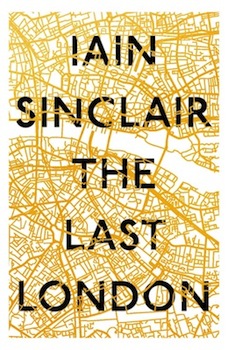
I was sitting at the dining table of a rented holiday cottage in West Bay, idly totting up the senses in which the title of Iain Sinclair’s chapter might be read: ‘After Sebald’ is the title of chapter four of The Last London: True Fictions from an Unreal City. Grant Gee’s 2012 film Patience is subtitled (parenthetically) After Sebald; and Sinclair follows in Sebald’s footsteps, to an extent, in company with the poet Stephen Watts, a friend of Sebald’s, who sometimes walked with him. Chronologically, Sinclair is, of course, after—later than—Sebald; he is also pursuing him, or an image of him. Much of his writing draws on similar tropes of memory and deep autobiography to those of Sebald: again, this is, in a sense, ‘after’ him. He also touches on the Sebaldian afterlife of conference, festschrift, memorial, tribute: and the influence of Sebald, as man, walker and writer, as presence, as image of ‘writer’, on others, including the writer Rachel Lichtenstein, with whom Sinclair has collaborated in the past. And the afterworld is an abiding concern in Sinclair’s fictional or metafictional world, not least here in the moving elegiac conjuring of Martin Stone. ‘Slow down. Lose yourself among walks laid out with sufficient complexity to confuse the dead. To keep them to allocated spaces. To the chipped ballast of memorial slabs holding them in the ground.’[1]

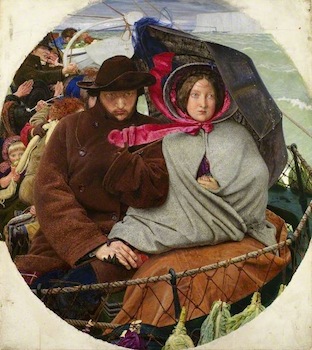
Post-lunch, convalescing from such mental exertions, I trip over Sinclair’s mention of a book called The Last of England (2004) by Randall Swingler. Now, to a close reader of Ford Madox Ford, that title, The Last of England, sets dogs barking and bell ringers swinging on their ropes.

Brown, Ford Madox, 1821-1893; The Last of England

(Ford Madox Brown, The Last of England: Birmingham Museums Trust)

By way of brief explanation, for those immune to such infections, The Last of England is a famous painting by Ford Madox Brown, maternal grandfather of Ford Madox Ford. It exists in two versions—or three, counting the watercolour replica in the Tate—the oil on panel of 1855 (Birmingham Museums Trust) and the 1860 version (oil on canvas: The Fitzwilliam Museum), which seems entirely suitable in the context of any discussion of a writer whose name, nationality and status are far from stable and are strongly marked by doubleness, trebleness—or more. (Sentences like that sometimes appear to be occupational hazards for those with ambitions to write about Ford.)

As well as his several unsurprising references to the picture’s title in his 1896 biography of grandfather Brown, Ford used the phrase in his great postwar tetralogy, Parade’s End, twice in the opening volume and once in the final one. There is a finer symmetry than is at first apparent: the single mention in the closing volume is balanced by the fact that Last Post is itself ‘the last of England’ for Ford in several senses. The whole of the tetralogy had been written abroad but constituted his most searching fictional analysis of this country, while Last Post moved on from recent history to glance at possible futures. Thereafter, the material of his fiction lay elsewhere, in France and the United States. And, arguably, Last Post, his last ‘English’ novel, was the last of his books to be aimed at a primarily British audience.

FMF_IWN

Ford used the phrase twice more, in It Was the Nightingale, the autobiographical volume most closely related in its themes and treatment to his great novel. Once, because of the restrictions that were being brought in against immigration:

‘What then was to become of England of the glorious traditions? It had been political fugitives and martyrs that had given England her place among the nations. It had been the Flemish weavers, the Anabaptists, the Huguenots, the ceaseless tide of the discontented from every nation that had given England, not alone her tradition of freedom, but her crafts, her system of merchanting, her sense of probity, her very security. . . . This then was the last of England, the last of London. . . . ’

(Cue two minutes’ silence here, looking around us, as we must.)

The second instance concerns Ford’s leaving England for France in November 1922: ‘There was, as I passed through Trafalgar Square, a dense fog and the results of a general election coming in. . . . an immense shouting mob in a muffled and vast obscurity. The roars made the fog sway in vast curtains over the baffled light-standard. That for me was the last of England.’[2]

So, for a moment, familiar with the poet Ted Walker’s memoir and Derek Jarman’s film, plus a couple of other uses of the phrase in book titles, I paused, breathing a little heavily. Had I missed something really significant? I’d heard of Randall Swingler, come across him in a couple of literary histories, in memoirs by several figures, including E. P. Thompson and Julian Symons, which appeared in PN Review—which had also published George Barker’s ‘Elegy’ (‘Randall Swingler, that most honest man’)—and especially in Swingler’s ‘The Right to Free Expression’, published in Polemic, with annotations by George Orwell.[3] As a committed Communist, Swingler was never going to hit it off with Orwell: taking such exception to Orwell’s ‘The Prevention of Literature’ and referring to its author as ‘singularly independent of factual evidence’ made sure of that.

The 2004 publication date Sinclair mentioned made me pause, even within my pausing, though reprints or revised editions of Swingler, who died in 1967, were plausible. Then I suddenly registered the reference to J. H. Prynne, which pointed pretty definitely to Randall Stevenson’s volume in The Oxford English Literary History, Volume 12: 1960-2000: The Last of England?

Last-London
Not to suggest for a moment that Sinclair’s bracing, exhilarating and often extremely funny book should be defined by a tiny error—but while some errors are merely errors, others exist for just such occasions, to connect with, and stimulate, those ready for such connection. In the past, I’ve commented to others about books particularly poorly proofread who turn out not to have noticed any errors at all; on the other hand, often having read a book I then see a review of it which points in tones of thunder to outrageous shortcomings, blunders and misrepresentations that completely passed me by. Swingler for Stevenson would be puzzling or a speck of grit in the eye for a minority of Sinclair’s readers, I suspect. Even if they noticed, would it really matter to them? Not unless they too had a selection of phrases like ‘the last of England’ wired up to the alarm system of their memory banks.

Besides, that ‘error’ (which already seems to need the qualification of quotation marks) seems quite at home in Sinclair’s chronicle of complex networks of connection and affiliation, all of a piece with a universe of chance encounters, names slightly misheard, images glimpsed through the interstices of blurry weather. ‘We impose connections in a futile attempt to find meaning in a maelstrom of possibilities.’ Elsewhere, he writes: ‘In the state that manifests itself when projects are launched, and when they dictate their terms by way of coincidences and excited discoveries, unexpected phone calls, emails from strangers, I found it difficult to sleep. The streets had become a displacement dream.’ And one more: ‘What I was groping towards was the conviction that different writers, laying down different maps of the same place, enlarge the potentialities of the city. Geography shifts. Individuals dissolve. Place is burnished and dissolved.’[4]

There’s a fascinating video on the London Review of Books website at the moment: Stewart Lee interviewing Iain Sinclair. The fact that Lee several times refers to Sinclair’s book as The Last of London seems to fit as well. . .

https://www.lrb.co.uk/audio-and-video


References

[1]
Iain Sinclair, The Last London: True Fictions from an Unreal City (London: Oneworld, 2017), 58.

[2] Ford Madox Ford, It Was the Nightingale (London: Heinemann, 1934), 86, 137. One of the book’s later editors describes it, in fact, as ‘a companion volume to Parade’s End, reiterating the concerns of the tetralogy with renewed urgency’. See John Coyle, editor, Ford Madox Ford, It Was the Nightingale (1934; Manchester: Carcanet Press, 2007), xiv.

[3] George Orwell, Smothered Under Journalism: 1946, edited by Peter Davison, revised and updated edition (London: Secker and Warburg, 2001), 432-443. Davison’s footnote (443) mentions Swingler’s volumes of poetry and his editorial involvement with several journals in the 1930s and 1940s. Barker’s poem is in PN Review 27, volume 9, number 1 (September-October 1982).

[4] Sinclair, The Last London, 18 (I see I’ve quoted this once before but think it’s earned a repeat), 42, 54.


Passing time, clocking off

harold-lloyd

(Harold Lloyd in Safety Last!)

On 11 November 1918, US pilot Sergeant Charles Veil, still with a French squadron although he had technically become a lieutenant in the United States Army, was greeted on landing with the news that the Armistice had been signed and that the war was over. ‘No more patrols, no more fights in the air. Nothing to do, nothing to live for. . . I found my watch, brought it forth, threw it as far as ever I could. Time would never mean the same thing again. . . .’[1]

It means, of course, different things to different people at different. . . times. It might seem stable enough if you stand still—until you move east or west—a lot more stable than it used to be, for sure. Standard time came in towards the close of the nineteenth century. In the United States, it was the railroad companies rather than governments that were first to institute it: ‘Around 1870, if a traveler from Washington to San Francisco set his watch in every town he passed through, he would set it over two hundred times.’ You’d barely have had time to set the time. And, in fact, it was on this day, 18 November, in 1883, that the railroads imposed uniform time. It was called ‘the day of two noons’ because at midday clocks in the eastern part of each zone had to be set back: ‘one last necessary disruption’.[2]

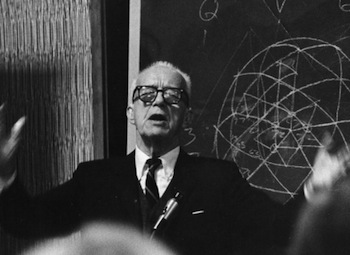
Clock time as a major issue can certainly be demanding. On Robert Scott’s Antarctic expedition of 1910-1913, the young Apsley Cherry-Gerrard (‘Cherry’) ‘kept three clocks and two wristwatches above his bunk to make absolutely sure that he did not miss his shift on deck.’[3] Hugh Kenner wrote of Buckminster Fuller that: ‘He zoomed around the globe in person, bearing his news to audiences in town after town. He wore three watches to tell him (1) the time back home, (2) the time where he was now, and (3) the time at his next stop.’[4]

Bucky

Buckminster Fuller ( https://pacificdomesnews.wordpress.com/happy-birthday-buckminster-fuller/ )

But time is not only clock time, of course: it’s time as experience, time in our heads, the moment that stretches into hours, the days collapsed into a heartbeat. Does time speed up as we age? Is it one of the inescapable problems of ageing, the days ‘flashing by like subway stations passed by the express train’, as Saul Bellow’s narrator remarks? ‘If only we could bring back the full days we knew as kids.’ But ‘[o]ur need for rapid disposal eliminates the details that bewitch, hold, or delay the children.’ Still, ‘Art is one rescue from this chaotic acceleration. Meter in poetry, tempo in music, form and color in painting. But we do feel that we are speeding earthward, crashing into our graves.’[5]

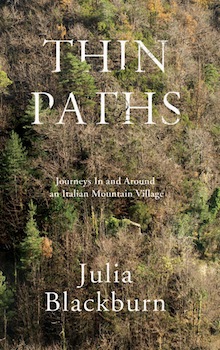
Time; space—or time as space. At a small party to celebrate the completion of her book about the area around the Italian village where she lives, Julia Blackburn writes of saying that: ‘being here in the valley has made me think that time past and time present and time future is like a vast landscape and we are walking through it on a tracery of thin paths.’[6]

thin_paths

Then space as time, in a sense. William Herschel’s 1802 paper considered the idea that deep space must also imply deep time. His telescope had ‘also, as it may be called, a power of penetrating into time past’ — the rays of light conveying the image of a remote nebula to the eye must have been ‘almost two million years on their way’. Therefore the universe was ‘almost unimaginably older than people had previously thought.’[7]

Writers, certainly most of the major modernist writers, have a complex relationship with time: James Joyce, Ford Madox Ford, David Jones, Marcel Proust, T. S. Eliot, Virginia Woolf, Ezra Pound, Dorothy Richardson, William Faulkner, Samuel Beckett, Gertrude Stein. How could they not, given the rupture of the First World War, that ‘crack across the table of History’?[8] Wyndham Lewis devoted a massive volume to opposing and analysing the ‘Time-doctrine’, the stress on the subjective and the interior which he traced to the French philosopher Henri Bergson, ‘the perfect philosophic ruffian, of the darkest and most forbidding description: and he pulls every emotional lever on which he can lay his hands.’[9] Characteristically, Lewis—‘Dogmatically, then, I am for the Great Without, for the method of external approach’[10]—had a pop at a huge range of targets, among them Joyce, Pound, Stein, Proust and a flock of philosophers.

Later writers’ view of time has tended more towards Bergson’s—and less towards Lewis’s—view of the matter. Eudora Welty remarked that ‘The time as we know it subjectively is often the chronology that stories and novels follow: it is the continuous thread of revelation.’[11] Jeanette Winterson wrote that Sigmund Freud, ‘one of the grand masters of narrative, knew that the past is not fixed in the way that linear time suggests. We can return. We can pick up what we dropped. We can mend what others broke. We can talk with the dead.’[12]

Indeed. We don’t need time machines. We are time machines. Possessing memory and imagination, we are masters—or mistresses—of both past and future. It’s just the present that’s so damned tricky.

References

[1] Stanley Weintraub, A Stillness Heard Round the World: The End of the Grest War, November 1918 (New York: Oxford University Press, 1987), 186.

[2] Stephen Kern, The Culture of Time and Space 1880-1918 (Harvard University Press, 1983), 12.

[3] Sara Wheeler, Cherry: A Life of Apsley Cherry-Gerrard (London: Jonathan Cape, 2001), 63.

[4] Hugh Kenner, The Elsewhere Community (New York: Oxford University Press, 2000), 139.

[5] Saul Bellow, Ravelstein (London: Viking, 2000), 191-192.

[6] Julia Blackburn, Thin Paths: Journeys In and Around an Italian Mountain Village (London: Jonathan Cape, 2011), 248.

[7] Richard Holmes. The Age of Wonder: How the Romantic Generation Discovered the Beauty and Terror of Science (London: Harper Collins, 2008), 203.

[8] Ford Madox Ford, A Man Could Stand Up— (1926; edited by Sara Haslam, Manchester: Carcanet, 2011), 17.

[9] Wyndham Lewis, Time and Western Man (London: Chatto & Windus, 1927), 449, 174.

[10] Wyndham Lewis, Men Without Art (London: Cassell, 1934), 128.

[11] Eudora Welty, One Writer’s Beginnings (London: Faber, 1985), 69.

[12] Jeanette Winterson, Why Be Happy When You Could Be Normal? (London: Vintage 2012), 58.

Difficult demands, corresponding charms

Macdonald-books

I drift back—early enough to cook the dinner—from a couple of days in California in the company of Ross Macdonald, not for the first time. The thirteenth occasion, I think. I must have seen, in a previous life, one of the films featuring Macdonald’s private eye Lew Archer, either Harper (1966, based on The Moving Target) or The Drowning Pool (1975), both starring Paul Newman. There was a later film, Blue City (1986), based on an early Macdonald novel, not a Lew Archer book. But I only started reading Macdonald a few years ago, decades after going through the whole of Chandler and of Hammett (one of whose books made a strong impression on the sixteen-year-old Macdonald).

Ross Macdonald was born Kenneth Millar in Los Gatos, California, though his parents were Canadian. After a difficult childhood, he studied at the University of Western Ontario and eventually received a PhD from the University of Michigan in 1952: his dissertation was on Coleridge.

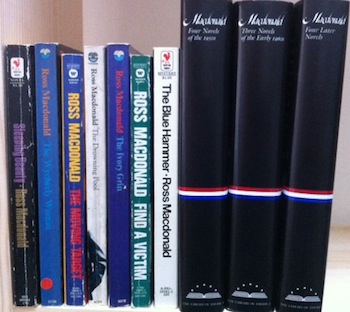
While I wait for The Archer Files to make its way through the postal system, I review my collection of Macdonalds: seven mass market paperbacks jostle the three handsome Library of America volumes which, between them, contain eleven full-length novels. The last of these, Four Later Novels, published this year, is a recent arrival on my shelves and awaits the week’s holiday towards the end of the year—probably, if I can last that long.

tspa_0099971f

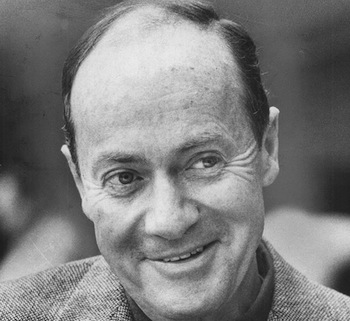
(Kenneth Millar/ Ross Macdonald via Library of America)

Inclusion in the Library of America series probably hints at the status that Macdonald has achieved in the view of some influential readers, since The Goodbye Look (1969) prompted the New York Times Book Review notice by William Goldman (‘the finest series of detective novels ever written by an American’).

Thirty-three years before the first Library of America volume of Macdonald’s work appeared—the series was launched in 1982, with eight volumes published that year—Hugh Kenner published an essay, ‘Classics by the Pound’, which began by detailing some comparisons between the products of that list and ‘the esteemed French series Bibliothèque de la Pléiade’, not least the fact that early volumes suggest a tendency to play it safe, perhaps influenced too much by potential copyright problems with more recent writers. Kenner went on to remark that ‘one difference’ between Harriet Beecher Stowe and Ross Macdonald was that Macdonald, ‘in devising his fables of modern identity, wrote them as things called “detective stories,” handled at Harvard with tongs’, while Stowe’s ‘famous eleven-Kleenex tract, sanctified by a testimonial of Lincoln’s, soars aloft into the Disneyfied sunsets of Literature.’ But, he added, a hundred years hence, should the Library of America series still be around, ‘it either will have atrophied into total irrelevance or else will have managed to embalm three novels by Ross Macdonald. Just watch. And you read it here first.’[1]

Kenner

(Hugh Kenner)

Ah, literary history. The friendship between Kenner and Macdonald dated back to 1950, when Kenner was teaching at the University of California, Santa Barbara. Kenner acknowledged his gratitude to Macdonald—Kenneth Millar—‘for his patience in expunging the flaws from the manuscript’ of Wyndham Lewis (1954); Macdonald reviewed Kenner’s Gnomon and his The Invisible Poet (on T. S. Eliot), while Kenner would contribute a piece to a collection of essays, memoirs, poems and photographs, Inward Journey: Ross Macdonald, edited by Ralph B. Sipper, published in 1984.[2] But the friendship ran into trouble long before the Sipper volume.

Sleeping Beauty (1973), my most recent outing in the Los Angeles/Santa Barbara area, is one of his most intricately plotted, with the trademark Macdonald complexities of generations of family history, unsuspected interrelations, threatening secrets and vulnerabilities, this one set against the backdrop of a disastrous oil spill. (Macdonald was politically engaged and environmentally concerned: when an underwater oil well blew out off Santa Barbara in early 1969, both Macdonald and his wife, novelist Margaret Millar, took part in the ensuing protests.)

Sleeping Beauty is dedicated to Eudora Welty. Two years earlier, the New York Times Book Review had run, on its front page, Eudora Welty’s hugely positive review of The Underground Man. The two writers’ correspondence had begun the previous spring and would develop into a close personal relationship. In January 1973, following Welty’s appearance on William F. Buckley’s Firing Line television programme, Macdonald mentioned that Buckley had recently been in Santa Barbara, ‘house guest of an old friend of mine, Hugh Kenner—a friendship that began to lose its virtue about the time that Hugh became literary godfather of the National Review, and has now eroded—but a friendship that I regret. In the late forties and early fifties Hugh and I taught each other a good deal, he more than I. Who is our most brilliant literary scholar? Alas, it is Hugh Kenner.—This summer he leaves Santa Barbara for Johns Hopkins.’[3]

Yes, that was the issue. Kenner had become friends with Buckley in the late 1950s and published his first contribution to Buckley’s conservative National Review in November 1957, his last more than forty years later. (My own knowledge of Buckley is pretty limited but I thought Best of Enemies, the 2015 documentary about the televised debates between Buckley and Gore Vidal in 1968 was tremendous: funny too.)

eudora-welty.paris.review

(Eudora Welty via The Paris Review)

Is there a Ford Madox Ford connection somewhere here—apart from Kenner? Indeed there is. In the spring of 1971, Welty mentioned to Macdonald that she was writing a review of Arthur Mizener’s biography of Ford (‘I’m not sure if I can stand Arthur Mizener on Ford, anyway [ . . . ] I’ve been reading all the Ford I can, to get a little balance.’ In his reply, Macdonald mentioned having seen a part of the biography and being struck by ‘what seemed to me its rather dull antipathy towards its subject.’ And it’s true that, while Arthur Mizener made some valuable contributions to the body of biographical work on Ford, what queers the pitch is that he really disliked Ford and ends up not believing a word he says, hardly the best frame of mind to foster insight and understanding. Ford had to wait another couple of decades before Alan Judd and Max Saunders corrected the Mizener view.

Another of Macdonald’s friends was Richard W. Lid, whose book, Ford Madox Ford: The Essence of His Art had appeared in 1964, dedicated ‘To Kenneth Millar’. Macdonald’s letter went on to mention this: ‘Dick wrote his own book on Ford—an analysis of the major novels which I think is the best thing done on him so far. Could be I’m prejudiced: I worked on it with Dick—this in confidence—and in fact he dedicated it to me. So when you told me you were involved with Ford, it closed another circle, dear Miss Welty, with a tinkle. But it’s no coincidence, is it? All writers admire Parade’s End and love The Good Soldier, and hate to see them fall into fumbling hands, unimaginative hands.’[4]

Thanking him for his letter—and Macdonald’s own copy of Lid’s book which he’d sent her—Eudora Welty said it was just what she needed ‘at this very point, when Mizener in his jovial disparagement was about to get me down.’ She claimed to see the traces of Macdonald’s work on the chapter devoted to The Good Soldier, ‘in the awareness of what Ford is doing in that marvelous book’, adding: ‘I don’t need to tell you I undertook the review not for love of Mizener but for love of Ford.’[5]

Eudora Welty’s review of Mizener’s biography is included in The Eye of the Story, a selection of essays and reviews. In that book, the review is immediately followed by her appreciation of Macdonald’s The Underground Man: ‘In our day it is for such a novel as The Underground Man that the detective form exists. I think it also matters that it is the detective form, with all its difficult demands and its corresponding charms, that makes such a novel possible.’[6]

We know that Ford greatly appreciated Welty’s writing.[7] I like to think that he would have admired Macdonald’s work too—‘fables of modern identity’ indeed.

References

[1] Hugh Kenner, Mazes (Athens: University of Georgia Press, 1995), 118, 123, 124.

[2] Hugh Kenner, Wyndham Lewis (1954; New York: New Directions, 1964), viii; other details are from Hugh Kenner: A Bibliography, edited by Willard Goodwin (Albany, New York: Whitston Publishing Company, 2001).

[3] Suzanne Marrs and Tom Nolan, editors, Meanwhile There Are Letters: The Correspondence of Eudora Welty and Ross Macdonald (New York: Arcade Publishing, 2015), 109-110.

[4] Meanwhile There Are Letters, 11, 12.

[5] Meanwhile There Are Letters, 13.

[6] Eudora Welty, The Eye of the Story: Selected Essays and Reviews (London: Virago Press, 1987), 258: review of Mizener, The Saddest Story: A Biography of Ford Madox Ford, 241-250; review of The Underground Man, 251-260. The book is dedicated ‘To Kenneth Millar’.

[7] Letters of Ford Madox Ford, edited by Richard M. Ludwig (Princeton: Princeton University Press, 1965), 310; Sondra Stang, editor, The Ford Madox Ford Reader (Manchester: Carcanet Press, 1986), 510-512.


The Sea – and James Agee

Beach

We have been to see the sea. We see it fairly often in any case but this time it was for a long, hard look, the window of the sitting-room of the rented apartment giving straight out onto the smaller beach and a wide view of the sea.

We are, of course, acquitted of the need to fashion trenchant or memorable remarks about it. It has all been done so many, many times before. ‘MER: N’a pas de fond. Image de l’infini. Donne de grandes pensées,’ Gustave Flaubert wrote, a hundred and fifty years ago, in his posthumously published Dictionnaire des idées reçues. Bottomless, a symbol of infinity, prompting deep thoughts.[1] That more or less covers it.

The fact is that gazing at a calm sea or, indeed, a restless one, is as transfixing as staring into an open fire, far more so, in fact. I might have added ‘watching other people work’ but this is often oddly gender-specific: men will watch for hours while other men dig a hole but perhaps they are ex-diggers themselves, so the watching is simply an exercise in nostalgia. Certainly, I can regard the open sea for a considerable period of time without strain; and have seen innumerable other people—regardless of gender—doing the same.

Agee

(© Walker Evans, 1937; via Smithsonian American Art Museum)

Writing of summer evenings in Knoxville, 1915, James Agee describes at length ‘the fathers of families’ all ‘hosing their lawns.’ After closely describing the varied sounds emitted by the hoses, singly and in concert, and then the dwindling and final ceasing of such activity, he notes that the locusts ‘carry on this noise of hoses on their much higher and sharper key.’ There is, again, the doubled effect, of the individual and the choral:

‘They are all around in every tree, so that the noise seems to come from nowhere and everywhere at once, from the whole shell heaven, shivering in your flesh and teasing your eardrums, the boldest of all the sounds of night. And yet it is habitual to summer nights, and is of the great order of noises, like the noises of the sea and of the blood her precocious grandchild, which you realize you are hearing only when you catch yourself listening.’[2]

That wonderful sentence is echoed for me, in another book published that same year, Lawrence Durrell’s Bitter Lemons, in which he stands with the Hodja (teacher) as darkness falls over the sea. ‘It was a blessed moment—a sunset which the Greeks and Romans knew—in which the swinging cradle-motion of the sea slowly copied itself into the consciousness, and made one’s mind beat with the elemental rhythm of the earth itself.’[3]

Bitter-Lemons

That ‘great order of noises’ evokes for me a faint tang of the divine, as of a religious order, which may not be fanciful, since religion played a significant part in Agee’s development: from the age of about ten, he lived for years in the dormitory at St Andrew’s School, established by Episcopal monks of the Order of the Holy Cross. His short novel The Morning Watch is set in such an institution, and centres on the thoughts and emotions of a young boy, Richard, in the early hours of Good Friday.

‘Knoxville: Summer 1915’ now stands as a brief prologue to Agee’s major novel, A Death in the Family. The central event, the death of the father in an automobile accident, is drawn from Agee’s boyhood: his own father died in just that way when James was seven. It’s an uneven but often very powerful book. The unevenness, or variations in control, focus and intensity, derive in part from the fact that Agee did not live to effect final revisions, which means, on occasion, that choices haven’t been made and words or phrases overlap and blur into one another. Then, too, the first editors chose to italicise sections of the book which they feel are not strictly part of the story: these are the reflections of the boy, Rufus, but it’s highly problematic to decide what is or is not ‘part of the story’ when that story largely comprises an intense recall of the events and its consequences: psychological, emotional and religious. The italics, anyway, are a little disconcerting at first – though only at first – recalling Faulkner’s The Sound and the Fury. Agee explores the reactions (and fears and repressions) of several members of the extended family, sometimes with a startlingly close-up, penetrative stare. Not formally perfect then, not aesthetically neat, but very effective, often strong, sometimes delicate.

Agee worked on A Death in the Family for several years from the late 1940s. When he died in 1955, it was completed, with the addition of ‘Knoxville : Summer 1915’, by the editors at McDowell, Obolensky (Agee’s friend David McDowell, was one of the co-founders), who also produced books by Hugh Kenner and William Carlos Williams, among others. Published in 1957, Agee’s novel won the Pulitzer Prize the following year. The University of Tennessee Press published a scholarly edition of the ‘restored’ manuscript ten years ago, edited by Michael A. Lofaro, professor of American literature and American and cultural studies at the University of Tennessee, Knoxville.

There’s a nice photograph by Helen Levitt, dating from 1939, which sat on my desktop for a while: Agee sitting at the wheel of his convertible beside his second wife, Alma, with, in the back seat, the young Delmore Schwartz.

Agee-Alma-Schwartz

Walker Evans Archive, Metropolitan Museum of Art © Estate of Helen Levitt (1913-2009)

Clouds of cigarette smoke, inevitably, drift up from the front seat; and all three are facing forward, Agee in what looks like a corduroy cap, Schwartz with his intent, distinctive profile; Alma, with her headscarf slipping back a little, gazing slightly down and, perhaps, inwards, maybe already sensing trouble to come. Here’s another photograph of Alma, by the great Walker Evans, taken in Brooklyn in 1939.

Alma-Agee

Walker Evans Archive, 1994 © Walker Evans Archive, The Metropolitan Museum of Art

Evans took the photographs which are so integral a part of the classic book he produced with Agee, published as Let Us Now Praise Famous Men (included in the Agee volume together with A Death in the Family and Agee’s shorter fiction: his novella The Morning Watch and a handful of short stories).

Much of Agee’s creative energy went into his film criticism (and co-writing the screenplay for The African Queen; he wrote the script for Charles Laughton’s 1955 The Night of the Hunter too, though Laughton cut it substantially). Agee also adapted ‘The Bride Comes to Yellow Sky’ by Stephen Crane. He appeared in a minor role in the film, which was released in a two-part Face to Face, the second section being an adaptation of Conrad’s The Secret Sharer.

That last detail interests the Ford Madox Ford scholar, because of Ford’s very specific allusions to Crane’s story,[4] and because several commentators have seen in Conrad’s novella evidence of his complicated attitude towards the collaboration with Ford (which produced two full-length novels and a long short story) and its ending.[5]

When her marriage to Agee broke down, Alma moved to Mexico with their young son, Joel; then back briefly to New York, then Mexico again, where she finally married the writer and political activist Bodo Uhse. She had some interesting encounters while working in a Mexico City Gallery, coming to know Diego Rivera, David Siqueiros and Pablo Neruda. In 1948, Alma, Bodo and Joel moved to East Germany. Joel later wrote a memoir called Twelve Years: An American Boyhood in East Germany (2000), published by the University of Chicago Press. Also for Chicago, Joel Agee has translated from German a number of volumes by writers including Rilke and Hans Erich Nossack, but principally, Friedrich Dürrenmatt: The Pledge, The Assignment, The Inspector Barlach Mysteries and the three-volume Selected Works.

Alma lived into her mid-sixties, dying in 1988: her memoir, Always Straight Ahead, appeared in 1993. But one striking fact about Agee’s generation of writers is how many of them failed even to attain that age. Agee himself died at 45, suffering a massive heart attack in a New York taxicab, while Delmore Schwartz died in a shabby hotel at 52. Weldon Kees was 41, John Berryman managed 57, and Robert Lowell 60. The slightly older R. P. Blackmur died – very slightly older – at just 61.

References

[1] Published in 1913: Robert Baldick’s translation of The Dictionary of Received Ideas is included in the A. J. Krailsheimer translation of Bouvard and Pécuchet (London: Penguin Books, 1976).

[2] James Agee, Let Us Now Praise Famous Men, A Death in the Family, and Shorter Fiction, edited by Michael Sragow (New York: Library of America, 2005), 470, 471.

[3] Lawrence Durrell’s Bitter Lemons (London: Faber and Faber, 1957), 240.

[4] See Ford, Thus to Revisit (London: Chapman & Hall, 1921), 108; and, particularly, ‘Stevie and Co.’, in New York Essays (New York: William Edwin Rudge, 1927). 29.

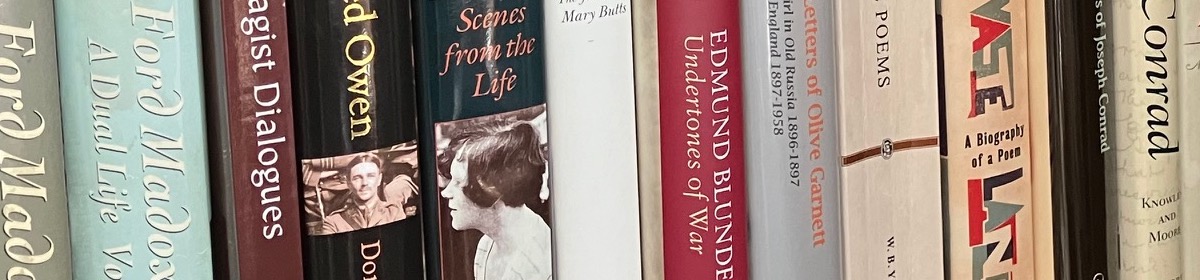
[5] See Frederick R. Karl, Joseph Conrad: The Three Lives (London: Faber and Faber, 1979), 673; letter from Thomas C. Moser, quoted in Zdzisław Najder, Joseph Conrad: A Chronicle, translated by Halina Carroll-Najder (Cambridge: Cambridge University Press, 1985), 361; Max Saunders, Ford Madox Ford: A Dual Life, two volumes (Oxford: Oxford University Press, 1996), I, 149.