Gilbert White of Selborne

Skylark

(Skylark: https://findingnature.co.uk/animal/skylark/ )

In Great Trade Route, Ford Madox Ford, recalling a visit to a New Jersey truck farm in the company of William Carlos Williams, commented on the behaviour of a snipe which was distracting the men from the nest to protect its young, an example of what Gilbert White famously termed storgé, using the Greek word for familial or ‘natural’ affection, one of the four Greek terms for ‘love’, along with philia, agape and eros: all were discussed in C. S. Lewis’s book, The Four Loves (1960).[1]

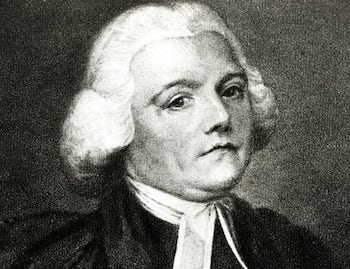
Ford often mentioned Gilbert White of Selborne (born 18 July 1720), the ‘parson-naturalist’, in both fictional and non-fictional contexts. In Parade’s End, White crops up in the first volume, Some Do Not. . .  as Christopher Tietjens spars with Valentine Wannop on their night-ride.
Gilbert-White

(Gilbert White)

‘He said:
“Where do you get your absurd Latin nomenclature from? Isn’t it phalæna …
She had answered:
“From White . . . The Natural History of Selborne is the only natural history I ever read….
“He’s the last English writer that could write,” said Tietjens.
“He calls the downs ‘those majestic and amusing mountains,’” she said. “Where do you get your dreadful Latin pronunciation from? Phal i i na! To rhyme with Dinah!”
“It’s ‘sublime and amusing mountains,’ not ‘majestic and amusing,’” Tietjens said. “I got my Latin pronunciation, like all public schoolboys of to-day, from the German.”’[2]

Later, in the third volume, A Man Could Stand Up—, Tietjens is in the trenches, where his Sergeant enthusiastically praises the skylark’s ‘Won’erful trust in yumanity! Won’erful hinstinck set in the fethered brest by the Halmighty!’

Tietjens says ‘mildly’ that he thinks the Sergeant has ‘got his natural history wrong. He must divide the males from the females. The females sat on the nest through obstinate attachment to their eggs; the males obstinately soared above the nests in order to pour out abuse at other male skylarks in the vicinity.’

‘“Gilbert White of Selbourne,” he said to the Sergeant, “called the behaviour of the female STORGE: a good word for it.” But, as for trust in humanity, the Sergeant might take it that larks never gave us a thought. We were part of the landscape and if what destroyed their nests whilst they sat on them was a bit of H[igh].E[xplosive]. shell or the coulter of a plough it was all one to them.’

The sergeant is highly sceptical of such sentiments:

‘“Ju ’eer what the orfcer said, Corporal,” the one said to the other. Wottever’ll ’e say next! Skylarks not trust ’uman beens in battles! Cor!”
The other grunted and, mournfully, the voices died out.’

Later in the same volume, Ford recurs to White in Valentine’s own reflections – Ford uses the image or allusion echoed in the thoughts of multiple characters to frequently brilliant effect:

‘Her mother was too cunning for them. With the cunning that makes the mother wild-duck tumble apparently broken-winged just under your feet to decoy you away from her little things. STORGE, Gilbert White calls it!’[3]

White-The-Wakes

(The Wakes, Gilbert White’s house:
http://gilbertwhiteshouse.org.uk/?venue=gilbert-whites-house)

In The Farther Shore: A Natural History of Perception, 1798-1984, a superb, rich study of how technological developments since the eighteenth century have affected the ways in which we interpret the world, Don Gifford wrote of how, for Samuel Johnson and Samuel Taylor Coleridge, the ambition to be generally well read, that is, to have a reasonable grasp of all that was being published and made available, ‘was within reach’, and that a community of those sharing that distinction or at least that ambition was ‘at least imagined to be a given among educated men and women.’ His footnote mentions the assumption evident in Gilbert White’s letters that his correspondents shared his acquaintance with Dryden, Pope, Addison, Swift, Gray, Johnson, Hume, Gibbon, Sterne – as well as with the Bible, Virgil, Homer, Horace, the Koran, Chaucer, Shakespeare and Milton. By the mid-80s (when he was writing this book), Gifford adds, ‘the idea of being well read and of belonging to such a community is a joke we have politely learned not to mention except with a shrug of self-deprecation.’

Of course, White’s acquaintance with Pope was not only with the man’s work: he was presented with a copy of Pope’s six-volume translation of the Iliad by the poet himself, when graduating with distinction from Oriel College, Oxford, in 1743.[4]

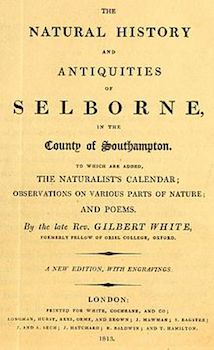
White’s fascinating and deceptively simple work has embedded itself in English culture in numerous contexts. His genius, as Ronald Blythe remarks, was ‘to revolutionise the study of natural history by noting what exactly lay outside his own back-door.’[5] In his first letter to the Honourable Daines Barrington in June 1769, White wrote, ‘I see you are a gentleman of great candour, and one that will make allowances; especially where the writer professes to be an out-door naturalist, one that takes his observations from the subject itself, and not from the writings of others’ (Selborne 104). He produced hundreds of pages, records of looking and listening and remembering and wondering. Birds, plants, insects, weather, animals, not least the human. ‘My musical friend, at whose house I am now visiting, has tried all the owls that are his near neighbours with a pitch-pipe set at concert-pitch, and finds they all hoot in B flat. He will examine the nightingales next spring’ (Selborne 127).
White's_Selborne_1813_title_page

The local as the universal. A hundred and eighty years after White’s death, William Carlos Williams would note that the poet’s business was ‘to write particularly, as a physician works, upon a patient, in the particular to discover the universal.’ He quoted the line of John Dewey’s that he had come upon by chance, ‘The local is the only universal, upon that all else builds’, commenting elsewhere that, ‘in proportion as a man has bestirred himself to become awake to his own locality he will perceive more and more of what is disclosed and find himself in a position to make the necessary translations.’[6] Williams in Rutherford; Thoreau in Concord; White in Selborne.

Don Gifford points out that, ‘In effect, White’s perspective differs radically from our own because he had no a priori basis for distinguishing between trivial and significant things.’ So, in addition to seeing with his own eyes, White ‘had to see cumulatively, a second order of seeing’. He tells the story of Henry Thoreau reducing Ellery Channing to tears when the two men went out into the woods together: Channing knew so little about what to record that he returned with an empty notebook, desperate and frustrated.[7]

White’s journals were published in 1931 and, Alexandra Harris comments, ‘his work was tirelessly reissued over the next decade.’ But then, in addition to being valued for his ‘timeless qualities’, White was ‘also being used as someone relevant to the present time precisely because the world he knew was disappearing.’[8]

When we read those writers detailing the current decline or disappearance of so much British wildlife, through environmental damage, farming practices and government policies, the parallels hardly need stressing.

On the matter of White’s journals, let your fingers do the running, to this superb resource:
http://naturalhistoryofselborne.com/

House and garden, café and shop?
http://www.gilbertwhiteshouse.org.uk/


References

[1] Ford Madox Ford, Great Trade Route (London: Allen & Unwin, 1937), 184; Gilbert White, The Illustrated History of Selborne (London: Macmillan, 1984), 114, 133-134.

[2] Ford Madox Ford, Some Do Not. . . (1924; edited by Max Saunders, Manchester: Carcanet Press, 2010), 163-164.

[3] Ford Madox Ford, A Man Could Stand Up— (1926; edited by Sara Haslam, Manchester: Carcanet, 2011), 63, 64, 65, 201.

[4] Don Gifford, The Farther Shore: A Natural History of Perception (London: Faber and Faber, 1990), 158 and n., 5.

[5] Ronald Blythe, Aftermath: Selected Writings 1960-2010, edited by Peter Tolhurst (Norwich: Black Dog Books, 2010), 226.

[6] William Carlos Williams, The Autobiography of William Carlos Williams (New York: New Directions, 1967), 391; Selected Essays (New York: New Directions, 1969), 28.

[7] Gifford, Farther Shore, 10, 11.

[8] Alexandra Harris, Romantic Moderns: English Writers, Artists and the Imagination from Virginia Woolf to John Piper (London: Thames & Hudson 2010), 171, 173.


Glorious ninth (or eleventh): Ford’s Encyclopaedia

Fordie

Hugh Kenner writes somewhere about the highly instructive experiment of going back to an encyclopaedia entry, once you actually know something of the subject to which it refers, and realising how much that entry has been altered by your enhanced knowledge. One of my favourite brief outlines of Ford Madox Ford’s life and work, of the encyclopaedic entry type (‘About the author’), appeared in the back pages of an American edition of one of his best-known works, managing four major errors in a dozen lines, while the prize exhibit among Ford scholars is probably the edition of one of his major novels which displays on the front cover an illustration placing the action of the book in entirely the wrong century, while, on the back cover, failing twice to spell the author’s name correctly. Between those covers, the last section of the text has mysteriously vanished.

That’s an individual perspective, of course, a personal, even specialised interest. But even in the case of Ford (a writer still not that widely known), a good many readers would surely have noticed the flawed nature of the Times obituary of Ford’s death. ‘Rather eccentric in selection of Ford books mentioned,’[1] Ford’s bibliographer comments of it. You might say that: the obituary fails to mention either The Good Soldier or the Parade’s End tetralogy. It does include a reference to the biography of his grandfather—though a mysterious painter named ‘Fox Madox Brown’ also features on this occasion.[2] But then at least one obituary of Herman Melville settled on Typee as his best book (though getting the publication date wrong) while omitting to mention Moby Dick at all.[3] (Although, as my old teacher, the late Tom Ingram, wrote in the margin of my essay, Typee is ‘still a damned good book.’)

FMB_Tells_Son

(Ford Madox Brown: Tell’s Son – Ford as model)

Like his friend Ezra Pound, Ford was wary of what he once termed ‘the half-learning of encyclopaedias’,[4] and made great play with them in several of his novels. In Some Do Not. . ., Christopher Tietjens is described as being ‘a perfect encyclopaedia of exact material knowledge’ – though this is stated not by the narrator but by Tietjens’ chief, Sir Reginald Ingleby. Tietjens diverts himself by ‘tabulating from memory the errors in the Encyclopaedia Britannica, of which a new edition had lately appeared.’ But this, as so often, is a seemingly innocuous detail which expands, under informed scrutiny, into labyrinthine complexities, as the editor’s lengthy footnote explains.[5]

Later, his memory damaged by a shell-blast, Tietjens will work his way through precisely that encyclopaedia, though he will, as he realises, be forced out of his job on the pretext of his having no more general knowledge than is contained in it.

‘In the old days’, Ford had written just before the war, ‘a publisher had to consider what was Literature. [ . . . ] Now it was just a business. You found out what the public had to have. For what Mr. Sorrell supplied was just that. He gave them encyclopaedias’.[6] In that same year, in his short story, ‘The Case of James Lurgan’, the Encyclopaedia Britannica made another appearance: the doctor has ‘a copy of the ninth edition of this useful work in his dining-room’.[7]

IFMFS14

The ninth edition: Ford’s father had written for that edition, while his uncle, William Rossetti, wrote for the famous – the celebrated – eleventh edition, and even enlisted Ford’s help in revising his articles for it, mainly on Italian painters.[8] The eleventh edition appeared in 1910-1911, so Ford’s repeated references to the ninth edition are, I think, a joke—which is probably the explanation for a good many oddities and suspected errors in his work.

In his memoir of 1911 (that year again), Ford’s preface is addressed to his daughters: ‘To the one of you who succeeds in finding the greatest number [of errors] I will cheerfully present a copy of the ninth edition of the Encyclopaedia Britannica, so that you may still further perfect yourself in the hunting out of errors.’ Later in the book, he writes: ‘My father was a man of an encyclopaedic knowledge and had a great respect for the attainments of the distinguished.’ Yes, I think those last nine words save Ford needing to write fifty pages on his relationship with his father, even without the following sentence: ‘He used, I remember, habitually to call me “the patient but extremely stupid donkey.”’[9]

Ford Madox Ford died in the Clinique St François, Deauville, on this day, 26 June 1939. He was just sixty-five years old.

 
References

[1] David Dow Harvey, Ford Madox Ford 1873-1939: A Bibliography of Works and Criticism, (New York: Gordian Press, 1972), 425.

[2] ‘Obituary’, Times (27 June, 1939), 16.

[3] Hershel Parker, Herman Melville: A Biography. Volume 2, 1851-1891 (Baltimore: Johns Hopkins University Press, 2002), 921.

[4] Ford Madox Ford, Great Trade Route (London: Allen & Unwin, 1937), 129.

[5] Ford Madox Ford, Some Do Not. . . (1924; edited by Max Saunders, Manchester: Carcanet Press, 2010), 6-7; 13 and note.

[6] Ford Madox Ford, Ladies Whose Bright Eyes (London: Constable, 1911), 7.

[7] Ford Madox Ford, ‘The Case of James Lurgan’, The Bystander, XXXII (6 December 1911), 540.

[8] Max Saunders, Ford Madox Ford: A Dual Life, two volumes (Oxford: Oxford University Press, 1996), I, 195. David Jones lost his treasured copy of the eleventh edition in a bet with Evelyn Waugh on a point of history and Waugh arrived next morning in a taxi to collect it. See Thomas Dilworth, David Jones: Engraver, Soldier, Painter, Poet (London: Jonathan Cape, 2017), 169.

[9] Ford Madox Ford, Ancient Lights and Certain New Reflections (London: Chapman and Hall, 1911), xv, 41-42.


The Extraordinary Ordinary

Tree-of-Man

In Patrick White’s 1955 novel, The Tree of Man, Stan Parker, suspecting what has taken place between his wife and a commercial traveller, turns his car round and drives along familiar roads towards the city. ‘People who did not know what had happened were continuing to live their lives.’[1]

This called to mind the W. H. Auden poem referred to recently, the fall of Icarus into the sea barely warranting the attention of those others busy with their own concerns. In another Auden poem, ‘In Memory of W. B. Yeats’, he writes:

Far from his illness
The wolves ran on through the evergreen forests,
The peasant river was untempted by the fashionable quays

He writes of the poet’s work passing into the minds and bodies of countless readers and listeners, who will adapt and interpret and use his writings in their own way and according to their own needs and urgencies, ‘The words of a dead man/ Are modified in the guts of the living.’

But in the importance and noise of to-morrow
When the brokers are roaring like beasts on the floor of the Bourse,
And the poor have their sufferings to which they are fairly accustomed,
And in each in the cell of himself is almost convinced of his freedom;
A few thousand will think of this day
As one thinks of a day when one did something slightly unusual.[2]

w-b-yeats

(W. B. Yeats via The Poetry Foundation)

The ultimate banal observation – that life continues – everywhere, or everywhere else, whatever disturbing or heart-rending or monstrous event is occurring here, or here, is something that must be confronted and withstood and, ultimately, accepted.

I remember the day on which I was waiting for a train to London, on my way to tell my mother that the hospital staff would be turning off my sister’s life support machine the next morning. My sister’s husband and daughter had made that impossible, inevitable decision and had asked me to break the news.

I was watching two young men on a bench across the tracks from me; one seemed to be dancing while still sitting down. His friend laughed, rocking gently to and fro. An elderly couple passed close to me, intent and purposeful; young women out for the evening shimmied and twirled. In touch with death and faced with exuberant or expressive or just ordinary life, you feel indignant but relieved, offended and thankful. You sit with your own arms wrapped around yourself, alive, while blood dances in your veins.

There is also the paradox against which you bruise yourself sooner or later: on the one hand, the life of practically any man or woman can be and generally is, in the end, whittled down to a handful of words, a few sentences. On the other hand, almost any individual life is, if viewed through certain lenses, immense, significant, infinitely varied. White’s novel, about professedly ‘ordinary’ people, embodies the question, over nearly five hundred pages, of whether there is really any such thing. ‘The sky was blurred now. As he stood waiting for the flesh to be loosened on him, he prayed for greater clarity, and it became obvious as a hand. It was clear that One, and no other figure, is the answer to all sums.’[3]

Sky-through-stone

All lives contain astonishments, illuminations, intensities, immeasurable depths – but very few can articulate, verbally, comprehensibly, what they have seen or glimpsed or divined. This is one purpose – or effect – of art: Guy Davenport despaired over the assumption, set in stone for so many, that the sole purpose of poetry is ‘self-expression’, ignoring the possibility that the poet ‘speaks for people who cannot speak’ and ‘makes sentences for people to say’.[4]

Hearing from Ford Madox Ford that he was publishing a fairy tale (three of Ford’s first five books were fairy tales), Peter Kropotkin said that he hoped it was not about princes and princesses (it was), or at least that Ford would write a fairy tale about simple and ordinary people. ‘I have been trying to do so ever since’, Ford commented forty years later. ‘I always want to write about ordinary people. But it seems to be almost impossible to decide who are ordinary people – and then to meet them. All men’s lives and characteristics are so singular.’[5] Elsewhere, he wrote of ‘The extraordinary complications of even the simplest lives! . . .’ and that ‘every case is a special case’.[6]

 The novelist Blanford, in Lawrence Durrell’s Quinx, also had his doubts about ordinariness: ‘Ah, the mind-numbing ineptness of the rational man with his formulations! Defeated always by the flying multiplicity of the real. “Ordinary life” – is there such a thing?’[7] While, perhaps most pertinently, Sarah Bakewell wrote of Michel de Montaigne, ‘From the start, Montaigne had the impression at once of being a peasant among peasants, and of being very special and different. This is the mixture of feelings that would stay with him for life. He felt ordinary, but knew that the very fact of realizing his ordinariness made him extraordinary.’[8]


References

[1] Patrick White, The Tree of Man (1955; Harmondsworth: Penguin Books, 1961), 322.

[2] W. H. Auden, The English Auden: Poems, Essays and Dramatic Writings, 1927-1939, edited by Edward Mendelson (London: Faber, 1977), 241, 242.

[3] White, The Tree of Man, 477.

[4] Guy Davenport, ‘Do You Have a Poem Book on E. E. Cummings?’, in The Geography of the Imagination (Boston: David R. Godine, 1997), 132.

[5] Ford Madox Ford, Return to Yesterday: Reminiscences 1894-1914 (London: Victor Gollancz, 1931), 108.

[6] Ford Madox Ford, No More Parades (1925; edited by Joseph Wiesenfarth, Manchester: Carcanet Press, 2011), 43; Great Trade Route (London: Allen and Unwin, 1937), 299.

[7] Lawrence Durrell, Quinx, or The Ripper’s Tale, in The Avignon Quintet, one-volume edition (London: Faber and Faber, 2004), 1260.

[8] Sarah Bakewell, How To Live: A Life of Montaigne in one question and twenty attempts at an answer (London: Vintage 2011), 52.


His tongue partly in his cheek – realism or not

White

On 14 June 1940, T. H. White, who had been in Ireland since the previous year, wrote from Healion’s Hotel, Belmullet, Co. Mayo, to his friend David Garnett. ‘Ireland is in a most amusing condition just now. Everybody has noticed in the last 3 days that there is a war on: it is too ridiculous.’ He went on: ‘Lord Dunsany said to me six months ago that we are like children on the beach at Howth, quarrelling about what shape our sand castle is to be, while all the time the tide is coming in.’ Then: ‘I wonder if I wrote to you about Dunsany? I made friends with him when I was in Meath. He is not a patch on his wife, who remarked in a tone of acute nostalgia, à propos of a Daimler which they had once owned: “Ah, that was a splendid car. It was simply riddled with bullets.”’[1]

White had lunched with Lord Dunsany at Dunsany Castle, ‘an ugly Victorian gothic structure in a very beautiful park’, and thought him ‘a decent, amusing, interested, selfish, vain, enlightened fellow’.[2]

OLYMPUS DIGITAL CAMERA

(Via www.buildingsofireland.ie )

Dunsany died in 1957, having published more than ninety books in practically every genre, though he was best-known as a writer of fantasy, his most celebrated title being The King of Elfland’s Daughter. He had been a significant donor to the Abbey Theatre, worked with Lady Gregory and W. B. Yeats, and his work was extraordinarily well-regarded in the period of the First World War.

In November 1953, White, now living on Alderney, wrote to Garnett about the recently published The Golden Echo, the first volume of Garnett’s autobiography.

‘Far the best of your character pictures are of course the safely dead: Lawrence and the charming Ford.’ He added, ‘If there is a chance in the next volume, do give us some more of Ford’s relative truths. What a kinship I feel for him! All my truths are relative. He must surely have had his tongue partly in his cheek?’[3]

David-Garnett

(David Garnett)

Partly often, yes, and wholly sometimes. To what extent, I wonder, when he used the occasion of reviewing Dunsany’s Five Plays for a prolonged meditation on realism, in the course of which he produced one or two of the critical remarks most often revisited by Ford enthusiasts.

Passing general remarks about Ireland and the Irish is risky at the best of times but in the spring of 1914, it was frankly hazardous. Ford declared that while the Irish were as humourless and joyless and materialist as anyone else, they had impressed upon ‘the bemused world’ the conviction that all the Irish ‘are passionate pilgrims journeying through a material world with their eyes on the great stars of heaven, with the verses of the old poets on their lips and gallant thoughts in the hearts of them’.[4]

All this was a disquisition on literary technique, Ford went on, ‘for what is literature but the producing of illusions?’ And, ‘for the producing of an illusion there is nothing like an Irishman.’ Dunsany’s great conjuring trick for Ford was to imagine himself ‘to represent the revolt against realism’, while in fact he did nothing of the sort, ‘since he is one of the chief realists of them all.’ And ‘we need realists very badly, because this world is so much too much with us. It is too much with us, and it is an extraordinarily unreal mirage. Yes, just a mirage.’ Ford describes the stones in the drive, a broken bucket in the orchard, the rain against the window, the baker coming in at the front gate. ‘But all that is really mirage; there is nothing real about the stones or the discarded bucket, or the rain, or the baker coming in at the gate. Myself, my own self, is miles away – thirty miles away, thinking of things how different – how utterly different!’

Ford Madox Ford, 1915

(The good soldier via NYRB)

And the future is to ‘the artist who, by rendering the stones and the bucket and the baker and the Daily Telegraph that is lying on the sofa, will give the world the image of that kingdom of heaven that is behind it all.’

‘I rather fancy’, Ford remarks, ‘that the Cubists and the Futurists and the rest of the movement that is trying to get away from representational art are trying to put the kingdom of heaven too directly on to canvas’.

Yes, the way to heaven is via the earth; the way to transcendence is via the real. Begin with the fantastic and you find you’re holding a one-way ticket ­– fine if that was the plan, if not, not. I’ve always liked realism plus, the world that seems solid enough, seems familiar enough, until you try to lean on it. With a little of what Muriel Spark called ‘the mental squint’. And Ford, with the body in one place and the mind somewhere quite other. Or, indeed, Mr Joyce, Mr Germ’s Choice, whose great novel is – what, precisely? Modernist, realist, naturalist, expressionist, surrealist, symbolist, postmodernist, mythic, epic, not a novel at all. If Dublin were destroyed in an earthquake, it could be rebuilt using Ulysses as a blueprint, its author thought. Yes, realism with a reach like that.

References

[1] David Garnett, editor, The White/ Garnett Letters (London: Jonathan Cape, 1968), 70.

[2] Letter to Ray Garnett, in The White/ Garnett Letters, 45; Sylvia Townsend Warner, T. H. White: A Biography (New York: Viking, 1968), 141.

[3] The White/ Garnett Letters, 264.

[4] All quotations from Ford Madox Ford, ‘Literary Portraits-XXXI. Lord Dunsany and “Five Plays”, Outlook, XXXIII (11 April 1914), 494-495; reprinted in Critical Essays, edited by Max Saunders and Richard Stang (Manchester: Carcanet Press, 2002), 142-146.


Cats, monkeys, parrots and a pelican

Shylock-Tubal

https://shakespeareillustration.org/2016/08/13/shylock-and-tubal/

‘Though I had to run to London several times’, Edward Fitzgerald wrote to Frederick Tennyson on 8 June 1852, ‘I generally ran back as fast as I could; much preferring the fresh air and the fields to the smoke and ‘“the wilderness of monkeys”’ in London.’

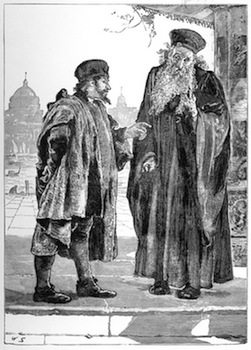
That last phrase comes from The Merchant of Venice—by the dramatist of whom Fitzgerald wrote, ‘What astonishes me is, Shakespeare: when I look into him, it is not a Book, but People talking all round me.’[1] Tubal tells Shylock he has been shown a ring that one of Antonio’s creditors ‘had of your daughter for a monkey.’ Shylock is hugely upset by the news since the ring was a turquoise given to him by Leah, before she became his wife: ‘I would not have given it for a wilderness of monkeys’ (III.i).

My Arden edition, so wedded to extensive and detailed footnotes, has nothing to add here. But recurrences of the phrase, with embellishments, or near misses or oblique references, have offered other editors and annotators hours of fun.

‘Excuse these moans’, Ivor Gurney wrote to Mrs Voynich in April 1916. ‘But I am as a bottle in the smoke, a mouldy pelican in a howling wilderness of monkeys.’ A footnote here points to the Book of Common Prayer, Psalm cxix (bottle in the smoke) and the pelican ‘(not mouldy)’ in Psalm cii, while commenting on Gurney’s ‘also mixing in the “wilderness of monkeys” from Shylock’s valuing of his ring in The Merchant of Venice, III, i.’[2]

Ten years later, C. E. Montague wrote in Rough Justice of his characters, ‘Molly and Auberon too, making no show among parrots and monkeys, but still somehow right’.[3] Parrots and monkeys now? An Army phrase meaning goods and chattels, personal possessions, Eric Partridge tells us, citing a later catchphrase: ‘All right! Pick up your parrots and monkeys, and get mobile’.[4]

Newton-Long-John-Silver

(Robert Newton as Long John Silver – with parrot)

Pelicans, parrots, monkeys. Something missing? Ah. In Some Do Not. . ., the first volume of Ford Madox Ford’s Parade’s End tetralogy, he has Christopher Tietjens remember ‘the words of some Russian: “Cats and monkeys. Monkeys and cats. All humanity is there.”’ ‘Some Russian’, forsooth! It was the New Yorker Henry James, as Ford’s editor, Max Saunders, documents in a footnote: ‘See Henry James, “The Madonna of the Future” (1873), which repeats the sentence: “Cats and monkeys, monkeys and cats; all human life is there!”: The Tales of Henry James, ed. Maqbool Aziz, vol. II (Oxford: Clarendon Press, 1978), 202–32 (226, 232).’[5] Fordian numerologists will savour the publication date of James’s story (the year of Ford’s birth).

Nor is this the volume’s only dealings with these furry constituents of ‘all humanity’. Less than fifty pages later, Mrs Wannop, writer and mother of Valentine, addresses Christopher Tietjens. ‘“My dear boy,” she said. “Life’s a bitter thing. I’m an old novelist and know it. There you are working yourself to death to save the nation with a wilderness of cats and monkeys howling and squalling your personal reputation away. . . ”’ This further twist engages the editor again: ‘While “cats and monkeys” echoes the phrase noted on 100 above, the addition of “wilderness” here adds another echo, to The Merchant of Venice, III.i.112–14, when Shylock says to his friend: “Thou torturest me, Tubal: it was my turquoise; I had it of Leah when I was a bachelor: I would not have given it for a wilderness of monkeys.”’ Four more pages and the stalwart Mrs Wannop remarks, ‘“Of course, I back my daughter against the cats and monkeys.”’[6] As who would not?

Valentine-in-Parades-End-008

(Adelaide Clemens as Valentine Wannop in the BBC/HBO series of Parade’s End)

A decade before Some Do Not. . ., Ford had devoted an entire book to Henry James, in the course of which he quoted that final sentence of ‘The Madonna of the Future’ twice, the second time while he was comparing aspects of James and another of Ford’s most admired confrères, Turgenev: ‘For the Russian could never have written The Turn of the Screw; and, if he could have given us Daisy Miller, he certainly could not have written “Cats and monkeys, monkeys and cats – all human life is there. . .”’[7]

Not that it’s all literary larks. Jaap Goudsmit’s 1997 study, Viral Sex, discussed the possible lines of descent of HIV and SIV (Simian immunodeficiency, a virus found in primates), mentioning that monkeys and cats ‘in the same household might sometimes become companions and groom each other.’ That they would also fight is shown in tomb paintings dating from the reigns of Amenhotep III and Horemheb, both fourteenth century BC. ‘So more than three thousand years ago, Egyptian domestic culture gave cat viruses the chance to infect monkeys.’[8]

Cats and monkeys. Monkeys and cats.

References

[1] The Letters of Edward Fitzgerald, edited by Alfred McKinley Terhune and Annabelle Burdick Terhune, four volumes (Princeton: Princeton University Press, 1980), II 56, 372.

[2] Ivor Gurney, Collected Letters, edited by R. K. R. Thornton (Mid Northumberland Arts Group & Carcanet Press 1991), 78 and fn.

[3] C. E. Montague, Rough Justice (London: Chatto & Windus 1926), 204.

[4] Eric Partridge, A Dictionary of Slang and Unconventional English, 8th edition, edited by Paul Beale (London: Routledge, 1984), 856.

[5] Ford Madox Ford, Some Do Not. . . (1924; edited by Max Saunders, Manchester: Carcanet Press, 2010), 100 and fn.

[6] Ford, Some Do Not. . ., 148 and fn., 152.

[7] Ford Madox Ford, Henry James: A Critical Study (London: Martin Secker, 1914), 140, 143. As the Oxford Dictionary of Quotations points out, from the late 1950s, ‘All human life is there’ became the slogan of the News of the World. They may not have come across it in their studies of Henry James, of course. Chapter Five of Fred Kaplan’s 1992 biography of James is entitled ‘“Cats and Monkeys”’.

[8] Jaap Goudsmit, Viral Sex: The Nature of AIDS (New York: Oxford University Press, 1997), 129.

Feeling sheepish

Lambs-gazing

Outside the back door: the familiar plant pots; the collapsing shed; the teetering bird table that caters to blackbirds, magpies, blue tits. Working keenly enough at the thinning, clearing, preparations for the new season’s plants, the Librarian is, nevertheless, a little wistful: she is missing the sheep.

Close to the Black Mountains, we stayed in a cottage six hundred years old. People were smaller in those days, Robin of Locksley’s chum Little John notwithstanding. I think my skull had significant contact with wood six times in all: twice to remember to duck as I went in or out between kitchen and terrace; twice more to remember to stay ducked, since the total breadth of solid wood to be negotiated before straightening was more than twelve inches; and, say, twice accounted for by thinking of, or looking at, something else as I approached the doorway.

The noise of that world was its height when you could just make out the sound of the tractor in the field across the valley. Otherwise, you heard only sheep, birdsong—and bees interrogating the crevices in the slate wall which bordered the terrace below the orchard. At times, especially at day’s end, you heard nothing. The sound of silence.

‘As the truest society approaches always nearer to solitude, so the most excellent speech finally falls into silence.’[1] So wrote Henry Thoreau, who was not, perhaps, that crazy about society. Still, for our first three days in border country, we went nowhere and saw nobody—and loved it.

Holiday-reading

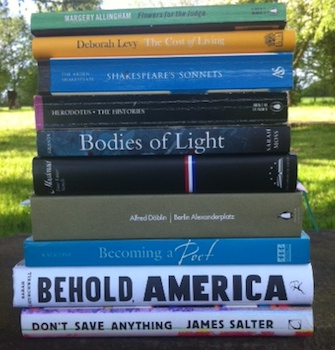
Did I take anything to read? I did. The Librarian’s gathering was a separate matter but didn’t consist of many fewer books.

As for sheep—literary sheep—I recalled the curious sentence in Ford Madox Ford’s memoir of Joseph Conrad: ‘In all our ten thousand conversations down the years we had only these two themes over which we quarrelled: as to the taste of saffron and as to whether one sheep is distinguishable from another.’ Hmm. The saffron affair came down to Conrad’s declaration that saffron had no flavour but was merely a matter of colouring, against Ford’s assertion that saffron was strongly flavoured. And one sheep distinguishable from another?

There was one more bone of contention mentioned later: the matter of official honours. ‘The reader should understand that this matter is one which divides forever—into sheep and goats—the world of the arts. There are some few artists who will accept Academic honours; to the majority of those who are really artists the idea is abhorrent, and those who accept such honours betray their brothers. To this majority Conrad had enthusiastically belonged. You had Flaubert who refused, you had Zola who all his life sought, academic distinction. For Conrad there had used to be no question as to which to follow. Now he had followed Zola.’[2]

As for the burning question of whether one sheep is distinguishable from another – on the basis of extensive research conducted over the last week, occasionally with a glass in my hand, I have an answer ready: yes.


References

[1] Henry David Thoreau, A Week on the Concord and Merrimack Rivers; Walden; The Maine Woods; Cape Cod (New York: Library of America, 1985), 318.

[2] Ford Madox Ford, Joseph Conrad: A Personal Remembrance (London: Duckworth, 1924), 29-30, 69.


An Agreeable Rattle

Sassoon

(Siegfried Sassoon)

In the Spring of 1921, Siegfried Sassoon made an entry in his diary about Mary Marjorie, his oldest friend, and the effect she had on him, making him become ‘quite an agreeable rattle!’[1]

It’s an odd and striking phrase – and one to make a close reader of Ford Madox Ford sit up and rub her hands. In Some Do Not. . ., the first volume of Ford’s Parade’s End tetralogy, Mark Tietjens, Christopher’s elder brother, has been made to realise that a man called Ruggles, with whom he has shared ‘a floor of a large and rather gloomy building in Mayfair’ for some twenty years, has been spreading malicious and untrue gossip about Christopher. ‘Of Ruggles he thought little or nothing. He had once heard the phrase “agreeable rattle,” and he regarded Ruggles as an agreeable rattle, though he did not know what the phrase meant.’ Max Saunders’ footnote reads: ‘A person who talks incessantly in a lively or inane manner; a constant chatterer’: OED. The dictionary cites Rose Macaulay’s Orphan Island, also of 1924: ‘xiii. 143, I think he must have been a rather agreeable rattle’.[2]

VH_FMF_Selsey

(Ford and Violet at Selsey)

A few more Fordian connections occur to me. Firstly, Violet Hunt, whose affair with Ford began in 1909, continued into the war years and foundered definitively when he encountered Stella Bowen. In Hunt’s novel, The Last Ditch, there is a markedly Fordian character named Audely: ‘“Call me an agreeable rattle at once!” he said.’[3]

Twenty years later, here is Caroline Gordon writing to Ford from Tennessee, assuring him that social intercourse would be available when he visited, given the proximity of the University of the South (Sewanee): ‘We have stayed out of this social spate, knowing it was too swift for us, and have permitted ourselves only one University friend, an agreeable rattle who comes once or twice a week and tells us tales that would curl our hair if we hadn’t already read it in Trollope or Cranford.’[4]

caroline-gordon

(Caroline Gordon)

Then a contemporary of Ford, though not, apparently, either friend or acquaintance, C. E. Montague, in whose story, ‘Ted’s Leave’, Ted ‘must have become the crowned wit of some little set of dull men, the sort of Agreeable Rattle to whom his world looks to keep the ball rolling in some second-rate bar.’[5]

One hundred and fifty years earlier, Act III of Oliver Goldsmith’s She Stoops to Conquer has Marlow explaining to Miss Hardcastle that, ‘At the Ladies’ Club in town I’m called their agreeable Rattle. Rattle, child, is not my real name, but one I’m known by.’ Just a few years before that, the young James Boswell had commented of Charles Crookshanks, Lord Eglinton’s steward in England: ‘He is a spirited fellow, has read a good deal, and is much of a gentleman, but has at the same time much of what is called a rattle.’ Boswell then added, ‘I must observe that we are not affected by the complaints of a genteel agreeable man against life.’ Boswell’s editor has earlier remarked of the Duke of York, heir presumptive to the throne when Boswell met him in 1760, that, ‘He was a violinist of some distinction, a rake, and what the eighteenth century called a “rattle.”’[6]

Woolf.2

(Virginia Woolf)

‘Rattle’—rattlers, rattletrap, rattling mumper—has an extensive history. But it strikes me now that ‘agreeable’ has almost vanished from common usage. Less than a hundred years ago, R. H. Mottram wrote of his character Skene’s ‘sure movements, straight glance, and agreeable carelessness’, and Virginia Woolf referred to becoming ‘part of that vast republican army of anonymous trampers, whose society is so agreeable after the solitude of one’s own room.’[7]

Just what is the problem with ‘agreeable’? Too bland, too unemphatic for these shouty times? Is it just too—Henry James? I recall now that his Portrait of a Lady begins, ‘Under certain circumstances there are few hours in life more agreeable than the hour dedicated to the ceremony known as afternoon tea.’ Pleasant, pleasing, my dictionary says. No, that really won’t do. Too restrained, too moderate, altogether too reasonable for these times. Good riddance, surely.

References

[1] Siegfried Sassoon, Diaries 1920-1922, edited by Rupert Hart-Davis (London: Faber and Faber, 1981), 64.

[2] Ford Madox Ford, Some Do Not. . . (1924; edited by Max Saunders, Manchester: Carcanet Press, 2010), 250 and fn.

[3] Violet Hunt, The Last Ditch (London: Stanley Paul, 1918), 305.

[4] Brita Lindbergh-Seyersted, editor, A Literary Friendship: Correspondence Between Caroline Gordon & Ford Madox Ford (Knoxville: The University of Tennessee Press, 1999), 97. The Editor’s note suggests that the ‘friend’ was ‘Probably Samuel Monk, a member of the English department.’

[5] C. E. Montague, Action (1928; Phoenix Library, 1936), 196.

[6] Boswell’s London Journal, 1762-1763, edited by Frederick A. Pottle (London: William Heinemann, 1950), 195-196; 53fn.

[7] R. H. Mottram, The Spanish Farm Trilogy (London: Chatto and Windus, 1927), 141;  Virginia Woolf, ‘Street Haunting: A London Adventure’, in Selected Essays, edited by David Bradshaw (Oxford: Oxford University Press, 2008), 177.


Men of Kent, fruit, hops, women


Edward Gibbon (born 27 April, 1737, in Putney) wrote in his less famous work, the autobiography, ‘My family is originally derived from the country of Kent, whose inhabitants have maintained from the earliest antiquity a provincial character of civility, courage and freedom.’ In the southern district of the country, he added, ‘which borders on Sussex and the sea’, the Gibbons ‘were possessed of lands in the year one thousand three hundred and twenty-six; and the elder branch of the family, without much increase or diminution of property, still adheres to its native soil.’[1]

My own family derived mainly from Hampshire but I myself was born in Kent so I’ll take at face value this testimony from the author of damned, thick, square books. Peter Vansittart mentions that Edward the Confessor (termed in an early work by Ford Madox Ford ‘the wavering, prevaricating, and totally useless king’) was the patron saint of England until the Hundred Years’ War. ‘Then Edward III, in debt to Genoese bankers, replaced him with their patron, the more aggressive St George, who was not to escape the attention of the supreme English ironist, Gibbon: he dismissed George as a dishonest bacon contractor, loathed by Christian and pagan alike.’[2]

Kent seems not to figure largely in Gibbon’s later life, though. Oxford, Lausanne, yes, Paris and, of course, Italy, where it was, on the fifteenth of October 1764, ‘as I sat musing amidst the ruins of the Capitol, while the barefooted friars were singing vespers in the temple of Jupiter, that the idea of writing the decline and fall of the City first started to my mind.’[3]

Dyce, William, 1806-1864; Pegwell Bay, Kent - a Recollection of October 5th 1858

(William Dyce, Pegwell Bay, Kent – a Recollection of October 5th 1858: Tate)

Ford Madox Ford, Londoner, who lived in Kent and Sussex, would often quote what he claimed to have heard said of Sussex men by their Kentish detractors: ‘Oh, he comes from Sussex. He sucked in Sussex silliness with his mother’s milk, and has been silly ever since.’[4] He added that he didn’t know what those Sussex men had to say of the men of Kent.

In one of the most resonant scenes in the first volume of his Parade’s End tetralogy, place is specific and vital: ‘This, Tietjens thought, is England! A man and a maid walk through Kentish grass fields: the grass ripe for the scythe. The man honourable, clean, upright; the maid virtuous, clean, vigorous: he of good birth; she of birth quite as good; each filled with a too good breakfast that each could yet capably digest. Each come just from an admirably appointed establishment: a table surrounded by the best people: their promenade sanctioned, as it were, by the Church—two clergy—the State: two Government officials; by mothers, friends, old maids…. Each knew the names of birds that piped and grasses that bowed: chaffinch, greenfinch, yellow-ammer (not, my dear, hammer! ammer from the Middle High German for “finch”), garden warbler, Dartford warbler, pied-wagtail, known as “dishwasher.” (These charming local dialect names.) Marguerites over the grass, stretching in an infinite white blaze: grasses purple in a haze to the far distant hedgerow: cocksfoot, wild white clover, sainfoin, Italian rye grass (all technical names that the best people must know: the best grass mixture for permanent pasture on the Wealden loam).’[5] Another four or five more pages I must resist transcribing. . .

Though Ford himself was born in Merton (then a parish in Surrey), he may have inhaled a little Kentish enthusiasm from his beloved grandfather: ‘Although Madox Brown’s early years were spent mostly in France and Belgium, he retained affection, even an idealised loyalty for Kent, his mother’s and his wife’s English county of origin.’[6]

As Dickens’ Mr Jingle said, ‘Kent, sir—everybody knows Kent—apples, cherries, hops, and women.’[7] If those are not quite my abiding memories of the county, it may be because I left it at the age of two (my father was posted to Gibraltar), came back at five and left again at eight. Cocker spaniel, guinea pigs, cat, yes; but no fruit, no hops, no women, alas.

Men of Kent or Kentish men. This is traditionally decided by whether you come from east or west of the River Medway. I am, I have just confirmed, a man of Kent.

References

[1] Edward Gibbon, Memoirs of My Life (Harmondsworth: Penguin Books, 2006), 43.

[2] Peter Vansittart, In Memory of England: A Novelist’s View of History (London: John Murray, 1998), 42; Ford Madox Ford, The Cinque Ports (Edinburgh and London: William Blackwood and Sons, 1900), 249.

[3] Gibbon, Memoirs, 143.

[4] Examples are in Ford Madox Ford, Cinque Ports, 33 fn.1; ‘Literary Portraits XXVI—Miss Amber Reeves and A Lady and her Husband’, Outlook, XXXIII (7 March 1914), 310-311, reprinted in Critical Essays, edited by Max Saunders and Richard Stang (Manchester: Carcanet Press, 2002), 134; A Mirror to France (London: Duckworth, 1926), 43; No Enemy (1929; edited by Paul Skinner, Manchester: Carcanet Press, 2002), 19.

[5] Ford Madox Ford, Some Do Not. . . (1924; edited by Max Saunders, Manchester: Carcanet Press, 2010), 131-132.

[6] Angela Thirlwell, Into the Frame: The Four Loves of Ford Madox Brown (London: Chatto & Windus, 2010), 10.

[7] Charles Dickens, The Pickwick Papers (1836-37; edited by Mark Wormald, London: Penguin Books, 1999), 31.

Processions, congresses, crowds

t-e-hulme

In ‘Notes on the Bologna Congress’, dated ‘Bologna 7 April’—it was a philosophical conference held over six days in April 1911, attracting between five and six hundred attendees—T. E. Hulme touched on a conversation with Henri Bergson and a meeting with the French philosopher and essayist Jules de Gaultier but was most concerned with the people in the streets, there apparently to welcome the Duke of the Abruzzi, who had come from Rome to open the Congress, on behalf of his cousin, King Victor Emmanuel III.

Hulme recounted the strong admiration that he felt for that gathering, which had ‘achieved the impossible. It was a crowd without being a crowd. It was simply an aggregation of people who managed the extraordinary feat of coming together without becoming that very low class multicellular organism – the mob.’ He added: ‘If anyone could invent a kind of democracy which includes, as an essential feature, the possession of large and sweeping brown cloaks, then I will be a democrat.’

But circumstances force upon him ‘a frightful dilemma’ since it’s now time for the official opening of the Congress. He should go and hear the opening paper on ‘Reality’. But, if he does, he will miss the street scene and ‘I regard processions as the highest form of art’. In the end, accepting the absurdity of crossing Europe to attend a conference and then watching a procession instead, Hulme goes in. ‘I missed a spectacle I shall never see again. I heard words I shall often hear again – I left the real world and entered that of Reality.’[1]

Heinrich_Heine-Oppenheim

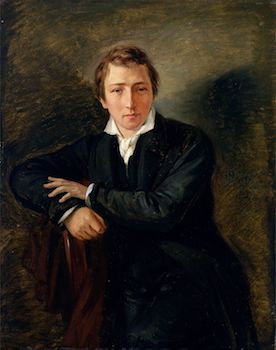
(Heinrich Heine: one of those German lyric poets. . . )

Memory snags a little on that word ‘procession’. Here’s Ford Madox Ford talking about the German lyric poets, who ‘sit at their high windows in German lodgings; they lean out; it is raining steadily.  Opposite them is a shop where herring salad, onions and oranges are sold. A woman with a red petticoat and a black and grey check shawl goes into the shop and buys three onions, four oranges and half a kilo of herring salad. And there is a poem! Hang it all ! There is a poem.
‘But this is England—this is Campden Hill, and we have a literary jargon in which we must write. We must write in it or every word will “swear.”

Denn nach Köln am Rheine
Geht die Procession.

“For the procession is going to Cologne on the Rhine.” You could not use the word procession in an English poem. It would not be literary.’[2]

Would it not? Robert Hampson suggested in a 1993 essay that Ford ‘must have forgotten’ Lionel Johnson’s poem to Oliver George Destree (‘Dead’), which includes the lines:

Past the ruinous church door,
The poor procession without music goes.

He points out that Ford’s own poem ‘The Starling’, which opens High Germany (1911), uses ‘procession’ and that Ezra Pound subsequently rises to the challenge with a cluster of processions in the poems of Lustra (1916).[3]

Ford might also have ‘forgotten’ Richard Corbet’s ‘Farewell Rewards and Fairies’:

By which we note the Fairies
Were of the old profession;
Their songs were Ave Marys,
Their dances were procession.

puck

(Puck, via the Kipling Society)

Why would he have known it? Though not, as far as I recall, in the habit of browsing through Percy’s Reliques of Ancient English Poetry, he might well have found it in the first story of Kipling’s Puck of Pook’s Hill (1906), where it’s sung (if not those precise lines) by Puck and Una; while the ‘sequel’ to Puck was, of course, Rewards and Fairies (1910).[4] There was also Ford’s friend Stephen Crane, who once began a poem: ‘There were many who went in huddled procession’.[5]

Hulme died, aged barely thirty-four, on 28 September 1917, literally blown to pieces in the trenches by a direct hit from a shell. He features in many narratives: as the translator of Henri Bergson and Georges Sorel; or, influenced by the German art historian Wilhelm Worringer, influencing in turn the course of early modernism in Britain. His friends and acquaintances included Jacob Epstein, Wyndham Lewis (whom Hulme hung upside-down, by his trouser turn-ups, from the railings of a house in Soho Square), David Bomberg and, of course, Pound. The painter Kate Lechmere, Hulme’s partner during much of this period (and the ostensible occasion of the ruckus that resulted in the railing-suspension), contributed substantially to the start-up costs of Blast, the Vorticist journal edited by Lewis (only two issues ever appeared).

blast1

Hulme wrote and lectured in support of ‘classicism’ as against ‘romanticism’—one critic suggested that ‘man is by nature bad or limited’ was the basis of all Hulme’s thinking—developing and articulating his essentially conservative philosophy in over fifty pieces for A. R. Orage’s influential journal, The New Age, many of them under the heading ‘War Notes’ by ‘North Staffs’ once he was serving in the army.[6] Some of his brief poems were included as an appendix to Pound’s Ripostes (1912) and reprinted in subsequent editions of Pound’s shorter poems.

Above the quiet dock in mid night,
Tangled in the tall mast’s corded height,
Hangs the moon. What seemed so far away
Is but a child’s balloon, forgotten after play.[7]

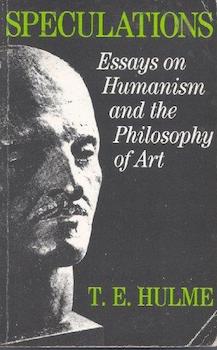
Speculations

Speculations, a collection of essays ‘on humanism and the philosophy of art’, edited by Herbert Read, was highly praised by T. S. Eliot when it appeared in 1924: ‘In this volume he appears as the forerunner of a new attitude of mind, which should be the twentieth-century mind, if the twentieth century is to have a mind of its own.’[8] Competing versions of the ‘origins’ of the Imagist movement have sometimes privileged Hulme as primary source – and sometimes Ford. Ezra Pound remembered Hulme in ‘Canto XVI’ and his ‘Poem: Abbreviated from the Conversation of Mr T. E. H.’ ends:

My mind is a corridor. The minds about me are corridors.
Nothing suggests itself. There is nothing to do but keep on.[9]

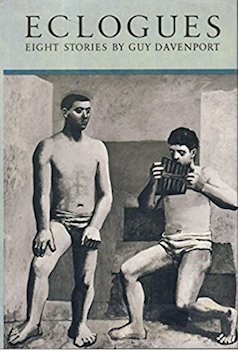
Eclogues

Guy Davenport’s story about Hulme at the Bologna Congress is called ‘Lo Splendore della Luce a Bologna’. It has many slyly wonderful moments; and the first of its seventeen short sections ends with the word ‘procession’.[10]


References

[1] T. E. Hulme, ‘Notes on the Bologna Congress’, New Age, VIII (27 April 1911), 607-608, reprinted in Further Speculations, edited by Sam Hynes (Minneapolis: University of Minnesota Press, 1955), 21-27.

[2] Ford Madox Ford , Collected Poems (New York: Oxford University Press, 1936), 326-327. This was the ‘Preface’ to the 1913 Collected Poems.

[3] Robert Hampson, ‘“Experiments in Modernity”: Ford and Pound’, in Andrew Gibson, editor, Pound in Multiple Perspective: A Collection of Critical Essays (Basingstoke: Macmillan, 1993), 121, n.31 and 32.

[4] Rudyard Kipling, ‘Wieland’s Sword’, in Puck of Pook’s Hill and Rewards and Fairies, edited with an introduction by Donald Mackenzie (Oxford: Oxford University Press, 1993), 10 and 413n.

[5] Stephen Crane, The Black Riders, XVII, in Prose and Poetry , edited by J. C. Levenson (New York: Library of America, 1984), 1304.

[6] Alun R. Jones, The Life and Opinions of T. E. Hulme (London: Gollancz, 1960), 69; some of the ‘War Notes’ are included in Further Speculations.

[7] T. E. Hulme, ‘Above the Dock’, in Personae: The Shorter Poems of Ezra Pound, edited by Lea Baechler and A. Walton Litz (New York: New Directions, 1990), 267.

[8] Eliot reviewed Speculations in The Criterion, II (7 April 1924), 231-232.

[9] Ezra Pound: Poems and Translations, edited by Richard Sieburth (New York: Library of America, 2003), 568.

[10] Guy Davenport, Eclogues: Eight Stories (London: Picador, 1984), 125.


Fording Kipling

Sadler, John, 1843-1908; The Anchorite's Cell, Chester

(John Sadler, The Anchorite’s Cell, Chester: Grosvenor Museum)

In 1877, Rudyard Kipling’s mother took her children from Lorne Lodge in Southsea—‘the House of Desolation’—to Golding’s Hill, on the edge of Epping Forest. In Kipling and the Children, Roger Lancelyn Green mentions that a part of the young Kipling’s reading there was Meinhold’s Sidonia the Sorceress, ‘a shibboleth of the Pre-Raphaelite circle (Morris later reprinted it at the Kelmscott Press)’. Later in the book, Green cites Edward A. Freeman’s reference to the legends of how Harold survived the Battle of Hastings: ‘Harold is supposed to have become a hermit, visiting many shrines but finally settling in the cell still shown as his near St. John’s Church, Chester.’[1]

The two details together reminded me of The Young Lovell, the last novel that Ford Madox Ford published before The Good Soldier, and which he described in a letter to his agent, dated 17 March 1913.[2]

‘The date is towards the end of the XVth Century, running up to the beginnings of the Reformation, though it isn’t in that sense concerned with religion. The action takes place in Northumberland and the story contains any number of things concerning “The Percy out of Northumberland”, the Bishops Palatine of Durham, the besieging of castles, border raids, and so on with what is called “a strong element of the supernatural” and a vigorous love interest.’[3]

Edward_Burne-Jones_Sidonia_von_Bork

(Edward Burne-Jones, Sidonia von Bork: Tate)

Sidonia the Sorceress, by Wilhelm Meinhold, was indeed ‘a shibboleth of the Pre-Raphaelite circle’, read and recommended by Dante Gabriel Rossetti, William Morris, Edward Burne-Jones (who painted watercolours depicting two of the book’s characters), Oscar Wilde (whose mother had translated it), Ford’s grandfather, Ford Madox Brown, and his brother Oliver (who wrote a book on witches). This is part of the ‘strong element of the supernatural’ contained in Ford’s novel.[4]

FMF-via_Arts_Desk

(Ford Madox Ford: via The Arts Desk)

The legend about Harold ending as a hermit in an anchorite’s cell is mirrored in the closing pages of The Young Lovell, where, in the aftermath of a great battle, Lovell’s body is walled up in a hermit’s cell while his spirit disports in paradise with the goddess Venus. Ford’s story is set in 1486, the year after the death of Richard III at the Battle of Bosworth Field. Historically, then, it follows not merely a battle but a war, since Bosworth Field was the last decisive battle in the Wars of the Roses, as Richard was the last king of the House of York and the last king of the Plantagenet dynasty.

Francis Lovell was a noted supporter of Richard: he disappeared in 1487, presumed dead. Mysteriously, though, when building work was carried out on his ancestral home, Minster Lovell, in 1708, a man’s skeleton was apparently discovered ‘in a vault’, seated at a table, surrounded by papers and with a dog’s skeleton at his feet – all crumbled to dust as soon as air was admitted to the room.[5] Max Saunders also connects Ford’s novel with a Victorian ballad called ‘The Mistletoe Bough’, in which a young bride disappears: her skeleton is eventually found in a trunk, in which she had been accidentally locked while playing hide-and-seek. The husband in the ballad is twice referred to as ‘Young Lovell’.[6]

Rudyard_Kipling .

(Rudyard Kipling)

The Ford–Kipling relationship or, rather, the lack of it, remains an enduring object of interest to me. They were not quite exact contemporaries (Kipling was eight years older) but had very similar Pre-Raphaelite backgrounds; and significant figures in Kipling’s case, the painter Edward Burne-Jones (Kipling’s uncle) and Crom Price (headmaster of United Services College at Westward Ho, scene of the Stalky & Co stories), were aligned not only in their artistic tastes and convictions but also in their anti-imperialist politics. So when Kipling veered off the path that he might have appeared to be cruising along, it was not only Pre-Raphaelitism that he diverged from – he moved camp politically too. Of course, while Ford wrote a lot about the Pre-Raphaelites, he also struggled at times to free himself from the inevitable weight of his familial and cultural connections. As for his politics: they tend to resist any attempt at tidy analysis, since he claims at various points to be strongly Tory, while simultaneously arguing the case for black South Africans at the time of the Boer War, or for Irish Home Rule; and ending as an equally unclassifiable pacifist, anarchist eco-warrior in the 1930s.

Ford’s complex dealings with England and Englishness would also seem to connect with Kipling’s own – his ‘foreignness’ that long sojourn in India, to set against Ford’s German family.  But, while Ford wrote several times about Kipling, as poet and short-story writer, Kipling displayed no evidence of knowing that Ford was even in the world. Yet, despite his many references to Kipling, Ford always seems to locate his best work in the Indian tales, barely mentioning anything thereafter. For me, apart from Kim and a scattering of the early stories, the work of greatest interest starts in Traffics and Discoveries (1904), running all the way through to Limits and Renewals (1932). And those more complex, oblique, often puzzling later stories are sufficiently ‘modern’ to make Ford’s apparent dismissal of them frankly odd.

Still, as literary lives, theirs were very different from one another. Ford’s literary connections were enormous and ranged over three generations, while Kipling’s friends, especially in later life, tended not to be writers. He became quite hostile to London literary society, in fact, and wrote satirical stories about it or  referring to it – they tend not to be among his best.

No, I certainly haven’t explained it satisfactorily to myself. Perhaps a minor mystery, but still one that I’m unlikely to lose interest in any time soon.


References

[1] Roger Lancelyn Green, Kipling and the Children (London: Elek, 1965), 49, 204.
And see: http://chester.shoutwiki.com/wiki/Hermitage

[2] He did publish Ring For Nancy in the United States around the same time but this was a slightly revised version of The Panel, a novel published in the UK a year earlier.

[3] Ford Madox Ford to James B. Pinker, Letters of Ford Madox Ford, edited by Richard M. Ludwig (Princeton: Princeton University Press, 1965), 56.

[4] I review Ford’s sources for the novel in ‘“Pretty Big and Serious”: Ford Madox Ford and The Young Lovell’, in Laura Colombino and Max Saunders, editors, The Edwardian Ford Madox Ford, International Ford Madox Ford Studies 12 (Amsterdam: Rodopi, 2013), 237-255.

[5] See, for instance, James Gairdner, ‘Francis, Viscount Lovel: Minster Lovel’, Notes & Queries, 5th series, X (1878), 28-29.

[6] Max Saunders, ‘The Case of The Good Soldier’, in Max Saunders and Sara Haslam, editors, Ford Madox Ford’s The Good Soldier: Centenary Essays (Amsterdam: Brill/Rodopi, 2015), 147, n.17.