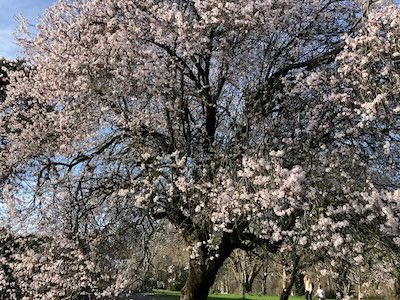
The year turns to meteorological spring. Blue sky, crisp air, early blossom, some trees apparently having had advance warning of this.
‘A glimmer of light’, the Librarian observed of the news that the Green party’s Hannah Spencer had won the Gorton and Denton by-election convincingly, followed by predictable slurs from the bad losers and incontinent frothings from the right-wing tabloids. Certainly a glimmer, though seemingly not reaching the relevant offices of the Labour administration, where it would surely have made even more legible the message that the government has been heading in precisely the wrong direction.
Snuffing that candle, though, was news that the President of the United States had been played again, and that the inevitable chaos, destruction and slaughter of civilians was already well underway – again.
Earlier, the most recent stories were all of fallen or ruined princes, royal, self-styled and otherwise. We no longer execute royal personages who have fallen from favour, not since 30 January 1649 anyway. In this country, the last official execution of anyone was in 1964, when, at 08:00 on 13 August, two convicted murderers were hanged simultaneously, one at Liverpool’s Walton prison and the other at Strangeways prison in Manchester. Nearer in time to the demise of Charles I outside the Banqueting House, Whitehall, though, public hangings were both frequent and popular, Samuel Pepys and James Boswell among those attending. ‘There were often as many as 30,000 people; one hanging in Moorfields in 1767 attracted 80,000 spectators.’[1]
Princes in a bad way might prompt in some bookish people a memory of the only line they can confidently ascribe to the poet and travel writer Gérard de Nerval. His ‘El Desdichado’, one of the ‘Chimeras’, begins:
Je suis le ténébreux, – le veuf, – l’inconsolé, Le prince d’Aquitaine à la tour abolie
Richard Sieburth’s translation has:
I am the man of gloom – the widower – the unconsoled, the prince of Aquitaine, his tower in ruins[2]
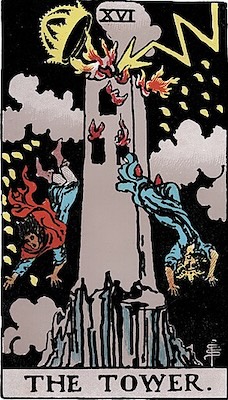
That second line in French is the one made famous by T. S. Eliot’s The Waste Land. One of that poem’s celebrated notes offers for line 429 only the name of the poet and the title of the poem. But an earlier note (to line 46) states that Eliot is ‘not familiar with the exact constitution of the Tarot pack of cards, from which I have obviously departed to suit my own convenience.’ He mentions The Hanged Man (one of the major arcana), The Phoenician Sailor (not a card in the traditional pack), The Merchant (a suit in the minor arcana), The Man with Three Staves (I’ll take a stab at the three of Wands). Oddly, he doesn’t mention The Tower (XVI: also one of the major arcana): the Prince’s is certainly in pretty bad shape and I gather (not being familiar myself with the exact constitution of the Tarot pack, as must be glaringly apparent) that the Tower (upright) is really not a card you want to come up against, connoting as it does chaos and destruction – even reversed, it’s not the ideal companion for an evening.
Princes and towers come unpleasantly together in a familiar, yet still unresolved, episode in English history, Richard of Shrewsbury and his brother, the young Edward V, who went in to the Tower of London but never emerged again. Two likely skeletons turned up during renovations in 1674. Richard III is often named as their murderer though it’s sometimes suggested that Henry VII has a case to answer.
A. E. Waite’s Pictorial Guide to the Tarot was published in 1910 (following the issue of the Rider-Waite Tarot deck, illustrated by Pamela Colman Smith) and reprinted in 1922, the year that The Waste Land also appeared. The illustration of the Tower shows it struck by lightning, a crown knocked off its top and two falling figures.
If not explicitly in the form of the Tarot card, Eliot’s poem has its towers too.
The brisk swell Rippled both shores Southwest wind Carried down stream The peal of bells White towers
Also:
Falling towers Jerusalem Athens Alexandria Vienna London Unreal
A few lines on:
And upside down in air were towers Tolling reminiscent bells, that kept the hours And voices singing out of empty cisterns and exhausted wells.
The Waste Land sometimes appears unsettlingly prophetic, when we read back into it later follies, failures and fiascos. Not too prophetic this time around, let’s hope.
Notes
[1] Lucy Moore, The Thieves’ Opera: The Remarkable Lives and Deaths of Jonathan Wild, Thief-Taker, and Jack Sheppard, House-Breaker (London: Penguin Books, 1998), 220. A figure outstripped by a good many recent football crowds in both England and Scotland but the current population is nearly ten times what it was then.
[2] Gérard de Nerval, Selected Writings, translated with an introduction by Richard Sieburth (London: Penguin Books, 1999), 363.
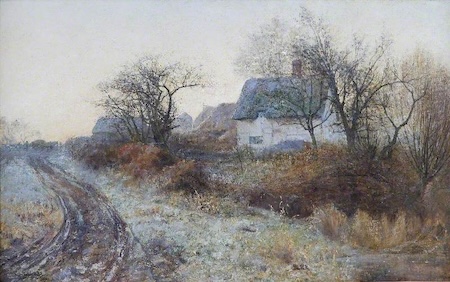
(Frederick William Newton Whitehead, A Frosty Morning: Dudley Museums Service)
‘But it must be remembered, that life consists not of a series of illustrious actions, or elegant enjoyments; the greater part of our time passes in compliance with necessities, in the performance of daily duties, in the removal of small inconveniences, in the procurement of petty pleasures; and we are well or ill at ease, as the main stream of life glides on smoothly, or is ruffled by small obstacles and frequent interruption. The true state of every nation is the state of common life.’[1]
I have a new hat, woollen, of the kind so frequently worn by sensible people in cold weather. My hat history is not an inspiring one but in this I look no more ridiculous than other wearers. Perhaps just a little more. Were it a magic hat, it might explore the current rumours of an illegal American invasion of a sovereign, oil-rich country while also analysing the strange sensation of having been here before. But of course there were differences and I’m reminded of the observation by C. L. R. James, ‘To the extent that a historical parallel is suggestive, to that very degree it is dangerous.’
James was writing of interconnections, not only with reference to cricket and colonialism but also cricket and art: ‘We may some day be able to answer Tolstoy’s exasperated and exasperating question: What is art? – but only when we learn to integrate our vision of Walcott on the back foot through the covers with the outstretched arm of the Olympic Apollo.’[2]
(Biography of Sir Clyde Walcott via New Beacon Books)
More broadly still, that two-way flow of influence and attraction that many nationalists and imperialists are unwilling or unable to comprehend. Beyond all manner of boundaries. Ian Baucom, writing of James, referred to his exploration of the false dichotomy of ‘here’ and ‘there’: the assertions of taking ‘Englishness’ abroad tending to forget or elide the ‘un-Englishness’ constantly flowing back into England. England’s history, after all, was and is, inextricably, the history of those others outside England too, the beyond also the within.[3]
I was glad to learn that ‘bounder’, a cad, an ill-bred person, though now long ‘archaic’, once also meant a limit, landmark or boundary. Even amidst the current icy weather, all along the lower half of our road, dead leaves are heaped against the kerbs, the recycling bins and front doorsteps, the park being just a stone’s throw away and a line of London plane trees just beyond its boundary wall.
This border at least is easily crossed, if not always elegantly, and is clearly visible to the naked eye. On Friday 18 November 1870, the Reverend Francis Kilvert wrote in his diary of sitting in Mrs Powell’s cottage in Killey, ‘feeling for the boundary notch in the chimney’, this being somewhere along the wavy line separating England from Wales on the map. A child had been born there that they had been careful to have born in England, ‘in the English corner of the cottage’, the midwife having Betsey deliver the child standing.[4]
The Finnish word ‘susiraja’ – literally wolf border, the boundary between the capital region and the rest of the country, implying perhaps that everything outside is wilderness – gave Sarah Hall the title of her fine 2015 novel.[5] The poet and translator Anne Carson also touches on boundaries – and wolves: ‘The wolf is a conventional symbol of marginality in Greek poetry. The wolf is an outlaw. He lives beyond the boundary of usefully cultivated and inhabited space marked off as the polis, in that blank no man’s land called to apeiron (“the unbounded”). Women, in the ancient view, share this territory spiritually and metaphorically in virtue of a “natural” female affinity for all that is raw, formless and in need of the civilizing hand of man.’[6]
That civilizing hand seems to have been sawing off its own limbs of late but we should focus on the positives. Hardly a promising start to the new year but there’s plenty of it left. Remembering Thomas Carlyle’s 1829 essay ‘Signs of the Times’, it occurs to me that its most familiar line (for those to whom any line of it is familiar) is probably ‘Men are grown mechanical in head and in heart, as well as in hand.’ But my eye was caught by a couple of other sentences: ‘There is no end to machinery. Even the horse is stripped of his harness, and finds a fleet fire-horse invoked in his stead.’
17 February (in the lunar calendar) marks the beginning of the Chinese New Year; and 2026 is, I gather, the year of the Horse, specifically the Fire Horse. All the commentaries—astrological and others—on this configuration (yang and yang) that occurs every sixty years seem to hint at both opportunity and danger, energy, heat, a greater willingness to take risks, one of them the risk of burn-out. The word ‘expansion’ cropped up once or twice, hardly reassuring in the present global context. Still, best wishes to all for this year, and, as more than one person said in my hearing over Christmas, ‘May the gods be kind.’
Notes
[1] Samuel Johnson, A Journey to the Western Isles of Scotland, edited by Ian McGowan (1775; Edinburgh: Canongate Books, 1996), 18-19.
[2] C. L. R. James, Beyond a Boundary (1963; London: Vintage, 2019), 205, 279.
[3] Ian Baucom, Out of Place: Englishness, Empire and the Locations of Identity (Princeton: Princeton University Press, 1999), ‘Introduction : Locating English Identity’, 38-39.
[4] Francis Kilvert, Kilvert’s Diary, edited by William Plomer, Three volumes (London: Jonathan Cape, 1938, reissued 1969), Volume 1, 262.
[5] Sarah Hall, The Wolf Border (London: Faber 2015).
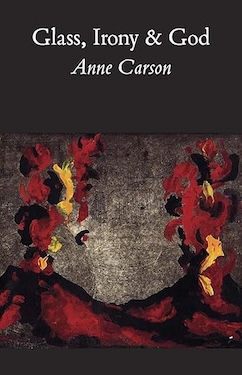
[6] Anne Carson, ‘The Gender of Sound’, in Glass, Irony & God, introduction by Guy Davenport (New York: New Directions, 1995), 124.
(William H. Clarkson, Floods in the Arun Valley, Brighton & Hove Museums)
Two years after the end of the Second World War, Aldous Huxley wrote: ‘The most important lesson of history, it has been said, is that nobody ever learns history’s lessons.’[1] A decade on, in Iris Murdoch’s fourth novel, she wrote of one of her young characters, ‘Toby had received, though not yet digested, one of the earliest lessons of adult life: that one is never secure. At any moment, one can be removed from a state of guileless serenity and plunged into its opposite, without any intermediate condition, so high about us do the waters rise of our own and other people’s imperfection.’[2]
Those rising waters would not have struck quite the note they would today, when the human species seems uncertain of whether to burn the planet or to drown it. (Recently—18 November—was the anniversary of the day on which, in 1929, Jonathan Cape published 5000 copies of a book by Robert Graves, with the reassuring title of Good-bye to All That.)
Lessons, though. Trying to think of life lessons I’d learned over the years, I could only initially come up with two: first, if at all possible, do the washing up before going to bed; and second, take the time to empty your bladder completely (if you’ve had one urinary infection in your life, you sure as hell don’t want another one). There must be more, surely. But then, looking around at some of my fellow-creatures just now, I think even two is probably pretty good going. Thus prompted, I remember a third: actually knowing or taking the trouble to find out who is to blame. A great many people in this country and elsewhere are angry, many of them with good reason, but astonishingly often that anger is effortlessly exploited by grifters, charlatans, gangsters, snake oil salesmen and rabblerousers with their own agendas, and the anger diverted to scapegoats rather than focused on the actual culprits.
(Guercino, Saint Cecilia: ã Dulwich Picture Gallery)
I see that today is the feast day of St Cecilia, patron saint of musicians, of whom I’ve written before—https://reconstructionarytales.blog/2019/11/22/camelot-and-st-cecilia/—John Dryden’s ‘Song for St Cecilia’s Day 1687’ and its connections with Ford Madox Ford’s work—a day on which so many anniversaries jostle for position: the assassination of President Kennedy, and the deaths, on precisely the same day, of Aldous Huxley, C. S. Lewis and, three decades later, Anthony Burgess (who was born in the same year as Kennedy). More cheerfully, it’s the birthday of Benjamin Britten, George Eliot and André Gide.
I used to let such dates be prompts quite often when I was writing this blog frequently if not regularly, both birthdays and deathdays, letters or diary entries. I liked too the comforting examples of writers and artists breezing (or bruising or boozing or cruising) into their eighties. Today, of the seven named figures, only Gide comes up to snuff (so to speak) in that respect.
Infrequent, irregular—but still extant, looking and listening.
And yes, there are rumours—even recent claims—of ‘peace’. In The Agricola, Tacitus sets down, or even, as has been suggested, devises—a speech (‘the substance of what he is reported to have said’) by one of the Britons, a military leader named Calgacus, ‘a man of outstanding valour and nobility’, to the crowds of warriors ‘clamouring for battle’. Part of the way through come the phrases familiar to many people, some of whom are probably hazy about the context: ‘auferre trucidare rapere falsis nominibus imperium, atque ubi solitudinem faciunt, pacem appellant’, ‘To robbery, butchery, and rapine, they give the lying name of “government”; they create a desolation and call it peace.’[3] There are probably as many suggestions about the translation of ‘solitudinem’ as there are about the first word (‘maman’) of Albert Camus’ L’Étranger—usually rendered as ‘desert’ but ‘desolation’ seems even more actively desolate than that. The poet and artist David Jones, wrote of ‘all the desolation peculiar to things that functioned in the immediate past but which are now no longer serviceable, either by neglect or by some movement of events.’[4]
(David Jones via Apollo)
It is, to be sure, immensely tiring to find that the constant contemporary echoes and resonances of past events or states of mind or actions seem always to be of a maleficent or destructive or stupid kind rather than constructive, benevolent or intelligent. But we can hardly pretend to be surprised. I try to find a positive in the Labour government’s relentless efforts to prevent my ever voting for them again in a general election. I think the latest vicious policy announcements with regard to the immigration ‘crisis’ may have ensured that.
Otherwise, when not engaged with the reliable humanitas of Ford Madox Ford, I seem to be edging further from the arena and back in time, currently with the young William Hogarth in Smithfield. . .
Notes
[1] Aldous Huxley, Science, Liberty and Peace (1947), 32.
[2] Iris Murdoch, The Bell (1958; London: Vintage, 2004), 163.
[3] Tacitus, The Agricola and The Germania, H. Mattingly’s translation revised by S. A. Handford (London: Penguin Books, 1970), 81.
[4] David Jones, In Parenthesis (1937; Faber 1963), 21.
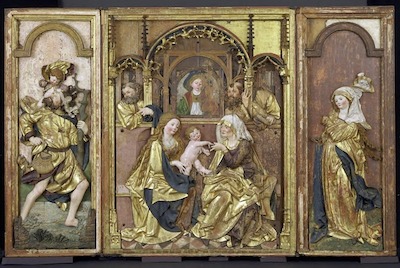
(The Boppard Altarpiece, Panel: limewood, pine, paint & gilt: Victoria & Albert Museum)
Back in the day—not that day, another one—a woman had been on the throne of England for around sixty years.
Walk wide o’ the Widow at Windsor, For ’alf o’ Creation she owns: We ’ave bought ’er the same with the sword an’ the flame, An’ we’ve salted it down with our bones.[1]
Yes, back then, a while and a world ago, when Queen Victoria was not quite gone, Rudyard Kipling had dropped in on the west coast of the United States. ‘There was wealth—unlimited wealth—in the streets’, he wrote of San Francisco, ‘but not an accent that would not have been dear at fifty cents.’ He was disappointed by the disparity between the fine and expensive clothes worn by the women he saw and their voices, ‘the staccato “Sez he”,“Sez I,” that is the mark of the white servant-girl all the world over.’
He felt, that is to say, that ‘fine feathers ought to make fine birds.’ But, ‘Wherefore, revolving in my mind that these folk were barbarians, I was presently enlightened and made aware that they also were the heirs of all the ages, and civilised after all.’ Luckily for this much-travelled traveller, he’s been accosted by ‘an affable stranger of prepossessing experience, with a blue and an innocent eye.’
It’s true that the man has peered into the hotel register and read ‘Indiana’ for the ‘India’ that Kipling has actually come from but, for the moment, the drinks and cigars that he presses upon the famous writer are welcome.[2]
Ford Madox Ford referred numerous times to Kipling, often admiringly, but almost always—and, to me, unaccountably—focusing on the early work. Some of that is wonderful but the later stories, becoming often more complex, more oblique, more modernist, somehow get lost sight of, not only by Ford but by several other major writers of the time, as if Kipling were a known quantity and need not be kept any longer in sight.
But I was thinking mostly of that phrase tucked into the Kipling lines, which recurs several times elsewhere. ‘We are the heirs of all the ages,’ Ford wrote in early September 1913, in an essay which provided the ‘Preface’ to his Collected Poems a few weeks later and in which the same line sits.[3] He had written nearly a decade earlier of ‘all the dead Londons that have gone to the producing of this child of all the ages’, and in his 1910 novel, A Call, Grimshaw remarks to Pauline: ‘We’re the children of the age and of all the ages. . .’[4]
(Kipling/ Tennyson)
Those words look back to ‘Locksley Hall’—‘I the heir of all the ages, in the foremost files of time’—by Alfred Tennyson, a poet that Ford was generally unenthusiastic about, seeing him as one of the stifling ‘Victorian Great’ figures. Yet Tennyson’s work so saturated the second half of the nineteenth century that familiarity with it was unavoidable for any serious reader.[5]
It’s a point so obvious, so banal, so unremarkable, that huge numbers of people must fail utterly to remark it. We are the heirs, the inheritors, of all that has gone before. Not just the books, the music, the paintings—which people like me are only too ready to bang on about—but the housing, the streets, the scars on the landscape, what were the mining villages, what were the dockyards and shipyards, what were the council estates, the public libraries, the youth clubs, the community centres, the rivers, the fields and hedgerows, the birds and the butterflies, the very flavour of the air. And we are also the ones who will, in our turn, bequeath or pass on or let fall the things which others will inherit and be the heirs to. As far as we have influence and agency, what will our legacy to them look like?
After January—the first rule of that month being: survive January!—I venture a little further afield to gauge the State of Things. The news, astonishingly, is Not Good. For weeks, my main focus has been the life and letters of Ford Madox Ford in the 1920s, though, on occasion, I dipped my toes into world news, not wishing to have my leg taken off just above the knee by sharks should I venture too far in.
In the United States, things are evidently shaping up to be as bad as any sane person would expect, far worse, in fact. But there’s enough derangement here to satisfy any eager watchers at the gates of Bedlam, not least a government apparently possessed of a talent to choose every time precisely the wrong policy, facing in the the wrong direction and benefiting the wrong people.
On the bright side, though—O optimist!—the Chinese New Year celebrations have welcomed in the Year of the Snake, are still welcoming it, I suppose, since this involves not only animal but also zodiac elements. This is then the Year of the Wood Snake – also known as the Year of the Green Snake, wood being associated with the colour green. The Spring Festival, I gather, takes place over fifteen days, ending with the Lantern Festival on 12 February, and is estimated to be celebrated by some two billion people in numerous countries, not only China but Indonesia, Malaysia, Singapore, Vietnam and their diasporas.
The snake may have had a bad press—certainly a bad Judaeo-Christian press—but I read that, in Chinese astrology, as a wood animal, it’s understood to represent good luck, renewal, flexibility, tolerance. Wood is good!
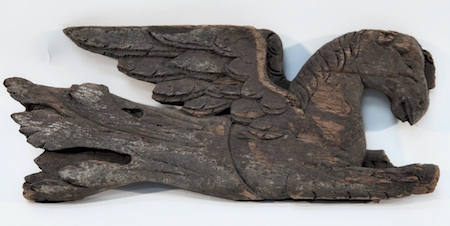
(‘Hippocamp’, a wooden carving in the form of a winged horse, originally part of the panelling inside Stafford Castle: Staffordshire County Museum Service)
This in turn brings to mind the recent piece following the death of David Lynch, which touched on Twin Peaks: The Return, and had a nice quote from Michael Horse, who played the series’ Deputy Sheriff Hawk: ‘When they did the premiere of The Return, the executives had not seen it, and they said: “Mr Lynch, would you say a few words?” And he comes out; he goes: “This project has a lot of wood in it. I like wood.”’ https://www.theguardian.com/tv-and-radio/2025/jan/23/an-oral-history-of-twin-peaks-david-lynch-madchen-amick-joan-chen
We all like wood, no? Wood nymphs, woodwind, woodbine, woodpeckers, woodlands – as a child, I had a pet woodlouse for a short time, though it didn’t end well. Woodcuts, wood engravings. Albrecht Dürer, Hiroshige, Käthe Kollwitz, Robert Gibbings, Thomas Bewick, Clare Leighton, David Jones, Gwen Raverat. Harriet Baker wrote of woodcuts made by Carrington and Vanessa Bell: ‘Carving directly into soft wood, the markings of tools and the tremors of hands were as much a part of the final pieces as form and composition.’[6]
The French historian Fernand Braudel gave wood a significant role in the lessening of the effects of the Black Death which, he argued, ‘did not, as used to be thought, arrive in Central Europe in the thirteenth century, but in the eleventh at the latest.’ His analysis of the retreat of the disease in the 18th century mentioned stone’s replacing wood in domestic architecture after major urban fires; the general increase in personal and domestic cleanliness, and the removal of small domestic mammals from dwellings, all factors that resulted in the lessening impact of fleas. He also discussed the enormous significance of wood being used everywhere: ‘One of the reasons for Europe’s power lay in its being so plentifully endowed with forests. Against it, Islam was in the long run undermined by the poverty of its wood resources and their gradual exhaustion.’[7]
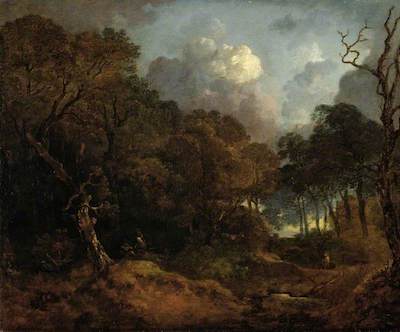
(Thomas Gainsborough, A Forest Road: Fitzwilliam Museum, Cambridge)
The gradual exhaustion of resources. Here we are again. Not so gradual now, I suspect, but in any case a phrase to tingle the tongues of those who, as previously noted, are custodians of the past and guardians of the future. Which is us, of course, even those currently making war on their own children and grandchildren.
In September 1911, Ezra Pound spent a Sunday afternoon with G. R. S. Mead, a scholar of hermetic philosophy, early Christianity and Gnosticism, the occult and theosophy: he had served as private secretary to Madame Blavatsky during her last years. He had founded the Quest Society in 1909 and invited Pound to give a lecture, which would be published subsequently in the quarterly review, The Quest. Pound delivered his lecture early in 1912 and it appeared in the October issue of the review with the title ‘Psychology and Troubadours’. Twenty years later, it was incorporated into Pound’s The Spirit of Romance.[8] It’s years since I read it but one sentence, particularly, lodged in my memory and remains intact: ‘We have about us the universe of fluid force, and below us the germinal universe of wood alive, of stone alive.’[9]
Pound, like Henri Gaudier-Brzeska, Guy Davenport wrote, ‘had conceived the notion that cultures awake with a brilliant springtime and move through seasonal developments to a decadence. This is an ideas from Frobenius, who had it from Spengler, who had it from Nietzsche, who had it from Goethe.’[10]
Yes. Never mind third runways, never mind nuclear power stations on every corner, never mind mimicking anti-immigrant messages from other political parties that run on that sort of fuel. If a body is bleeding to death in front of you—how can I put this?—it may be best, before all else, to try to stop the bleeding.
Touch wood. Good wood. Touch good wood.
Notes
[1] ‘The Widow at Windsor’, Rudyard Kipling’s Verse: Inclusive Edition, 1885-1918 (New York: Doubleday, Page & Co., 1925), 471.
[2] Rudyard Kipling, From Sea to Sea (2 volumes: Macmillan, 1900), I: 479-480
[3] Ford Madox Ford, ‘The Poet’s Eye’, New Freewoman, I, 6 (1 September 1913), 109; ‘Preface’ to Collected Poems (London: Max Goschen, 1914 [1913]), 20.
[4] Ford Madox Ford, England and the English, edited by Sara Haslam (Manchester: Carcanet Press, 2003), 4; Ford Madox Ford, A Call: The Tale of Two Passions (1910; with an afterword by C. H. Sisson, Manchester: Carcanet Press, 1984), 23.
[5] Alfred Tennyson, Poems: A Selected Edition, edited by Christopher Ricks (London: Longman, 1989), 192.
[6] Harriet Baker, Rural Hours: The Country Lives of Virginia Woolf, Sylvia Townsend Warner & Rosamond Lehmann (London: Allen Lane, 2024), 73.
[7] Fernand Braudel, Civilization and Capitalism, 15th – 18th Century. Volume I: The Structures of Everyday Life: The Limits of the Possible (London: Fontana Books, 1985). Translated from the French; revised by Sîan Reynolds, 83, 84, 363.
[8] Ezra Pound, Ezra Pound to His Parents: Letters 1895–1929, edited by Mary de Rachewiltz, David Moody and Joanna Moody (Oxford: Oxford University Press, 2010), 260; A. David Moody, Ezra Pound: Poet: A Portrait of the Man and His Work: Volume I: The Young Genius 1885–1920 (Oxford: Oxford University Press, 2007), 159.
[9] Ezra Pound, The Spirit of Romance (1910; New York: New Directions, 1968), 92.
[10] Guy Davenport, The Geography of the Imagination (Boston: David R. Godine, 1997), 22.
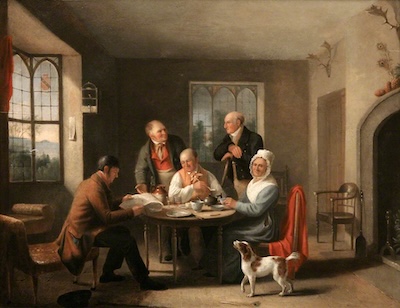
(Nicholas Condy, Estate Staff in a Servants’ Hall: Mount Edgcumbe House)
As we get older – I’m warily assuming that I’m not alone in this – our reading habits tend to change. These days, I don’t even pretend to persevere with a work that bores me or that I find incomprehensible, while avoiding anything that smacks of the dutiful. I also have a small store of things that keep the reading wheels turning if I stall. Crime fiction, certainly, but also a few writers with a healthy backlist of novels and stories, always of, or above, a certain quality threshold, literary but not excruciatingly so, tending to the concise and accessible. My usual suspects include Graham Greene and Muriel Spark.
Reading recently Spark’s unsettling short novel Not to Disturb, I came across Lister, the Baron Klopstock’s butler, saying to the other household servants as they anticipate the incursion of the press: ‘“Bear in mind that when dealing with the rich, the journalists are mainly interested in backstairs chatter. The popular glossy magazines have replaced the servants’ hall in modern society. Our position of privilege is unparalleled in history. The career of domestic service is the thing of the future.”’[1]
Any close encounters with literature and history, up to and well into the twentieth century will bump up against the servants – or, very often, the silence and spaces where the servants would be. If domestic service of the old kind seemed until recently to have largely died out in this country, except in the homes of the immensely rich or ostentatious, in many other parts of the world, it seems never to have diminished much at all. Definitions of ‘servant’ and ‘service’ have shifted or dissolved, and the contemporary situation is complex and frequently alarming, riven with cancelled visas, failed safeguards and government inaction, while the exploitation and abuse reported from a great many countries seem indistinguishable from slavery.
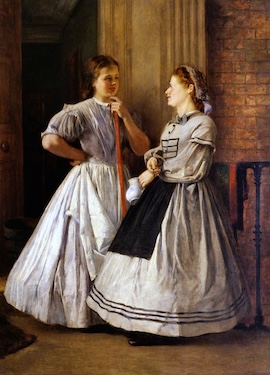
(John Finnie, Maids of All Work: Museum of the Home)
Lucy Lethbridge observed that: ‘In 1900 domestic service was the single largest occupation in Edwardian Britain: of the four million women in the British workforce, a million and a half worked as servants, a majority of them as single-handed maids in small households. Hardly surprising then that the keeping of servants was not necessarily considered an indication of wealth: for many families it was so unthinkable to be without servants that their presence was almost overlooked.’[2]
In Dorothy Sayers’ childhood, her biographer wrote, ‘It was the period of wash-stands with jug and basin in the bedrooms, and chamber pots. The housemaid carried cans of hot water up to the bedrooms every morning. When baths were needed, hot water was again carried up and poured into a hip bath. ‘“Strangely enough, my mother used to say,” wrote Dorothy, “she never had a servant complain of this colossal labour in all the twenty years we were at Bluntisham.”’[3] Beside this might be placed Rudyard Kipling’s recalling, late in life, his dislike for those radicals who ‘derided my poor little Gods of the East, and asserted that the British in India spent violent lives “oppressing” the Native. (This in a land where white girls of sixteen, at twelve or fourteen pounds per annum, hauled thirty and forty pounds weight of bath-water at a time up four flights of stairs!)’[4] Twelve or fourteen pounds. . . At a private view, on 3 December 1898, Arthur Balfour, who would become Prime Minister in 1902, bought two of William Hyde’s pictures on the spot. Hyde’s collaboration with the poet Alice Meynell, London Impressions, her ten essays complementing his many ‘etchings and pictures in photogravure’ was published that month, priced at eight guineas, apparently ‘equal to a house servant’s wages for a year’.[5]
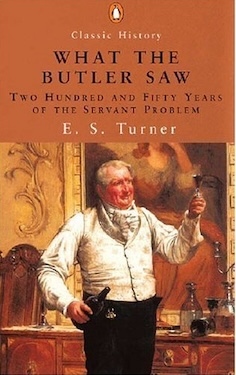
Some servants were more highly prized—and individualised—particularly butlers and manservants. E. S. Turner informed his readers that: ‘The butler wore no livery but was attired in formal clothes, distinguished by some deliberate solecism—the wrong tie for the wrong coat or the wrong trousers—to prevent his being mistaken for a gentleman.’[6] Always best to be on the safe side. In the household of Edward and Georgiana Burne-Jones, ‘William, like all good butlers, was a depressive.’[7] Some butlers and valets had interesting family connections. In 1840, Benjamin-François Courvoisier was hanged outside Newgate Prison, before a huge crowd (among which were Charles Dickens and William Makepeace Thackeray), for the murder of Lord William Russell (he was suspected of other murders but never charged with them). The defendant’s legal representation was provided by Sir George Beaumont, the amateur painter, friend of William Wordsworth and art patron whose pictures were a foundational gift to the National Gallery. Beaumont’s butler was Courvoisier’s uncle.[8]
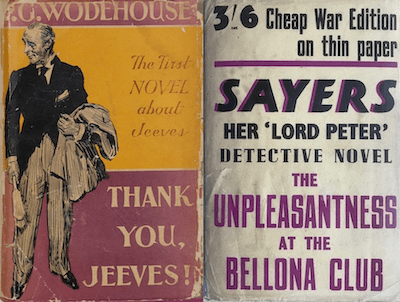
After the irruption of Sam Weller into the serial version of Dickens’ The Pickwick Papers and the contribution of Passepartout to Phineas Fogg’s trip Around the World in 80 Days, the most famous—and visible and audible—manservant, in or out of literature, is presumably Jeeves, Bertie Wooster’s valet, surely followed, if at a modest distance, by Lord Peter Wimsey’s ‘immaculate man’, Mervyn Bunter.[9] It’s been suggested that Bunter drew partly on P. G. Wodehouse’s creation though he certainly incorporated elements of a man named Bates, the ‘gentleman’s gentleman’ to an ex-cavalry officer, Charles Crichton, whom Sayers met in France; and Sayers’ husband, ‘Mac’ Fleming, who developed his own photographs and was a good cook (also Bunter attributes).[10] Bunter, Wimsey’s mother explains to Harriet Vane, was previously a footman but ended up a sergeant in Peter’s unit. They were together in a tight spot and took a fancy to each other – ‘so Peter promised Bunter that, if they both came out of the War alive, Bunter should come to him. . . .’ Wimsey’s nightmares about German sappers linger on for a few postwar years: he’s afraid to go to sleep and unable to give orders of any kind. ‘There were eighteen months . . . not that I suppose he’ll ever tell you about that, at least, if he does, then you’ll know he’s cured. . .’ In January 1919, Bunter turns up, on one of Wimsey’s worst days, takes charge and sees to everything, not least finding the Piccadilly flat and installing himself and Wimsey in it.[11]
In that postwar period, apparently, ‘as many as forty ex-soldiers would answer a single advertisement for domestic help.’[12] Though the widespread employment of domestic servants hugely diminished by the time of the Second World War, the habit sometimes persisted in individual lives. Penelope Fitzgerald’s 1974 letter to her daughter Maria, describing the guests at the ‘surrealist tea-party’ that took place during her visit to a friend in Rye, includes mention of ‘Henry James’s manservant (still living in Rye, but with a deaf-aid which had to be plugged into the skirting) who couldn’t really bear to sit down and have tea, but kept springing up and trying to wait on people, with the result that he tripped over the cable and contributing in a loud, shrill voice remarks like “Mr Henry was a heavy man – nearly 16 stone – it was a job for him to push his bicycle uphill” – in the middle of all the other conversation wh: he couldn’t hear.’[13]
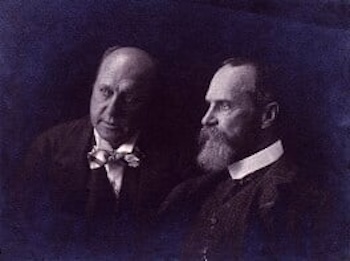
(Marie Leon, ‘Henry and William James’, (c) National Portrait Gallery)
It occurs to me at this late stage that the matter of servants is not purely an historical issue in my own case since, for three years in Singapore, my parents had the benefit of a cook-boy and an amah, Goh Heck Sin and his wife Leo: cooking, cleaning, laundry all taken care of (had there been young children in the family, the amah would have looked after them too). My primary—and certainly not undervalued—inheritance from those years is my ability to attract the attention of cats by making the call that Sin always made when he summoned our three (Thai Ming, Remo, Tiga) to their meals of rice and steamed fish.
Notes
[1] Muriel Spark, Not to Disturb (Harmondsworth: Penguin Books, 1974), 83.
[2] Lucy Lethbridge, Servants: A Downstairs View of Twentieth-century Britain (London: Bloomsbury, 2013), 9.
[3] Barbara Reynolds, Dorothy Sayers: Her Life and Soul, revised edition (London: Hodder and Stoughton, 1998), 24. Sayers was born in 1893.
[4] Rudyard Kipling, Something of Myself, edited by Robert Hampson (Harmondsworth: Penguin, 1987), 87.
[5] Jerrold Northrop Moore, The Green Fuse: Pastoral Vision in English Art, 1820-2000 (Woodbridge, Suffolk: Antique Collectors’ Club, 2007), 90.
[6] E. S. Turner, What the Butler Saw: Two Hundred and Fifty Years of the Servant Problem (Michael Joseph 1962; reprinted with new afterword, London: Penguin Books, 2001), 158.
[7] Penelope Fitzgerald, Edward Burne-Jones (London: Michael Joseph, 1975), 223.
[8] Judith Flanders, The Invention of Murder: How the Victorians Revelled in Death and Detection and Created Modern Crime (London: Harper Press, 2011), 202fn.
[9] Dorothy L. Sayers, ‘The Entertaining Episode of the Article in Question’, in Lord Peter Views the Body (1928; London: New English Library, 1977), 27.
(Edward Atkinson Hornel, The Blackbird Song: Dundee Art Galleries and Museum Collection)
I thought for a moment that the blackbird in the tree that reaches over the back neighbour’s fence into our garden had sung itself hoarse. It’s certainly dwindled, unsurprisingly, since it was already in full flow when I came downstairs, cheered on by the cat, at 05:30 this morning. There is even a tentative sunlight, flickering a little, as if unsure of itself, a faltering connection – and who can wonder, at the end of an 18-month period (since October 2022) which is the wettest in Met Office recorded history? Of course, they only started collecting the data in 1836 (Guardian, 10 April 2024), so it’s not even 200 years yet.
The weekly journals arrive, still a little light on the good news. ‘Easy stories drive out hard ones. Simple paradigms prevail over complicated ones.’[1] Well, yes, though sometimes it really is that simple and, hearing some of the voices currently uplifted in the world, brings the sentiment expressed in the Goncourt Journal vividly to mind: ‘If there is a God, atheism must strike Him as less of an insult than religion.’[2]
The ice-cream van drifts into hearing, still a few streets off, playing ‘Yankee Doodle went to town’. I used to be rather baffled by the line, ‘Stuck a feather in his cap / and called it macaroni.’ Now, along with anyone that has access to the internet, and, presumably, millions of Americans, I’m no longer baffled, at least by that. As the incomparable Opie team has it: ‘Young dandies, who had been on the Tour, wore fantastical clothes, and affected Continental habits, were dubbed “Macaronis”; there was, indeed, a Macaroni Club flourishing in 1764.’[3] By 1772, a year before the Boston Tea Party and three years before the American War of Independence began, the Macaronis ‘were distinguished especially by an immense knot of artificial hair worn at the back but with the peruke flat on top’.[4] The story goes that the British forces sang it to mock those unsophisticated colonials but the Yankees took it up anyway. And, come to think of it, they won that war.
Philip Dawe, ‘The Macaroni. A Real Character at the Late Masquerade’ (1773)
Later, the rain still holding off – and now I can hear the bees. The tulips are open and not yet fallen; the cherry tree in its strong pot some seven feet high; branches above the high fence nodding; faint tones of the Italian near-neighbour and the laughter of a few guests, their windows must be ajar, the season’s premier opening; less faint tones of scaffolders a few houses along; Harry the Cat nodding on an outside blanket; all this is the first real scent of summer. I remember Sarah Bakewell noting that Plutarch’s Moralia, translated into French in the same year in which Montaigne began writing Essays, touched on the question of how to achieve peace of mind: ‘Plutarch’s advice was the same as Seneca’s: focus on what is present in front of you, and pay full attention to it.’[5] No doubt both Plutarch and Seneca had their difficulties to contend with – but one of those was not the internet, with its clamorous, competing and often lethal versions of the world. Reading of Elizabeth I’s ‘innate disposition to hedge’ in ‘the face of peril or hostility’, I noted Strachey’s later remarks about Robert Cecil: ‘But passivity, too, may be a kind of action – may, in fact, prove more full of consequence than action itself.’[6] Indeed. Or, too often, alas.
[2] Edmund and Jules de Goncourt, entry for 24 January 1868, Pages From the Goncourt Journal, edited and translated by Robert Baldick (New York: New York Review Books, 2006), 135.
[3]The Oxford Dictionary of Nursery Rhymes, edited by Iona and Peter Opie, second edition (Oxford: Oxford University Press, 1997), 532.
[4] James Stevens Cox, An Illustrated Dictionary of Hairdressing and Wigmaking (London: Batsford, 1984), 99.
[5] Sarah Bakewell, How To Live: A Life of Montaigne in one question and twenty attempts at an answer (London: Vintage 2011), 32.
[6] Lytton Strachey, Elizabeth and Essex: a Tragic History (1928; Oxford: Oxford University Press, 1981), 114, 140.
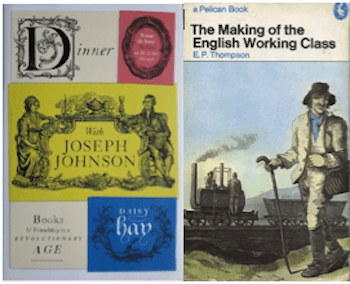
Reading Daisy Hay’s Dinner With Joseph Johnson: Books & Friendship in a Revolutionary Age, I came to the pages dealing with the contortions of William Pitt’s increasingly repressive administration in its attempts to shut down protest in the 1790s, particularly the recasting of the 1351 Act, which had made it a crime to ‘compass and imagine’ the death of the King, that is, to intend the death of the king, as it was commonly understood. ‘Pitt’s lawyers redefined it, so that an act of imagining alone became a crime. To commit treason one needed merely to have imagined the King’s death, not to have acted to advance it. Writing and speaking thus became treasonable.’ Since the government was appointed in the King’s name, any action which threatened ‘the security and stability of government legally constituted an attempt to “levy war” on the King himself. Political protest thus became treasonable by its very nature.’[1]
I was reminded, unsurprisingly, of a very much more recent decline and fall—but reminded also of the first undergraduate essay I wrote on my History course, about the French Revolution or, rather, the domestic effects in this country of the dramatic events in France. The marker’s comments included the suggestion, I recall, that I try to refrain from running before I could walk (but also queried my use of the word ‘climactic’, about which I was right and they were wrong, not that I ever dwell on that at all). I’d read fairly widely, and, I suspect not unusually, the book I found most stimulating—and exciting—was E. P. Thompson’s The Making of the English Working Class. I didn’t make a habit of reading 900-page history books but made an exception for this one. At that time, Margaret Thatcher’s government tended to behave as though anything that couldn’t be measured, weighed and, ideally, made a profit from, didn’t exist, so I was strongly drawn to such sentiments as followed Thompson’s assertion that definitive answers to such a controversy as that over the effect on standards of living of the Industrial Revolution still evaded us. ‘For beneath the word “standard” we must always find judgements of value as well as questions of fact. Values, we hope to have shown, are not “imponderables” which the historian may safely dismiss with the reflection that, since they are not amenable to measurement, anyone’s opinion is as good as anyone else’s. They are, on the contrary, those questions of human satisfaction, and of the direction of social change, which the historian ought to ponder if history is to claim a position among the significant humanities.’
Still, the quotation most familiar to readers of the book, certainly the last few words of it, is the intention stated in the ‘Preface’: ‘I am seeking to rescue the poor stockinger, the Luddite cropper, the “obsolete” hand-loom weaver, the “utopian” artisan, and even the deluded follower of Joanna Southcott, from the enormous condescension of posterity.’ That last phrase is often quoted and recalled but sometimes as if it simply refers to the assumption that, coming later, we simply know and understand more. As Thompson notes further on, though, ‘for those who live through it, history is neither “early” nor “late”. “Forerunners” are also the inheritors of another past.’[2]
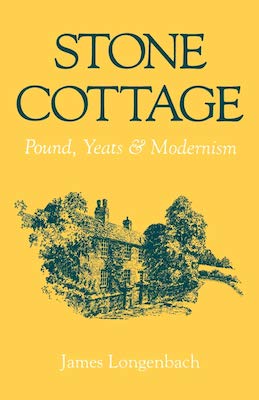
(James Longenbach, poet, teacher and fine scholar, died 29 July this year)
Tricky business, the past. That familiar quotation briefly conjured up another, William Faulkner’s ‘The past is never dead. It’s not even past’, which he puts into the mouth of one of his recurring characters, the lawyer (and occasional amateur sleuth), Gavin Stevens, in Requiem for a Nun. I noticed a few days ago how many literary anniversaries cropped up on 19 December: Constance Garnett’s ‘heroic life’ began at 11 a.m. on that day in 1861;[3] the French writer Colette was married to Henry de Jouvenel in 1912, a simple civil ceremony in the mairie of the sixteenth arrondissement: ‘Madame Colette Willy, woman of letters, notorious lesbian, bare-breasted music-hall star, and social pariah, was now the baroness de Jouvenel des Ursins, and the wife of one of Paris’s most influential political journalists.’[4] From Coleman’s Hatch the following year, Ezra Pound wrote to William Carlos Williams, in a letter that reads with great poignancy now: ‘I am very placid and happy and busy. Dorothy is learning Chinese. I’ve all old Fenollosa’s treasures in mss.’ And: ‘Have just bought two statuettes from the coming sculptor, Gaudier-Brzeska. I like him very much [ . . . ] We are getting our little gang together after five years of waiting.’[5] A little over seven months before German forces cross the Belgian frontier near a place called Gemmenich. . .
But I was thinking, particularly, of David Jones: poet, painter and, for a while, soldier, enlisted in the 15th (London Welsh) Battalion of the Royal Welsh Fusiliers. For two weeks, his battalion was billeted in farm outbuildings in Warne, a mile south of Rocquetoire, ‘all this time the cold rain continuing, more rain than in any December for 39 years.’ On 19 December they boarded ‘grey-painted London buses for La Gorgue, near Estaires.’ They were headed for the front line at Neuve Chapelle.
(David Jones via The Spectator)
‘In the trenches’, Thomas Dilworth wrote of Jones, ‘he became convinced that any distinction between past and present was superficial, accidental, largely unreal. History had not ended; it continued.’[6] In his ‘Autobiographical Talk’ (1954), Jones said: ‘You see by what close shaves some of us are what we are, and you see how accidents of long past history can be of importance to us in the most intimate sense, and can determine integral things about us.’[7] Like other literary soldiers—Blunden, Sassoon, Ford, Graves among them—the war haunted his later life and writing, perhaps to a greater extent than most of the others. ‘Decades afterwards, a door slamming or a car backfiring would startle him back to the trenches. In distant thunder, he heard artillery.’[8]
Close shaves and roads not taken. Year’s end, year’s turning: there’s a strong tendency to look both forward and back, reviewing what’s past and anticipating, hoping or—increasingly, these days—dreading what’s to come. For some, such reviews have a tendency to ripple outwards, to include peripheral as well as central figures, the gone as well as the present, not only the dead but the lost, the ghosts of those still living, somewhere, but in places either no longer known to us or just inaccessible, for varied reasons: neglect, forgetfulness, estrangement – or those unexceptional divergences in the trajectories of all individuals’ lives. There in their hundreds, perhaps thousands: friends, colleagues, acquaintances, fellow students, fellow teachers, lovers, almost-lovers, antagonists, the watchers and the watched, the lives that touched us, held us, struck us, changed us, missed us by inches—or by a country mile. ‘If I thought I was not thinking about the past’, Deborah Levy wrote, ‘the past was thinking about me.’[9]
Yes. We are not only subjects but objects, not only observers but observed. That’s the sort of thing that can easily slip a person’s mind as they look about themselves, so much to see, so much to learn, so much to talk about, read about, write about, think about. Recounting his work on an illustrated history of exploration, an impossibly huge task, the contributions sent to his publishers routinely thousands of words too long, Eric Newby comments: ‘I had, and still have, the conviction that I must let the reader know if I discover anything interesting, and unfortunately so many things are interesting. At least they are to me.’[10]
Things certainly look grim just now – and have done this past year, three years, decade, steadily worsening. And not only individuals get lost. The things we—some of us—care about are under threat and under attack, some are already gone and we won’t be getting them back. But after all it isn’t after all, not yet all, anyway. We are still here, still there, the more energetic actively resisting while others, on occasion, discover something interesting, at least to us – and let others know.
So: a wave from the bunker to any passer-by. And, to various friends who, in Auden’s phrase, ‘show an affirming flame’: Joyeux Noël, Buon Natale, Feliz Navidad, Nadolig Llawen – and Happy Holidays.
Notes
[1] Daisy Hay, Dinner With Joseph Johnson: Books and Friendship in a Revolutionary Age (London: Chatto & Windus, 2022),
[2] E. P. Thompson, The Making of the English Working Class (1963; revised edition with new preface, Harmondsworth: Penguin Books, 1980), 485, 12, 648.
[3] Richard Garnett, Constance Garnett: A Heroic Life (London: Sinclair-Stevenson, 1991), 11.
[4] Judith Thurman, Secrets of the Flesh: A Life of Colette (London: Bloomsbury Publishing, 2000), 247.
[5]Letters of Ezra Pound, 1907-1941, edited by D. D. Paige (London: Faber and Faber, 1951), 65.
[6] Thomas Dilworth, David Jones in the Great War (London: Enitharmon Press, 2012), 62, 63, 93.
[7] In Epoch and Artist (London: Faber and Faber, 1973), 25.
[8] Thomas Dilworth, David Jones: Engraver, Soldier, Painter, Poet (London: Jonathan Cape, 2017), 54
[9] Deborah Levy, Things I Don’t Want to Know (London: Penguin Books, 2018), 162.
[10] Eric Newby, ‘Walking the Plank’, in Departures and Arrivals (London: Harper Collins, 1999), 39.
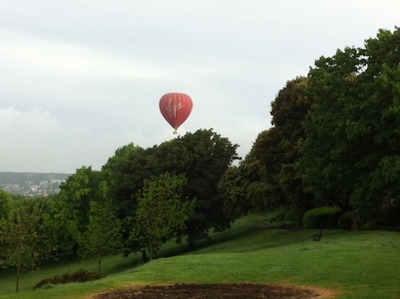
Blackberrying again: working our way down bushes on the slopes of the park, filling plastic containers, taking them home, rinsing the fruit in a colander, transferring them to compostable bags and sticking them in the freezer. It seems, oddly, like a blow on behalf of the ordinary universe. As are the hot air balloons, going over so early some mornings, as they have done for years. And, as I have done for years, I step outside and stare up at the sky and feel a strange sense of reassurance, of confirmation, of a fitness in the world.
We have stepped, or been forced, outside of all that. Our recent pleasures have included quite ridiculous weather and quite ridiculous politics. Or, more soberly, terrifying weather and terrifying politics, two areas intimately linked, of course. There have been hot summers before, 1976, 1911, and droughts, such as 1921, 1911 again – and 1976, again. But in recent years, it is no longer in a metaphorical sense, or even a hyperbolic one, that we say: the world is on fire. Set against this, of course, is the continuing failure of governments to meet the urgency of need with priority of response. If major heart surgery is needed, sticking a plaster on the patient’s thumb strikes some of us as less than adequate. But there is also the massive disconnect, the stolid denial that individual actions can make any difference – while the careful sorting of paper, cardboard and plastics for the weekly collection somehow co-exists in the same single life with a steely determination, and a conviction of entitlement, to fly to three holiday destinations every year.
Walking on one of the quieter paths in the Victorian cemetery, we pass a wedding reception at the Underwood Centre, several dozen guests in a woodland setting. In the midst of death we are in life. It is odd, to say the least, to know, or at least to suspect, that after so many centuries of progress, if you can call it that, of achievement, if that’s what it is, we are living in an age of extinction, an age in which things will not simply slow down or even go backwards but will just stop and die. We don’t want to think of such things… and the vast majority of us – manage not to
04:28 – and the cat feels it’s time to begin discussing breakfast. The workmen won’t be here to plague us for another three and a half hours. But there’s the light – and the birdsong. ‘All winter long’, William Maxwell wrote to Eudora Welty in June 1979, ‘I worried because there were no birds, and now there is such a racket you can’t hear yourself think.’[1] (Not long before this, he’d written: ‘In some ways the most beautiful journeys are the ones you don’t take’, which are the journeys I’ve been enjoying for a while now, liking them more and more.)
‘In this weather’—Maxwell again, this time in the summer of 1953, ‘one needs astonishment in the head to keep the heat out.’[2] That afternoon, listening to the rain on the windows, I was struck by the consciousness of what I was doing and the moment in which I was doing it: listening to the rain. It was late in the hottest day ever recorded in this country, the bulletins said, the hottest anyway since the day before. Fires were reported all over the United Kingdom, in London, South Yorkshire, Leicestershire. Our temperate northern climate, forsooth.
All those weary years, those decades, in which the warnings were given, the recommendations made, the figures presented – and nothing done and nothing done and nothing done. It would have been so much cheaper then, more manageable then, the future infinitely strengthened and sweetened then. But we had no influential figures equal to the task. Nor have we had any since. And, looking at the poor creatures now, with their paucity of ideas and their disgusting gestures at policy, it’s painfully evident why we have declined so fast and so far.
‘It does no good to regret history’, Samuel Hynes remarked, ‘all we can do is to try to understand it.’[3] That seems reasonable enough, though forces here, there and everywhere want something quite other. Why understand it? Here’s the version we like – why not go with that?
As Sarah Churchwell recently remarked, ‘The past has consequences in the present regardless of whether we know what happened in it; learning the history makes those consequences intelligible.’[4]
The other day, in an attempt to prevent the Librarian’s determined misquoting of a couple of lines in Dirty Harry, I played her the clip: at the end, the wounded man, maddened by the uncertainty about whether Harry has fired five shots or six, says: ‘I gots to know! I gots to know!’
Yes, I think I suffer a little from that compulsion. Is there one left – or is it already empty?
Answers on a postcard, please – but then you may as well recycle them.
Notes
[1] Suzanne Marrs, editor, What There Is to Say, We Have Said: The Correspondence of Eudora Welty and William Maxwell (Boston and New York: Houghton Mifflin Harcourt, 2011), 348.
[3] Samuel Hynes, ‘Introduction: A Note on “Edwardian”, in Edwardian Occasions: Essays on English Writing in the Early Twentieth Century (London: Routledge & Kegan Paul, 1972), 11.
[4] Sarah Churchwell, The Wrath to Come: Gone With the Wind and the Lies America Tells (London: Head of Zeus, 2022), 11.
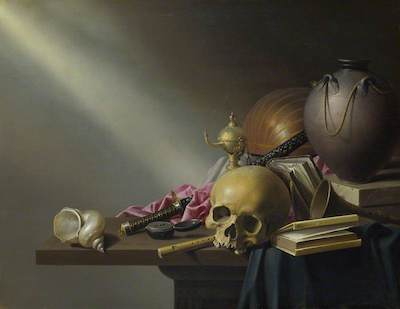
(Harmen van Steenwyck, Still Life: An Allegory of the Vanities of Human Life: National Gallery, London)
The name on the local builder’s van parked just outside our window recalls a nineteenth-century book title. ‘“Socially and politically mean one thing in the end,” said Beauchamp. “If you have a nation politically corrupt you won’t have a good state of morals in it, and the laws that keep society together bear upon the politics of the country.”’ I’ve not actually read George Meredith’s novel, Beauchamp’s Career, but was happy to lean on Roy Foster, clearly familiar not only with Meredith but also Trollope, Disraeli, George Eliot, Dickens, Mrs Humphrey Ward and others, together with a raft or, rather, flotilla of critics, biographers, diarists and historians that had any bearing on his subject.[1]
1871 was the date of the Meredith novel. A long way back—Victoria, Gladstone, the opening of the Royal Albert Hall, trade unions legalised, Stanley bumping into Livingstone, a UK census total (2 April) of 26,072,036—in some ways, at least.
In the early eighteenth century, E. P. Thompson remarked, ‘High politics was a predatory game, with recognized spoils, and [Robert] Walpole is to be distinguished chiefly by his systematizing of the means of corruption, with unusual blatancy.’[2] Through much of the nineteenth century, with England seen as primarily an industrial nation, foreign visitors went North to visit the ‘real seat of English power’, while London was regarded as a place of idleness and corruption.
As economic power failed, the perceived centre of the economy shifted south. The last years of the nineteenth century brought ‘a new urban world to the fore, the world of inner London.’ Imperial designs increased as manufacturing aspirations declined – and London was the heart of the Empire.’[3]
‘Unusual blatancy’ then: impunity now, with little attempt to hide the corruption, lying and hypocrisy that characterises the current English government. And Emerson’s 1836 remark that ‘The corruption of man is followed by the corruption of language’[4] is still germane.
My younger daughter comes over from Barcelona: the first sighting for eight months. While she’s here, my elder daughter comes for dinner; the four of us together, first time in a long time.
How are you? I’m all right, I say. Apart from my eyes, ears, teeth, leg and back. (Leave it there, man, leave it there. I leave it there.)
All too soon, politics edge in. Then and now, sitting at a dinner table, sitting down to a keyboard, I think, though briefly: don’t just rant about bloody Tories. Surely everyone in this country with a half-decent view of the world now rants about bloody Tories. Or is that too sweeping? I’m old enough to remember when the Conservative party was a serious and respectable political organisation. I knew reasonable, intelligent people who voted for them. They were the law and order party, the party of economic moderation and stability, the party of patriotism and national pride. Not my party but – respectable. All that’s gone, of course. They’re well on the way to becoming like the Republican Party in the United States, a cult, utterly divorced from truth, honesty, justice, fairness, the national interest, democratic principles and the rest. All those Conservative MPs had their chance, they had several chances – but chose not to take them. Any claim to moral authority or ethical standards is now long gone.
I think of Elizabeth Bishop writing to her friend Pearl Kazin in 1953, mentioning a piece in Darwin’s Beagle journal about a Brazilian complaining that English Law gave the rich and respectable no advantage over the poor. ‘It reminds me of Lota’s story about a relative, a judge, who used to say, “For my friends, cake! For my enemies, Justice!”’[5]
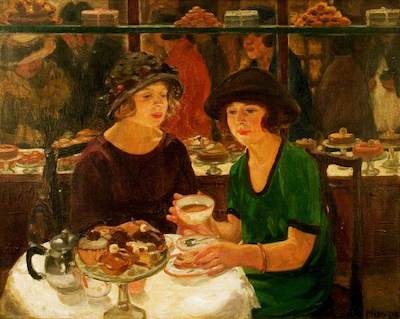
(Mabel Frances Layng, The Tea Table: West Park Museum, Macclesfield)
Cake, yes. Having it, eating it. Could we say ‘no advantage’ now? Hardly, when rich men frequently bring libel actions against investigative journalists who have looked into their dealings with offshore accounts, tax havens, foreign agents, cyber hackers, purveyors of fake news and the like, in an attempt to shut down those journalists’ researches.
The day descends. Russian forces continue their genocidal campaign in Ukraine. In India, Jignesh Mevani, a prominent campaigner for the Dalit community, is arrested for tweeting criticism of Prime Minister Modi. Police clash with Palestinian protesters in Jerusalem. In the US, car crashes have been overtaken by guns as the main cause of death among children and teenagers. In France, the far right are in serious contention for the Presidency, while Leave and Tory voters in this country apparently favour Le Pen by a margin of some 13 points. In Singapore—which currently ranks 160th out of 180 territories in the Reporters Without Borders’ World Press Freedom Index (behind Belarus and Russia – yes, really)—Terry Xu, the former editor of the Online Citizen, has been jailed for three weeks for defamation over a letter published on the site that alleged corruption among government ministers. And here – we read the headlines, watch members of parliament defend the indefensible (not least the latest vicious and absurd proposal to traffic refugees to Rwanda) and wonder how we ended up here.
No, of course we don’t really wonder, because we already know. We know. But the knowledge hurts.
Notes
[1] R. F. Foster, ‘“Fatal Drollery”: Parliamentary Novels, Outsiders and Victorian Political History’, in Paddy & Mr Punch: Connections in Irish and English History (London: Penguin Books, 1995), 139-170.
[2] E. P. Thompson, Whigs and Hunters (London: Penguin Books, 1990), 214.
[3] Alan Howkins, ‘The Discovery of Rural England’, in Robert Colls and Philip Dodd, editors, Englishness: Politics and Culture, 1880-1920 (London: Croom Helm, 1986), 65.
[4] Ralph Waldo Emerson, ‘Nature’, in SelectedEssays, edited by Larzer Ziff (London: Penguin Books, 1982), 51.
[5] Elizabeth Bishop, One Art: The Selected Letters, edited by Robert Giroux (London: Pimlico, 1996), 255. ‘Lota’ is Lota de Macedo Soares, with whom Bishop lived in Brazil for fifteen years.
‘For years of our lives the days pass waywardly, featureless, without meaning, without particular happiness or unhappiness’, says the narrator of Jane Gardam’s 1985 novel, Crusoe’s Daughter. There are, of course, exceptions – yesterday, for one instance, when I received both Covid booster and flu jab, emerging, as they say, fully armed.
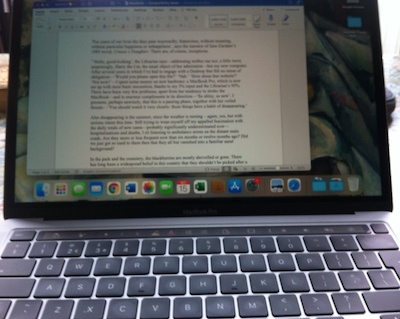
‘‘Hello, good-looking’, the Librarian says—addressing neither me nor, a little more surprisingly, Harry the Cat, the usual object of her admiration—but my new computer. After several years of engaging with a Desktop that felt no sense of obligation—‘Would you please open this file?’ ‘Nah.’ ‘How about that website?’ ‘Not now!’—I’ve invested (interest-free deal!) in new hardware: a MacBook Pro, which is now set up with most basic necessities, thanks to my 5% input and the Librarian’s 95%. There have been very few problems, apart from her tendency to stroke the MacBook—and to murmur compliments in its direction—‘So shiny, so new’. I presume, perhaps unwisely, that this is a passing phase, together with her veiled threats—‘You should watch it very closely: these things have a habit of disappearing.’
(Not a MacBook)
Also disappearing is the summer, since the weather is turning – again, yes, but with serious intent this time. Still trying to wean myself off my appalled fascination with the daily totals of new cases—probably significantly underestimated now—hospitalisations and deaths, I sit listening to ambulance sirens on the distant main roads. Are they more or less frequent now than six months or twelve months ago? Did we just get so used to them then that they all but vanished into a familiar aural background?
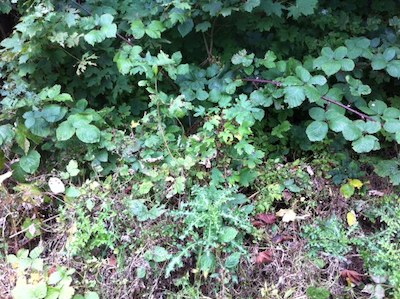
In the park and the cemetery, the blackberries are mostly shrivelled or gone. There has long been a widespread belief in this country that they shouldn’t be picked after a certain date, usually Michaelmas but with some regional variations, up to about 10 October, which, as Jacqueline Simpson and Steve Roud point out, ‘allowing for the eleven-day calendar shift of 1752, is the same thing.’[1] The berries are said to be bad because the Devil has spat on them, stamped on them or, alas, pissed on them. On a walk a few days ago, I noticed a bush in the park still boasting several plump and very black berries and pointed them out. In defiance of devilish warnings, the Librarian’s mother picked one off, popped it into her mouth and pronounced it ‘delicious’.
‘I like to remind myself of the Dorset proverb’, Patrick White wrote, ‘“God gave us meat, we have to go to the Devil for sauce”.’[2] An astonishing number of people now not only want but apparently require sauce.
The Gardam quote I began with continues: ‘Then, like turning over a tapestry when you have only known the back of it, there is spread the pattern.’[3] Some of us are uncommonly fond of patterns. Also in 1985, Anthony Burgess published a piece called, ‘The Anachronist Strikes Back’, in which he remarked: ‘The point is, I think, that the past is made by the present. The pattern we call history is not in history: it’s made by us.’[4] This will not sit well with those for whom ‘history’ is fixed, unchanging and manifesting no need whatsoever for questioning or examination. But still, but still – in the individual life, as in the collective, the past is constantly reappraised, revised, reconfigured. How could it not be?
Notes
[1] Jacqueline Simpson and Steve Roud, A Dictionary of English Folklore (Oxford: Oxford University Press, 2000), 24.
[2] Patrick White, ‘The Reading Sickness’ (1980), in Patrick White Speaks, edited by Paul Brennan and Christine Flynn (London: Jonathan Cape, 1990), 75.
[3] Jane Gardam, Crusoe’s Daughter (London: Abacus, 2012), 270.
[4] Anthony Burgess, The Ink Trade, edited by Will Carr (Manchester: Carcanet Press, 2018), 157.











 Reconstructionary Tales