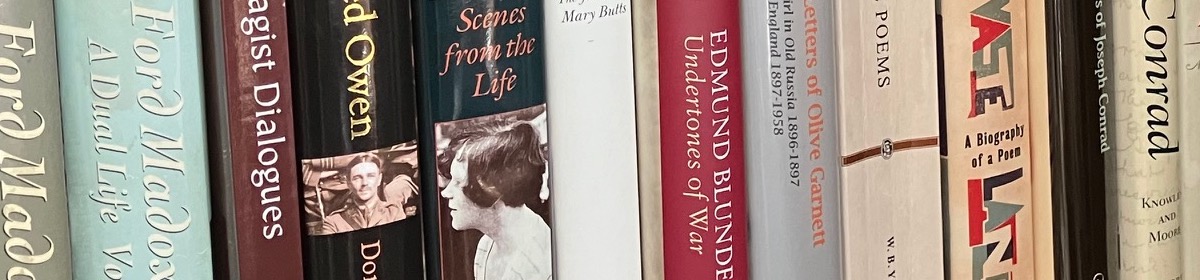
‘The Weeping and the Laughter’


Almost August. Record–breaking temperatures in South Korea and Japan but a dull, grey morning here today. Even the saxophonist who practises in the small wood in the park may postpone his session for a while.

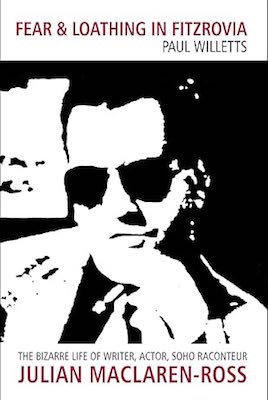
Emerging from Paul Willetts’ biography of Julian Maclaren-Ross, I was a little dizzy from the extraordinary sequences of work done, or proposed, or rewritten, of contracts honoured or let slip, of rooms and suites and flats rented and left in a series of moonlight flits or evictions, of creditors and lawsuits, landladies, hoteliers, retailers (a pram for his son Alex) and the post office (for telephone bills), of separations from, and reconciliations with, wives and girlfriends.[1] It’s difficult not to have a sense of being slightly bruised by contact with the innumerable knocks that the writer underwent. He was incurably extravagant and wasteful with money, nor did the alcoholism, heavy smoking, bad diet, amphetamine use and lack of exercise help much, and the fatal heart attack at the age of fifty-two is not wholly unexpected.

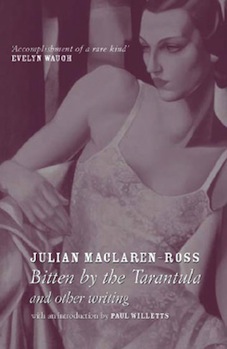
The two undeniable positives, though, are the biography itself, a prodigious feat of research and writing; and Maclaren-Ross’s own staggering fecundity. The novels, short stories, sketches, radio dramas, adaptations, autobiographies, screenplays, parodies, memoirs, reviews and essays emerge at an astonishing rate. Writing often through the night, he seems to turn out entire radio drama series in days, reviews and sketches in hours, year after year through the 1940s, 1950s and into the early 1960s, always in financial distress and increasingly aware that the impact made by some of his early work had not been maintained and had ebbed away. It’s remarkable, given the rate of production and the conditions in which most of it was written, that so much of it is so good. Some of the stories, the novel, Of Love and Hunger, the memoirs, many of the superb parodies and critical writings (on cinema as well as literature) in Bitten By the Tarantula, are assured, often very funny, and hugely impressive. 

Endless monologues on a barstool in Fitzrovia. The teddy-bear coat, the sharp suit, the cigarette-holder, the silver-topped malacca cane, the snuff box, the eternal dark glasses: ‘From an early age’, Paul Willetts writes, ‘Julian put as much effort into propagating his personal myth as perfecting his prose style’ (306), going on to mention the many characters in poems and novels that are based on him, as well as the memoirs in which he features. Pubs and clubs, magazines and anthologies, are threaded through the story as much as boxers and bullfighters are in Hemingway’s, and Maclaren-Ross encountered an extraordinary range of writers, editors, publishers, painters and BBC producers. One of these, who became increasingly important in his desperate pursuit of commissions and payments, was Reginald Donald ‘Reggie’ Smith (born on this day, 31 July, 1914), whose name rang a bell because he’d cropped up in a couple of other stories. Married to the novelist Olivia Manning, he’s familiar to readers of her Balkan Trilogy as the model for her central character Guy Pringle (to viewers of the superb adaptation, it is, of course, Kenneth Branagh). Smith crops up on more than thirty pages of Willetts’ biography because he was hugely supportive of Maclaren-Ross for some years. He was a friend of the novelist and critic Walter Allen and of Louis MacNeice, and had been to King Edward Grammar School in Aston, Birmingham, with poet Henry Reed and George D. Painter, future biographer of Marcel Proust. When he married Olivia Manning in August 1939 at Marylebone Registrar’s Office, their witnesses included Stevie Smith and Walter Allen. Their best man had been written into the certificate as ‘Louise MacNeice’—both bride and groom noticed but said nothing—and Olivia seems to have taken the opportunity to shave a few years off her age, her birthdate recorded there as 1911 (in fact it was 1908).[2]


I may briefly take refuge now in something calmer, less harassed—perhaps a Simenon. Not that the world of Inspector Jules Maigret is entirely detached from that of Julian Maclaren-Ross, one of whose many publications was a translation, published by Penguin Books in association with Hamish Hamilton in 1959: Maigret and the Burglar’s Wife. . .


Notes

[1] Paul Willetts, Fear & Loathing in Fitzrovia: The Bizarre Life of Writer, Actor, Soho Raconteur Julian Maclaren-Ross, revised edition (London: Dewi Lewis, 2013). Willetts also introduces Collected Memoirs (London: Black Spring Press, 2004) and Bitten By the Tarantula and other writing (London: Black Spring Press, 2005). Penguin Books published Of Love and Hunger, with an introduction by D. J. Taylor, in 2002. ‘The Weeping and the Laughter’ is subtitled ‘A Chapter of Autobiography’ in Collected Memoirs (1-110).

[2] Neville & June Braybrooke, Olivia Manning: A Life (London: Chatto & Windus, 2004), 54, 58, 59.
The one after the one after that: 1924

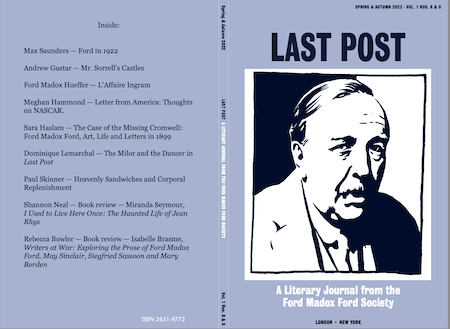
In a recent issue of Last Post, writing of Ford Madox Ford in 1924, Max Saunders remarked that it ‘certainly is an annus mirabilis for Ford; a year in which he launched the transatlantic review, and published two masterpieces: Some Do Not . . ., the first novel of his postwar Parade’s End tetralogy; and the brilliant critical memoir of his collaborator Joseph Conrad’.[1] He was pointing out the objections to the often feverish concentration upon that now-conventional annus mirabilis of modernism, 1922, in literary criticism and history, which has sometimes narrowed down to two particular gleamings in the gloaming, Ulysses and The Waste Land. It’s true that there were dozens of other remarkable works published in that year; lists can easily be constructed and I’ve been guilty of at least one myself. Tempted to do the same thing for 1924, I sailed past a couple of dozen before accepting that 1924 was also guilty of producing an absurd number of interesting items, in addition to the previously mentioned Fordian masterworks.

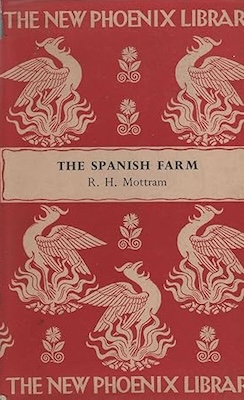
I leave aside, for the moment, Aldous Huxley, Katherine Mansfield, W. B. Yeats, a posthumous Herman Melville, T. E. Hulme, Ernest Hemingway, Glenway Wescott,  Marianne Moore and the bestselling The Green Hat by Michael Arlen (formerly Dikrān Kuyumjian) to mention, among my personal favourites, R. H. Mottram’s The Spanish Farm, first volume of a trilogy (the second and third followed in successive years) and winner of that year’s Hawthornden Prize. It focuses primarily not on trench warfare but rather on the narrator’s dealings with the local inhabitants, their claims for loss and damage against the British forces, and the relationship between an English officer and the daughter of the Ferme d’Espagnole. The trilogy was deservedly successful—and published in an omnibus volume in 1927—but has since seemed to drift out of view, only scholars of the period paying much attention to it lately. The one-volume edition was published as a Penguin Modern Classic in 1979 but is long out of print and the only editions currently on offer all look pretty nasty. Mottram was closely identified with Norfolk and sometimes nudged by the familiar British ‘regional novelist’ elbow into some cultural annexe or other. But see Craig Gibson’s piece here: https://norfolkrecordofficeblog.org/2021/04/14/forgotten-r-h-mottram/

Also in this year: John Buchan’s The Three Hostages (Dr Greenslade to Richard Hannay: ‘“Have you ever realized, Dick, the amount of stark craziness that the War has left in the world? . . . I hardly meet a soul who hasn’t got some slight kink in his brain as a consequence of the last seven years”’). There was D. H. Lawrence’s long ‘Introduction’ to Memoirs of the Foreign Legion by Maurice Magnus; Rudyard Kipling wrote four fascinating stories, ‘The Wish House’, ‘The Eye of Allah’, ‘The Bull That Thought’ and ‘A Madonna of the Trenches’ (especially the first two), and Stanley Spencer began The Resurrection in Cookham Churchyard in February 1924 (finished in 1926, it was shown at his first one-man exhibition in 1927).

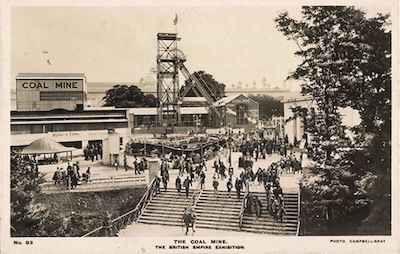
In April, before a crowd of 120,000 people, George V opened the British Empire Exhibition at Wembley, put together by 18,000 workmen: Palace of Art (and Palace of Beauty), Never Stop Railway, Queen’s Doll’s House, butter sculptures, elephants, Mary Pickford and Douglas Fairbanks, massed choirs in white surplices. Poet and publisher Harold Monro was, apparently, impressed by its patriotic glitter and ‘in one of his satiric dream poems he envisaged an exhibition of the future, where the last Georgian Nature Poet would be on show, dressed in tweed and sipping beer, in a specially designed case.’[2]

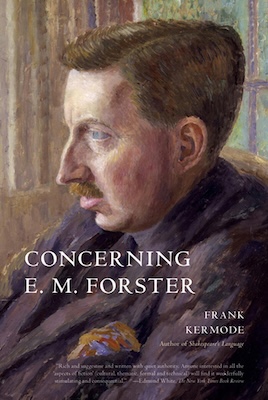
The narrator of Edith Wharton’s ‘The Spark’ comments that ‘People, I had by this time found, all stopped living at one time or another, however many years longer they continued to be alive’.[3] D. H. Lawrence announced to Middleton Murry that he wanted ‘to go south, where there is no autumn, where the cold doesn’t crouch over one like a snow-leopard, waiting to pounce. The heart of the North is dead’.[4] Ezra Pound, well-embarked upon The Cantos by now, was looking back as well as forward, writing in a letter of 3 December to Wyndham Lewis: ‘We were hefty guys in them days; an of what has come after us, we seem to have survived without a great mass of successors’.[5] E. M. Forster published A Passage to India: his next novel, Maurice, would appear 47 years later, following its author’s death. In February 1924, acknowledging Forster’s Pharos and Pharillon, Lawrence wrote to him: ‘To me you are the last Englishman. And I am the one after that.’[6]

In the journal that he kept for a short period, the poet John Clare wrote (30 November 1824): ‘Read the Literary Souvenir for 1825 in all its gilt & finery what a number of candidates for fame are smiling on its pages – what a pity it is that time should be such a destroyer of our hopes & anxiety for the best of us but doubts on fame’s promises & a century will thin the myriad worse than a plague.’[7]

One hundred years on from 1924, the authors and titles of that period present a dazzling image of astonishing abilities and achievements. As to whether, another century on (assuming the continued existence of books, readers or, indeed, people), any of the current ‘candidates for fame’ will be visible to (some version of) literary historians, I have no settled opinion. Let me get back to you.

Notes


[1] Max Saunders, ‘Ford in 1922’, Last Post: A Literary Journal from the Ford Madox Ford Society, 1, 8 & 9 (Spring & Autumn, 2022), 1-19 (2). His essay concentrates on what Ford was writing, rather than publishing, in 1922.

[2] Penelope Fitzgerald, Charlotte Mew And Her Friends (1984; London: Flamingo, 2002), 209.

[3] Edith Wharton, Old New York (1924), in Novellas and Other Writings, edited by Cynthia Griffin Wolff (New York: Library of America, 1990), 467.

[4] The Selected Letters of D. H. Lawrence, compiled and edited by James T. Boulton (Cambridge: Cambridge University Press, 1996), 284.

[5] Pound/Lewis: The Letters of Ezra Pound and Wyndham Lewis, edited by Timothy Materer (London: Faber and Faber, 1985), 138. His possible exceptions to this statement were the composer George Antheil and the writer Robert McAlmon.

[6] The Letters of D. H. Lawrence IV, June 1921–March 1924, edited by Warren Roberts, James T. Boulton and Elizabeth Mansfield (Cambridge: Cambridge University Press, 1987), 584. The term has since been applied to Arthur Ransome and J. L. Carr by their biographers, and to Lieutenant-Colonel Alfred Daniel Wintle by himself. The day the other Lawrence (T. E., ‘of Arabia’) died, Forster was on his way to see him.

[7] John Clare, Journals, Essays, Journey from Essex, edited by Anne Tibble (Manchester: Carcanet New Press, 1980), 54.

First lines, later thoughts


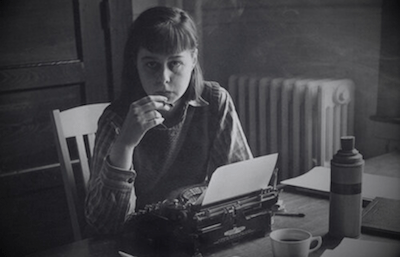
(Carson McCullers: Columbus State University via Library of America)

Rereading a Carson McCullers novel recently, I was thinking again about the curious affair of the opening line. Though I’m quite capable these days of forgetting someone’s name even while they’re still being introduced to me, I recall or recognise the openings of books read twenty, thirty, even forty years ago. Ford, unsurprisingly; Joyce, Faulkner, Patrick White, Virginia Woolf, Henry Miller, one or two, the famous ones by Beckett and by Camus (with translators and their reviewers jousting over the ‘correct’ Anglo-American equivalent to that one word, ‘maman’). Not always the ones I expect, sometimes books of which I remember practically nothing else. Here, The Heart Is a Lonely Hunter’s opening, ‘In the town there were two mutes, and they were always together’, was, I realised, already imprinted on one of the walls of my brain, perhaps a little faded after more than a quarter of a century, but still clearly legible.

First lines are frequently very far from first thoughts; and sometimes freighted, by writer or critic, with all manner of significance. Of the famous opening of John Keats’s Endymion:

A thing of beauty is a joy for ever:
Its loveliness increases; it will never
Pass into nothingness; but still will keep
A bower quiet for us, and a sleep
Full of sweet dreams, and health, and quiet breathing

Robert Gittings remarked that ‘Keats had not only found a first line and a beginning; he had found a principle that was to maintain him all through his life.’[1] That is, loving the principle of beauty in all things.

Also attentive to large implications, Hugh Kenner wrote of the eventual opening of Pound’s Cantos:

And then went down to the ship,
Set keel to breakers, forth on the godly sea

that here the poet was pondering ‘a chord that should comprise four of history’s beginnings: the earliest English (“Seafarer” rhythms and diction), the earliest Greek (the Nekuia), the beginnings of the 20th-century Vortex, and the origins of the Vortex we call the Renaissance, when once before it had seemed pertinent to reaffirm Homer’s perpetual freshness.’[2] What actually precedes that first word, ‘And’, has also proved a fertile subject for discussion. One thing that precedes it, of course, is the section of Canto III in the 1917 Poetry publication, ‘Three Cantos of a Poem of Some Length’, that alludes to Andreas Divus, the Renaissance translator of Homer’s Odyssey into Latin and continues:

‘Here’s but rough meaning:
“And then went down to the ship, set keel to breakers,
Forth on the godly sea”’[3]


That first line, in a prose work, can suggest tone, style, diction, even imply the extent or nature of the whole. It can also, of course, strike the wrong note with some readers. ‘By the way’, Penelope Fitzgerald wrote to the novelist Francis King, ‘wouldn’t you agree that the worst thing about the opening of Howards End isn’t so much the letter itself (as a method) as the “One may as well begin with”. It makes me feel resentful. Why begin at all, if that’s how he feels about it.’[4]

And, it hardly needs saying, there is often another issue about that first line to consider, specifically, is it in fact the first line at all? Is the first line of Byron’s Don Juan, the ‘Preface to Cantos I and II’—‘In a note or preface (I forget which) by Mr W. Wordsworth to a poem’—or the ‘Dedication’—‘Bob Southey! You’re a poet, poet laureate’—or ‘Canto I’: ‘I want a hero, an uncommon want’?  We all know that Melville’s Moby Dick commences dramatically: ‘Call me Ishmael.’ Except that it really begins: ‘Etymology (Supplied by a late consumptive usher to a grammar school.)’ This list is followed by a dozen pages of ‘Extracts (supplied by a sub-sub-librarian.)’ And then there are accretions: readers beginning Ford’s The Good Soldier will now, more often than not, reach its famous opening line (‘This is the saddest story I ever heard’) via the ‘Dedicatory Letter’, addressed to Stella Bowen, added to the 1927 edition (a dozen years after the first) and generally included in subsequent editions – the opening line itself having been altered from the serial version in Blast: Review of the Great English Vortex, while the story of that alteration is contained in the letter (one version of the story, anyway, just to be clear).


(Frances Flora Bond Palmer, lithograph published by Currier and Ives, ‘Rounding a Bend on the Mississippi – The Parting Salute’, Metropolitan Museum of Art)

Huckleberry Finn also has its prefatory matter and its own slight challenge to determine exactly how and where it begins. ‘You don’t know about me, without you have read a book by the name of “The Adventures of Tom Sawyer,” but that ain’t no matter.’ This sentence is preceded by the ‘Notice’ warning against attempts to find motive, moral or plot in the narrative that follows and a note about the variety of dialects used in it, Twain adding (still funny, I think, 140 years on): ‘I make this explanation for the reason that without it many readers would suppose that all these characters were trying to talk alike and not succeeding.’

D. H. Lawrence was sometimes prone to writing complete new versions of a text, rather than tinkering. Still, as Frances Wilson notes, in the case of the superb ‘Introduction’ to the Memoirs of the Foreign Legion by ‘M. M.’ (Maurice Magnus), ‘apart from revising his opening line and rethinking some later sentences, his sixty handwritten pages are as neat and unblotted as the work of a medieval scribe.’[5] Lawrence himself thought it ‘the best single piece of writing, as writing, that he had ever done’.[6]

Last words are, of course, a different matter entirely. . .


Notes

[1] Robert Gittings, John Keats (London: Pelican Books, 1971), 188.

[2] Hugh Kenner, The Pound Era (London: Faber and Faber, 1972), 349.

[3] So one earlier thing is those quotation marks. The 1917 texts are included in Ezra Pound: Poems and Translations, edited by Richard Sieburth (New York: Library of America, 2003), 318-330, and discussed at length by Ronald Bush, The Genesis of Ezra Pound’s Cantos (Princeton: Princeton University Press, 1989).

[4] Letter of 12 April [c.1978], So I Have Thought of You: The Letters of Penelope Fitzgerald, edited by Terence Dooley (London: Fourth Estate, 2008), 269.

[5] Frances Wilson, Burning Man: The Ascent of D. H. Lawrence (London: Bloomsbury,  2021), 153. Lawrence’s essay is reprinted in Phoenix II: Uncollected, Unpublished and Other Prose Works by D. H. Lawrence, Collected and Edited with an Introduction and Notes by Warren Roberts and Harry T. Moore (London: William Heinemann, 1968), 303-361.

[6] David Ellis, D. H. Lawrence: Dying Game 1922-1930 (Cambridge: Cambridge University Press, 1998), 6. Lawrence said this to Catherine Carswell: see her The Savage Pilgrimage: A Narrative of D. H. Lawrence (1932; Cambridge: Cambridge University Press, 1981), 117.

Melancholy baby, maybe


(George Romney, Mirth and Melancholy (Miss Wallis, Later Mrs James Campbell): National Trust, Petworth House)

‘What did you do in the end times?’ Well, among other things, I reread Olivia Manning’s Fortunes of War with immense pleasure and admiration. Here is the eunuch in the hallway of the Pomegranate nightclub in Athens: ‘His face was grey-white, matte, and very delicately lined. It was fixed in an expression of profound melancholy.’[1]

In 1915, after refraining from reading it until he had his own ‘few pages’ out of the way, Joseph Conrad wrote to the author of The Good Soldier: ‘The women are extraordinary—in the laudatory sense—and the whole “Vision” of the subject perfectly amazing. And talking of cadences, one hears all through them a tone of fretful melancholy extremely effective. Something new, this, in Your work my dear Ford – c’est très, très curieux. Et c’est très bien, très juste. You may take my word for that —speaking as an unsophisticated reader first—and as homme du métier afterwards—after reflection.’[2]

That ‘fretful melancholy’ is perhaps a distant relation of the ‘hilarious depression’ identified by Graham Greene in his review of  Ford’s Provence.[3] But it’s the word ‘melancholy’ that lingers more determinedly: how could it not, in yet another news cycle dominated by the latest governmental cowardice, grubbiness and xenophobia?

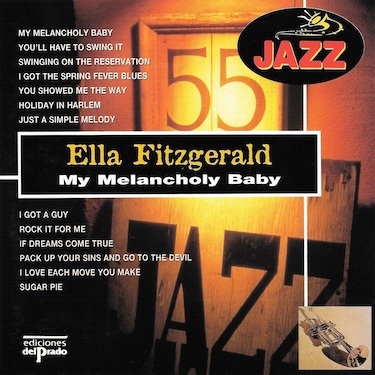
‘Come to me my melancholy baby/ Cuddle up and don’t be blue’. So ran the 1912 song, ‘My Melancholy Baby’, since associated with some famous names—Judy Garland, Al Bowlly, Connie Francis, Bing Crosby. The word itself has a long history, beginning as one of the four humours in Hippocratic medicine. Black bile, linked not only to melancholy but to one of the elements, Earth, and later to the season of autumn.[4] John Keats grants melancholy goddess status, associating her with beauty and joy as well as loss: ‘Ay, in the very temple of Delight/ Veiled Melancholy has her sovran shrine’.[5] But such nuances were sternly ironed out over time and the word became, as it has essentially remained, a near-synonym for sadness, though usually implying something deeper and longer-lasting than the common or garden kind and, often, of rather mysterious or inexplicable origin.


‘This was one of the blackest days that I ever passed. I was most miserably melancholy’, the sufferer James Boswell wrote; and in a letter of the following year: ‘Yet let me remember this truth: I am subject to melancholy, and of the operations of melancholy, reason can give no account.’[6] He recalled of Dr Johnson: ‘Burton’s Anatomy of Melancholy, he said, was the only book that ever took him out of bed two hours sooner than he wished to rise.’[7] Robert Burton and Edward Young, author of Night Thoughts, are probably the big cheeses of British gloom. I have a copy of the Anatomy, a reprint of the 1932 edition, introduced then by Holbrook Jackson (bibliophile and journalist, who had bought the New Age in partnership with A. R. Orage), and in the New York Review Books edition by William Gass. I have, though, only sampled and dipped, rather than read cover to cover. Alexandra Harris mentioned that Burton, ‘it was rumoured, took his own life in his college room in Christ Church. If this is true, the date makes sense. He died on 25 January 1640, well past the encouraging feasts of Christmas, at a melancholy time of the year.’[8]

An understandable trajectory there: the falling off or lapsing back from good fare and company to a more customary level, and the likely worsening of weather into the bargain. Melancholy often sits companionably enough beside modifying words or notions. Robert Graves remembered an old man in an antique shop telling him that ‘everyone died of drink in Limerick except the Plymouth Brethren, who died of religious melancholia.’[9] Ernst Jünger, fighting on the Western Front, remarked: ‘How often since that first time I’ve gone up the line through dead scenery in that strange mood of melancholy exaltation!’ And he remembered walking through a neglected but flourishing landscape: ‘Nature seemed to be pleasantly intact, and yet the war had given it a suggestion of heroism and melancholy; its almost excessive blooming was even more radiant and narcotic than usual.’[10]


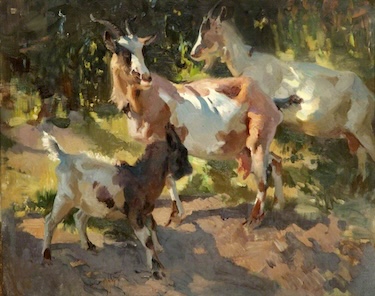
(Dorothy Adamson, Goats: Walker Gallery)

D. H. Lawrence decided that staying a long time in England made one ‘so melancholy’ but let that feeling extend to Sardinia and to other living creatures than troublesome humans: ‘Sometimes near at hand, long-haired, melancholy goats leaning sideways like tilted ships under the eaves of some scabby house. The call the house-eaves the dogs’ umbrellas. In town you see the dogs trotting close under the wall out of the wet. Here the goats lean like rock, listing inwards to the plaster wall. Why look out?’[11]

Lawrence and animals. I have a vague (and getting vaguer) memory of an exam question which I seized upon – was it writers on the animal world or specifically Lawrence? A resounding victory for the vagueness. I certainly wrote about Lawrence and, what, horses, snakes, cattle, perhaps even goats. It used to be a not uncommon ploy for people to concede cautiously that Lawrence was ‘very good with children and animals’, as though he couldn’t be trusted with anything else. Perhaps, for them, he couldn’t. Unsettling sort of chap. There are increasing numbers of unsettling figures in literary history as boundaries soften or bend. Is she modernist or not? Is he essentially Georgian or Victorian or. . .? The either/or becoming both or several or all.

Nick Jenkins, narrator of Anthony Powell’s A Dance to the Music of Time, reflects of  Dicky Umfraville: ‘He seemed still young, a person like oneself; and yet at the same time his appearance and manner proclaimed that he had had time to live at least a few years of his grown-up life before the outbreak of war in 1914. Once I had thought of those who had known the epoch of my own childhood as “older people”. Then I had found there existed people like Umfraville who seemed somehow to span the gap. They partook of both eras, specially forming the tone of the postwar years; much more so, indeed, than the younger people. Most of them, like Umfraville, were melancholy; perhaps from the strain of living simultaneously in two different historical periods.’[12]

Umfraville! Umfraville! – a composition for trombones or some other confident brass instruments. A bleak and almost wintry sky. ‘Cuddle up and don’t be blue’.


Notes

[1] Olivia Manning, Friends and Heroes (1965) in The Balkan Trilogy (London: Penguin Books, 1981), 802.

[2] The Collected Letters of Joseph Conrad: Volume 5 1912-1916, edited by Frederick R. Karl and Laurence Davies (Cambridge: Cambridge University Press, 1996), 529.

[3] ‘As in his fiction he writes out of a kind of hilarious depression’: London Mercury, xxxix (December 1938), in Frank MacShane, editor, Ford Madox Ford: The Critical Heritage (London: Routledge and Kegan Paul, 1972), 173.

[4] Roy Porter has a useful diagram of humours and elements in his The Greatest Benefit to Mankind: A Medical History of Humanity from Antiquity to the Present (London: Harper Collins, 1997), 58.

[5] John Keats, ‘Ode on Melancholy’, in The Complete Poems, edited by John Barnard, 3rd edition (London: Penguin Books, 1988), 349.

[6] Boswell’s London Journal, 1762-1763, edited by Frederick A. Pottle (London: William Heinemann, 1950), 213-214; letter to William Temple, 17 April 1764, in Boswell in Holland, 1763-1764, edited by Frederick A. Pottle (London: William Heinemann, 1952), 220.

[7] James Boswell, Life of Johnson, edited by R. W. Chapman, revised by J. D. Fleeman, (Oxford: Oxford University Press, 1980), 438.

[8] Alexandra Harris, Weatherland: Writers and Artists Under English  Skies (London: Thames & Hudson, 2015), 123.

[9] Robert Graves, Good-bye to All That: An Autobiography (1929; Harmondsworth: Penguin, 2014), 349.

[10] Ernst Jünger, Storm of Steel, translated by Michael Hofmann (Harmondsworth: Penguin, 2004), 9, 143.

[11] Letters of D. H. Lawrence II, June 1913-October 1916, edited by George J. Zytaruk and James T. Boulton (Cambridge: Cambridge University Press, 1981), 25; Sea and Sardinia (1921), in D. H. Lawrence and Italy (London: Penguin Books, 1997), 13.

[12] Anthony Powell, The Acceptance World, in A Dance to the Music of Time: 1st Movement (Chicago: University of Chicago Press, 1995), 153.

Cheerful notes from literary history

Boat.Upturned

(The Ship of State)

The United Kingdom (as it’s currently known) goes to the polls tomorrow and I wish I felt a little more confidence in the British electorate. An astonishing number of people seem willing to ignore the threats to the survival of the National Health Service, working families forced to go to food banks, teachers having to use their own money to buy stationery and food for their pupils, homeless people dying on the streets. The obvious question is: do they not know or do they not care?

Thinking back to the much-quoted comment on the 2016 referendum—that people don’t mind being lied to if they like the lie they’re being told—we’re seeing now, unsurprisingly, the corollary: people do mind being told a truth if they don’t like the truth that’s being told.

In Nick Park’s Wallace & Gromit film, The Wrong Trousers, there’s a police ‘Reward’ poster headed: ‘Have you seen this chicken?’ It’s the criminal penguin in an absurdly obvious red rubber glove doubling as chicken comb. Wallace, never the sharpest tool in the box, exclaims at one point when the penguin has donned the glove: ‘It’s you!’

WrongTrousers

In Steve Bell’s cartoons of late, Boris Johnson has adopted ‘the scarlet rubber gauntlet of integrity’ https://www.theguardian.com/commentisfree/picture/2019/dec/09/steve-bells-if-boris-johnson-gets-ready-to-fight-the-election and Johnson in person has been no more convincing than the penguin. Yet many have, it seems, chosen to be convinced. There has, of course, been a relentless and sustained media onslaught against Jeremy Corbyn, for several years now, mainly in the trashier Tory papers—Sun, Express, Mail—but with some substantial if less hysterical help from the Times and the Johnson outlet, the Telegraph, collectively representing the Labour leader as a threat to western civilization. But I don’t know – he doesn’t despise ordinary people, doesn’t hide from interviewers or nick their phones and doesn’t lie through his teeth. Is he just too old-fashioned?

Frankly, the Labour manifesto seems to me the only chance our failing country has to reverse its precipitous decline—and if you think their manifesto’s too radical, then it’s just as well I don’t get to enact mine.

11 December. Surely there are some cheerful notes from literary history?

‘On Monday 11 December [1916]’, D. H. Lawrence sensed ‘a terrible wave of depression in Cornwall with people in Penzance market saying England was beaten, as the news came of the fall of Asquith and his replacement by Lloyd George. For Lawrence this was the death-blow to the liberal and decent England he had cared about . . . Now finally the old England was gone, replaced by the “patriotism” of Horatio Bottomley and the demago­guery of Lloyd George.’[1]

(Two years later, Lloyd George was returned to power at the head of a coalition government with 478 ‘Coalition’ MPs, the vast majority of them Conservatives. John Maynard Keynes famously asked ‘a Conservative friend [Stanley Baldwin], who had known previous houses, what he thought of them. “They are a lot of hard-faced men,” he said, “who look as if they had done very well out of the war.”’)[2]

Okay, try another one. In his essay ‘Welsh Poetry’, poet and painter David Jones wrote that, ‘In the Brenhinedd y Saeson, “The Kings of the English”, which is a Welsh version of a Latin chronicle, the scribe, in an entry for 11th December 1282, after noting that the Lord Llywelyn had been killed on that day, adds these significant words” Ac yna i bwriwyd holl Gymry y’r llawr, And then was cast down all Wales, to the ground.’[3]

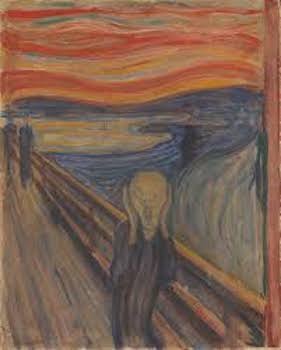
Scream

Perhaps not that one either. Wait, though, tomorrow—Election Day—is the birthday of Edvard Munch, painter best-known for, ah, The Scream (several versions). So that’s encouraging.


Notes

[1] Mark Kinkead-Weekes, D. H, Lawrence: Triumph to Exile, 1912-1922 (Cambridge: Cambridge University Press, 1996), 345.

[2] John Maynard Keynes. The Economic Consequences of the Peace (London: Macmillan, 1919), 133.

[3] David Jones, Epoch and Artist: Selected Writings (London: Faber, 1973), 61.


Berwick, Sussex, tenebrosities

berwick-via-guardian

(Berwick-on-Tweed, via The Guardian)

In January 1923, Ezra Pound wrote: ‘Les guerres de Napoléon having interrupted communications between the islanders and the rest of the world, the light of the eighteenth century was lost, Landor went into exile, the inhabitants of Berwick and Sussex existed in darkness, England as a whole fell back into the tenebrosities of the counter reformation, and has remained there ever since.’[1]

Ah, those tenebrosities. Hello, darkness, my old friend, as we are practising saying. But the light of the eighteenth century? Pound is less likely to be pointing to Samuel Johnson, Pope, Crabbe, Burke and Swift than, given the context and his Francophile tendencies, the Encyclopaedists, Voltaire, Diderot, Montesquieu.

blake_ancient_of_days

(Some 18th century light: William Blake, The Ancient of Days)

‘If Pound’s Enlightenment, with its stress on Bayle, Voltaire, a few historians, and the antecedents of Revolutionary America, is not precisely that of the eighteenth-century specialist, that is because of the sharp selection and re-emphasis incident to solving a poetic problem located two centuries later’, Hugh Kenner remarked, that ‘problem’ being Pound’s need to ‘break free from Rossetti, “the nineties” and the opalescent word’.[2]

NPG Ax7811; Ezra Pound by Alvin Langdon Coburn  yeats-1911

(Alvin Langdon Coburn, Ezra Pound)        (W. B. Yeats, 1916)

As for those inhabitants of Berwick and Sussex – it could be a straightforward ‘north’ and ‘south’ of England: still, for the latter, there had been Pound’s three winters (1913-1916) at Stone Cottage at the edge of Ashdown Forest, as ‘secretary’ to William Butler Yeats.[3] Then, too, in the summer of 1920, Pound had visited his friend Ford Madox Ford in Bedham: ‘And Mr. Pound appeared, aloft on the seat of my immense dog-cart, like a bewildered Stuart pretender visiting a repellent portion of his realms. For Mr. Pound hated the country, though I will put it on record that he can carve a sucking pig as few others can. With him I quarrelled about vers libres and he shortly afterwards left England and acquired his mastery of the more resounding rhythms.’[4]

And then – Berwick. In the summer of 1914, as Ford recalled it nearly twenty years later, ‘I went home to pack my things. Next morning I was on the high platform of Berwick station. Berwick town is in Berwickshire and Berwickshire is in Scotland. But Berwick town is neither English nor Scottish. It is “juist Berwick”. The King’s proclamations are ordered to be affixed to the church doors of England, Scotland, Wales and Ireland and the town of Berwick-on-Tweed.’ Then, putting down the newspaper, Ford catches sight of a three-line paragraph, ‘tucked away at the bottom of a page and headed minutely: AUSTRIAN HEIR MURDERED IN SARAJEVO. It was London’s news of the 28th June, 1914, reaching me there in a border town.’[5]

A little nearer in time to the events described, he shifts that moment forward a few weeks, writing that, ‘On the morning of 20th July, 1914, I stood upon the platform of Berwick-on-Tweed station, reading the London papers.’[6] Max Saunders discusses the conflicting dates with his usual thoroughness and accuracy.[7]

Ford was at Berwick-on-Tweed to catch the train on to Duns, where he and Violet Hunt had been invited to a house party by the novelist Mary Borden, who had rented Duns Manor with her husband, George Turner. The other houseguests included E. M. Forster and Wyndham Lewis (with whom Borden was having an affair).[8] Pound was not present but was in close contact with both Ford and Lewis (whose fictional rendering of the occasion, ‘The Country House Party, Scotland’, remained unpublished in his lifetime, though a version appears in his first autobiographical volume, Blasting and Bombardiering.[9]

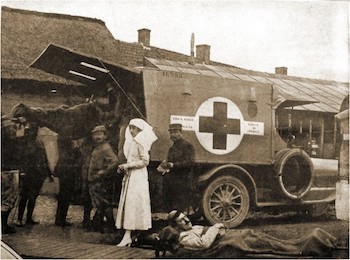
At that time, Borden had published only one novel and a play, both under the name of ‘Bridget MacLagan’. She eventually produced twenty-five books, publishing well into the 1950s: the most highly regarded probably remains The Forbidden Zone, a collection of sketches and poems finally published in 1929. In both world wars, Borden set up and ran mobile hospitals in France, close to the front line, making full use of her wealth and contacts but also demonstrating immense personal courage and endurance. She was awarded the Croix de Guerre and made a member of the Légion d’honneur. After the fall of France in 1940, and a circuitous, hair-raising journey home, Borden ended up running a hospital in the Western Desert, spending time in Syria and Lebanon. She died in December 1968.[10]

mar-borden-france

Mary Borden working at a Field Hospital in France:
https://modernismmodernity.org/articles/war-experience-modernist-noise

Duns, the county town of Berwickshire, bordered the twin parishes of Bunkle and Preston, in which Ford’s great-grandfather, the physician John Brown had been born in the winter of 1735-36. In The Spirit of the People,[11] Ford again referred to Berwick-on-Tweed as if it were a separate entity, neither Scottish nor English and, a few years later, in his novel of border country, The Young Lovell, he has the Earl of Northumberland read to Margaret from an old document: ‘And when he had done with Hotspur, the Earl went on to read of the fate of the father of Hotspur, Henry, the Fourth Lord Percy of Alnwick. This lord fell at Bramham Moor fighting against King Henry IV, as Hotspur had done at Hately Field, fighting against the same King four years before. This lord’s head and quarters were placed upon London Bridge: one quarter upon the gate of York, another at Newcastle, and yet further pieces at King’s Lynn and Berwick- on-Tweed.’[12]

That seems to add up to five quarters, a miscounting to set beside Murphy’s scarves in Samuel Beckett’s novel (the text says seven but accounts for only six). In a letter to Hugh Kenner, referring to Guy Davenport’s work on the drawings for The Stoic Comedians, Beckett wrote: ‘I wonder where he will place that 7th scarf.’ In fact, Davenport used eight.[13]

Ford worked Berwick and the return journey to London into the first volume of the Tietjens tetralogy;[14] and Berwick is there again more than a decade later, ‘the patient New Yorker’ reading in Malory’s Morte d’Arthur Sir Gawaine’s letter to Sir Launcelot, telling him that he had been smitten upon the old wound received from Launcelot ‘afore the cité of Benwyke, and thorow that wounde I am com to my deth-day.’[15]

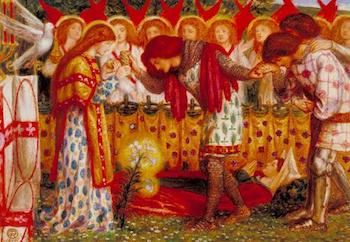
How Sir Galahad, Sir Bors and Sir Percival Were Fed with the Sanct Grael; but Sir Percival's Sister Died by the Way 1864 by Dante Gabriel Rossetti 1828-1882

Dante Gabriel Rossetti, How Sir Galahad, Sir Bors and Sir Percival Were Fed with the Sanct Grael; but Sir Percival’s Sister Died by the Way (1864): Tate

There’s an obvious affinity between Ford (Englishman, German father, lived in France and America, published across two centuries, modernist who doesn’t quite fit the template), who wrote often—explicitly and implicitly—about borders, and Berwick, the northernmost town in England, at the mouth of a river which runs across the Anglo-Scottish border, a town which was at one time in Scotland, some of whose inhabitants regard themselves as English, some Scottish, others simply as Berwickers.

Fertile ground for the arts, then, borders – but in the wider world they can be lethal. . .

https://www.theguardian.com/commentisfree/2019/jan/31/ireland-hard-border-brexit-backstop-good-friday-agreement


References

[1] Ezra Pound, ‘On Criticism in General’, Criterion, I, 2 (January 1923), 143.

[2] Hugh Kenner, ‘Ezra Pound and the Light of France’, in Gnomon: Essays on Contemporary Literature (New York: McDowell, Obolensky, 1958), 264.

[3] This chapter of modernism is splendidly described by James Longenbach, in Stone Cottage: Pound, Yeats and Modernism (New York: Oxford University Press, 1988).

[4] Ford Madox Ford, It Was the Nightingale (London: Heinemann, 1934), 138.

[5] Ford Madox Ford, Return to Yesterday: Reminiscences 1894-1914 (London: Victor Gollancz, 1931), 434, 435.

[6] Ford Madox Ford, Between St Dennis and St George: A Sketch of Three Civilisations (London: Hodder, 1915), 38.

[7] Max Saunders, Ford Madox Ford: A Dual Life, two volumes (Oxford: Oxford University Press, 1996), I, 604-605, n.12.

[8] Paul O’Keeffe, Some Sort of Genius: A Life of Wyndham Lewis (London: Jonathan Cape, 2000), 158-159.

[9] Wyndham Lewis, ‘In Berwickshire, August 1914’, Blasting and Bombardiering (London: Eyre and Spottiswoode, 1937), 60-63.

[10] See Jane Conway, A Woman of Two Wars: The Life of Mary Borden (London: Munday Books, 2010).

[11] Ford Madox Ford, The Spirit of the People (1907), in England and the English, edited by Sara Haslam (Manchester: Carcanet Press, 2003), 253.

[12] Ford Madox Ford, The Young Lovell: A Romance (London: Chatto & Windus, 1913), 140.

[13] Questioning Minds: The Letters of Guy Davenport and Hugh Kenner, edited by Edward M. Burns, two volumes (Berkeley: Counterpoint Press, 2018), I, 144, 158; Davenport’s drawing, ‘Murphy rocking: prior to inversion’, is in Hugh Kenner, The Stoic Comedians: Flaubert, Joyce, and Beckett (1962; Berkeley: University of California Press, 1974), 99.

[14] Ford Madox Ford, Some Do Not. . . (1924; edited by Max Saunders, Manchester: Carcanet Press, 2010), 195 and n., 227, 231, 234.

[15] Ford Madox Ford, Great Trade Route (London: Allen & Unwin, 1937), 75, 89; The Works of Sir Thomas Malory, edited by Eugène Vinaver (London: Oxford University Press, 1964), 863.


The teeth of the evidence – or the evidence of teeth

Fear-and-Loathing . Toorenvliet, Jacob, c.1635-1719; The Dentist

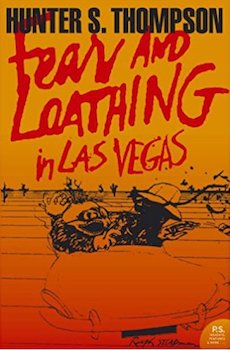
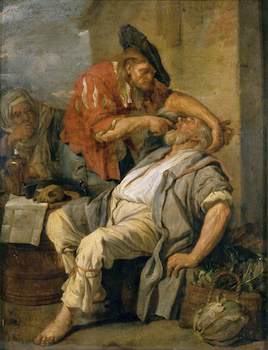
(Hunter Thompson; Jacob Toorenvliet, The Dentist: Brighton and Hove Museums and Art Galleries)

‘We were somewhere around Barstow on the edge of the desert when the drugs began to take hold. I remember saying something like “I feel a bit lightheaded; maybe you should drive. …” And suddenly there was a terrible roar all around us and the sky was full of what looked like huge bats, all swooping and screeching and diving around the car, which was going about 100 miles an hour with the top down to Las Vegas. And a voice was screaming: “Holy Jesus! What are these goddamn animals?”’

Hunter S. Thompson, Fear and Loathing in Las Vegas, of course. And against this, what? ‘We were somewhere around Bridport when the toothache took hold.’ No. But the pain was real, one hundred per cent genuine pain; I gather that Thompson’s account was, say, seventy-five per cent actual, the rest invention. Still, that particular seventy-five is scary enough.

‘Why don’t you’, the Librarian inquires mildly, ‘just go to the dentist?’ Ah yes. There are subtle undercurrents here. On the phone to the Librarian’s mum, I ask: ‘How’s your tooth?’ ‘Quiet at the moment. How’s yours?’ ‘The same. Are you going to the dentist?’ ‘Do I want to disturb it? Won’t that just stir it up? Are you going?’ ‘Not sure yet.’ Yes. Why don’t you just . . . ?

I fleetingly recall an entry in Francis Kilvert’s diary about a dentist called Gaine and his discovery that a combination of concentrated carbolic acid and arsenious acid ‘will destroy the nerve almost entirely without pain.’[1] So much acid and no pain – almost? It sounds agonisingly unlikely. My recent dental visits have, in fact, been pretty uneventful. But teeth – a serious business. Probably the worst pain I remember is tooth-related: a mere bagatelle, most women would think, familiar as they are with chronic period pains, let alone the pains of childbirth, but I’m not too keen to go through it again.

Teeth bulked large in Ford Madox Ford’s life. In August 1911, he had ‘an awful week of dentistry’ in Paris and came to meet Violet Hunt at the Gare du Nord, ‘toothless and feckless’. He had had ‘four teeth cut one morning without gas. The dentist said he must have a week or ten days rest before beginning the lower jaw.’[2] Five years later, in March 1917, here is Ford’s friend Ezra Pound, writing to Alice Corbin Henderson: ‘Ford has been in hospital. All we know for certain is that his false teeth fell out.?? Ague or shell shock.???’[3]

Pound, teeth and Englishmen. ‘NO englishman is ever sufficiently evolved to stand civility’, he wrote to Wyndham Lewis in March 1939, when some encounter had clearly put him in a major snit. ‘KICK the bastards in the jaw FIRST.’ Commenting on this in the piece he wrote for a 1950 collection of essays assembled by Peter Russell, Lewis recalled it as: ‘There’s only one thing to do with an Englishman—kick him in the teeth’. Lewis explained that it concerned ‘a young English bibliophile’ he had sent to Rapallo’, adding that Pound’s patience ‘must have been sorely tried.’[4]

Lewis, Wyndham, 1882-1957; Mr Wyndham Lewis as 'Tyro'

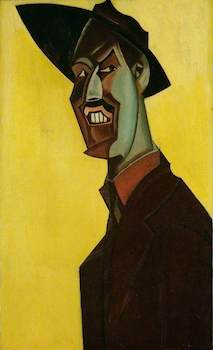
(‘Mr Wyndham Lewis as a Tyro’, Ferens Art Gallery © Estate of Mrs G. A. Wyndham Lewis; The Wyndham Lewis Memorial Trust)

Also tooth-related was ‘one of the great tragedies’ of Ford’s life, which occurred just before the First World War, when Ford was in Germany with the Liberal politician Charles Masterman and his wife. The landlord of the Hotel zur Post in Trêves, as a reward for having brought him ‘a British Excellency’, presented Ford with a bottle of 1813 brandy. ‘In the Mosel there is a stone that is only uncovered in years of great drought – which are years of glorious vintages. On such years they chain a barrel of brandy to that stone. When it is again uncovered they remove the old barrel and chain on a new one. That stone had not been uncovered since 1813. The bottle that the host gave me had been filled from the 1813 barrel.’ During the night, Masterman had toothache. ‘He poured by degrees the whole of that 1813 brandy into his mouth and spat it out again. By ringing the bell he could have procured a bottle of 1913 brandy for one franc fifty.’[5]

But then, as early as the turn of the century, teeth were an issue. When Joseph Conrad and Ford were collaborating on the novel that became The Inheritors and Conrad reluctantly attended to a female character—a part of what he usually termed ‘Ford’s women’—to the extent of granting her ‘good hair, good eyes and some charm’, it was ‘only with difficulty’, Ford recalled, ‘that he was restrained from adding good teeth to the catalogue. “Why not good teeth? Good teeth in a woman are part of her charm. Think of when she laughs. You would not have her not have good teeth. They are a sign of health. Your damn woman has to be healthy, doesn’t she?”’[6] By way of compensation, perhaps, the book does contain a dramatic critic who ‘furtively took a set of false teeth out of his waistcoat pocket; wiped them with a bandanna handkerchief, and inserted them in his mouth.’[7]

‘Do you know what Maupassant said about England?’, Colette wrote to Léopold Marchand in 1921, ‘“Too many toothbrushes and not enough bidets!”’[8] About bidets he was surely right but how many toothbrushes is ‘too many’?

Good night. Don’t forget to brush your teeth.


References

[1] Francis Kilvert, Kilvert’s Diary, edited by William Plomer, three volumes (London: Jonathan Cape, 1938, reissued 1969): II, 100.

[2] See Max Saunders, Ford Madox Ford: A Dual Life, two volumes (Oxford: Oxford University Press, 1996), I, 346. And see Alan Judd, Ford Madox Ford (London: Collins, 1990), 388: ‘Never for long could he forget those teeth that Violet had paid for.’

[3] The Letters of Ezra Pound to Alice Corbin Henderson, edited by Ira B. Nadel (Austin: University of Texas Press, 1993), 201.

[4] Pound/Lewis: The Letters of Ezra Pound and Wyndham Lewis, edited by Timothy Materer (London: Faber and Faber, 1985), 208 and n.

[5] Ford Madox Ford, Return to Yesterday: Reminiscences 1894-1914 (London: Victor Gollancz, 1931), 425.

[6] Ford Madox Ford, Joseph Conrad: A Personal Remembrance (London: Duckworth, 1924), 144.

[7] Ford Madox Ford and Joseph Conrad, The Inheritors: An Extravagant Story (1901; Liverpool: Liverpool University Press, 1999), 31.

[8] Colette, Letters from Colette, selected and translated by Robert Phelps (London: Virago Press, 1982), 63.

Four-posted

Barber, Alfred R., 1841-1925; Four Rabbits

Rabbit Quartet
(Alfred Barber, Four Rabbits: Stockport Heritage Services)

Glancing over the titles I’d borrowed from the university library—on my infrequent visits, I tend to range widely and sometimes incoherently—I was struck by a quite unintended recurrence: Four archetypes, The fourth imagist, The letters of D. H. Lawrence: Volume 4, W. H. Auden’s Prose: Volume 4, 1956-1962. Four fours. (There was, in fact, a trickster: a fifth title, by Patrick White, although—fittingly enough—it was called Three uneasy pieces).

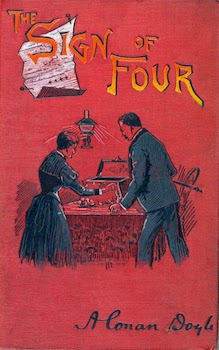
 Four-square. The sign of four. In August 1889, less than two years after the debut of Sherlock Holmes in A Study in Scarlet, Arthur Conan Doyle had dinner at the Langham Hotel with Joseph Marshall Stoddart, the editor of Lippincott’s Monthly Magazine, Thomas Patrick Gill, former editor and M.P—and friend of Charles Stuart Parnell—and Oscar Wilde. The dinner resulted in two short novels appearing in Lippincott’s: Wilde’s The Picture of Dorian Gray and Conan Doyle’s The Sign of Four (its magazine title added a second definite article: ‘The Sign of the Four; or, The Problem of the Sholtos’).

Doyle-Sign-of-Four

The story begins with the famous scene of Holmes injecting himself with cocaine (‘a seven-per-cent solution’)—and ends with him reaching up for the cocaine-bottle—touches on Watson’s publication of A Study in Scarlet and Holmes’s own published works (on types of tobacco ash, the tracing of footsteps, the influence of a trade upon the form of a hand), demonstrates the difference between observation and deduction, and introduces the Baker Street Irregulars, the tracker dog Toby and the woman who will become Watson’s wife, Miss Mary Morstan (‘I have never looked upon a face which gave a clearer promise of a refined and sensitive nature’, the doctor decides). All this as well as tales of the Indian Mutiny and a narrative excursion to the Andaman Islands. Conan Doyle also acknowledged the part played by the Langham Hotel: it is from here that Captain Morstan has so mysteriously disappeared.[1]

The Earth may be round but much of it’s quadriform –‘the four corners of the earth’ is familiar enough. Four elements, four seasons (for some of us); also dimensions, estates and (coming up fast on the inside) horsemen of the apocalypse. Franklin D. Roosevelt proposed four fundamental freedoms, though Harry Truman fooled around with them, replacing freedom from want and freedom from fear with ‘a promise of “freedom of enterprise”.’[2] According to Fernand Braudel, the world population doubled in four centuries (the fifteenth to the eighteenth); it does so now in more like four decades.[3] Ovid had described four ages of man; Thomas Love Peacock wrote of four ages of poetry: iron, gold, silver and brass. Modern poetry too had its ages and ‘that egregious confraternity of rhymesters’—the Lake Poets, primarily Wordsworth, Coleridge and Southey—were guilty of ‘conjuring up a herd of desperate imitators’, who had in turn ‘brought the age of brass prematurely to its dotage’.[4]

Four-ages-of-man

‘The four ages of man’, Bartholomaeus Anglicus (Royal 17 E III, f. 80): © The British Library

‘The grand object of travelling’, Samuel Johnson declared, ‘is to see the shores of the Mediterranean. On those shores were the four great Empires of the world; the Assyrian, the Persian, the Grecian, and the Roman.—All our religion, almost all our law, almost all our arts, almost all that sets us above savages, has come to us from the shores of the Mediterranean.’[5] Other fours that spring or schlep to mind include Ronald Duncan, ‘I have always needed the assistance of at least four women—and thought they were happy if they were too busy to complain’,[6] and Hugh Kenner’s discussion of Ezra Pound mulling over the opening of the Cantos, pondering ‘a chord that should comprise four of history’s beginnings: the earliest English (“Seafarer” rhythms and diction), the earliest Greek (the Nekuia), the beginnings of the 20th-century Vortex, and the origins of the Vortex we call the Renaissance, when once before it had seemed pertinent to reaffirm Homer’s perpetual freshness.’[7] And there is Lawrence Durrell’s epigraph to Justine, the first volume of The Alexandria s Quartet, a quotation from Freud (a letter to Wilhelm Fliess in 1899): ‘I am accustoming myself to the idea of regarding every sexual act as a process in which four persons are involved. We shall have a lot to discuss about that.’ Unsurprisingly, I’d say.

My own record on quartets and tetralogies is distinctly patchy. Brass, wind, string? Not many, a very superficial acquaintance given the range of choice. But Durrell, yes, T. S. Eliot’s Four Quartets and Elena Ferrante’s Neapolitan novels and T. H. White’s The Once and Future King, yes. Updike’s Rabbit books, almost there, Michael Moorcock’s The Cornelius Quartet, ditto, Yukio Mishima’s The Sea of Fertility, a bit. Paul Scott’s Raj Quartet, not at all, pretty close once or twice but never quite seized the moment; and the same goes for L. H. Myers, The Near and the Far.

On the other hand, when we come to Ford Madox Ford’s Parade’s End – I’d say I’m more than covered. ‘Bridge was his only passion; a fortnight every year was what, in his worn-out life, he got of it. On his holiday he rose at ten. At eleven it was: “A four for the Father.” From two to four they walked in the forest. At five it was: “A four for the Father.” [ . . . ] The other four played on solemnly.’

Fordian fours. No Enemy is not part of a tetralogy but the temptation’s there; and, after all, if I were to throw in Ford’s other immediate postwar writings (the ones that remained unpublished), ‘True Love & a G. C. M.’, ‘Mr Croyd’ plus one of the two other typescripts intimately related to it—‘That Same Poor Man’ and ‘The Wheels of the Plough’—I have a foursome.[8]

‘So Gringoire had four landscapes, which represent four moments in four years when, for very short intervals, the strain of the war lifted itself from the mind. They were, those intermissions of the spirit, exactly like gazing through rifts in a mist.’

Bring on those intermissions of the spirit, those rifts in the mist.

 
References

[1] Arthur Conan Doyle, The Sign of Four, in The New Annotated Sherlock Holmes: The Novels, edited with notes by Leslie S. Klinger (New York and London: W.W. Norton and Company 2006), 209-381.

[2] Sarah Churchwell, Behold, America: A History of America First and the American Dream (London: Bloomsbury Publishing, 2018), 285-286.

[3] Fernand Braudel, Civilization and Capitalism, 15th – 18th Century. Volume I: The Structures of Everyday Life: The Limits of the Possible, translated from the French; revised by Sîan Reynolds (London: Fontana Books 1985), 31.

[4] Peacock, The Four Ages of Poetry, quoted in Stephen Prickett, ‘Romantic Literature’, The Romantics, edited by Prickett (London: Routledge, 2016), 243.

[5] James Boswell, Life of Johnson, edited by R. W. Chapman, revised by J. D. Fleeman, (Oxford: Oxford University Press, 1980), 742.

[6] Ronald Duncan, All Men Are Islands: An Autobiography (London: Rupert Hart-Davis, 1964), 187.

[7] Hugh Kenner, The Pound Era (London: Faber and Faber, 1972), 349.

[8] The apparent confidence with which I list these is, of course, entirely based on the second volume of Max Saunders’ Ford Madox Ford: A Dual Life (Oxford: Oxford University Press, 1996).

Ghost-seers and revenants

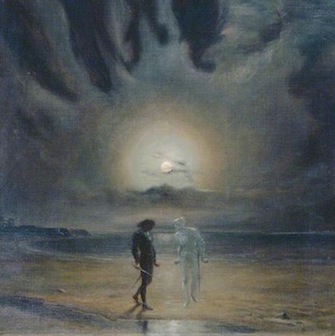
Shields, Frederick James, 1833-1911; Hamlet and the Ghost

(Frederick James Shields, Hamlet and the Ghost: Manchester Art Gallery)

Saturday’s Guardian carried a paperback review of Lisa Morton’s Ghosts: A Haunted History. It begins: ‘Nearly half of Americans believe in ghosts; the worldwide figure is almost certainly higher’, and adds that Morton shows belief in ghosts to be ‘nearly universal, though the form taken by the “undead spirit” varies across time and space.’[1]

It’s certainly a remarkably prevalent word – and idea – in our culture, in most cultures. Ghostwriter, ghost story, Ghostbuster, ghost train, ghost town, ghost of a chance, give up the ghost, to look like a ghost, ghosts walking over our graves, the ghost in the machine. The Holy Ghost: the Divine Spirit, the third person of the trinity, the Holy Spirit, closer there to the German geist. Ford Madox Ford remembered telling his confessor about his difficulty in conceiving, let along believing in, that ‘Third Person of the Trinity’. The old priest sensibly replied: ‘“Calm yourself, my son, that is a matter for theologians. Believe as much as you can”.’[2]

The poet Thomas Campbell recalled meeting the celebrated astronomer William Herschel in Brighton, in September 1813, feeling that he’d been ‘conversing with a supernatural intelligence’. Herschel completely perplexed him by saying that many distant stars had probably ceased to exist ‘millions of years ago’, ‘and that looking up into the night sky we were seeing a stellar landscape that was not really there at all. The sky was full of ghosts.’[3]

I’d tended to assume that fear of ghosts in the old sense had sensibly diminished in the more than four hundred years since Hamlet and the other witnesses had no doubts at all about what they were seeing when the ghost of the late king appeared to them, or the two hundred and fifty years since James Boswell was so unsettled by talk of ghosts: ‘This was very strong. My mind was now filled with a real horror instead of an imaginary one. I shuddered with apprehension. I was frightened to go home’.[4]

Had interest not steadily shifted to the observer rather than the observed? Henry James’s The Turn of the Screw is an obvious example; and Algernon Blackwood, in the preface to his collected stories, wrote: ‘My interest in psychic matters has always been the interest in questions of extended or expanded consciousness. If a ghost is seen, what is it interests me less than what sees it?’[5]

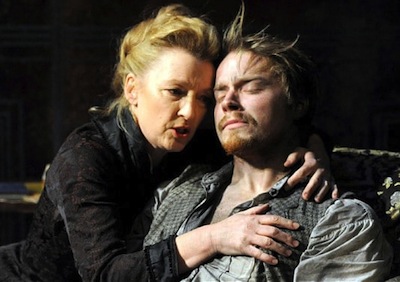
Ghosts_Almeida

(Ghosts at the Almeida Theatre via The Telegraph)
Lesley Manville as Helene Alving and Jack Lowden as Oswald Alving.

Henrik Ibsen disliked Ghosts as the title chosen by William Archer for his translation of the play into English. Richard Eyre, discussing his 2013 version, rendered the Norwegian Gengangere as ‘“a thing that walks again”, rather than the appearance of a soul of a dead person’ but pointed out that ‘Againwalkers’ was ungainly and the alternative, ‘Revenants’ he found ‘both awkward and French. Ghosts has a poetic resonance to the English ear.’
https://www.theguardian.com/stage/2013/sep/20/richard-eyre-spirit-ibsen-ghosts

Awkward? Arguably. French, most certainly. The 2004 film, Les Revenants, I’ve seen translated as They Came Back, while the recent television series based on it is called The Returned. In any case, the poetic resonance of ‘ghosts’ is certainly true enough in this English ear.

Unsurprisingly, the ‘theatre of war’—‘“theatre” is good. There are those who did not want / it to come to an end’[6]—is a flourishing site of wraiths, phantoms, visitants, revenants and vanishings. ‘Ghosts were numerous in France at that time’, Robert Graves wrote, recalling the second year of the First World War. Later, staying near Harlech at the large Tudor house of the Nicholson family—Graves married Nancy Nicholson, sister of Ben, third child of the painter William Nicholson and his wife Mabel—Graves remembered, ‘It was the most haunted house that I have ever been in, though the ghosts were invisible except in the mirrors.’[7]

Lucy_Masterman

(By Source (WP:NFCC#4), Fair use, https://en.wikipedia.org/w/index.php?curid=51483551)

From France in 1916, Ford Madox Ford wrote to Lucy Masterman, wife of the Liberal politician, then running the British War Propaganda Bureau (Wellington House): ‘Why does nobody write to me? Does one so quickly become a ghost, alas!’[8]

And two and a half years after the Armistice, Siegfried Sassoon, thinking about the war, pulled out his war notebooks and paused on a diary entry of 30 June 1916. ‘The diary makes me realise that I shall never partake of another war. It makes me wonder whether five years ago was real. “Gibson’s face in the first grey of dawn . . . ” Gibson is a ghost but he is more real to-night than the pianist who played Scriabine with such delicate adroitness. I wish I could “find a moral equivalent for war”. To-night I feel as if I were only half-alive. Part of me died with all the Gibsons I used to know.’[9]

Rapid and colossal changes, in agriculture, in urban sprawl, in transport, in technology, in population density, in the widespread loss of natural habitats, the accelerating extinction of species, the rampant carelessness of planning and development, combine to engender common but unpredictable sensations of loss, an uneasiness, an unfocused search for the missing. ‘Our landscape is full of ghosts’, Anna Pavord writes, ‘of hands that have twitched and pulled it into sheep runs and cattle folds, bridleways and burial mounds. It is one of its great strengths.’[10] And Helen Macdonald wrote that ‘The hawk and I have a shared history of these fields. There are ghosts here, but they are not long-dead falconers. They are ghosts of things that happened.’[11]

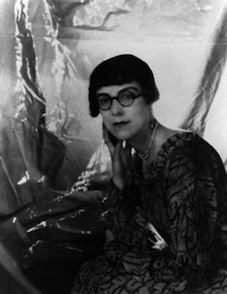
The self, of course, can become a ghost, or feel like one. Writing to William Maxwell in early 1940, Sylvia Townsend Warner remarked: ‘Being a writer makes one a ghost before one’s time—the kind of ghost that likes a libation. War—or rather a state of things that antedates war—makes one feel more ghostly still’.[12] John Banville’s narrator refers to the self as an indistinct black shape, ‘like the shape that no one at the séance sees until the daguerreotype is developed. I think I am becoming my own ghost.’[13]

STW2

(Sylvia Townsend Warner via  http://sylviatownsendwarner.tumblr.com/)

How many of us are never haunted, by remembered faces, voices, names, the lives unlived, places unvisited, old friends misplaced, acquaintances not pursued, desired lovers untried? We may not use the word ‘ghost’, of course. But sometimes one of the most poignant experiences of the ghostly is not the dead friend or relative or lover, the spirit reluctant to leave building, battlefield or landscape—but the life that was never quite there at the outset, the lost because never held, the almost-life, as in the poem by Julia Copus, her narrator straining to see the longed-for sign of a successful IVF treatment:

She takes it all in, like a small, controlled explosion:
here is the inch-long stiff, absorbent pad –
a stopped tongue, the damp on it still; and the plastic housing

with its cut-out windows. And here is the latex strip
(two lines for yes), the single band of purple
and beside it the silvery ghost of a second line

willed into being – frail as the arm of a sea-frond
trailed in the ocean – but failing to darken or turn
into more than a watermark.[14]


References

[1] P. D. Smith, ‘Out in paperback’ column, which I cannot find online: Guardian review supplement (7 October 2017), 9.

[2] Ford Madox Ford, Provence (London: Allen & Unwin, 1938), 140.

[3] Richard Holmes, The Age of Wonder: How the Romantic Generation Discovered the Beauty and Terror of Science (London: Harper Collins, 2008), 210.

[4] Boswell’s London Journal, 1762-1763, edited by Frederick A. Pottle (London: William Heinemann, 1950), 214.

[5] The Tales of Algernon Blackwood (London: Martin Secker, 1938), xi.

[6] ‘Canto LXXVIII’, The Cantos of Ezra Pound, fourth collected edition (London: Faber and Faber, 1987), 477.

[7] Robert Graves, Goodbye to All That (1929 edition; Harmondsworth: Penguin, 2014), 157, 342; Sanford Schwartz, William Nicholson (New Haven: Yale University Press, 2004), 179-180.

[8] Letter of 6 September 1916: Letters of Ford Madox Ford, edited by Richard M. Ludwig (Princeton: Princeton University Press, 1965), 74.

[9] Siegfried Sassoon, Diaries 1920-1922, edited by Rupert Hart-Davis (London: Faber and Faber, 1981), 73.

[10] Anna Pavord, Landskipping: Painters, Ploughmen and Places (London: Bloomsbury 2016), 43.

[11] Helen Macdonald, H is for Hawk (London: Jonathan Cape, 2014), 240.

[12] Michael Steinman, editor, The Element of Lavishness: Letters of Sylvia Townsend Warner and William Maxwell, 1938-1978 (Washington: Counterpoint, 2001), 8.

[13] John Banville, The Sea (London: Picador, 2006), 194.

[14] Julia Copus, ‘Ghost’, in The World’s Two Smallest Humans (London: Faber and Faber, 2012), 50.