Grackles, clouds, popes

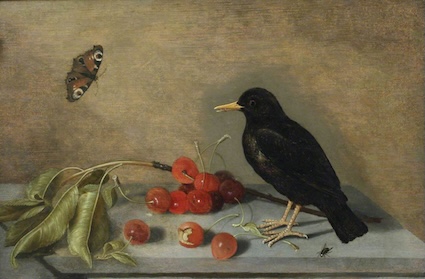
(Ambrosius Bosschaert the Younger, A Blackbird, Butterfly and Cherries: National Trust, Ham House)

04:30 and the blackbird already in full song. Not conducive to much further sleep but fine music. The same bird or a different one has several times come down to pick up grubs from pots ranged against the walls. Writing of the disappearances from the natural world over the past decades, Richard Mabey mentions smaller gnat swarms and choruses of blackbirds, and the barn owls gone.[1] And it’s true that we never hear such choruses now: it is almost always a solitary blackbird.

Guy Davenport remarks on ‘Gracchus’, meaning ‘grackle’ or ‘blackbird’; in Czech, kavka. And that Franz Kafka’s father had a blackbird on his business letterhead.[2] I recall that Davenport used ‘Grackle’ in ‘The Messengers’, his fourth story about Kafka (after ‘The Aeroplanes at Brescia’, ‘The Chair’ and ‘Belinda’s World Tour’). The writer is asked his name by the household god:
‘My name? Why, it’s Amschel. I mean, Franz. By the world, I am Franz Kafka.’
‘A kavka is a jackdaw.’
‘A grackle. Graculus, in Latin a blackbird.’
‘Yes.’[3]

I see that yesterday was Allen Ginsberg’s birthday, just one short of a centenary. Dear Ginsberg. I saw him read a couple of times, too many years ago, and the phrase ‘what thoughts I have of you’ came into my mind quite recently, remembering then: ‘What thoughts I have of you tonight, Walt Whitman, for I walked down the sidestreets under the trees with a headache self-conscious looking at the full moon.’

That poem ends: ‘Ah, dear father, graybeard, lonely old courage-teacher, what America did you have when Charon quit poling his ferry and you got out on a smoking bank and stood watching the boat disappear on the black waters of Lethe?’[4]

Whitman’s America, opening out; Ginsberg opening, broadening, welcoming. A decade or so later and he calls on Whitman again, this time with a long quotation from Democratic Vistas as epigraph to the collection called, ah, The Fall of America.

Here we are. And here we are.

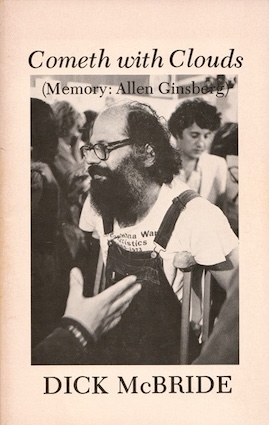
Back then too, in my early bookselling days, was Dick McBride, poet, playwright, actor, bookseller, publisher, former manager of City Lights Bookshop, having been introduced to Lawrence Ferlinghetti by poet, painter and novelist Kenneth Patchen. Dick was living in England then, distributing American small press books (and not so small: New Directions for a while)—a cottage in Great Horwood, Buckinghamshire, and an abandoned Victorian Methodist chapel for a warehouse. On my shelves is a copy of Cometh with Clouds (Memory: Allen Ginsberg), inscribed to me by Dick and dated July 14, 1983. It was published the previous year by Cherry Valley editions. I think I have a few of his other books, Lonely the Autumn Bird: Two Novels and Memoirs of a Natural-Born Expatriate were issued by Alan Swallow, and also The Astonished I, published by, ah, McBride’s Books.

Looking for online traces of Dick all these years later, I find more than I’d expected, on the Allen Ginsberg Project site and, particularly, a fine website created (and ongoing) by Rob McDowall: https://dickmcbride.co.uk/

I am currently with James Boswell in Italy, Dorothy Parker in New York, and Ford Madox Ford more or less anywhere, generally in either Paris or New York, though occasionally in Corsica or Carqueiranne. Also, just now, with Stella Bowen in Italy, where she is travelling with Dorothy Pound, looking at pictures, while Ezra ransacks the archives to find material for the Malatesta Cantos. Quite unable to rely on so much of the world to refrain from barbarism and conduct its affairs with decency, intelligence or basic humanity, I’m happy enough to be elsewhere in quite other temporal locations.

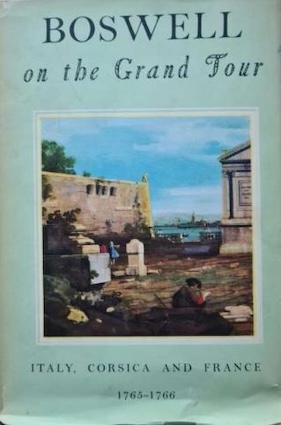
Poor Boswell lectures himself on his conduct almost daily but then argues with his companions, pursues a married countess or takes himself off to the nearest working girl.  A ‘fille charmante’, about seven shillings. Also, ‘“Des filles” in the next three days ran to thirteen shillings.’ He seems strikingly subject to venereal disease too. After his triumphant forays into the lives of Jean Jacques Rousseau and Voltaire, Boswell is travelling with a party that includes Lord Mountstuart, son of Lord Bute, and has secured the friendship of John Wilkes, who (perhaps not an ideal model for young Boswell) takes the view that ‘dissipation and profligacy renew the mind’, he having written his best issues of his newspaper The North Briton (founded to attack Prime Minister Lord Bute) while ‘in bed with Betsy Green’.[5]

(Alexander Pope by William Hoare: National Portrait Gallery)

From time to time, I also try to get back more into the eighteenth-century frame of mind with some Pope – Alexander, to avoid any possible confusion, recalling an occasion not so long ago when I asked the Librarian what she was watching. ‘A bit of Pope’, she said. I looked into the front room and saw a blaze of red, cardinal red, you might say. Boswell, in an earlier journal, had recounted an evening including the poet’s work, which was not, however, quite enough to save the occasion: ‘The night before I drank tea and sat all the evening writing in the room with my landlord and landlady. They insisted that I should eat a bit of supper. I complied. I also drank a glass of punch. I read some of Pope. I sung a song. I let myself down too much. Also, being unaccustomed to taste supper, my small alteration put me out of order. I went up to my room much disgusted. I thought myself a low being.’[6]

Having actually taught Pope to unfortunate students many years back, I’m surprised to find I have to make a stern and conscious effort to stick with him, uneasily recalling W. H. Auden’s remark (8 January 1947) to Alan Ansen: ‘The real test of liking English poetry is Pope. His ideas aren’t much, but the language is wonderful—“Chicane in furs.” The Rape of the Lock is the most perfect poem in English.’[7] Or, indeed, Hugh Kenner, reviewing Maynard Mack’s life of the poet: ‘The great danger of absorbing writers’ biographies is that you can begin to think you understand writing you’ve not troubled to come to terms with.’[8]

I like to think of Gilbert White being presented with a copy of Pope’s six-volume translation of the Iliad by the poet himself, when graduating with distinction from Oriel College, Oxford, in 1743.

In Pope’s ‘Epistle to Burlington’, I see a neat encapsulation of pre-Romantic sensibility:

‘In all, let Nature never be forgot.
But treat the Goddess like a modest fair,
Not over-dress, nor leave her wholly bare;
Let not each beauty ev’ry where be spy’d
Where half the skill is decently to hide.
He gains all points, who pleasingly confounds
Surprizes, varies, and conceals the Bounds.’

And elsewhere a remark that never goes out of date, alas:

‘But when to Mischief Mortals bend their Will,
How soon they find fit Instruments of Ill!’ (‘Rape of the Lock’, Canto III).


Notes

[1] Richard Mabey, Nature Cure (London: Chatto & Windus 2005), 134.

[2] Guy Davenport, The Hunter Gracchus and Other Papers on Literature and Art (Washington: Counterpoint, 1996), 2.

[3] Guy Davenport, The Cardiff Team: Ten Stories (New York: New Directions, 1996), 2.

[4] ‘A Supermarket in California’, in Allen Ginsberg, Selected Poems 1947-1995 (London: Penguin Books, 2001), 89.

[5] Boswell on the Grand Tour: Italy, Corsica and France, 1765-1766, edited by Frank Brady and Frederick A. Pottle (London: William Heinemann, 1955), 54n., 58n.

[6] Sunday 19 December 1762: Boswell’s London Journal, 1762-1763, edited by Frederick A. Pottle (London: William Heinemann, 1950), 95.

[7] Alan Ansen, The Table Talk of W. H Auden, edited by Nicholas Jenkins (London: Faber and Faber, 1991), 15-16.

[8] Hugh Kenner, ‘Maynard Mack’s Pope’, Historical Fictions (Athens: University of Georgia Press, 1995), 250.

Good Wood

(The Boppard Altarpiece, Panel: limewood, pine, paint & gilt: Victoria & Albert Museum)

Back in the day—not that day, another one—a woman had been on the throne of England for around sixty years.

Walk wide o’ the Widow at Windsor,
For ’alf o’ Creation she owns:
We ’ave bought ’er the same with the sword an’ the flame,
An’ we’ve salted it down with our bones.[1]

Yes, back then, a while and a world ago, when Queen Victoria was not quite gone, Rudyard Kipling had dropped in on the west coast of the United States. ‘There was wealth—unlimited wealth—in the streets’, he wrote of San Francisco, ‘but not an accent that would not have been dear at fifty cents.’ He was disappointed by the disparity between the fine and expensive clothes worn by the women he saw and their voices, ‘the staccato “Sez he”,“Sez I,” that is the mark of the white servant-girl all the world over.’

He felt, that is to say, that ‘fine feathers ought to make fine birds.’ But, ‘Wherefore, revolving in my mind that these folk were barbarians, I was presently enlightened and made aware that they also were the heirs of all the ages, and civilised after all.’ Luckily for this much-travelled traveller, he’s been accosted by ‘an affable stranger of prepossessing experience, with a blue and an innocent eye.’

It’s true that the man has peered into the hotel register and read ‘Indiana’ for the ‘India’ that Kipling has actually come from but, for the moment, the drinks and cigars that he presses upon the famous writer are welcome.[2]

Ford Madox Ford referred numerous times to Kipling, often admiringly, but almost always—and, to me, unaccountably—focusing on the early work. Some of that is wonderful but the later stories, becoming often more complex, more oblique, more modernist, somehow get lost sight of, not only by Ford but by several other major writers of the time, as if Kipling were a known quantity and need not be kept any longer in sight.

But I was thinking mostly of that phrase tucked into the Kipling lines, which recurs several times elsewhere. ‘We are the heirs of all the ages,’ Ford wrote in early September 1913, in an essay which provided the ‘Preface’ to his Collected Poems a few weeks later and in which the same line sits.[3] He had written nearly a decade earlier of ‘all the dead Londons that have gone to the producing of this child of all the ages’, and in his 1910 novel, A Call, Grimshaw remarks to Pauline: ‘We’re the children of the age and of all the ages. . .’[4]

(Kipling/ Tennyson)

Those words look back to ‘Locksley Hall’—‘I the heir of all the ages, in the foremost files of time’—by Alfred Tennyson, a poet that Ford was generally unenthusiastic about, seeing him as one of the stifling ‘Victorian Great’ figures. Yet Tennyson’s work so saturated the second half of the nineteenth century that familiarity with it was unavoidable for any serious reader.[5]

It’s a point so obvious, so banal, so unremarkable, that huge numbers of people must fail utterly to remark it. We are the heirs, the inheritors, of all that has gone before. Not just the books, the music, the paintings—which people like me are only too ready to bang on about—but the housing, the streets, the scars on the landscape, what were the mining villages, what were the dockyards and shipyards, what were the council estates, the public libraries, the youth clubs, the community centres, the rivers, the fields and hedgerows, the birds and the butterflies, the very flavour of the air. And we are also the ones who will, in our turn, bequeath or pass on or let fall the things which others will inherit and be the heirs to. As far as we have influence and agency, what will our legacy to them look like?

After January—the first rule of that month being: survive January!—I venture a little further afield to gauge the State of Things. The news, astonishingly, is Not Good. For weeks, my main focus has been the life and letters of Ford Madox Ford in the 1920s, though, on occasion, I dipped my toes into world news, not wishing to have my leg taken off just above the knee by sharks should I venture too far in.

In the United States, things are evidently shaping up to be as bad as any sane person would expect, far worse, in fact. But there’s enough derangement here to satisfy any eager watchers at the gates of Bedlam, not least a government apparently possessed of a talent to choose every time precisely the wrong policy, facing in the the wrong direction and benefiting the wrong people.

On the bright side, though—O optimist!—the Chinese New Year celebrations have welcomed in the Year of the Snake, are still welcoming it, I suppose, since this involves not only animal but also zodiac elements. This is then the Year of the Wood Snake – also known as the Year of the Green Snake, wood being associated with the colour green. The Spring Festival, I gather, takes place over fifteen days, ending with the Lantern Festival on 12 February, and is estimated to be celebrated by some two billion people in numerous countries, not only China but Indonesia, Malaysia, Singapore, Vietnam and their diasporas.

The snake may have had a bad press—certainly a bad Judaeo-Christian press—but I read that, in Chinese astrology, as a wood animal, it’s understood to represent good luck, renewal, flexibility, tolerance. Wood is good!

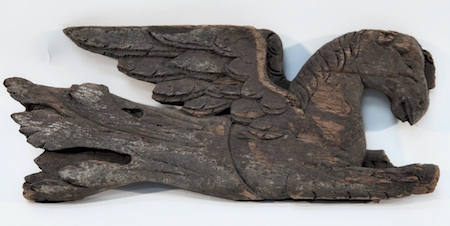
(‘Hippocamp’, a wooden carving in the form of a winged horse, originally part of the panelling inside Stafford Castle: Staffordshire County Museum Service)

This in turn brings to mind the recent piece following the death of David Lynch, which touched on Twin Peaks: The Return, and had a nice quote from Michael Horse, who played the series’ Deputy Sheriff Hawk: ‘When they did the premiere of The Return, the executives had not seen it, and they said: “Mr Lynch, would you say a few words?” And he comes out; he goes: “This project has a lot of wood in it. I like wood.”’
https://www.theguardian.com/tv-and-radio/2025/jan/23/an-oral-history-of-twin-peaks-david-lynch-madchen-amick-joan-chen

We all like wood, no?  Wood nymphs, woodwind, woodbine, woodpeckers, woodlands – as a child, I had a pet woodlouse for a short time, though it didn’t end well. Woodcuts, wood engravings. Albrecht Dürer, Hiroshige, Käthe Kollwitz, Robert Gibbings, Thomas Bewick, Clare Leighton, David Jones, Gwen Raverat. Harriet Baker wrote of woodcuts made by Carrington and Vanessa Bell: ‘Carving directly into soft wood, the markings of tools and the tremors of hands were as much a part of the final pieces as form and composition.’[6]

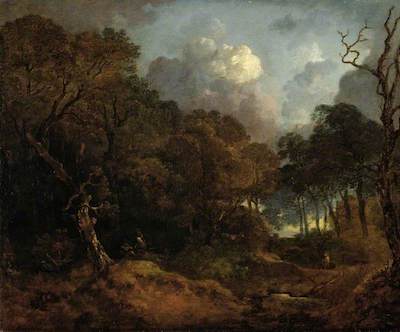
The French historian Fernand Braudel gave wood a significant role in the lessening of the effects of the Black Death which, he argued, ‘did not, as used to be thought, arrive in Central Europe in the thirteenth century, but in the eleventh at the latest.’ His analysis of the retreat of the disease in the 18th century mentioned stone’s replacing wood in domestic architecture after major urban fires; the general increase in personal and domestic cleanliness, and the removal of small domestic mammals from dwellings, all factors that resulted in the lessening impact of fleas. He also discussed the enormous significance of wood being used everywhere: ‘One of the reasons for Europe’s power lay in its being so plentifully endowed with forests. Against it, Islam was in the long run undermined by the poverty of its wood resources and their gradual exhaustion.’[7]

(Thomas Gainsborough, A Forest Road: Fitzwilliam Museum, Cambridge)

The gradual exhaustion of resources. Here we are again. Not so gradual now, I suspect, but in any case a phrase to tingle the tongues of those who, as previously noted, are custodians of the past and guardians of the future. Which is us, of course, even those currently making war on their own children and grandchildren.

In September 1911, Ezra Pound spent a Sunday afternoon with G. R. S. Mead, a scholar of hermetic philosophy, early Christianity and Gnosticism, the occult and theosophy: he had served as private secretary to Madame Blavatsky during her last years. He had founded the Quest Society in 1909 and invited Pound to give a lecture, which would be published subsequently in the quarterly review, The Quest. Pound delivered his lecture early in 1912 and it appeared in the October issue of the review with the title ‘Psychology and Troubadours’. Twenty years later, it was incorporated into Pound’s The Spirit of Romance.[8] It’s years since I read it but one sentence, particularly, lodged in my memory and remains intact: ‘We have about us the universe of fluid force, and below us the germinal universe of wood alive, of stone alive.’[9]

Pound, like Henri Gaudier-Brzeska, Guy Davenport wrote, ‘had conceived the notion that cultures awake with a brilliant springtime and move through seasonal developments to a decadence. This is an ideas from Frobenius, who had it from Spengler, who had it from Nietzsche, who had it from Goethe.’[10]

Yes. Never mind third runways, never mind nuclear power stations on every corner, never mind mimicking anti-immigrant messages from other political parties that run on that sort of fuel. If a body is bleeding to death in front of you—how can I put this?—it may be best, before all else, to try to stop the bleeding.

Touch wood. Good wood. Touch good wood.


Notes

[1] ‘The Widow at Windsor’, Rudyard Kipling’s Verse: Inclusive Edition, 1885-1918 (New York: Doubleday, Page & Co., 1925), 471.

[2] Rudyard Kipling, From Sea to Sea (2 volumes: Macmillan, 1900), I: 479-480

[3] Ford Madox Ford, ‘The Poet’s Eye’,  New Freewoman, I, 6 (1 September 1913), 109; ‘Preface’ to Collected Poems (London: Max Goschen, 1914 [1913]), 20.

[4] Ford Madox Ford, England and the English, edited by Sara Haslam (Manchester: Carcanet Press, 2003), 4; Ford Madox Ford, A Call: The Tale of Two Passions (1910; with an afterword by C. H. Sisson, Manchester: Carcanet Press, 1984), 23.

[5] Alfred Tennyson, Poems: A Selected Edition, edited by Christopher Ricks (London: Longman, 1989), 192.

[6] Harriet Baker, Rural Hours: The Country Lives of Virginia Woolf, Sylvia Townsend Warner & Rosamond Lehmann (London: Allen Lane, 2024), 73.

[7] Fernand Braudel, Civilization and Capitalism, 15th – 18th Century. Volume I: The Structures of Everyday Life: The Limits of the Possible (London: Fontana Books, 1985). Translated from the French; revised by Sîan Reynolds, 83, 84, 363.

[8] Ezra Pound, Ezra Pound to His Parents: Letters 1895–1929, edited by Mary de Rachewiltz, David Moody and Joanna Moody (Oxford: Oxford University Press, 2010), 260; A. David Moody, Ezra Pound: Poet: A Portrait of the Man and His Work: Volume I: The Young Genius 1885–1920 (Oxford: Oxford University Press, 2007), 159.

[9] Ezra Pound, The Spirit of Romance (1910; New York: New Directions, 1968), 92.

[10] Guy Davenport, The Geography of the Imagination (Boston: David R. Godine, 1997), 22.

By heart in the park

(Philip Wilson Steer, Dover Coast: York Art Gallery)

Another last warm and sunny afternoon of autumn. How many more can there be? With the Librarian in the office for a pretty full day, so not available for the lunchtime stroll, I walk alone in the park and succumb to the temptation to recall (and recite) the handful of poems that, at one time or another, I’ve committed to memory. Committed they may have been but seem, for the most part, to have escaped or at least to be out on parole.

Matthew Arnold’s ‘Dover Beach’ is worse than shaky and, in its current state, Marvell’s ‘To His Coy Mistress’ would probably not detain her for a moment. A bit of Pound, a bit of Yeats and a fragment of Elizabeth Bishop all hold steady, while a couple of others improve with work, which necessitates keeping a wary eye open – and an ear, given the increasing tendency of people to rush up behind you on bicycles or accursed electric scooters. Robert Lowell’s ‘Skunk Hour’ (dedicated to Bishop) yields a little to pressure:

Nautilus Island’s hermit heiress still
something something
her sheep still graze above the sea

Two men, walking briskly but not quite briskly enough, so staying almost exactly the same distance behind me, fairly close and, worse, very gradually nearing. . .

Her farmer
Is first selectman in our village;
she’s in her dotage.

We’re sailing now. Ah:

Thirsting for the hierarchic privacy
of Queen Victoria’s century,
she buys up all
the eyesores facing her shore,
and lets them fall.

(Lowell and Bishop in Brazil, 1962. Photo: Vassar College Library via the New Criterion)

But then there’s some confusion in the order of half-remembered stanzas, though I have most of the mother skunk’s activities in the final one. Move on to surer ground, anyway, the much-learned, almost-all recollected ‘Bagpipe Music’.

Though here a slight pause for the woman standing with her dog at the top of a slope below the play area. Is it a Pointer? We’ve seen it more than once before. Similar shape, similar attitude, its attention fixed on something in the grass near the foot of a tree, that can only be a squirrel. Looking it up later, I see that it’s a Vizsla, also known as a Hungarian Pointer. I stroll past it, resisting the impulse to give it some advice: you may be quick but you won’t win, they climb, you don’t. We’ve seen some close shaves for squirrels in the past but they always seem to evade dogs’ jaws. And ‘Bagpipe Music’? Pretty good, in fact. A slight hiccup over the penultimate stanza but both MacNeice and myself ending strongly:

It’s no go my honey love, it’s no go my poppet;
Work your hands from day to day, the winds will blow the profit.
The glass is falling hour by hour, the glass will fall for ever,
But if you break the bloody glass you won’t hold up the weather.

Now distractions range from the two old ladies intent on feeding a squirrel by hand (‘Come on, dear, see what I’ve got’ – Fleas, soon enough, I suspect) to the fellow with the ponytail and curious blue-green leggings intent on kicking a very small ball across the grass, and who crosses my path again half an hour later in a different and distant part of the park; and a murder of crows, around thirty in total, spread right across and down a broad grassy slope to the cycle path that runs along beneath the outspread branches of several wild pear trees. The fruits fall partly onto the earthy slopes beyond and partly onto the cycle path itself, one missed my right ear by inches one day last week. Walking along that path now before climbing sharply to my left, I see a dozen crows rooting among the fallen pears, though some turn to stare at me as I approach. ‘Are you auditioning for that nice Mister Hitchcock?’ I ask. One crow, not to be put off by a mere human, lingers to stick its beak straight through a pear before flying up to the branch above. Knowing how clever corvids are, I watch to see how it goes about extricating beak from fruit. It thrusts the pear into a narrow fork of branches which holds it in a tight embrace, withdraws the beak and starts tucking in. I whistle my sincere appreciation. That Lowellian mother skunk, I recall,

    jabs her wedge-head in a cup
of sour cream, drops her ostrich tail,
and will not scare.

Why is it so hard these days? No answers on a postcard, please. At school, everyone learned poems by heart and some people never lost the habit. I recalled an aside of the Reverend Kilvert: ‘I thought of William Wordsworth the poet who often used to come and stay at this house with blind Mr. Monkhouse who had nearly all his poems off by heart.’[1] Eric Gill’s father and one of Gill’s teachers, named Mr Catt, were great admirers of Tennyson. Gill himself also learned much of it by heart, being particularly fond of ‘the passage about the routine of rural agriculture:

As year by year the labourer tills
His wonted glebe and lops the glades’[2]

This is from stanza CX of Tennyson’s In Memoriam A. H. H., the initials those of Tennyson’s beloved friend Arthur Henry Hallam, who died in Vienna in 1833. Born in 1811, he was eighteen months younger than Tennyson. They had met at Trinity College, Cambridge in 1828. Tennyson seems to have begun this long poem very soon after hearing of Hallam’s death, though it was not published until 1850, and then anonymously. Edward Fitzgerald—translator of The Rubaiyat of Omar Khayyam—wrote to the poet’s elder brother Frederick Tennyson (15 August 1850): ‘Alfred has also published his Elegiacs on A. Hallam: these sell greatly: and will, I fear, raise a host of Elegiac scribblers.’[3]

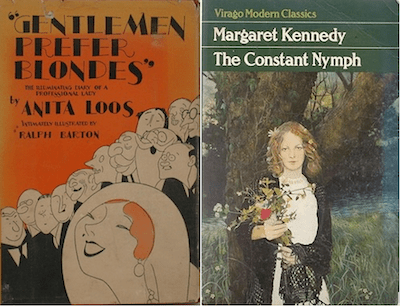
But it is not only poetry that the heroes of yesteryear committed to memory in large chunks – some mastered prose in a similar way, which always seems to me somehow an even more impressive achievement, though I accept that actors, having to learn their lines, sometimes comprising tremendously long speeches or monologues, would not necessarily find it so. Joseph Conrad and Ford Madox Ford would swap pages of Flaubert or Maupassant, while James Joyce ‘knew by heart whole pages of Flaubert, Newman, de Quincey, E. Quinet, A. J. Balfour and of many others.’[4] And, while Anita Loos’ Gentlemen Prefer Blondes was apparently one of Patrick White’s favourite novels (Joyce, Faulkner and Edith Wharton were also admirers), he knew Margaret Kennedy’s The Constant Nymph ‘practically off by heart.’[5]

‘Heart’ is another of those words with a great many friends, the compounds running over several columns of the dictionary: in one’s mouth or boots or the right place; open, shut, taken; worn on the sleeve; piercing, rending, sore and sick. It has its reasons and is, in many contexts, simply mysterious, as the author of ‘Dover Beach’ wrote:

But often, in the world’s most crowded streets,
But often, in the din of strife,
There rises an unspeakable desire
After the knowledge of our buried life;
A thirst to spend our fire and restless force
In tracking out our true, original course;
A longing to inquire
Into the mystery of this heart which beats
So wild, so deep in us – to know
Whence our lives comes and where they go.[6]

I briefly consider this last poem as a candidate but coming in at around a hundred lines, it may be a stretch too far for me. Sonnets are a handy length, though . . .


Notes

[1] Francis Kilvert, entry for 27 April 1870, Kilvert’s Diary, edited by William Plomer (London: Jonathan Cape, 1938, reissued 1969), I, 119.

[2] Fiona MacCarthy, Eric Gill (London: Faber & Faber, 1990), 26.

[3] The Letters of Edward Fitzgerald, edited by Alfred McKinley Terhune and Annabelle Burdick Terhune, four volumes (Princeton: Princeton University Press, 1980), I, 676.

[4] Frank Budgen, James Joyce and the Making of ‘Ulysses’ and other writings, enlarged edition (1934; London: Oxford University Press, 1972), 181. Edgar Quinet was a French historian; by A. J. Balfour is meant, presumably, the British Prime Minister (1902-1905) – who also published works of philosophy.

[5] David Marr, Patrick White: A Life (London: Vintage, 1992), 85.

[6] Matthew Arnold, ‘The Buried Life’, Poetry and Criticism of Matthew Arnold, edited by A. Dwight Culler (Boston: Houghton Mifflin, 1961), 114.

Rosemary, responsibility


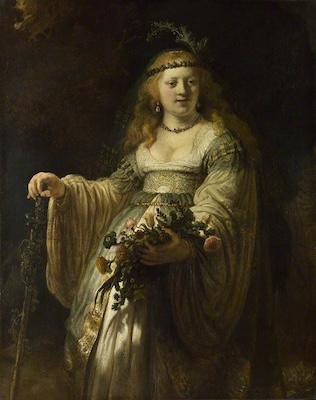
(Rembrandt van Rijn, Saskia van Uylenburgh in Arcadian Costume: National Gallery, London)

In the other park, which we traverse quite often, there are rosemary bushes to be discreetly ransacked – for potatoes, fish, meat, as well as for remembrance. ‘“There’s rosemary, that’s for remembrance”’, Ophelia says. And Laura Cumming notes that when Rembrandt’s wife Saskia van Uylenburgh died in 1642, at the age of 29 and after less than eight years of their marriage, Rembrandt ‘put a sprig of rosemary in her hand: rosemary for remembrance.’[1]

The weather forecast offers a 70% chance of rain. I add an umbrella to my tote bag and am soon walking uphill – in warm sunshine. Yes, the forecasts are more sophisticated these days, with many technical advances – on the other hand, I seem to remember that, in the days before we broke the weather, things were a bit more definite. Or did conditions appear to change every ten minutes then as well?


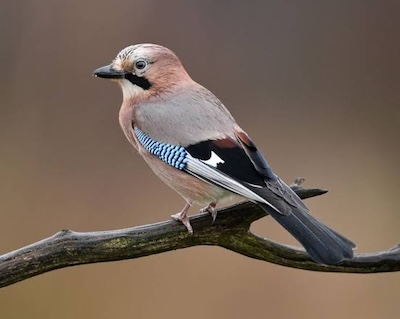
Under an abruptly darkening sky, I enter the park and the uncertain terrain of rosemary-picking. Plants in a public park: it would never occur to me to pick flowers in one and take them home since they’re for everybody to look at and enjoy. But a bush, herbs, green, largely unnoticed, simply wasted if not used. . . the case is altered, surely. Nevertheless, I aim for discretion and scan the park. Two women with dogs on the grassy slope; a woman with a child in a pushchair walking towards me on the path. Progress is arrested by the sight of a jay, landing on a nearby wooden post. It lingers for ten, fifteen seconds. I stand and stare. Eventually, it moves, I move. The woman says, in passing: ‘Pretty birds, aren’t they?’ Always the loquacious Englishman, I say ‘Yes, very’, moving on to stock up on rosemary and continue my walk into a sunshine resuming its humorous campaign.


In another campaign, the fallout from the presidential debate in Philadelphia on Tuesday night was still dominating the media, and I could still amuse the Librarian by abruptly announcing: ‘They’re eating the dogs!’ but the joke, if that’s what it is, is a dark one. Like a great many other people – at least I hope so, I’m baffled by this stuff much of the time, by those ‘undecided voters’, let alone those determined to make America hate again.

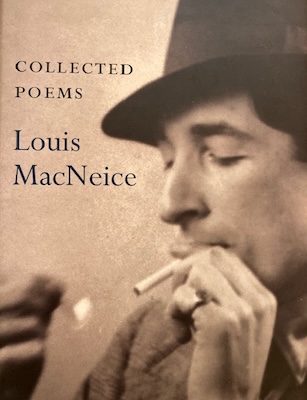
I realised later that it was the birthday of Louis MacNeice, a fine poet who also kept a wary eye on the political weather and who died at the absurdly young age of 55. Thinking of how the wrong things keep happening and the wrong people ending up on top almost invariably, and how far, how much, if at all, the rest of us can be said to bear responsibility, I noted the lines in his Autumn Journal:


And at this hour of the day it is no good saying
            “Take away this cup”;
Having helped to fill it ourselves it is only logic
            That now we should drink it up.
Nor can we hide our heads in the sand, the sands have
            Filtered away;
Nothing remains but rock at this hour, this zero
            Hour of the day.[2]

‘Responsibility’ is a handy word. Delmore Schwartz’s famous short story, ‘In Dreams Begin Responsibilities’, which gave his first volume its title, has the narrator watching, on a movie screen, the time just before the beginning of his own life, his parents moving towards their disastrous marriage, which will have a lasting and damaging effect on the poet. He’s ejected from the cinema after shouting at the screen—’“What are they doing?”’—and wakes up ‘into the bleak winter morning of my twenty-first birthday, the windowsill shining with its lip of snow, and the morning already begun.’[3]

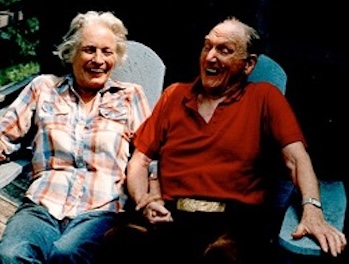
But I was thinking too of the close of Robert Penn Warren’s fine novel, All The King’s Men : ‘soon now we shall go out of the house and go into the convulsion of the world, out of history into history and the awful responsibility of Time.’[4] The connection is with MacNeice, because of that poet’s relationship with Eleanor Clark in 1939-40. When MacNeice was invited by F. R. Higgins to join the Irish Academy of Letters, it was to Eleanor that he wrote about it, saying that ‘The Irish Academy of Letters meets once a year in Dublin’s only decent restaurant and gets so drunk they have to send the waiters away.’[5] Clark grew up in Connecticut, went to  Vassar in the 1930s, and worked on their literary magazine with Elizabeth Bishop and Mary McCarthy, among others. She wrote for left-leaning magazines and journals such as The Partisan Review, thought of herself for a while as a ‘Trotskyite sympathizer’ and went to Mexico in the late 1930s. Apparently, she did some translating for Trotsky and was married for a while to his Czech secretary, Jan Frankl. She wrote novels, essays and reviews, children’s books and a memoir, but was probably best-known for her travel books, Rome and a Villa and The Oysters of Locmariaquer. She married Robert Penn Warren in 1952 and died in 1996, aged 82, seven years after Warren himself.


(Eleanor Clark and Robert Penn Warren at their summer home in West Wardsboro, Vermont, 1986: Kentucky Library and Museum)

The novelist Nicholas Mosley once wrote that ‘Humans can either learn – or refuse to believe that humans are responsible for themselves.’[6] My favourite use of ‘responsibility’, though, is probably that of the hugely influential Trinidadian radical historian, journalist and political theorist, C. L. R. James, who adopted, in his early years, William Makepeace Thackeray’s Vanity Fair as the book: ‘By the time I was fourteen I must have read the book over twenty times’. And he adds, a little later: ‘Thackeray, not Marx, bears the heaviest responsibility for me.’[7]

That radical, Thackeray!

Notes


[1] William Shakespeare, Hamlet, IV. v.; Laura Cumming, Thunderclap: A memoir of art and life & sudden death (London: Chatto & Windus, 2023), 61.

[2] Louis MacNeice, Collected Poems, edited by Peter McDonald (London: Faber, 2007), 111.

[3] Ilan Stavans, editor, The Oxford Book of Jewish Short Stories (New York: Oxford University Press, 1998), 165.

[4] Robert Penn Warren, All The King’s Men (1946; Harmondsworth: Penguin, 2007), 661.

[5] Louis MacNeice, Letters of Louis MacNeice, edited by Jonathan Allison (London: Faber, 2010), 351.

[6] Nicholas Mosley, Efforts at Truth: An Autobiography (London: Minerva , 1996), 299.

[7] C. L. R. James, Beyond a Boundary (1963; London: Vintage, 2019), 24, 52.

Wording, birding


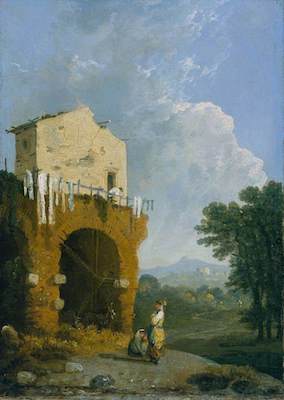
(Robert Wilson, Hadrian’s Villa, c.1765: Tate)

‘At night I trailed from one window recess to another’, the Emperor Hadrian recalls in Marguerite Yourcenar’s novel, ‘from balcony to balcony through the rooms of that palace where the walls were still cracked from the earthquake, here and there tracing my astrological calculations upon the stones, and questioning the trembling stars. But it is on earth that the signs of the future have to be sought.’[1]

So it is. ‘Ghosts await you in the future if they do not follow you from the past’, Sarah Moss wrote, and: ‘No one who knows what happens in the world, what humans do to humans, has any claim to contentment.’[2] Yes. I write pages and delete them, since they serve no real purpose except to relieve my feelings for a short while. The past is not always a foreign country and they do not always do things differently there. As Pankaj Mishra said in his recent ‘Winter Lecture’: ‘It hardly seems believable, but the evidence has become overwhelming: we are witnessing some kind of collapse in the free world.’[3]

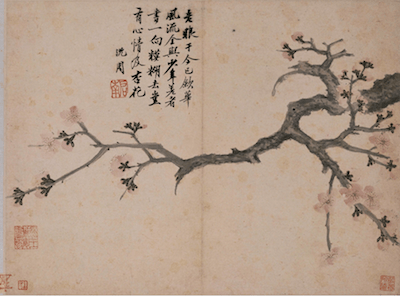
Early summer creeps on, though fitfully. Watching rose petals fall from the bush in a light wind, I remembered Pound’s Canto XIII, the first in which Confucius appears, and which ends:

The blossoms of the apricot
            blow from the east to the west
And I have tried to keep them from falling.[4]


(Shen Zhou, ‘Apricot Blossom’, leaf from the album, Dreaming of Travelling While in Bed: Palace Museum, Beijing)

Ronald Bush observed that: ‘To keep the blossoms of the apricot from falling is to keep nature in a permanent vernal bounty.’[5] It also seems to me to signify cultural contact, the free exchange of ideas, without the limits of borders or nationalism. At that stage, Pound was using Guillaume Pauthier’s translation of Confucian texts in Confucius et Mencius: les quatre livres de philosophie morale et politique de la Chine and had written in ‘Exile’s Letter’:

Intelligent men came drifting in from the sea and from the west border,
And with them, and with you especially
There was nothing at cross purpose,
And they made nothing of sea-crossing or of mountain crossing,
If only they could be of that fellowship,
And we all spoke out our hearts and minds, and without regret.[6]

On the daily walks we speak our minds but, just lately, exchanges are punctuated by information from our newly downloaded Merlin app, available from Cornell University, which draws on a huge database of bird sounds, sightings and photographs to identify what you’re probably hearing in that nearby tree or passing overhead.


So we stroll along narrow paths thus:

Politics, dinner, politics. . .
‘Blue tit. Carrion crow. Wren.’
Politics, domestic details, politics, cat, literary chuntering. . .
‘Dunnock. Blackcap. Chiffchaff.’
Ash dieback, politics, university gossip, politics. . .
‘Blackbird. Herring gull. Great tit. Jay!’

Excuse me, sir, let me just ask about the birdsong: in a world both literally and metaphorically on fire, democracies hanging by a thread, war crimes, liars and knaves in public places – does it help?

Why, yes, a little – rather more than a little, in fact. . .


Notes

[1] Marguerite Yourcenar, The Memoirs of Hadrian, translated by Grace Frick, with Yourcenar (1951; Penguin Books, 2000), 82.

[2] Sarah Moss, Signs for Lost Children (London: Granta Books, 2016), 88-89, 97.

[3] Pankaj Mishra, ‘The Shoah after Gaza’ [Winter Lecture], London Review of Books 46, 5 (7 March 2024).

[4] The Cantos of Ezra Pound, fourth collected edition (London: Faber and Faber, 1987), 60.

[5] Ronald Bush, The Genesis of Ezra Pound’s Cantos (Princeton: Princeton University Press, 1989), 251.

[6] ‘Exile’s Letter’, Ezra Pound: Poems and Translations, edited by Richard Sieburth (New York: Library of America, 2003), 255.

Diversions of the usual kind


(Samuel Bough, Cricket Match at Edenside, Carlisle: Tulle House Museum and Art Gallery)

September. Autumn at last; and an end to the nonsense of summer, the increasingly anachronistic expectation of pleasant weather, an expectation mistreated by endless rain or unbearable heat. And, on Samuel Johnson’s birthday, a revisiting of his remark to Doctor Brocklesby (as refracted through James Boswell): ‘The weather indeed is not benign; but how low is he sunk whose strength depends upon the weather!’[1]

On another day, though white clouds are piled so high as to be on the point of toppling over onto the crowns of trees, they’re surrounded by sky so blue that one suspects a gargantuan deception. Still, disposable barbecues, spawned by the Devil, are nowhere to be seen and the grass of the park has been mown again, which always imparts a faint whiff of paradise.

Le paradis n’est pas artificiel,
l’enfer non plus.

Ezra Pound at Pisa, with hell very much on his mind.[2] ‘I am now the proud possessor of a Johnson’s Dictionary’, Guy Davenport announced to Hugh Kenner in 1967. ‘Dorothy [Pound] once told me EP has never owned any other, and sure enough, practically every word of H[ugh]S[elwyn]M[auberley] is used with Johnson’s rhetorical colouring (juridical, adjunct, phantasm, factitious).’[3]

Walking is more comfortable in the cooler weather, thinking also. And the near-neighbours, we dare to believe, are gone, their riotous tenancy ended. The next lot may, of course, be anything from a heavy metal band that just loves to rehearse to a group of trainee Trappists. We await with interest. So the mood swings between, say, states represented by quotations, the first something like Clare Leighton’s: ‘Who can resist the Lincolnshire name for the wild pansy: meet-her-in-the-entry-kiss-her-in-the-buttery?’ Well, not me, obviously. On the other hand, there is always the reliable standby from D. H. Lawrence’s letter to E. M. Forster: ‘I am in a black fury with the world, as usual.’[4]


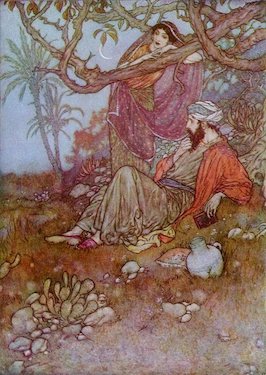
There are diversions, of course, of the usual kind, usual at this kitchen table anyway (between meals). In the ‘Credits’ section of Bad Actors, after the usual acknowledgements (publishers, agents, all those involved in the TV series of Slow Horses), Mick Herron recalls an email from a reader informing him that a line he’d used in Slough House was ‘more or less from a Robert Frost poem’. Herron asked for ‘many dozens of similar offences to be taken into consideration.’[5] And it’s true that one of the many pleasures of reading his books is picking up echoes, half-echoes, perhaps-echoes from poets and novelists. Some might not stand up in court—courts vary, as is painfully clear by now, I suspect—but I’m pretty sure about this from the third Zoë Boehm book, Why We Die: ‘Life was too short to approach death head-on. On that journey you took any diversion available – marriage, travel, children, alcohol. At the very least, you stopped to admire the view.’[6] Beside which I would set the resonant advice from William Carlos Williams, to ‘approach death at a walk, take in all the scenery.’[7] Elsewhere,  Margery Allingham’s detective, Albert Campion, remarks to Guffy Randall: ‘“Across the face of the East Suffolk Courier and Hadleigh Argus, Fate’s moving finger writes, and not very grammatically either”.’[8] The response of the many readers of Edward Fitzgerald’s rendering of the Rubáiyát of Omar Khayyám is surely to nod sagely at a clear or misty memory of stanza LI:

The Moving Finger writes; and, having writ,
Moves on: nor all thy Piety nor Wit
Shall lure it back to cancel half a Line,
Nor all thy Tears wash out a Word of it.[9]


(A jug of wine, a loaf of bread and Edmund Dulac)

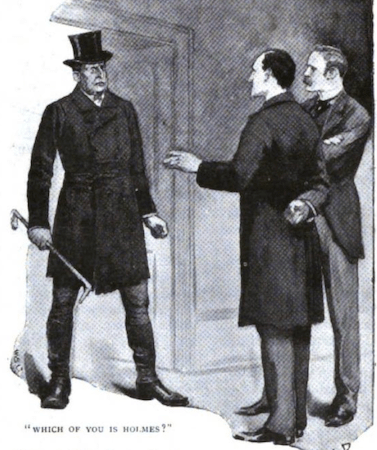
Or again, thirteen pages earlier, Campion talking of the intention to wait for an offer of purchase ‘and then to freeze on to the vendor with the tenacity of bull-pups.’ Bull-pups? Freezing? Here is Sherlock Holmes telling Dr John Watson in ‘The “Gloria Scott”’: ‘Trevor was the only man I knew, and that only through the accident of his bull terrier freezing onto my ankle one morning as I went down to chapel.’[10]


(Sidney Paget, Strand magazine illustration to ‘The “Gloria Scott”‘)

Do I find this stuff diverting? Why yes, in between those other matters of life and love and death and war. Some varied reading and even some varied writing, on the better days. But there are also visits to the vet with Harry the cat, the usual budget of human aches and pains, as well as that constant screaming of the world outside these walls. Winter, no doubt, is coming. Yet there are still pockets of sense and sanity to be found. One of my latest is the excellent Melissa Harrison’s new Witness Marks (‘A monthly miscellany from a little Suffolk cottage: nature and the seasons, poetry, books and writing, thoughts on creativity, news and Qs’).

https://mzharrison.substack.com/

I read, listen, enjoy and – yes – learn a few things.


Notes

[1] James Boswell, Life of Johnson, edited by R. W. Chapman, revised by J. D. Fleeman, (Oxford: Oxford University Press, 1980), 1338.

[2] The Cantos of Ezra Pound, fourth collected edition (London: Faber and Faber, 1987), 76/460.

[3] Questioning Minds: The Letters of Guy Davenport and Hugh Kenner, edited by Edward M. Burns, two volumes (Berkeley: Counterpoint Press, 2018), II, 904. Samuel Johnson’s A Dictionary of the English Language was published in 1755.

[4] Clare Leighton, Four Hedges: A Gardener’s Chronicle (1935; Toller Fratrum: Little Toller Books, 2010), 40; Letters of D. H. Lawrence III, October 1916–June 1921, edited by James T. Boulton and Andrew Robertson (Cambridge: Cambridge University Press, 1984),  21.

[5] Mick Herron, Bad Actors (London: John Murray, 2022), 339-340.

[6] Mick Herron, Why We Die (London: John Murray, 2020), 122.

[7] William Carlos Williams, Kora in Hell (1920), in Imaginations (London: MacGibbon and Kee, 1970), 32.

[8] Margery Allingham, Sweet Danger (1933; Harmondsworth: Penguin Books, 1950), 44.

[9] In Daniel Karlin, editor, The Penguin Book of Victorian Verse (London: Penguin Books, 1997), 125.

[10] Arthur Conan Doyle, The New Annotated Sherlock Holmes, 2 volumes, edited with notes by Leslie S. Klinger (New York and London: W.W. Norton and Company 2005), I, 502. Klinger quotes Nicholas Utechin’s Sherlock Holmes at Oxford to the effect that Trevor’s bull terrier ‘has been a subject more disputed by scholars in the Sherlockian world than any other—animal, vegetable, or mineral’, the issue of which university Holmes attended being a highly contentious one and the dog a crucial clue.

Toiling optimists

(Thomas Fenwick, Late Autumn Landscape: University of Edinburgh)

A new month, the first of the meteorological autumn. On 2 September 1774, the naturalist Gilbert White observed that: ‘Many birds which become silent about Midsummer reassume their notes again in September; as the thrush, blackbird, wood-lark, willow-wren, &c.; hence August is by much the most mute month, the spring, summer, and autumn through. Are birds induced to sing again because the temperament of autumn resembles that of spring?’[1] Birds here, particularly the bluetits, are certainly singing, though a little warily. Still, who would not be wary just now?

The trees in the parks had already been misled into thinking that autumn had arrived. The weather generally has dried again, with a warm, slightly unhealthy feel to the breeze. The constants remain. . . constant – that is, the workmen, still, after months, making those thunderous noises of drilling and hammering that you associate with the beginnings of a job like that, not the late stages. Surely by now it should be no louder than the seductive murmur of a paintbrush on skirting-board or garden fence, the feathering of a soft broom, the occasional faint squeal of a cloth on clean glass. As well as the workmen, of course, the howl of ambulance sirens and the relentless overhead roar of damned aeroplanes, each one shaving just a little more off the lifespan of homo sapiens on this earth.

As for the news—from time to time, the Librarian, referencing the late Leonard Cohen just a little too appositely, will inquire, in passing: ‘You Want It Darker’? My response is most often ‘God, no!’ while, inside my mildly floundering but at-straw-grasping mind, another refrain runs: ‘It’s not dark yet but it’s getting’ there.’[2] Really, monsieur D.? Not there yet? O, optimist! But that was, of course, twenty-five years ago, which can make all the difference in the life histories of failed states.


What do you find to boast of in our age,
To boast of now, my friendly sonneteer,
And not to blush for, later? By what line
Do you entrain from Mainz to Regions saner?
Count our achievements and uplift my heart;
Blazen our fineness. Optimist, I toil
Whilst you crow cocklike.

So Ford Madox Ford began a poem, ‘Canzone à la Sonata’, dedicated to ‘E. P.’, that is, Ezra Pound, then in Giessen, the German town in which Ford stayed while pursuing a madcap scheme to secure a divorce from his wife under German law by qualifying for citizenship of that country. It was the setting for the famous ‘Giessen roll’, Ford diving headlong to the floor and writhing about in agony in response to the archaisms in Pound’s new collection of poems. The poem’s title indicates its target: ‘canzone’, a poetic form, not a style. It guys, as Ford often did, the conventional picture of the inspired and youthful lyric poet, and queries the price of exclusion paid by the optimistic singer. His inquiring ‘By what line/ Do you entrain from Mainz to Regions saner’ alludes to the poetic line but also employs an image that Ford would recur to often: the use of the railway journey as intersection of illusory stability, permanence, stasis and radical circumstantial alteration, whether in personal relationships or the larger configurations of history. Indeed, a poem called ‘In the Train’ occurs four pages earlier than ‘Canzone’ in the published volume, High Germany. By early 1912, in fact, Ford was perfectly aware of the threat from Germany, though his own history of involvement with that country was already immensely complicated and soon to become more so.


Optimist –  so many shades of meaning, interpretation, claim or confession there. People with their glasses half-full, half-empty – surely, just order another drink, to be on the safe side. The word defines not only individuals but eras: ‘It is difficult to think of an important Edwardian optimist’, Samuel Hynes wrote. ‘So that if “Edwardian” is to be used as an adjective identifying a literary tone, that tone must be one of social awareness and anxious concern.’[3]

More positively, it can evoke recovery, rebuilding, resurgence. Doris Lessing, remembering her arrival in Britain in the early 1950s, wrote: ‘There was still that post-war effervescence, the feeling that suppressed energies were exploding, the arrival of working-class or at least not middle-class talent into the arts, and, above all, the political optimism, which has so completely evaporated.’[4] More upbeat too was Margery Allingham’s view of her detective, Albert Campion, seeing in that extraordinary individual the virtues of the ordinary man (which, of course, enabled him to perform the feats of detection and deduction that qualified him to serve as her central character): ‘The optimism of a healthy mind is indefatigable, however, and as time went on even Campion began to see the events here recorded from that detached distance so often miscalled true perspective.’[5]

I am, of course, keeping my own optimism firmly within bounds: a true perspective in a healthy mind, as they say. Possibly.


Notes

[1] Gilbert White, The Illustrated History of Selborne (London: Macmillan, 1984), 94.

[2] Bob Dylan, ‘Not Dark Yet’, Track 7 on Time Out of Mind (1997).

[3] Samuel Hynes, ‘Introduction: A Note on “Edwardian”’, in Edwardian Occasions: Essays on English Writing in the Early Twentieth Century (London: Routledge & Kegan Paul, 1972), 8.

[4] Doris Lessing, Walking in the Shade (1997; London: Fourth Estate, 2013), 280.

[5] Margery Allingham, Death of a Ghost (London: Penguin Books, 1942), 176.

Roses (almost) all the way


‘What a lovely thing a rose is’, Sherlock Holmes remarks, adverting to the necessity of deduction in religion – and goes on to add that: ‘Our highest assurance of the goodness of Providence seems to me to rest in the flowers.’ Client and client’s fiancée view this demonstration ‘with surprise and a good deal of disappointment’ but Holmes, with the moss-rose between his fingers, has fallen into a reverie. Not unusually, all turns out well in the end.[1] Oddly, I see that, in the language of flowers, the moss-rose was associated with ‘voluptuous love’, not the first thing that comes to mind in Holmes’s case.

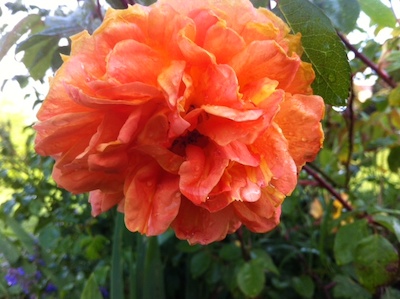
It’s that time of the morning when there are no workmen yet hammering, drilling or sawing, and the park and the cemetery are peaceful enough even for me. The Librarian photographs a good many flowers and trees while I stand gazing into middle distances, though I succumb to the orange specimen in the park on the way back home.


Reading Rebecca Solnit earlier, I was reminded again of how much George Orwell’s short life (forty-six and a half years) was hampered by respiratory disease: bronchitis, pneumonia, tuberculosis.[2] Set against that are the plump volumes of Peter Davison’s scholarly edition of Orwell’s work: twenty of them in all. Of the ones I have, the 600-page extent of the first volume is not unrepresentative. But then Orwell’s productivity, given his state of health and his honest confrontation of it, the long-held knowledge that his life would not be a long one, is not itself unique: the example that comes quickest to mind is D. H. Lawrence, also hugely prolific, his letters alone filling eight fat volumes, his life two years shorter than Orwell’s.


‘If war has an opposite’, Solnit writes, ‘gardens might sometimes be it, and people have found a particular kind of peace in forests, meadows, parks and gardens’ (5). Orwell’s life was, as she says, shot through with wars. The German writer Ernst Jünger, born almost a decade before Orwell and in a markedly different cultural tradition, recalled that: ‘Grown up in an age of security, we shared a yearning for danger, for the experience of the extraordinary. We were enraptured by war, We had set out in a rain of flowers, in a drunken atmosphere of blood and roses. Surely the war had to supply us with what we wanted: the great, the overwhelming, the hallowed experience.’[3]

This theme of roses conjured up for me not Ruskin, Pound, Gertrude Stein, Sappho, Shakespeare or Sir John Mandeville but, not for the first time, Patrick White, a young child in the First World War, an intelligence officer in the Second, serving in Egypt, Palestine, Greece. His books are dense with roses. A dozen references, more, in The Tree of Man, as motif, symbol, marker of passing time, from the moment when Stan and Amy Parker arrive at the house after the wedding:

‘Once I saw a house’, she said, in the even dreamlike voice of inspiration, ‘that had a white rosebush growing beside it, and I always said that if I had a house I would plant a white rose. It was a tobacco rose, the lady said.’
‘Well’, he said, laughing up at her, ‘you have the house.’[4]

The black rose on Theodora Goodman’s hat in The Aunt’s Story; Waldo and Arthur talking of the white rose in The Solid Mandala; and, in Riders in the Chariot: ‘Where Himmelfarb was at last put down, roses met him, and led him all the way. Had he been blind, he could have walked by holding on to ropes of roses.’[5] Among the stories, ‘Dead Roses’ calls attention to itself while ‘The Letters’, another  mother-son relationship leading to mental disintegration, has some lovely flowers but, alas, ‘this morning something was eating the roses.’ In ‘A Cheery Soul’, the dreadful Miss Docker doesn’t care for the rector’s wife, who ‘accused her of pruning Crimson Glory to death. “I only did it as a gesture,” Miss Docker had defended herself, “and nobody knows for certain the rose did not die a natural death.”’[6] Most poignantly, perhaps, in Voss, Laura picks roses while the pregnant Rose Portion holds the basket: ‘But the girl was dazed by roses.’ Laura will later find Rose dead in her bed: ‘the girl who had arrived breathless, blooming with expectation and the roses she had pinned at her throat, was herself turned yellow by the hot wind of death.’[7]

White had met Manoly Lascaris, with whom he would live for the rest of his life, in the apartment of Charles de Menasce in Alexandria, in July 1941.[8] They would spend a good deal of time in Greece and, appropriately, White remembered, decades later, Athens after the German occupation: ‘The smell of those days remains with me – the perfume of stocks in the Maroussi fields, chestnuts roasting at street corners, Kokkoretsi turning on spits in open doorways. And the roses, the crimson roses. . . ’[9]

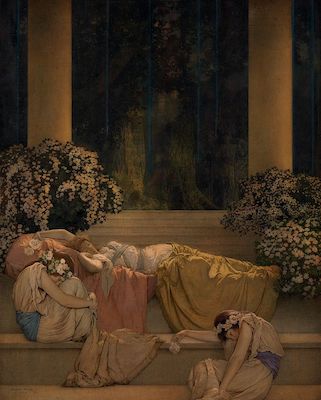
Maxfield Parrish, ‘Sleeping Beauty’, Colliers (1912)

No rose without a thorn, the saying goes – unless you’re that lucky. Or perhaps in the right sort of story, say ‘Briar Rose’, where, the hundred years of the curse having expired precisely on the day that the prince comes breezing along, the briar hedge is transformed into beautiful flowers. The bride is won with minimal effort—no giants or dragons—just impeccable timing, ‘illustrating’, as Maria Tatar observes, ‘how good fortune often trumps heroic feats in fairy tales.’[10]

Remembering the appearance of the early romances of H. G. Wells, Ford Madox Ford wrote: ‘Fairy tales are a prime necessity of the world’.[11] So they are, so they are.


Notes

[1] Arthur Conan Doyle, ‘The Naval Treaty’, The New Annotated Sherlock Holmes, 2 volumes, edited with notes by Leslie S. Klinger (New York and London: W.W. Norton and Company 2005), I, 686, 687.

[2] Rebecca Solnit, Orwell’s Roses (London: Granta Books, 2021), 25-26.

[3] Ernst Jünger, Storm of Steel, translated by Michael Hofmann (Harmondsworth: Penguin, 2004), 5.

[4] Patrick White, The Tree of Man, (Harmondsworth: Penguin Books, 1961), 28.

[5] Patrick White, Riders in the Chariot (Harmondsworth: Penguins Books, 1964), 383.

[6] Patrick White, The Burnt Ones (1964; Harmondsworth: Penguin Books, 1968), 231, 180.

[7] Patrick White, Voss (London: Eyre & Spottiswoode, 1957), 170, 250.

[8] David Marr, Patrick White: A Life (London: Vintage, 1992), 213.

[9] ‘Greece – My Other Country’ (1983), in Patrick White Speaks, edited by Paul Brennan and Christine Flynn (London: Jonathan Cape, 1990), 134.

[10] Maria Tatar, editor, The Annotated Brothers Grimm (New York: W. W. Norton, 2004), 238.

[11] Ford Madox Ford, Portraits from Life (Boston: Houghton Mifflin, 1937), 109.

Oddnesses and cloudy crossroads


With the Librarian away and the cat, though frankly puzzled, not yet overtly resentful, I walk uphill after breakfast, through the other, smaller park and along quiet streets, one or two walkers glimpsed at comfortable distances, barely any cars on the roads I’ve chosen, and the only mild disturbance a runner with a backpack, who pants his way past while I shift well away, thinking that there’s surely no real need for that sort of thing.

Mild disturbance, though, is almost welcome, after the past few days of relentless activity in the neighbouring house, which is evidently being gutted before its sale or re-letting. Yesterday, the workmen seemed to be drilling directly through the wall – I expected their imminent arrival in the room where I sat at my keyboard. On several days last week they took over from the other crew beyond the back fence, the ones with the shocking musical taste. Occasionally they would harmonise, after a fashion, sledgehammer against drill, concrete mixer against hacksaw. Though raising sympathetic eyebrows to the Librarian and Harry the cat when our paths crossed, I regarded the unholy row with relative equanimity—mostly—still feeling the after taste of euphoria that attended the final surrender of a tooth that had wavered and jiggled for more than a week, making mealtimes purgatory and tending to vandalise my dreams.

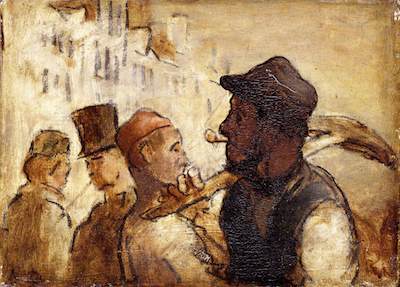
(Honoré Daumier, Workmen on the Street: National Museum of Wales)

We tend to think of incessant noise as a recent development—wars apart—given motorised road traffic, aircraft and other modern machinery. It’s largely true. Still, it’s salutary to be reminded of the London streets in Victorian times, when the Inns of Court served as ‘oases of quiet’, into which people walked, especially in Dickens’ work, in order to hear one another speak.[1]

Out early this morning, not in Dickens’ London, I was buffeted and boomed at only by birdsong, the bushes and hedges and thick-leaved branches in constant movement. I always find such occasions oddly heartening, as when I saw recently, in the tree that overlooks—and reaches over—our garden fence, at least two bluetits and a pair of goldfinches, plausibly the same ones seen on several occasions this past fortnight. Why ‘oddly’, though? An odd choice of word. I should know by now that I can rely more confidently on birds, trees, cats, walls, cemetery paths and grassy slopes for reassurance that we are not approaching the end of days than on the behaviour of my fellow humans (sometimes yes, often no).


‘Nature has no destiny for us: our boat is upon her ocean and in her winds, but she has expended as much ingenuity designing the flea as she has expended on us, and is perfectly indifferent to Hooke’s conversation at Garraway’s Coffee House. We, however, perish the instant we take our eyes off nature.’[2]

There we have it: the perish option. Or not. Don’t take your eyes off it—her—it. And cherish the oddities, as Enid Bagnold wrote: ‘Who wants to become a writer? And why? Because it’s the answer to everything. To “Why am I here?” To uselessness. It’s the streaming reason for living. To note, to pin down, to build up, to create, to be astonished at nothing, to cherish the oddities, to let nothing go down the drain, to make something, to make a great flower out of life, even if it’s a cactus.’[3]

The past two and a half years­—very nearly that now—have changed some behaviours, habits, attitudes and perceptions in ways which are still largely invisible to us. In Elizabeth Bowen’s novel, Friends and Relations, Lady Elfrida reflects that: ‘Surely people were odder, or was it just that one met them? Had these years, with their still recent sense of catastrophe, brought out curious people, like toads after rain?’[4] I often find other people’s behaviour odd, to be sure, but suspect that the newer, larger oddness is in myself. ‘That is to say’, Ford’s narrator Gringoire in No Enemy remarks of the recent war from which he has emerged, ‘it did teach us what a hell – what a hell! – of a lot we can do without.’[5]

A good many people in the current crisis—there is always a crisis for some of them—are finding that they have little or no choice in the matter of what to do without, of course. Others, who are in a more comfortable position, have evidently decided on at least one of the things that they won’t do without. That scrubbed-smooth sky this morning was streaked with cloud strips like tracer but also with the swift lines of numerous aircraft, stuffed with people making their modest but not insignificant contributions to the climate crisis. At one point, with a symbolism so apt as to verge on unconvincing, the clouds had formed a solid and clearly delineated crossroads which one of those crammed airliners was approaching.

It ploughed straight on, of course.


Notes

[1] Judith Flanders, The Victorian City: Everyday Life in Dickens’ London, (London: Atlantic Books, 2012), 30-33.

[2] Guy Davenport, ‘The Death of Picasso’, Eclogues: Eight Stories (London: Picador, 1984), 23. That would be scientist and philosopher Robert Hooke (1635-1703), while Garraway’s, dating from the 1650s, was the first coffee house in London. I see that Simon Schama has it as ‘Garway’ – but am not downhearted.

[3] Enid Bagnold, Autobiography (London: Century Publishing, 1985), 59.

[4] Elizabeth Bowen, Friends and Relations: A Novel (1931; Chicago: University Chicago Press, 2012), 82.

[5] Ford Madox Ford, No Enemy (1929; edited by Paul Skinner Manchester: Carcanet Press, 2002), 52. A decade earlier, his poem ‘The Starling’ began: ‘It’s an odd thing how one changes’.

On the other hand


There was, is, a saying:
‘Till April is dead
Change not a thread’

Perhaps less a suggestion to heavy users of social media than a body blow to personal hygiene. All Fools’ Day, I finally troubled to find out, is of French origin, the poisson d’avril—April fish—persons to be hoaxed or have a cardboard fish attached to their backs or simply to be sent on some ridiculous errand. The April fish, because of its abundance in that month, is the mackerel – and the French maquereau also meaning ‘pimp’, occasional complications, or extensions of the idea, were always likely to arise.[1]

‘Whan that Aprille with his shoures soote’ or no, rather, as has been very often quoted of late, ‘the cruellest month’. Some days begin well enough. After breakfast, sitting at the kitchen table with Wodehouse or Lawrence or Mary Wollstonecraft (‘more tea, Mary?’), the cat at the back door or already upstairs again, sprawled on the bed with the Librarian, who is speaking French back at her iPad or looking at her timetable, clouds on the breezier days moving, steadily stately galleons, above the trees and houses, maybe the quick crossword done, even a sentence written that stays written.

But the news is always there, whether just arriving or already waiting. The worst is still from Ukraine, of course, the continued targeting and murder of civilians, and names that will not be forgotten by historians of atrocity: Borodyanka, Bucha, Mariupol, Kramatorsk.

‘Far from his illness’, W. H. Auden wrote of W. B. Yeats, ‘The wolves ran on through the evergreen forests’.[2] To those deluged in grief or fighting for their lives, it’s often shocking that things go on elsewhere – perhaps not as normal, or as before, but they go on. Apsley Cherry-Gerrard, youngest member of Scott’s second Antarctic expedition, who had gone to the war with his health still shaky, was invalided out of the army with what was eventually diagnosed as ulcerative colitis. While men died in their hundreds of thousands on the other side of the channel, Cherry found himself, in 1916, alone in the family home for the first time. ‘There, in the stillness behind the high yew hedge, he watched the oaks and beeches flower and observed the progress of a family of robins nesting in the willow. He noted the arrival of a hen sparrowhawk, and listed the species of tits hovering around the fruit trees. It was a stay against the chaos of the war, and he absorbed himself in the smallness of his garden while the world went mad.’[3]

A few months after the end of that war, Aldous Huxley—who had, in fact, volunteered but was, inevitably, rejected on health grounds because of his famously poor eyesight, following a serious infection years before—wrote to his brother Julian: ‘great events are both terrifying and boring, terrifying because one may be killed and boring because they interfere with the free exercise of the mind—and after all, that freedom is the only thing in the world worth having and the people who can use it properly are the only ones worthy of the least respect: the others are all madmen, pursuing shadows and prepared at any moment to commit acts of violence. The prospects of the universe seem to me dim and dismal to a degree.’[4]

Well, yes. On the other hand – there are goldfinches in our garden. . .


Notes

[1] Bonnie Blackburn and Leofranc Holford-Strevens, The Oxford Companion to the Year (Oxford: Oxford University Press, 1999), 140, 142-143.

[2] Auden, ‘In Memory of W. B. Yeats (d. Jan. 1939)’, W. H. Auden, The English Auden: Poems, Essays and Dramatic Writings, 1927-1939, edited by Edward Mendelson (London: Faber, 1977), 241.

[3] Sara Wheeler, Cherry: A Life of Apsley Cherry-Gerrard (London: Jonathan Cape, 2001), 185.

[4] Aldous Huxley, Letters of Aldous Huxley, edited by Grover Smith (London: Chatto and Windus, 1969), 173-174