Dusks and darks

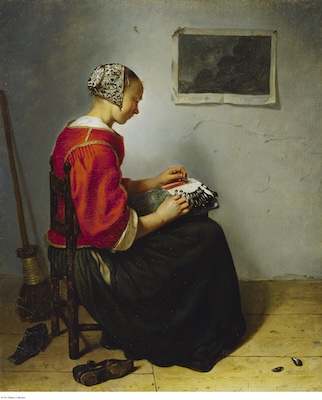
(Caspar Netscher, The Lace Maker, Wallace Collection)

‘In a mid-September twilight’, Ford Madox Ford writes, remembering himself as Second Lieutenant in September 1916, ‘the rain poured down on Pont-de-Nieppe.’ He is bothered by his wet shirt-cuffs and the man assigned to him as temporary batman has clearly decided that Ford is not a man who can be safely left and, ‘though he must have been uncommonly wet and hungry and tired, he followed me to the door of the house in whose dark windows I had seen the luminous patch—the forehead of Rosalie Prudent as she sat sewing, her head bent forward, in the twilight.

‘I don’t know how it is: but from the moment when I first saw that highlight—and it had been certainly three hours before—I had been perfectly sure that that was what it was—the forehead of a quiet woman bending her head forward to have more light from the high window whilst she sewed in the dusk.’

This is Rosalie Prudent of Pont-Nieppe, who has lost her house, her husband and her sons, and is one of the most significant figures that Lieutenant Ford Madox Hueffer—a man at the end of his tether and a writer who cannot write—will encounter during the war. She will sit by the stove in the wash-house, sewing his wristbands. She will cook him an omelette and fried potatoes, talk to his orderly and, ‘looking at Mme. Rosalie—so extremely centred in the work in hand, so oblivious to the very real danger, so brave and so tranquil, I said to myself:
“What the devil! If she can stick it, I too can!”’[1]

And he will. He is one young Australian artist and one five shilling a week cottage away from salvation: ‘The dusk was falling as I approached my isolated, sixteenth century abode that had a leaky, red-tiled roof and defective diamond-framed casements. It stood under a darkling bank. . . . And you think that the half-crown dog was an extravagance! I assure you that he was not. The floors sagged, the paper fell in scrolls from the walls. There was more than a bushel’s bulk of starling’s nest in the downstairs ingle.’[2]

Back in the day—ah, those days—I read, as did half the people I knew at the time, the books of Carlos Castaneda or, at least, the first three or four. Much of it, even the unfolding controversy, is a little cloudy now, but I do recall the assertion that: ‘The twilight is the crack between the worlds.’ Or rather, I recalled it as I made my way around the park a day or two back as the light slipped further down into its last phase before incontrovertible darkness.
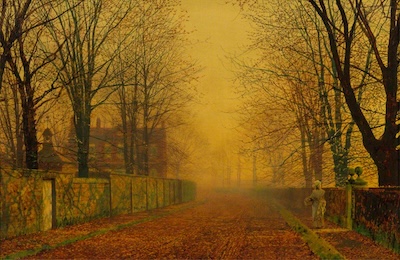
(John Atkinson Grimshaw, Evening Glow: Yale Center for British Art)

If that is in fact the case, some of the denizens of that other world are a little unsettling. As is, of course, the possibility that I myself am, in fact, an inhabitant of the ‘other’ world.

There seem to be more people than usual devoting their time to shouting into phones or at dogs, heard rather than seen, or glimpsed between branches or benches. A man wearing a cloth cap and an alarming neck tattoo scatters broken biscuits from a bag as he walks, to more than a dozen crows and one slightly shifty magpie (‘Yeah, I’m a crow. Who’s asking?’). A second man passes me, marching like a robot, legs thrown out, with a can of beer gripped in each outstretched hand; a teenaged schoolgirl, one of three, having an emotional moment, turns her tearstained face away from me as I pass and one of her friends says: ‘I didn’t meant to hurt you, Lily, but you shouldn’t have said—‘. And on an upper path, a woman running towards me; I cross over to make room for her; she smiles and turns sharply into the play area ten yards ahead, to crouch in front of a swing on which her child is sitting, watched over by a friend.

Vladimir Nabokov mentions ‘soomerki—the lovely Russian word for dusk.’[3] It is, or can be, oddly different, the air itself a different texture or the mind made more receptive to such notions by the slippage in other senses: sounds half-heard and harder to locate, things not quite seen. A Golden Labrador with one of those illuminated collars races through a thick ribbon of trees that borders a lower path, a ghost dog that has me wracking my brains to come up with Jim Jarmusch’s 1999 film, Ghost Dog: The Way of the Samurai, with Forest Whitaker as the hitman. A group of dog-owners I passed earlier did look and sound like contract killers but that may have been down to the special sound qualities of this twilight zone.
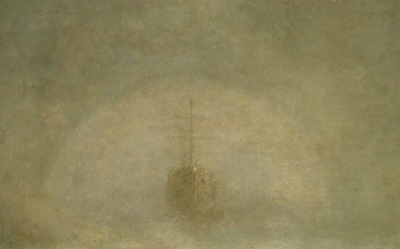
(G. F. Watts, A Sea Ghost: Watts Gallery – Artists’ Village)

‘It is the magic hour’, Lawrence Durrell wrote, ‘between two unrealized states of being—the day-world expiring in its last hot tones of amber and lemon, and the night-world gathering with its ink-blue shadows and silver moonlight.’[4] The colours may be a little different in Corfu, as emotional responses might have been a little more accentuated in Emerson’s nineteenth-century New England: ‘Crossing a bare common, in snow puddles, at twilight, under a clouded sky, without having in my thoughts any occurrence of special good fortune, I have enjoyed a perfect exhilaration. I am glad to the brink of fear.’[5]

Richard Garnett (father of Edward and Olive, father-in-law of Constance) wrote about The Twilight of the Gods (as did Richard Wagner); Nietzsche wrote about the Twilight of the Idols; D. H. Lawrence wrote of Twilight in Italy; Edith Wharton was concerned with Twilight Sleep; a volume of Conan Doyle stories was called Tales of Twilight and the Unseen.  ‘I drove carefully’, the private eye Lew Archer says, ‘feeling a little depressed, stalled in the twilight period when day has run down and night hasn’t picked up speed.’[6]

We’re just a week away from the winter solstice, the shortest day, the longest night. Beyond that date, of course, the days get longer, inch by inch. Grounds for optimism, some say. And why not? Just mind the cracks—and, of course, those worlds.


Notes

[1] Ford Madox Ford, No Enemy (1929; edited by Paul Skinner, Manchester: Carcanet Press, 2002), 117, 127, 124.

[2] Ford Madox Ford, ‘Rough Cookery’, New York Herald Tribune Magazine (29 July 1928), 18.

[3] Vladimir Nabokov, Speak, Memory: An Autobiography Revisited (New York: Putnam’s, 1966), 81.

[4] Lawrence Durrell, Prospero’s Cell (London: Faber 1962), 105.

[5] Ralph Waldo Emerson, ‘Nature’, Selected Essays, edited by Larzer Ziff (Penguin American Library, 1982), 38.

[6] Ross Macdonald, The Moving Target (1949; Warner Books, 1990), 98.
Words, things, words for things


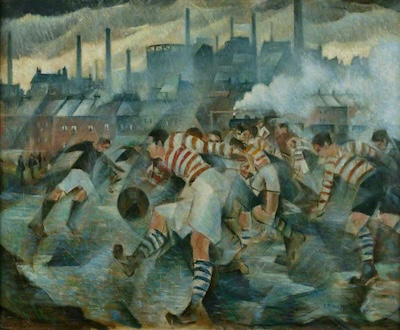
(C. R. W. Nevinson, Any Wintry Afternoon in England: Manchester Art Gallery)

Walking on the wide path in the park, I see a football rolling determinedly towards me over the grass, two boys watching, a long way off. I trap it, nudge and kick. It travels a fair distance but nowhere near the waiting boys. A woman walking towards me on the path says: ‘One of my irrational fears, a ball coming at me like that.’ I say: ‘One of mine too now’, and she laughs. ‘Oh, you did okay.’

Did I, though? Not the kick, that was what it was but. . . irrational fears? If it were now one of mine because of that episode, it’s not irrational but quite rational, reasoned, based on solid, empirical evidence, so. . .Don’t overthink it! the Librarian says, often in person and now in my head. Don’t overthink things!

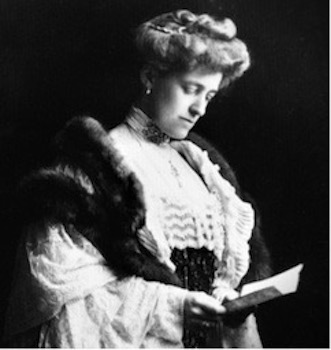
Ding, ting, chose, cosa, peth, rud, shay, hlutur: thing. . . ‘The distinguished thing’ was Henry James’s famous phrase for death. Did he actually say it? Following a reference to Edith Wharton’s A Backward Glance, I see that there’s an extra link or two: ‘He is said to have told his old friend Lady Prothero, when she saw him after the first stroke, that in the very act of falling (he was dressing at the time) he heard in the room a voice which was distinctly, it seemed, not his own, saying: “So here it is at last, the distinguished thing!”’ Wharton adds: ‘The phrase is too beautifully characteristic not to be recorded.’[1] It’s certainly wonderfully—and characteristically—indefinite, or at least, on a very convoluted path: ‘He is said’ to have told someone else that he heard a voice which wasn’t his own, the word ‘distinctly’ applied only to a negative, ‘not his own’ and, even then, ‘it seemed’.


(Edith Wharton via BBC)

Death as ‘the thing’ (Death! Where is thy thing?) – while for Edna St Vincent Millay, death was not the thing but the force engulfing it:

Death devours all lovely things:
   Lesbia with her sparrow
Shares the darkness,—presently
   Every bed is narrow.[2]

The line ‘Every bed is narrow’ I take to refer to coffins (rather than, or as well as, singleness or separation), and it also recalls Pound’s ‘Homage to Sextus Propertius’. ‘We, in our narrow bed, turning aside from battles:/ Each man where he can, wearing out the day in his manner.’[3]

And yet – I was thinking, at the outset, more of things than of death; or rather, words and things, particularly the word ‘thing’. Impressively, its origin seems to embrace both ‘object’ and ‘parliament’. The definitions are lavish: an assembly, court, council, matter, affair, problem, fact, event, action, that which exists or can be thought of, a living creature, a piece of writing; in the plural, clothes, personal belongings. What a word, what a world, ‘thing’ is!

While an inmate of the Disciplinary Training Center at Metato, north of Pisa, in the autumn of 1945, Ezra Pound wrote:

   And for all that old Ford’s conversation was better,
consisting in res non verba,
          despite William’s anecdotes, in that Fordie
   never dented an idea for a phrase’s sake
and had more humanitas [4]

Things, not words for things. Pound was reiterating his belief in those opposing—or complementary—positions, Ford as realist, Yeats as symbolist, that he proposed on more than one other occasion.[5] Poignantly, they were both just six years dead – the length of a world war, say.

That ‘humanitas’ had led the youthful Ford to rashly discuss the conditions of the London poor with a young woman he took out in a boat, only to be reproved the next day by her mother, Lady Cusins: ‘“Fordie, you are a dear boy. Sir George and I like you very much. But I must ask you not to talk to dear Beatrice … about Things!”’[6]

(Iris Barry)

Ford had actually written to Iris Barry (4 July 1918): ‘I have always been preaching to people not to write “about” things but to write things—& you really do it—so I like to flatter myself that you are an indirect product of my preachings—a child of my poor old age.’ (He was still serving in the British Army, having by then reached the ‘poor old age’ of 44.)[7]

Ralph Waldo Emerson also fished in those waters: ‘The corruption of man is followed by the corruption of language’ and ‘new imagery ceases to be created, and old words are perverted to stand for things which are not’. But ‘wise men pierce this rotten diction and fasten words again to visible things’.[8] This linking of words and things would have some later commentators and theorists tearing their hair out, words for them being quite arbitrary marks on the page, the word for something not otherwise  linked to that something. Lord Byron though, as so often, pursued his own path:

But words are things, and a small drop of ink,
Falling like dew upon a thought, produces
That which makes thousands, perhaps millions, think.[9]

And as if by magic, an email just arrived from PN Review offers, from its archive, ‘Holà’, a short poem by C. H. Sisson from 1992, which is also concerned with words and things:

Words do not hold the thing they say: 
Say as you will, the thing escapes 
Loose upon air, or in the shapes 
Which struggle still before the eyes. 
Holà will run upon its way 
And never catch up with its prize.[10]


Later in my park walk, halfway down a steepish path, I see a woman ahead of me with a child in a pushchair and a dog crouched in the grass nearby, with a ball in its mouth. It looks at me inquiringly. ‘I’m afraid not’, I say. ‘You’re not my dog and that ball is covered with slobber, as we both know.’ The woman is partly blocking the path where it meets the wider track, talking on her phone and with her back to me, but moves to one side as I approach. The dog lies down close by her and lets the ball drop from its mouth. She half-turns and kicks the ball, which rockets cleanly away for a good distance – and apparently just where she meant it to go. Damn, I think, she only needed to be a bit better than me to make the point. What point? That I shall not overthink it. . .


Notes

[1] Edith Wharton, Novellas and Other Writings: Madame de Treymes, Ethan Frome, Summer, Old New York, The Mother’s Recompense, A Backward Glance, edited by Cynthia Griffin Wolff (New York: Library of America, 1990), 1055.

[2] Millay, ‘Passer Mortuus Est’ (first of three stanzas), in F. O. Matthiessen, The Oxford Book of American Verse (New York: Oxford University Press, 1950), 886. As is often noted, Millay here references Catullus 2, about the death of his lover Lesbia’s sparrow, her ‘plaything’: The Poems of Catullus, translated with an introduction by Peter Whigham (Harmondsworth: Penguin Books, 1966), 52.

[3] Ezra Pound: Poems and Translations, edited by Richard Sieburth (New York: Library of America, 2003), 535.

[4] Canto LXXXII, The Cantos of Ezra Pound, fourth collected edition (London: Faber and Faber, 1987), 525. I have tried—and failed—to insert the ideogram, ‘jen’.

[5] Ezra Pound, Polite Essays (1937; Plainview, New York: Books for Libraries Press, 1966), 50; Pound/ Williams: Selected Letters of Ezra Pound and William Carlos Williams, edited by Hugh Witemeyer (New York: New Directions, 1996), 187.

[6] Ford Madox Ford, Return to Yesterday: Reminiscences 1894-1914 (London: Victor Gollancz, 1931), 75.

[7] Ford Madox Ford, Letters of Ford Madox Ford, edited by Richard M. Ludwig (Princeton: Princeton University Press, 1965), 87.

[8] Ralph Waldo Emerson, Selected Essays, edited by Larzer Ziff (Harmondsworth: Penguin Books, 1982), 51.

[9] Lord Byron, Don Juan, III:88, edited by T. G. Steffan, E. Steffan and W. W. Pratt (London: Penguin Books, 1996), 182.

[10] PN Review 87 (September–October 1992), 28.

There not there


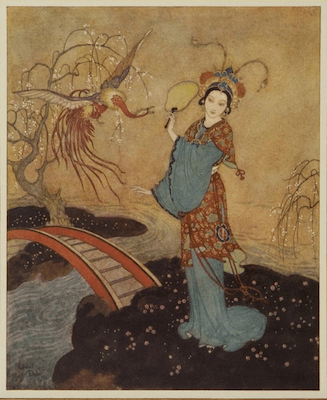
(Edmund Dulac, Frontispiece to Princess Badoura: A Tale from The Arabian Nights, by Laurence Housman)

‘The things you think of to link are not in your control. It’s just who you are, bumping into the world. But how you link them is what shows the nature of your mind. Individuality resides in the way links are made.’[1]

Bumping into the world, I noticed yesterday that I was reading A. S. Byatt on what would have been her 88th birthday. More, in the volume’s longest story, was the sentence: ‘And she waited for the sound of thunder, or worse, the silence of absence.’[2] I was struck (or bumped against) by that last phrase, having been thinking recently in similar terms. Sometimes the silence here is indeed the dictionary’s ‘absence of sound; complete quietness’ – but often something more. Silences have their own flavours, idiosyncrasies, tones, strengths and essences.

‘Throughout the house’, Patrick White wrote in  his story ‘The Night the Prowler’, ‘there were the sounds of furniture, and clocks, and silence.’[3] It has to be said that furniture was often on his mind, not least in populating Theodora Goodman’s world: ‘There is perhaps no more complete a reality than a chair and a table’ – though he adds there: ‘Still, there will always also be people, Theodora Goodman said, and she continued to wait with something of the superior acceptance of mahogany for fresh acts.’[4] When the painter Hurtle Duffield meets a man named Mothersole on the ferry, the printer asks what sort of things Duffield paints. ‘“Well! For some time now, tables and chairs.”’ Mothersole finds it a ’funny sort of subject’ and Duffield responds: ‘“Why? What could be more honest?”’[5]

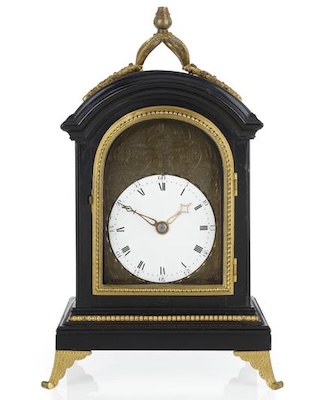
There must be vastly fewer ticking clocks in the world now, timepieces having been widely and inescapably recruited to the cause of at least electronic silence. Ticking is a disturbing anomaly in this grave, enslaved new world. My maternal grandfather once owned several fish and chip shops in Portsmouth but, by the time I was of an age to notice such things, he had become a jeweller and watchmaker. The clocks that had audibly populated so much fiction through several centuries still kept the faith in his shop. He even had, at one point and appropriately enough, a grandfather clock. Ticks, tocks and chimes galore.


(The Clockmakers’ Museum. Musical table clock by Thwaites for Barraud. L2015-3473 Science Museum Group Collection Online.)

Thinking of silence, then, we often think of absence too, perhaps of the old saying that ‘absence makes the heart grow fonder’ (or, as I once heard someone—probably of a poetic turn of mind—say, a few drinks in: ‘Absinthe takes the art au fond-er’). Old sayings, though. People sometimes ask: are they true? To which the answer is, can only be, it depends. For some yes, for others no.

Absence can be a source of amusement, an occasion for pleasure. Rudyard Kipling’s parents (John Lockwood Kipling and Alice Macdonald) were unable to attend a party given by Dante Gabriel Rossetti because the date of their sailing on the S. S. Ripon to Bombay had been brought forward by a day, to Wednesday 12 April, 1865. ‘In their absence, however, Ford Madox Brown proposed their health, in a speech throughout which, with his usual inability to remember names, he referred to the bridegroom as “John Gilpin”—to the delight of all present.’[6]

Annie Erneaux, though, recalled literally writing out her passion in Florence, being temporarily removed from an intense and wounding affair: ‘Those eight days on my own, without speaking, except to waiters in restaurants, haunted by the image of A. (to the extent that I was astonished to be accosted by men, could they not see him silhouetted inside my own body?) seemed to me an ordeal for the betterment of love. A sort of further investment, this time to imagination and craving through absence.’ And elsewhere she stated that:  ‘It is the absence of meaning in what one lives, at the moment one lives it, which multiplies the possibilities of writing.’[7]


(Franz Ferdinand & Sophie. Photograph: Bettmann/Corbis via The Guardian)

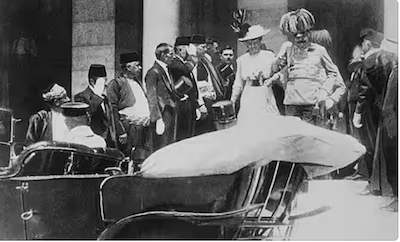
When Stanley Weintraub wrote about the guns falling silent at the end of the First Word War, his book’s title, A Stillness Heard Round the World, looked back both to Ralph Waldo Emerson’s ‘Concord Hymn’, which included the phrase ‘the shot heard round the world’ and the fact that Emerson’s phrase has often been applied to the shot that began the war, fired at the Austrian Archduke Franz Ferdinand by Gavrilo Princip, who killed both the Archduke and his wife Sophie on 28 June 1914. The significance of that incident was not widely grasped and reports of it were often to be found on the inner pages of the following day’s newspapers – a squabble in the Balkans! – but since then a great deal of writing about it has certainly been found possible.

Marcel Proust observed that ‘the absence of a thing is not merely that, it is not simply a partial lack, it is a disruption of everything else, it is a new state which one cannot foresee in the old.’[8] We can, in fact, often foresee that absence, we grasp its inevitability, not least the inescapable end of every living thing but of course that single fact is not, cannot be, all there is. We distinguish between ‘surprise’ and ‘shock’ for a reason. Our awareness that something is coming, will inevitably happen, does not provide a thorough preparation for the event and its aftermath. Some effects are unscripted.

‘There is a time in life when you expect the world to be always full of new things’, Helen Macdonald wrote. ‘And then comes a day when you realise that is not how it will be at all. You see that life will become a thing made of holes. Absences. Losses. Things that were there and are no longer. And you realise, too, that you have to grow around and between the gaps, though you can put your hand out to where things were and feel that tense, shining dullness of the space where the memories are.’[9]


Yes. As Sarah Moss wrote, ‘One does not need to see ghosts, to know that people are haunted.’ And, a little further on: ‘It is not ghosts but absence that is harder to bear.’[10]


Notes

[1] Anne Carson, Paris Review interview (2004), quoted by Jennifer Krasinski in her review of Carson’s Wrong Norma in Bookforum, 30, 3 (Winter 2024), 13.

[2] A. S. Byatt, ‘The Djinn in the Nightingale’s Eye’, in Medusa’s Ankles: Selected Stories (London: Vintage, 2023), 256.

[3] Patrick White, ‘The Night the Prowler’, in The Cockatoos: Shorter Novels and Stories (London: Jonathan Cape, 1974), 149.

[4] White, The Aunt’s Story, (1948; Harmondsworth: Penguin Books, 1963), 141.

[5] White, The Vivisector (London: Jonathan Cape, 1970), 420.

[6] Roger Lancelyn Green, Kipling and the Children (London: Elek, 1965), 20, citing Georgiana Burne-Jones, Memorials of Edward Burne-Jones (1904), I, 290.

[7] Annie Erneaux, Simple Passion, translated by Tanya Leslie (London: Fitzcarraldo Editions, 2021), 33; A Girl’s Story, translated by Alison L. Strayer (London: Fitzcarraldo Editions, 2020), 143.

[8] Marcel Proust, In Search of Lost Time. 1: The Way By Swann’s, translated by Lydia Davis (London: Allen Lane, 2002), 308.

[9] Helen Macdonald, H is for Hawk (London: Jonathan Cape, 2014), 171.

[10] Sarah Moss, Signs for Lost Children (London: Granta Books, 2016), 64, 86.

Advice Notes


(Marianne North, Foliage and Flowers of a Madagascar Tree at Singapore, Marianne North Gallery; photo credit: Board of Trustees of the Royal Botanic Gardens, Kew)

I see that Mick Jagger—Sir Michael Philip Jagger, rather—is eighty this year. We lived abroad for a few years because of my father’s job while the Beatles and the Rolling Stones were getting going. ‘Not Fade Away’ must have been the first Stones song I heard when we came back to England; and it was another year before Jagger sang: ‘Well I told you once and I told you twice, But you never listen to my advice’—a slight friction there between ‘telling’ and ‘advice’? Unsurprising, perhaps, that it could have been the last time.

I’ve always been wary of advice, both giving and receiving. ‘I never myself took anyone’s advice’, Ford Madox Ford remarked, ‘and I do not imagine that many people will take mine.’[1] Robert Lowell appears to have taken it, though with mixed results, telling Flannery O’Connor in 1952: ‘Ford used to say that you could tell if a writer was any good from the first sentence—I found this advice useful when manuscript-reading for Sheed and Ward, though it led to fatal misunderstandings in my interviews with students at Iowa . . . ’[2]

I wouldn’t say ‘never’, I’m sure I’ve taken it from time to time but rarely with enthusiasm. Giving it as well, being too conscious of the tendency in many people, myself not excluded, to react negatively to such gestures, even embracing the opposite, sometimes ending up, metaphorically or literally, in a rainstorm without an umbrella. Though, it now occurs to me, I can advise, or at least suggest, that eating beetroot for lunch while reading a book you care about is best avoided.

Politicians, newspapers, television channels and radio stations are profligate dispensers of the stuff. I can recall the days when doctors and the BBC, anyway, were viewed with near-unanimity as reliable sources. Now people unwilling or unable to distinguish between blanket mistrust and informed scepticism are easy prey. Some conversations, to be sure, are best kept private when so much of the world appears to have gone mad-dog. To be appalled by so many governments is hardly a novelty, though, and my intake of news bulletins remains. . . careful.


(Herbert George Ponting, ‘Captain Scott’s Birthday, 6 June 1911’, National Portrait Gallery, London; photo credit, NPG. Cherry is the third seated man along on the left)

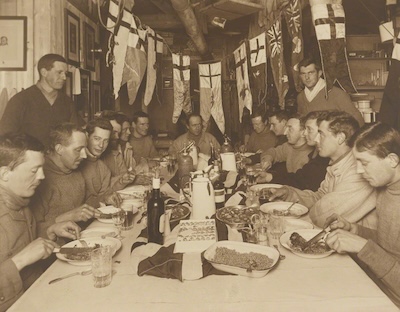
‘Defeats on the Western Front in March catapulted the nation into shock’, Sara Wheeler wrote in her biography of Apsley Cherry-Garrard, recalling the period of the First World War. ‘The Times rallied as usual to shore up public confidence, issuing advice on all fronts, including the stern “Don’t think you know better than Haig”, even though most people over the age of ten probably did.’[3]

On all fronts, not just the Western one.

In Penelope Fitzgerald’s The Blue Flower, a novel based on the life of the 18th century writer  Novalis, Fritz meets Sophie’s elder sister Friederike (‘the Mandelsloh’): ‘“I thank you for your advice,” said Fritz. “I think, indeed, that women have a better grasp on the whole business of life than we men have. We are morally better than they are, but they can reach perfection, we can’t. And that is in spite of the fact that they particularise, we generalise.”
   “That I have heard before. What is wrong with particulars? Someone has to look after them.”’[4]

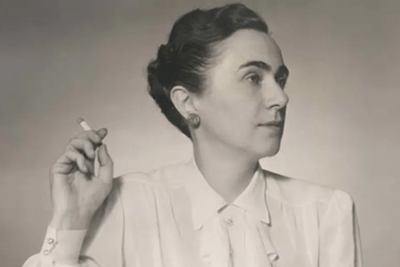
Yes, those particulars. Colette was a generous dispenser of advice, not least to the young Georges Simenon when she was literary editor at Le Matin, telling him that, though on the right track, ‘he should drop “the literature”. “Pas de littérature!” she said. “Supprimez toute la littérature et ça ira!”’[5] To a young woman writer who had sought her advice, she replied: ‘When you are capable of certifying that today’s work is equal to yesterday’s, you will have earned your stripes. For I am convinced that talent is nothing other than the possibility of resembling oneself from one day to the next, whatever else befalls you.’[6] But she also served as a magazine’s regular agony aunt, sharing her expertise in matters of dress, cosmetics and, always, love.


(Colette, plus—of course—a cat)

On dress and cosmetics, I am probably unreliable; but I was writing recently about aeroplanes, though hardly straying from my usual temporal zone, the first two or three decades of the twentieth century. The context was Ford Madox Ford’s war but a lot of the material I had to draw on related to Guy Davenport—some of which has gone into blog posts here—as well as other writers of Ford’s time, references to whom had to be whittled down or eliminated. Every time I approached the suggested word limit, things spiralled out of control again as some other alleyway beckoned. I remembered that line of W. B. Yeats: ‘My thoughts were a great excitement, but when I tried to do anything with them, it was like trying to pack a balloon into a shed in a high wind.’[7]

The Davenport material went, leaving only a faint shadow of his 1991 response to Laurence Zachar’s remark that: ‘A proportionately large part of your work is Utopian. It deals with happy people, in an ideal place where there is no violence’, when Davenport commented of  “The Aeroplanes at Brescia”, ‘there’s the implicit sense that aeroplanes were going to stop all wars; the Wright brothers wrote a famous letter to the War Department which paid no attention to it, saying: with the aeroplane, there can be no more troop movements because they can be observed from the air, and therefore no more wars.’[8]

When his story, or assemblage—drawing on Franz Kafka’s first published work, a report on the 1909 air show—appeared in the Hudson Review, a paragraph on the final page put the assertion that wars would cease with the coming of the aeroplane into the mouth of Max Brod’s engineer brother Otto but Davenport may have felt that such an unbearably painful irony was too easy, too heavy-handed. It was omitted when revised for book publication.[9]


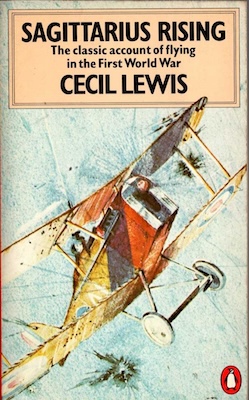
Another twist on that occurred to me when I was rereading the memoir by Cecil Lewis, Sagittarius Rising, who was in his teens when he joined the Royal Flying Corps. By the time he was posted to Home Establishment, he had survived eight months overseas, including four months of the Somme battle, and spent 350 hours in the air, during a period when pilots were lasting, on average, three weeks. Within little more than a month after the Armistice, he had been demobilised and secured a civilian job with Vickers. He was then twenty years old.

Writing in the mid-1930s, he looked back to the failure of the postwar conferences, aimed at ensuring peace, to take note of air power, finally waking to the significance of that power with a shudder of horror. ‘No wonder. Frontiers were gone. Security was gone. No man could hope for peace or prosperity under the threat of a violent death. The days of war were over: massacre had taken their place, wholesale massacre of the community in which children would retch their lives away, women would be blinded and men powerless to protect or succour. The end of civilization was in sight.’[10]


Notes

[1] Ford Madox Ford, Return to Yesterday: Reminiscences 1894-1914 (London: Victor Gollancz, 1931), 251-252.

[2] The Letters of Robert Lowell, edited by Saskia Hamilton (New York: Farrar, Straus and Giroux, 2005), 187.

[3] Sara Wheeler, Cherry: A Life of Apsley Cherry-Garrard (London: Jonathan Cape, 2001), 199.

[4] Penelope Fitzgerald, The Blue Flower (1995; London: Everyman, 2001), 364.

[5] Patrick Marnham, The Man Who Wasn’t Maigret: A Portrait of Georges Simenon (San Diego: Harcourt Brace & Company 1994), 112.

[6] Judith Thurman, Secrets of the Flesh: A Life of Colette (London: Bloomsbury Publishing, 2000), 409.

[7] W. B. Yeats, Autobiographies (London: Macmillan, 1955), 41.

[8] Laurence Zachar, ‘Guy Davenport. Lexington, Kentucky: December 1991’, Effets de voix (Tours: Presses universitaires François Rabelais, 1994).
See: http://books.openedition.org/pufr/3904 (accessed 20 January 2021).

[9] Guy Davenport, ‘The Aeroplanes at Brescia’, Hudson Review, 22, 4 (Winter, 1969-1970), 567-585; Tatlin! Six Stories (New York: Scribner’s, 1974), 52-70.

[10] Cecil Lewis, Sagittarius Rising (1936; Harmondsworth: Penguin, 1977), 152-153.

Letters by degrees


On a strike day, the Librarian sets off early, bound for picket line and rally, one of millions currently defending their livelihoods, pay, pensions, conditions—not to mention the future of school and university education, the National Health Service, transport systems, emergency services and social care, just about everything that a civilised society requires, come to think of it.

Foot soldier in a different campaign, I peer at online newspaper archives—The Folkestone Herald! The North Star! The Gloucester Journal!—and mutely interrogate the pages of Suetonius, biographies of Liberal statesmen and the Catholic Encyclopedia or run a cyber-finger down columns of common First World War acronyms and abbreviations. Then: how many serving soldiers had that surname? Ah, 5,762. But perhaps—recurring hopefully to Olive Schreiner—‘there is another method’.[1]

I think sometimes of old volumes of letters I’ve read, or old biographies: ‘Cannot trace’, ‘Not yet identified’. That was then; this . . . Isn’t everything online? No. Aren’t all archives freely accessible? No. Can’t you translate anything from one language to another on one of those whizzbang websites? No (especially if he makes it up).

‘I am making quite good progress with that book’, Ford Madox Ford wrote to his friend Charles Masterman, the Liberal politician and head of the British propaganda department, in October 1914. I use the same cautious terms. Since this is not a leap year—no leaping!—it’s already the last day of February as I sit trying to work out which cousin of which daughter of which Lady This or Lady That married the right man (right for me, never mind for her). The ennobled families of England (and, often, Scotland; less often the other countries that make up, for the moment, the United Kingdom of Great Britain and Northern Ireland) breed, or bred, like rabbits, it occurs to me once more, if not for the exact same reasons as the poor. Bloodlines, money, influence, money, land, money. Clearly a genealogist would be handy since, as far back as I can recall, the interconnections of families have given me a headache. I can cope with straightforward cousins adequately but as soon as ‘second’ or ‘third’ or ‘removed’, even, on occasion, ‘by marriage’, swim before my eyes, darkness descends.

Apart from a genealogist, what else might help? Who or what would be useful? My provisional list features a few gaps or weaker links that may well be filled by fellow-editors or other colleagues and would include: someone with a better grasp of colloquial French than mine; a fluent Welsh speaker and, ideally, a Flemish one too; a classical scholar; an expert on Catholic doctrine, texts and rituals; a Biblical scholar, to be on the safe side; a couple of military historians, specialising in the First World War, plus one conversant with the minutiae of domestic British politics of the period, including a detailed knowledge of the career of David Lloyd George, ‘Dai Bach’; an expert on the topography of London; ditto Sussex; ditto Kent (again, to be on the safe side). In reserve, an expert on pigs and potatoes; scholar of dialect and slang, particularly of Sussex and Kent; and one or two historians of the London newspaper and periodical press.


(James Boswell by Joshua Reynolds, 1785: National Portrait Gallery)

On a good day, of course, I am—or attempt or aspire to be—all or most, or at least some, of these things myself – to a degree. Happy things, degrees, as James Boswell knew. ‘21 November 1762. Since I came up [to London], I have begun to acquire a composed genteel character very different from a rattling uncultivated one which for some time past I have been fond of. I have discovered that we may be in some degree whatever character we choose.’[2] And here he is a little later in the land of Rembrandt and Vermeer: ‘Tissot [a medical doctor] said mankind were all mad and differed only in degrees.’[3]

Not always happy things, of course, as C. L. R. James perceived: ‘To the extent that a historical parallel is suggestive, to that very degree it is dangerous.’[4] And talk of dangerous degrees recalls Alexandra Harris on the beginning of what historians call the Little Ice Age. ‘The start was the worst of it; there was never again such prolonged rain, frost, and drought as in the years of the Great Famine of 1315-18. But the altered climate forced long-term changes in English farming. Though the average annual temperature fell by only a degree Celsius, it was a critical degree.’[5]

How is our patient, Earth, today? Alas, doctor, situation critical.

Post! Bank statement for the Ford Madox Society. The London Review of Books. The Times Literary Supplement. And – a bellringing journal? My grasp of campanology is feeble, consisting almost entirely of The Nine Tailors, Dorothy Sayers’ 1934 novel, which takes its title from the saying that ‘nine tailors make a man’, a reference to the number of strokes at the beginning of the tolling for the dead (it was six for the death of a woman). In Akenfield, Ronald Blythe described it as three times three for a man, three times two for a woman; then the years of the dead person’s age would be tolled. He added that the practice continued up to the Second World War, ‘when all the bells of England were silenced. It was never revived.’[6]


A wrongly delivered bellringing journal, then, but the address is a very local one and can be slipped into the afternoon walk. And so it is—a detour through the park first to avoid the adjacent road, which often requires walking in the road because of all the antisocial dimwits that leave their cars on the narrow pavement. Still, even in the park, you have to avoid, in addition to cyclists, those people on those damned scooters to whom no rules apply: ‘E-twats’ is the technical term. But I exit the park close to the crossing lights, nip up the facing road and find the number. A notice is prominent in the small front garden: SOLD. The house looks dark but not empty. Should I knock – or would that risk involving me in an H. P. Lovecraft story? Discretion, valour, all that jazz. I stuff it through the letterbox, not without difficulty, and retreat.

It’s not always, though, a matter of retreat. ‘Quite an adventure for you’, the Librarian observes, as we return from Bath. ‘Going on a train. Going into shops. And a café.’

Indeed. ‘It is not grace but patience’, Guy Davenport observed, ‘that gets most of us through the world.’[7]

And our cherry tree is blossoming.


Notes

[1] Olive Schreiner. The Story of an African Farm (1883), v.

[2] Boswell’s London Journal, 1762-1763, edited by Frederick A. Pottle (London: William Heinemann, 1950), 47.

[3] Boswell in Holland, 1763-1764, edited by Frederick A. Pottle (London: William Heinemann, 1952), 256.

[4] C. L. R. James, Beyond a Boundary (1963; London: Vintage, 2019), 205.

[5] Alexandra Harris, Weatherland: Writers and Artists Under English  Skies (London: Thames & Hudson, 2015), 66.

[6] Ronald Blythe, Akenfield (Harmondsworth: Penguin Books, 1972), 84.

[7] Letter to Hugh Kenner, 8 October 1965: Questioning Minds: The Letters of Guy Davenport and Hugh Kenner, edited by Edward M. Burns, two volumes (Berkeley: Counterpoint Press, 2018), I, 732.

Infinite presents


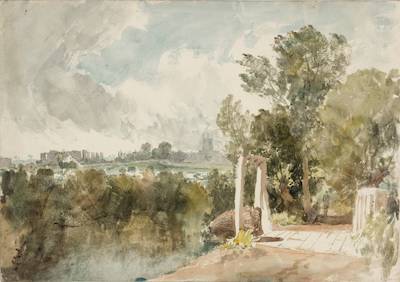
(J. M. W. Turner, A Church and Village seen from a Riverside Footpath: Tate)

I was thinking about—or idly musing upon—the infinite, arrived at by the usual wandering off footpaths. Decanting a packet of ground coffee into the regular tin, I was prompted by the resulting level to look at the net weight printed on the packet. It had lessened by some ten per cent, diminished by one-tenth (‘No, we haven’t put our prices up’). But then there has been, inevitably, a strong and widespread sensation of lessening, of shrinkage over the past few years. The narrowness of nationalist discourse, the closing of borders, the hostility to refugees and migrants, together with the pandemic, lockdowns, withdrawals either voluntary or enforced, now a metaphorical or literal huddling together against cold, hunger, discomfort, all in worsening weather.

Often placed against that diminishment are, precisely, ideas of freedom, expansion, movement through time and space. Art, then, or memory, or history, or imagination. Borders, walls, boundaries, limits of any kind set aside, evaded, vaulted over. The infinite – notions of which can swing to both positive and negative poles, depending on the viewer.

I thought of Ford Madox Ford recalling his ‘most glorious memory of England’, in the 1890s, hundreds of Jewish refugees from the Russian pogroms, landing at Tilbury Docks, falling on their knees and kissing the sacred soil of Liberty. ‘It was not of course because they were Jews or were martyrs. And I daresay it was not merely because England was my country. It was pride in humanity.’ But because of ‘an Order in Council’, that route would now be narrowed or blocked: ‘This then was the last of England, the last of London . . .’ And: ‘One had been accustomed to think of London as the vastest city in the world . . . as being, precisely, London, the bloody world!’ But now? ‘Ease then was gone; freedom was no more; the great proportions were diminished . . .’[1]


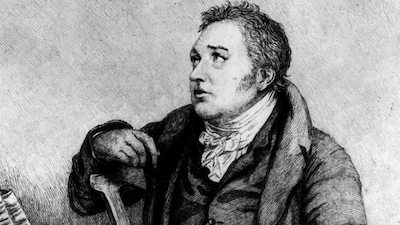
(Samuel Taylor Coleridge via the BBC)

One of the most famous instances of infinitude is that of Samuel Taylor Coleridge, in Chapter XIII of the Biographia, where he summarises his distinction between imagination and fancy: ‘The primary IMAGINATION I hold to be the living Power and prime Agent of all human Perception, and as a repetition in the finite mind of the eternal act of creation in the infinite I AM.’[2] This was one of the main targets of another, later, celebrated statement, by T. E. Hulme: ‘Here is the root of all romanticism: that man, the individual, is an infinite reservoir of possibilities’ – against which, Hulme’s version of the classical: ‘Man is an extraordinarily fixed and limited animal whose nature is absolutely constant. It is only by tradition and organisation that anything decent can be got out of him.’[3]

Hulme was primarily a philosopher – a poet only in miniature. I suspect that artists generally tend more towards embracing the positive than feeling repelled or threatened by the negative. ‘We must consume whole worlds to write a single sentence and yet we never use up a part of what is available’, James Salter wrote to Robert Phelps. ‘I love the infinities, the endlessness involved . . . ’[4] Laura Cumming, writing in praise of Jan Van Eyck, observed that: ‘His art is so lifelike it was once thought divine. But he does not simply set life before us as it is – an enduring objection to realism, that it is no more than mindless copying – he adjusts it little by little to inspire awe at the infinite variety of the world and our existence within it; the astonishing fact that it contains not just all this but each of our separate selves.’[5]

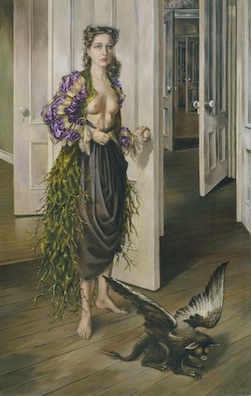
In an entry dated ‘[Saturday 24 November 1984]’, Annie Ernaux wrote: ‘One image haunts me: a big window wide open and a woman (myself) gazing out at the countryside. A springtime, sun-drenched landscape that is childhood. She is standing before a window giving onto childhood. The scene always reminds me of a painting by Dorothea Tanning – Birthday. It depicts a woman with naked breasts: behind her, a series of open doors stretch into infinity.’[6]


(Dorothea Tanner, Birthday (1942): Philadelphia Museum of Art)

Is that a wish to see the world, one’s personal world, as an unending series of opened doors? Or simply an observation, a belief, a conviction that this is how the world actually is, that much of what we assume to be fixed, unalterable, closed, finite, is nothing of the sort? Some observers, actors, participants, acknowledge the infinite nature of ideas, of the abstract but, certainly in specific circumstances—the Second World War, in the case of Ronald Duncan, pacifist and farmer—choose to turn away from them: ‘We were people used to dealing with ideas which are infinitely pliable, and for the first time were in contact with things which are rigid, brittle’, Duncan wrote. ‘Contact with things is infinitely more satisfying than contact with ideas. And if we are honest we must admit that few of us are capable of holding abstract conceptions in our heads. If we manage it, it gives us little pleasure. Somehow or other we have fallen into the rot of thinking that pigs and poetry are incompatible. They are not.’[7]

Pigs and poetry. Why, yes. In immediate postwar Sussex, Ford Madox Ford bred pigs and wrote poetry—A House (1921), Mister Bosphorus and the Muses (1923)—though, admittedly, the pigs died or had to be sold off at bacon prices when Ford and Stella Bowen moved to France. Staying in the realm of the abstract—or more abstract, at least, than pigs—I think of Sarah Churchwell, already author of a book on Fitzgerald and the world of Jay Gatsby, writing in 2018: ‘Gatsby’s famous ending, in other words, describes the narrowing of the American dream, from a vision of infinite human potential to an avaricious desire for the kind of power wielded by stupid white supremacist plutocrats who inherited their wealth and can’t imagine what to do with it beyond using it to display their dominance.’[8]

There are, though, different kinds of dominance, some more insidious than others, habits so ingrained as not to be seen any longer as habits, procedures so immediate, so automatic, so normalised as to seem – natural. Annie Ernaux has written of the worldwide web as ‘the royal road for the remembrance of things past’ and adds: ‘Memory became inexhaustible, but the depth of time, its sensation conveyed through the odour and yellowing of paper, bent-back pages, paragraphs underscored in an unknown hand, had disappeared. Here we dwelled in the infinite present.’[9]

The more I look at it, the more unsettling that final phrase is. . .

Notes


[1] Ford Madox Ford, It Was the Nightingale (London: Heinemann, 1934), 85-88.

[2] Samuel Taylor Coleridge, Biographia Literaria or Biographical Sketches of My Literary Life and Opinions, edited by James Engell and W. Jackson Bate (Princeton: Princeton University Press, 1984), I, 304.

[3] T. E. Hulme, ‘Romanticism and Classicism’, in Speculations: Essays on Humanism and the Philosophy of Art, edited by Herbert Read (Second edition, London: Routledge & Kegan Paul, 1936), 116.

[4] Memorable Days: The Selected Letters of James Salter and Robert Phelps, edited by John McIntyre (Berkeley, California: Counterpoint, 2010), 39.

[5] Laura Cumming, A Face to the World: On Self-Portraits (London: Harper Press, 2010), 13.

[6] Annie Ernaux, I Remain in Darkness, translated by Tanya Leslie (London: Fitzcarraldo Editions, 2020), 37-38.

[7] Ronald Duncan, All Men Are Islands: An Autobiography (London: Rupert Hart-Davis, 1964), 245, 226.

[8] Sarah Churchwell, Behold, America: A History of America First and the American Dream (London: Bloomsbury Publishing, 2018), 141. The earlier book was Careless People: Murder, Mayhem and the Invention of The Great Gatsby (2013).

[9] Annie Ernaux, The Years, translated by Alison L. Strayer (London: Fitzcarraldo Editions, 2019), 209-210.

Toiling optimists

(Thomas Fenwick, Late Autumn Landscape: University of Edinburgh)

A new month, the first of the meteorological autumn. On 2 September 1774, the naturalist Gilbert White observed that: ‘Many birds which become silent about Midsummer reassume their notes again in September; as the thrush, blackbird, wood-lark, willow-wren, &c.; hence August is by much the most mute month, the spring, summer, and autumn through. Are birds induced to sing again because the temperament of autumn resembles that of spring?’[1] Birds here, particularly the bluetits, are certainly singing, though a little warily. Still, who would not be wary just now?

The trees in the parks had already been misled into thinking that autumn had arrived. The weather generally has dried again, with a warm, slightly unhealthy feel to the breeze. The constants remain. . . constant – that is, the workmen, still, after months, making those thunderous noises of drilling and hammering that you associate with the beginnings of a job like that, not the late stages. Surely by now it should be no louder than the seductive murmur of a paintbrush on skirting-board or garden fence, the feathering of a soft broom, the occasional faint squeal of a cloth on clean glass. As well as the workmen, of course, the howl of ambulance sirens and the relentless overhead roar of damned aeroplanes, each one shaving just a little more off the lifespan of homo sapiens on this earth.

As for the news—from time to time, the Librarian, referencing the late Leonard Cohen just a little too appositely, will inquire, in passing: ‘You Want It Darker’? My response is most often ‘God, no!’ while, inside my mildly floundering but at-straw-grasping mind, another refrain runs: ‘It’s not dark yet but it’s getting’ there.’[2] Really, monsieur D.? Not there yet? O, optimist! But that was, of course, twenty-five years ago, which can make all the difference in the life histories of failed states.


What do you find to boast of in our age,
To boast of now, my friendly sonneteer,
And not to blush for, later? By what line
Do you entrain from Mainz to Regions saner?
Count our achievements and uplift my heart;
Blazen our fineness. Optimist, I toil
Whilst you crow cocklike.

So Ford Madox Ford began a poem, ‘Canzone à la Sonata’, dedicated to ‘E. P.’, that is, Ezra Pound, then in Giessen, the German town in which Ford stayed while pursuing a madcap scheme to secure a divorce from his wife under German law by qualifying for citizenship of that country. It was the setting for the famous ‘Giessen roll’, Ford diving headlong to the floor and writhing about in agony in response to the archaisms in Pound’s new collection of poems. The poem’s title indicates its target: ‘canzone’, a poetic form, not a style. It guys, as Ford often did, the conventional picture of the inspired and youthful lyric poet, and queries the price of exclusion paid by the optimistic singer. His inquiring ‘By what line/ Do you entrain from Mainz to Regions saner’ alludes to the poetic line but also employs an image that Ford would recur to often: the use of the railway journey as intersection of illusory stability, permanence, stasis and radical circumstantial alteration, whether in personal relationships or the larger configurations of history. Indeed, a poem called ‘In the Train’ occurs four pages earlier than ‘Canzone’ in the published volume, High Germany. By early 1912, in fact, Ford was perfectly aware of the threat from Germany, though his own history of involvement with that country was already immensely complicated and soon to become more so.


Optimist –  so many shades of meaning, interpretation, claim or confession there. People with their glasses half-full, half-empty – surely, just order another drink, to be on the safe side. The word defines not only individuals but eras: ‘It is difficult to think of an important Edwardian optimist’, Samuel Hynes wrote. ‘So that if “Edwardian” is to be used as an adjective identifying a literary tone, that tone must be one of social awareness and anxious concern.’[3]

More positively, it can evoke recovery, rebuilding, resurgence. Doris Lessing, remembering her arrival in Britain in the early 1950s, wrote: ‘There was still that post-war effervescence, the feeling that suppressed energies were exploding, the arrival of working-class or at least not middle-class talent into the arts, and, above all, the political optimism, which has so completely evaporated.’[4] More upbeat too was Margery Allingham’s view of her detective, Albert Campion, seeing in that extraordinary individual the virtues of the ordinary man (which, of course, enabled him to perform the feats of detection and deduction that qualified him to serve as her central character): ‘The optimism of a healthy mind is indefatigable, however, and as time went on even Campion began to see the events here recorded from that detached distance so often miscalled true perspective.’[5]

I am, of course, keeping my own optimism firmly within bounds: a true perspective in a healthy mind, as they say. Possibly.


Notes

[1] Gilbert White, The Illustrated History of Selborne (London: Macmillan, 1984), 94.

[2] Bob Dylan, ‘Not Dark Yet’, Track 7 on Time Out of Mind (1997).

[3] Samuel Hynes, ‘Introduction: A Note on “Edwardian”’, in Edwardian Occasions: Essays on English Writing in the Early Twentieth Century (London: Routledge & Kegan Paul, 1972), 8.

[4] Doris Lessing, Walking in the Shade (1997; London: Fourth Estate, 2013), 280.

[5] Margery Allingham, Death of a Ghost (London: Penguin Books, 1942), 176.

Backing the inevitable


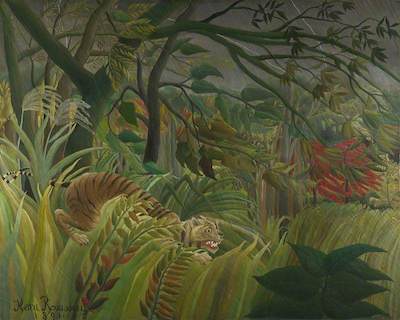
(Henri Rousseau, Surprised!, National Gallery)

As the Chinese Year of the Ox prepares to shuffle off in favour of the Year of the Tiger, more locally I have the Year of the Back – or no, that’s too downbeat, even for me. Say: the Month of the Back. Or, as I noted in my sporadically-kept diary, ‘The Back is back.’ Following in what has, unfortunately, become an irregular traditional practice—2013, 2015, 2019 and 2020—I am devoting twenty minutes each morning to putting my socks on. A schooling in patience, so to speak.

Initially, the cat looked suspicious and a little bewildered to have the Librarian preparing and serving his food—that bowl on the floor being just too far away for me—but is becoming reconciled. As is she. Probably. Perhaps.

When it comes to the serious work, though, the problem is that, like a bad toothache, a wrecked back tends to occupy the mind and resents any incursions by such brittle beasts as research or writing. But I can read more rovingly, so I do that: Mary Gaitskill, C. L. R. James, Annie Ernaux, Jane Gardam – and Byron’s Don Juan. Writing to poet-publisher James Laughlin in 1993, Guy Davenport told him: ‘I’ve been rereading (for the whatevereth time) Don Juan, which may be the funniest poem in English—certainly the greatest stylistic tour de force. It’s proof enough that God doesn’t read our books that Byron didn’t get to finish it. Juan was to have become a ranting Methodist in Yorkshire.’[1] Nearly sixty years earlier, W. H. Auden had, at the age of twenty-nine:

Just read Don Juan and I found it fine.
I read it on the boat to Reykjavik
Except when eating or asleep or sick.[2]

I remembered a brief exchange with the poet and artist David Jones that William Blissett recorded:

 ‘“Bugger old age.” 
“Is that your final word today?” 
“Yes.”’[3]

Jones lived to—almost—seventy-nine. In the half-century since his death, of course, our expectations are a little greater. (Or were, until the recent downturn, often the sign of governments with fatally wrong priorities.)

Still, physically at least, deterioration is written into everybody’s contract. A quotation was long lodged in my head from Henry Miller, which I had trouble finding, not least because, it transpires, I had the word order slightly wrong. I’m reminded now that ‘We resist only what is inevitable’ is from Miller’s 1957 Big Sur and the Oranges of Hieronymus Bosch, one of those statements that seems to shunt the reader or listener straight to the opposite or corollary statement, here, that we don’t resist what is not inevitable—and which, arguably, might be changed or averted through resistance. That would accord with the view of Miller famously presented by George Orwell in ‘Inside the Whale’, which begins and ends with Miller, to whom Orwell ascribes ‘a sort of mystical acceptance of thing-as-it-is.’ Orwell then runs through just what such acceptance includes in the mid-twentieth century—concentration camps, Hitler, Stalin, press censorship, political murders and the rest—but argues that Miller’s general attitude, nevertheless, is ‘“Let’s swallow it whole”’.[4]


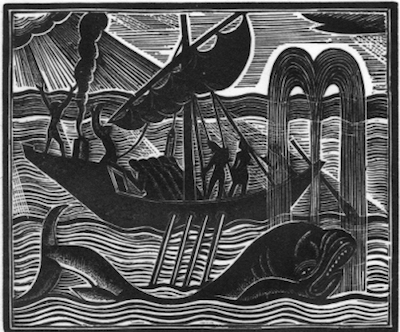
(David Jones, from The Book of Jonah
https://www.artwales.com/exhibition-mtg-en.php?locationID=184 )

Inevitability, then, most famously that of death and taxes, according to Benjamin Franklin, though my Oxford Dictionary of Quotations points to Daniel Defoe as precedent, more or less. For the rich, of course, in this country and surely many others, paying tax seems to be optional if you have that sort of moral threshold, that sort of accountant and offshore accounts already set up – but no government, however supine or conflicted, has yet managed to legislate against the Grim Reaper or to arrange loopholes for its friends.

Endings, anyway. As Annie Ernaux has it, ‘The time that lies ahead of me grows shorter. There will inevitably be a last book, as there is always a last lover, a last spring, but no sign by which to know them.’[5] And D. H. Lawrence wrote to Catherine Carswell, ‘One can tell what will happen, more or less. Some things one knows inwardly, and infallibly. But the how and the why are left to the conjunction of circumstances.’[6]

Lawrence, in fact, dwelt often on inevitability. ‘This is England. One meaning blots out another. So the mines were blotting out the halls. It was inevitable. When the great landowners started the mines, and made new fortunes, they started also their own obliteration from the English countryside. One meaning blots out another.’ And: ‘It had taken Constance a long time to accept the inevitable. The old England was doomed to be blotted out, with a terrifying absoluteness, by a new and gruesome England. It was inevitable.’[7]

This, perhaps, has a distant relative in Aldous Huxley’s pronouncement in a letter to his brother Julian a few months before the Armistice in 1918: ‘Whatever happens, we may be sure it will be for the worst. I dread the inevitable acceleration of American world domination which will be the ultimate result of it all. It was a thing that had got to come in time, but this will hasten its arrival by a century.’[8]

Patrick White’s Voss remarks that: ‘Human behaviour is a series of lunges, of which, it is sometimes sensed, the direction is inevitable.’[9] A little more positively, perhaps, ‘And yes’, Katherine Mansfield wrote to William Gerhardi in March 1922, ‘that is what I tried to convey in The Garden Party. The diversity of life and how we try to fit in everything, Death included. That is bewildering for a person of Laura’s age. She feels things ought to happen differently. First one and then another. But life isn’t like that. We haven’t the ordering of it. Laura says, “But all these things must not happen at once.” And Life answers, “Why not? How are they divided from each other?” And they do all happen, it is inevitable. And it seems to me there is beauty in that inevitability.’[10]


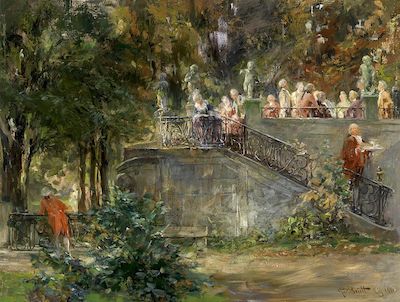
(Ferdinand Brütt, Gartenfest (1900)

There is, lastly—or firstly—the consciously literary. Ford Madox Ford wrote, in a piece on Joseph Conrad, of ‘the great faculty of this author – that he can make an end seem inevitable, in every instance, the only possible end.’[11]

More than a decade later, and returning to the subject—and the writer—at greater length, Ford wrote of ‘all that is behind the mystic word “justification.” Before everything a story must convey a sense of inevitability: that which happens in it must seem to be the only thing that could have happened. Of course a character may cry, “If I had then acted differently how different everything would now be.” The problem of the author is to make his then action the only action that character could have taken. It must be inevitable, because of his character, because of his ancestry, because of past illness or on account of the gradual coming together of the thousand small circumstances by which Destiny, who is inscrutable and august, will push us into one certain predicament.’[12]

‘One certain predicament.’ There’s a neat summary. My current predicament is, though, gradually easing. Of course, that’s a subjective assessment. Subjective? ‘This word has made considerable progress in England during the year you have been away’, Edward Fitzgerald wrote to his friend Frederick Tennyson (7 June 1840), ‘so that people begin to fancy they understand what it means.’[13]

I fancy it means that I no longer have to read Don Juan while lying on the bedroom floor.


Notes

[1] W. C. Bamberger, editor, Guy Davenport and James Laughlin: Selected Letters (New York: W. W. Norton & Co., 2007), 146.

[2] Letter to Lord Byron, in W. H. Auden and Louis MacNeice, Letters from Iceland (London: Faber and Faber, 1937), 18.

[3] William Blissett, The Long Conversation: A Memoir of David Jones (Oxford: Oxford University Press, 1981), 108.

[4] George Orwell, A Patriot After All: 1940-1941, edited by Peter Davison, revised and updated edition (London: Secker and Warburg, 2000), 86-115.

[5] Annie Ernaux, A Girl’s Story, translated by Alison L. Strayer (London: Fitzcarraldo Editions, 2020), 17.

[6] Letters of D. H. Lawrence III, October 1916–June 1921, edited by James T. Boulton and Andrew Robertson (Cambridge: Cambridge University Press, 1984), 24.

[7] D. H. Lawrence, The First and Second Lady Chatterley Novels, edited by Dieter Mehl and Christa Jansohn (Cambridge: Cambridge University Press, 1999), 366.

[8] Aldous Huxley, Letters of Aldous Huxley, edited by Grover Smith (London: Chatto and Windus, 1969), 160.

[9] Patrick White, Voss (London: Eyre & Spottiswoode, 1957), 16-17.

[10] Katherine Mansfield, Selected Letters, edited by Vincent O’Sullivan (Oxford: Oxford University Press, 1990), 250.

[11] Ford Madox Ford, ‘Joseph Conrad’, English Review (December 1911), 82.

[12] Ford Madox Ford, Joseph Conrad: A Personal Remembrance (London: Duckworth, 1924), 204.

[13] The Letters of Edward Fitzgerald, edited by Alfred McKinley Terhune and Annabelle Burdick Terhune, four volumes (Princeton: Princeton University Press, 1980), I, 250.

Communicable experience: words begin again


Sitting down to write the handful of Christmas cards we sent this year, I found myself oddly inhibited when it came to the notes I’d meant to add—mainly rallying cries or apologies for silences, distances and disappearances. Last year, so much still felt relatively new, baffling, a strangeness that could be conveyed in simple language, with an expectation of a shared response, a reciprocity. To say the same things twelve months later seemed somehow absurd; in fact, any phrase that came to mind appeared wholly banal, quite pointless. Then, too, it required too many assumptions, some quite hazardous, about people’s recent history and present circumstances. So, either a five-page letter or nothing at all – beyond best wishes for next year – hardly, when it came to it, a difficult choice.

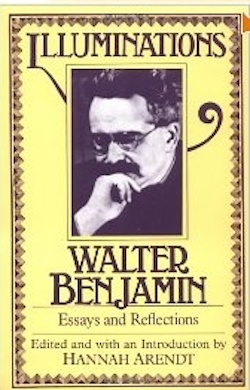
I thought of the famous observation of Walter Benjamin, ‘Was it not noticeable at the end of the [First World] war that men returned from the battlefield grown silent—not richer, but poorer in communicable experience?’ He has been discussing the loss of ‘the ability to exchange experiences’, one reason for this being that ‘experience has fallen in value.’ Our picture of both the external world and the moral world have undergone ‘changes which were never thought possible.’ He goes on:

A generation that had gone to school on a horse-drawn streetcar now stood under the open sky in a countryside in which nothing remained unchanged but the clouds, and beneath these clouds, in a field of force of destructive torrents and explosions, was the tiny, fragile human body.[1]

It’s very easy to look at this and think ah, yes, mechanized warfare, dramatic scientific and technological changes, transport and communications revolutions, all very historical, all very back then. Despite the massive volume of commentary—largely because of it, perhaps—we find it harder to grasp the speed and impact of some of the changes occurring in our own historical period, in part because as things develop and change increasingly quickly, we accommodate, allow for and absorb those changes increasingly quickly too. The internet—we fret if it takes more than a few seconds to respond to a search term. And if we should actually draw a complete blank? ‘If it’s not on the internet it doesn’t exist’—I remember an American librarian ascribing this assumption to college students who frequented the library, some ten or fifteen years ago now. We see many programmes, essays, articles devoted to the phenomenon of social media, especially the aggressive and destructive aspects of it. Were there always this many repellent people? Have they been created or merely enabled by the internet, because before it existed they would have had to write a letter, address an envelope and stick a stamp on it? Incredible advances in medicine: why do so many people reject them out of hand? Questions pretty simple, answers less so.


But Benjamin’s ‘communicable experience’? Men returned from the battlefield, even had they wished to, could rarely find the vocabulary to convey the enormity, intensity and sheer unprecedented nature of what some of them had seen, heard and suffered. That surely differs fundamentally from our situation now. These last two years, there has been a good deal of shared, or at least common, experience. Not as common as it was originally represented as being: the—sometimes literally—murderous inequalities that obtain in this country (among others) meant that, while some glided, many others crashed and burned. Still, there were elements of a society under siege which were at least recognised by most of us.

Helen Macdonald recently articulated with her usual lucidity some familiar if often inchoate thoughts, firstly about the dual speed of time, passing ‘far more slowly than it did before’ but also ‘running far too fast’, secondly with the unvarnished statement that: ‘Most of us began this pandemic thinking that life would return to normal. We all now know that this is a fiction; nothing will return to what it was before.’[2] And I nod, yes, though I’d baulk at that ‘all now know’. A lot of New Statesman readers, maybe. More broadly, I suspect the rule of division still holds sway. I see I wrote a little earlier of ‘our situation’. But once more particularised than ‘the human animal’, that ‘our’ is a little shaky.

We’re told, on an almost daily basis, that we live now in a divided country, a fractured society. The nation splits along fault lines of class or age or education or information sources. Brexit showed up the real cracks and some of the reactions to the pandemic, or measures intended to combat that pandemic, have revealed some more, frequently new pressures on earlier, still suppurating wounds—which are often, in fact, the most troubling.

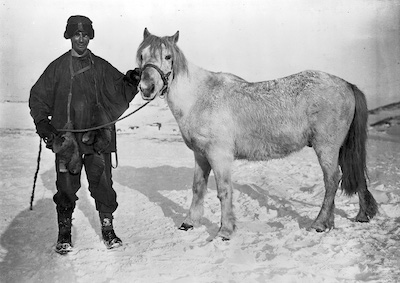
(Cherry-Garrard and pony: https://www.coolantarctica.com/Antarctica%20fact%20file/History/biography/cherry-gearrard_apsley.php

The biographer of Apsley Cherry-Garrard, a member of the Terrra Nova expedition, travelling with Scott on that doomed journey to the Antarctic in 1910, and author of The Worst Journey in the World, observes that:

Many of those who had served felt, after the war, that the world had been everlastingly divided into those who had been there, and those who had not. To Cherry that binary vision had been cast before 1914, and the war only served to polarise it further: those who had been south, and those who had not. His psyche never fully engaged with the war. It was still in the Antarctic.[3]

In a way, things were simpler in the ancient world. Herodotus lived in a world divided into Greeks and barbarians, that is to say, ‘hoi barbaroi’, the non-Greeks.[4] In more recent times, Penelope Fitzgerald’s memorable categories occur in The Bookshop: ‘She blinded herself, in short, by pretending for a while that human beings are not divided into exterminators and exterminatees, with the former, at any given moment, predominating.’[5] And predominate they do, as so much of the twentieth century and, alas, this one too, can testify. Primo Levi, who survived the death camps, later wrote: ‘Those who experienced imprisonment (and, more generally, all persons who have gone through harsh experiences) are divided into two distinct categories, with rare intermediate shadings: those who remain silent and those who speak.’[6]

Personal, temporal. A time to keep silence, and a time to speak, as Ecclesiastes has it. Anne Carson, as ever, has her own take: ‘After a story is told there are some moments of silence. Then words begin again. Because you would always like to know a little more. Not exactly more story. Not necessarily, on the other hand, an exegesis. Just something to go on with. After all, stories end but you have to proceed with the rest of the day. You have to shift your weight, raise your eyes, notice the sound of traffic again, maybe go out for cigarettes.’[7]


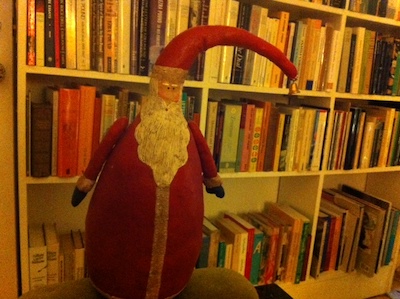
In the teeth of it all, we—we?—proceed with the rest of the day, and the words that accompany it. The rain has cleared, the sky has brightened a little. And Fat Santa has not left the building.


Notes


[1] Walter Benjamin, ‘The Storyteller: Reflections on the Works of Nikolai Leskov’ (1936), Illuminations: Essays and Reflections, edited and with an introduction by Hannah Arendt (New York: Schocken Books, 1985), 83-84.

[2] Helen Macdonald, ‘The lure of hibernation’, New Statesman (10 December 2021 – 6 January 2022), 44.

[3] Sara Wheeler, Cherry: A Life of Apsley Cherry-Garrard (London: Jonathan Cape, 2001), 189.

[4] Herodotus, The Histories, translated by Aubrey de Sélincourt, revised by John Marincola (London: Penguin Books, 1996), 3.

[5] Penelope Fitzgerald, The Bookshop (1978; London: Everyman, 2001), 29.

[6] Primo Levi, The Drowned and the Saved, translated by Raymond Rosenthal (London: Abacus, 1989), 121.

[7] Anne Carson, ‘Afterword’, in  Plainwater: Essays and Poetry (New York: Vintage, 2000), 88.

Small pleasures, wary smiles, beautiful trees

(Thomas Kyd, The Spanish Tragedy)

Tramping through the park, I mention to the Librarian that small pleasures are underrated. Her sideways glance says—or do I misread it?—‘Why then Ile fit you/ Hieronymo’s mad againe.’ I explain that I’m thinking of the scheme of the Cantos that Ezra Pound conveyed to his father in a letter of April 1927, which begins: ‘A. A. Live man goes down into world of Dead’.[1]

I’d seen this for, what, the twentieth time, more? when rereading an essay by Walter Baumann,[2] that same sentence having turned up in volumes of letters and who knows how many commentaries on the Cantos, beginnings of, progress of, schema of. ‘In another place’, I said, ‘he talks about Odysseus as a live man among duds.’[3] She eyes me warily, though she’s fairly used to this stuff. ‘It finally occurred to me’, I say, ‘the aural closeness of “dead” and “duds”. I’m just wondering if there’s any etymological connection.’ (If it were really of any interest, dozens of Pound scholars would already have noted this, of course: they probably have but I just missed it; they certainly seem to have noticed everything else. But – small pleasures. . . )
She nods. ‘The trees are looking really beautiful at the moment.’
So they are, so they are.

At home, naturally enough, I look up ‘dud’ – and the first dictionary to which I turn offers: ‘Origin unknown’; the second, ‘Middle English, of unknown origin’. Clearly, this won’t do. But here is the blessed Eric Partridge:[4] ‘dud’ is probably influenced by the 17th-20th century dialect term ‘dudman’, a scarecrow – ah, ‘but the word may derive ultimately ex Dutch dood, dead.’ His entry points to Ernest Weekley’s Etymological Dictionary of Modern English. And yes, rather wonderfully, it is that Weekley, Professor of Modern Languages at the University of Nottingham for forty years and husband of Frieda Weekley until a chap called D. H. Lawrence happened by. Weekley was compiler of this often-referred to dictionary plus many other works and lived until 1954, almost a quarter of a century after the death of the man who decamped with his wife.

(https://picturenottingham.co.uk/image-library/image-details/poster/ntgm007755/posterid/ntgm007755.html)

Small pleasures– or pleasures generally. As Emma Woodhouse explains to her puzzled father: ‘“That is the case with us all, papa. One half of the world cannot understand the pleasures of the other.”’[5]

Three calendar months too late, I remember the words of ‘the Compiler’, in Ford Madox Ford’s No Enemy: ‘And, truly, in all the gardening year – which is all pleasure except for such lets and hindrances as God decrees to you in order that you may remember that you are human – there is no pleasure to equal the pleasures of a mid-September day.’[6] Looking back in 1924 to the far side of the war, further, to the period of collaboration with Joseph Conrad, Ford wrote: ‘one got in those days those small, cheerful pleasures out of life.’[7] And, two years later: ‘there is a really sensuous pleasure in uttering a correct French sentence, as there is in eating good French cookery, the pleasures being very nearly akin.’[8] A man who took his pleasures seriously and knew their precise nature. . .

Perhaps unsurprisingly, Flannery O’Connor’s view of pleasures had, let’s say, a slightly different angle. In a 1952 letter to Sally and Robert Fitzgerald, she wrote: ‘I had to go have my picture taken for the purposes of Harcourt Brace. They were all bad. (The Pictures.) The one I sent looked as if I had just bitten my grandmother and that this was one of my few pleasures, but all the rest were worse.’[9]

(Flannery O’Connor: via https://ugapress.wordpress.com/ )

This was a woman who knew precisely where – on the scale of pleasures – biting your grandmother should be placed.

The other morning, I woke around 04:30, was joined by the cat shortly afterwards and didn’t really get back to sleep before 06:00 arrived, with Harry’s well-established expectations of breakfast. The ninety-minute interlude occasionally strayed into that area of semi-doze in which nonsense confidently presents itself as insight. And yet, and yet, somewhere there is the border, on the other side of which insight and rationality wait with bottled water, sandwiches and encouragement. Which side are you on?

DA, I found myself thinking—as in Datta, Dayadhvam, Damyata—why, those are the initials of Dante Alighieri, who is quoted on The Waste Land‘s very next page.[10]

It hardly needs saying that this is either of world-shattering importance or mere evidence of a man having trouble getting back to sleep. Obviously, I haven’t mentioned it just yet. I am waiting for the next walk – ideally, while the trees are still looking extravagantly beautiful.


Notes

[1] Letters of Ezra Pound, 1907-1941, edited by D. D. Paige (London: Faber and Faber, 1951), 285.

[2] Walter Baumann, ‘Ezra Pound and Magic: Old World Tricks in a New World Poem’, in Roses from the Steel Dust: Collected Essays on Ezra Pound (Orono: National Poetry Foundation, 2000), 29.

[3] Ezra Pound, ‘Hell’, a review of Laurence Binyon’s translation of Dante’s Inferno: Literary Essays of Ezra Pound, edited by T. S. Eliot (London: Faber and Faber, 1960), 212.

[4] Eric Partridge, A Dictionary of Slang and Unconventional English, 8th edition, edited by Paul Beale (London: Routledge, 1984).

[5] Jane Austen, Emma (1816; edited by James Kinsley, Oxford: Oxford University Press, 1990), 74.

[6] Ford Madox Ford, No Enemy (1929; edited by Paul Skinner Manchester: Carcanet Press, 2002), 116-117.

[7] Ford Madox Ford, Joseph Conrad: A Personal Remembrance (London: Duckworth, 1924), 39.

[8] Ford Madox Ford, A Mirror to France (London: Duckworth, 1926), 250.

[9] Flannery O’Connor, Collected Works, edited by Sally Fitzgerald (New York: Library of America, 1988), 895.

[10] T. S. Eliot, The Waste Land, lines 400ff and 427, The Complete Poems and Plays (London: Faber and Faber, 1969), 74-75.