Elation, Misprints, Anthony Burgess

Ink-Trade

I’ve been poring over the intended final proofs of the first issue of the Ford Madox Ford journal, looking for misprints, of course, those tiny details that are capable of provoking rage or despair in some individuals, as I’m only too aware. I’ve reacquainted myself with the well-known phenomenon of staring at a word a dozen times before noticing, at the thirteenth attempt, that a letter is missing. Still, since I’ve come close on past occasions to dismissing out of hand people who can’t spell Ford Madox Ford’s name or who jam an apostrophe into Finnegans Wake, I can hardly rule out a similar intolerance in others, potential readers of our journal.

FMF-Logo

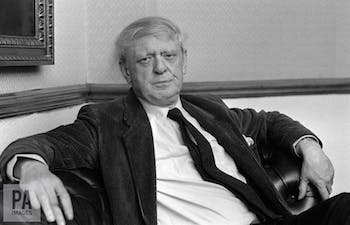
I’ve now reached the point where I tacitly assume that there will be errors in every book I read. Novels are less affected by the virus but anything with a lot of names, places and book titles is at risk. Usually, these are minor lapses, probably invisible unless you have that proofreading or editorial predilection – but not always. I’ve just been reading a highly enjoyable selection of journalism by Anthony Burgess, The Ink Trade (edited by Will Carr, Manchester: Carcanet Press, 2018) and, while ‘the playgoing pubic’ is mildly amusing, to be told that, in Gerard Manley Hopkins’ ‘The Windhover’, the word ‘buckle’ ‘resents a forceful ambiguity which is at the root of the strength of the poem’, gives me pause to frown. Resents? Presents? Represents? Interesting, anyway, to learn that, apart from Shakespeare, the two writers that have meant much to him are James Joyce – hardly a secret, that one – and Hopkins.

In any case, the book offers so many pleasures that it warrants a high degree of tolerance to such errors. There are sixty items, uncollected and several unpublished, with numerous reminders of Burgess’s energy, erudition, wit and wide-ranging enthusiasms. On censorship, Henry Miller, Nabokov, Erica Jong, A. S. Byatt, Evelyn Waugh and Malcolm Lowry; Ellmann on Wilde, V. S. Naipaul, Graham Greene and Kingsley Amis. Burgess is always readable, often provocative, generally engaging. Remembering Earthly Powers, whose main protagonist was reputedly based on, or drew upon, Somerset Maugham, it’s salutary to be reminded of Burgess’s considerable and genuine regard for Maugham’s writing. He describes Cakes and Ale as ‘a textbook of literary criticism as well as a superb novel’ and, though he proposes to modify that to ‘a superb work of fiction’, since the book may be seen as an inflated short story, he adds that some of Maugham’s stories are ‘among the best in the language.’ Of his first reading of The Waste Land: ‘I was only fifteen, and I understood very little of the poem, but I recognised that it was important. I seemed to hear a door, a long way down one of my mind’s corridors, trying to creak open but not quite making it.’ That last sentence is right on the money.

He writes often and well on Joyce, of course, is consistent in his championing of Ford—‘without doubt the greatest British novelist of the century’—offers some clear and often compelling insights into the writing of fiction (‘The problem for all fiction writers is to decide who is telling the story’), is always fascinated by language, slang, class differences in speech and pronunciation. I liked this, from an unpublished piece (a version of a speech given at the Tate in 1991): ‘I say that a thing portrays beauty when it induces a feeling of elation which is unrelated to the biological or the utilitarian. The orgasm produces elation because that is nature’s bribe to ensure the continuation of the race, even through that bribe is thwarted. The elation of health, or its recovery, or financial success, the winning of a difficult game doesn’t call into being the praise or near-worship of an artefact. The elation is probably the elation of a kind of metaphysical discovery, and that discovery is very frequently a sense of unity which only the arts can convey.’

Burgess

(Anthony Burgess via theconversation.com)

That word ‘elation’ caught my eye because it recurs in several Jonathan Williams contexts, usually when he was quoting Louis Zukofsky to the effect that the function of poetry is ‘to record & elate’ (or, on occasion, ‘to elate and record’), while Elite/Elate was the title of his 1979 Selected Poems. It’s ironic that Burgess is mentioned in a Williams essay only in a negative context: ‘In one of the Sunday papers, Mr. Anthony Burgess considered it withering and simple enough to call [Zukofsky] “a New Yorker, a Communist, a Jew, and a poet” (I think in that order)’.

Still, Burgess and Zukofsky at least have in common the valuing of ‘elation’ as a desirable effect of literature or the arts and an indispensable element in the perception of beauty.

My other recent Burgess-spotting came in my fat volume of Patrick White’s letters. Writing to Marshall Best, his American publisher, in 1970, White commented that Burgess had seemingly ruffled a gathering of Australian writers with a talk given at the Adelaide Festival, in which he asserted that, ‘A country is only remembered for its art. Rome is remembered for Vergil, Greece for Homer, and Australia may be remembered for Patrick White.’ According to the newspaper report, no one clapped. ‘How I wish I had been watching and listening at a hole in the wall’, White remarked.


Dog Days

Dog

We’ve had a dog as houseguest for the past few days while her owners disport themselves in Portugal – quite an old dog now, a little doddery and pretty set in her ways but still fine company. This means that the Librarian is rousted from her bed at an unearthly hour to share with me the joy of walking to the park before sunrise, clutching small black bags, a torch and pockets full of dog treats.

During the very hot summer of 1925, the poet Charlotte Mew spent some time in a cottage near Rye, in Sussex, with Alida Munro, the wife of Harold Monro, poet, proprietor of the Poetry Bookshop, and publisher of The Poetry Review, Poetry and Drama and The Chapbook. He also produced, at his own expense, volumes by several poets, including both Pound’s Des Imagistes and the Georgian Poetry anthologies. After his death a few years later, Pound wrote: ‘I doubt if any death in, or in the vicinity of, literary circles could have caused as much general regret as that of Mr Harold Monro’.[1] The Monros went through a succession of weekend cottages, in Essex and Hampshire as well as Sussex.[2] ‘All of them had earth closets and well-water, and had to be adapted to the needs of six dogs and a cat. Harold Monro, meanwhile, was often abroad, seeking cures for what Alida called “the enemy” though she also felt that the continent, where wine was sixpence a bottle, was “not the place to fight such a battle”.’[3]

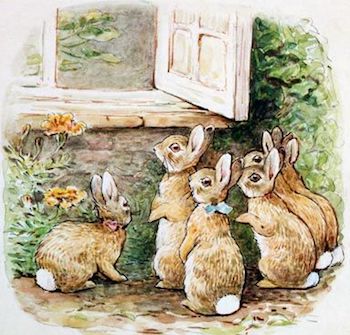
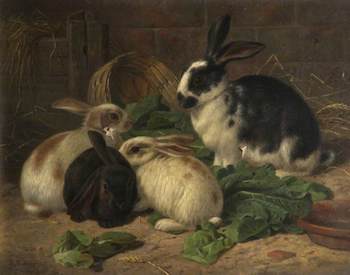
Six dogs. One, two, three. . .But this can only recall Beatrix Potter’s tale:

Flopsy-Bunnies

‘Mr. McGregor climbed down on to the rubbish heap—
“One, two, three, four! five! six leetle rabbits!” said he as he dropped them into his sack. The Flopsy Bunnies dreamt that their mother was turning them over in bed. They stirred a little in their sleep, but still they did not wake up.’

Do dogs in literature outnumber cats? A glance at the index to the Oxford Dictionary of Quotations suggests that they do – by quite a margin. Walking with dogs, hunting with dogs, playing with dogs in ways that are impossible with cats—it seems likely enough. Certainly dogs in literature, as in life, fill many roles. Roger Grenier includes one in his title, begins with a reference in his preface to Odysseus’ dog Argos—who recognises his returned master as several people who know him signally fail to do—and opens with the story of how, ‘A few years ago, whenever a tourist visited Paul Valéry’s famous oceanside cemetery at Sète and asked the caretaker to show him the location of Paul Valéry’s tombstone, the caretaker would wake up his dog and give the command, “Valéry!” Whereupon the dog, all on its own, would lead the tourist to the poet’s grave.’[4]

Familiarity with canine expressions, characteristics and perceived associations with both social classes and individuals, are also fertile ground. In Elizabeth Bowen’s The Last September, Gerald ‘turned in thought to confident English country, days like the look in a dog’s eye, rooms small in the scope of firelight, neighbourly lights through trees.’[5] In Henry Green’s novel Nothing, Mrs Haye considers whether it would not be kinder to have Ruffles, the old, blind dog, put down: ‘Yet he had been such a good servant, for ten years he had barked faithfully at friends. And the only time he had not barked was when the burglars had come that once, when they had eaten the Christmas cake, and had left the silver.’ Almost immediately afterwards, when the aged retainer William comes in, ‘carrying one of the silver inkstands as if it had been a chalice’, the same sentiments are rehearsed. William is so old and feeble that he can barely do his share of the work. ‘But what could one do? He had served her for years, he had been a most conscientious servant, and it was only the night when the burglars did come that he had been asleep. However, they had only eaten the Christmas cake, they had left the silver.’[6]

Kipling-TSAD

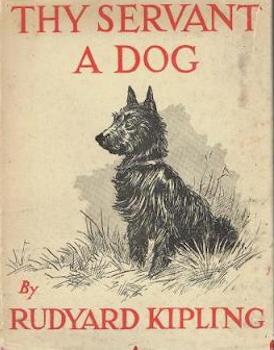
‘Thou good and faithful servant’. Rudyard Kipling made good use of dogs in several of his stories while the 1930 volume, Thy Servant a Dog, contained three stories told from the dogs’ point of view. Collected Dog Stories (1934) gathered them all.

In Somerset Maugham’s Of Human Bondage, Norah claims not to believe in churches and parsons but accepts God, not believing that he ‘minds much about what you do as long as you keep your end up and help a lame dog over a stile when you can.’[7]

Just so, Ford Madox Ford remembered his grandfather, the painter Ford Madox Brown, ‘laying down a rule of life for me. He said: “Fordie, never refuse to help a lame dog over a stile. Never lend money: always give it. When you give money to a man that is down, tell him that it is to help him to get up; tell him that when he is up he should pass on the money you have given him to any other poor devil that is down. Beggar yourself rather than refuse assistance to any one whose genius you think shows promise of being greater than your own.”’ Ford adds: ‘This is a good rule of life. I wish I could have lived up to it.’[8]   To a surprising degree, he did.

Then too, while authorial comment may be frowned upon, a fictional dog can be persuaded to stand in for its creator. In Patrick White’s story, ‘A Cheery Soul’, the dreadful Miss Docker, so noisily ‘doing good’ all over the place, in fact does immense harm. But when, at the end of the story, she tries to attract a blue cattle-dog, offering to allow it ‘every licence’ if it will come home with her, ‘the dog turned, and lifted his leg on the suppliant, and walked stiffly off.’[9] I think ‘stiffly’ is the indispensable word there.

Our period of stewardship ends soon. There will no longer be the unwavering scrutiny of my every move in the kitchen; urination and defecation will not be quite so prominent in my thoughts; I shall feel a little disorientated for a while, leaving the house without reaching for the dog’s lead, the bags and the treats; and the Librarian will stay in bed a little longer.

 
References

[1] Ezra Pound, ‘Harold Monro’ (1932), in Polite Essays (1937; New York: Books for Libraries Press, 1966), 3.

[2] Joy Grant, Harold Monro and the Poetry Bookshop (Berkeley: University of California Press, 1967), 209.

[3] Penelope Fitzgerald, Charlotte Mew And Her Friends (1984; London: Flamingo, 2002), 209.   Fitzgerald tried for years to interest a publisher in a book on The Poetry Bookshop but never succeeded in doing so.

[4] Roger Grenier, The Difficulty of Being a Dog (Chicago: University of Chicago Press, 2002), vii, 1.

[5] Elizabeth Bowen, The Last September (1929; Collected edition, London: Jonathan Cape, 1948), 123.

[6] Henry Green, Nothing (1950; in Nothing, Doting, Blindness, London: Vintage Books, 2008), 382-383.

[7] Somerset Maugham, Of Human Bondage (Harmondsworth: Penguin Books, 1969), 318.

[8] Ford Madox Ford, Ancient Lights and Certain New Reflections (London: Chapman and Hall, 1911), 197-198.

[9] Patrick White, The Burnt Ones (Harmondsworth: Penguin Books, 1968), 188.


Not turning away for solace

dhw_flyer

https://www.bristolferry.com/trips/DHW/

 I was thinking, as you do, about solace – to comfort in distress, to console or allay. Not really a word you bump up against on a daily basis, though individuals working with the bereaved or the clinically depressed may meet it or send it out into the world rather more frequently. I tend to connect it with the poem by Delmore Schwartz—‘All of us always turning away for solace/ From the lonely room where the self must be honest,/ All of us turning from being alone’—though in truth I always liked the title more than the poem itself. In his introduction to Schwartz’s work, Douglas Dunn quotes John Berryman’s Dream Song #150; and I’d forgotten that there is not one but a sequence of more than a dozen consecutive Dream Songs which are elegies for Schwartz, who died alone in a New York hotel room in 1966. [1]

Delmore-Schwartz

(Delmore Schwartz)

Solace as consolation, then, which I’ve found in two contrasting situations just lately. This in the midst of national and international news which continues dark and darker. Along with millions of other people, we watched in horrified fascination the spectacle of the Senate judiciary committee hearing, admiring Dr Christine Blasey Ford’s courage while wondering aloud and often how a man who was behaving like that could ever have been considered a suitable candidate for the highest court in the land. O America!

But quickly to the solace—although, briefly detained by the thought of pessimism (Latin, pessimus, worst) and his sibling, optimism, I find a note from a William Gerhardie novel: ‘Our spacious pessimism, what is it? The squeal of a puppy. Life hurts, and then the night is starless, the world a desolating void where the wind groans and mutters and complains in our echo. But we go on, amazed, a little puzzled, inert, day-dreaming and unquestioning.’[2] I recall reading, more recently, a note to one of Patrick White’s letters which mentioned, admiringly, Charles Manning Clark, author of the standard history of Australia (in six volumes). Introduced to White about 1960, Manning Clark later told David Marr, the editor of White’s letters (also his biographer) that he was struck by the hunger on White’s face, ‘a hunger for forgiveness in a man who places himself, through his pride and pessimism, beyond the reach of forgiveness.’[3]

guildofhandicraft-silk-mill

(Guild of Handicraft at the Silk Mill)

http://www.chippingcampdenhistory.org.uk/content/new-contributions/c_r_ashbee

William Faulkner succinctly defined optimism by running a track through its supposed opposite: ‘Miss Jenny, being a true optimist—that is, expecting the worst at all times and so being daily agreeably surprised’.[4] More poignantly, looking back to the early years of the twentieth century and the removal of the Guild of Handicraft from the East End of London to a small market town in Gloucestershire, which thus became a centre of Arts and Crafts activity, Fiona MacCarthy writes: ‘The years of the Guild of Handicraft in Chipping Campden were something unique in the life of England. There had been experimental communities before but very few as large and as coherent as this one. It was an episode of unusual conviction, in its emphasis on aesthetic excellence and in its creation of a special kind of life-style, and in many ways it was a swan-song: such extraordinary optimism never came again.’[5]

The simple life—connects, in a way, with one of those positives. ‘I booked us on this’, the Librarian emailed me, briefly and to the point. ‘This’ was part of the Docks Heritage Weekend, a tour of the floating harbour aboard a Bristol ferry. There was ‘an authentic soundscape’, created from interviews with former dock workers, part of an oral history project, run by Amy King of the University of Bristol, and the audio was presented in conjunction with a superb shadow puppet show. The place was packed with both children and adults who, without benefit of box sets, flashing lights, virtual reality goggles or state of the art electronic devices, were thoroughly engaged—and many of them transfixed—by some recorded voices and puppets moving behind a screen, augmented by a pause at the pub for drinks and sea shanties.

River-2

The day before that, I spent three hours in a busy emergency department—a precautionary visit, as it turned out—and, perhaps paradoxically, my time there was also restorative and curiously therapeutic. I had the advantage of the Librarian’s company together with the knowledge that my symptoms had receded very quickly: so I was at liberty to lie on the bed and watch and listen until the blood test results came back. Unsurprisingly, a lot of the patients there were very ill; a couple of those wheeled past were pretty obviously homeless people, who may have collapsed in the street or been referred by a concerned passer-by, while a morbidly obese woman, in evident pain, required the attentions of eight staff at one stage. Yet they all—doctors, nurses, porters, the man filling the paper towel dispenser and emptying the bins—went about their business so professionally, so composedly and efficiently, and with such good humour where appropriate, that it was curiously calming. Solace, yes.

It is in fact in Dream Song #150 that the word occurs, in the stanza that Dunn quotes:

I’d bleed to say his lovely work improved
but it is not so. He painfully removed
himself from the ordinary contacts
and shook with resentment. What final thought
solaced his fall to the hotel carpet, if any,
& the New York Times’s facts?[6]


References

[1] Delmore Schwartz, ‘All of Us Always Turning Away for Solace’, What Is To Be Given: Selected Poems (Manchester: Carcanet Press, 1976), 28; Douglas Dunn, ‘Introduction’, viii.

[2] William Gerhardie, The Polyglots (1925; revised edition, London: MacDonald, 1970), 172.

[3] Patrick White, Letters, edited by David Marr (London: Jonathan Cape, 1994), 262fn.

[4] William Faulkner Flags in the Dust (1929), in Novels 1926-1929, edited by Joseph Blotner and Noel Polk (New York: Library of America, 2006), 716.

[5] Fiona MacCarthy, The Simple Life: C. R. Ashbee in the Cotswolds (London: Lund Humphries, 1981), 90.

[6] John Berryman, The Dream Songs, collected edition (New York: Farrar, Straus and Giroux, 1969), 169.


Pound Punning on Talbot

CloisterWalkLacock-NT
(Lacock Abbey cloisters: National Trust)

On 30 September 1920, in a letter to his father Homer, Ezra Pound reported that he and his wife Dorothy had spent four days at Lacock Abbey, ‘14th century cloisters , charter of Henry III left there in 1225 still in the tower room, etc. Family name Talbot, vide works of Wm. Shx. et al. Got a little tennis, etc.’[1]

Talbot-2

In October 1945, Pound sent two extracts from the Pisan Cantos to Dorothy, one of them from ‘To watch a while from the tower’ to ‘attic rafters’.[2] ‘“My aunt took me there a couple of times”, Dorothy told Hugh Kenner in 1965, “and once Ezra and I crawled over the roof to a turret to see a copy of the Magna Charta, kept there in a glass case. Cousin Charles left the place to his niece, a Scotswoman named Maud Gilchrist-Clark on condition she take the name Maud Talbot.”’

The emblem of the Talbot family was a dog: Kenner mentioned that Omar Pound possessed ‘a beautiful gold seal of the Talbots’, once owned by Dorothy’s father, ‘their dog emblem both as handle and in imprint.’[3]

Maud Gilchrist-Clark needed to sell some valuable possessions to raise the funds necessary to maintain the property (‘more pictures gone to pay taxes’ and, in 1944, she presented the Lacock copy of the Magna Charta to the British Museum. She gave the abbey to the National Trust in the same year.

Talbot

Canto 80 is always, for me, the English canto, certainly in its last two-thirds. Of the lines just quoted, Donald Davie writes that here is part of what Pound loved in Dorothy, and that his ‘feelings for and about England were, right to the end, not much less tormented than any English reader’s can be.’ He adds that, ‘the English reader who does not understand that the punning on “Talbot” is painful and all but hysterical, like the punning of Shakespeare’s Hamlet, does not understand Pound at all.’[4]

‘All but hysterical’? Yes, perhaps, it’s like the riff on similar-sounding words that we play with just a little too long; and, certainly, some of those rhymes, almost doggerel-like, are unusual for Pound in the context of the Cantos. Yet, rhyme, particularly simple, declarative monosyllables, often serves as a mnemonic device. Rhymed poetry is generally easier to recall than unrhymed. And here? Out and doubt, nation’s and patience, slide and hide, the tangle of Talbots and tall butts, left it and cleft it. But then the whole canto is ‘about’ memory, as is the whole Pisan sequence (to pause at that boundary).

Pound had lived through an extraordinary twenty years, more, since he left England, first for Paris, then Rapallo. Yet England, his time in England, was ineradicable, inescapable. He arrived in 1908, young, derivative, inexperienced; he left as the author of Cathay, Homage to Sextus Propertius, Hugh Selwyn Mauberley and the early Cantos. He had met and married Dorothy Shakespear in London. He was centrally involved in Imagism and Vorticism. He had known, encouraged or learned from almost every writer of importance then at work there, spending three winters in Ashdown Forest with Yeats, consulting with Ford over the latter’s Collected Poems and his book on Henry James, close to Wyndham Lewis and Henri Gaudier-Brzeska. How could England not have lodged in his body and mind, impossible of removal?

In early 1946, Dorothy wrote to him from Rapallo and mentioned a book by Douglas Goldring – this was South Lodge: Reminiscences of Violet Hunt, Ford Madox Ford and the English Review Circle (1943). His biography of Ford would not emerge for a couple more years. In April, Pound wrote to Eileen Lane Kinney from St Elizabeths: ‘Weeping over Goldring’s memoir “South Lodge.”’ He said it brought back his ‘jeunesse, 1908-1920 à Londres. An honest book in a flurried world.’[5] And Charles Olson recorded: ‘Goldring’s SOUTH LODGE, on Yeats, Pound, Ford. P: “It was the high period of my life . . . . (or something like that, a sort of apology for his sentimentality about it, as he is reading it).’[6]

The copy of the Magna Charta given by Maud Talbot to the British Museum was sent to Washington as part of an exhibition while both Pound and Dorothy were there. It was not then ‘still there if you climb over attic rafters’. Its still being there was, perhaps, the crucial point: continuity, a fixed point, however specific or even personal, in a world—quite literally, to a considerable extent—blown to pieces: ‘and God knows what is left of our London/ my London, your London’. Earlier in the sequence, the poet identified himself ‘As a lone ant from a broken ant-hill/ from the wreckage of Europe, ego scriptor’ (76/458) and in the same canto, asked: ‘and who’s dead, and who isn’t/ and will the world ever take up its course again?’ (76/453).

Unanswerable questions – or answers that won’t keep still for the space of a single heartbeat. Pound’s own final answer was, essentially, silence.


References

[1] Ezra Pound to His Parents: Letters 1895–1929, edited by Mary de Rachewiltz, David Moody and Joanna Moody (Oxford: Oxford University Press, 2010), 471. Pound must be referring to Henry VI, Part I, which features Lord Talbot, afterwards Earl of Shrewsbury, and his son, John.

[2] Omar Pound and Robert Spoo, editors, Ezra and Dorothy Pound: Letters in Captivity, 1945-1946 (New York: Oxford University Press, 1999)101, 100-101fn.2.

[3] Hugh Kenner, ‘D. P. Remembered’ (1973), reprinted in Mazes (Athens: University of Georgia Press, 1995), 292-293. The essay mentions ‘a magnificent old abbey in Yorkshire’, when Wiltshire is meant. I assume this error was also in the original Paideuma piece but can’t lay hands on my copy just now to check that. The Talbot Magna Charta was not the original 1215 version but that of 1225, technically ‘An Exemplification of Henry III’s reissue of Magna Carta, 1225’, as Carroll F. Terrell explains: see A Companion to The Cantos of Ezra Pound, one-volume edition (Berkeley: University of California Press, 1993), 447.

[4] Donald Davie, ‘Ezra Pound Abandons the English’, reprinted in Studies in Ezra Pound (Manchester: Carcanet Press, 1991), 234.

[5] Ezra and Dorothy Pound: Letters in Captivity, 243, 242n.

[6] Charles Olson and Ezra Pound: An Encounter at St. Elizabeths , edited by Catherine Seeley (1975; New York: Paragon House, 1991), 86.


Making space, taking space

Parking

The round trip to the baker—one of the bakers—takes around an hour. I walk on the long back road, on the shaded side if the weather’s warm. The black and green boxes are out on the pavement, which triggers an odd memory. In 2011 there was a referendum on the alternative vote, following what one commentator termed a ‘bad-tempered and ill-informed public debate’.[1] The vote went not as I’d hoped but more or less as I’d expected. At some point, walking along a pavement crowded with recycling boxes and looking at the state of them, I remember thinking that, if so many people had such problems sorting out their rubbish, they were not that likely to explore the intricacies of competing voting systems.

Skip forward five years and you might say that the phrase ‘bad-tempered and ill-informed public debate’ was still serviceable, though barely. Skip forward two more and I’m edging my way through parts of the city, thinking of the word ‘space’, ‘the final frontier’ as the first speech of every episode of Star Trek had it, recalling too how Charles Olson begins Part One of Call Me Ishmael: ‘I take SPACE to be the central fact to man born in America, from Folsom Cave to now. I spell it large because it comes large here. Large, and without mercy.’[2]

By way of contrast, space is mercilessly shrinking here as local government, starved of funding and agency, falls and fails. Private intrusion into public spaces; not only roads but pavements too now given over to cars, which block pedestrian pathways; neglected bushes and hedges jutting out onto pavements already littered with bins and boxes. No room for an Olson.

PNR

Opening the latest issue of PN Review, I see a review by Ian Brinton—reviews editor of Tears in the Fence (https://tearsinthefence.com/blog/ )—of Chris Torrance’s The Magic Door and Brinton begins by quoting precisely those words from Call Me Ishmael: ‘I take SPACE to be the central fact to man born in America . . .’ They are, he writes, ‘central to an understanding of the wide-ranging poetry written by Chris Torrance, British poet who was born in Edinburgh, raised in Surrey and who moved to an isolated cottage in the Upper Neath Valley in South Wales nearly fifty years ago’. The names cited in the course of his review include Iain Sinclair, Lee Harwood, Roy Fisher and Barry MacSweeney, and Brinton closes by quoting a letter from Torrance, who recalls how he ‘grabbed onto Olson mid-60s’ and concludes: ‘I’ve kept at Olson ever since. I love to take the big books outside in the summer, read those wide poems out in the open where they belong.’[3]

torrance_citrinas1

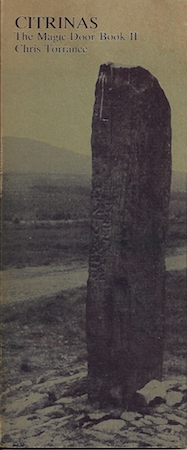
I’d quite lost track of Torrance yet, without moving from my desk, I can just reach a tall, slim volume, Citrinas, published in an edition of 300, ‘of which 15 are casebound and contain additional holograph material.’ In fact, I see it’s signed, with a personal inscription – though not to me.

the birds are lost, out of sight
though the food goes, mysteriously,
invisibly, except when the imperious jay,
flashing electric blue & snowy white,
with immense black mustachios
over his olive-smoked sheath
picks up crushed oats[4]

Remembered impressions I have are of landscape, place, the natural world, the mystery of things, prompting the thought of Pound writing—in an essay first published in Quest, edited by G. R. S. Mead, leading Theosophist and founder of the Quest Society—‘We have about us the universe of fluid force, and below us the germinal universe of wood alive, of stone alive.’[5]

In fact I have a little more Torrance in-house, a dozen pages in the anthology edited by Iain Sinclair:

straight from sleep
to chase sheep from the garden
a bloody, dead blackbird on the doormat
’mid thousands of feathers & catspew
the world jumps
from this to that
to break the ennui
of my own tense control
all goes into the melting pot of acid
over the hill kicking a dead lambskin
what to do with all this energy, lambent, unreconciled
an atmosphere almost of terror
the planet helpless with mirth
gold coins rolling in the streets
the skylark’s interminable raga
borne aloft on shivering wings[6]

These are early poems, several dated 1970-1971, at the beginning of the poet’s time in Wales. When this anthology appeared (1996), five books of The Magic Door had appeared. The recently published volume that Brinton is reviewing apparently represents eight books in all, reaching back over forty years.

A launch event for The Magic Door is announced on the Test Centre website: Wednesday 4 October, 7 pm, Swedenborg House, where Torrance will be joined by Iain Sinclair and Allen Fisher. The author’s afterword to this edition, quoted on the website, includes the statement that, ‘With this collected volume, I am only halfway through.’

A life’s work, then. At least. . .

See: (https://testcentre.org.uk/magic-door/ )


References

[1] Iain McLean, ‘“England Does Not Love Coalitions”: The Most Misused Political Quotation in the Book’, Government and Opposition: An International Journal of Comparative Politics, 47, 1 (2012), 10.

[2] Call Me Ishmael, in Charles Olson, The Collected Prose, edited by Donald Allen and Benjamin Friedlander (Berkeley: University of California Press, 1997), 17. As in Moby Dick itself, this ‘beginning’ is preceded by a prologue, here ‘First Fact’.

[3] Ian Brinton. ‘Reading in the Open Air’, PN Review 243 (September-October 2018), 78, 79.

[4] Chris Torrance, Citrinas: The Magic Door, Book II (London: Albion Village Press, 1977), unpaginated: this is ‘Retreat’, from the book’s first section.

[5] Ezra Pound, The Spirit of Romance (1910; New York: New Directions, 1968), 92. The essay, ‘Psychology and Troubadours’ became Chapter V of this book.

[6] Chris Torrance, ‘Straight from Sleep’, in Iain Sinclair, editor, Conductors of Chaos: A Poetry Anthology (London: Picador, 1996), 453.


Gammon and spinach. Ha!

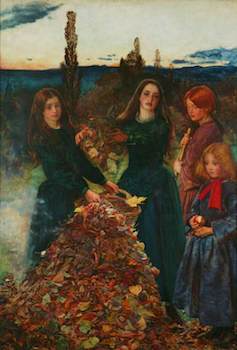
Millais, John Everett, 1829-1896; Autumn Leaves

(John Everett Millais, Autumn Leaves, 1856: Manchester Art Gallery)

Autumn Leaves. Autumn, on the contrary, now definitely arrives in a flurry of contradictory weather, though, really, we need to borrow the American term, ‘fall’.

‘Let us stop this war’, Edmund Blunden wrote, ‘and walk along to Beaucourt before the leaves fall. I smell autumn again.’[1]

‘But, my Marguerite, how strange it all is!’, Colette wrote to her friend Marguerite Moreno, ‘I have the fleeting confidence of people who fall out of a clock tower and for a moment sail through the air in a comfortable fairy-world, feeling no pain anywhere . . . ’[2]

‘What are the chances’, the Librarians wonders aloud, ‘of an adult standing up and saying: This Brexit business was a terrible, terrible idea, which everyone surely realises by now, if they didn’t know already. So let’s just scrap the whole thing.’ Not good, I think, the chances are not so good. I recall the note I came across a few days ago, from a William Faulkner novel: ‘They all talked at once, their voices insistent and contradictory and impatient, making of unreality a possibility, then a probability, then an incontrovertible fact, as people will when their desires become words.’[3]

Magpie

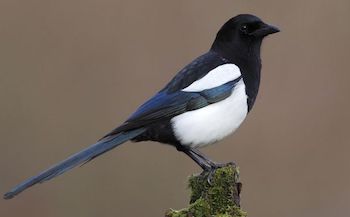
I was also remembering the magpies in the park last week. It began with an evident squabble between two birds, who kept fluttering a few feet off the ground, jabbing at one another and coming to earth again: a couple of minutes later, they were racing around above my head, one obviously pursuer and one pursued but keeping only inches apart, however abruptly the lines of their flight paths veered and soared. But the most striking thing was the way in which the dispute spread and the speed at which it did so: at least two more pairs were scuffling with one another almost immediately, while more and more magpies kept arriving, then gathered in groups of three or four in the branches of surrounding trees. And all the while, their distinctive chatter, more than twenty of them by the end, scattered over four or five locations. They all had something to shout about, they all insisted on outshouting others and weren’t above getting physical if they disagreed.

Doctor-maggotty

I stood on the path for a good ten minutes, thinking: magpie Brexit? In Beatrix Potter’s The Tale of the Pie and the Patty-Pan, the local doctor is a magpie by the name of Dr Maggotty. He has the disconcerting habit of shouting ‘Gammon!’ or ‘Spinach!’ and, ultimately, ‘Gammon and spinach! Ha ha HA!’ Why does that last ejaculation oddly suggest a sly commentary on our current political woes?

Still, I’ve always liked magpies and been impressed by their acumen, as well as the wealth of folklore and superstition associated with them. Patrick White’s biographer reveals that, by the end of his second year at university, White realised that he didn’t have ‘a scholar’s mind’ and wouldn’t get a brilliant degree. ‘This discovery hurt him at first’, Marr writes, ‘and he was nagged by a sense of intellectual inadequacy until he came to see that he had another kind of intelligence, a “magpie mind” that found ideas as he needed them and seized any image that caught his eye.’[4]

Magpies-Bagpipe

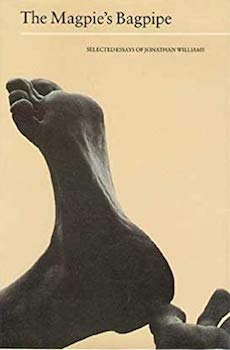
Then, very recently, in the Jonathan Williams festschrift I was reading, I came across the writer and folklorist Gary Carden’s remark that, over the years, he had ‘often searched for a fitting icon or symbol’ for Williams. Carden focused on Williams’ ability to perceive talent and to spot what others missed. ‘Finally, I can pick my icon’, Carden announced. ‘Jonathan is a magpie!’ He wrote of watching a magpie stalking through a landfill site and extracting something that caught his eye, to carry home and give it ‘a choice setting’, while Williams, he added, did much the same thing, having ‘waded through the wreckage of our culture’, sometimes finding ‘the real thing’.[5]

Indeed, Williams published his first book of essays under the title of The Magpie’s Bagpipe (1982) – and the avian theme continued with his second essay collection, Blackbird Dust (2000).

‘Gammon and spinach! Ha ha HA!’ Hold that thought. I am certainly holding that thought.

 
References

[1] Edmund Blunden, Undertones of War (1928; Harmondsworth: Penguin, 1982), 90.

[2] Letter of 11 June 1925: Letters from Colette, selected and translated by Robert Phelps (London: Virago Press, 1982), 90.

[3] William Faulkner, The Sound and the Fury (1929), in Novels 1926-1929, edited by Joseph Blotner and Noel Polk (New York: Library of America, 2006), 967.

[4] David Marr, Patrick White: A Life (London: Vintage, 1992), 128.

[5] Gary Carden, ‘The Bard of Scaly Mountain’, in Jeffery Beam and Richard Owens, editors, Jonathan Williams: The Lord of Orchards, (Westport: Prospecta Press, 2017), 49.


That terrible word ‘genius’

Gimme-Shelter

(Image from the website called, yes, www.genius.com )

Listening again to the opening riff of the Rolling Stones’ Gimme Shelter, I think: ‘This is genius’. Coming up to fifty years ago—it was the opening track on Let It Bleed (1969)—Keith Richards playing an open tuning on a Maton EG240 Supreme, which he was ‘looking after’ for a friend. It sounded great, Richards said, although, on the very last note of Gimme Shelter, ‘the whole neck fell off. You can hear it on the original take.’ (www.guitarworld.com) If your guitar needs looking after, leave it with Keith.

‘This is genius’. If that statement doesn’t conjure up the phrase, ‘Excellency, a few goats’, you probably don’t spend a disproportionate amount of your time on such curious characters as Ford Madox Ford and Joseph Conrad. Ford is writing here of himself in the third person: ‘But no sooner had he got the words on the paper than Conrad burst into one of his roars of ecstasy. “This,” he shouted when he was in a condition to speak, “is genius!” And out of breath, exhausted and rolling on the sofa, he continued to gasp, “Genius I … This is genius…. That’s what it is. Pure genius…. Genius, I tell you!” The writer agreed that it was genius—for the sake of peace!’[1]

Romance

The occasion for this outburst was Ford’s reading to his collaborator a sentence written ‘in a quite commonplace frame of mind’, to ‘provide an obscure Lugareño [local, villager] with a plausible occupation’ – the man is being interrogated by the judge as to how he makes his living – hence the reply: ‘“Excellency—a few goats. . . . ”’[2] In Ford’s telling, Conrad recurred to this example of writerly precision and concision with great frequency for years afterwards.

goats
http://www.bristol.ac.uk/policybristol/policy-briefings/sheep-and-goat/

‘Genius’ – or, as Ford termed it elsewhere, ‘that terrible word “genius”’. He had, after all, come out of ‘the hot-house atmosphere of Pre-Raphaelism where I was being trained for a genius.’[3] Fondly recalling his grandfather once more, forty years after Ford Madox Brown’s death, he wrote: ‘He was, I imagine, the best, the most honorable, the most generous, and the most optimistic of men. For him all geese were swans and all his children and grandchildren geniuses. That was what he asked of life—and to be allowed to go on working.’[4]

Terrible the word may have been but it recurs with striking frequency in Ford’s work (and the work of a great many others too, it’s only fair to add). It certainly did the rounds of the circle of fellow-writers with whom Ford was more usually associated. In 1913, he would note Henry James’s application of the phrase ‘the beautiful genius’ to Ivan Turgenev; in 1927, he would apply the same phrase to Stephen Crane and also referred to Conrad in just that way.[5]

Brett, Dorothy Eugenie, 1883-1977; D. H. Lawrence

(D. H. Lawrence by Dorothy Brett © National Portrait Gallery, London. Photo credit: National Portrait Gallery, London)

D. H. Lawrence too found himself in the firing-line. In ‘Autobiographical Sketch’, he recalled showing the manuscript of his first novel, The White Peacock, to Ford, who read it immediately. ‘And in his queer voice, when we were in an omnibus in London, he shouted in my ear: “It’s got every fault that the English novel can have.”’ Lawrence remarks that, ‘Just then the English novel was supposed to have so many faults, in comparison with the French, that it was hardly allowed to exist at all. “But,” shouted Hueffer in the ’bus, “you’ve got GENIUS.”’ Lawrence goes on to say that, ‘This made me want to laugh, it sounded so comical. In the early days they were always telling me I had got genius, as if to console me for not having their own incomparable advantages.
‘But Hueffer didn’t mean that. I always thought he had a bit of genius himself.’[6]

So did Ford’s friend Olive Garnett, who unleashed the offending word in a diary entry of March 1892. Commenting on a man named Henry Cecil Sturt, who worked at the British Museum, she wrote: “I couldn’t help contrasting him & Ford & the two arguments. He representing solid worth, clear & elaborate construction; Ford, unreliability, inaccuracy &—genius . . . ’[7]

Ezra Pound seemed not to have any problem with the word, writing home in 1908: ‘You have my hearty sympathy for having possibility of genius in the family but I suppose it cant be helped.’[8] And he would supply a lucid enough explanation for that quality in the Roman poet Propertius:

Yet you ask on what account I write so many love lyrics
And whence this soft book comes into my mouth.
Neither Calliope nor Apollo sung these things into my ear,
My genius is no more than a girl.

The poet goes on to enlarge upon this:

Cynthia

If she with ivory fingers drive a tune through the lyre,
We look at the process.
How easy the moving fingers; if hair is mussed on her forehead,
If she goes in a gleam of Cos, in a slither of dyed stuff,
There is a volume in the matter; if her eyelids sink into sleep,
There are new jobs for the author;
And if she plays with me with her shirt off,
We shall construct many Iliads.
And whatever she does or says
We shall spin long yarns out of nothing.[9]

Towards the end of his life, Ford specified one danger of using the word in connection with writers: ‘Really to account for how Jane Austen and Richardson achieved their masterpieces one has to resort to the very dangerous expedient of saying that they must have been natural geniuses. That is dangerous because once you make the concession the whole cry of hounds of the professorio-academic pack will be on your back, shouting: “You see, when it comes to real works of art this fellow has to admit that they can only be produced autochthonously—by writers and others who follow no traditions and know no aesthetic law.” With the corollary that artists who do follow traditions and aesthetic rules are dull fellows whom nobody loves.’[10]

Danger, genius at work! Yes, explanations are not always forthcoming or particularly helpful when they do arrive. Hugh Kenner remarks that ‘the biographer’s is the tested American strategy for doing something about unassimilable phenomena like Howard Hughes and literary genius.’[11] The dictionary can help with that one – ‘assimilable’: able to be taken fully into the mind; or made similar; or received and accepted fully into a group.

With this word in mind, I circle back to Lawrence, who had his faults but also, we remember, genius. Here he is, writing in 1921: ‘The moment has come when America, that extremist in world-assimilation and world-oneness, is reacting into violent egocentricity, a truly Amerindian egocentricity. As sure as fate we are on the brink of American empire.’[12]

Ah, on the brink. Yes, we’ve all been there, I think.


References

[1] Ford Madox Ford, Joseph Conrad: A Personal Remembrance (London: Duckworth, 1924), 147.

[2] Ford Madox Ford and Joseph Conrad, Romance: A Novel (London: Smith, Elder & Co., 1903), 395.

[3] Ford Madox Ford, Ancient Lights and Certain New Reflections (London: Chapman and Hall, 1911), 101, 195. The terrible word appears on at least thirty pages of the book.

[4] Ford Madox Ford, ‘Pre-Raphaelite Epitaph’, The Saturday Review of Literature, X, 27 (20 January 1934), 418.

[5] Ford Madox Ford, Henry James: A Critical Study (London: Martin Secker, 1914), 10; New York Essays (New York: William Edwin Rudge, 1927), 21; Joseph Conrad, 32.

[6] D. H. Lawrence, Phoenix II: Uncollected, Unpublished and Other Prose Works by D. H. Lawrence, Collected and Edited with an Introduction and Notes by Warren Roberts and Harry T. Moore (London: William Heinemann, 1968), 593, 594.

[7] Olive Garnett, Tea and Anarchy! The Bloomsbury Diary of Olive Garnett, 1890-1893, edited by Barry C. Johnson (London: Bartletts Press, 1989), 71.

[8] Ezra Pound to His Parents: Letters 1895–1929, edited by Mary de Rachewiltz, David Moody and Joanna Moody (Oxford: Oxford University Press, 2010), 125.

[9] ‘Homage to Sextus Propertius’ (V, ii), Ezra Pound: Poems and Translations, edited by Richard Sieburth (New York: Library of America, 2003), 534.

[10] Ford Madox Ford, The March of Literature: From Confucius to Modern Times (London: Allen & Unwin, 1939), 595-596.

[11] Hugh Kenner, ‘Literary Biographies’, in Historical Fictions (Athens: University of Georgia Press, 1995), 47.

[12] D. H. Lawrence and Italy (London: Penguin Books, 1997): Sea and Sardinia, 91.


Jonathan Williams: The Lord of Orchards

JW-Lord

A little late to the party but hugely glad to finally arrive, I’ve been immersed in Jonathan Williams: The Lord of Orchards, edited by Jeffery Beam and Richard Owens.[1] This ‘memorial festschrift’ briefly brought to mind an earlier example, Madeira & Toasts for Basil Bunting’s 75th Birthday, edited by Williams himself, which gathered prose and poetry (and illustrations and music) from almost a hundred writers and artists, published by the Jargon Society and with a cover (a pastel portrait of Bunting) by R. B. Kitaj. But none of those contributions was more than three pages long and most were less than a page, whereas this book of ‘essays, images, and shouts’ (xiv) is not only a good deal heftier, not far short of 500 pages, but also includes substantial studies of several aspects of Williams’ life and work, and is thus perhaps more reminiscent of the ‘Person and Poet’ series of often ground-breaking volumes produced by the National Poetry Foundation (https://personandpoet.wordpress.com/ ).[2]

‘Heft’ is an apposite word, in fact, with its cluster of meanings, some obsolete or archaic, some dialect, ‘weight’, ‘ability or influence’—and one alternative reading ‘a number of sheets fastened together: an instalment of a serial publication.’ Apposite for Jonathan Williams, to be sure. Polumetis—‘many-minded’, versatile—was one of the stock epithets for Odysseus, which Ezra Pound took over and lavished also upon Sigismondo Malatesta; and Williams possessed, and displayed, that versatility in spades, a versatility not only of cultural activities and poetic forms but in his range of reference, from the Greek and Latin classics to Appalachian eavesdropping.

Divided into four sections—‘Remembering’, ‘Responding’, ‘Reviewing’ and ‘Recollecting’—and concluding with two invaluable checklists, of Jargon Society titles and of Williams’s own publications, this volume explores and celebrates that many-minded Williams in a rich array of prose, poetry and, appropriately, illustration—Williams was a superb photographer. There is an extraordinary gallery of images, both of and by Williams, some truly memorable (and also offering a splendid selection of Williams’ hats). A good number of the contributors to Williams’ festschrift for Bunting are represented here too, among them Robert Kelly, Ronald Johnson, Simon Cutts, Eric Mottram, Guy Davenport, Thomas Meyer and Bunting himself.

JW-Jubilant

The last three sections include extensive, thoroughly-researched essays: on Williams and Black Mountain; on Williams’ poetic practice and, more specifically, on ‘metafours’, the form that he invented, refined and extended through several books—‘Williams proves there is always something new under the sun. And that the new is usually found in the glory of the remaindered old’ (195)—and on Williams the photographer. Tom Patterson considers Williams’ long and dynamic engagement with the visual arts: he was a significant collector of folk or vernacular art and, in a talk transcribed here, says that a lot of his poetry of the last ten or fifteen years has been ‘involved with what they call these days, I guess, “outsider art” or “self-taught art” or “naïve art” or . . . Again, it’s essentially people who live in the country who make things’ (416). Patterson’s lengthy essay on this ‘involvement’ details Williams’ discovery of the potter Lanier Meaders and the wood sculptor Edgar Tolson, listing, at one point, nearly forty other ‘self-taught artists’ from Williams’ native region from whom he’d acquired pieces for his collection, not only buying from them but meeting and talking with them too. Much of this was field work connected with the Southern Visionary Folk Art Project though the resultant manuscript, Walks to the Paradise Garden, remained unpublished (338-339).

‘The essential thing in a poet is that he build us his world’, Ezra Pound wrote in 1915.[3] It’s striking just how often the word or the sense of that scope and reach arises in this book. In his introduction, Beam refers to ‘the Jonathan who collected the world and offered it to anyone willing and capable of responding’ (xiii). Guy Davenport points to ‘a long and distinguished history of poets who have balanced a love affair and a feud with the world’, and comments a little later: ‘A pattern of artists emerge—Blake, Ives, Nielsen, Samuel Palmer, Bruckner—and (if we have our eyes open) a whole world’ (118, 120). Kenneth Irby writes that Williams’ is ‘a contemplative poetry, attentive upon the entire world before the clear senses’ and further comments: ‘It is very much a poetry of what Ford Madox Ford called, in that neglected masterpiece, England and the English (1907), assoupissement, “a bathing in the visible world”’ (225).[4] The poet Thomas Meyer, Williams’ partner for forty years, remarks: ‘Here is a man for whom the world cannot be the world until it is palpable, until it can be handled. Or is itself a “handle”’ (247). ‘He has made a great motion in the world’, Vic Brand observes, ‘in his goings and comings, on foot and by car across America’ (278). And Williams himself, in the ‘Foreword’ to his beautiful collection of photographs and extended captions (or mini-essays) A Palpable Elysium, pronounced: ‘So, finally, what we have here is a “Home-Made World,” to use Hugh Kenner’s term.’[5]

The main impressions—either new or enhanced—that I take away from this remarkable collection are, firstly, the truly multifarious nature of Williams’ activities and enthusiasms. ‘His wide-ranging passions and interests were omnivorous. Literature, photography, hiking, food & wine, folk art, music were just a few of his serious preoccupations’ (Jonathan Greene, 202)—and he means serious: Williams’ knowledge of these things was deep and detailed. Jeffery Beam, friend and colleague of Williams for almost three decades, writes that ‘his work of more than half a century is such that no one activity or identity takes primacy over any other—seminal small press publisher of the Jargon Society; poet; book designer; editor; photographer; legendary correspondent; literary, art, and photography critic and collector; early collector and proselytizer of visionary folk art; cultural anthropologist and Juvenalian critic; curmudgeon; happy gardener; resolute walker; and keen and adroit raconteur and gourmand’ (xiii). That ‘resolute walker’ takes in the Appalachian Trail (close to 1500 miles, walked with poet Ronald Johnson over some four months) and later the fells and dales of Cumbria and Yorkshire, while the ‘legendary correspondent’ kept up an average of fifty letters a week for fifty years.

Secondly, I’d say, a much better grasp of Williams’ complex relationship with the Black Mountain poets (so many of whom he published and, often, launched), the subject of Ross Hair’s thirty-page essay: Williams’ strong admiration for Charles Olson coupled with his understanding that, ‘You ran a risk being a student of his of being kind of smothered’ (393). Hair is very good on the paradox of Black Mountain College’s being so liberal and advanced in many ways while still strikingly conservative in its gender politics and the prevailing view of the men as ‘shakers and makers’, while women ‘cooked the cornbread and made children and kept quiet’ (Williams, quoted, 138).

JW-Blackbird

Thirdly, the Jargon Society’s irrefutable importance in the history of American literature in the second half of the twentieth century: look at the authors of the first twenty Jargon titles, famous now but many or most of them far from famous then. Apart from Williams (volumes of his own poetry as well as his calligraphy and photographs deployed in several others), they include Oppenheimer, Patchen, Olson, Creeley, Zukofsky, Duncan, Levertov, McClure – and Henry Miller, Mina Loy and Paul Metcalf are just around the corner, as are introductions by William Carlos Williams and Kenneth Rexroth. Nor are we seeing only the names of writers: here are Robert Rauschenberg, Paul Ellsworth, Dan Rice, René Laubiès, Aaron Siskind – and drawings by Miller, Patchen and Fielding Dawson.

Fourthly, the extent of Williams’ enthusiasm for the chance encounter, the overheard remark, the glimpsed roadside sign, the ready-made. One of his favourite quotations (and one cited several times by other contributors here) is from John Clare: ‘I found these poems in the fields and only wrote them down.’ Jim Cory asserts that, more than any other poet in the postmodern schools descending from the Pound–William Carlos Williams line, Jonathan Williams ‘made the found poem central to his enterprise’, believing that ‘discovery was at least half the process of creation’ (197). As far back as the Black Mountain years, Hair points to Williams sharpening his ears on local speech at Ma Peak’s Tavern, three miles from the college: ‘The beer joint in Hicksville, USA should never be underestimated’ (Williams quoted, 156). Eric Mottram quotes Williams (in the London Times, 1970) saying that, ‘Poetry to me is a kind of field—a place in which things happen’ (187-188).[6] Their happening requires a democratic openness, a quickness of response and recording, a detailed memory—but, above all, attention. ‘It is the life of attention which is life itself for the Epicurean, the panoply of detail and experience’, Thomas Meyer writes. ‘Pay attention. Close attention. Is his credo. / For attention is the highest form of delight’ (250). As Williams himself said, ‘I don’t make much distinction. I like to find things, and then I like to make things. I don’t particularly like to make up things. I just like to make things, and they’re usually things that I’ve found—either signs or conversation or words out of some stranger’s mouth, which struck me as terrific’ (383).

JW-Palpable

Fifthly, the extent of his concern to commemorate and celebrate those—poets and others—who have gone on to Elysium. Gary Carden remembers that Williams ‘was fond of addressing his dead friends, saying things like, “If there is a flight out of the Elysian Fields tonight, old friend, I’ll pick you up at the airport.”’ (49). And Guy Davenport described Williams as not only ‘the iconographer of poets in our time’ but also ‘of the places and graves of poets gone on to Elysium’ (111).[7] Indeed, some of the most resonant photographs in A Palpable Elysium are of the many and varied graves: Jelly Roll Morton, Kenneth Grahame (‘who passed the river on the 6th of July 1932’), Erik Satie, Wallace Stevens, Rachmaninoff, Charlie Parker, Vincent and Theo Van Gogh in Auvers-sur-Oise, E. E. Cummings and H. P. Lovecraft, James Thurber, Edgar Tolson (‘the Woodcarver’) and the mausoleum of Walt Whitman.

Attention and death— they come together in Tom Meyer’s elegant and often intensely moving poem Kintsugi. Robert Kelly, in his foreword, notes that, ‘When we are that close, so close that the whole of one’s attention is given to that person who is going away, love means little more than paying attention’ (98). Meyer writes:

Walk into a room.
Not know where I am.
Once it was Love
had me so distracted.
Now it’s Death. (103)

As soon as I came across Jeffery Beam, in his introduction to this print edition, quoting a 1991 letter from Williams that starts by recommending Alan Judd’s fine biography of Ford Madox Ford, I knew that the omens were good, at least for this reader. And so it proved, to a greater extent than I’ve managed to outline here – and a sense of Williams’ real significance is brought into sharp relief by the extraordinary range and variety of the contributors gathered in The Lord of Orchards, to remember, bear witness, respond, review and celebrate the poet, the publisher, the photographer and the man.

In his 2007 interview with Beam’s co-editor, Richard Owens, Jonathan Williams remarked of Lorine Niedecker: ‘It’s hard to imagine people not being interested in her but most people do manage not to be interested and it continues on’ (367). Most people do so manage and it does continue on – but it’s at least as hard to imagine anybody with an interest in Jonathan Williams, or Charles Olson and the other Black Mountain poets, or small press publishing, or Anglo-American literature from the 1940s to now, not finding a great deal of intense and lasting interest—and enjoyment—here.

 
References

[1] Jonathan Williams: The Lord of Orchards, edited by Jeffery Beam and Richard Owens. ISBN 978-1-63226-087-1. Westport and New York: Prospecta Press, 2017. The title is taken from Williams’ ‘Symphony No. 2 in C Minor’, v (‘Scherzo tempo: all stops out’): ‘The Lord of Orchards/ selects his fruits/ in the Firmament’s/ breast’. See Jubilant Thicket: New & Selected Poems (Port Townsend, Washington: Copper Canyon Press, 2005), 61. The book is an expansion of the feature on Williams which appeared in late 2009 in the online journal Jacket: http://jacketmagazine.com/38/index.shtml#jw

[2] Sensibly amalgamated from the earlier ‘Man and Poet’ (William Carlos Williams, Eliot, Bunting, Zukofsky, Bunting) and ‘Woman and Poet’ (Mina Loy, Lorine Niedecker, H. D., May Sarton, Marianne Moore).

[3] Pound, ‘Hark to Sturge Moore’, Poetry, VI, 3 (June 1915), 140. The line was used as epigraph to ‘Part One’ of Ezra Pound, Selected Prose 1909-1965, edited by William Cookson (London: Faber and Faber, 1973), 19.

[4] Indeed he does, in The Soul of London (1905): see England and the English, edited by Sara Haslam (Manchester: Carcanet Press, 2003), 75.

[5] Jonathan Williams, A Palpable Elysium: Portraits of Genius and Solitude, introduction by Guy Davenport (Boston: David R. Godine, 2002), 10. The Hugh Kenner book referred to is A Homemade World: The American Modernist Writers (1975).

[6] This may recall William Carlos Williams’ ‘The Poem as a Field of Action’ (1948) – ‘we here must listen to the language for the discoveries we hope to make’: Selected Essays (New York: New Directions, 1969), 290.

[7] In his ‘Introduction’ to A Palpable Elysium, Davenport notes of Williams: ‘It is his opinion (in conversation) that lots of people who think they are alive are actually dead’ (11).


Autumn harvest

Sargent-gassed

(John Singer Sargent, Gassed, Imperial War Museums)

September. Originally the seventh month of the year. The Welsh name, ‘Medi’, is the word for reaping; the Irish, ‘Meán Fómhair’ means ‘mid-autumn’; and the Scots Gaelic, an t-Sutltuine, refers to the abundance and cheerfulness of harvest.[1] It hardly feels like mid-autumn here yet, early mornings aside; and while the ‘astronomical’ autumn begins on 23 September, the date of the autumn equinox, the ‘meteorological’ autumn began on 1 September (mine too).

The ‘abundance of harvest’. Yes, I’m currently closely engaged with a handsome festschrift for poet and publisher (and much else) Jonathan Williams, which I intend to write about in the very near future. Jeffery Beam, one of the book’s editors, closes his introduction with the observation that, ‘One might call Jonathan’s life a poetics of gathering, and this book is a first harvest.’[2] Then too, harvest looms very large indeed in a superb recent novel, All Among the Barley, by Melissa Harrison.[3] She took part in a Festival of Ideas event last night with Tim Pears, ‘The Pastoral Novel and Lessons of History’, held at the main Waterstones branch in Bristol, both of them very impressive, articulate and engaged (the moderator was good too). Melissa Harrison, asked to read an extract from her book, recited from memory, as Alice Oswald does her poetry. With prose, it’s rarer, though I recall an event years ago at which Iain Sinclair read and then Stewart Home recited or, possibly, improvised, talking very quickly and for a good fifteen minutes.

Harrison-Barley

I read Melissa Harrison’s novel on the train to and from Manchester. Set in the 1930s, it doesn’t need to spell out or even point towards the painful resonances with our current situation. The narrator dreams of the countryside in which she grew up. ‘Awake, I would picture in loving detail the valley’s fields and farms, its winding lanes and villages, conjuring up a vision of a lost Eden to which I longed to return. But at last I came to see that there is a danger in such thinking; for you can never go back, and to make an idol of the past only disfigures the present, and makes the future harder to attain’ (324).

Wave-IWMN

The Imperial War Museum North is exhibiting Wave, initially conceived for the installation at the Tower of London in 2014, designed by Tom Piper and sculpted by Paul Cummins. Poppies as symbols of remembrance (the history, the controversies, the disparate opinions) featured in the current exhibition, Lest We Forget? As well as some fascinating photographs, film footage, documents and commissioned war paintings—Paul Nash, Stanley Spencer, Wyndham Lewis—there was the huge John Singer Sargent picture, Gassed, which I’d been trying to show to the Librarian for quite a while: when we asked in London it had been lent to Washington but now we’d finally caught up with it.

Whitworth

Once checked-out of the hotel, we walked to the refurbished Whitworth Gallery, a stunning success, every detail a real class act, now one of the Librarian’s favourite places (and mine). To walk into a huge and elegant space—the exhibition is called In the Land—a Terry Frost canvas on either side of the threshold, past a Peter Lanyon, a Bryan Wynter, a Roger Hilton, then a Barbara Hepworth and John Milne’s aluminium Icarus, to the end wall’s pairing of a John Piper and a beautiful Ben Nicholson—it’s a damned fine walk. Prints of Darkness: Goya and Hogarth in a Time of European Turmoil was wonderful and terrifying, reminding me again how precisely Goya’s ‘The Sleep of Reason Produces Monsters’ provides the default text for our times. Textiles from the Islamic World included some breathtaking exhibits and Bodies of Colour—yes, wallpaper—was diverting too.

Goya-sleep-of-reason

(Goya, ‘The Sleep of Reason Produces Monsters’)

Then the City Gallery—remarkable—with the wonderful cards that people fill in: ‘What did you enjoy most about your visit?’ One read: ‘I saw it with my wife’. Another: ‘The Ancient Arts were decent. Thank you.’ Then the Central Library. Bloody hell. Fantastic. The Wolfson Reading Room. The rows of intent and silent readers. The Henry Watson Music Library. The kids picking out tunes on the piano, working out songs together. Democratic. Non-judgemental. Free. This stuff matters. I think of all the Tories and privatisation fetishists who say: ‘We don’t need libraries’ or ‘Nobody uses libraries’. They know nothing; they display such shameful ignorance that they should never pronounce on this or any other issue again. Never ever again.
References

[1] Bonnie Blackburn and Leofranc Holford-Strevens, The Oxford Companion to the Year (Oxford: Oxford University Press, 1999), 355.

[2] Jonathan Williams: The Lord of Orchards, edited by Jeffery Beam and Richard Owens (Westport and New York: Prospecta Press, 2017), xiv.

[3] Melissa Harrison, All Among the Barley (London: Bloomsbury Publishing, 2018).

Memory, photographs, life

Ginzburg-via-TLS

(Natalia Ginzburg via the TLS)

Recently, reading a novella by Natalia Ginzburg, I came across this passage, a memory of Carmine Donati, an architect, forty years old.

‘He remembered one occasion when he was very tiny, still in his mother’s arms, and they were in town, at the station. It was night time and pouring with rain. There were crowds of people with umbrellas waiting for the train, and mud was running between the tracks. Why on earth his memory should have squandered and destroyed so many events, and yet preserved that moment so accurately, bringing it safely through the years, tempests and ruins, he did not know. At that point, he could not remember anything about himself, what clothes and shoes he had worn, what wonder and curiosity had woven and unwoven itself in his thoughts at the time. His memory had thrown all that out as useless. Instead, he had retained a whole pile of random detailed impressions, that were hazy, but light as a feather. He had kept the memory of voices, mud, umbrellas, people, the night.’[1]

BSMCricket794

(Rohan Kanhai, via The Cricket Monthly)

Memory, the eternal object of fascination, certainly for a reader of Ford Madox Ford and an occasional, though rather short-winded, visitor to the Marcel Proust estate. Why, years after I stopped following test cricket (and reading Wisden Cricketers’ Almanack) could I recall the exact scores made by the Guyanese batsman Rohan Kanhai in Adelaide in 1960-61? Or the first paragraph of Henry Miller’s Tropic of Cancer, not having read it for forty years? Or the exact shape and feel of the gates of our house in Gillingham, Kent, when I was two or three years old? All these against the important—sometimes crucial—information that fell out of my head the moment it arrived there. Arbitrary, unreliable, disordered, beloved memory.

Up in the loft, surrounded by books—as I would be practically anywhere else in the house save for the bathroom—and distracted by misreading the maker’s name on the iron as ‘Russell Hoban’ (literary tunnel vision) as I attempt to subdue a clean shirt, I catch sight of an old photograph of myself, unearthed by the Librarian in her recent excavations, clearing and culling.

I have a few other photographs of similar vintage but buried in boxes or an old album given to me by my mother and misplaced since, of course. This recent rediscovery would probably prompt remarks similar to those elicited by others of its kind. ‘Nice-looking chap. What happened?’ To which the standard rejoinder is: ‘Life’.

PS-c1970

Bad haircut; cigarette hanging out of mouth; good grief, thin tie tucked into trousers. I was, I think, working at a garage at the time: it was primarily a Fiat dealership but also sold used cars, specialising in Rovers. I was the accounting troubleshooter, brought in because not all the mechanics’ hours were being charged and I was to track them down. The owner—father of a close friend, who also worked there as a salesman—paid for my driving lessons until I passed my test and became more generally useful, able occasionally to collect and deliver new cars when I wasn’t hunched over an adding-machine, telling bad jokes to the foreman or flirting with the forecourt attendant.

Such recollections seem stable enough—are they also static, black and white, like my photographs of the time, because of my photographs of the time? ‘Like history, memory is inherently revisionist and never more chameleon than when it appears to stay the same.’[2] The novelist Patrick White wrote that, ‘although memory is the glacier in which the past is preserved, memory is also licensed to improve on life.’[3]

Photographs of oneself. I’m reminded of Marie Darrieussecq’s discussion of Paula Modersohn-Becker’s pregnancy in her 1907 self-portrait. Darrieussecq writes that the only photograph of herself on the walls of her home, a portrait by Kate Barry, was taken when she was six months pregnant. ‘At the time, I often offered it to journalists when they asked me for an author photo. It was rejected every time. The answer was always the same: “We’d like a normal photo.”’[4]

Ah yes, the widely-known abnormality of a woman being pregnant.

With memory in mind, Eric Ormsby wrote:

‘Somehow I had assumed
That the past stood still, in perfected effigies of itself,
And that what we had once possessed remained our possession
Forever, and that at least the past, our past, our child-
Hood, waited, always available, at the touch of a nerve,
Did not deteriorate like the untended house of an
Aging mother, but stood in pristine perfection, as in
Our remembrance. I see that this isn’t so, that
Memory decays like the rest, is unstable in its essence,
Flits, occludes, is variable, sidesteps, bleeds away, eludes
All recovery; worse, is not what it seemed once, alters
Unfairly, is not the intact garden we remember but,
Instead, speeds away from us backward terrifically
Until when we pause to touch that sun-remembered
Wall the stones are friable, crack and sift down,
And we could cry at the fierceness of that velocity
If our astonished eyes had time.’[5]

Blackburn-Emperors

In a Julia Blackburn book, I came across this: ‘I recently read an article about a retired accountant who uses a metal coat-hanger as a dowsing rod with which he can locate the exact position of the walls, windows and doorways of churches that fell down long ago and are now covered by grass and earth and forgetfulness. Sometimes he might sketch out an area where stones and bricks should be lying but when the archaeologists come to dig they find nothing there. This can be simply because he has made a mistake, but often it has turned out that he was locating a part of a building that had lain there concealed and undisturbed but was then dug up and removed many years ago. This phenomenon, of finding the memory of something that has vanished and left no trace of itself, is called by dowsers “remanence”.’[6]

Under ‘remanent’, my dictionary offers ‘remaining’ and, for the noun, ‘a remainder, a remnant’. My other dictionary, though, suggests for the adjective, ‘(of magnetism) remaining after the magnetizing field has been removed’.

The magnetizing field of memory; and the memory of ‘something that has vanished and left no trace of itself’. Elusive, allusive, illusive stuff. As for that photograph, the script will read: ‘Who’s this?’ ‘No idea. Looks vaguely familiar but. . . can’t quite place it.’

 
References

[1] Natalia Ginzburg, Family and Borghesia: Two Novellas, translated by Beryl Stockman (Manchester: Carcanet Press, 1992), 68.

[2] Raphael Samuel, Theatres of Memory (London: Verso, 1996), 15.

[3] Patrick White, The Solid Mandala (Harmondsworth: Penguin Books, 1969), 192.

[4] Marie Darrieussecq, Being Here: The Life of Paula Modersohn-Becker, translated by Penny Hueston (Melbourne, Australia: Text Publishing, 2017), 131.

[5] From ‘Childhood House’ by Eric Ormsby, in For a Modest God: New and Selected Poems (New York: Grove Press, 1997), 117. I believe I first saw this poem on the Anecdotal Evidence website years ago: http://evidenceanecdotal.blogspot.com/

[6] Julia Blackburn, The Emperor’s Last Island: A Journey to St Helena (London: Vintage, 1997), 176-177.