Following up

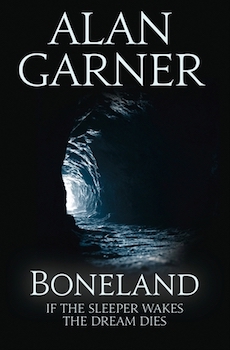
Where-Shall-we-run-to . Boneland

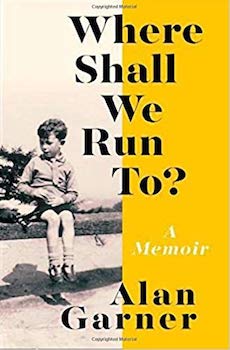
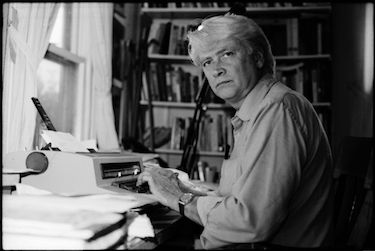
I’ve recently bought—but am not yet reading—the new book by Alan Garner, called Where Shall We Run To? – A Memoir. I’m not reading it yet because my epic revisiting of the Patrick White canon is only now nearing its close; then, too, some major deadlines are approaching for the first issue of the new Ford Madox Ford Journal; and in any case, I was just in time to glimpse the Librarian carrying the book away to some other part of the house. First dibs, as they say.

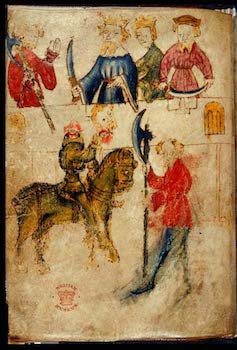
The publication of this new Garner recalled for me the previous one, Boneland, a novel which appeared in 2012. It’s short, powerful and cryptic, as much of Garner’s work tends to be, not through obfuscation but compression. Some of his readers are extraordinarily knowledgeable not only about Garner’s entire oeuvre but also the mythologies and belief systems that underlie so much of his writing; and I remember that the medieval text, Sir Gawain and the Green Knight, was mentioned and cited several times in online comments about the book. So I followed up.

 sir-gawain-green-knight-decapitated-head-f94v

(Via The British Library)

I’d certainly read Gawain at some stage over the years. I’d never taken the kind of course of study that included it, though the University of Bristol had the supreme good fortune to have on its staff John Burrow, a brilliant critic and editor of medieval literature (and one of the most delightful people I’ve ever come across). He published a classic study of the poem in 1965, and an edition of it for Penguin in 1982. Following up, though, the edition I read was the one at hand in the office, a modern English version with a critical introduction by John Gardner from the University of Chicago Press, reissued in 2011. Ninety pages of introduction and commentary allow for a fair bit of jousting with other critics and commentators, while demonstrating an impressive familiarity with the relevant secondary literature as well as the poem itself. The alliterative verse rollicks along at a pleasing lick:

Now comes the season of summer; soft are the winds;
The spirit of Zephyrus whispers to seeds and green shoots.
Joyful enough is that herb rising up out of earth,
When the dampening dew has dropped from all her leaves,
To bask in the blissful gaze of the bright sun.

John-Gardner-Paris-Review

(John Gardner, via The Paris Review)

John Champlin Gardner Jr. died nearly forty years ago in a motorcycle accident at the early age of 49. He’d published more than a dozen works of fiction, half a dozen critical works, children’s books, and translations of the Alliterative Morte d’Arthur and Other Middle English Poems as well as the complete works of the Gawain poet. He’s probably still best-known for his novel Grendel, a retelling of the Beowulf story from the monster’s point of view.

That phrase, ‘following up’, I always associate with an essay by Guy Davenport on the extraordinary photographer Ralph Eugene Meatyard (in The Geography of the Imagination):

He was an unfailing follower-up, which is why I think of him as the best educated man I have ever known. As a professor I must work with people for whom indifference is both a creed and a defense of their fantastic narrowness of mind, but Gene knew nothing of this. When he met Louis and Celia Zukofsky at my house, he went away and read Zukofsky. Not that he was an enthusiast. He simply had a curiosity that went all the way, and a deep sense of courtesy whereby if a man were a writer he would read what he had written, if a man were a painter he would look at his paintings.

Davenport was himself a follower-up of impressive proportions. He remembered a walking trip in Italy and France with Christopher Middleton, the two of them armed only with a collected John Donne and Pound’s Cantos, ‘a rich, barely comprehensible poem’, Davenport commented. He continues: ‘My first response was to learn Italian and Provençal, and to paint in the quattrocento manner. All real education’, he adds, ‘is such unconscious seduction.’

That’s quite a response; quite a follow-up.


An ethical dimension/ unethical dementia

Robin-Cook-Guardian

(Robin Cook via The Guardian)

I’m old enough to remember Robin Cook’s ‘mission statement’, more than twenty years ago now. Of course, we know how things worked out there but still, but still. ‘Our foreign policy must have an ethical dimension and must support the demands of other peoples for the democratic rights on which we insist for ourselves.’ And, towards the close: ‘Today’s Mission Statement sets out new directions in foreign policy. It makes the business of the Foreign and Commonwealth Office delivery of a long-term strategy, not just managing crisis intervention. It supplies an ethical content to foreign policy and recognises that the national interest cannot be defined only by narrow realpolitik. It aims to make Britain a leading partner in a world community of nations, and reverses the Tory trend towards not so splendid isolation.’
https://www.theguardian.com/world/1997/may/12/indonesia.ethicalforeignpolicy

Goodbye to all that, then. In Yemen, where war has been raging for several years, the latest atrocity is the dozens of deaths and injuries in a Saudi-led coalition attack on a bus full of children. An official Saudi press agency statement termed this ‘a legitimate military action’.
https://www.theguardian.com/world/2018/aug/09/dozens-dead-in-yemen-as-bus-carrying-children-hit-by-airstrike-icrc

Of an earlier offensive, the Conservative MP Andrew Mitchell observed that, ‘The problem for Britain is that we are complicit in this attack. It is part of the coalition that supports Saudi Arabia in its war in Yemen.’
https://www.theguardian.com/commentisfree/2018/jun/13/britain-complicit-saudi-arabia-war-yemen-hodeidah

You could say that. You could, indeed, say more than that. Several months ago, David Mepham, UK Director of Human Rights Watch, remarked that the British government ‘has been one of the strongest backers of the Saudis and their Gulf-led coalition. It has provided largely uncritical support for Saudi’s role in the war, as well as selling the Saudis £4.6 billion of military equipment over this period, seemingly ignoring its own rules about not selling arms when they are likely to be used unlawfully.’ As for British ministers, they ‘insist that staying close to the Saudis and offering advice privately is the most effective way to influence Saudi actions, alongside military advice and practical support through arms sales.’
https://www.hrw.org/news/2018/03/23/britains-policy-saudi-arabia-has-worsened-suffering-yemen

Well, well. Try this. ‘For many civilians, the realisation that one’s nation might be immoral or duplicitous was profoundly disturbing’, Trudi Tate writes, discussing Rudyard Kipling’s story, ‘Mary Postgate’, having commented a little earlier that, ‘Widespread literacy made it easier to spread lies.’ Yup. And she cited an essay by Sigmund Freud, ‘The Disillusionment of the War’, dating from 1915.[1]

Freud begins by writing that, ‘In the confusion of wartime in which we are caught up, relying as we must on one-sided information, standing too close to the great changes that have already taken place or are beginning to, and without a glimmering of the future that is being shaped, we ourselves are at a loss as to the significance of the impressions which press in upon us and as to the value of the judgements which we form.’

Take away ‘of wartime’ from his opening sentence and the essay could have been written this week.

sigmund-freud

Sigmund Freud
(‘when they were yung and easily freudened’—James Joyce, Finnegans Wake
Sometimes a psychoanalyst is just a psychoanalyst)

I see I marked another, later passage, about how, when a village grows into a town or a child into an adult, the earlier forms become lost in the later; but that it’s ‘otherwise with the development of the mind’. Succession, Freud writes, also involves co-existence and every earlier stage of development persists alongside the later stages. It may well happen, he suggests, that ‘a later and higher stage of development, once abandoned, cannot be reached again. But the primitive stages can always be re-established; the primitive mind is, in the fullest meaning of the word, imperishable.’[2]

So this is where we’ve got to. Our current, carefully selective and discriminating arms trade policy appears to boil down to this: ‘If they have the money, we’ll sell to anyone that asks.’ Appendix 1, no doubt, reads: ‘when, as is bound to happen, you use the weapons we’ve supplied to slaughter civilians, with a particular appetite for children, we agree to say nothing whatever about it. So long as your cheque is in the post.’

 
References

[1] Trudi Tate, Modernism, History and the First World War (Manchester: Manchester University Press, 1998), 39, 5.

[2] Sigmund Freud, ‘Thoughts for the Times on War and Death’, Civilization, Society and Religion, Penguin Freud Library Volume 12, edited by Albert Dickson (London: Penguin Books, 1991), 61, 73.


Bees, tea towels, staying at home

tolpuddle-martyrs

With a new tea towel to prompt me, I should at least finally commit to memory the names of the Tolpuddle Martyrs. It was a part of, let’s call it, a bulk purchase of Radical Tea Towels, made by the Librarian on our recent trip to Manchester.

https://www.radicalteatowel.co.uk/

With limited time at our disposal, we hared off to the People’s History Museum – or intended to. Twenty-minute walk, my note said. Perhaps, if you’re a champion athlete, know the city like the back of your hand and don’t start off by coming out on the wrong side of Manchester Piccadilly station. After fifteen minutes, we made our way back to where we’d begun and climbed into a taxi.

Match-Girls

We might have stayed the night in Manchester had the Librarian not already been committed to a professional trip to London and Oxford the next day. So we arrived back in Bristol around midnight in order that, on Finland’s National Sleepy Head Day, I might roll out of bed at five o’clock, an hour earlier than usual.

Suffragette-Teatowel

’We went to Europe’, Flannery O’Connor wrote to Elizabeth Bishop in 1958, ‘and I lived through it but my capacity for staying at home has now been perfected, sealed & is going to last me the rest of my life.’ Yes. I recalled the painter Hurtle Duffield’s initial reaction as his Greek lover persuades him onto a flying boat for the first leg of their journey, in Patrick White’s The Vivisector: ‘In the air he huddled in his overcoat and longed for his abandoned house; nobody would coax him out of it again. In any case after childhood, or at most, youth, experience breeds more fruitfully in a room.’

We are home now, anyway, in the resurgent hot weather. The bees are entranced by African blue basil, lavender, roses and Skylover. The gabbiest magpie of the four regulars perches on the fence and sounds off. The neighbour’s cat is still digesting the news that the recent arrivals in the house beyond our back wall have rabbits in a hutch by their kitchen door. We, in turn, are digesting the news that, after several years of quiet, those recent arrivals subscribe to the new twenty-first century conventions: make as much noise as you can. Still, the hot weather will pass; windows will close; the novelty of careering loudly around a shared house and garden will wear off.

Birds

So we are left with the recent news items which have—certainly not comforted but, perhaps, diverted—such as Government ministers drawing up plans to investigate whether the government’s own policies are to blame for the sharp rise in the use of food banks.
https://www.theguardian.com/society/2018/aug/01/revealed-ministers-plan-to-research-effect-of-policies-on-food-bank-use

Could they possibly be connected? As has already been pointed out several times, this is something of an ‘is the Pope Catholic?’ query. I remember thinking the same thing when, two or three months ago, after the deaths of many unarmed protesters, there was a headline on the BBC website: ‘Did Israel use excessive force at Gaza protests?’

And one which has caused extreme discomfort: the assault on Bookmarks, the Bloomsbury Street shop.
https://www.theguardian.com/uk-news/2018/aug/05/far-right-protesters-ransack-socialist-bookshop-bookmarks-in-london

There have been a good many recent attempts to suggest that we are seeing a rerun of the 1930s and, usually, I find the differences far outweigh the similarities. But masked thugs attacking a radical bookshop? That brings us a little closer, I think.

As easy as pie – sometimes

Basil

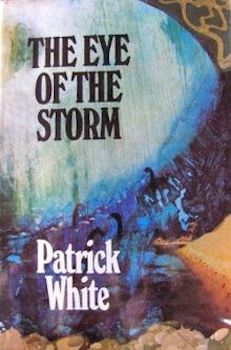
‘Basil returned with the two pies. He was wearing the expression of a man who has laid hands on a symbol of his boyhood: it made him look somewhat ponderous.’[1] This seems a pretty straightforward example of a symbol (pie = boyhood), though the passive construction of those verbs (‘He was wearing’ and ‘it made him look’) must be seen a little warily in the context of ‘Basil’ being the ‘great actor’, Sir Basil Hunter, come back from England to Australia to ease his dying mother into an old folks’ home, secure as much of the loot as he can, and play whatever roles are required.

EyeOfTheStorm.jpg

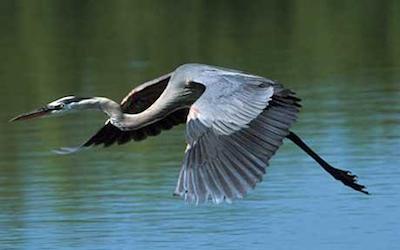
In the opening paragraph of her second novel, Penelope Fitzgerald writes of her central character, Florence Green: ‘She had once seen a heron flying across the estuary and trying, while it was on the wing, to swallow an eel which it had caught. The eel, in turn, was struggling to escape from the gullet of the heron and appeared a quarter, a half, or occasionally three-quarters of the way out. The indecision expressed by both creatures was pitiable. They had taken on too much.’ Bracketing this description, there are passages of studied ambiguity: it is one of the nights when Florence is ‘not absolutely sure whether she had slept or not’; and ‘Florence felt that if she hadn’t slept at all – and people often say this when they mean nothing of the kind – she must have been kept awake by thinking of the heron.’

A little later, we read that, ‘The weather was curious, and reminded her of the day she saw the flying heron trying to swallow the eel.’ One more reference, a dozen pages further on, seems to emphasise dreaming rather than thinking in that first instance: ‘Completely tired out by the time she went to bed, she no longer dreamed of the heron and the eel, or, so far as she knew, of anything else.’[2]

Some fifteen years later, in an essay on the voices of fictional characters, Fitzgerald quoted from that opening and commented, ‘I now think this was a mistake, because dreams in fiction are just as tedious as people’s dreams in real life.’[3] True enough: but the reference to the form rather than the content seems a little disingenuous – or am I oversimplifying by seeing the heron and the eel as a symbolic conjunction relevant to Fitzgerald’s entire corpus? One of her critics, enlarging on this ‘remarkable, predatory image’, remarks that, ‘As if borrowed from the sphere of sleep’s hauntings, the image, Darwinian and predacious, will be recalled more than once in the course of the novel, and it sets up, right at the start, the theme of survival—and the challenges that make survival, especially for the less fit and self-assertive, a chancy matter.’[4]

Blue-Heron-via-Telegraph

(Blue heron, via The Telegraph)

Yes, just before the second reference to the heron and eel, we find: ‘She blinded herself, in short, by pretending for a while that human beings are not divided into exterminators and exterminatees, with the former, at any given moment, predominating.’ And elsewhere, reflecting on V. S. Pritchett’s warning against writing one’s life away, Fitzgerald wrote: ‘This is a warning that has to be taken seriously. I can only say that however close I’ve come, by this time, to nothingness, I have remained true to my deepest convictions – I mean to the courage of those who are born to be defeated, the weaknesses of the strong, and the tragedy of misunderstandings and missed opportunities which I have done my best to treat as a comedy, for otherwise how can we manage to bear it?’[5]

The heron and the eel—together—comprise then an image, and surely a symbol, of the battle that life entails for a certain kind of person, with that particular balance of courage and confidence, who will never triumph yet will never quite give up either. How conscious, how deliberate must the use of a symbol be to qualify as a symbol? It seems absurdly patronising to suggest that so accomplished a writer wouldn’t have been perfectly aware of what she was doing. Nevertheless, I wonder if some writers—having produced such images, or symbols, capable of such strong and varied interpretations—hold them at a distance, play down their ownership with its implied rights of sustained control, concerned to allow those images room to breathe, to expand and flower in their readers’ minds.

‘I think you are playing a dangerous game,’ Patrick White wrote to Manfred Mackenzie in 1963, ‘fascinating to the player, no doubt – in all this symbol-chasing. Most of the time, I’m afraid, it leads up the wrong tree!’ He added, ‘I am sorry not to be able to confess to most of the influences you suggest. I may have arrived at certain conclusions via other writers who had read those you mention. Otherwise I suppose symbols can pop out of the collective unconscious.’ Two years earlier, replying to James Stern’s queries about his religious development, White replied: ‘Certainly in my own case I did not return to orthodox Anglicanism, but the Anglican church is a feeble organisation compared with the Jewish faith. I made the attempt, found that Churches destroy the mystery of God, and had to evolve symbols of my own through which to worship.’[6]

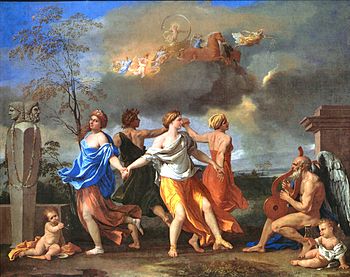
White did sometimes use symbols quite deliberately, often foregrounding them, as with the mandala that becomes part of the title of one of his novels, though circles and other figures of wholeness are everywhere in his books (as are roses). Linked to this, a sense of the wholeness of the world, certainly the artist’s world, perhaps not rationally apprehended but felt, sensed, known, is conveyed by the figure of the dance: Arthur Brown dancing the mandala for Mrs Poulter, or the young musician when she first enters Hurtle Duffield’s house: ‘As she continued turning within the conservatory’s narrow limits, she began also to hum. A golden tinsel of light hung around her lithe, mackerel body; while out of the dislodged tiles and shambles of broken glass her shuffling feet produced discordancies, but appropriate ones: Kathy Volkov would probably never teeter over into sweetness.’[7] William Butler Yeats, mindful of the interconnectedness of every part of both a tree and a work of art, famously asked at the end of ‘Among School Children’, ‘How can we know the dancer from the dance?’[8] And the novelist Richard Hughes, in his introduction to an edition of a William Faulkner novel, mentioned the story told of ‘a celebrated Russian dancer, who was asked by someone what she meant by a certain dance. She answered with some exasperation, “If I could say it in so many words, do you think I should take the very great trouble of dancing it?”’[9] It occurs to me that the title of Poussin’s painting that Anthony Powell adopted for his novel-sequence, A Dance to the Music of Time, could hardly have comprised three terms more mysterious and more difficult to grasp with confidence and conviction.

Dance_to_the_music_of_time

(Nicolas Poussin, A Dance to the Music of Time: Wallace Collection)

The gap that uncertainty—as to whether a literary image or motif is deliberately designed to perform a more substantial symbolic function—allows can carry a good deal of force. I’ve reflected more than once on Ford Madox Ford’s multiple references to cooking and gardening. They are almost always, in the first instance, actual cooking and actual gardening—both arts that Ford practised and regarded as hugely important. But, of course, they also offer extraordinary scope for symbolic interpretation. Ford uses more explicitly symbolic images too, which occur less often but with a more focused aim. So Christopher Tietjens characterises his wife and his lover thus: ‘If you wanted something killed you’d go to Sylvia Tietjens in the sure faith that she would kill it: emotion: hope: ideal: kill it quick and sure. If you wanted something kept alive you’d go to Valentine: she’d find something to do for it . . . The two types of mind: remorseless enemy: sure screen: dagger . . . sheath!’ Later, the suffragette and pacifist Valentine Wannop will acknowledge her ‘automatic feeling that all manly men were lust-filled devils, desiring nothing better than to stride over battlefields, stabbing the wounded with long daggers in frenzies of sadism.’[10]

For literary critics, psychoanalysts and many others, the world is a seething mass of symbols—in the index to my Penguin edition of Freud’s The Interpretation of Dreams, ‘symbol’ runs into three columns, offering no end of joyous examples: asparagus, burglar, nail-file, zeppelin—but they would probably be the first to agree that sometimes a cigar is just a cigar, a pipe a pipe, a rose a rose. And surely sometimes a pie is just a pie.


References

[1] Patrick White, The Eye of the Storm (London: Penguin Books, 1975), 452.

[2] Penelope Fitzgerald, The Bookshop (1978; London: Everyman, 2001), 5, 29, 40.

[3] Penelope Fitzgerald, ‘Hearing Them Speak’ (1993), in A House of Air: Selected Writings, edited by Terence Dooley with Mandy Kirkby and Chris Carduff (London: Harper Perennial, 2005), 499-500.

[4] Christopher J. Knight, ‘The Second Saddest Story: Despair, Belief, and Moral Perseverance in Penelope Fitzgerald’s The Bookshop’, Journal of Narrative Theory, 42, 1 (Spring 2012), 70, 71.

[5] Fitzgerald, ‘Curriculum Vitae’, in A House of Air, 480.

[6] Patrick White, Letters, edited by David Marr (London: Jonathan Cape, 1994), 216, 217, 196.

[7] See Patrick White, The Solid Mandala ( Harmondsworth: Penguin Books, 1969), 265-267; The Vivisector (London: Jonathan Cape, 1970), 443-444.

[8] W. B. Yeats, Collected Poems, second edition (London: Macmillan, 1950), 245.

[9] Hughes, ‘Introduction’ to William Faulkner, The Sound and the Fury (London: Chatto and Windus, 1966), vii.

[10] Ford Madox Ford, Some Do Not. . . (1924; edited by Max Saunders, Manchester: Carcanet Press, 2010), 160, 284. Related images occur in many of Ford’s other works.

Summer ended: autumn begun.

Henry, George, 1858-1943; Autumn

George Henry, Autumn: Glasgow Museums Resource Centre (GMRC)

First day of August. ‘Very lovely with calm lake,’ John Ruskin wrote at Brantwood of Coniston Water in 1884, ‘but the roses fading, the hay cut. The summer is ended. Autumn begun.’ It seems a little early. Still, in February of that year, Ruskin had given his lectures on ‘The Storm-Cloud of the Nineteenth Century’ and the details of weather that he’d entered in his diary in the intervening months tended to focus on darkness, fierce wind and heavy rain.

As Jeeves conveys the seasonal news to Bertie, at the opening of The Code of the Woosters: ‘There is a fog, sir. If you will recollect, we are now in autumn – season of mists and mellow fruitfulness.’ Literature not being his strong point, Bertie can only reply, ‘Season of what?’ John Keats—he of To Autumn fame—probably wrote the poem in the second or third week of September, in 1819, a more autumnal sort of date.

So here, in a manner of speaking, we all are (as Ford Madox Ford often had Henry James say). Not that we have a very clear idea of where we are, though the general direction of travel is, alas, only too obvious. There seem to be increasingly loud hints and assertions that this country might end up with no EU deal ‘by accident’. That is to say, we might be moving in the direction that the extremists have been angling for from the outset, a result to suit their ideologies, their unsavoury friends and perhaps their business plans too. I heard one of them, a notable reactionary, say on the radio a week or two back, apropos of something or other: ‘this is not what the people of this country voted for’. Careful with the negative there, I thought, since 63% of the British electorate didn’t vote to leave the European Union at all.

Yeovil-early-morning

Jonathan Franzen once referred to ‘the one benefit of being a depressive pessimist, which is the propensity to laugh in dark times.’ There’s something in that though the laughter, like much else, is wearing a little thin of late. Even not particularly literary people have taken to quoting Yeats’s ‘The Second Coming’ (‘The best lack all conviction, while the worst/ Are full of passionate intensity’).

Certainly, I’ve more or less given up on the Labour leadership: the last few years should have resulted in nothing remaining of the Tories apart from some unsavoury stains on the floor. But that would have required an opposition to oppose instead of sniping, posturing and bitching among themselves, endlessly inventing new pretexts for internal wrangling.

I look back to Mollie Panter-Downes’ London War Notes: 1941, since the Second World War seems to be the period that so many people in this country are still totally and curiously fixated upon. ‘As a nation’, she wrote, ‘the British wear disaster more gracefully than they do victory.’ Well, that was then and this is now; and while there’s absolutely no danger of victory I strongly suspect that there will be no visible signs of grace when the magic moment comes.


Still feeling the heat – but smelling the rain

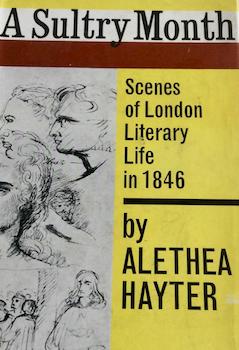
Sultry-month

It was ‘the hottest summer month that anyone could remember. For the first twenty-two days of the month the average day temperature was 84° in the shade, 105° in the sun. Kent had had six weeks without rain and midday temperatures of 104° to 116°.’ Alethea Hayter is writing here, in A Sultry Month, about June 1846, though the period covered by her book extends over the first two weeks of July as well.

It was, she adds, ‘murderous weather. Wherrymen, out in boats on the Thames all day, died of sunstroke; farm-labourers died of heat-stroke after a day’s mowing; many people all over the country were drowned while bathing.’ But there were also ‘sudden and violent storms all over the country, many people were killed by lightning, in some places the very air smelt of fire, and the raindrops that fell were the largest ever seen.’[1]

It’s been murderous weather enough in Greece and Japan, to name but two. Still, we tend to look at temperatures with a comparative eye. Only 86°F? In the past few days, I see that Arizona has been running up temperatures of 111° while Basra recorded 45C (113°F). But in 1846 there was no refrigeration; workers’ rights were minimal or non-existent; and in many places the water was quite unfit to drink: a Royal Commission, reporting in 1844 and 1845, inquired among much else into the water-supply of fifty large towns and found that it was good in only six cases.[2]

As for the dangers—no sun cream and no health professionals advising you to slap it on. Half a century after Hayter’s sultry month, Roy Porter notes, the Danish physician Niels Finsen (1860-1904) suggested ‘that ultraviolet rays were bactericidal, and so could be useful against conditions like lupus. Many early hospital radiology departments provided both radiation and ultraviolet light therapy, and Finsen’s researches stimulated high-altitude tuberculosis sanatoria and inspired the unfortunate belief that sun-tans were healthy.’[3]

Sun-tans. Sunbaths. Sun. In his story of that title, D. H. Lawrence writes of a woman and her child sent away to the sun. ‘It was not just taking sunbaths. It was much more than that. Something deep inside her unfolded and relaxed, and she was given.’ Naked by the cypress trees when the husband, in his suit and tie, returns after many weeks. ‘She had always been mistress of herself, aware of what she was doing, and held tense for her own power. Now she felt inside her quite another sort of power, something greater than herself, flowing by itself. Now she was vague, but she had a power beyond herself.’ She becomes intimate with a peasant, seen from a distance—though her next child will be her husband’s.[4]

‘It is strange how different the sun-dried, ancient, southern slopes of the world are, from the northern slopes’, Lawrence wrote in another context. ‘It is as if the god Pan really had his home among these sun-bleached stones and tough, sun-dark trees. And one knows it all in one’s blood, it is pure, sun-dried memory.’[5]

Lawrences-Bynner-Teotihuacan-1923

D. H. Lawrence, Frieda and Witter Bynner at Teotihuacan, Mexico, 1923: site of the Pyramid of the Sun

He was not always so positive about the beneficial effects of the sun. Immediately following ‘Sun’ in the Collected Stories is ‘The Woman Who Rode Away’: the sun reaching a certain point in the sky is the moment at which the woman will be sacrificed under the knife of the old priest. ‘The Shadow in the Rose Garden’ has a woman encountering her ex-lover Archie, the rector’s son, now a lunatic after contracting sunstroke during military service in Africa.

Rupert Brooke’s death from blood poisoning in 1915 was first reported as sunstroke. Lawrence attributed this to the sun-god, Phoebus Apollo: ‘He was slain by bright Phoebus shaft – it was in keeping with his general sunniness [ . . . ] Bright Phoebus smote him down. It is all in the saga.’[6]

In Patrick White’s Voss, Laura Trevelyan takes charge of Rose Portion’s baby. Her relationship with the child wonderfully exemplifies Laura’s own complex and courageous character: ‘They were the baby’s days. There was a golden fuzz of morning in the garden. She could not bring herself to tread upon the tender flesh of rose petals that were showered at her feet. To avoid this, she would walk round by another way, though it meant running the gauntlet of the sun. Then her duty was most delicious. She was the living shield, that rejoiced to deflect the most savage blows. Other pains, of desert suns, of letters unwritten, of the touch of his man’s hands, with their queer pronounced finger-joints, would fluctuate, as she carried her baby along the golden tunnels of light.’[7]

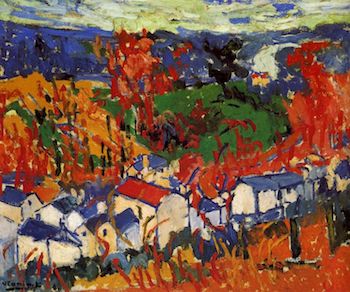
Vlaminck-maisons-et-arbres

Maurice de Vlaminck, Maisons et Arbres, 1906.

Julian Barnes remarks that Fauvism was ‘all about heat’ and that ‘the journey towards analytic and then synthetic cubism also plays out in terms of temperature.’ Fauvism ‘is all pinks and mauves, with shouty blues and hilarious oranges: the sun is ferocious, whatever the sky in the picture may pretend.’ Classical Cubism was suspicious of colour, Braque embracing rich browns, greens, greys. ‘By 1910-11 you could have any colour you liked, so long as it was grey, brown or beige.’[8]

HD-via-ND

(H. D. via New Directions)

‘O wind, rend open the heat’, H. D. wrote:

cut apart the heat,
rend it to tatters.

Fruit cannot drop
through this thick air—
fruit cannot fall into heat
that presses up and blunts
the points of pears
and rounds the grapes.

Cut the heat—
plough through it,
turning it on either side
of your path.[9]

But now the cloud is thickening and darkening, and the quickening wind smells of rain, all of this perfectly natural, since I’ve just watered the tomato plants. . .

 
References

[1] Alethea Hayter, A Sultry Month: Scenes of London Literary Life in 1846 (London: Faber and Faber, 1965), 47.

[2] Llewellyn Woodward, The Age of Reform: 1815-1870, second edition (Oxford: Oxford University Press, 1962), 463.

[3] Roy Porter, The Greatest Benefit to Mankind: A Medical History of Humanity from Antiquity to the Present (London: Harper Collins, 1997), 607.

[4] D. H. Lawrence, ‘Sun’, in The Collected Short Stories of D. H. Lawrence (London: William Heinemann, 1974), 493-508.

[5] D. H. Lawrence, Twilight in Italy, in D. H. Lawrence and Italy (London: Penguin Books, 1997), 163.

[6] Paul Delany, The Neo-Pagans: Friendship and Love in the Rupert Brooke Circle (London: Macmillan, 1987), 211; Letters of D. H. Lawrence II, June 1913-October 1916, edited by George J. Zytaruk and James T. Boulton (Cambridge: Cambridge University Press, 1981), 330-331.

[7] Patrick White, Voss (London: Eyre & Spottiswoode, 1957), 247.

[8] Julian Barnes, Keeping an Eye Open: Essays on Art (London: Jonathan Cape, 2015), 195.

[9] H. D., ‘Garden’, in Collected Poems 1912-1944, edited by Louis L. Martz (Manchester: Carcanet Press, 1984), 25.


‘Volunteer fireman’s clothes’: Thomas Eakins

Miss-Amelia-Van-Buren

(Eakins, Miss Amelia Van Buren: The Phillips Collection, Washington, D. C. Eakins ‘excelled at painting thought’, Robert Hughes wrote.)

A word about Thomas Eakins – not Thomas Atkins, which is a whole other world* – but Thomas Cowperthwait Eakins, painter, sculptor and photographer, born 25 July 1844 (died 1916). A tremendous artist of the realist persuasion, who didn’t always chime with the prevailing tastes or accepted modes of behaviour. His public ‘often resented having unvarnished truth shoved at it, and he entered his forties regarded as truculent and socially inept – at home with his family and his cabal of students, but otherwise unpleasant to know.’[1]

In Artopia, his art diary, the late John Perreault discussed Thomas Eakins and a recent book about him by Henry Adams, Eakins Revealed: The Secret Life of an American Artist (Oxford University Press, 2005). He asserted that Adams was certainly right in taking to task Lloyd Goodrich, one-time director of the Whitney Museum of American Art, ‘for creating the deceptive view of Eakins as manly, honest, and forthright, posing him as virtuously all-American and the dubious precedent for the all-American representational painters Goodrich was promoting then’. In reality, Perreault says, Eakins ‘had a high-pitched voice, affected volunteer fireman’s clothes and often painted in his underwear; failed his classes in Paris, told dirty jokes, was “feminine,” was not exactly fond of women, was never much of an athlete, and drank a quart of milk with every meal.’
https://www.artsjournal.com/artopia/2006/02/eakins_naked.html

The high point here, obviously, is ‘affected volunteer fireman’s clothes’. Wonderful.

Though he had a three-year stint in Paris, which included training at the Ecole des Beaux Arts, Eakins was back in Philadelphia by the end of 1870 and remained in the city thereafter, teaching at the Academy until he was forced to resign in 1886, the purported reason being his removal of a male model’s loincloth in a class which included female students.

Eakins-Whitman

(Eakins, Walt Whitman, Pennsylvania Academy of Fine arts)

In December 1887, Eakins took the ferry across the Delaware River to Camden and began painting a portrait of Walt Whitman, a few weeks after their first meeting. Eakins had had no significant contact with the Impressionists in France, absorbing rather the lessons of French academicism: his ‘contemporary reputation as a radical lies more in his pedagogy, his use of photograph, and in his interest in the nude, rather than in his approach to portraiture.’[2] Nevertheless, Whitman would prefer Eakins’ interpretation of him above all the many other versions because it depicted him ‘“without feathers”’.[3] ‘I never knew of but one artist, and that’s Tom Eakins, who could resist the temptation to see what they thought ought to be rather than what is.’[4]

As so often, ‘Realism’ is the beginning rather than the end of the matter. Robert Hughes remarks that there are two halves of Eakins the realist: the idea of a painting as ‘a factual and consistent slice of life’ but, ‘rejecting the illusion of Impressionist instantaneity’, he is for ‘memory and combination’, for ‘the tangle of feelings, however far under the surface they may be.’ He bought his first camera in 1880 and saw clearly enough how it could both empirical and romantic, that it could ‘describe fact and suggest fiction’.[5]

Eakins’ most familiar painting is probably The Swimming-Hole, first, The Swimmers: apparently, John Perreault comments, Eakins’ widow tried to shift the title further, to the ‘even more sentimental’ The Old Swimming Hole, and denied that he used photographs – but he did.

Thomas_Eakins_-_Swimming_(1895)

(Amon Carter Museum of American Art)

Unsurprisingly, the painting recalls Whitman: ‘Where the splash of swimmers and divers cools the warm noon’.[6] And the title recalls too Ezra Pound’s ‘Canto XIII’, the ‘Confucian’ canto, where Kung walks ‘out by the lower river’ with several companions. He asks them what they would do to fulfil their destinies and they speak of government, military administration, religious practices.

And Tian said, with his hand on the strings of his lute
The low sounds continuing
after his hand left the strings,
And the sound went up like smoke, under the leaves,
And he looked after the sound:
”The old swimming hole,
”And the boys flopping off the planks,
”Or sitting in the underbrush playing mandolins.”
And Kung smiled upon all of them equally.
And Thseng-sie desired to know:
”Which had answered correctly?”
And Kung said, “They have all answered correctly,
”That is to say, each in his nature.”

Reason-Eakins

Back in my book trade days, I remember a book by Akela Reason, Thomas Eakins and the Uses of History (Philadelphia: University of Pennsylvania Press, 2010), which drew on unpublished letters, diaries of friends and contemporaries, and period newspapers, and won the SECAC Award for Excellence in Scholarly Research and Publication.

 
*Popular term for a British infantryman, dating back to at least the mid-eighteenth century, prevalent in the First World War, generally shortened to ‘Tommy’, and used not infrequently by Rudyard Kipling, as in the poem of that name:

O it’s Tommy this, an’ Tommy that, an’ “Tommy go away”;
But it’s “Thank you, Mister Atkins,” when the band begins to play-
The band begins to play, my boys, the band begins to play,
O it’s “Thank you Mr Atkins,” when the band begins to play.


References

[1] Robert Hughes, American Visions: The Epic History of Art in America (London: The Harvill Press, 1997), 295.

[2] Jane Watkins, editor, Pennsylvania Academy of the Fine Arts: 200 Years of Excellence (Philadelphia: Pennsylvania Academy of the Fine Arts, 2005), 158.

[3] Jerome Loving, Walt Whitman: The Song of Myself (Berkeley: University of California Press, 1999), 455.

[4] Quoted by F. O. Matthiessen, American Renaissance: Art and Expression in the Age of Emerson and Whitman (1941; New York: Oxford University Press, 1968), 604.

[5] Hughes, American Visions, 289, 296.

[6] Song of Myself, in Walt Whitman: The Complete Poems, edited by Francis Murphy (Harmondsworth: Penguin Books, 1986), 98. This edition has a detail from The Swimming Hole on the jacket.


Pronouns, tales of the tribe and which side are you on?

Stone-wall

‘I sit in one of the dives
On Fifty-Second Street
Uncertain and afraid
As the clever hopes expire
Of a low dishonest decade’.

So, famously, W. H. Auden begins ‘September 1, 1939’. This was the day on which Germany invaded Poland. The British and French declarations of war followed two days later. Lately, I’ve been thinking more about the final stanza:

‘Defenceless under the night
Our world in stupor lies;
Yet, dotted everywhere,
Ironic points of light
Flash out wherever the Just
Exchange their messages:
May I, composed like them
Of Eros and of dust,
Beleaguered by the same
Negation and despair,
Show an affirming flame.’[1]

Sept 1 NYT

We are, of course, slurring our way towards the close of a low, dishonest decade, not for the first time. And a lot of us are feeling ‘beleaguered’, for sure. But the point on which you catch your clothes—or your skin—is those damn pronouns. ‘We’, ‘’us’, ‘them’. And ‘the Just? Us, obviously, though, again, query ‘us’ (itself usefully contained in the words ‘dust’ and ‘Just’), and note Auden’s use of ‘them’.

‘There is no mystery about the Cantos, they are the tale of the tribe’, Ezra Pound wrote towards the close of the decade of which Auden was writing, ‘—give Rudyard credit for his use of the phrase’.[2] But which tribe? He meant, I’d say, the collective human tribe; and was echoing a talk given by Kipling thirty years earlier.[3]

We are, it seems, reverting to tribes again. ‘Everybody’s shouting “Which side are you on”?’, Bob Dylan sang on Desolation Row. It’s a topical question, for sure. One of the songs performed by Natalie Merchant and her guitarist Erik Della Penna in an outstanding show in Bath the other evening was the song Dylan probably alluded to, Which Side Are You On?, its lyrics written in 1931 by poet and activist Florence Reece, its melody borrowed from either the ballad Jack Munro or the hymn Lay the Lily Low. Reece’s husband Sam was an organizer for the mineworkers’ union in Harlan County, Kentucky, which was locked in a fierce struggle with the mine owners, who hired men, including a sheriff, to intimidate Reece.

Merchant-Tour

The lines of battle would have been starkly drawn then, as they were in the context of Auden’s poem. For the bosses or for the workers; for or against fascism, genocide, armed conquest. And now? Pretty clear, you’d think—but no, seemingly not. You couldn’t make it up, I hear people say. End of days, the Librarian comments, watching the news from America or, nearer, groups of zealots wielding disproportionate power or divulging ‘the will of the people’—a slightly risky business since just 37% of the electorate actually voted to leave the European Union.

‘Probability? Nothing is so improbable as what is true’, Ambrose Bierce wrote in a critique of the realist novelist, William Dean Howells. ‘It is the unexpected that occurs; but that is not saying enough; it is also the unlikely—one might almost say the impossible.’[4] And, in an ‘Author’s Note’ to her huge novel of the French Revolution, Hilary Mantel remarked, ‘The reader may ask how to tell fact from fiction. A rough guide: anything that seems particularly unlikely is probably true.’[5]

I seem to come across half a dozen lucid, intelligent articles a week that set out or summarise where we’ve got to and how—and the dangers that we—the people and the democratic process which defines and enables us—are facing. And I know that, for the most part, their only readers are those who already know some or all of this stuff and will have reached similar conclusions. But what of the others?

One of the most baffling and frequently recurring questions is ‘just what would it take?’ And, in the United States, for instance, the answer seems to be that nothing Donald Trump might do, or leave undone, would disappoint or alienate his core supporters. Even after the recent Presidential trip to Europe, when he attacked his European allies, trashed the British Prime Minister’s policies and prioritised Mr Putin’s assurances over the painstaking work and unambiguous conclusions of his own intelligence services, nearly 80% of Republicans ‘approved of his handling of the Russian president at the post-summit press conference’, while 85% ‘think the justice department investigation into Russia’s meddling in US elections is a distraction.’

The former White House communications director, Anthony Scaramucci, was quoted as saying that, ‘They couldn’t care less about what happened in Russia. They love this guy, they think this guy’s for them. These are low information, emotional voters and they like what they see in the president. They think he’s working for them.’[6]

The phrase ‘low information’ rang a bell. One of the most striking ironies about the EU referendum is that a great many of those who voted in what would turn out to be the bitterest and most divisive electoral contest in living memory appear not to pay much attention to politics at all. The endless revisiting of Brexit ‘heartlands’ by journalists that still want to understand and explain it is not particularly enlightening but I’ve been struck by the number of times that people are quoted as saying that they don’t follow current affairs, that politics is ‘nothing to do with them’. The related irony is the widespread belief that their votes don’t really make any difference in General Elections—largely true given our antiquated electoral system and the huge proportion of ‘safe seats’—but that in this one case, the ill-conceived and worse-designed referendum, their votes actually did make a difference.

But I was remembering too a passage in Sarah Churchwell’s Behold, America, where she’s citing a 1923 essay in Vanity Fair by the hugely influential journalist and political commentator, Walter Lippmann. ‘Education and the White Collar Class’ stressed the importance of widening access to higher education: without it, America would be left with ‘a literate and uneducated democracy’. Churchwell points out that ‘the distinction between literacy and education was crucial: what would happen to a nation in which voters could read, but weren’t well informed?’ What, indeed? ‘An uneducated but literate democracy would, Lippmann warned, elect the incompetent, the corrupt and the fascistic.’[7]

Lippmann

We have in this country a largely literate democracy but not, I tend to feel, a very well-informed one on the whole. There are several reasons for this: some gaping holes in the standard educational fare, the poor quality of much of the national press, the increased distancing of government from people, the emasculation of local councils, the sheer noise of social media and the apparent illusion that because there’s so much available information it must somehow be absorbed into the mind—or simply through the skin perhaps. Then the effect of recent administrations has tended to produce indifference, a widespread lack of interest in the political process and an inability to take seriously what are genuine threats, now that there are factions in positions of power  perfectly willing to see this country crash and burn rather than their view of it not prevail.

In the wake of the First World War, Pound wrote:

Died some pro patria, non dulce non et decor. . .

walked eye-deep in hell
believing in old men’s lies, then unbelieving
came home, home to a lie,
home to many deceits,
home to old lies and new infamy;

usury age-old and age-thick
and liars in public places.[8]

‘Liars in public places’: surely never more so than now. We are all—or rather, some of us are—wearing that tee-shirt.


References

[1] W. H. Auden, The English Auden: Poems, Essays and Dramatic Writings, 1927-1939, edited by Edward Mendelson (London: Faber, 1977), 245-247.

[2] Ezra Pound, Guide to Kulchur (1938; New York: New Directions, 1970), 194; see too Selected Letters, 1907-1941, edited by D. D. Paige (New York: New Directions, 1971), 294.

[3] Rudyard Kipling, ‘Literature’, in A Book of Words (London: Macmillan, 1928), 3-8. See Michael André Bernstein, The Tale of the Tribe: Ezra Pound and the Modern Verse Epic (Princeton: Princeton University Press, 1980), 7-8.

[4] Ambrose Bierce, ‘The Short Story’ (1897), in Tales of Soldiers and Civilians and Other Stories, edited by Tom Quirk (Harmondsworth: Penguin Books 2000), 259.

[5] Hilary Mantel, A Place of Greater Safety (Harmondsworth: Penguin Books, 1993), x.

[6] David Smith, ‘Solid support: why Trump voters don’t care about Putin controversy’, The Guardian (Saturday 21 July 2018), 26.

[7] Sarah Churchwell, Behold, America: A History of America First and the American Dream (London: Bloomsbury Publishing, 2018), 109, 110.

[8] Hugh Selwyn Mauberley, IV, Ezra Pound: Poems and Translations, edited by Richard Sieburth (New York: Library of America, 2003), 551.


Gilbert White of Selborne

Skylark

(Skylark: https://findingnature.co.uk/animal/skylark/ )

In Great Trade Route, Ford Madox Ford, recalling a visit to a New Jersey truck farm in the company of William Carlos Williams, commented on the behaviour of a snipe which was distracting the men from the nest to protect its young, an example of what Gilbert White famously termed storgé, using the Greek word for familial or ‘natural’ affection, one of the four Greek terms for ‘love’, along with philia, agape and eros: all were discussed in C. S. Lewis’s book, The Four Loves (1960).[1]

Ford often mentioned Gilbert White of Selborne (born 18 July 1720), the ‘parson-naturalist’, in both fictional and non-fictional contexts. In Parade’s End, White crops up in the first volume, Some Do Not. . .  as Christopher Tietjens spars with Valentine Wannop on their night-ride.

Gilbert-White

(Gilbert White)

‘He said:
“Where do you get your absurd Latin nomenclature from? Isn’t it phalæna …
She had answered:
“From White . . . The Natural History of Selborne is the only natural history I ever read….
“He’s the last English writer that could write,” said Tietjens.
“He calls the downs ‘those majestic and amusing mountains,’” she said. “Where do you get your dreadful Latin pronunciation from? Phal i i na! To rhyme with Dinah!”
“It’s ‘sublime and amusing mountains,’ not ‘majestic and amusing,’” Tietjens said. “I got my Latin pronunciation, like all public schoolboys of to-day, from the German.”’[2]

Later, in the third volume, A Man Could Stand Up—, Tietjens is in the trenches, where his Sergeant enthusiastically praises the skylark’s ‘Won’erful trust in yumanity! Won’erful hinstinck set in the fethered brest by the Halmighty!’

Tietjens says ‘mildly’ that he thinks the Sergeant has ‘got his natural history wrong. He must divide the males from the females. The females sat on the nest through obstinate attachment to their eggs; the males obstinately soared above the nests in order to pour out abuse at other male skylarks in the vicinity.’

‘“Gilbert White of Selbourne,” he said to the Sergeant, “called the behaviour of the female STORGE: a good word for it.” But, as for trust in humanity, the Sergeant might take it that larks never gave us a thought. We were part of the landscape and if what destroyed their nests whilst they sat on them was a bit of H[igh].E[xplosive]. shell or the coulter of a plough it was all one to them.’

The sergeant is highly sceptical of such sentiments:

‘“Ju ’eer what the orfcer said, Corporal,” the one said to the other. Wottever’ll ’e say next! Skylarks not trust ’uman beens in battles! Cor!”
The other grunted and, mournfully, the voices died out.’

Later in the same volume, Ford recurs to White in Valentine’s own reflections – Ford uses the image or allusion echoed in the thoughts of multiple characters to frequently brilliant effect:

‘Her mother was too cunning for them. With the cunning that makes the mother wild-duck tumble apparently broken-winged just under your feet to decoy you away from her little things. STORGE, Gilbert White calls it!’[3]

White-The-Wakes

(The Wakes, Gilbert White’s house:
http://gilbertwhiteshouse.org.uk/?venue=gilbert-whites-house)

In The Farther Shore: A Natural History of Perception, 1798-1984, a superb, rich study of how technological developments since the eighteenth century have affected the ways in which we interpret the world, Don Gifford wrote of how, for Samuel Johnson and Samuel Taylor Coleridge, the ambition to be generally well read, that is, to have a reasonable grasp of all that was being published and made available, ‘was within reach’, and that a community of those sharing that distinction or at least that ambition was ‘at least imagined to be a given among educated men and women.’ His footnote mentions the assumption evident in Gilbert White’s letters that his correspondents shared his acquaintance with Dryden, Pope, Addison, Swift, Gray, Johnson, Hume, Gibbon, Sterne – as well as with the Bible, Virgil, Homer, Horace, the Koran, Chaucer, Shakespeare and Milton. By the mid-80s (when he was writing this book), Gifford adds, ‘the idea of being well read and of belonging to such a community is a joke we have politely learned not to mention except with a shrug of self-deprecation.’

Of course, White’s acquaintance with Pope was not only with the man’s work: he was presented with a copy of Pope’s six-volume translation of the Iliad by the poet himself, when graduating with distinction from Oriel College, Oxford, in 1743.[4]

White’s fascinating and deceptively simple work has embedded itself in English culture in numerous contexts. His genius, as Ronald Blythe remarks, was ‘to revolutionise the study of natural history by noting what exactly lay outside his own back-door.’[5] In his first letter to the Honourable Daines Barrington in June 1769, White wrote, ‘I see you are a gentleman of great candour, and one that will make allowances; especially where the writer professes to be an out-door naturalist, one that takes his observations from the subject itself, and not from the writings of others’ (Selborne 104). He produced hundreds of pages, records of looking and listening and remembering and wondering. Birds, plants, insects, weather, animals, not least the human. ‘My musical friend, at whose house I am now visiting, has tried all the owls that are his near neighbours with a pitch-pipe set at concert-pitch, and finds they all hoot in B flat. He will examine the nightingales next spring’ (Selborne 127).

White's_Selborne_1813_title_page

The local as the universal. A hundred and eighty years after White’s death, William Carlos Williams would note that the poet’s business was ‘to write particularly, as a physician works, upon a patient, in the particular to discover the universal.’ He quoted the line of John Dewey’s that he had come upon by chance, ‘The local is the only universal, upon that all else builds’, commenting elsewhere that, ‘in proportion as a man has bestirred himself to become awake to his own locality he will perceive more and more of what is disclosed and find himself in a position to make the necessary translations.’[6] Williams in Rutherford; Thoreau in Concord; White in Selborne.

Don Gifford points out that, ‘In effect, White’s perspective differs radically from our own because he had no a priori basis for distinguishing between trivial and significant things.’ So, in addition to seeing with his own eyes, White ‘had to see cumulatively, a second order of seeing’. He tells the story of Henry Thoreau reducing Ellery Channing to tears when the two men went out into the woods together: Channing knew so little about what to record that he returned with an empty notebook, desperate and frustrated.[7]

White’s journals were published in 1931 and, Alexandra Harris comments, ‘his work was tirelessly reissued over the next decade.’ But then, in addition to being valued for his ‘timeless qualities’, White was ‘also being used as someone relevant to the present time precisely because the world he knew was disappearing.’[8]

When we read those writers detailing the current decline or disappearance of so much British wildlife, through environmental damage, farming practices and government policies, the parallels hardly need stressing.

On the matter of White’s journals, let your fingers do the running, to this superb resource:
http://naturalhistoryofselborne.com/

House and garden, café and shop?
http://www.gilbertwhiteshouse.org.uk/


References

[1] Ford Madox Ford, Great Trade Route (London: Allen & Unwin, 1937), 184; Gilbert White, The Illustrated History of Selborne (London: Macmillan, 1984), 114, 133-134.

[2] Ford Madox Ford, Some Do Not. . . (1924; edited by Max Saunders, Manchester: Carcanet Press, 2010), 163-164.

[3] Ford Madox Ford, A Man Could Stand Up— (1926; edited by Sara Haslam, Manchester: Carcanet, 2011), 63, 64, 65, 201.

[4] Don Gifford, The Farther Shore: A Natural History of Perception (London: Faber and Faber, 1990), 158 and n., 5.

[5] Ronald Blythe, Aftermath: Selected Writings 1960-2010, edited by Peter Tolhurst (Norwich: Black Dog Books, 2010), 226.

[6] William Carlos Williams, The Autobiography of William Carlos Williams (New York: New Directions, 1967), 391; Selected Essays (New York: New Directions, 1969), 28.

[7] Gifford, Farther Shore, 10, 11.

[8] Alexandra Harris, Romantic Moderns: English Writers, Artists and the Imagination from Virginia Woolf to John Piper (London: Thames & Hudson 2010), 171, 173.


Turning left to Poets’ Walk

Lookout

In recovery mode, so short a time after our hasty retreat from a yurt in the border country, we remember Clevedon. When were we last there? That we can’t remember. But it’s close, barely a dozen miles away; we don’t have to return the car until tomorrow; and there will be sea. We drive. Turn left, the Librarian murmurs, left. When? I ask. Back there. Ah. But there will be other turnings, surely. And there are.

Clevedon: seaside town with a fine pier overlooking the Bristol Channel (you can have coffee overlooking the pier). You can gaze across to Wales: on your extreme right the Second Severn Crossing. Ahead of you, the guide to the vista notes, among other allurements, ‘Swansea, 48 miles, not visible.’

There’s a bandstand, a marine lake and, apparently, the oldest purpose-built cinema in the world—the Curzon—which is still in working order. Arthur Hallam, subject of Alfred Tennyson’s immense poem, In Memoriam, is buried here. Tuppence Middleton, whom I’ve been watching lately in Sense8—and previously saw in the BBC’s War and Peace—grew up here. But the most famous cultural association is probably with Samuel Taylor Coleridge, who lived here with his wife, Sara Fricker, after their marriage in St Mary Redcliffe in October 1795. ‘After all the upheavals of life with Southey’, Richard Holmes comments—Coleridge and Robert Southey had ‘quarrelled irrevocably’—‘these first few weeks of domestic calm and intimacy were poetically very rich for Coleridge.’[1]

Coleridge-Cottage-Clevedon

Coleridge cottage on Old Church Road
Via http://discovernorthsomerset.co.uk/

It was ‘probably not the cottage now bearing a commemorative tablet’, Tom Mayberry remarks, adding that Coleridge and Sara, ‘in further disregard of the proprieties’, first stayed there over a month before their marriage.[2]

The headnote to Coleridge’s ‘Effusion XXXV’ does indeed read ‘Composed August 20th, 1795, at Clevedon, Somersetshire’. It was revised as ‘The Eolian Harp’, the first of what came to be known as the ‘Conversation Poems’.

My pensive Sara! thy soft cheek reclined
Thus on mine arm, most soothing sweet it is
To sit beside our Cot, our Cot o’ergrown
With white-flowered Jasmin, and the broad-leaved Myrtle,
(Meet emblems they of Innocence and Love!)
And watch the clouds, that late were rich with light,
Slow saddening round, and mark the star of eve
Serenely brilliant (such would Wisdom be)
Shine opposite! How exquisite the scents
Snatched from yon bean-field! and the world so hushed!
The stilly murmur of the distant Sea
Tells us of silence.

The harp is a stringed instrument with a sound box: placed in a window or at a point where the wind can play over it, it emits ‘a natural music’. Coleridge shaped it as ‘an image of inspiration in which the poet was a harp over whom the winds of inspiration blow.’[3]

And what if all of animated nature
Be but organic harps diversely framed,
That tremble into thought, as o’er them sweeps
Plastic and vast, one intellectual breeze,
At once the Soul of each, and God of all?[4]

Idyllic, perhaps, but the cottage, myrtle and jasmine notwithstanding, would not do for long. Clevedon proved to be too far from Bristol—the library, literary contacts, not least friend and publisher Joseph Cottle—for Coleridge to walk there and back in a day.[5] What milksops these Romantic poets were: a snivelling twenty-seven miles round trip. Today, most people can walk almost as far as the car park without complaint.

Lookout-plaque

Poets’ Walk (Coleridge! Thackeray! Tennyson!) is a popular footpath which runs along the coast and around Wain’s Hill and Church Hill at the southern end of Clevedon. Along the way is the Lookout, with its plaque detailing the watched-for arrival of sugar ships from the West Indies in the nineteenth century. The slave trade was formally abolished in the British Empire in 1807 but slavery was not finally abolished until 1833. Notoriously, the colonial slave owners were handed millions of pounds in compensation by the government: the former slaves were offered nothing.

Poets-Walk

That sloping path under the trees is blessedly cool on those days, quite frequent lately, when the English summer has become a little unhinged.

We make a marginal note: Clevedon again. Soon. Turn left there.

 
References

[1] Richard Holmes, Coleridge: Early Visions (London: Hodder and Stoughton, 1989), 100, 103.

[2] Tom Mayberry, Coleridge and Wordsworth: The Crucible of Friendship, revised edition (Stroud: Sutton Publishing, 2000), 45.

[3] Paul Magnuson, ‘The “Conversation” Poems’, in The Cambridge Companion to Coleridge, edited by Lucy Newlyn (Cambridge: Cambridge University Press, 2002), 34.

[4] Samuel Taylor Coleridge, ‘The Eolian Harp’, in The Complete Poems, edited by William Keach (London: Penguin Books, 1997), 87, 88.

[5] Rosemary Ashton, The Life of Samuel Taylor Coleridge (Oxford: Blackwell, 1997), 78.