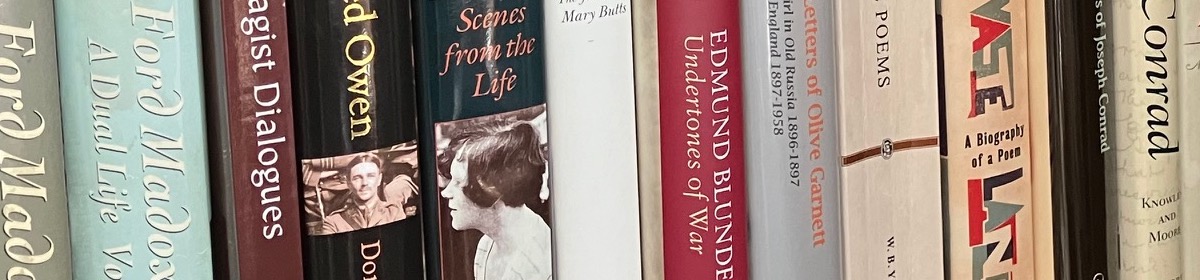
Corner posts and lucky beans


‘When he finally left, his eyes blurry from having stared at printed papers for so long, he felt that something was different’, Georges Simenon (or his translator) wrote of Inspector Jules Maigret. ‘It took a while to dawn on him that it had stopped raining. It felt like a void.’[1]

It has hardly stopped raining here, has barely drawn breath, in fact. No relief. None either in the news, with its daily litany of continuing atrocities, grotesque historical ironies and politicians soiling themselves to degrees remarkable even in our Golden Age of Hypocrisy.

But here the work continues, the ordinary processes of living which, more fortunate than some others, we are able to pursue: in my case, transcribing letters, reading Simenon, William Faulkner, Mary Butts – and feeding the cat.


(Harry the Cat)

When their meals are imminent, some cats have a habit of displaying affection to their owners (their staff) and, often, to the corners of cupboards, the legs of chairs, the edges of tables. Harry rubs his face against various fixtures and fittings but, particularly, the corners of a low table in front of the living-room sofa, where I sit to take off my outdoor shoes after a walk. Several times I’ve watched him work his way around the table – but always nudging three corners and missing one, though the missed one varies.

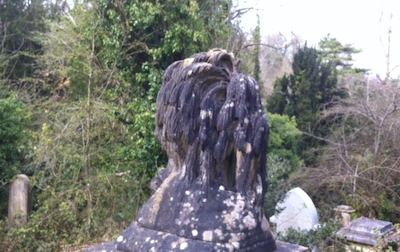
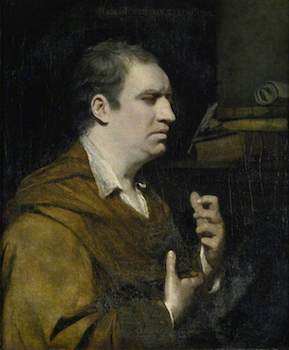
I mention to the vacant room that, when Doctor Johnson missed touching a post, he had to turn back to remedy the situation before continuing on his way, as reported by a man named Samuel Whyte:

I perceived him at a good distance working along with a peculiar solemnity of deportment, and an awkward sort of measured step…. Upon every post as he passed along, I could observe he deliberately laid his hand; but missing one of them, when he had got at some distance, he seemed suddenly to recollect himself, and immediately returning back, carefully performed the accustomed ceremony, and resuming his former course, not omitting one till he gained the crossing. This, Mr. Sheridan assured me … was his constant practice.[2]


(Joshua Reynolds, Samuel Johnson, National Trust: Knole)

Superstitions. Black cats, lucky beans, touching iron, meeting pigs, replacing chairs after dining, turnips, umbrellas and snails – throwing and divination. I realise that I have not one but two relevant reference books: Steve Roud, The Penguin Guide to the Superstitions of Britain and Ireland (London: Penguin, 2003), and Iona Opie and Moira Tatem, editors, A Dictionary of Superstitions (Oxford: Oxford University Press, 1989). Iona Opie, with her husband Peter, wrote the classic The Lore and Language of Schoolchildren, containing a chapter, ‘Half-Belief’, which assembles an astonishing array of ‘ancient apprehensions’ that, ‘even if only half-believed in, continue to infiltrate their minds’. These range from the likely bad effects of seeing a white horse (and omitting to spit) through the madness resulting from moonlight shining on a sleeping person’s face, screeching owls, dropped photograph frames, the perils of stepping on black beetles, walking under bridges as trains cross them, glimpses of funerals, chimney sweeps, spotted dogs, haycarts, sailors’ collars, nuns and wooden legs.[3]

(Georges Simenon: via Discovering Belgium)

Simenon again:

“Good luck, boys!”
“Break a leg,” grunted Torrence, touching wood.
Lucas, who claimed not to be superstitious, repeated in an almost reluctant whisper, “Break a leg!”[4]

Lucas claiming not to be superstitious but following suit anyway is a sly version of Pascal’s wager: bet on God’s existence and, if you’re wrong, nothing lost; if you bet on his non-existence and he then rolls up at your front door with a couple of heavies, you’re in trouble. I have vague memories of paying childhood lip service to one or two superstitions, just in case, then vigorously reversing. My avoidance of walking under ladders was succeeded by my determinedly walking under every ladder in sight (to demonstrate that I was not superstitious) and I recall an enthusiastic embracing of the number 13 on every possible occasion. Black cats I greeted warmly, was never overly concerned with sneezes or snowdrops, and may have looked askance at pairs of crows or ravens only because of the ballad of ‘The Twa Corbies’.

“Ye’ll sit on his white hause-bane,
And I’ll pike out his bonny blue e’en:
Wie ae lock o’ his gowden hair
We’ll theek our nest when it grows bare.”

Richard Ellmann writes that Paul Ruggiero, whom James Joyce had known in Zurich during the First World War and with whom he renewed acquaintance on returning there following the outbreak of the Second, had the habit of dropping in to see Joyce after work and laying his hat on the bed. Joyce ‘reproved him each time’, believing in the superstition that it meant somebody was going to die.[5]  This one seems connected particularly to cowboys and Italians. Bad luck to anyone that sleeps in the bed, evil spirits spilling out of it – in past times, I gather, priests and doctors would sometimes lay their hat on the bed if the patient in it was on the way out. Joyce, of course, subscribed to a mass of superstitions, ranging from thunder through colours, numbers, months, the arrangement of cutlery and a rat running downstairs.

He also shared Ford Madox Ford’s dismal view of years which added up to 13,[6] and a superstition about numbers must be one of the commonest. Edmund de Goncourt recalled a dinner at the Charpentiers, attended also by Emile Zola and his wife. Zola ‘spoke about his superstitions, saying that he added up the figures of the carriages he noticed, that 7 was his favourite number, and that he tapped the doors and windows a given number of times before going to bed.’[7]

‘I have always been superstitious myself and so remain—impenitently’, Ford wrote in 1931. ‘I cannot bear to sit in a room with three candles or to bring snowdrops, may or marigolds indoors.’ He claimed that, when the Daily Mail requested him to write a sonnet on Samuel Johnson, ‘All I could remember about Johnson at the moment was that he had kept pieces of orange peel and patted corner posts when he walked down Fleet Street.’[8]

Superstitions, the word and the idea, are endlessly malleable, able to fit occasion, character or context. Herman Melville, he of the White Whale, whose dealings with William Shakespeare were complex and extensive, nevertheless asserted that ‘this absolute and unconditional adoration of Shakespeare has grown to be a part of our Anglo-Saxon superstitions. The Thirty-Nine Articles are now Forty. Intolerance has come to exist in this matter. You must believe in Shakespeare’s unapproachability, or quit the country.’[9] Wyndham Lewis remarked that, ‘One of our greatest superstitions is that the plain man, being so “near to life,” is a great “realist.”’[10] Graham Greene presented it, in the case of his Assistant Commissioner, more as a matter of conscious selection, albeit a necessary one, like diet or wardrobe: ‘One had to choose certain superstitions by which to live; they were the nails in the shoes with which one gripped the rock. This was what a war threw up: a habit, a superstition, one more trick by which one got through the day.’[11]

But I like this, what might be termed intelligent tolerance, another threatened species – Dervla Murphy, in another age and another country, noting a traffic policeman in Kabul, abandoning his post to pray at the appointed time: ‘This frank devotion is for me one of the most impressive features of Islamic culture. If we accept that it is more than a superstition then there is something very wonderful indeed about mixing one’s daily deeds and one’s daily prayers in such an unselfconscious fashion, instead of keeping each in an airtight compartment.’[12]


Notes

[1] Georges Simenon Maigret and the Man on the Bench (1953; translated by David Watson, London: Penguin Books, 2017), 108.

[2] Samuel Whyte, Miscellanea Nova (Dublin, 1801), 49: James Boswell, Life of Johnson, edited by G. B. Hill, revised and enlarged by L. F. Powell (Oxford, the Clarendon Press, 1934), I, 485 n1. This and a great deal more is referred to and discussed by Lawrence C. McHenry, Jr., in an article, ‘Samuel Johnson’s Tics and Gesticulations’, Journal of the History of Medicine, 22 (April 1967), 152-168.

[3] Iona and Peter Opie, The Lore and Language of Schoolchildren (1959; New York: New York Review of Books, 2001), 206-231.

[4] Georges Simenon, Maigret, Lognon and the Gangsters (1952; translated by William Hobson, London: Penguin Books, 2017), 140.

[5] Richard Ellmann, James Joyce, new revised edition (Oxford: Oxford University Press, 1983), 739.

[6] Stuart Gilbert, editor, Letters of James Joyce (London: Faber, 1957), 161, n.

[7] Entry for 8 December 1891: Edmund and Jules de Goncourt, Pages From the Goncourt Journal, edited and translated by Robert Baldick (New York: New York Review Books, 2006), 369.

[8] Ford Madox Ford, Return to Yesterday: Reminiscences 1894-1914 (London: Victor Gollancz, 1931), 254-255 and 271; 299.

[9] Herman Melville, ‘Hawthorn and His Mosses’ (1850; in The Portable Melville, edited by Jay Leyda, Harmondsworth: Penguin Books, 1975), 409.

[10] Wyndham Lewis, The Complete Wild Body, edited by Bernard Lafourcade (Santa Barbara: Black Sparrow Press, 1982), 102. 

[11] Graham Greene, It’s a Battlefield (1934; London: Penguin Books, 1980), 170.

[12] Dervla Murphy, Full Tilt: Ireland to India with a Bicycle (1965; London: Century Publishing, 1985), 63.

Fetch a flitch of bacon


(John Frederick Herring II, ‘Farmyard with Saddlebacks’: Haworth Art Gallery)

The year has turned but, unfortunately, the direction of human travel has not, bringing to mind the old ballad:

It was mirk, mirk night, there was nae starlight,
They waded thro’ red blude to the knee;
For a’ the blude that’s shed on the earth
Rins through the springs of that countrie.[1]

We have long passed ‘that blessed season’, which Saki so liked, ‘between the harshness of winter and the insincerities of summer’.[2] I read hungrily, if not always strictly relevantly to the projects currently in train.

‘Every time I consider autobiography’, Guy Davenport wrote to the author and publisher W. C. Bamberger in June 2000, ‘my mind instantly runs to senseless (but satisfying) recrimination.’ He went on to detail the losses – due to carelessness or dishonesty – of valued letters, priceless association copies of books, drawings made to accompany essays or stories, which were jettisoned by editor or publisher once the material had been printed. ‘One of them was a Greek mask I’d worked on for a week, pen and ink, perhaps the finest drawing I’ve ever done.’ He added: ‘And there’s the art book with color plates that a fellow grad student at Harvard borrowed and kept his place with a slice of bacon,’ before concluding: ‘L’enfer, c’est les autres.’[3]


(Portrait of Lady Charlotte Harley as Ianthe: drawn by Richard Westall, engraved by W. Finden)

Bacon, you say. . . . Francis and Roger and Francis, and how many more? There was Lady Charlotte, wife of Colonel Anthony Bacon of the Lancers and daughter of the Earl of Oxford. Bacon was involved in the War of the Brothers, 1832-1834 (Pedro and Miguel) in Portugal, in the cause of Dom Pedro. Charlotte was the ‘Ianthe’ to whom, at the age of ten, Byron wrote his introductory stanzas at the beginning of Childe Harold.[4]

Such is thy name with this my verse entwined;
And long as kinder eyes a look shall cast
On Harold’s page, Ianthe’s here enshrined
Shall thus be first beheld, forgotten last[5]

There was Sir Nicholas Bacon, Keeper of the Great Seal to Queen Elizabeth I, who built a fine house mentioned by Ronald Blythe in his discussion of Stiffkey, a Norfolk village more famous since for the rector, Harold Davidson, who was defrocked after being charged with immorality – and died as a result of being mauled by a lion.[6] Francis – not the painter – supplies two epigraphs to Dorothy Sayers in her 1935 novel, Gaudy Night.[7] More entertainingly on the bacon front, Peter Vansittart writes that, until the Hundred Years’ War, the patron saint of England was Edward the Confessor. ‘Then Edward III, in debt to Genoese bankers, replaced him with their patron, the more aggressive St George, who was not to escape the attention of the supreme English ironist, Gibbon: he dismissed George as a dishonest bacon contractor, loathed by Christian and pagan alike.’[8]

Anyone fretfully wondering how long it will take Ford Madox Ford to rock up can now put their mind at rest. In Ancient Lights, Ford segued from a memory of Dante Gabriel Rossetti’s limericks to an anecdote about ‘another poet, a descendant of many Pre-Raphaelites, of whom it was related that whilst reading his friend’s valuable books at that friend’s breakfast table he was in the habit of marking his place with a slice of bacon.’ He added that he knew this anecdote to be untrue.[9] How might he be so sure? Slip forward twenty years and Ford is remembering his doctor, Tebb, with whom Ford stayed for a while when the good doctor was treating him in the late stages of a breakdown. He writes of Tebb inventing ‘one of the most ingenious lies’ about his guest: that Ford marked his place in Tebb’s ‘priceless first editions and incredibly sumptuous large paper copies with a slice of bacon.’[10]

Reading the recently published collection of shorter pieces by Hilary Mantel—and reminding myself of just how funny she can be—I come across an article, written for Vogue, on perfumes. Mantel remarks: ‘What women have always wanted to know is what scent drives men wild; researchers have the answer, say Turin and Sanchez [co-authors of the book Perfumes: The Guide], and it’s bacon.’[11] It’s just possible that this news may not have brought unalloyed delight to those inquiring women.

Bacon features largely in Ford’s letters around the end of the First World War, given the twin factors of meat rationing (introduced in 1918) and Ford’s own pig-breeding ambitions. ‘I got as far as the above’, he wrote to Stella Bowen in a letter that stretched over two days (28-29 April 1919), ‘when sleep overtook me—or rather sleepiness, for, when I went to bed I cd not get to sleep. I fancy an unmixed diet of bacon is telling on my liver.’[12]


William Cobbett – farmer, MP, soldier, traveller, radical journalist, printer, avid dispenser of practical advice to the common people (‘The Poor Man’s Friend’) – who took a positive view of pigs, wrote in his Cottage Economy:

A couple of flitches of bacon are worth fifty thousand Methodist sermons and religious tracts. The sight of them upon the rack tends more to keep a man from poaching and stealing than whole volumes of penal statutes, though assisted by the terrors of the hulks and the gibbet.[13]

It was also a matter of personal preference. On one of his famous rural rides, he arrived at Ashurst ‘(which is the first parish in Kent on quitting Sussex)’, where, ‘for want of bacon’, he was ‘compelled to put up with bread and cheese for myself. I waited in vain for the rain to cease or to slacken, and the want of bacon made me fear as to a bed.’[14] So he rode on through the night and the driving rain. Better drenched than baconless.

No mention of pork or bacon, unsurprisingly, in our Syrian and Palestinian cookbooks, nor, surely, in Claudia Roden’s The Book of Jewish Food? But yes, there is an entry in her index, which turns out to be connected with her visit to El Molino in Granada, a centre for research into the history of Spanish food. She was told that some Marranos, forced by the Inquisition to convert to Christianity, ‘made a point of cooking pork to protect themselves from charges by the Inquisition of continuing to practise their old religion.’[15]

The Librarian and I were recently comparing our inability to remember jokes. Some people have a repertoire of hundreds, others recall not a single one. The Librarian offers only one: it concerns the Pink Panther and she first heard it decades ago. I cudgel my brains and offer a knock knock joke dredged from some long unvisited cerebral recess:

Knock knock! (Who’s there?) Egbert! (Egbert who?) Egbert not bacon!

A brief, pitying smile. She murmurs, with visible effort, ‘That’s quite funny.’

It’s the way I tell them.


Notes

[1] ‘Thomas the Rhymer’, in The Oxford Book of Ballads, edited by Arthur Quiller-Couch (Oxford: Oxford University Press, 1910, reprinted 1932), 3.

[2] ‘The Romancers’, The Short Stories of Saki (London: The Bodley Head, 1930), 311.

[3] Guy Davenport, I Remember This Detail: 40 Letters to Bamberger Books, edited by W. C. Bamberger (Whitmore Lake, Michigan: Bamberger Books, 2022), 79-80. The French sentence is Jean Paul Sartre’s famous line from his play Huis Clos (No Exit).

[4] Rose Macaulay, They Went to Portugal (1946; London, Penguin Books, 1985), 307.

[5] Lord Byron, Selected Poems, edited by Susan J. Wolfson and Peter J. Manning (London: Penguin Books, 1996), 60.

[6] Ronald Blythe, The Age of Illusion: England in the Twenties and Thirties 1919-40 (Harmondsworth: Penguin, 1964), 156.

[7] Dorothy Sayers, Gaudy Night (1935; London: Hodder and Stoughton, 2016), Chapters 3 and 17.

[8] Peter Vansittart, In Memory of England: A Novelist’s View of History (London: John Murray, 1998), 42.

[9] Ford Madox Ford, Ancient Lights and Certain New Reflections (London: Chapman and Hall, 1911), 44, 45.

[10] Ford Madox Ford, Return to Yesterday: Reminiscences 1894-1914 (London: Victor Gollancz, 1931), 305.

[11] Hilary Mantel, ‘At First Sniff’ (2009), in A Memoir of My Former Self: A Life in Writing, edited by Nicholas Pearson (London: John Murray 2023), 332. I also learn from this that Burger King, yes, released a meat-infused scent called ‘Flame Grilled’.

[12] Correspondence of Ford Madox Ford and Stella Bowen, edited by Sondra J. Stang and Karen Cochran (Bloomington & Indianapolis: Indiana University Press, 1994), 109-110.

[13] William Cobbett, Cottage Economy (1823; Oxford University Press, 1979), 103. In past centuries, pigs ‘were kept by everyone, fed economically on scraps, waste, and wild food’: Alan Davidson, The Oxford Companion to Food, Second Edition by Tom Jaine (Oxford: Oxford University Press, 2006), 49.

[14] William Cobbett, Rural Rides, edited by George Woodcock (1830 edition; Harmondsworth: Penguin Books, 1983), 171-172.

[15] Claudia Roden, The Book of Jewish Food (London: Viking, 1997), 332.

Advice Notes


(Marianne North, Foliage and Flowers of a Madagascar Tree at Singapore, Marianne North Gallery; photo credit: Board of Trustees of the Royal Botanic Gardens, Kew)

I see that Mick Jagger—Sir Michael Philip Jagger, rather—is eighty this year. We lived abroad for a few years because of my father’s job while the Beatles and the Rolling Stones were getting going. ‘Not Fade Away’ must have been the first Stones song I heard when we came back to England; and it was another year before Jagger sang: ‘Well I told you once and I told you twice, But you never listen to my advice’—a slight friction there between ‘telling’ and ‘advice’? Unsurprising, perhaps, that it could have been the last time.

I’ve always been wary of advice, both giving and receiving. ‘I never myself took anyone’s advice’, Ford Madox Ford remarked, ‘and I do not imagine that many people will take mine.’[1] Robert Lowell appears to have taken it, though with mixed results, telling Flannery O’Connor in 1952: ‘Ford used to say that you could tell if a writer was any good from the first sentence—I found this advice useful when manuscript-reading for Sheed and Ward, though it led to fatal misunderstandings in my interviews with students at Iowa . . . ’[2]

I wouldn’t say ‘never’, I’m sure I’ve taken it from time to time but rarely with enthusiasm. Giving it as well, being too conscious of the tendency in many people, myself not excluded, to react negatively to such gestures, even embracing the opposite, sometimes ending up, metaphorically or literally, in a rainstorm without an umbrella. Though, it now occurs to me, I can advise, or at least suggest, that eating beetroot for lunch while reading a book you care about is best avoided.

Politicians, newspapers, television channels and radio stations are profligate dispensers of the stuff. I can recall the days when doctors and the BBC, anyway, were viewed with near-unanimity as reliable sources. Now people unwilling or unable to distinguish between blanket mistrust and informed scepticism are easy prey. Some conversations, to be sure, are best kept private when so much of the world appears to have gone mad-dog. To be appalled by so many governments is hardly a novelty, though, and my intake of news bulletins remains. . . careful.


(Herbert George Ponting, ‘Captain Scott’s Birthday, 6 June 1911’, National Portrait Gallery, London; photo credit, NPG. Cherry is the third seated man along on the left)

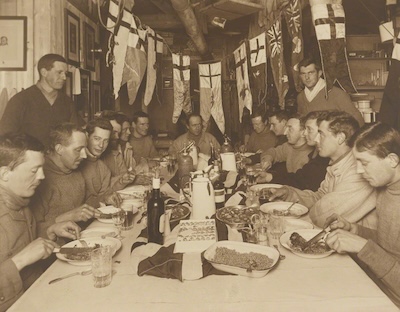
‘Defeats on the Western Front in March catapulted the nation into shock’, Sara Wheeler wrote in her biography of Apsley Cherry-Garrard, recalling the period of the First World War. ‘The Times rallied as usual to shore up public confidence, issuing advice on all fronts, including the stern “Don’t think you know better than Haig”, even though most people over the age of ten probably did.’[3]

On all fronts, not just the Western one.

In Penelope Fitzgerald’s The Blue Flower, a novel based on the life of the 18th century writer  Novalis, Fritz meets Sophie’s elder sister Friederike (‘the Mandelsloh’): ‘“I thank you for your advice,” said Fritz. “I think, indeed, that women have a better grasp on the whole business of life than we men have. We are morally better than they are, but they can reach perfection, we can’t. And that is in spite of the fact that they particularise, we generalise.”
   “That I have heard before. What is wrong with particulars? Someone has to look after them.”’[4]

Yes, those particulars. Colette was a generous dispenser of advice, not least to the young Georges Simenon when she was literary editor at Le Matin, telling him that, though on the right track, ‘he should drop “the literature”. “Pas de littérature!” she said. “Supprimez toute la littérature et ça ira!”’[5] To a young woman writer who had sought her advice, she replied: ‘When you are capable of certifying that today’s work is equal to yesterday’s, you will have earned your stripes. For I am convinced that talent is nothing other than the possibility of resembling oneself from one day to the next, whatever else befalls you.’[6] But she also served as a magazine’s regular agony aunt, sharing her expertise in matters of dress, cosmetics and, always, love.


(Colette, plus—of course—a cat)

On dress and cosmetics, I am probably unreliable; but I was writing recently about aeroplanes, though hardly straying from my usual temporal zone, the first two or three decades of the twentieth century. The context was Ford Madox Ford’s war but a lot of the material I had to draw on related to Guy Davenport—some of which has gone into blog posts here—as well as other writers of Ford’s time, references to whom had to be whittled down or eliminated. Every time I approached the suggested word limit, things spiralled out of control again as some other alleyway beckoned. I remembered that line of W. B. Yeats: ‘My thoughts were a great excitement, but when I tried to do anything with them, it was like trying to pack a balloon into a shed in a high wind.’[7]

The Davenport material went, leaving only a faint shadow of his 1991 response to Laurence Zachar’s remark that: ‘A proportionately large part of your work is Utopian. It deals with happy people, in an ideal place where there is no violence’, when Davenport commented of  “The Aeroplanes at Brescia”, ‘there’s the implicit sense that aeroplanes were going to stop all wars; the Wright brothers wrote a famous letter to the War Department which paid no attention to it, saying: with the aeroplane, there can be no more troop movements because they can be observed from the air, and therefore no more wars.’[8]

When his story, or assemblage—drawing on Franz Kafka’s first published work, a report on the 1909 air show—appeared in the Hudson Review, a paragraph on the final page put the assertion that wars would cease with the coming of the aeroplane into the mouth of Max Brod’s engineer brother Otto but Davenport may have felt that such an unbearably painful irony was too easy, too heavy-handed. It was omitted when revised for book publication.[9]


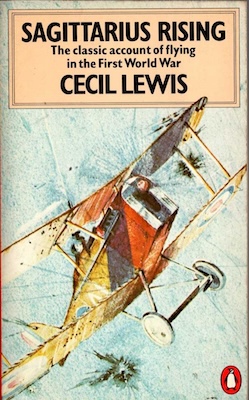
Another twist on that occurred to me when I was rereading the memoir by Cecil Lewis, Sagittarius Rising, who was in his teens when he joined the Royal Flying Corps. By the time he was posted to Home Establishment, he had survived eight months overseas, including four months of the Somme battle, and spent 350 hours in the air, during a period when pilots were lasting, on average, three weeks. Within little more than a month after the Armistice, he had been demobilised and secured a civilian job with Vickers. He was then twenty years old.

Writing in the mid-1930s, he looked back to the failure of the postwar conferences, aimed at ensuring peace, to take note of air power, finally waking to the significance of that power with a shudder of horror. ‘No wonder. Frontiers were gone. Security was gone. No man could hope for peace or prosperity under the threat of a violent death. The days of war were over: massacre had taken their place, wholesale massacre of the community in which children would retch their lives away, women would be blinded and men powerless to protect or succour. The end of civilization was in sight.’[10]


Notes

[1] Ford Madox Ford, Return to Yesterday: Reminiscences 1894-1914 (London: Victor Gollancz, 1931), 251-252.

[2] The Letters of Robert Lowell, edited by Saskia Hamilton (New York: Farrar, Straus and Giroux, 2005), 187.

[3] Sara Wheeler, Cherry: A Life of Apsley Cherry-Garrard (London: Jonathan Cape, 2001), 199.

[4] Penelope Fitzgerald, The Blue Flower (1995; London: Everyman, 2001), 364.

[5] Patrick Marnham, The Man Who Wasn’t Maigret: A Portrait of Georges Simenon (San Diego: Harcourt Brace & Company 1994), 112.

[6] Judith Thurman, Secrets of the Flesh: A Life of Colette (London: Bloomsbury Publishing, 2000), 409.

[7] W. B. Yeats, Autobiographies (London: Macmillan, 1955), 41.

[8] Laurence Zachar, ‘Guy Davenport. Lexington, Kentucky: December 1991’, Effets de voix (Tours: Presses universitaires François Rabelais, 1994).
See: http://books.openedition.org/pufr/3904 (accessed 20 January 2021).

[9] Guy Davenport, ‘The Aeroplanes at Brescia’, Hudson Review, 22, 4 (Winter, 1969-1970), 567-585; Tatlin! Six Stories (New York: Scribner’s, 1974), 52-70.

[10] Cecil Lewis, Sagittarius Rising (1936; Harmondsworth: Penguin, 1977), 152-153.

Things going better, bitte


(Not a Sequoia)

‘We drove up once to the Sequoia forest’, Christopher Isherwood told W. I. Scobie, ‘and I remember Stravinsky, so tiny, looking up at this enormous giant Sequoia and standing there for a long time in meditation and then turning to me and saying: “That’s serious.”’[1]

Sometimes, even for those long-practised in weathering it, the news becomes so distressing—and the public pronouncements of senior politicians so disgusting—that it’s best to pause, assuming you’re in the luxurious position of being able to do so.

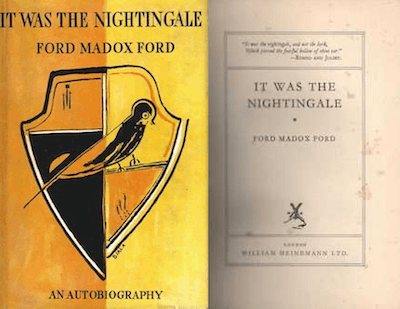
Ford Madox Ford or, let’s say, the narrator, does just that on page fifteen of It Was the Nightingale, which I’m currently reading for—let’s say the fifth time, not to sound too crazy. He pauses ‘with one foot off the kerb at the corner of the Campden Hill waterworks’. He is ‘about to cross the road. But, whilst I stood with one foot poised in air, suddenly I recognised my unfortunate position. . . .’ His rendering of the reflections that occur to him in that position appear to end, or pause, around page 88.


A few years back, I was writing about Ford and comedy, about genres and how comic writing is not viewed using the same critical criteria as ‘serious’ writing, discussing mostly the novels by Ford that might be regarded as comic: farces, satires for the most part. I was struck by a passage in a Guy Davenport essay:

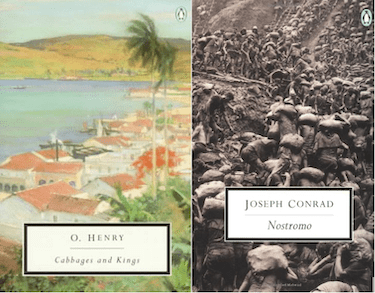
‘When Nostromo and Cabbages and Kings were published in 1904, we were beginning to make a distinction not among the four large types of literature which Northrop Frye has named comedy, romance, tragedy, and satire, or spring, summer, autumn, and winter spirits of the imagination, but between comic and serious. Some writers, like Shakespeare, Mark Twain, and Bernard Shaw, were allowed to be both at once, but with the understanding that the comic was being put in the service of the serious. The seriousness of the comic writer could only be sentimentality, and his business was to entertain, not to instruct’.[2]


Davenport writes as an admirer of O. Henry, a fat selection of whose stories he edited and introduced for Penguin Books. ‘To those friends who knew his past’, he writes there, ‘O. Henry always compared himself to Lord Jim.’ His introduction ranges over the classics—unsurprisingly, Davenport being both classicist and modernist—and some of the writers, possibly unexpected, who have admired O. Henry’s stories, among them Cesare Pavese, the Russians of the Constructivist movement, Yevgeny Zamyatin. Alluding to practitioners of the New Comedy, he remarks: ‘Miserable as our century is, we can still boast that for seventy years of it we had P. G. Wodehouse, the Menander de nos jours, and for ten years O. Henry.’[3]

Ford being one of those who was surely ‘allowed to be both at once’, I tried to convey how many comic moments—certainly passages that made me laugh—there were in the ‘serious’ books, not excluding The Good Soldier and Parade’s End.[4] I’ve wondered since whether I shouldn’t simply have said: Well, just read It Was the Nightingale. But no. It’s perfectly possible to explain, or attempt in accepted ways to do so, why you think a writer or a painter is good, what they succeed in, their distinctive personal characteristics. But explaining why someone is funny? Can it be done? You might explain why you personally find something funny but that may sound, to a reluctant or sceptical listener, as interesting and persuasive as your last night’s dream.

I quoted the estimable Frank Budgen on his friend, author of the comic masterpiece, Ulysses: ‘one day Joyce laughed and said to me: “Some people were up at our flat last night and we were talking about Irish wit and humour. And this morning my wife said to me, “[w]hat is all this about Irish wit and humour? Have we any book in the house with any of it in? I’d like to read a page or two.”’[5]

If the reader doesn’t find Ulysses funny, I suspect it’s because it feels intimidating too: this huge book, full of words, phrases, constructions, comparisons, images and symbols that you’re never come across before. Not, anyway, in those contexts and those combinations. Worse, it’s the Greatest Novel of the century or one that defined an era or the justification for the whole modern movement or—but is it funny? Well, yes, probably not if you go through it on tiptoe or hands and knees, peering warily about you as you go. But if you can relax, telling yourself that you’ll come back to it with a pick and shovel at some later date but just not now – pour a glass (leave the bottle) and sit back in that comfortable chair – things may go better.

I linger over that phrase—‘things may go better’—just for a moment, you understand. How could I not?

Notes


[1] Writers at Work. The Paris Review Interviews: 4th Series, edited by George Plimpton (Harmondsworth: Penguin Books, 1977), 232.

[2] ‘The Artist as Critic’, in Every Force Evolves a Form (Berkeley: North Point Press, 1987), 79.

[3] ‘Introduction’ to O. Henry, Selected Stories (New York: Penguin Books, 1993), xi, xv. Possible additions to these inheritors of the New Comedy are ‘the exotic and manic S. J. Perelman and the gentle, whimsical Thurber’.

[4] ‘Ford and Comedy’, Sara Haslam, Laura Colombino and Seamus O’Malley, editors, The Routledge Research Companion to Ford Madox Ford (London: Routledge, 2019), 427-440.

[5] Frank Budgen, James Joyce and the Making of ‘Ulysses’ and other writings, enlarged edition (1934; London: Oxford University Press, 1972), 38.

Melancholy baby, maybe


(George Romney, Mirth and Melancholy (Miss Wallis, Later Mrs James Campbell): National Trust, Petworth House)

‘What did you do in the end times?’ Well, among other things, I reread Olivia Manning’s Fortunes of War with immense pleasure and admiration. Here is the eunuch in the hallway of the Pomegranate nightclub in Athens: ‘His face was grey-white, matte, and very delicately lined. It was fixed in an expression of profound melancholy.’[1]

In 1915, after refraining from reading it until he had his own ‘few pages’ out of the way, Joseph Conrad wrote to the author of The Good Soldier: ‘The women are extraordinary—in the laudatory sense—and the whole “Vision” of the subject perfectly amazing. And talking of cadences, one hears all through them a tone of fretful melancholy extremely effective. Something new, this, in Your work my dear Ford – c’est très, très curieux. Et c’est très bien, très juste. You may take my word for that —speaking as an unsophisticated reader first—and as homme du métier afterwards—after reflection.’[2]

That ‘fretful melancholy’ is perhaps a distant relation of the ‘hilarious depression’ identified by Graham Greene in his review of  Ford’s Provence.[3] But it’s the word ‘melancholy’ that lingers more determinedly: how could it not, in yet another news cycle dominated by the latest governmental cowardice, grubbiness and xenophobia?

‘Come to me my melancholy baby/ Cuddle up and don’t be blue’. So ran the 1912 song, ‘My Melancholy Baby’, since associated with some famous names—Judy Garland, Al Bowlly, Connie Francis, Bing Crosby. The word itself has a long history, beginning as one of the four humours in Hippocratic medicine. Black bile, linked not only to melancholy but to one of the elements, Earth, and later to the season of autumn.[4] John Keats grants melancholy goddess status, associating her with beauty and joy as well as loss: ‘Ay, in the very temple of Delight/ Veiled Melancholy has her sovran shrine’.[5] But such nuances were sternly ironed out over time and the word became, as it has essentially remained, a near-synonym for sadness, though usually implying something deeper and longer-lasting than the common or garden kind and, often, of rather mysterious or inexplicable origin.


‘This was one of the blackest days that I ever passed. I was most miserably melancholy’, the sufferer James Boswell wrote; and in a letter of the following year: ‘Yet let me remember this truth: I am subject to melancholy, and of the operations of melancholy, reason can give no account.’[6] He recalled of Dr Johnson: ‘Burton’s Anatomy of Melancholy, he said, was the only book that ever took him out of bed two hours sooner than he wished to rise.’[7] Robert Burton and Edward Young, author of Night Thoughts, are probably the big cheeses of British gloom. I have a copy of the Anatomy, a reprint of the 1932 edition, introduced then by Holbrook Jackson (bibliophile and journalist, who had bought the New Age in partnership with A. R. Orage), and in the New York Review Books edition by William Gass. I have, though, only sampled and dipped, rather than read cover to cover. Alexandra Harris mentioned that Burton, ‘it was rumoured, took his own life in his college room in Christ Church. If this is true, the date makes sense. He died on 25 January 1640, well past the encouraging feasts of Christmas, at a melancholy time of the year.’[8]

An understandable trajectory there: the falling off or lapsing back from good fare and company to a more customary level, and the likely worsening of weather into the bargain. Melancholy often sits companionably enough beside modifying words or notions. Robert Graves remembered an old man in an antique shop telling him that ‘everyone died of drink in Limerick except the Plymouth Brethren, who died of religious melancholia.’[9] Ernst Jünger, fighting on the Western Front, remarked: ‘How often since that first time I’ve gone up the line through dead scenery in that strange mood of melancholy exaltation!’ And he remembered walking through a neglected but flourishing landscape: ‘Nature seemed to be pleasantly intact, and yet the war had given it a suggestion of heroism and melancholy; its almost excessive blooming was even more radiant and narcotic than usual.’[10]


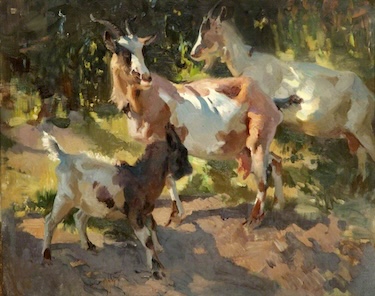
(Dorothy Adamson, Goats: Walker Gallery)

D. H. Lawrence decided that staying a long time in England made one ‘so melancholy’ but let that feeling extend to Sardinia and to other living creatures than troublesome humans: ‘Sometimes near at hand, long-haired, melancholy goats leaning sideways like tilted ships under the eaves of some scabby house. The call the house-eaves the dogs’ umbrellas. In town you see the dogs trotting close under the wall out of the wet. Here the goats lean like rock, listing inwards to the plaster wall. Why look out?’[11]

Lawrence and animals. I have a vague (and getting vaguer) memory of an exam question which I seized upon – was it writers on the animal world or specifically Lawrence? A resounding victory for the vagueness. I certainly wrote about Lawrence and, what, horses, snakes, cattle, perhaps even goats. It used to be a not uncommon ploy for people to concede cautiously that Lawrence was ‘very good with children and animals’, as though he couldn’t be trusted with anything else. Perhaps, for them, he couldn’t. Unsettling sort of chap. There are increasing numbers of unsettling figures in literary history as boundaries soften or bend. Is she modernist or not? Is he essentially Georgian or Victorian or. . .? The either/or becoming both or several or all.

Nick Jenkins, narrator of Anthony Powell’s A Dance to the Music of Time, reflects of  Dicky Umfraville: ‘He seemed still young, a person like oneself; and yet at the same time his appearance and manner proclaimed that he had had time to live at least a few years of his grown-up life before the outbreak of war in 1914. Once I had thought of those who had known the epoch of my own childhood as “older people”. Then I had found there existed people like Umfraville who seemed somehow to span the gap. They partook of both eras, specially forming the tone of the postwar years; much more so, indeed, than the younger people. Most of them, like Umfraville, were melancholy; perhaps from the strain of living simultaneously in two different historical periods.’[12]

Umfraville! Umfraville! – a composition for trombones or some other confident brass instruments. A bleak and almost wintry sky. ‘Cuddle up and don’t be blue’.


Notes

[1] Olivia Manning, Friends and Heroes (1965) in The Balkan Trilogy (London: Penguin Books, 1981), 802.

[2] The Collected Letters of Joseph Conrad: Volume 5 1912-1916, edited by Frederick R. Karl and Laurence Davies (Cambridge: Cambridge University Press, 1996), 529.

[3] ‘As in his fiction he writes out of a kind of hilarious depression’: London Mercury, xxxix (December 1938), in Frank MacShane, editor, Ford Madox Ford: The Critical Heritage (London: Routledge and Kegan Paul, 1972), 173.

[4] Roy Porter has a useful diagram of humours and elements in his The Greatest Benefit to Mankind: A Medical History of Humanity from Antiquity to the Present (London: Harper Collins, 1997), 58.

[5] John Keats, ‘Ode on Melancholy’, in The Complete Poems, edited by John Barnard, 3rd edition (London: Penguin Books, 1988), 349.

[6] Boswell’s London Journal, 1762-1763, edited by Frederick A. Pottle (London: William Heinemann, 1950), 213-214; letter to William Temple, 17 April 1764, in Boswell in Holland, 1763-1764, edited by Frederick A. Pottle (London: William Heinemann, 1952), 220.

[7] James Boswell, Life of Johnson, edited by R. W. Chapman, revised by J. D. Fleeman, (Oxford: Oxford University Press, 1980), 438.

[8] Alexandra Harris, Weatherland: Writers and Artists Under English  Skies (London: Thames & Hudson, 2015), 123.

[9] Robert Graves, Good-bye to All That: An Autobiography (1929; Harmondsworth: Penguin, 2014), 349.

[10] Ernst Jünger, Storm of Steel, translated by Michael Hofmann (Harmondsworth: Penguin, 2004), 9, 143.

[11] Letters of D. H. Lawrence II, June 1913-October 1916, edited by George J. Zytaruk and James T. Boulton (Cambridge: Cambridge University Press, 1981), 25; Sea and Sardinia (1921), in D. H. Lawrence and Italy (London: Penguin Books, 1997), 13.

[12] Anthony Powell, The Acceptance World, in A Dance to the Music of Time: 1st Movement (Chicago: University of Chicago Press, 1995), 153.

Diversions of the usual kind


(Samuel Bough, Cricket Match at Edenside, Carlisle: Tulle House Museum and Art Gallery)

September. Autumn at last; and an end to the nonsense of summer, the increasingly anachronistic expectation of pleasant weather, an expectation mistreated by endless rain or unbearable heat. And, on Samuel Johnson’s birthday, a revisiting of his remark to Doctor Brocklesby (as refracted through James Boswell): ‘The weather indeed is not benign; but how low is he sunk whose strength depends upon the weather!’[1]

On another day, though white clouds are piled so high as to be on the point of toppling over onto the crowns of trees, they’re surrounded by sky so blue that one suspects a gargantuan deception. Still, disposable barbecues, spawned by the Devil, are nowhere to be seen and the grass of the park has been mown again, which always imparts a faint whiff of paradise.

Le paradis n’est pas artificiel,
l’enfer non plus.

Ezra Pound at Pisa, with hell very much on his mind.[2] ‘I am now the proud possessor of a Johnson’s Dictionary’, Guy Davenport announced to Hugh Kenner in 1967. ‘Dorothy [Pound] once told me EP has never owned any other, and sure enough, practically every word of H[ugh]S[elwyn]M[auberley] is used with Johnson’s rhetorical colouring (juridical, adjunct, phantasm, factitious).’[3]

Walking is more comfortable in the cooler weather, thinking also. And the near-neighbours, we dare to believe, are gone, their riotous tenancy ended. The next lot may, of course, be anything from a heavy metal band that just loves to rehearse to a group of trainee Trappists. We await with interest. So the mood swings between, say, states represented by quotations, the first something like Clare Leighton’s: ‘Who can resist the Lincolnshire name for the wild pansy: meet-her-in-the-entry-kiss-her-in-the-buttery?’ Well, not me, obviously. On the other hand, there is always the reliable standby from D. H. Lawrence’s letter to E. M. Forster: ‘I am in a black fury with the world, as usual.’[4]


There are diversions, of course, of the usual kind, usual at this kitchen table anyway (between meals). In the ‘Credits’ section of Bad Actors, after the usual acknowledgements (publishers, agents, all those involved in the TV series of Slow Horses), Mick Herron recalls an email from a reader informing him that a line he’d used in Slough House was ‘more or less from a Robert Frost poem’. Herron asked for ‘many dozens of similar offences to be taken into consideration.’[5] And it’s true that one of the many pleasures of reading his books is picking up echoes, half-echoes, perhaps-echoes from poets and novelists. Some might not stand up in court—courts vary, as is painfully clear by now, I suspect—but I’m pretty sure about this from the third Zoë Boehm book, Why We Die: ‘Life was too short to approach death head-on. On that journey you took any diversion available – marriage, travel, children, alcohol. At the very least, you stopped to admire the view.’[6] Beside which I would set the resonant advice from William Carlos Williams, to ‘approach death at a walk, take in all the scenery.’[7] Elsewhere,  Margery Allingham’s detective, Albert Campion, remarks to Guffy Randall: ‘“Across the face of the East Suffolk Courier and Hadleigh Argus, Fate’s moving finger writes, and not very grammatically either”.’[8] The response of the many readers of Edward Fitzgerald’s rendering of the Rubáiyát of Omar Khayyám is surely to nod sagely at a clear or misty memory of stanza LI:

The Moving Finger writes; and, having writ,
Moves on: nor all thy Piety nor Wit
Shall lure it back to cancel half a Line,
Nor all thy Tears wash out a Word of it.[9]


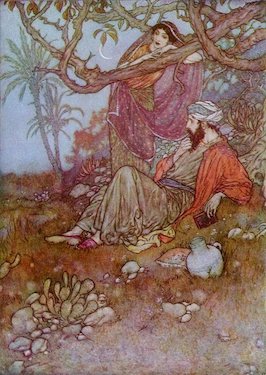
(A jug of wine, a loaf of bread and Edmund Dulac)

Or again, thirteen pages earlier, Campion talking of the intention to wait for an offer of purchase ‘and then to freeze on to the vendor with the tenacity of bull-pups.’ Bull-pups? Freezing? Here is Sherlock Holmes telling Dr John Watson in ‘The “Gloria Scott”’: ‘Trevor was the only man I knew, and that only through the accident of his bull terrier freezing onto my ankle one morning as I went down to chapel.’[10]


(Sidney Paget, Strand magazine illustration to ‘The “Gloria Scott”‘)

Do I find this stuff diverting? Why yes, in between those other matters of life and love and death and war. Some varied reading and even some varied writing, on the better days. But there are also visits to the vet with Harry the cat, the usual budget of human aches and pains, as well as that constant screaming of the world outside these walls. Winter, no doubt, is coming. Yet there are still pockets of sense and sanity to be found. One of my latest is the excellent Melissa Harrison’s new Witness Marks (‘A monthly miscellany from a little Suffolk cottage: nature and the seasons, poetry, books and writing, thoughts on creativity, news and Qs’).

https://mzharrison.substack.com/

I read, listen, enjoy and – yes – learn a few things.


Notes

[1] James Boswell, Life of Johnson, edited by R. W. Chapman, revised by J. D. Fleeman, (Oxford: Oxford University Press, 1980), 1338.

[2] The Cantos of Ezra Pound, fourth collected edition (London: Faber and Faber, 1987), 76/460.

[3] Questioning Minds: The Letters of Guy Davenport and Hugh Kenner, edited by Edward M. Burns, two volumes (Berkeley: Counterpoint Press, 2018), II, 904. Samuel Johnson’s A Dictionary of the English Language was published in 1755.

[4] Clare Leighton, Four Hedges: A Gardener’s Chronicle (1935; Toller Fratrum: Little Toller Books, 2010), 40; Letters of D. H. Lawrence III, October 1916–June 1921, edited by James T. Boulton and Andrew Robertson (Cambridge: Cambridge University Press, 1984),  21.

[5] Mick Herron, Bad Actors (London: John Murray, 2022), 339-340.

[6] Mick Herron, Why We Die (London: John Murray, 2020), 122.

[7] William Carlos Williams, Kora in Hell (1920), in Imaginations (London: MacGibbon and Kee, 1970), 32.

[8] Margery Allingham, Sweet Danger (1933; Harmondsworth: Penguin Books, 1950), 44.

[9] In Daniel Karlin, editor, The Penguin Book of Victorian Verse (London: Penguin Books, 1997), 125.

[10] Arthur Conan Doyle, The New Annotated Sherlock Holmes, 2 volumes, edited with notes by Leslie S. Klinger (New York and London: W.W. Norton and Company 2005), I, 502. Klinger quotes Nicholas Utechin’s Sherlock Holmes at Oxford to the effect that Trevor’s bull terrier ‘has been a subject more disputed by scholars in the Sherlockian world than any other—animal, vegetable, or mineral’, the issue of which university Holmes attended being a highly contentious one and the dog a crucial clue.

Sleeping mowers


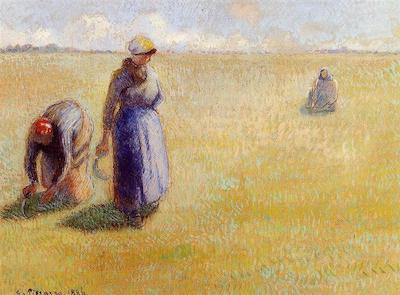
(Camille Pissarro, Three Women Cutting Grass)

It rains, it rains,
From gutters and drains
And gargoyles and gables
It drips from the tables
That tell us the tolls upon grains.
Oxen, asses, sheep, turkeys and fowls
Set into the rain-soaked wall
Of  the old Town Hall.[1]

While much of the world is on fire, some of it quite literally, we have been frequently awash with summer rains, though complaining about it less than usual. The United Kingdom as a whole recorded the sixth highest July rainfall since those records began in 1836; Northern Ireland recorded its highest July rainfall ever. In the United States, heat-related deaths are confidently predicted to exceed those of previous years. Beijing reports the heaviest rainfall in 140 years, with many deaths and disappearances. In the Antarctic, sea ice levels are at record lows as we veer towards the final tipping point.

In response to all this, as if mindful of Samuel Beckett’s famous formulation in Worstward Ho—‘Try again. Fail again. Fail better’—politicians are skipping the trying bit and simply failing again, though labouring to fail even worse than before, reaching new depths of dangerous irresponsibility. Are the voters they paw at really as selfish and unthinking as they assume? Or is it just their usual contempt for the proles? Answers on a lump of coal please, tossed into a rising and soon to be overwhelming sea.

At 05:45, the vegetable boxes are already delivered and I bring them in; by 06:30 the light has deteriorated enough to warrant flipping switches in the kitchen. Surely it’s not that many days back that, in balmy weather, the mowers were out in the park and the air heavy with the distinctive and evocative scent of freshly cut grass. ‘Do you ever feel the smell of freshly cut grass is a cry for help from the grass?’ the (dead) Lily asks Finn in Lorrie Moore’s new novel.[2]


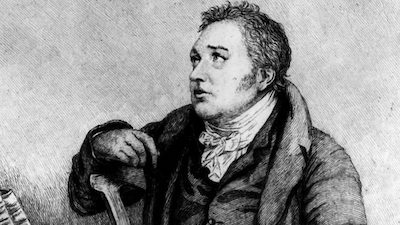
In Alethea Hayter’s fine book—but then she wrote only fine books—Voyage in Vain, she describes how Samuel Taylor Coleridge, en route to Malta, ‘identified himself’ with a sheep in a pen, destined, like the ducks and chickens, ‘to figure on the ship’s menu’. ‘He imagined it as coming from a countryside of flat peaceable meadows, and when he saw it cheerfully eating hay, he pictured its sensations, taking the brightness and sweet murmur of the sea for “dewy grass in sunshine, and the murmur of the trees”.’[3]

On another, more hazardous voyage, late in Moby Dick, Ahab’s anguished raving to the mate has: ‘“and the air smells now, as if it blew from a far-away meadow; they have been making hay somewhere under the slopes of the Andes, Starbuck, and the mowers are sleeping among the new-mown hay. Sleeping? Aye, toil we how we may, we all sleep at last on the field.”’[4]

Sensory commerce between ship and shore.

Helen, thy beauty is to me
   Like those Nicéan barks of yore,
That gently, o’er a perfumed sea,
   The weary, way-worn wanderer bore
   To his own native shore.

Of Edgar Allan Poe’s poem ‘To Helen’, Guy Davenport remarked: ‘We can defend perfumed seas, which has been called silly, by noting that classical ships never left sight of land, and could smell orchards on shore, that perfumed oil was an extensive industry in classical times and that ships laden with it would smell better than your shipload of sheep. Poe is normally far more exact than he is given credit for.’[5]


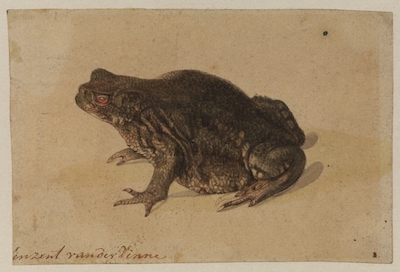
(Vincent Laurentsz van der Vinne, Toad: © The Courtauld)

Wet weather tends to steer us to the nearby park, a couple of circuits by varying paths. On drier days, we still head to Arnos Vale, pausing to pluck some rosemary from the bushes in Perrett Park, eyeing in several of our usual locations the blackberries which are nearly, nearly ready. Our walk back from Arnos Vale is along Cemetery Road. At home, I sit down with a cup of tea and a Mick Herron novel called, ah, Down Cemetery Road. And there is Zoë Boehm, thinking of Joe: ‘Larkin, she thought. He’d always been fond of Philip Larkin. Give me your arm, old toad; Help me down Cemetery Road. . .[6]

Yes, not the famous ‘Toads’:

Why should I let the toad work
Squat on my life?
Can’t I use my wit as a pitchfork
And drive the brute off?

But ‘Toads Revisited’:

What else can I answer,

When the lights come on at four
At the end of another year?
Give me your arm, old toad;
Help me down Cemetery Road.[7]

(Naturally, having drafted this, I see a tweet from Noreen Masud, author of the excellent A Flat Place—‘We can’t live in this world without damaging or being damaged. The point is to be deliberate about which damage to give and take’[8]—with a photograph of the street sign for Cemetery Road and, for heading, that same quote from Larkin: ‘Give me your arm, old toad’. If you believe in coincidences, this is one; if not, not.)


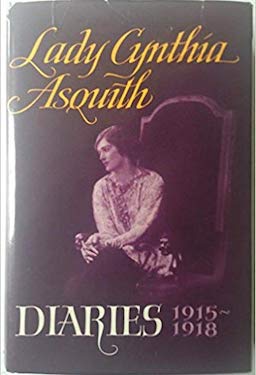
So the news of seemingly endless grotesque and malign misgovernment grinds on, and I think of D. H. Lawrence’s letter to Lady Cynthia Asquith in February 1917: ‘You mustn’t think I haven’t cared about England. I have cared deeply and bitterly. But something is broken.’[9]

I have too – and something is.


Notes

[1] Ford Madox Ford, ‘In the Little Old Market-Place’, Collected Poems (London: Max Goschen, 1913), 36.

[2] Lorrie Moore, I Am Homeless If This Is Not My Home (London: Faber & Faber, 2023), 149.

[3] Alethea Hayter, Voyage in Vain: Coleridge’s Journey to Malta in 1804 (1973; London: Robin Clark, 1993), 70.

[4] Herman Melville, Moby Dick (1851; edited by Harold Beaver, Harmondsworth: Penguin Books, 1972), 653.

[5] Guy Davenport, The Geography of the Imagination (Boston: David R. Godine, 1997), 7.

[6] Mick Herron, Down Cemetery Road (London: John Murray, 2020), 353.

[7] Philip Larkin, Collected Poems, edited by Anthony Thwaite (East St Kilda: The Marvell Press and London: Faber, 2003), 62, 90.

[8] Noreen Masud. A Flat Place: A Memoir (London: Hamish Hamilton, 2023), 210.

[9] Letters of D. H. Lawrence III, October 1916–June 1921, edited by James T. Boulton and Andrew Robertson (Cambridge: Cambridge University Press, 1984), 91.

Reports of summer


‘Sumer is icumen in’, as the song has it, but at 7 a.m. even on the hottest days the paths have been cool, the birdsong loud and the dog walkers few and far between. There is, though, the usual dislocation of feeling, the season barely begun, while the solstice, the first day of astronomical summer and already two weeks in the past, was followed three days later by what is still widely celebrated as Midsummer’s Day.

Midsummer 1857 was the occasion of the third trip taken by Henry Thoreau—‘probably the American writer who tells us best how to live comfortably with our most constant companion, ourselves’, Edward Hoagland wrote—which provided the material of his The Maine Woods.[1] Thoreau travelled in the company of Edward Hoar and a Native American, Joe Polis, of the Penobscot tribe. The second trip had concerned moose hunting; and Thoreau noted that the moose’s sounds, by their resemblance to familiar ones (such as the strokes of an axe) ‘enhanced the impression of solitude and wildness.’ It was, though, in the account of the first expedition, which included the ascent of Mount Ktaadn (‘highest land’) that one of the most extraordinary passages occurs:

‘I stand in awe of my body, this matter to which I am bound has become so strange to me. I fear not spirits, ghosts, of which I am one, — that my body might, — but I fear bodies, I tremble to meet them. What is this Titan that has possession of me? Talk of mysteries! Think of our life in nature, — daily to be shown matter, to come in contact with it, — rocks, trees, wind on our cheeks! the solid earth! the actual world! the common sense! Contact! Contact! Who are we? where are we?’[2]

The Maine Woods was published posthumously, two years after Thoreau’s death at the age of 44, his last words reportedly ‘moose’ and ‘Indian’.


Indeed, 4th July, apart from being the birthday of Nathaniel Hawthorne (1804)—‘It is remarkable that persons who speculate the most boldly conform with the most perfect quietude to the external regulations of society. The thought suffices them, without investing itself in the flesh and blood of action’—was also the day in 1845, six weeks after Franklin set out from Greenhithe on his last voyage to find the Northwest Passage, on which Thoreau strolled off to Walden Pond.[3] (‘We commonly do not remember that it is, after all, always the first person that is speaking.’)[4]

Weeks before our own midsummer or solstice, we had four, five, gorgeous afternoons (in among the rain), as if we had skipped even late spring and vaulted straight into the first day of summer. It seemed an absurdly short time since winds were shaking the darling buds of April. We had lunch down at the harbourside on one of those April days where, sitting at an outside restaurant table, in a covered area, we’d allowed for the rain but a wind with serious ambitions caught us out sufficiently to warrant a move inside for dessert and coffee. On the wide paths, there were dogs with horizontal ears, especially spaniels eminently ready for take-off. We are more accustomed, especially on calmer days in quiet roads, to cats with vertical tails.

That other people felt the early summer sensation was confirmed by the number of them sprawled, in various positions—some of them frankly improbable—on the grass and, in one case, half on the grass and half on the path. Who would deliberately arrange themselves like that, I wondered, staring but not-staring, deciding that voicing the question ’Excuse me, are you dead?’ might not be the way to go. I became aware, not just in the park, that I spend a good deal of time when walking in looking up, a habit I date from our first visit to Amsterdam. Birds, kites (sometimes flying, more often caught in branches), clouds, rooftops and chimneys—and trees.


‘I liked cemeteries, parks, the roof terraces of buildings’, the narrator (one of them) of Valeria Luiselli’s novel says, ‘but most of all cemeteries. In a way, I was living in a perpetual state of communion with the dead. But not in a sordid sense.’[5]

Yes. In a sordid sense, though, the news impinges. Democracy—in the democracies—is not doing well, is, frankly, sick. India, Israel, the United States—and here. People everywhere, some people at any rate, continually asking how it happened, how it came to this, how things became so badly broken. But we know, really. We watched it happen.


The recently arrived near-neighbours are not always in evidence, which is the best that can be said for them. A shared house with a slew of young men of a certain type, who shout rather than talk; who bray rather than laugh; who drunkenly howl rather than sing; who can only listen to music if it’s rank bad stuff and played at full volume, who can only take phone calls on speakerphone, jammed up against our back fence. Season of pests and bellowed frightfulness, as the poet said.

After breakfasts, showers, walks – the day offers: diseases of the potato; nursery rhymes; Welsh terriers; First World War cooking implements; advertisements for foot powder; flowering bulbs, translators of Anatole France, dog roses and Fabians. The joys of research. And the danger signs, such as the slight frisson produced by the heading of a column on an old photocopy ‘The Best of Swine’. The reason for obtaining the photocopy is there on the two central columns: a review article by Ford Madox Ford, novelist, poet, critic, autobiographer—and pig breeder. Alas, further scrutiny of that enticing right-hand column reveals the terminal ‘E’ of ‘SWINE’ to be half of a ‘B’. The review is of a selection of poetry—‘The Best of Swinburne’. Still, this review is by T. Earle Welby, probably not a household name these days but yes, a name that had already cropped up in a letter to Ford’s agent. Who was it that said everything is connected? A great many people, probably – one of them was certainly Stanley Spencer.


And here is A. E. Stallings:

                                    Don’t ask
The Mind to rest, though someday it must cease;
In life, only the flesh has any peace.[6]

Some flesh, of course, needs greedy reading, to convince the restless mind that such things are still possible, a few hundred pages a day for a while. C. J. Sansom’s Matthew Shardlake novels and Mick Herron’s Slow Horses series fitted the bill perfectly. So I could then slow down again, with Noreen Masud’s A Flat Place, William Beckford’s journals, more D. H. Lawrence letters and a rereading of Erskine Childers’ The Riddle of the Sands. And, notwithstanding the last few days’ rain, the summer persists. As we do. As we must.


Notes

[1] In his introduction to the Penguin Nature Library edition of The Maine Woods (New York, 1988), ix.

[2] Henry David Thoreau, A Week on the Concord and Merrimack Rivers; Walden; The Maine Woods; Cape Cod, edited by Robert F. Sayre (New York: Library of America, 1985), 668, 646.

[3] Hawthorne, The Scarlet Letter (1850; edited by Brian Harding, Oxford: Oxford University Press, 1990), 164;  Robert D. Richardson, Jr., Henry Thoreau: A Life of the Mind (Berkeley: University of California Press, 1986), 152.

[4] Henry David Thoreau, Walden, edited by J. Lyndon Shanley (Princeton: Princeton University Press, 1974), 3.

[5] Valeria Luiselli, Faces in the Crowd (London: Granta 2022), 10.

[6] A. E. Stallings, ‘Lost and Found’, Like (New York: Farrar Straus Giroux, 2018), 61.

April, come she will


(Charles Sims, The Shower: Aberdeen Art Gallery and Museums)

April comes in like a drowned rat. The wettest English March for more than forty years – but today? It’s raining. Though traditionally placed at 15 July, St Swithin’s day has gone rogue, completely unmoored from the calendar. Forty days and nights of rain appears a conservative estimate of the drenching we’re ensnared in.

‘More social interaction than I’ve had for a while’, I said to the Librarian some while back. This comprised, firstly, a dialogue with the driver of the recycling truck that had failed to remove a broken box even though we’d received the replacement.
‘Can’t you take this one?’
‘Not us. That’s Avonmouth.’
‘I thought the old one was meant to be collected.’
‘Can’t take it. It’s hard plastic. They’ll tell you to break it up and put it in your black bin anyway.’

Next was a knock on the door: the driver of the resurfacing lorry.
‘Is that your van?’
‘No. There are men working next door. Maybe theirs.’
‘Can’t make anyone hear.’
In the back garden, I call over the fence.
‘You might have to move your van.’
‘Not our van. We saw the signs yesterday.’

(Being-in-the-world. Not quite Heidegger bur definitely being in the world.)

At least there was the excitement of seeing the offending van winched on to the back of a lorry and trundled away; the downside being that its alarm went off at regular intervals while the operation was in progress.

I left the broken recycling box outside to dry off before taking it through the house to break it up in the garden. It’s still there. Nothing has dried off. Conjugate that: nothing has dried off, is drying off, will dry off. The inspiration for that exercise comes from hearing the Librarian in the front room, intoning questions in French about trying the roasted mangoes with honey or invitations to dance at the castle, everyday stuff that gets those verbs meshing.

I resume readerly interaction with Hannah Rose Woods and Eleanor Catton, pausing to wonder exactly when it was that we went to a reading at Topping’s Bookshop in Bath and came away with a signed copy of The Luminaries. It was September 2013, I find. She mentioned James Salter as one of the writers she valued to the person ahead of me in the queue, so I told her, while she was signing my copy of her book, that we’d seen Salter interviewed and heard him read at the Watershed in Bristol in May, in the Festival of Ideas programme. He was almost eighty-eight then, in good form and good voice. He died in 2015, just past his ninetieth birthday. Eleanor Catton was already on the shortlist for the Man Booker prize. I wished her luck — but she didn’t need it.


Five years since I read any Salter. What would I revisit now? A Sport and a Pastime and All That Is, yes. Probably Light Years, maybe Burning the Days. Some of the stories and, always, the marvellous correspondence with Robert Phelps.

‘I also had a lovely letter from John Collier, who was seventy this month. His letter bears no reference to time, does not acknowledge it. He writes as if he had always been part of the world and always would be.’
‘I have 65 pages of outline, not to mention 150, at least, of notes. All this to be entitled to write a single paragraph, the last paragraph of the book.’
‘Why am I writing about myself all the time? Then again, who else do I know?’
‘Imagine finding a friend late in life when one’s heart has begun to close.’
‘I’ve felt, for a month, like those English of the Great War years, 1914-, who saw everyone they knew simply vanish and vanish forever.’

Change that ‘everyone’ to ‘everything’ and look around the world and things get a little chilly. On the other hand – good grief, I think the rain has stopped. To the park! Yes, the paths will be flooded and the grass beside them waterlogged and the road below the park running with water since the drains gave up the ghost – but the rain has stopped!

Sirens and syrens


(Herbert James Draper, Ulysses and the Sirens: Ferens Art Gallery)

—I know you think I’m obsessed with sirens.
—Yes.
—But there were three at once just now. And at least a dozen or more, so far today.
—Think of where we are.
—Arterial junction on this side of the city. But still . . .

But still. Sirens. Or Syrens? The meaning of which, the Merriam-Webster Dictionary sternly pronounces, is ‘chiefly British spelling of siren’. Elsewhere, ‘syren’ is simply termed ‘old-fashioned’.

‘What song the sirens sang, or what name Achilles assumed when he hid himself among women, though puzzling questions, are not beyond conjecture’, Sir Thomas Browne wrote in chapter 5 of his Urn Burial.[1] His editor points out that those questions had been put by the emperor Tiberius to test the grammarians. Or, according to Suetonius, in his life of that strikingly unpleasant Roman, ‘his greatest passion was for mythology, to the extent that he made himself seem foolish and absurd; for he used to make trial of scholars, a class of men on whom [ . . . ] he was especially keen: “Who was Hecuba’s mother? What was Achilles’ name when he was among the virgins? What songs used the Sirens to sing?”’[2]


Sleight of hand, yes, siren to siren: but both rub shoulders under the one dictionary heading. A beckoning and a warning; a come-on and a note of caution. The mythological nymphs whose singing required Homer’s hero to be bound to his ship’s mast while his crew had their ears stuffed with beeswax; but also a signalling or warning instrument, as well as an American genus of eel-like amphibians (typically living in muddy pools). The proposed derivation is suitably tortuous: Middle English from Old French from Late Latin from Greek (Seirēn).

‘I imagine’, Ford Madox Ford wrote, ‘that I should prefer to be where Christobel low-lieth and to listen to the song the syrens sang. But I am in London of the nineteen tens, and I am content to endure the rattles and the bangs—and I hope to see them rendered.’[3] He had used the phrase—‘what songs the Sirens sang’—a year earlier; and would use it, or a variant of it, on several later occasions.[4]  In 1931, reporting fierce storms in the South of France to the novelist Caroline Gordon, one of which had drowned seventeen men, he added: ‘the Mediterranean being a treacherous syren’.[5]

Ford also recalled, from his days of editing the English Review, a piece by Norman Douglas called Syrens, ‘which was, I think, the most beautiful thing we printed.’ That Douglas essay begins: ‘It was the Emperor Tiberius who startled his grammarians with the question, what songs the Sirens sang.’[6]

Not that Ford and Douglas were the only ones with Sirens on their mind. E. M. Forster was at it too. In his ‘The Story of the Siren’, a Sicilian boatman tells the English narrator the story of his brother’s sighting of the Siren, when he dives for silver coins. Permanently changed, he marries a woman similarly bewitched, who is murdered by a priest while pregnant, religion and popular superstition having conspired to produce the conviction among the villagers that the couple’s child would empower the Siren, that the Pope would then die and the world be turned upside down.[7]


Also in 1920, the writer John Rodker’s recently created Ovid Press issued an edition of 200 copies of Ezra Pound’s Hugh Selwyn Mauberley, with initials and colophon by Edward Wadsworth, who had been briefly associated with the Omega Workshops, then with the Vorticists, contributing five illustrations and a review of Kandinsky’s On the Spiritual in Art to the first issue of Blast.

The third stanza of Mauberley:

ἴδμεν γάρ τοι πάνθ᾽ ὅσ᾽ ἐνὶ Τροίῃ εὐρείῃ
Caught in the unstopped ear;
Giving the rocks small lee-way
The chopped seas held him, therefore, that year.

The first line, from Homer’s Odyssey (Bk.XII, 189), ‘For we know all the toils that are in wide Troy’, is, precisely, from the Sirens’ song, its transmission unimpeded by that ‘unstopped ear’ (while ‘lee-way’ is Pound’s bilingual rhyme with Τροίῃ, and those choppy seas or, rather, that ‘therefore’, suitably disturbs the rhythm of the final line).[8]


Richard Buxton notes that the Sirens are ‘depicted by post-Homeric sources as women above the waist and birds below it’ and prints the image of an Attic vase, which the British Museum dates to c.480-470 BC, one of the Sirens having thrown herself off a cliff onto the ship, ‘perhaps because the safe passage of Odysseus’ vessel marks a defeat for the Sirens’ power’. [9]

https://www.britishmuseum.org/collection/object/G_1843-1103-31

In May 1940, after the Nazi invasion of the Lowlands, Mollie Panter-Downes noted that ‘the bus changing gear at the corner sounds ridiculously like a siren for a second, as it used to do in the first edgy days of the war.’[10] But even those of us (now most of us) not old enough to recall the originals have been made familiar with the sound of air raid sirens by film and television dramas.

Things were a little more makeshift in the earlier war. When the Gothas, heavy wide-spanned biplanes, virtually took over from Zeppelins the attacks on London in the summer of 1917, E. S. Turner wrote: ‘Belatedly the Government introduced a proper warning system of maroons [fireworks used as signals or warnings]; one of the earlier methods had been to send out a fast open car with a bugler (sometimes a Boy Scout) standing in the back, or a policeman hard-pedalling a cycle with a ‘Take Cover’ notice. Engine drivers had their own way of sounding “All Clear”; they blew a cock-a-doodle-do on their whistles.’[11] Hard luck if your attention was elsewhere when that policeman cycled by.

Dropping off the car on returning from Somerset, we are almost deafened by a rush and cacophony of wailing vehicles, both ambulance and police. I suspect I know what song those sirens sing.


Notes

[1] Browne, Selected Writings, edited by Claire Preston (Manchester: Carcanet Press, 1995), 105. Thetis sent her son Achilles to the court of King Lycomedes on Skyros to avoid his being sent to war with Troy, where he was destined to die. He disguised himself as a girl under the name of Pyrrha but was tracked down by Odysseus.

[2] Suetonius, Live of the Caesars, edited and translated by Catharine Edwards (Oxford: Oxford University Press, 2000), 132.

[3] Ford, ‘On a Notice of “Blast”’, Outlook, XXXVI (31 July 1915), 144. Coleridge’s ‘Christabel’ may have wantonly embraced Tennyson’s 1830 poem ‘Claribel’ (‘Where Claribel low-lieth’) here.

[4] Ford, ‘Literary Portraits XXVIII—Mr Morley Roberts and Time and Thomas Waring’, Outlook, XXXIII (21 March 1914), 390; Thus to Revisit (London: Chapman & Hall, 1921), 7; The Marsden Case (London: Duckworth, 1923), 44; and ‘Somewhere the sirens smiled’, in The Rash Act (1933; Manchester: Carcanet Press, 1982), 187.

[5] Brita Lindbergh-Seyersted, A Literary Friendship: Correspondence Between Caroline Gordon & Ford Madox Ford (Knoxville: The University of Tennessee Press, 1999), 11-12.

[6] Ford Madox Ford, Return to Yesterday (London: Gollancz, 1931), 408-409; Norman Douglas, ‘Sirens’, English Review, II, ii (May 1909), 202-214.

[7] Forster’s story was ‘hand-printed by the Woolfs’ and published in a limited edition in July 1920: The Diary of Virginia Woolf, Volume 2: 1920-24, edited by Anne Olivier Bell, assisted by Andrew McNeillie (Harmondsworth: Penguin, 1981), 51-52 and n.; E. M. Forster, Collected Short Stories (London: Penguin Books, 1954), 179-187.

[8] Hugh Selwyn Mauberley, in Ezra Pound: Poems and Translations, edited by Richard Sieburth (New York: Library of America, 2003), 549.

[9] Richard Buxton, The Complete World of Greek Mythology (London: Thames & Hudson, 2004), 142.

[10] Mollie Panter-Downes, London War Notes (1971; edited by William Shawn, new preface by David Kynaston, London: Persephone Books, 2014), 64.

[11] E. S. Turner, Dear Old Blighty (London: Michael Joseph 1980), 123.