Words, things, words for things


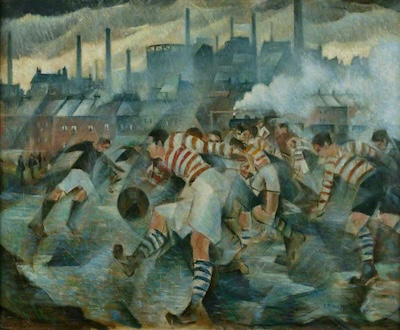
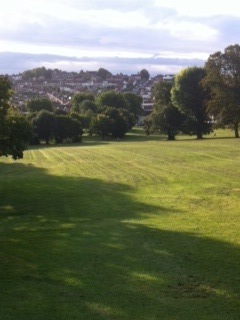
(C. R. W. Nevinson, Any Wintry Afternoon in England: Manchester Art Gallery)

Walking on the wide path in the park, I see a football rolling determinedly towards me over the grass, two boys watching, a long way off. I trap it, nudge and kick. It travels a fair distance but nowhere near the waiting boys. A woman walking towards me on the path says: ‘One of my irrational fears, a ball coming at me like that.’ I say: ‘One of mine too now’, and she laughs. ‘Oh, you did okay.’

Did I, though? Not the kick, that was what it was but. . . irrational fears? If it were now one of mine because of that episode, it’s not irrational but quite rational, reasoned, based on solid, empirical evidence, so. . .Don’t overthink it! the Librarian says, often in person and now in my head. Don’t overthink things!

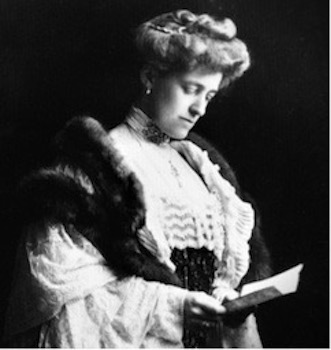
Ding, ting, chose, cosa, peth, rud, shay, hlutur: thing. . . ‘The distinguished thing’ was Henry James’s famous phrase for death. Did he actually say it? Following a reference to Edith Wharton’s A Backward Glance, I see that there’s an extra link or two: ‘He is said to have told his old friend Lady Prothero, when she saw him after the first stroke, that in the very act of falling (he was dressing at the time) he heard in the room a voice which was distinctly, it seemed, not his own, saying: “So here it is at last, the distinguished thing!”’ Wharton adds: ‘The phrase is too beautifully characteristic not to be recorded.’[1] It’s certainly wonderfully—and characteristically—indefinite, or at least, on a very convoluted path: ‘He is said’ to have told someone else that he heard a voice which wasn’t his own, the word ‘distinctly’ applied only to a negative, ‘not his own’ and, even then, ‘it seemed’.


(Edith Wharton via BBC)

Death as ‘the thing’ (Death! Where is thy thing?) – while for Edna St Vincent Millay, death was not the thing but the force engulfing it:

Death devours all lovely things:
   Lesbia with her sparrow
Shares the darkness,—presently
   Every bed is narrow.[2]

The line ‘Every bed is narrow’ I take to refer to coffins (rather than, or as well as, singleness or separation), and it also recalls Pound’s ‘Homage to Sextus Propertius’. ‘We, in our narrow bed, turning aside from battles:/ Each man where he can, wearing out the day in his manner.’[3]

And yet – I was thinking, at the outset, more of things than of death; or rather, words and things, particularly the word ‘thing’. Impressively, its origin seems to embrace both ‘object’ and ‘parliament’. The definitions are lavish: an assembly, court, council, matter, affair, problem, fact, event, action, that which exists or can be thought of, a living creature, a piece of writing; in the plural, clothes, personal belongings. What a word, what a world, ‘thing’ is!

While an inmate of the Disciplinary Training Center at Metato, north of Pisa, in the autumn of 1945, Ezra Pound wrote:

   And for all that old Ford’s conversation was better,
consisting in res non verba,
          despite William’s anecdotes, in that Fordie
   never dented an idea for a phrase’s sake
and had more humanitas [4]

Things, not words for things. Pound was reiterating his belief in those opposing—or complementary—positions, Ford as realist, Yeats as symbolist, that he proposed on more than one other occasion.[5] Poignantly, they were both just six years dead – the length of a world war, say.

That ‘humanitas’ had led the youthful Ford to rashly discuss the conditions of the London poor with a young woman he took out in a boat, only to be reproved the next day by her mother, Lady Cusins: ‘“Fordie, you are a dear boy. Sir George and I like you very much. But I must ask you not to talk to dear Beatrice … about Things!”’[6]

(Iris Barry)

Ford had actually written to Iris Barry (4 July 1918): ‘I have always been preaching to people not to write “about” things but to write things—& you really do it—so I like to flatter myself that you are an indirect product of my preachings—a child of my poor old age.’ (He was still serving in the British Army, having by then reached the ‘poor old age’ of 44.)[7]

Ralph Waldo Emerson also fished in those waters: ‘The corruption of man is followed by the corruption of language’ and ‘new imagery ceases to be created, and old words are perverted to stand for things which are not’. But ‘wise men pierce this rotten diction and fasten words again to visible things’.[8] This linking of words and things would have some later commentators and theorists tearing their hair out, words for them being quite arbitrary marks on the page, the word for something not otherwise  linked to that something. Lord Byron though, as so often, pursued his own path:

But words are things, and a small drop of ink,
Falling like dew upon a thought, produces
That which makes thousands, perhaps millions, think.[9]

And as if by magic, an email just arrived from PN Review offers, from its archive, ‘Holà’, a short poem by C. H. Sisson from 1992, which is also concerned with words and things:

Words do not hold the thing they say: 
Say as you will, the thing escapes 
Loose upon air, or in the shapes 
Which struggle still before the eyes. 
Holà will run upon its way 
And never catch up with its prize.[10]


Later in my park walk, halfway down a steepish path, I see a woman ahead of me with a child in a pushchair and a dog crouched in the grass nearby, with a ball in its mouth. It looks at me inquiringly. ‘I’m afraid not’, I say. ‘You’re not my dog and that ball is covered with slobber, as we both know.’ The woman is partly blocking the path where it meets the wider track, talking on her phone and with her back to me, but moves to one side as I approach. The dog lies down close by her and lets the ball drop from its mouth. She half-turns and kicks the ball, which rockets cleanly away for a good distance – and apparently just where she meant it to go. Damn, I think, she only needed to be a bit better than me to make the point. What point? That I shall not overthink it. . .


Notes

[1] Edith Wharton, Novellas and Other Writings: Madame de Treymes, Ethan Frome, Summer, Old New York, The Mother’s Recompense, A Backward Glance, edited by Cynthia Griffin Wolff (New York: Library of America, 1990), 1055.

[2] Millay, ‘Passer Mortuus Est’ (first of three stanzas), in F. O. Matthiessen, The Oxford Book of American Verse (New York: Oxford University Press, 1950), 886. As is often noted, Millay here references Catullus 2, about the death of his lover Lesbia’s sparrow, her ‘plaything’: The Poems of Catullus, translated with an introduction by Peter Whigham (Harmondsworth: Penguin Books, 1966), 52.

[3] Ezra Pound: Poems and Translations, edited by Richard Sieburth (New York: Library of America, 2003), 535.

[4] Canto LXXXII, The Cantos of Ezra Pound, fourth collected edition (London: Faber and Faber, 1987), 525. I have tried—and failed—to insert the ideogram, ‘jen’.

[5] Ezra Pound, Polite Essays (1937; Plainview, New York: Books for Libraries Press, 1966), 50; Pound/ Williams: Selected Letters of Ezra Pound and William Carlos Williams, edited by Hugh Witemeyer (New York: New Directions, 1996), 187.

[6] Ford Madox Ford, Return to Yesterday: Reminiscences 1894-1914 (London: Victor Gollancz, 1931), 75.

[7] Ford Madox Ford, Letters of Ford Madox Ford, edited by Richard M. Ludwig (Princeton: Princeton University Press, 1965), 87.

[8] Ralph Waldo Emerson, Selected Essays, edited by Larzer Ziff (Harmondsworth: Penguin Books, 1982), 51.

[9] Lord Byron, Don Juan, III:88, edited by T. G. Steffan, E. Steffan and W. W. Pratt (London: Penguin Books, 1996), 182.

[10] PN Review 87 (September–October 1992), 28.

There not there


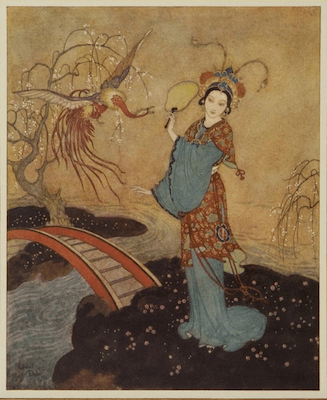
(Edmund Dulac, Frontispiece to Princess Badoura: A Tale from The Arabian Nights, by Laurence Housman)

‘The things you think of to link are not in your control. It’s just who you are, bumping into the world. But how you link them is what shows the nature of your mind. Individuality resides in the way links are made.’[1]

Bumping into the world, I noticed yesterday that I was reading A. S. Byatt on what would have been her 88th birthday. More, in the volume’s longest story, was the sentence: ‘And she waited for the sound of thunder, or worse, the silence of absence.’[2] I was struck (or bumped against) by that last phrase, having been thinking recently in similar terms. Sometimes the silence here is indeed the dictionary’s ‘absence of sound; complete quietness’ – but often something more. Silences have their own flavours, idiosyncrasies, tones, strengths and essences.

‘Throughout the house’, Patrick White wrote in  his story ‘The Night the Prowler’, ‘there were the sounds of furniture, and clocks, and silence.’[3] It has to be said that furniture was often on his mind, not least in populating Theodora Goodman’s world: ‘There is perhaps no more complete a reality than a chair and a table’ – though he adds there: ‘Still, there will always also be people, Theodora Goodman said, and she continued to wait with something of the superior acceptance of mahogany for fresh acts.’[4] When the painter Hurtle Duffield meets a man named Mothersole on the ferry, the printer asks what sort of things Duffield paints. ‘“Well! For some time now, tables and chairs.”’ Mothersole finds it a ’funny sort of subject’ and Duffield responds: ‘“Why? What could be more honest?”’[5]

There must be vastly fewer ticking clocks in the world now, timepieces having been widely and inescapably recruited to the cause of at least electronic silence. Ticking is a disturbing anomaly in this grave, enslaved new world. My maternal grandfather once owned several fish and chip shops in Portsmouth but, by the time I was of an age to notice such things, he had become a jeweller and watchmaker. The clocks that had audibly populated so much fiction through several centuries still kept the faith in his shop. He even had, at one point and appropriately enough, a grandfather clock. Ticks, tocks and chimes galore.


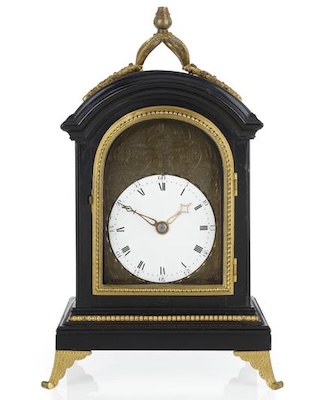
(The Clockmakers’ Museum. Musical table clock by Thwaites for Barraud. L2015-3473 Science Museum Group Collection Online.)

Thinking of silence, then, we often think of absence too, perhaps of the old saying that ‘absence makes the heart grow fonder’ (or, as I once heard someone—probably of a poetic turn of mind—say, a few drinks in: ‘Absinthe takes the art au fond-er’). Old sayings, though. People sometimes ask: are they true? To which the answer is, can only be, it depends. For some yes, for others no.

Absence can be a source of amusement, an occasion for pleasure. Rudyard Kipling’s parents (John Lockwood Kipling and Alice Macdonald) were unable to attend a party given by Dante Gabriel Rossetti because the date of their sailing on the S. S. Ripon to Bombay had been brought forward by a day, to Wednesday 12 April, 1865. ‘In their absence, however, Ford Madox Brown proposed their health, in a speech throughout which, with his usual inability to remember names, he referred to the bridegroom as “John Gilpin”—to the delight of all present.’[6]

Annie Erneaux, though, recalled literally writing out her passion in Florence, being temporarily removed from an intense and wounding affair: ‘Those eight days on my own, without speaking, except to waiters in restaurants, haunted by the image of A. (to the extent that I was astonished to be accosted by men, could they not see him silhouetted inside my own body?) seemed to me an ordeal for the betterment of love. A sort of further investment, this time to imagination and craving through absence.’ And elsewhere she stated that:  ‘It is the absence of meaning in what one lives, at the moment one lives it, which multiplies the possibilities of writing.’[7]


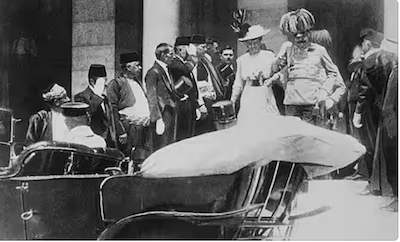
(Franz Ferdinand & Sophie. Photograph: Bettmann/Corbis via The Guardian)

When Stanley Weintraub wrote about the guns falling silent at the end of the First Word War, his book’s title, A Stillness Heard Round the World, looked back both to Ralph Waldo Emerson’s ‘Concord Hymn’, which included the phrase ‘the shot heard round the world’ and the fact that Emerson’s phrase has often been applied to the shot that began the war, fired at the Austrian Archduke Franz Ferdinand by Gavrilo Princip, who killed both the Archduke and his wife Sophie on 28 June 1914. The significance of that incident was not widely grasped and reports of it were often to be found on the inner pages of the following day’s newspapers – a squabble in the Balkans! – but since then a great deal of writing about it has certainly been found possible.

Marcel Proust observed that ‘the absence of a thing is not merely that, it is not simply a partial lack, it is a disruption of everything else, it is a new state which one cannot foresee in the old.’[8] We can, in fact, often foresee that absence, we grasp its inevitability, not least the inescapable end of every living thing but of course that single fact is not, cannot be, all there is. We distinguish between ‘surprise’ and ‘shock’ for a reason. Our awareness that something is coming, will inevitably happen, does not provide a thorough preparation for the event and its aftermath. Some effects are unscripted.

‘There is a time in life when you expect the world to be always full of new things’, Helen Macdonald wrote. ‘And then comes a day when you realise that is not how it will be at all. You see that life will become a thing made of holes. Absences. Losses. Things that were there and are no longer. And you realise, too, that you have to grow around and between the gaps, though you can put your hand out to where things were and feel that tense, shining dullness of the space where the memories are.’[9]


Yes. As Sarah Moss wrote, ‘One does not need to see ghosts, to know that people are haunted.’ And, a little further on: ‘It is not ghosts but absence that is harder to bear.’[10]


Notes

[1] Anne Carson, Paris Review interview (2004), quoted by Jennifer Krasinski in her review of Carson’s Wrong Norma in Bookforum, 30, 3 (Winter 2024), 13.

[2] A. S. Byatt, ‘The Djinn in the Nightingale’s Eye’, in Medusa’s Ankles: Selected Stories (London: Vintage, 2023), 256.

[3] Patrick White, ‘The Night the Prowler’, in The Cockatoos: Shorter Novels and Stories (London: Jonathan Cape, 1974), 149.

[4] White, The Aunt’s Story, (1948; Harmondsworth: Penguin Books, 1963), 141.

[5] White, The Vivisector (London: Jonathan Cape, 1970), 420.

[6] Roger Lancelyn Green, Kipling and the Children (London: Elek, 1965), 20, citing Georgiana Burne-Jones, Memorials of Edward Burne-Jones (1904), I, 290.

[7] Annie Erneaux, Simple Passion, translated by Tanya Leslie (London: Fitzcarraldo Editions, 2021), 33; A Girl’s Story, translated by Alison L. Strayer (London: Fitzcarraldo Editions, 2020), 143.

[8] Marcel Proust, In Search of Lost Time. 1: The Way By Swann’s, translated by Lydia Davis (London: Allen Lane, 2002), 308.

[9] Helen Macdonald, H is for Hawk (London: Jonathan Cape, 2014), 171.

[10] Sarah Moss, Signs for Lost Children (London: Granta Books, 2016), 64, 86.

Oxford Days (a few)


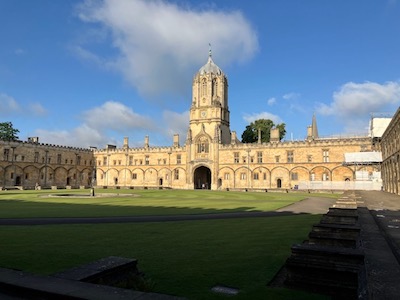
(Tom Quad, Christ Church College)

‘Even when we protested the invasion of Iraq’, I said to the Librarian, recalling that day some twenty years earlier when we shuffled along London streets in company with over a million others, ‘I think we moved more quickly than this.’

‘This’ was our glacial progress up St Aldates in Oxford on a sunny afternoon, together with residents, tourists, American and other participants in the Oxford Experience, or those embarked upon the countless other summer courses and programmes, and many hundreds of—mainly Japanese—children dressed in the Gryffindor house colours of scarlet and gold, concerned to take in the Harry Potter vibrations from New College, the Bodleian Library and Christ Church College. Tour guides in their dozens hoisted small flags or halted in gateways with uplifted arms. Lanyards in their hundreds bobbed or swung. Some individuals, either on home turf or away, looked vague, a little stunned, reminding me of the passage in Rory Stewart’s memoir, where he described Steve Hilton, David Cameron’s director of strategy, moving into the corridor and another room. ‘He seemed to be searching for something – although I couldn’t tell whether it was a cat, an idea, or his shoes.’[1]

On High Street or Broad Street, Broad Walk, Christ Church Meadow, by rivers and canals, on bridges and benches, crowds ebbed and flowed – but mainly flowed. We are soon to be visible in a thousand physical or virtual photograph albums. I said, at one point, ‘Okay, if it’s a child of ten or younger having a photograph taken, we’ll pause. Otherwise, we plough straight on.’ The Librarian agreed but soon lowered the qualifying age to eight, then six. Minutes later, it was down to zero. Thereafter, we ploughed straight on.


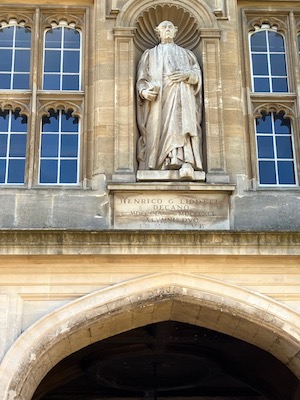
(Alice Liddell’s dad, Henry George Liddell, dean of Christ Church from 1855)

Oxford! The literary references the word throws up are astonishing, even excluding the people that only studied there. Lewis Carroll, or rather, Charles Dodgson, haunts the place, but other names rampage through a distracted memory: Philip Pullman, Dorothy Sayers’ Gaudy Night, John Wain, P. D. James, Iris Murdoch, Hardy’s Jude and Colin Dexter’s Morse, C. S. Lewis and J. R. R. Tolkien. A random footnote fact I gathered since that visit was that Edward De Vere, seventeenth Earl of Oxford, was educated not at Oxford, as one might reasonably expect, but at Queen’s College, Cambridge. Attempts were later made to claim him as the ‘real’ author of Shakespeare’s plays, an idea launched by the splendidly named John Thomas Looney. De Vere was the nephew of Arthur Golding, translator of Ovid, his Metamorphoses ‘the most beautiful book in the language’, in Ezra Pound’s words.[2] A man skilled in ‘fourteeners’ (that many syllables in a line):

Then sprang up first the golden age, which of it selfe maintainde,
The truth and right of every thing unforst and unconstrainde.
There was no feare of punishment, there was no threatning lawe
In brazen tables nayled up, to keep the folke in awe.
There was no man would crouch or creepe to Judge with cap in hand,
They lived safe without a Judge, in everie Realme and lande.

Here Daphne flees from Apollo:

And as shee ran the meeting windes hir garments backewarde blue,
So that hir naked skinne apearde behinde hir as she flue,
Hir goodly yellowe golden haire that hanged loose and slacke,
With every puffe of ayre did wave and tosse behind hir backe.[3]

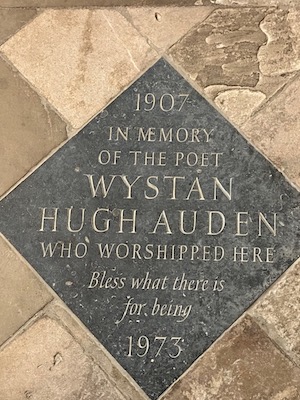
One name occurs on the ground as well as in the mind, the memorial plaque in Christ Church Cathedral (astonishing vaulted ceiling, stained glass by Burne-Jones and others, the St Frideswide Shrine). W. H. Auden came to the College to study biology, switched to English Literature in his second year and graduated (with a third class degree) in 1928. Nearly 30 years later, he became Oxford Professor of Poetry, and returned to Christ Church to live (part of the time) in 1972, the year before his death.


Wot, no Ford Madox Ford notes? Perhaps a sly one. In Some Do Not. . ., Christopher Tietjens, in a mood verging on ‘high good humour’, walks through a Kentish field with Valentine Wannop, a scene, a day, a walk which will recur in both their memories. Among those things that the best people must know are the local names (and the stories behind them) of the plants and flowers they pass. Tietjens—younger son, mathematician, member of the English public official class, who will also, in time, be lover, soldier and antique dealer—tells over to himself the words, the names, the language:

In the hedge: Our lady’s bedstraw: dead-nettle: bachelor’s button (but in Sussex they call it ragged robin, my dear: So interesting!) cowslip (paigle, you know, from the old French pasque, meaning Easter): burr, burdock (farmer that thy wife may thrive, let not burr and burdock wive!); violet leaves, the flowers of course over; black briony; wild clematis: later it’s old man’s beard; purple loose-strife. (That our young maids long purples call and liberal shepherds give a grosser name. So racy of the soil!) …[4]

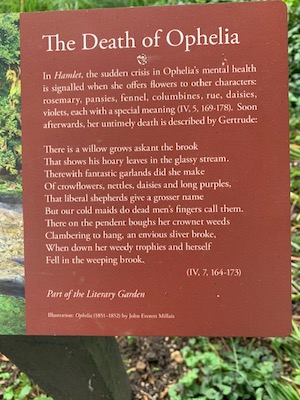
In the wonderful Botanic Garden, the country’s oldest, one section is the Literary Garden, featuring plants that occur in literature, Alice in Wonderland, Agatha Christie (a great user of poisons) and others, including William Shakespeare:

Yes, those liberal shepherds grossly naming again. Modernists though Joyce, Eliot, Woolf, Wyndham Lewis and Ford were, they were not Futurists rejecting the past—a little more selective than that: ‘BLAST years 1837 to 1900’ and, indeed, ‘BLESS SHAKESPEARE for his bitter Northern Rhetoric of humour’—and they all had frequent recourse to that Elizabethan. . .


Notes

[1] Rory Stewart, Politics on the Edge: A Memoir from Within (London: Jonathan Cape, 2023), 100.

[2] Ezra Pound, The ABC of Reading (London: Faber and Faber, 1961), 127

[3] Extracts in The Oxford Book of Classical Verse, edited by Adrian Poole and Jeremy Maule (Oxford: Oxford University Press, 2000), 394; The Oxford Book of Verse in English Translation, Chosen and Edited by Charles Tomlinson (Oxford: Oxford University Press, 1980), 38.

[4] Ford Madox Ford, Some Do Not. . . (1924; edited by Max Saunders, Manchester: Carcanet Press, 2010), 132.

Wording, birding


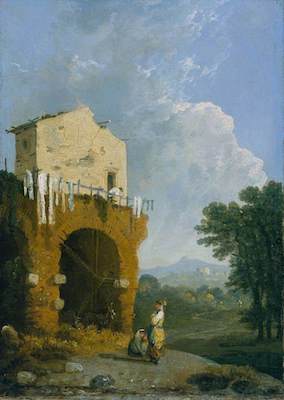
(Robert Wilson, Hadrian’s Villa, c.1765: Tate)

‘At night I trailed from one window recess to another’, the Emperor Hadrian recalls in Marguerite Yourcenar’s novel, ‘from balcony to balcony through the rooms of that palace where the walls were still cracked from the earthquake, here and there tracing my astrological calculations upon the stones, and questioning the trembling stars. But it is on earth that the signs of the future have to be sought.’[1]

So it is. ‘Ghosts await you in the future if they do not follow you from the past’, Sarah Moss wrote, and: ‘No one who knows what happens in the world, what humans do to humans, has any claim to contentment.’[2] Yes. I write pages and delete them, since they serve no real purpose except to relieve my feelings for a short while. The past is not always a foreign country and they do not always do things differently there. As Pankaj Mishra said in his recent ‘Winter Lecture’: ‘It hardly seems believable, but the evidence has become overwhelming: we are witnessing some kind of collapse in the free world.’[3]

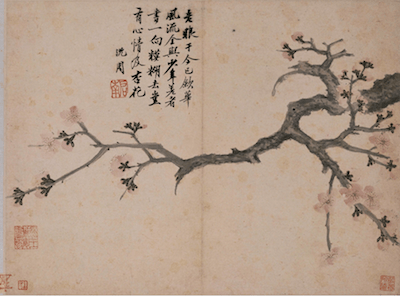
Early summer creeps on, though fitfully. Watching rose petals fall from the bush in a light wind, I remembered Pound’s Canto XIII, the first in which Confucius appears, and which ends:

The blossoms of the apricot
            blow from the east to the west
And I have tried to keep them from falling.[4]


(Shen Zhou, ‘Apricot Blossom’, leaf from the album, Dreaming of Travelling While in Bed: Palace Museum, Beijing)

Ronald Bush observed that: ‘To keep the blossoms of the apricot from falling is to keep nature in a permanent vernal bounty.’[5] It also seems to me to signify cultural contact, the free exchange of ideas, without the limits of borders or nationalism. At that stage, Pound was using Guillaume Pauthier’s translation of Confucian texts in Confucius et Mencius: les quatre livres de philosophie morale et politique de la Chine and had written in ‘Exile’s Letter’:

Intelligent men came drifting in from the sea and from the west border,
And with them, and with you especially
There was nothing at cross purpose,
And they made nothing of sea-crossing or of mountain crossing,
If only they could be of that fellowship,
And we all spoke out our hearts and minds, and without regret.[6]

On the daily walks we speak our minds but, just lately, exchanges are punctuated by information from our newly downloaded Merlin app, available from Cornell University, which draws on a huge database of bird sounds, sightings and photographs to identify what you’re probably hearing in that nearby tree or passing overhead.


So we stroll along narrow paths thus:

Politics, dinner, politics. . .
‘Blue tit. Carrion crow. Wren.’
Politics, domestic details, politics, cat, literary chuntering. . .
‘Dunnock. Blackcap. Chiffchaff.’
Ash dieback, politics, university gossip, politics. . .
‘Blackbird. Herring gull. Great tit. Jay!’

Excuse me, sir, let me just ask about the birdsong: in a world both literally and metaphorically on fire, democracies hanging by a thread, war crimes, liars and knaves in public places – does it help?

Why, yes, a little – rather more than a little, in fact. . .


Notes

[1] Marguerite Yourcenar, The Memoirs of Hadrian, translated by Grace Frick, with Yourcenar (1951; Penguin Books, 2000), 82.

[2] Sarah Moss, Signs for Lost Children (London: Granta Books, 2016), 88-89, 97.

[3] Pankaj Mishra, ‘The Shoah after Gaza’ [Winter Lecture], London Review of Books 46, 5 (7 March 2024).

[4] The Cantos of Ezra Pound, fourth collected edition (London: Faber and Faber, 1987), 60.

[5] Ronald Bush, The Genesis of Ezra Pound’s Cantos (Princeton: Princeton University Press, 1989), 251.

[6] ‘Exile’s Letter’, Ezra Pound: Poems and Translations, edited by Richard Sieburth (New York: Library of America, 2003), 255.

Passing the critical stage, or not


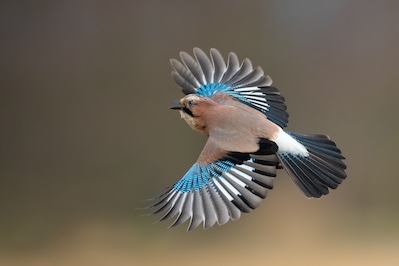
RSPB: https://www.rspb.org.uk/birds-and-wildlife/jay

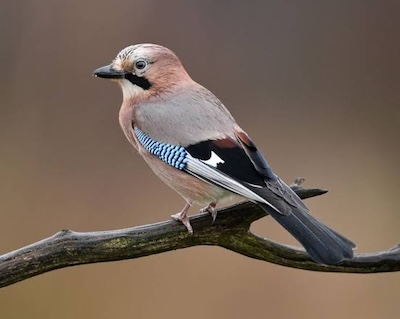
The highlight of yesterday morning was the jay, garrulus glandarius, briefly perched on the high roof of the shed beyond our back fence, a bird we’ve seen high up in the trees of the Victorian cemetery but never so close to home. The lowlight, in the wake of the announcement of a forthcoming General Election, now a little over five weeks away, was probably the reported Tory proposals to cut taxes for the rich again and to bring back National Service. This last appears to be an attempt to outflank satirists with a first strike of absurdity and anachronism. We await with bated breath the reintroduction to the statute books of the death penalty for stealing a pocket handkerchief, damaging Westminster Bridge or impersonating a Chelsea Pensioner.

Reading the stories of  Somerville and Ross lately, I alighted on Major Sinclair Yeates, together with Flurry Knox and the visiting Englishman Leigh Kelway, taking refuge from the rain in a public-house, having failed to get to the country races: ‘The bread tasted of mice, the butter of turf-smoke, the tea of brown paper, but we had got past the critical stage.’[1]

On occasion, we – or certainly I – don’t get to the critical stage, much less past it. Some things, moments, sights, sounds, are merely to be experienced and enjoyed (or, occasionally, suffered), without evaluation or ranking or even attempted analysis. And sometimes, writing so good or so distinctive that it delays or disarms criticism.

After a recent lunch, the librarian lingered at the table, extending her familiarity with the work of Olivia Laing, occasionally pausing to tell me how good it—The Garden Against Time—was. On my side of the table, I was extending my familiarity with the work of Anne Carson (Wrong Norma), frowning occasionally, laughing often and muttering, not at all rarely, ‘Wonderful!’ None of which, I suppose, passes muster as incisive literary analysis or exegesis. Not all the world’s a critical stage, you might say. (I’ve since read the Olivia Laing myself, muttering ‘Wonderful’ from time to time.)


The authors: from Irish Memories (1919)

‘It has been said of Ireland that the inevitable never happens, and that the impossible invariably occurs.’[2]

The volume that contains the Somerville and Ross story was published 125 years ago and is dense with hunting and hunting lore: horses, hounds, whips, drags and the rest. I could hardly be further from the imagined target audience if an interest in, or sympathy with, hunting were assumed. But that, of course, is not the point. The point is the writing, the humour, the sharply drawn characters, the thorough, detailed knowledge of Irish people and culture with which it deals, the politics of the time not made central but subtly pointed up from time to time.

In the Laing book, in fact, there are hundreds of plant names that meant nothing to me, functioning rather as sound poetry, mantra or music. But then, as more than one critic has pointed out, you don’t need detailed knowledge of baccarat or poker to take pleasure in Ian Fleming’s Casino Royale and, more broadly, the narrator or central character of a novel with whom we don’t sympathise, empathise, agree or even like at all is pretty standard. So too the frequent apparent gap between the maker and the made, and the recurrent agonising over how one can possibly read X’s writings or look at Y’s pictures or listen to Z’s music because they were such awful people doesn’t really connect with me. . .

On hunting, Walter de la Mare had a neat little poem:

Hi! Handsome hunting man,
Fire your little gun,
Bang! Now that animal
Is dead and dumb and done.
Never more to peep again, creep again, leap again,
Eat or sleep or drink again, oh, what fun![3]

In a New York Times Book Review piece, W. H. Auden quotes it and concludes: ‘A child brought up on such verses may break his mother’s heart or die on the gallows but he will never suffer from a tin ear.’[4]

Tin ears are very widely rampant just now (if ears can in fact ramp). But then, in the cemetery this morning: two jays in the same tree, quite close together. I doubt if the Tories, in their distorting lowlight mirror, can rival that.


Notes

[1] E. Œ. Somerville & Martin Ross, ‘Lisheen Races, Second-Hand’, in The Irish R. M. (London: Abacus, 1989), 102-103.

[2] ‘Major Apollo Riggs: Part III’, The Irish R. M., 518.

[3] Walter de la Mare, Rhymes and Verses: Collected Poems for Children (New York: Holt, 1988), 86.

[4] W. H. Auden, ‘An Appreciation of the Lyric Verse of Walter de la Mare’ (NYTBR, 26 February 1956), reprinted in Prose, Volume IV: 1956-1962, edited by Edward Mendelson (Princeton: Princeton University Press, 2010), 8. He noted that Randall Jarrell’s was ‘the only good American article about de la Mare’s recent work that I have come across’. This must be the piece published in The Nation (1946) and included in Poetry and the Age (1955; London: Faber and Faber, 1973), 137-141.

First lines, later thoughts


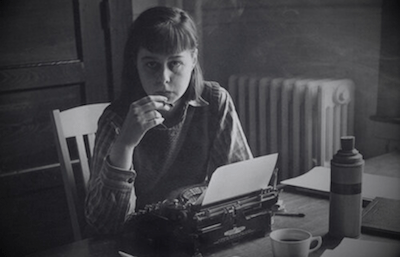
(Carson McCullers: Columbus State University via Library of America)

Rereading a Carson McCullers novel recently, I was thinking again about the curious affair of the opening line. Though I’m quite capable these days of forgetting someone’s name even while they’re still being introduced to me, I recall or recognise the openings of books read twenty, thirty, even forty years ago. Ford, unsurprisingly; Joyce, Faulkner, Patrick White, Virginia Woolf, Henry Miller, one or two, the famous ones by Beckett and by Camus (with translators and their reviewers jousting over the ‘correct’ Anglo-American equivalent to that one word, ‘maman’). Not always the ones I expect, sometimes books of which I remember practically nothing else. Here, The Heart Is a Lonely Hunter’s opening, ‘In the town there were two mutes, and they were always together’, was, I realised, already imprinted on one of the walls of my brain, perhaps a little faded after more than a quarter of a century, but still clearly legible.

First lines are frequently very far from first thoughts; and sometimes freighted, by writer or critic, with all manner of significance. Of the famous opening of John Keats’s Endymion:

A thing of beauty is a joy for ever:
Its loveliness increases; it will never
Pass into nothingness; but still will keep
A bower quiet for us, and a sleep
Full of sweet dreams, and health, and quiet breathing

Robert Gittings remarked that ‘Keats had not only found a first line and a beginning; he had found a principle that was to maintain him all through his life.’[1] That is, loving the principle of beauty in all things.

Also attentive to large implications, Hugh Kenner wrote of the eventual opening of Pound’s Cantos:

And then went down to the ship,
Set keel to breakers, forth on the godly sea

that here the poet was pondering ‘a chord that should comprise four of history’s beginnings: the earliest English (“Seafarer” rhythms and diction), the earliest Greek (the Nekuia), the beginnings of the 20th-century Vortex, and the origins of the Vortex we call the Renaissance, when once before it had seemed pertinent to reaffirm Homer’s perpetual freshness.’[2] What actually precedes that first word, ‘And’, has also proved a fertile subject for discussion. One thing that precedes it, of course, is the section of Canto III in the 1917 Poetry publication, ‘Three Cantos of a Poem of Some Length’, that alludes to Andreas Divus, the Renaissance translator of Homer’s Odyssey into Latin and continues:

‘Here’s but rough meaning:
“And then went down to the ship, set keel to breakers,
Forth on the godly sea”’[3]


That first line, in a prose work, can suggest tone, style, diction, even imply the extent or nature of the whole. It can also, of course, strike the wrong note with some readers. ‘By the way’, Penelope Fitzgerald wrote to the novelist Francis King, ‘wouldn’t you agree that the worst thing about the opening of Howards End isn’t so much the letter itself (as a method) as the “One may as well begin with”. It makes me feel resentful. Why begin at all, if that’s how he feels about it.’[4]

And, it hardly needs saying, there is often another issue about that first line to consider, specifically, is it in fact the first line at all? Is the first line of Byron’s Don Juan, the ‘Preface to Cantos I and II’—‘In a note or preface (I forget which) by Mr W. Wordsworth to a poem’—or the ‘Dedication’—‘Bob Southey! You’re a poet, poet laureate’—or ‘Canto I’: ‘I want a hero, an uncommon want’?  We all know that Melville’s Moby Dick commences dramatically: ‘Call me Ishmael.’ Except that it really begins: ‘Etymology (Supplied by a late consumptive usher to a grammar school.)’ This list is followed by a dozen pages of ‘Extracts (supplied by a sub-sub-librarian.)’ And then there are accretions: readers beginning Ford’s The Good Soldier will now, more often than not, reach its famous opening line (‘This is the saddest story I ever heard’) via the ‘Dedicatory Letter’, addressed to Stella Bowen, added to the 1927 edition (a dozen years after the first) and generally included in subsequent editions – the opening line itself having been altered from the serial version in Blast: Review of the Great English Vortex, while the story of that alteration is contained in the letter (one version of the story, anyway, just to be clear).


(Frances Flora Bond Palmer, lithograph published by Currier and Ives, ‘Rounding a Bend on the Mississippi – The Parting Salute’, Metropolitan Museum of Art)

Huckleberry Finn also has its prefatory matter and its own slight challenge to determine exactly how and where it begins. ‘You don’t know about me, without you have read a book by the name of “The Adventures of Tom Sawyer,” but that ain’t no matter.’ This sentence is preceded by the ‘Notice’ warning against attempts to find motive, moral or plot in the narrative that follows and a note about the variety of dialects used in it, Twain adding (still funny, I think, 140 years on): ‘I make this explanation for the reason that without it many readers would suppose that all these characters were trying to talk alike and not succeeding.’

D. H. Lawrence was sometimes prone to writing complete new versions of a text, rather than tinkering. Still, as Frances Wilson notes, in the case of the superb ‘Introduction’ to the Memoirs of the Foreign Legion by ‘M. M.’ (Maurice Magnus), ‘apart from revising his opening line and rethinking some later sentences, his sixty handwritten pages are as neat and unblotted as the work of a medieval scribe.’[5] Lawrence himself thought it ‘the best single piece of writing, as writing, that he had ever done’.[6]

Last words are, of course, a different matter entirely. . .


Notes

[1] Robert Gittings, John Keats (London: Pelican Books, 1971), 188.

[2] Hugh Kenner, The Pound Era (London: Faber and Faber, 1972), 349.

[3] So one earlier thing is those quotation marks. The 1917 texts are included in Ezra Pound: Poems and Translations, edited by Richard Sieburth (New York: Library of America, 2003), 318-330, and discussed at length by Ronald Bush, The Genesis of Ezra Pound’s Cantos (Princeton: Princeton University Press, 1989).

[4] Letter of 12 April [c.1978], So I Have Thought of You: The Letters of Penelope Fitzgerald, edited by Terence Dooley (London: Fourth Estate, 2008), 269.

[5] Frances Wilson, Burning Man: The Ascent of D. H. Lawrence (London: Bloomsbury,  2021), 153. Lawrence’s essay is reprinted in Phoenix II: Uncollected, Unpublished and Other Prose Works by D. H. Lawrence, Collected and Edited with an Introduction and Notes by Warren Roberts and Harry T. Moore (London: William Heinemann, 1968), 303-361.

[6] David Ellis, D. H. Lawrence: Dying Game 1922-1930 (Cambridge: Cambridge University Press, 1998), 6. Lawrence said this to Catherine Carswell: see her The Savage Pilgrimage: A Narrative of D. H. Lawrence (1932; Cambridge: Cambridge University Press, 1981), 117.

Blackbird, macaroni

(Edward Atkinson Hornel, The Blackbird Song: Dundee Art Galleries and Museum Collection)

I thought for a moment that the blackbird in the tree that reaches over the back neighbour’s fence into our garden had sung itself hoarse. It’s certainly dwindled, unsurprisingly, since it was already in full flow when I came downstairs, cheered on by the cat, at 05:30 this morning. There is even a tentative sunlight, flickering a little, as if unsure of itself, a faltering connection – and who can wonder, at the end of an 18-month period (since October 2022) which is the wettest in Met Office recorded history? Of course, they only started collecting the data in 1836 (Guardian, 10 April 2024), so it’s not even 200 years yet.

The weekly journals arrive, still a little light on the good news. ‘Easy stories drive out hard ones. Simple paradigms prevail over complicated ones.’[1] Well, yes, though sometimes it really is that simple and, hearing some of the voices currently uplifted in the world, brings the sentiment expressed in the Goncourt Journal vividly to mind: ‘If there is a God, atheism must strike Him as less of an insult than religion.’[2]

The ice-cream van drifts into hearing, still a few streets off, playing ‘Yankee Doodle went to town’. I used to be rather baffled by the line, ‘Stuck a feather in his cap / and called it macaroni.’ Now, along with anyone that has access to the internet, and, presumably, millions of Americans, I’m no longer baffled, at least by that. As the incomparable Opie team has it: ‘Young dandies, who had been on the Tour, wore fantastical clothes, and affected Continental habits, were dubbed “Macaronis”; there was, indeed, a Macaroni Club flourishing in 1764.’[3] By 1772, a year before the Boston Tea Party and three years before the American War of Independence began, the Macaronis ‘were distinguished especially by an immense knot of artificial hair worn at the back but with the peruke flat on top’.[4] The story goes that the British forces sang it to mock those unsophisticated colonials but the Yankees took it up anyway. And, come to think of it, they won that war.

Philip Dawe, ‘The Macaroni. A Real Character at the Late Masquerade’ (1773)

Later, the rain still holding off – and now I can hear the bees. The tulips are open and not yet fallen; the cherry tree in its strong pot some seven feet high; branches above the high fence nodding; faint tones of the Italian near-neighbour and the laughter of a few guests, their windows must be ajar, the season’s premier opening; less faint tones of scaffolders a few houses along; Harry the Cat nodding on an outside blanket; all this is the first real scent of summer. I remember Sarah Bakewell noting that Plutarch’s Moralia, translated into French in the same year in which Montaigne began writing Essays, touched on the question of how to achieve peace of mind: ‘Plutarch’s advice was the same as Seneca’s: focus on what is present in front of you, and pay full attention to it.’[5] No doubt both Plutarch and Seneca had their difficulties to contend with – but one of those was not the internet, with its clamorous, competing and often lethal versions of the world. Reading of Elizabeth I’s ‘innate disposition to hedge’ in ‘the face of peril or hostility’, I noted Strachey’s later remarks about Robert Cecil: ‘But passivity, too, may be a kind of action – may, in fact, prove more full of consequence than action itself.’[6] Indeed. Or, too often, alas.


Notes

[1] Phyllis Rose, Parallel Lives: Five Victorian Marriages (London: Chatto & Windus, 1984), 9.

[2] Edmund and Jules de Goncourt, entry for 24 January 1868,  Pages From the Goncourt Journal, edited and translated by Robert Baldick (New York: New York Review Books, 2006), 135.

[3] The Oxford Dictionary of Nursery Rhymes, edited by Iona and Peter Opie, second edition (Oxford: Oxford University Press, 1997), 532.

[4] James Stevens Cox, An Illustrated Dictionary of Hairdressing and Wigmaking (London: Batsford, 1984), 99.

[5] Sarah Bakewell, How To Live: A Life of Montaigne in one question and twenty attempts at an answer (London: Vintage 2011), 32.

[6] Lytton Strachey, Elizabeth and Essex: a Tragic History (1928; Oxford: Oxford University Press, 1981), 114, 140.

Reliably unreliable


(Horatio McCulloch, Loch Katrine: Perth Art Gallery; managed by Culture Perth and Kinross)

(‘Bussoftlhee, mememormee!’ James Joyce, Finnegans Wake)

I was reading Rosemary Hill’s review of a recent book by Steven Brindle, Architecture in Britain and Ireland: 1530-1830, and the extent to which Henry VIII’s break with Rome was an ‘unmitigated disaster’ for architecture. ‘“The dissolution of the religious houses”, Steven Brindle writes, “tore the heart out of the patronage of … the arts” as it had existed for nine centuries and brought about “the largest redistribution of land since the Norman Conquest”. It would take three generations to begin to recover from this “colossal self-inflicted cultural catastrophe”’.[1]

In the current painful condition of the United Kingdom, the notion of colossal self-inflicted catastrophes brings to mind most readily the ill-conceived and dishonestly presented referendum of 2016, although, with the example in mind of Kipling’s phrase in ‘With the Night Mail’, ‘the traffic and all it implies’,[2] we tend to reflect on Brexit and all it implies. The implications are not pretty. A part-time television critic of my acquaintance, who’d watched a series called ‘The Rise and Fall of Boris Johnson’, observes that it’s very easy to forget how simply and thoroughly ‘a small group of men fucked this country over’. Indeed it is.


Memory is fickle, quite easily manipulated (as is blindingly obvious in our time) but, in any case, a fiction writer of great, if sometimes wayward, abilities. It can also perform extraordinary feats. Katherine Rundell, writing of John Donne’s age, describes how‘ [a] school system which hinged on colossal amounts of memorisation had built a population with the kind of mammoth recall which is, in retrospect, breathtaking’ – listeners returning home to argue over sermons, plagiarise them, make them ‘part of the fabric of their days.’[3] Sylvia Beach recalled reading a line at random from “The Lady of the Lake” – and James Joyce then reciting the whole page and the next ‘without a single mistake’.[4] Scott’s poem is in six cantos, the first of which has 35 stanzas, the second 37 – and the stanzas are not short ones. As for its author’s own powers of recall, James Hogg, in his Domestic Manners and Private Life of Sir Walter Scott, ‘tells of how he once went fishing with Scott and Skene [James Skene of Rubislaw]. He was asked to sing the ballad of “Gilmanscleuch” which he had once sung to Scott, but stuck at the ninth verse, whereupon Scott repeated the whole eighty-eight stanzas without a mistake.’[5]

Jenny Diski wrote that ‘there is nothing so unreliable or delicious as one’s rackety memories of oneself.’[6] And we certainly hear and read a lot about ‘unreliable narrators’. Memory is, of course, both narrator and reliably unreliable. This applies both to ourselves and the wider world (perceived and processed by those same selves). In the ‘Foreword’ to Joan Didion’s South and West: From a Notebook, centred on her trip through the deep South in 1970, Nathaniel Rich discussed how a view of ‘the past’ had been relegated to the aesthetic realm and Didion herself remarked on ‘[t]he time warp: the Civil War was yesterday, but 1960 is spoken of as if it were about three hundred years ago.’[7]

Oddly (though probably not), memory delayed a little in reminding me that my remark about unreliable narrators may be more or less purloined from an essay by Frank Kermode, revisited when I went back to a Conrad novel last year. Nearly one-third of the books I read in 2023 I’d read before, largely due to working on Ford Madox Ford, of course; they were either his own books or Ford-related, directly or tangentially.


Unsurprisingly, they included ‘that finest novel in the English language’, as Ford once described it. And again: ‘[F]or me, Under Western Eyes is a long way the greatest—as it is the latest—of all Conrad’s great novels.’[8] Once more: ‘That is to say, in common with myself, he regarded the writing of novels as the only occupation for a proper man and he thought that those novels should usually concern themselves with the life of great cities.’ There were two such novels. ‘But although The Secret Agent was relatively a failure, Under Western Eyes with its record of political intrigue and really aching passion has always seemed to me by a long way Conrad’s finest achievement.’[9]

I had read Conrad’s novel of pre-revolutionary politics, betrayal and assassination so long ago that it might almost have been for the first time – almost. It is, no doubt, a tribute to the writing that I found myself consciously offering advice to the student Razumov during his interview with Councillor Mikulin: Shut up! Don’t say another word! Hold your tongue! He can’t, of course. And Ford saw the driving force of much of the book to be personal honour. Of Razumov’s ploy to ‘add a touch of verisimilitude’, having a foolish boy rob his own rich father but then tossing the money from a train window, Ford comments: ‘And the same unimaginative cruelty of a man blindly pursuing his lost honour dignifies Razumov to the end.’[10]

My surviving sense of the book had included Conrad’s known antipathy to Russia (hardly surprising in a Pole born in the Ukraine, part of the Russian Empire but once part of Poland) and his contempt for revolutionaries, which was evident in The Secret Agent. Under Western Eyes was written between two Russian revolutions, published (1911) exactly midway, in fact. But notions of nationality, allegiance and bafflement also shouted aloud ‘Conrad’! Or, perhaps, ‘Konrad Korzeniowski!’ Much of this was to do with that complex process of holding onto a strong sense of one’s native country and culture, while adopting a second language (retaining fluency in the first) – and then a third, while settling in another country and choosing to write in that third language. None of this was made much easier for Conrad by his being attacked on occasion by Polish compatriots for deserting both language and country. Not that migration is ever only a matter of language. H. G. Wells had a couple of digs at Conrad, not only that he spoke English ‘strangely’ but also that ‘[o]ne could always baffle Conrad by saying “humour.” It was one of our damned English tricks he had never learned to tackle.’[11] Under-westernised?

Kermode’s celebrated essay, ‘Secrets and Narrative Sequence’, I’d also read a long time ago.[12] Briefly, he argues that Conrad’s text shows itself obsessed with certain words and images which wholly evade orthodox, ‘common sense’ readings. More, he suggests that the book’s ‘secrets’ are in fact ‘all but blatantly advertised’ (99) and from which, by a curious process of collusion, ‘we avert our attention’ (95). He is pointing to the novel’s constant references to ghosts or phantoms, souls, eyes and, perhaps above all, to the art of writing, more, the materials of writing: black on white, ink on paper, shadows on snow, notebooks, a journal wrapped in a veil. I went back to the essay after reading the novel. It’s true that I found it difficult to see how critics had not seen and grasped – or sought – the significance of the astonishing frequency of such images. Souls, ghosts and related words occur a hundred times, references to eyes more than sixty times, and so on. This is bound to snag the attention of a reader of Ford’s The Good Soldier, an even shorter novel, I think, in which the verb ‘to know’ in its various forms, occurs not far short of three hundred times. ‘What I ask you to believe’, Kermode writes, ‘is that such oddities are not merely local; they are, perhaps, the very “spirit” of the novel’ (97). Difficult not to notice, I said, but cannot be sure of how much that noticeability is related to residual memories of his essay. With a fistful of exceptions, I’m unacquainted with the secondary literature on Conrad which is, I’ve learned, ‘huge, approximately 800 monographs, biographies, edited collections, volumes of letters and catalogues, without counting the hundreds of peer-reviewed papers in the general and specialist literary journals, the untranslated material and the unpublished doctoral theses.’[13]


Richard Parkes Bonington, La Place du Molard, Geneva (Victoria & Albert Museum)

St Petersburg, Geneva. The book is centrally concerned, of course, with Russia: its psychology, Conrad himself suggested, more than its politics. There is also the essential complicating factor of the narrator—‘all narrators are unreliable, but some are more expressly so than others’, as Kermode remarks (yes, that’s the one).[14] A language teacher, English, in love with Natalia Haldin, sister of the executed assassin Victor Haldin, and friendly with their mother. Speaking sometimes in his own voice (whatever the extent to which it’s borrowed) and sometimes through the medium of Razumov’s journal, he repeatedly asserts an inability to understand the Russian character, the Russian soul. He glances down at the letter Natalia is holding, ‘the flimsy blackened pages whose very handwriting seemed cabalistic, incomprehensible to the experience of Western Europe.’ At one point, ‘I could not forget that, standing by Miss Haldin’s side, I was like a traveller in a strange country.’ Again, ‘The Westerner in me was discomposed’ and: ‘I felt profoundly my European remoteness and said nothing, but I made up my mind to play my part of helpless spectator to the end.’ And: ‘To my Western eyes she seemed to be getting farther and farther from me, quite beyond my reach now, but undiminished in the increasing distance.’ One more:  ‘And this story, too, I received without comment in my character of a mute witness of things Russian, unrolling their Eastern logic under my Western eyes.’

Continually asserting his incomprehension, the unfamiliarity of what he is observing, he does, of course recall Ford’s John Dowell, to whom it is all a darkness and who repeatedly asserts: ‘I don’t know’. And yet, and yet. There are many suspicious readings of The Good Soldier, some of which ask if Dowell is as unknowing as he appears to be and also, perhaps, what kind of knowledge he does not possess. It is, unusually for Ford, narrated in the first person. In any case, it is fatally easy, waltzing among thornbushes, to catch one’s sleeve on that knowledge of knowing nothing, to recall the famous moment in Eliot’s The Waste Land—‘I knew nothing,/Looking into the heart of light, the silence’—and, remembering his interest in eastern thought and religion, wonder if that knew should be stressed infinitely more than the nothing.


(J. M. W. Turner, Sunrise with a Boat between Headlands: Tate)

Kermode notes that, when Conrad began the book, he called it Razumov: ‘but when it was done (on the last page of the manuscript, in fact) he changed the title to Under Western Eyes. He had found out what he was doing’ (98). I remember the pleasure with which I came across that last sentence: the recognition of the fact that, so often, we find out not only how to do something but what it is we are actually doing – only by doing it. And this, certainly, not just in art.

The novelist and playwright Enid Bagnold described how: ‘Beauty never hit me until I was nine.’ When she arrived in Jamaica as a child: ‘this was the first page of my life as someone who can “see”. It was like a man idly staring at a field suddenly finding he had Picasso’s eyes. In the most startling way I never felt young again. I remember myself then just as I feel myself now.’ She adds, a little later: ‘And what you remember is richer than the thing itself.’[15]

Well, sometimes.


Notes

[1] Rosemary Hill, ‘Des briques, des briques’, London Review of Books, 46, 6 (21 March 2024), 13.

[2] Rudyard Kipling, Actions and Reactions (New York: Scribner’s 1909), 148.

[3] Katherine Rundell, Super-Infinite: The Transformations of John Donne (London: Faber, 2023), 223.

[4] Sylvia Beach, Shakespeare and Company, new edition (Lincoln: University of Nebraska Press, 1991), 71.

[5] John Buchan, Sir Walter Scott (London: Cassell, 1932), 131. The ballad was included in Hogg’s first book, The Mountain Bard (1807).

[6] Jenny Diski, In Gratitude (London: Bloomsbury, 2017), 187.

[7] Joan Didion, South and West: From a Notebook, foreword by Nathaniel Rich (London: 4th Estate, 2017), xviii, 104.

[8] Ford, Thus to Revisit (London: Chapman & Hall, 1921), 90-91; Return to Yesterday: Reminiscences 1894-1914 (London: Victor Gollancz, 1931), 193.

[9] Ford, ‘Introduction’ to Joseph Conrad, The Sisters, edited by Ugo Mursia (Milan: U. Mursia & Co., 1968), 11-30 (14).

[10] Ford, ‘Joseph Conrad’, English Review, X (December 1911), 68-83 (71).

[11] H. G. Wells, Experiment in Autobiography (1934; London: Faber, 1984), 616, 622.

[12] Frank Kermode, ‘Secrets and Narrative Sequence’, Critical Inquiry, 7, 1 (Autumn 1980), 83-101 (references are to this); reprinted in Essays on Fiction, 1971-1982 (London: Routledge and Kegan Paul, 1983), 133-155.

[13] Helen Chambers, review of Robert Hampson, Joseph Conrad (London: Reaktion Books,  2020), Last Post: A Literary Journal from the Ford Madox Ford Society, I, 4 (Autumn 2020), 124.

[14] Kermode, 89-90; and see footnote 7: ‘The trouble is not that there are unreliable narrators but that we have endorsed as reality the fiction of the “reliable” narrator.’

[15] Enid Bagnold, Autobiography (London: Century Publishing, 1985), 14, 100.

Advice Notes


(Marianne North, Foliage and Flowers of a Madagascar Tree at Singapore, Marianne North Gallery; photo credit: Board of Trustees of the Royal Botanic Gardens, Kew)

I see that Mick Jagger—Sir Michael Philip Jagger, rather—is eighty this year. We lived abroad for a few years because of my father’s job while the Beatles and the Rolling Stones were getting going. ‘Not Fade Away’ must have been the first Stones song I heard when we came back to England; and it was another year before Jagger sang: ‘Well I told you once and I told you twice, But you never listen to my advice’—a slight friction there between ‘telling’ and ‘advice’? Unsurprising, perhaps, that it could have been the last time.

I’ve always been wary of advice, both giving and receiving. ‘I never myself took anyone’s advice’, Ford Madox Ford remarked, ‘and I do not imagine that many people will take mine.’[1] Robert Lowell appears to have taken it, though with mixed results, telling Flannery O’Connor in 1952: ‘Ford used to say that you could tell if a writer was any good from the first sentence—I found this advice useful when manuscript-reading for Sheed and Ward, though it led to fatal misunderstandings in my interviews with students at Iowa . . . ’[2]

I wouldn’t say ‘never’, I’m sure I’ve taken it from time to time but rarely with enthusiasm. Giving it as well, being too conscious of the tendency in many people, myself not excluded, to react negatively to such gestures, even embracing the opposite, sometimes ending up, metaphorically or literally, in a rainstorm without an umbrella. Though, it now occurs to me, I can advise, or at least suggest, that eating beetroot for lunch while reading a book you care about is best avoided.

Politicians, newspapers, television channels and radio stations are profligate dispensers of the stuff. I can recall the days when doctors and the BBC, anyway, were viewed with near-unanimity as reliable sources. Now people unwilling or unable to distinguish between blanket mistrust and informed scepticism are easy prey. Some conversations, to be sure, are best kept private when so much of the world appears to have gone mad-dog. To be appalled by so many governments is hardly a novelty, though, and my intake of news bulletins remains. . . careful.


(Herbert George Ponting, ‘Captain Scott’s Birthday, 6 June 1911’, National Portrait Gallery, London; photo credit, NPG. Cherry is the third seated man along on the left)

‘Defeats on the Western Front in March catapulted the nation into shock’, Sara Wheeler wrote in her biography of Apsley Cherry-Garrard, recalling the period of the First World War. ‘The Times rallied as usual to shore up public confidence, issuing advice on all fronts, including the stern “Don’t think you know better than Haig”, even though most people over the age of ten probably did.’[3]

On all fronts, not just the Western one.

In Penelope Fitzgerald’s The Blue Flower, a novel based on the life of the 18th century writer  Novalis, Fritz meets Sophie’s elder sister Friederike (‘the Mandelsloh’): ‘“I thank you for your advice,” said Fritz. “I think, indeed, that women have a better grasp on the whole business of life than we men have. We are morally better than they are, but they can reach perfection, we can’t. And that is in spite of the fact that they particularise, we generalise.”
   “That I have heard before. What is wrong with particulars? Someone has to look after them.”’[4]

Yes, those particulars. Colette was a generous dispenser of advice, not least to the young Georges Simenon when she was literary editor at Le Matin, telling him that, though on the right track, ‘he should drop “the literature”. “Pas de littérature!” she said. “Supprimez toute la littérature et ça ira!”’[5] To a young woman writer who had sought her advice, she replied: ‘When you are capable of certifying that today’s work is equal to yesterday’s, you will have earned your stripes. For I am convinced that talent is nothing other than the possibility of resembling oneself from one day to the next, whatever else befalls you.’[6] But she also served as a magazine’s regular agony aunt, sharing her expertise in matters of dress, cosmetics and, always, love.


(Colette, plus—of course—a cat)

On dress and cosmetics, I am probably unreliable; but I was writing recently about aeroplanes, though hardly straying from my usual temporal zone, the first two or three decades of the twentieth century. The context was Ford Madox Ford’s war but a lot of the material I had to draw on related to Guy Davenport—some of which has gone into blog posts here—as well as other writers of Ford’s time, references to whom had to be whittled down or eliminated. Every time I approached the suggested word limit, things spiralled out of control again as some other alleyway beckoned. I remembered that line of W. B. Yeats: ‘My thoughts were a great excitement, but when I tried to do anything with them, it was like trying to pack a balloon into a shed in a high wind.’[7]

The Davenport material went, leaving only a faint shadow of his 1991 response to Laurence Zachar’s remark that: ‘A proportionately large part of your work is Utopian. It deals with happy people, in an ideal place where there is no violence’, when Davenport commented of  “The Aeroplanes at Brescia”, ‘there’s the implicit sense that aeroplanes were going to stop all wars; the Wright brothers wrote a famous letter to the War Department which paid no attention to it, saying: with the aeroplane, there can be no more troop movements because they can be observed from the air, and therefore no more wars.’[8]

When his story, or assemblage—drawing on Franz Kafka’s first published work, a report on the 1909 air show—appeared in the Hudson Review, a paragraph on the final page put the assertion that wars would cease with the coming of the aeroplane into the mouth of Max Brod’s engineer brother Otto but Davenport may have felt that such an unbearably painful irony was too easy, too heavy-handed. It was omitted when revised for book publication.[9]


Another twist on that occurred to me when I was rereading the memoir by Cecil Lewis, Sagittarius Rising, who was in his teens when he joined the Royal Flying Corps. By the time he was posted to Home Establishment, he had survived eight months overseas, including four months of the Somme battle, and spent 350 hours in the air, during a period when pilots were lasting, on average, three weeks. Within little more than a month after the Armistice, he had been demobilised and secured a civilian job with Vickers. He was then twenty years old.

Writing in the mid-1930s, he looked back to the failure of the postwar conferences, aimed at ensuring peace, to take note of air power, finally waking to the significance of that power with a shudder of horror. ‘No wonder. Frontiers were gone. Security was gone. No man could hope for peace or prosperity under the threat of a violent death. The days of war were over: massacre had taken their place, wholesale massacre of the community in which children would retch their lives away, women would be blinded and men powerless to protect or succour. The end of civilization was in sight.’[10]


Notes

[1] Ford Madox Ford, Return to Yesterday: Reminiscences 1894-1914 (London: Victor Gollancz, 1931), 251-252.

[2] The Letters of Robert Lowell, edited by Saskia Hamilton (New York: Farrar, Straus and Giroux, 2005), 187.

[3] Sara Wheeler, Cherry: A Life of Apsley Cherry-Garrard (London: Jonathan Cape, 2001), 199.

[4] Penelope Fitzgerald, The Blue Flower (1995; London: Everyman, 2001), 364.

[5] Patrick Marnham, The Man Who Wasn’t Maigret: A Portrait of Georges Simenon (San Diego: Harcourt Brace & Company 1994), 112.

[6] Judith Thurman, Secrets of the Flesh: A Life of Colette (London: Bloomsbury Publishing, 2000), 409.

[7] W. B. Yeats, Autobiographies (London: Macmillan, 1955), 41.

[8] Laurence Zachar, ‘Guy Davenport. Lexington, Kentucky: December 1991’, Effets de voix (Tours: Presses universitaires François Rabelais, 1994).
See: http://books.openedition.org/pufr/3904 (accessed 20 January 2021).

[9] Guy Davenport, ‘The Aeroplanes at Brescia’, Hudson Review, 22, 4 (Winter, 1969-1970), 567-585; Tatlin! Six Stories (New York: Scribner’s, 1974), 52-70.

[10] Cecil Lewis, Sagittarius Rising (1936; Harmondsworth: Penguin, 1977), 152-153.

Sleeping mowers


(Camille Pissarro, Three Women Cutting Grass)

It rains, it rains,
From gutters and drains
And gargoyles and gables
It drips from the tables
That tell us the tolls upon grains.
Oxen, asses, sheep, turkeys and fowls
Set into the rain-soaked wall
Of  the old Town Hall.[1]

While much of the world is on fire, some of it quite literally, we have been frequently awash with summer rains, though complaining about it less than usual. The United Kingdom as a whole recorded the sixth highest July rainfall since those records began in 1836; Northern Ireland recorded its highest July rainfall ever. In the United States, heat-related deaths are confidently predicted to exceed those of previous years. Beijing reports the heaviest rainfall in 140 years, with many deaths and disappearances. In the Antarctic, sea ice levels are at record lows as we veer towards the final tipping point.

In response to all this, as if mindful of Samuel Beckett’s famous formulation in Worstward Ho—‘Try again. Fail again. Fail better’—politicians are skipping the trying bit and simply failing again, though labouring to fail even worse than before, reaching new depths of dangerous irresponsibility. Are the voters they paw at really as selfish and unthinking as they assume? Or is it just their usual contempt for the proles? Answers on a lump of coal please, tossed into a rising and soon to be overwhelming sea.

At 05:45, the vegetable boxes are already delivered and I bring them in; by 06:30 the light has deteriorated enough to warrant flipping switches in the kitchen. Surely it’s not that many days back that, in balmy weather, the mowers were out in the park and the air heavy with the distinctive and evocative scent of freshly cut grass. ‘Do you ever feel the smell of freshly cut grass is a cry for help from the grass?’ the (dead) Lily asks Finn in Lorrie Moore’s new novel.[2]


In Alethea Hayter’s fine book—but then she wrote only fine books—Voyage in Vain, she describes how Samuel Taylor Coleridge, en route to Malta, ‘identified himself’ with a sheep in a pen, destined, like the ducks and chickens, ‘to figure on the ship’s menu’. ‘He imagined it as coming from a countryside of flat peaceable meadows, and when he saw it cheerfully eating hay, he pictured its sensations, taking the brightness and sweet murmur of the sea for “dewy grass in sunshine, and the murmur of the trees”.’[3]

On another, more hazardous voyage, late in Moby Dick, Ahab’s anguished raving to the mate has: ‘“and the air smells now, as if it blew from a far-away meadow; they have been making hay somewhere under the slopes of the Andes, Starbuck, and the mowers are sleeping among the new-mown hay. Sleeping? Aye, toil we how we may, we all sleep at last on the field.”’[4]

Sensory commerce between ship and shore.

Helen, thy beauty is to me
   Like those Nicéan barks of yore,
That gently, o’er a perfumed sea,
   The weary, way-worn wanderer bore
   To his own native shore.

Of Edgar Allan Poe’s poem ‘To Helen’, Guy Davenport remarked: ‘We can defend perfumed seas, which has been called silly, by noting that classical ships never left sight of land, and could smell orchards on shore, that perfumed oil was an extensive industry in classical times and that ships laden with it would smell better than your shipload of sheep. Poe is normally far more exact than he is given credit for.’[5]


(Vincent Laurentsz van der Vinne, Toad: © The Courtauld)

Wet weather tends to steer us to the nearby park, a couple of circuits by varying paths. On drier days, we still head to Arnos Vale, pausing to pluck some rosemary from the bushes in Perrett Park, eyeing in several of our usual locations the blackberries which are nearly, nearly ready. Our walk back from Arnos Vale is along Cemetery Road. At home, I sit down with a cup of tea and a Mick Herron novel called, ah, Down Cemetery Road. And there is Zoë Boehm, thinking of Joe: ‘Larkin, she thought. He’d always been fond of Philip Larkin. Give me your arm, old toad; Help me down Cemetery Road. . .[6]

Yes, not the famous ‘Toads’:

Why should I let the toad work
Squat on my life?
Can’t I use my wit as a pitchfork
And drive the brute off?

But ‘Toads Revisited’:

What else can I answer,

When the lights come on at four
At the end of another year?
Give me your arm, old toad;
Help me down Cemetery Road.[7]

(Naturally, having drafted this, I see a tweet from Noreen Masud, author of the excellent A Flat Place—‘We can’t live in this world without damaging or being damaged. The point is to be deliberate about which damage to give and take’[8]—with a photograph of the street sign for Cemetery Road and, for heading, that same quote from Larkin: ‘Give me your arm, old toad’. If you believe in coincidences, this is one; if not, not.)


So the news of seemingly endless grotesque and malign misgovernment grinds on, and I think of D. H. Lawrence’s letter to Lady Cynthia Asquith in February 1917: ‘You mustn’t think I haven’t cared about England. I have cared deeply and bitterly. But something is broken.’[9]

I have too – and something is.


Notes

[1] Ford Madox Ford, ‘In the Little Old Market-Place’, Collected Poems (London: Max Goschen, 1913), 36.

[2] Lorrie Moore, I Am Homeless If This Is Not My Home (London: Faber & Faber, 2023), 149.

[3] Alethea Hayter, Voyage in Vain: Coleridge’s Journey to Malta in 1804 (1973; London: Robin Clark, 1993), 70.

[4] Herman Melville, Moby Dick (1851; edited by Harold Beaver, Harmondsworth: Penguin Books, 1972), 653.

[5] Guy Davenport, The Geography of the Imagination (Boston: David R. Godine, 1997), 7.

[6] Mick Herron, Down Cemetery Road (London: John Murray, 2020), 353.

[7] Philip Larkin, Collected Poems, edited by Anthony Thwaite (East St Kilda: The Marvell Press and London: Faber, 2003), 62, 90.

[8] Noreen Masud. A Flat Place: A Memoir (London: Hamish Hamilton, 2023), 210.

[9] Letters of D. H. Lawrence III, October 1916–June 1921, edited by James T. Boulton and Andrew Robertson (Cambridge: Cambridge University Press, 1984), 91.