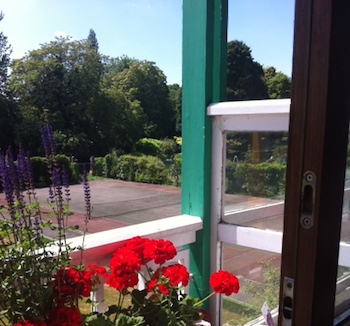
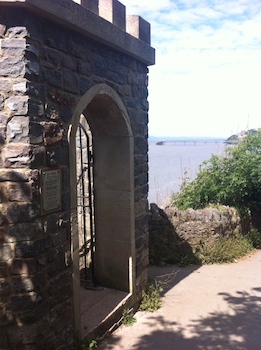
Turning left to Poets’ Walk

Lookout

In recovery mode, so short a time after our hasty retreat from a yurt in the border country, we remember Clevedon. When were we last there? That we can’t remember. But it’s close, barely a dozen miles away; we don’t have to return the car until tomorrow; and there will be sea. We drive. Turn left, the Librarian murmurs, left. When? I ask. Back there. Ah. But there will be other turnings, surely. And there are.

Clevedon: seaside town with a fine pier overlooking the Bristol Channel (you can have coffee overlooking the pier). You can gaze across to Wales: on your extreme right the Second Severn Crossing. Ahead of you, the guide to the vista notes, among other allurements, ‘Swansea, 48 miles, not visible.’

There’s a bandstand, a marine lake and, apparently, the oldest purpose-built cinema in the world—the Curzon—which is still in working order. Arthur Hallam, subject of Alfred Tennyson’s immense poem, In Memoriam, is buried here. Tuppence Middleton, whom I’ve been watching lately in Sense8—and previously saw in the BBC’s War and Peace—grew up here. But the most famous cultural association is probably with Samuel Taylor Coleridge, who lived here with his wife, Sara Fricker, after their marriage in St Mary Redcliffe in October 1795. ‘After all the upheavals of life with Southey’, Richard Holmes comments—Coleridge and Robert Southey had ‘quarrelled irrevocably’—‘these first few weeks of domestic calm and intimacy were poetically very rich for Coleridge.’[1]

Coleridge-Cottage-Clevedon

Coleridge cottage on Old Church Road
Via http://discovernorthsomerset.co.uk/

It was ‘probably not the cottage now bearing a commemorative tablet’, Tom Mayberry remarks, adding that Coleridge and Sara, ‘in further disregard of the proprieties’, first stayed there over a month before their marriage.[2]

The headnote to Coleridge’s ‘Effusion XXXV’ does indeed read ‘Composed August 20th, 1795, at Clevedon, Somersetshire’. It was revised as ‘The Eolian Harp’, the first of what came to be known as the ‘Conversation Poems’.

My pensive Sara! thy soft cheek reclined
Thus on mine arm, most soothing sweet it is
To sit beside our Cot, our Cot o’ergrown
With white-flowered Jasmin, and the broad-leaved Myrtle,
(Meet emblems they of Innocence and Love!)
And watch the clouds, that late were rich with light,
Slow saddening round, and mark the star of eve
Serenely brilliant (such would Wisdom be)
Shine opposite! How exquisite the scents
Snatched from yon bean-field! and the world so hushed!
The stilly murmur of the distant Sea
Tells us of silence.

The harp is a stringed instrument with a sound box: placed in a window or at a point where the wind can play over it, it emits ‘a natural music’. Coleridge shaped it as ‘an image of inspiration in which the poet was a harp over whom the winds of inspiration blow.’[3]

And what if all of animated nature
Be but organic harps diversely framed,
That tremble into thought, as o’er them sweeps
Plastic and vast, one intellectual breeze,
At once the Soul of each, and God of all?[4]

Idyllic, perhaps, but the cottage, myrtle and jasmine notwithstanding, would not do for long. Clevedon proved to be too far from Bristol—the library, literary contacts, not least friend and publisher Joseph Cottle—for Coleridge to walk there and back in a day.[5] What milksops these Romantic poets were: a snivelling twenty-seven miles round trip. Today, most people can walk almost as far as the car park without complaint.

Lookout-plaque

Poets’ Walk (Coleridge! Thackeray! Tennyson!) is a popular footpath which runs along the coast and around Wain’s Hill and Church Hill at the southern end of Clevedon. Along the way is the Lookout, with its plaque detailing the watched-for arrival of sugar ships from the West Indies in the nineteenth century. The slave trade was formally abolished in the British Empire in 1807 but slavery was not finally abolished until 1833. Notoriously, the colonial slave owners were handed millions of pounds in compensation by the government: the former slaves were offered nothing.

Poets-Walk

That sloping path under the trees is blessedly cool on those days, quite frequent lately, when the English summer has become a little unhinged.

We make a marginal note: Clevedon again. Soon. Turn left there.

 
References

[1] Richard Holmes, Coleridge: Early Visions (London: Hodder and Stoughton, 1989), 100, 103.

[2] Tom Mayberry, Coleridge and Wordsworth: The Crucible of Friendship, revised edition (Stroud: Sutton Publishing, 2000), 45.

[3] Paul Magnuson, ‘The “Conversation” Poems’, in The Cambridge Companion to Coleridge, edited by Lucy Newlyn (Cambridge: Cambridge University Press, 2002), 34.

[4] Samuel Taylor Coleridge, ‘The Eolian Harp’, in The Complete Poems, edited by William Keach (London: Penguin Books, 1997), 87, 88.

[5] Rosemary Ashton, The Life of Samuel Taylor Coleridge (Oxford: Blackwell, 1997), 78.


Reading, rallying, resisting

Demo1

Rereading The Solid Mandala, I come across this snatch of dialogue between the two brothers, Waldo—competent, rational, self-professed writer of genius who hasn’t actually written anything much—and Arthur, regarded as mentally challenged, ‘short of a shingle’, a hopeless burden on his brother.

‘He said: “One day perhaps I’ll be able to explain – not explain, because it’s difficult for me, isn’t it, to put into words – but to make you see. Words are not what make you see.”
‘“I was taught they were,” Waldo answered in hot words.
‘“I dunno,” Arthur said. “I forget what I was taught. I only remember what I’ve learnt.”’

A good many people forget what they’ve been taught, of course. And a fair number seem not to have learnt anything much: some of them, oddly, are in important political positions.

Patrick-White-Speaks

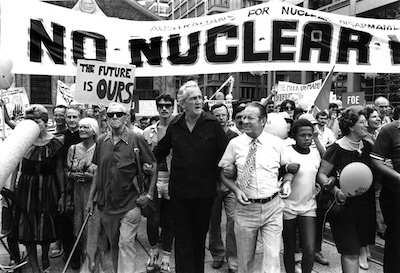
White, in contrast, learned and remembered an extraordinary amount. And, in the last twenty years of his life, he became increasingly active politically, both writing and speaking, against the depredations of developers and local politicians, cultural provincialism, the mining and export of uranium, the continued mistreatment and exploitation of Australian Aborigines, hostility to immigrants, the Vietnam War and the proliferation of nuclear weapons.

White-Hiroshima

(Patrick White and Tom Uren, Hiroshima Day demonstration, Sydney, 1984)
https://www.portrait.gov.au/magazines/26/the-activist-a-list

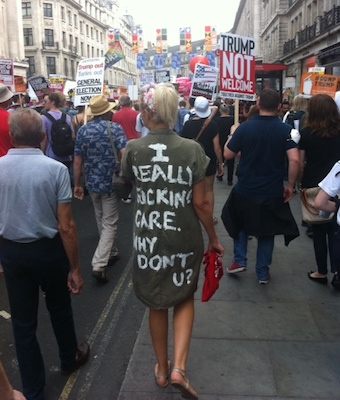
So I read Patrick White on the train, en route and coming home again. In between, in the company of wife and elder daughter, I move slowly from Regents Park to Trafalgar Square, along with a hundred thousand other people [update five days later: I was far too restrained: more like 250,000], of all kinds, classes, ages and nationalities (quite a few Americans). It was tremendously encouraging to see so many individuals and families opposing racism, misogyny, the forcible separation of young children from their parents, serial untruths, environmental vandalism and the degradation of the office of United States President – and restating the case for decency, truthfulness, peace, justice, honesty, equitable treatment of individuals: all quite reasonable standards and expectations, you might think, and so inevitably trashed by rags like the Daily Mail.

Demo3 Demo2

Still, it may finally have dawned on a few more of those people who have been mouthing the words ‘US trade deal’ with semi-religious fervour that, while the United States has historically been an ally of Great Britain, this President is not. His main concern is to fracture alliances, treaties and agreements, and to separate nations if he can from positions of collective strength to positions of individual weakness, so they can be more easily bullied and exploited. And on we go.


In search of coolness

blue gentian (gentiana clusii)

In search of coolness, I think usually of green; of, say, Lawrence Durrell and Panos heading for Klepini to gather cyclamens. ‘Though it was only a few hundred feet up we had moved into different air. The faint luminous tremble of damp had gone from the sky, and the sea which rolled below us among the silver-fretted screen of olives was green now, green as a Homeric adjective.’[1] Or W. H. Hudson’s ‘green refreshing nooks’.[2] Or Andrew Marvell’s doubled greenness, ‘green thought in a green shade’.[3]

But is blue, in some of its variations, even cooler?

In one of his essays, Geoffrey Grigson wrote of the spring gentian, ‘which properly is an alpine; and which I first saw like the flash of a sapphire ring lost in the grass as a car took me quickly along the sea road from Ballyvaughan around Black Head. Its colour is deep and clear enough for one to be able to pick it out in that way, pick out a mere single flower in the grass as one goes by at forty miles an hour. The spring gentian is one of several flowers, most of them blues, whose colour seems to have depth, like the colour coming from a jewel stone.’[4]

‘Most of them blues’: yes, depth and richness. The title of Penelope Fitzgerald’s last published novel, The Blue Flower, drawing on the brief life of Friederich von Hardenberg, who used the pseudonym of ‘Novalis’ and died at the age of twenty-eight, already seems to carry the kind of resonance that greater specificity will not further enrich.

Cruel-Way

Ella Maillart inventively extends the context of the flower Grigson terms ‘properly an alpine’, writing that, ‘The higher you climb on mountains, the deeper is the cobalt of the gentian, the green of the turf, the scarlet of the alpine rose. The same seems to apply to Asian mosaics the further one climbs back in time. Then at a certain altitude, ice and rock prevail, all vegetation having disappeared. So, before the twelfth century, as far as I know, there is no coloured enamel: ascetic plain brick reigns supreme beside the snow of stucco-work.’[5]

Famously, D. H. Lawrence writes of Bavarian gentians, native to the European Alps:

Not every man has gentians in his house
in soft September, at slow, sad Michaelmas.

Bavarian gentians, big and dark, only dark
darkening the day-time torch-like with the smoking blueness of Pluto’s
gloom,
ribbed and torch-like, with their blaze of darkness spread blue
down flattening into points, flattened under the sweep of white day
torch-flower of the blue-smoking darkness, Pluto’s dark-blue daze,
black lamps from the halls of Dis, burning dark blue,
giving off darkness, blue darkness, as Demeter’s pale lamps give off
light,
lead me then, lead the way.

Reach me a gentian, give me a torch!
let me guide myself with the blue, forked torch of this flower
down the darker and darker stairs, where blue is darkened on blueness.
even where Persephone goes, just now, from the frosted September
to the sightless realm where darkness was awake upon the dark
and Persephone herself is but a voice
or a darkness invisible enfolded in the deeper dark
of the arms Plutonic, and pierced with the passion of dense gloom,
among the splendour of torches of darkness, shedding darkness on the
lost bride and her groom.[6]

In her introduction to Lawrence’s 1920 novel The Lost Girl, Carol Siegel remarks that ‘The most important referent for Alvina’s experience is the myth of Persephone.’ She points to this 1928 poem and comments that, ‘Many of Lawrence’s other writings refer to the myth less directly.’ Well yes, just a few. She mentions his Twilight in Italy and cites Virginia Hyde’s essay, ‘”Lost” Girls’ as providing ‘a full discussion of the recurrence of references to the Persephone myth in Lawrence’s work’.[7]

Persephone-Bks

Cool enough in the underworld, surely, all that damp earth – though conditions vary dramatically. In Dante’s Hell, the third circle offers perpetual icy rain and the ninth an icy lake, though with a bit of infernal flaming in between.

Lawrence’s Lydia, originally Polish, feels a rather different chill after her husband’s death in The Rainbow: ‘She was like one walking in the Underworld, where the shades throng intelligibly but have no connection with one. She felt the English people as a potent, cold, slightly hostile host amongst whom she walked.’[8]

Yes, that would cool the blood, for sure.

And in the end there is always cool blues—or cool jazz—as reported by Lew Archer when he visits The Listening Ear, which is ‘full of dark blue light and pale blue music. A combo made up of piano, bass fiddle, trumpet, and drums was playing something advanced. I didn’t have my slide rule with me, but the four musicians seemed to understand each other. From time to time they smiled and nodded like space jockeys passing in the night.’[9]


References

[1] Lawrence Durrell, Bitter Lemons (London: Faber and Faber, 1959), 221.

[2] W. H. Hudson, Afoot in England (1909; London: Dent, 1924), 32. The phrase ‘green nook’ recurs in the work of his friend Ford Madox Ford: Letters of Ford Madox Ford, edited by Richard M. Ludwig (Princeton: Princeton University Press, 1965), 105; The Cinque Ports (Edinburgh and London: William Blackwood and Sons, 1900), 360; No Enemy (1929; edited by Paul Skinner Manchester: Carcanet Press, 2002), 112.

[3] Andrew Marvell, ‘The Garden’, in The Complete Poems, edited by Elizabeth Story Donno (Harmondsworth: Penguin Books, 1985), 101.

[4] Geoffrey Grigson, ‘The Melancholia of Burren’, in Country Writings (London: Century Publishing, 1984), 156.

[5] Ella K. Maillart, The Cruel Way: Switzerland to Afghanistan in a Ford, 1939 (1947; Chicago: Chicago University Press, 2013, with a new foreword by Jessa Crispin), 123-124.

[6] D. H. Lawrence, ‘Bavarian Gentians’, The Complete Poems, edited by Vivian de Sola Pinto and F. Warren Roberts (Harmondsworth: Penguin Books, 1977), 697; for a variant version, see 960.

[7] D. H. Lawrence, The Lost Girl, edited by John Worthen, with an introduction and notes by Carol Siegel (Cambridge edition, 1981; London: Penguin, 1995), xxiii, xxiv, xxix; Virginia Hyde, ‘“Lost” Girls: D. H. Lawrence’s Versions of Persephone’, in Elizabeth T. Hayes, editor, Images of Persephone: Feminist Readings in Western Literature (Gaines: University Press of Florida, 1994). Andrew Radford has since published The Lost Girls: Demeter-Persephone and the Literary Imagination, 1850-1930 (Amsterdam: Rodopi, 2007): Chapter 6 is ‘Lawrence’s Underworld’.

[8] D. H. Lawrence, The Rainbow, edited Mark Kinkead-Weekes, introduction and notes Anne Fernihough (Cambridge, 1989; Penguin edition with new editorial matter, 1995), 50.

[9] Ross Macdonald, The Galton Case (1959), in Four Novels of the 1950s, edited by Tom Nolan (New York: Library of America, 2015), 700.


Camping, decamping

Yurt-setting

We drive. We are on, hmm, a short camping trip. Staying in a yurt. In the border country. But did I actually shut the freezer door properly? I only ask because we’ve been woken by the alarm twice before now; and also because we’re now approaching the Second Severn Crossing and it’s too late to do anything about it. Once over the bridge, the motorway traffic stalls and crawls. Flashing signals urge us to keep our speed down to 40, just as the speedometer limps up to 15. Heat. Are my legs swelling as they seemed to the other day? Heat-related oedema, the Librarian explained then, helpfully. I am feeling claustrophobic even in dense traffic these days.

But then, I say (as three army lorries in succession pass us in the slow lane), what’s the worst that can happen if the freezer door isn’t shut? Water all over the kitchen floor and some food ruined? Unless the fridge overheats and explodes, the Librarian suggests. Yes, I agree, unless that.

Still, when we turn off at Junction 24, things ease. Past Abergavenny and heading for Hereford. Along narrow lanes, up agonising tracks. The directions are ambiguous and, once parked, we carefully head off to the wrong corner of the field, staggering under the weight of several bags. We stare at the directions again, peer into dazzling distances, up and down slopes, plunge into clumps of trees and we’re finally there.

It would suit some people very well. It clearly has done: some posted reviews are fulsome, verging on ecstatic. We walk up the field again to get some icepacks from a communal fridge. Back at the yurt, we walk around, go outside, locate the view. Our last holiday deluged us with light and space and air. Here, I feel hemmed in, short of both light and space. There’s a view but it’s round the corner, so to speak.

Yurt-1

This was to be a mini-break for reading and relaxation, simply that: and to exorcize the Librarian’s long-established yurt yearnings. We walk around again, look outside, look at each other. Three questions, I say, four really, if we count the possible freezer door problem. One, could you relax here? Two, could you settle down to read here? Three, would any of the food that we’ve carefully transported here last even until tomorrow morning without turning into something else? The Librarian considers this carefully for almost a second. No. No. And no.

No need to repack bags that were not disturbed. Two trips back up to the car, staggering even more obviously now, as muscles sag and the heat takes its toll. We drive. Only a single navigational hiccup finds us on an unintended road to Chepstow. One signpost mentions fourteen miles but that’s a clearly a joke or local legend. But we do finally emerge at a junction where the caption BRISTOL 17 MILES eases away all tensions and dark suspicions. We drive.

At home, we return the food and drink to fridge and freezer. The plants are already watered, tomorrow’s recycling already outside on the pavement. There is little to do but raise our glasses: ‘Chepstow!’

The freezer door was, of course, firmly closed.

Squeaky toys, Punch and Judy

Nobody-for-tennis

(Nobody for tennis?)

The weather continues hot, certainly by British standards. I recall the opening of Samuel Beckett’s first novel as ‘The sun shone, having no alternative, on the nothing new. Murphy sat out of it’, pausing there because I can’t remember what comes next (my copy is in a box ‘at another location’, as they say in the storage business), except that it places Murphy somewhere in London, a hundred and twenty miles from my desk. But certainly, as far as is possible, I sit out of it.

If I need to go out, I go as early as I can. In the park, small groups, especially the ones with small children, arrange themselves sensibly under the trees,. A few reckless or uninformed individuals sprawl asleep on unprotected slopes of grass. Small dogs race after balls and squeaky toys. A man and a woman are sitting together on the bench beside the path I’m walking down, with home almost in sight. A terrier races back towards the bench with a rubber ring between its teeth. “Good boy’, says the man. ‘Good girl’, says the woman. Good grief, I think, even the dog has gender issues.

Fourth of July, America’s Independence Day, has been and gone, largely drowned here by the roars of football fans and the smack of racquet on ball at Wimbledon; and muffled too, perhaps, by uncertainty about what precisely independence signifies, truth, equality, liberty and happiness having become so oddly complicated of late.

‘And the American dream isn’t dead, either – we just have no idea what it means any more.’ Sarah Churchwell wrote in Behold, America, reviewed in this week’s TLS.

Behold-America

Brexit, alas, is not dead either: but then nobody—whether unemployed metal workers, rural Tories, billionaire fixers, market traders, Scottish trawler men, barstool economists or, indeed, the people supposedly in charge of the process—ever really knew what that meant and certainly couldn’t agree on what it meant.

‘The acts of people are baffling unless we realize that their wits are disordered’, Edward Dahlberg once wrote. Reviewing the latest sequence in our long-running Punch and Judy show, one can only nod and raise a glass to the man Jonathan Williams called ‘the Job of American Letters’.


Flaming June

Flaming_June_Leighton

(Frederic Leighton, Flaming June, Museo de Arte de Ponce)

Yes, June has flamed, is flaming still. Devotees of sweltering heat and football have clearly struck gold. Personally, my appreciation peaks around 22 degrees Celsius and steadily declines thereafter. But then, retired, if not always retiring, I’m lucky enough to have the option of shopping early before sitting at the kitchen table with a notebook and a pot of tea, reading Patrick White and offering advice to the magpies.

Disconcertingly, for a day or so, while heat waved outside the kitchen windows, White’s Voss and his companions, embarked upon their doomed expedition across the Australian interior, had been halted and confined to the shelter of a cave by incessant rainfall.

‘Now, from time to time, the rain would lift, literally, he felt, of something so permanent and solid. Then, in the stillness, the grey would blur with green. In the middle of the day the body of the drowned earth would appear to float to the surface; islands were breeding; and a black dust of birds, blowing across the sky, seemed to promise salvation.’

But soon enough, more familiar climatic conditions reassert themselves.

‘By the time the sun had mounted the sky, their own veins had begun to run with fire. Their heads were exact copies of that same golden mirror. They could not look into one another for fear of recognizing their own torments.’

Even painful sufferings in the deserts of Australia might seem to offer a kind of relief from the dispiriting spectacle of recent news: caged children in the land of the free (‘That’s a concentration camp’, the Librarian observed as we watched the images beamed from Texas – as, of course, it was), the blustering cowardice of our Foreign Secretary, new evidence of Britain’s complicity in torture and rendition, the Tory ‘rebellion’ on the Lords amendment, which ended, not for the first time, in a handful of feathers on the floor, anti-democratic or frankly racist developments in Hungary, Turkey, Italy – and always, down there in the dust of the arena, Brexit’s heavy boot on this country’s neck.

Magpie-0618

This week’s New Statesman arrives. Concluding her column, ‘Out of the Ordinary’, Helen Lewis writes: ‘I’ve spent my adult life believing that politics matters. But Brexit means I can’t stop thinking . . . what’s the point?’

Indeed. Still, the magpies have grasped the fact that if they stand on the edge of the seed tray they can reach the fat balls comfortably without having to balance on that unstable frame above them. Learning from experience, as they say. A cabinet of magpies – why not?


Glorious ninth (or eleventh): Ford’s Encyclopaedia

Fordie

Hugh Kenner writes somewhere about the highly instructive experiment of going back to an encyclopaedia entry, once you actually know something of the subject to which it refers, and realising how much that entry has been altered by your enhanced knowledge. One of my favourite brief outlines of Ford Madox Ford’s life and work, of the encyclopaedic entry type (‘About the author’), appeared in the back pages of an American edition of one of his best-known works, managing four major errors in a dozen lines, while the prize exhibit among Ford scholars is probably the edition of one of his major novels which displays on the front cover an illustration placing the action of the book in entirely the wrong century, while, on the back cover, failing twice to spell the author’s name correctly. Between those covers, the last section of the text has mysteriously vanished.

That’s an individual perspective, of course, a personal, even specialised interest. But even in the case of Ford (a writer still not that widely known), a good many readers would surely have noticed the flawed nature of the Times obituary of Ford’s death. ‘Rather eccentric in selection of Ford books mentioned,’[1] Ford’s bibliographer comments of it. You might say that: the obituary fails to mention either The Good Soldier or the Parade’s End tetralogy. It does include a reference to the biography of his grandfather—though a mysterious painter named ‘Fox Madox Brown’ also features on this occasion.[2] But then at least one obituary of Herman Melville settled on Typee as his best book (though getting the publication date wrong) while omitting to mention Moby Dick at all.[3] (Although, as my old teacher, the late Tom Ingram, wrote in the margin of my essay, Typee is ‘still a damned good book.’)

FMB_Tells_Son

(Ford Madox Brown: Tell’s Son – Ford as model)

Like his friend Ezra Pound, Ford was wary of what he once termed ‘the half-learning of encyclopaedias’,[4] and made great play with them in several of his novels. In Some Do Not. . ., Christopher Tietjens is described as being ‘a perfect encyclopaedia of exact material knowledge’ – though this is stated not by the narrator but by Tietjens’ chief, Sir Reginald Ingleby. Tietjens diverts himself by ‘tabulating from memory the errors in the Encyclopaedia Britannica, of which a new edition had lately appeared.’ But this, as so often, is a seemingly innocuous detail which expands, under informed scrutiny, into labyrinthine complexities, as the editor’s lengthy footnote explains.[5]

Later, his memory damaged by a shell-blast, Tietjens will work his way through precisely that encyclopaedia, though he will, as he realises, be forced out of his job on the pretext of his having no more general knowledge than is contained in it.

‘In the old days’, Ford had written just before the war, ‘a publisher had to consider what was Literature. [ . . . ] Now it was just a business. You found out what the public had to have. For what Mr. Sorrell supplied was just that. He gave them encyclopaedias’.[6] In that same year, in his short story, ‘The Case of James Lurgan’, the Encyclopaedia Britannica made another appearance: the doctor has ‘a copy of the ninth edition of this useful work in his dining-room’.[7]

IFMFS14

The ninth edition: Ford’s father had written for that edition, while his uncle, William Rossetti, wrote for the famous – the celebrated – eleventh edition, and even enlisted Ford’s help in revising his articles for it, mainly on Italian painters.[8] The eleventh edition appeared in 1910-1911, so Ford’s repeated references to the ninth edition are, I think, a joke—which is probably the explanation for a good many oddities and suspected errors in his work.

In his memoir of 1911 (that year again), Ford’s preface is addressed to his daughters: ‘To the one of you who succeeds in finding the greatest number [of errors] I will cheerfully present a copy of the ninth edition of the Encyclopaedia Britannica, so that you may still further perfect yourself in the hunting out of errors.’ Later in the book, he writes: ‘My father was a man of an encyclopaedic knowledge and had a great respect for the attainments of the distinguished.’ Yes, I think those last nine words save Ford needing to write fifty pages on his relationship with his father, even without the following sentence: ‘He used, I remember, habitually to call me “the patient but extremely stupid donkey.”’[9]

Ford Madox Ford died in the Clinique St François, Deauville, on this day, 26 June 1939. He was just sixty-five years old.

 
References

[1] David Dow Harvey, Ford Madox Ford 1873-1939: A Bibliography of Works and Criticism, (New York: Gordian Press, 1972), 425.

[2] ‘Obituary’, Times (27 June, 1939), 16.

[3] Hershel Parker, Herman Melville: A Biography. Volume 2, 1851-1891 (Baltimore: Johns Hopkins University Press, 2002), 921.

[4] Ford Madox Ford, Great Trade Route (London: Allen & Unwin, 1937), 129.

[5] Ford Madox Ford, Some Do Not. . . (1924; edited by Max Saunders, Manchester: Carcanet Press, 2010), 6-7; 13 and note.

[6] Ford Madox Ford, Ladies Whose Bright Eyes (London: Constable, 1911), 7.

[7] Ford Madox Ford, ‘The Case of James Lurgan’, The Bystander, XXXII (6 December 1911), 540.

[8] Max Saunders, Ford Madox Ford: A Dual Life, two volumes (Oxford: Oxford University Press, 1996), I, 195. David Jones lost his treasured copy of the eleventh edition in a bet with Evelyn Waugh on a point of history and Waugh arrived next morning in a taxi to collect it. See Thomas Dilworth, David Jones: Engraver, Soldier, Painter, Poet (London: Jonathan Cape, 2017), 169.

[9] Ford Madox Ford, Ancient Lights and Certain New Reflections (London: Chapman and Hall, 1911), xv, 41-42.


The Extraordinary Ordinary

Tree-of-Man

In Patrick White’s 1955 novel, The Tree of Man, Stan Parker, suspecting what has taken place between his wife and a commercial traveller, turns his car round and drives along familiar roads towards the city. ‘People who did not know what had happened were continuing to live their lives.’[1]

This called to mind the W. H. Auden poem referred to recently, the fall of Icarus into the sea barely warranting the attention of those others busy with their own concerns. In another Auden poem, ‘In Memory of W. B. Yeats’, he writes:

Far from his illness
The wolves ran on through the evergreen forests,
The peasant river was untempted by the fashionable quays

He writes of the poet’s work passing into the minds and bodies of countless readers and listeners, who will adapt and interpret and use his writings in their own way and according to their own needs and urgencies, ‘The words of a dead man/ Are modified in the guts of the living.’

But in the importance and noise of to-morrow
When the brokers are roaring like beasts on the floor of the Bourse,
And the poor have their sufferings to which they are fairly accustomed,
And in each in the cell of himself is almost convinced of his freedom;
A few thousand will think of this day
As one thinks of a day when one did something slightly unusual.[2]

w-b-yeats

(W. B. Yeats via The Poetry Foundation)

The ultimate banal observation – that life continues – everywhere, or everywhere else, whatever disturbing or heart-rending or monstrous event is occurring here, or here, is something that must be confronted and withstood and, ultimately, accepted.

I remember the day on which I was waiting for a train to London, on my way to tell my mother that the hospital staff would be turning off my sister’s life support machine the next morning. My sister’s husband and daughter had made that impossible, inevitable decision and had asked me to break the news.

I was watching two young men on a bench across the tracks from me; one seemed to be dancing while still sitting down. His friend laughed, rocking gently to and fro. An elderly couple passed close to me, intent and purposeful; young women out for the evening shimmied and twirled. In touch with death and faced with exuberant or expressive or just ordinary life, you feel indignant but relieved, offended and thankful. You sit with your own arms wrapped around yourself, alive, while blood dances in your veins.

There is also the paradox against which you bruise yourself sooner or later: on the one hand, the life of practically any man or woman can be and generally is, in the end, whittled down to a handful of words, a few sentences. On the other hand, almost any individual life is, if viewed through certain lenses, immense, significant, infinitely varied. White’s novel, about professedly ‘ordinary’ people, embodies the question, over nearly five hundred pages, of whether there is really any such thing. ‘The sky was blurred now. As he stood waiting for the flesh to be loosened on him, he prayed for greater clarity, and it became obvious as a hand. It was clear that One, and no other figure, is the answer to all sums.’[3]

Sky-through-stone

All lives contain astonishments, illuminations, intensities, immeasurable depths – but very few can articulate, verbally, comprehensibly, what they have seen or glimpsed or divined. This is one purpose – or effect – of art: Guy Davenport despaired over the assumption, set in stone for so many, that the sole purpose of poetry is ‘self-expression’, ignoring the possibility that the poet ‘speaks for people who cannot speak’ and ‘makes sentences for people to say’.[4]

Hearing from Ford Madox Ford that he was publishing a fairy tale (three of Ford’s first five books were fairy tales), Peter Kropotkin said that he hoped it was not about princes and princesses (it was), or at least that Ford would write a fairy tale about simple and ordinary people. ‘I have been trying to do so ever since’, Ford commented forty years later. ‘I always want to write about ordinary people. But it seems to be almost impossible to decide who are ordinary people – and then to meet them. All men’s lives and characteristics are so singular.’[5] Elsewhere, he wrote of ‘The extraordinary complications of even the simplest lives! . . .’ and that ‘every case is a special case’.[6]

 The novelist Blanford, in Lawrence Durrell’s Quinx, also had his doubts about ordinariness: ‘Ah, the mind-numbing ineptness of the rational man with his formulations! Defeated always by the flying multiplicity of the real. “Ordinary life” – is there such a thing?’[7] While, perhaps most pertinently, Sarah Bakewell wrote of Michel de Montaigne, ‘From the start, Montaigne had the impression at once of being a peasant among peasants, and of being very special and different. This is the mixture of feelings that would stay with him for life. He felt ordinary, but knew that the very fact of realizing his ordinariness made him extraordinary.’[8]


References

[1] Patrick White, The Tree of Man (1955; Harmondsworth: Penguin Books, 1961), 322.

[2] W. H. Auden, The English Auden: Poems, Essays and Dramatic Writings, 1927-1939, edited by Edward Mendelson (London: Faber, 1977), 241, 242.

[3] White, The Tree of Man, 477.

[4] Guy Davenport, ‘Do You Have a Poem Book on E. E. Cummings?’, in The Geography of the Imagination (Boston: David R. Godine, 1997), 132.

[5] Ford Madox Ford, Return to Yesterday: Reminiscences 1894-1914 (London: Victor Gollancz, 1931), 108.

[6] Ford Madox Ford, No More Parades (1925; edited by Joseph Wiesenfarth, Manchester: Carcanet Press, 2011), 43; Great Trade Route (London: Allen and Unwin, 1937), 299.

[7] Lawrence Durrell, Quinx, or The Ripper’s Tale, in The Avignon Quintet, one-volume edition (London: Faber and Faber, 2004), 1260.

[8] Sarah Bakewell, How To Live: A Life of Montaigne in one question and twenty attempts at an answer (London: Vintage 2011), 52.


His tongue partly in his cheek – realism or not

White

On 14 June 1940, T. H. White, who had been in Ireland since the previous year, wrote from Healion’s Hotel, Belmullet, Co. Mayo, to his friend David Garnett. ‘Ireland is in a most amusing condition just now. Everybody has noticed in the last 3 days that there is a war on: it is too ridiculous.’ He went on: ‘Lord Dunsany said to me six months ago that we are like children on the beach at Howth, quarrelling about what shape our sand castle is to be, while all the time the tide is coming in.’ Then: ‘I wonder if I wrote to you about Dunsany? I made friends with him when I was in Meath. He is not a patch on his wife, who remarked in a tone of acute nostalgia, à propos of a Daimler which they had once owned: “Ah, that was a splendid car. It was simply riddled with bullets.”’[1]

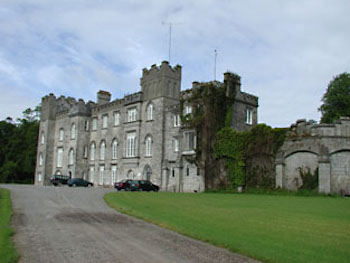
White had lunched with Lord Dunsany at Dunsany Castle, ‘an ugly Victorian gothic structure in a very beautiful park’, and thought him ‘a decent, amusing, interested, selfish, vain, enlightened fellow’.[2]

OLYMPUS DIGITAL CAMERA

(Via www.buildingsofireland.ie )

Dunsany died in 1957, having published more than ninety books in practically every genre, though he was best-known as a writer of fantasy, his most celebrated title being The King of Elfland’s Daughter. He had been a significant donor to the Abbey Theatre, worked with Lady Gregory and W. B. Yeats, and his work was extraordinarily well-regarded in the period of the First World War.

In November 1953, White, now living on Alderney, wrote to Garnett about the recently published The Golden Echo, the first volume of Garnett’s autobiography.

‘Far the best of your character pictures are of course the safely dead: Lawrence and the charming Ford.’ He added, ‘If there is a chance in the next volume, do give us some more of Ford’s relative truths. What a kinship I feel for him! All my truths are relative. He must surely have had his tongue partly in his cheek?’[3]

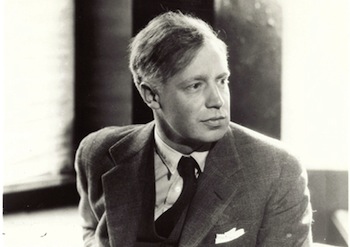
David-Garnett

(David Garnett)

Partly often, yes, and wholly sometimes. To what extent, I wonder, when he used the occasion of reviewing Dunsany’s Five Plays for a prolonged meditation on realism, in the course of which he produced one or two of the critical remarks most often revisited by Ford enthusiasts.

Passing general remarks about Ireland and the Irish is risky at the best of times but in the spring of 1914, it was frankly hazardous. Ford declared that while the Irish were as humourless and joyless and materialist as anyone else, they had impressed upon ‘the bemused world’ the conviction that all the Irish ‘are passionate pilgrims journeying through a material world with their eyes on the great stars of heaven, with the verses of the old poets on their lips and gallant thoughts in the hearts of them’.[4]

All this was a disquisition on literary technique, Ford went on, ‘for what is literature but the producing of illusions?’ And, ‘for the producing of an illusion there is nothing like an Irishman.’ Dunsany’s great conjuring trick for Ford was to imagine himself ‘to represent the revolt against realism’, while in fact he did nothing of the sort, ‘since he is one of the chief realists of them all.’ And ‘we need realists very badly, because this world is so much too much with us. It is too much with us, and it is an extraordinarily unreal mirage. Yes, just a mirage.’ Ford describes the stones in the drive, a broken bucket in the orchard, the rain against the window, the baker coming in at the front gate. ‘But all that is really mirage; there is nothing real about the stones or the discarded bucket, or the rain, or the baker coming in at the gate. Myself, my own self, is miles away – thirty miles away, thinking of things how different – how utterly different!’

Ford Madox Ford, 1915

(The good soldier via NYRB)

And the future is to ‘the artist who, by rendering the stones and the bucket and the baker and the Daily Telegraph that is lying on the sofa, will give the world the image of that kingdom of heaven that is behind it all.’

‘I rather fancy’, Ford remarks, ‘that the Cubists and the Futurists and the rest of the movement that is trying to get away from representational art are trying to put the kingdom of heaven too directly on to canvas’.

Yes, the way to heaven is via the earth; the way to transcendence is via the real. Begin with the fantastic and you find you’re holding a one-way ticket ­– fine if that was the plan, if not, not. I’ve always liked realism plus, the world that seems solid enough, seems familiar enough, until you try to lean on it. With a little of what Muriel Spark called ‘the mental squint’. And Ford, with the body in one place and the mind somewhere quite other. Or, indeed, Mr Joyce, Mr Germ’s Choice, whose great novel is – what, precisely? Modernist, realist, naturalist, expressionist, surrealist, symbolist, postmodernist, mythic, epic, not a novel at all. If Dublin were destroyed in an earthquake, it could be rebuilt using Ulysses as a blueprint, its author thought. Yes, realism with a reach like that.

References

[1] David Garnett, editor, The White/ Garnett Letters (London: Jonathan Cape, 1968), 70.

[2] Letter to Ray Garnett, in The White/ Garnett Letters, 45; Sylvia Townsend Warner, T. H. White: A Biography (New York: Viking, 1968), 141.

[3] The White/ Garnett Letters, 264.

[4] All quotations from Ford Madox Ford, ‘Literary Portraits-XXXI. Lord Dunsany and “Five Plays”, Outlook, XXXIII (11 April 1914), 494-495; reprinted in Critical Essays, edited by Max Saunders and Richard Stang (Manchester: Carcanet Press, 2002), 142-146.


Aunts, mandalas, cockatoos: Patrick White

SMH

(Patrick White: photo credit, Ross via The Telegraph)

‘But old Mrs Goodman did die at last.’ That opening sentence—of The Aunt’s Story, by Patrick White (London, 28 May 1912—Sydney, 30 September 1990)—has stayed in my head since I first read it more than thirty years ago. It’s partly the use of the conjunction to open not merely a sentence but a book: a conjunction which, by definition, usually contradicts or qualifies what has come before it. Nothing has come before it here—except the epigraph, taken from Olive Schreiner’s The Story of an African Farm: ‘She thought of the narrowness of the limits within which a human soul may speak and be understood by its nearest of mental kin, of how soon it reaches that solitary land of the individual experience, in which no fellow footfall is ever heard.’[1]

So ‘But’, together with ‘did’ in that first short sentence, looks backward to an existing situation not yet explained; and the epigraph looks forward to what will become an increasingly internal voyage made by Theodora Goodman:

Then, in a gust, Theodora knew that her abstraction also did not fit. She did not fit the houses. Although she had in her practical handbag her destination in writing, she was not sure that paper might not tear. Although she was insured against several acts of violence, there was ultimately no safeguard against the violence of personality. This was less controllable than fire. In the bland corn song, in the theme of days, Theodora Goodman was a discord. Those mouths which attempted her black note rejected it wryly. They glossed over something that had strayed out of some other piece, or slow fire.[2]

The Aunt’s Story was White’s first great novel, following Happy Valley and The Living and the Dead. He won the initial Miles Franklin Award for Voss (and won it again four years later with Riders in the Chariot), declined a knighthood in 1970 and was awarded the Nobel Prize for Literature in 1973 (he didn’t attend the ceremony in Stockholm so the painter Sidney Nolan collected it on his behalf and read White’s acceptance speech). But, even though an unfinished novel, The Hanging Garden, was published in 2012 and a film of The Eye of the Storm released a year earlier (with Geoffrey Rush, Charlotte Rampling and Judy Davis, among others), White seems to have suffered the neglect which often follows the deaths of major artists, coupled with his kind of writing—perhaps seen as that of ‘another dead white male’—apparently going out of fashion.[3]

What was his kind of writing? Modernist, dense, often lyrical, psychologically penetrating, serious (which certainly didn’t exclude an often savage humour), built on the grand scale. The Nobel citation referred to White’s ‘epic and psychological narrative art which has introduced a new continent into literature’. The continent was Australia, which White left, returned to, embraced, rejected, loved and loathed. I read a lot of White’s work many years ago and remember that, at the time, it made a great many other contemporary writers look as though they were just playing at it. These days, the research seems to be the important thing, sometimes more than the actual writing. A lot of people seem to have forgotten what fiction actually is and does. It wasn’t a matter of research with White: it was the immense ambition, the scale of things, the grasp of the elemental, the hard rock at the basis of lives and the extraordinary lengths to which people will go to fulfil or deny their individual destiny. Sometimes his characters staggered under their symbolic weight but even White’s partial failures were more impressive than the majority of contemporary successes. From the pages of his best books, even opened at random, one is often reluctant to stop transcribing:

To what extent is this girl dishonest? he wondered.
Unaccustomed to recognize his own dishonesties, he was rather sensitive to them in others.
It is disgraceful, of course, Laura realized; I have come out here for no convincing reason. She was defenceless. Perhaps even guilty.
‘I try to visualize your life in this house,’ said Voss, facing the honeycomb of windows, in some of which dark figures burrowed for a moment before drowning in the honey-coloured light. ‘Do you count the linen?’
He was truly interested, now that it did seem to affect him in some way not yet accounted for.
‘Do you make pastry? Hem sheets? Or are you reading novels in these rooms, and receiving morning calls from acquaintances, ladies with small waists and affectations?’
‘We indulge in a little of each,’ Laura admitted, ‘but in no event are we insects, Mr Voss.’
‘I have not intended to suggest,’ he laughed. ‘It is my habit of approach.’
‘Is it so difficult then, for a man, to imagine the lives of poor domesticated women? How very extraordinary! Or is it that you are an extraordinary man?’
‘I have not entered into the minds of other men, so that I cannot honestly say with any degree of accuracy.’
But he would keep his private convictions.[4]

White battled constantly with reactionary forces in Australia. Increasingly irascible, with an ever-expanding list of shipwrecked friendships and moving politically further to the left, he campaigned and spoke in public against cowardly or shifty politicians, nuclear weapons and environmental vandalism.

Who could fail to be diverted by White’s rehearsal of testimony as a literary expert at the Melbourne trial of Philip Roth’s Portnoy’s Complaint? White mentioned the charges of pornography laid against Lady Chatterley’s Lover, suggesting that Lawrence’s novel ‘might well be considered pornographic since when I read it I developed a cockstand. Judged by this criterion, Portnoy’s Complaint cannot be considered pornographic since I read it from start to finish without once developing a cockstand.’ The judge then asking, ‘But Mr White – at your age do you think you are capable of manifesting such a physical alteration?’ To which White, ‘beaming around the courtroom’, replies: ‘Shall the court go in camera while we find out?’[5]

White-Letters

‘I went down to Melbourne one day last week for the Portnoy trial’, White wrote to Tom Maschler of Jonathan Cape, who published Roth’s novel as well as many of White’s own, ‘It was an ordeal till I actually got in the box, then the actor in me quite enjoyed the performance. The whole thing has to be conducted with great solemnity, I realise, but I couldn’t resist saying what a funny book I think Portnoy is: I hope I didn’t put my foot in it.’[6]

Thinking about Patrick White, revisiting even the memory of his books, has had a couple of immediate effects: the rapid acquisition of a tidy copy of David Marr’s large volume of White’s Letters—to set beside his fine biography of White; and a troubling determination to add at least half a dozen White titles to my ‘Books to Re-read’ list: certainly The Aunt’s Story, Voss, The Tree of Man, The Eye of the Storm and The Vivisector – about a painter, Hurtle Duffield, one to put beside Joyce Cary’s The Horse’s Mouth (for all the differences); and probably A Fringe of Leaves and The Solid Mandala. Then there’s Riders in the Chariot, The Cockatoos, The Twyborn Affair—a late, remarkable work—and White’s characteristically fierce and candid self-portrait, Flaws in the Glass.[7] Frankly, the list was already looking ridiculous.

There’s a valuable reappraisal of White by the novelist David Malouf, first published in the TLS but probably more generally accessible here:
http://www.theage.com.au/news/books/patrick-white-reappraised/2007/01/26/1169594479079.html?page=fullpage

An appreciation by novelist and biographer Nicholas Shakespeare is here:
https://www.telegraph.co.uk/culture/books/bookreviews/9617484/Patrick-White-Under-the-Skin.html

References

[1] In fact, Schreiner’s sentence begins with the word ‘Perhaps’, which White omits here. Part Three of The Aunt’s Story uses another epigraph from Schreiner’s novel: ‘When your life is most real, to me you are mad.’

[2] Patrick White, The Aunt’s Story (1948; Harmondsworth: Penguin Books, 1963), 270.

[3] See the edited extract from the recent book on White by Christos Tsiolkas here:

https://www.theguardian.com/books/2018/may/23/i-saw-patrick-white-as-another-dead-white-male-but-his-writing-changed-my-world

[4] Patrick White, Voss (1957; Harmondsworth: Penguins Books, 1960), 86.

[5] David Marr, Patrick White: A Life (London: Vintage, 1992), 502.

[6] Letter of 1 November 1970: Patrick White, Letters, edited by David Marr (London: Jonathan Cape, 1994), 368.

[7] ‘In my own opinion, my three best novels are The Solid Mandala, The Aunt’s Story, and The Twyborn Affair’: Patrick White, Flaws in the Glass: A Self-Portrait (London: Jonathan Cape, 1981), 145.