Blackberries, cats and a tilly


And every tree is a tree of branches
And every wood is a wood of trees growing
     And what has been contributes to what is.
So I am glad to have known them,
     The people or events apparently withdrawn;
The world is round and there is always dawn
     Undeniably somewhere.[1]

Some days, if you’re early enough, you can walk all the way round a huge Victorian cemetery and not see even a single dogwalker—though you might catch sight of a fox, if you’re lucky. The blackberries have got ahead of themselves to such an extent that  they’ll barely last the month: but once in the freezer drawer, they’ll see us well into winter.  Cow parsley, Anthriscus sylvestris, or Queen Anne’s lace (or, I gather, keck) still hangs on in places. A mistle thrush and a song thrush seem to answer one another and there’s a goldcrest somewhere near.

We are well past midsummer now. Glastonbury Festival is over (I shall probably get The Cure’s ‘Friday I’m in Love’ out of my head soon), the Wimbledon tennis tournament finished, the Bristol Harbour Festival has happened and the Balloon Fiesta is just a couple of weeks away. The wider canvas still largely features arterial blood and heavy boots on infant faces though even some Western politicians have now begun to wonder if deliberately starving thousands of innocent civilians and then shooting them down in cold blood day after day when they try to secure food might be just a bit over the top. Even so, to demonstrate that they know what’s terrorism and what isn’t, our government is prosecuting people who object to their country’s complicity in war crimes.

But pass on, pass on. Books, music, food, wine, love, cats.

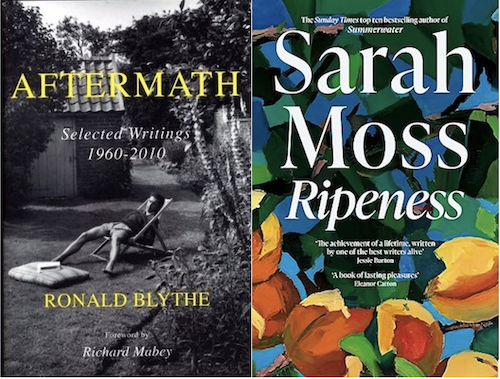
When I surface from Ford’s letters, I have waiting for me Paul Willetts’ remarkable reconstruction of the life of Julian Maclaren-Ross, Ronald Blythe, Sarah Moss, early Ernest Hemingway. Otherwise, I just revel in Anne Carson:

‘My mother forbad us to walk backwards. That is how the dead walk, she would say. Where did she get this idea? Perhaps from a bad translation. The dead, after all, do not walk backwards but they do walk behind us. They have no lungs and cannot call out but would love for us to turn around. They are victims of love, many of them.’[2]

Yes. Meanwhile, the weather, or much of it, prompts me to recognise my increasing intolerance to higher temperatures (and to much else: I know I’m widely assumed to become more conservative politically as I age but something’s clearly gone wrong). Earlier walks, more water, more cursing – I know all the tricks.

As to cats – yes, I like to remember that ‘Balthus painted himself once as a cat dining on fish, and once as the King of the Cats.’[3] Sylvia Townsend Warner mentioned, in a letter to William Maxwell (9 April 1952) , the northern Scottish traveller’s tale of seeing the cat funeral. ‘And the cat of the house, lying on the hearth, started up at these words, and exclaimed, “Then I am the King of the Cats”, and vanished up the chimney.’[4] When Swinburne died in 1909, William Butler Yeats said to his sister Lily, ‘Now I am king of the cats.’[5]

.

(John Butler Yeats, portrait of embroiderer, and co-founder (with her sister Lolly) of Cuala Industries, Susan Mary (Lily) Yeats (1901): National Gallery of Ireland)

The novelist, suffragist and partner—for several fraught years—of Ford Madox Ford had a good many of them: ‘Violet’s parrots—part of a menagerie that included an  owl (named Anne Veronica after Wells’s novel), a bulldog and nine Persian cats—shrieked “Ezra! Ezra!” whenever they saw him bouncing up the walk.’[6]

I can, alas, only half-agree with Lord Peter Wimsey when he says to Parker at the end of that bell-ringing mystery, The Nine Tailors, ‘“Bells are like cats and mirrors – they’re always queer, and it doesn’t do to think too much about them.”’[7] Queer they may be but I think about them a good deal and seem none the worse for it.

There was a collection of essays published ‘on the Occasion of the 25th Anniversary of Finnegans Wake’, which included pieces by Padraic Colum, Frank Budgen, Vivian Mercier, Fritz Senn, A. Walton Litz and other distinguished Joyceans. It was called Twelve and a Tilly.[8]

For ‘tilly’, my Shorter Oxford has: ‘In Ireland and places of Irish settlement, an additional article or amount unpaid for by the purchaser as a gift from the vendor.’ Joyce’s nocturnal masterpiece offers four occurrences and the splendid online glossary – http://finwake.com – adds to ‘the thirteenth of a baker’s dozen’ the derivation from Irish tuilleadh, added measure.

Opening my eyes to uncertain light, I can hear the table-tennis ball moving in the kitchen and the hall, knocking against skirting-boards and doorframes. I get up for a pee and a small grey tabby runs in to check on my progress and brush against my legs. Getting back into bed, I see that it’s 03:50. Moments later, the table-tennis ball is on the move again.
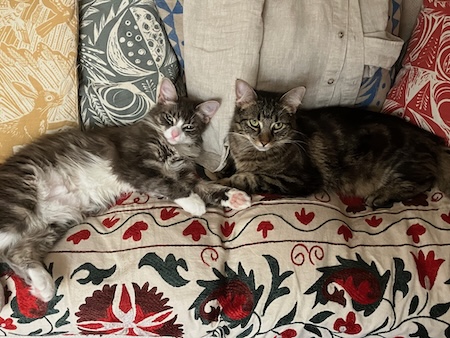
Yes, we have our own Tilly now, not an added measure but one-half of a pair. Her brother is named Max, which I like in part because it was the name of the very first pet I remember, in Gillingham, Kent, a black cocker spaniel—but also because of the occasional fleeting uncertainty which attends such phrases as ‘I said to Max’ or, more plausibly, ‘I asked Max’, which might conceivably be a reference to either a handsome tabby or our leading Ford Madox Ford scholar.

Scholars, though, at least as a general rule, do not sit in the kitchen sink, talk to toy mice or suck their tails. . .

Notes


[1] Louis MacNeice, ‘Autumn Journal: XXI’, Collected Poems, edited by Peter McDonald (London: Faber, 2007), 153.

[2] Anne Carson, ‘On Walking Backwards’, Plainwater: Essays and Poetry (New York: Vintage, 2000), 36.

[3] Guy Davenport,  A Balthus Notebook (New York: Norton, 1989), 7. Le Roi des Chats (1935). Balthus identified strongly with cats: in the year of this self-portrait, he began signing his letters to his future wife Antoinette as ‘King of Cats’. ‘Jeune fille’ occurs many times in the titles of his paintings—but so does ‘chat’ (sometimes together).

[4] Sylvia Townsend Warner, Letters, edited by William Maxwell (London: Chatto & Windus, 1982), 133.

[5] Yeats to Susan Mary (‘Lily’) Yeats, 12 Apr. 1909: R. F. Foster, W. B. Yeats: A Life. I: The Apprentice Mage: 1865–1914 (Oxford: Oxford University Press, 1997), 616n.69.

[6] Pound, of course. Barbara Belford, Violet: The Story of the Irrepressible Violet Hunt and her Circle of Lovers and Friends—Ford Madox Ford, H. G. Wells, Somerset Maugham, and Henry James (New York: Simon and Schuster, 1990), 166-7.

[7] Dorothy L. Sayers, The Nine Tailors (1934; with an introduction by Elizabeth George, London: New English Library, 2003), 305.

[8] Twelve and a Tilly: Essays on the Occasion of the 25th Anniversary of Finnegans Wake, edited by Jack P. Dalton and Clive Hart (Evanston: Northwestern University Press, 1965).
Grackles, clouds, popes

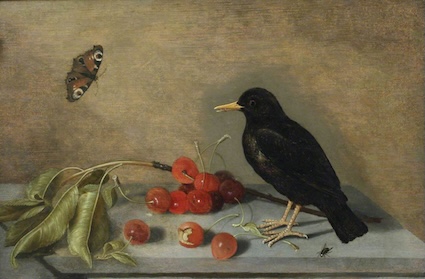
(Ambrosius Bosschaert the Younger, A Blackbird, Butterfly and Cherries: National Trust, Ham House)

04:30 and the blackbird already in full song. Not conducive to much further sleep but fine music. The same bird or a different one has several times come down to pick up grubs from pots ranged against the walls. Writing of the disappearances from the natural world over the past decades, Richard Mabey mentions smaller gnat swarms and choruses of blackbirds, and the barn owls gone.[1] And it’s true that we never hear such choruses now: it is almost always a solitary blackbird.

Guy Davenport remarks on ‘Gracchus’, meaning ‘grackle’ or ‘blackbird’; in Czech, kavka. And that Franz Kafka’s father had a blackbird on his business letterhead.[2] I recall that Davenport used ‘Grackle’ in ‘The Messengers’, his fourth story about Kafka (after ‘The Aeroplanes at Brescia’, ‘The Chair’ and ‘Belinda’s World Tour’). The writer is asked his name by the household god:
‘My name? Why, it’s Amschel. I mean, Franz. By the world, I am Franz Kafka.’
‘A kavka is a jackdaw.’
‘A grackle. Graculus, in Latin a blackbird.’
‘Yes.’[3]

I see that yesterday was Allen Ginsberg’s birthday, just one short of a centenary. Dear Ginsberg. I saw him read a couple of times, too many years ago, and the phrase ‘what thoughts I have of you’ came into my mind quite recently, remembering then: ‘What thoughts I have of you tonight, Walt Whitman, for I walked down the sidestreets under the trees with a headache self-conscious looking at the full moon.’

That poem ends: ‘Ah, dear father, graybeard, lonely old courage-teacher, what America did you have when Charon quit poling his ferry and you got out on a smoking bank and stood watching the boat disappear on the black waters of Lethe?’[4]

Whitman’s America, opening out; Ginsberg opening, broadening, welcoming. A decade or so later and he calls on Whitman again, this time with a long quotation from Democratic Vistas as epigraph to the collection called, ah, The Fall of America.

Here we are. And here we are.

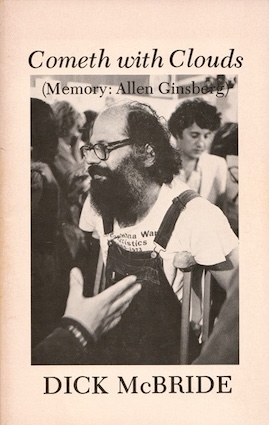
Back then too, in my early bookselling days, was Dick McBride, poet, playwright, actor, bookseller, publisher, former manager of City Lights Bookshop, having been introduced to Lawrence Ferlinghetti by poet, painter and novelist Kenneth Patchen. Dick was living in England then, distributing American small press books (and not so small: New Directions for a while)—a cottage in Great Horwood, Buckinghamshire, and an abandoned Victorian Methodist chapel for a warehouse. On my shelves is a copy of Cometh with Clouds (Memory: Allen Ginsberg), inscribed to me by Dick and dated July 14, 1983. It was published the previous year by Cherry Valley editions. I think I have a few of his other books, Lonely the Autumn Bird: Two Novels and Memoirs of a Natural-Born Expatriate were issued by Alan Swallow, and also The Astonished I, published by, ah, McBride’s Books.

Looking for online traces of Dick all these years later, I find more than I’d expected, on the Allen Ginsberg Project site and, particularly, a fine website created (and ongoing) by Rob McDowall: https://dickmcbride.co.uk/

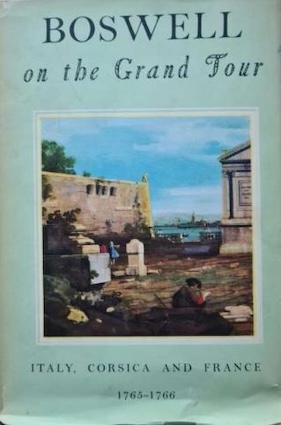
I am currently with James Boswell in Italy, Dorothy Parker in New York, and Ford Madox Ford more or less anywhere, generally in either Paris or New York, though occasionally in Corsica or Carqueiranne. Also, just now, with Stella Bowen in Italy, where she is travelling with Dorothy Pound, looking at pictures, while Ezra ransacks the archives to find material for the Malatesta Cantos. Quite unable to rely on so much of the world to refrain from barbarism and conduct its affairs with decency, intelligence or basic humanity, I’m happy enough to be elsewhere in quite other temporal locations.

Poor Boswell lectures himself on his conduct almost daily but then argues with his companions, pursues a married countess or takes himself off to the nearest working girl.  A ‘fille charmante’, about seven shillings. Also, ‘“Des filles” in the next three days ran to thirteen shillings.’ He seems strikingly subject to venereal disease too. After his triumphant forays into the lives of Jean Jacques Rousseau and Voltaire, Boswell is travelling with a party that includes Lord Mountstuart, son of Lord Bute, and has secured the friendship of John Wilkes, who (perhaps not an ideal model for young Boswell) takes the view that ‘dissipation and profligacy renew the mind’, he having written his best issues of his newspaper The North Briton (founded to attack Prime Minister Lord Bute) while ‘in bed with Betsy Green’.[5]

(Alexander Pope by William Hoare: National Portrait Gallery)

From time to time, I also try to get back more into the eighteenth-century frame of mind with some Pope – Alexander, to avoid any possible confusion, recalling an occasion not so long ago when I asked the Librarian what she was watching. ‘A bit of Pope’, she said. I looked into the front room and saw a blaze of red, cardinal red, you might say. Boswell, in an earlier journal, had recounted an evening including the poet’s work, which was not, however, quite enough to save the occasion: ‘The night before I drank tea and sat all the evening writing in the room with my landlord and landlady. They insisted that I should eat a bit of supper. I complied. I also drank a glass of punch. I read some of Pope. I sung a song. I let myself down too much. Also, being unaccustomed to taste supper, my small alteration put me out of order. I went up to my room much disgusted. I thought myself a low being.’[6]

Having actually taught Pope to unfortunate students many years back, I’m surprised to find I have to make a stern and conscious effort to stick with him, uneasily recalling W. H. Auden’s remark (8 January 1947) to Alan Ansen: ‘The real test of liking English poetry is Pope. His ideas aren’t much, but the language is wonderful—“Chicane in furs.” The Rape of the Lock is the most perfect poem in English.’[7] Or, indeed, Hugh Kenner, reviewing Maynard Mack’s life of the poet: ‘The great danger of absorbing writers’ biographies is that you can begin to think you understand writing you’ve not troubled to come to terms with.’[8]

I like to think of Gilbert White being presented with a copy of Pope’s six-volume translation of the Iliad by the poet himself, when graduating with distinction from Oriel College, Oxford, in 1743.

In Pope’s ‘Epistle to Burlington’, I see a neat encapsulation of pre-Romantic sensibility:

‘In all, let Nature never be forgot.
But treat the Goddess like a modest fair,
Not over-dress, nor leave her wholly bare;
Let not each beauty ev’ry where be spy’d
Where half the skill is decently to hide.
He gains all points, who pleasingly confounds
Surprizes, varies, and conceals the Bounds.’

And elsewhere a remark that never goes out of date, alas:

‘But when to Mischief Mortals bend their Will,
How soon they find fit Instruments of Ill!’ (‘Rape of the Lock’, Canto III).


Notes

[1] Richard Mabey, Nature Cure (London: Chatto & Windus 2005), 134.

[2] Guy Davenport, The Hunter Gracchus and Other Papers on Literature and Art (Washington: Counterpoint, 1996), 2.

[3] Guy Davenport, The Cardiff Team: Ten Stories (New York: New Directions, 1996), 2.

[4] ‘A Supermarket in California’, in Allen Ginsberg, Selected Poems 1947-1995 (London: Penguin Books, 2001), 89.

[5] Boswell on the Grand Tour: Italy, Corsica and France, 1765-1766, edited by Frank Brady and Frederick A. Pottle (London: William Heinemann, 1955), 54n., 58n.

[6] Sunday 19 December 1762: Boswell’s London Journal, 1762-1763, edited by Frederick A. Pottle (London: William Heinemann, 1950), 95.

[7] Alan Ansen, The Table Talk of W. H Auden, edited by Nicholas Jenkins (London: Faber and Faber, 1991), 15-16.

[8] Hugh Kenner, ‘Maynard Mack’s Pope’, Historical Fictions (Athens: University of Georgia Press, 1995), 250.

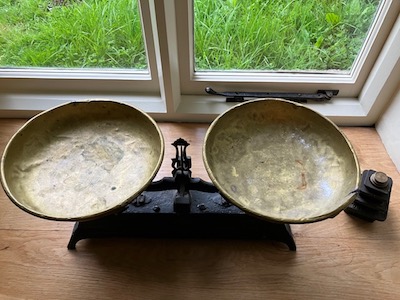
In the Scales

On 25 August 1773, in an indifferent inn at Banff, James Boswell watched Samuel Johnson pen a long letter to Mrs Thrale. ‘I wondered to see him write so much so easily. He verified his own doctrine that “a man may always write when he will set himself doggedly to it.”’[1]

Dogged, yes: ‘sullen’ I don’t quite see but ‘pertinacious’, holding obstinately to an opinion or a purpose, unyielding, we can certainly settle for. So that

Writing of April in the Scotland uplands, of mainly grey days, cold and snow, the 20-year-old John Buchan remarked: ‘Nor have we any of the common associations of spring, like the singing of birds. A mavis or a blackbird may on occasion break into a few notes, and there is, for certain, an increasing twitter among the trees. But the clear note of the lark as yet is not; the linnet does not pipe; the many named finches are still silent.’[2]

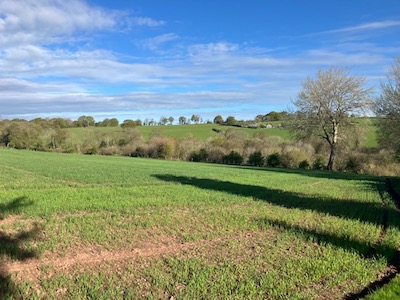
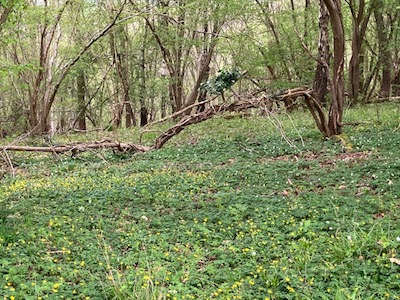
We have also been in the hills this April, though further south, with not a hint of snow. A few days in the Black Mountains, the border country, with its panoramic vistas and the River Wye looking sleek and animated and glossy, and where, on some roads, you move from England to Wales and back again with dizzying ease and frequency. That was in a foreign country. . .

As for birds. . . . In a few days and in a limited area, we saw or heard (frequently both), skylark, chaffinch, blackbird, robin, blackcap, sparrow, wood pigeon, linnet,  chiffchaff, wren, dunnock, crow, goldfinch and song thrush (Buchan’s ‘mavis’).[3] Many of these in the trees and the grass outside the living-room or kitchen windows of the farmhouse we were renting, others on walks through fields and woods.

Birds we had, then, in abundance. Space and grass and sheep and silence also. Wi-Fi, broadband, not so much. ‘I’ve rebooted it and logged on several times, it seems fine now’, the housekeeper said before leaving. The blue light lasted for at least a minute. The Librarian tried resetting it a few times, quite a few times, over the next few days with the same result. But we had food, wine, books and packs of cards. There were mobile phones too, in the event of an emergency. We survived. And what lengths would we go to, should we go to, for the latest news? After all, given the current state of things, should you not warm to neo-fascist extremism or the aggressive erasure of history or the continuing mass murder of civilians or the vicious suppression of non-violent protest, there’s little in daily bulletins to lift the spirits. Some people, though—and I have it on the best authority—can find it oddly cheering to see, as they cross a field from stile to stile, a pheasant strolling to and fro in that field, apparently without a care in the world.

So Inspector Jules Maigret sweltered in August heat or remained on edge when ‘no one had ever known such a damp, cold gloomy March.’[4] Virginia Woolf did not go to the party at Gordon Square where the d’Aranyi sisters, Adila, Hortense and Jelly (‘great-nieces of the renowned Hungarian violinist Joachim’) would be playing, because Leonard arrived home too late, ‘& it rained, & really, we didn’t want to go.’[5] And I was glad to learn about the Society of Dilettanti, concerned with practical patronage of the arts, whose members included Sir Joshua Reynolds, David Garrick and Charles James Fox, and to be told of Horace Walpole’s writing that, while the nominal qualification for membership of the Society was having been to Italy, the real one was being drunk.[6]

After the diversions of fictional Paris and historical Brighton, I am now with James Boswell, young Boswell on his Grand Tour, after Holland, currently in Germany, soon to be in Switzerland. He is still often preposterous, still wholly irresistible—and still battling with the Black Dog (‘The fiend laid hold of me’). But he finds diversions enough: ‘I must not forget to mark that I fell in love with the beauteous Princess Elizabeth. I talked of carrying her off from the Prince of Prussia, and so occasioning a second Trojan War.’[7]

We are back, then, via taxi and train among Good Friday crowds, walking again in the park amidst hurtling spaniels rather than quietly to and fro along a secluded lane with teeming hedgerows, remarkable trees and glimpses of an unfamiliar breed of sheep, which gave rise to a good deal of highly technical agricultural vocabulary: ‘God, they’re chunky!’ Too far away for a convincing photograph but, scanning various sheep breeders’ websites, we agree that they were probably Zwartbles.

As confirmed by such remarks, we are now returned to what E. M. Forster termed the world of ‘telegrams and anger’—minus the telegrams, of course, and seemingly with many times the anger. We are also back, that is to say, in the firm grip of the internet. Does that warrant one cheer or two?


Notes

[1] James Boswell, The Journal of a Tour to the Hebrides with Samuel Johnson, LL.D., edited by Ian McGowan (1785; Edinburgh: Canongate Books, 1996), 234-235.

[2] John Buchan, ‘April in the Hills’, in Scholar-Gipsies (1896; London: John Lane The Bodley Head, 1927), 28.

[3] Apparently derived from the French mauvis (though, confusingly, this seems to mean ‘redwing’, turdus iliacus rather than turdus philomelos). ‘It is still used for the bird in Orkney and survives elsewhere in Scotland’: Mark Cocker and Richard Mabey, Birds Britannica (London: Chatto & Windus, 2005),  358-359.

[4] Georges Simenon, Maigret’s Failure, translated by William Hobson (Penguin Books, 2025), 1; August heat in Maigret Sets a Trap, translated by Siân Reynolds (London: Penguin Books, 2017).

[5] The Diary of Virginia Woolf, Volume 1: 1915-19, edited by Anne Olivier Bell (with the Asheham Diary, London: Granta, 2023), 11-12.

[6] Venetia Murray, High Society in the Regency Period: 1780-1830 (London: Penguin Books, 1999), 165.

[7] Boswell on the Grand Tour: Germany and Switzerland 1764, edited by Frederick A. Pottle (London: William Heinemann, 1953), 12, 67.

Good Wood

(The Boppard Altarpiece, Panel: limewood, pine, paint & gilt: Victoria & Albert Museum)

Back in the day—not that day, another one—a woman had been on the throne of England for around sixty years.

Walk wide o’ the Widow at Windsor,
For ’alf o’ Creation she owns:
We ’ave bought ’er the same with the sword an’ the flame,
An’ we’ve salted it down with our bones.[1]

Yes, back then, a while and a world ago, when Queen Victoria was not quite gone, Rudyard Kipling had dropped in on the west coast of the United States. ‘There was wealth—unlimited wealth—in the streets’, he wrote of San Francisco, ‘but not an accent that would not have been dear at fifty cents.’ He was disappointed by the disparity between the fine and expensive clothes worn by the women he saw and their voices, ‘the staccato “Sez he”,“Sez I,” that is the mark of the white servant-girl all the world over.’

He felt, that is to say, that ‘fine feathers ought to make fine birds.’ But, ‘Wherefore, revolving in my mind that these folk were barbarians, I was presently enlightened and made aware that they also were the heirs of all the ages, and civilised after all.’ Luckily for this much-travelled traveller, he’s been accosted by ‘an affable stranger of prepossessing experience, with a blue and an innocent eye.’

It’s true that the man has peered into the hotel register and read ‘Indiana’ for the ‘India’ that Kipling has actually come from but, for the moment, the drinks and cigars that he presses upon the famous writer are welcome.[2]

Ford Madox Ford referred numerous times to Kipling, often admiringly, but almost always—and, to me, unaccountably—focusing on the early work. Some of that is wonderful but the later stories, becoming often more complex, more oblique, more modernist, somehow get lost sight of, not only by Ford but by several other major writers of the time, as if Kipling were a known quantity and need not be kept any longer in sight.

But I was thinking mostly of that phrase tucked into the Kipling lines, which recurs several times elsewhere. ‘We are the heirs of all the ages,’ Ford wrote in early September 1913, in an essay which provided the ‘Preface’ to his Collected Poems a few weeks later and in which the same line sits.[3] He had written nearly a decade earlier of ‘all the dead Londons that have gone to the producing of this child of all the ages’, and in his 1910 novel, A Call, Grimshaw remarks to Pauline: ‘We’re the children of the age and of all the ages. . .’[4]

(Kipling/ Tennyson)

Those words look back to ‘Locksley Hall’—‘I the heir of all the ages, in the foremost files of time’—by Alfred Tennyson, a poet that Ford was generally unenthusiastic about, seeing him as one of the stifling ‘Victorian Great’ figures. Yet Tennyson’s work so saturated the second half of the nineteenth century that familiarity with it was unavoidable for any serious reader.[5]

It’s a point so obvious, so banal, so unremarkable, that huge numbers of people must fail utterly to remark it. We are the heirs, the inheritors, of all that has gone before. Not just the books, the music, the paintings—which people like me are only too ready to bang on about—but the housing, the streets, the scars on the landscape, what were the mining villages, what were the dockyards and shipyards, what were the council estates, the public libraries, the youth clubs, the community centres, the rivers, the fields and hedgerows, the birds and the butterflies, the very flavour of the air. And we are also the ones who will, in our turn, bequeath or pass on or let fall the things which others will inherit and be the heirs to. As far as we have influence and agency, what will our legacy to them look like?

After January—the first rule of that month being: survive January!—I venture a little further afield to gauge the State of Things. The news, astonishingly, is Not Good. For weeks, my main focus has been the life and letters of Ford Madox Ford in the 1920s, though, on occasion, I dipped my toes into world news, not wishing to have my leg taken off just above the knee by sharks should I venture too far in.

In the United States, things are evidently shaping up to be as bad as any sane person would expect, far worse, in fact. But there’s enough derangement here to satisfy any eager watchers at the gates of Bedlam, not least a government apparently possessed of a talent to choose every time precisely the wrong policy, facing in the the wrong direction and benefiting the wrong people.

On the bright side, though—O optimist!—the Chinese New Year celebrations have welcomed in the Year of the Snake, are still welcoming it, I suppose, since this involves not only animal but also zodiac elements. This is then the Year of the Wood Snake – also known as the Year of the Green Snake, wood being associated with the colour green. The Spring Festival, I gather, takes place over fifteen days, ending with the Lantern Festival on 12 February, and is estimated to be celebrated by some two billion people in numerous countries, not only China but Indonesia, Malaysia, Singapore, Vietnam and their diasporas.

The snake may have had a bad press—certainly a bad Judaeo-Christian press—but I read that, in Chinese astrology, as a wood animal, it’s understood to represent good luck, renewal, flexibility, tolerance. Wood is good!

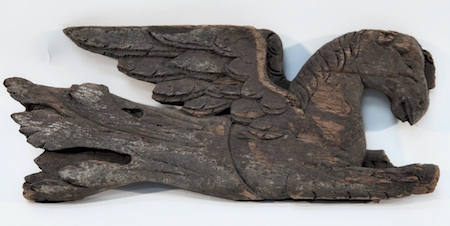
(‘Hippocamp’, a wooden carving in the form of a winged horse, originally part of the panelling inside Stafford Castle: Staffordshire County Museum Service)

This in turn brings to mind the recent piece following the death of David Lynch, which touched on Twin Peaks: The Return, and had a nice quote from Michael Horse, who played the series’ Deputy Sheriff Hawk: ‘When they did the premiere of The Return, the executives had not seen it, and they said: “Mr Lynch, would you say a few words?” And he comes out; he goes: “This project has a lot of wood in it. I like wood.”’
https://www.theguardian.com/tv-and-radio/2025/jan/23/an-oral-history-of-twin-peaks-david-lynch-madchen-amick-joan-chen

We all like wood, no?  Wood nymphs, woodwind, woodbine, woodpeckers, woodlands – as a child, I had a pet woodlouse for a short time, though it didn’t end well. Woodcuts, wood engravings. Albrecht Dürer, Hiroshige, Käthe Kollwitz, Robert Gibbings, Thomas Bewick, Clare Leighton, David Jones, Gwen Raverat. Harriet Baker wrote of woodcuts made by Carrington and Vanessa Bell: ‘Carving directly into soft wood, the markings of tools and the tremors of hands were as much a part of the final pieces as form and composition.’[6]

The French historian Fernand Braudel gave wood a significant role in the lessening of the effects of the Black Death which, he argued, ‘did not, as used to be thought, arrive in Central Europe in the thirteenth century, but in the eleventh at the latest.’ His analysis of the retreat of the disease in the 18th century mentioned stone’s replacing wood in domestic architecture after major urban fires; the general increase in personal and domestic cleanliness, and the removal of small domestic mammals from dwellings, all factors that resulted in the lessening impact of fleas. He also discussed the enormous significance of wood being used everywhere: ‘One of the reasons for Europe’s power lay in its being so plentifully endowed with forests. Against it, Islam was in the long run undermined by the poverty of its wood resources and their gradual exhaustion.’[7]

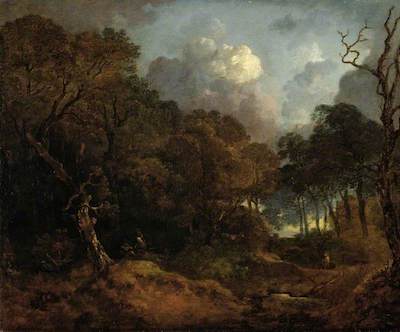
(Thomas Gainsborough, A Forest Road: Fitzwilliam Museum, Cambridge)

The gradual exhaustion of resources. Here we are again. Not so gradual now, I suspect, but in any case a phrase to tingle the tongues of those who, as previously noted, are custodians of the past and guardians of the future. Which is us, of course, even those currently making war on their own children and grandchildren.

In September 1911, Ezra Pound spent a Sunday afternoon with G. R. S. Mead, a scholar of hermetic philosophy, early Christianity and Gnosticism, the occult and theosophy: he had served as private secretary to Madame Blavatsky during her last years. He had founded the Quest Society in 1909 and invited Pound to give a lecture, which would be published subsequently in the quarterly review, The Quest. Pound delivered his lecture early in 1912 and it appeared in the October issue of the review with the title ‘Psychology and Troubadours’. Twenty years later, it was incorporated into Pound’s The Spirit of Romance.[8] It’s years since I read it but one sentence, particularly, lodged in my memory and remains intact: ‘We have about us the universe of fluid force, and below us the germinal universe of wood alive, of stone alive.’[9]

Pound, like Henri Gaudier-Brzeska, Guy Davenport wrote, ‘had conceived the notion that cultures awake with a brilliant springtime and move through seasonal developments to a decadence. This is an ideas from Frobenius, who had it from Spengler, who had it from Nietzsche, who had it from Goethe.’[10]

Yes. Never mind third runways, never mind nuclear power stations on every corner, never mind mimicking anti-immigrant messages from other political parties that run on that sort of fuel. If a body is bleeding to death in front of you—how can I put this?—it may be best, before all else, to try to stop the bleeding.

Touch wood. Good wood. Touch good wood.


Notes

[1] ‘The Widow at Windsor’, Rudyard Kipling’s Verse: Inclusive Edition, 1885-1918 (New York: Doubleday, Page & Co., 1925), 471.

[2] Rudyard Kipling, From Sea to Sea (2 volumes: Macmillan, 1900), I: 479-480

[3] Ford Madox Ford, ‘The Poet’s Eye’,  New Freewoman, I, 6 (1 September 1913), 109; ‘Preface’ to Collected Poems (London: Max Goschen, 1914 [1913]), 20.

[4] Ford Madox Ford, England and the English, edited by Sara Haslam (Manchester: Carcanet Press, 2003), 4; Ford Madox Ford, A Call: The Tale of Two Passions (1910; with an afterword by C. H. Sisson, Manchester: Carcanet Press, 1984), 23.

[5] Alfred Tennyson, Poems: A Selected Edition, edited by Christopher Ricks (London: Longman, 1989), 192.

[6] Harriet Baker, Rural Hours: The Country Lives of Virginia Woolf, Sylvia Townsend Warner & Rosamond Lehmann (London: Allen Lane, 2024), 73.

[7] Fernand Braudel, Civilization and Capitalism, 15th – 18th Century. Volume I: The Structures of Everyday Life: The Limits of the Possible (London: Fontana Books, 1985). Translated from the French; revised by Sîan Reynolds, 83, 84, 363.

[8] Ezra Pound, Ezra Pound to His Parents: Letters 1895–1929, edited by Mary de Rachewiltz, David Moody and Joanna Moody (Oxford: Oxford University Press, 2010), 260; A. David Moody, Ezra Pound: Poet: A Portrait of the Man and His Work: Volume I: The Young Genius 1885–1920 (Oxford: Oxford University Press, 2007), 159.

[9] Ezra Pound, The Spirit of Romance (1910; New York: New Directions, 1968), 92.

[10] Guy Davenport, The Geography of the Imagination (Boston: David R. Godine, 1997), 22.

‘So they came to the end of that year’

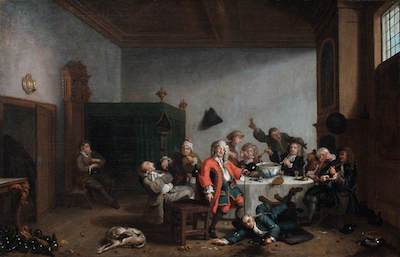
(Jan Josef Horemans the Younger, A Merry Party: Hackney Museum)

‘For Books are not absolutely dead things, but doe contain a potencie of life in them to be as active as that soule was whose progeny they are; nay they do preserve as in a violl the purest efficacie and extraction of that living intellect that bred them. I know they are as lively, and as vigorously productive, as those fabulous Dragons teeth; and being sown up and down, may chance to spring up armed men.’—John Milton, Areopagitica

How was it for you?
Bad. How could it not be? Our cat died.
And—more broadly?
Some good connections, some good work done, some good books read.
More broadly still?
Pretty bad. The end of all rules-based international order. Genocidal violence, unchecked. Countries losing their minds, wars waged on children in the modern fashion. The usual stupidity, greed, aggression, corruption. Electorates incapable of paying attention. Cyclists on footpaths; cars on the pavement. Dante knew where to put those people. . .
And next year?
Ah well.
Better or—?
Ah well.
Give me a word.
Attention.
Give me a number.
Two. Three with a cat.
Give me a blessing.
May you always be threefold, even if alone.

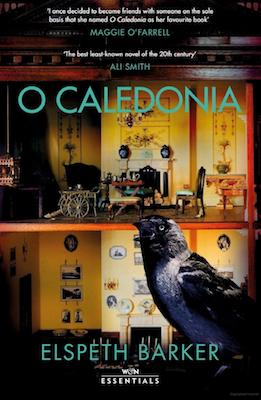
I read a lot of books this year and see that just over half of them were by women (which I find significant primarily by virtue of its non-significance now), despite Fords, Simenons, Herrons and the like. Hmm. A recent one was Charlotte Wood’s novel, Stone Yard Devotional, which I’d say is about acceptance and forgiveness, of oneself and of others—and of those who die or disappear before forgiving or being forgiven. That in itself reminds me of another novel recently read, the reissue of Elspeth Barker’s O Caledonia: ‘It was Janet’s view that forgetting was the only possible way of forgiving. She did not believe in forgiveness; the word had no meaning.’[1]

Leaning towards Janet – but here’s Willie:

MY SELF:
I am content to follow to its source,
Every event in action or in thought;
Measure the lot; forgive myself the lot!
When such as I cast out remorse
So great a sweetness flows into the breast
We must laugh and we must sing,
We are blest by everything,
Everything we look upon is blest.[2]

Ali Smith was also a little more, ah, yielding than Elspeth’s Janet: ‘many things get forgiven in the course of a life : nothing is finished or unchangeable except death and even death will bend a little if what you tell of it is told right’.[3]

Would I be that forgiving were I a victim of the numberless war crimes, sexual assaults, racist attacks, domestic outrages? Frankly, no. But we are at year’s end and, by the sound of it—bears of little brain letting off fireworks as though it were that day in November—it’s an evening of celebration.

Here’s the laureate of cheerfulness, J. G. Ballard: ‘It is a misreading to assume that because my work is populated by abandoned hotels, drained swimming pools, empty nightclubs, deserted airfields and the like, I am celebrating the run-down of a previous psychological and social order. I am not. What I am interested in doing is using these materials as the building blocks of a new order.’[4]

The eminent literary critic Frank Kermode did get to the celebratory stage but seemed to find the steps to it a little surprising. At Liverpool University, he was taught Latin by F. W. Wallbank, J. F. Mountford ‘and, rather surprisingly, George Painter’ (the celebrated biographer of Marcel Proust). ‘I took up Italian, under the instruction, also surprisingly, of the future father of Marianne Faithfull. Indeed, I drank wine in celebration of his wedding and continue to take comfort from this connection with true fame.’[5]

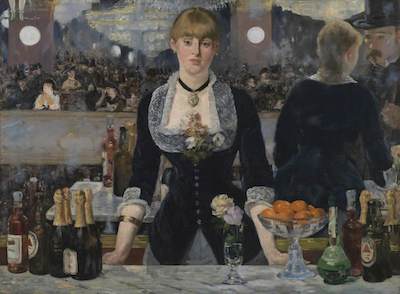
(Édouard Manet, A Bar at the Folies-Bergère (The Courtauld: Samuel Courtauld Trust)

We are rather more low-key here. A bottle of champagne, some rye bread with smoked salmon, and sitting in front of University Challenge, lamenting (that is, me lamenting) the fact that, while the contestants can answer obscure questions about astronomical phenomena, Third World flags or physiological irregularities, they are all at sea with literary questions that I vaguely assumed to be common knowledge even among household pets.

‘New Year’s Day, for us, is All Souls’ Day’, the Goncourt brothers wrote, 1 January 1862. ‘Our hearts grow chill and count those who are gone’.[6]  Ah, well and ah, well. Best wishes to all, wherever you may be, and may 2025 lean more towards Life than the other thing. . .


Notes

[1] Elsbeth Barker, O Caledonia (1991; Weidenfeld and Nicolson, 2021), 116.

[2] W. B. Yeats, A Dialogue of Self and Soul, Collected Poems, second edition (London: Macmillan, 1950), 142.

[3] Ali Smith, How to be both (London: Hamish Hamilton, 2014), 95.

[4] J. G. Ballard, interview with Peter Rǿnnov-Jessen (1984), cited by John Gray, ‘Crash and Burn’, New Statesman (5-11 October 2012), 52.

[5] Frank Kermode, Not Entitled: A Memoir (London: Harper Collins, 1996), 78.

[6] Edmund and Jules de Goncourt, Pages From the Goncourt Journal, edited and translated by Robert Baldick (New York: New York Review Books, 2006), 66.

Cookery: war, cavalry: rice

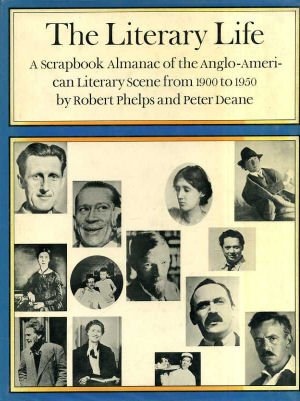
Browsing the tirelessly interesting The Literary Life: A Scrapbook Almanac of the Anglo-American Literary Scene from 1900 to 1950, I come across (‘In the Wings’ section of 1913): ‘“Eager for any sort of adventure,” Joyce Cary serves as a cook in the Montenegrin Army in the First Balkan War, receiving a gold medal for his participation in the final campaign.’[1] Montenegro! It reminded me that F. Scott Fitzgerald’s Major Jay Gatsby had been decorated by every Allied government, ‘even Montenegro, little Montenegro down on the Adriatic Sea!’[2]

And a cook! Intriguing, especially when poking about in various sources to confirm it but coming up against Red Cross nurse, stretcher bearer, Red Cross orderly, and finally: stretcher bearer and cook, which I promptly accept as definitive.

Cary (1888-1957) was born in Derry but, when he settled in England, this was where he largely stayed. He attended Clifton College in Bristol (as did L. P. Hartley, Sir Arthur Quiller-Couch, Henry Newbolt, Geoffrey Household, Montague Summers, actors, musicians and an astonishing array of military, scientific and political notables). He joined the colonial service in Africa and fought in the First World War – with a Nigerian regiment in the Cameroon campaign. He seems to have largely dropped from view but was pretty well-known for a while, particularly for his novel The Horse’s Mouth, published in 1944 and reprinted as a Penguin book four years later.

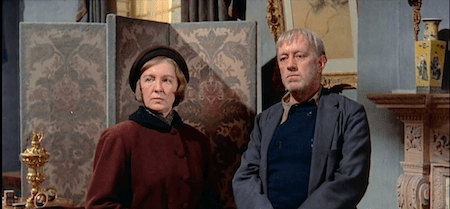
(Alec Guinness and Kay Walsh in the 1958 film, The Horse’s Mouth)

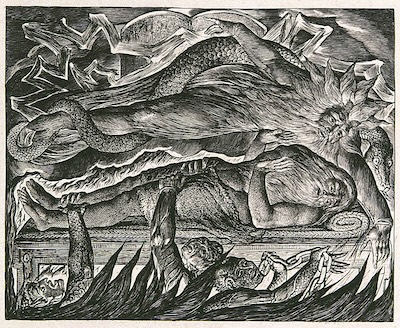
I did read several of his other novels but that’s the one I remember best. It’s about a painter, Gulley Jimson, who has some diverting comments about the art that he practises. One day, he remembers, ‘I happened to see a Manet. Because some chaps were laughing at it. And it gave me the shock of my life. Like a flash of lightning. It skinned my eyes for me and when I came out I was a different man. And I saw the world again, the world of colour. By Gee and Jay, I said, I was dead, and I didn’t know it.’ A little later, ‘And then I began to make a few little pencil sketches, studies, and I took Blake’s Job drawings out of somebody’s bookshelf and peeped into them and shut them up again. Like a chap who’s fallen down the cellar steps and knocked his skull in and opens a window too quick, on something too big.’ But to a boy who keeps turning up, saying he wants to be a painter himself, Jimson tells him ‘“something for your good. All art is bad, but modern art is the worst. Just like the influenza. The newer it is, the more dangerous. And modern art is not only a public danger – it’s insidious. You never know what may happen when it’s got loose.”’[3]

(William Blake, engraving for The Book of Job)

Cookery and war, though. Conflict in the kitchen is familiar fare in several strenuous television series of recent years but there are other offscreen instances enough.

Joan Didion recalled being taught to cook by someone from Louisiana. ‘We lived together for some years, and I think we most fully understood each other when once I tried to kill him with a kitchen knife.’[4] And M. F. K. Fisher remembered a Mrs Cheever at Miss Huntingdon’s School for Girls: ‘She ran her kitchens with such skill that in spite of ordinary domestic troubles like flooded basements and soured cream, and even an occasional extraordinary thing like the double murder and hara-kiri committed by the head boy one Good Friday, our meals were never late and never bad.’[5]

In the First World War, as in so many other wars, cookhouses and dining halls were central to the military effort, both at home and abroad. If your medical category was C1, then cookhouse fatigues were likely to feature on your work rota, along with clerking, cleaning and gardening. The poet F. S. Flint did precisely that although towards the end of his war service in England and Scotland—brief enough since he was only called up in August 1918—he taught French to officers who were awaiting demobilisation. The novelist Edgar Jepson wrote of attempting ‘to diminish the gluttony of the British people.’ His masterpiece drew, he said, on the experiments of Mrs Peel in the basement kitchen: ‘I dwell at this length on the Cookery Book [The Win the War Cookery Book of May 1917] because I wish to make it wholly clear that it shares equally with the United States the glory of having won the war.’ He added: ‘Not that I would have it supposed that I reckon the months I spent at the Ministry of Food wasted: I acquired there a faith in human stupidity, which nothing will ever shake.’[6]

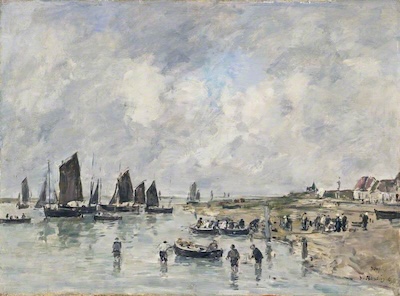
(Eugène Louis Bourdin, Étaples)

Closer to the scenes of combat, the young Wilfred Owen would discover in December 1916 that meals in the officers’ mess at Étaples in northern France—where a series of mutinies the following year resulted in executions and prison sentences—‘were cooked by a former chef to the Duke of Connaught and presided over by a baronet.’[7]

Midway through that war, in the same year as Owen’s sumptuous dinners, poet and novelist Robert Graves bought a small cottage from his mother. He wrote, a decade later: ‘I bought it in defiance of the war, as something to look forward to when the guns stopped (“when the guns stop” was how we always thought of the end of the war). I whitewashed the cottage and put in a table, a chair, a bed and a few dishes and cooking utensils. I had decided to live there by myself on bread and butter, bacon and eggs, lettuce in season, cabbage and coffee; and to write poetry.’[8]

War and the kitchen. Really not in my case; perhaps the nearest would be peeling a butternut squash, the culinary equivalent, I suppose, of fell walking or hill climbing, requiring as it does both stamina and occasional brute strength. And war has changed out of all recognition in the last hundred-odd years, sometimes seeming to be called ‘war’ only to spare the feelings of those on one side who are slaughtering, almost without resistance or effective means of defence, the other. And there was a time, after all, when ‘war’ meant men on horseback. . .

‘It was from the cavalry that the nation’s military leaders were drawn. They believed in the cavalry charge as they believed in the Church of England.’ Perhaps unsurprisingly, then, when the future General Sir Ian Hamilton, as an English observer in the Russo-Japanese War of 1904-1905, reported that ‘the only thing the cavalry could do in the face of entrenched machine guns was to cook rice for the infantry’, his statement had the effect of ‘causing the War Office to wonder if his months in the Orient had not affected his mind.’[9]

Never underestimate the value to the world of getting the cooking time of your rice just right.

Notes


[1] Robert Phelps and Peter Deane, The Literary Life: A Scrapbook Almanac of the Anglo-American Literary Scene from 1900 to 1950 (New York: Farrar, Straus and Giroux, 1968), 54.

[2] F. Scott Fitzgerald, The Great Gatsby (1926; edited by Tony Tanner, London: Penguin Books, 2000), 65.

[3] Joyce Cary, The Horse’s Mouth (Harmondsworth: Penguin Books, 1948), 70-71, 72, 24-25.

[4] Joan Didion, South and West: From a Notebook, foreword by Nathaniel Rich (London: Fourth Estate, 2017), 8.

[5] M. F. K.  Fisher, ‘The First Oyster’ (1924), in Gastronomical Me (1943; London: Daunt Books, 2017), 26.

[6] Edgar Jepson, Memories of an Edwardian and Neo-Georgian (London: Richards, 1937), 193, 196. Mrs C. S. Peel was a prolific author of books about thrifty cookery, including The Eat-Less-Meat Book: War Ration Housekeeping (1917).

[7] Dominic Hibberd, Wilfred Owen: A New Biography (London: Weidenfeld & Nicolson, 2002), 203.

[8] Robert Graves, Good-bye to All That: An Autobiography (1929; Harmondsworth: Penguin, 2014), 252.

[9] Barbara Tuchman, The Guns of August and The Proud Tower, edited by Margaret MacMillan (New York: Library of America, 2012), 593, 214.

Dusks and darks

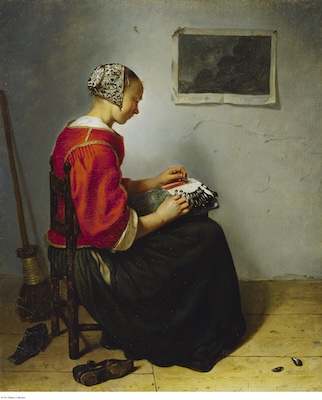
(Caspar Netscher, The Lace Maker, Wallace Collection)

‘In a mid-September twilight’, Ford Madox Ford writes, remembering himself as Second Lieutenant in September 1916, ‘the rain poured down on Pont-de-Nieppe.’ He is bothered by his wet shirt-cuffs and the man assigned to him as temporary batman has clearly decided that Ford is not a man who can be safely left and, ‘though he must have been uncommonly wet and hungry and tired, he followed me to the door of the house in whose dark windows I had seen the luminous patch—the forehead of Rosalie Prudent as she sat sewing, her head bent forward, in the twilight.

‘I don’t know how it is: but from the moment when I first saw that highlight—and it had been certainly three hours before—I had been perfectly sure that that was what it was—the forehead of a quiet woman bending her head forward to have more light from the high window whilst she sewed in the dusk.’

This is Rosalie Prudent of Pont-Nieppe, who has lost her house, her husband and her sons, and is one of the most significant figures that Lieutenant Ford Madox Hueffer—a man at the end of his tether and a writer who cannot write—will encounter during the war. She will sit by the stove in the wash-house, sewing his wristbands. She will cook him an omelette and fried potatoes, talk to his orderly and, ‘looking at Mme. Rosalie—so extremely centred in the work in hand, so oblivious to the very real danger, so brave and so tranquil, I said to myself:
“What the devil! If she can stick it, I too can!”’[1]

And he will. He is one young Australian artist and one five shilling a week cottage away from salvation: ‘The dusk was falling as I approached my isolated, sixteenth century abode that had a leaky, red-tiled roof and defective diamond-framed casements. It stood under a darkling bank. . . . And you think that the half-crown dog was an extravagance! I assure you that he was not. The floors sagged, the paper fell in scrolls from the walls. There was more than a bushel’s bulk of starling’s nest in the downstairs ingle.’[2]

Back in the day—ah, those days—I read, as did half the people I knew at the time, the books of Carlos Castaneda or, at least, the first three or four. Much of it, even the unfolding controversy, is a little cloudy now, but I do recall the assertion that: ‘The twilight is the crack between the worlds.’ Or rather, I recalled it as I made my way around the park a day or two back as the light slipped further down into its last phase before incontrovertible darkness.

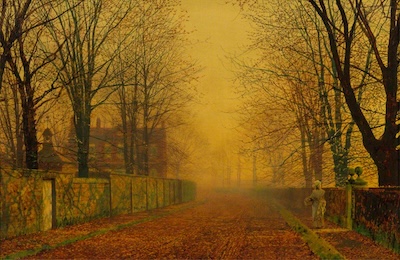
(John Atkinson Grimshaw, Evening Glow: Yale Center for British Art)

If that is in fact the case, some of the denizens of that other world are a little unsettling. As is, of course, the possibility that I myself am, in fact, an inhabitant of the ‘other’ world.

There seem to be more people than usual devoting their time to shouting into phones or at dogs, heard rather than seen, or glimpsed between branches or benches. A man wearing a cloth cap and an alarming neck tattoo scatters broken biscuits from a bag as he walks, to more than a dozen crows and one slightly shifty magpie (‘Yeah, I’m a crow. Who’s asking?’). A second man passes me, marching like a robot, legs thrown out, with a can of beer gripped in each outstretched hand; a teenaged schoolgirl, one of three, having an emotional moment, turns her tearstained face away from me as I pass and one of her friends says: ‘I didn’t meant to hurt you, Lily, but you shouldn’t have said—‘. And on an upper path, a woman running towards me; I cross over to make room for her; she smiles and turns sharply into the play area ten yards ahead, to crouch in front of a swing on which her child is sitting, watched over by a friend.

Vladimir Nabokov mentions ‘soomerki—the lovely Russian word for dusk.’[3] It is, or can be, oddly different, the air itself a different texture or the mind made more receptive to such notions by the slippage in other senses: sounds half-heard and harder to locate, things not quite seen. A Golden Labrador with one of those illuminated collars races through a thick ribbon of trees that borders a lower path, a ghost dog that has me wracking my brains to come up with Jim Jarmusch’s 1999 film, Ghost Dog: The Way of the Samurai, with Forest Whitaker as the hitman. A group of dog-owners I passed earlier did look and sound like contract killers but that may have been down to the special sound qualities of this twilight zone.

(G. F. Watts, A Sea Ghost: Watts Gallery – Artists’ Village)

‘It is the magic hour’, Lawrence Durrell wrote, ‘between two unrealized states of being—the day-world expiring in its last hot tones of amber and lemon, and the night-world gathering with its ink-blue shadows and silver moonlight.’[4] The colours may be a little different in Corfu, as emotional responses might have been a little more accentuated in Emerson’s nineteenth-century New England: ‘Crossing a bare common, in snow puddles, at twilight, under a clouded sky, without having in my thoughts any occurrence of special good fortune, I have enjoyed a perfect exhilaration. I am glad to the brink of fear.’[5]

Richard Garnett (father of Edward and Olive, father-in-law of Constance) wrote about The Twilight of the Gods (as did Richard Wagner); Nietzsche wrote about the Twilight of the Idols; D. H. Lawrence wrote of Twilight in Italy; Edith Wharton was concerned with Twilight Sleep; a volume of Conan Doyle stories was called Tales of Twilight and the Unseen.  ‘I drove carefully’, the private eye Lew Archer says, ‘feeling a little depressed, stalled in the twilight period when day has run down and night hasn’t picked up speed.’[6]

We’re just a week away from the winter solstice, the shortest day, the longest night. Beyond that date, of course, the days get longer, inch by inch. Grounds for optimism, some say. And why not? Just mind the cracks—and, of course, those worlds.


Notes

[1] Ford Madox Ford, No Enemy (1929; edited by Paul Skinner, Manchester: Carcanet Press, 2002), 117, 127, 124.

[2] Ford Madox Ford, ‘Rough Cookery’, New York Herald Tribune Magazine (29 July 1928), 18.

[3] Vladimir Nabokov, Speak, Memory: An Autobiography Revisited (New York: Putnam’s, 1966), 81.

[4] Lawrence Durrell, Prospero’s Cell (London: Faber 1962), 105.

[5] Ralph Waldo Emerson, ‘Nature’, Selected Essays, edited by Larzer Ziff (Penguin American Library, 1982), 38.

[6] Ross Macdonald, The Moving Target (1949; Warner Books, 1990), 98.

Pictures and Cathedral Closes

05:30 on the morning of another named storm, wind gusting like a fanatic and the tall, elaborate scaffolding at a house behind us, and three doors along, grinds and clacks and shrieks. It seems impossible that so much noise can result in no hazardous movement, no damage, no change in look or structure. And yet – collapsed scaffolding would be so absurdly appropriate, so ridiculously, symbolically pitch perfect, that I could never have taken either weather or metalwork seriously again.

Earlier this month, having avoided the news for the previous week, I’d lost track of the days, until I was walking away from coffee with my elder daughter and, halfway along the harbourside path, heard behind me the strains of a piper playing A Long Way To Tipperary. Armistice Day. A lengthy history but feeling a little awry when the world is so excessively out of true. Veterans of one world war utterly gone, veterans of the other all but gone. And, thinking of what the Second World War is believed to have been fought against, and of victory declared, and to look around the world now is. . . a little odd.

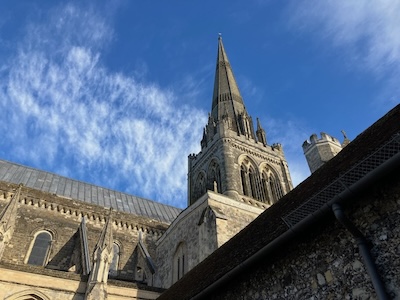
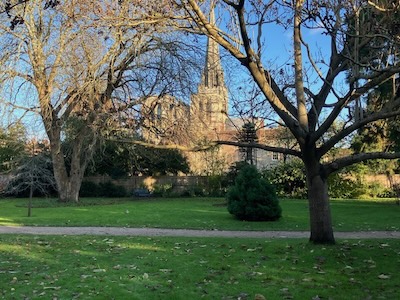
The good stuff is elsewhere. Indeed, the Decline of the West, though accelerating madly in recent months, seems oddly absent in West Sussex, where we go to spend a few days in Chichester for the Librarian’s birthday.

A quick shopping trip. What do we need? Wine and . . . something or other to go with it. And here is the Cathedral Close, Canon Lane, the Bishop’s Palace, St Richard’s Walk and the Deanery, which dates from 1725 and was itself a replacement for an earlier building, damaged in 1642, during the English Civil War. Key in the code and close the door and take in a roomy and well-appointed apartment with, unignorably, a television four or five times the size we’re used to. Could anything make the current dramatisation of Hilary Mantel’s The Mirror and the Light even more remarkable? Apparently so.

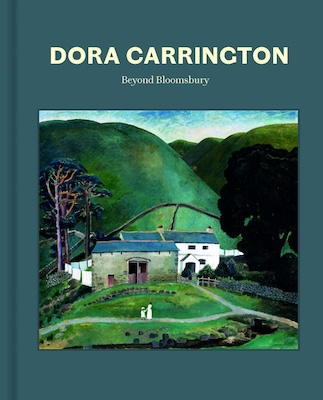
An excellent Carrington exhibition at the Pallant House Gallery: I’ve seen the Lytton Strachey portrait before but am convinced now that his fingers grow even more elongated under cover of darkness. The drawing of her brother is perfect; and the two portraits of Annie Stiles, seen together, are hugely pleasing. A scattering of works by Mark Gertler too, a significant presence in Carrington’s life, both personally and professionally: they include the portrait of Gilbert Cannan and His Mill, familiar from several visits to the Ashmolean in Oxford. Somehow, it strikes me as a little odder every time I see it. A few steps away from the building where we’re staying, we find an arresting anthology of birds, curious plants and extraordinary trees in the Bishop’s Palace Garden. Then a walk, nearly one and a half miles, following the surviving city walls, some traceable to the 3rd century. A bus trip to Selsey. And the Cathedral.

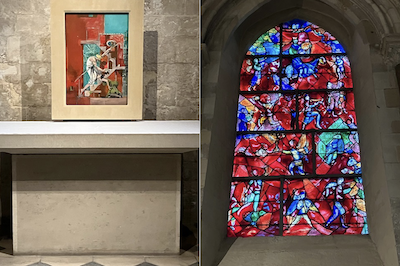
(Sutherland, Noli me Tangere and the Marc Chagall window)

‘I can stand a great deal of gold’, Henry James murmured to Desmond MacCarthy, as they stood in an exceptionally gilded drawing-room.[1] I can, it seems, stand a great deal of cathedrals. Poised on that delicate boundary between agnostic and atheist (finding it ultimately as absurd to state dogmatically that there isn’t as to state dogmatically that there is), I may attend evensong too (we did, liking to be sung to), though declining to recite the Apostle’s Creed, for obvious reasons.

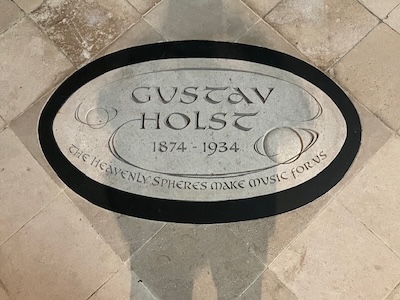
But the Cathedral. I’ve been to Durham, Wells, Exeter, Salisbury, Christchurch, St Paul’s, Hereford, Bristol. Different settings, different grandeurs. Here—among much else, stained-glass windows, statuary, painted panels, altarpieces—is Graham Sutherland’s Noli me Tangere, and two huge tapestries, one by John Piper and the other co-created by Ursula Benker-Schirmer and West Dean College students. There is a stunning Marc Chagall window, installed in 1978, and Gustav Holst’s ashes are buried in the North Transept.

Then Selsey: the Ford Madox Ford connection, of course, Violet Hunt having rented a cottage from Edward Heron-Allen, she and Ford spending much time there before—and during—the war. Little of that remaining in Selsey – but fascinating to learn that the monastery here, founded by St Wilfrid in 681, became the first cathedral in Sussex, until 1076, when the see of Chichester was established.

On the morning we leave: snow. Knowing how bad we continue to be in this country at dealing with any weather event out of the ordinary—even thought the formerly extraordinary is increasingly now the unremarkable—we skip brunch in the Cloisters café and head for the station. And yes, trains cancelled, delayed, signal failures, the whole nine yards, as our American cousins say – to whom we warily extend our sympathy (amidst our total and enduring bafflement). . .

Notes


[1] Leon Edel, The Life of Henry James: Volume 2 (Harmondsworth: Penguin Books, 1977), 680-681.

Darkness and Light

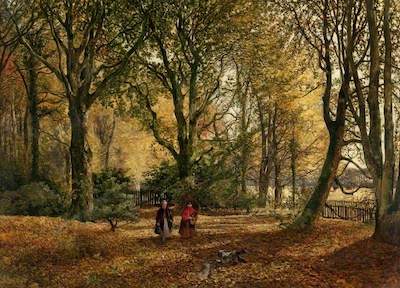
(John Milne Donald, Autumn Leaves: Glasgow Museums Resource Centre)

‘Darknesse and light divide the course of time, and oblivion shares with memory a great part even of our living beings; we slightly remember our felicities, and the smartest stroaks of affliction leave but short smart upon us.’[1]

The leaves are falling faster now, perhaps mostly fallen. Our clocks have gone back an hour and we are on Greenwich Mean Time. The polymath Edward Heron-Allen wrote in his journal on 22 May 1916, ‘The notable feature of the month is the establishment by law on the 20th of “summer time” which Willett, the originator of the idea, never lived to see introduced. At midnight on the 20th we all had to put our clocks on one hour, and in this way an hour of daylight is “added” to the day.’ And, five months later, he noted: ‘I do not think I have recorded that on 30 September we put our clocks back an hour and returned to Greenwich time.’[2]

William Willett, whose 1907 pamphlet, The Waste of Daylight, marked a crucial point in the advance towards ‘summer time’, had died from influenza on 4 March 1915, at the early age of 58, and is buried in St Nicholas churchyard in Chislehurst (as is his second wife.) The 1916 emergency law was passed to change the clocks twice a year as a measure to reduce energy and increase war production. It became a permanent feature when the Summertime Act was passed in 1925.

Leaves falling, darker days, the year in some ways closing down – but all these are in the natural order of things, as—or so we hope—the political convulsions, atrocities in Gaza, Lebanon, Ukraine, Sudan and elsewhere, are not. At least, as Jake Barnes says, at the close of Ernest Hemingway’s The Sun Also Rises, ‘Isn’t it pretty to think so?’

(John Berryman via The Paris Review)

‘Now there is further a difficulty with the light’, John Berryman wrote:

I am obliged to perform in complete darkness
operations of great delicacy
on my self.[3]

Currently those operations feature slow and sometimes painful analyses of my bafflement and confusion, not always helped by the Librarian’s daily bulletins from the battlefield that is the American election, often delivered in tones of appalled astonishment, while the phrase ‘batshit crazy!’ tends to recur.

What, in some senses, seems self-evident (one candidate sane, the other rather less so) is dwarfed by complexities and nuances almost invisible to us – we’re here and they’re. . . over there. I grasp, more or less, the fact that America is so divided a country now that neither side can—perhaps has no wish to—hear the other. But there is that other complication. While I can see that the appalling and spineless response of the Biden government to the conflict in the Middle East must repel a good many voters, it baffles me that those voters should think that withholding their vote from Harris (and thereby potentially contributing to her defeat) could somehow help the Palestinian people. Surely the precise opposite?

(John Donne, unknown English artist, c.1595)

Well, we’ll know soon enough. People, eh? I think of Katherine Rundell writing that, ‘amid all Donne’s reinventions, there was a constant running though his life and work: he remained steadfast in his belief that we, humans, are at once a catastrophe and a miracle.’ And: ‘He thought often of sin, and miserable failure, and suicide. He believed us unique in our capacity to ruin ourselves. “Nothing but man, of all envenomed things,/Doth work upon itself with inborn sting”. He was a man who walked so often in darkness that it became for him a daily commute.’[4]


Notes

[1] Sir Thomas Browne. Hydriotaphia, or Urn-Buriall, in Selected Writings, edited by Geoffrey Keynes (London: Faber  and Faber, 1970), 152.

[2] Edward Heron-Allen’s Journal of the Great War: From  Sussex Shore to Flanders Fields, edited by Brian W. Harvey and Carol Fitzgerald (Lewes: Sussex Record Society, 2002), 65, 71.

[3] John Berryman, ‘Dream Song # 67’, The Dream Songs, collected edition (New York: Farrar, Straus and Giroux, 1969), 74.

[4] Katherine Rundell, Super-Infinite: The Transformations of John Donne (London: Faber, 2023), 5-7.

By heart in the park

(Philip Wilson Steer, Dover Coast: York Art Gallery)

Another last warm and sunny afternoon of autumn. How many more can there be? With the Librarian in the office for a pretty full day, so not available for the lunchtime stroll, I walk alone in the park and succumb to the temptation to recall (and recite) the handful of poems that, at one time or another, I’ve committed to memory. Committed they may have been but seem, for the most part, to have escaped or at least to be out on parole.

Matthew Arnold’s ‘Dover Beach’ is worse than shaky and, in its current state, Marvell’s ‘To His Coy Mistress’ would probably not detain her for a moment. A bit of Pound, a bit of Yeats and a fragment of Elizabeth Bishop all hold steady, while a couple of others improve with work, which necessitates keeping a wary eye open – and an ear, given the increasing tendency of people to rush up behind you on bicycles or accursed electric scooters. Robert Lowell’s ‘Skunk Hour’ (dedicated to Bishop) yields a little to pressure:

Nautilus Island’s hermit heiress still
something something
her sheep still graze above the sea

Two men, walking briskly but not quite briskly enough, so staying almost exactly the same distance behind me, fairly close and, worse, very gradually nearing. . .

Her farmer
Is first selectman in our village;
she’s in her dotage.

We’re sailing now. Ah:

Thirsting for the hierarchic privacy
of Queen Victoria’s century,
she buys up all
the eyesores facing her shore,
and lets them fall.

(Lowell and Bishop in Brazil, 1962. Photo: Vassar College Library via the New Criterion)

But then there’s some confusion in the order of half-remembered stanzas, though I have most of the mother skunk’s activities in the final one. Move on to surer ground, anyway, the much-learned, almost-all recollected ‘Bagpipe Music’.

Though here a slight pause for the woman standing with her dog at the top of a slope below the play area. Is it a Pointer? We’ve seen it more than once before. Similar shape, similar attitude, its attention fixed on something in the grass near the foot of a tree, that can only be a squirrel. Looking it up later, I see that it’s a Vizsla, also known as a Hungarian Pointer. I stroll past it, resisting the impulse to give it some advice: you may be quick but you won’t win, they climb, you don’t. We’ve seen some close shaves for squirrels in the past but they always seem to evade dogs’ jaws. And ‘Bagpipe Music’? Pretty good, in fact. A slight hiccup over the penultimate stanza but both MacNeice and myself ending strongly:

It’s no go my honey love, it’s no go my poppet;
Work your hands from day to day, the winds will blow the profit.
The glass is falling hour by hour, the glass will fall for ever,
But if you break the bloody glass you won’t hold up the weather.

Now distractions range from the two old ladies intent on feeding a squirrel by hand (‘Come on, dear, see what I’ve got’ – Fleas, soon enough, I suspect) to the fellow with the ponytail and curious blue-green leggings intent on kicking a very small ball across the grass, and who crosses my path again half an hour later in a different and distant part of the park; and a murder of crows, around thirty in total, spread right across and down a broad grassy slope to the cycle path that runs along beneath the outspread branches of several wild pear trees. The fruits fall partly onto the earthy slopes beyond and partly onto the cycle path itself, one missed my right ear by inches one day last week. Walking along that path now before climbing sharply to my left, I see a dozen crows rooting among the fallen pears, though some turn to stare at me as I approach. ‘Are you auditioning for that nice Mister Hitchcock?’ I ask. One crow, not to be put off by a mere human, lingers to stick its beak straight through a pear before flying up to the branch above. Knowing how clever corvids are, I watch to see how it goes about extricating beak from fruit. It thrusts the pear into a narrow fork of branches which holds it in a tight embrace, withdraws the beak and starts tucking in. I whistle my sincere appreciation. That Lowellian mother skunk, I recall,

    jabs her wedge-head in a cup
of sour cream, drops her ostrich tail,
and will not scare.

Why is it so hard these days? No answers on a postcard, please. At school, everyone learned poems by heart and some people never lost the habit. I recalled an aside of the Reverend Kilvert: ‘I thought of William Wordsworth the poet who often used to come and stay at this house with blind Mr. Monkhouse who had nearly all his poems off by heart.’[1] Eric Gill’s father and one of Gill’s teachers, named Mr Catt, were great admirers of Tennyson. Gill himself also learned much of it by heart, being particularly fond of ‘the passage about the routine of rural agriculture:

As year by year the labourer tills
His wonted glebe and lops the glades’[2]

This is from stanza CX of Tennyson’s In Memoriam A. H. H., the initials those of Tennyson’s beloved friend Arthur Henry Hallam, who died in Vienna in 1833. Born in 1811, he was eighteen months younger than Tennyson. They had met at Trinity College, Cambridge in 1828. Tennyson seems to have begun this long poem very soon after hearing of Hallam’s death, though it was not published until 1850, and then anonymously. Edward Fitzgerald—translator of The Rubaiyat of Omar Khayyam—wrote to the poet’s elder brother Frederick Tennyson (15 August 1850): ‘Alfred has also published his Elegiacs on A. Hallam: these sell greatly: and will, I fear, raise a host of Elegiac scribblers.’[3]

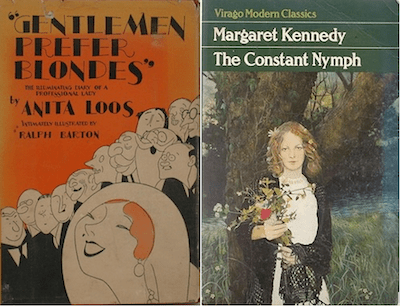
But it is not only poetry that the heroes of yesteryear committed to memory in large chunks – some mastered prose in a similar way, which always seems to me somehow an even more impressive achievement, though I accept that actors, having to learn their lines, sometimes comprising tremendously long speeches or monologues, would not necessarily find it so. Joseph Conrad and Ford Madox Ford would swap pages of Flaubert or Maupassant, while James Joyce ‘knew by heart whole pages of Flaubert, Newman, de Quincey, E. Quinet, A. J. Balfour and of many others.’[4] And, while Anita Loos’ Gentlemen Prefer Blondes was apparently one of Patrick White’s favourite novels (Joyce, Faulkner and Edith Wharton were also admirers), he knew Margaret Kennedy’s The Constant Nymph ‘practically off by heart.’[5]

‘Heart’ is another of those words with a great many friends, the compounds running over several columns of the dictionary: in one’s mouth or boots or the right place; open, shut, taken; worn on the sleeve; piercing, rending, sore and sick. It has its reasons and is, in many contexts, simply mysterious, as the author of ‘Dover Beach’ wrote:

But often, in the world’s most crowded streets,
But often, in the din of strife,
There rises an unspeakable desire
After the knowledge of our buried life;
A thirst to spend our fire and restless force
In tracking out our true, original course;
A longing to inquire
Into the mystery of this heart which beats
So wild, so deep in us – to know
Whence our lives comes and where they go.[6]

I briefly consider this last poem as a candidate but coming in at around a hundred lines, it may be a stretch too far for me. Sonnets are a handy length, though . . .


Notes

[1] Francis Kilvert, entry for 27 April 1870, Kilvert’s Diary, edited by William Plomer (London: Jonathan Cape, 1938, reissued 1969), I, 119.

[2] Fiona MacCarthy, Eric Gill (London: Faber & Faber, 1990), 26.

[3] The Letters of Edward Fitzgerald, edited by Alfred McKinley Terhune and Annabelle Burdick Terhune, four volumes (Princeton: Princeton University Press, 1980), I, 676.

[4] Frank Budgen, James Joyce and the Making of ‘Ulysses’ and other writings, enlarged edition (1934; London: Oxford University Press, 1972), 181. Edgar Quinet was a French historian; by A. J. Balfour is meant, presumably, the British Prime Minister (1902-1905) – who also published works of philosophy.

[5] David Marr, Patrick White: A Life (London: Vintage, 1992), 85.

[6] Matthew Arnold, ‘The Buried Life’, Poetry and Criticism of Matthew Arnold, edited by A. Dwight Culler (Boston: Houghton Mifflin, 1961), 114.