Frankly, I didn’t think much of July. It used to be a favourite month of mine: it contained my birthday, school holidays, reliably fine weather, test cricket on the BBC. Now it just contains my birthday. And leaks in the kitchen. And worries about the cat. And other leaks in the kitchen. And bodily aches and pains generously distributed, a bad leg here, a repetitive strain injury there; plumbers that don’t get back to you; misnamed ‘freedom days’; our shoddy, barrel-scraping media; weather that was either oppressively hot or relentlessly wet; plus the reliable constants of a global pandemic and half the world seemingly on fire and a government much less keen on democratic rights and free speech than it pretends.
On the other hand, there were books. I reread Ford Madox Ford and the wonderful Stella Bowen, and books by Inez Holden, Jonathan Coe and Elizabeth Taylor, the anthology of weird stories by women edited by Melissa Edmundson, Juliet Nicolson’s Frostquake—and strolled through the first few volumes of Simon Raven’s Alms for Oblivion series, reminded more than once, especially by some of the characters in the early books, of the sentiment expressed by John Dowell in Ford Madox Ford’s The Good Soldier: ‘The instances of honesty that one comes across in this world are just as amazing as the instances of dishonesty.’
But we have, of course, moved on, and August—no, August seems not to have received the note about ‘marked improvement’. Endless rain, an unwell librarian, an internet connection with the strength of a day-old kitten. The plumbers continue not to return calls as I work on through the list. I make contact with a plasterer—my next bout of self-indulgence—but silence has descended since.
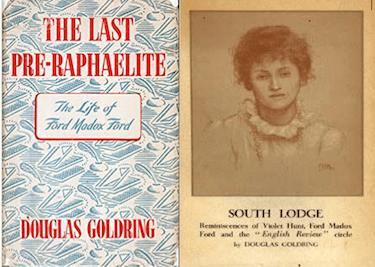
And yet—here is Douglas Goldring, Ford Madox Ford’s sub-editor on the famous English Review, a friend of thirty year’s standing and Ford’s first biographer. I’ve been rereading his books and, although he gets some things wrong and is a little too romantic in his view of Stalin’s Soviet Union—as so many people were, in reaction against fascism and the English establishment’s tolerance of, or even enthusiasm for, fascism—he is right about things surprisingly often. I do like Goldring. Always aware of Ford’s absurdities, they never obscure his view of Ford’s literary genius and his many personal qualities, what Pound called his ‘humanitas’. Goldring is opinionated, vigorous, wonderfully convinced and convincing on the changes that became visible after the First World War, the slaughter on the Western Front and the radical change in the complexion of those in power. ‘There was no longer any room in the Establishment for men with traditions of unselfish public service who regarded those who made money out of wars as the scum of the earth.’
Librarians recover; cats perk up; internet speeds revive; daughters can visit, sometimes after long, long pauses; rain can ease and blackberries offer themselves to ready fingers. August can improve—locally, yes, always locally. Julian Barnes, in his ‘Preface’ to Richard Cobb’s Paris and Elsewhere, remarked on his ‘very English taste for the particular and the local’. Unlike some recent manifestations of nationalist zealotry, the Francophile Cobb’s taste was grounded, rather, in a considerably wider range of knowledge and sympathies. David Jones (in ‘James Joyce’s Dublin’) remarked that, ‘of all artists ever, James Joyce was the most dependent on the particular, on place, site, locality.’ Joyce too, though always intensely Irish, was also a citizen of the world, to coin a phrase. As far as improvement goes, then, I am trusting only to the local – just for now.
From 25 June to 6 August 1818, John Keats went walking with his friend Charles Brown, to the Lake District, Scotland, briefly to Northern Ireland and back to Scotland. 42 days, 642 miles. On 29 June, setting off at four in the morning, they climbed Skiddaw, the sixth highest summit in England, just north of Keswick in Cumbria : ‘I have an amazing partiality for mountains in the clouds.’
I myself have an amazing partiality for staying at home of late, walled in by books. Nevertheless we ventured, the Librarian and Harry the cat and I, as far as Somerset (and Dorset and Wiltshire: meandering roads), and stayed the night—actually three nights—in A Different Place, for the first time since Christmas 2019. Not quite a Keatsian trip but quietly impressive on its own terms, I thought.
Once there, we talked, ate, read, walked, drank a little wine. At the Chalke Valley History Festival, the Librarian and I mooched about and necked a salted caramel ice-cream while her parents went to see Tom Stoppard and his biographer, Hermione Lee, discourse before a rapt audience in a large tent. Slightly unsettled by our earlier view of combatants wielding sticks, apparently in their underwear (‘Look! People fighting in their pants!’), we stayed to watch Dan Snow, with a smattering of other historians and willing helpers, re-enact the Battle of Agincourt.
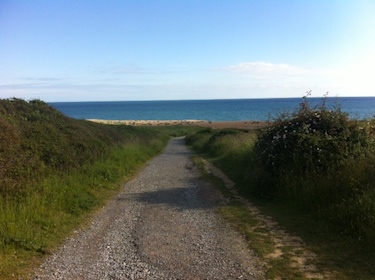
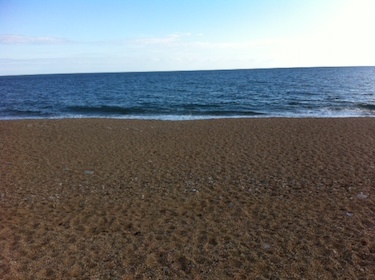
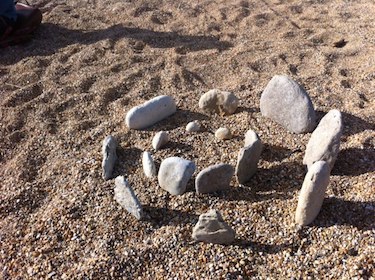
But the main business, apart from the company, was to see the sea, again for the first time in too long. It was a quiet stretch of coast—having no facilities—offering sea, sand, sea cabbage, occasional dog walkers, a distant angler, a wheeling gull or two, pebbles, mysterious flowers, mysterious stone circles.
As for literary connections—Keats aside—there was the village of Broad Chalke, familiar to John Aubrey, author of Brief Lives, and home to historical novelist and poet Maurice Hewlett (1861-1923), who lived in the Old Rectory. In 1904, recovering from a breakdown, Ford Madox Ford spent time at Winterborne Stoke, three miles from Stonehenge. He met and walked with W. H. Hudson, who had recommended that area as one to which Ford might escape from his situation in London. He later remembered standing for half an hour with Hudson watching a rookery near Broad Chalke. He saw a good deal of Hewlett too. At Christmas 1911, Ezra Pound also stayed with Hewlett, an occasion poignantly recalled—ghosts and shadows—as he sat in the military detention centre near Pisa:
and for that Christmas at Maurie Hewlett’s Going out from Southampton they passed the car by the dozen who would not have shown weight on a scale riding, riding for Noel the green holly Noel, Noel, the green holly A dark night for the holly (80/515)
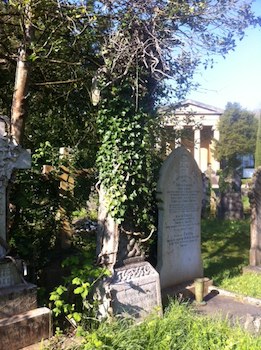
Our local Victorian cemetery is pretty quiet, certainly early on a Saturday—Mayday—morning. Good walking, orchestral birdsong. The sparrows en route are noisy, even clamorous in two or three specific bushes, but it’s chatter, sociability. Some of the cemetery birdsong smacks more of performance.
At one point, the Librarian and I conduct a highly technical ornithological exchange.
—What’s that bird up there? —Where? Oh, just a pigeon, isn’t it? —Is it? I thought there was something about the beak. —Oh yes, looks like a finch. —I thought perhaps a jay. Tiring of this, the bird launches itself into space. —Oh yes! You can see now. Beautiful colours. It is a jay.
In Ford Madox Ford’s 1923 novel, The Marsden Case, the narrator is found ‘gazing through a plate-glass window set in granite at a blue straw hat trimmed with jay’s wings pointing backwards so that it resembled a helmet of Mercury’.[1] ‘The jay, the “British Bird of Paradise”, displaying his vari-coloured feathers at a spring-time gathering’, W. H. Hudson wrote in one of his catalogues of the birds which ‘give most delight to the aesthetic sense’.[2]
(Benjamin Haughton, Jay: Portsmouth Museums and Visitor Services)
Ford was a great admirer of—and well acquainted with—Hudson, who devoted a great deal of time in his later years to combatting the barbaric treatment of birds, which slaughtered hundreds of thousands and drove many species to extinction. ‘Rare visitors were shot on sight. In May 1870 a flock of forty golden orioles, arriving in woods near Penzance, was quickly wiped out: “everyone in the place was up and after them.”’ This ‘spirit of destruction prevailed everywhere’, in town and country and ‘running through all classes.’ Fashionable women wore hats ‘trimmed with gulls’ wings or the plumes of great crested grebes, or a ball dress set off by a spray of goldfinches or robins.’ Hudson was closely involved with the founding in the late 1880s of the Society for the Protection of Birds, which was incorporated by Royal charter in 1904.[3]
‘The wilderness is near as well as dear to every man’, Henry Thoreau wrote, ‘The very uprightness of the pines and maples asserts the ancient rectitude and vigor of nature. Our lives need the relief of such a background, where the pine flourishes and the jay still screams.’[4]
As well it might.
Notes
[1] Ford Madox Ford, The Marsden Case (London: Duckworth, 1923), 22-23.
[2] Hudson, Birds and Man, (1901); see Ruth Tomalin, W. H. Hudson: A Biography (Oxford: Oxford University Press, 1984), 150.
‘Come, come, now, my blonde darling, I may not have written for a little longer than usual, but it couldn’t have been that “over a month” you mention. And you mustn’t worry about not hearing from me now and then. A lot of things can happen in a wartime Army to make writing difficult, and they don’t all have to be bad. If anything should happen to me, the good old USA would notify you, your name and address are on my dog tag. (The new dog tags, not yet issued to us, have no name and address of next-of-kin on them.)’
Dashiell Hammett was sending reassurances (after a fashion) from the Aleutians to his older daughter Mary, in February 1944.[1] Over a month! Still, it was, as he says, the Aleutians in wartime. ‘Darling’, Ford Madox Ford wrote to Stella Bowen in November 1918, ‘I haven’t had a word from you for three days—& you can imagine how long a time that seems to me’.[2]
There are people now that we haven’t had a word from for six months, people that we haven’t seen for a year – or more. So how would this work? That the people we haven’t seen for the longest period are the ones we most want to see? Of course not – or not necessarily. We are, after all, human animals, so we have, most of us, some of us, a few of us, lived in that magical state where we miss people the moment they leave us, more, even before they leave us since we can predict the moment when that separation will occur and feel it on our skin before it happens.
I see that people are pining away for the loss of a sight of Athens, Paris, New York, Sydney, Prague, Bilbao. I have been to some, though not all, of those places but, to be frank (to be earnest), the places I am plagued by pictures of—unannounced, unprompted, unasked for—are palpably absurd. Absurd and banal and not to be mentioned in the context of these discussions of exotic and far-flung locations. They are the corners of streets not far from here; the road leading to a park in Bath; the hill running down to the Librarian’s parents’ home; a lane in Clifton, three miles away.
The local is lodged in my brain in a way that those others are not. Even the marvels of that apartment in Prague, that we talked of this evening. Even the baguette and Brie and glass of red wine on a pavement in Paris, bringing to mind the letter that Ford Madox Ford writes to Henry Goddard Leach, the editor of Forum and Century, in 1938, about the pieces he is thinking of drafting: ‘Another I meditate treating very soon is simply the fact that France—from the point of view of culture and the arts—manages everything so infinitely better than either branch of Anglo-Saxondom that the sooner we acknowledge the fact the sooner we shall be out of the wood.’[3]
And that was it, more or less. I remember thinking at the time, as I sat on that pavement in Paris: If we can’t even manage to provide bread and cheese and a glass of wine at this sort of level, how the hell can we manage anything else?
The answer was, of course: we can’t. And so it proved. Proves. Has proven. Will prove. Will prove to have proven.
Notes
[1]Selected Letters of Dashiell Hammett, 1921-1960, edited by Richard Layman with Julie M. Rivett (Washington, D.C.: Counterpoint, 2001), 281-282.
[2]Correspondence of Ford Madox Ford and Stella Bowen, edited by Sondra J. Stang and Karen Cochran (Bloomington & Indianapolis: Indiana University Press, 1994), 38.
[3] Ford Madox Ford, Letters of Ford Madox Ford, edited by Richard M. Ludwig (Princeton: Princeton University Press, 1965), 288.
‘A Lady asks me’, as Ezra Pound begins Canto 36, borrowing from his own translation of Guido Cavalcanti’s ‘Donna mi prega’, ‘I speak in season’. In fact, here, the season is undeniably autumn – and it’s the Librarian, asking what I’m finding the worst thing about the pandemic – ‘apart, obviously, from huge numbers of people dying’.
I know already that she misses, often very keenly, her library, the beautiful physical space itself and her colleagues—the greetings on a staircase, words exchanged in a corridor, on the phone or round the edge of a door, those brief moments that, tabulated and totalled, make up a significant proportion of any working day, both qualitatively and quantitatively.
For me, though, the shape of the days is much less changed. I read, I write, I walk, I cook, I feed the cat. The things that huge numbers of my fellow-citizens are apparently frantic for don’t really bother me. In another age, we would go to the cinema occasionally and to restaurants a little more often: but a large part of going out to eat—and of being in the cinema—is being able to relax. I certainly couldn’t relax in those settings at the moment, so why would I do it? Going on holiday: yes, but we’d be doing the same things, just in a different setting and at a substantial cost, and the logistics of any such trip make my head hurt. I’d really like to walk by the sea again – but now, as always, I don’t want to do it in the company of several thousand others.
There’s a world out there of worsening political chaos, lethal incompetence, thousands of avoidable deaths (and how many more in the United States, whose president is waging war against his own country); after the schools failures, now the universities fiasco, students imprisoned while administrators rearrange deckchairs on an ever more steeply tilting deck amidst ignorant comments from politicians and tabloid journalists.
Louis MacNeice writes in Autumn Journal:
It is this we learn after so many failures, The building of castles in sand, of queens in snow, That we cannot make any corner in life or in life’s beauty, That no river is a river which does not flow.
Even in lives superficially unchanged or little changed, this has changed. Life at present does not flow. Watching moving water, the fact of it moving becomes less and less its dominant feature; the currents that make our own lives flow are often invisible, unremarked. So perhaps one of the worst things is the simplest. We can go out, we can walk, other people can and do take buses or trains – but never now in an untroubled way, never wholly spontaneous, never unthinking, never without watchfulness, wariness, a readiness to take evasive measures. It’s the old literary metaphor of the poem as a field of action, of moving through hostile territory, always on the qui vive. A potentially productive conceit, you might argue, but probably not how you want to live your – civilian – life.
On this day in 1916, Ford Madox Ford published a piece called ‘Trois Jours de Permission’, about a three-day leave granted to him a little earlier that year, which he spent in Paris, much of it waiting for some grand fromage or other. ‘Yes, one learns to wait’, Ford wrote. ‘The most impatient temperament, somewhere in France, will be strait-waistcoated into inaction, into introspection.’
So here I am, somewhere in England, inactive and introspective, waving goodbye to September – though mentally active and prospective enough to expect little better of October. . .
It being August, and some nights seeming unusually long, I was reminded of the short Thomas Hardy poem, ‘An August Midnight’, written at Max Gate in 1899.[1]
I A shaded lamp and a waving blind, And the beat of a clock from a distant floor: On this scene enter—winged, horned, and spined— A longlegs, a moth, and a dumbledore; While ’mid my page there idly stands A sleepy fly, that rubs its hands…
II Thus meet we five, in this still place, At this point of time, at this point in space. — My guests besmear my new-penned line, Or bang at the lamp and fall supine. “God’s humblest, they!” I muse. Yet why? They know Earth-secrets that know not I.
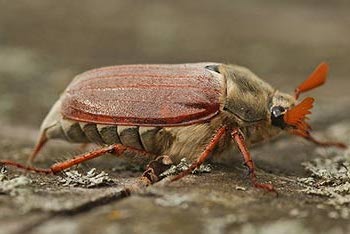
Only twelve lines, seemingly simple enough, but not without interest. A small drama, which ‘this scene’ emphasises. Four indefinite articles in the first two lines – and one definite article, tied to the word ‘beat’, in the most strongly stressed line of the poem, because of those two strategic monosyllables, ‘beat’ and ‘clock’. ‘Dumbledore’ might momentarily trip up the Harry Potter generation; and commentators on the poem don’t always agree: is it a bumblebee or a cockchafer – or cockchafter? F. B. Pinion says bumblebee, Claire Tomalin says ‘a cockchafter or maybug’.[2]
I pause on ‘Thus meet we five’, partly because of the implied equalising of the lives involved here, partly because of the inversion of natural word order and partly because of the number in this context. One of the mystic numbers, as Brewer’s Dictionary of Phrase and Fable explains, the pentad ‘being the sum of 2 and 3, the first even and first odd compound. Unity is God alone, i.e. without creation. Two is diversity, and three (being 1 and 2) is the compound of unity and diversity, or the two principles in operation since creation, and representing all the powers of nature.’
The conjunctions of ‘still’ and ‘point’ (and time and space) prompt a forward glance to T. S. Eliot’s ‘Burnt Norton’: ‘At the still point of the turning world’ and:
Except for the point, the still point, There would be no dance, and there is only the dance. I can only say, there we have been: but I cannot say where. And I cannot say, how long, for that is to place it in time.
‘I muse’ is another of these teasing touches, Hardy being his own muse, providing context, content, then text himself, from the materials in his immediate vicinity, the subjects of his poem entering the poet’s territory, the page, physically—‘My guests besmear my new-penned line’—as well as in the mind and memory. Tomalin comments on Hardy’s ‘appreciation that life is lived on different scales’, that the poem ‘shows him at his most tender, at ease in what still sometimes seemed to him to be God’s creation’.
The poem ends: ‘They know Earth-secrets that know not I.’ Pinion remarks that: ‘The inversion of the last line is perhaps an extreme example of the awkwardness and disregard for sound that Hardy sometimes accepted for the sake of verse pattern.’
Inversion: a change in order or position, a recurring theme in critical commentary, mainly but not always with reference to modern poets who, it’s implied, should know better or should, at least, reflect the habits of their own day. We expect to find it in Victorian poetry but not in modern poetry. Where—when—does the change come?
‘Poetry must be as well written as prose. Its language must be a fine language, departing in no way from speech save by a heightened intensity (i.e. simplicity)’, Ezra Pound wrote in January 1915, in a letter often cited, to Harriet Monroe, editor of Poetry magazine. ‘There must be no book words, no periphrases, no inversions. It must be as simple as De Maupassant’s best prose, and as hard as Stendhal’s.’[3]
(Harriet Monroe, 1920)
Ford Madox Ford, whose ideas this letter largely repeated (as Pound himself subsequently acknowledged), had written in 1905 of how modern poets were barred from certain subjects by that dialect then accepted as the proper language for poetry. ‘We wait, in fact, for the poet who, in limpid words, with clear enunciation and without inverted phrases, shall give the mind of the time sincere frame and utterance.’[4] Twenty years on and Ford, in some ‘Notes for a Lecture on Vers Libre’, explained: ‘You see I hate—and I hated then—inversions of phrase. A line like A sensitive plant in a garden grew filled me with hot rage. If the chap wanted to say that a sensitive plant grew in a garden, why didn’t he say it—or if he could not find a rhyme for garden, let him for Heaven’s sake hold his peace.’[5]
Did Pound and Ford not use ‘inversions of phrase’ in their early poetry? Of course they did. But in the quest for both modernity itself and a definition of modernity which could separate your tribe from the others (and occasionally be brandished like a broadsword), word order—along with archaisms, ‘hath’, ‘thou’—was an early bone of contention (and remains so). Often, of course, the driving factor was the need for a rhymeword, until that need too fell away for many. And the First World War brought its own complications, the urgency and intensity of the subject matter sometimes crowding out concern with technique or ‘modernity’—besides, some of the soldier-poets died so young that they had little time to dwell on them.
Here’s Charles Sorley, probably in 1915 – he was killed by a sniper in October of that year at the Battle of Loos, aged twenty, and the manuscript of this poem was found by his father among Sorley’s personal effects:
When you see millions of the mouthless dead Across your dreams in pale battalions go, Say not soft things as other men have said, That you’ll remember. For you need not so. Give them not praise.[6]
The inversions are probably not what you’d first notice there…
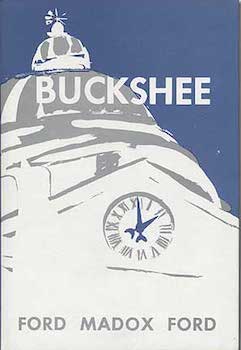
Ford ended, in Buckshee, with very free and colloquial verse:
We shall have to give up watering the land Almost altogether. The maize must go. But the chilis and tomatoes may still have A little water.
Pound, in some respects, circled round upon himself, his concerns, images – and diction, the earliest sometimes bleeding into the latest. Canto CX begins: ‘Thy quiet house’ and, a few lines on:
Hast’ou seen boat’s wake on sea-wall, how crests it?
And some just kept going regardless, such as the prolific, popular and long-lived Walter de la Mare. His biographer noted that the critic Forrest Reid advised de la Mare to aim for simplicity of expression, however subtle the thought. ‘He thought this, with some justice, de la Mare’s greatest temptation, and condemned his inversions as a growing mannerism [ . . . ] De la Mare defended himself rather vaguely on the grounds that inversion either came off or it didn’t, and could not be defended or attacked on principle. He doubted anyway “whether ordinary talk is necessarily the best or most forcible or most attractive form of expression”’.[7]
(Walter de la Mare)
And yes, opening the book almost at random, de la Mare’s 1950 volume begins with ‘Here I sit, and glad am I’. There’s ‘The Changeling’: ‘Come in the dark did I’ and ‘Here’: ‘Forgave I everything’. Although I also catch sight of ‘Unwitting’:
This evening to my manuscript Flitted a tiny fly; At the wet ink sedately sipped, Then seemed to put the matter by, Mindless of him who wrote it, and His scrutinizing eye – That any consciousness indeed Its actions could descry! . . .
Silence; and wavering candlelight; Night; and a starless sky.[8]
Half a century apart, poets working late, their pages encroached upon by insect visitors.
Hardy’s last line doesn’t jar that much to me, probably because the inversion—as is not unusual—produces that flickering moment of uncertainty to offset it, as if, as well as the narrator not knowing those Earth-secrets, they don’t know him either.
First rule of poetic inversion: there’s no absolute rule.
Notes
[1] Thomas Hardy, The Complete Poems, edited by James Gibson (London: Macmillan, 1976), 113.
[2] F. B. Pinion, A Commentary on the Poems of Thomas Hardy (London: Macmillan, 1976), 51; Claire Tomalin, Thomas Hardy: The Time-Torn Man (London: Viking, 2006), 281.
[3] Ezra Pound, Selected Letters, 1907-1941, edited by D. D. Paige (New York: New Directions, 1971), 48-49.
[4] ‘A Literary Causerie: On Some Tendencies of Modern Verse’, Academy, 69 (23 September 1905), 982-984, reprinted in Critical Essays, edited by Max Saunders and Richard Stang (Manchester: Carcanet Press, 2002), 28-32.
[5] Ford Madox Ford, ‘Notes for a Lecture on Vers Libre’ (1920s), in Critical Writings, edited by Frank MacShane (Lincoln: University of Nebraska Press, 1964). The words quoted are from Shelley’s ‘The Sensitive Plant’.
[6] Charles Sorley, ‘[When you see millions of the mouthless dead]’, in Poetry of the First World War: An Anthology, edited by Tim Kendall (Oxford: Oxford University Press, 2013), 191.
[7] Theresa Whistler, The Life of Walter de la Mare: Imagination of the Heart (London: Duckworth, 2003), 323-324.
[8] Walter de la Mare, Collected Poems (London: Faber and Faber, 1979), 349-355.
‘Heaven take my soul, and England keep my bones!’ are Arthur’s last words in Shakespeare’s King John (IV.iii.10), as he leaps from a castle wall. T. H. White, author of The Goshawk and The Once and Future King (another Arthur), among many other books, had a slightly different version, the last four words of which gave him the title of his 1936 volume: ‘God keep my soul/ And England have my bones.’ It ended up, he said, as ‘a book about the tangible side of country life’, adding that: ‘Fishermen will be maddened by the flying, aviators by the snakes, zoologists by the instructions for playing darts.’ Trying to imagine ’the kind of person who will bear with every digression’, he concluded that, should such a person exist, ‘he will be an amateur like myself: a reader with a forgiving mind, not a critical one: somebody not fascinated by sherry parties, who can see the point of an England defined by negatives.’[1]
White’s letter to David Garnett (his second) asking Garnett to look at England Keep My Bones marked the beginning of their nearly thirty-year friendship, ‘a friendship which, reversing the usual order, ripened into acquaintance’, Sylvia Townsend Warner explained, ‘for they met seldom, and never for long at a time. In fact, they were better apart. When they met, they got on each other’s nerves.’
(Sylvia Townsend Warner via NYRB; and her biography of White)
But then, with strangers, as another friend remembered, White ‘could be quite odious; rude and suspicious if he thought they were lionizing them, still more if he thought they weren’t; shouting down anyone who disagreed with his more preposterous assertions or even ventured to interrupt.’[2]
White’s book is often lyrical, but also marked by frequently pugnacious or arresting statement—‘Nowadays we don’t know where we live, or who we are’ (3), ‘I felt happy and interested, as if I had been condemned to death’ (20-21), and ‘Even sitting in the same chair rots one’s soul. Decent men ought to break all their furniture every six months’ (65). There are curious anecdotes and details, such as the origins of Lewis Carroll’s Mad Hatter (42) and, writing of ‘the shire’ in which he lives, located about half-way between ‘the doze of Norfolk and the fierce friendliness of Gloucestershire’ (4), he notes that it boasted the first recorded beheading and the last person to be gibbeted (110). But there are also evocative statements such as ‘Falling in love is a desolating experience, but not when it is with a countryside’ (22), which seem expressly designed to be plundered by people like me – and have been. The book’s devotion to ‘outdoor pursuits’ prompted the reviewer James Agate to remark—quite understandably, I think—‘It is about subjects in which I am not even faintly interested. It is entrancing’ (quoted by Warner, 87).
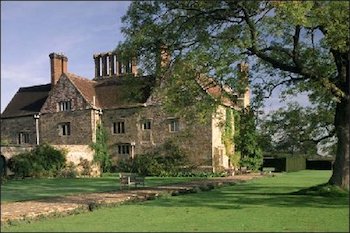
It was on this day 85 years ago, 18 August 1935, that White scored 180 with three darts—‘for the first and last time in three or four thousand games of darts’—in The Rose and Crown at Burwash, ‘of which the proper pronunciation is Burridge’ as Henry James remarked to Ford Madox Ford (who already knew).[3] ‘It was not a landlord’s board’, White added, by which I take him to mean that if the target areas for the highest scoring darts are slightly enlarged there is a correspondingly larger chance of successful, happy, and thus higher-spending, punters. ‘Burwash’ may, though, be pronounced ‘Burrish’: it certainly was by a helpful National Trust volunteer, to whom I put the specific question on my one visit to Bateman’s, the fine Jacobean house in which Rudyard Kipling—a story of whom was the occasion of James’s pronouncing the name to Ford—made his home between 1902 and his death in 1936. I bought a bag of flour from the 17th century—and still working—mill which could at that time be seen in action most Wednesday and Saturday afternoons.
(Batemans: National Trust)
The setting is remarkable: the house itself, the garden, the 1928 Rolls Royce Phantom 1 – and the mill. Kipling installed a turbine generator in 1902 and, in the autumn of that same year, published a short story, ‘Below the Mill Dam’. The story, collected in Traffics and Discoveries (1904), largely comprises a conversation between the cat and the rat and is widely seen as a political fable expressing Kipling’s dislike of the attitudes and policies exemplified by Arthur Balfour. David Gilmour, author of The Long Recessional: The Imperial Life of Rudyard Kipling, thinks the cat is Balfour (or at least talks like him): ‘there is no problem identifying the prototype of the Grey Cat’.[4]
That memorable visit to East Sussex was heavily Ford Madox Ford-related: he lived for years in the area, and his books—ten, fifteen, twenty years later—are saturated with its place-names and roads and buildings and outlooks. But, with an hour or two to spare in the afternoon, with Bateman’s on the route back to the station, Kipling-world became irresistible. Perhaps I’ll get back there – sometime – for a longer, slower look.
Notes
[1]England Have My Bones (1934; London: Macdonald Futura, 1981), v-vi.
[2] Sylvia Townsend Warner, T. H. White: A Biography (New York: Viking, 1968), 86; John Verney in the ‘Foreword’, 6.
[3] Ford, Return to Yesterday (London: Gollancz, 1931), 7.
[4] David Gilmour, The Long Recessional: The Imperial Life of Rudyard Kipling (London: John Murray, 2002), 181.
‘June’, Paul Simon wrote—and Art Garfunkel sang—‘will change her tune/ In restless dreams she’ll prowl the night’. In June 1919, Ford Madox Hueffer moved a little beyond melody and changed his surname.
‘Yesterday I changed my name by deed poll from Hueffer to Ford’, he wrote to his agent on 5 June, ‘partly to oblige a relative & partly because a Teutonic name is in these days disagreeable & though my native stubbornness would not let me do it while the war was on, I do not see why I shd. go on being subjected to the attacks of blackmailers indefinitely.’
To his friend the Liberal politician C. F. G. Masterman, he wrote on 28 June that the novelist Violet Hunt, with whom he had lived for several years, had refused to sever relations with people who had been denouncing him to the police as a German agent and ‘stating, on her authority, various other untruths to my disadvantage.’ Consequently, he ‘took a labourer’s cottage in the country where I am still.’ And, ‘Today I have changed my name by deed-poll to “Ford.”’
To the novelist and later art critic Herbert Read, he wrote that he’d changed his name by deed-poll on 28 June ‘to please a relative from whom I have expectations; & in order to escape from the attentions of the Society of the neighbourhood’.[1]
The apparent disparity in the dates is explained by the petition being lodged on 4 June and the legal process being actually completed on 28 June.[2]
Names were, of course, always remarkably unstable in Ford’s life. In Violet Hunt’s memoirs, he is ‘Joseph Leopold’ (his Catholic baptismal names), to Ezra Pound he is ‘Forty Mad-Dogs Hueffer’ or ‘Freiherr von Grumpus ZU und VON Bieberstein’. Then too he chooses to adopt quite a few pseudonyms in the course of his career, from the early ‘Fenil Haig’ through ‘Baron von Aschendrof’ and ‘Daniel Chaucer’ to ‘Faugh an-Ballagh Faugh’, the name with which he signed a letter—not long before he died—complaining about a lukewarm review of Joyce’s Finnegans Wake which, Ford wrote, ‘stands up across the flat lands of our literatures as does the first Pyramid across the sands of Egypt’.
(Stella Bowen, mid-20s: Carl A. Kroch Library, Cornell University; Stella Bowen, Vegetable Still Life)
‘The year 1919 was certainly an annus mirabilis’ Richard Aldington remembered, ‘if you take the “mirabilis” ironically.’[3] For Ford, one of the year’s main points would be the official end of his war service: ‘Darling’, he wrote to Stella Bowen on 7 January 1919, ‘I was gazetted out of the Army this morning—so I might walk out this minute’—in fact he didn’t, for another week.[4] Another major factor was his seriously beginning to write again. And there was Stella herself, the young Australian painter whom he had met in the autumn of 1917—their daughter Julie was born in November 1920—and with whom he would live for most of the next ten years. ‘In June’, Ford wrote to his mother in early July, ‘I set up house with another lady.’[5]
House but also garden; flowers and many vegetables; pigs (Anna and Anita); an old mare; chickens; a goat called Penny, ‘because it had a certain facial resemblance to Mr. Pound’, ‘a drake that someone called Fordie’, a dog named Beau. ‘These beasts had a great dislike of being left alone, so that when I went out I was followed by dog, drake and goat—sometimes for great distances. A little later I acquired a black pig. This animal was also companionable, but I thought my procession would look too noticeable if she were added to it.’[6]
Ford was also a cook and hugely interested in food. Coming up next year is a special edition of Last Post: A Literary Journal from the Ford Madox Ford Society, devoted to that: Ford and Food (a broader and deeper subject than you might think), for which we’re already inviting proposals.
[1] Ford Madox Ford, Letters of Ford Madox Ford, edited by Richard M. Ludwig (Princeton: Princeton University Press, 1965), 93, 95, 98.
[2] Max Saunders, Ford Madox Ford: A Dual Life, two volumes (Oxford: Oxford University Press, 1996), I, 1.
[3] Richard Aldington, Life for Life’s Sake (London: Cassell, 1968), 225.
[4]Correspondence of Ford Madox Ford and Stella Bowen, edited by Sondra J. Stang and Karen Cochran (Bloomington & Indianapolis: Indiana University Press, 1993), 53-54.
In a letter to his publisher Ben Huebsch (11 May 1959) about his new novel, Riders in the Chariot (1961), Patrick White wrote: ‘What I want to emphasise through my four “Riders” – an orthodox refugee intellectual Jew, a mad Erdgeist [Earth spirit] of an Australian spinster, an evangelical laundress, and a half-caste aboriginal painter – is that all faiths, whether religious, humanistic, instinctive, or the creative artist’s act of praise, are in fact one.’[1]
‘Faith’ is a word that’s caught my attention recently: there have often been children’s chalked drawings on the paths of the park, which I find oddly heartening; but also small blue flags inscribed with pithy sayings, planted at various points beside the wide left-hand path and near the bases of trees, which I find a little less so.
‘Keep faith’, one of them advised. Yes, but in what, with what? For the religiously inclined, it’s probably clear enough, but for the rest of us? Faith—trust—in government or the existing financial and social systems or the quality of electoral choices has not been possible for quite some time. And I get the impression that the word itself is used less often now – less often than its opposite, surely.
(Ernest Dowson)
The poet Ernest Dowson was faithful to his Cynara ‘in my fashion’, unable to shake free of an obsessive love, though it was the prostitute he lay with ‘last night’ who prompted the comparison:
All night upon mine heart I felt her warm heart beat,
Night-long within mine arms in love and sleep she lay;
Surely the kisses of her bought red mouth were sweet;
But I was desolate and sick of an old passion,
When I awoke and found the dawn was grey:
I have been faithful to thee, Cynara! in my fashion.[2]
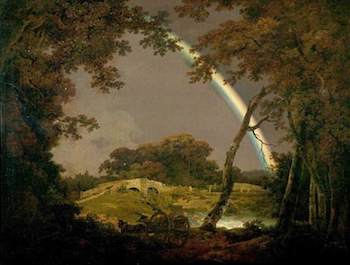
D. H. Lawrence’s The Rainbow was suppressed, prosecuted and banned in 1915. Seven years later, he was writing Kangaroo. There’s a moment in the later novel when Harriett Somers asks her husband Richard: “Who is there that you feel you are with, besides me—or who feel themselves with you?”
‘And at the same moment he looked up and saw the rainbow fume beyond the sea. But it was on a dark background like a coloured darkness. The rainbow was always a symbol to him—a good symbol: of this peace. A pledge of unbroken faith, between the universe and the innermost. And the very moment he said “No one,” he saw the rainbow for an answer.’[3]
(Joseph Wright of Derby, Landscape with a Rainbow: Derby Museum and Art Gallery)
Innermost. An adjective seemingly called into urgent Lawrentian service as a noun. Katherine Mansfield was thinking of action around then, writing to Middleton Murry from Menton in 1920 that she sometimes wondered whether ‘the act of surrender is not one of the greatest of all’, one of the most difficult. ‘Can it be accomplished or even apprehended except by the aristocrats of this world? You see its so immensely complicated. It “needs” real humility and at the same time an absolute belief in ones own essential freedom. It is an act of faith. At the last moments like all great acts it is pure risk. This is true for me as a human being and as a writer. Dear Heaven how hard it is to let go—to step into the blue.’[4]
Thomas Merton—poet, monk, writer on comparative religions—remarked in his journal (New York, May 30, 1940): ‘Instead of having faith, which is a virtue, and therefore nourishes the soul and gives it a healthy life, people merely have a lot of opinions, which excite the soul but don’t give it anything to feed it, just wear it out until it falls over from exhaustion.’[5]
By way of contrast, John Cowper Powys observed of his brother Llewellyn Powys: ‘To be as certain as he was that there is no God and no immortality and no Moral Law, is, I think, a rarer human phenomenon than most of us realize. I take it that the normal human mood—it is certainly my own mood—is to alternate between faith shaken by rational doubts, and doubt shaken by irrational faith; in other words, to be an illusioned or disillusioned agnostic.’[6]
(Henri Rousseau, Surprised! – National Gallery)
Guy Davenport argued that ‘[Henri] Rousseau and Flaubert simply record, and hold to a faith, wholly new in art, that the scene has its meaning inherent in it.’[7] Ford Madox Ford had also cited Flaubert when he touched on faith in an essay some seventy years earlier: ‘whatever the French school had or hadn’t, they had faith – the faith that, if they turned out good art, sociology and the rest would follow. That is what Flaubert meant when he said that if his countrymen had read L’Education Sentimentale France would have been spared the horrors of the débâcle.’[8]
Faith was an abiding, or at least recurrent, concern to Ford, not least because he was a Roman Catholic himself—converted in 1892, just before his nineteenth birthday—but also because several of his novels concerned the Tudor (the Fifth Queen trilogy) and Jacobean (The “Half-Moon”) periods, so such phrases as ‘the old faith’ and ‘the new faith’ crop up many times.
One early Ford poem was entitled ‘The Old Faith to the Converts’:
When the world is growing older,
And the road leads down and down and down,
And the wind is in the bare tree-tops
And the meadows sodden with much rain,
Seek me here in the old places,
And here, where I dwell, you shall find me,’
Says the old Faith we are leaving.[9]
In a more secular context, Ford would later assert: ‘I owe a great deal to Conrad. But most of all I owe to him that strong faith—that in our day and hour the writing of novels is the only pursuit worth while for a proper man.’[10]
Long after the end of the First World War and close to the beginning of a second, Ford wrote: ‘Faith, in short, died after the war—every sort of faith.’[11] And he repeated this to Henry Goddard Leach, editor of Forum and Century, in early 1938: ‘The War, that is to say, got rid of Faith, Loyalty, Courage and all the other big words as motives for human action….’[12]
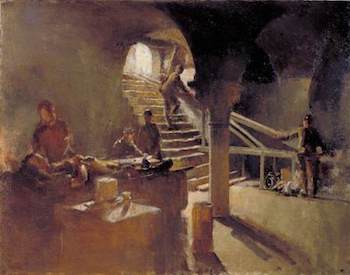
(Henry Tonks, An Underground Casualty Clearing Station, Arras: photo credit Imperial War Museum)
But perhaps Ford’s most memorable use of the word is in a fictional context, its import quite explicitly unclear to Christopher Tietjens, who is describing to his wife Sylvia his experiences in a Casualty Clearing Station after suffering the effects of a shell blast: ‘“but the fellow who was strangling me was what I wanted to tell you about. He let out a number of ear-piercing shrieks and lots of orderlies came and pulled him off me and sat all over him. Then he began to shout ‘Faith!’ He shouted: ‘Faith! … Faith! … Faith!…’ at intervals of two seconds, as far as I could tell by my pulse, until four in the morning, when he died…. I don’t know whether it was a religious exhortation or a woman’s name, but I disliked him a good deal because he started my tortures, such as they were. . . . There had been a girl I knew called Faith. Oh, not a love affair: the daughter of my father’s head gardener, a Scotsman. The point is that every time he said Faith I asked myself ‘Faith … Faith what?’ I couldn’t remember the name of my father’s head gardener.”’[13]
‘Faith what?’ It’s a good question. I imagine we each have our own answer.
Notes
[1] Patrick White, Letters, edited by David Marr (London: Jonathan Cape, 1994), 153.
[2] Dowson, ‘Non Sum Qualis Eram Bonae Sub Regno Cynarae’, in Ian Fletcher, editor, British Poetry and Prose, 1870-1905 (Oxford: Oxford University Press, 1987), 377. The title, from Horace’s Odes, IV, translates as ‘I am not what once I was under kind/ Cynara’s reign.’
[3] D. H. Lawrence, Kangaroo, edited by Bruce Steele, with an introduction and notes by Mac Daly (Cambridge edition, 1994; London: Penguin, 1997), 155.
[4] Katherine Mansfield, Selected Letters, edited by Vincent O’Sullivan (Oxford: Oxford University Press, 1990), 186.
[5] Thomas Merton, A Secular Journal (London: Hollis & Carter, 1959), 58.
[6] John Cowper Powys, introduction to Llewellyn Powys, A Baker’s Dozen (1941; London: Village Press, 1974), 15.
[7] Davenport, ‘What Are These Monkeys Doing?’ in Every Force Evolves a Form (San Francisco: North Point Press, 1987), 20.
[8] Ford Madox Ford, ‘Literary Portraits – VII. Mr. Percival Gibbon and “The Second-Class Passenger’: Outlook, XXXII (25 October 1913), 571. The ‘débâcle’ is the Franco-Prussian war and the upheaval that immediately followed it.
[9] In Poems for Pictures and for Notes of Music (1900): Collected Poems (London: Max Goschen, 1913 [dated 1914]), 142.
[10] Ford Madox Ford, Return to Yesterday: Reminiscences 1894-1914 (London: Victor Gollancz, 1931), 185.
[11] Ford Madox Ford, Provence (London: Allen & Unwin, 1938), 315.
[12] Ford Madox Ford, Letters of Ford Madox Ford, edited by Richard M. Ludwig (Princeton: Princeton University Press, 1965), 287.
[13] Ford Madox Ford, Some Do Not. . . (1924; edited by Max Saunders, Manchester: Carcanet Press, 2010), 210.
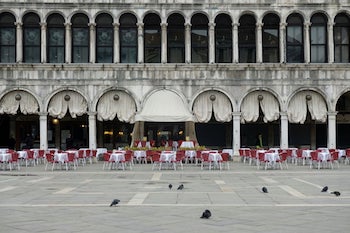
(St Mark’s Square, Venice. Photograph: Manuel Silvestri/Reuters: via The Guardian)
An end to March, then. Looking back, it was as recently as 28 February that Greta Thunberg visited Bristol and I decided against trying to attend the rally because of the vast crowds thronging the streets. Now photographs from around the world show us places empty of people: from Piccadilly Circus to St Mark’s Square in Venice, from Gaobeidian, Beijing to Market Square, Frankfurt. That the distance from there to here is just a little over four weeks is dizzying and almost impossible to grasp securely. I’m reminded that a decade after the Boer War—‘that never to be sufficiently accursed war’—Ford Madox Ford wrote that it ‘set, as it were, an iron door between the past and the present.’ Perhaps more appositely, he remarked that it ‘appears to me like a chasm separating the new world from the old.’[1]
Across that chasm, we see the ghosts of former lives, the normal that no longer exists and may not do so again. Among strange doublenesses, it’s both reassuring and immensely sad that approaching figures in a quiet park veer off on a different trajectory, twenty or thirty metres ahead of us, if we haven’t already begun to do the same. At the dinner table, we wonder aloud how long it will be before we browse in shops again without anxiety, or move comfortably among crowds, or visit dentists and hairdressers. The answers vary from ‘maybe six months’ to ‘probably never’.
In ancient Rome, the festival of Venus Verticordia or Venus Genetrix ran for three days from the first day of April. The preceding night, 31 March, occasioned the 93-line poem the Pervigilium Veneris – The Eve of Venus or The Vigil of Venus, its authorship and date of composition uncertain.[2]
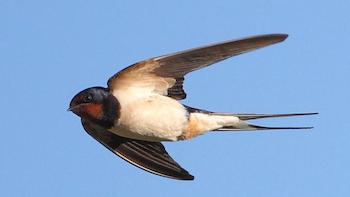
(Swallow: via BBC)
One of the most familiar bits of the poem is lodged in the closing lines of the most famous modern poem, among the fragments that one of The Waste Land’s voices has shored against his or her ruin:
‘Quando fiam uti chelidon [When shall I be as the swallow]—O swallow swallow’
The story of Philomela, raped by Tereus, king of Thrace, who cut out her tongue so she might not make the dreadful story known to her sister Procne, the wife of Tereus—which she does at last through another voice, the tale told in a tapestry—runs from Homer and Aeschylus through Ovid and on through great swathes of English literature, as detailed in the expansive notes in the Ricks and McCue edition of Eliot’s poems.[3]
In the myth, the sisters kill Itylus, son of Tereus and Procne, cook him and feed him to Tereus. When he is told what they’ve done, he sets off in murderous pursuit of them: but the gods save them, turn Philomela into a nightingale and Procne into a swallow.
Swinburne’s ‘Itylus’ takes the form of a monologue by Philomela:
Swallow, my sister, O sister swallow,
How can thine heart be full of the spring?
A thousand summers are over and dead.
What hast thou found in the spring to follow?
What has thou found in thine heart to sing?
What wilt thou do when the summer I shed?[4]
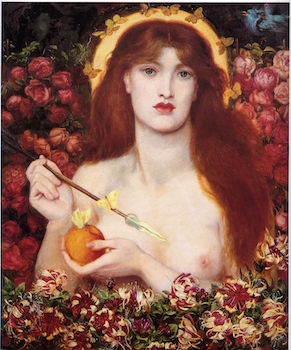
In 1868, Dante Gabriel Rossetti published a sonnet, ‘Venus Verticordia (for a picture)’ – the picture was commissioned in 1863 and finally sent to John Mitchell of Bradford in the autumn of 1869.
(Rossetti, Venus Verticordia: Russell-Cotes Art Gallery, Bournemouth)
She hath the apple in her hand for thee,
Yet almost in her heart would hold it back;
She muses, with her eyes upon the track
Of that which in thy spirit they can see.
Haply, ‘Behold, he is at peace,’ saith she;
‘Alas! the apple for his lips,—the dart
That follows its brief sweetness to his heart,—
The wandering of his feet perpetually!’
A little space her glance is still and coy;
But if she give the fruit that works her spell,
Those eyes shall flame as for her Phrygian boy.
Then shall her bird’s strained throat the woe foretell,
And her far seas moan as a single shell,
And through her dark grove strike the light of Troy.[5]
In 1936, Ford wrote to Allen Tate: ‘Is there, by the bye, any decent translation of the XELIDON [swallow] song? If there isn’t, I think I’d have a shot at it. Isn’t it the most beautiful thing that was ever made…or is that one of my sexagenarian delusions?’[6]
Tate did translate the Pervigilium Veneris as ‘The Vigil of Venus’ (1943). In his preface, he wrote that he had come upon the poem in about 1917 ‘in the usual way’ (in Walter Pater’s Marius the Epicurean), looked up the Latin text and was disappointed, because his ‘adolescent revolt’ against the influence of Swinburne made it impossible ‘to read properly any poem about pagan love.’ He didn’t look at the poem again until about 1930, when he ‘tried to work out a translation of the famous refrain’, an attempt that failed. He returned to it in the fall of 1942, and this time translated the entire poem.
Tate’s preface ends with his acknowledgements: to Robert Lowell, ‘for constant criticism’ and, for the translation of the first line of stanza XXI, to his wife Caroline Gordon, the novelist and short story writer:
Now the tall swans with hoarse cries thrash the lake:
The girl of Tereus pours from the poplar ring
Musical change—sad sister who bewails
Her act of darkness with the barbarous king!
And that famous refrain? The Latin is: Cras amet qui nunquam amavit, quique amavit cras ame. There are, Ford noted, many translations. Tate has ‘Tomorrow may loveless, may lover tomorrow make love.’[7]
Ford’s own ‘free rendering’ was: ‘He that has never loved, let him love tomorrow; the lusty lover, let him love again.[8]
Now April beckons. The cruellest month, some say. We can only hope not.
Notes
[1] Ford Madox Ford, Ancient Lights and Certain New Reflections: Being the Memories of a Young Man (London: Chapman & Hall, 1911), 175, 154.
[2] Bonnie Blackburn and Leofranc Holford-Strevens, The Oxford Companion to the Year (Oxford: Oxford University Press, 1999), 139.
[3]The Poems of T. S. Eliot. Volume I: Collected and Uncollected Poems, edited by Christopher Ricks and Jim McCue (London: Faber & Faber, 2015), 705-706.
[4] Algernon Charles Swinburne, Poems and Ballads & Atalanta in Calydon, edited by Kenneth Haynes (London: Penguin Books, 2000), 45.
[5]The Poetical Works of Dante Gabriel Rossetti, edited with a preface by William Rossetti (London: Ellis and Elvey, 1893), 360.
[6]Letters of Ford Madox Ford, edited by Richard M. Ludwig (Princeton: Princeton University Press, 1965), 259.
[7] Allen Tate, Collected Poems, 1919-1976 ((New York: Farrar, Straus and Giroux, 1977), 145, 149, 161.
[8] Ford Madox Ford, The March of Literature: From Confucius to Modern Times (London: Allen & Unwin, 1939), 277.







 Reconstructionary Tales