Birth days (and other kinds)

‘Birth, and copulation, and death.
That’s all the facts when you come to brass tacks:
Birth, and copulation, and death.’
            (Fragment of an Agon)[1]

Is T. S. Eliot’s Sweeney a little too concise here? You may be thinking, in some moods yes, in some moods no. You may even be thinking it a little too expansive. But most people, I suspect, might want to add a bit.

Take today, for instance, 17 December. The celebrated translator of Russian literature, Constance Garnett, died at 03:00 on this day in 1946. Over 70 English versions, of Turgenev, Dostoevsky, Chekhov, Goncharov, Tolstoy. Dorothy Sayers, author of superb detective stories and translator of Dante, died in 1957, also on this day.

The middle term: throw in a wedding (and assume a positive). On 17 December 1914, the painter Paul Nash and Margaret Odeh—‘Bunty’—were married in St Martin-in-the-Fields by ‘the young pacifist vicar the Reverend Dick Sheppard.’[2] Cue the opening stanza of W. H. Auden’s Letter to Lord Byron:

Excuse, my lord, the liberty I take
   In thus addressing you. I know that you
Will pay the price of authorship and make
   The allowances an author has to do.
   A poet’s fan-mail will be nothing new.
And then a lord—Good Lord, you must be peppered,
Like Gary Cooper, Coughlin, or Dick Sheppard.[3]

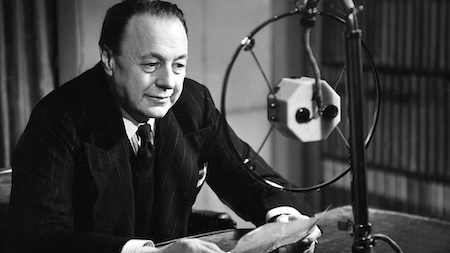
Gary Cooper, at least, will still be a familiar name; the other two, these days, rather less so, though not to historians of the 1920s and 1930s: Sheppard, the priest whose sermons, broadcast by the BBC, made him a national figure, and who later founded the Peace Pledge Union; Charles Coughlin, the Catholic priest who was also a widely-known broadcaster, though his anti-Semitic and pro-Fascist sympathies made his output rather different.

(Dick Sheppard broadcasting from St Martin-in-the-Fields: BBC)

On 17 December 1941, Sylvia Townsend Warner wrote to her friend Paul Nordoff: ‘Luckily, I have a tough memory for what I like, and I have most of it tucked away somewhere behind my ears.’[4] Just ten days after the attack on Pearl Harbor, then, a reminder if one were needed that on another 17 December—1903—Wilbur Wright’s fourth and last flight carried him  852 feet in 59 seconds.

The implications of that pioneering effort emerged with gradually increasing force and clarity a decade or so later. In 1915, Ezra Pound wrote to his parents (17 December): ‘Lewis has enlisted. That about takes the lot.’ He added: ‘I suppose we will go to France after the war. if it ever ends.’[5] Bombardier Wyndham Lewis would later recall that: ‘The war was a sleep, deep and animal, in which I was visited by images of an order very new to me. Upon waking I found an altered world: and I had changed, too, very much.’[6]

A few years on (17 December 1958) and the great Australian novelist Patrick White was writing to his friend and publisher Ben Huebsch—the rock on which White’s career was built, David Marr remarks—about his novel, Riders in the Chariot. ‘I shall want somebody here to check the Jewish parts after a second writing. I feel I may have given myself away a good deal, although passages I have been able to check for myself, seem to have come through either by instinct or good luck, so perhaps I shall survive. After all, I did survive the deserts of Voss.’ And in another letter to Huebsch, five months later, he returned to this: ‘What I want to emphasise through my four “Riders” – an orthodox refugee intellectual Jew, a mad Erdgeist [Earth spirit] of an Australian spinster, an evangelical laundress, and a half-caste aboriginal painter – is that all faiths, whether religious, humanistic, instinctive, or the creative artist’s act of praise, are in fact one.’[7] (I reread all Patrick White’s books seven years ago and I’m damned if I don’t feel almost ready to do it again. . .)

(Ford via New York Review of Books)

But then – why not celebrate? 17 December birthdays, yes: Humphry Davy, John Greenleaf Whittier, Erskine Caldwell, Paul Cadmus, Penelope Fitzgerald, Jacqueline Wilson, John Kennedy Toole – and the primary focus, or beginning spark, of all this anniversary rambling, Ford Madox Ford, 152 today.

His birthdays weren’t always joyous: at a party in 1901, he nearly choked on a chicken bone ‘and was prostrate for some days’.[8] In 1916, he was in a Red Cross Hospital in Rouen, writing to Joseph Conrad a couple of days later: ‘As for me—c’est fini de moi, I believe, at least as far as fighting is concerned—my lungs are all charred up & gone—they appeared to be quite healed, but exposure day after day has ended in the usual stretchers and ambulance trains’. In 1920, he spent at least a small portion of his birthday writing to Thomas Hardy, asking him to sign a manifesto protesting against British government policy in Ireland. It was published on 1 January 1921 in the Manchester Guardian and other papers. Fifty writers, artists and academics signed it but Thomas Hardy was not among them.

Past lives, past struggles, victories, defeats. Surely there is comfort to be found there, that they were faced with things we recognise only too well—not only the individual battles but the more general ones, against Fascism, vicious racism, authoritarianism, the hijacking of news, of the sources of information, the assaults on free speech, on civil liberties, on democratic rights—and came through. And we?

Optimism, pessimism. One up, one down; Monday, Tuesday; left hand; right hand. I liked Guy Davenport on the judicious estimate of his own make-up, reporting to Hugh Kenner that his friend Steve Diamant’s photographs included one that served as the author photograph on the dust jacket of Tatlin!, Davenport’s first collection of stories, or assemblages: ‘Guy beaming in the Dionysian priest’s chair, the Theatre, Athens. I had no notion such a radiant smile was in me. It cured a third of my paranoia and an eighth of my Calvinist pessimism to see it.’[9]

A whole eighth. Some photograph, some smile.


Notes

[1] T. S. Eliot, The Complete Poems and Plays (London: Faber and Faber, 1969), 122.

[2] Ronald Blythe, First Friends: Paul and Bunty, John and Christine – and Carrington (London: Viking, 1999), 77; David Boyd Haycock, A Crisis of Brilliance (London: Old Street Publishing, 2009), 238-9.

[3] W. H. Auden, The English Auden: Poems, Essays and Dramatic Writings, 1927-1939, edited by Edward Mendelson (London: Faber, 1977), 169.

[4] Sylvia Townsend Warner, Letters, edited by William Maxwell (London: Chatto & Windus, 1982), 76.

[5] Ezra Pound, Ezra Pound to His Parents: Letters 1895–1929, edited by Mary de Rachewiltz, David Moody and Joanna Moody (Oxford: Oxford University Press, 2010), 358.

[6] Wyndham Lewis, Rude Assignment: A narrative of my career up-to-date (London: Hutchinson, 1950), 129.

[7] Patrick White, Letters, edited by David Marr (London: Jonathan Cape, 1994), 151, 153. Marr’s remark about Huebsch’s importance is in ‘The Cast of Correspondents’, 638.

[8] Arthur Mizener, The Saddest Story: A Biography of Ford Madox Ford (London: The Bodley Head, 1972), 73.

[9] Questioning Minds: The Letters of Guy Davenport and Hugh Kenner, edited by Edward M. Burns, two volumes (Berkeley: Counterpoint Press, 2018), I, 630.

Burden of proofs


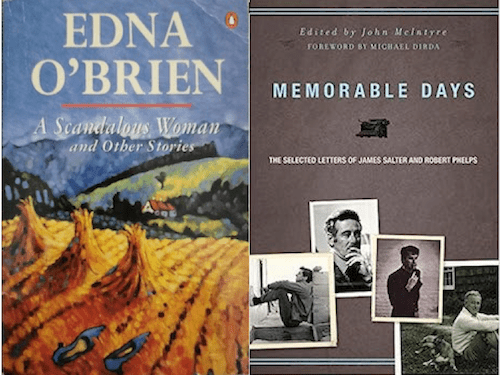
In the past couple of weeks, I’ve read a lot of tributes to, and memories of, Edna O’Brien, who died on 27 July. I know some of her books but clearly not enough of them. My favourite story about her is probably that in one of James Salter’s letters to Robert Phelps (a wonderful volume), dated 2 November 1972. Salter mentions at the top of the letter that Ezra Pound has died (it had happened the previous day) and reports on ‘Dinner last night with Edna O’Brien and her son.’ She was nervous about the play opening that night, A Pagan Place, from her novel of the same title. ‘She ate everything with her fingers’, Salter wrote, ‘lamb, clumps of spinach, they didn’t even have to wash her fork.’ O’Brien told him about a long story, ‘Over’, which the New Yorker was publishing. ‘She was marvelous, she could recite great passages, long pieces of her story, there was one sentence saying something like: I liked your voice and the way you poured things and your fingering.’ Her editor, ‘in the vastly inquisitorial galleys, wrote: “Mr Shawn [editor of the magazine, 1952-87] thinks this is a little too strong for us.” So Edna changed it to “and your fucking.”’[1]

Alas, ‘fingering’ seem to have made a comeback, certainly when the story was collected in A Scandalous Woman and other stories (1974): ‘Do you still use the same words exactly, and exactly the same caresses, the same touch, the same hesitation, the same fingering? Are you as shy with her as with me? If only you had had courage and a braver heart.’[2]

As for the change, was it made around that time, by reluctant but common consent, or later – perhaps at the proof stage? Proofs!

Looking for the umpteenth time at the draft of a Ford Madox Ford letter (its notes, rather), I wondered about an ‘enormous slap of cake’ and was dispirited by my glimpse of a poet named ‘William Worsworth’. In the first instance, I looked back to the original article and found—almost regretfully because I was warming to a ‘slap of cake’—that it was indeed ‘slab’. I didn’t need to check on the poet but simply inserted the missing letter. Any offended descendants of the poet Worsworth should write in.

Reporting on his struggle with the page proofs of The Pound Era (probably—but only probably—a longer book than this volume of letters will turn out to be), Hugh Kenner wrote to Guy Davenport: ‘It is demoralizing to find “viligance” for “vigilance” in a line one has already read 4 times.’[3] And any writer, editor or proofreader will be familiar with that feeling.


(Hugh Kenner via The National Post; photo by the scholar Walter Baumann)

Of an earlier book (on Samuel Beckett), Kenner had confided: ‘In accordance with my normal policy of imitating the specimen’s style, I rigorously trained myself to write dead-pan declarative sentences page after page, with here and there flickers of irony gleaming through the performance. I hope you like the effect.’ And proofs were not always an ordeal: fun was there for the taking, as he added to Davenport a week later: ‘I forget whether I told you that I have spliced bits of Happy Days into my Beckett proofs, so adroitly (I think) that no one will be able to tell they were not there all along.’[4]

In turn, Davenport mentioned, in his ‘Pergolesi’s Dog’—‘We are never so certain of our knowledge as when we’re dead wrong’—that ‘The New York Review of Books once referred to The Petrarch Papers of Dickens and a nodding proofreader for the TLS once let Margery Allingham create a detective named Albert Camus.’[5]

Sylvia Beach recalled the printer of Ulysses, Monsieur Dalantière, supplying as many sets of proofs as James Joyce wanted—‘he was insatiable’—and they were all ‘adorned with the Joycean rockets and myriads of stars guiding the printers to words and phrases all around the margins. Joyce told me that he had written a third of  Ulysses on the proofs.’ Right up to the last minute, ‘the long-suffering printers in Dijon were getting back these proofs, with new things to be inserted somehow, whole paragraphs, even, dislocating pages.’[6] My Viking Press edition of Finnegans Wake (New York: 4th printing, 1945) contains a list of corrections of misprints, made by Joyce: fifteen closely printed pages of double columns, in which such phrases as ‘insert comma’ and ‘delete stop’ abound.[7] The book was published in 1939, less than two years before Joyce’s death, after decades of eye trouble, cataracts, glaucoma and much else.


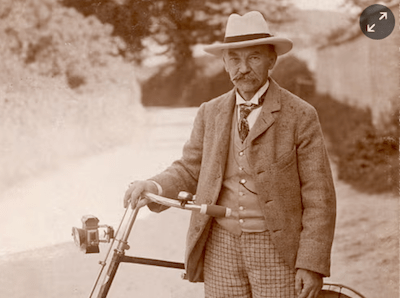
(Thomas Hardy, early 1920s via The Guardian)

For the professional writer, of course, proofs are a constant, whether burden or blessing. . ‘I am bringing out a stodgy novel this autumn’, E. M. Forster wrote to his friend Malcolm Darling (22 August 1910) ‘but I think I told you this. It’s called Howards End, and dealeth dully with many interesting matters. I am correcting proofs now.’[8] Sylvia Townsend Warner reported in her diary: ‘Proofs and ten thousand letters.’ She added the more specific news that: ‘Thomas Hardy has died. Dorset will mourn – a more rare and antique state of things than England mourning.’[9]

As yet, a very long way from reaching the proof stage, I am still inching through Word documents. As for the errors that other people have missed in the proofs of their texts, errors I come across almost daily in my reading, that would be altogether too long a tale to tell. . .


Notes

[1] Memorable Days: The Selected Letters of James Salter and Robert Phelps, edited by John McIntyre, foreword by Michael Dirda (Berkeley, California: Counterpoint, 2010), 95-96. Phelps, in his letter of 10 November, commented: ‘I’ll never forget Miss O’Brien’s way with spinach’ (97). ‘Over’ appeared in The New Yorker (24 November 1972).

[2] Penguin Books edition (Harmondsworth, 1976), 56.

[3] Letter of 21 June 1971: Questioning Minds: The Letters of Guy Davenport and Hugh Kenner, edited by Edward M. Burns, two volumes (Berkeley: Counterpoint Press, 2018), II, 1357.

[4] Letters of 27 September 1961 and 6 October 1961: Questioning Minds, I, 37, 39.

[5] Guy Davenport, Every Force Evolves a Form (San Francisco: North Point Press, 1987), 145. Allingham’s Albert Campion would probably have been amused.

[6] Sylvia Beach, Shakespeare and Company, new edition (Lincoln: University of Nebraska Press, 1991), 58.

[7] See, on Joyce ‘adding commas’, Richard Ellmann, James Joyce (new edition, Oxford: Oxford University Press, 1983), 731, 734.

[8] Selected Letters of E. M. Forster, Volume One: 1879-1920, edited by Mary Lago and P. N. Furbank (London: Collins, 1983), 114.

[9] The Diaries of Sylvia Townsend Warner, edited by Claire Harman (London: Virago Press, 1995), 11: entry for 12 January 1928. Hardy had died in Dorchester the previous day, at the age of 87.

Fetch a flitch of bacon


(John Frederick Herring II, ‘Farmyard with Saddlebacks’: Haworth Art Gallery)

The year has turned but, unfortunately, the direction of human travel has not, bringing to mind the old ballad:

It was mirk, mirk night, there was nae starlight,
They waded thro’ red blude to the knee;
For a’ the blude that’s shed on the earth
Rins through the springs of that countrie.[1]

We have long passed ‘that blessed season’, which Saki so liked, ‘between the harshness of winter and the insincerities of summer’.[2] I read hungrily, if not always strictly relevantly to the projects currently in train.

‘Every time I consider autobiography’, Guy Davenport wrote to the author and publisher W. C. Bamberger in June 2000, ‘my mind instantly runs to senseless (but satisfying) recrimination.’ He went on to detail the losses – due to carelessness or dishonesty – of valued letters, priceless association copies of books, drawings made to accompany essays or stories, which were jettisoned by editor or publisher once the material had been printed. ‘One of them was a Greek mask I’d worked on for a week, pen and ink, perhaps the finest drawing I’ve ever done.’ He added: ‘And there’s the art book with color plates that a fellow grad student at Harvard borrowed and kept his place with a slice of bacon,’ before concluding: ‘L’enfer, c’est les autres.’[3]


(Portrait of Lady Charlotte Harley as Ianthe: drawn by Richard Westall, engraved by W. Finden)

Bacon, you say. . . . Francis and Roger and Francis, and how many more? There was Lady Charlotte, wife of Colonel Anthony Bacon of the Lancers and daughter of the Earl of Oxford. Bacon was involved in the War of the Brothers, 1832-1834 (Pedro and Miguel) in Portugal, in the cause of Dom Pedro. Charlotte was the ‘Ianthe’ to whom, at the age of ten, Byron wrote his introductory stanzas at the beginning of Childe Harold.[4]

Such is thy name with this my verse entwined;
And long as kinder eyes a look shall cast
On Harold’s page, Ianthe’s here enshrined
Shall thus be first beheld, forgotten last[5]

There was Sir Nicholas Bacon, Keeper of the Great Seal to Queen Elizabeth I, who built a fine house mentioned by Ronald Blythe in his discussion of Stiffkey, a Norfolk village more famous since for the rector, Harold Davidson, who was defrocked after being charged with immorality – and died as a result of being mauled by a lion.[6] Francis – not the painter – supplies two epigraphs to Dorothy Sayers in her 1935 novel, Gaudy Night.[7] More entertainingly on the bacon front, Peter Vansittart writes that, until the Hundred Years’ War, the patron saint of England was Edward the Confessor. ‘Then Edward III, in debt to Genoese bankers, replaced him with their patron, the more aggressive St George, who was not to escape the attention of the supreme English ironist, Gibbon: he dismissed George as a dishonest bacon contractor, loathed by Christian and pagan alike.’[8]

Anyone fretfully wondering how long it will take Ford Madox Ford to rock up can now put their mind at rest. In Ancient Lights, Ford segued from a memory of Dante Gabriel Rossetti’s limericks to an anecdote about ‘another poet, a descendant of many Pre-Raphaelites, of whom it was related that whilst reading his friend’s valuable books at that friend’s breakfast table he was in the habit of marking his place with a slice of bacon.’ He added that he knew this anecdote to be untrue.[9] How might he be so sure? Slip forward twenty years and Ford is remembering his doctor, Tebb, with whom Ford stayed for a while when the good doctor was treating him in the late stages of a breakdown. He writes of Tebb inventing ‘one of the most ingenious lies’ about his guest: that Ford marked his place in Tebb’s ‘priceless first editions and incredibly sumptuous large paper copies with a slice of bacon.’[10]

Reading the recently published collection of shorter pieces by Hilary Mantel—and reminding myself of just how funny she can be—I come across an article, written for Vogue, on perfumes. Mantel remarks: ‘What women have always wanted to know is what scent drives men wild; researchers have the answer, say Turin and Sanchez [co-authors of the book Perfumes: The Guide], and it’s bacon.’[11] It’s just possible that this news may not have brought unalloyed delight to those inquiring women.

Bacon features largely in Ford’s letters around the end of the First World War, given the twin factors of meat rationing (introduced in 1918) and Ford’s own pig-breeding ambitions. ‘I got as far as the above’, he wrote to Stella Bowen in a letter that stretched over two days (28-29 April 1919), ‘when sleep overtook me—or rather sleepiness, for, when I went to bed I cd not get to sleep. I fancy an unmixed diet of bacon is telling on my liver.’[12]


William Cobbett – farmer, MP, soldier, traveller, radical journalist, printer, avid dispenser of practical advice to the common people (‘The Poor Man’s Friend’) – who took a positive view of pigs, wrote in his Cottage Economy:

A couple of flitches of bacon are worth fifty thousand Methodist sermons and religious tracts. The sight of them upon the rack tends more to keep a man from poaching and stealing than whole volumes of penal statutes, though assisted by the terrors of the hulks and the gibbet.[13]

It was also a matter of personal preference. On one of his famous rural rides, he arrived at Ashurst ‘(which is the first parish in Kent on quitting Sussex)’, where, ‘for want of bacon’, he was ‘compelled to put up with bread and cheese for myself. I waited in vain for the rain to cease or to slacken, and the want of bacon made me fear as to a bed.’[14] So he rode on through the night and the driving rain. Better drenched than baconless.

No mention of pork or bacon, unsurprisingly, in our Syrian and Palestinian cookbooks, nor, surely, in Claudia Roden’s The Book of Jewish Food? But yes, there is an entry in her index, which turns out to be connected with her visit to El Molino in Granada, a centre for research into the history of Spanish food. She was told that some Marranos, forced by the Inquisition to convert to Christianity, ‘made a point of cooking pork to protect themselves from charges by the Inquisition of continuing to practise their old religion.’[15]

The Librarian and I were recently comparing our inability to remember jokes. Some people have a repertoire of hundreds, others recall not a single one. The Librarian offers only one: it concerns the Pink Panther and she first heard it decades ago. I cudgel my brains and offer a knock knock joke dredged from some long unvisited cerebral recess:

Knock knock! (Who’s there?) Egbert! (Egbert who?) Egbert not bacon!

A brief, pitying smile. She murmurs, with visible effort, ‘That’s quite funny.’

It’s the way I tell them.


Notes

[1] ‘Thomas the Rhymer’, in The Oxford Book of Ballads, edited by Arthur Quiller-Couch (Oxford: Oxford University Press, 1910, reprinted 1932), 3.

[2] ‘The Romancers’, The Short Stories of Saki (London: The Bodley Head, 1930), 311.

[3] Guy Davenport, I Remember This Detail: 40 Letters to Bamberger Books, edited by W. C. Bamberger (Whitmore Lake, Michigan: Bamberger Books, 2022), 79-80. The French sentence is Jean Paul Sartre’s famous line from his play Huis Clos (No Exit).

[4] Rose Macaulay, They Went to Portugal (1946; London, Penguin Books, 1985), 307.

[5] Lord Byron, Selected Poems, edited by Susan J. Wolfson and Peter J. Manning (London: Penguin Books, 1996), 60.

[6] Ronald Blythe, The Age of Illusion: England in the Twenties and Thirties 1919-40 (Harmondsworth: Penguin, 1964), 156.

[7] Dorothy Sayers, Gaudy Night (1935; London: Hodder and Stoughton, 2016), Chapters 3 and 17.

[8] Peter Vansittart, In Memory of England: A Novelist’s View of History (London: John Murray, 1998), 42.

[9] Ford Madox Ford, Ancient Lights and Certain New Reflections (London: Chapman and Hall, 1911), 44, 45.

[10] Ford Madox Ford, Return to Yesterday: Reminiscences 1894-1914 (London: Victor Gollancz, 1931), 305.

[11] Hilary Mantel, ‘At First Sniff’ (2009), in A Memoir of My Former Self: A Life in Writing, edited by Nicholas Pearson (London: John Murray 2023), 332. I also learn from this that Burger King, yes, released a meat-infused scent called ‘Flame Grilled’.

[12] Correspondence of Ford Madox Ford and Stella Bowen, edited by Sondra J. Stang and Karen Cochran (Bloomington & Indianapolis: Indiana University Press, 1994), 109-110.

[13] William Cobbett, Cottage Economy (1823; Oxford University Press, 1979), 103. In past centuries, pigs ‘were kept by everyone, fed economically on scraps, waste, and wild food’: Alan Davidson, The Oxford Companion to Food, Second Edition by Tom Jaine (Oxford: Oxford University Press, 2006), 49.

[14] William Cobbett, Rural Rides, edited by George Woodcock (1830 edition; Harmondsworth: Penguin Books, 1983), 171-172.

[15] Claudia Roden, The Book of Jewish Food (London: Viking, 1997), 332.

Advice Notes


(Marianne North, Foliage and Flowers of a Madagascar Tree at Singapore, Marianne North Gallery; photo credit: Board of Trustees of the Royal Botanic Gardens, Kew)

I see that Mick Jagger—Sir Michael Philip Jagger, rather—is eighty this year. We lived abroad for a few years because of my father’s job while the Beatles and the Rolling Stones were getting going. ‘Not Fade Away’ must have been the first Stones song I heard when we came back to England; and it was another year before Jagger sang: ‘Well I told you once and I told you twice, But you never listen to my advice’—a slight friction there between ‘telling’ and ‘advice’? Unsurprising, perhaps, that it could have been the last time.

I’ve always been wary of advice, both giving and receiving. ‘I never myself took anyone’s advice’, Ford Madox Ford remarked, ‘and I do not imagine that many people will take mine.’[1] Robert Lowell appears to have taken it, though with mixed results, telling Flannery O’Connor in 1952: ‘Ford used to say that you could tell if a writer was any good from the first sentence—I found this advice useful when manuscript-reading for Sheed and Ward, though it led to fatal misunderstandings in my interviews with students at Iowa . . . ’[2]

I wouldn’t say ‘never’, I’m sure I’ve taken it from time to time but rarely with enthusiasm. Giving it as well, being too conscious of the tendency in many people, myself not excluded, to react negatively to such gestures, even embracing the opposite, sometimes ending up, metaphorically or literally, in a rainstorm without an umbrella. Though, it now occurs to me, I can advise, or at least suggest, that eating beetroot for lunch while reading a book you care about is best avoided.

Politicians, newspapers, television channels and radio stations are profligate dispensers of the stuff. I can recall the days when doctors and the BBC, anyway, were viewed with near-unanimity as reliable sources. Now people unwilling or unable to distinguish between blanket mistrust and informed scepticism are easy prey. Some conversations, to be sure, are best kept private when so much of the world appears to have gone mad-dog. To be appalled by so many governments is hardly a novelty, though, and my intake of news bulletins remains. . . careful.


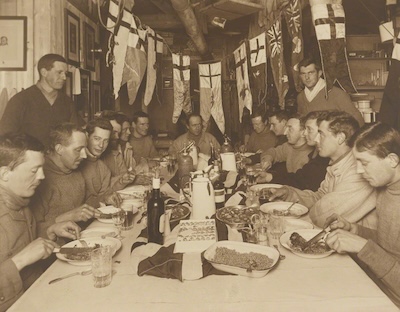
(Herbert George Ponting, ‘Captain Scott’s Birthday, 6 June 1911’, National Portrait Gallery, London; photo credit, NPG. Cherry is the third seated man along on the left)

‘Defeats on the Western Front in March catapulted the nation into shock’, Sara Wheeler wrote in her biography of Apsley Cherry-Garrard, recalling the period of the First World War. ‘The Times rallied as usual to shore up public confidence, issuing advice on all fronts, including the stern “Don’t think you know better than Haig”, even though most people over the age of ten probably did.’[3]

On all fronts, not just the Western one.

In Penelope Fitzgerald’s The Blue Flower, a novel based on the life of the 18th century writer  Novalis, Fritz meets Sophie’s elder sister Friederike (‘the Mandelsloh’): ‘“I thank you for your advice,” said Fritz. “I think, indeed, that women have a better grasp on the whole business of life than we men have. We are morally better than they are, but they can reach perfection, we can’t. And that is in spite of the fact that they particularise, we generalise.”
   “That I have heard before. What is wrong with particulars? Someone has to look after them.”’[4]

Yes, those particulars. Colette was a generous dispenser of advice, not least to the young Georges Simenon when she was literary editor at Le Matin, telling him that, though on the right track, ‘he should drop “the literature”. “Pas de littérature!” she said. “Supprimez toute la littérature et ça ira!”’[5] To a young woman writer who had sought her advice, she replied: ‘When you are capable of certifying that today’s work is equal to yesterday’s, you will have earned your stripes. For I am convinced that talent is nothing other than the possibility of resembling oneself from one day to the next, whatever else befalls you.’[6] But she also served as a magazine’s regular agony aunt, sharing her expertise in matters of dress, cosmetics and, always, love.


(Colette, plus—of course—a cat)

On dress and cosmetics, I am probably unreliable; but I was writing recently about aeroplanes, though hardly straying from my usual temporal zone, the first two or three decades of the twentieth century. The context was Ford Madox Ford’s war but a lot of the material I had to draw on related to Guy Davenport—some of which has gone into blog posts here—as well as other writers of Ford’s time, references to whom had to be whittled down or eliminated. Every time I approached the suggested word limit, things spiralled out of control again as some other alleyway beckoned. I remembered that line of W. B. Yeats: ‘My thoughts were a great excitement, but when I tried to do anything with them, it was like trying to pack a balloon into a shed in a high wind.’[7]

The Davenport material went, leaving only a faint shadow of his 1991 response to Laurence Zachar’s remark that: ‘A proportionately large part of your work is Utopian. It deals with happy people, in an ideal place where there is no violence’, when Davenport commented of  “The Aeroplanes at Brescia”, ‘there’s the implicit sense that aeroplanes were going to stop all wars; the Wright brothers wrote a famous letter to the War Department which paid no attention to it, saying: with the aeroplane, there can be no more troop movements because they can be observed from the air, and therefore no more wars.’[8]

When his story, or assemblage—drawing on Franz Kafka’s first published work, a report on the 1909 air show—appeared in the Hudson Review, a paragraph on the final page put the assertion that wars would cease with the coming of the aeroplane into the mouth of Max Brod’s engineer brother Otto but Davenport may have felt that such an unbearably painful irony was too easy, too heavy-handed. It was omitted when revised for book publication.[9]


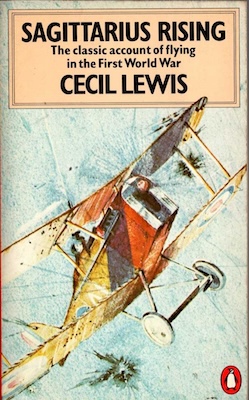
Another twist on that occurred to me when I was rereading the memoir by Cecil Lewis, Sagittarius Rising, who was in his teens when he joined the Royal Flying Corps. By the time he was posted to Home Establishment, he had survived eight months overseas, including four months of the Somme battle, and spent 350 hours in the air, during a period when pilots were lasting, on average, three weeks. Within little more than a month after the Armistice, he had been demobilised and secured a civilian job with Vickers. He was then twenty years old.

Writing in the mid-1930s, he looked back to the failure of the postwar conferences, aimed at ensuring peace, to take note of air power, finally waking to the significance of that power with a shudder of horror. ‘No wonder. Frontiers were gone. Security was gone. No man could hope for peace or prosperity under the threat of a violent death. The days of war were over: massacre had taken their place, wholesale massacre of the community in which children would retch their lives away, women would be blinded and men powerless to protect or succour. The end of civilization was in sight.’[10]


Notes

[1] Ford Madox Ford, Return to Yesterday: Reminiscences 1894-1914 (London: Victor Gollancz, 1931), 251-252.

[2] The Letters of Robert Lowell, edited by Saskia Hamilton (New York: Farrar, Straus and Giroux, 2005), 187.

[3] Sara Wheeler, Cherry: A Life of Apsley Cherry-Garrard (London: Jonathan Cape, 2001), 199.

[4] Penelope Fitzgerald, The Blue Flower (1995; London: Everyman, 2001), 364.

[5] Patrick Marnham, The Man Who Wasn’t Maigret: A Portrait of Georges Simenon (San Diego: Harcourt Brace & Company 1994), 112.

[6] Judith Thurman, Secrets of the Flesh: A Life of Colette (London: Bloomsbury Publishing, 2000), 409.

[7] W. B. Yeats, Autobiographies (London: Macmillan, 1955), 41.

[8] Laurence Zachar, ‘Guy Davenport. Lexington, Kentucky: December 1991’, Effets de voix (Tours: Presses universitaires François Rabelais, 1994).
See: http://books.openedition.org/pufr/3904 (accessed 20 January 2021).

[9] Guy Davenport, ‘The Aeroplanes at Brescia’, Hudson Review, 22, 4 (Winter, 1969-1970), 567-585; Tatlin! Six Stories (New York: Scribner’s, 1974), 52-70.

[10] Cecil Lewis, Sagittarius Rising (1936; Harmondsworth: Penguin, 1977), 152-153.

Things going better, bitte


(Not a Sequoia)

‘We drove up once to the Sequoia forest’, Christopher Isherwood told W. I. Scobie, ‘and I remember Stravinsky, so tiny, looking up at this enormous giant Sequoia and standing there for a long time in meditation and then turning to me and saying: “That’s serious.”’[1]

Sometimes, even for those long-practised in weathering it, the news becomes so distressing—and the public pronouncements of senior politicians so disgusting—that it’s best to pause, assuming you’re in the luxurious position of being able to do so.

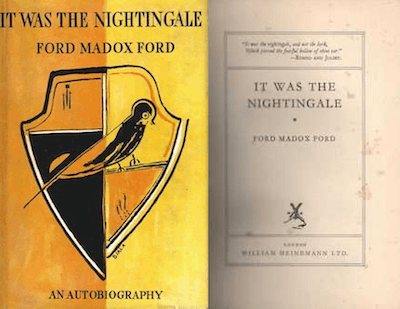
Ford Madox Ford or, let’s say, the narrator, does just that on page fifteen of It Was the Nightingale, which I’m currently reading for—let’s say the fifth time, not to sound too crazy. He pauses ‘with one foot off the kerb at the corner of the Campden Hill waterworks’. He is ‘about to cross the road. But, whilst I stood with one foot poised in air, suddenly I recognised my unfortunate position. . . .’ His rendering of the reflections that occur to him in that position appear to end, or pause, around page 88.


A few years back, I was writing about Ford and comedy, about genres and how comic writing is not viewed using the same critical criteria as ‘serious’ writing, discussing mostly the novels by Ford that might be regarded as comic: farces, satires for the most part. I was struck by a passage in a Guy Davenport essay:

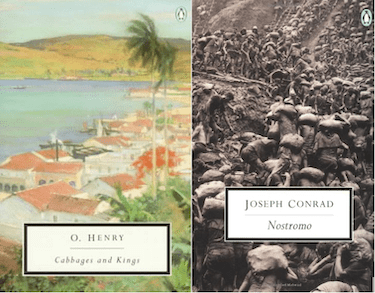
‘When Nostromo and Cabbages and Kings were published in 1904, we were beginning to make a distinction not among the four large types of literature which Northrop Frye has named comedy, romance, tragedy, and satire, or spring, summer, autumn, and winter spirits of the imagination, but between comic and serious. Some writers, like Shakespeare, Mark Twain, and Bernard Shaw, were allowed to be both at once, but with the understanding that the comic was being put in the service of the serious. The seriousness of the comic writer could only be sentimentality, and his business was to entertain, not to instruct’.[2]


Davenport writes as an admirer of O. Henry, a fat selection of whose stories he edited and introduced for Penguin Books. ‘To those friends who knew his past’, he writes there, ‘O. Henry always compared himself to Lord Jim.’ His introduction ranges over the classics—unsurprisingly, Davenport being both classicist and modernist—and some of the writers, possibly unexpected, who have admired O. Henry’s stories, among them Cesare Pavese, the Russians of the Constructivist movement, Yevgeny Zamyatin. Alluding to practitioners of the New Comedy, he remarks: ‘Miserable as our century is, we can still boast that for seventy years of it we had P. G. Wodehouse, the Menander de nos jours, and for ten years O. Henry.’[3]

Ford being one of those who was surely ‘allowed to be both at once’, I tried to convey how many comic moments—certainly passages that made me laugh—there were in the ‘serious’ books, not excluding The Good Soldier and Parade’s End.[4] I’ve wondered since whether I shouldn’t simply have said: Well, just read It Was the Nightingale. But no. It’s perfectly possible to explain, or attempt in accepted ways to do so, why you think a writer or a painter is good, what they succeed in, their distinctive personal characteristics. But explaining why someone is funny? Can it be done? You might explain why you personally find something funny but that may sound, to a reluctant or sceptical listener, as interesting and persuasive as your last night’s dream.

I quoted the estimable Frank Budgen on his friend, author of the comic masterpiece, Ulysses: ‘one day Joyce laughed and said to me: “Some people were up at our flat last night and we were talking about Irish wit and humour. And this morning my wife said to me, “[w]hat is all this about Irish wit and humour? Have we any book in the house with any of it in? I’d like to read a page or two.”’[5]

If the reader doesn’t find Ulysses funny, I suspect it’s because it feels intimidating too: this huge book, full of words, phrases, constructions, comparisons, images and symbols that you’re never come across before. Not, anyway, in those contexts and those combinations. Worse, it’s the Greatest Novel of the century or one that defined an era or the justification for the whole modern movement or—but is it funny? Well, yes, probably not if you go through it on tiptoe or hands and knees, peering warily about you as you go. But if you can relax, telling yourself that you’ll come back to it with a pick and shovel at some later date but just not now – pour a glass (leave the bottle) and sit back in that comfortable chair – things may go better.

I linger over that phrase—‘things may go better’—just for a moment, you understand. How could I not?

Notes


[1] Writers at Work. The Paris Review Interviews: 4th Series, edited by George Plimpton (Harmondsworth: Penguin Books, 1977), 232.

[2] ‘The Artist as Critic’, in Every Force Evolves a Form (Berkeley: North Point Press, 1987), 79.

[3] ‘Introduction’ to O. Henry, Selected Stories (New York: Penguin Books, 1993), xi, xv. Possible additions to these inheritors of the New Comedy are ‘the exotic and manic S. J. Perelman and the gentle, whimsical Thurber’.

[4] ‘Ford and Comedy’, Sara Haslam, Laura Colombino and Seamus O’Malley, editors, The Routledge Research Companion to Ford Madox Ford (London: Routledge, 2019), 427-440.

[5] Frank Budgen, James Joyce and the Making of ‘Ulysses’ and other writings, enlarged edition (1934; London: Oxford University Press, 1972), 38.

Scholars and storytellers


(J. R. R. Tolkien: Reuters via The Guardian)

The incomparable Guy Davenport was born on 23 November 1927 (he died in 2005). I remember making some notes about him in connection with J. R. R. Tolkien some years back, when the company I worked for represented Cornell University Press. In 2013 the press reissued a book first published in 1979, six years after Tolkien’s death, a collection of pieces entitled J. R. R. Tolkien, Scholar and Storyteller: Essays in Memoriam. It included contributions from a wide range of friends, colleagues and former students. The first part contains the Times obituary; Tolkien’s 1959 ‘Valedictory Address’ to the University of Oxford; and a personal remembrance by a friend of forty years’ standing. The second part consists of critical essays concerned with the literatures of Old Norse, Old English and Middle English, Tolkien’s own main scholarly interests. The last part comprises three pieces on Tolkien’s famous fictions and concludes with a bibliography of his writings, compiled by Humphrey Carpenter (Tolkien’s biographer).[1]

‘The first professor to harrow me with the syntax and morphology of Old English,’ Davenport writes, ‘had a speech impediment, wandered in his remarks, and seemed to think that we, his baffled scholars, were well up in Gothic, Erse, and Welsh, the grammar of which he freely alluded to. How was I to know that he had one day written on the back of one of our examination papers, “In a hole in the ground there lived a hobbit”?’[2]


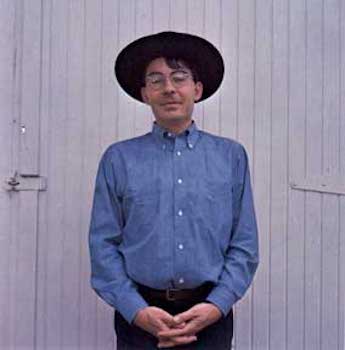
(One genius by another; or, Jonathan Williams’ photograph of Guy Davenport – ‘in Quakerish garb’ – Lexington, 1964: Portrait Photographs (London: Coracle Press, 1979).

After graduating from Duke University, Davenport was awarded a Rhodes Scholarship and studied at Merton College, Oxford, from 1948 to 1950. His thesis on James Joyce was directed by J. I. M. Stewart; his examiner was David Cecil. Davenport was drafted into the army on his return to the United States and served two years before taking a job at Washington University, St Louis. At Harvard, he worked as graduate assistant to Archibald MacLeish and wrote his dissertation, Cities on Hills, on the first thirty of Pound’s Cantos, under Harry Levin’s direction. It was published a little over twenty years later.

Davenport finished reading Lord of the Rings in March 1963, writing to Hugh Kenner that it was ‘a major work’. He went on: ‘What imagination! Never does his invention run out, on and on. I have a feeling that he has summed up 500 years of literature from the Mabinogion through Von Essenbach to the High Victorians. He has done well in prose what Spenser probably could not have finished in verse. It makes the “realistic” novel look like a skinned knee criss-crossed with band-aids.’[3]

In October 1963, Kenner was two-thirds of the way through the trilogy, remarking of the plans to reissue the work in paperback, ‘It could not fail to do good to anyone who read it through! one of the few books for which there is point in winning a larger public’ (I, 427). Davenport responded three days later: ‘I glow that you like Tolkien. He provides a vocabulary, both of phrases and imagery. Gandalf began life, in The Hobbit, as Sherlock [Holmes] in an astrologer’s gown. Frank Meyer [book review and cultural editor of National Review],[4] who is not uninfluenced in his fight with the Bolsheviki by Gandalf’s war upon the Orcs, got me onto Tolkien. [Stan] Brakhage heavily influenced by Tolkien, his other influence being Pound’ (I, 430)


In ‘Hobbitry’, Davenport noted that he’d talked to Tolkien’s son, Christopher—under whose steady hand the published Tolkien canon has expanded significantly—as well as to his friend ‘Hugo’ Dyson, who said of Tolkien, ‘His was not a true imagination, you know. He made it all up.’ ‘I have tried for fifteen years’, Davenport comments, ‘to figure out what Dyson meant by that remark.’ And he talked to a history teacher, Allen Barnett, who had been a classmate of Tolkien’s and remembered how he ‘could never get enough of my names of Kentucky folk. He used to make me repeat family names like Barefoot and Boffin and Baggins and good country names like that.’

Ah.

Tolkien’s readers run into millions, of course, the viewers of the films based on his books surely running into tens of millions by now. An intriguing if unanswerable question is what proportion of those readers and viewers have a sense of the main focus of his scholarly work.

 ‘Practically all the names of Tolkien’s hobbits are listed in my Lexington phone book’, Davenport writes, ‘and those that aren’t can be found over in Shelbyville.’ He concludes: ‘I despaired of trying to tell Barnett what his talk of Kentucky folk became in Tolkien’s imagination. I urged him to read The Lord of the Rings but as our paths have never crossed again, I don’t know that he did. Nor if he knew that he created by an Oxford fire and in walks along the Cherwell and Isis the Bagginses, Boffins, Tooks, Brandybucks, Grubbs, Burrowses, Goodbodies, and Proudfoots (or Proudfeet, as a branch of the family will have it) who were, we are told, the special study of Gandalf the Grey, the only wizard who was interested in their bashful and countrified ways.’


Notes

[1] J. R. R. Tolkien, Scholar and Storyteller: Essays in Memoriam, edited by Mary Salu and Robert T. Farrell (Cornell University Press, 9780801478871, 325pp, paperback).

[2] ‘Hobbitry’, in The Guy Davenport Reader, edited by Erik Reese (Berkeley: Counterpoint, 2013), 273.

[3] Questioning Minds: The Letters of Guy Davenport and Hugh Kenner, edited by Edward M. Burns, two volumes (Berkeley: Counterpoint Press, 2018), I, 287. I’ve lifted several details of Davenport’s biography from this superb edition.

[4] As Erik Reece, who knew Davenport well and is his literary executor, wrote, ‘And though he reviewed books for right-wing National Review, he did so simply because Hugh Kenner got him the job, not because he felt any allegiance to William F. Buckley or the conservative movement’: ‘Afterword, Remembering Guy Davenport’,  Reader, 440.

Ashes, sawdust, felled trees


In 1976, 3 March was Ash Wednesday, the first day of Western Lent, named for the custom of sprinkling on the heads of penitents the ashes of consecrated palms left over from Palm Sunday. In a letter of this date, Hugh Kenner wrote to Guy Davenport: ‘The enclosed clippings may amuse. And did I mention the sermon on hell in an Irish church last month, in the midst of which a choir boy was noticed to be on fire? Sleeve too near a candle apparently.’[1]

Dear Hugh – ‘was noticed’.

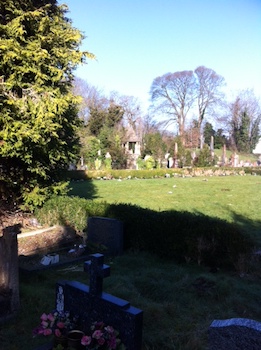
Clear, dry days draw us back to Arnos Vale, our local Victorian garden cemetery, one of the city’s wonders. The last few visits there, though, have been a bit disconcerting: unfamiliar gaps and bare slopes and sightlines where before were dense gatherings of trees. Then, too, we can often hear the melancholy sound of chainsaws.

Guy Davenport wrote of two entwined trees, an apple and a pear, which had stood near his home for over fifty years. They were cut down by a developer, ‘in full bloom, with a power saw, the whining growl of which is surely the language of devils at their business, which is to cancel creation.’[2]

‘My aspens dear, whose airy cages quelled’, Gerard Manley Hopkins wrote,

Quelled or quenched in leaves the leaping sun,
All felled, felled, are all felled;
   Of a fresh and following folded rank
         Not spared, not one
         That dandled a sandalled
   Shadow that swam or sank
On meadow and river and wind-wandering
   weed-winding bank.[3]


The situation at Arnos Vale is quite other. Not, like the felled trees mourned by Hopkins or Davenport, due to rapacious developers, nor like those in so many present or recent cases of misguided (or not wholly disinterested) councils or the disastrous vandalism inextricable from hugely expensive vanity projects. The Arnos Vale trees have fallen prey to Chalara ash dieback, a fungal disease affecting ash trees in many locations across the country, an infection frequently fatal once contracted. At Arnos Vale they have been dealing with it since 2017 and, tragically, they have almost total infection across this beautiful 45-acre site.
https://arnosvale.org.uk/ash-dieback-faqs/#:~:text=If%20you%20have%20recently%20visited,total%20infection%20across%20the%20site.

The cemetery was, in fact, rescued from development, more than thirty years ago, when the private owner of the site announced plans to clear and commercially develop a large part of it. Local individuals and other citizens, Bristol city council and well wishers from around the world campaigned and worked together to rescue and preserve it for future generations. Still a working cemetery, it also offers a paradise for walkers with or without dogs, nature lovers, curious children, people in need of quiet, of ‘a green thought in a green shade.’[4]


They will plant other trees there. The gaps will be filled, the spaces will narrow and we’ll go on walking along the paths. If we could change governments or perceived priorities or media shortcomings or UK laws, we’d do that. Since we can’t, we’ll have to settle for making a donation every so often, to help the work that’s being done there. Where better, after all, could we walk?

Notes


[1] Questioning Minds: The Letters of Guy Davenport and Hugh Kenner, edited by Edward M. Burns, two volumes (Berkeley: Counterpoint Press, 2018), II, 1611.

[2] Guy Davenport, ‘Shaker Light’, in The Hunter Gracchus and Other Papers on Literature and Art (Washington: Counterpoint, 1996), 59.

[3] ‘Binsey Poplars (felled 1879)’, Poems of Gerard Manley Hopkins, fourth edition, revised and enlarged, edited by W. H. Gardner and N. H. Mackenzie (London: Oxford University Press, 1967), 78.

[4] Andrew Marvell, ‘The Garden’, in The Complete Poems, edited by Elizabeth Story Donno (Harmondsworth: Penguin Books, 1985), 101.

Orchards – from a distance

(Clarence Hudson White, The Ring Toss: Yale Visual Resources Collection; William Merritt Chase, The Ring Toss)

I noticed that today is the birthday of the photographer Clarence Hudson White, born in Ohio in 1871 (he died early, aged 54, in Mexico City). He became close friends with Alfred Stieglitz. I’d barely heard of White but, in a brief gallery of his photographs, my eye snagged on ‘The Ring Toss’ because I knew of the 1896 painting by William Merritt Chase, ‘The Ring Toss’. A lot of Chase’s paintings are very reminiscent of John Singer Sargent – who painted a portrait of Chase in 1902 (Museum of Modern Art).[1]

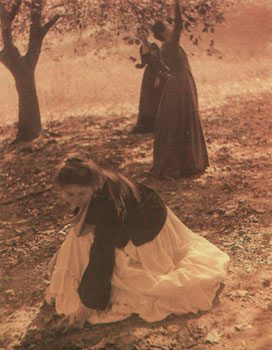
Clarence_White-The_Orchard.1902

(Clarence Hudson White, The Orchard)

This very evocative Clarence White photograph was published in 1905 (Camerawork, 9). Should the women seem to be practising social distancing, that’s probably mere happenstance.

Orchards are certainly evocative for artists and writers, perhaps because of their seeming to balance on the threshold of imposed order and unchecked nature, perhaps because they’re often associated with childhood, a lost paradise, or at least with a rural or semi-rural peace – and thus standing in stark contrast to the destructive forces of war. Edmund Blunden’s classic memoir, Undertones of War, refers to them often.

Early on in his ‘education’, in a chapter called ‘The Cherry Orchard’, he writes: ‘The joyful path away from the line, on that glittering summer morning, was full of pictures for my infant war-mind. History and nature were beginning to harmonize in the quiet of that sector. In the orchard through we passed immediately, waggons had been dragged together once with casks and farm gear to form barricades; I felt that they should never be disturbed again, and the memorial raised near them to the dead of 1915 implied a closed chapter.’ And of Englebelmer, ‘a sweet village scarcely yet spoiled’: ‘Its green turf under trees loaded with apples was daily gouged out by heavy shells; its comfortable houses were struck and shattered, and the paths and entrances gagged with rubble, plaster and woodwork.’[2]

Katherine Mansfield would also borrow the title of Chekhov’s last play, writing to John Middleton Murry from Menton two years after the war’s end: ‘You see it’s too late to beat about the bush any longer. They are cutting down the cherry tree; the orchard is sold—that is really the atmosphere I want.’[3]

In the midst of that war (22 March 1916), Ivor Gurney wrote to Marion Scott, from near Tidworth, in Wiltshire, of his beloved home county, ‘Glostershire where Spring sends greetings before other less happy counties have forgotten Winter and the snow. Where the talk is men’s talk, and eyes of folk are as soft as the kind airs. The best roads in England, the finest cider, the richest blossom in the most magical orchards, beauty content in security, strength quiet in confidence controlled, blood mixed of plain and hill, Welsh and English; are not these only of my county, my home?’[4]

Wilfred Owen never did see the war’s end – though he planned for it, writing in 1917 to his brother Colin, then working on a farm: ‘In my walk this afternoon, considering at leisure the sunshine and the appearance of peace (I don’t mean from the news) I determined what I should do after the war [ . . . ] I should like to take a cottage and orchard in Kent Surrey or Sussex, and give my afternoon to the care of pigs.’[5]

In May 1962, Guy Davenport wrote, in a letter to Hugh Kenner, ‘You see, my ambition is to put down roots and have a real library and workshop, a hearth & orchard, and STAY PUT.’[6]

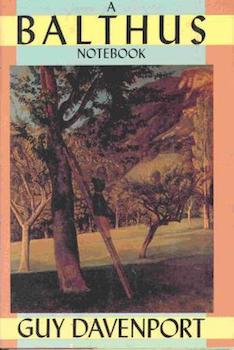
GD-Balthus-Notebook

(The Balthus painting on the jacket is the 1940 The Cherry Tree)

Apples – and pears – were of central and lasting importance to Davenport: ‘Apple and pear, brother and sister’, he writes in the novel-length title story.[7] In Objects on a Table, he stated that: ‘Pear symbolizes a harmony between human and divine; apple an encounter between human and divine. The forbidden fruit in Eden became an apple through linguistic accident, punning on evil and apple. But the inevitability of the accident was ensured by centuries of Greek and Latin pastoral poetry in which the apple was eroticized.’[8] In A Balthus Notebook, he discussed the painter’s Balthus’s use of apples and pears—‘In Christian iconography, a pear symbolizes the Redemption, and apple and pear are frequently together in Madonnas, Mary being the redemption of Eve, Christ of Adam’—noting that apple and pear appeared together for the first time in the 1981 Painter and His Model.[9]

And in ‘Shaker Light’, he tells the story of a pear tree and an apple tree ‘that had grown around each other in a double spiral’ and had stood for over fifty years around the corner from Davenport’s house. Walking past them daily for twenty years, they got into his thoughts ‘and always benignly.’ He saw them as husband and wife, as in Ovid’s poem. ‘They generated in my imagination a curiosity about the myths our culture has told itself about apples and pears. Apple is the symbol of the Fall, pear of Redemption. Apple is the world, pear heaven. Apple is tragic. A golden one given first as a false wedding gift and later presented by a shepherd to a goddess began the Trojan War and all that Homer recorded in the Iliad and the Odyssey. The apple that fell at Newton’s feet also fell on Hiroshima and Nagasaki and is right now embedded in thousands of bombs mounted in the heads of rockets, glowing with elemental fire that is, like Adam and Eve’s apple, an innocent detail of creation if untouched and all the evil of which man is capable if plucked.’ Finally, the trees were cut down by a developer, ‘in full bloom, with a power saw, the whining growl of which is surely the language of devils at their business, which is to cancel creation.’[10]

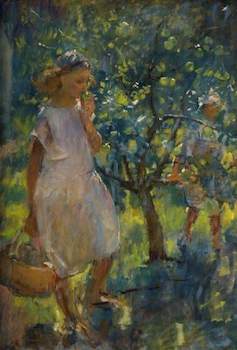
The painting that Stanley Spencer would later call his first ambitious one was called The Apple Gatherers. Spencer was one of that famous generation taught at the Slade by Henry Tonks – other Tonks pupils included Mark Gertler, Harold Gilman, Gwen John, Isaac Rosenberg, Stanley Spencer, David Bomberg, William Orpen, Wyndham Lewis and Winifred Knights. Tonks himself was clearly not immune to the lure of the orchard.

Tonks, Henry, 1862-1937; The Orchard

(Henry Tonks, The Orchard: Birmingham Museums Trust)

And I remember too one of the most memorable and thought-provoking moments in Ford Madox Ford’s The Good Soldier, when the narrator John Dowell says: ‘For I can’t conceal from myself the fact that I loved Edward Ashburnham—and that I love him because he was just myself. If I had had the courage and virility and possibly also the physique of Edward Ashburnham I should, I fancy, have done much what he did. He seems to me like a large elder brother who took me out on several excursions and did many dashing things whilst I just watched him robbing the orchards, from a distance.’[11]

Next time you feel the need to do a dashing thing, then, you might well look out for an orchard. It it won’t be for a good while yet, of course. Best stay safely indoors and read about it for the present, watching from a distance.

 
Notes

[1] See Richard Ormond and Elaine Kilmurray, John Singer Sargent. The Later Portraits. Complete Paintings Volume III (Yale: Yale University Press, 2003), 81-84.

[2] Edmund Blunden’s Undertones of War (1928; edited by John Greening, Oxford: Oxford University Press, 2015), 25, 81.

[3] Quoted by Antony Alpers, The Life of Katherine Mansfield (London: Jonathan Cape, 1980), 327.

[4] Ivor Gurney, Collected Letters, edited by R. K. R. Thornton (Mid Northumberland Arts Group & Carcanet Press 1991), 75.

[5] Quoted by Jon Stallworthy, Wilfred Owen (Oxford: Oxford University Press, 1977), 174.

[6] Questioning Minds: The Letters of Guy Davenport and Hugh Kenner, edited by Edward M. Burns, two volumes (Berkeley: Counterpoint Press, 2018), I, 121.

[7] Guy Davenport, Apples and Pears (San Francisco: North Point Press, 1984), 77.

[8] Guy Davenport, Objects on a Table: Harmonious Disarray in Art and Literature (Washington: Counterpoint, 1998), 63.

[9] Guy Davenport, A Balthus Notebook (New York: Norton, 1989), 53.

[10] Guy Davenport, The Hunter Gracchus and Other Papers on Literature and Art (Washington: Counterpoint, 1996), 59.

[11] Ford Madox Ford, The Good Soldier: A Tale of Passion (1915; edited by Max Saunders, Oxford: Oxford University Press, 2012), 191-192.


Exemplars, anthropology, writing selves

To-West-Bay-Wall

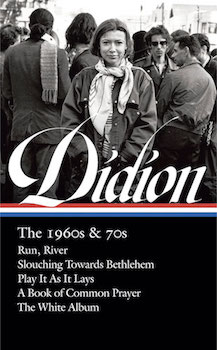
Sitting at the kitchen table with the recent Library of America collection of Joan Didion’s early books, I can hear the Librarian upstairs in vigorous dialogue with the radio. Is it politicians or another helping of vox populi snippets? It’s not easy to say which is more thoroughly depressing these days.

It’s not been a cheering week generally: adding to the university staff strike and the gloom of a general election campaign that’s demeaning to us all came the deaths of Clive James and Jonathan Miller – as one of the contributors to the ‘Letters’ page remarked, ‘just when we’re most in need of an increase in the gross national IQ, we get a drastic reduction.’
https://www.theguardian.com/culture/2019/nov/28/sad-loss-of-clive-james-and-jonathan-miller-modest-witty-intellectual-giants

(Jonathan Miller via The Independent; Clive James via The Financial Times)

On the plus side, not unusually, Guy Davenport – it was his birthday on 23 November (1927-2005); sitting in a rented house on the South coast, I’d just finished re-reading his second collection of essays, Every Force Evolves a Form; and, to complete the trinity, I also read Greg Gerke’s splendid short essay, ‘Davenport as Exemplar’.

Quoting Davenport’s foreword to The Hunter Gracchus and Other Papers on Literature and Art—‘I am not writing for scholars or fellow critics, but for people who like to read, to look at pictures, and to know things’—Gerke writes: ‘I’d always wanted to come at art in a vital Davenportian way, which is to say not with pompous stridency—declaiming for my own notoriety, using Hegel and Derrida as petards to enjoyment—but in a cogent, stylistic manner for the aforementioned “people who like to read.”’ He mentions other critics from whom he has learned—William Gass, Hugh Kenner, Elizabeth Hardwick, Susan Sontag, Cynthia Ozick—and notes that, ‘Though Davenport’s style is not the closest to mine, he is probably the most inimitable, and maybe the most angry’, the three notable forerunners of such literate anger being Blake, Ruskin and Ezra Pound, all of them of central concern to Davenport. Gerke goes on to explore the relationship between the writing self and the ‘superficial’ self, Proust’s ‘self that frequents the world’, a relationship that inhabits, implicitly or explicitly, many of the essays collected in his recent See What I See.*

(* ‘Davenport as Exemplar’ is available here: https://www.essaydaily.org/2019/11/greg-gerke-davenport-as-exemplar.html
See What I See collects thirty-one essays on literature, cinema and the writing life); also recommended is Especially the Bad Things (Gerke’s short fiction). Both have just been published by Birmingham-based Splice: https://www.thisissplice.co.uk/?s=gerke )

A few days ago, it was the birthday of Claude Levi-Strauss—he died in 2009, aged one hundred—whose work I know rather patchily and, frankly, can’t be sure of how much I absorbed from ‘The Champollion of Table Manners’, an essay by Davenport which is by way of being a review of The Origin of Table Manners: Introduction to a Science of Mythology: 3.

Davenport wrote another essay called ‘The Anthropology of Table Manners from Geophagy Onward’, a far more personal take on the subject – within the very definite autobiographical limits that Davenport allows, agreeing with Menander that ‘Talking about oneself [ . . . ] is a feast that starves the guest’ (a reference that Gerke instances in the essay mentioned above). Briefly citing both Davenport essays, Adam Mars-Jones remarked (‘Introversion Has Its Limits’, London Review of Books, 8 March 2018), ‘Shockingly, there is no overlap between them, though cannibalising your own material is generally regarded as anthropophagy at its most respectable.’

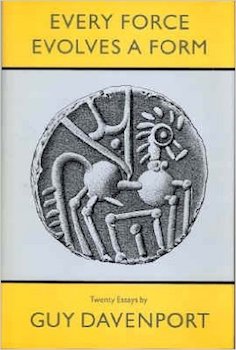
GD_Every_Force

‘The Anthropology of Table Manners’ seems saturated with Lévi-Strauss, though it never mentions his name, and The Geography of the Imagination, in which it is collected, preceded Every Force Evolves a Form by several years. The original journal publication of the two essays, though, reverses the volume order, so the reading for the review did indeed underlie ‘The Anthropology of Table Manners’, one of Davenport’s funniest essays (and he can be extremely funny). ‘He is not an easy writer’, he concludes his review. ‘The Elementary Structure of Kinship is one of the most difficult books ever. The Savage Mind is, in its charming way, almost as difficult. The four volumes of the Mythologies require dedication and stamina to read all 2,500 pages. Yet he has never written an uninteresting sentence.’ And when he asserts that Lévi-Strauss ‘is, to my knowledge, the best and most diligent interpreter of our time’, that knowledge very probably incorporated a great deal, if not all, of Lévi-Strauss’s oeuvre. In 1978, he referred, in a letter to Hugh Kenner, to Lévi-Strauss’s Totemism, translated by Davenport’s friend from Merton College, Oxford days, Rodney Needham, and with an introduction by Roger Poole, the Virginia Woolf and Kierkegaard scholar who later wrote on Ford Madox Ford and became a hugely valued member of the Ford community.

Didion-60s-70s

The day moves on from radio to housework, yoga, cooking. Over coffee, I turn to another page of the Joan Didion volume, the opening of her third novel, A Book of Common Prayer: ‘I am an anthropologist who lost faith in her own method, who stopped believing that observable activity defined anthropos. I studied under Kroeber at California and worked with Lévi-Strauss at São Paulo’.

As for what Gerke accurately characterises as Davenport’s ‘very poetic, crisp style—the long pungent sentences are masked by short pugilistic ones’, so many of those sentences stick in the mind, my mind, some consoling, some vertiginously relevant to the present, even if shaped thirty or more years ago.

‘If the past is prologue, it is also a record of grievances to call up and enlist as excuses. All you need is rhetorical talent and a gift for rationalizing.’ Or try: ‘Words are tyrants more powerful than any Caesar. When they are lies, they are devils.’ In one of his most memorable pieces, ‘On Reading’, he writes: ‘We can evince any number of undeniable beliefs—an informed society cannot be enslaved by ideologies and fanaticism, a cooperative pluralistic society must necessarily be conversant with the human record in books of all kinds, and so on—but we will always return to the private and inviolable act of reading as our culture’s way of developing an individual.’ I also pause over ‘Every epoch chooses its own past and cannot know how it will be remembered’; on ‘The uncritical mind is a prey to credulity, and without skepticism there can be no democracy’; and close with ‘Where language has torn the world to pieces, the writer can put it back together.’

More than ever, clearly, the writers have a great deal of work to do.

Endings also

Minnedosa

(The Minnedosa via www.greatships.net )

On the night of 22 September 1927, off Labrador, aboard Canadian Pacific S. S. Minnedosa, Ford Madox Ford wrote to Stella Bowen in Paris: ‘Darling: I finished Last Post ten minutes ago: I am tired out but quite well and awfully happy!’

The fourth and last part of his masterpiece Parade’s End, Last Post, while concerned with new beginnings—for Christopher Tietjens, for Valentine Wannop and the child she is carrying, and for England—is deeply engaged with endings also, both within and without the book itself, not least, the closing of his ten-year life with Stella. She would write to him in New York a few months later, ‘But your letter, & the “Last Post” together, seem to mark the end of our long intimacy, which did have a great deal of happiness in it for me’[1]

stella-bowen

(Stella Bowen: https://www.nationaltrust.org.au )

Exactly thirty-seven years later, 22 September 1964, Hugh Kenner wrote to Guy Davenport that he was reading Evelyn Waugh’s authorized biography of the Catholic theologian and author Ronald Knox. Knox was ‘the darling child of the gone world’ and ‘like so many Englishmen of that generation was the end of something. Literally every single Oxford crony of his fell in W.W.I, having enjoyed only a few months of free manhood and commenced, with Ronnie, to found the future.’ He went on: ‘We are apt to forget how devastated was the landscape over which the Pound Era seized hegemony.’ While Pound and Eliot, as Americans, were noncombatants, the Irish Joyce had sat out the war in Europe and Wyndham Lewis (British mother, American father) had served in the war but survived, ‘the English generation corresponding to theirs was annihilated: how thoroughly, till I read Knox’s life, I had never before realized.’

Kenner and his first wife, Mary-Jo, were received into the Catholic Church that month: Mary-Jo was in her final illness, suffering from spinal cancer, and though she was at home when Kenner wrote again on 28 September, he feared it would be temporary. ‘The statistical likelihood is of course that it has metastasized already. We are all dying, but at different rates.’[2] She died six weeks later.

wheeler-cartland

(Sir Mortimer Wheeler with Barbara Cartland)

Then too, ‘every single Oxford crony’ reminded me of Charlotte Higgins writing about Mortimer Wheeler, who became the archaeologist best-known to the British public, not least because of his appearances on the 1950s television show, Animal, Vegetable, Mineral: in 1954, he was the BBC’s first television personality of the year.

Wheeler, Higgins observed, ‘had a good war and emerged a major. But by 1918 his generation, he recalled in his memoir, “had been blotted out”. He wrote: “Of the five university students who worked together in the Wroxeter excavations, only one survived the war. It so happened that the survivor was myself.” The “Oxford Blues” were dead.’ Wheeler himself was not an Oxford man but had studied at University College London, taught Latin by the poet and classicist A. E. Housman.[3]

One visitor to the Wroxeter excavations—the village occupies a portion of what was once Uriconium, the fourth largest Roman town in Britain—in the summer of 1913 was Wilfred Owen. He met several of those working there, probably including Wheeler, though he felt ‘miserably jealous of two of them, who were from Oxford.’[4]

Wroxeter-English-Heritage

(Wroxeter via English Heritage)

It lieth low near merry England’s heart
Like a long-buried sin; and Englishmen
Forget that in its death their sires had part.
And, like a sin, Time lays it bare again
To tell of races wronged,
And ancient glories suddenly overcast,
And treasures flung to fire and rabble wrath.[5]

Owen’s end came just five years later on 4 November 1918 as he crossed the Oise-Sambre canal in northern France—the telegram announcing his death arrived at the family home on Armistice Day, one week later.

Before all else, though, the date on the calendar prompts thoughts of my sister. Had she lived, she would have been seventy-four today, so, though there is hardly a need for more reasons to raise a glass in these benighted times – santé, Penny.


Notes

[1] Correspondence of Ford Madox Ford and Stella Bowen, edited by Sondra J. Stang and Karen Cochran (Bloomington: Indiana University Press, 1993), 320, 373.

[2] Questioning Minds: The Letters of Guy Davenport and Hugh Kenner, edited by Edward M. Burns, two volumes (Berkeley: Counterpoint Press, 2018), I, 618, 620. Kenner’s phrase, ‘the gone world’, occurs, of course, in the opening line of The Pound Era (1971), which he first mentioned to Davenport in October 1961. The famous closing line, ‘Thought is a labyrinth’, came from Davenport.

[3] Charlotte Higgins, Under Another Sky: Journeys in Roman Britain (London: Jonathan Cape, 2013), 80.

[4] Dominic Hibberd, Wilfred Owen: A New Biography (London: Weidenfeld & Nicolson, 2002), 106.

[5] Wilfred Owen, opening of ‘Uriconium – An Ode’ (1913): The Poems of Wilfred Owen, edited by Jon Stallworthy (London: Chatto & Windus, 1990), 42; and see Stallworthy’s note (45).