Birth days (and other kinds)

‘Birth, and copulation, and death.
That’s all the facts when you come to brass tacks:
Birth, and copulation, and death.’
            (Fragment of an Agon)[1]

Is T. S. Eliot’s Sweeney a little too concise here? You may be thinking, in some moods yes, in some moods no. You may even be thinking it a little too expansive. But most people, I suspect, might want to add a bit.

Take today, for instance, 17 December. The celebrated translator of Russian literature, Constance Garnett, died at 03:00 on this day in 1946. Over 70 English versions, of Turgenev, Dostoevsky, Chekhov, Goncharov, Tolstoy. Dorothy Sayers, author of superb detective stories and translator of Dante, died in 1957, also on this day.

The middle term: throw in a wedding (and assume a positive). On 17 December 1914, the painter Paul Nash and Margaret Odeh—‘Bunty’—were married in St Martin-in-the-Fields by ‘the young pacifist vicar the Reverend Dick Sheppard.’[2] Cue the opening stanza of W. H. Auden’s Letter to Lord Byron:

Excuse, my lord, the liberty I take
   In thus addressing you. I know that you
Will pay the price of authorship and make
   The allowances an author has to do.
   A poet’s fan-mail will be nothing new.
And then a lord—Good Lord, you must be peppered,
Like Gary Cooper, Coughlin, or Dick Sheppard.[3]

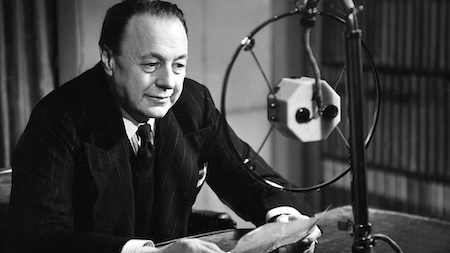
Gary Cooper, at least, will still be a familiar name; the other two, these days, rather less so, though not to historians of the 1920s and 1930s: Sheppard, the priest whose sermons, broadcast by the BBC, made him a national figure, and who later founded the Peace Pledge Union; Charles Coughlin, the Catholic priest who was also a widely-known broadcaster, though his anti-Semitic and pro-Fascist sympathies made his output rather different.

(Dick Sheppard broadcasting from St Martin-in-the-Fields: BBC)

On 17 December 1941, Sylvia Townsend Warner wrote to her friend Paul Nordoff: ‘Luckily, I have a tough memory for what I like, and I have most of it tucked away somewhere behind my ears.’[4] Just ten days after the attack on Pearl Harbor, then, a reminder if one were needed that on another 17 December—1903—Wilbur Wright’s fourth and last flight carried him  852 feet in 59 seconds.

The implications of that pioneering effort emerged with gradually increasing force and clarity a decade or so later. In 1915, Ezra Pound wrote to his parents (17 December): ‘Lewis has enlisted. That about takes the lot.’ He added: ‘I suppose we will go to France after the war. if it ever ends.’[5] Bombardier Wyndham Lewis would later recall that: ‘The war was a sleep, deep and animal, in which I was visited by images of an order very new to me. Upon waking I found an altered world: and I had changed, too, very much.’[6]

A few years on (17 December 1958) and the great Australian novelist Patrick White was writing to his friend and publisher Ben Huebsch—the rock on which White’s career was built, David Marr remarks—about his novel, Riders in the Chariot. ‘I shall want somebody here to check the Jewish parts after a second writing. I feel I may have given myself away a good deal, although passages I have been able to check for myself, seem to have come through either by instinct or good luck, so perhaps I shall survive. After all, I did survive the deserts of Voss.’ And in another letter to Huebsch, five months later, he returned to this: ‘What I want to emphasise through my four “Riders” – an orthodox refugee intellectual Jew, a mad Erdgeist [Earth spirit] of an Australian spinster, an evangelical laundress, and a half-caste aboriginal painter – is that all faiths, whether religious, humanistic, instinctive, or the creative artist’s act of praise, are in fact one.’[7] (I reread all Patrick White’s books seven years ago and I’m damned if I don’t feel almost ready to do it again. . .)

(Ford via New York Review of Books)

But then – why not celebrate? 17 December birthdays, yes: Humphry Davy, John Greenleaf Whittier, Erskine Caldwell, Paul Cadmus, Penelope Fitzgerald, Jacqueline Wilson, John Kennedy Toole – and the primary focus, or beginning spark, of all this anniversary rambling, Ford Madox Ford, 152 today.

His birthdays weren’t always joyous: at a party in 1901, he nearly choked on a chicken bone ‘and was prostrate for some days’.[8] In 1916, he was in a Red Cross Hospital in Rouen, writing to Joseph Conrad a couple of days later: ‘As for me—c’est fini de moi, I believe, at least as far as fighting is concerned—my lungs are all charred up & gone—they appeared to be quite healed, but exposure day after day has ended in the usual stretchers and ambulance trains’. In 1920, he spent at least a small portion of his birthday writing to Thomas Hardy, asking him to sign a manifesto protesting against British government policy in Ireland. It was published on 1 January 1921 in the Manchester Guardian and other papers. Fifty writers, artists and academics signed it but Thomas Hardy was not among them.

Past lives, past struggles, victories, defeats. Surely there is comfort to be found there, that they were faced with things we recognise only too well—not only the individual battles but the more general ones, against Fascism, vicious racism, authoritarianism, the hijacking of news, of the sources of information, the assaults on free speech, on civil liberties, on democratic rights—and came through. And we?

Optimism, pessimism. One up, one down; Monday, Tuesday; left hand; right hand. I liked Guy Davenport on the judicious estimate of his own make-up, reporting to Hugh Kenner that his friend Steve Diamant’s photographs included one that served as the author photograph on the dust jacket of Tatlin!, Davenport’s first collection of stories, or assemblages: ‘Guy beaming in the Dionysian priest’s chair, the Theatre, Athens. I had no notion such a radiant smile was in me. It cured a third of my paranoia and an eighth of my Calvinist pessimism to see it.’[9]

A whole eighth. Some photograph, some smile.


Notes

[1] T. S. Eliot, The Complete Poems and Plays (London: Faber and Faber, 1969), 122.

[2] Ronald Blythe, First Friends: Paul and Bunty, John and Christine – and Carrington (London: Viking, 1999), 77; David Boyd Haycock, A Crisis of Brilliance (London: Old Street Publishing, 2009), 238-9.

[3] W. H. Auden, The English Auden: Poems, Essays and Dramatic Writings, 1927-1939, edited by Edward Mendelson (London: Faber, 1977), 169.

[4] Sylvia Townsend Warner, Letters, edited by William Maxwell (London: Chatto & Windus, 1982), 76.

[5] Ezra Pound, Ezra Pound to His Parents: Letters 1895–1929, edited by Mary de Rachewiltz, David Moody and Joanna Moody (Oxford: Oxford University Press, 2010), 358.

[6] Wyndham Lewis, Rude Assignment: A narrative of my career up-to-date (London: Hutchinson, 1950), 129.

[7] Patrick White, Letters, edited by David Marr (London: Jonathan Cape, 1994), 151, 153. Marr’s remark about Huebsch’s importance is in ‘The Cast of Correspondents’, 638.

[8] Arthur Mizener, The Saddest Story: A Biography of Ford Madox Ford (London: The Bodley Head, 1972), 73.

[9] Questioning Minds: The Letters of Guy Davenport and Hugh Kenner, edited by Edward M. Burns, two volumes (Berkeley: Counterpoint Press, 2018), I, 630.

Blackberries, cats and a tilly


And every tree is a tree of branches
And every wood is a wood of trees growing
     And what has been contributes to what is.
So I am glad to have known them,
     The people or events apparently withdrawn;
The world is round and there is always dawn
     Undeniably somewhere.[1]

Some days, if you’re early enough, you can walk all the way round a huge Victorian cemetery and not see even a single dogwalker—though you might catch sight of a fox, if you’re lucky. The blackberries have got ahead of themselves to such an extent that  they’ll barely last the month: but once in the freezer drawer, they’ll see us well into winter.  Cow parsley, Anthriscus sylvestris, or Queen Anne’s lace (or, I gather, keck) still hangs on in places. A mistle thrush and a song thrush seem to answer one another and there’s a goldcrest somewhere near.

We are well past midsummer now. Glastonbury Festival is over (I shall probably get The Cure’s ‘Friday I’m in Love’ out of my head soon), the Wimbledon tennis tournament finished, the Bristol Harbour Festival has happened and the Balloon Fiesta is just a couple of weeks away. The wider canvas still largely features arterial blood and heavy boots on infant faces though even some Western politicians have now begun to wonder if deliberately starving thousands of innocent civilians and then shooting them down in cold blood day after day when they try to secure food might be just a bit over the top. Even so, to demonstrate that they know what’s terrorism and what isn’t, our government is prosecuting people who object to their country’s complicity in war crimes.

But pass on, pass on. Books, music, food, wine, love, cats.

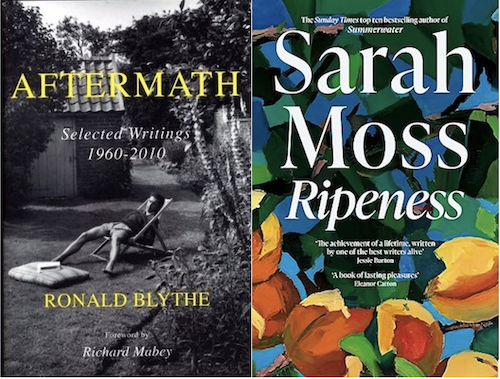
When I surface from Ford’s letters, I have waiting for me Paul Willetts’ remarkable reconstruction of the life of Julian Maclaren-Ross, Ronald Blythe, Sarah Moss, early Ernest Hemingway. Otherwise, I just revel in Anne Carson:


‘My mother forbad us to walk backwards. That is how the dead walk, she would say. Where did she get this idea? Perhaps from a bad translation. The dead, after all, do not walk backwards but they do walk behind us. They have no lungs and cannot call out but would love for us to turn around. They are victims of love, many of them.’[2]

Yes. Meanwhile, the weather, or much of it, prompts me to recognise my increasing intolerance to higher temperatures (and to much else: I know I’m widely assumed to become more conservative politically as I age but something’s clearly gone wrong). Earlier walks, more water, more cursing – I know all the tricks.

As to cats – yes, I like to remember that ‘Balthus painted himself once as a cat dining on fish, and once as the King of the Cats.’[3] Sylvia Townsend Warner mentioned, in a letter to William Maxwell (9 April 1952) , the northern Scottish traveller’s tale of seeing the cat funeral. ‘And the cat of the house, lying on the hearth, started up at these words, and exclaimed, “Then I am the King of the Cats”, and vanished up the chimney.’[4] When Swinburne died in 1909, William Butler Yeats said to his sister Lily, ‘Now I am king of the cats.’[5]

.

(John Butler Yeats, portrait of embroiderer, and co-founder (with her sister Lolly) of Cuala Industries, Susan Mary (Lily) Yeats (1901): National Gallery of Ireland)

The novelist, suffragist and partner—for several fraught years—of Ford Madox Ford had a good many of them: ‘Violet’s parrots—part of a menagerie that included an  owl (named Anne Veronica after Wells’s novel), a bulldog and nine Persian cats—shrieked “Ezra! Ezra!” whenever they saw him bouncing up the walk.’[6]

I can, alas, only half-agree with Lord Peter Wimsey when he says to Parker at the end of that bell-ringing mystery, The Nine Tailors, ‘“Bells are like cats and mirrors – they’re always queer, and it doesn’t do to think too much about them.”’[7] Queer they may be but I think about them a good deal and seem none the worse for it.

There was a collection of essays published ‘on the Occasion of the 25th Anniversary of Finnegans Wake’, which included pieces by Padraic Colum, Frank Budgen, Vivian Mercier, Fritz Senn, A. Walton Litz and other distinguished Joyceans. It was called Twelve and a Tilly.[8]

For ‘tilly’, my Shorter Oxford has: ‘In Ireland and places of Irish settlement, an additional article or amount unpaid for by the purchaser as a gift from the vendor.’ Joyce’s nocturnal masterpiece offers four occurrences and the splendid online glossary – http://finwake.com – adds to ‘the thirteenth of a baker’s dozen’ the derivation from Irish tuilleadh, added measure.

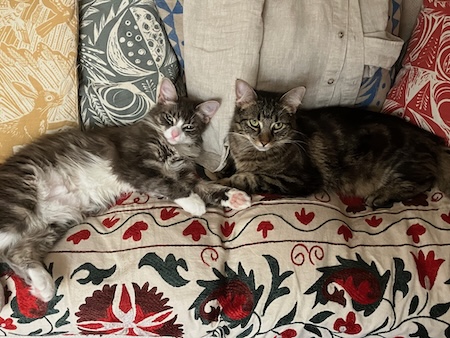
Opening my eyes to uncertain light, I can hear the table-tennis ball moving in the kitchen and the hall, knocking against skirting-boards and doorframes. I get up for a pee and a small grey tabby runs in to check on my progress and brush against my legs. Getting back into bed, I see that it’s 03:50. Moments later, the table-tennis ball is on the move again.

Yes, we have our own Tilly now, not an added measure but one-half of a pair. Her brother is named Max, which I like in part because it was the name of the very first pet I remember, in Gillingham, Kent, a black cocker spaniel—but also because of the occasional fleeting uncertainty which attends such phrases as ‘I said to Max’ or, more plausibly, ‘I asked Max’, which might conceivably be a reference to either a handsome tabby or our leading Ford Madox Ford scholar.

Scholars, though, at least as a general rule, do not sit in the kitchen sink, talk to toy mice or suck their tails. . .

Notes


[1] Louis MacNeice, ‘Autumn Journal: XXI’, Collected Poems, edited by Peter McDonald (London: Faber, 2007), 153.

[2] Anne Carson, ‘On Walking Backwards’, Plainwater: Essays and Poetry (New York: Vintage, 2000), 36.

[3] Guy Davenport,  A Balthus Notebook (New York: Norton, 1989), 7. Le Roi des Chats (1935). Balthus identified strongly with cats: in the year of this self-portrait, he began signing his letters to his future wife Antoinette as ‘King of Cats’. ‘Jeune fille’ occurs many times in the titles of his paintings—but so does ‘chat’ (sometimes together).

[4] Sylvia Townsend Warner, Letters, edited by William Maxwell (London: Chatto & Windus, 1982), 133.

[5] Yeats to Susan Mary (‘Lily’) Yeats, 12 Apr. 1909: R. F. Foster, W. B. Yeats: A Life. I: The Apprentice Mage: 1865–1914 (Oxford: Oxford University Press, 1997), 616n.69.

[6] Pound, of course. Barbara Belford, Violet: The Story of the Irrepressible Violet Hunt and her Circle of Lovers and Friends—Ford Madox Ford, H. G. Wells, Somerset Maugham, and Henry James (New York: Simon and Schuster, 1990), 166-7.

[7] Dorothy L. Sayers, The Nine Tailors (1934; with an introduction by Elizabeth George, London: New English Library, 2003), 305.

[8] Twelve and a Tilly: Essays on the Occasion of the 25th Anniversary of Finnegans Wake, edited by Jack P. Dalton and Clive Hart (Evanston: Northwestern University Press, 1965).

Grackles, clouds, popes

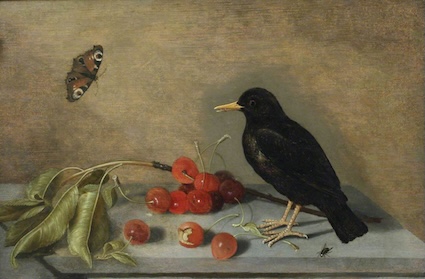
(Ambrosius Bosschaert the Younger, A Blackbird, Butterfly and Cherries: National Trust, Ham House)

04:30 and the blackbird already in full song. Not conducive to much further sleep but fine music. The same bird or a different one has several times come down to pick up grubs from pots ranged against the walls. Writing of the disappearances from the natural world over the past decades, Richard Mabey mentions smaller gnat swarms and choruses of blackbirds, and the barn owls gone.[1] And it’s true that we never hear such choruses now: it is almost always a solitary blackbird.

Guy Davenport remarks on ‘Gracchus’, meaning ‘grackle’ or ‘blackbird’; in Czech, kavka. And that Franz Kafka’s father had a blackbird on his business letterhead.[2] I recall that Davenport used ‘Grackle’ in ‘The Messengers’, his fourth story about Kafka (after ‘The Aeroplanes at Brescia’, ‘The Chair’ and ‘Belinda’s World Tour’). The writer is asked his name by the household god:
‘My name? Why, it’s Amschel. I mean, Franz. By the world, I am Franz Kafka.’
‘A kavka is a jackdaw.’
‘A grackle. Graculus, in Latin a blackbird.’
‘Yes.’[3]

I see that yesterday was Allen Ginsberg’s birthday, just one short of a centenary. Dear Ginsberg. I saw him read a couple of times, too many years ago, and the phrase ‘what thoughts I have of you’ came into my mind quite recently, remembering then: ‘What thoughts I have of you tonight, Walt Whitman, for I walked down the sidestreets under the trees with a headache self-conscious looking at the full moon.’

That poem ends: ‘Ah, dear father, graybeard, lonely old courage-teacher, what America did you have when Charon quit poling his ferry and you got out on a smoking bank and stood watching the boat disappear on the black waters of Lethe?’[4]

Whitman’s America, opening out; Ginsberg opening, broadening, welcoming. A decade or so later and he calls on Whitman again, this time with a long quotation from Democratic Vistas as epigraph to the collection called, ah, The Fall of America.

Here we are. And here we are.

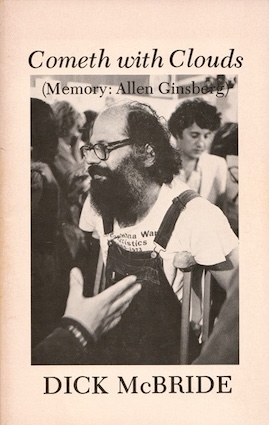
Back then too, in my early bookselling days, was Dick McBride, poet, playwright, actor, bookseller, publisher, former manager of City Lights Bookshop, having been introduced to Lawrence Ferlinghetti by poet, painter and novelist Kenneth Patchen. Dick was living in England then, distributing American small press books (and not so small: New Directions for a while)—a cottage in Great Horwood, Buckinghamshire, and an abandoned Victorian Methodist chapel for a warehouse. On my shelves is a copy of Cometh with Clouds (Memory: Allen Ginsberg), inscribed to me by Dick and dated July 14, 1983. It was published the previous year by Cherry Valley editions. I think I have a few of his other books, Lonely the Autumn Bird: Two Novels and Memoirs of a Natural-Born Expatriate were issued by Alan Swallow, and also The Astonished I, published by, ah, McBride’s Books.

Looking for online traces of Dick all these years later, I find more than I’d expected, on the Allen Ginsberg Project site and, particularly, a fine website created (and ongoing) by Rob McDowall: https://dickmcbride.co.uk/

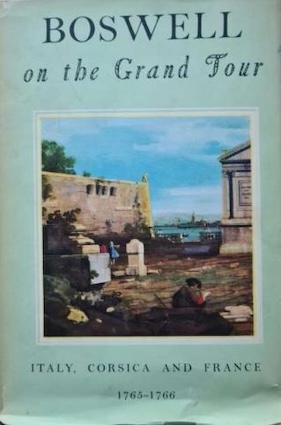
I am currently with James Boswell in Italy, Dorothy Parker in New York, and Ford Madox Ford more or less anywhere, generally in either Paris or New York, though occasionally in Corsica or Carqueiranne. Also, just now, with Stella Bowen in Italy, where she is travelling with Dorothy Pound, looking at pictures, while Ezra ransacks the archives to find material for the Malatesta Cantos. Quite unable to rely on so much of the world to refrain from barbarism and conduct its affairs with decency, intelligence or basic humanity, I’m happy enough to be elsewhere in quite other temporal locations.

Poor Boswell lectures himself on his conduct almost daily but then argues with his companions, pursues a married countess or takes himself off to the nearest working girl.  A ‘fille charmante’, about seven shillings. Also, ‘“Des filles” in the next three days ran to thirteen shillings.’ He seems strikingly subject to venereal disease too. After his triumphant forays into the lives of Jean Jacques Rousseau and Voltaire, Boswell is travelling with a party that includes Lord Mountstuart, son of Lord Bute, and has secured the friendship of John Wilkes, who (perhaps not an ideal model for young Boswell) takes the view that ‘dissipation and profligacy renew the mind’, he having written his best issues of his newspaper The North Briton (founded to attack Prime Minister Lord Bute) while ‘in bed with Betsy Green’.[5]

(Alexander Pope by William Hoare: National Portrait Gallery)

From time to time, I also try to get back more into the eighteenth-century frame of mind with some Pope – Alexander, to avoid any possible confusion, recalling an occasion not so long ago when I asked the Librarian what she was watching. ‘A bit of Pope’, she said. I looked into the front room and saw a blaze of red, cardinal red, you might say. Boswell, in an earlier journal, had recounted an evening including the poet’s work, which was not, however, quite enough to save the occasion: ‘The night before I drank tea and sat all the evening writing in the room with my landlord and landlady. They insisted that I should eat a bit of supper. I complied. I also drank a glass of punch. I read some of Pope. I sung a song. I let myself down too much. Also, being unaccustomed to taste supper, my small alteration put me out of order. I went up to my room much disgusted. I thought myself a low being.’[6]

Having actually taught Pope to unfortunate students many years back, I’m surprised to find I have to make a stern and conscious effort to stick with him, uneasily recalling W. H. Auden’s remark (8 January 1947) to Alan Ansen: ‘The real test of liking English poetry is Pope. His ideas aren’t much, but the language is wonderful—“Chicane in furs.” The Rape of the Lock is the most perfect poem in English.’[7] Or, indeed, Hugh Kenner, reviewing Maynard Mack’s life of the poet: ‘The great danger of absorbing writers’ biographies is that you can begin to think you understand writing you’ve not troubled to come to terms with.’[8]

I like to think of Gilbert White being presented with a copy of Pope’s six-volume translation of the Iliad by the poet himself, when graduating with distinction from Oriel College, Oxford, in 1743.

In Pope’s ‘Epistle to Burlington’, I see a neat encapsulation of pre-Romantic sensibility:

‘In all, let Nature never be forgot.
But treat the Goddess like a modest fair,
Not over-dress, nor leave her wholly bare;
Let not each beauty ev’ry where be spy’d
Where half the skill is decently to hide.
He gains all points, who pleasingly confounds
Surprizes, varies, and conceals the Bounds.’

And elsewhere a remark that never goes out of date, alas:

‘But when to Mischief Mortals bend their Will,
How soon they find fit Instruments of Ill!’ (‘Rape of the Lock’, Canto III).


Notes

[1] Richard Mabey, Nature Cure (London: Chatto & Windus 2005), 134.

[2] Guy Davenport, The Hunter Gracchus and Other Papers on Literature and Art (Washington: Counterpoint, 1996), 2.

[3] Guy Davenport, The Cardiff Team: Ten Stories (New York: New Directions, 1996), 2.

[4] ‘A Supermarket in California’, in Allen Ginsberg, Selected Poems 1947-1995 (London: Penguin Books, 2001), 89.

[5] Boswell on the Grand Tour: Italy, Corsica and France, 1765-1766, edited by Frank Brady and Frederick A. Pottle (London: William Heinemann, 1955), 54n., 58n.

[6] Sunday 19 December 1762: Boswell’s London Journal, 1762-1763, edited by Frederick A. Pottle (London: William Heinemann, 1950), 95.

[7] Alan Ansen, The Table Talk of W. H Auden, edited by Nicholas Jenkins (London: Faber and Faber, 1991), 15-16.

[8] Hugh Kenner, ‘Maynard Mack’s Pope’, Historical Fictions (Athens: University of Georgia Press, 1995), 250.

Darkness and Light

(John Milne Donald, Autumn Leaves: Glasgow Museums Resource Centre)

‘Darknesse and light divide the course of time, and oblivion shares with memory a great part even of our living beings; we slightly remember our felicities, and the smartest stroaks of affliction leave but short smart upon us.’[1]

The leaves are falling faster now, perhaps mostly fallen. Our clocks have gone back an hour and we are on Greenwich Mean Time. The polymath Edward Heron-Allen wrote in his journal on 22 May 1916, ‘The notable feature of the month is the establishment by law on the 20th of “summer time” which Willett, the originator of the idea, never lived to see introduced. At midnight on the 20th we all had to put our clocks on one hour, and in this way an hour of daylight is “added” to the day.’ And, five months later, he noted: ‘I do not think I have recorded that on 30 September we put our clocks back an hour and returned to Greenwich time.’[2]

William Willett, whose 1907 pamphlet, The Waste of Daylight, marked a crucial point in the advance towards ‘summer time’, had died from influenza on 4 March 1915, at the early age of 58, and is buried in St Nicholas churchyard in Chislehurst (as is his second wife.) The 1916 emergency law was passed to change the clocks twice a year as a measure to reduce energy and increase war production. It became a permanent feature when the Summertime Act was passed in 1925.

Leaves falling, darker days, the year in some ways closing down – but all these are in the natural order of things, as—or so we hope—the political convulsions, atrocities in Gaza, Lebanon, Ukraine, Sudan and elsewhere, are not. At least, as Jake Barnes says, at the close of Ernest Hemingway’s The Sun Also Rises, ‘Isn’t it pretty to think so?’

(John Berryman via The Paris Review)

‘Now there is further a difficulty with the light’, John Berryman wrote:

I am obliged to perform in complete darkness
operations of great delicacy
on my self.[3]

Currently those operations feature slow and sometimes painful analyses of my bafflement and confusion, not always helped by the Librarian’s daily bulletins from the battlefield that is the American election, often delivered in tones of appalled astonishment, while the phrase ‘batshit crazy!’ tends to recur.

What, in some senses, seems self-evident (one candidate sane, the other rather less so) is dwarfed by complexities and nuances almost invisible to us – we’re here and they’re. . . over there. I grasp, more or less, the fact that America is so divided a country now that neither side can—perhaps has no wish to—hear the other. But there is that other complication. While I can see that the appalling and spineless response of the Biden government to the conflict in the Middle East must repel a good many voters, it baffles me that those voters should think that withholding their vote from Harris (and thereby potentially contributing to her defeat) could somehow help the Palestinian people. Surely the precise opposite?

(John Donne, unknown English artist, c.1595)

Well, we’ll know soon enough. People, eh? I think of Katherine Rundell writing that, ‘amid all Donne’s reinventions, there was a constant running though his life and work: he remained steadfast in his belief that we, humans, are at once a catastrophe and a miracle.’ And: ‘He thought often of sin, and miserable failure, and suicide. He believed us unique in our capacity to ruin ourselves. “Nothing but man, of all envenomed things,/Doth work upon itself with inborn sting”. He was a man who walked so often in darkness that it became for him a daily commute.’[4]


Notes

[1] Sir Thomas Browne. Hydriotaphia, or Urn-Buriall, in Selected Writings, edited by Geoffrey Keynes (London: Faber  and Faber, 1970), 152.

[2] Edward Heron-Allen’s Journal of the Great War: From  Sussex Shore to Flanders Fields, edited by Brian W. Harvey and Carol Fitzgerald (Lewes: Sussex Record Society, 2002), 65, 71.

[3] John Berryman, ‘Dream Song # 67’, The Dream Songs, collected edition (New York: Farrar, Straus and Giroux, 1969), 74.

[4] Katherine Rundell, Super-Infinite: The Transformations of John Donne (London: Faber, 2023), 5-7.

By heart in the park

(Philip Wilson Steer, Dover Coast: York Art Gallery)

Another last warm and sunny afternoon of autumn. How many more can there be? With the Librarian in the office for a pretty full day, so not available for the lunchtime stroll, I walk alone in the park and succumb to the temptation to recall (and recite) the handful of poems that, at one time or another, I’ve committed to memory. Committed they may have been but seem, for the most part, to have escaped or at least to be out on parole.

Matthew Arnold’s ‘Dover Beach’ is worse than shaky and, in its current state, Marvell’s ‘To His Coy Mistress’ would probably not detain her for a moment. A bit of Pound, a bit of Yeats and a fragment of Elizabeth Bishop all hold steady, while a couple of others improve with work, which necessitates keeping a wary eye open – and an ear, given the increasing tendency of people to rush up behind you on bicycles or accursed electric scooters. Robert Lowell’s ‘Skunk Hour’ (dedicated to Bishop) yields a little to pressure:

Nautilus Island’s hermit heiress still
something something
her sheep still graze above the sea

Two men, walking briskly but not quite briskly enough, so staying almost exactly the same distance behind me, fairly close and, worse, very gradually nearing. . .

Her farmer
Is first selectman in our village;
she’s in her dotage.

We’re sailing now. Ah:

Thirsting for the hierarchic privacy
of Queen Victoria’s century,
she buys up all
the eyesores facing her shore,
and lets them fall.

(Lowell and Bishop in Brazil, 1962. Photo: Vassar College Library via the New Criterion)

But then there’s some confusion in the order of half-remembered stanzas, though I have most of the mother skunk’s activities in the final one. Move on to surer ground, anyway, the much-learned, almost-all recollected ‘Bagpipe Music’.

Though here a slight pause for the woman standing with her dog at the top of a slope below the play area. Is it a Pointer? We’ve seen it more than once before. Similar shape, similar attitude, its attention fixed on something in the grass near the foot of a tree, that can only be a squirrel. Looking it up later, I see that it’s a Vizsla, also known as a Hungarian Pointer. I stroll past it, resisting the impulse to give it some advice: you may be quick but you won’t win, they climb, you don’t. We’ve seen some close shaves for squirrels in the past but they always seem to evade dogs’ jaws. And ‘Bagpipe Music’? Pretty good, in fact. A slight hiccup over the penultimate stanza but both MacNeice and myself ending strongly:

It’s no go my honey love, it’s no go my poppet;
Work your hands from day to day, the winds will blow the profit.
The glass is falling hour by hour, the glass will fall for ever,
But if you break the bloody glass you won’t hold up the weather.

Now distractions range from the two old ladies intent on feeding a squirrel by hand (‘Come on, dear, see what I’ve got’ – Fleas, soon enough, I suspect) to the fellow with the ponytail and curious blue-green leggings intent on kicking a very small ball across the grass, and who crosses my path again half an hour later in a different and distant part of the park; and a murder of crows, around thirty in total, spread right across and down a broad grassy slope to the cycle path that runs along beneath the outspread branches of several wild pear trees. The fruits fall partly onto the earthy slopes beyond and partly onto the cycle path itself, one missed my right ear by inches one day last week. Walking along that path now before climbing sharply to my left, I see a dozen crows rooting among the fallen pears, though some turn to stare at me as I approach. ‘Are you auditioning for that nice Mister Hitchcock?’ I ask. One crow, not to be put off by a mere human, lingers to stick its beak straight through a pear before flying up to the branch above. Knowing how clever corvids are, I watch to see how it goes about extricating beak from fruit. It thrusts the pear into a narrow fork of branches which holds it in a tight embrace, withdraws the beak and starts tucking in. I whistle my sincere appreciation. That Lowellian mother skunk, I recall,

    jabs her wedge-head in a cup
of sour cream, drops her ostrich tail,
and will not scare.

Why is it so hard these days? No answers on a postcard, please. At school, everyone learned poems by heart and some people never lost the habit. I recalled an aside of the Reverend Kilvert: ‘I thought of William Wordsworth the poet who often used to come and stay at this house with blind Mr. Monkhouse who had nearly all his poems off by heart.’[1] Eric Gill’s father and one of Gill’s teachers, named Mr Catt, were great admirers of Tennyson. Gill himself also learned much of it by heart, being particularly fond of ‘the passage about the routine of rural agriculture:

As year by year the labourer tills
His wonted glebe and lops the glades’[2]

This is from stanza CX of Tennyson’s In Memoriam A. H. H., the initials those of Tennyson’s beloved friend Arthur Henry Hallam, who died in Vienna in 1833. Born in 1811, he was eighteen months younger than Tennyson. They had met at Trinity College, Cambridge in 1828. Tennyson seems to have begun this long poem very soon after hearing of Hallam’s death, though it was not published until 1850, and then anonymously. Edward Fitzgerald—translator of The Rubaiyat of Omar Khayyam—wrote to the poet’s elder brother Frederick Tennyson (15 August 1850): ‘Alfred has also published his Elegiacs on A. Hallam: these sell greatly: and will, I fear, raise a host of Elegiac scribblers.’[3]

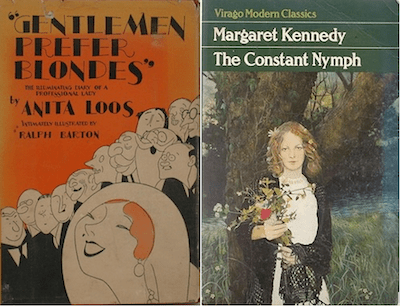
But it is not only poetry that the heroes of yesteryear committed to memory in large chunks – some mastered prose in a similar way, which always seems to me somehow an even more impressive achievement, though I accept that actors, having to learn their lines, sometimes comprising tremendously long speeches or monologues, would not necessarily find it so. Joseph Conrad and Ford Madox Ford would swap pages of Flaubert or Maupassant, while James Joyce ‘knew by heart whole pages of Flaubert, Newman, de Quincey, E. Quinet, A. J. Balfour and of many others.’[4] And, while Anita Loos’ Gentlemen Prefer Blondes was apparently one of Patrick White’s favourite novels (Joyce, Faulkner and Edith Wharton were also admirers), he knew Margaret Kennedy’s The Constant Nymph ‘practically off by heart.’[5]

‘Heart’ is another of those words with a great many friends, the compounds running over several columns of the dictionary: in one’s mouth or boots or the right place; open, shut, taken; worn on the sleeve; piercing, rending, sore and sick. It has its reasons and is, in many contexts, simply mysterious, as the author of ‘Dover Beach’ wrote:

But often, in the world’s most crowded streets,
But often, in the din of strife,
There rises an unspeakable desire
After the knowledge of our buried life;
A thirst to spend our fire and restless force
In tracking out our true, original course;
A longing to inquire
Into the mystery of this heart which beats
So wild, so deep in us – to know
Whence our lives comes and where they go.[6]

I briefly consider this last poem as a candidate but coming in at around a hundred lines, it may be a stretch too far for me. Sonnets are a handy length, though . . .


Notes

[1] Francis Kilvert, entry for 27 April 1870, Kilvert’s Diary, edited by William Plomer (London: Jonathan Cape, 1938, reissued 1969), I, 119.

[2] Fiona MacCarthy, Eric Gill (London: Faber & Faber, 1990), 26.

[3] The Letters of Edward Fitzgerald, edited by Alfred McKinley Terhune and Annabelle Burdick Terhune, four volumes (Princeton: Princeton University Press, 1980), I, 676.

[4] Frank Budgen, James Joyce and the Making of ‘Ulysses’ and other writings, enlarged edition (1934; London: Oxford University Press, 1972), 181. Edgar Quinet was a French historian; by A. J. Balfour is meant, presumably, the British Prime Minister (1902-1905) – who also published works of philosophy.

[5] David Marr, Patrick White: A Life (London: Vintage, 1992), 85.

[6] Matthew Arnold, ‘The Buried Life’, Poetry and Criticism of Matthew Arnold, edited by A. Dwight Culler (Boston: Houghton Mifflin, 1961), 114.

Pilots, poets, bays

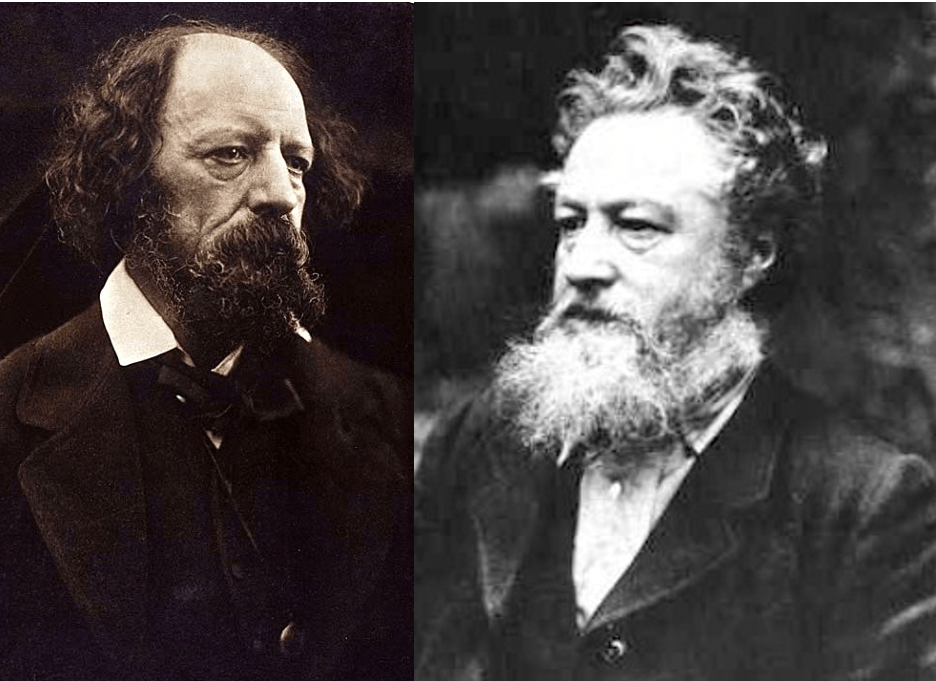
Alfred Lord Tennyson died on 6 October 1892, having served as Queen Victoria’s Poet Laureate for over forty years, the longest ever tenure – though a later octogenarian, John Masefield, came very close. Tennyson’s funeral, which took place six days after his death, was a pretty grand affair. His remains were, the Times reported, ‘consigned to their last resting-place in Poets’ Corner, Westminster’ – the grave of Robert Browning, who had died three years previously, is immediately adjacent to Tennyson’s. All the leading members of the royal family sent representatives (Sir Henry Ponsonby, Sir Dighton Probyn, Lord Edward Cecil) and the place was thronged with bishops, lords and ladies, the pall-bearers including the Duke of Argyll and Lord Kelvin. Conan Doyle, Ellen Terry, John Burns, Frederic Harrison and Henry Irving were among the mourners. In the street outside, vendors were offering, for a penny, copies of the poet’s 1889 lyric, ‘Crossing the Bar’ (author portrait included):

Sunset and evening star,
   And one clear call for me!
And may there be no moaning of the bar,
   When I put out to sea,

But such a tide as moving seems asleep,
   Too full for sound and foam,
When that which drew from out the boundless deep
Turns again home.

Twilight and evening bell,
   And after that the dark!
And may there be no sadness of farewell,
   When I embark;

For though from out our bourne of Time and Place
   The flood may bear me far,
I hope to see my Pilot face to face
When I have crost the bar.[1]

Tennyson was 80 when he wrote it, so unsurprisingly aware that the encounter with his ‘Pilot’ was not that far off.

Edward Burne-Jones was particularly excited that the city of Mantua ‘had sent bay from Virgil’s birthplace to lay in the tomb.’ In fact, ‘bay’ and ‘pilot’ occurred in another ‘literary’ interment context a few years later, though William Morris’s ‘country funeral’, Fiona MacCarthy observes, ‘was the absolute antithesis of Tennyson’s burial in Westminster Abbey in 1892.’[2]

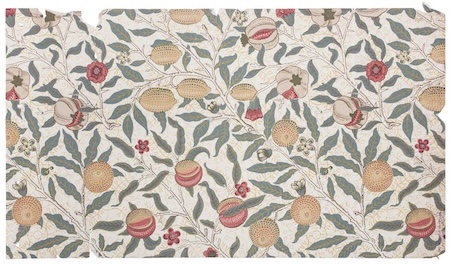
(William Morris, Fruit (Wallpaper): William Morris Society: Kelmscott House)

Morris died on 3 October 1896. He was only 62 but such a tireless worker, such a tireless maker, of pictures, poems, translations, tapestries, stained-glass windows, fabrics, carpets, furniture, illuminated books, wallpapers, prose romances and more that, as is often remarked, the primary cause of his death was simply being William Morris. His funeral took place on 6 October, exactly four years after the death of Tennyson. The body had to be transported from Paddington to Lechlade by train (a form of transport that Morris disliked intensely), then taken by cart to Kelmscott Church.

It was a cold wet morning, and the day turned stormy later. In that week’s issue of the Saturday Review (10 October 1896), there were pieces on Morris by George Bernard Shaw, Arthur Symons – and R. B. Cunninghame Graham, whose account of the day on which ‘the most striking figure of our times’ was buried, began with that weather. ‘As we never associated William Morris with fine weather, rather taking him to be a pilot poet lent by the Vikings to steer us from the doldrums in which we now lie all becalmed in smoke to some Valhalla of his own creation beyond the world’s end, it seemed appropriate that on his burial day the rain descended and the wind blew half a gale from the north-west.’ He noted of the arrival at Lechlade: ‘There, unlike Oxford, the whole town was out’, and added that the open haycart on which the coffin was transported to Kelmscott Church was ‘driven by a man who looked coeval with the Saxon Chronicle.’[3]

‘Over the coffin were thrown two pieces of Oriental embroidered brocade, and a wreath of bays was laid at his head’, the Daily News reported. The mourners included, alongside painters, publishers and printers, workmen from Merton Abbey (where the tapestry, weaving and fabric printing workshops were sited), Kelmscott villagers and members of the Art Workers’ Guild, all in their daily working clothes. The architect William Lethaby wrote: ‘It was the only funeral I have ever seen that did not make me ashamed to have to be buried.’[4]

(William Morris, Kelmscott Press Edition of ‘Godefrey of Boloyne’ by William Caxton: William Morris Society: Kelmscott House)

Morris continues to attract enormous biographical and scholarly interest, and warrants it all. So many arts, so many crafts, so many connections, so widespread and generative an influence, cropping up in all manner of places, often the expected ones, sometimes less so. Ezra Pound read Morris to the young Hilda Doolittle, ‘in an orchard under blossoming—yes, they must have been blossoming—apple trees.’ And: ‘It was Ezra who really introduced me to William Morris. He literally shouted “The Gilliflower of Gold” in the orchard. How did it go? Hah! hah! La belle jaune giroflée. And there was “Two Red Roses across the Moon” and “The Defence of Guenevere.”’[5] Pound read Morris to Yeats too, in Stone Cottage at the edge of Ashdown Forest, his translations of the Icelandic sagas.[6] Yeats would later recall of Morris’s prose romances that they were ‘the only books I was ever to read slowly that I might not come too quickly to the end.’[7]

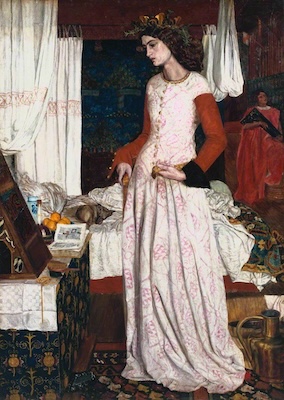
(William Morris, La Belle Iseult: Tate)

Fiona MacCarthy remarks that ‘There was a neurotic basis to his fluency. On a good day he could write 1,000 lines of verse’, and some readers will find some of the longer poems soporific.[8] Penelope Fitzgerald wrote that the lyrics, in her opinion were ‘far the most important part’ of his  poetry and, ‘If I could keep them I would cheerfully sweep all the sagas and Earthly Paradises under the carpet.’[9] Other readers, in Morris’s own time, and since, have felt quite differently. Yeats continued to be one of them. In October 1933, he reported to his old friend (and ex-lover) Olivia Shakespear (Pound’s mother-in-law) his attempt to read Morris’s long poem The Story of Sigurd the Volsung to his daughter and then to his wife: ‘and last night when I came to the description of the birth of Sigurd and that wonderful first nursing of the child, I could hardly read for my tears. Then when Anne had gone to bed I tried to read it to George and it was just the same.’[10]

This is probably the passage he refers to, early in Book II:

Then she held him a little season on her weary and happy breast
And she told him of Sigmund and Volsung and the best sprung forth from the best:
She spake to the new-born baby as one who might understand,
And told him of Sigmund’s battle, and the dead by the sea-flood’s strand,
And of all the wars passed over, and the light with darkness blent.

So she spake, and the sun rose higher, and her speech at last was spent,
And she gave him back to the women to bear forth to the people’s kings,
That they too may rejoice in her glory and her day of happy things.[11]

For other admirers of Morris, it may be the campaigner, the Socialist, or perhaps the designer and producer of stained-glass, fabrics, stories, the late romances, the lectures and the essays:

‘To give people pleasure in the things they must perforce use, that is one great office of decoration; to give people pleasure in the things they must perforce make. That is the other use of it.’
     ‘Does not our subject look important enough now? I say that without those arts, our rest would be vacant and uninteresting, our labour mere endurance, mere wearing away of body and mind.’[12]

Yes, the allusions to damaging and artificial divisions are often wonderfully suggestive of other divisions causing much wider harms – as, of course, they continue to do. And, though I may be prejudiced in this regard, I like his idea, in ‘The Beauty of Life’, of ‘the fittings necessary to the sitting-room of a healthy person’. The first of these is ‘a book-case with a great many books in it’. Oddly, he never seems to mention, let alone recommend, piles of books everywhere else. . .


Notes

[1] Tennyson: A Selected Edition, edited by Christopher Ricks (Harlow: Longman Group, 1989), 665-666.

[2] Fiona MacCarthy, William Morris: A Life for Our Time (London: Faber & Faber, 1994), 631, 673-675.

[3] R. B. Cunninghame Graham, ‘With the North-West Wind’, Saturday Review (10 October 1896), Vol. 82, Issue 2137, 389-390.

[4] Quoted by Philip Henderson, William Morris: His Life, Work and Friends (Harmondsworth: Pelican Books, 1973), 429.

[5] H. D., End to Torment: A Memoir of Ezra Pound, edited by Norman Holmes Pearson and Michael King (Manchester: Carcanet Press, 1980), 22-23.

[6] James Longenbach, Stone Cottage: Pound, Yeats and Modernism (New York: Oxford University Press, 1990), 142-143.

[7] W. B. Yeats, ‘The Trembling of the Veil [1922]: Four Years’, in Autobiographies (London: Macmillan, 1955), 141.

[8] MacCarthy, William Morris, ix.

[9] Penelope Fitzgerald to Dorothy Coles, 5 June [1992], So I Have Thought of You: The Letters of Penelope Fitzgerald, edited by Terence Dooley (London: Fourth Estate, 2008), 460.

[10] The Letters of W. B. Yeats, edited by Allan Wade (London: Rupert Hart-Davis, 1954), 816.

[11] William Morris, The story of Sigurd the Volsung and the fall of the Niblungs (London: Ellis & White, 1877), 80-81.

[12] ‘The Lesser Arts’, in William Morris: The Selected Writings, edited by G. D. H. Cole (London: The Nonesuch Press, 1934), 496.

Rosemary, responsibility


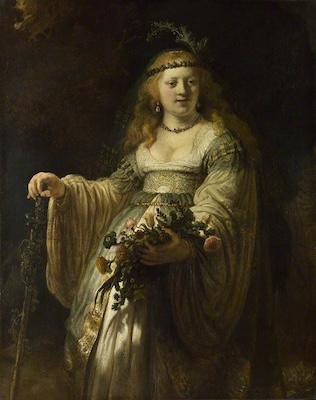
(Rembrandt van Rijn, Saskia van Uylenburgh in Arcadian Costume: National Gallery, London)

In the other park, which we traverse quite often, there are rosemary bushes to be discreetly ransacked – for potatoes, fish, meat, as well as for remembrance. ‘“There’s rosemary, that’s for remembrance”’, Ophelia says. And Laura Cumming notes that when Rembrandt’s wife Saskia van Uylenburgh died in 1642, at the age of 29 and after less than eight years of their marriage, Rembrandt ‘put a sprig of rosemary in her hand: rosemary for remembrance.’[1]

The weather forecast offers a 70% chance of rain. I add an umbrella to my tote bag and am soon walking uphill – in warm sunshine. Yes, the forecasts are more sophisticated these days, with many technical advances – on the other hand, I seem to remember that, in the days before we broke the weather, things were a bit more definite. Or did conditions appear to change every ten minutes then as well?


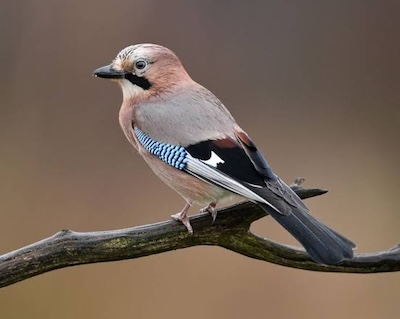
Under an abruptly darkening sky, I enter the park and the uncertain terrain of rosemary-picking. Plants in a public park: it would never occur to me to pick flowers in one and take them home since they’re for everybody to look at and enjoy. But a bush, herbs, green, largely unnoticed, simply wasted if not used. . . the case is altered, surely. Nevertheless, I aim for discretion and scan the park. Two women with dogs on the grassy slope; a woman with a child in a pushchair walking towards me on the path. Progress is arrested by the sight of a jay, landing on a nearby wooden post. It lingers for ten, fifteen seconds. I stand and stare. Eventually, it moves, I move. The woman says, in passing: ‘Pretty birds, aren’t they?’ Always the loquacious Englishman, I say ‘Yes, very’, moving on to stock up on rosemary and continue my walk into a sunshine resuming its humorous campaign.


In another campaign, the fallout from the presidential debate in Philadelphia on Tuesday night was still dominating the media, and I could still amuse the Librarian by abruptly announcing: ‘They’re eating the dogs!’ but the joke, if that’s what it is, is a dark one. Like a great many other people – at least I hope so, I’m baffled by this stuff much of the time, by those ‘undecided voters’, let alone those determined to make America hate again.

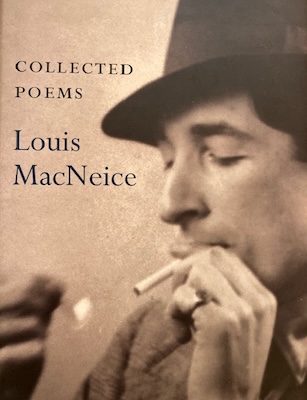
I realised later that it was the birthday of Louis MacNeice, a fine poet who also kept a wary eye on the political weather and who died at the absurdly young age of 55. Thinking of how the wrong things keep happening and the wrong people ending up on top almost invariably, and how far, how much, if at all, the rest of us can be said to bear responsibility, I noted the lines in his Autumn Journal:


And at this hour of the day it is no good saying
            “Take away this cup”;
Having helped to fill it ourselves it is only logic
            That now we should drink it up.
Nor can we hide our heads in the sand, the sands have
            Filtered away;
Nothing remains but rock at this hour, this zero
            Hour of the day.[2]

‘Responsibility’ is a handy word. Delmore Schwartz’s famous short story, ‘In Dreams Begin Responsibilities’, which gave his first volume its title, has the narrator watching, on a movie screen, the time just before the beginning of his own life, his parents moving towards their disastrous marriage, which will have a lasting and damaging effect on the poet. He’s ejected from the cinema after shouting at the screen—’“What are they doing?”’—and wakes up ‘into the bleak winter morning of my twenty-first birthday, the windowsill shining with its lip of snow, and the morning already begun.’[3]

But I was thinking too of the close of Robert Penn Warren’s fine novel, All The King’s Men : ‘soon now we shall go out of the house and go into the convulsion of the world, out of history into history and the awful responsibility of Time.’[4] The connection is with MacNeice, because of that poet’s relationship with Eleanor Clark in 1939-40. When MacNeice was invited by F. R. Higgins to join the Irish Academy of Letters, it was to Eleanor that he wrote about it, saying that ‘The Irish Academy of Letters meets once a year in Dublin’s only decent restaurant and gets so drunk they have to send the waiters away.’[5] Clark grew up in Connecticut, went to  Vassar in the 1930s, and worked on their literary magazine with Elizabeth Bishop and Mary McCarthy, among others. She wrote for left-leaning magazines and journals such as The Partisan Review, thought of herself for a while as a ‘Trotskyite sympathizer’ and went to Mexico in the late 1930s. Apparently, she did some translating for Trotsky and was married for a while to his Czech secretary, Jan Frankl. She wrote novels, essays and reviews, children’s books and a memoir, but was probably best-known for her travel books, Rome and a Villa and The Oysters of Locmariaquer. She married Robert Penn Warren in 1952 and died in 1996, aged 82, seven years after Warren himself.


(Eleanor Clark and Robert Penn Warren at their summer home in West Wardsboro, Vermont, 1986: Kentucky Library and Museum)

The novelist Nicholas Mosley once wrote that ‘Humans can either learn – or refuse to believe that humans are responsible for themselves.’[6] My favourite use of ‘responsibility’, though, is probably that of the hugely influential Trinidadian radical historian, journalist and political theorist, C. L. R. James, who adopted, in his early years, William Makepeace Thackeray’s Vanity Fair as the book: ‘By the time I was fourteen I must have read the book over twenty times’. And he adds, a little later: ‘Thackeray, not Marx, bears the heaviest responsibility for me.’[7]

That radical, Thackeray!

Notes


[1] William Shakespeare, Hamlet, IV. v.; Laura Cumming, Thunderclap: A memoir of art and life & sudden death (London: Chatto & Windus, 2023), 61.

[2] Louis MacNeice, Collected Poems, edited by Peter McDonald (London: Faber, 2007), 111.

[3] Ilan Stavans, editor, The Oxford Book of Jewish Short Stories (New York: Oxford University Press, 1998), 165.

[4] Robert Penn Warren, All The King’s Men (1946; Harmondsworth: Penguin, 2007), 661.

[5] Louis MacNeice, Letters of Louis MacNeice, edited by Jonathan Allison (London: Faber, 2010), 351.

[6] Nicholas Mosley, Efforts at Truth: An Autobiography (London: Minerva , 1996), 299.

[7] C. L. R. James, Beyond a Boundary (1963; London: Vintage, 2019), 24, 52.

Words, things, words for things


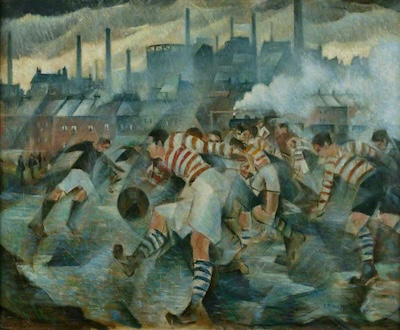
(C. R. W. Nevinson, Any Wintry Afternoon in England: Manchester Art Gallery)

Walking on the wide path in the park, I see a football rolling determinedly towards me over the grass, two boys watching, a long way off. I trap it, nudge and kick. It travels a fair distance but nowhere near the waiting boys. A woman walking towards me on the path says: ‘One of my irrational fears, a ball coming at me like that.’ I say: ‘One of mine too now’, and she laughs. ‘Oh, you did okay.’

Did I, though? Not the kick, that was what it was but. . . irrational fears? If it were now one of mine because of that episode, it’s not irrational but quite rational, reasoned, based on solid, empirical evidence, so. . .Don’t overthink it! the Librarian says, often in person and now in my head. Don’t overthink things!

Ding, ting, chose, cosa, peth, rud, shay, hlutur: thing. . . ‘The distinguished thing’ was Henry James’s famous phrase for death. Did he actually say it? Following a reference to Edith Wharton’s A Backward Glance, I see that there’s an extra link or two: ‘He is said to have told his old friend Lady Prothero, when she saw him after the first stroke, that in the very act of falling (he was dressing at the time) he heard in the room a voice which was distinctly, it seemed, not his own, saying: “So here it is at last, the distinguished thing!”’ Wharton adds: ‘The phrase is too beautifully characteristic not to be recorded.’[1] It’s certainly wonderfully—and characteristically—indefinite, or at least, on a very convoluted path: ‘He is said’ to have told someone else that he heard a voice which wasn’t his own, the word ‘distinctly’ applied only to a negative, ‘not his own’ and, even then, ‘it seemed’.


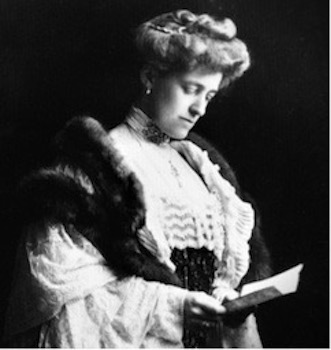
(Edith Wharton via BBC)

Death as ‘the thing’ (Death! Where is thy thing?) – while for Edna St Vincent Millay, death was not the thing but the force engulfing it:

Death devours all lovely things:
   Lesbia with her sparrow
Shares the darkness,—presently
   Every bed is narrow.[2]

The line ‘Every bed is narrow’ I take to refer to coffins (rather than, or as well as, singleness or separation), and it also recalls Pound’s ‘Homage to Sextus Propertius’. ‘We, in our narrow bed, turning aside from battles:/ Each man where he can, wearing out the day in his manner.’[3]

And yet – I was thinking, at the outset, more of things than of death; or rather, words and things, particularly the word ‘thing’. Impressively, its origin seems to embrace both ‘object’ and ‘parliament’. The definitions are lavish: an assembly, court, council, matter, affair, problem, fact, event, action, that which exists or can be thought of, a living creature, a piece of writing; in the plural, clothes, personal belongings. What a word, what a world, ‘thing’ is!

While an inmate of the Disciplinary Training Center at Metato, north of Pisa, in the autumn of 1945, Ezra Pound wrote:

   And for all that old Ford’s conversation was better,
consisting in res non verba,
          despite William’s anecdotes, in that Fordie
   never dented an idea for a phrase’s sake
and had more humanitas [4]

Things, not words for things. Pound was reiterating his belief in those opposing—or complementary—positions, Ford as realist, Yeats as symbolist, that he proposed on more than one other occasion.[5] Poignantly, they were both just six years dead – the length of a world war, say.

That ‘humanitas’ had led the youthful Ford to rashly discuss the conditions of the London poor with a young woman he took out in a boat, only to be reproved the next day by her mother, Lady Cusins: ‘“Fordie, you are a dear boy. Sir George and I like you very much. But I must ask you not to talk to dear Beatrice … about Things!”’[6]

(Iris Barry)

Ford had actually written to Iris Barry (4 July 1918): ‘I have always been preaching to people not to write “about” things but to write things—& you really do it—so I like to flatter myself that you are an indirect product of my preachings—a child of my poor old age.’ (He was still serving in the British Army, having by then reached the ‘poor old age’ of 44.)[7]

Ralph Waldo Emerson also fished in those waters: ‘The corruption of man is followed by the corruption of language’ and ‘new imagery ceases to be created, and old words are perverted to stand for things which are not’. But ‘wise men pierce this rotten diction and fasten words again to visible things’.[8] This linking of words and things would have some later commentators and theorists tearing their hair out, words for them being quite arbitrary marks on the page, the word for something not otherwise  linked to that something. Lord Byron though, as so often, pursued his own path:

But words are things, and a small drop of ink,
Falling like dew upon a thought, produces
That which makes thousands, perhaps millions, think.[9]

And as if by magic, an email just arrived from PN Review offers, from its archive, ‘Holà’, a short poem by C. H. Sisson from 1992, which is also concerned with words and things:

Words do not hold the thing they say: 
Say as you will, the thing escapes 
Loose upon air, or in the shapes 
Which struggle still before the eyes. 
Holà will run upon its way 
And never catch up with its prize.[10]


Later in my park walk, halfway down a steepish path, I see a woman ahead of me with a child in a pushchair and a dog crouched in the grass nearby, with a ball in its mouth. It looks at me inquiringly. ‘I’m afraid not’, I say. ‘You’re not my dog and that ball is covered with slobber, as we both know.’ The woman is partly blocking the path where it meets the wider track, talking on her phone and with her back to me, but moves to one side as I approach. The dog lies down close by her and lets the ball drop from its mouth. She half-turns and kicks the ball, which rockets cleanly away for a good distance – and apparently just where she meant it to go. Damn, I think, she only needed to be a bit better than me to make the point. What point? That I shall not overthink it. . .


Notes

[1] Edith Wharton, Novellas and Other Writings: Madame de Treymes, Ethan Frome, Summer, Old New York, The Mother’s Recompense, A Backward Glance, edited by Cynthia Griffin Wolff (New York: Library of America, 1990), 1055.

[2] Millay, ‘Passer Mortuus Est’ (first of three stanzas), in F. O. Matthiessen, The Oxford Book of American Verse (New York: Oxford University Press, 1950), 886. As is often noted, Millay here references Catullus 2, about the death of his lover Lesbia’s sparrow, her ‘plaything’: The Poems of Catullus, translated with an introduction by Peter Whigham (Harmondsworth: Penguin Books, 1966), 52.

[3] Ezra Pound: Poems and Translations, edited by Richard Sieburth (New York: Library of America, 2003), 535.

[4] Canto LXXXII, The Cantos of Ezra Pound, fourth collected edition (London: Faber and Faber, 1987), 525. I have tried—and failed—to insert the ideogram, ‘jen’.

[5] Ezra Pound, Polite Essays (1937; Plainview, New York: Books for Libraries Press, 1966), 50; Pound/ Williams: Selected Letters of Ezra Pound and William Carlos Williams, edited by Hugh Witemeyer (New York: New Directions, 1996), 187.

[6] Ford Madox Ford, Return to Yesterday: Reminiscences 1894-1914 (London: Victor Gollancz, 1931), 75.

[7] Ford Madox Ford, Letters of Ford Madox Ford, edited by Richard M. Ludwig (Princeton: Princeton University Press, 1965), 87.

[8] Ralph Waldo Emerson, Selected Essays, edited by Larzer Ziff (Harmondsworth: Penguin Books, 1982), 51.

[9] Lord Byron, Don Juan, III:88, edited by T. G. Steffan, E. Steffan and W. W. Pratt (London: Penguin Books, 1996), 182.

[10] PN Review 87 (September–October 1992), 28.

Words made flesh, flash, at a trumpet crash


(‘The Ash Yggdrasil’ from Aasgard and the Gods, by Wilhelm Wägner)

‘I remember going on to think that Ragnarök seemed “truer” than the Resurrection’, the narrator of A. S. Byatt’s story, ‘Sugar’, writes, having known, as a child, the 1880 book Asgard and the Gods.[1]

There’s a peculiar fascination about those moments in a work of art when other practitioners are evoked, quoted or alluded to, especially when the source is altered. Often enough, this is because the writer is quoting from memory: while George Orwell usually announces that he’s about to do so, others engage in the same practice without any such explicit statement, not infrequently getting things almost—but not quite—right. In a letter to G. K. Chesterton (6 July 1928), T. S. Eliot wrote: ‘The last time that I ventured to quote from memory in print, a correspondent [ . . . ] pointed out that I had made twelve distinct mistakes in well-known passages of Shakespeare.’[2] Joseph Conrad used lines from Spenser’s Faerie Queene (I, ix, 359-360) as the epigraph to his novel The Rover (1923), and the same lines were  later incised on his gravestone at Canterbury: ‘Sleep after toyle, port after stormie seas,/ Ease after warre, death after life does greatly please’. When they reappeared at the close of the ‘English’ text of Ford Madox Ford’s No Enemy (there is an appendix with the original French version of an earlier chapter in English), there were a few differences. ‘Sleep’ becomes ‘rest’ (a resonant word in Ford’s writings), ‘ease after warre’ is excluded, even though Ford wrote much of the book in 1919, having just been gazetted out of the British army after serving both at home and in France and Flanders, ‘death after life’ goes too, since he is celebrating survival, if among a number of ghosts. This is far from simple ‘misquoting’ or ‘misremembering’.[3]


There’s a moment in Dorothy Sayers’ 1934 novel, The Nine Tailors—‘O my, what a lovely piece of work’, Guy Davenport commented, having just read Sayers’ book—when Lord Peter Wimsey, watching a coffin go off up the road, slips into reverie, or stream of consciousness, and suddenly comes up with a chunk of what was immediately familiar to me, though it took a minute or two to identify it as a poem by Gerard Manley Hopkins called ‘That Nature is a Heraclitean Fire’:

                            ‘In a flash, at a trumpet crash,
I am all at once what Christ is, | since he was what I am, and
This Jack, joke, poor potsherd, | patch, matchwood, immortal diamond,
                            Is immortal diamond.’[4]

These are characteristically arresting lines, but the poem’s full title is ‘That Nature is a Heraclitean Fire and of the Comfort of the Resurrection’, and there is a striking gap, an elision, in the passage that occurs in Wimsey’s thoughts: the line, ‘I am all at once what Christ is, | since he was what I am, and’, is missing.[5]

Hopkins wrote to his friend, the poet Robert Bridges, on 25 September 1888, that, while the sonnet he’d recently sent Bridges on the Heraclitean fire had distilled a lot of early Greek philosophical thought, perhaps ‘the liquor of the distillation did not taste very Greek’. He added: ‘The effect of studying masterpieces is to make me admire and do otherwise’—which seems eminently reasonable.[6]


(Gerard Manley Hopkins)

Hopkins—Jesuit priest, classics professor—is, as W. H. Gardner wrote, ‘a religious, not merely a devotional, poet. Religion, for him, was the total reaction of the whole man to the whole of life’ (‘Introduction’ to Poems, xxxv). A good many of his poems are addressed directly and vividly to God, as in the first stanza of the first major poem, ‘The Wreck of the Deutschland’:

Thou mastering me
God! giver of breath and bread
World’s strand, sway of the sea;
Lord of living and dead
Thou has bound bones and veins in me, fastened me flesh,
And after it almost unmade, what with dread,
Thy doing: and dost thou touch me afresh?
Over again I feel thy finger and find thee.

‘The Windhover’ is dedicated ‘To Christ our Lord’, ‘Pied Beauty’ begins: ‘Glory be to God for dappled things’, ‘The Loss of the Eurydice’ is addressed ‘O Lord’ and a late sonnet begins: ‘Thou art indeed just, Lord, if I contend/ With thee’. The ‘terrible sonnets’, evidence of great stress, even ‘desolation’, also centrally concern his relationship with God:

I am gall, I am heartburn. God’s most deep decree
Bitter would have me taste: my taste was me;
Bones built in me, flesh filled, blood brimmed the curse.[7]


Religious themes featured early in Sayers’ writing life and became more central later, in her many plays and her translation of Dante’s Divine Comedy. This rector’s daughter may have had both father and rectory in mind when she wrote The Nine Tailors. Mr Venables is scholarly, very amiable and extremely absent-minded, and Lord Peter Wimsey comes to regard him with affection and respect. Could Sayers have felt that the line she omitted from Hopkins’ poem might have seemed blasphemous to some readers, an issue further complicated by its occurring in her hero’s thoughts? At one point, Wimsey is confronted by a visiting card on a wreath, purporting to be from him but actually supplied by his manservant Bunter (who had been Sergeant to Major Wimsey in the First World War). The card includes a biblical reference, Luke xii, 6. ‘“Very appropriate,” said his lordship, identifying the text after a little thought (for he had been carefully brought up)’ (The Nine Tailors, 133). It’s probably safe to assume that Sayers too had been ‘carefully brought up’ in that respect.


Notes

[1] A. S. Byatt, Medusa’s Ankles: Selected Stories (London: Vintage, 2023), 37. Her Ragnarok: The End of the Gods was published in 2011.

[2] Quoted in a note to the epigraph of ‘Gerontion’, in The Poems of T. S. Eliot. Volume I: Collected and Uncollected Poems, edited by Christopher Ricks and Jim McCue (London: Faber & Faber, 2015), 469.

[3] Paul Skinner, ‘Just Ford – an Appreciation of No Enemy: A Tale of Reconstruction’, Agenda, edited by Max Saunders, 27, 4/ 28, 1 (Winter 1989/ Spring 1990), 103-109 (105).

[4] Poems of Gerard Manley Hopkins, Fourth edition, revised and enlarged, edited by W. H. Gardner and N. H. Mackenzie (London: Oxford University Press, 1967), 105-106. These are the last lines of the poem.

[5] The Nine Tailors (1934; with an introduction by Elizabeth George, London: New English Library, 2003), 122. Davenport’s enthusiasm (he writes the title as The Nine Taylors) is expressed in a letter to Hugh Kenner, 10 April 1967: Questioning Minds: The Letters of Guy Davenport and Hugh Kenner, edited by Edward M. Burns, two volumes (Berkeley: Counterpoint Press, 2018), II, 888.

[6] The Letters of Gerard Manley Hopkins to Robert Bridges, edited by Claude Colleer Abbott (Oxford: Oxford University Press, 1955), 291.

[7] ‘I wake and feel the fell of dark’, Poems, 101.

Taking liberties


(A. Webster, ‘An Oriental Harbour’, National Trust for Scotland, Castle Fraser, Garden & Estate)

Walking back from the long round of the Victorian cemetery, still early, the Librarian remarks that this would be ‘a good Harry day’. As it would: the sun already high, little or no cloud, barely a breath of wind, soon to be around 26 degrees or so – as high as 30 (that’s 86 degrees in American money). The back garden will be warm and calm, idyllically so for animals that worship sun and sleep.

Not much later, I am aboard the Al Raza, not a classic dhow, locally known as ‘a launch’, some sixty feet long, ‘decidedly stubby, and her single mast was more like a twig than a tree and carried no sails.’ The craft is ‘a working launch of 100 tons and looked it.’ A crew of eight, including the nakhoda, the ship’s master, all Baluchis except one Indian-born and one Iranian. When engine trouble forces them to drop anchor off the coast of Iran, Gavin Young, whose earlier reading on the trip has included Ford Madox Ford’s Memories and Impressions, and who repeatedly cites Joseph Conrad, turns to his copy of Helen MacInnes’s Decision at Delphi.[1]

Just then, a white rabbit passed me, plucking a pocket watch from his waistcoat and audibly murmuring that he mustn’t be late, before popping down a large rabbit-hole under the hedge. Naturally, having recently reread the Alice books for Fordian purposes, I followed.

Now, MacInnes. Surely Hammond? Scottish, 30-odd novels and other books. Had I not read one or two? The Wreck of the Mary Deare, perhaps? Levkas Man? The rabbit rolled its eyes. Of course – I was misremembering, actually thinking of Innes, Hammond Innes. Helen MacInnes (1907-1985), whom I then looked up, did an MA at Glasgow University in French and German and added a diploma in librarianship from University College, London. She married, translated from the German with her husband, travelled widely in 1930s Europe, taking copious notes along the way, and moved to the United States when her husband, a fellow of St John’s College, University of Oxford, was offered a chair at Columbia University, teaching Latin and Greek. She published more than 20 books, mainly espionage novels, and several were filmed. Decision at Delphi was her 11th published novel.


(Helen MacInnes in 1941)

Her husband was Gilbert Highet, classicist – and MI6 intelligence agent. That name rang a bell. Careful to avoid the white rabbit’s gaze, I leafed through various mental pages and turned up Ezra Pound and Sextus Propertius.

Pound’s Homage to Sextus Propertius appeared in part in Poetry (March 1919) and in volume form seven months later, though he’d written to his parents as early as 1910: ‘I’ve taken to Propertius’.[2] And, decades later, it was Highet who wrote, in Horizon (January 1961), that Pound’s Homage was ‘an insult both to poetry and to scholarship and to common sense.’[3]

It’s true that, beginning with Professor William Gardner Hale of Chicago, against whose emphatic protests Harriet Monroe reluctantly published four of twelve sections in Poetry, a good many classical scholars have clutched their pearls in outrage at this iconoclastic American taking such liberties with a canonical writer—one of theirs.

Annalists will continue to record Roman reputations,
Celebrities from the Trans-Caucasus will belaud Roman celebrities
And expound the distensions of Empire,
But for something to read in normal circumstances?
For a few pages brought down from the forked hill unsullied?
I ask a wreath which will not crush my head.
            And there is no hurry about it

The poet Charles Tomlinson headed his selection from the poem ‘A travesty of Propertius’ Latin’, but his grasp of what Pound was doing meant that there was no contradiction between that heading and his terming the poem a masterpiece.[4] In another Oxford anthology, Adrian Poole and Jeremy Maule quote Pound’s ‘rampant defence’ of his poem in a letter to A. R. Orage on the first page of their introduction: ‘My job was to bring a dead man to life, to present a living figure’ and begin their Part 7, ‘Propertius to Hadrian’, with Pound’s superb section VII.

Though you give all your kisses
                                    you give but few.

Nor can I shift my pains to other,
            Hers will I be dead,
If she confer such nights upon me,
                                    long is my life, long in years,
If she give me many,
                        God am I for the time.

As Poole and Maule rightly say, ‘Translators must take liberties. They are in any case bound to be accused of having done so.’[5] Indeed, the history of translation and its reception is littered with the husks of those who knew the classical texts but had no sense of living English. George Steiner writes in his introduction: ‘A first look at nearly any translation in this anthology is enough to show whether it comes before or after’ the Homage, adding: ‘But the “making new” of translation had already occurred in Personae (1909) and Provença (1910). After “The River Merchant’s Wife” (1915) the art of translation had entered its modern phase.’[6]


The critic F. R. Leavis, highly influential in his time, wrote appreciatively of Hugh Selwyn Mauberley but Hugh Kenner, in ‘The Making of the Modernist Canon’ (1984), remarks on how Henry James’s ‘habits of diction were refracted throughout a poem Leavis nowhere mentions, Pound’s Homage to Sextus Propertius. That was a central modernist discovery, that distinctions between “prose” and “verse” vanish before distinctions between firm writing and loose’.[7] Kenner also touches there on  Imaginary Letters (1917-18), a series in the Little Review, begun by Wyndham Lewis and continued by Pound when Lewis was transferred to France. One striking feature of Pound’s ‘Imaginary Letters’ is the extent to which their texts would not look out of place in the Homage. Much of this is to do with the varied registers of language, mixing contemporary diction, poeticisms, large-mouthed polysyllables and the careful use of plain often monosyllabic words for some of Propertius’ reflections on love, death or fate. To that extent, his poem’s real subject is language, the intimate relation between a country’s language and its cultural health, the differences between public and private pronouncements, the strategies of a ruling class entrenched behind fortifications of rhetoric and generality. The disorientation that a reading of the poem can produce results in part from the multiplicity of voices Pound employs: Propertius as conventionally heard and as Pound hears and presents him; Victorian or earlier translators; contemporary English poets (in that last year of the war). Perhaps unsurprisingly, not a few readers these days rate the Homage even above Mauberley. It was, and remains, an astonishing achievement, by turns provocative, moving and funny.

I have, of course, ordered a copy of MacInnes’s Decision at Delphi – and also a copy of Assignment in Brittany, her second book, which became, apparently, required reading for British agents joining forces with the French resistance.


Notes

[1] Gavin Young, Slow Boats to China (1981; London: Picador, 1995), 269, 278. His In Search of Conrad, published in 1991, won the Thomas Cook Travel Book Award.

[2] Ezra Pound to His Parents: Letters 1895–1929, edited by Mary de Rachewiltz, David Moody and Joanna Moody (Oxford: Oxford University Press, 2010), 239. His letter of 3 November 1918 has: ‘Also done a new oeuvre on Propertius’ (423).

[3] Quoted by J. P. Sullivan, Ezra Pound and Sextus Propertius: A Study in Creative Translation (London: Faber and Faber, 1965), ix.

[4] The Oxford Book of Verse in English Translation, Chosen and Edited by Charles Tomlinson (Oxford: Oxford University Press, 1980), 443; Tomlinson, Poetry and Metamorphosis (Cambridge: Cambridge University Press, 1983), 59. The book contains the four 1982 Clark Lectures, delivered at Trinity College, Cambridge.

[5] The Oxford Book of Classical Verse, edited by Adrian Poole and Jeremy Maule (Oxford: Oxford University Press, 2000), xxxv, 423.

[6] George Steiner, editor, The Penguin Book of Modern Verse Translation (Harmondsworth: Penguin Books, 1966), 33. In his introduction to The Translations of Ezra Pound (enlarged edition, London: Faber and Faber, 1970), Hugh Kenner remarks: ‘Pound calls the Propertius sequence a Homage, largely in a futile attempt to keep it from being mistaken for an attempt at translation’ (12-13). He does not include the poem in that volume.

[7] Reprinted in Hugh Kenner, Mazes (Athens: University of Georgia Press, 1995), 31. ‘Major snow job in western education is concealment of the hit & miss state of Graeco-Roman texts, all but a few’, Kenner wrote to Guy Davenport (8 June 1962).  ‘Ez rearranged Propertius fragments in the spirit of the scholarship that gave us the standard texts by—arranging fragments’: Questioning Minds: The Letters of Guy Davenport and Hugh Kenner, edited by Edward M. Burns, two volumes (Berkeley: Counterpoint Press, 2018), I, 137.