Dusks and darks

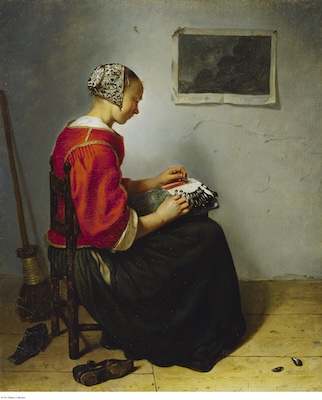
(Caspar Netscher, The Lace Maker, Wallace Collection)

‘In a mid-September twilight’, Ford Madox Ford writes, remembering himself as Second Lieutenant in September 1916, ‘the rain poured down on Pont-de-Nieppe.’ He is bothered by his wet shirt-cuffs and the man assigned to him as temporary batman has clearly decided that Ford is not a man who can be safely left and, ‘though he must have been uncommonly wet and hungry and tired, he followed me to the door of the house in whose dark windows I had seen the luminous patch—the forehead of Rosalie Prudent as she sat sewing, her head bent forward, in the twilight.

‘I don’t know how it is: but from the moment when I first saw that highlight—and it had been certainly three hours before—I had been perfectly sure that that was what it was—the forehead of a quiet woman bending her head forward to have more light from the high window whilst she sewed in the dusk.’

This is Rosalie Prudent of Pont-Nieppe, who has lost her house, her husband and her sons, and is one of the most significant figures that Lieutenant Ford Madox Hueffer—a man at the end of his tether and a writer who cannot write—will encounter during the war. She will sit by the stove in the wash-house, sewing his wristbands. She will cook him an omelette and fried potatoes, talk to his orderly and, ‘looking at Mme. Rosalie—so extremely centred in the work in hand, so oblivious to the very real danger, so brave and so tranquil, I said to myself:
“What the devil! If she can stick it, I too can!”’[1]

And he will. He is one young Australian artist and one five shilling a week cottage away from salvation: ‘The dusk was falling as I approached my isolated, sixteenth century abode that had a leaky, red-tiled roof and defective diamond-framed casements. It stood under a darkling bank. . . . And you think that the half-crown dog was an extravagance! I assure you that he was not. The floors sagged, the paper fell in scrolls from the walls. There was more than a bushel’s bulk of starling’s nest in the downstairs ingle.’[2]

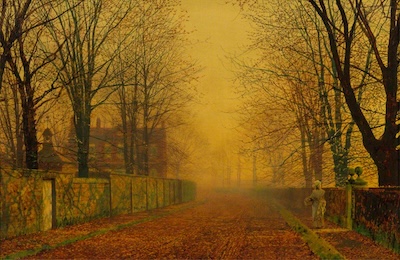
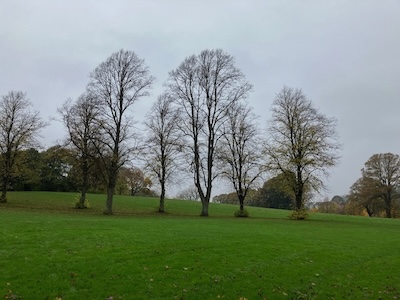
Back in the day—ah, those days—I read, as did half the people I knew at the time, the books of Carlos Castaneda or, at least, the first three or four. Much of it, even the unfolding controversy, is a little cloudy now, but I do recall the assertion that: ‘The twilight is the crack between the worlds.’ Or rather, I recalled it as I made my way around the park a day or two back as the light slipped further down into its last phase before incontrovertible darkness.

(John Atkinson Grimshaw, Evening Glow: Yale Center for British Art)

If that is in fact the case, some of the denizens of that other world are a little unsettling. As is, of course, the possibility that I myself am, in fact, an inhabitant of the ‘other’ world.

There seem to be more people than usual devoting their time to shouting into phones or at dogs, heard rather than seen, or glimpsed between branches or benches. A man wearing a cloth cap and an alarming neck tattoo scatters broken biscuits from a bag as he walks, to more than a dozen crows and one slightly shifty magpie (‘Yeah, I’m a crow. Who’s asking?’). A second man passes me, marching like a robot, legs thrown out, with a can of beer gripped in each outstretched hand; a teenaged schoolgirl, one of three, having an emotional moment, turns her tearstained face away from me as I pass and one of her friends says: ‘I didn’t meant to hurt you, Lily, but you shouldn’t have said—‘. And on an upper path, a woman running towards me; I cross over to make room for her; she smiles and turns sharply into the play area ten yards ahead, to crouch in front of a swing on which her child is sitting, watched over by a friend.

Vladimir Nabokov mentions ‘soomerki—the lovely Russian word for dusk.’[3] It is, or can be, oddly different, the air itself a different texture or the mind made more receptive to such notions by the slippage in other senses: sounds half-heard and harder to locate, things not quite seen. A Golden Labrador with one of those illuminated collars races through a thick ribbon of trees that borders a lower path, a ghost dog that has me wracking my brains to come up with Jim Jarmusch’s 1999 film, Ghost Dog: The Way of the Samurai, with Forest Whitaker as the hitman. A group of dog-owners I passed earlier did look and sound like contract killers but that may have been down to the special sound qualities of this twilight zone.

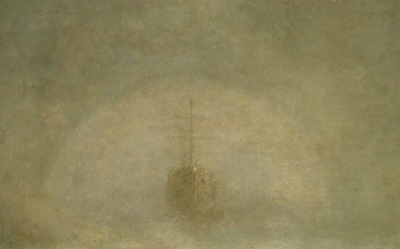
(G. F. Watts, A Sea Ghost: Watts Gallery – Artists’ Village)

‘It is the magic hour’, Lawrence Durrell wrote, ‘between two unrealized states of being—the day-world expiring in its last hot tones of amber and lemon, and the night-world gathering with its ink-blue shadows and silver moonlight.’[4] The colours may be a little different in Corfu, as emotional responses might have been a little more accentuated in Emerson’s nineteenth-century New England: ‘Crossing a bare common, in snow puddles, at twilight, under a clouded sky, without having in my thoughts any occurrence of special good fortune, I have enjoyed a perfect exhilaration. I am glad to the brink of fear.’[5]

Richard Garnett (father of Edward and Olive, father-in-law of Constance) wrote about The Twilight of the Gods (as did Richard Wagner); Nietzsche wrote about the Twilight of the Idols; D. H. Lawrence wrote of Twilight in Italy; Edith Wharton was concerned with Twilight Sleep; a volume of Conan Doyle stories was called Tales of Twilight and the Unseen.  ‘I drove carefully’, the private eye Lew Archer says, ‘feeling a little depressed, stalled in the twilight period when day has run down and night hasn’t picked up speed.’[6]

We’re just a week away from the winter solstice, the shortest day, the longest night. Beyond that date, of course, the days get longer, inch by inch. Grounds for optimism, some say. And why not? Just mind the cracks—and, of course, those worlds.


Notes

[1] Ford Madox Ford, No Enemy (1929; edited by Paul Skinner, Manchester: Carcanet Press, 2002), 117, 127, 124.

[2] Ford Madox Ford, ‘Rough Cookery’, New York Herald Tribune Magazine (29 July 1928), 18.

[3] Vladimir Nabokov, Speak, Memory: An Autobiography Revisited (New York: Putnam’s, 1966), 81.

[4] Lawrence Durrell, Prospero’s Cell (London: Faber 1962), 105.

[5] Ralph Waldo Emerson, ‘Nature’, Selected Essays, edited by Larzer Ziff (Penguin American Library, 1982), 38.

[6] Ross Macdonald, The Moving Target (1949; Warner Books, 1990), 98.

Pictures and Cathedral Closes

05:30 on the morning of another named storm, wind gusting like a fanatic and the tall, elaborate scaffolding at a house behind us, and three doors along, grinds and clacks and shrieks. It seems impossible that so much noise can result in no hazardous movement, no damage, no change in look or structure. And yet – collapsed scaffolding would be so absurdly appropriate, so ridiculously, symbolically pitch perfect, that I could never have taken either weather or metalwork seriously again.

Earlier this month, having avoided the news for the previous week, I’d lost track of the days, until I was walking away from coffee with my elder daughter and, halfway along the harbourside path, heard behind me the strains of a piper playing A Long Way To Tipperary. Armistice Day. A lengthy history but feeling a little awry when the world is so excessively out of true. Veterans of one world war utterly gone, veterans of the other all but gone. And, thinking of what the Second World War is believed to have been fought against, and of victory declared, and to look around the world now is. . . a little odd.

The good stuff is elsewhere. Indeed, the Decline of the West, though accelerating madly in recent months, seems oddly absent in West Sussex, where we go to spend a few days in Chichester for the Librarian’s birthday.

A quick shopping trip. What do we need? Wine and . . . something or other to go with it. And here is the Cathedral Close, Canon Lane, the Bishop’s Palace, St Richard’s Walk and the Deanery, which dates from 1725 and was itself a replacement for an earlier building, damaged in 1642, during the English Civil War. Key in the code and close the door and take in a roomy and well-appointed apartment with, unignorably, a television four or five times the size we’re used to. Could anything make the current dramatisation of Hilary Mantel’s The Mirror and the Light even more remarkable? Apparently so.

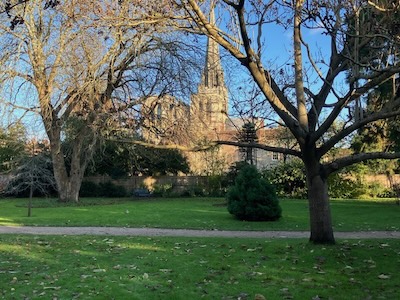
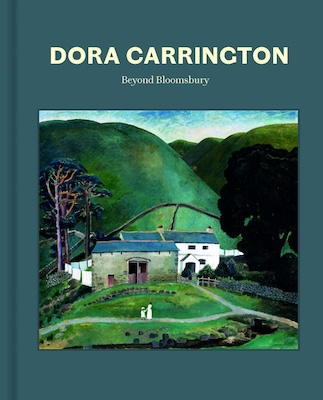
An excellent Carrington exhibition at the Pallant House Gallery: I’ve seen the Lytton Strachey portrait before but am convinced now that his fingers grow even more elongated under cover of darkness. The drawing of her brother is perfect; and the two portraits of Annie Stiles, seen together, are hugely pleasing. A scattering of works by Mark Gertler too, a significant presence in Carrington’s life, both personally and professionally: they include the portrait of Gilbert Cannan and His Mill, familiar from several visits to the Ashmolean in Oxford. Somehow, it strikes me as a little odder every time I see it. A few steps away from the building where we’re staying, we find an arresting anthology of birds, curious plants and extraordinary trees in the Bishop’s Palace Garden. Then a walk, nearly one and a half miles, following the surviving city walls, some traceable to the 3rd century. A bus trip to Selsey. And the Cathedral.

(Sutherland, Noli me Tangere and the Marc Chagall window)

‘I can stand a great deal of gold’, Henry James murmured to Desmond MacCarthy, as they stood in an exceptionally gilded drawing-room.[1] I can, it seems, stand a great deal of cathedrals. Poised on that delicate boundary between agnostic and atheist (finding it ultimately as absurd to state dogmatically that there isn’t as to state dogmatically that there is), I may attend evensong too (we did, liking to be sung to), though declining to recite the Apostle’s Creed, for obvious reasons.

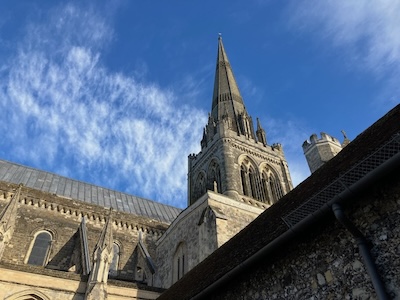
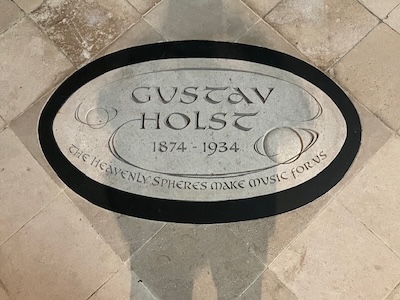
But the Cathedral. I’ve been to Durham, Wells, Exeter, Salisbury, Christchurch, St Paul’s, Hereford, Bristol. Different settings, different grandeurs. Here—among much else, stained-glass windows, statuary, painted panels, altarpieces—is Graham Sutherland’s Noli me Tangere, and two huge tapestries, one by John Piper and the other co-created by Ursula Benker-Schirmer and West Dean College students. There is a stunning Marc Chagall window, installed in 1978, and Gustav Holst’s ashes are buried in the North Transept.

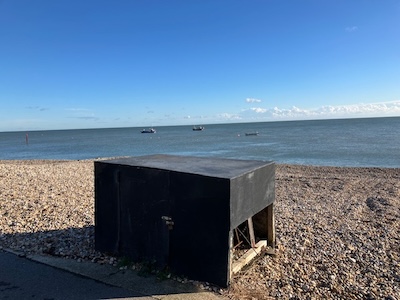
Then Selsey: the Ford Madox Ford connection, of course, Violet Hunt having rented a cottage from Edward Heron-Allen, she and Ford spending much time there before—and during—the war. Little of that remaining in Selsey – but fascinating to learn that the monastery here, founded by St Wilfrid in 681, became the first cathedral in Sussex, until 1076, when the see of Chichester was established.

On the morning we leave: snow. Knowing how bad we continue to be in this country at dealing with any weather event out of the ordinary—even thought the formerly extraordinary is increasingly now the unremarkable—we skip brunch in the Cloisters café and head for the station. And yes, trains cancelled, delayed, signal failures, the whole nine yards, as our American cousins say – to whom we warily extend our sympathy (amidst our total and enduring bafflement). . .

Notes


[1] Leon Edel, The Life of Henry James: Volume 2 (Harmondsworth: Penguin Books, 1977), 680-681.

Darkness and Light

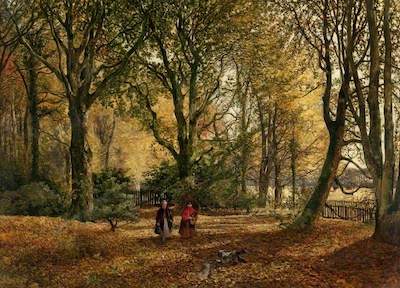
(John Milne Donald, Autumn Leaves: Glasgow Museums Resource Centre)

‘Darknesse and light divide the course of time, and oblivion shares with memory a great part even of our living beings; we slightly remember our felicities, and the smartest stroaks of affliction leave but short smart upon us.’[1]

The leaves are falling faster now, perhaps mostly fallen. Our clocks have gone back an hour and we are on Greenwich Mean Time. The polymath Edward Heron-Allen wrote in his journal on 22 May 1916, ‘The notable feature of the month is the establishment by law on the 20th of “summer time” which Willett, the originator of the idea, never lived to see introduced. At midnight on the 20th we all had to put our clocks on one hour, and in this way an hour of daylight is “added” to the day.’ And, five months later, he noted: ‘I do not think I have recorded that on 30 September we put our clocks back an hour and returned to Greenwich time.’[2]

William Willett, whose 1907 pamphlet, The Waste of Daylight, marked a crucial point in the advance towards ‘summer time’, had died from influenza on 4 March 1915, at the early age of 58, and is buried in St Nicholas churchyard in Chislehurst (as is his second wife.) The 1916 emergency law was passed to change the clocks twice a year as a measure to reduce energy and increase war production. It became a permanent feature when the Summertime Act was passed in 1925.

Leaves falling, darker days, the year in some ways closing down – but all these are in the natural order of things, as—or so we hope—the political convulsions, atrocities in Gaza, Lebanon, Ukraine, Sudan and elsewhere, are not. At least, as Jake Barnes says, at the close of Ernest Hemingway’s The Sun Also Rises, ‘Isn’t it pretty to think so?’

(John Berryman via The Paris Review)

‘Now there is further a difficulty with the light’, John Berryman wrote:

I am obliged to perform in complete darkness
operations of great delicacy
on my self.[3]

Currently those operations feature slow and sometimes painful analyses of my bafflement and confusion, not always helped by the Librarian’s daily bulletins from the battlefield that is the American election, often delivered in tones of appalled astonishment, while the phrase ‘batshit crazy!’ tends to recur.

What, in some senses, seems self-evident (one candidate sane, the other rather less so) is dwarfed by complexities and nuances almost invisible to us – we’re here and they’re. . . over there. I grasp, more or less, the fact that America is so divided a country now that neither side can—perhaps has no wish to—hear the other. But there is that other complication. While I can see that the appalling and spineless response of the Biden government to the conflict in the Middle East must repel a good many voters, it baffles me that those voters should think that withholding their vote from Harris (and thereby potentially contributing to her defeat) could somehow help the Palestinian people. Surely the precise opposite?

(John Donne, unknown English artist, c.1595)

Well, we’ll know soon enough. People, eh? I think of Katherine Rundell writing that, ‘amid all Donne’s reinventions, there was a constant running though his life and work: he remained steadfast in his belief that we, humans, are at once a catastrophe and a miracle.’ And: ‘He thought often of sin, and miserable failure, and suicide. He believed us unique in our capacity to ruin ourselves. “Nothing but man, of all envenomed things,/Doth work upon itself with inborn sting”. He was a man who walked so often in darkness that it became for him a daily commute.’[4]


Notes

[1] Sir Thomas Browne. Hydriotaphia, or Urn-Buriall, in Selected Writings, edited by Geoffrey Keynes (London: Faber  and Faber, 1970), 152.

[2] Edward Heron-Allen’s Journal of the Great War: From  Sussex Shore to Flanders Fields, edited by Brian W. Harvey and Carol Fitzgerald (Lewes: Sussex Record Society, 2002), 65, 71.

[3] John Berryman, ‘Dream Song # 67’, The Dream Songs, collected edition (New York: Farrar, Straus and Giroux, 1969), 74.

[4] Katherine Rundell, Super-Infinite: The Transformations of John Donne (London: Faber, 2023), 5-7.

By heart in the park

(Philip Wilson Steer, Dover Coast: York Art Gallery)

Another last warm and sunny afternoon of autumn. How many more can there be? With the Librarian in the office for a pretty full day, so not available for the lunchtime stroll, I walk alone in the park and succumb to the temptation to recall (and recite) the handful of poems that, at one time or another, I’ve committed to memory. Committed they may have been but seem, for the most part, to have escaped or at least to be out on parole.

Matthew Arnold’s ‘Dover Beach’ is worse than shaky and, in its current state, Marvell’s ‘To His Coy Mistress’ would probably not detain her for a moment. A bit of Pound, a bit of Yeats and a fragment of Elizabeth Bishop all hold steady, while a couple of others improve with work, which necessitates keeping a wary eye open – and an ear, given the increasing tendency of people to rush up behind you on bicycles or accursed electric scooters. Robert Lowell’s ‘Skunk Hour’ (dedicated to Bishop) yields a little to pressure:

Nautilus Island’s hermit heiress still
something something
her sheep still graze above the sea

Two men, walking briskly but not quite briskly enough, so staying almost exactly the same distance behind me, fairly close and, worse, very gradually nearing. . .

Her farmer
Is first selectman in our village;
she’s in her dotage.

We’re sailing now. Ah:

Thirsting for the hierarchic privacy
of Queen Victoria’s century,
she buys up all
the eyesores facing her shore,
and lets them fall.

(Lowell and Bishop in Brazil, 1962. Photo: Vassar College Library via the New Criterion)

But then there’s some confusion in the order of half-remembered stanzas, though I have most of the mother skunk’s activities in the final one. Move on to surer ground, anyway, the much-learned, almost-all recollected ‘Bagpipe Music’.

Though here a slight pause for the woman standing with her dog at the top of a slope below the play area. Is it a Pointer? We’ve seen it more than once before. Similar shape, similar attitude, its attention fixed on something in the grass near the foot of a tree, that can only be a squirrel. Looking it up later, I see that it’s a Vizsla, also known as a Hungarian Pointer. I stroll past it, resisting the impulse to give it some advice: you may be quick but you won’t win, they climb, you don’t. We’ve seen some close shaves for squirrels in the past but they always seem to evade dogs’ jaws. And ‘Bagpipe Music’? Pretty good, in fact. A slight hiccup over the penultimate stanza but both MacNeice and myself ending strongly:

It’s no go my honey love, it’s no go my poppet;
Work your hands from day to day, the winds will blow the profit.
The glass is falling hour by hour, the glass will fall for ever,
But if you break the bloody glass you won’t hold up the weather.

Now distractions range from the two old ladies intent on feeding a squirrel by hand (‘Come on, dear, see what I’ve got’ – Fleas, soon enough, I suspect) to the fellow with the ponytail and curious blue-green leggings intent on kicking a very small ball across the grass, and who crosses my path again half an hour later in a different and distant part of the park; and a murder of crows, around thirty in total, spread right across and down a broad grassy slope to the cycle path that runs along beneath the outspread branches of several wild pear trees. The fruits fall partly onto the earthy slopes beyond and partly onto the cycle path itself, one missed my right ear by inches one day last week. Walking along that path now before climbing sharply to my left, I see a dozen crows rooting among the fallen pears, though some turn to stare at me as I approach. ‘Are you auditioning for that nice Mister Hitchcock?’ I ask. One crow, not to be put off by a mere human, lingers to stick its beak straight through a pear before flying up to the branch above. Knowing how clever corvids are, I watch to see how it goes about extricating beak from fruit. It thrusts the pear into a narrow fork of branches which holds it in a tight embrace, withdraws the beak and starts tucking in. I whistle my sincere appreciation. That Lowellian mother skunk, I recall,

    jabs her wedge-head in a cup
of sour cream, drops her ostrich tail,
and will not scare.

Why is it so hard these days? No answers on a postcard, please. At school, everyone learned poems by heart and some people never lost the habit. I recalled an aside of the Reverend Kilvert: ‘I thought of William Wordsworth the poet who often used to come and stay at this house with blind Mr. Monkhouse who had nearly all his poems off by heart.’[1] Eric Gill’s father and one of Gill’s teachers, named Mr Catt, were great admirers of Tennyson. Gill himself also learned much of it by heart, being particularly fond of ‘the passage about the routine of rural agriculture:

As year by year the labourer tills
His wonted glebe and lops the glades’[2]

This is from stanza CX of Tennyson’s In Memoriam A. H. H., the initials those of Tennyson’s beloved friend Arthur Henry Hallam, who died in Vienna in 1833. Born in 1811, he was eighteen months younger than Tennyson. They had met at Trinity College, Cambridge in 1828. Tennyson seems to have begun this long poem very soon after hearing of Hallam’s death, though it was not published until 1850, and then anonymously. Edward Fitzgerald—translator of The Rubaiyat of Omar Khayyam—wrote to the poet’s elder brother Frederick Tennyson (15 August 1850): ‘Alfred has also published his Elegiacs on A. Hallam: these sell greatly: and will, I fear, raise a host of Elegiac scribblers.’[3]

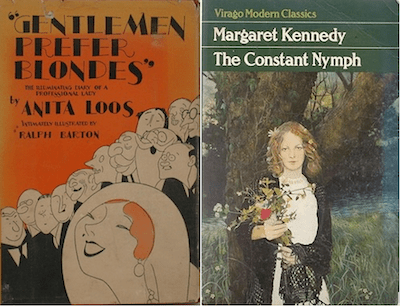
But it is not only poetry that the heroes of yesteryear committed to memory in large chunks – some mastered prose in a similar way, which always seems to me somehow an even more impressive achievement, though I accept that actors, having to learn their lines, sometimes comprising tremendously long speeches or monologues, would not necessarily find it so. Joseph Conrad and Ford Madox Ford would swap pages of Flaubert or Maupassant, while James Joyce ‘knew by heart whole pages of Flaubert, Newman, de Quincey, E. Quinet, A. J. Balfour and of many others.’[4] And, while Anita Loos’ Gentlemen Prefer Blondes was apparently one of Patrick White’s favourite novels (Joyce, Faulkner and Edith Wharton were also admirers), he knew Margaret Kennedy’s The Constant Nymph ‘practically off by heart.’[5]

‘Heart’ is another of those words with a great many friends, the compounds running over several columns of the dictionary: in one’s mouth or boots or the right place; open, shut, taken; worn on the sleeve; piercing, rending, sore and sick. It has its reasons and is, in many contexts, simply mysterious, as the author of ‘Dover Beach’ wrote:

But often, in the world’s most crowded streets,
But often, in the din of strife,
There rises an unspeakable desire
After the knowledge of our buried life;
A thirst to spend our fire and restless force
In tracking out our true, original course;
A longing to inquire
Into the mystery of this heart which beats
So wild, so deep in us – to know
Whence our lives comes and where they go.[6]

I briefly consider this last poem as a candidate but coming in at around a hundred lines, it may be a stretch too far for me. Sonnets are a handy length, though . . .


Notes

[1] Francis Kilvert, entry for 27 April 1870, Kilvert’s Diary, edited by William Plomer (London: Jonathan Cape, 1938, reissued 1969), I, 119.

[2] Fiona MacCarthy, Eric Gill (London: Faber & Faber, 1990), 26.

[3] The Letters of Edward Fitzgerald, edited by Alfred McKinley Terhune and Annabelle Burdick Terhune, four volumes (Princeton: Princeton University Press, 1980), I, 676.

[4] Frank Budgen, James Joyce and the Making of ‘Ulysses’ and other writings, enlarged edition (1934; London: Oxford University Press, 1972), 181. Edgar Quinet was a French historian; by A. J. Balfour is meant, presumably, the British Prime Minister (1902-1905) – who also published works of philosophy.

[5] David Marr, Patrick White: A Life (London: Vintage, 1992), 85.

[6] Matthew Arnold, ‘The Buried Life’, Poetry and Criticism of Matthew Arnold, edited by A. Dwight Culler (Boston: Houghton Mifflin, 1961), 114.

Lords and servants

(Nicholas Condy, Estate Staff in a Servants’ Hall: Mount Edgcumbe House)

As we get older – I’m warily assuming that I’m not alone in this – our reading habits tend to change. These days, I don’t even pretend to persevere with a work that bores me or that I find incomprehensible, while avoiding anything that smacks of the dutiful. I also have a small store of things that keep the reading wheels turning if I stall. Crime fiction, certainly, but also a few writers with a healthy backlist of novels and stories, always of, or above, a certain quality threshold, literary but not excruciatingly so, tending to the concise and accessible. My usual suspects include Graham Greene and Muriel Spark.

Reading recently Spark’s unsettling short novel Not to Disturb, I came across Lister, the Baron Klopstock’s butler, saying to the other household servants as they anticipate the incursion of the press: ‘“Bear in mind that when dealing with the rich, the journalists are mainly interested in backstairs chatter. The popular glossy magazines have replaced the servants’ hall in modern society. Our position of privilege is unparalleled in history. The career of domestic service is the thing of the future.”’[1]

Any close encounters with literature and history, up to and well into the twentieth century will bump up against the servants – or, very often, the silence and spaces where the servants would be. If domestic service of the old kind seemed until recently to have largely died out in this country, except in the homes of the immensely rich or ostentatious, in many other parts of the world, it seems never to have diminished much at all. Definitions of ‘servant’ and ‘service’ have shifted or dissolved, and the contemporary situation is complex and frequently alarming, riven with cancelled visas, failed safeguards and government inaction, while the exploitation and abuse reported from a great many countries seem indistinguishable from slavery.

(John Finnie, Maids of All Work: Museum of the Home)

Lucy Lethbridge observed that: ‘In 1900 domestic service was the single largest occupation in Edwardian Britain: of the four million women in the British workforce, a million and a half worked as servants, a majority of them as single-handed maids in small households. Hardly surprising then that the keeping of servants was not necessarily considered an indication of wealth: for many families it was so unthinkable to be without servants that their presence was almost overlooked.’[2]

In Dorothy Sayers’ childhood, her biographer wrote, ‘It was the period of wash-stands with jug and basin in the bedrooms, and chamber pots. The housemaid carried cans of hot water up to the bedrooms every morning. When baths were needed, hot water was again carried up and poured into a hip bath. ‘“Strangely enough, my mother used to say,” wrote Dorothy, “she never had a servant complain of this colossal labour in all the twenty years we were at Bluntisham.”’[3] Beside this might be placed Rudyard Kipling’s recalling, late in life, his dislike for those radicals who ‘derided my poor little Gods of the East, and asserted that the British in India spent violent lives “oppressing” the Native. (This in a land where white girls of sixteen, at twelve or fourteen pounds per annum, hauled thirty and forty pounds weight of bath-water at a time up four flights of stairs!)’[4] Twelve or fourteen pounds. . . At a private view, on 3 December 1898, Arthur Balfour, who would become Prime Minister in 1902, bought two of William Hyde’s pictures on the spot. Hyde’s collaboration with the poet Alice Meynell, London Impressions, her ten essays complementing his many ‘etchings and pictures in photogravure’ was published that month, priced at eight guineas, apparently ‘equal to a house servant’s wages for a year’.[5]

Some servants were more highly prized—and individualised—particularly butlers and manservants. E. S. Turner informed his readers that: ‘The butler wore no livery but was attired in formal clothes, distinguished by some deliberate solecism—the wrong tie for the wrong coat or the wrong trousers—to prevent his being mistaken for a gentleman.’[6] Always best to be on the safe side. In the household of Edward and Georgiana Burne-Jones, ‘William, like all good butlers, was a depressive.’[7] Some butlers and valets had interesting family connections. In 1840, Benjamin-François Courvoisier was hanged outside Newgate Prison, before a huge crowd (among which were Charles Dickens and William Makepeace Thackeray), for the murder of Lord William Russell (he was suspected of other murders but never charged with them). The defendant’s legal representation was provided by Sir George Beaumont, the amateur painter, friend of William Wordsworth and art patron whose pictures were a foundational gift to the National Gallery. Beaumont’s butler was Courvoisier’s uncle.[8]

After the irruption of Sam Weller into the serial version of Dickens’ The Pickwick Papers and the contribution of Passepartout to Phineas Fogg’s trip Around the World in 80 Days, the most famous—and visible and audible—manservant, in or out of literature, is presumably Jeeves, Bertie Wooster’s valet, surely followed, if at a modest distance, by Lord Peter Wimsey’s ‘immaculate man’, Mervyn Bunter.[9] It’s been suggested that Bunter drew partly on P. G. Wodehouse’s creation though he certainly incorporated elements of a man named Bates, the ‘gentleman’s gentleman’ to an ex-cavalry officer, Charles Crichton, whom Sayers met in France; and Sayers’ husband, ‘Mac’ Fleming, who developed his own photographs and was a good cook (also Bunter attributes).[10] Bunter, Wimsey’s mother explains to Harriet Vane, was previously a footman but ended up a sergeant in Peter’s unit. They were together in a tight spot and took a fancy to each other – ‘so Peter promised Bunter that, if they both came out of the War alive, Bunter should come to him. . . .’ Wimsey’s nightmares about German sappers linger on for a few postwar years: he’s afraid to go to sleep and unable to give orders of any kind. ‘There were eighteen months . . . not that I suppose he’ll ever tell you about that, at least, if he does, then you’ll know he’s cured. . .’ In January 1919, Bunter turns up, on one of Wimsey’s worst days, takes charge and sees to everything, not least finding the Piccadilly flat and installing himself and Wimsey in it.[11]

In that postwar period, apparently, ‘as many as forty ex-soldiers would answer a single advertisement for domestic help.’[12] Though the widespread employment of domestic servants hugely diminished by the time of the Second World War, the habit sometimes persisted in individual lives. Penelope Fitzgerald’s 1974 letter to her daughter Maria, describing the guests at the ‘surrealist tea-party’ that took place during her visit to a friend in Rye, includes mention of ‘Henry James’s manservant (still living in Rye, but with a deaf-aid which had to be plugged into the skirting) who couldn’t really bear to sit down and have tea, but kept springing up and trying to wait on people, with the result that he tripped over the cable­ and contributing in a loud, shrill voice remarks like “Mr Henry was a heavy man – nearly 16 stone – it was a job for him to push his bicycle uphill” – in the middle of all the other conversation wh: he couldn’t hear.’[13]

(Marie Leon, ‘Henry and William James’, (c) National Portrait Gallery)

It occurs to me at this late stage that the matter of servants is not purely an historical issue in my own case since, for three years in Singapore, my parents had the benefit of a cook-boy and an amah, Goh Heck Sin and his wife Leo: cooking, cleaning, laundry all taken care of (had there been young children in the family, the amah would have looked after them too). My primary—and certainly not undervalued—inheritance from those years is my ability to attract the attention of cats by making the call that Sin always made when he summoned our three (Thai Ming, Remo, Tiga) to their meals of rice and steamed fish.

Notes


[1] Muriel Spark, Not to Disturb (Harmondsworth: Penguin Books, 1974), 83.

[2] Lucy Lethbridge, Servants: A Downstairs View of Twentieth-century Britain (London: Bloomsbury, 2013), 9.

[3] Barbara Reynolds, Dorothy Sayers: Her Life and Soul, revised edition (London: Hodder and Stoughton, 1998), 24. Sayers was born in 1893.

[4] Rudyard Kipling, Something of Myself, edited by Robert Hampson (Harmondsworth: Penguin, 1987), 87.

[5] Jerrold Northrop Moore, The Green Fuse: Pastoral Vision in English Art, 1820-2000 (Woodbridge, Suffolk: Antique Collectors’ Club, 2007), 90.

[6] E. S. Turner, What the Butler Saw: Two Hundred and Fifty Years of the Servant Problem (Michael Joseph 1962; reprinted with new afterword, London: Penguin Books, 2001), 158.

[7] Penelope Fitzgerald, Edward Burne-Jones (London: Michael Joseph, 1975), 223.

[8] Judith Flanders, The Invention of Murder: How the Victorians Revelled in Death and Detection and Created Modern Crime (London: Harper Press, 2011), 202fn.

[9] Dorothy L. Sayers, ‘The Entertaining Episode of the Article in Question’, in Lord Peter Views the Body (1928; London: New English Library, 1977), 27.

[10] Reynolds, Dorothy L. Sayers, 112, 180.

[11] Dorothy L. Sayers, Busman’s Honeymoon,(1937; London: Coronet, 1988), 379-380.

[12] Turner, What the Butler Saw, 279.

[13] Penelope Fitzgerald, So I Have Thought of You: The Letters of Penelope Fitzgerald, edited by Terence Dooley (London: Fourth Estate, 2008), 150.

Pilots, poets, bays

Alfred Lord Tennyson died on 6 October 1892, having served as Queen Victoria’s Poet Laureate for over forty years, the longest ever tenure – though a later octogenarian, John Masefield, came very close. Tennyson’s funeral, which took place six days after his death, was a pretty grand affair. His remains were, the Times reported, ‘consigned to their last resting-place in Poets’ Corner, Westminster’ – the grave of Robert Browning, who had died three years previously, is immediately adjacent to Tennyson’s. All the leading members of the royal family sent representatives (Sir Henry Ponsonby, Sir Dighton Probyn, Lord Edward Cecil) and the place was thronged with bishops, lords and ladies, the pall-bearers including the Duke of Argyll and Lord Kelvin. Conan Doyle, Ellen Terry, John Burns, Frederic Harrison and Henry Irving were among the mourners. In the street outside, vendors were offering, for a penny, copies of the poet’s 1889 lyric, ‘Crossing the Bar’ (author portrait included):

Sunset and evening star,
   And one clear call for me!
And may there be no moaning of the bar,
   When I put out to sea,

But such a tide as moving seems asleep,
   Too full for sound and foam,
When that which drew from out the boundless deep
Turns again home.

Twilight and evening bell,
   And after that the dark!
And may there be no sadness of farewell,
   When I embark;

For though from out our bourne of Time and Place
   The flood may bear me far,
I hope to see my Pilot face to face
When I have crost the bar.[1]

Tennyson was 80 when he wrote it, so unsurprisingly aware that the encounter with his ‘Pilot’ was not that far off.

Edward Burne-Jones was particularly excited that the city of Mantua ‘had sent bay from Virgil’s birthplace to lay in the tomb.’ In fact, ‘bay’ and ‘pilot’ occurred in another ‘literary’ interment context a few years later, though William Morris’s ‘country funeral’, Fiona MacCarthy observes, ‘was the absolute antithesis of Tennyson’s burial in Westminster Abbey in 1892.’[2]

(William Morris, Fruit (Wallpaper): William Morris Society: Kelmscott House)

Morris died on 3 October 1896. He was only 62 but such a tireless worker, such a tireless maker, of pictures, poems, translations, tapestries, stained-glass windows, fabrics, carpets, furniture, illuminated books, wallpapers, prose romances and more that, as is often remarked, the primary cause of his death was simply being William Morris. His funeral took place on 6 October, exactly four years after the death of Tennyson. The body had to be transported from Paddington to Lechlade by train (a form of transport that Morris disliked intensely), then taken by cart to Kelmscott Church.

It was a cold wet morning, and the day turned stormy later. In that week’s issue of the Saturday Review (10 October 1896), there were pieces on Morris by George Bernard Shaw, Arthur Symons – and R. B. Cunninghame Graham, whose account of the day on which ‘the most striking figure of our times’ was buried, began with that weather. ‘As we never associated William Morris with fine weather, rather taking him to be a pilot poet lent by the Vikings to steer us from the doldrums in which we now lie all becalmed in smoke to some Valhalla of his own creation beyond the world’s end, it seemed appropriate that on his burial day the rain descended and the wind blew half a gale from the north-west.’ He noted of the arrival at Lechlade: ‘There, unlike Oxford, the whole town was out’, and added that the open haycart on which the coffin was transported to Kelmscott Church was ‘driven by a man who looked coeval with the Saxon Chronicle.’[3]

‘Over the coffin were thrown two pieces of Oriental embroidered brocade, and a wreath of bays was laid at his head’, the Daily News reported. The mourners included, alongside painters, publishers and printers, workmen from Merton Abbey (where the tapestry, weaving and fabric printing workshops were sited), Kelmscott villagers and members of the Art Workers’ Guild, all in their daily working clothes. The architect William Lethaby wrote: ‘It was the only funeral I have ever seen that did not make me ashamed to have to be buried.’[4]

(William Morris, Kelmscott Press Edition of ‘Godefrey of Boloyne’ by William Caxton: William Morris Society: Kelmscott House)

Morris continues to attract enormous biographical and scholarly interest, and warrants it all. So many arts, so many crafts, so many connections, so widespread and generative an influence, cropping up in all manner of places, often the expected ones, sometimes less so. Ezra Pound read Morris to the young Hilda Doolittle, ‘in an orchard under blossoming—yes, they must have been blossoming—apple trees.’ And: ‘It was Ezra who really introduced me to William Morris. He literally shouted “The Gilliflower of Gold” in the orchard. How did it go? Hah! hah! La belle jaune giroflée. And there was “Two Red Roses across the Moon” and “The Defence of Guenevere.”’[5] Pound read Morris to Yeats too, in Stone Cottage at the edge of Ashdown Forest, his translations of the Icelandic sagas.[6] Yeats would later recall of Morris’s prose romances that they were ‘the only books I was ever to read slowly that I might not come too quickly to the end.’[7]

(William Morris, La Belle Iseult: Tate)

Fiona MacCarthy remarks that ‘There was a neurotic basis to his fluency. On a good day he could write 1,000 lines of verse’, and some readers will find some of the longer poems soporific.[8] Penelope Fitzgerald wrote that the lyrics, in her opinion were ‘far the most important part’ of his  poetry and, ‘If I could keep them I would cheerfully sweep all the sagas and Earthly Paradises under the carpet.’[9] Other readers, in Morris’s own time, and since, have felt quite differently. Yeats continued to be one of them. In October 1933, he reported to his old friend (and ex-lover) Olivia Shakespear (Pound’s mother-in-law) his attempt to read Morris’s long poem The Story of Sigurd the Volsung to his daughter and then to his wife: ‘and last night when I came to the description of the birth of Sigurd and that wonderful first nursing of the child, I could hardly read for my tears. Then when Anne had gone to bed I tried to read it to George and it was just the same.’[10]

This is probably the passage he refers to, early in Book II:

Then she held him a little season on her weary and happy breast
And she told him of Sigmund and Volsung and the best sprung forth from the best:
She spake to the new-born baby as one who might understand,
And told him of Sigmund’s battle, and the dead by the sea-flood’s strand,
And of all the wars passed over, and the light with darkness blent.

So she spake, and the sun rose higher, and her speech at last was spent,
And she gave him back to the women to bear forth to the people’s kings,
That they too may rejoice in her glory and her day of happy things.[11]

For other admirers of Morris, it may be the campaigner, the Socialist, or perhaps the designer and producer of stained-glass, fabrics, stories, the late romances, the lectures and the essays:

‘To give people pleasure in the things they must perforce use, that is one great office of decoration; to give people pleasure in the things they must perforce make. That is the other use of it.’
     ‘Does not our subject look important enough now? I say that without those arts, our rest would be vacant and uninteresting, our labour mere endurance, mere wearing away of body and mind.’[12]

Yes, the allusions to damaging and artificial divisions are often wonderfully suggestive of other divisions causing much wider harms – as, of course, they continue to do. And, though I may be prejudiced in this regard, I like his idea, in ‘The Beauty of Life’, of ‘the fittings necessary to the sitting-room of a healthy person’. The first of these is ‘a book-case with a great many books in it’. Oddly, he never seems to mention, let alone recommend, piles of books everywhere else. . .


Notes

[1] Tennyson: A Selected Edition, edited by Christopher Ricks (Harlow: Longman Group, 1989), 665-666.

[2] Fiona MacCarthy, William Morris: A Life for Our Time (London: Faber & Faber, 1994), 631, 673-675.

[3] R. B. Cunninghame Graham, ‘With the North-West Wind’, Saturday Review (10 October 1896), Vol. 82, Issue 2137, 389-390.

[4] Quoted by Philip Henderson, William Morris: His Life, Work and Friends (Harmondsworth: Pelican Books, 1973), 429.

[5] H. D., End to Torment: A Memoir of Ezra Pound, edited by Norman Holmes Pearson and Michael King (Manchester: Carcanet Press, 1980), 22-23.

[6] James Longenbach, Stone Cottage: Pound, Yeats and Modernism (New York: Oxford University Press, 1990), 142-143.

[7] W. B. Yeats, ‘The Trembling of the Veil [1922]: Four Years’, in Autobiographies (London: Macmillan, 1955), 141.

[8] MacCarthy, William Morris, ix.

[9] Penelope Fitzgerald to Dorothy Coles, 5 June [1992], So I Have Thought of You: The Letters of Penelope Fitzgerald, edited by Terence Dooley (London: Fourth Estate, 2008), 460.

[10] The Letters of W. B. Yeats, edited by Allan Wade (London: Rupert Hart-Davis, 1954), 816.

[11] William Morris, The story of Sigurd the Volsung and the fall of the Niblungs (London: Ellis & White, 1877), 80-81.

[12] ‘The Lesser Arts’, in William Morris: The Selected Writings, edited by G. D. H. Cole (London: The Nonesuch Press, 1934), 496.

The one after the one after that: 1924

In a recent issue of Last Post, writing of Ford Madox Ford in 1924, Max Saunders remarked that it ‘certainly is an annus mirabilis for Ford; a year in which he launched the transatlantic review, and published two masterpieces: Some Do Not . . ., the first novel of his postwar Parade’s End tetralogy; and the brilliant critical memoir of his collaborator Joseph Conrad’.[1] He was pointing out the objections to the often feverish concentration upon that now-conventional annus mirabilis of modernism, 1922, in literary criticism and history, which has sometimes narrowed down to two particular gleamings in the gloaming, Ulysses and The Waste Land. It’s true that there were dozens of other remarkable works published in that year; lists can easily be constructed and I’ve been guilty of at least one myself. Tempted to do the same thing for 1924, I sailed past a couple of dozen before accepting that 1924 was also guilty of producing an absurd number of interesting items, in addition to the previously mentioned Fordian masterworks.

I leave aside, for the moment, Aldous Huxley, Katherine Mansfield, W. B. Yeats, a posthumous Herman Melville, T. E. Hulme, Ernest Hemingway, Glenway Wescott,  Marianne Moore and the bestselling The Green Hat by Michael Arlen (formerly Dikrān Kuyumjian) to mention, among my personal favourites, R. H. Mottram’s The Spanish Farm, first volume of a trilogy (the second and third followed in successive years) and winner of that year’s Hawthornden Prize. It focuses primarily not on trench warfare but rather on the narrator’s dealings with the local inhabitants, their claims for loss and damage against the British forces, and the relationship between an English officer and the daughter of the Ferme d’Espagnole. The trilogy was deservedly successful—and published in an omnibus volume in 1927—but has since seemed to drift out of view, only scholars of the period paying much attention to it lately. The one-volume edition was published as a Penguin Modern Classic in 1979 but is long out of print and the only editions currently on offer all look pretty nasty. Mottram was closely identified with Norfolk and sometimes nudged by the familiar British ‘regional novelist’ elbow into some cultural annexe or other. But see Craig Gibson’s piece here: https://norfolkrecordofficeblog.org/2021/04/14/forgotten-r-h-mottram/

Also in this year: John Buchan’s The Three Hostages (Dr Greenslade to Richard Hannay: ‘“Have you ever realized, Dick, the amount of stark craziness that the War has left in the world? . . . I hardly meet a soul who hasn’t got some slight kink in his brain as a consequence of the last seven years”’). There was D. H. Lawrence’s long ‘Introduction’ to Memoirs of the Foreign Legion by Maurice Magnus; Rudyard Kipling wrote four fascinating stories, ‘The Wish House’, ‘The Eye of Allah’, ‘The Bull That Thought’ and ‘A Madonna of the Trenches’ (especially the first two), and Stanley Spencer began The Resurrection in Cookham Churchyard in February 1924 (finished in 1926, it was shown at his first one-man exhibition in 1927).

In April, before a crowd of 120,000 people, George V opened the British Empire Exhibition at Wembley, put together by 18,000 workmen: Palace of Art (and Palace of Beauty), Never Stop Railway, Queen’s Doll’s House, butter sculptures, elephants, Mary Pickford and Douglas Fairbanks, massed choirs in white surplices. Poet and publisher Harold Monro was, apparently, impressed by its patriotic glitter and ‘in one of his satiric dream poems he envisaged an exhibition of the future, where the last Georgian Nature Poet would be on show, dressed in tweed and sipping beer, in a specially designed case.’[2]

The narrator of Edith Wharton’s ‘The Spark’ comments that ‘People, I had by this time found, all stopped living at one time or another, however many years longer they continued to be alive’.[3] D. H. Lawrence announced to Middleton Murry that he wanted ‘to go south, where there is no autumn, where the cold doesn’t crouch over one like a snow-leopard, waiting to pounce. The heart of the North is dead’.[4] Ezra Pound, well-embarked upon The Cantos by now, was looking back as well as forward, writing in a letter of 3 December to Wyndham Lewis: ‘We were hefty guys in them days; an of what has come after us, we seem to have survived without a great mass of successors’.[5] E. M. Forster published A Passage to India: his next novel, Maurice, would appear 47 years later, following its author’s death. In February 1924, acknowledging Forster’s Pharos and Pharillon, Lawrence wrote to him: ‘To me you are the last Englishman. And I am the one after that.’[6]

In the journal that he kept for a short period, the poet John Clare wrote (30 November 1824): ‘Read the Literary Souvenir for 1825 in all its gilt & finery what a number of candidates for fame are smiling on its pages – what a pity it is that time should be such a destroyer of our hopes & anxiety for the best of us but doubts on fame’s promises & a century will thin the myriad worse than a plague.’[7]

One hundred years on from 1924, the authors and titles of that period present a dazzling image of astonishing abilities and achievements. As to whether, another century on (assuming the continued existence of books, readers or, indeed, people), any of the current ‘candidates for fame’ will be visible to (some version of) literary historians, I have no settled opinion. Let me get back to you.

Notes


[1] Max Saunders, ‘Ford in 1922’, Last Post: A Literary Journal from the Ford Madox Ford Society, 1, 8 & 9 (Spring & Autumn, 2022), 1-19 (2). His essay concentrates on what Ford was writing, rather than publishing, in 1922.

[2] Penelope Fitzgerald, Charlotte Mew And Her Friends (1984; London: Flamingo, 2002), 209.

[3] Edith Wharton, Old New York (1924), in Novellas and Other Writings, edited by Cynthia Griffin Wolff (New York: Library of America, 1990), 467.

[4] The Selected Letters of D. H. Lawrence, compiled and edited by James T. Boulton (Cambridge: Cambridge University Press, 1996), 284.

[5] Pound/Lewis: The Letters of Ezra Pound and Wyndham Lewis, edited by Timothy Materer (London: Faber and Faber, 1985), 138. His possible exceptions to this statement were the composer George Antheil and the writer Robert McAlmon.

[6] The Letters of D. H. Lawrence IV, June 1921–March 1924, edited by Warren Roberts, James T. Boulton and Elizabeth Mansfield (Cambridge: Cambridge University Press, 1987), 584. The term has since been applied to Arthur Ransome and J. L. Carr by their biographers, and to Lieutenant-Colonel Alfred Daniel Wintle by himself. The day the other Lawrence (T. E., ‘of Arabia’) died, Forster was on his way to see him.

[7] John Clare, Journals, Essays, Journey from Essex, edited by Anne Tibble (Manchester: Carcanet New Press, 1980), 54.

Labyrinthine meanings

(Francisco Goya, Las Parcas: Atropos, or The Fates: Prado, Madrid)

‘Words of grief become almost meaningless in these days, they have to be used so frequently. But one does not feel any the less. Sorrows do not grow lighter because they are many.’[1]

Sitting in the kitchen, turning away from the seemingly endless and indiscriminate slaughter of civilians in Gaza and the West Bank, now extended to Lebanon, watching the rain or the gaps between the rain, I hear the Librarian coming into the kitchen, to announce another day of being baffled by the news that the American election is still ‘on a knife-edge’, the candidates ‘neck and neck’, when one of those candidates is evidently unhinged. ‘At his rallies, he just comes on and talks complete nonsense for fifty minutes.’ Similarly bewildered by this, I find it oddly reassuring that it’s not just non-Americans, looking in or on from outside, that share such feelings. Eliot Weinberger, whose devastating What I Heard About Iraq I still recall from nearly twenty years ago, summarises the matter with characteristic skill, in a piece dated 13 September:

‘It seems incredible that almost half the country still supports Trump, despite the felony convictions, the porn stars, the blatant graft, the endless lies, the allegations of assault and rape, the 6 January insurrection, the continuing refusal to accept his defeat in 2020, the classified documents in his bathroom at Mar-a-Lago, the vows to prosecute all his many enemies, including journalists, and to fire everyone in the government bureaucracy who is not loyal to him, the claims to dictatorial power. Even more incredible is that there is a slice of the voting population that is still “undecided”. Republican legislatures in various states have already set in motion procedures to keep people from voting and to deny the results if Trump loses’.[2]

There is, indeed, a report, more than one report, about highly suspect practices and preparations, changes of rules and the like, with reassuring headlines such as ‘Network of Georgia election officials strategizing to undermine 2024 result’: https://www.theguardian.com/us-news/2024/sep/18/trump-election-georgia

I know there are Americans who believe wholeheartedly that the moon landings were faked and patched together in a Hollywood back lot, while others know for a certainty that giant lizards are the true masters of the world but seeing, back in the summer, footage of men and women at political rallies with wads of fabric or nappy liners stuck to the sides of their heads was somehow in another dimension: irrefutable, painfully visible, undeniably and palpably there. A full-throttle alternative reality in operation, for sure, and believable enough that it might be swallowed by a few hundred, even a few thousand. But millions? And all in tune with what used to be a major and mainstream political party?

‘It is very extraordinary’, John Dowell reflects as he looks at the mad Nancy, ‘to see the perfect flush of health on her cheeks, to see the lustre of her coiled black hair, the poise of the head upon the neck, the grace of the white hands—and to think that it all means nothing—that it is a picture without a meaning.’[3] We are frequently confronted either by pictures that may really have no meaning—in the sense of a rational, graspable, ideally paraphrasable, meaning—or have a meaning that cannot be understood, either because we lack the necessary contextual information or because removal from the immediate experience is required, granting us distance, perspective, the means by which to find the edges, the boundaries, and thus the true extent of what we have witnessed.

(Richard Westall, Theseus and Ariadne at the Entrance of the Labyrinth: North Lincolnshire Museums)

Edmund Blunden recalled the sight of flares on the Ypres battlefield on New Year’s Eve, 1917: ‘Their writing on the night was as the earliest scribbling of children, meaningless; they answered none of the questions with which a watcher’s eyes were painfully wide.’[4] A considerable number of people stared uncomprehendingly at the clay tablets Arthur Evans had unearthed at Knossos before the researches of Alice Kober and Michael Ventris eventually led to an understanding and decipherment of Linear B.

‘The contemporary is without meaning while it is happening’, Guy Davenport remarked, ‘it is a vortex, a whirlpool of action. It is a labyrinth.’[5] And Hugh Kenner remembered Wyndham Lewis observing that ‘The present cannot be revealed to people until it has become yesterday.’[6]

Some parts of the present, surely; and to some people. Historians will, we accept quite conventionally, see more—though in some cases, or in some senses, less. There is, after all, an increasingly clear and present danger now not only of misinformation being manufactured and widely (and rapidly) disseminated but also of witnesses being silenced (often permanently), of evidence being systematically destroyed, of commentary and analysis being censored or concealed. And yet, while it’s true that we are all in the labyrinth and that the Minotaur is real – some people, I persist in believing, still have hold of that crucial thread.


Notes

[1] Vera Brittain, Chronicle of Youth: Vera Brittain’s Diary 1913-1917 (London: Gollancz 1981), 206.

[2] Eliot Weinberger, ‘The Debate’, London Review of Books, 46, 18 (26 September 2024), 8.

[3] Ford Madox Ford, The Good Soldier: A Tale of Passion (1915; edited by Max Saunders, Oxford: Oxford University Press, 2012), 192.

[4] Edmund Blunden, Undertones of War (1928; Harmondsworth: Penguin, 1982), 234.

[5] Guy Davenport, ‘The House That Jack Built’, in The Geography of the Imagination (Boston: David R. Godine, 1997), 56.

[6] Hugh Kenner, The Pound Era (London: Faber and Faber, 1972), 436.

Rosemary, responsibility


(Rembrandt van Rijn, Saskia van Uylenburgh in Arcadian Costume: National Gallery, London)

In the other park, which we traverse quite often, there are rosemary bushes to be discreetly ransacked – for potatoes, fish, meat, as well as for remembrance. ‘“There’s rosemary, that’s for remembrance”’, Ophelia says. And Laura Cumming notes that when Rembrandt’s wife Saskia van Uylenburgh died in 1642, at the age of 29 and after less than eight years of their marriage, Rembrandt ‘put a sprig of rosemary in her hand: rosemary for remembrance.’[1]

The weather forecast offers a 70% chance of rain. I add an umbrella to my tote bag and am soon walking uphill – in warm sunshine. Yes, the forecasts are more sophisticated these days, with many technical advances – on the other hand, I seem to remember that, in the days before we broke the weather, things were a bit more definite. Or did conditions appear to change every ten minutes then as well?


Under an abruptly darkening sky, I enter the park and the uncertain terrain of rosemary-picking. Plants in a public park: it would never occur to me to pick flowers in one and take them home since they’re for everybody to look at and enjoy. But a bush, herbs, green, largely unnoticed, simply wasted if not used. . . the case is altered, surely. Nevertheless, I aim for discretion and scan the park. Two women with dogs on the grassy slope; a woman with a child in a pushchair walking towards me on the path. Progress is arrested by the sight of a jay, landing on a nearby wooden post. It lingers for ten, fifteen seconds. I stand and stare. Eventually, it moves, I move. The woman says, in passing: ‘Pretty birds, aren’t they?’ Always the loquacious Englishman, I say ‘Yes, very’, moving on to stock up on rosemary and continue my walk into a sunshine resuming its humorous campaign.


In another campaign, the fallout from the presidential debate in Philadelphia on Tuesday night was still dominating the media, and I could still amuse the Librarian by abruptly announcing: ‘They’re eating the dogs!’ but the joke, if that’s what it is, is a dark one. Like a great many other people – at least I hope so, I’m baffled by this stuff much of the time, by those ‘undecided voters’, let alone those determined to make America hate again.

I realised later that it was the birthday of Louis MacNeice, a fine poet who also kept a wary eye on the political weather and who died at the absurdly young age of 55. Thinking of how the wrong things keep happening and the wrong people ending up on top almost invariably, and how far, how much, if at all, the rest of us can be said to bear responsibility, I noted the lines in his Autumn Journal:


And at this hour of the day it is no good saying
            “Take away this cup”;
Having helped to fill it ourselves it is only logic
            That now we should drink it up.
Nor can we hide our heads in the sand, the sands have
            Filtered away;
Nothing remains but rock at this hour, this zero
            Hour of the day.[2]

‘Responsibility’ is a handy word. Delmore Schwartz’s famous short story, ‘In Dreams Begin Responsibilities’, which gave his first volume its title, has the narrator watching, on a movie screen, the time just before the beginning of his own life, his parents moving towards their disastrous marriage, which will have a lasting and damaging effect on the poet. He’s ejected from the cinema after shouting at the screen—’“What are they doing?”’—and wakes up ‘into the bleak winter morning of my twenty-first birthday, the windowsill shining with its lip of snow, and the morning already begun.’[3]

But I was thinking too of the close of Robert Penn Warren’s fine novel, All The King’s Men : ‘soon now we shall go out of the house and go into the convulsion of the world, out of history into history and the awful responsibility of Time.’[4] The connection is with MacNeice, because of that poet’s relationship with Eleanor Clark in 1939-40. When MacNeice was invited by F. R. Higgins to join the Irish Academy of Letters, it was to Eleanor that he wrote about it, saying that ‘The Irish Academy of Letters meets once a year in Dublin’s only decent restaurant and gets so drunk they have to send the waiters away.’[5] Clark grew up in Connecticut, went to  Vassar in the 1930s, and worked on their literary magazine with Elizabeth Bishop and Mary McCarthy, among others. She wrote for left-leaning magazines and journals such as The Partisan Review, thought of herself for a while as a ‘Trotskyite sympathizer’ and went to Mexico in the late 1930s. Apparently, she did some translating for Trotsky and was married for a while to his Czech secretary, Jan Frankl. She wrote novels, essays and reviews, children’s books and a memoir, but was probably best-known for her travel books, Rome and a Villa and The Oysters of Locmariaquer. She married Robert Penn Warren in 1952 and died in 1996, aged 82, seven years after Warren himself.


(Eleanor Clark and Robert Penn Warren at their summer home in West Wardsboro, Vermont, 1986: Kentucky Library and Museum)

The novelist Nicholas Mosley once wrote that ‘Humans can either learn – or refuse to believe that humans are responsible for themselves.’[6] My favourite use of ‘responsibility’, though, is probably that of the hugely influential Trinidadian radical historian, journalist and political theorist, C. L. R. James, who adopted, in his early years, William Makepeace Thackeray’s Vanity Fair as the book: ‘By the time I was fourteen I must have read the book over twenty times’. And he adds, a little later: ‘Thackeray, not Marx, bears the heaviest responsibility for me.’[7]

That radical, Thackeray!

Notes


[1] William Shakespeare, Hamlet, IV. v.; Laura Cumming, Thunderclap: A memoir of art and life & sudden death (London: Chatto & Windus, 2023), 61.

[2] Louis MacNeice, Collected Poems, edited by Peter McDonald (London: Faber, 2007), 111.

[3] Ilan Stavans, editor, The Oxford Book of Jewish Short Stories (New York: Oxford University Press, 1998), 165.

[4] Robert Penn Warren, All The King’s Men (1946; Harmondsworth: Penguin, 2007), 661.

[5] Louis MacNeice, Letters of Louis MacNeice, edited by Jonathan Allison (London: Faber, 2010), 351.

[6] Nicholas Mosley, Efforts at Truth: An Autobiography (London: Minerva , 1996), 299.

[7] C. L. R. James, Beyond a Boundary (1963; London: Vintage, 2019), 24, 52.

Words, things, words for things


(C. R. W. Nevinson, Any Wintry Afternoon in England: Manchester Art Gallery)

Walking on the wide path in the park, I see a football rolling determinedly towards me over the grass, two boys watching, a long way off. I trap it, nudge and kick. It travels a fair distance but nowhere near the waiting boys. A woman walking towards me on the path says: ‘One of my irrational fears, a ball coming at me like that.’ I say: ‘One of mine too now’, and she laughs. ‘Oh, you did okay.’

Did I, though? Not the kick, that was what it was but. . . irrational fears? If it were now one of mine because of that episode, it’s not irrational but quite rational, reasoned, based on solid, empirical evidence, so. . .Don’t overthink it! the Librarian says, often in person and now in my head. Don’t overthink things!

Ding, ting, chose, cosa, peth, rud, shay, hlutur: thing. . . ‘The distinguished thing’ was Henry James’s famous phrase for death. Did he actually say it? Following a reference to Edith Wharton’s A Backward Glance, I see that there’s an extra link or two: ‘He is said to have told his old friend Lady Prothero, when she saw him after the first stroke, that in the very act of falling (he was dressing at the time) he heard in the room a voice which was distinctly, it seemed, not his own, saying: “So here it is at last, the distinguished thing!”’ Wharton adds: ‘The phrase is too beautifully characteristic not to be recorded.’[1] It’s certainly wonderfully—and characteristically—indefinite, or at least, on a very convoluted path: ‘He is said’ to have told someone else that he heard a voice which wasn’t his own, the word ‘distinctly’ applied only to a negative, ‘not his own’ and, even then, ‘it seemed’.


(Edith Wharton via BBC)

Death as ‘the thing’ (Death! Where is thy thing?) – while for Edna St Vincent Millay, death was not the thing but the force engulfing it:

Death devours all lovely things:
   Lesbia with her sparrow
Shares the darkness,—presently
   Every bed is narrow.[2]

The line ‘Every bed is narrow’ I take to refer to coffins (rather than, or as well as, singleness or separation), and it also recalls Pound’s ‘Homage to Sextus Propertius’. ‘We, in our narrow bed, turning aside from battles:/ Each man where he can, wearing out the day in his manner.’[3]

And yet – I was thinking, at the outset, more of things than of death; or rather, words and things, particularly the word ‘thing’. Impressively, its origin seems to embrace both ‘object’ and ‘parliament’. The definitions are lavish: an assembly, court, council, matter, affair, problem, fact, event, action, that which exists or can be thought of, a living creature, a piece of writing; in the plural, clothes, personal belongings. What a word, what a world, ‘thing’ is!

While an inmate of the Disciplinary Training Center at Metato, north of Pisa, in the autumn of 1945, Ezra Pound wrote:

   And for all that old Ford’s conversation was better,
consisting in res non verba,
          despite William’s anecdotes, in that Fordie
   never dented an idea for a phrase’s sake
and had more humanitas [4]

Things, not words for things. Pound was reiterating his belief in those opposing—or complementary—positions, Ford as realist, Yeats as symbolist, that he proposed on more than one other occasion.[5] Poignantly, they were both just six years dead – the length of a world war, say.

That ‘humanitas’ had led the youthful Ford to rashly discuss the conditions of the London poor with a young woman he took out in a boat, only to be reproved the next day by her mother, Lady Cusins: ‘“Fordie, you are a dear boy. Sir George and I like you very much. But I must ask you not to talk to dear Beatrice … about Things!”’[6]

(Iris Barry)

Ford had actually written to Iris Barry (4 July 1918): ‘I have always been preaching to people not to write “about” things but to write things—& you really do it—so I like to flatter myself that you are an indirect product of my preachings—a child of my poor old age.’ (He was still serving in the British Army, having by then reached the ‘poor old age’ of 44.)[7]

Ralph Waldo Emerson also fished in those waters: ‘The corruption of man is followed by the corruption of language’ and ‘new imagery ceases to be created, and old words are perverted to stand for things which are not’. But ‘wise men pierce this rotten diction and fasten words again to visible things’.[8] This linking of words and things would have some later commentators and theorists tearing their hair out, words for them being quite arbitrary marks on the page, the word for something not otherwise  linked to that something. Lord Byron though, as so often, pursued his own path:

But words are things, and a small drop of ink,
Falling like dew upon a thought, produces
That which makes thousands, perhaps millions, think.[9]

And as if by magic, an email just arrived from PN Review offers, from its archive, ‘Holà’, a short poem by C. H. Sisson from 1992, which is also concerned with words and things:

Words do not hold the thing they say: 
Say as you will, the thing escapes 
Loose upon air, or in the shapes 
Which struggle still before the eyes. 
Holà will run upon its way 
And never catch up with its prize.[10]


Later in my park walk, halfway down a steepish path, I see a woman ahead of me with a child in a pushchair and a dog crouched in the grass nearby, with a ball in its mouth. It looks at me inquiringly. ‘I’m afraid not’, I say. ‘You’re not my dog and that ball is covered with slobber, as we both know.’ The woman is partly blocking the path where it meets the wider track, talking on her phone and with her back to me, but moves to one side as I approach. The dog lies down close by her and lets the ball drop from its mouth. She half-turns and kicks the ball, which rockets cleanly away for a good distance – and apparently just where she meant it to go. Damn, I think, she only needed to be a bit better than me to make the point. What point? That I shall not overthink it. . .


Notes

[1] Edith Wharton, Novellas and Other Writings: Madame de Treymes, Ethan Frome, Summer, Old New York, The Mother’s Recompense, A Backward Glance, edited by Cynthia Griffin Wolff (New York: Library of America, 1990), 1055.

[2] Millay, ‘Passer Mortuus Est’ (first of three stanzas), in F. O. Matthiessen, The Oxford Book of American Verse (New York: Oxford University Press, 1950), 886. As is often noted, Millay here references Catullus 2, about the death of his lover Lesbia’s sparrow, her ‘plaything’: The Poems of Catullus, translated with an introduction by Peter Whigham (Harmondsworth: Penguin Books, 1966), 52.

[3] Ezra Pound: Poems and Translations, edited by Richard Sieburth (New York: Library of America, 2003), 535.

[4] Canto LXXXII, The Cantos of Ezra Pound, fourth collected edition (London: Faber and Faber, 1987), 525. I have tried—and failed—to insert the ideogram, ‘jen’.

[5] Ezra Pound, Polite Essays (1937; Plainview, New York: Books for Libraries Press, 1966), 50; Pound/ Williams: Selected Letters of Ezra Pound and William Carlos Williams, edited by Hugh Witemeyer (New York: New Directions, 1996), 187.

[6] Ford Madox Ford, Return to Yesterday: Reminiscences 1894-1914 (London: Victor Gollancz, 1931), 75.

[7] Ford Madox Ford, Letters of Ford Madox Ford, edited by Richard M. Ludwig (Princeton: Princeton University Press, 1965), 87.

[8] Ralph Waldo Emerson, Selected Essays, edited by Larzer Ziff (Harmondsworth: Penguin Books, 1982), 51.

[9] Lord Byron, Don Juan, III:88, edited by T. G. Steffan, E. Steffan and W. W. Pratt (London: Penguin Books, 1996), 182.

[10] PN Review 87 (September–October 1992), 28.