Letting in water

Durer-ill-ShipFools

(Albrecht Dürer, illustration to The Ship of Fools)

There was a piece in The Guardian a few days back, which rounded up some foreign views of the state the United Kingdom is in, reminding us, if we needed reminding, that to many people outside this country, such a spectacle must seem extraordinary.

The Washington Post had a piece called ‘Brexit will mark the end of Britain’s role as a great power’, which observed that the UK, ‘famous for its prudence, propriety and punctuality, is suddenly looking like a banana republic’. Here was a country ‘determined to commit economic suicide but unable even to agree on how to kill itself’, led by ‘a ship of fools’ unwilling to ‘compromise with one another and with reality’. The result was an ‘epic failure of political leadership’, Friedman said: scary stuff, but ‘you can’t fix stupid’.

‘Ship of fools.’ That was an adaptation (1509) by the poet Alexander Barclay of a 1494 allegory by the German satirist Sebastian Brant; also the title of an allegorical novel by Katherine Anne Porter, published in 1962. The nautical theme recurs, not only in the header illustration by the Guardian design team, showing the HMS Britain steeply angled in an unfriendly-looking sea, but in one or two other comments. Sreeram Chaulia, dean of the Jindal School of International Affairs, said many Indians saw Brexit as the latest chapter in a ‘sharp decline in the place Britain commands as a great power’. The UK ‘is not a gold standard to look up to’, he said. ‘We get a feeling of a sinking ship, and everybody wants to leave a sinking ship.’

https://www.theguardian.com/politics/2019/apr/06/a-shambles-on-which-the-sun-never-sets-how-the-world-sees-brexit

I was reminded of that stout phrase, ‘the Ship of State’, which I see is traced back to Book Six of Plato’s The Republic. In the old Jowett translation, one section caught my eye: ‘The sailors are quarrelling with one another about the steering—every one is of opinion that he has a right to steer, though he has never learned the art of navigation and cannot tell who taught him or when he learned, and will further assert that it cannot be taught, and they are ready to cut in pieces any one who says the contrary.’

No contemporary parallel there, obviously. Precisely in the middle of the nineteenth century, Henry Wadsworth Longfellow waxed optimistic:

‘Thou, too, sail on, O Ship of State!
Sail on, O UNION, strong and great!’

And:

‘In spite of rock and tempest’s roar,
In spite of false lights on the shore,
Sail on, nor fear to breast the sea!’[1]

Traffic-Hole-Shoe

That of course, was another Union, which, eleven years later, didn’t seem so solid; while ours is certainly lower-case and seems to be letting in water. In another lifetime, Traffic had a hit with a Dave Mason song, ‘Hole in My Shoe’ (‘And all that I knew/ The hole in my shoe/ Was letting in water’) – only a shoe then, so the situation’s clearly deteriorated.

I’ve never been in a shipwreck before—certainly not one caused by the crew and passengers together scuttling the ship—so, while the joy is hardly unconfined, there is at least an element of novelty.

I remembered poor Owen Chase, first mate of the Essex, sunk by a sperm whale in 1820.[2] The survivors in their small boats were finally reduced to eating the bodies of the dead; the next stage, once those supplies were exhausted, was the drawing of lots and the shooting of those who lost. In Captain Pollard’s boat, the man shot was the captain’s own nephew, named Owen Coffin. In later life, Chase apparently developed an obsessive fear of starvation, ‘never wasting a morsel at the dinner table, and frequenting the market to buy supplies that he larded [stuffed] in his attic.’[3] We can perhaps glimpse certain elements of his story in our own too likely future—but not, we hope, all of them.

Turner, Joseph Mallord William, 1775-1851; The Shipwreck

(J. M. W. Turner, The Shipwreck: Tate Britain)

More relevant, perhaps, is Declan Kiberd’s comment on Homer’s epic: ‘The logic of the Odyssey is that of many tales involving shipwreck – the answers to problems will be found only after the act of destruction. The catastrophe must precede clarification.’

And he adds a little later that resurgences, such as modern Ireland’s, ‘often come after a period of trauma – what Gaelic poets called longbhriseadh (shipwreck), a terrible but challenging disaster which becomes the precondition of a change to a new future.’[4] ‘Resurgence’: rising again, basically resurrection which, as I recall, requires death as a precondition. So that’s another cheering thought.

Thoreau queried the sort of impulses that have been driving a number of political developments lately: ‘Why should we be in such desperate haste to succeed, and in such desperate enterprises? If a man does not keep pace with his companions, perhaps it is because he hears a different drummer. Let him step to the music which he hears, however measured or far away. It is not important that he should mature as soon as an apple-tree or an oak. Shall he turn his spring into summer? If the condition of things which we were made for is not yet, what were any reality which we can substitute? We will not be shipwrecked on a vain reality. Shall we with pains erect a heaven of blue glass over ourselves, though when it is done we shall be sure to gaze still at the true ethereal heavens far above, as if the former were not?’[5]

Walden_1854_cover_image

Elsewhere, he suggests that ‘A book should contain pure discoveries, glimpses of terra firma, though by shipwrecked mariners, and not the art of navigation by those who have never been out of sight of land.’[6]

‘In our time’, Guy Davenport’s Dutch philosopher Adriaan van Hovendaal writes in his notebook, ‘we long not for a lost past but for a lost future.’[7] Thirty-five years on, that is true of some of us—but clearly not of others, which at least partly explains how we got here. Wherever here might be.

 
References

[1] ‘The Building of the Ship’, The Poetical Works of Henry Wadsworth Longfellow (London: Ward, Lock: n.d.), 103.

[2] His account was published in 1821. Herman Melville saw him, though not to speak to, in 1841; he did meet Chase’s son, who gave him a copy of his father’s Narrative: Melville, Moby Dick (1851; edited by Harold Beaver, Harmondsworth: Penguin Books, 1972), 17; and ‘Appendix: The Earliest Sources’, 971-979.

[3] Paul Lyons, introduction to Owen Chase, Shipwreck of the Whaleship Essex (London: Pimlico, 2000), xxvii.

[4] Declan Kiberd, Ulysses and Us: The Art of Everyday Living (London: Faber and Faber, 2009), 283, 307.

[5] Henry David Thoreau, Walden, edited by J. Lyndon Shanley (Princeton University Press: Princeton and London, 1974), 326.

[6] Henry David Thoreau, A Week on the Concord and Merrimack Rivers (New York: Library of America, 1985), 80.

[7] Guy Davenport, Apples and Pears (San Francisco: North Point Press, 1984), 63.

Kidneys out of mind

AB-rear-7-Feb-1965

(Anthony Burgess at the rear of 7 Eccles Street, 7 February 1965. From The Listener via James Joyce online notes: http://www.jjon.org/joyce-s-environs/no-7-eccles-street )

‘Cut to ECCLES STREET. Number 7, Bloom’s Ithaca, was being demolished to make way for office blocks, but the destroyers were persuaded to hold off for a day while we filmed in what would have been the Blooms’ bedroom. Much speech was slurred by the need to down much whisky in freezing pubs. Some of my monologues were unacceptable in London, They had to be redone as voice over.’[1]

‘Kidneys were in his mind as he moved about the kitchen softly, righting her breakfast things on the humpy tray.’ This is our first sight of Mr Leopold Bloom in his house at 7 Eccles Street, in James Joyce’s Ulysses. I still find ‘Kidneys were in his mind’ funny when I revisit: it was certainly a point of contention among the translators of Joyce’s novel into French and one of the examples that Valery Larbaud sent to Joyce, suggesting that, in the version by Auguste Morel and Stuart Gilbert, ‘The humourous side of the phrase in the text is lost.’[2]

valery larbaud

(Valery Larbaud)

Crossing the bedroom to the bathroom, I hear Melvyn Bragg signing off from his radio programme, ‘In Our Time’, by mentioning that next week they’ll be discussing the evolution of teeth. Damn, really? I think that’s what he said but could have been unduly influenced by the fact that teeth are in my mind again just lately, biting into it, in fact, with increasing force. Yes, I’ve been to the dentist: and have another appointment for Friday. Can I hang on that long? No. I make a phone call and plead my case. The appointment lurches a little closer to me.

Eyes slammed shut while the drill gets into its stride, I pass the time in the dentist’s chair running through the seventy-nine titles Ford Madox Ford published in his lifetime, going backwards on this occasion, in tune with the current national mood. I’ve barely reached A Little Less Than Gods (1928) before I experience a fierce spasm that lifts me a little out of the chair. It happens twice more. ‘Yes’, my dentist explains later, ‘where you were feeling the most sensitivity in the gums on the far side of that tooth, I had to inject anaesthetic directly into the nerve.’

ALLTG

http://www.fordmadoxfordsociety.org/first-editions-gallery.html

In Anne Carson’s compelling ‘The Glass Essay’, the narrator writes of her visit to her father, in company with her mother, in the hospital where he is cared for, having suffered from dementia for several years:

I notice his front teeth are getting black.
I wonder how you clean the teeth of mad people.

He always took good care of his teeth. My mother looks up.
She and I often think two halves of one thought.
Do you remember the gold-plated toothpick

you sent him from Harrod’s the summer you were in London? she asks.
Yes I wonder what happened to it.
Must be in the bathroom somewhere.[3]

With teeth no longer in my mind—nor kidneys, for sure—I can again eat normally, rather than biting down on precisely the same point with every mouthful. Even better, I can once more take liquids into my mouth without gripping the edge of my seat convulsively or tipping my head tipped steeply sideways as though going fast around a sharp corner in a motorcycle sidecar. Water, tea, coffee, yes. And wine. Red wine. Santé.

 
References

[1] You’ve Had Your Time: Being the Second Part of the Confessions of Anthony Burgess (London: Heinemann, 1990), 100.

[2] James Joyce, Ulysses (1922; London: The Bodley Head, revised edition, 1969), 65; Richard Ellmann, James Joyce, new revised edition (Oxford: Oxford University Press, 1983), 602fn.

[3] Anne Carson, Glass, Irony & God, introduction by Guy Davenport (New York: New Directions, 1995), 26.


Radical calendar, pronouns, rats’ alley

March-poster

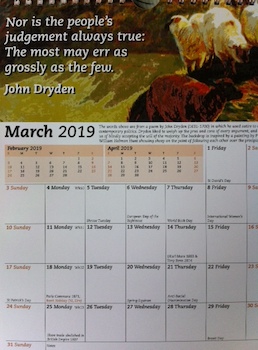
It’s a Radical Calendar for us this year, each page headed by a stirring quotation to put fire into the bellies of those fighting for justice, equality and other unfashionable things. (I have an exhortatory poster on the wall behind me, come to think of it: that particular ‘March’ is not the name of a month.)

https://www.radicalteatowel.co.uk/

January’s legend was from Percy Bysshe Shelley’s ‘The Masque of Anarchy’, written in 1819, after the massacre at Peterloo:

Rise like Lions after slumber
In unvanquishable number,
Shake your chains to earth like dew
Which in sleep had fallen on you –
Ye are many – they are few.

That last line is now more widely familiar because of its adoption as a Labour Party slogan. It’s also one that I’ve tended to misremember as ‘We are many – they are few’. A little risky for the eldest – legitimate – ­ son of the MP Sir Timothy Shelley to designate himself one of the many, you might think. But of course he doesn’t, distancing himself from both the ‘Ye’ and the ‘they’, reasonably enough given his belief that poets, as the unacknowledged legislators of the world, can’t easily be positioned within any conventional constituency.

But then – who can? ‘The others’, no doubt. The deployment of such pronouns – ‘we’, ‘you’, ‘they’, ‘us’ – has probably never been a simple matter. It sure as hell isn’t now. Ironically, as this country becomes more conformist and more tribal and more wedded to willed simplicities, the issue is becoming thornier by the day.

February boasted a mention of Benjamin Lay (1682-1759), the four feet tall Anglo-American Quaker humanitarian and abolitionist, vegetarian and author of around two hundred pamphlets. And that chimed in nicely with the book I was reading at the time, Madge Dresser’s Slavery Obscured: The Social History of the Slave Trade in an English Provincial Port, the port in question being Bristol, of course.

Calendar

March offers a sliver of John Dryden’s Absalom and Achitophel:

Nor is the people’s judgment always true:
The most may err as grossly as the few.

Indeed. Then under 29 March is printed the notice: ‘Brexit Day’. The news has now come through about how well it all went this afternoon. It was diverting to learn that, before that particular piece of parliamentary business, Liam Fox, urging his Westminster colleagues to vote the prime minister’s deal through, was warning that they would undermine faith in mainstream politics by creating a ‘chasm of distrust’ if they failed to do so. Yes, really: that Liam Fox; and ‘would undermine faith in mainstream politics’ and would create distrust. There’s a man with his finger on the pulse of current attitudes towards ‘mainstream politics’.

So where are we (them, us)? One speaker in T. S. Eliot’s The Waste Land remarked:

I think we are in rats’ alley
Where the dead men lost their bones

That’s definitely a possibility. Or is our whole planet a speck of dust beneath the fingernail of a trickster god unimaginably vast? There’s another one.

Will we ever come back from this, whatever happens now? Probably not. Still, I do enjoy having people with mad eyes explain to journalists that if X, Y or Z doesn’t happen, there’s ‘a risk of no Brexit at all’.

I think that’s a risk we’re—me, us, some of them—prepared to take. So why not just revoke Article 50? That, by the way, is called ‘a clean non-Brexit’.


Soil, bones, grass

Buson-narrow-road-deep-north

(Yosa Buson, Narrow Road to the Deep North)

I was reading Bashō, who wrote: ‘I went to see the Atsuta Shrine, but it had been reduced to utter ruins. Walls had crumbled and dry grasses were standing among the falling blocks.’[1]

Grass as witness to decay, deterioration, disappearance. Or grass signifying growth, fertility, recovery. Times, circumstances, characters.

For A. E. Housman, born on this day in 1859, it could be positive, as in ‘Spring Morning’:

Now the old come out to look,
Winter past and winter’s pains,
How the sky in pool and brook
Glitters on the grassy plains.

But, as Nick Laird writes in the introduction to the Penguin edition of Housman’s poems, ‘Like Webster, Housman was much possessed by death’—death and lads would cover a lot of it, in fact—so there is also:

The sigh that heaves the grasses
Whence thou wilt never rise
Is of the air that passes
And knows not if it sighs.[2]

Robert Frost, also born on this day, in 1874, published one of his most famous poems, ‘The Road Not Taken’, in August 1915. It is, as Frost himself said, ‘a tricky poem – very tricky’, and the poet seems to have had his friend Edward Thomas in mind when he wrote it.[3] The narrator of Frost’s poem looks down one path as far as possible before it bends into the undergrowth:

Then took the other, as just as fair
And having perhaps the better claim,
Because it was grassy and wanted wear;
Though as for that, the passing there
Had worn them really about the same.

‘About the same’ – and both paths covered in freshly fallen leaves anyway.[4]

One more: on this day, in 1892, Walt Whitman died, the great poet of Leaves of Grass, thinking not only of graves but also of growth, expansion, burgeoning power.

Buson-Basho

(Yosa Buson, Matsuo Bashō)

For Ezra Pound’s Li Po, in eighth-century China, grass grows over the piled bones of the dead:

Bones white with a thousand frosts,
High heaps, covered with trees and grass;
Who brought this to pass?
Who has brought the flaming imperial anger?
Who has brought the army with drums and with
kettle-drums?
Barbarous kings.[5]

Lucille, in A Place of Greater Safety, Hilary Mantel’s novel about the French Revolution, looks to a future which will evidence recognisably similar signs: ‘With all the desperate passions in our heads and bodies, one day these walls will split, one day this house will fall down. There will be soil and bones and grass, and they will read our diaries to find out what we were.’[6]

rousseau-portrait-of-pierre-loti

(Henri Rousseau, Portrait of Pierre Loti, 1891)

In his translator’s note to Pierre Loti’s 1917 pamphlet, L’Outrage des barbaresThe Trail of the Barbarians (1918), Ford Madox Ford disagreed with Loti’s use of the word ‘irreparable’, believing that the land in France would indeed recover, thanks to its ‘little industries’ and its traditions of husbandry: ‘ . . . I am more sure than Mr Loti that the grass is already moving that shall cover the graveyards and the rusty heaps of recovered provinces.’[7]

Still, circling back to Bashō, I find: ‘When a country is defeated, there remain only mountains and rivers, and on a ruined castle in spring only grasses thrive. I sat down on my hat and wept bitterly till I almost forgot time.’[8]

As we know, not all a country’s defeats are military – nor even caused by external forces.
References

[1] Matsuo Bashō, ‘The Records of a Weather-exposed Skeleton’, in The Narrow Road to the Deep North and other travel sketches, translated by Nobuyuki Yuasa (London: Penguin Books, 1966), 59.

[2] A Shropshire Lad and Other Poems: The Collected Poems of A. E. Housman, edited by Archie Burnett, with an introduction by Nick Laird (London: Penguin Books, 2010), 102, xi, 114.

[3] As discussed by Matthew Hollis, Now All Roads Lead to France: The Last Years of Edward Thomas (London: Faber, 2012), 233-236.

[4] The Poetry of Robert Frost, edited by Edward Connery Lathem (London: Jonathan Cape, 1977), 105.

[5] ‘Lament of the Frontier Guard’, in Cathay (1915): Ezra Pound: Poems and Translations, edited by Richard Sieburth (New York: Library of America, 2003), 254.

[6] Hilary Mantel, A Place of Greater Safety (London: Penguin Books, 1993), 722.

[7] Ford Madox Ford, War Prose, edited by Max Saunders (Manchester: Carcanet Press, 1999), 191.

[8] Bashō, Narrow Road to the Far North, 118.

‘A house is a ship turned upside down’: some notes on Guy Davenport’s ‘Tatlin!’

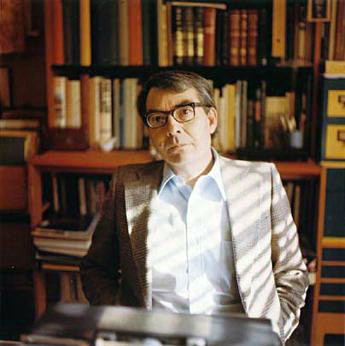
GD_JW_via_Jacket

(Guy Davenport by Jonathan Williams via Jacket)

Due partly to my prolonged (and continuing) immersion in the Davenport-Kenner letters, partly to the frequent references—and some generously supplied scans of Davenport essays and reviews—in emails exchanged with the writer Greg Gerke, I’ve just begun rereading Guy Davenport’s stories. While I’m forever peering into various volumes of his essays and art criticism, my reading of most of his fiction dates back between fifteen and thirty years. I’d like to think that I know a bit more now than I did then—not just about Davenport or modern literature but things more generally. I certainly know enough to tread warily, one assemblage at a time. So, a few notes suggested by that reading and a strong awareness of the recurring question prompted by all Davenport’s writings: how does he know that? Perhaps two questions, the other being: how does he do that?

‘Tatlin!’—Vladimir Tatlin, the Russian painter, architect and designer—is the title story of Davenport’s first collection (dedicated to the photographer Ralph Eugene Meatyard) and its opening story, though actually the last of the six in order of composition, which was ‘The Aeroplanes at Brescia’, ‘Robot’, ‘The Dawn in Erewhon’, ‘1830’, ‘Herakleitos’, ‘Tatlin!’.[1]
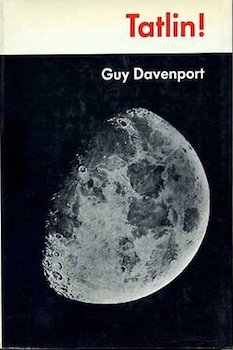
GD_Tatlin

In the summer of 1969, Davenport wrote to Hugh Kenner: ‘I’m at work on a piece of prose not like anything I’ve done before, or anybody else to my knowledge—a breakthrough, I think (I hope), and an invention. It’s the kind of thing I’ve wanted to do for the longest, but have never been able to organize my imagination enough to get ahead with it. It is essentially the biography of Tatlin’.[2]

‘You would seem to have invented a new genre’, Kenner wrote to him in March 1970, ‘the assemblage, as by a postulated consciousness, of the clues to some unnoticed event’, adding, to distinguish Davenport’s perspective from a work by Hilaire Belloc to which he referred, ‘you don’t use the point-of-view of an imaginary spectator, but a “consciousness” as in the Cantos.’[3]
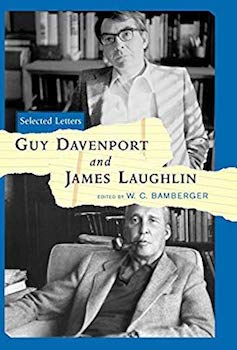
GD-JL-Letters

To James Laughlin, more than twenty years later, Davenport traced the emergence of his fictional strategy: ‘The breakthrough came when I realized that I mustn’t write about anything from my own experience, or anybody I’ve known, but to work with pure imagination, and to work with that hiatus between the mind and the world in which the pragmatic always fails and the imagination has to take over.’[4]

‘Tatlin!’, like a number of other Davenport fictions, includes the author’s drawings, designed as integral parts of the text—‘Tatlin! began as a painting’.[5] Peter Quartermain comments that ‘all his stories are written as though they were drawn and hence call attention to themselves as made works’[6] and Davenport remarked to Laughlin: ‘My fiction is a kind of drawing.’[7] These drawings are beautifully achieved, elegant, detailed, with exquisite cross-hatching: one of Vladimir Tatlin in snazzy striped trousers, holding a straw hat in his right hand (and looking, to my eye, not unlike the young Pablo Picasso), two of Lenin and then a third following five representations of Tatlin’s artworks, some of those reproduced in Camilla Gray’s book on Russian art which Davenport acknowledged on Tatlin!’s title page.[8] But the final three drawings are all of Joseph Stalin and the modernist artists, poets and painters, scientists and Constructivists who had seemed for a while to be in tune with the revolution are by this time dead, dishonoured or in exile.
letatlin-1932.jpg!Large

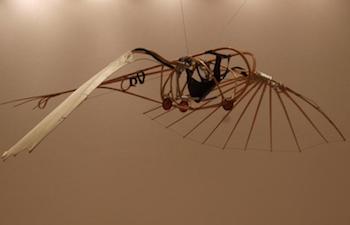
‘Tatlin!’ begins with a section entitled ‘Moscow 1932’, the artist’s Constructivist works and his flying machine—a glider ‘for everyday use’—hung from the ceiling, like ‘the fossil skeleton of a pterodactyl.’ ‘Tatlin’ is the first and fourth word of the story; by the eight line, Lenin has been mentioned three times. Then we read: ‘This is no place to continue talking about M. N. Ryutin’s remarks concerning Comrade Stalin, mimeographed and running to many pages, said by people who knew to foreshadow a change.’[9] Lenin died in 1924 and Stalin had consolidated his position as supreme leader before the end of that decade. Ryutin’s writings argued against some central Communist policies and for the removal of Stalin. It didn’t end well—though Ryutin wasn’t executed until 1937, as part of the ‘Great Purge’.

The story moves through St. Petersburg’s Bloody Sunday in 1905, when the march led by Father Gapon resulted in at least 200 deaths; Tatlin as busker, as sailor, in Paris meeting Picasso, Chagall and others; Tsiolkovsky, Russian space science pioneer; Tatlin in the classroom; and the dissipation, perversion and betrayal of the revolution.

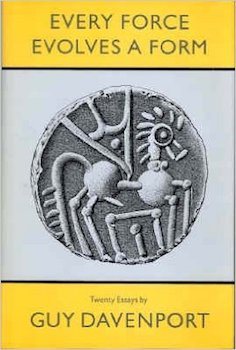
The second page of text introduces a good many more names and several themes which bulk large in Davenport’s work: not only flight but the crucial link between modernism and the archaic—‘What is most modern in our time frequently turns out to be the most archaic’ (Geography of the Imagination, 21)—the reaching back over great stretches of time common to Pound, Joyce, Gaudier-Brzeska, Picasso, Modigliani, Khlebnikov and others. ‘Tatlin had gone back to Daedalos’ (Tatlin! 3). This will be another recurring theme or motif in Davenport’s essays and stories: the labyrinth, the marriage of art and science and, of course, flight again, while—‘At Teraspol there were cobwebs in the barley, wasps at the panes, and cats in the knitting baskets’ (Tatlin! 10)—wasps, cats and barley will also crop up many times in the Davenport oeuvre. And Tatlin in the classroom? ‘Every force evolves a form, he taught’ (Tatlin! 16)—the title of a volume of Davenport essays and a dictum he took from Mother Ann Lee, founder of the Shakers.
GD_Every_Force

Among names here which will also recur are those of Frank Lloyd Wright, Ruskin, Rousseau, Osip Mandelstam, Fourier, Picasso, Gertrude Stein and Nijinsky. A list like that might in turn prompt a reader to wonder just how many names the story actually includes, either as character or reference. In fact, in a story of fifty pages of good-sized type and generous margins, twelve of which are given over to the drawings already mentioned, there are close on one hundred and forty named painters, sculptors, poets, pianists, engineers, political and historical figures, architects, film-makers, chemists, explorers, aeronauts, dancers, composers and journalists. Some are unfamiliar – but can, of course, be looked up, far more easily than when Davenport first published these stories. A few details I paused over: Marya Ivanovna, apparently a Pravda journalist. Was this also an historical character? Then I realised that it was a patronymic form and there’s really no obvious way of finding out—though somewhere, inevitably, there will be a scholar of 1930s Russian media who will know the answer—in fact, it crops up in a number of literary texts: there are characters so named in Pushkin’s The Captain’s Daughter, Tolstoy’s Childhood, Boyhood, Youth and Resurrection, Grossman’s Life and Fate and Dostoevsky’s The Adolescent. Ivan Alekseyevich threw me for a moment but is, I think, the writer known as Ivan Bunin.

I hesitated too over a reference to the assassination of Tsar Nicholas II in 1881 – did Davenport make mistakes? Answer: very rarely, certainly as far as I’m aware. And was it a mistake – or a private joke or a cunning postmodern playfulness wholly unfamiliar to me? A mistake, apparently – it was, in any case, emended: when I looked at a later printing, the last of the Romanov rulers had indeed become Csar Aleksandr II.[10]

One phrase that came to mind, given Davenport’s lifelong study of Ezra Pound, was ‘Life and Contacts’, the subtitle attached to Pound’s long poem, Hugh Selwyn Mauberley, first published in 1919 – thought, when it appeared, with Homage to Sextus Propertius, in Diptych Rome-London (1958), in a limited edition of 200 copies, the terms were reversed (‘Contacts and Life’). Pound wrote to his publisher: ‘Note inversion in subtitle of Mauberley, NOT Life and Contacts but the actual order of the subject matter.’[11] ‘Tatlin!’ moves freely back and forth in time but it is the ‘contacts’ that inform the intellectual and artistic development and these in turn sketch the outline of the life. And the dozens of names, many but not all of them ones that a reader would recognise, so skilfully and confidently deployed, generate and populate and substantiate that life and the world that contained it.

Davenport was an extremely private man and this extended to his fiction. He wrote to James Laughlin in 1992, ‘I don’t think I have an ego. That is, I have nothing to say for myself, or as from myself. It annoys the hell out of me when reviewers say I like or dislike whatever: they’re always looking at what a character likes or dislikes. In a confessional age I keep my mouth shut (in fiction; not as a critic, natch). . . . ’[12] So friends and relations might be used in his stories but would be moved through vast distances in time and space. ‘Members of my family wearing long Russian beards, walk around in “Tatlin!” and moments of my childhood figure there on Russian porches and against a background of sunflowers and the Black Sea.’[13]
ML-VT

(Mikhail Larionov, portrait of Vladimir Tatlin)

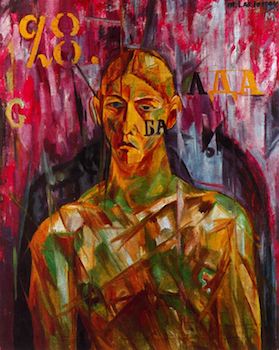
That refers to the time spent by Tatlin with the young Mikhail Larionov in Teraspol. ‘Vladimir and Mikhail edged through the thicket of sunflowers on rainy days to find things, old bits, bottomless wooden pails, snakes, baling wire lizards’ (Tatlin! 10).

It’s a forerunner of what will be fully fleshed out in the short novel which ends this book, The Dawn in Erewhon and in many of Davenport’s fictions thereafter: the utopian vision, drawing on Charles Fourier, of a paradisal world in which people, especially children, explore and learn the physical world’s sensuous beauty and sensual pleasures, focusing not least upon their own—and others’—bodies.

This persistent theme in Davenport’s fictions has provoked hostility, suspicion, even dismissal, some commentators becoming fixated upon it to the virtual exclusion of everything else, responses tending to confirm Davenport’s diagnosis of continuing Comstockery and Puritan frigidity. Erik Reese, though, writes that Davenport ‘believed that attraction is fundamentally amoral. We love what, and who, we love. Period.’ And he points to the review by Wyatt Mason, which suggested that Davenport’s fictions are really asking ‘one persistent question: “What if we were free?”’[14]

The story ends with Tatlin and Viktor Shklovsky talking together, Tatlin explaining that all politicians are mad. ‘A genius has no interest in controlling people with anything so crude as power. The artist has true power. The intellectual may hunger for power as his ideas prove to be weak, but he is for the most part content to live in his mind’ (Tatlin! 48). Stalin is dead – but Tatlin will outlive him by less than three months. ‘They sat in a kind of grief, a kind of joy, stunned.’ Tatlin asks: ‘Will they publish your books, build my tower, open the jails?’ Shklovsky replies: ‘It is only Stalin who is dead.’ To which Tatlin responds: ‘Aren’t we all?’

Viktor leaves. Tatlin sits among his hens and his books, of which he reads the same pages over and over. He and the others are ghosts of themselves, living in their minds, in memory and imagination. The story ends, as it began, with the flying machine. ‘He could ponder the glider strut by strut, and with a soft chirr and dance of hands, imagine it agile as a bat over rivers, lakes, fields’ (Tatlin! 51).


References

[1] Guy Davenport to Nicholas Kilmer, letter of 3 April 1979: ‘Fragments from a Correspondence’, Arion: A Journal of Humanities and the Classics, Third Series, 13, 3 (Winter, 2006), 89-130 (97).

[2] Davenport to Kenner [10 June 1969], in Questioning Minds: The Letters of Guy Davenport and Hugh Kenner, edited by Edward M. Burns, two volumes (Berkeley: Counterpoint Press, 2018), II, 1228.

[3] Questioning Minds II, 1298; see also Guy Davenport, ‘Ernst Machs, Max Ernst’, in The Geography of the Imagination (Boston: David R. Godine, 1997), 380.

[4] Letter of 24 October 1992, in W. C. Bamberger, editor, Guy Davenport and James Laughlin: Selected Letters (New York: W. W. Norton & Co., 2007), 92.

[5] Guy Davenport, ‘Postscript’ to Twelve Stories (Washington D. C.: Counterpoint, 1997), 235.

[6] Peter Quartermain, ‘Writing as Assemblage: Guy Davenport’, in Disjunctive Poetics: From Gertrude Stein and Louis to Zukofsky to Susan Howe (Cambridge: Cambridge University Press, 1992), 176.

[7] Bamberger, Guy Davenport and James Laughlin: Selected Letters, 138.

[8] Camilla Gray’s The Great Experiment: Russian Art 1863-1922 (1962) was revised and enlarged after Gray’s early death by Marian Burleigh-Motley. See her The Russian Experiment in Art, 1863-1922 (London: Thames and Hudson, 1986), 203, for Board No. 1: Old Bosmannaya (1916-1917) and Relief (1917).

[9] Guy Davenport, Tatlin! Six Stories (New York: Scribner’s, 1974), 1.

[10] Davenport, Twelve Stories, 13. Is a ‘mistake’ possible in fiction? Davport addresses the question himself in ‘Ernst Machs, Max Ernst’: The Geography of the Imagination, 376.

[11] Ezra Pound: Poems and Translations, edited by Richard Sieburth (New York: Library of America, 2003), 1308 n.549.2.

[12] Bamberger, Guy Davenport and James Laughlin: Selected Letters, 97.

[13] See Guy Davenport, ‘From Indifference to Attention’, New York Times Book Review (4 April, 1982), 30.

[14] ‘Afterword: Remembering Guy Davenport’, in The Guy Davenport Reader, edited by Erik Reese (Berkeley: Counterpoint, 2013), 414, 415. See Wyatt Mason, ‘There Must I Begin to Be: Guy Davenport’s heretical fictions’, Harper’s Magazine (April 2004): ‘If the language of fiction is to be of any lasting use, as Davenport cajoles us again and again to see, it must struggle to define–and, in so doing, attain–moments of liberty. In his own fiction, Davenport has succeeded in that regard, finding new ways to dramatize one, suggestive question: What if we were free?’


Gentleman farmer, amiable grouch, Jonathan Williams

JW

(JW via http://thisrecording.squarespace.com/today/tag/jonathan-williams)

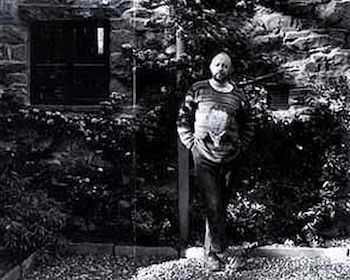
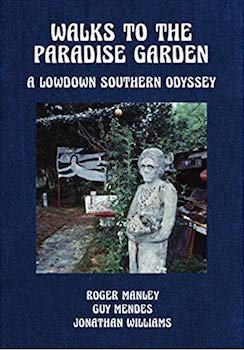
Today is the birthday of Jonathan Williams (1929-2008), poet, publisher, photographer, essayist, ‘gentleman farmer and amiable grouch’, as Thomas Meyer phrased it—he would have been 90. His last unpublished manuscript, Walks to the Paradise Garden, has just been released by Institute 193, the non-profit arts organisation based in Lexington, Kentucky—yes, Guy Davenport country—which collaborates with artists, musicians, and writers to produce exhibitions, publications, and projects that document the cultural landscape of the modern South. The 240-page book chronicles Williams’ road trips across the Southern United States with photographers Guy Mendes and Roger Manley ‘in search of the most authentic and outlandish artists the South had to offer.’

Walks-Paradise-Garden

More information here: https://www.kickstarter.com/projects/801455684/walks-to-the-paradise-garden-a-lowdown-southern-od?ref=email

The exhibition associated with the book has just opened: Way Out There: The Art of Southern Backroads at the High Museum of Art in Atlanta, March 2 – May 19, 2019.

https://www.high.org/exhibition/way-out-there-the-art-of-southern-backroads/

A post about Williams last year brought me into contact with the poet Jeffery Beam, co-editor with Richard Owens of Jonathan Williams: The Lord of Orchards, (Wesport: Prospecta Press, 2017).

Here—and why not?—is a Williams poem, ‘An Omen for Stevie Smith’, which caught my eye earlier today.

this is your aunt, Stevie,
and oh you must hurry!

The Man in Black
who waits tonight along the Lyke Wake Walk
has a gown for you
the colour of rowan berries;

a gown borne in air by hornets,
hagworms, and ants, riding
the backs of great bustards and herons. . .

your cats,
Brown and Fry and Hyde,
yes, Stevie, they too
shall come at last
to Whinny-Moor. . .

the five of you
shall dance that heath
to Death!

Stevie Smith has a poem called ‘My Cats’:

I like to toss him up and down
A heavy cat weights half a Crown
With a hey do diddle my cat Brown.

I like to pinch him on the sly
When nobody is passing by
With a hey do diddle my cat Fry.

I like to ruffle up his pride
And watch him skip and turn aside
With a hey do diddle my cat Hyde.

Hey Brown and Fry and Hyde my cats
That sit on tombstones for your mats.

Spectral-Pegasus

Jeffery Beam has a new book out, which I’ve just begun reading, a collaboration with the Welsh painter Clive Hicks-Jenkins, Spectral Pegasus / Dark Movements: Poems by Jeffery Beam; Paintings by Clive Hicks-Jenkins (Higganum, Connecticut: Kin Press, 2019, ISBN 9780998929316) A limited edition CD of the poems and songs is included with the first 500 copies and available thereafter through Beam’s website: www.jefferybeam.com

Jeffery has a series of readings and launch events coming up, mostly in the United States, but he’ll be at MOMA, the Museum of Modern Art in Machynlleth, Powys, Wales on 15 May 2019.


Positive Blossoming

Blossom

A large bumble bee, having perhaps misread the calendar, veers about in our small garden. The plump, intellectually challenged grey cat, perched on a stone pillar, dabs in its general direction with an ineffectual paw. The grey cat is still in recovery mode, having all but fallen from the fence just now, scrabbling frantically, clutching and scraping, hauling itself back only to be plunged into embarrassment by finding me watching its antics from the kitchen table, where I sat over a fat volume.

‘“I’ve seen fire and I’ve seen rain,” I recall James Taylor singing over and over on the news radio station between updates on the 1978 Mandeville and Kanan fires, both of which started on October 23 of that year and could be seen burning toward each other, systematically wiping out large parts of Malibu and Pacific Palisades, from an upstairs window of my house in Brentwood.’[1]

Oddly, I’d been thinking of James Taylor myself the previous day, when I passed trees in the park already in blossom. I say ‘already’ but, if they were autumn cherry, they’d be blossoming fitfully from November to March. Almond blossom? Not sure.

Blossom, anyway. Meteorologically, spring has started, psychologically not so much, though, when the breeze quickens and becomes something else, the Romantics among us murmur: ‘O, Wind,/ If Winter comes/ Can Spring be far behind?’[2]

Sweet-baby-James

James Taylor’s ‘Blossom’ was the second track on the second side of his second album, Sweet Baby James, melodic and, as they say, reassuringly unthreatening, though not without its darker tints. It’s one of two tracks on the album—the other was ‘Country Road’—on which Randy Meisner, founder member of The Eagles, played bass.

The word ‘blossom’ is one of those whose syllables seem to act out the actions and qualities associated with it. Ivor Gurney wrote of his beloved Gloucestershire, ‘where Spring sends greetings before other less happy counties have forgotten Winter and the snow. Where the talk is men’s talk, and eyes of folk are as soft as the kind airs. The best roads in England, the finest cider, the richest blossom in the most magical orchards, beauty content in security, strength quiet in confidence controlled, blood mixed of plain and hill, Welsh and English; are not these only of my county, my home?’ Though he added—he was writing to Marion Scott from near Tidworth in March 1916—‘And yet were I there the canker in my soul would taint all these.’[3]

Blossom fits with sweet reasonableness into contexts of ironic undercurrent and ambiguity, say, the final stanza of Henry Reed’s ‘Naming of Parts’:

They call it easing the Spring: it is perfectly easy
If you have any strength in your thumb: like the bolt,
And the breech, and the cocking-piece, and the point of balance,
Which in our case we have not got; and the almond-blossom
Silent in all of the gardens and the bees going backwards and forwards,
For today we have naming of parts.[4]

And here is the narrator of V. S. Naipaul’s The Enigma of Arrival, blossom a part of his learning to read the English landscape and its complicated history:

‘When I grew to see the wild roses and hawthorn on my walk, I didn’t see the windbreak they grew beside as a sign of the big landowners who had left their mark on the solitude, had preserved it, had planted the woods in certain places (in imitation, it was said, of the positions at the battle of Trafalgar – or was it Waterloo?), I didn’t think of the landowners. My mood was purer: I thought of these single-petalled roses and sweet-smelling blossom at the side of the road as wild and natural growths.’[5]

Brett, Dorothy Eugenie, 1883-1977; D. H. Lawrence

Dorothy Brett, D. H. Lawrence
© National Portrait Gallery, London. Photo credit: National Portrait Gallery, London

For D. H. Lawrence, it seems a symbol of a stage on the road to moral growth: ‘You have to suffer before you blossom in this life’, Lettie tells George in The White Peacock. ‘When death is just touching a plant, it forces it into a passion of flowering.’[6] His short story, ‘The Last Laugh’, centring on an encounter with Pan ends with a faint scent of almond blossom in the air[7]—and Pan is not only a recurrent element in Lawrence’s work but crops up all over the place at that time: from E. M. Forster to The Wind in the Willows. Unsurprisingly, perhaps, what Lawrence sees as our separation from the natural world finds blossom on the casualty list as he gets into his stride in the last year of his life:

‘Sex is the balance of male and female in the universe, the attraction, the repulsion, the transit of neutrality, the new attraction, the new repulsion, always different, always new. The long neuter spell of Lent, when the blood is low, and the delight of the Easter kiss, the sexual revel of spring, the passion of midsummer, the slow recoil, revolt, and grief of autumn, greyness again, then the sharp stimulus of winter, of the long nights. Sex goes through the rhythm of the year, in man and woman, ceaselessly changing: the rhythm of the sun in his relation to the earth.’ [ . . . ] This is what is the matter with us. We are bleeding at the roots, because we are cut off from the earth and sun and stars, and love is a grinning mockery, because, poor blossom, we plucked it from its stem on the tree of Life, and expected it to keep on blooming in our civilised vase on the table.’[8]

Cherry-Blossom-Japan-Guide

(Via www.japan-guide.com )

When it comes to national obsessions, some Western countries might do better to look to Japan: ‘Residents of Kochi Prefecture in the Shikoku region will be the first to see cherry blossoms of the Somei-Yoshino tree this year, as early as March 18, according to a forecast by an Osaka-based meteorological company that predicts Japan’s iconic sakura may bloom earlier than usual’, the Japan Times reported:
https://www.japantimes.co.jp/news/2019/01/15/national/cherry-blossoms-across-japan-forecast-arrive-earlier-usual-2019/#.XH-WyFP7RQM

I don’t pitch my own interest and enthusiasm quite that high but I’ll still lean towards the positive side: new growth, new life, new beauty. Some news as good news. ‘The positive side’—here, now, England, March 2019.

Remarkable.

 
References

[1] Joan Didion, ‘Fire Season’, in We Tell Ourselves Stories in Order to Live: Collected Nonfiction (New York: Knopf, 2006), 656.

[2] Percy Bysshe Shelley, ‘Ode to the West Wind’, The Complete Poetical Works of Percy Bysshe Shelley, edited by Thomas Hutchinson (London: Oxford University Press, 1909), 574.

[3] Ivor Gurney, Collected Letters, edited by R. K. R. Thornton (Mid Northumberland Arts Group & Carcanet Press 1991), 75.

[4] Henry Reed, ‘Naming of Parts’, in Collected Poems (Manchester: Carcanet Press, 2007), 49.

[5] V. S. Naipaul, The Enigma of Arrival: A Novel in Five Sections (1987; London: Pan McMillan, 2002), 20.

[6] D. H. Lawrence, The White Peacock (1911; Cambridge University Press, edited by Andrew Robertson, Cambridge 1983), 28.

[7] D. H. Lawrence, ‘The Last Laugh’, in The Collected Short Stories of D. H. Lawrence (London: William Heinemann, 1974), 587-602.

[8] D. H. Lawrence, ‘A Propos of “Lady Chatterley’s Lover”, in Phoenix II: Uncollected, Unpublished and Other Prose Works by D. H. Lawrence, Collected and Edited with an Introduction and Notes by Warren Roberts and Harry T. Moore (London: William Heinemann, 1968), 504.


Always changing, always the same

durrell.via.theamericanreader.com .  Mansfield

‘I think that, as I say, in England, living as if we are not part of Europe, we are living against the grain of what is nourishing to our artists, do you see? There seems to be an ingrown psychological thing about it, I don’t know why it is. You can see it reflected even in quite primitive ways like this market business now—the European Common Market. It’s purely psychological, the feeling that we are too damned superior to join this bunch of continentals in anything they do. And I think that’s why it is so vitally important for young artists to identify more and more with Europe. As for me, I have joined the Common Market, as it were. But, mind you, that doesn’t qualify one’s origins or one’s attitude to things. I mean if I’m writing, I’m writing for England—and so long as I write English it will be for England that I have to write.’

(Lawrence Durrell—born 27 February 1912: happy birthday, Larry—interviewed by Julian Mitchell and Gene Andrewski, 23 April 1959,[1] fourteen years before the United Kingdom joined what was then the EEC (European Economic Community). Two years later, a referendum resulted in a 67.2% vote in favour of remaining in the EEC.)

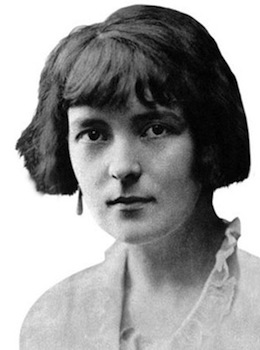
‘I shall never live in England again’, Katherine Mansfield wrote to Sydney Waterlow, ‘I recognise England’s admirable qualities, but we simply don’t get on. We have nothing to say to each other, we are always meeting as strangers.’[2] Of course, that ‘never’ turned out to have strict limits since, less than two years after writing her letter, Mansfield was dead, at the age of thirty-four.

A hundred years on; there are still some ‘admirable qualities’ (my choices wouldn’t be everybody’s) and I shall certainly go on living in England. That ‘meeting as strangers’, though, crops up a lot just lately. Good grief, how many times can you ask the question—of the empty air or, indeed, of a Librarian—‘What is wrong with these people?’

Dore-Punishment-Sowers-Discord

(Gustave Doré, ‘Punishment of the Sowers of Discord’ (1890), illustration for Dante’s Inferno)

The end-of-pier show lurched into literature following Donald Tusk’s studied musing into a microphone as to ‘what the special place in hell looks like for those who promoted Brexit without even a sketch of a plan how to carry it out safely’. Letter-writers determinedly sited the miscreants in Dante’s Inferno. I remember one suggestion that the ‘special place’ might be the poet’s eighth Bolgia or ditch, where the souls of deceivers and false counsellors are found, though I’d been thinking of the ninth one, where the sowers of discord are given a very hard time by a large demon equipped with a sharp sword. But of course, it might not be a special place at all and they may just be pitchforked in with the rest of the riff-raff.

There were people in the public sphere to be admired – but they all seemed to be under voting age – the twelve year old journalist Hilde Lysak, for instance (https://www.theguardian.com/us-news/2019/feb/24/hilde-lysak-police-officer-arrest-video) and the thousands of schoolchildren striking in protest at the feeble gestures made by the political class towards combatting climate change and environmental crisis, inspired by the example of the – now – sixteen year old Swede Greta Thunberg. The criticism of this demonstration from Downing Street and in the columns of one or two professional dimwits rather strengthened the case made by other commentators that the only adults in the room seemed to be, ah, children. The young environmental activists were acting in concert in the face of a planetary disaster. In the House of Commons, even the imminence of a national disaster couldn’t affect the posturing and squabbling and the exorbitant influence on Government policy exerted by a gaggle of fops, chancers and wide-boys.

Still, as a friend remarked to me yesterday, although the situation seems always the same it also seems to be constantly changing, a bizarre but discernible feature. So the Labour leadership has, at that familiar glacial pace, finally arrived at allowing, if not actually supporting, the idea of a People’s Vote, turning up at the party with a bottle of cheap white wine as the ashtrays are being emptied, the floors swept and the lights turned out. It could all, as they say, have been so different. But when historic opportunities come along, the relevant people need to be looking in the right direction.

 
References

[1] Writers at Work: the Paris Review Interviews, 2nd series, edited by George Plimpton ((Harmondsworth: Penguin Books, 1977), 263.

[2] Katherine Mansfield, Selected Letters, edited by Vincent O’Sullivan (Oxford: Oxford University Press, 1990), 199.


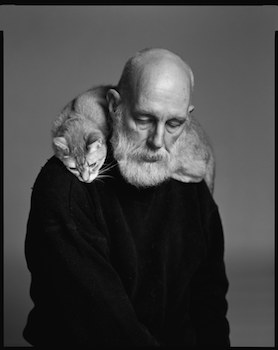
Bearded men in overcoats: Edward Gorey

Gorey-Avedon

(Photograph by Richard Avedon, via The New Yorker
© The Richard Avedon Foundation)

‘Gorey’, Hugh Kenner wrote to Guy Davenport in 1962. ‘I have tracked down THE CURIOUS SOFA, THE FATAL LOZENGE, THE WILLOWDALE EXPRESS [i.e., The Willowdale Handcar], and THE HAPLESS CHILD. No others seem to be available. One is especially curious about THE DOUBTFUL GUEST and ($1,000,000 prize title) THE LISTING ATTIC. Are any sources of supply known to you?’

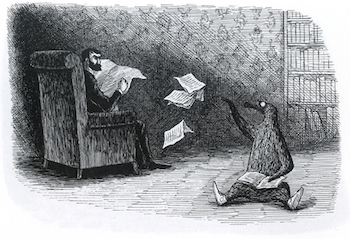
The following Spring, breathing down the neck of Pound-Joyce-Ruskin references that will emerge in different form a dozen years later in ‘The House That Jack Built’, is this Davenport remark: ‘All the bearded men in overcoats in Gorey are Gorey.’[1]

Doubtful-Guest

‘At times it would tear out whole chapters from books,
Or put roomfuls of pictures askew on their hooks.’[2]

Some of the attractions for Davenport are fairly obvious: a wide and varied taste in books (Gorey owned upwards of 25000), cats—and the hospitality offered to other living creatures—virtuosic graphic work, an extraordinary range of interests and knowledge, a productive eccentricity and a distinctly individual stance towards the world.

Edward St John Gorey was born 22 February 1925 (and died in 2000). He published more than a hundred of his own works, beginning with The Unstrung Harp in 1953, and illustrated the works of scores of other writers, poets and critics, from Dickens, Edward Lear, H. G. Wells and Samuel Beckett to Saki, Muriel Spark, Virginia Woolf and the wonderful Treehorn books by Florence Parry Heide.

Treehorn

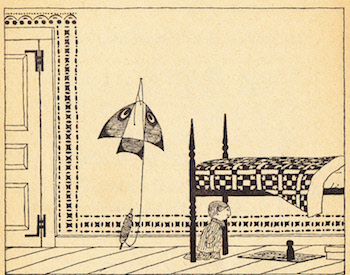
‘The next morning Treehorn was so small he had to jump out of bed. On the floor under the bed was a game he’d pushed under there and forgotten about. He walked under the bed to look at it.’[3]

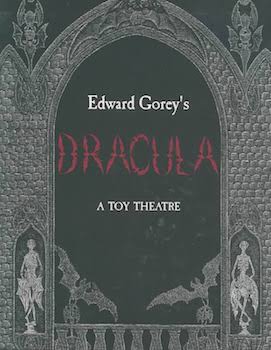
Moving around our house, I find Gorey items in a surprising number of places: small hardbacks and larger paperbacks, postcards, a jigsaw, even a toy theatre, Edward Gorey’s Dracula, a Christmas present to the Librarian some years back.

Gorey-Dracula

There are some irresistible moments in the interview of Gorey by Clifford Ross:

CR: What about your working day?
EG: I usually wake up and think, “Oh, I really must do something today.” But then quite often many things come up before I can start doing them.
CR: Do you work each day?
EG: I try and do something each day. Work might not be exactly the word for it.

Elsewhere, ‘But I do collect postcards of dead babies.’ And, in response to the question about what sort of art he collects—Balthus, Burchfield, Albert York, Vuillard, Bonnard—‘And I have one Munch lithograph, I think.’ Ross asks which one and Gorey tells him: ‘Omega and the Bear. I couldn’t resist it. It’s this back of a naked lady and she’s got her arms around a big bear. I think it has some significance. I’m not sure what.’

Karen Wilkin, in her absorbing essay, lists some of the inhabitants—‘Mustachioed men in ankle-length overcoats; elegant matrons with high-piled hair; athletic hearties in thick turtlenecks; imposing patriarchs in sumptuous dressing-gowns; kohl-eyed wantons with alarming décolletages and nodding plumes’—of what she terms ‘an utterly unreal but wholly believable universe instantly recognizable, at least to initiates, as the world of Edward Gorey.’ It is, it is. She details the influence of theatre and, particularly, dance on Gorey’s art. He rarely missed a performance of the New York Ballet for thirty years and his ‘knowledge and understanding’ of the choreography of George Balanchine was ‘profound’.[4]

McDermott-Elephant-House

(© Kevin McDermott, photograph facing chapter heading ‘The Living Room’)

Kevin McDermot, in his book about Gorey’s Cape Cod house, illustrated with his own superb photographs, quotes a Vanity Fair interview with Gorey from October 1997:

What or who is the greatest love of your life?
“Cats.”
If you were to die and come back as a person or thing, what do you think it would be?
“A stone.”
What is your favourite journey?
“Looking out the window.”[5]

Accept no substitutes.

Gorey’s home is now a museum, dedicated to his life and work, open from April to December each year. The Edward Gorey House: http://www.edwardgoreyhouse.org/

 
References

[1] Questioning Minds: The Letters of Guy Davenport and Hugh Kenner, edited by Edward M. Burns, two volumes (Berkeley: Counterpoint Press, 2018), I, 167, 286.

[2] Edward Gorey, The Doubtful Guest (1957), in Amphigorey: Fifteen Books by Edward Gorey (New York: Perigee Books, 1981), unpaginated.

[3] Florence Parry Heide, The Shrinking of Treehorn, in The Treehorn Trilogy, drawings by Edward Gorey (New York: Abrams, 2006), unpaginated.

[4] Clifford Ross, ‘Interview with Edward Gorey’, in Clifford Ross and Karen Wilkin, The World of Edward Gorey (New York: Abrams, 1996), 19; Karen Wilkins, ‘Mr. Earbrass Jots Down a Few Visual Notes: The World of Edward Gorey’, 45, 86.

[5] Kevin McDermot, Elephant House, or, The Home of Edward Gorey (San Francisco: Pomegranate, 2003), unpaginated.


Owl’s Eyes

Owls

My daughter’s flight from Barcelona, due late in the evening, is delayed by two hours, so I sit up, well beyond my usual bedtime. ‘Night-owl’, people used to say, certainly my mother used to say, of those who kept late hours, though Edward Hopper’s famous 1942 painting of four people in a diner keeping very late hours, ‘the classic film noir Hopper’, as Robert Hughes calls it, is entitled Nighthawks.[1]

Nighthawks

(Edward Hopper, Nighthawks: The Art Institute of Chicago; Friends of American Art Collection)

Owls, though, I associate with at least three firsts in my life: in the pages of the brief travel journal I kept on my first trip to Greece some twenty years ago, I see several mentions of the call of the Scops owl, the Eurasian (or Common) Scops owl, known to a generation of young (and older) readers of J. K. Rowling’s Harry Potter books because Ron Weasley’s owl is a Scops. Similar in some ways to a Scops and, apparently, sometimes mistaken for it, is the Little Owl, Athene noctua, sacred owl of Athena. The goddess with the grey eyes, she was traditionally described as. When James Joyce talked to Sylvia Beach of his eye problems and mentioned glaucoma, Beach remembered: ‘It was the first time I had ever heard of this disease, with its beautiful name. “The gray owl eyes of Athena,” said Joyce.’[2] So said the author of Ulysses but, apparently, while Homer uses the word for an ‘owl’ (skops) only once, glaukopis—derived from glaux, the generic term for ‘owl’—occurs some ninety times in his work. It may have meant ‘sharp-eyed’ or ‘with gleaming eyes’.[3]

SB-JJ

(Sylvia Beach and James Joyce via The Washington Times)

I was working on my thesis when my supervisor, the poet Charles Tomlinson, mentioned in conversation that John Ruskin had discussed the meaning of glaukopis in a book called The Queen of the Air (1869). ‘In her prudence, or sight in darkness, she is “Glaukopis,” owl-eyed’, he wrote of Athena. And a little later, Glaukopis ‘chiefly means grey-eyed: grey standing for a pale or luminous blue; but it only means “owl-eyed” in thought of the roundness and expansion, not from the colour; this breadth and brightness being, again, in their moral sense, typical of the breadth, intensity, and singleness of the sight in prudence’.[4]

I’d been reading Ezra Pound on Allen Upward and the pages to which Charles had directed me evolved into a large part of my first published essay.[5] Upward regarded with a severely critical eye the attempts of scholars thus far ‘to understand the word glaukopis, given to the goddess Athene. Did it mean blue-eyed, or gray-eyed, or—by the aid of Sanskrit—merely glare-eyed? And all the time they had not only the word glaux staring them in the face, as the Athenian name for owl, and the name of ox-eyed Hera to guide them, but they had the owl itself cut at the foot of every statue of Athene, and stamped on every coin of Athens, to tell them that she was the owl-eyed goddess, the lightning that blinks like an owl. For what is characteristic of the owl’s eyes is not that they glare, but that they suddenly leave off glaring, like lighthouses whose light is shut off. We may see the shutter of the lightning in that mask that overhangs Athene’s brow, and hear its click in the word glaukos. And the leafage of the olive, whose writhen trunk bears, as it were, the lightning’s brand, does not glare, but glitters, the pale under face of the leaves alternating with the dark upper face, and so the olive is Athene’s tree, and is called glaukos. Why need we carry owls to Oxford?’[6] (The many owls that were in Athens gave rise to the saying, ‘To bring owls to Athens’, an early forerunner of the English phrase, ‘to take coals to Newcastle’.)

Athenes-Owl

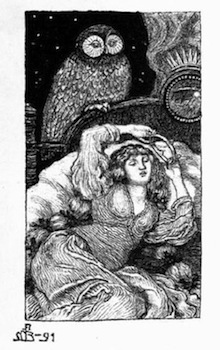
The novelist Violet Hunt, who often received Ezra Pound at South Lodge, her home on Campden Hill Road, had an owl named Ann Veronica, after the novel by H. G. Wells, ‘a very pretty little owl’ but—‘She died untimely.’[7] The owl was part of a menagerie that included a bulldog, nine Persian cats, and several parrots that ‘shrieked “Ezra! Ezra!” whenever they saw him bouncing up the walk.’[8] Hunt’s partner for a decade was, of course, Ford Madox Ford, the other main focus of my research: the rest of my essay linked Upward and his double vortex, or waterspout, with Ford’s 1913 novel The Young Lovell. Ford published almost eighty books in his lifetime but the first of them all was a fairy tale called The Brown Owl, its frontispiece created by his grandfather, the painter Ford Madox Brown.

Brown_Owl_FMB

The mountains being so tall
And forcing the town on the river,
The market’s so small
That, with the wet cobbles, dark arches and all,
The owls
(For in dark rainy weather the owls fly out
Well before four), so the owls
In the gloom
Have too little room
And brush by the saint on the fountain
In veering about.[9]

 
References

[1] Robert Hughes, American Visions: The Epic History of Art in America (London: The Harvill Press, 1997), 427.

[2] Sylvia Beach, Shakespeare and Company, new edition (Lincoln: University of Nebraska Press, 1991), 39.

[3] Michael Ferber, A Dictionary of Literary Symbols (Cambridge: Cambridge University Press, 1999), 146. Liddell and Scott’s Greek Lexicon has ‘epithet of Minerva’—Roman goddess identified with Greek Athene—‘with gleaming eyes’.

[4] The Works of John Ruskin, Library Edition, Volume XIX: The Cestus of Aglaia and The Queen of the Air with Other Papers and Lectures on Art and Literature, 1860–1870, edited by E. T. Cook and Alexander Wedderburn (London: George Allen, 1905), 306, 381.

[5] Paul Skinner, ‘Of Owls and Waterspouts’, Paideuma, 17, 1 (Spring 1988), 59-68.

[6] Allen Upward, The New Word: An Open Letter addressed to the Swedish Academy in Stockholm on the meaning of the word IDEALIST (New York: Mitchell Kennerley, 1910), 238.

[7] Violet Hunt, The Flurried Years (London: Hurst and Blackett, 1926), 109.

[8] Barbara Belford, Violet: The Story of the Irrepressible Violet Hunt and her Circle of Lovers and Friends—Ford Madox Ford, H. G. Wells, Somerset Maugham, and Henry James (New York: Simon and Schuster, 1990), 166-167.

[9] Ford Madox Ford, ‘In the Little Old Market-place’, Selected Poems, edited and introduced by Max Saunders (Manchester: Carcanet Press, 1997), 68.