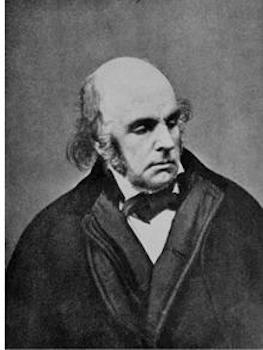
Edward Fitzgerald: a Life in Letters

Edward-Fitzgerald

‘Oh this wonderful wonderful world, and we who stand in the middle of it are all in a maze.’—Letter to Bernard Barton, 11 April 1844.

In 1922, modernism’s annus mirabilis, Virginia Woolf confided to her diary that she had made up her mind that she was not going to be popular. ‘My only interest as a writer lies, I begin to see, in some queer individuality: not in strength, or passion, or anything startling; but then I say to myself, is not “some queer individuality” precisely the quality I respect? Peacock, for example: Borrow; Donne; Douglas, in Alone, has a touch of it. Who else comes to mind immediately? FitzGerald’s Letters.’ She added that, ‘People with this gift go on sounding long after the melodious vigorous music is banal.’[1]

People of a bookish bent tend to know one or two things about Edward FitzGerald: the most generally known one is that he translated the Rubáiyát of Omar Khayyám; the second thing, also pretty widely known now, is that A. C. Benson’s book about FitzGerald, published in the English Men of Letters series in 1909, which includes the lines, ‘Here he sits, in a dry month, old and blind, being read to by a country boy, longing for rain’, lay behind the famous beginning of T. S. Eliot’s ‘Gerontion’:

Here I am, an old man in a dry month,
Being read to by a boy, waiting for rain.

‘I can recall clearly enough’, Eliot wrote, a decade after The Waste Land, ‘the moment when. at the age of fourteen or so, I happened to pick op a copy of Fitzgerald’s Omar which was lying about, and the almost overwhelming introduction to a new world of feeling which this poem was the occasion of giving me. It was like a sudden conversion; the world appeared anew, painted with bright, delicious and painful colours.’[2]

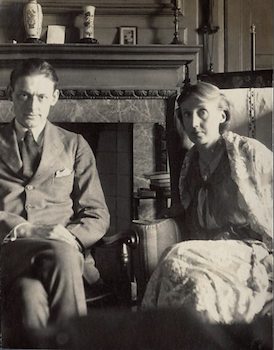
TSE-VW-1924-OM-NPG

(Lady Ottoline Morrell, T. S. Eliot and Virginia Woolf (1924): © National Portrait Gallery)

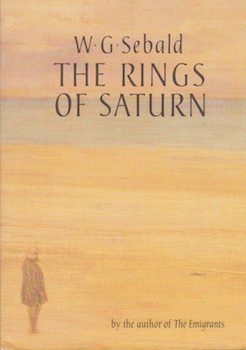
Most recently, I find a small slip of paper lodged in my old proof copy of W. G. Sebald’s Rings of Saturn, scrawled all over with a couple of dozen one- or two-word notes: names, from literature and history, on which Sebald’s mind has seized until the point is made, the connection or association teased out, the story told. Thomas Browne, Rembrandt, Dunwich, Ashburnham, Michael Hamburger, Middleton, sugar and art, Merton, the Ashburys, Chateaubriand, herrings, silk, the storm of 16 October 1897, Felixstowe, Orfordness – and Edward FitzGerald.[3]

sebald-rings-of-saturn-british-edition

(Jacket of UK edition, W. G. Sebald, The Rings of Saturn)

FitzGerald was born on 31 March 1809. On the death of his grandfather in 1818, his mother was reputed to be the wealthiest commoner in England. After grammar school and Cambridge, he eventually furnished a cottage on the edge of the family estate at Boulge Hall in Suffolk. Two years later, after describing a typical day, he could add, with justice, ‘But such as life is, I believe I have got hold of a good end of it.’[4] He married reluctantly – and briefly: less than a year later, he and his wife Lucy concluded that the marriage was a failure and decided to separate. In 1864, FitzGerald moved to Woodbridge. He numbered among his friends, acquaintances and correspondents George Borrow, Thomas Carlyle, the poet George Crabbe’s son (also George), the actress and writer Fanny Kemble, Alfred and Frederick Tennyson, and William Makepeace Thackeray. At Woodbridge, he read, continued to write marvellous letters and visit his circle of friends.

It was in 1856 that one of those friends, E. B. Cowell, had begun transcribing portions of the Ouseley MS of Omar Khayyám’s Rubáiyát, which he’d recently discovered in the Bodleian; in July of that year, he gave FitzGerald the complete transcript. The following year, Cowell, by then in India, sent a transcript of the Calcutta MS of the Rubáiyát. FitzGerald submitted a translation to Fraser’s Magazine but later retrieved it and determined to publish it himself, having two and hundred and fifty copies printed, of which he reserved forty for his own use. It appeared in late March 1859 but failed to sell. It was discovered in the bookseller Bernard Quaritch’s ‘penny-box’ by W. H. Thompson and by Whitley Stokes, a Celtic scholar, who bought other copies and gave one to Dante Gabriel Rossetti. From Rossetti, the circle of appreciation widened, taking in George Meredith, Swinburne, William Morris, Edward Burne-Jones and, through him, his nephew, Rudyard Kipling. Ruskin also read it, quoting a stanza of the poem in a letter to Mrs Simon and remarking, ‘I wish the old Persian could see how much better I write for love of him.’[5] Famously, Ezra Pound would recall, in the context of Burne-Jones and Rossetti that ‘The English Rubaiyat was still-born/ In those days.’[6]

Myself when young did eagerly frequent
Doctor and Saint, and heard great Argument
About it and about: but evermore
Came out by the same Door as in I went.

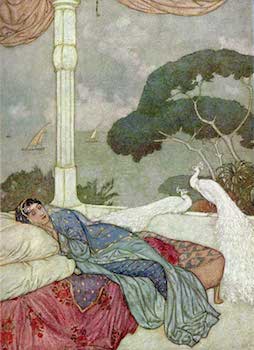
Dulac_Rubaiyat

(Edmund Dulac, one of twenty colour illustrations to the Rubáiyát, 1909)

A second edition of the Rubáiyát appeared in 1866, a third in 1872, a fourth in 1879, resulting in a great many changes over that time; FitzGerald translated other Persian poems, as well as Calderon, Aeschylus and others. Other translations of the Rubáiyát appeared in the 1880s and 1890s.

If a loaf of wheaten bread be forthcoming,
A gourd of wine, and a thigh-bone of mutton,
And then if thou and I be sitting in the wilderness—

This is, apparently, a literal translation by Edward Heron-Allen (1899) of the lines that FitzGerald translated as ‘A Jug of Wine, a Loaf of Bread—and Thou/ Beside me singing in the Wilderness—’ (II, 308 n.11). No wonder, then, that Ezra Pound, who had condensed twelve lines of poetry translated from the Chinese by H. A. Giles to a three-line work plus, indispensably, the title (‘Fan-Piece, for her Imperial Lord’), was so receptive to the qualities of FitzGerald’s Rubáiyát.[7]

Ah, fill the Cup: – what boots it to repeat
How Time is slipping underneath our Feet:
Unborn TO-MORROW, and dead YESTERDAY,
Why fret about them if TO-DAY be sweet![8]

To his friend W. F. Pollock, FitzGerald wrote in 1846: ‘I have been all my life apprentice to this heavy business of idleness; and am not yet master of my craft; the Gods are too just to suffer that I should’ (I, 550). Though no stranger to the capital he was rarely at ease there. ‘Though I had to run to London several times, I generally ran back as fast as I could; much preferring the fresh air and the fields to the smoke and ‘“the wilderness of monkeys”’ in London’ (II, 56). FitzGerald was hit hard by the deaths of two close friends, particularly that of Kenworthy Browne who died in a riding accident, crushed by his horse. It was the death of Browne, the editors of his letters remark, ‘that finally made London intolerable to FitzGerald. The two had visited the city together frequently and the memory of his friend so haunted FitzGerald in streets and taverns as to “fling a sad shadow over all”’(I, 4).

Then too, for all his enjoyment of the English countryside, time could hang heavy even in Suffolk. ‘Oh, if you were to hear “Where and oh where is my Soldier Laddie gone” played every three hours in a languid way by the Chimes of Woodbridge Church, wouldn’t you wish to hang yourself? On Sundays we have the “Sicilian Mariners’ Hymn”—very slow indeed. I see, however, by a Handbill in the Grocer’s Shop that a Man is going to lecture on the Gorilla in a few weeks. So there is something to look forward to.’ (II, 411-412). And one of my favourites, in a letter to Mrs Charles Allen in 1857. ‘I always think a Nation with great Estates is like a Man with them:—more trouble than Profit: I would only have a Competence for my country as for myself’ (II, 296). Hurrah for a Competence.

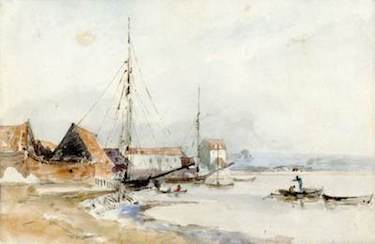
; Old Jessup's Quay, Woodbridge

(Thomas Churchyard, Old Jessup’s Quay, Woodbridge. Photo credit: Colchester and Ipswich Museums Service: Ipswich Borough Council Collection)

His focus was increasingly on sailing, on his boat, on all things maritime—‘My chief amusement in Life is Boating, on River and Sea’ (II, 400). In August 1875, he wrote to Cowell, ‘I have not been very well all this Summer, and fancy that I begin to “smell the Ground,” as Sailors say of the Ship that slackens speed as the Water shallows under her. I can’t say I have much care for long Life: but still less for long Death: I mean a lingering one’ (III, 592-593).

FitzGerald died on 14 June 1883 and is buried in the churchyard of St Michael & All Angels, Boulge, Suffolk.[9]

References

[1] Entry for Saturday 18 February: The Diary of Virginia Woolf, Volume 2: 1920-24, edited by Anne Olivier Bell, assisted by Andrew McNeillie (Harmondsworth: Penguin, 1981), 168. A footnote mentions that Norman Douglas’s Alone had appeared in late 1921; and that Woolf possessed the seven volumes of the 1902 Letters and Literary Remains of Edward Fitzgerald

[2] T. S. Eliot, The Use of Poetry and the Use of Criticism (1933; London: Faber and Faber, 1964), 33.

[3] See W. G. Sebald, The Rings of Saturn, translated by Michael Hulse (London: The Harvill Press, 1998), 195-207, on the FitzGerald family.

[4] To John Allen, 28 April, 1839. The Letters of Edward FitzGerald, edited by Alfred McKinley Terhune and Annabelle Burdick Terhune, four volumes (Princeton: Princeton University Press, 1980), I, 224. All references in text to this edition.

[5] The Letters of John Ruskin: Volume I, 1827-1869, edited by E. T. Cook and Alexander Wedderburn (London: George Allen, 1909), 455.

[6] Ezra Pound, ‘Yeux Glauques’ (Hugh Selwyn Mauberley VI), Personae: The Shorter Poems of Ezra Pound, edited by Lea Baechler and A. Walton Litz (New York: New Directions, 1990), 189.

[7] Hugh Kenner, The Pound Era (London: Faber and Faber, 1972), 197.

[8] Quotations from the first edition, the text used in The Penguin Book of Victorian Verse (London: Allen Lane, 1997), selected and edited by Daniel Karlin, who subsequently produced the Oxford World Classics edition of the Rubáiyát (2009).

[9] A visit to the grave by T. F. Powys is the starting-point for a fascinating discussion of the Fitzgerald–Sebald–Powys connection in Stephen Batty’s ‘“To grasp this sorry Scheme of Things”’: Theodore Francis Powys & the Rubáiyát of Omar Khayyám’, The Powys Journal, XXI (2011), 71-95.

Geoffrey Not Maynard


Geoffrey-Keynes

‘Just now I am very proud because I recently acquired a wonderful edition of Sir Thomas Browne’, Elizabeth Bishop wrote to Donald E. Stanford in 1934, ‘very elegant, once selling for $36 and now remaindered at $12. It’s edited by Geoffrey Keynes and has a lot of charming portraits.’[1]

Geoffrey Keynes may be less well known than his famous economist brother Maynard but is of extraordinary interest on his own account. He was at Rugby School with Rupert Brooke, becoming the literary executor of Brooke’s estate after the poet’s death in 1915: his huge Letters of Rupert Brooke finally appeared in 1968. When a house surgeon at St Bartholomew’s, Keynes played a major part in saving the life of Virginia Woolf after her first suicide attempt in 1913 (and so prior to publishing any of her novels).[2] During the war, he served in the Royal Army Medical Corps and, in 1917, married Margaret Elizabeth Darwin, Charles Darwin’s grand-daughter and younger sister of Gwen Raverat, the artist and author of Period Piece, constantly in print since its first appearance nearly seventy years ago:


‘Once I was taken out of bed and carried down to the front door in my nightgown to see the water covering the road and the Green, when a flood had risen suddenly one night. My parents had gone out to dinner on foot, but the frightened maids sent a four-wheeler to fetch them back in a hurry. The water came up to the hubs of the wheels, but was not very deep on the pavement. The cellars were awash, and my father had to wade out into the garden to rescue a cat which was marooned on top of a wall. We had several very delightful floods in my youth, but unfortunately the water never quite came into the house; nor did it in the Great Flood of 1947.’[3]

Keynes was a close friend of Jacques Raverat (who married Gwen in 1911), knew Eric Gill, and arranged publication of several limited editions of Siegfried Sassoon’s work, as well as compiling a Sassoon bibliography. He became an eminent medical figure, particularly notable for his advocacy of blood transfusion and his treatment of breast cancer. But he’s most commonly celebrated as the bibliographer of Donne, John Evelyn, Thomas Browne and, especially, William Blake. His bibliography of Blake, together with his editions of Blake’s writings, paved the way for the great rise in Blake scholarship and the general revaluation of his works in the twentieth century.

Keynes met Francis Meynell, founder of the Nonesuch Press, in 1923, the year in which the press produced its first title, an edition of John Donne’s Love Poems. They became, and remained, friends for over fifty years. Meynell later remarked that Keynes had produced, in whole or in part, sixteen books for the Nonesuch Press, though Keynes comments that he ‘had a finger in a great many more besides’.[4]

Many people will own, or at least remember, Nonesuch Press volumes. I also have to hand a ‘Prospectus and Retrospectus of the Nonesuch Press 1932/ 16 Great James Street WC2’. Glancing through it in search of Keynesian input, I find, firstly, The Writings of William Blake, edited in three volumes by Geoffrey Keynes: 1500 sets at £5 11s. 6d. and 75 copies in one volume at £10. This may have been the edition that Elizabeth Bishop mentioned in her letter, though, on balance, perhaps more likely is another Keynes production, The Works of Sir Thomas Browne, in six volumes, published in 1928 by Faber & Gwyer. (The firm traded under that name from 1925 to 1929, when the Gwyers and Geoffrey Faber parted ways and Faber devised the new firm’s impressive name by simply doubling his own.

)Nonesuch

Also in the Nonesuch catalogue:
Evelyn’s Instructions for the Gardiner at Sayes Court, edited by Geoffrey Keynes (Ready in June)
Ten Sermons by Dr John Donne, chosen by Geoffrey Keynes (725 copies at £1 7s. 6d.)
Memoirs for my Grand-son by John Evelyn, edited by Geoffrey Keynes
Blake’s Pencil Drawings: eighty-two collotype reproductions, chosen and annotated by Geoffrey Keynes
De Motu Cordis by Dr William Harvey, edited by Geoffrey Keynes
The Compleat Walton, edited by Geoffrey Keynes, illustrated by C. Sigrsit and T. L. Poulton
Bibliography of Jane Austen, compiled by Geoffrey Keynes
Bibliography of William Hazlitt, compiled by Geoffrey Keynes
Among the ‘Unlimited Editions’ of the Nonesuch Press, Keynes edits a one-volume Poetry and Prose of William Blake and a Selected Essays of William Hazlitt.

So eleven  books in (at most) nine years, some of them involving enormous labour.
All the while, he was putting in a tremendous amount of work at Bart’s Hospital – and pursuing other cultural interest (music, ballet). Were the hours just longer in those days? As for that Nonesuch list. Other stray, non-Keynesian, items catch the eye: Charles Ricketts on Oscar Wilde; an edition of D. H. Lawrence’s Love Among the Haystacks with a memoir by David Garnett; Montaigne edited by J. I. M. Stewart; Herbert Farjeon’s edition of Shakespeare in seven volumes. . . .

And there is an odd sense of dislocation. Knowing perfectly well that the catalogue is eighty-six years old and that the prices are in a form of currency extinct for more than forty, I still catch myself fashioning a short shopping list. The quoted review from the Manchester Guardian of an earlier volume in the series devoted to John Dryden’s dramatic works, edited by Montague Summers, has this: ‘His introduction, too, is in many ways a new survey of Dryden’s literary career. But it is, we regret to say, not infrequently disfigured by irrelevant and tasteless remarks…’ Who wouldn’t want to know what those remarks were? Here, in any case, is the Letters from W. H. Hudson, edited by Edward Garnett; and Peter Warlock’s selection of songs from the eighteenth-century pleasure gardens of London. Add the three-volume Blake and perhaps Cobbett’s Life and Adventures of Peter Porcupine, the Walton and possibly that handsome edition of North’s Plutarch. Then this brief note swims into focus: ‘Of the complete tally of Nonesuch books printed in the Retrospectus…only the last to be published is still available [a book on the death of Marlowe]; all the other editions are exhausted. . . ’

Browne

Fine printing and attractive, carefully designed books have not, of course, vanished from the world. Far from it—the book as desirable physical object has steadily became one of the primary defences against those invading digital hordes. And, unlike the holiday that turned out badly, the lavish celebratory meal that didn’t quite cut the mustard or the latest piece of whizz-technology that will be mutton-dead in a year or so, they can last—still beautiful and still useful—for a hundred years or so.
Thomas Browne (to end with him) wrote: ‘’Tis opportune to look back upon old times, and contemplate our Forefathers. Great examples grow thin, and to be fetched from the passed world. Simplicity flies away, and iniquity comes at long strides upon us. We have enough to do to make up our selves from present and passed times, and the whole stage of things scarce serveth for our instruction. A compleat peece of vertue must be made up from the Centos of all ages, as all the beauties of Greece could make but one handsome Venus.’[5]

References

[1] Elizabeth Bishop to Donald E. Stanford, 21 January 1934: One Art: The Selected Letters, edited by Robert Giroux (London: Pimlico, 1996), 15.

[2] Hermione Lee, Virginia Woolf (London: Chatto and Windus, 1996), 330.

[3] Gwen Raverat, Period Piece: The Cambridge Childhood of Darwin’s Granddaughter (1952; London: Faber and Faber, 2002), 43.

[4] Geoffrey Keynes, The Gates of Memory (Oxford: Oxford University Press, 1983), 180.

[5] Sir Thomas Browne, Hydriotaphia, or Urn-Buriall, in Selected Writings, edited by Geoffrey Keynes (London: Faber and Faber, 1970), 116.


Education, chaos, Henry Adams

Henry_Adams__Marian_Hooper_Adams_1883

(Henry Adams at his desk. Massachusetts Historical Society via Wikipedia: photograph by Marion Hooper Adams, 1883.)

‘Said Mr Adams, of the education,
Teach? at Harvard?
Teach? It cannot be done.
and this I had from the monument’

So Ezra Pound, in the first and longest of The Pisan Cantos.[1] That ‘monument’ was the philosopher George Santayana: born in Spain, he went to the United States at the age of eight, later studied at Harvard and taught there for many years before returning to Europe for the last forty years of his long life.

‘Mr Adams’ was not the John Adams to whom Pound so frequently referred, often pairing him with Thomas Jefferson; nor the historian Brooks Adams but his elder brother Henry Adams (born 16 February 1838), also historian—and novelist, and autobiographer.

In early 1939, Pound had put together four quotations, from John Adams, Jefferson, Abraham Lincoln and section 8 of the American Constitution, as an Introductory Text Book, which he asserted ‘should be taught in all American universities as the basis of a true American culture.’[2] Towards the end of that year, he called on Santayana when the latter was in Venice. As David Moody surmises, ‘Possibly feeling rather talked at as by an over-excited teacher’, he told Pound the anecdote about Henry Adams which found its way into the Cantos.[3] But Noel Stock is surely correct in saying that, while Pound seems to make the story apply to Harvard in particular, Santayana in his autobiography implies a more general statement about teaching.[4]

‘Never before had Adams been able to discern the working of law in history, which was the reason of his failure in teaching it, for chaos cannot be taught.’[5] So Adams—writing of himself in the third person, as he does throughout his book—defines the problem. Santayana looked back to that meeting in Persons and Places: ‘“So you are trying to teach philosophy at Harvard,” Mr Adams said’, adding ‘“I once tried to teach history there but it can’t be done. It isn’t really possible to teach anything.”’ Santayana commented dryly, ‘This may be true, if we give very exacting meanings to our terms; but it was not encouraging.’[6]

Fenollosa-and-Mary

(Ernest and Mary Fenollosa, via https://otakusenvenezuela.wordpress.com/ )

For Pound, the main link with Henry Adams—about whom he is not particularly complimentary—is the figure of Ernest Fenollosa, whose notes and direct translations, given to Pound by Fenollosa’s widow, Mary, enabled both the Noh plays and the poems of Cathay; and whose ideas expressed in The Chinese Written Character as a Medium for Poetry had a lasting influence upon Pound.

Chapter XX of Adams’ Education is headed ‘Failure (1871); Chapter XXI is headed ‘Twenty Years After (1892). In that large and gaping temporal space, Adams was married to Marion Hooper, known as ‘Clover’ (a talented amateur photographer), in 1872; she committed suicide in December 1885. In the late spring of 1886, Adams, in company with the artist John La Farge, set off westward to Japan. After a week in Tokyo, they moved to a small house, belonging to a Buddhist priest, in the hills, close to the summer villa of Ernest and Mary Fenollosa in Nikko. La Farge emerged from his stay with drawings, sketches and other material for future use—the book, An Artist’s Letters from Japan, and a printed version in the same year of a talk centred on Hokusai—but Adams seems never to have really engaged with Japan.

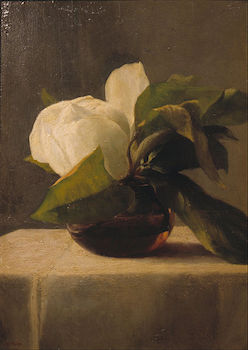
John_LaFarge_Magnolia_1860

(Magnolia by John La Farge, 1860)

In September, Adams and La Farge sailed back across the Pacific to San Francisco. Lawrence Chisolm remarks that, ‘For Adams, return was a prelude to years of wandering, until at last, in The Education of Henry Adams, he transformed the story of his personal searches into a history of Western man.’[7]

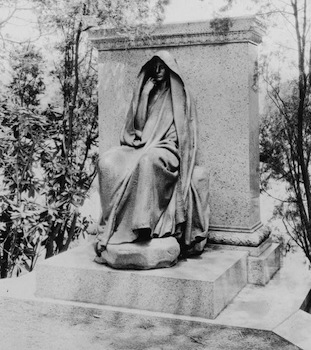
‘His first step, on returning to Washington’, Adams wrote, ‘took him out to the cemetery known as Rock Creek, to see the bronze figure which St. Gaudens had made for him in his absence’ (329). This was the sculptor Augustus Saint-Gaudens; and that ‘bronze figure’ was a memorial to Adams’ wife Clover. Adams discusses his own, and others’, responses to the figure but doesn’t allude to the reason for its being there at all. Robert Hughes suggests that this may in fact have been one legacy of Japan: its inspiration ‘seems to have been a sixth-century wooden figure sheathed in bronze which he saw in the convent of Chugu-ji’.[8]

Marian_Hooper_Adams_Monument

(Augustus Saint-Gaudens, Adams Memorial (1886-1891), Rock Creek, Washington)

Adams once noted that ‘One sees what one brings’ (387)—and he brought an extensive knowledge of artistic and religious history to the moment when ‘he found himself lying in the Gallery of Machines at the Great Exposition of 1900, his historical neck broken by the sudden irruption of forces totally new’ (382). He had seen, at the Louvre and at Chartres, what he judged ‘the highest energy ever known to man’, exercising ‘vastly more attraction over the human mind than all the steam-engines and dynamos ever dreamed of’ (384-385), yet the unprecedented speed and extent of new scientific and technological developments represented now, in 1900, ‘a new avalanche of unknown forces’ which would require ‘new mental powers to control. If this view was correct, the mind could gain nothing by flight or by fight; it must merge in its sensual multiverse, or succumb to it’ (463).

Familiar modernist concerns: speed, fragmentation, instability, multiplicity – but Adams gets in quite early.

(There was an intriguing novel called Panama by Eric Zencey, which sets Henry Adams in Paris in 1892, investigating the disappearance of a young woman connected with the Panama Canal bribery scandal. I’m slightly alarmed to see that it’s over twenty years since I read it.)

References

[1] The Cantos of Ezra Pound, fourth collected edition (London: Faber and Faber, 1987), 433.

[2] Ezra Pound, Selected Prose 1909-1965, edited by William Cookson (London: Faber and Faber, 1973), 129; A. David Moody, Ezra Pound: Poet: A Portrait of the Man and His Work: Volume II: The Epic Years 1921–1939 (Oxford: Oxford University Press, 2014), 299.

[3] A. David Moody, Ezra Pound: Poet: A Portrait of the Man and His Work: Volume III: The Tragic Years 1939-1972 (Oxford: Oxford University Press, 2015), 7.

[4] Noel Stock, The Life of Ezra Pound (Harmondsworth: Penguin Books, 1974), 478.

[5] Henry Adams, The Education of Henry Adams (1918; New York: The Modern Library, 1931), 363: page numbers in brackets refer to this edition.

[6] George Santayana, Persons and Places: The Background of My Life (New York: Charles Scribner’s Sons, 1944), 234.

[7] Lawrence W. Chisolm, Fenollosa, the Far East and American Culture (New Haven: Yale University Press, 1963), 75.

[8] Robert Hughes, American Visions: The Epic History of Art in America (London: The Harvill Press, 1997), 244.


Wintry discontents

Winter

It was St Matthew who observed that God ‘maketh his sun to rise on the evil and on the good, and sendeth rain on the just and on the unjust’ (Matthew 5:45). Still, some people—very few of whom will fall into such clear-cut categories—get a lot more sun than others; or a lot more rain; or snow; or just weather, generally.

BBC weather reports mention strong winds disrupting events at the Winter Olympics in Pyeongchang; a tropical storm threatening the Phillipines; and, just over a week ago, the extreme weather in Moscow. The Russian capital had seen its heaviest snowfall in a day since records began, with more than 2000 trees brought down and air travel disrupted, according to official statements. This followed the breaking of another record in December, when the city registered the least amount of sunshine ever seen in a month there.

And here, in the mild South? Glumly dutiful rain today: no snow, of course (though more Northern parts of the country have had plenty), and it’s not even that cold. I turn the thermostat up one degree and it’s comfortable enough. But yes, some days lately have been pretty murky. ‘We just sat and grew older’, Frank Kermode recalled of his early naval experience in the Second World War, parked off the coast of Iceland, ‘as lightless winter followed nightless summer and the gales swept down the funnel of the fjord’.[1]

Patrick Hamilton was probably right to observe that, certainly in the twentieth century, ‘Wars, on the whole, are remembered by their winters.’[2] In the First World War, 1916-17 was claimed to be ‘the coldest winter in living memory.’[3] And the next year? Holidays for some. ‘Even in the doom-struck winter of 1917-18’, E. S. Turner observed, ‘British newspapers carried advertisements headed, “Where to Winter: Monte Carlo.”’[4]

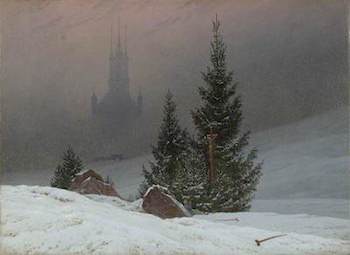
Friedrich, Caspar David, 1774-1840; Winter Landscape

(Caspar David Friedrich, Winter Landscape:
photo credit, The National Gallery)

In war or peace, though, winters take their toll, physically, financially, psychologically, emotionally. ‘Wynter wakeneth al my care’, an anonymous medieval (early fourteenth century) lyricist wrote – or sang, sighing and sorely mourning, ‘When hit cometh in my thoht / Of this worldes joie, hou it geth al to noht.’

Nou hit is, and nou hit nys,
Al so hit ner nere, ywys[5]

(Now it is and now it is not,
As though it had never been, indeed)

White-GWHouse

(http://gilbertwhiteshouse.org.uk/ )

It might well seem that the world’s joy (and much else) was pretty fleeting when the average life expectancy for a male child was not much more than thirty years. In later centuries, people would take a longer view: Gilbert White could look back almost the length of that medieval lifespan when, writing of the winter of 1767-8, he noted that there was ‘reason to believe that some days were more severe than any since the year 1739-40.’[6]

On to Victorian England, where the Reverend Francis Kilvert can record in his diary for Septuagesima Sunday, St Valentine’s Eve, 13 February 1870: ‘the hardest frost we have had yet.’ Arriving at the Chapel, he writes, ‘my beard moustaches and whiskers were so stiff with ice that I could hardly open my mouth and my beard was frozen on to my mackintosh.’[7]

Ah, that old beard and mackintosh combo.

VW-Hut-Int

A little later still: though Virginia Woolf defined ‘the greatest pleasure of town life in winter’ as ‘rambling the streets of London’,[8] the disquieting character of the first winter of the war certainly unsettled her. ‘It’s a queer winter—the worst I ever knew, & suitable for the war & all the rest of it’, she wrote in her diary for Friday 22 January 1915. And, three weeks later: ‘I am sure however many years I keep this diary, I shall never find a winter to beat this. It seems to have lost all self control.’[9]

It was in the winter of the next year that D. H. Lawrence retrospectively placed the apocalyptic moment from which there was no real coming back. ‘It was in 1915 the old world ended. In the winter of 1915-1916 the spirit of the old London collapsed, the city, in some way, perished, perished from being a heart of the world, and became a vortex of broken passions, lusts, hopes, fears, and horrors.’[10]

Lady_Ottoline_Morrell

(Ottoline Morrell by George Charles Beresford, 1864-1938)

That was through the eyes, or in the voice, of his protagonist, Richard Somers, still traumatised by his encounters with officialdom. Lawrence’s letters of the time are not, though, hugely different. To Harriet Monroe, he wrote on 15 September 1915:‘This is the real winter of the spirit in England.’ Less than two months later, though, to Ottoline Morrell, he wrote with—if not optimism, then at least a crack of light—‘There must be deep winter before there can be spring.’

DH-Lawrence

(D. H. Lawrence)

No, definitely not optimism. He is advising her to drift and let go. His postscript reads: ‘Only do not struggle – let go and become dark, quite dark.’[11]

References

[1] Frank Kermode, Not Entitled: A Memoir (London: Harper Collins, 1996), 125.

[2] Patrick Hamilton, The West Pier (1951; in The Gorse Trilogy, Black Spring Press, 2007), 30.

[3] Michael Hurd, The Ordeal of Ivor Gurney (Oxford: Oxford University Press, 1978), 94.

[4] E. S. Turner, Dear Old Blighty (London: Michael Joseph 1980), 49.

[5] The Oxford Book of English Verse, 1250-1918, edited by Sir Arthur Quiller-Couch (Oxford: Clarendon Press, 1966), 9, 10.

[6] Gilbert White, The Illustrated History of Selborne (1789; London: Macmillan, 1984), 46.

[7] Kilvert’s Diary, edited by William Plomer, Three volumes (London: Jonathan Cape, 1938, reissued 1969), Volume One (1 January 1870—19 August 1871), 34.

[8] Virginia Woolf, ‘Street Haunting: A London Adventure’, in Selected Essays, edited by David Bradshaw (Oxford: Oxford University Press, 2008), 177.

[9] The Diary of Virginia Woolf, Volume 1: 1915-19, edited by Anne Olivier Bell (Harmondsworth: Penguin, 1979), 26, 33.

[10] D. H. Lawrence, Kangaroo, edited by Bruce Steele, with an introduction and notes by Mac Daly (1923; Cambridge edition, 1994; London: Penguin, 1997), 216.

[11] Letters of D. H. Lawrence II, June 1913-October 1916, edited by George J. Zytaruk and James T. Boulton (Cambridge: Cambridge University Press, 1981), 393, 469.


Manning the pump, manning the ship

Collins, William, 1788-1847; The Caves of Ulysses at Sorrento, Naples

(William Collins, The Caves of Ulysses at Sorrento, Naples, 1843
Photo credit: Victoria and Albert Museum)

There’s a moment in Hermione Lee’s biography of Penelope Fitzgerald when, discussing the long period of Fitzgerald’s teaching, she mentions that ‘Her copies of Joyce and Beckett are full of little jokes to herself, as when the citizen in the “Cyclops” episode of Ulysses goes out “to the back of the yard to pumpship”, and she notes: “Has to pee just like Bloom. We’re all human.”’[1] By ‘the citizen’ is meant—or should be meant—not ‘the Citizen’, that violent and foul-mouthed Polyphemus figure but the unidentified narrator of the ‘Cyclops’ episode. ‘So I just went round to the back of the yard to pumpship’.[2]

Pumpship – or pump ship. Yes, perhaps inevitably there comes a time in a man’s life when his thoughts alight and pause on slang terms for urination. Might women be content to be left out of this general discussion? On the basis of my (admittedly very limited) survey, it would seem so. . . .

Don Gifford’s authoritative Ulysses Annotated didn’t find the term worth elucidating, though R. W. Dent’s Colloquial Language in Ulysses has an entry (which basically reproduces Eric Partridge’s).[3] Joyce’s friend Frank Budgen doesn’t enlarge on it either, merely commenting that ‘I’, or ‘the Nameless One’, as he also refers to the narrator, ‘goes out into the yard to pumpship’. But then Budgen, in earlier life, had spent six years at sea.[4]

Bloomsbury-Pie

All this put me in mind of the account in Regina Marler’s Bloomsbury Pie of the discussions between Joanne Trautmann Banks and Nigel Nicolson, the editors of Virginia Woolf’s letters, on the level of annotation to be used there:

‘Having decided, too, that the annotation should insult neither English nor American readers, the editors sometimes battled over what should be explained. The Adirondacks, for instance, were judged too basic. But what about “pumping ship,” or as Virginia used the phrase, in reference to T. S. Eliot’s extreme reserve: “It’s on a par with not pump shipping in front of your wife.” “What’s that?” Trautmann asked, certain they would have to annotate it. “Pumping ship means urinating,” Nicolson told her. “Every Englishman knows that.” Trautmann decided to test his assumption:

So the typists, the cook, and the nanny were asked. Nigel’s children were asked, as was every guest at Nigel’s next dinner party….Only one man knew, a physician, as it happens. I say “as it happens,” because Nigel determined that it was not the doctor’s profession that led to this particular genito-urinary information, but his age and schooling. “Only Old Etonians over 50 know about pumping ship,” Nigel announced. We annotated it.[5]

They did. The note reads ‘Virginia misconstructed this now obsolescent term for urinating.’[6] With a markedly worse misconstruction, E. M. Forster, floundering badly and unappealingly, writes in letters of having ‘pump shitted’ and of ‘pump shitting’.[7]

‘P.S.’, Rupert Brooke wrote in a 1912 letter to James Strachey, ‘When I pump ship, it’s bright green. What does that portend?’[8]  A portentous question.

PF-BlondeB-Slate

(Penelope Knox, ‘the blonde bombshell’, via Slate Magazine )

Penelope Fitzgerald, anyway, seems untroubled by the word ‘pumpship’. To be sure, she wasn’t an Old Etonian over fifty, but two of her uncles had been (though Dillwyn died in 1943, aged only fifty-eight). Back in mid-1930s Oxford, where men at the university outnumbered women by six to one, ‘the blonde bombshell’ then at Somerville College—‘No one was surprised when she got a First after a “congratulatory viva”, at which the candidate is praised rather than quizzed’—surely met a good many Old Etonians (and Harrovians and Rugbeians).[9]

But then a Dubliner, educated at O’Connell, Clongowes and Belvedere, also seems quite untroubled about it, as does ‘the Nameless One’, as fluent in speech as in relieving himself—and admiring too (if grudgingly) of Leopold Bloom’s own fluency:

And of course Bloom had to have his say too about if a fellow had a rower’s heart violent exercise was bad. I declare to my antimacassar if you took up a straw from the bloody floor and if you said to Bloom: Look at, Bloom. Do you see that straw? That’s a straw. Declare to my aunt he’d talk about it for an hour so he would and talk steady.[10]

References

[1] Hermione Lee, Penelope Fitzgerald: A Life (London: Chatto and Windus, 2013), 199.

[2] James Joyce, Ulysses (1922; London: The Bodley Head, revised edition, 1969), 435.

[3] Don Gifford, with Robert J. Seidman, Ulysses Annotated: Notes for James Joyce’s Ulysses, revised and expanded edition (Berkeley: University of California Press, 1989); R. W. Dent, Colloquial Language in Ulysses: A Reference Guide (Newark: University of Delaware Press, 1994), 145; Eric Partridge, A Dictionary of Slang and Unconventional English, edited by Paul Beale, 8th edition (London: Routledge, 1991), 933: nautical slang, late 18th century to c.1870, given there as two words.

[4] Frank Budgen, James Joyce and the Making of ‘Ulysses’ and other writings, enlarged edition (1934; London: Oxford University Press, 1972), 165.

[5] Regina Marler, Bloomsbury Pie: The Story of the Bloomsbury Revival (London: Virago, 1997), 158. She quotes from Trautmann’s piece in Charleston Magazine, 13 (1996), 12. See also Joanna Trautmann Banks, ‘The Editor as Ethicist’, in Virginia Woolf: Interpreting the Modernist Text, edited by James M. Haule and J. H. Stape (London: Palgrave Macmillan, 2002), 29.

[6] Virginia Woolf, The Question of Things Happening: Collected Letters II, 1912-1922 (London: The Hogarth Press, 1980), 572, n1.

[7] Selected Letters of E. M. Forster, Volume One: 1879-1920, edited by Mary Lago and P. N. Furbank (London: Collins, 1983), 95, 238. His editors note, of the letter of 19 October 1908, ‘“Pump shitted”: EMF’s misspelling of “pumpshipped”’ (96, n.3).

[8] Friends and Apostles: The Correspondence of Rupert Brooke and James Strachey, 1905-1914, edited by Keith Hale (New Haven: Yale University Press, 1998), 253. A footnote mentions ‘semen’, so poet and editor appear to have something else in mind here.

[9] Lee, Penelope Fitzgerald, 57. In the 1970s, Fitzgerald became friends with Mary Lago, one of the editors of E. M. Forster’s letters (quoted above)—on which she was probably then working.

[10] Joyce, Ulysses, 410.

Ezra Pound, Stella Bowen and ‘the stylist’

Ford-_E_Pound_Rapallo_1932 Stella-Bowen-photo

(Ford Madox Ford and Ezra Pound, Rapallo, 1932; Stella Bowen, 1920s, Cornell)

On 30 October 1885 Ezra Pound was born in Hailey, Idaho. (‘Here he lies, the Idaho kid,/ The only time he ever did.’)[1] On 30 October 1947, Stella Bowen, painter and writer, died at the age of fifty-four, three weeks after the birth of her grandson, leaving her last painting (‘Still Life with Grapes’) unfinished.[2]

Stella met Pound during the First World War, when the studio she shared with her friend Phyllis Reid was lent for a party, to which Pound came. ‘To me’, Stella remembered, ‘he was at first an alarming phenomenon. His movements, though not uncontrolled, were sudden and angular, and his droning American voice, breaking into bomb-shells of emphasis, was rather incomprehensible as he enlightened us on the Way, the Truth, and the Light, in Art.’[3] Thereafter, largely through Pound, she and Phyllis met everyone: Eliot, Yeats, Wyndham Lewis, May Sinclair, Violet Hunt, Arthur Waley, Edward Wadsworth and others, including Ford Madox Ford.

Solitaire

Stella Bowen, Ford Playing Solitaire, Paris 1927
(Private collection: via https://www.awm.gov.au/visit/exhibitions/stella )

By the autumn of 1917, Stella was exchanging letters with Ford, she in London, he still stationed in Redcar, on the Yorkshire coast. They would live together for almost ten years. The first cottage they shared was Red Ford, in Pulborough, ‘a leaky-roofed, tile-healed, rat-ridden, seventeenth-century, five-shilling a week, moribund labourer’s cottage.’[4] ‘Penny, (not Pound) the goat, the sweet corn, Mrs Ford and the hole in the roof are still, here, going strong’, Ford wrote to Herbert Read in June 1920.[5] That summer, they moved to Bedham, ten miles away, while the indispensable Mr Hunt was still working on Coopers Cottage. Pound visited them there, ‘once, just before he and Dorothy migrated to Paris’, Stella remembered.[6] Or, in Ford’s own, lengthier version: ‘And Mr Pound appeared, aloft on the seat of my immense high dog-cart, like a bewildered Stuart pretender visiting a repellent portion of his realms. For Mr Pound hated the country, though I will put it on record that he can carve a sucking pig as few others can.’[7]

Two months before Pound’s visit to Bedham, the poet John Rodker published at The Ovid Press, in a limited edition of 200 copies, Hugh Selwyn Mauberley by ‘E. P.’ The press’s backers included May Sinclair and Pound himself but was primarily financed by Mary Butts, then married to Rodker.[8] Butts was one of the first friends that Stella made when she moved to London, when they both worked on a Children’s Care Committee in the East End.

Mary_Butts

Mary Butts (Photo by Bertram Park, 1919: Beinecke Library, Yale University)

Hugh Selwyn Mauberley is a long poem or suite of poems, numbering eighteen in all. The centre of the work (poems IX and X) is occupied by two poems contrasting different types of writer. The first, ‘Mr Nixon’, is often taken to refer to Arnold Bennett. Pound wrote to Ford that Rodker ‘thinks both he and I will be murdered by people making personal application of necessary literary constructions verging too near to photography.’ He went on: ‘My defence being that “Mr Nixon” is the only person who need really see red, and go hang himself in the potters field or throw bombs through my window.’[9]

A ‘potter’s field’ is generally applied to a burial place for paupers and unidentified strangers but Bennett, famously, was from ‘the Potteries’, his most celebrated novels (certainly up to 1920) all focusing on the ‘Five Towns’, centres of the pottery industry. In his prose collection Instigations, published in April 1920, Pound wrote of Wyndham Lewis’s Tarr (1918): ‘What we are blessedly free from is the red-plush Wellsian illusionism, and the click of Mr Bennett’s cash-register finish.’ When this essay was reprinted many years later, Pound added a footnote to the effect that he’d ‘rather modified his view of part of Bennett’s writing’ when he finally got around to reading The Old Wives’ Tale.[10] Still, three years before Virginia Woolf’s famous essay ‘Mr Bennett and Mrs Brown’, Pound has the same realist novelists in his sights; and there is a clear imputation to Bennett of predominantly mercenary motives.

HSB-Ovid

What other ‘people making personal application of necessary literary constructions verging too near to photography’ might Pound’s poem suggest? The second type of writer in that central pair of poems, is termed ‘the stylist’:

Beneath the sagging roof
The stylist has taken shelter,
Unpaid, uncelebrated,
At last from the world’s welter

Nature receives him,
With a placid and uneducated mistress
He exercises his talents
And the soil meets his distress.

The haven from sophistications and contentions
Leaks through its thatch;
He offers succulent cooking;
The door has a creaking latch.[11]

‘Unpaid, uncelebrated’: a pretty stark contrast with the famous and successful ‘Mr Nixon’. If this draws—as it surely does—on Ford and Stella in their first Sussex cottage, just what does this imply about Pound’s view of Ford at this juncture? There’s sympathy—as you’d expect in a friendship that extended over thirty years—even an acknowledgement of the justification for that withdrawal, that ‘taking shelter’. But I think there are indications of something more, a taking leave, a sense of retrospect or valediction, for all the prominent use here of the present tense.

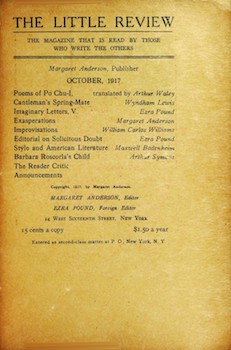
For himself, Pound feels, despite all the usual frustrations of shrinking periodical outlets, paltry funding, uncooperative editors and the rest, a sense of burgeoning strength after a hugely productive few years, culminating in Homage to Sextus Propertius (1919) and now Hugh Selwyn Mauberley, with the Cantos too definitely under way. As for the others, the ones who mattered to Pound: T. S. Eliot had published Prufrock and Other Observations (1917) and Poems (1919); Wyndham Lewis, like Ford, had been to the war but had also just published Tarr while, since March 1918, The Little Review had been serialising Ulysses by James Joyce, whose A Portrait of the Artist had appeared in 1916 and his Exiles in 1918. And Ford? Since 1915 and his entry into the British army, he had published only a handful of articles and stories, and one volume of poems, On Heaven and Poems Written on Active Service (April 1918). Pound’s brief review of that book was not a positive one (‘Time was when he held a brief for good writing’).[12]

Poem X is a subtle and artful performance, with its long first sentence and feminine rhymes; the polysyllabic ‘sophistications and contentions’ enacting just what ‘the stylist’ has retreated from, set against the plain language in which the—leaking—‘haven’ is described; these, together with the choice of verbs and the forms those verbs take, combine to suggest passivity and diminution. In fact, this is part of a long-running story, Pound always urging the active, the intense, the harder edge against what he felt to be Fordian impressionism’s softer, vaguer character and reliance on the visual. Still, there are hints here that, in Pound’s eyes, Ford’s strongest creative period might be over. Of course, as David Moody remarks, Pound ‘could not know that growing in the stylist’s mind was the best English novel of the Great War, a work of wide-angled and deep truth-telling that would cut to the heart of the war and culminate in a brilliantly written act of post-war reconstruction based on his life in that Sussex country cottage.’[13]

stellabowen-drawnfromlife

But then – a ‘placid and uneducated mistress’. Really? Stella? We may be tempted to see in ‘placid’ further hints of passivity or self-effacement or male constructions of ‘desirable’ qualities, considering at the word’s origins in the verb ‘to please’. And yet. . . the dictionary gives only ‘calm’, ‘not easily upset or excited’. As for education: Stella wrote that Pound ‘took the trouble to occupy himself with our joint education’—Phyllis Reid and Stella herself—and, wondering about his and others’ efforts, she remarked: ‘I can only suppose that they found my complete lack of education something of a novelty! The clean slate.’ Then too, reviewing her relationship with Ford, she recalled that, while he got his cottage, domestic peace and a baby daughter, she herself got out of it ‘a remarkable and liberal education, administered in ideal circumstances’.[14]

In the autumn of 1917, in Imaginary Letters, a series begun by Wyndham Lewis, Pound wrote of an ‘eminently cultured female’ named Elis—and her cousin, ‘who knows “nothing at all” and is ‘ten times better educated.’ She asks him ‘sane’ questions. She is ‘“wholly uneducated”. That is to say I find her reading Voltaire and Henry James with placidity.’[15] In the summer of 1914, Lewis had written that ‘[e]ducation (art education and general education) tends to destroy the creative instinct’ while Pound, in another 1917 piece, wrote that ‘[t]his little American had rotten luck; he was educated – soundly and thoroughly educated’.[16]

No, ‘uneducated’, for both Stella and Pound at this juncture, was not a particularly simple matter. In any case, the friendships continued, apparently untroubled by poems about stylists, mistresses and leaky havens.

References

[1] Rex Lampman’s ‘Epitaph’ is in Pound’s Pavannes and Divagations (1958; New York: New Directions, 1974), vii.

[2] Drusilla Modjeska, Stravinsky’s Lunch (New York: Farrar, Straus and Giroux, 2000), 169: the painting is reproduced as Plate 15.

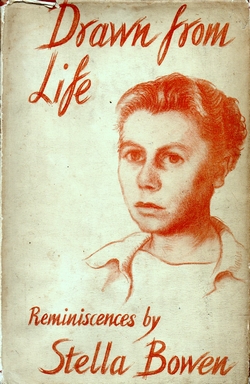
[3] Stella Bowen, Drawn From Life (London: Collins, 1941), 48.

[4] Ford Madox Ford, It Was the Nightingale (London: Heinemann, 1934), 9.

[5] Ford, Letters of Ford Madox Ford, edited by Richard M. Ludwig (Princeton: Princeton University Press, 1965), 103.

[6] Bowen, Drawn From Life, 81.

[7] Ford Madox Ford, It Was the Nightingale, 138.

[8] See Mary Butts, The Journals of Mary Butts, edited by Nathalie Blondel (New Haven: Yale University Press, 2002), 132 and fn.; Nathalie Blondel, Mary Butts: Scenes from the Life (New York: McPherson & Co., 1998), 71-72.

[9] Brita Lindberg-Seyersted, Pound/Ford: The Story of a Literary Friendship (London: Faber & Faber 1982), 36-37.

[10] Literary Essays of Ezra Pound, edited by T. S. Eliot (London: Faber and Faber, 1960), 429 and footnote. In 1937, a letter to Michael Roberts included a reference to ‘nickle [sic] cash-register Bennett’: Ezra Pound, Selected Letters, 1907-1941, edited by D. D. Paige (New York: New Directions, 1971), 296.

[11] Ezra Pound: Poems and Translations, edited by Richard Sieburth (New York: Library of America, 2003), 555.

[12] Lindberg-Seyersted, Pound/Ford, 27.

[13] A. David Moody, Ezra Pound: Poet: A Portrait of the Man and His Work: Volume I: The Young Genius 1885–1920 (Oxford: Oxford University Press, 2007), 404.

[14] Bowen, Drawn From Life, 50, 52, 64.

[15] Pound, Pavannes and Divagations, 59, 60.

[16] Lewis, ‘Long Live the Vortex!’, Blast: Review of the Great English Vortex, I (20 June 1914), 7; Pound, ‘Stark Realism: This Little Pig Went to Market’, Pavannes and Divagations, 105.

‘We poets in our youth’

Redcliffe_Church_via_OBI.tumblr

(George Shepherd, Via https://www.oldbookillustrations.com/ )

‘The weather was brilliant’, the Reverend Francis Kilvert recorded in his diary, Friday 24 October 1873, when he attended the Bristol Music Festival. ‘We walked first to St Mary Redcliffe Church and remained to service in the beautiful Lady Chapel at 11 o’clock.’[1]

This imposing church, some of it dating back to the twelfth century, is about a mile from where I sit at this moment. Bristol boasts a giddily multifarious literary-historical line-up, those who have lived, visited or worked here ranging from Richard Hakluyt, Maria Edgeworth and Thomas Lovell Beddoes to Walter Savage Landor, Angela Carter and Charles Tomlinson. Edmund Burke was Member of Parliament, Humphry Davy experimented with laughing gas (often on himself) and Daniel Defoe may have met Alexander Selkirk, the ‘original’ of Robinson Crusoe, in a tavern in King Street. But traces of English Romanticism show up particularly strongly in any blood sample taken from the city’s literary history, and St Mary Redcliffe’s is a name that recurs often.

On this day, 4 October, in 1795, Samuel Taylor Coleridge, poet—recently, though briefly, having served with the Fifteenth Light Dragoons under the name Silas Tomkyn Comberbache—was married to Miss Sara Fricker in St Mary Redcliffe. He was not quite twenty-three, she a year or two older. The marriage would not be a conspicuous success but, in and around this year, Coleridge was meeting and often enchanting other figures who would be crucially important to his life and art.

‘SOUTHEY! thy melodies steal o’er mine ear
Like far-off joyance, or the murmuring
Of wild bees in the sunny showers of Spring –
Sounds of such mingled import as may cheer

The lonely breast, yet rouse a mindful tear’.[2]

Coleridge and Southey first met in Oxford in June 1794. Coleridge and his travelling companion, Joseph Hucks, had just begun a walking tour which would extend to more than five hundred miles in just over a month. The three-day stopover was transformed into a three-week stay, essentially because of this encounter between Coleridge and the twenty-year-old Southey, who ‘wrote bad poetry at tremendous speed’ and, though a self-proclaimed atheist and democrat, ‘with strong Jacobin sympathies’, was at that stage destined for the church.[3] Southey was a Bristol man, born above the family draper’s shop in Wine Street in August 1774, educated at Westminster School and then Balliol College. Coleridge’s friendship with him—like his friendships with several other men of letters—would be prone to convulsions, smarts and sorties but it started out with a tremendous velocity.
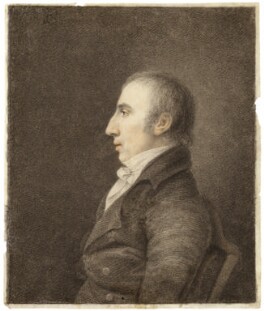
Coleridge

(Coleridge, 1975, by Peter Vandyke: © National Portrait Gallery)

By the time he and Hucks moved on from Oxford, Coleridge had established with Southey plans for a community on the banks of the Susquehanna river in Pennsylvania, which would sustain itself through farming (two or three hours’ daily labour) and would be grandly based on the principles of ‘Pantisocracy’, a Coleridgean coining, from Greek roots, meaning, more or less, government by all. The ‘astonishing’ speed with which this all happened ‘was testimony not only to the transforming effect they had on one another, but to the very weak foundations upon which the whole enterprise rested.’[4]

Within the next three months, Coleridge would meet Thomas Poole, radical, philanthropist and essayist, then living in Bristol, who would become a lifelong friend; and his future wife, Sara Fricker.

‘My gaze! Proud towers, and Cots more dear to me,
Elm-shadowed Fields, and prospect-bounding Sea.
Deep sighs my lonely heart: I drop the tear:
Enchanting spot! O were my Sara here.’[5]

In August and September, Coleridge composed other poems looking forward to his marriage: ‘The Eolian Harp’, the first of his celebrated ‘Conversation’ poems; and ‘Lines Written at Shurton Bars’, in which he ‘even dares to anticipate metaphorically the soon-to-be-enjoyed sexual congress with Sara (‘And so shall flash my love-charg’d eye/ When all the heart’s big ecstasy/ Shoots rapid through the frame!’).[6]

Still, there were hints for Sara of the absences and unreliability to come:

‘O Peace, that on a lilied bank dost love
To rest thine head beneath an olive tree,
I would, that from the pinions of thy dove
One quill withouten pain ypluck’d might be!
For O! I wish my Sara’s frowns to flee,
And fain to her some soothing song would write,
Lest she resent my rude discourtesy,
Who vowed to meet her ere the morning light,
But broke my plighted word—ah! false and recreant wight!’[7]

In August or September 1795, Coleridge met William Wordsworth, in Bristol: most likely at the house of John Pinney, a hugely wealthy merchant whose fortune was founded on sugar and slaves.

(The University of Bristol Library Special Collections include the Pinney family papers: accounts, letter-books, family and estate papers, mainly relating to Dorset and the West Indies, 1650-1986. See https://www.bristol.ac.uk//library/resources/specialcollections/archives/#pinney )

WW-Robert-Hancock-1798

(William Wordsworth, 1798, by Robert Hancock: © National Portrait Gallery)

In that same busy period, he quarrelled with Southey: though they were reconciled in the autumn of the following year, their Pantisocracy scheme, hardly surprisingly, fell through. And, less than six weeks after the Coleridge wedding, on 13 November 1795, Southey also married—also in St Mary Redcliffe Church. His bride was Edith Fricker, a sister of Coleridge’s wife.
In later years, when the Southeys lived in Keswick, at Greta Hall, they also supported Sara Coleridge and her children. And where was Coleridge then? In London, perhaps; or Germany; or South Wales; or Scotland; or Malta; or Sicily; or Italy. In September 1798, Lyrical Ballads, the landmark volume by Wordsworth and Coleridge, was published in Bristol by Joseph Cottle. Thereafter, Coleridge nursed an increasingly hopeless love for Sara Hutchinson (whom he addressed in print as ‘Asra’, not quite an unbreakable code), sister to Mary—whom Wordsworth would marry in 1802; there were quarrels and reconciliations; unfinished poems; accusations of plagiarism; lectures, marathon conversations, table-talk—and opium.

The early celebration of French revolutionary principles fell entirely away in the cases of both Wordsworth and Coleridge—and fell away even more steeply, perhaps, in that of Robert Southey, with whom Byron’s ‘Dedication’ to Don Juan was concerned (the first two Cantos appeared in 1819), though he had begun his ‘Preface’ with a swipe at Wordsworth’s unintelligibility and here jabbed at Coleridge’s recent preoccupations.

Byron-Thomas-Phillips

(Byron by Thomas Phillips)

Bob Southey! You’re a poet – Poet Laureate,
And representative of all the race;
Although ‘tis true that you turned out a Tory at
Last, yours has lately been a common case.
And now my epic renegade, what are ye at
With all the Lakers, in and out of place?
A nest of tuneful persons, to my eye
Like ‘four and twenty blackbirds in a pye,

Which pye being opened they began to sing’
(This old song and new simile holds good),
‘A dainty dish to set before the King’
Or Regent, who admires such kind of food.
And Coleridge too has lately taken wing,
But like a hawk encumbered with his hood,
Explaining metaphysics to the nation;
I wish he would explain his explanation.[8]

There were major achievements still to come from Coleridge, though, barring his restless revising, few of these were in the field of poetry, after the first years of the nineteenth century, and some—the Notebooks—would be barely visible in his lifetime. Wordsworth too, after the publication of Poems in Two Volumes (1807), is generally viewed in terms of poetic decline. In ‘Resolution and Independence’, written in the first half of 1802, though not published until 1807, Wordsworth’s narrator thinks of Chatterton, ‘the marvellous Boy’, whose brief life and tragic death were inextricably linked to St Mary Redcliffe Church, where his father was sexton and found the papers in the Muniment Room which led to Chatterton’s ‘discovery’ of the poet Thomas Rowley.[9] The same stanza concludes with two famous lines:

We Poets in our youth begin in gladness;
But thereof comes in the end despondency and madness.[10]

And yes, ‘sadness’ would have scanned—and would have rhymed too. But it just wouldn’t have cut the mustard, somehow. . .

References

[1] Francis Kilvert, Kilvert’s Diary, edited by William Plomer, Three volumes (London: Jonathan Cape, 1938, reissued 1969). Volume Two (23 August 1871—13 May 1874), 386.

[2] ‘To Robert Southey of Balliol College, Oxford, Author of the “Retrospect”, and Other Poems’, in Samuel Taylor Coleridge, The Complete Poems, edited by William Keach (London: Penguin Books, 1997), 74.

[3] Richard Holmes, Coleridge: Early Visions (London: Hodder and Stoughton, 1989), 61-62.

[4] Tom Mayberry, Coleridge and Wordsworth: The Crucible of Friendship, revised edition (Stroud: Sutton Publishing, 2000), 22-23.

[5] ‘Lines composed while climbing the left ascent of Brockley Coomb, Somersetshire, May, 1795: Coleridge, The Complete Poems, 80.

[6] Rosemary Ashton, The Life of Samuel Taylor Coleridge (Oxford: Blackwell, 1997), 74-75; Coleridge, The Complete Poems, 87-88, 89-91.

[7] ‘Lines in the manner of Spenser’: Coleridge, The Complete Poems, 81.

[8] Lord Byron, Don Juan, edited by T. G. Steffan, E. Steffan and W. W. Pratt (London: Penguin Books, 1996), 37, 41. Southey accepted the post of Poet Laureate in 1813. Byron had assisted Coleridge financially, sending him £100 in February 1816: Ashton, The Life of Samuel Taylor Coleridge, 295. On the Pye joke, see an earlier post: https://reconstructionarytales.blog/2017/08/21/sorrows-joys-magpies/

[9] On Chatterton, see Richard Holmes, ‘Thomas Chatterton: The Case Re-opened’, in Sidetracks: Explorations of a Romantic Biographer (London: Harper Collins, 2000), 5-50; Alistair Heys, editor, From Gothic to Romantic: Thomas Chatterton’s Bristol (Bristol: Redcliffe Press, 2005).

[10] William Wordsworth, edited by Stephen Gill (Oxford: Oxford University Press, 2012), 232.


Circumspect and right

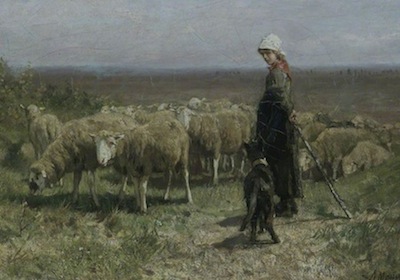
Mauve, Anton, 1838-1888; Shepherdess
Anton Mauve, The Shepherdess (National Museum of Wales, Cardiff)

Early in Ford Madox Ford’s Some Do Not. . ., the first volume of the Parade’s End tetralogy, Christopher Tietjens and Vincent Macmaster are talking together in a railway carriage (their topics of conversation ranging over many of the novel’s themes).

“I’m thinking,” Tietjens said, “thinking how not to be too rude.”
“You want to be rude,” Macmaster said bitterly, “to people who lead the contemplative. . . the circumspect life.”
“It’s precisely that,” Tietjens said. He quoted:

‘She walks the lady of my delight,
A shepherdess of sheep;
She is so circumspect and right:
She has her thoughts to keep.’”[1]

As the note says, these lines are from ‘The Shepherdess’, one of the best-known lyrics by Alice Meynell. She was born on this day, 22 September, in 1847 and died on 27 November 1922 (within a month or so from the probable start date of Ford’s writing of Some Do Not . . .). ‘The Shepherdess’ had first appeared in Meynell’s 1901 Later Poems, was reissued in a 1914 volume of that title, and was collected several times thereafter, usually in editions  issued by Burns and Oates, the Catholic publishing house of which her husband Wilfrid was manager.

Alice_Meynell

Curiously, the 1939 revision of The Oxford Book of English Verse, 1250-1918, edited by Sir Arthur Quiller-Couch, includes this poem under the title ‘The Lady of the Lambs’—which somehow makes it worse—and, in the version Tietjens quotes, the third and fourth lines of Meynell’s stanza have been promoted to the first and second lines. Then, too, while Tietjens has ‘thoughts to keep’, Meynell, characteristically, has ‘soul’.

Born Alice Thompson, she spent much of her early life in Italy, where she was educated mainly by her father. After the family returned to England in 1864, Alice converted to Catholicism at the age of twenty-five and, in 1877, married Wilfred Meynell, with whom she co-edited several magazines and had eight children between 1879 and 1891. They were friends with the leading Victorian poets (Tennyson, Meredith, Coventry Patmore) and famously took in the destitute, opium-addicted and—at that stage—suicidal poet Francis Thompson, who lived with them for the best part of twenty years, though he also spent time in a Franciscan monastery in North Wales.

Meynell was highly popular and also critically applauded but her public persona of piety and ‘femininity’ have complicated later reactions to her, not least because of her involvement with the struggle for women’s suffrage: critical of the Women’s Social and Political Union’s methods, she joined the Women Writers Suffrage League, formed in 1908 by the playwright and novelist Cicely Hamilton.

The enduring response to that image of the pure and impeccably virtuous Angel in the House, which prompted Ford’s use of Meynell’s poem at this juncture, also underlies D. H. Lawrence’s letter to his agent, James Pinker, about the decision of Chatto and Windus to omit the poem ‘Song of a Man who is loved’ (and one other poem, plus several lines in others) from the collection Look! We have Come Through! Lawrence remarked of the poem that ‘I’m sure Alice Meynell might print it without reproach.’[2]

Probably not. The poem ends:

So I hope I shall spend eternity
With my face buried between her breasts;
And my still heart full of security,
And my still hands full of her breasts.[3]

Perhaps, then, his publisher’s nervousness was not a complete mystery in wartime England, just two years after the prosecution of The Rainbow.

hyde2
William Hyde, from London Impressions

The Lawrence connection with the Meynell family is probably the one of greatest interest, though their story breaks off in several directions which reward pursuit. Another Ford connection which suggests itself  is through Edward Hyde, an artist and illustrator whom Ford greatly admired and knew well. Hyde provided the illustrations (‘Photogravure plates’) for Ford’s 1900 volume, The Cinque Ports. Ford published an appreciation of the artist in January 1898 and, in December of that year, there was a private view of Hyde’s ‘London Impressions’, to accompany the publication of his book of that title: Hyde’s illustrations accompaned a series of essays by Alice Meynell. The volume was priced at eight guineas—‘equal to a house servant’s wages for a year’—and, at the private view, Arthur Balfour (who would become Prime Minister in the summer of 1902) bought two of Hyde’s pictures on the spot.[4]

One more connection is that to David Garnett, through Francis Meynell, the youngest of the children, who founded the famous Nonesuch Press, which produced its first title in 1923. Garnett was a partner in the Press, together with Francis and his wife Vera. He was also, of course, a friend of Lawrence and the Nonesuch titles would include an edition of Lawrence’s Love Among the Haystacks, in the year of his death—with a memoir by David Garnett.

Nonesuch-DHL

Just two days ago, it was the anniversary of the launching of Georgian Poetry, 20 September 1912, in Edward Marsh’s rooms in Gray’s Inn. Present were Rupert Brooke, Marsh, Wilfred Gibson, John Drinkwater, Harold Monro and Arundel del Ré. Brooke and Marsh were the prime movers at the earliest stage but both Francis and Alice Meynell have been credited with awakening that interest in contemporary verse in Marsh which led to the production of the anthology and its successors.[5]

But the best-known connection is that with D. H. Lawrence, whose closest contact with the Meynell family occurred from late January to the end of July in 1915. He and Frieda had been invited to stay on the Meynell estate at Greatham, just a few miles from Pulborough in West Sussex (where Ford Madox Ford first lived with Stella Bowen between June 1919 and August 1920). The cottage was lent to the Lawrences by Viola Meynell; and their stay there produced one story, ‘England, My England’, which has provoked a good deal of criticism of Lawrence for his apparent ‘ruthlessness’ in using figures and events ‘from life’.[6]

The cottage was also the venue for a much-disputed visit by Ford and Violet Hunt. They saw—and quarrelled with—Frieda Lawrence; unless Frieda quarrelled with Catherine Wells, wife of H. G. And Lawrence himself was not present. Almost certainly. . .[7]

D_H_Lawrence_1915

(D. H. Lawrence, 1915)

David Garnett visited, in the company of his friend Francis Birrell, and the pair were invited to breakfast with the Meynells. Garnett remembered that ‘Wilfred Meynell, the Patriarch, was rustling the pages of the Observer, the room was full of dark, madonna-like girls and women, the Poetess [Alice] lay stretched upon a couch’.[8]

Viola Meynell, herself the author of more than twenty books, was an early supporter of Lawrence. The typescript of The Rainbow dates from February 1915 to 31 May 1915, and Viola was one of its three, possibly four, typists.[9] It was also to Viola that Lawrence announced that he was ‘going to begin a book about Life.’[10]

‘It is the Meynells’ place’, Lawrence wrote to his friend William Hopkins before he and Frieda set off. ‘You know Alice Meynell, Catholic poetess rescuer of Francis Thompson.’[11] Thompson had died only eight years earlier, his Selected Poems appearing posthumously, though his critical standing was already high, his best-known poem probably ‘The Hound of Heaven’. As late as 1952, Viola would publish Francis Thompson and Wilfrid Meynell: A Memoir.

Alice Meynell’s poems have not lasted well. To modern eyes—certainly to mine—they’re redolent of a kind of Victorian self-parody: very conventional, often sentimental, worthy, rather thin and clunky. Perhaps some of the essays, introductions and reviews have survived in ruder health. There was a centenary volume of her prose and poetry, published in 1947 by Jonathan Cape, with an introduction by Vita Sackville-West. It’s noticeable that, in that 400-page book, the selection of her poems doesn’t begin until page 357. That selection includes a poem entitled ‘The Lady Poverty—‘The Lady Poverty was fair / But she has lost her looks of late’—which, in 1932, George Orwell mentioned when trying to settle on a title for his first book. He thought of calling it ‘The Lady Poverty’ or ‘Lady Poverty’—but settled instead on Down and Out in Paris and London, which finally appeared on 9 January 1933.[12]

On the other hand, Alice Meynell: Prose and Poetry­—circumspectly, perhaps—does not include ‘The Shepherdess.’

References

[1] Ford, Some Do Not. . . (1924; edited by Max Saunders, Manchester: Carcanet Press, 2010), 26.

[2] To Pinker, 3 August 1917: Letters of D. H. Lawrence III, October 1916–June 1921, edited by James T. Boulton and Andrew Robertson (Cambridge: Cambridge University Press, 1984), 145-146 and notes.

[3] D. H. Lawrence, The Complete Poems, edited by Vivian de Sola Pinto and F. Warren Roberts (Harmondsworth: Penguin Books, 1977), 250.

[4] Ford, ‘William Hyde: An Illustrator of London’, The Artist, XXI (January 1898), 1-6; Jerrold Northrop Moore, The Green Fuse: Pastoral Vision in English Art, 1820-2000 (Woodbridge, Suffolk: Antique Collectors’ Club, 2007), 90.

[5] Robert H. Ross, The Georgian Revolt: Rise and Fall of a Poetic Ideal, 1910-1922 (London: Faber and Faber, 1967), 120, 103-104.

[6] Mark Kinkead-Weekes, D. H, Lawrence: Triumph to Exile, 1912-1922 (Cambridge: Cambridge University Press, 1996), 252-255.

[7] Max Saunders reviews the evidence—and some related assertions—in Ford Madox Ford: A Dual Life, two volumes (Oxford: Oxford University Press, 1996), I, 476-478.

[8] David Garnett, Great Friends (London: Macmillan, 1979), 86.

[9] The Rainbow, edited Mark Kinkead-Weekes, introduction and notes Anne Fernihough (Cambridge, 1989; Penguin edition with new editorial matter, 1995), 1 (‘A Note on the Text’). One of the other typists was Eleanor Farjeon.

[10] Letter of 2 March 1915: Letters of D. H. Lawrence II, June 1913-October 1916, edited by George J. Zytaruk and James T. Boulton (Cambridge: Cambridge University Press, 1981), 299. This was ‘The Crown’.

[11] Letters of D. H. Lawrence II, 259. Eric Gill was only brought into contact with this prominent Catholic family when he was commissioned by Everard Meynell to carve the tomb for Thompson in St Mary’s Roman Catholic Cemetery in Kensal Green: Fiona MacCarthy, Eric Gill (London: Faber & Faber, 1990), 112.

[12] George Orwell, A Kind of Compulsion: 1903-1936, edited by Peter Davison, revised and updated edition (London: Secker and Warburg, 2000), 253.


Margins and Montague

Cat-hair

What a menu of news: a major earthquake in Mexico, another hurricane battering the Caribbean, and leading politicians well down to their usual standard, whether of dishonest posturing or reckless and irresponsible ranting. Sidestepping further gloom, I decide to forego the pleasures of the churchyard shortcut—a man shooting up on the steps a few weeks ago, two agitated women clearly waiting for The Man a few days ago—and take another route, the way I used to walk to work, to call at the baker, the deli and the fishmonger. I pause only long enough for the visiting cat to successfully deposit some hair on the leg of my trousers before setting off.

The fishmonger is open but seems a little unready, as none of the fish is labelled yet. ‘Am I a bit early?’ I wonder. No, no, he says, then asks casually if I know exactly what I want and mentions, when I come to pay, that he’d prefer a card transaction because he hasn’t sorted out a float yet. But no, I’m not too early, he’s just ‘marginally, marginally late.’ How marginal is that, precisely?

Henry-Thoreau

Margin: an edge or border, blank edge on the page of a book, something allowed more than is needed. ‘I love a broad margin to my life’, Thoreau wrote—and elsewhere: ‘The really efficient laborer will be found not to crowd his day with work, but will saunter to his task surrounded by a wide halo of ease and leisure. There will be a wide margin for relaxation to his day.’[1] This is (possibly) not an experience of work and working conditions commonly shared by those on zero-hour contracts in the United Kingdom’s contemporary employment paradise.

I saunter, pausing from time to time to check that the two cartons of double cream—‘Keep upright’—in my rucksack are in fact keeping upright. I am thinking of margins, firstly of that blank edge of a book’s page. W. J. Jackson wrote a book entirely about the notes that found their way there: Marginalia: Readers Writing in Books (Yale University Press, 2002) and the British Library holds William Blake’s copy of the three-volume set of the Works of Sir Joshua Reynolds, with their extensive annotations in Blake’s hand (there are—of course—books and articles wholly devoted to these).

When Sr Joshua Reynolds died
All Nature was degraded;
The King dropd a tear into the Queens ear;
And all his Pictures Faded.[2]

reynolds-joshua-works-B20132-53

Blake’s copy of Reynolds’ Works: British Library.
(‘To Generalize is to be an Idiot  To Particularize is the Alone Distinction of Merit—General Knowledges are those Knowledges that Idiots possess’)

In Lawrence Durrell’s Sebastian, ‘In the margin of a book she had borrowed from Sutcliffe’, Constance ‘had found the scribbled words: “The same people are also others without realising it.”’[3] Robert Phelps wrote to James Salter: ‘Scrapbooks, footnotes, almanacs, letters, diaries, questionnaires, marginalia, memos, alphabets . . . how I love them. Pasolini once called himself a “pasticheur.” I think I am an annotator. The story exists for the scribbled notes in the margin.’[4]

Secondly, that edge or border, often physical, often psychological and sometimes both at the same time. In war, certainly in the First World War, that sense of being on the edge of things, never having sufficient information to know what was actually going on, worsened by feeling abandoned or forgotten. Eric Leed wrote: ‘Astonishing numbers of those who wrote about their experience of war designate No Man’s Land as their most lasting and disturbing image. This was a term that captured the essence of an experience of having been sent beyond the outer boundaries of social life, placed between the known and the unknown, the familiar and uncanny. The experience of war was an experience of marginality, and the “change of character” undergone by the combatant could adequately be summarized as marginalization.’[5]

David Jones writes of John Ball and his comrades (‘Here they sat, his friends, serving their harsh novitiate’), in contrast to the Army Service Corps, Base-wallahs, Staff-wallahs and the like: ‘but these sit in the wilderness, pent like lousy rodents all the day long; appointed scape-beasts come to the waste-lands, to grope; to stumble at the margin of familiar things—at the place of separation.’[6]

‘Marginal’ is often applied to those figures that are viewed as of secondary importance, off-centre: but in some disciplines, the centre has an unsettling habit of shifting.[7] Certainly, in the arts, the ‘canon’ broadens and deepens constantly as some of the most important figures of previous generations are found not to last, the new questions addressed to them getting little or nothing in reply.

Montague-Capt-Cadge-censors

(C. E. Montague and Captain Cadge as army censors via Spartacus International

That third margin, the ‘something allowed more than is needed’, is a critical element in the title story of C. E. Montague’s Action (1928), part of our recent haul from Hay-on-Wye. It concerns Christopher Bell, ‘reigning sovereign’ of a dynasty of Manchester merchant princes, who wakes one morning to feel a numbness down one side of his body. He has fought in the Great War, during which he lost his beloved wife, and is a keen climber. Facing a future of invalid-chair and male nurse, and after a couple of humiliating allowances being made for his condition, he revolts. He won’t commit suicide but, reading of a great climber’s ‘greatest adventures’, Bell wonders how big a margin of safety had attended that successful expedition: ‘what if such a party were to try paring and paring away at that pretty wide margin?’ He returns to an old haunt, Zinal, in the Swiss canton of Valais, in late September. His target is a glacier with ice ‘steep and bare and blue’—with an overhang: ‘nowhere in the whole thousand feet of ascent would a man have a foothold to stand on, unless he made it.’ He climbs conscientiously until genuinely exhausted: ‘that was the end, he felt, of all possible effort’. Then a falling ice-axe and the standard Alpine cry for help, alerts him to a drama just above the overhang: a woman at the end of a rope which her husband desperately hangs on to above her. Bell is galvanised into heightened, unthinking action, and all three are eventually saved. In the Weisshorn hut, while she sleeps, he tells the man, Gollen, who’s a doctor, his symptoms. Gollen talks about artists, saints, raised to the uttermost through action, ‘“every bit of your consciousness taken up into some ecstasy of endeavour that’s passion and peace.”’ Looking out at the mountain under the moon, Gollen asks, when Bell says it’s ‘all right’, whether it’s all right enough. Bell says oh yes, he’s ‘sticking on’.

Thirty pages in my pocket edition,[8] and a story, ‘inspired by a report of a climber who had died of exposure on Kinder Scout following a mountain storm on New Year’s Day 1922’, which manages to touch on a surprising number of themes, the effects of the recent war, masculinity, heroism, trauma and recovery.[9]

Montague himself might be regarded as a ‘marginal’ man but is of great interest to those working in and around the Great War, especially those concerned with its after-effects, social and cultural, through the nineteen-twenties.

There’s an informative page on Montague at Spartacus International:
http://spartacus-educational.com/Jmontague.htm
and he also crops up on Josh Levithan’s remarkable site, A Century Back
http://www.acenturyback.com/
and on George Simmers’ excellent Great War Fiction blog:
https://greatwarfiction.wordpress.com/

Some very good criticism on Montague can be found in Andrew Frayn’s Writing Disenchantment: British First World War Prose, 1914-30 (Manchester: Manchester University Press, 2014) and in his essay, ‘“What a victory it might have been”: C. E. Montague and the First World War’, in Trudi Tate and Kate Kennedy, editors, The Silent Morning: Culture and Memory After the Armistice (Manchester: Manchester University Press, 2015), 131-148.

Montague is a fascinating figure who really illuminates some important aspects of the post-war period—and I’m still reading him.

 
References

[1] Henry David Thoreau, Walden, edited by Jeffrey S. Cramer (New Haven and London: Yale University Press, 2004), 108 and note.

[2] The Complete Poetry & Prose of William Blake, newly revised edition, edited by David V. Erdman (New York: Anchor Books, 1988), 641. This edition also includes Blake’s underlinings and annotations in works by Swedenborg, Lavater, Bacon, Wordsworth, Edward Young and others.

[3] Durrell, Sebastian or Ruling Passions (1983), in the Avignon Quintet, one-volume edition (London: Faber and Faber, 2004), 978.

[4] Memorable Days: The Selected Letters of James Salter and Robert Phelps, edited by John McIntyre (Berkeley, California: Counterpoint, 2010), 38.

[5] Eric J. Leed, No Man’s Land: Combat and Identity in World War I (Cambridge: Cambridge University Press, 1979), 15.

[6] David Jones, In Parenthesis (1937; London: Faber and Faber 1963), 70.

[7] So the first two, at least, of Piers Gray’s Marginal Men: Edward Thomas; Ivor Gurney; J. R. Ackerley (Basingstoke: Macmillan, 1991) are much more visible twenty-five years later.

[8] C. E. Montague, Action (1928; London: Chatto & Windus, Phoenix Library, 1936), 1-31.

[9] Paul Gilchrist, ‘Mountains, Manliness and Post-war Recovery: C.E. Montague’s “Action”’, Sport in History, 33:3 (2013), 288 and passim.


Waking, Sunday morning

Dante_Inferno_XV

(Gustav Doré, illustration for Dante, Inferno, Canto XV)

Waking on Sunday morning, I listen to the headlines, just to be sure that the 45th President of the United States has not brought about the incineration of a large part of the world because someone called him names in the playground. Then downstairs, to resume my book over coffee, hoping that there’s no significance in the title of the long story I’m finishing: ‘The Nemesis of Fire’.[1]

Sunday seems to preoccupy poets, with its unsettling conjunction of religion and war, of prophecy and delusion.

Complacencies of the peignoir, and late
Coffee and oranges in a sunny chair,
And the green freedom of a cockatoo
Upon a rug mingle to dissipate
The holy hush of ancient sacrifice.

An attractive setting in which to consider questions of religious belief, the possibility of paradise on earth and the acceptance of inevitable endings. There are unsettling moments, to be sure:

Death is the mother of beauty, mystical,
Within whose burning bosom we devise
Our earthly mothers waiting, sleeplessly.[2]

More direct, perhaps, is Robert Lowell in ‘Waking Early Sunday Morning’, the poem which opens Near the Ocean. Politics and religion in the era of the Vietnam War and, of course, the Six-Day War,[3] bled profusely into one another:

O Bible chopped and crucified
in hymns we hear but do not read,
none of the milder subtleties
of grace or art will sweeten these
stiff quatrains shovelled out foursquare—
they sing of peace, and preach despair;
yet they gave darkness some control,
and left a loophole for the soul.

Lowell

(Via The Poetry Foundation: www.poetryfoundation.org/)

The last three stanzas move from an imagined glimpse of the President (Lyndon B. Johnson on his Sunday morning) to end thus:

No weekends for the gods now. Wars
flicker, earth licks its open sores,
fresh breakage, fresh promotions, chance
assassinations, no advance.
only man thinning out his kind
sounds through the Sabbath noon, the blind
swipe of the pruner and his knife
busy about the tree of life . . .

Pity the planet, all joy gone
from this sweet volcanic cone;
peace to our children when they fall
in small war on the heels of small
war—until the end of time
to police the earth, a ghost
orbiting forever lost
in our monotonous sublime.[4]

On a Sunday in September 1819, John Keats wrote ‘To Autumn’. The Odes, of which this is one of the most famous, were written, Robert Gittings notes, ‘in what Keats had now come to regard as a fever, a beating at the bars of life.’ Less than five months later, on the night of Thursday 3 February 1820, came the first showing of arterial blood, followed by a second, massive haemorrhage.[5]

Gittings_Keats

There are less portentous Sundays, some offering simple (or complex) pleasure. ‘This is the day that Robert Burns delighted in,’ the Reverend Francis Kilvert remarked in his diary, ‘the first fine Sunday in May.’[6] Fifty years later, D. H. Lawrence was in receptive mood: ‘This Sunday morning, seeing the frost among the tangled, still savage bushes of Sardinia, my soul thrilled again. This was not all known. This was not all worked out. Life was not only a process of rediscovering backwards. It is that, also: and it is that intensely. Italy has given me back I know not what of myself, but a very, very great deal.’[7]

There was a time, not that long ago, when Sunday in this country was either a huge relief, peaceful and relaxing; or stupendously boring, enough to drive you up the wall, depending on your age, character and predilections. Norman Lewis remembered that ‘England, this April [1946], was an everlasting Sunday morning, lying under a spell of emptiness and silence.’[8]

And in the United States? Charles Reznikoff remembered ‘Sunday Walks in the Suburbs’, hardly an Edenic setting:

On stones mossed with hot dust, no shade but the thin, useless shadows of roadside grasses;
into the wood’s gloom, staring back at the blue flowers on stalks thin as threads.

He details rubbish, rats, scared dogs, old women, old men and remarks that:

This is where I walked night after night;
this is where I walked away many years.[9]

Henry Thoreau, though, sought to reach back to something precisely Edenic, before the religious disagreements that complicated the life of his friend and mentor Ralph Waldo Emerson: ‘It was a quiet Sunday morning, with more of the auroral rosy and white than of the yellow in it, as if it dated from earlier than the fall of man, and still preserved a heathenish integrity’.[10]

SundayBloodySunday

We could certainly do with a large infusion of integrity in public life. But heathenish? No, probably not. Always these complications. Sunday bloody Sunday, as they say. (U2, yes, but John Schlesinger first.)


References

[1] ‘Nemesis of Fire’, in The Tales of Algernon Blackwood (London: Martin Secker, 1938), 440-513. The story is about a ‘fire-elemental’, enraged by the desecration of a tomb and the theft of a ‘scarabaeus’, a gem in the form of the dung-beetle, sacred to the ancient Egyptians.

[2] Wallace Stevens, ‘Sunday Morning’, The Collected Poems (New York: Vintage Books, 1982), 66-67, 69.

[3] See Lowell’s comments on the poem in The Letters of Robert Lowell, edited by Saskia Hamilton (New York: Farrar, Straus and Giroux, 2005), 485-486, 487.

[4] Robert Lowell, Collected Poems, edited by Frank Bidart and David Gewanter (New York: Farrar, Straus and Giroux, 2003), 384, 385-386. See 933-936 for the magazine version of the poem, which included two more stanzas between the last two quoted here.

[5] Robert Gittings, John Keats (Harmondsworth: Penguin Books, 1971), 507, 508.

[6] Kilvert’s Diary, edited by William Plomer, Three volumes (London: Jonathan Cape, 1938, reissued 1969). Volume One (1 January 1870—19 August 1871), 329: entry for Sunday 7 May 1871.

[7] Lawrence, Sea and Sardinia (1921), in D. H. Lawrence and Italy (London: Penguin Books, 1997), 123.

[8] Lewis, The World, the World (London: Jonathan Cape, 1996), 18.

[9] Charles Reznikoff, Poems 1918-1936: Volume I of The Complete Poems of Charles Reznikoff, edited by Seamus Cooney, two volumes (Santa Barbara: Black Sparrow Press, 1978), 41.

[10] A Week on the Concord and Merrimack Rivers, in Henry David Thoreau, A Week on the Concord and Merrimack Rivers; Walden; The Maine Woods; Cape Cod (New York: Library of America, 1985), 36.