Locked down – and down

Organic-Forms-2

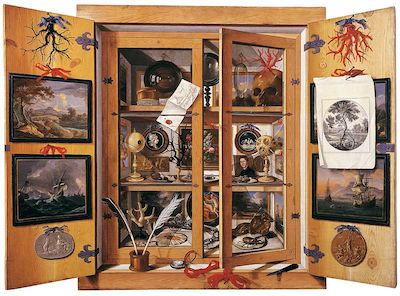
(Walter Poole, Organic Forms 2: private collection)

The combination of lockdown and a crocked back contrives to make whole weeks drain away before you can get a grip on them. My trouble has an eye on the calendar and nips in smartly in case I think it’s waiting for the anniversary of the last bout. So I’ve been spending a good deal of time on the floor lately, wondering why the painkillers seem not to be killing the pain and the various gels are proving themselves laughably ineffective. Perhaps ‘laughably’ is not the word I want.

Every so often, a passing Librarian puts the cat’s dish down in the kitchen, picks up the mail from the mat, ties my shoelaces for me. What if you don’t have a passing Librarian to offer such assistance? Wear slip-ons, I suppose. I’m thankful at least that there’s no visual record of me putting on a pair of socks. I try five or six positions, none of them elegant, because I can never remember which one finally worked last time. The soundtrack too is distressing.

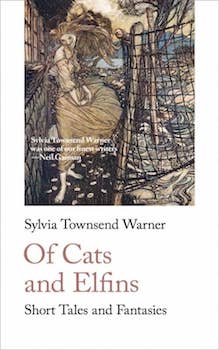
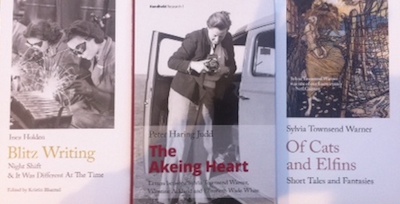
So the floor, yes, on a folded duvet cover which, unfortunately, the cat has taken a liking to. There have been one or two undignified run-ins. At this level, anyway, I can see—and reach— Modern Women’s Stories, an anthology edited by Patricia Craig; Modern Art in Britain 1910-1914, edited by Anna Greutzer Robins; and the Handheld Press edition of Sylvia Townsend Warner’s Of Cats and Elfins: ‘“Surely she has grown smaller,” thought the baker. “Or do my eyes deceive me?” Looking at her more attentively he saw that his daughter had changed into an owl.’[1] Further off, there’s a shockingly miscellaneous pile that I can just about ignore; and closer, the state of the carpet, which I can’t ignore for much longer.

Cats-and-Elfins

It’s a few days now since I attempted the early morning walk. We moved at very different speeds. At one stage, the Librarian paused to photograph something—chalk drawings on the path, a squirrel, an abandoned child’s jacket caught in a bush—until she was a good hundred and fifty metres behind. She ran past me, murmuring ‘Dutch study! Dutch study!’ to which I could offer no adequate response.

So the latest misjudgement in our government’s catalogue of misjudgements has made no difference to me: locked down physically at present as well as by choice. There was already visible evidence of other choices in the park at the weekend: the sort of people who never take their rubbish home with them had been out in force, so bottles, ‘Disposable Barbecue’ packaging, cans, balls of greasy paper and cardboard scraps were scattered everywhere across the grass.

‘Odd’, Edward Dahlberg remarked, ‘one cannot hold onto pleasure but pain stays with you until it has given up its last breath.’[2]

Thanks, Ed.

 
Notes

[1] ‘Bread for the Castle’, Sylvia Townsend Warner, Of Cats and Elfins: Short Tales and Fantasies (Bath: Handheld Press, 2020), 188.

[2] Edward Dahlberg, The Confessions of Edward Dahlberg (New York: George Braziller, 1971), 176.


‘Every sort of faith’

Blake-wheel-of-fire

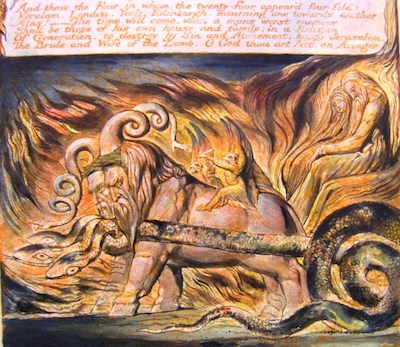
(William Blake, from Jerusalem)

In a letter to his publisher Ben Huebsch (11 May 1959) about his new novel, Riders in the Chariot (1961), Patrick White wrote: ‘What I want to emphasise through my four “Riders” – an orthodox refugee intellectual Jew, a mad Erdgeist [Earth spirit] of an Australian spinster, an evangelical laundress, and a half-caste aboriginal painter – is that all faiths, whether religious, humanistic, instinctive, or the creative artist’s act of praise, are in fact one.’[1]

‘Faith’ is a word that’s caught my attention recently: there have often been children’s chalked drawings on the paths of the park, which I find oddly heartening; but also small blue flags inscribed with pithy sayings, planted at various points beside the wide left-hand path and near the bases of trees, which I find a little less so.

‘Keep faith’, one of them advised. Yes, but in what, with what? For the religiously inclined, it’s probably clear enough, but for the rest of us? Faith—trust—in government or the existing financial and social systems or the quality of electoral choices has not been possible for quite some time. And I get the impression that the word itself is used less often now – less often than its opposite, surely.

Ernest_Dowson

(Ernest Dowson)

The poet Ernest Dowson was faithful to his Cynara ‘in my fashion’, unable to shake free of an obsessive love, though it was the prostitute he lay with ‘last night’ who prompted the comparison:

All night upon mine heart I felt her warm heart beat,
Night-long within mine arms in love and sleep she lay;
Surely the kisses of her bought red mouth were sweet;
But I was desolate and sick of an old passion,
When I awoke and found the dawn was grey:
I have been faithful to thee, Cynara! in my fashion.[2]

D. H. Lawrence’s The Rainbow was suppressed, prosecuted and banned in 1915. Seven years later, he was writing Kangaroo. There’s a moment in the later novel when Harriett Somers asks her husband Richard: “Who is there that you feel you are with, besides me—or who feel themselves with you?”

‘And at the same moment he looked up and saw the rainbow fume beyond the sea. But it was on a dark background like a coloured darkness. The rainbow was always a symbol to him—a good symbol: of this peace. A pledge of unbroken faith, between the universe and the innermost. And the very moment he said “No one,” he saw the rainbow for an answer.’[3]

Wright of Derby, Joseph, 1734-1797; Landscape with a Rainbow

(Joseph Wright of Derby, Landscape with a Rainbow: Derby Museum and Art Gallery)

Innermost. An adjective seemingly called into urgent Lawrentian service as a noun. Katherine Mansfield was thinking of action around then, writing to Middleton Murry from Menton in 1920 that she sometimes wondered whether ‘the act of surrender is not one of the greatest of all’, one of the most difficult. ‘Can it be accomplished or even apprehended except by the aristocrats of this world? You see its so immensely complicated. It “needs” real humility and at the same time an absolute belief in ones own essential freedom. It is an act of faith. At the last moments like all great acts it is pure risk. This is true for me as a human being and as a writer. Dear Heaven how hard it is to let go—to step into the blue.’[4]

Thomas Merton—poet, monk, writer on comparative religions—remarked in his journal (New York, May 30, 1940): ‘Instead of having faith, which is a virtue, and therefore nourishes the soul and gives it a healthy life, people merely have a lot of opinions, which excite the soul but don’t give it anything to feed it, just wear it out until it falls over from exhaustion.’[5]

By way of contrast, John Cowper Powys observed of his brother Llewellyn Powys:  ‘To be as certain as he was that there is no God and no immortality and no Moral Law, is, I think, a rarer human phenomenon than most of us realize. I take it that the normal human mood—it is certainly my own mood—is to alternate between faith shaken by rational doubts, and doubt shaken by irrational faith; in other words, to be an illusioned or disillusioned agnostic.’[6]

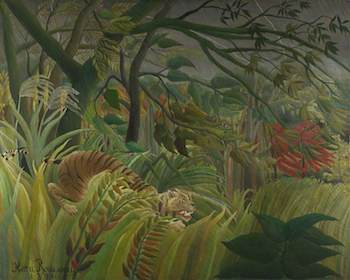
Rousseau, Henri, 1844-1910; Surprised!

(Henri Rousseau, Surprised! – National Gallery)

Guy Davenport argued that ‘[Henri] Rousseau and Flaubert simply record, and hold to a faith, wholly new in art, that the scene has its meaning inherent in it.’[7] Ford Madox Ford had also cited Flaubert when he touched on faith in an essay some seventy years earlier: ‘whatever the French school had or hadn’t, they had faith – the faith that, if they turned out good art, sociology and the rest would follow. That is what Flaubert meant when he said that if his countrymen had read L’Education Sentimentale France would have been spared the horrors of the débâcle.’[8]

Faith was an abiding, or at least recurrent, concern to Ford, not least because he was a Roman Catholic himself—converted in 1892, just before his nineteenth birthday—but also because several of his novels concerned the Tudor (the Fifth Queen trilogy) and Jacobean (The “Half-Moon”) periods, so such phrases as ‘the old faith’ and ‘the new faith’ crop up many times.

One early Ford poem was entitled ‘The Old Faith to the Converts’:

When the world is growing older,
And the road leads down and down and down,
And the wind is in the bare tree-tops
And the meadows sodden with much rain,
Seek me here in the old places,
And here, where I dwell, you shall find me,’
Says the old Faith we are leaving.[9]

In a more secular context, Ford would later assert: ‘I owe a great deal to Conrad. But most of all I owe to him that strong faith—that in our day and hour the writing of novels is the only pursuit worth while for a proper man.’[10]

Long after the end of the First World War and close to the beginning of a second, Ford wrote: ‘Faith, in short, died after the war—every sort of faith.’[11] And he repeated this to Henry Goddard Leach, editor of Forum and Century, in early 1938: ‘The War, that is to say, got rid of Faith, Loyalty, Courage and all the other big words as motives for human action….’[12]

Tonks, Henry, 1862-1937; An Underground Casualty Clearing Station, Arras

(Henry Tonks, An Underground Casualty Clearing Station, Arras: photo credit Imperial War Museum)

But perhaps Ford’s most memorable use of the word is in a fictional context, its import quite explicitly unclear to Christopher Tietjens, who is describing to his wife Sylvia his experiences in a Casualty Clearing Station after suffering the effects of a shell blast: ‘“but the fellow who was strangling me was what I wanted to tell you about. He let out a number of ear-piercing shrieks and lots of orderlies came and pulled him off me and sat all over him. Then he began to shout ‘Faith!’ He shouted: ‘Faith! … Faith! … Faith!…’ at intervals of two seconds, as far as I could tell by my pulse, until four in the morning, when he died…. I don’t know whether it was a religious exhortation or a woman’s name, but I disliked him a good deal because he started my tortures, such as they were. . . . There had been a girl I knew called Faith. Oh, not a love affair: the daughter of my father’s head gardener, a Scotsman. The point is that every time he said Faith I asked myself ‘Faith … Faith what?’ I couldn’t remember the name of my father’s head gardener.”’[13]

‘Faith what?’ It’s a good question. I imagine we each have our own answer.
Notes

[1] Patrick White, Letters, edited by David Marr (London: Jonathan Cape, 1994), 153.

[2] Dowson, ‘Non Sum Qualis Eram Bonae Sub Regno Cynarae’, in Ian Fletcher, editor, British Poetry and Prose, 1870-1905 (Oxford: Oxford University Press, 1987), 377. The title, from Horace’s Odes, IV, translates as ‘I am not what once I was under kind/ Cynara’s reign.’

[3] D. H. Lawrence, Kangaroo, edited by Bruce Steele, with an introduction and notes by Mac Daly (Cambridge edition, 1994; London: Penguin, 1997), 155.

[4] Katherine Mansfield, Selected Letters, edited by Vincent O’Sullivan (Oxford: Oxford University Press, 1990), 186.

[5] Thomas Merton, A Secular Journal (London: Hollis & Carter, 1959), 58.

[6] John Cowper Powys, introduction to Llewellyn Powys, A Baker’s Dozen (1941; London: Village Press, 1974), 15.

[7] Davenport, ‘What Are These Monkeys Doing?’ in Every Force Evolves a Form (San Francisco: North Point Press, 1987), 20.

[8] Ford Madox Ford, ‘Literary Portraits – VII. Mr. Percival Gibbon and “The Second-Class Passenger’: Outlook, XXXII (25 October 1913), 571. The ‘débâcle’ is the Franco-Prussian war and the upheaval that immediately followed it.

[9] In Poems for Pictures and for Notes of Music (1900): Collected Poems (London: Max Goschen, 1913 [dated 1914]), 142.

[10] Ford Madox Ford, Return to Yesterday: Reminiscences 1894-1914 (London: Victor Gollancz, 1931), 185.

[11] Ford Madox Ford, Provence (London: Allen & Unwin, 1938), 315.

[12] Ford Madox Ford, Letters of Ford Madox Ford, edited by Richard M. Ludwig (Princeton: Princeton University Press, 1965), 287.

[13] Ford Madox Ford, Some Do Not. . . (1924; edited by Max Saunders, Manchester: Carcanet Press, 2010), 210.


Haphazard navigations

Park-early

Harry’s waking earlier now. The lighter mornings must penetrate directly into cats’ bloodstreams. Whatever the reason, he’s there at around 05:30, suggesting breakfast. We hit the park by 05:45.

The walkers who favour the same early hour are there: the Indian couple, with whom we exchange waves and greetings; the man in the red trousers accompanied by the spaniel whose frenetic tail can be seen from space, I surmise, on the lines of the Great Wall of China; the man who clears up rubbish around the perimeter, accompanied by his wonky pooch—‘a John Burningham dog’, the Librarian supplies.

john-burningham-cannonball-simp

(John Burningham’s Cannonball Simp)

Others are a little less welcome.
“Bloody runners.”
“But he’s miles away.”
Miles are so subjective these days. I remember when a mile was a mile.

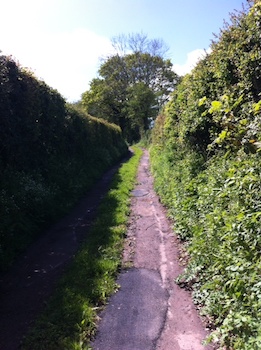
I seem to have moved from not being able to imagine walking at this time every morning of the foreseeable future to having trouble envisaging not doing it. Desires and longings vary in frequency, duration, intensity though some things recur or remain: to see and touch certain people; to stand looking out at the sea; to walk again on certain paths, in certain lanes.

Hill-Farm-Lane

‘One of my favourite places in the world’, she said.

Following some foolish and wildly irresponsible headlines in Tory tabloids, we are waiting to see whether the government will avoid compounding the earlier errors of locking down too late and too loosely by lifting some restrictions too early. The bass drum of ‘following the science’ is still beaten daily, as though that science were a single, solid, clearly defined object, not unlike an ice-cream van.

‘One definition of an expert is someone who understands better than most how little he or she knows’, Ian Leslie wrote in the New Statesman recently. ‘The governor of New York, Andrew Cuomo, has remarked that his scientific advisers preface every answer with “I don’t know”. The scientists know little about how infectious Covid-19 is, why it kills some people and barely bothers others, whether it returns to those whom it has already visited, whether and how it will mutate, or the best way to treat it. They are desperately trying to work out the best way to handle it, but it is like navigating in a snowstorm when every instrument is faulty.’
https://www.newstatesman.com/politics/uk/2020/04/politicians-must-do-more-simply-listen-expert-advice-they-need-challenge-it

Noting that life is not, like fiction, navigation, Penelope Lively observed in Making It Up (Harmondsworth: Penguin, 2006, 136): ‘There is no shrewd navigator, just a person’s own haphazard lurching from one decision to another. Which is why life so often seems to lack the authenticity of fiction.’

That ‘a person’s’ could surely be enormously extended.

Visits from The Strange

Allan, Andrew, 1863-1942; Thistledown

(Andrew Allan, Thistledown: Glasgow Museums Resource Centre)

Yesterday, two goldfinches in a tree beside the uphill path through the park. Gulls, pigeons, starlings, sparrows and blackbirds also, singing in a purer air among the hawthorn. ‘Dutch study’, the Librarian murmured once as a cyclist moved along a parallel path, referring to the joint Belgian-Dutch research project which concluded ‘that for walking the distance of people moving in the same direction in 1 line should be at least 4–5 meters, for running and slow biking it should be 10 meters and for hard biking at least 20 meters. Also, when passing someone it is advised to already be in different lane at a considerable distance e.g. 20 meters for biking.’
https://medium.com/@jurgenthoelen/belgian-dutch-study-why-in-times-of-covid-19-you-can-not-walk-run-bike-close-to-each-other-a5df19c77d08

Burne-Jones, Edward, 1833-1898; The Beguiling of Merlin

(Edward Burne-Jones, The Beguiling of Merlin: photo credit, Lady Lever Art Gallery)

My current social distance is 25 metres, to be on the safe side. Beyond the early morning walk, age and circumstances mean that the only contribution I can realistically make is to stay at home, out of the health professionals’ way, and take no chances. With a small back garden and the wider expanse of the park nearby, I have the luxury of making such choices. Many don’t, as is clearer every day, the fault lines of social and economic inequality—the gaping holes that ten years of austerity, cuts and closures and underfunding, have left in the social structure—painfully apparent. The blunders made by the government in the early stages of its response to the crisis are also increasingly clear.
https://www.newstatesman.com/2020/04/eleven-days-may-have-tragically-cost-uk-fight-against-coronavirus

Today: steady rain. But a parcel arrives, sensibly placed on the doorstep by the postman, who knocks and retreats. My order has arrived from the excellent Handheld Press, started a few years back by the writer and academic Kate MacDonald. Beautifully designed books, superbly packaged and received in two working days from my placing the order: post free too.
https://www.handheldpress.co.uk/

Handheld-titles

And we go on. ‘Nothing, perhaps, is strange’, Rose Macaulay wrote, ‘once you have accepted life itself, the great strange business which includes all lesser strangenesses.’[1] Jonathan Williams was more proactive: ‘I love to visit The Strange like some people love to visit The Country, as I say over and over again.’[2]

Now The Strange has ferociously visited all of us, is mutating into many forms, some of them mimicking the ordinary, habits of strangeness bedding down, the same people in the park at six in the morning, that couple, that runner with her dog, the spaniel man, the man who picks up rubbish as he tours the perimeter. Some days, some moments, are stranger than others. Every so often, taking what have now become the habitual precautions, washing your hands yet again, wiping down door handles, quarantining envelopes, packages, food wrapped in plastic, you catch your own eye in the mirror and ask what the hell you’re doing and what you’ve become.

Probably more disturbing is the widespread evidence that a great many people not only expect things to ‘go back to how they were before’ but believe that to be a desirable outcome. Are we so lacking in ambition? Are those tens of thousands of lost lives, including many medical and other frontline staff, not worth more than that? Might it not be an opportunity to begin repairing and rebuilding the country? Or do we simply not have any contemporary politicians with the necessary qualities?

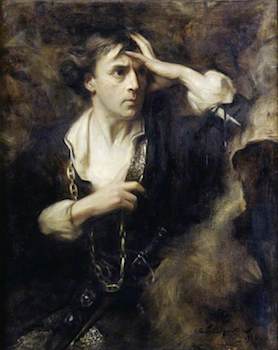
‘O God, I could be bounded in a nutshell’, Hamlet says, ‘and count myself a king of infinite space, were it not that I have bad dreams’ (Hamlet, II, ii).

Hacker, Arthur, 1858-1919; Sir John Martin-Harvey (1863-1944), as 'Hamlet'

(Arthur Hacker, Sir John Martin-Harvey as ‘Hamlet’: Museum of London)

Infinite space is itself a dream just lately – and yes, I’ve been having a few bad ones myself, probably in the company of at least twenty or thirty million other people in this country and who knows how many more worldwide. Tens of millions of bad dreams, not so much nightmares as creeping unease, unsettling encroachments, an impermeable sense of threat, figures in doorways, dark cars waiting where they really shouldn’t be. ‘There is at least one spot in every dream at which it is unplumbable’, Sigmund Freud wrote, ‘a navel, as it were, that is its point of contact with the unknown.’[3] At least one, yes. And all those dreams must add up to a lot of negative energy. Or is the arithmetic quite different? Does it account in part for the immense weariness that seems to be affecting so many people now, even the ones working from home? Or is that down to their online meetings, ten times as tiring as those old face-to-face ones?

Goya-Los-caprichos.jpgDuendecitos-

(Francisco de Goya, Los caprichos: Duendecitos)

After a visit to an injured colleague, feeling unsettled, Inspector Maigret ‘did not go home, although he lived only 500 metres from there, in Boulevard Richard Lenoir. He began walking, because he needed to walk, needed to feel the indifferent crowd brush against him.’[4]

Yes, that is familiar, less so recently but for years, the desire to be one of a crowd, any crowd, the mass, the many, included, immersed, incorporated and invisible. Less keen these days, unsurprisingly, on crowds and certainly on being brushed against by anyone that I can’t personally vouch for, currently one woman and one cat.

 
Notes

[1] Rose Macaulay, Crewe Train (1926; New York, Carroll & Graf, 1986), 30.

[2] Jonathan Williams, ‘“Who Knows the Fate of His Bones?”’, in Blackbird Dust: Essays, Poems, and Photographs (New York: Turtle Point Press, 2000), 189.

[3] Freud, The Interpretation of Dreams, translated by James Strachey, edited by Angela Richards (Harmondsworth: Penguin Books, 1976)  186, fn2.

[4] Georges Simenon, A Man’s Head (1931; translated by David Coward, London: Penguin Books, 2014), 51.

A whole bottle

Wines

In an article from 1962, ‘Ladies’ Halves’, after detailing recent occasions on which a wine waiter has produced a half-bottle of the requested wine (since he’s serving two women dining together), Elizabeth David recalls ‘the steward on the Edinburgh-London express a few years ago who yelled at me across the rattling crockery and two other bemused passengers, “A bottle, madam? A whole bottle? Do you know how large a whole bottle is?”’

Reading this over breakfast, two thoughts occurred to me: firstly, the several occasions on which the Librarian and I have remarked to one another how small wine bottles are these days; secondly: Prague.

It was, alarmingly, sixteen years ago. We had one or two practical problems at the time – the fridge had died and the drain was blocked – from which we made our escape. Nerudova, Mala Strana. A long room which looked out over the Romanian embassy. A well-equipped kitchen, I noted at the time, except for a kettle, toaster, corkscrew, plug for the sink, colander and other peripheral items.

There were crowds, especially on and around the Charles Bridge, of course, but almost everywhere: crowds of friends, tourists, students, and, above all, the tour parties, ten, twenty, thirty, even forty strong: Germans particularly, and Japanese, but French and Italian, English and American.

Long walks in the Jewish quarter; the old cemetery with the leaning stones roped in, a moment of excitement at the sight of Rabbi Löw’s grave – the inventor of the Golem – and pebbles placed on the headstone. Golden Lane, to look at Kafka’s house at Number 22, the lane, the whole area, awash with people. Then lunch at the café on the square. A good mozzarella and roasted vegetable sandwich. We decide to try the white wine. ‘Is it Czech? White wine?’ ‘Yes.’ ‘Could we try a bottle?’ Polite pause. ‘A bottle?’ It would make a good pub sign: The Incredulous Waiter. We have a bottle, in its ice bucket. When I pour again, I pass the crucial point at which it’s worth saving, and pour the whole lot in. The waiter, whose task this probably is, disapproves. ‘Now it will get warm.’ But it didn’t really have much chance to do that.

Ah, Prague. Or Paris. Or, indeed, Sherborne. When shall we three meet again?


Browsing Glaucus

Pound-Personae-1909 Pound-CEP-ND

Leafing through Peter Jay’s edition of The Greek Anthology—borrowed from the library, so likely to be with me for a while—its translators ranging from Fleur Adcock and Guy Davenport to Tony Harrison and Peter Whigham, I came across Glaukos – not, a note explains, Glaukos of Athens but Glaukos of Nikopolis (‘perhaps the suburb of Alexandria’). This is translated by Clive Sansom:

No, not earth, nor a stone slab,
But the whole vast surface of the ocean that you see
Is Erasippus’ tomb.
He and his ship drowned together. – Where
And in what unknown depths his bones wander
Seabirds alone can tell.[1]

I like the neat manner in which the close relationship of man and ship is conveyed; and the suggestion that the bones ‘wander’, the voyager never still even in death. Who the seabirds might tell is, of course, a separate question.

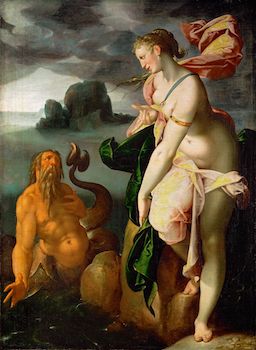
In classical literature and mythology, Glaukos or Glaucus crops up several times, including in the Iliad; he is also the son of Sisyphus who ends up being eaten by his own mares, possibly because Aphrodite was in a snit with him. But the best-known is probably the fisherman who ate a magical herb and was transformed into a sea-god. He was later renowned for his prophecies. The story of his doomed love for Scylla is told by Ovid, as is the moment of his ‘sea change’:

I picked some stalks and chewed
What I had picked. The juice, the unknown juice,
Had hardly passed my throat when suddenly
I felt my heart-strings tremble and my soul
Consumed with yearning for that other world.
I could not wait. “Farewell”, I cried, “farewell,
Land never more my home”, and plunged beneath
The waves.[2]

Spranger_Galucus-Scylla

(Bartholomeus Spranger, Glaucus and Scylla)

Glaucus is mentioned by Dante – and that mention, from the Paradiso, is the epigraph of Ezra Pound’s ‘An Idyl for Glaucus’, included in his third volume, Personae, published on 16 April 1909.

Pound’s poem is a dramatic monologue, which has ‘invented the lover who witnessed Glaucus’ transformation’, David Moody writes, ‘but does not know how to follow him, and who is left astray in the mortal world in which she can no longer be at home.’[3]

I sought long days amid the cliffs thinking to find
The body-house of him, and then
There at the blue cave-mouth my joy
Grew pain for suddenness, to see him ’live.
Whither he went I may not come, it seems
He is become estranged from all the rest,
And all the sea is now his wonder-house.

She suspects that ‘each time they come/ Up from the sea heart to the realm of air/ They are more far-removèd from the shore’. Once he plucks some grass and bids her eat it before abruptly leaping back into the sea. Then:

I wonder why he mocked me with the grass.
I know not any more how long it is
Since I have dwelt not in my mother’s house.
I know they think me mad, for all night long
I haunt the sea-marge, thinking I may find
Some day the herb he offered unto me.

And, at the end:

I am quite tired now. I know the grass
Must grow somewhere along this Thracian coast,
If only he would come some little while and find it me.[4]

Anglo-Saxon-K

This is still early Pound: there are numberless inversions, archaisms and ‘poeticisms’ but the power and force of some of the work—including ‘An Idyl for Glaucus’—is undeniable. While ‘The Seafarer’ is two and a half years away, Hugh Witemeyer remarks of an earlier poem in the volume, ‘At the Heart O’ Me, A. D. 751’, that it was Pound’s ‘earliest experiment with Anglo-Saxon diction and meter’. Do this poem’s ‘body-house’ and ‘wonder-house’ point in the same direction?[5]

Perhaps. But then Pound read a great deal of Rudyard Kipling’s work and I remember that the opening lines of Kim are: ‘He sat, in defiance of municipal orders, astride the gun Zam-Zammah on her brick platform opposite the old Ajaib-Gher—the Wonder House, as the natives call the Lahore Museum.’ So perhaps not.

The influences tumble over one another in the first years, sometimes fighting like rats in a sack, but he’ll gradually outdistance Pre-Raphaelites, Aesthetes, Symbolists and others—not abandoning or jettisoning them but absorbing them into a stronger and more expansive poetic framework. Dante and Ovid will last the course, though: the experience of the underworld, the reaching for paradise and the lure of transformation.


Notes

[1] Peter Jay, editor, The Greek Anthology and Other Ancient Greek Epigrams: A selection in modern verse translations (London: Allen Lane, 1973), 154.

[2] Ovid, Metamorphoses, translated by A. D. Melville (Oxford: Oxford University Press, 1987), 323.

[3] A. David Moody, Ezra Pound: Poet: A Portrait of the Man and His Work: Volume I: The Young Genius 1885–1920 (Oxford: Oxford University Press, 2007), 90-91.

[4] ‘An Idyl for Glaucus’, in Collected Early Poems of Ezra Pound, edited by Michael John King (London: Faber and Faber, 1977), 83-85.

[5] Hugh Witemeyer, The Poetry of Ezra Pound: Forms and Renewal, 1908-1920 (Berkeley: University of California Press, 1981), 117.


Orchards – from a distance

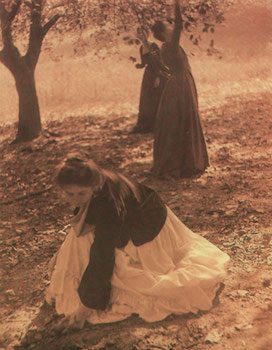
(Clarence Hudson White, The Ring Toss: Yale Visual Resources Collection; William Merritt Chase, The Ring Toss)

I noticed that today is the birthday of the photographer Clarence Hudson White, born in Ohio in 1871 (he died early, aged 54, in Mexico City). He became close friends with Alfred Stieglitz. I’d barely heard of White but, in a brief gallery of his photographs, my eye snagged on ‘The Ring Toss’ because I knew of the 1896 painting by William Merritt Chase, ‘The Ring Toss’. A lot of Chase’s paintings are very reminiscent of John Singer Sargent – who painted a portrait of Chase in 1902 (Museum of Modern Art).[1]

Clarence_White-The_Orchard.1902

(Clarence Hudson White, The Orchard)

This very evocative Clarence White photograph was published in 1905 (Camerawork, 9). Should the women seem to be practising social distancing, that’s probably mere happenstance.

Orchards are certainly evocative for artists and writers, perhaps because of their seeming to balance on the threshold of imposed order and unchecked nature, perhaps because they’re often associated with childhood, a lost paradise, or at least with a rural or semi-rural peace – and thus standing in stark contrast to the destructive forces of war. Edmund Blunden’s classic memoir, Undertones of War, refers to them often.

Early on in his ‘education’, in a chapter called ‘The Cherry Orchard’, he writes: ‘The joyful path away from the line, on that glittering summer morning, was full of pictures for my infant war-mind. History and nature were beginning to harmonize in the quiet of that sector. In the orchard through we passed immediately, waggons had been dragged together once with casks and farm gear to form barricades; I felt that they should never be disturbed again, and the memorial raised near them to the dead of 1915 implied a closed chapter.’ And of Englebelmer, ‘a sweet village scarcely yet spoiled’: ‘Its green turf under trees loaded with apples was daily gouged out by heavy shells; its comfortable houses were struck and shattered, and the paths and entrances gagged with rubble, plaster and woodwork.’[2]

Katherine Mansfield would also borrow the title of Chekhov’s last play, writing to John Middleton Murry from Menton two years after the war’s end: ‘You see it’s too late to beat about the bush any longer. They are cutting down the cherry tree; the orchard is sold—that is really the atmosphere I want.’[3]

In the midst of that war (22 March 1916), Ivor Gurney wrote to Marion Scott, from near Tidworth, in Wiltshire, of his beloved home county, ‘Glostershire where Spring sends greetings before other less happy counties have forgotten Winter and the snow. Where the talk is men’s talk, and eyes of folk are as soft as the kind airs. The best roads in England, the finest cider, the richest blossom in the most magical orchards, beauty content in security, strength quiet in confidence controlled, blood mixed of plain and hill, Welsh and English; are not these only of my county, my home?’[4]

Wilfred Owen never did see the war’s end – though he planned for it, writing in 1917 to his brother Colin, then working on a farm: ‘In my walk this afternoon, considering at leisure the sunshine and the appearance of peace (I don’t mean from the news) I determined what I should do after the war [ . . . ] I should like to take a cottage and orchard in Kent Surrey or Sussex, and give my afternoon to the care of pigs.’[5]

In May 1962, Guy Davenport wrote, in a letter to Hugh Kenner, ‘You see, my ambition is to put down roots and have a real library and workshop, a hearth & orchard, and STAY PUT.’[6]

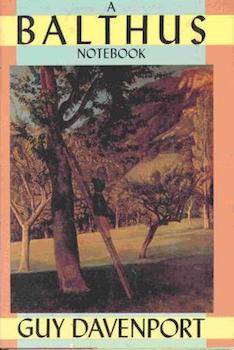
GD-Balthus-Notebook

(The Balthus painting on the jacket is the 1940 The Cherry Tree)

Apples – and pears – were of central and lasting importance to Davenport: ‘Apple and pear, brother and sister’, he writes in the novel-length title story.[7] In Objects on a Table, he stated that: ‘Pear symbolizes a harmony between human and divine; apple an encounter between human and divine. The forbidden fruit in Eden became an apple through linguistic accident, punning on evil and apple. But the inevitability of the accident was ensured by centuries of Greek and Latin pastoral poetry in which the apple was eroticized.’[8] In A Balthus Notebook, he discussed the painter’s Balthus’s use of apples and pears—‘In Christian iconography, a pear symbolizes the Redemption, and apple and pear are frequently together in Madonnas, Mary being the redemption of Eve, Christ of Adam’—noting that apple and pear appeared together for the first time in the 1981 Painter and His Model.[9]

And in ‘Shaker Light’, he tells the story of a pear tree and an apple tree ‘that had grown around each other in a double spiral’ and had stood for over fifty years around the corner from Davenport’s house. Walking past them daily for twenty years, they got into his thoughts ‘and always benignly.’ He saw them as husband and wife, as in Ovid’s poem. ‘They generated in my imagination a curiosity about the myths our culture has told itself about apples and pears. Apple is the symbol of the Fall, pear of Redemption. Apple is the world, pear heaven. Apple is tragic. A golden one given first as a false wedding gift and later presented by a shepherd to a goddess began the Trojan War and all that Homer recorded in the Iliad and the Odyssey. The apple that fell at Newton’s feet also fell on Hiroshima and Nagasaki and is right now embedded in thousands of bombs mounted in the heads of rockets, glowing with elemental fire that is, like Adam and Eve’s apple, an innocent detail of creation if untouched and all the evil of which man is capable if plucked.’ Finally, the trees were cut down by a developer, ‘in full bloom, with a power saw, the whining growl of which is surely the language of devils at their business, which is to cancel creation.’[10]

The painting that Stanley Spencer would later call his first ambitious one was called The Apple Gatherers. Spencer was one of that famous generation taught at the Slade by Henry Tonks – other Tonks pupils included Mark Gertler, Harold Gilman, Gwen John, Isaac Rosenberg, Stanley Spencer, David Bomberg, William Orpen, Wyndham Lewis and Winifred Knights. Tonks himself was clearly not immune to the lure of the orchard.

Tonks, Henry, 1862-1937; The Orchard

(Henry Tonks, The Orchard: Birmingham Museums Trust)

And I remember too one of the most memorable and thought-provoking moments in Ford Madox Ford’s The Good Soldier, when the narrator John Dowell says: ‘For I can’t conceal from myself the fact that I loved Edward Ashburnham—and that I love him because he was just myself. If I had had the courage and virility and possibly also the physique of Edward Ashburnham I should, I fancy, have done much what he did. He seems to me like a large elder brother who took me out on several excursions and did many dashing things whilst I just watched him robbing the orchards, from a distance.’[11]

Next time you feel the need to do a dashing thing, then, you might well look out for an orchard. It it won’t be for a good while yet, of course. Best stay safely indoors and read about it for the present, watching from a distance.

 
Notes

[1] See Richard Ormond and Elaine Kilmurray, John Singer Sargent. The Later Portraits. Complete Paintings Volume III (Yale: Yale University Press, 2003), 81-84.

[2] Edmund Blunden’s Undertones of War (1928; edited by John Greening, Oxford: Oxford University Press, 2015), 25, 81.

[3] Quoted by Antony Alpers, The Life of Katherine Mansfield (London: Jonathan Cape, 1980), 327.

[4] Ivor Gurney, Collected Letters, edited by R. K. R. Thornton (Mid Northumberland Arts Group & Carcanet Press 1991), 75.

[5] Quoted by Jon Stallworthy, Wilfred Owen (Oxford: Oxford University Press, 1977), 174.

[6] Questioning Minds: The Letters of Guy Davenport and Hugh Kenner, edited by Edward M. Burns, two volumes (Berkeley: Counterpoint Press, 2018), I, 121.

[7] Guy Davenport, Apples and Pears (San Francisco: North Point Press, 1984), 77.

[8] Guy Davenport, Objects on a Table: Harmonious Disarray in Art and Literature (Washington: Counterpoint, 1998), 63.

[9] Guy Davenport, A Balthus Notebook (New York: Norton, 1989), 53.

[10] Guy Davenport, The Hunter Gracchus and Other Papers on Literature and Art (Washington: Counterpoint, 1996), 59.

[11] Ford Madox Ford, The Good Soldier: A Tale of Passion (1915; edited by Max Saunders, Oxford: Oxford University Press, 2012), 191-192.


Beastly normal

Lyme

(Lyme Regis, which I suspect we may not see this year)

Sunday morning, just before dawn, and the seagulls are out in vast numbers again. With less greasy rubbish and fast food containers strewn around the streets, they’re having to do an honest day’s gull-work and grub for insects on the slopes of the park. Two or three couples glimpsed at a distance, one man probably walking to work – and one cyclist, travelling too quickly from behind us, calling out a bit too late and shooting past us as we jump back.

‘It’s okay’, the Librarian says over my fluent curses, ‘he didn’t cough or sneeze, and he was still far enough away from us anyway.’ And yes, he probably was; in normal times, undoubtedly. But – ‘normal times’?

There’s a lot of discussion currently, in newspaper columns, opinion pieces, online comments, about ‘when things return to normal’. It’s perfectly understandable but unsettling. In the first place, surely not everything will ‘return’. Nor should it. It’s being pointed out with increasing frequency, for instance, that those people who are dutifully, bravely and impressively keeping the country running in this crisis are, in fact, the ones who usually do so anyway: the ones who have so often been classed as ‘unskilled’ by the government that now praises them and finds them indispensable, the ones who have been consistently underpaid and undervalued.

Normal: conforming to a standard; usual, typical, or expected; according to rule; ordinary; well-adjusted; functioning regularly. A relatively recent usage, linking back to the Latin for precept, rule – and the carpenter’s square. It’s all very shipshape and reassuring but, of course, one age’s ‘normal’ can look a little off, sometimes a bit macabre, to other ages. It was, apparently, ‘quite normal in the nineteenth century for the family album to have photographs of the infant dead, choreographed so that, with eyes open, they still seemed to be alive.’[1] Then too normality can be appraised from widely differing ethical and political standpoints: ‘It was normal for goods to arrive from all over the world and freely circulate, while men and women were turned away at the borders. To cross them, some had themselves locked into trucks, inert merchandise, and died asphyxiated when the driver forgot them in a Dover parking lot under the June sun.’[2]

Arendt-via-BBC

(Hannah Arendt via the BBC)

And there are those instances where the whole business of definitions and comparisons rather falls to pieces. Writing of Adolf Eichmann, whose trial for war crimes she was reporting for the New Yorker, Hannah Arendt stated that Eichmann ‘was indeed normal insofar as he was “no exception within the Nazi regime.” However, under the conditions of the Third Reich only “exceptions” could be expected to react “normally.” This simple truth of the matter created a dilemma for the judges which they could neither resolve nor escape.’[3]

Still, as individuals, we have a pretty clear sense of the normal we would recognise and long to see again. Perhaps for many of us, given the chosen or obligatory changes of the past few weeks, it includes a sharper or deeper sense of quite small and ordinary things, the details—often undervalued—on which our lives actually rest. From that secure position, we might again be cavalier about more general versions of ‘normal’. Writing in 1927 from Paris to Ford Madox Ford in New York, Stella Bowen praised Ford’s recently completed Last Post. Knowing that Valentine Wannop was based largely on her, Bowen commented on several successful aspects of the book, ‘even Valentine’s agonies’, adding: ‘even if she is so beastly normal!’[4]

No doubt the beast will come again – and how readily will we recognise him, or her, or it, when that happens?

 
Notes

[1] Raphael Samuel, Theatres of Memory (London: Verso, 1996), 375; and see some of the photographs in Michael Lesy’s Wisconsin Death Trip (1973; Albuquerque: University of New Mexico Press, 2000).

[2] Annie Ernaux, The Years, translated by Alison L. Strayer (London: Fitzcarraldo Editions, 2019), 205.

[3] Hannah Arendt, Eichmann in Jerusalem: A Report on the Banality of Evil, revised and enlarged edition (London: Penguin Books, 1994), 26-27.

[4] Correspondence of Ford Madox Ford and Stella Bowen, edited by Sondra J. Stang and Karen Cochran (Bloomington & Indianapolis: Indiana University Press, 1993), 331.

Swallowing Venus

St-Marks

(St Mark’s Square, Venice. Photograph: Manuel Silvestri/Reuters: via The Guardian)

An end to March, then. Looking back, it was as recently as 28 February that Greta Thunberg visited Bristol and I decided against trying to attend the rally because of the vast crowds thronging the streets. Now photographs from around the world show us places empty of people: from Piccadilly Circus to St Mark’s Square in Venice, from Gaobeidian, Beijing to Market Square, Frankfurt. That the distance from there to here is just a little over four weeks is dizzying and almost impossible to grasp securely. I’m reminded that a decade after the Boer War—‘that never to be sufficiently accursed war’—Ford Madox Ford wrote that it ‘set, as it were, an iron door between the past and the present.’ Perhaps more appositely, he remarked that it ‘appears to me like a chasm separating the new world from the old.’[1]

Across that chasm, we see the ghosts of former lives, the normal that no longer exists and may not do so again. Among strange doublenesses, it’s both reassuring and immensely sad that approaching figures in a quiet park veer off on a different trajectory, twenty or thirty metres ahead of us, if we haven’t already begun to do the same. At the dinner table, we wonder aloud how long it will be before we browse in shops again without anxiety, or move comfortably among crowds, or visit dentists and hairdressers. The answers vary from ‘maybe six months’ to ‘probably never’.

In ancient Rome, the festival of Venus Verticordia or Venus Genetrix ran for three days from the first day of April. The preceding night, 31 March, occasioned the 93-line poem the Pervigilium VenerisThe Eve of Venus or The Vigil of Venus, its authorship and date of composition uncertain.[2]

Swallow-BBC

(Swallow: via BBC)

One of the most familiar bits of the poem is lodged in the closing lines of the most famous modern poem, among the fragments that one of The Waste Land’s voices has shored against his or her ruin:

‘Quando fiam uti chelidon [When shall I be as the swallow]—O swallow swallow’

The story of Philomela, raped by Tereus, king of Thrace, who cut out her tongue so she might not make the dreadful story known to her sister Procne, the wife of Tereus—which she does at last through another voice, the tale told in a tapestry—runs from Homer and Aeschylus through Ovid and on through great swathes of English literature, as detailed in the expansive notes in the Ricks and McCue edition of Eliot’s poems.[3]

In the myth, the sisters kill Itylus, son of Tereus and Procne, cook him and feed him to Tereus. When he is told what they’ve done, he sets off in murderous pursuit of them: but the gods save them, turn Philomela into a nightingale and Procne into a swallow.

Swinburne’s ‘Itylus’ takes the form of a monologue by Philomela:

Swallow, my sister, O sister swallow,
How can thine heart be full of the spring?
A thousand summers are over and dead.
What hast thou found in the spring to follow?
What has thou found in thine heart to sing?
What wilt thou do when the summer I shed?[4]

In 1868, Dante Gabriel Rossetti published a sonnet, ‘Venus Verticordia (for a picture)’ – the picture was commissioned in 1863 and finally sent to John Mitchell of Bradford in the autumn of 1869.

Rossetti-Venus-Verticordia

(Rossetti, Venus Verticordia: Russell-Cotes Art Gallery, Bournemouth)

She hath the apple in her hand for thee,
Yet almost in her heart would hold it back;
She muses, with her eyes upon the track
Of that which in thy spirit they can see.
Haply, ‘Behold, he is at peace,’ saith she;
‘Alas! the apple for his lips,—the dart
That follows its brief sweetness to his heart,—
The wandering of his feet perpetually!’

A little space her glance is still and coy;
But if she give the fruit that works her spell,
Those eyes shall flame as for her Phrygian boy.
Then shall her bird’s strained throat the woe foretell,
And her far seas moan as a single shell,
And through her dark grove strike the light of Troy.[5]

In 1936, Ford wrote to Allen Tate: ‘Is there, by the bye, any decent translation of the XELIDON [swallow] song? If there isn’t, I think I’d have a shot at it. Isn’t it the most beautiful thing that was ever made…or is that one of my sexagenarian delusions?’[6]

Tate did translate the Pervigilium Veneris as ‘The Vigil of Venus’ (1943). In his preface, he wrote that he had come upon the poem in about 1917 ‘in the usual way’ (in Walter Pater’s Marius the Epicurean), looked up the Latin text and was disappointed, because his ‘adolescent revolt’ against the influence of Swinburne made it impossible ‘to read properly any poem about pagan love.’ He didn’t look at the poem again until about 1930, when he ‘tried to work out a translation of the famous refrain’, an attempt that failed. He returned to it in the fall of 1942, and this time translated the entire poem.

Tate’s preface ends with his acknowledgements: to Robert Lowell, ‘for constant criticism’ and, for the translation of the first line of stanza XXI, to his wife Caroline Gordon, the novelist and short story writer:

Now the tall swans with hoarse cries thrash the lake:
The girl of Tereus pours from the poplar ring
Musical change—sad sister who bewails
Her act of darkness with the barbarous king!

And that famous refrain? The Latin is: Cras amet qui nunquam amavit, quique amavit cras ame. There are, Ford noted, many translations. Tate has ‘Tomorrow may loveless, may lover tomorrow make love.’[7]

Ford’s own ‘free rendering’ was: ‘He that has never loved, let him love tomorrow; the lusty lover, let him love again.[8]

Now April beckons. The cruellest month, some say. We can only hope not.

 
Notes

[1] Ford Madox Ford, Ancient Lights and Certain New Reflections: Being the Memories of a Young Man (London: Chapman & Hall, 1911), 175, 154.

[2] Bonnie Blackburn and Leofranc Holford-Strevens, The Oxford Companion to the Year (Oxford: Oxford University Press, 1999), 139.

[3] The Poems of T. S. Eliot. Volume I: Collected and Uncollected Poems, edited by Christopher Ricks and Jim McCue (London: Faber & Faber, 2015), 705-706.

[4] Algernon Charles Swinburne, Poems and Ballads & Atalanta in Calydon, edited by Kenneth Haynes (London: Penguin Books, 2000), 45.

[5] The Poetical Works of Dante Gabriel Rossetti, edited with a preface by William Rossetti (London: Ellis and Elvey, 1893), 360.

[6] Letters of Ford Madox Ford, edited by Richard M. Ludwig (Princeton: Princeton University Press, 1965), 259.

[7] Allen Tate, Collected Poems, 1919-1976 ((New York: Farrar, Straus and Giroux, 1977), 145, 149, 161.

[8] Ford Madox Ford, The March of Literature: From Confucius to Modern Times (London: Allen & Unwin, 1939), 277.


‘Into your clothes and come!’

‘“Come, Watson, come!” he cried. “The game is afoot. Not a word! Into your clothes and come!”’* Yes, the mornings just lately begin like that, though my name is not Watson (and ‘he’ is ‘she’) but, for that single permitted daily exercise outing, it’s up at six, into our clothes, feed the cat and go.

(* ‘The Adventure of the Abbey Grange’)

The Victorian Garden cemetery where we liked to walk – 45 acres, quiet apart from the magpies – has now closed its gates, so we use our (very: thirty metres away) local park, which was seeming a bit crowded four or five days ago but, at this hour of the morning, there are very few people around and perhaps the same number of dogs, if you average it out over solitary runners and owners of two or even three hounds. We walk briskly, the slightly more paranoid one – me – turning round more often to make sure that nobody’s coming up the path behind us. But the last few days have seen a definite change: everybody in the park keeps their distance – and a healthy distance at that. Half an hour’s walking then back for breakfast.

My reading has become even more disorganised and haphazard just lately; books picked up on no scheme or plan, to be read for the first time or reread or read properly after previous dipping-in or briefly browsing. So, in the parapet around me, I have Michael J. K. Walsh’s study of the painter Richard (C. R. W.) Nevinson, H. D.’s Trilogy, Roy Foster’s Paddy & Mr Punch, Fiona Benson’s Vertigo & Ghost (filched from the Librarian’s bedside pile), The Letters of Gamel Woolsey to Llewellyn Powys, John Buchan’s autobiography, Memory Hold-the-Door and Ford’s Fifth Queen trilogy. Our of the corner of my eye, I can see a pile of Georges Simenon’s Maigret novels in the new Penguin translations, Defoe’s A Journal of the Plague Year and John Christopher The Death of Grass, Penelope Fitzgerald’s A House of Air, another Irish history title by Foster – Vivid Faces – and Sterne’s A Sentimental Journey. Add them together and they should see me through a few weeks (if not the duration of a pandemic).

My days have altered less than a lot of other people’s because, since retirement, I’ve done more or less what I do now, except that I have much less time outside and the Librarian is currently at home though often engaged with online meetings, referencing queries, team briefings and the like. Being what William Maxwell termed ‘a sociable introvert’ helps too: I sympathise with those people who are naturally gregarious, who like the constant company of others and really only enjoy and value face to face interactions rather than remote ones. They must be having a very hard time.

Yesterday evening, at our open front door, clapping those on the frontline in this crisis: NHS staff, care workers, pharmacists, delivery drivers, supermarket staff and others. The closest thing to a social event for a while: near and more distant neighbours all along our street applauding, some waving and calling.

So it’s not all dark.