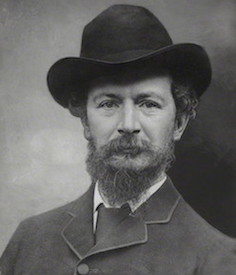
‘Swinburne my only miss’

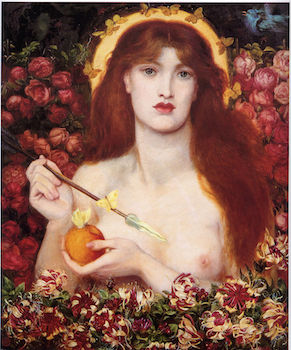
EP-Pisa-viaWallStJournalNPG x81998; Algernon Charles Swinburne by Elliott & Fry

(Pound in the dispensary at the DTC via Wall Street Journal; Algernon Charles Swinburne by John McLanachan: Wikipedia Commons)

It’s the first day of official lockdown in the UK, a little looser as yet than in some other countries but a large stride in what had become a necessary direction.

In an earlier and rather different instance of containment—the Disciplinary Training Center near Pisa in 1945—remembering those days ‘before the world was given over to wars’, Ezra Pound wrote: ‘Swinburne my only miss’. To his parents, in the Spring of 1909, the literary traveller (who would seek out W. B. Yeats, meet most other leading writers and ‘glare’ at Henry James across a room) had remarked that ‘Swinburne happens to be stone deaf with a temper a bit the worse for wear, so I haven’t continued investigation in that direction.’[1]

Less than three weeks after that letter, on 10 April 1909, Swinburne died. ‘He grafted on to epic volume a Berserker rage: he was a man of fine frenzies’, Ford Madox Ford wrote in the May 1909 issue of The English Review,[2] seeming to allude to Shakespeare’s A Midsummer Night’s Dream, in which Theseus asserts that ‘The lunatic, the lover, and the poet/ Are of imagination all compact’:

The poet’s eye, in a fine frenzy rolling,
Doth glance from heaven to earth, from earth to heaven,
And as imagination bodies forth
The forms of things unknown, the poet’s pen
Turns them to shapes, and gives to airy nothing
A local habitation and a name. (V.i.12-17)

Fuseli, Henry, 1741-1825; Titania and Bottom

(Henry Fuseli, A Midsummer Night’s Dream: Tate)

Ford’s obituary note on Swinburne is generous – but he certainly didn’t regard rage and frenzy as ideal writerly qualities. He once described what he termed ‘the view of their profession held by what it is convenient to call the Typical English Writer of the pre-Moonrise period. You sit down; you write; the vine leaves are in your hair; you forget mundane tribulations; gradually intoxication steals over you. Sometimes you stumble into sense; sometimes you do not.’[3] Nearly thirty years later, borrowing Jean Cocteau’s remark about Victor Hugo, Ford would describe the painful progress of his ‘weary eyes’ and ‘enfeebled mind’ through ‘rivulets of print between top and bottom of a page’ of Swinburne’s verse: ‘And then in exasperated protest: “That page is mad. . . . It thinks it’s Swinburne!”’[4]

Ford disliked the notion of the inspired, even intoxicated poet; he disliked inversions, needless profusions of rhymewords and, with regard to Victorian poets in particular, was dismayed by the sheer quantity of stuff that they disgorged. His doubts about Swinburne at least were shared wholly or in part by other writers, including Browning, Matthew Arnold and A. E. Housman.[5]

‘Love of sound and especially of rhyme persuaded [Swinburne] to a somewhat lighter use of words than is common among great poets’, Edward Thomas wrote, a couple of years after Swinburne’s death. ‘Space would be wasted by examples of words produced apparently by submission to rhyme, not mastery over it. The one line in “Hesperia”: “Shrill shrieks in our faces the blind bland air that was mute as a maiden”, is enough to illustrate the poet’s carelessness of the fact that alliteration is not a virtue in itself.’[6]

In Ford’s The Good Soldier, the narrator, John Dowell, recalls of Edward Ashburnham that: ‘Once, in the hall, when Leonora was going out, Edward said, beneath his breath—but I just caught the words: “Thou hast conquered, O pale Galilean.”’ Interestingly, Dowell then adds: ‘It was like his sentimentality to quote Swinburne.’[7]

The line is from Swinburne’s ‘Hymn to Proserpine’, which laments the ousting of the pagan gods and goddesses by the Christian faith:

Thou hast conquered, O pale Galilean; the world has grown grey from thy breath;
We have drunk of things Lethean, and fed on the fullness of death.
Laurel is green for a season, and love is sweet for a day;
But love grows bitter with treason, and laurel outlives not May.[8]

FMF-Good-Soldier

‘Sentimental’ or ‘sentimentalist’ is applied to Edward Ashburnham more than two dozen times in this short novel. Early on, speculating on what so many people, particularly women, see in Ashburnham, Dowell wonders too what he even talks to them about. ‘Ah, well, suddenly, as if by a flash of inspiration, I know. For all good soldiers are sentimentalists—all good soldiers of that type. Their profession, for one thing is full of the big words, courage, loyalty, honour, constancy’ (28).

That phrase ‘a flash of inspiration’ may prompt us to caution but I think there is a parallel between what Edward Thomas called ‘submission to rhyme, not mastery over it’, and an unthinking adherence to preferences or forms of thought or behaviour without review or scrutiny. We grow out of things, we adapt, develop and change: this may mean leaving behind some youthful tastes and assumptions, not clinging to them for wrong reasons. John Buchan, late in life, reflected on those ‘oddments’ which are ‘carried over from youth’, the memory of them recalling ‘blessed moments’ with which we associate them. He terms it ‘pure sentimentality, but how many of us are free from it?’ He goes on: ‘My memory is full of such light baggage. Stanzas of Swinburne, whom I do not greatly admire, remind me of summer mornings when I shouted them on a hill-top, and still please, because of the hill-top, not the poetry.’[9]

VH_FMF_Selsey

(Ford and Violet Hunt at Selsey)

Ford is one of the recurrent figures in Pound’s Pisan Cantos and elsewhere in Canto 80, after the mention of ‘the mass of preraphaelite reliques/ in a trunk in a walled-up cellar in Selsey’—a reference to the West Sussex cottage, owned by Violet Hunt, where she and, very often, Ford spent a good deal of time—we read: ‘“Tyke ’im up to the bawth” (meaning Swinburne)’ (80/508).

In ‘Swinburne versus his Biographers’ (1918), Pound had launched with even more orthographic gusto into his Cockney performance, citing: ‘Swinburne at the Madox Browns’ door in a cab, while the house-keeper lectures the cabman: “Wot! No, sir, my marster is at the ’ead of ’is table carving the j’int. That’s Mr. Swinburne—tike ’im up to the barth”’.[10]

Through his grandfather, Ford knew both Swinburne and Theodore Watts-Dunton, who cared for Swinburne during the last thirty years of the poet’s life. Pound’s line derives from Ford’s writing—or, more likely, conversation—recalling the anecdotes about his grandfather’s housemaid, Charlotte Kirby. In Ancient Lights, Ford recalls her telling him: ‘“I was down in the kitchen waiting to carry up the meat, when a cabman comes down the area steps and says: ‘I’ve got your master in my cab. He’s very drunk.’ I says to him— “and an immense intonation of pride would come into Charlotte’s voice—” ‘My master’s a-sitting at the head of his table entertaining his guests. That’s Mr. —. Carry him upstairs and lay him in the bath.’”

A later version has Ford overhearing the conversation himself – and the blank is filled in: ‘At last she brought out composedly the words:
“That’s Mr. Swinburne. Help me carry him upstairs and put him in the bath.”
And that was done.’[11]

Ford_Madox_Brown

(Ford Madox Brown)

Ford explains that his grandfather, the painter Ford Madox Brown, ‘whose laudable desire it was at many stages of his career to redeem poets and others from dipsomania, was in the habit of providing several of them with labels upon which were inscribed his own name and address. Thus, when any of these geniuses were found incapable in the neighbourhood they would be brought by cabmen or others to Fitzroy Square’ (Ancient Lights 12).

In his essay on Swinburne—one of Pound’s early enthusiasms but one which he now felt he could see in a clearer perspective[12]—Pound is frank about what he sees as Swinburne’s defects while also extolling his virtues: ‘we can, whatever our verbal fastidiousness, be thankful for any man who kept alive some spirit of paganism and of revolt in a papier-mâché era’. While he remarks that ‘No man who cares for his art can be deaf to the rhythms of Swinburne, deaf to their splendour, deaf also to their bathos’, there are signs of familiar—and not, perhaps, strictly ‘literary’—Poundian preoccupations of that period. One is that ‘paganism’ (and lack of enthusiasm for the Christian faith) of ‘Hymn to Proserpine’; another is made clear by the assertion that his essays ends on: Swinburne’s ‘magnificent passion for liberty—a passion dead as mutton in a people who allow their literature to be blanketed by a Comstock and his successors; for liberty is not merely a catchword of politics, nor a right to shove little slips of paper through a hole. The passion not merely for political, but also for personal, liberty is the bedrock of Swinburne’s writing’ (Literary Essays 294).
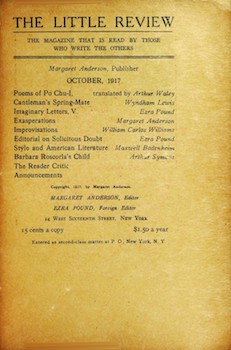
LR-Oct-17

(The Modernist Journals Project (Searchable database). Brown and Tulsa Universities, ongoing)

Pound’s long essay on Henry James, published a few months later, would praise James in part along the same lines: ‘the hater of tyranny’, author of ‘book after early book against oppression’, with ‘outbursts in The Tragic Muse, the whole of The Turn of the Screw, human liberty, personal liberty, the rights of the human individual against all sorts of intangible bondage!’ (Literary Essays 296). D. H. Lawrence’s The Rainbow had been suppressed in 1915; in October 1917, the issue of the Little Review containing Wyndham Lewis’s ‘Cantleman’s Spring Mate’ had been seized by the U.S. postal authorities and the same periodical’s serialising of Joyce’s Ulysses would soon lead to more censorship difficulties, culminating in a trial in early 1921.[13] In that climate, Pound’s celebration of a ‘passion for liberty’ in artists he admires is hardly surprising but the tribute to Swinburne is nevertheless a genuine and powerful one.

 
Notes

[1] The Cantos of Ezra Pound, fourth collected edition (London: Faber and Faber, 1987), 82/523, 80/506; letters dated 21 February 1912 and c. 24 March 1909: Ezra Pound to His Parents: Letters 1895–1929, edited by Mary de Rachewiltz, David Moody and Joanna Moody (Oxford: Oxford University Press, 2010), 273, 165.

[2] The English Review (May 1909), 193-194: reprinted in Ford Madox Ford, Critical Essays, edited by Max Saunders and Richard Stang (Manchester: Carcanet Press, 2002), 71-72. Ford wrote a two-part essay entitled ‘The Poet’s Eye’ in 1913.

[3] Ford Madox Ford, Thus to Revisit (London: Chapman & Hall, 1921), 9.

[4] Ford Madox Ford, Portraits from Life (Boston: Houghton Mifflin, 1937), 194.

[5] All mentioned by Kenneth Haynes in his edition of Swinburne’s Poems and Ballads & Atalanta in Calydon (London: Penguin Books, 2000), xiv-xv.

[6] Edward Thomas, A Language not to be Betrayed: Selected Prose, edited by Edna Longley (Manchester: Carcanet Press, 1985), 43.

[7] Ford Madox Ford, The Good Soldier: A Tale of Passion (1915; edited by Max Saunders, Oxford: Oxford University Press, 2012), 190. A nice detail here is that Swinburne’s maternal grandfather was the third Earl of Ashburnham.

[8] ‘Hymn to Proserpine (After the Proclamation in Rome of the Christian Faith)’, Haynes, Poems, 55-61. Daniel R. Barnes comments that ‘Leonora, as the agent of orthodox Catholicism, has triumphed over [Edward Ashburnham’s] own paganism’. See ‘Ford and the “Slaughtered Saints”: A New Reading of The Good Soldier’, Modern Fictions Studies, XIV, 2 (Summer 1968), 168.

[9] John Buchan, Memory Hold-the-Door (London: Hodder & Stoughton, 1940), 202-203.

[10] Literary Essays of Ezra Pound, edited by T. S. Eliot (London: Faber and Faber, 1960), 290.

[11] Ford Madox Ford, Ancient Lights and Certain New Reflections (London: Chapman and Hall, 1911), 11-12; Portraits from Life, 187.

[12] For the youthful enthusiasm, see Collected Early Poems of Ezra Pound, edited by Michael John King (London: Faber and Faber, 1977), 40-43, 261; and Christoph de Nagy, The Poetry of Ezra Pound: The Pre-Imagist Stage (Bern: Francke, 1960), on Pound seeing Swinburne as ‘the poet of human destiny’, who asked ‘the final questions about the fate of man’ rather than the erotic or perverse poet; also as the poet of ‘liberation’ (73, 74).

[13] That ‘pale Galilean’ crops up in Ulysses, as do a good many other Swinburne references: see index to Don Gifford, with Robert J. Seidman, Ulysses Annotated: Notes for James Joyce’s Ulysses, revised and expanded edition (Berkeley: University of California Press, 1989). There’s also a lot of Swinburne in Lawrence’s work, not least in Lady Chatterley’s Lover, largely because of his constant recurrence to the Persephone myth.

 

Zigzagging to the park – and the cemetery

STC205055

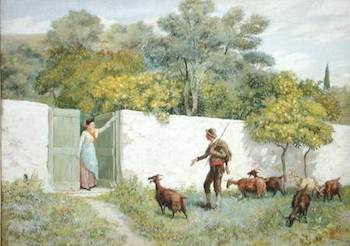
(22 March, birthday of the artist and illustrator Randolph Caldecott: ‘Scene at Montone’, with the shepherd and his sweetheart – ­if she is that – observing the rule of social distancing rather better than some inhabitants of these islands)

That old saying about a week being a long time in politics has been drastically revised; now a day is a long time and single hours are catching up, in part because, increasingly, we pay attention to other parts of the world, countries whose situations have previously tended to slide by under the generous rubric of ‘Elsewhere’.

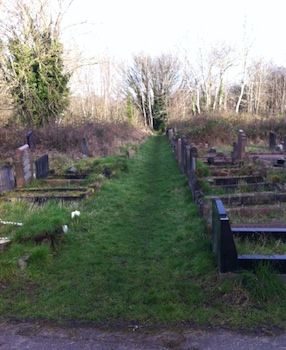
The only course the Librarian and I can take is to stay at home and, for as long as possible and with all feasible precautions, have a daily walk. But the walks are getting trickier. Fine weather just at the moment, and more people feeling the need for fresh air, unused to spending so much more time than usual indoors. So we are zigzagging. Crisscrossing. Dodging to and fro, as we progress up the long, steep road, cut through the small park, circle the cemetery and come home again. One or two of the paths there are generously wide but most are not. A growing number of people are clearly conscious of the risks and the need to distance themselves but this only makes more obvious the many who are still not, whether distracted or thoughtless or simply irresponsible. Most of those, though, are at least walking near their homes and are to be distinguished from the massed ranks of arrant fools littering roads in the Scottish Highlands and the Lake District and Snowdonia and the Yorkshire Dales, crowding onto beaches and into beauty spots, stuffing themselves into second homes and holiday cottages in areas ill-equipped to deal with the likely fallout of their dangerous idiocy.

Path

At long to medium range, you register the risks: people with young children and with dogs are likely to wander over the pavement without much warning for child- or dog-related reasons, so we give them a wide berth. Pregnant women are already mindful of the dangers so tend to take their own avoiding action. And there are those others, still behaving as though there is no crisis, no pandemic infecting huge swathes of people and killing a lot of them. We were changing to single file and keeping to the edge of the path but all too often the people bearing down on us would either hog the centre of the path or veer about all over it. So now we simply cross the road or dive down side paths or detour abruptly over flowerbeds or old graves. In the cemetery, there are many paths branching off the main road – but other walkers can appear without warning, necessitating an explosive burst of speed. I’m now armed with the useful knowledge that the Librarian can move from 0 to 60 m.p.h. in about four seconds when threatened by a family group bursting out of the trees.

At least we can still go for a walk without needing to produce a document authorising us to do so. That, of course, could change. What’s needed is for common sense to become a bit more common – and quickly.


Plague, fire, war – and bark

Cowper

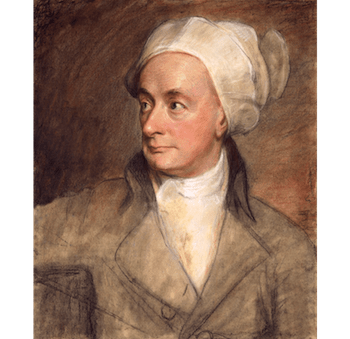
(George Romney, William Cowper (1792): © National Portrait Gallery)

On another 19 March (1788), the poet William Cowper wrote to his friend the Reverend Walter Bagot, ‘The Spring is come, but not I suppose that Spring which our poets have celebrated. So I judge at least by the extreme severity of the Season, sunless skies and freezing blasts, surpassing all that we experienced in the depth of winter. How do you dispose of yourself in this howling month of March? As for me, I walk daily be the weather what it may, take Bark, and write verses.’[1]

Cinchona

https://botanical.com/botanical/mgmh/p/perbar29.html

Similarly, I walk with the Librarian daily (‘be the weather what it may’) – the park is noticeably busier but the cemetery is still pretty quiet – though I tend to write prose more often these days – and I’ve never knowingly taken ‘Bark’. Nor was I even sure what it meant. My dictionary offered ‘cinchona’ and I gather that this was Peruvian bark, the source of quinine. Roy Porter notes that it was brought to Europe between 1630 and 1640 or thereabouts, possibly by Jesuit missionaries, the reason for its being known as ‘Jesuits’ Bark’ – and also the reason why ‘staunch Protestants like Oliver Cromwell’ refused to take it. Porter adds that cinchona, demonstrably effective against fevers, was introduced into the London Pharmacopoeia in 1677.[2]

In August 1685, the diarist (among much else) John Evelyn visited Mr Watts, ‘keeper of the Apothecaries Garden of simples at Chelsea where there is a collection of innumerable rarieties of that sort, particularly beside many rare annuals the tree bearing the Jesuit’s bark, which had done such cures in quartans’.[3]

[‘Quartans’ refers to a form of malaria resulting in a fever which recurs every third day – by inclusive reckoning, the fourth day, so Latin quartanus, of the fourth]

Samuel_Pepys

(Samuel Pepys)

Recalling that Evelyn’s famous contemporary, Samuel Pepys, also lived through a period of war, plague and fire, I looked up his 19 March 1665 entry, though the Great Plague broke out in earnest a little later than that, so the record of that particular ‘Lords Day’, begins: ‘Mr Povy and I in his coach to Hide parke, being the first day of the Tour there – where many brave ladies. Among others Castlemayne lay impudently upon her back in her coach, asleep with her mouth open. There was also my Lady Kerneeguy, once my Lady Anne Hambleton, that is said to have given the Duke a clap upon his first coming over.’[4]

No reference to applause there, I suspect.

Plague, fire and war: that’s to say the second Anglo-Dutch War (1665-1667, when the peace treaty gave the Dutch a monopoly on nutmeg); it was a period thickly populated with conflicts. In another, later time of war (c. 19 March 1915), D. H. Lawrence wrote enthusiastically to Ottoline Morrell of his novel The Rainbow, having had the first 71 pages typed: ‘It really puts a new thing in the world, almost a new vision of life.’[5]

Lady_Ottoline_Morrell

(Ottoline Morrell)

A positive, anyway, a blow on behalf of the ordinary universe. A new thing in the world. Happy birthday, then, to Philip Roth, born on this day in 1933: ‘But back in bed he thought, The burden isn’t that everything has to be a book. It’s that everything can be a book. And doesn’t count as life until it is.’[6]

Yes. One more 19 March. 1941 this time, when Penelope Fitzgerald (by then a producer in the BBC Features Department) kept her friend Hugh Lee (‘Ham’) up to date: ‘The BBC is not exactly tedious, in fact it is rent with scandals and there are dreadful quarrels in the canteen, about liberty, the peoples’ convention, &c, and the air is dark with flying spoons and dishes. Miss Stevens poured some tea down Mr Fletcher’s neck the other day. He knew Freud who told him the term inferiority complex was a mistranslation and there was really no such thing. I have to eat all the time to keep my spirits up so I am getting quite fat.’[7]

Whatever it takes to keep your spirits up at the moment, I’d say, is just fine.

 
Notes

[1] William Cowper, Letters and Prose Writings, Volume III: 1787-1791, edited by James King and Charles Ryskamp (Oxford: Oxford University Press, 1982), 128.

[2] Roy Porter, The Greatest Benefit to Mankind: A Medical History of Humanity from Antiquity to the Present (London: Harper Collins, 1997), 233.

[3] John Evelyn’s Diary, quoted by Miles Hadfield, A History of British Gardening (London: Penguin Books, 1985), 143.

[4] Samuel Pepys, The Shorter Pepys, selected and edited by Robert Latham (Harmondsworth: Penguin Books, 1993), 446-447.

[5] Letters of D. H. Lawrence II, June 1913-October 1916, edited by George J. Zytaruk and James T. Boulton (Cambridge: Cambridge University Press, 1981), 308.

[6] Philip Roth, The Anatomy Lesson (1984), in Zuckerman Bound: A Trilogy and Epilogue 1979-1985 (New York: Library of America, 2007), 443.

[7] So I Have Thought of You: The Letters of Penelope Fitzgerald, edited by Terence Dooley (London: Fourth Estate, 2008), 22.


Hand wash, news watch

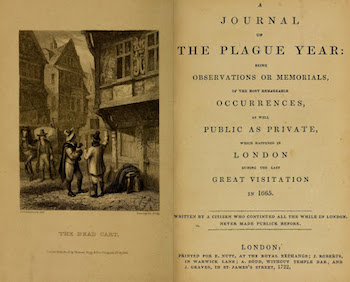
Defoe-Journal

The news changes daily, hourly, minute by minute at times. I’d drifted away from my excessive consumption of the stuff because of the depressing political developments but this has drawn me back, however unwillingly. My younger daughter is in Barcelona (finding it hard to believe that Britain is being so slow to act when it’s clear what needs to be done), my elder daughter working in the National Health Service, the Librarian working in the university sector which is just emerging from a series of scheduled strikes and now has to make very difficult decisions quickly, there are friends in Europe and North America. So yes, I watch the news: Canada, the Netherlands, Argentina; China, Myanmar, Iran; Hong Kong, Australia, India, Monaco, the United States. . . France, Spain, England.

In the past, we’ve had epidemics that turned out not to be so bad, others that were deadly but didn’t spread beyond a few countries, one that was hugely and widely destructive but still allowed vast numbers of people to feel that it wouldn’t affect them since they weren’t ‘like that’. Whenever the news of such threats first breaks, it’s inevitable that we wonder: is this The One?

Now we have Covid-19, a true pandemic – that seems to target predominantly the elderly or those with existing health problems but which may prove to be rather less discriminating. And while the elderly are regarded as most vulnerable to the virus, others are highly vulnerable to the related effects of it: the poor – cash-poor, time-poor, resource-poor – who don’t have the options and can’t make the choices that the luckier ones enjoy. So our government also needs to focus attention and resources on precisely those who have come off very badly under recent administrations: the impoverished, the precarious, the disabled, the unemployed, the homeless, those with the greatest needs and the least hope of meeting them.

But all this washing of hands! Pontius Pilate on steroids, I thought, impressing myself for the space of a heartbeat before remembering that it is, if anything, the opposite: a taking of personal responsibility rather than the avoidance of it. So the hands get washed alarmingly often, door handles are wiped, parcels put aside for a while. Otherwise, I just read, cook, write. Every day we go out for a reasonable walk, avoiding busy places and keeping a wary eye on other walkers. While the weather’s still cool, I wear gloves, not yet looking a little paranoid, though warmer days may foster that impression. But after all, just because you’re paranoid it doesn’t mean that the virus isn’t out to get you.

And behind closed doors? Are bookish types reading or re-reading Camus’ The Plague or John Christopher’s The Death of Grass or the more recent post-apocalyptic delights? Or are they rewriting Defoe’s Journal of a Plague Year? In Britain, more than a hundred thousand copies of Hilary Mantel’s The Mirror and the Light are being read: but at least everyone knows how that story ends.

Here comes a candle to light you to bed,
Here comes a chopper to chop off your head!

Covid-19 will clearly be with us for quite a while: and speculation about possible sequels has hardly begun.

Last Posting

The still life, Guy Davenport observed in Objects on a Table: Harmonious Disarray in Art and Literature, ‘likes puns and double meanings’.

So too, among many others, did James Joyce (‘yung and easily freudened’), Ezra Pound – and Ford Madox Ford. One of the attractions of Last Post as a title for our Ford journal, certainly to my mind, was its many possible interpretations. I’d also edited the first critical edition of Ford’s novel of that title (the final volume of the Parade’s End tetralogy) where I’d discussed some of those interpretations,* so it was always going to be close to my heart.

My copies of the second issue of Last Post have just arrived—after long delays of the kind familiar to journal editors everywhere, I suspect—and I’m very glad to see it. The first issue is now open access and freely downloadable from the Ford Madox Ford Society website: http://www.fordmadoxfordsociety.org/

Just lately it seems that the most obviously timely writer is the sixteenth-century Thomas Nashe (‘In Time of Pestilence’):

Rich men, trust not in wealth,
Gold cannot buy you health;
Physic himself must fade;
All things to end are made;
The plague full swift goes by;
I am sick, I must die—
Lord, have mercy on us!

Beauty is but a flower
Which wrinkles will devour;
Brightness falls from the air;
Queens have died young and fair;
Dust hath closed Helen’s eye;
I am sick, I must die—
Lord, have mercy on us!

I’m sometimes made a little uneasy by attempts to make various historical figures (including writers) ‘relevant’ to our times: it’s often impressive enough if they were relevant to their own. But I find Ford inexhaustibly interesting both in revealing social, political and artistic facets of his own time and—smallholder, environmentalist, cultural commentator as well as creative artist—often illuminating aspects of ours too. So there’s plenty of scope for many more issues – and Last Post 3 is shaping up pretty well.

[* Among the ‘posts’: the Latin for ‘after’ or ‘since’ (‘post-war’), horse-racing, mail, support, the point at which a soldier is stationed when on duty, boundary marker, furniture and—these days—blogging. ‘Last’ takes us into the realms of cobblers, cargoes, endurance and contemporaneity. Taken together, they speak of communications and, of course, the bugle call signalling the order to retire for the night as well as the final farewell at military funerals and at remembrance services.]

Nourished by Travel – or not

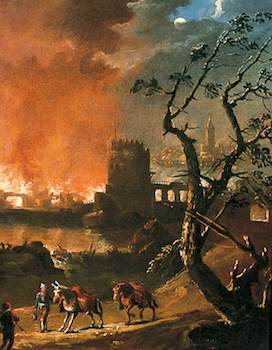
Chambers, Thomas, active 1849-1859; A Burning Town by Moonlight with Travellers

(Thomas Chambers, A Burning Town by Moonlight with Travellers: York Art Gallery
© York Museums Trust)

Reading, on and off, Somerset Maugham’s short stories, I remembered Anthony Burgess, a great admirer of Maugham, writing that: ‘The form fitted a talent that was wide rather than deep, not (as with James) going over the same ground again and again till its possibilities were exhausted, but best nourished by travel, brief encounters with many human types, an anecdote swiftly jotted down between rubbers of bridge, a newspaper report, “brunch” with a planter in Burma, a whisky suku in a Malayan club.’[1]

‘Nourished by travel’, yes, though it’s often said that, in a great many cases, travel narrows the mind. Most obviously nourished are the travel companies, the airlines—and, as becomes daily more obvious, the spread of infectious diseases. But the number of those who feel less positive towards the industry is surely growing, now that even the thickest skull and skin must have been penetrated by some shaft of understanding that every journey by air—and, though less, by road and rail too—is another nail in the coffin of this abused planet.

There’s a moment in Jenny Offill’s new novel:
‘Young person worry: What if nothing I do matters?
‘Old person worry: What if everything I do does?’[2]

Like the destructive effects of smoking, denied, concealed or spun away for years, the facts now sit like giant stones on the road to the airport.

In 1950, apparently, the English travelled an average of five miles a day; in 2000, it was more like thirty miles.[3] The Librarian and I now travel, and plan to travel, far less; and less far, mainly because we don’t want to fly – besides, the cat takes a dim view of prolonged absences. On cats and travel: Guy Davenport wrote to James Laughlin (29 July 1995) about an inquiry from Laughlin’s wife: ‘Gertrude’s question—how do I know all the things I know—is a good one in that it lets several cats out of the bag at once. If she means history and geographical detail, the answer is books, travel, and stealing. If she means psychology and the behavior of people, I make it up.’[4]

One of the main divisions among travellers seems to have been the matter of purpose; more specifically, is there one? Sometimes, it’s a personal trait or tic: Colette wrote in Chance Acquaintances of ‘the few personal belongings which, at that time, I held to be invaluable: my cat, my resolve to travel, and my solitude.’[5]

Colette-and-cat

(Colette and cat: via The Guardian)

‘For my part, I travel not to go anywhere, but to go’, Robert Louis Stevenson wrote in a famous passage. ‘The great affair is to move; to feel the needs and hitches of our life more nearly; to come down off this feather-bed of civilisation, and find the globe granite underfoot and strewn with cutting flints.’[6] So too, in Angela Carter’s post-apocalyptic Heroes and Villains, she writes: ‘The roads were arteries which no longer sprang from a heart. Once the cities were gone, the roads reverted to an older function; they were used for the most existential kind of travelling, that nomadic peregrination which is an end in itself.’[7]

Samuel Johnson certainly defined a purpose: ‘The grand object of travelling is to see the shores of the Mediterranean. On those shores were the four great Empires of the world; the Assyrian, the Persian, the Grecian, and the Roman.—All our religion, almost all our law, almost all our arts, almost all that sets us above savages, has come to us from the shores of the Mediterranean.’[8] Elsewhere, the opening of The Vanity of Human Wishes proposed surveying mankind on a broader scope, ‘from China to Peru’.

A more personal object was voiced by Edward Leithen, central to half a dozen of John Buchan’s novels, who remarks that: ‘All my life I have cherished certain pictures of landscape, of which I have caught glimpses in my travels, as broken hints of a beauty of which I hoped some day to find the archetype.’[9]

The brutal fact is that millions of affluent people fondly believe that they have a perfect right to drive wherever and whenever they like, and to fly wherever and whenever they like, and that exercising such perceived rights concerns nobody else and affects nobody else. The truth is otherwise. Perhaps the most famous inhabitant of Concord, Massachusetts, once wrote: ‘I have travelled a good deal in Concord’.[10]

A few more of us may need to cultivate the ability—and the desire—to study, learn and feel, let’s say, nourished by our own locality, our own small corner of the world.

 
Notes

[1] Anthony Burgess, ‘Bitter-sweet Savour’ (1965), in The Ink Trade, edited by Will Carr (Manchester: Carcanet Press, 2018), 23-24.

[2] Jenny Offill, Weather (London: Granta, 2020), 21-22.

[3] Madeleine Bunting, The Plot: A Biography of an English Acre (London: Granta 2009),  91.

[4] W. C. Bamberger, editor, Guy Davenport and James Laughlin: Selected Letters (New York: W. W. Norton & Co., 2007), 205.

[5] Colette, Chance Acquaintances & Julie de Carneilhan (translated by Patrick Leigh Fermor; Harmondsworth; Penguin Books, 1957), 168.

[6] Robert Louis Stevenson, Travels with a Donkey in the Cevennes and Selected Travel Writings, edited by Emma Letley (Oxford: Oxford University Press, 1992), 163.

[7] Angela Carter, Heroes and Villains (London: Picador, 1972), 107.

[8] James Boswell, Life of Johnson, edited by R. W. Chapman, revised by J. D. Fleeman, (Oxford: Oxford University Press, 1980), 742.

[9] John Buchan, The Dancing Floor (1926; edited by Marilyn Deegan, Oxford: Oxford University Press, 1997), 115-116.

[10] Henry David Thoreau, Walden, edited by Jeffrey S. Cramer (New Haven and London: Yale University Press, 2004), 2.


Apocalyptic shopping

The Great Day of His Wrath 1851-3 by John Martin 1789-1854

(John Martin, The Great Day of his Wrath: Tate)

The university strike is on again for lecturers, librarians, technicians and support staff. More pickets, rallies, marches and earlier mornings. What are the issues? Pensions, workloads, declining salaries in real terms, pay disparities (gender and ethnicity), reliance on staff who are on insecure, short-term contracts, the increased marketisation of higher education. Ah, the joys of late capitalism, set in the context of its abiding question: why do the bastards always win?

The shopping arrives and it occurs to me that the Librarian is planning for the apocalypse, though she mentions snow and epidemics as rational bases for such precautions. There is at least plenty of cat food and strong bread flour, toilet rolls, pasta, rice. We have a lot of tins, wine, cheese and vegetables. I think we’re covered.

After a brief pause here yesterday, the rain once again seems to want to fall forever, bringing further misery to a lot of places and perhaps demonstrating to those not already apprised of the fact just how much the current government, particularly the Prime Minister, cares. (The Greek apokalypsis, I see, means ‘an uncovering’.) Some days have been so dark at times that I had to turn on both overhead lights in the kitchen before I could glimpse the Bara Brith that I was trying to make (and, by the way, Anna Jones, excellent recipe but some detail must be wrong: either the duration of cooking or the oven temperature or the dish should be covered in foil for all or part of the time. If I simply follow the directions given – it burns). And the coronavirus, whatever the arguments over terminology, has very obvious pandemic ambitions – ‘You self-isolate almost all the time already, don’t you?’ the Librarian remarks.

Alexandra Harris, in Weatherland: Writers and Artists Under English Skies, has a quotation from William Cowper’s 5000-line poem, The Task (1785) which seems startlingly apposite to our current situation:

Is it a time to wrangle, when the props
And pillars of our planet seem to fail,
And Nature with a dim and sickly eye
To wait the close of all?[1]

For now, given the state of the game and the players engaged in it – stack the tins higher.


Note

[1] Alexandra Harris, Weatherland: Writers and Artists Under English Skies (London: Thames & Hudson, 2015), 214; the Cowper quote is from book 2, lines 62-65.


In search of stars

van-gogh-starry_night

(Vincent van Gogh, Starry Night: https://www.vangoghgallery.com/painting/starry-night.html )

Walking part-way to the station with the Librarian, who’s catching a painfully early train to London, I’m reminded how hard it is to see stars in the night sky now in a city awash with lights: streetlamps, headlights, office buildings, traffic lights and illuminated road signs. There was an occasion, years back, when I lay on my back on the grass of the Downs along with several colleagues, all of us slightly the worse for wear, marvelling at the number and brilliance of visible stars, all making over again the usual discovery that the longer you look the greater the number you can see. Now, just once, on the yellow bridge spanning our tidal river, swiftly running just now, in a brief oasis of relative darkness, I could glimpse a mere handful of stars above me.

‘Goodbye, my dears, and bless you all, and again thank you for your cheering letters, like stars in a dark night’, the poet and composer Ivor Gurney wrote from Park House Camp on Salisbury Plain, where his battalion arrived in February 1916.[1] And elsewhere: ‘Dewy are the stars against their dark cloth/ And infinitely far that star Capella/ That calls to poetry.’[2]

Gurney was a walker, by day and by night, under sun, rain or stars. Sixty years later, Charles Tomlinson wrote:

Driving north, I catch the hillshapes, Gurney,
Whose drops and rises – Cotswold and Malvern
In their cantilena above the plains –
Sustained your melody: your melody sustains
Them, now – Edens that lay
Either side of this interminable roadway.
You would recognize them still, but the lanes
Of lights that fill the lowlands, brim
To the Severn and glow into the heights.
You can regain the gate: the angel with the sword
Illuminates the paths to let you see
That night is never to be restored
To Eden and England spangled in bright chains.[3]

Gurney-ODNB

(Ivor Gurney via Oxford Dictionary of National Biography)

In Ford Madox Ford’s 1933 novel The Rash Act, Henry Martin ‘imagined that it was like that when you are dead. You were motionless in black space. There would of course be great stars. Wherever it was perfectly black the light of the stars pierced the blackness. From the bottom of a deep, dry well in Indiana he had once seen the constellation of Cassiopeia though the sun was torrid above between the well-head and the sky.’[4]

Seven years earlier, Ford had made a similar point, though in a rather different context: ‘Twice he had stood up on a rifleman’s step enforced by a bullybeef case to look over—in the last few minutes. Each time, on stepping down again, he had been struck by that phenomenon: the light seen from the trench seemed if not brighter, then more definite. So, from the bottom of a pit-shaft in broad day you can see the stars.’[5]

Literature and painting seethe with stars: stars for distance, for coldness, for brightness, for fate, for navigation, for glory, for innumerability, deities and signals and portents. Bacchus flung Ariadne’s crown into the heavens where it became the constellation Corona Borealis and Titian paints those brilliant stars above her head.

Titian, c.1488-1576; Bacchus and Ariadne

(Titian, Bacchus and Ariadne: National Gallery)

More than once, I’ve thought of James Joyce’s famous phrase, ‘The heaventree of stars hung with humid nightblue fruit’,[6] as epitomising style – style capitalised or italicised, perhaps even in block capitals. Though I’ve seen this linked to the end of Dante’s Inferno, all three volumes of his Divine Comedy end with ‘stelle’ and both translations I have at home end with ‘stars’: the prose translation by John D. Sinclair and the verse translation, in terza rima, triple rhyme, by Laurence Binyon.

William Blissett recorded of a 1971 conversation that the poet and painter David Jones ‘was staying with Laurence Binyon when he was translating Dante, and one day a letter came from Ezra Pound. Binyon was puzzled, but David could see at a glance that
!!!!!!
meant “jolly good” or “jolly bad”, and
??????
meant “I wonder”. He drew these slowly on a cigarette packet.’[7]

Harry-Night-Sky

(Harry gazing: star-seekers come in all shapes and sizes)

Stellar: of the stars. I’m sure I’ve quoted before Richard Holmes’ recounting of the poet Thomas Campbell meeting the great astronomer William Herschel in Brighton in 1813, perplexed by Herschel’s saying that many distant stars had probably ceased to exist ‘millions of years ago’, ‘and that looking up into the night sky we were seeing a stellar landscape that was not really there at all. The sky was full of ghosts.’[8] So too in Helen DeWitt’s novel, The Last Samurai, it’s said of George Sorabji: ‘He was obsessed with distance. He had read of stars whose light had left them millions of years ago, and he had read that the light we see may come from stars now dead. He would look up and think that all the stars might now be dead; he thought that they were so far away there would be no way to know.
‘It was as if everything might really already be over.’[9]

Emma_Lavinia_Gifford

(Emma Hardy)

Thomas Hardy’s first wife, Emma Lavinia Gifford, in the City of Light on her honeymoon trip in 1874, wrote excitedly in her travel diary: ‘“Place de la Concorde first seen by moonlight! . . . Stars quite put out by Parisian lamps.”’[10]

Nearly forty years later, when she herself was eclipsed, her husband, in one of the remarkable poems of 1912-1913, wrote:

Soon will be growing
Green blades from the mound,
And daisies be showing
Like stars on the ground,
Till she form part of them[11]

Still, it seems that, as well as those dedicated journeys to experience true darkness and to breathe clean air, we must now add one more: expeditions in search of stars.


Notes

[1] Stars in a Dark Night: The Letters of Ivor Gurney to the Chapman Family, edited by Anthony Boden (Gloucester: Alan Sutton, 1986), 50.

[2] Ivor Gurney, ‘Fragment’, in Collected Poems, edited with an introduction by P. J. Kavanagh, revised edition (Manchester: Carcanet Press, 2004), 90.

[3] ‘To Ivor Gurney’, in Charles Tomlinson, New Collected Poems (Manchester: Carcanet Press, 2009), 380-381.

[4] Ford Madox Ford, The Rash Act (1933; Manchester: Carcanet Press, 1982), 157.

[5] Ford Madox Ford, A Man Could Stand Up— (1926; edited by Sara Haslam, Manchester: Carcanet Press, 2011), 59-60.

[6] James Joyce, Ulysses (1922; London: The Bodley Head, revised edition, 1969), 819.

[7] William Blissett, The Long Conversation: A Memoir of David Jones, (Oxford: Oxford University Press, 1981), 72. Pound corresponded with Binyon over many years and published a complimentary review of his Inferno: ‘Hell’, in Literary Essays of Ezra Pound, edited by T. S. Eliot (London: Faber and Faber, 1960), 201-213.

[8] Richard Holmes. The Age of Wonder: How the Romantic Generation Discovered the Beauty and Terror of Science (London: Harper Collins, 2008), 210.

[9] Helen DeWitt, The Last Samurai (London: Vintage, 2001), 349.

[10] Emma’s diary quoted by Claire Tomalin, Thomas Hardy: The Time-Torn Man (London: Viking, 2006), 143.

[11] ‘Rain on a Grave’, Thomas Hardy, The Complete Poems, edited by James Gibson (London: Macmillan, 1976), 341.


Adding a few Maigrets

Davies-Maigret-Sunday-Times

(Rupert Davies as Jules Maigret: via Sunday Times)

I read my first Simenon in translation more than forty years ago – and that wasn’t actually a Maigret but The Man Who Watched the Trains Go By. In the 1990s, particularly, I did read a lot of the Maigrets, between thirty and forty, usually in batches of five or six, some of them Penguins but probably at least as many Harcourt Brace paperbacks when the Penguins were out of print. Whenever the bookshop needed to order titles through our American wholesaler, I would add a few Maigrets.

In 2013, Penguin Books, Simenon’s long-time British paperback publisher, began producing a complete edition of the seventy-five Maigret titles, in new translations – and featuring some of the leading contemporary translators. Early volumes in the series are by David Bellos, Anthea Bell, Linda Coverdale, David Coward and Linda Asher.

These new translations, or the ones I’ve seen, are fresh, clean, brisk: these are qualities often ascribed to Simenon anyway, the shaving off of adjectives, of ‘every word which is there just to make an effect’, of anything ‘literary’, that lesson learned early from Colette, then literary editor of Le Matin: ‘“Pas de littérature!” she said. “Supprimez toute la littérature et ça ira!”’

The first Maigret (not, originally, the first in book-form, since it had appeared as a serial), Pietr the Latvian is, as Julian Barnes observes in a TLS piece of May 2014, reprinted in Maigret and the Penguin Books (London: Penguin Collectors Society, 2015), ‘the most hectic and the most anxiously complicated’, but he adds that the template is established as early as the opening paragraph of the second book. And yes, there are many of the details and much of the texture that readers recognise and rely upon: the office stove, the characteristic exchanges with telephone operators, the endless sandwiches and beer—the endless food and drink in fact (if Maigret hasn’t eaten for a while, that is always commented on), Maigret’s physical characteristics, his height and weight (‘a good hundred kilos’), his solidity, his imperturbability. He can and does talk to anyone, focusing often on those who have felt the rough edge of life. In the series’ first novel, we read that Maigret, ‘worked like any other policeman. [ . . . ] But what he sought, what he waited and watched out for, was the crack in the wall. In other words, the instant when the human being comes out from behind the opponent.’

Maigret-Yellow-Dog

The Yellow Dog has some enlightening exchanges between Maigret and Inspector Leroy (with whom he hasn’t worked before, since he usually teams up with Lucas): ‘But I don’t go in for deductions.’ When Leroy comments that he doesn’t quite understand Maigret’s methods but is beginning to see, Maigret replies: ‘You’re lucky, my friend. Especially in this case, in which my method has actually been not to have one . . . ’

Most readers find a few authors, or series of books, which they’ll happily return to repeatedly. Those resources can seem, and often are, priceless. Mine are hardly controversial: the Sherlock Holmes stories of Conan Doyle; the novels of P. G. Wodehouse; and Georges Simenon, particularly the Maigret stories.

So, when the series of new translations was nearing completion, I ordered half a dozen and asked for a few more for Christmas, so that I had a reasonable store against the time when winter really kicked in – or the world was unarguably going to hell. I dip into the news a little warily these days but the runes aren’t hard to read: Trump’s America, Modi’s India, my own unfortunate country; Australian bushfires illuminating flat-earthers; coronavirus in China – and in how many other countries by now?

Six Maigrets read in as many days is not so surprising then. But I should probably pause now and keep some in reserve – just on the off-chance that there are still dark days ahead. . .


Notes in the margins

Walden-Cramer

‘I love a broad margin to my life’, Henry Thoreau wrote in Walden, describing days when he ‘could not afford to sacrifice the bloom of the present moment to any work, whether of the head or hands.’ Trees, birdsong, sunlight. In his fully annotated edition of Thoreau’s work, Jeffrey Cramer points to the journal entry for 31 March 1842: ‘The really efficient laborer will be found not to crowd his day with work, but will saunter to his task surrounded by a wide halo of ease and leisure. There will be a wide margin for relaxation to his day. He is only earnest to secure the kernels of time, and does not exaggerate the value of the husk.’[1]

(Many readers trapped in debilitating jobs might be yearning for any width of margin at this point – but have no Ralph Waldo Emerson to buy more than a dozen acres of land and grant them permission to live there. We did end up with Walden, though.)

I’ve been thinking about margins lately: less marginalisation (based on class or gender or colour) than marginalia. And not in the sense, say, of Matthew Hollis on Edward Thomas when he remarks of early 1915 that Thomas ‘would write many poems over the next two years in which the events of the war took place obliquely in the margins of the page: the missing cast of characters who had been killed in France, the unattended garden tools, the rusty harrow, the older men missing their mates, the bereft wives.’[2] I mean it rather more literally.

H. J. Jackson’s well-known Marginalia: Readers Writing in Books examined thousands of volumes annotated by both famous and obscure readers. I recall too William H. Sherman’s Used Books: Marking Readers in Renaissance England, from those glory days when I was professionally engaged with the University of Pennsylvania Press and more related titles have turned up in the last few years. William Blake famously—and productively for his modern critics—annotated the Works of Joshua Reynolds, but books by Lavater, Swedenborg, Wordsworth, Berkeley, Francis Bacon and others as well. Also famously, or notoriously, the playwright Joe Orton and his lover Kenneth Halliwell altered the cover art and publishers’ blurbs of more than seventy books from public libraries, were found guilty of malicious damage and theft, and served several months in prison. Five years later, Halliwell battered Orton to death with a hammer and then killed himself, though I don’t suggest that the one thing invariably follows the other.

Lavater-Blakes-Marginalia

(Blake on Lavater’s Aphorisms on Man)
https://blog.blakearchive.org/2016/07/20/some-promising-forays-into-transcribing-blakes-marginalia/

It happens in fiction too. In Lawrence Durrell’s Sebastian or Ruling Passions, he writes of Constance that, ‘In the margin of a book she had borrowed from Sutcliffe she had found the scribbled words: “The same people are also others without realising it.”’[3] (A sentence which neatly encapsulates a fair proportion of that long work, come to think of it.)

For sure, one man’s marginalia is another man’s malicious damage, as one woman’s graffiti is another woman’s street art. In some contexts, to some tastes, yes, such details can be fascinating. Robert Phelps remarked, in a letter to James Salter: ‘Scrapbooks, footnotes, almanacs, letters, diaries, questionnaires, marginalia, memos, alphabets . . . how I love them. Pasolini once called himself a “pasticheur.” I think I am an annotator. The story exists for the scribbled notes in the margin.’[4]

Scribbled notes. Well. . . A few weeks ago, reading Osip Mandelstam, I took out from the university library the ground-breaking 1973 book on Mandelstam by Clarence Brown, strongly recommended by Guy Davenport (a decisive factor in my case). A little way in and the unwanted markings and annotations—frequently in ink—which started as a distraction, steadily developed into annoyance and passed on into the higher state of insuperable obstacle. I abandoned it and looked for secondhand copies online, finally settling on one, its condition described as ‘Very Good’, for sale in the United States. Prepared for a longish wait, I was happy enough with the four weeks it took. When I opened the package, though, I found that it was an ex-library copy, which hadn’t been mentioned in the description. Worse, some noodle or juggins or muggins had scribbled on more than eighty pages – that hadn’t been mentioned either. ‘Very Good’? Hah.

Brown-Mandelstam

The only saving graces were, firstly, that all the annotations, underlinings, question marks and circlings seemed to be in pencil; secondly, that Cambridge University Press books from the early 1970s—this one, at least—had good quality paper and print, so wielding an eraser only removes the scribble, not the text underneath it. And then sending it back would be a nuisance – it’s a long way from here to Indiana.

I’ve made plenty of pencilled markings in books myself: some of the older ones that survived are pretty embarrassing to revisit – the brief definitions of words perfectly familiar now or reminders to check facts that seem painfully obvious. The point is, I suppose, that I make notes in my own books, not anybody else’s; and certainly not in a library book which is a shared resource, available to all the library’s users – and that availability is rather diminished if half of it’s unreadable because of someone else’s scrawl.

Still, on the upside, my general ignorance to date of Mandelstam’s work and its context will substantially lessen any temptation to pencil notes in the margins, gesturing to various points of the cultural compass. It has to be said that the state of some of my Ford Madox Ford and Ezra Pound books is a disgrace. . .

 
Notes

[1] Henry David Thoreau, Walden, edited by Jeffrey S. Cramer (New Haven and London: Yale University Press, 2004), 108; he quotes Thoreau’s Journal, I, 356. The Journal and a great deal more is accessible on the superb website https://www.walden.org/

[2] Matthew Hollis, Now All Roads Lead to France: The Last Years of Edward Thomas (London: Faber and Faber, 2012), 201.

[3] Lawrence Durrell, Avignon Quintet, one-volume edition (London: Faber and Faber, 2004), 978.

[4] Memorable Days: The Selected Letters of James Salter and Robert Phelps, edited by John McIntyre (Berkeley, California: Counterpoint, 2010), 38.