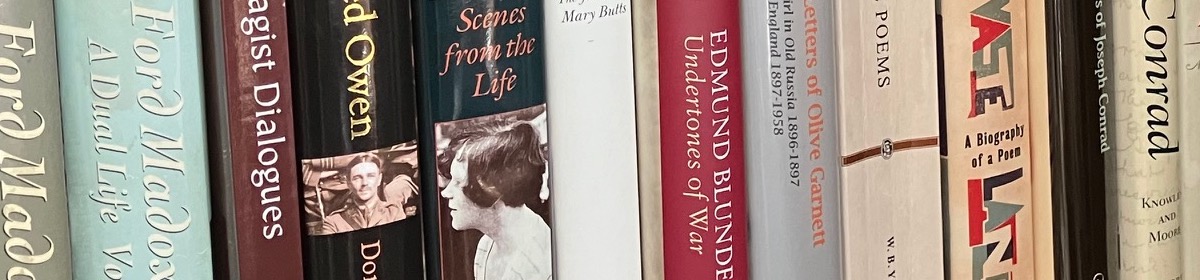
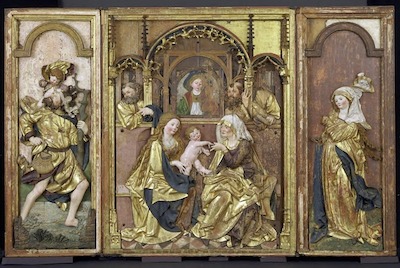
Good Wood

(The Boppard Altarpiece, Panel: limewood, pine, paint & gilt: Victoria & Albert Museum)

Back in the day—not that day, another one—a woman had been on the throne of England for around sixty years.

Walk wide o’ the Widow at Windsor,
For ’alf o’ Creation she owns:
We ’ave bought ’er the same with the sword an’ the flame,
An’ we’ve salted it down with our bones.[1]

Yes, back then, a while and a world ago, when Queen Victoria was not quite gone, Rudyard Kipling had dropped in on the west coast of the United States. ‘There was wealth—unlimited wealth—in the streets’, he wrote of San Francisco, ‘but not an accent that would not have been dear at fifty cents.’ He was disappointed by the disparity between the fine and expensive clothes worn by the women he saw and their voices, ‘the staccato “Sez he”,“Sez I,” that is the mark of the white servant-girl all the world over.’

He felt, that is to say, that ‘fine feathers ought to make fine birds.’ But, ‘Wherefore, revolving in my mind that these folk were barbarians, I was presently enlightened and made aware that they also were the heirs of all the ages, and civilised after all.’ Luckily for this much-travelled traveller, he’s been accosted by ‘an affable stranger of prepossessing experience, with a blue and an innocent eye.’

It’s true that the man has peered into the hotel register and read ‘Indiana’ for the ‘India’ that Kipling has actually come from but, for the moment, the drinks and cigars that he presses upon the famous writer are welcome.[2]

Ford Madox Ford referred numerous times to Kipling, often admiringly, but almost always—and, to me, unaccountably—focusing on the early work. Some of that is wonderful but the later stories, becoming often more complex, more oblique, more modernist, somehow get lost sight of, not only by Ford but by several other major writers of the time, as if Kipling were a known quantity and need not be kept any longer in sight.

But I was thinking mostly of that phrase tucked into the Kipling lines, which recurs several times elsewhere. ‘We are the heirs of all the ages,’ Ford wrote in early September 1913, in an essay which provided the ‘Preface’ to his Collected Poems a few weeks later and in which the same line sits.[3] He had written nearly a decade earlier of ‘all the dead Londons that have gone to the producing of this child of all the ages’, and in his 1910 novel, A Call, Grimshaw remarks to Pauline: ‘We’re the children of the age and of all the ages. . .’[4]

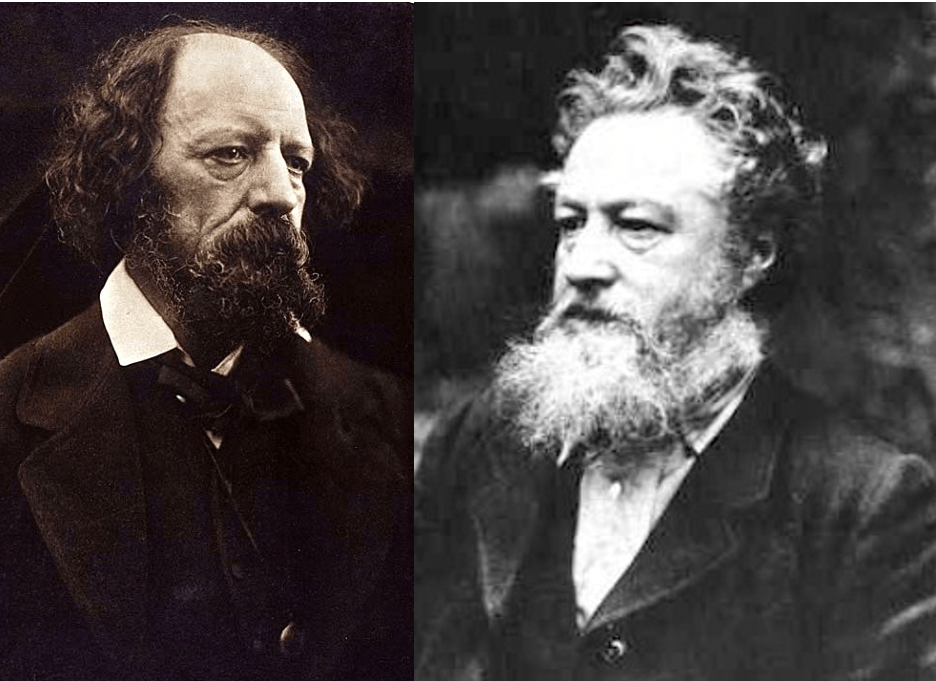
(Kipling/ Tennyson)

Those words look back to ‘Locksley Hall’—‘I the heir of all the ages, in the foremost files of time’—by Alfred Tennyson, a poet that Ford was generally unenthusiastic about, seeing him as one of the stifling ‘Victorian Great’ figures. Yet Tennyson’s work so saturated the second half of the nineteenth century that familiarity with it was unavoidable for any serious reader.[5]

It’s a point so obvious, so banal, so unremarkable, that huge numbers of people must fail utterly to remark it. We are the heirs, the inheritors, of all that has gone before. Not just the books, the music, the paintings—which people like me are only too ready to bang on about—but the housing, the streets, the scars on the landscape, what were the mining villages, what were the dockyards and shipyards, what were the council estates, the public libraries, the youth clubs, the community centres, the rivers, the fields and hedgerows, the birds and the butterflies, the very flavour of the air. And we are also the ones who will, in our turn, bequeath or pass on or let fall the things which others will inherit and be the heirs to. As far as we have influence and agency, what will our legacy to them look like?

After January—the first rule of that month being: survive January!—I venture a little further afield to gauge the State of Things. The news, astonishingly, is Not Good. For weeks, my main focus has been the life and letters of Ford Madox Ford in the 1920s, though, on occasion, I dipped my toes into world news, not wishing to have my leg taken off just above the knee by sharks should I venture too far in.

In the United States, things are evidently shaping up to be as bad as any sane person would expect, far worse, in fact. But there’s enough derangement here to satisfy any eager watchers at the gates of Bedlam, not least a government apparently possessed of a talent to choose every time precisely the wrong policy, facing in the the wrong direction and benefiting the wrong people.

On the bright side, though—O optimist!—the Chinese New Year celebrations have welcomed in the Year of the Snake, are still welcoming it, I suppose, since this involves not only animal but also zodiac elements. This is then the Year of the Wood Snake – also known as the Year of the Green Snake, wood being associated with the colour green. The Spring Festival, I gather, takes place over fifteen days, ending with the Lantern Festival on 12 February, and is estimated to be celebrated by some two billion people in numerous countries, not only China but Indonesia, Malaysia, Singapore, Vietnam and their diasporas.

The snake may have had a bad press—certainly a bad Judaeo-Christian press—but I read that, in Chinese astrology, as a wood animal, it’s understood to represent good luck, renewal, flexibility, tolerance. Wood is good!
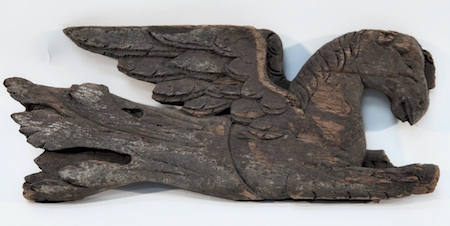
(‘Hippocamp’, a wooden carving in the form of a winged horse, originally part of the panelling inside Stafford Castle: Staffordshire County Museum Service)

This in turn brings to mind the recent piece following the death of David Lynch, which touched on Twin Peaks: The Return, and had a nice quote from Michael Horse, who played the series’ Deputy Sheriff Hawk: ‘When they did the premiere of The Return, the executives had not seen it, and they said: “Mr Lynch, would you say a few words?” And he comes out; he goes: “This project has a lot of wood in it. I like wood.”’
https://www.theguardian.com/tv-and-radio/2025/jan/23/an-oral-history-of-twin-peaks-david-lynch-madchen-amick-joan-chen

We all like wood, no?  Wood nymphs, woodwind, woodbine, woodpeckers, woodlands – as a child, I had a pet woodlouse for a short time, though it didn’t end well. Woodcuts, wood engravings. Albrecht Dürer, Hiroshige, Käthe Kollwitz, Robert Gibbings, Thomas Bewick, Clare Leighton, David Jones, Gwen Raverat. Harriet Baker wrote of woodcuts made by Carrington and Vanessa Bell: ‘Carving directly into soft wood, the markings of tools and the tremors of hands were as much a part of the final pieces as form and composition.’[6]

The French historian Fernand Braudel gave wood a significant role in the lessening of the effects of the Black Death which, he argued, ‘did not, as used to be thought, arrive in Central Europe in the thirteenth century, but in the eleventh at the latest.’ His analysis of the retreat of the disease in the 18th century mentioned stone’s replacing wood in domestic architecture after major urban fires; the general increase in personal and domestic cleanliness, and the removal of small domestic mammals from dwellings, all factors that resulted in the lessening impact of fleas. He also discussed the enormous significance of wood being used everywhere: ‘One of the reasons for Europe’s power lay in its being so plentifully endowed with forests. Against it, Islam was in the long run undermined by the poverty of its wood resources and their gradual exhaustion.’[7]
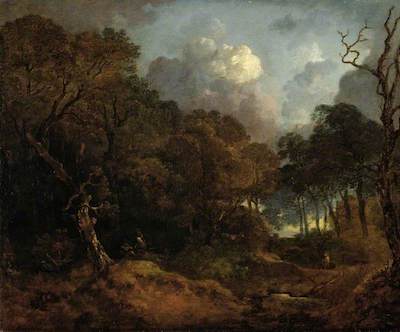
(Thomas Gainsborough, A Forest Road: Fitzwilliam Museum, Cambridge)

The gradual exhaustion of resources. Here we are again. Not so gradual now, I suspect, but in any case a phrase to tingle the tongues of those who, as previously noted, are custodians of the past and guardians of the future. Which is us, of course, even those currently making war on their own children and grandchildren.

In September 1911, Ezra Pound spent a Sunday afternoon with G. R. S. Mead, a scholar of hermetic philosophy, early Christianity and Gnosticism, the occult and theosophy: he had served as private secretary to Madame Blavatsky during her last years. He had founded the Quest Society in 1909 and invited Pound to give a lecture, which would be published subsequently in the quarterly review, The Quest. Pound delivered his lecture early in 1912 and it appeared in the October issue of the review with the title ‘Psychology and Troubadours’. Twenty years later, it was incorporated into Pound’s The Spirit of Romance.[8] It’s years since I read it but one sentence, particularly, lodged in my memory and remains intact: ‘We have about us the universe of fluid force, and below us the germinal universe of wood alive, of stone alive.’[9]

Pound, like Henri Gaudier-Brzeska, Guy Davenport wrote, ‘had conceived the notion that cultures awake with a brilliant springtime and move through seasonal developments to a decadence. This is an ideas from Frobenius, who had it from Spengler, who had it from Nietzsche, who had it from Goethe.’[10]

Yes. Never mind third runways, never mind nuclear power stations on every corner, never mind mimicking anti-immigrant messages from other political parties that run on that sort of fuel. If a body is bleeding to death in front of you—how can I put this?—it may be best, before all else, to try to stop the bleeding.

Touch wood. Good wood. Touch good wood.


Notes

[1] ‘The Widow at Windsor’, Rudyard Kipling’s Verse: Inclusive Edition, 1885-1918 (New York: Doubleday, Page & Co., 1925), 471.

[2] Rudyard Kipling, From Sea to Sea (2 volumes: Macmillan, 1900), I: 479-480

[3] Ford Madox Ford, ‘The Poet’s Eye’,  New Freewoman, I, 6 (1 September 1913), 109; ‘Preface’ to Collected Poems (London: Max Goschen, 1914 [1913]), 20.

[4] Ford Madox Ford, England and the English, edited by Sara Haslam (Manchester: Carcanet Press, 2003), 4; Ford Madox Ford, A Call: The Tale of Two Passions (1910; with an afterword by C. H. Sisson, Manchester: Carcanet Press, 1984), 23.

[5] Alfred Tennyson, Poems: A Selected Edition, edited by Christopher Ricks (London: Longman, 1989), 192.

[6] Harriet Baker, Rural Hours: The Country Lives of Virginia Woolf, Sylvia Townsend Warner & Rosamond Lehmann (London: Allen Lane, 2024), 73.

[7] Fernand Braudel, Civilization and Capitalism, 15th – 18th Century. Volume I: The Structures of Everyday Life: The Limits of the Possible (London: Fontana Books, 1985). Translated from the French; revised by Sîan Reynolds, 83, 84, 363.

[8] Ezra Pound, Ezra Pound to His Parents: Letters 1895–1929, edited by Mary de Rachewiltz, David Moody and Joanna Moody (Oxford: Oxford University Press, 2010), 260; A. David Moody, Ezra Pound: Poet: A Portrait of the Man and His Work: Volume I: The Young Genius 1885–1920 (Oxford: Oxford University Press, 2007), 159.

[9] Ezra Pound, The Spirit of Romance (1910; New York: New Directions, 1968), 92.

[10] Guy Davenport, The Geography of the Imagination (Boston: David R. Godine, 1997), 22.
Pilots, poets, bays

Alfred Lord Tennyson died on 6 October 1892, having served as Queen Victoria’s Poet Laureate for over forty years, the longest ever tenure – though a later octogenarian, John Masefield, came very close. Tennyson’s funeral, which took place six days after his death, was a pretty grand affair. His remains were, the Times reported, ‘consigned to their last resting-place in Poets’ Corner, Westminster’ – the grave of Robert Browning, who had died three years previously, is immediately adjacent to Tennyson’s. All the leading members of the royal family sent representatives (Sir Henry Ponsonby, Sir Dighton Probyn, Lord Edward Cecil) and the place was thronged with bishops, lords and ladies, the pall-bearers including the Duke of Argyll and Lord Kelvin. Conan Doyle, Ellen Terry, John Burns, Frederic Harrison and Henry Irving were among the mourners. In the street outside, vendors were offering, for a penny, copies of the poet’s 1889 lyric, ‘Crossing the Bar’ (author portrait included):

Sunset and evening star,
   And one clear call for me!
And may there be no moaning of the bar,
   When I put out to sea,

But such a tide as moving seems asleep,
   Too full for sound and foam,
When that which drew from out the boundless deep
Turns again home.

Twilight and evening bell,
   And after that the dark!
And may there be no sadness of farewell,
   When I embark;

For though from out our bourne of Time and Place
   The flood may bear me far,
I hope to see my Pilot face to face
When I have crost the bar.[1]

Tennyson was 80 when he wrote it, so unsurprisingly aware that the encounter with his ‘Pilot’ was not that far off.

Edward Burne-Jones was particularly excited that the city of Mantua ‘had sent bay from Virgil’s birthplace to lay in the tomb.’ In fact, ‘bay’ and ‘pilot’ occurred in another ‘literary’ interment context a few years later, though William Morris’s ‘country funeral’, Fiona MacCarthy observes, ‘was the absolute antithesis of Tennyson’s burial in Westminster Abbey in 1892.’[2]

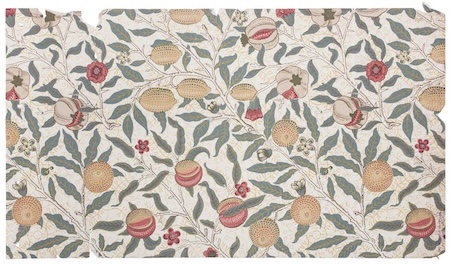
(William Morris, Fruit (Wallpaper): William Morris Society: Kelmscott House)

Morris died on 3 October 1896. He was only 62 but such a tireless worker, such a tireless maker, of pictures, poems, translations, tapestries, stained-glass windows, fabrics, carpets, furniture, illuminated books, wallpapers, prose romances and more that, as is often remarked, the primary cause of his death was simply being William Morris. His funeral took place on 6 October, exactly four years after the death of Tennyson. The body had to be transported from Paddington to Lechlade by train (a form of transport that Morris disliked intensely), then taken by cart to Kelmscott Church.

It was a cold wet morning, and the day turned stormy later. In that week’s issue of the Saturday Review (10 October 1896), there were pieces on Morris by George Bernard Shaw, Arthur Symons – and R. B. Cunninghame Graham, whose account of the day on which ‘the most striking figure of our times’ was buried, began with that weather. ‘As we never associated William Morris with fine weather, rather taking him to be a pilot poet lent by the Vikings to steer us from the doldrums in which we now lie all becalmed in smoke to some Valhalla of his own creation beyond the world’s end, it seemed appropriate that on his burial day the rain descended and the wind blew half a gale from the north-west.’ He noted of the arrival at Lechlade: ‘There, unlike Oxford, the whole town was out’, and added that the open haycart on which the coffin was transported to Kelmscott Church was ‘driven by a man who looked coeval with the Saxon Chronicle.’[3]

‘Over the coffin were thrown two pieces of Oriental embroidered brocade, and a wreath of bays was laid at his head’, the Daily News reported. The mourners included, alongside painters, publishers and printers, workmen from Merton Abbey (where the tapestry, weaving and fabric printing workshops were sited), Kelmscott villagers and members of the Art Workers’ Guild, all in their daily working clothes. The architect William Lethaby wrote: ‘It was the only funeral I have ever seen that did not make me ashamed to have to be buried.’[4]

(William Morris, Kelmscott Press Edition of ‘Godefrey of Boloyne’ by William Caxton: William Morris Society: Kelmscott House)

Morris continues to attract enormous biographical and scholarly interest, and warrants it all. So many arts, so many crafts, so many connections, so widespread and generative an influence, cropping up in all manner of places, often the expected ones, sometimes less so. Ezra Pound read Morris to the young Hilda Doolittle, ‘in an orchard under blossoming—yes, they must have been blossoming—apple trees.’ And: ‘It was Ezra who really introduced me to William Morris. He literally shouted “The Gilliflower of Gold” in the orchard. How did it go? Hah! hah! La belle jaune giroflée. And there was “Two Red Roses across the Moon” and “The Defence of Guenevere.”’[5] Pound read Morris to Yeats too, in Stone Cottage at the edge of Ashdown Forest, his translations of the Icelandic sagas.[6] Yeats would later recall of Morris’s prose romances that they were ‘the only books I was ever to read slowly that I might not come too quickly to the end.’[7]

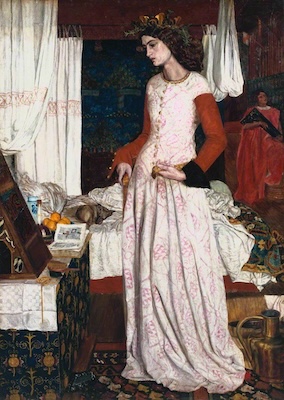
(William Morris, La Belle Iseult: Tate)

Fiona MacCarthy remarks that ‘There was a neurotic basis to his fluency. On a good day he could write 1,000 lines of verse’, and some readers will find some of the longer poems soporific.[8] Penelope Fitzgerald wrote that the lyrics, in her opinion were ‘far the most important part’ of his  poetry and, ‘If I could keep them I would cheerfully sweep all the sagas and Earthly Paradises under the carpet.’[9] Other readers, in Morris’s own time, and since, have felt quite differently. Yeats continued to be one of them. In October 1933, he reported to his old friend (and ex-lover) Olivia Shakespear (Pound’s mother-in-law) his attempt to read Morris’s long poem The Story of Sigurd the Volsung to his daughter and then to his wife: ‘and last night when I came to the description of the birth of Sigurd and that wonderful first nursing of the child, I could hardly read for my tears. Then when Anne had gone to bed I tried to read it to George and it was just the same.’[10]

This is probably the passage he refers to, early in Book II:

Then she held him a little season on her weary and happy breast
And she told him of Sigmund and Volsung and the best sprung forth from the best:
She spake to the new-born baby as one who might understand,
And told him of Sigmund’s battle, and the dead by the sea-flood’s strand,
And of all the wars passed over, and the light with darkness blent.

So she spake, and the sun rose higher, and her speech at last was spent,
And she gave him back to the women to bear forth to the people’s kings,
That they too may rejoice in her glory and her day of happy things.[11]

For other admirers of Morris, it may be the campaigner, the Socialist, or perhaps the designer and producer of stained-glass, fabrics, stories, the late romances, the lectures and the essays:

‘To give people pleasure in the things they must perforce use, that is one great office of decoration; to give people pleasure in the things they must perforce make. That is the other use of it.’
     ‘Does not our subject look important enough now? I say that without those arts, our rest would be vacant and uninteresting, our labour mere endurance, mere wearing away of body and mind.’[12]

Yes, the allusions to damaging and artificial divisions are often wonderfully suggestive of other divisions causing much wider harms – as, of course, they continue to do. And, though I may be prejudiced in this regard, I like his idea, in ‘The Beauty of Life’, of ‘the fittings necessary to the sitting-room of a healthy person’. The first of these is ‘a book-case with a great many books in it’. Oddly, he never seems to mention, let alone recommend, piles of books everywhere else. . .


Notes

[1] Tennyson: A Selected Edition, edited by Christopher Ricks (Harlow: Longman Group, 1989), 665-666.

[2] Fiona MacCarthy, William Morris: A Life for Our Time (London: Faber & Faber, 1994), 631, 673-675.

[3] R. B. Cunninghame Graham, ‘With the North-West Wind’, Saturday Review (10 October 1896), Vol. 82, Issue 2137, 389-390.

[4] Quoted by Philip Henderson, William Morris: His Life, Work and Friends (Harmondsworth: Pelican Books, 1973), 429.

[5] H. D., End to Torment: A Memoir of Ezra Pound, edited by Norman Holmes Pearson and Michael King (Manchester: Carcanet Press, 1980), 22-23.

[6] James Longenbach, Stone Cottage: Pound, Yeats and Modernism (New York: Oxford University Press, 1990), 142-143.

[7] W. B. Yeats, ‘The Trembling of the Veil [1922]: Four Years’, in Autobiographies (London: Macmillan, 1955), 141.

[8] MacCarthy, William Morris, ix.

[9] Penelope Fitzgerald to Dorothy Coles, 5 June [1992], So I Have Thought of You: The Letters of Penelope Fitzgerald, edited by Terence Dooley (London: Fourth Estate, 2008), 460.

[10] The Letters of W. B. Yeats, edited by Allan Wade (London: Rupert Hart-Davis, 1954), 816.

[11] William Morris, The story of Sigurd the Volsung and the fall of the Niblungs (London: Ellis & White, 1877), 80-81.

[12] ‘The Lesser Arts’, in William Morris: The Selected Writings, edited by G. D. H. Cole (London: The Nonesuch Press, 1934), 496.

Words, things, words for things


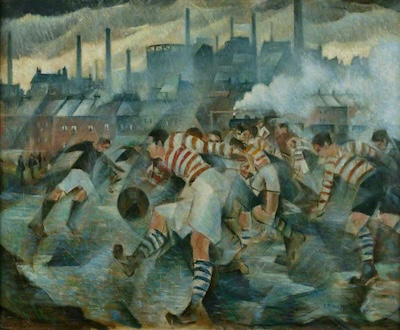
(C. R. W. Nevinson, Any Wintry Afternoon in England: Manchester Art Gallery)

Walking on the wide path in the park, I see a football rolling determinedly towards me over the grass, two boys watching, a long way off. I trap it, nudge and kick. It travels a fair distance but nowhere near the waiting boys. A woman walking towards me on the path says: ‘One of my irrational fears, a ball coming at me like that.’ I say: ‘One of mine too now’, and she laughs. ‘Oh, you did okay.’

Did I, though? Not the kick, that was what it was but. . . irrational fears? If it were now one of mine because of that episode, it’s not irrational but quite rational, reasoned, based on solid, empirical evidence, so. . .Don’t overthink it! the Librarian says, often in person and now in my head. Don’t overthink things!

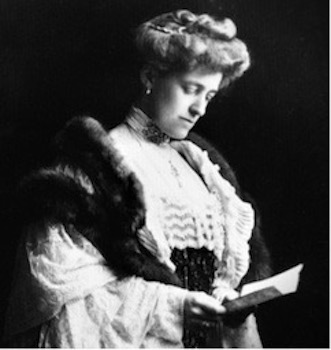
Ding, ting, chose, cosa, peth, rud, shay, hlutur: thing. . . ‘The distinguished thing’ was Henry James’s famous phrase for death. Did he actually say it? Following a reference to Edith Wharton’s A Backward Glance, I see that there’s an extra link or two: ‘He is said to have told his old friend Lady Prothero, when she saw him after the first stroke, that in the very act of falling (he was dressing at the time) he heard in the room a voice which was distinctly, it seemed, not his own, saying: “So here it is at last, the distinguished thing!”’ Wharton adds: ‘The phrase is too beautifully characteristic not to be recorded.’[1] It’s certainly wonderfully—and characteristically—indefinite, or at least, on a very convoluted path: ‘He is said’ to have told someone else that he heard a voice which wasn’t his own, the word ‘distinctly’ applied only to a negative, ‘not his own’ and, even then, ‘it seemed’.


(Edith Wharton via BBC)

Death as ‘the thing’ (Death! Where is thy thing?) – while for Edna St Vincent Millay, death was not the thing but the force engulfing it:

Death devours all lovely things:
   Lesbia with her sparrow
Shares the darkness,—presently
   Every bed is narrow.[2]

The line ‘Every bed is narrow’ I take to refer to coffins (rather than, or as well as, singleness or separation), and it also recalls Pound’s ‘Homage to Sextus Propertius’. ‘We, in our narrow bed, turning aside from battles:/ Each man where he can, wearing out the day in his manner.’[3]

And yet – I was thinking, at the outset, more of things than of death; or rather, words and things, particularly the word ‘thing’. Impressively, its origin seems to embrace both ‘object’ and ‘parliament’. The definitions are lavish: an assembly, court, council, matter, affair, problem, fact, event, action, that which exists or can be thought of, a living creature, a piece of writing; in the plural, clothes, personal belongings. What a word, what a world, ‘thing’ is!

While an inmate of the Disciplinary Training Center at Metato, north of Pisa, in the autumn of 1945, Ezra Pound wrote:

   And for all that old Ford’s conversation was better,
consisting in res non verba,
          despite William’s anecdotes, in that Fordie
   never dented an idea for a phrase’s sake
and had more humanitas [4]

Things, not words for things. Pound was reiterating his belief in those opposing—or complementary—positions, Ford as realist, Yeats as symbolist, that he proposed on more than one other occasion.[5] Poignantly, they were both just six years dead – the length of a world war, say.

That ‘humanitas’ had led the youthful Ford to rashly discuss the conditions of the London poor with a young woman he took out in a boat, only to be reproved the next day by her mother, Lady Cusins: ‘“Fordie, you are a dear boy. Sir George and I like you very much. But I must ask you not to talk to dear Beatrice … about Things!”’[6]

(Iris Barry)

Ford had actually written to Iris Barry (4 July 1918): ‘I have always been preaching to people not to write “about” things but to write things—& you really do it—so I like to flatter myself that you are an indirect product of my preachings—a child of my poor old age.’ (He was still serving in the British Army, having by then reached the ‘poor old age’ of 44.)[7]

Ralph Waldo Emerson also fished in those waters: ‘The corruption of man is followed by the corruption of language’ and ‘new imagery ceases to be created, and old words are perverted to stand for things which are not’. But ‘wise men pierce this rotten diction and fasten words again to visible things’.[8] This linking of words and things would have some later commentators and theorists tearing their hair out, words for them being quite arbitrary marks on the page, the word for something not otherwise  linked to that something. Lord Byron though, as so often, pursued his own path:

But words are things, and a small drop of ink,
Falling like dew upon a thought, produces
That which makes thousands, perhaps millions, think.[9]

And as if by magic, an email just arrived from PN Review offers, from its archive, ‘Holà’, a short poem by C. H. Sisson from 1992, which is also concerned with words and things:

Words do not hold the thing they say: 
Say as you will, the thing escapes 
Loose upon air, or in the shapes 
Which struggle still before the eyes. 
Holà will run upon its way 
And never catch up with its prize.[10]


Later in my park walk, halfway down a steepish path, I see a woman ahead of me with a child in a pushchair and a dog crouched in the grass nearby, with a ball in its mouth. It looks at me inquiringly. ‘I’m afraid not’, I say. ‘You’re not my dog and that ball is covered with slobber, as we both know.’ The woman is partly blocking the path where it meets the wider track, talking on her phone and with her back to me, but moves to one side as I approach. The dog lies down close by her and lets the ball drop from its mouth. She half-turns and kicks the ball, which rockets cleanly away for a good distance – and apparently just where she meant it to go. Damn, I think, she only needed to be a bit better than me to make the point. What point? That I shall not overthink it. . .


Notes

[1] Edith Wharton, Novellas and Other Writings: Madame de Treymes, Ethan Frome, Summer, Old New York, The Mother’s Recompense, A Backward Glance, edited by Cynthia Griffin Wolff (New York: Library of America, 1990), 1055.

[2] Millay, ‘Passer Mortuus Est’ (first of three stanzas), in F. O. Matthiessen, The Oxford Book of American Verse (New York: Oxford University Press, 1950), 886. As is often noted, Millay here references Catullus 2, about the death of his lover Lesbia’s sparrow, her ‘plaything’: The Poems of Catullus, translated with an introduction by Peter Whigham (Harmondsworth: Penguin Books, 1966), 52.

[3] Ezra Pound: Poems and Translations, edited by Richard Sieburth (New York: Library of America, 2003), 535.

[4] Canto LXXXII, The Cantos of Ezra Pound, fourth collected edition (London: Faber and Faber, 1987), 525. I have tried—and failed—to insert the ideogram, ‘jen’.

[5] Ezra Pound, Polite Essays (1937; Plainview, New York: Books for Libraries Press, 1966), 50; Pound/ Williams: Selected Letters of Ezra Pound and William Carlos Williams, edited by Hugh Witemeyer (New York: New Directions, 1996), 187.

[6] Ford Madox Ford, Return to Yesterday: Reminiscences 1894-1914 (London: Victor Gollancz, 1931), 75.

[7] Ford Madox Ford, Letters of Ford Madox Ford, edited by Richard M. Ludwig (Princeton: Princeton University Press, 1965), 87.

[8] Ralph Waldo Emerson, Selected Essays, edited by Larzer Ziff (Harmondsworth: Penguin Books, 1982), 51.

[9] Lord Byron, Don Juan, III:88, edited by T. G. Steffan, E. Steffan and W. W. Pratt (London: Penguin Books, 1996), 182.

[10] PN Review 87 (September–October 1992), 28.

Dusting the monument


Let not a monument give you or me hopes,
Since not a pinch of dust remains of Cheops.
(Byron, Don Juan, I, 219)

Walking to and from the Watershed, meeting my elder daughter, prior to her birthday, and her travels to Germany and France, we cross Queen Square. It’s a famous Bristol feature, dating in its present form from 1700 and named after the queen two years later. The statue of William III, ‘Dutch William’, by John Michael Rysbrack (originally Jan Michiel Rijsbrack), stands in the centre. The Bristol riots of October 1831, following the House of Lords blocking a Reform Bill, left nearly a hundred buildings in the square burned to the ground, their cellars looted, including the Mansion House. Four rioters were hanged and scores sent to prison. Estimates of those who actually died in the riots ranged up to 250. The rebuilding went on for decades.

Approaching the monument, I felt a flicker of uncertainty as to whether I would pass it on the left or the right. It really doesn’t matter to me but it certainly did to William Faulkner’s Benjy Compson, 33 years old but with the mind of a child and no sense of time. The closing pages portray, you might say, Benjy’s sound and his brother Jason’s fury. Luster, 14 year old son of the Compson family’s black servant Dilsey, in the driving seat, swings the horse, Queenie, to the left at the Confederate monument. ‘For an instant Ben sat in an utter hiatus. Then he bellowed. Bellow on bellow, his voice mounted, with scarce interval for breath. There was more than astonishment in it, it was horror; shock; agony eyeless, tongueless; just sound’ – provoking Jason to rush furiously across the square and on to the step. ‘With a backhanded blow he hurled Luster aside and caught the reins and sawed Queenie about and doubled the reins back and slashed her across the hips. He cut her again and again, into a plunging gallop,  while Ben’s hoarse agony roared about them, and swung her about to the right of the monument. Then he struck Luster over the head with his fist.
‘“Don’t you know any better than to take him to the left?” he said.’
When the horse moves again Ben hushes at once. ‘The broken flower drooped over Ben’s feet and his eyes were empty and blue and serene again as cornice and façade flowed smoothly once more from left to right; post and tree, window and doorway, and signboard, each in its ordered place.’[1]

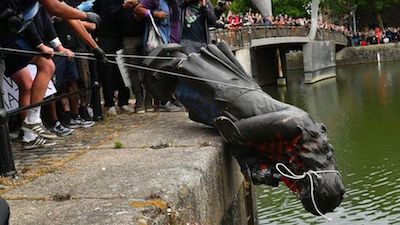
(The Colston statue taking a dip, Bristol, June 2020)

Monuments (not just Confederate ones) are a tricky business, of course. Rysbrack also produced a sculpture of Edward Colston, the Bristol slave trader and philanthropist, another statue of whom, created in 1895 by John Cassidy, was toppled into Bristol Harbour by protesters in June 2020. There have been many other contested monuments, Cecil Rhodes, Columbus and James Cook among them.

But other figures, perhaps in other ages, provoke quite different, and often more positive, emotions and reactions. Of the stone monument of Tsubo-no-ishibumi on the ancient site of the Taga castle in the village of Ichikawa (about six feet tall and three feet wide), Bashō wrote:

‘In this ever-changing world where mountains crumble, rivers change their courses, roads are deserted, rocks are buried, and old trees yield to young shoots, it was nothing short of a miracle that this monument alone had survived the battering of a thousand years to be the living memory of the ancients. I felt as if I were in the presence of the ancients themselves, and forgetting all the troubles I had suffered on the road, rejoiced in the utter happiness of this joyful moment, not without tears in my eyes.’[2]

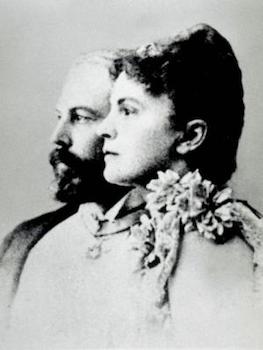
Also in Japan is the monument to Ernest Fenollosa, in Uyeno Park, Tokyo. He had suffered his final, fatal heart attack in September 1908, at his home in London, while his step-daughter Erwin Scott (‘Noshi’, aged sixteen), was reading Dante Gabriel Rossetti’s  ‘The Blessed Damozel’ to him. His ashes remained for a short while in Highgate cemetery but were then transported to Japan, to the hills overlooking Lake Biwa and the gardens of Miidera Temple, where they were reburied on the first anniversary of his death. The inscription, chosen by his students, read: ‘To the merit of our Sensei [teacher], high like the mountains and eternal like the water.’[3]


(Ernest and Mary Fenollosa)

It is not always a case of a specified and designated monument, but may be something that becomes so, such as the Esnoga synagogue that Steven Nadler wrote of: ‘Almost alone among the synagogues of Holland, this unmistakeable monument to Jewish achievement was left standing, undamaged, by the Nazis. Inside the hechal [ark of the Torah] is a Torah said to be the one brought to Amsterdam from Emden in 1602 by Moses Uri Halevi.’[4]

A monument might also serve as a complex representation of parallels and comparisons, whether discerned or imposed, as in Ezra Pound’s focus upon—or obsession with—the condottiere Sigismondo Malatesta’s monument to his wife Isotta. Pound was writing the Malatesta Cantos in the early 1920s and, Lawrence Rainey writes, ‘On the simplest level Pound seeks to suggest that the Tempio’s construction heralds a new cultural era, the dawn of the Renaissance and the spring of a neopagan revival.’ Of more urgent personal interest, though, he wished ‘to discern a parallel between himself and Sigismondo Malatesta’, and ‘between the magnum opus he wished to write and the unfinished monument of Rimini.’[5] That the Cantos (like the Tempio) ultimately remained unfinished was not then envisaged, and remains a curious historical irony.

‘Exegi monumentum aere perennius’, Horace wrote (Odes, Book III), and Pound translated it:

This monument will outlast metal and I made it
More durable than the king’s seat, higher than pyramids.
Gnaw of the wind and rain?
                                    Impotent
The flow of the years to break it, however many.[6]

One might argue of some of these names that it’s a bit soon to tell – but Horace (Quintus Horatius Flaccus) has lasted over 2030 years so far, and seems to be holding on quite well. . .


Notes

[1] William Faulkner, The Sound and the Fury (1929), in Novels 1926-1929, edited by Joseph Blotner and Noel Polk (New York: Library of America, 2006), 1123-1124. In ‘Appendix. Compson: 1699-1945’ (1141), Faulkner wrote of Luster that he was ‘a man, aged 14’, who was ‘not only capable of the complete care and security’ of Benjy, a man ‘twice his age and three times his size, but could keep him entertained.’

[2] Matsuo Bashō, The Narrow Road to the Deep North and other travel sketches, translated by Nobuyuki Yuasa (London: Penguin Books, 1966), 113.

[3] Lawrence W. Chisolm, Fenollosa: The Far East and American Culture (New Haven: Yale University Press, 1963), 211, 35.

[4] Steven Nadler, Rembrandt’s Jews (Chicago: University of Chicago Press, 2003), 162.

[5] Lawrence S. Rainey, Ezra Pound and the Monument of Culture: Text, History, and the Malatesta Cantos (Chicago: University of Chicago Press, 1991), 38, 43.

[6] Ezra Pound: Poems and Translations, edited by Richard Sieburth (New York: Library of America, 2003), 1146.

Taking liberties


(A. Webster, ‘An Oriental Harbour’, National Trust for Scotland, Castle Fraser, Garden & Estate)

Walking back from the long round of the Victorian cemetery, still early, the Librarian remarks that this would be ‘a good Harry day’. As it would: the sun already high, little or no cloud, barely a breath of wind, soon to be around 26 degrees or so – as high as 30 (that’s 86 degrees in American money). The back garden will be warm and calm, idyllically so for animals that worship sun and sleep.

Not much later, I am aboard the Al Raza, not a classic dhow, locally known as ‘a launch’, some sixty feet long, ‘decidedly stubby, and her single mast was more like a twig than a tree and carried no sails.’ The craft is ‘a working launch of 100 tons and looked it.’ A crew of eight, including the nakhoda, the ship’s master, all Baluchis except one Indian-born and one Iranian. When engine trouble forces them to drop anchor off the coast of Iran, Gavin Young, whose earlier reading on the trip has included Ford Madox Ford’s Memories and Impressions, and who repeatedly cites Joseph Conrad, turns to his copy of Helen MacInnes’s Decision at Delphi.[1]

Just then, a white rabbit passed me, plucking a pocket watch from his waistcoat and audibly murmuring that he mustn’t be late, before popping down a large rabbit-hole under the hedge. Naturally, having recently reread the Alice books for Fordian purposes, I followed.

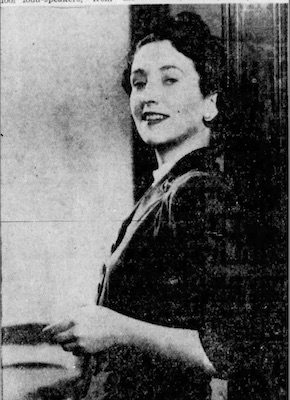
Now, MacInnes. Surely Hammond? Scottish, 30-odd novels and other books. Had I not read one or two? The Wreck of the Mary Deare, perhaps? Levkas Man? The rabbit rolled its eyes. Of course – I was misremembering, actually thinking of Innes, Hammond Innes. Helen MacInnes (1907-1985), whom I then looked up, did an MA at Glasgow University in French and German and added a diploma in librarianship from University College, London. She married, translated from the German with her husband, travelled widely in 1930s Europe, taking copious notes along the way, and moved to the United States when her husband, a fellow of St John’s College, University of Oxford, was offered a chair at Columbia University, teaching Latin and Greek. She published more than 20 books, mainly espionage novels, and several were filmed. Decision at Delphi was her 11th published novel.


(Helen MacInnes in 1941)

Her husband was Gilbert Highet, classicist – and MI6 intelligence agent. That name rang a bell. Careful to avoid the white rabbit’s gaze, I leafed through various mental pages and turned up Ezra Pound and Sextus Propertius.

Pound’s Homage to Sextus Propertius appeared in part in Poetry (March 1919) and in volume form seven months later, though he’d written to his parents as early as 1910: ‘I’ve taken to Propertius’.[2] And, decades later, it was Highet who wrote, in Horizon (January 1961), that Pound’s Homage was ‘an insult both to poetry and to scholarship and to common sense.’[3]

It’s true that, beginning with Professor William Gardner Hale of Chicago, against whose emphatic protests Harriet Monroe reluctantly published four of twelve sections in Poetry, a good many classical scholars have clutched their pearls in outrage at this iconoclastic American taking such liberties with a canonical writer—one of theirs.

Annalists will continue to record Roman reputations,
Celebrities from the Trans-Caucasus will belaud Roman celebrities
And expound the distensions of Empire,
But for something to read in normal circumstances?
For a few pages brought down from the forked hill unsullied?
I ask a wreath which will not crush my head.
            And there is no hurry about it

The poet Charles Tomlinson headed his selection from the poem ‘A travesty of Propertius’ Latin’, but his grasp of what Pound was doing meant that there was no contradiction between that heading and his terming the poem a masterpiece.[4] In another Oxford anthology, Adrian Poole and Jeremy Maule quote Pound’s ‘rampant defence’ of his poem in a letter to A. R. Orage on the first page of their introduction: ‘My job was to bring a dead man to life, to present a living figure’ and begin their Part 7, ‘Propertius to Hadrian’, with Pound’s superb section VII.

Though you give all your kisses
                                    you give but few.

Nor can I shift my pains to other,
            Hers will I be dead,
If she confer such nights upon me,
                                    long is my life, long in years,
If she give me many,
                        God am I for the time.

As Poole and Maule rightly say, ‘Translators must take liberties. They are in any case bound to be accused of having done so.’[5] Indeed, the history of translation and its reception is littered with the husks of those who knew the classical texts but had no sense of living English. George Steiner writes in his introduction: ‘A first look at nearly any translation in this anthology is enough to show whether it comes before or after’ the Homage, adding: ‘But the “making new” of translation had already occurred in Personae (1909) and Provença (1910). After “The River Merchant’s Wife” (1915) the art of translation had entered its modern phase.’[6]


The critic F. R. Leavis, highly influential in his time, wrote appreciatively of Hugh Selwyn Mauberley but Hugh Kenner, in ‘The Making of the Modernist Canon’ (1984), remarks on how Henry James’s ‘habits of diction were refracted throughout a poem Leavis nowhere mentions, Pound’s Homage to Sextus Propertius. That was a central modernist discovery, that distinctions between “prose” and “verse” vanish before distinctions between firm writing and loose’.[7] Kenner also touches there on  Imaginary Letters (1917-18), a series in the Little Review, begun by Wyndham Lewis and continued by Pound when Lewis was transferred to France. One striking feature of Pound’s ‘Imaginary Letters’ is the extent to which their texts would not look out of place in the Homage. Much of this is to do with the varied registers of language, mixing contemporary diction, poeticisms, large-mouthed polysyllables and the careful use of plain often monosyllabic words for some of Propertius’ reflections on love, death or fate. To that extent, his poem’s real subject is language, the intimate relation between a country’s language and its cultural health, the differences between public and private pronouncements, the strategies of a ruling class entrenched behind fortifications of rhetoric and generality. The disorientation that a reading of the poem can produce results in part from the multiplicity of voices Pound employs: Propertius as conventionally heard and as Pound hears and presents him; Victorian or earlier translators; contemporary English poets (in that last year of the war). Perhaps unsurprisingly, not a few readers these days rate the Homage even above Mauberley. It was, and remains, an astonishing achievement, by turns provocative, moving and funny.

I have, of course, ordered a copy of MacInnes’s Decision at Delphi – and also a copy of Assignment in Brittany, her second book, which became, apparently, required reading for British agents joining forces with the French resistance.


Notes

[1] Gavin Young, Slow Boats to China (1981; London: Picador, 1995), 269, 278. His In Search of Conrad, published in 1991, won the Thomas Cook Travel Book Award.

[2] Ezra Pound to His Parents: Letters 1895–1929, edited by Mary de Rachewiltz, David Moody and Joanna Moody (Oxford: Oxford University Press, 2010), 239. His letter of 3 November 1918 has: ‘Also done a new oeuvre on Propertius’ (423).

[3] Quoted by J. P. Sullivan, Ezra Pound and Sextus Propertius: A Study in Creative Translation (London: Faber and Faber, 1965), ix.

[4] The Oxford Book of Verse in English Translation, Chosen and Edited by Charles Tomlinson (Oxford: Oxford University Press, 1980), 443; Tomlinson, Poetry and Metamorphosis (Cambridge: Cambridge University Press, 1983), 59. The book contains the four 1982 Clark Lectures, delivered at Trinity College, Cambridge.

[5] The Oxford Book of Classical Verse, edited by Adrian Poole and Jeremy Maule (Oxford: Oxford University Press, 2000), xxxv, 423.

[6] George Steiner, editor, The Penguin Book of Modern Verse Translation (Harmondsworth: Penguin Books, 1966), 33. In his introduction to The Translations of Ezra Pound (enlarged edition, London: Faber and Faber, 1970), Hugh Kenner remarks: ‘Pound calls the Propertius sequence a Homage, largely in a futile attempt to keep it from being mistaken for an attempt at translation’ (12-13). He does not include the poem in that volume.

[7] Reprinted in Hugh Kenner, Mazes (Athens: University of Georgia Press, 1995), 31. ‘Major snow job in western education is concealment of the hit & miss state of Graeco-Roman texts, all but a few’, Kenner wrote to Guy Davenport (8 June 1962).  ‘Ez rearranged Propertius fragments in the spirit of the scholarship that gave us the standard texts by—arranging fragments’: Questioning Minds: The Letters of Guy Davenport and Hugh Kenner, edited by Edward M. Burns, two volumes (Berkeley: Counterpoint Press, 2018), I, 137.

Wording, birding


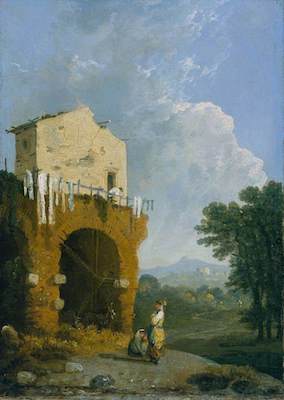
(Robert Wilson, Hadrian’s Villa, c.1765: Tate)

‘At night I trailed from one window recess to another’, the Emperor Hadrian recalls in Marguerite Yourcenar’s novel, ‘from balcony to balcony through the rooms of that palace where the walls were still cracked from the earthquake, here and there tracing my astrological calculations upon the stones, and questioning the trembling stars. But it is on earth that the signs of the future have to be sought.’[1]

So it is. ‘Ghosts await you in the future if they do not follow you from the past’, Sarah Moss wrote, and: ‘No one who knows what happens in the world, what humans do to humans, has any claim to contentment.’[2] Yes. I write pages and delete them, since they serve no real purpose except to relieve my feelings for a short while. The past is not always a foreign country and they do not always do things differently there. As Pankaj Mishra said in his recent ‘Winter Lecture’: ‘It hardly seems believable, but the evidence has become overwhelming: we are witnessing some kind of collapse in the free world.’[3]

Early summer creeps on, though fitfully. Watching rose petals fall from the bush in a light wind, I remembered Pound’s Canto XIII, the first in which Confucius appears, and which ends:

The blossoms of the apricot
            blow from the east to the west
And I have tried to keep them from falling.[4]


(Shen Zhou, ‘Apricot Blossom’, leaf from the album, Dreaming of Travelling While in Bed: Palace Museum, Beijing)

Ronald Bush observed that: ‘To keep the blossoms of the apricot from falling is to keep nature in a permanent vernal bounty.’[5] It also seems to me to signify cultural contact, the free exchange of ideas, without the limits of borders or nationalism. At that stage, Pound was using Guillaume Pauthier’s translation of Confucian texts in Confucius et Mencius: les quatre livres de philosophie morale et politique de la Chine and had written in ‘Exile’s Letter’:

Intelligent men came drifting in from the sea and from the west border,
And with them, and with you especially
There was nothing at cross purpose,
And they made nothing of sea-crossing or of mountain crossing,
If only they could be of that fellowship,
And we all spoke out our hearts and minds, and without regret.[6]

On the daily walks we speak our minds but, just lately, exchanges are punctuated by information from our newly downloaded Merlin app, available from Cornell University, which draws on a huge database of bird sounds, sightings and photographs to identify what you’re probably hearing in that nearby tree or passing overhead.


So we stroll along narrow paths thus:

Politics, dinner, politics. . .
‘Blue tit. Carrion crow. Wren.’
Politics, domestic details, politics, cat, literary chuntering. . .
‘Dunnock. Blackcap. Chiffchaff.’
Ash dieback, politics, university gossip, politics. . .
‘Blackbird. Herring gull. Great tit. Jay!’

Excuse me, sir, let me just ask about the birdsong: in a world both literally and metaphorically on fire, democracies hanging by a thread, war crimes, liars and knaves in public places – does it help?

Why, yes, a little – rather more than a little, in fact. . .


Notes

[1] Marguerite Yourcenar, The Memoirs of Hadrian, translated by Grace Frick, with Yourcenar (1951; Penguin Books, 2000), 82.

[2] Sarah Moss, Signs for Lost Children (London: Granta Books, 2016), 88-89, 97.

[3] Pankaj Mishra, ‘The Shoah after Gaza’ [Winter Lecture], London Review of Books 46, 5 (7 March 2024).

[4] The Cantos of Ezra Pound, fourth collected edition (London: Faber and Faber, 1987), 60.

[5] Ronald Bush, The Genesis of Ezra Pound’s Cantos (Princeton: Princeton University Press, 1989), 251.

[6] ‘Exile’s Letter’, Ezra Pound: Poems and Translations, edited by Richard Sieburth (New York: Library of America, 2003), 255.

All, or mostly, at sea


(Pound’s ‘Canto I’, initial by Henry Strater)

I see that, 118 years ago today—a nice round number, as they say—Ezra Pound, on a fellowship from the University of Pennsylvania to study Spanish literature in Madrid,  ‘went down to the ship’, specifically the König Albert, and left New York, landing at Gibraltar on 7 May. On that later day, he wrote to his parents to announce his arrival, mentioning that he’d been reading Rudyard Kipling’s From Sea to Sea and quoting from that work: ‘Imagine a shipload of people to whom time is no object, who have no desires beyond three meals a day and no emotions save those caused by a casual cockroach.’ He added: ‘for this voyage. deduct the cock roach, as the boat is clean.’[1]

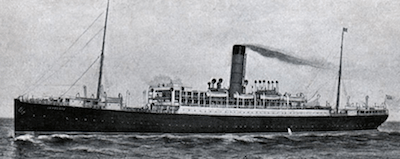
Pound went down to the ship on several occasions in this early part of his life: the European tours with his Aunt Frank Weston in 1898 and 1902; the 1906 trip;  the departure on 17 March 1908, on Cunard Royal Mail Steamship Slavonia, to Gibraltar in March, then Venice for much of the summer and on to London in August 1908.[2] In 1911, after  more than six months in the United States, he returned to Europe, boarding S. S. Mauretania on 22 February 1911. Then followed something of a pause in those sailings, before he boarded the Rex in Genoa, 13 April 1939 – that pause being a little over 28 years.[3]


(S. S. Slavonia)

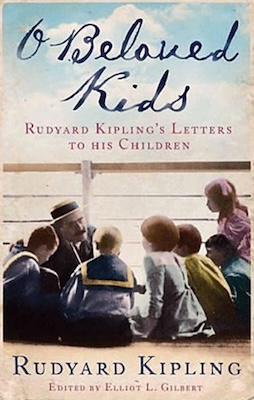
Kipling himself went down to ships a great deal more often than ‘the Idaho kid’. Born in Bombay—now Mumbai—he was taken to England, aged two, by his mother when she travelled there to give birth to her second child, Alice (‘Trix’). Then they returned to India. Aged 5, he took ship again, he and his sister being left in Southsea at ‘The House of Desolation’ as Kipling later termed it.[4] He was there for five years. In 1882, he sails back to India, returning to England seven years later via Rangoon, Singapore, Hong Kong, Yokohama, San Francisco and New York. His trip around the world follows in 1891. The following year sees more voyaging, to America and Japan. After the return to England the frequent trips to winter in South Africa begin – and there’s more to come, including the West Indies and South America.[5]

Much of the 1890s journeying fed into the many letters and sketches which provided the material for the two-volume From Sea to Sea and Other Sketches, as well as the later Letters of Travel (1892-1913). In that sense, the voyages were not simply leisure; yet Kipling could somehow combine work and play to a striking degree. Immediately preceding the lines quoted by Pound in the letter to his parents, Kipling writes: ‘Now we are lying off Moulmein [later renamed Mawlamyine] in a new steamer which does not seem to run anywhere in particular. Why she should go to Moulmein is a mystery; but as every soul on the ship is a loafer like myself, no one is discontented.’[6]

He wrote again about his experience of a specific ship in the article, ‘Sea Travel’, first published as ‘Egypt of the Egyptians’ in Nash’s Magazine (June 1914). Some of the men working on the ship brought back vivid memories of his early years in India: ‘Serangs [lascar boatswains] used to be very kind to little white children below the age of caste.’ Then: ‘Most familiar of all was the ship itself. It had slipped my memory, nor was there anything in the rates charged to remind me, that single-screws still lingered in the gilt-edged passenger trade.’ This was an exciting discovery for some ‘North Atlantic passengers’, who were ‘as pleased about it as American tourists at Stratford-on-Avon.’ The passengers are disembarking at Port Said, towards which the ‘one-screw tub thumped gingerly’. Kipling has leisure to observe the table linen, the glassware, the poor waiting service, the cabins lacking curtains and other dispiriting features: ‘time and progress had stood still with the P. & O.’ He then gets into conversation with other passengers and is entertained by the telling of several stories but ‘no stories could divert one long from the peculiarities of that amazing line which exists strictly for itself.’ He reflects on the glory days of the Peninsular and Oriental Steam Navigation Company and concludes that: ‘To-day it neither feeds nor tends its passengers, nor keeps its ships well enough to put on any airs at all.’[7]


Ships and stories. His biographers explore his love of both. He would later enjoy trips on Royal Navy vessels but in From Sea to Sea the author of Barrack-Room Ballads (1892) remarked that: ‘The blue-jacket is a beautiful creature, and very healthy, but . . . I gave my heart to Thomas Atkins long ago, and him I love’ (I, 292). Marghanita Laski observes that, ‘As a traveller, his chosen transport was the most comfortable steamer available, and even so, if the sea was at all rough, he was usually seasick.’[8] Nevertheless, a remarkable number of articles, fictions and poems centre on, or strongly feature, Matthew Arnold’s ‘unplumb’d, salt, estranging sea’.[9]

When I was a child and my father was posted to Singapore, we flew out and sailed back. I can’t be entirely sure of the ship’s name but believe it was the S. S. Oriana, at that stage owned by the Orient Steam Navigation Company. The flight out had its moments—an impressive bout of air sickness, melting tarmac under the feet at the airport in Tehran, brief stops at Istanbul and Mumbai, I think—but the voyage home, three years later, unsurprisingly, had far more. Pyramids and Tutankhamen in Cairo, fierce heat and alley cats in Aden, light and colour in Lisbon. Sea, sky, the shipboard entertainment uncritically consumed, the table tennis tournaments, ferreting about in forbidden corners, running like lunatics up and down stairs and along narrow corridors. Even a fine romance –as fine, at least, as an inexperienced thirteen-year-old could make it. . .


(A boy on a camel)

At that age, it occurs to me, Kipling’s work was appearing for the first time in The Scribbler, a family magazine, in collaboration with May and Jenny Morris (daughters of William and Jane), and Philip and Margaret Burne-Jones (children of Edward and Georgiana). More precocious than some, that Kipling.

Notes


[1] Ezra Pound, Ezra Pound to His Parents: Letters 1895–1929, edited by Mary de Rachewiltz, David Moody and Joanna Moody (Oxford: Oxford University Press, 2010), 72n., 73.

[2] J. J. Wilhelm, Ezra Pound in London and Paris, 1908-1925 (University Park: Pennsylvania State University Press, 1990), 66.

[3] A. David Moody, Ezra Pound: Poet: A Portrait of the Man and His Work: Volume II: The Epic Years 1921–1939 (Oxford: Oxford University Press, 2014), 301.

[4] Rudyard Kipling, Something of Myself, edited by Thomas Pinney (Cambridge: Cambridge University Press, 2008), 7; and see the story, ‘Baa Baa, Black Sheep’, in Wee Willie Winkie, edited by Hugh Haughton (London: Penguin Books, 1989), 260-288. An ‘English Heritage’ blue plaque is on the house now: I see it’s not so very far from where I lived in Southsea for several years.

[5] Much of the chronology lifted from Norman Page’s indispensable A Kipling Companion (London: Macmillan, 1989), 1-7.

[6] Rudyard Kipling, From Sea to Sea and Other Sketches: Letters of Travel, 2 volumes (London: Macmillan, 1900), I, 230.

[7] Rudyard Kipling, Letters of Travel (1892-1913) (London: Macmillan, 1920), 210, 211, 219.

[8] Marghanita Laski, From Palm to Pine: Rudyard Kipling Abroad and at Home (London: Sidgwick & Jackson, 1987), 142.

[9] ‘To Marguerite – Continued’, Poetry and Criticism of Matthew Arnold, edited by A. Dwight Culler (Boston: Houghton Mifflin, 1961), 81. Familiar to some readers from its use in John Fowles’ The French Lieutenant’s Woman.

Sirens and syrens


(Herbert James Draper, Ulysses and the Sirens: Ferens Art Gallery)

—I know you think I’m obsessed with sirens.
—Yes.
—But there were three at once just now. And at least a dozen or more, so far today.
—Think of where we are.
—Arterial junction on this side of the city. But still . . .

But still. Sirens. Or Syrens? The meaning of which, the Merriam-Webster Dictionary sternly pronounces, is ‘chiefly British spelling of siren’. Elsewhere, ‘syren’ is simply termed ‘old-fashioned’.

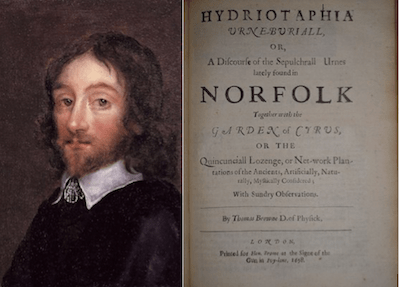
‘What song the sirens sang, or what name Achilles assumed when he hid himself among women, though puzzling questions, are not beyond conjecture’, Sir Thomas Browne wrote in chapter 5 of his Urn Burial.[1] His editor points out that those questions had been put by the emperor Tiberius to test the grammarians. Or, according to Suetonius, in his life of that strikingly unpleasant Roman, ‘his greatest passion was for mythology, to the extent that he made himself seem foolish and absurd; for he used to make trial of scholars, a class of men on whom [ . . . ] he was especially keen: “Who was Hecuba’s mother? What was Achilles’ name when he was among the virgins? What songs used the Sirens to sing?”’[2]


Sleight of hand, yes, siren to siren: but both rub shoulders under the one dictionary heading. A beckoning and a warning; a come-on and a note of caution. The mythological nymphs whose singing required Homer’s hero to be bound to his ship’s mast while his crew had their ears stuffed with beeswax; but also a signalling or warning instrument, as well as an American genus of eel-like amphibians (typically living in muddy pools). The proposed derivation is suitably tortuous: Middle English from Old French from Late Latin from Greek (Seirēn).

‘I imagine’, Ford Madox Ford wrote, ‘that I should prefer to be where Christobel low-lieth and to listen to the song the syrens sang. But I am in London of the nineteen tens, and I am content to endure the rattles and the bangs—and I hope to see them rendered.’[3] He had used the phrase—‘what songs the Sirens sang’—a year earlier; and would use it, or a variant of it, on several later occasions.[4]  In 1931, reporting fierce storms in the South of France to the novelist Caroline Gordon, one of which had drowned seventeen men, he added: ‘the Mediterranean being a treacherous syren’.[5]

Ford also recalled, from his days of editing the English Review, a piece by Norman Douglas called Syrens, ‘which was, I think, the most beautiful thing we printed.’ That Douglas essay begins: ‘It was the Emperor Tiberius who startled his grammarians with the question, what songs the Sirens sang.’[6]

Not that Ford and Douglas were the only ones with Sirens on their mind. E. M. Forster was at it too. In his ‘The Story of the Siren’, a Sicilian boatman tells the English narrator the story of his brother’s sighting of the Siren, when he dives for silver coins. Permanently changed, he marries a woman similarly bewitched, who is murdered by a priest while pregnant, religion and popular superstition having conspired to produce the conviction among the villagers that the couple’s child would empower the Siren, that the Pope would then die and the world be turned upside down.[7]


Also in 1920, the writer John Rodker’s recently created Ovid Press issued an edition of 200 copies of Ezra Pound’s Hugh Selwyn Mauberley, with initials and colophon by Edward Wadsworth, who had been briefly associated with the Omega Workshops, then with the Vorticists, contributing five illustrations and a review of Kandinsky’s On the Spiritual in Art to the first issue of Blast.

The third stanza of Mauberley:

ἴδμεν γάρ τοι πάνθ᾽ ὅσ᾽ ἐνὶ Τροίῃ εὐρείῃ
Caught in the unstopped ear;
Giving the rocks small lee-way
The chopped seas held him, therefore, that year.

The first line, from Homer’s Odyssey (Bk.XII, 189), ‘For we know all the toils that are in wide Troy’, is, precisely, from the Sirens’ song, its transmission unimpeded by that ‘unstopped ear’ (while ‘lee-way’ is Pound’s bilingual rhyme with Τροίῃ, and those choppy seas or, rather, that ‘therefore’, suitably disturbs the rhythm of the final line).[8]


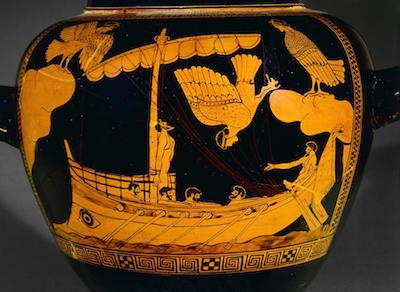
Richard Buxton notes that the Sirens are ‘depicted by post-Homeric sources as women above the waist and birds below it’ and prints the image of an Attic vase, which the British Museum dates to c.480-470 BC, one of the Sirens having thrown herself off a cliff onto the ship, ‘perhaps because the safe passage of Odysseus’ vessel marks a defeat for the Sirens’ power’. [9]

https://www.britishmuseum.org/collection/object/G_1843-1103-31

In May 1940, after the Nazi invasion of the Lowlands, Mollie Panter-Downes noted that ‘the bus changing gear at the corner sounds ridiculously like a siren for a second, as it used to do in the first edgy days of the war.’[10] But even those of us (now most of us) not old enough to recall the originals have been made familiar with the sound of air raid sirens by film and television dramas.

Things were a little more makeshift in the earlier war. When the Gothas, heavy wide-spanned biplanes, virtually took over from Zeppelins the attacks on London in the summer of 1917, E. S. Turner wrote: ‘Belatedly the Government introduced a proper warning system of maroons [fireworks used as signals or warnings]; one of the earlier methods had been to send out a fast open car with a bugler (sometimes a Boy Scout) standing in the back, or a policeman hard-pedalling a cycle with a ‘Take Cover’ notice. Engine drivers had their own way of sounding “All Clear”; they blew a cock-a-doodle-do on their whistles.’[11] Hard luck if your attention was elsewhere when that policeman cycled by.

Dropping off the car on returning from Somerset, we are almost deafened by a rush and cacophony of wailing vehicles, both ambulance and police. I suspect I know what song those sirens sing.


Notes

[1] Browne, Selected Writings, edited by Claire Preston (Manchester: Carcanet Press, 1995), 105. Thetis sent her son Achilles to the court of King Lycomedes on Skyros to avoid his being sent to war with Troy, where he was destined to die. He disguised himself as a girl under the name of Pyrrha but was tracked down by Odysseus.

[2] Suetonius, Live of the Caesars, edited and translated by Catharine Edwards (Oxford: Oxford University Press, 2000), 132.

[3] Ford, ‘On a Notice of “Blast”’, Outlook, XXXVI (31 July 1915), 144. Coleridge’s ‘Christabel’ may have wantonly embraced Tennyson’s 1830 poem ‘Claribel’ (‘Where Claribel low-lieth’) here.

[4] Ford, ‘Literary Portraits XXVIII—Mr Morley Roberts and Time and Thomas Waring’, Outlook, XXXIII (21 March 1914), 390; Thus to Revisit (London: Chapman & Hall, 1921), 7; The Marsden Case (London: Duckworth, 1923), 44; and ‘Somewhere the sirens smiled’, in The Rash Act (1933; Manchester: Carcanet Press, 1982), 187.

[5] Brita Lindbergh-Seyersted, A Literary Friendship: Correspondence Between Caroline Gordon & Ford Madox Ford (Knoxville: The University of Tennessee Press, 1999), 11-12.

[6] Ford Madox Ford, Return to Yesterday (London: Gollancz, 1931), 408-409; Norman Douglas, ‘Sirens’, English Review, II, ii (May 1909), 202-214.

[7] Forster’s story was ‘hand-printed by the Woolfs’ and published in a limited edition in July 1920: The Diary of Virginia Woolf, Volume 2: 1920-24, edited by Anne Olivier Bell, assisted by Andrew McNeillie (Harmondsworth: Penguin, 1981), 51-52 and n.; E. M. Forster, Collected Short Stories (London: Penguin Books, 1954), 179-187.

[8] Hugh Selwyn Mauberley, in Ezra Pound: Poems and Translations, edited by Richard Sieburth (New York: Library of America, 2003), 549.

[9] Richard Buxton, The Complete World of Greek Mythology (London: Thames & Hudson, 2004), 142.

[10] Mollie Panter-Downes, London War Notes (1971; edited by William Shawn, new preface by David Kynaston, London: Persephone Books, 2014), 64.

[11] E. S. Turner, Dear Old Blighty (London: Michael Joseph 1980), 123.

Small pleasures, wary smiles, beautiful trees

(Thomas Kyd, The Spanish Tragedy)

Tramping through the park, I mention to the Librarian that small pleasures are underrated. Her sideways glance says—or do I misread it?—‘Why then Ile fit you/ Hieronymo’s mad againe.’ I explain that I’m thinking of the scheme of the Cantos that Ezra Pound conveyed to his father in a letter of April 1927, which begins: ‘A. A. Live man goes down into world of Dead’.[1]

I’d seen this for, what, the twentieth time, more? when rereading an essay by Walter Baumann,[2] that same sentence having turned up in volumes of letters and who knows how many commentaries on the Cantos, beginnings of, progress of, schema of. ‘In another place’, I said, ‘he talks about Odysseus as a live man among duds.’[3] She eyes me warily, though she’s fairly used to this stuff. ‘It finally occurred to me’, I say, ‘the aural closeness of “dead” and “duds”. I’m just wondering if there’s any etymological connection.’ (If it were really of any interest, dozens of Pound scholars would already have noted this, of course: they probably have but I just missed it; they certainly seem to have noticed everything else. But – small pleasures. . . )
She nods. ‘The trees are looking really beautiful at the moment.’
So they are, so they are.

At home, naturally enough, I look up ‘dud’ – and the first dictionary to which I turn offers: ‘Origin unknown’; the second, ‘Middle English, of unknown origin’. Clearly, this won’t do. But here is the blessed Eric Partridge:[4] ‘dud’ is probably influenced by the 17th-20th century dialect term ‘dudman’, a scarecrow – ah, ‘but the word may derive ultimately ex Dutch dood, dead.’ His entry points to Ernest Weekley’s Etymological Dictionary of Modern English. And yes, rather wonderfully, it is that Weekley, Professor of Modern Languages at the University of Nottingham for forty years and husband of Frieda Weekley until a chap called D. H. Lawrence happened by. Weekley was compiler of this often-referred to dictionary plus many other works and lived until 1954, almost a quarter of a century after the death of the man who decamped with his wife.

(https://picturenottingham.co.uk/image-library/image-details/poster/ntgm007755/posterid/ntgm007755.html)

Small pleasures– or pleasures generally. As Emma Woodhouse explains to her puzzled father: ‘“That is the case with us all, papa. One half of the world cannot understand the pleasures of the other.”’[5]

Three calendar months too late, I remember the words of ‘the Compiler’, in Ford Madox Ford’s No Enemy: ‘And, truly, in all the gardening year – which is all pleasure except for such lets and hindrances as God decrees to you in order that you may remember that you are human – there is no pleasure to equal the pleasures of a mid-September day.’[6] Looking back in 1924 to the far side of the war, further, to the period of collaboration with Joseph Conrad, Ford wrote: ‘one got in those days those small, cheerful pleasures out of life.’[7] And, two years later: ‘there is a really sensuous pleasure in uttering a correct French sentence, as there is in eating good French cookery, the pleasures being very nearly akin.’[8] A man who took his pleasures seriously and knew their precise nature. . .

Perhaps unsurprisingly, Flannery O’Connor’s view of pleasures had, let’s say, a slightly different angle. In a 1952 letter to Sally and Robert Fitzgerald, she wrote: ‘I had to go have my picture taken for the purposes of Harcourt Brace. They were all bad. (The Pictures.) The one I sent looked as if I had just bitten my grandmother and that this was one of my few pleasures, but all the rest were worse.’[9]

(Flannery O’Connor: via https://ugapress.wordpress.com/ )

This was a woman who knew precisely where – on the scale of pleasures – biting your grandmother should be placed.

The other morning, I woke around 04:30, was joined by the cat shortly afterwards and didn’t really get back to sleep before 06:00 arrived, with Harry’s well-established expectations of breakfast. The ninety-minute interlude occasionally strayed into that area of semi-doze in which nonsense confidently presents itself as insight. And yet, and yet, somewhere there is the border, on the other side of which insight and rationality wait with bottled water, sandwiches and encouragement. Which side are you on?

DA, I found myself thinking—as in Datta, Dayadhvam, Damyata—why, those are the initials of Dante Alighieri, who is quoted on The Waste Land‘s very next page.[10]

It hardly needs saying that this is either of world-shattering importance or mere evidence of a man having trouble getting back to sleep. Obviously, I haven’t mentioned it just yet. I am waiting for the next walk – ideally, while the trees are still looking extravagantly beautiful.


Notes

[1] Letters of Ezra Pound, 1907-1941, edited by D. D. Paige (London: Faber and Faber, 1951), 285.

[2] Walter Baumann, ‘Ezra Pound and Magic: Old World Tricks in a New World Poem’, in Roses from the Steel Dust: Collected Essays on Ezra Pound (Orono: National Poetry Foundation, 2000), 29.

[3] Ezra Pound, ‘Hell’, a review of Laurence Binyon’s translation of Dante’s Inferno: Literary Essays of Ezra Pound, edited by T. S. Eliot (London: Faber and Faber, 1960), 212.

[4] Eric Partridge, A Dictionary of Slang and Unconventional English, 8th edition, edited by Paul Beale (London: Routledge, 1984).

[5] Jane Austen, Emma (1816; edited by James Kinsley, Oxford: Oxford University Press, 1990), 74.

[6] Ford Madox Ford, No Enemy (1929; edited by Paul Skinner Manchester: Carcanet Press, 2002), 116-117.

[7] Ford Madox Ford, Joseph Conrad: A Personal Remembrance (London: Duckworth, 1924), 39.

[8] Ford Madox Ford, A Mirror to France (London: Duckworth, 1926), 250.

[9] Flannery O’Connor, Collected Works, edited by Sally Fitzgerald (New York: Library of America, 1988), 895.

[10] T. S. Eliot, The Waste Land, lines 400ff and 427, The Complete Poems and Plays (London: Faber and Faber, 1969), 74-75.

Travels, not Keatsian

From 25 June to 6 August 1818, John Keats went walking with his friend Charles Brown, to the Lake District, Scotland, briefly to Northern Ireland and back to Scotland. 42 days, 642 miles. On 29 June, setting off at four in the morning, they climbed Skiddaw, the sixth highest summit in England, just north of Keswick in Cumbria : ‘I have an amazing partiality for mountains in the clouds.’

I myself have an amazing partiality for staying at home of late, walled in by books. Nevertheless we ventured, the Librarian and Harry the cat and I, as far as Somerset (and Dorset and Wiltshire: meandering roads), and stayed the night—actually three nights—in A Different Place, for the first time since Christmas 2019. Not quite a Keatsian trip but quietly impressive on its own terms, I thought.


Once there, we talked, ate, read, walked, drank a little wine. At the Chalke Valley History Festival, the Librarian and I mooched about and necked a salted caramel ice-cream while her parents went to see Tom Stoppard and his biographer, Hermione Lee, discourse before a rapt audience in a large tent. Slightly unsettled by our earlier view of combatants wielding sticks, apparently in their underwear (‘Look! People fighting in their pants!’), we stayed to watch Dan Snow, with a smattering of other historians and willing helpers, re-enact the Battle of Agincourt.

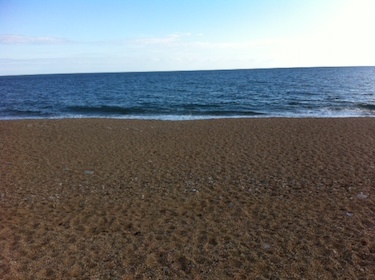
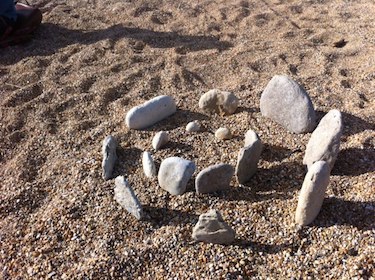
But the main business, apart from the company, was to see the sea, again for the first time in too long. It was a quiet stretch of coast—having no facilities—offering sea, sand, sea cabbage, occasional dog walkers, a distant angler, a wheeling gull or two, pebbles, mysterious flowers, mysterious stone circles.


As for literary connections—Keats aside—there was the village of Broad Chalke, familiar to John Aubrey, author of Brief Lives, and home to historical novelist and poet Maurice Hewlett (1861-1923), who lived in the Old Rectory. In 1904, recovering from a breakdown, Ford Madox Ford spent time at Winterborne Stoke, three miles from Stonehenge. He met and walked with W. H. Hudson, who had recommended that area as one to which Ford might escape from his situation in London. He later remembered standing for half an hour with Hudson watching a rookery near Broad Chalke. He saw a good deal of Hewlett too. At Christmas 1911, Ezra Pound also stayed with Hewlett, an occasion poignantly recalled—ghosts and shadows—as he sat in the military detention centre near Pisa:

and for that Christmas at Maurie Hewlett’s
Going out from Southampton
they passed the car by the dozen
     who would not have shown weight on a scale
               riding, riding
                     for Noel the green holly
     Noel, Noel, the green holly
     A dark night for the holly
          (80/515)