The teeth of the evidence – or the evidence of teeth

Fear-and-Loathing . Toorenvliet, Jacob, c.1635-1719; The Dentist

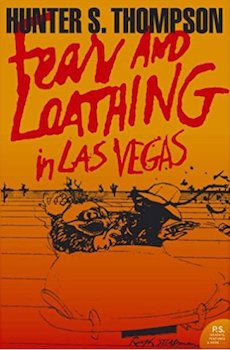
(Hunter Thompson; Jacob Toorenvliet, The Dentist: Brighton and Hove Museums and Art Galleries)

‘We were somewhere around Barstow on the edge of the desert when the drugs began to take hold. I remember saying something like “I feel a bit lightheaded; maybe you should drive. …” And suddenly there was a terrible roar all around us and the sky was full of what looked like huge bats, all swooping and screeching and diving around the car, which was going about 100 miles an hour with the top down to Las Vegas. And a voice was screaming: “Holy Jesus! What are these goddamn animals?”’

Hunter S. Thompson, Fear and Loathing in Las Vegas, of course. And against this, what? ‘We were somewhere around Bridport when the toothache took hold.’ No. But the pain was real, one hundred per cent genuine pain; I gather that Thompson’s account was, say, seventy-five per cent actual, the rest invention. Still, that particular seventy-five is scary enough.

‘Why don’t you’, the Librarian inquires mildly, ‘just go to the dentist?’ Ah yes. There are subtle undercurrents here. On the phone to the Librarian’s mum, I ask: ‘How’s your tooth?’ ‘Quiet at the moment. How’s yours?’ ‘The same. Are you going to the dentist?’ ‘Do I want to disturb it? Won’t that just stir it up? Are you going?’ ‘Not sure yet.’ Yes. Why don’t you just . . . ?

I fleetingly recall an entry in Francis Kilvert’s diary about a dentist called Gaine and his discovery that a combination of concentrated carbolic acid and arsenious acid ‘will destroy the nerve almost entirely without pain.’[1] So much acid and no pain – almost? It sounds agonisingly unlikely. My recent dental visits have, in fact, been pretty uneventful. But teeth – a serious business. Probably the worst pain I remember is tooth-related: a mere bagatelle, most women would think, familiar as they are with chronic period pains, let alone the pains of childbirth, but I’m not too keen to go through it again.

Teeth bulked large in Ford Madox Ford’s life. In August 1911, he had ‘an awful week of dentistry’ in Paris and came to meet Violet Hunt at the Gare du Nord, ‘toothless and feckless’. He had had ‘four teeth cut one morning without gas. The dentist said he must have a week or ten days rest before beginning the lower jaw.’[2] Five years later, in March 1917, here is Ford’s friend Ezra Pound, writing to Alice Corbin Henderson: ‘Ford has been in hospital. All we know for certain is that his false teeth fell out.?? Ague or shell shock.???’[3]

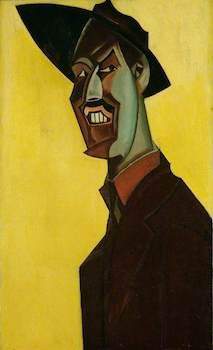
Pound, teeth and Englishmen. ‘NO englishman is ever sufficiently evolved to stand civility’, he wrote to Wyndham Lewis in March 1939, when some encounter had clearly put him in a major snit. ‘KICK the bastards in the jaw FIRST.’ Commenting on this in the piece he wrote for a 1950 collection of essays assembled by Peter Russell, Lewis recalled it as: ‘There’s only one thing to do with an Englishman—kick him in the teeth’. Lewis explained that it concerned ‘a young English bibliophile’ he had sent to Rapallo’, adding that Pound’s patience ‘must have been sorely tried.’[4]

Lewis, Wyndham, 1882-1957; Mr Wyndham Lewis as 'Tyro'

(‘Mr Wyndham Lewis as a Tyro’, Ferens Art Gallery © Estate of Mrs G. A. Wyndham Lewis; The Wyndham Lewis Memorial Trust)

Also tooth-related was ‘one of the great tragedies’ of Ford’s life, which occurred just before the First World War, when Ford was in Germany with the Liberal politician Charles Masterman and his wife. The landlord of the Hotel zur Post in Trêves, as a reward for having brought him ‘a British Excellency’, presented Ford with a bottle of 1813 brandy. ‘In the Mosel there is a stone that is only uncovered in years of great drought – which are years of glorious vintages. On such years they chain a barrel of brandy to that stone. When it is again uncovered they remove the old barrel and chain on a new one. That stone had not been uncovered since 1813. The bottle that the host gave me had been filled from the 1813 barrel.’ During the night, Masterman had toothache. ‘He poured by degrees the whole of that 1813 brandy into his mouth and spat it out again. By ringing the bell he could have procured a bottle of 1913 brandy for one franc fifty.’[5]

But then, as early as the turn of the century, teeth were an issue. When Joseph Conrad and Ford were collaborating on the novel that became The Inheritors and Conrad reluctantly attended to a female character—a part of what he usually termed ‘Ford’s women’—to the extent of granting her ‘good hair, good eyes and some charm’, it was ‘only with difficulty’, Ford recalled, ‘that he was restrained from adding good teeth to the catalogue. “Why not good teeth? Good teeth in a woman are part of her charm. Think of when she laughs. You would not have her not have good teeth. They are a sign of health. Your damn woman has to be healthy, doesn’t she?”’[6] By way of compensation, perhaps, the book does contain a dramatic critic who ‘furtively took a set of false teeth out of his waistcoat pocket; wiped them with a bandanna handkerchief, and inserted them in his mouth.’[7]

‘Do you know what Maupassant said about England?’, Colette wrote to Léopold Marchand in 1921, ‘“Too many toothbrushes and not enough bidets!”’[8] About bidets he was surely right but how many toothbrushes is ‘too many’?

Good night. Don’t forget to brush your teeth.


References

[1] Francis Kilvert, Kilvert’s Diary, edited by William Plomer, three volumes (London: Jonathan Cape, 1938, reissued 1969): II, 100.

[2] See Max Saunders, Ford Madox Ford: A Dual Life, two volumes (Oxford: Oxford University Press, 1996), I, 346. And see Alan Judd, Ford Madox Ford (London: Collins, 1990), 388: ‘Never for long could he forget those teeth that Violet had paid for.’

[3] The Letters of Ezra Pound to Alice Corbin Henderson, edited by Ira B. Nadel (Austin: University of Texas Press, 1993), 201.

[4] Pound/Lewis: The Letters of Ezra Pound and Wyndham Lewis, edited by Timothy Materer (London: Faber and Faber, 1985), 208 and n.

[5] Ford Madox Ford, Return to Yesterday: Reminiscences 1894-1914 (London: Victor Gollancz, 1931), 425.

[6] Ford Madox Ford, Joseph Conrad: A Personal Remembrance (London: Duckworth, 1924), 144.

[7] Ford Madox Ford and Joseph Conrad, The Inheritors: An Extravagant Story (1901; Liverpool: Liverpool University Press, 1999), 31.

[8] Colette, Letters from Colette, selected and translated by Robert Phelps (London: Virago Press, 1982), 63.

Remembering to forget

Fuseli-night_hag

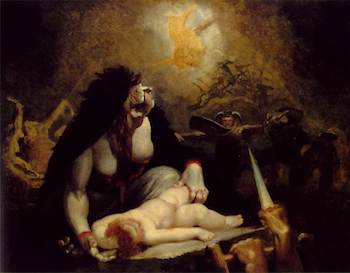
Henry Fuseli, The Night-Hag Visiting Lapland Witches (Metropolitan Museum of Art)

‘Towards morning I was possessed by a kind of nightmare; I felt the fiend’s grasp in my neck and could not free myself from it; groans and cries rang in my ears. My father, who was watching over me, perceiving my restlessness, awoke me; the dashing waves were around, the cloudy sky above, the fiend was not here: a sense of security, a feeling that a truce was established between the present hour and the irresistible, disastrous future imparted to me a kind of calm forgetfulness of which the human mind is by its structure peculiarly susceptible.’[1]

A ‘calm forgetfulness’ (I lightly pass over that ‘irresistible, disastrous future’, on the fish-in-a-barrel principle) – in 1938-39, Henry Green was clear about the dangers of forgetting, of ageing and acceptance: ‘As I write now a war, or the threat of war, while still threatening seems more remote; a change of wind and the boat is blown in, there is nothing to do but tie up and call it a day. That is the pity of sobering down to middle age, there must be a threat to one’s skin to wake what is left of things remembered into things to die with. The crime is to forget.’[2]

Still, we know well enough the dangers, if not the crimes and misdemeanours, of selective remembering too. We’ve just passed the centenary of the end of the Great War Armistice and, as John Greening remarked recently in the TLS, ‘After four years of remembering the First World War, remembrance itself is being commemorated.’[3] There has been a lot of attention rightly paid to personal stories, men surviving only in blurry photographs or in fragmentary family histories. Meanwhile, the arguments about what actually brought the war about, the competence of various military leaders, the emergence and maintenance of myths that drive nations into further wars or into disastrous political decisions, continue and will continue.

In John Le Carré’s novel, A Most Wanted Man, Dr Abdullah remarks: ‘“That’s one of the great problems of the modern world, you know. Forgetting. The victim never forgets. Ask an Irishman what the English did to him in 1920 and he’ll tell you the day of the month and the time and the name of every man they killed. Ask an Iranian what the English did to him in 1953 and he’ll tell you. His child will tell you. His grandchild will tell you. And when he has one, his great-grandchild will tell you too. But ask an Englishman—?” He flung up his hands in mock ignorance. “If he ever knew, he has forgotten.”’[4]

‘The victim never forgets.’ Indeed. But who is the victim? In earlier catastrophes, from the Armenian genocide through Soviet purges to the Holocaust, the identity of the victims was not in doubt. But now? Afghanistan, Syria, Iraq, Yemen, Nigeria, Somalia, Kashmir, Ukraine. Everyone claims victimhood. In some countries, angry white men claim that the only real victims are angry white men. The only inevitability is that innocent civilians, particularly women and children, will continue to bear the brunt of murderous violence and aggression.

opium-eater_quincey

And sometimes, the need to forget, at least for a while, is more urgent, more desperate, than the need to remember. ‘Life’, Balzac wrote, ‘cannot go on without a great a deal of forgetting.’[5] Julia Blackburn remarks that, ‘sometimes we need to remember things because only then can we forget’,[6] while, in a similar vein, the critic Frank Kermode observed that, ‘in the ordinary course of his written narrative, as of the interminable day-to-day account he gives himself of himself, the autobiographer will remember only in order to forget what he cannot bear to remember.’[7]

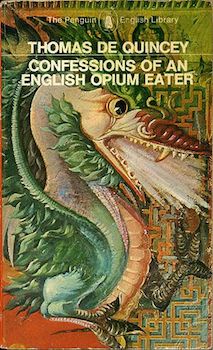
How easy is it to forget? Is it subject to the usual vagaries of the human mind and will – we unfailingly remember what we seek to forget while what we urgently need to remember falls immediately away? ‘Of this, at least, I feel assured’, Thomas De Quincey firmly asserted, ‘that there is no such thing as forgetting possible to the mind; a thousand accidents may, and will interpose a veil between our present consciousness and the secret inscriptions on the mind; accidents of the same sort will also rend away this veil; but alike, whether veiled or unveiled, the inscription remains for ever; just as the stars seem to withdraw before the common light of day, whereas, in fact, we all know that it is the light which is drawn over them as a veil — and that they are waiting to be revealed, when the obscuring daylight shall have withdrawn.’[8]

Yes: you may think you’ve forgotten – but it’s in there somewhere. . .

 
References

[1] Mary Shelley, Frankenstein; or, the Modern Prometheus, in Three Gothic Novels, edited by Peter Fairclough (Harmondsworth: Penguin, 1968), 455.

[2] Henry Green, Pack My Bag: A Self-Portrait (1940; The Hogarth Press, 1992), 50.

[3] John Greening, ‘Pity War Distilled: Poetry and the act of remembering’ (review of three recent books), Times Literary Supplement No. 6032 (9 November 2018), 9.

[4] John Le Carré, A Most Wanted Man (London: Hodder and Stoughton, 2009), 341.

[5] Honoré de Balzac, Cousin Bette, translated by Marion Ayton Crawford (London: Penguin Books, 2004), 442.

[6] Julia Blackburn, Thin Paths: Journeys In and Around an Italian Mountain Village (London: Jonathan Cape, 2011), 193.

[7] Frank Kermode, Not Entitled: A Memoir (London: Harper Collins, 1996), 156.

[8] Thomas De Quincey, Confessions of an English Opium Eater, edited by Alethea Hayter (Harmondsworth: Penguin Books, 1971), 104.

Last Post: one more parade

Last Post jpeg

We’ve just  launched Last Post: A Literary Journal from the Ford Madox Ford Society. So soon after the centenary of the Armistice, a paper signed in a railway carriage in Compiègne forest, we’ve been thinking about Ford in that context (among others).

“At the beginning of the war,” Tietjens said, “I had to look in on the War Office, and in a room I found a fellow What do you think he was doing what the hell do you think he was doing? He was devising the ceremonial for the disbanding of a Kitchener battalion. You can’t say we were not prepared in one matter at least. . . . Well, the end of the show was to be: the adjutant would stand the battalion at ease: the band would play Land of Hope and Glory, and then the adjutant would say: There will be no more parades. . . . Don’t you see how symbolical it was: the band playing Land of Hope and Glory, and then the adjutant saying There will be no more parades? For there won’t. There won’t, there damn well won’t. . . . No more Hope, no more Glory, no more parades for you and me any more. Nor for the country Nor for the world, I dare say None Gone Na poo, finny! No . . . more . . . parades!”[1]

In the midst of war, Christopher Tietjens looks back to a moment at the beginning of the war which looked forward to the end of the war. But that dizzying simultaneous backward and forward shift had occurred before the war in, fittingly, a book about moving through time. In Ford’s Ladies Whose Bright Eyes, published in 1911, the publisher William Sorrell is involved in a railway accident, from which he wakes, or seems to wake, in medieval England. ‘Supposing that his railway accident had really made him see something queer? Supposing that all these people were really just ghosts? He did not believe in ghosts. But, on the other hand, he was modern enough to know that in these days anything might happen, and suddenly he found himself saying to himself, that though he could not for the life of him say what he believed, he would not equally for the life of him say that he disbelieved any single thing.’ A little later, ‘he felt vaguely that if the ghosts from the past could come into the present, why in the world should not ghosts of the future be able to go back into the past?’[2] Is he himself a sort of ghost, he wonders?

LP-Blog-image

Parade’s End is, unsurprisingly, a haunted book, as was much of the literature that emerged from the conflict. ‘Ghosts were numerous in France at that time’, Robert Graves remembered, looking back to 1915. ‘Fall in, ghosts’, Edmund Blunden titled his essay on ‘a Battalion Reunion’.[3] Ford’s novel is haunted, in part, by the Armistice itself, peace after war, the first and third parts of A Man Could Stand Up— explicitly so, the reunion between Valentine Wannop and Christopher Tietjens taking place on Armistice Day, while all the main characters in Last Post recur obsessively to memories of Armistice Day or, for the most part, Armistice Night.

‘Do you not find’, Ford wrote to Isabel Paterson, in Last Post’s dedicatory letter, ‘that, however it may be with the mass of humanity, in the case of certain dead people you cannot feel that they are indeed gone from this world? You can only know it, you can only believe it. That is, at any rate, the case with me—and in my case the world daily becomes more and more peopled with such revenants and less and less with those who still walk this earth.’[4]

In Return to Yesterday, published three years later, Ford wrote that the three people in whose deaths he had never been able to believe were Conrad, Arthur Marwood and Jane Wells, wife of H. G. In an essay published in 1927, he stated that he had just ‘suddenly realised’ that Conrad, Henry James and Stephen Crane were all dead. He began writing Last Post a month after the death of another friend, the painter Juan Gris, and around the time his mother died.[5] Less than six months later, his old friend Charles Masterman, the Liberal politician and author, died at the age of fifty-four. All these deaths, following that of W. H. Hudson in 1922 and Joseph Conrad in 1924, individual as they are, also form part of a vast, cumulative wave of human loss, in and around that vast waste of life strewn across four years, thousands of miles and millions of casualties. Ford the writer and Ford the soldier had known his fair share of them: ‘I remember when I went to have lunch with the officers of our 2nd Battalion—all dead, the officers I had lunch with!—in Albert’.[6]

The first issue of Last Post ranges pretty widely, dwelling, as it happens, on neither war nor death: the stories contained in Ford’s own library (now in the Berg Collection, New York), Ford as reader, as literary ghost, as commentator on Anglo-German relations, as writer of detective stories, as subject of research, as point of reference in today’s America, plus a few reviews. Members of the Ford Madox Ford Society will receive two issues a year.

http://www.fordmadoxfordsociety.org/

 
References

[1] Ford Madox Ford, No More Parades (1925; edited by Joseph Wiesenfarth, Manchester: Carcanet Press, 2011), 27; see also the reconstruction of the previous volume’s original ending, the autograph fragment in Ford Madox Ford, Some Do Not. . . (1924; edited by Max Saunders, Manchester: Carcanet Press, 2010), 412.

[2] Ford Madox Ford, Ladies Whose Bright Eyes: A Romance (London: Constable, 1911), 82-83, 100.

[3] Robert Graves, Goodbye to All That (1929 edition; Harmondsworth: Penguin, 2014), 157; Edmund Blunden, Fall In, Ghosts: Selected War Prose, edited with an introduction by Robyn Marsack (Manchester: Carcanet Press, 2014), 77-93.

[4] Ford Madox Ford, Last Post (1928; edited by Paul Skinner, Manchester: Carcanet Press, 2011), 5.

[5] Ford Madox Ford, Return to Yesterday: Reminiscences 1894-1914 (London: Victor Gollancz, 1931), 371; Ford Madox Ford, New York Essays (New York: William Edwin Rudge, 1927), 24-25. Max Saunders remarks on the indication that ‘this most elegiac of his books was an oblique elegy for his mother’: Ford Madox Ford: A Dual Life, two volumes (Oxford: Oxford University Press, 1996), II, 316.

[6] Ford Madox Ford, No Enemy (1929; edited by Paul Skinner Manchester: Carcanet Press, 2002), 134.


Raising a glass

L-Moet

Graham Greene described one of his characters as giving ‘an impression of unstable hilarity, as if perhaps he had been celebrating a birthday, alone.’ Suitable for some temperaments, perhaps, but certainly not all. Christina Rossetti seems, on the face of it, to have been unusually demanding in birthday terms:

Raise me a dais of silk and down;
Hang it with vair and purple dyes;
Carve it in doves and pomegranates,
And peacocks with a hundred eyes;
Work it in gold and silver grapes,
In leaves and silver fleurs-de-lys;
Because the birthday of my life
Is come, my love is come to me.

We were a little less extravagant on the Librarian’s birthday but, should the idea appeal and funds be available, I’d certainly recommend a beach hut facing a brooding sea, a bottle of champagne and two glasses (clearly, mine is the one on the left).

Santé!


Frenchies and Russkis

(Ivan Turgenev and Pauline Viardot)

Ivan Turgenev was born two hundred years ago, on 9 November 1818, in Oryol, 220 miles southwest of Moscow; he died near Paris in 1883. Exiled in 1852 to his estate in Spasskoye when an obituary that he wrote on Gogol provoked disapproval, he spent most of his later life in Baden-Baden and Paris, always close to the singer and composer Pauline Viardot. He was long associated with the French realists, Flaubert, Zola, the brothers Goncourt.

I’ve read half a dozen of Turgenev’s novels in translation, mostly the work of Richard Freeborn, otherwise that of Constance Garnett. Probably because of the unfamiliar alphabet, the ‘original’ text seems even more distant than is the case with other languages and I’m more conscious that I’m reading the words of a translator. I’ve tended, in any case, to read those words through the eyes of Ford Madox Ford, for whom Turgenev, perhaps above all other writers, remained ‘a talismanic figure throughout his career’.[1] Unsurprisingly, I see that almost all the notes I’ve made or phrases I’ve marked in Turgenev’s books link back to Ford, some quite directly, some by more circuitous paths.

In 1878, Henry James published French Novels and Novelists, the eighth chapter of which concerned one ‘Ivan Turgénieff’. This is our man, his name spelt in a dashing Gallic manner. Richard Garnett remarks that Turgenev had ‘authorised and supervised, if not actually written, French translations of his works himself. Without ceasing to be a Russian he had become an honorary Frenchman.’[2] A good many English readers knew Turgenev’s work in French, even though English translations were becoming available. By the turn of the century, Constance Garnett had translated most of Turgenev’s fiction. Ezra Pound refers to ‘Turgeneff’ in a 1912 letter to his mother, possibly influenced by James in this instance,[3] but he certainly advises his mother to ‘take the things in french, if you can.’[4]

Turgenev visited this country a dozen times, often in the company of his friend—and translator of one of his books— W. R. S. Ralston. Ford, as a child of seven, had met them both in the studio of his grandfather, Ford Madox Brown. Forty years after that meeting, Ford wrote a novel called The Marsden Case. Sending a copy to his friend Edgar Jepson, he wrote: ‘I believe that, as “treatment,” it’s the best thing I’ve done—but the subject is not a very good one, though it’s one that has haunted me certainly ever since I was eighteen on and off. It’s the story of Ralston, the first translator of Turgenev—a man I liked very much. At any rate, that suggested it to me.’[5]

On another 9 November—1894—Olive Garnett confided to her diary that Ford’s brother Oliver, having been to Blomfield, where Ford (still Ford Madox Hueffer at that date) and his new wife Elsie were living, had passed on his ‘graphic account of the ménage’. Both Ford and Elsie were, apparently, smoking shag in a cutty pipe constantly on their walks. They were known, Olive noted, as the Frenchies, and their society ‘was that of the Vicar & his pretty daughter’.[6]

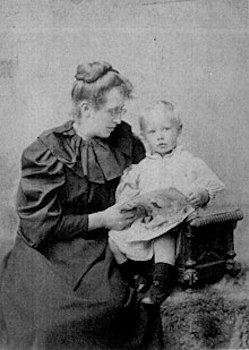
Constance Garnett and her son David, known as Bunny, mid-1890s

(Constance and David Garnett, 1890s)

Twenty years on, Ford was writing about Constance Garnett’s translation of Dostoevsky’s The Idiot. Ford viewed Dostoevsky as Romantic, as against his admired ‘French Realist School – in which I should include Turgenev’.[7] The following year, writing about two other Russian writers, Ford again mentioned Turgenev, suggesting that he was ‘something more than merely Russian’.[8]

All these citizens of – somewhere, of several somewheres, managing to transcend the narrow bounds of nationality, reaching beyond borders, whether actual or imposed. Not that aggressive nationalism was ever entirely absent from the story. In the 1930s, Ford recalled seeing John Galsworthy give a presidential address to PEN. To French writers then, Ford remarked, Maupassant was ‘the Nihilist enemy’ and Turgenev ‘an alien ugly duckling who once disgusted the paving stones of Paris with his foreign footsteps.’ Ford described how, when the applause subsided, ‘poor Jack went on: Yes, he repeated, all the art he had had he had had of the French. If he stood where he was, if he was honoured as he was, it was because all his life long he had studied the works, he had been guided by the examples of . . . Guy de Maupassant and of him who though a foreigner by birth was yet more French in heart than any Frenchman—Ivan Turgenev!’[9]

Ford was himself a man of multiple roles, selves and aspects; born to a German father, possessed of Italian uncles and an aunt through his Aunt Lucy’s marriage; never divorced from his English wife; his third daughter born to an Australian painter while his partner by the thirties was a painter of Jewish family born in Eastern Poland; his closest literary relationships were with a Pole and an American; he fought in the British Army still bearing a German surname; and wrote in half a dozen different genres. He once observed—surely with a strong sense of recognition—that Turgenev ‘was by turns and all at once, Slavophil and Westerner, Tsarist and Nihilist, Germanophile and Francophobe, Francophile and Hun-hater’.[10] Homo duplex, homo x-plex. In 1925, he wrote to a friend that Some Do Not. . ., the first of the Tietjens novels, had done well in America but that, ‘Otherwise I am rapidly becoming a French writer.’[11]

Metzinger-Apollinaire-Christies

(Jean Metzinger, Portrait of Guillaume Apollinaire, via Christie’s)

Curiously, exactly one hundred years after Turgenev’s birth, 9 November 1918, Guillaume Apollinaire died in the flu pandemic. Poet, prose writer and influential art critic, this ‘Frenchman by everything except birth’[12] had been born in Rome and then named Wilhelm Albert Włodzimierz Apolinary Kostrowicki.

Here you are beside me again
Memories of my companions killed in the war
The olive-branch of time
Memories that make only a single memory
As a hundred skins make only a single coat
As these thousands of wounds make only a single newspaper article
Impalpable and dark presence who have assumed
The changing shape of my shadow

(from ‘Shadow’, translated by Christopher Middleton)

At the time of his death, Apollinaire was just thirty-eight years old.

 
References

[1] Max Saunders’ phrase. His ‘Ford and Turgenev’ is the most thorough reading of this literary relationship: see Ford Madox Ford’s Literary Contacts, edited by Paul Skinner (Amsterdam: Rodopi, 2007), 63-78.

[2] Richard Garnett, Constance Garnett: A Heroic Life (London: Sinclair-Stevenson, 1991), 95.

[3] Richard Sieburth suggested this in Instigations: Ezra Pound and Remy de Gourmont (Cambridge: Harvard University Press. 1978), 96. Ford was referring to ‘Tourgénieff’ around this time: The Critical Attitude (London: Duckworth, 1911), 59.

[4] Ezra Pound, Ezra Pound to His Parents: Letters 1895–1929, edited by Mary de Rachewiltz, David Moody and Joanna Moody (Oxford: Oxford University Press, 2010), 283.

[5] Ford Madox Ford, Letters of Ford Madox Ford, edited by Richard M. Ludwig (Princeton: Princeton University Press, 1965), 149. Ralston died in 1889.

[6] Barry C. Johnson, editor, Olive and Stepniak: The Bloomsbury Diary of Olive Garnett, 1893-1895 (Birmingham: Bartletts Press, 1993), 128.

[7] Ford Madox Ford, ‘Fydor Dostoevsky and The Idiot’ (14 February 1914), reprinted in Critical Essays, edited by Max Saunders and Richard Stang (Manchester: Carcanet Press, 2002), 129.

[8] Ford Madox Ford, ‘Sologub and Artzibashef’ (26 June 1915), reprinted in Critical Essays, 176.

[9] Ford Madox Ford, Portraits from Life (Boston: Houghton Mifflin, 1937), 141-142.

[10] Ford, Portraits from Life, 158.

[11] Ford, Letters, 166.

[12] Francis Steegmuller, Apollinaire: Poet Among the Painters (London: Rupert Hart-Davis, 1963), 322.

Electricity and beefsteak

Sky-through-stone

‘His eyes followed the high figure in homespun, beard and bicycle, a listening woman at his side. Coming from the vegetarian. Only weggebobbles and fruit. Don’t eat a beefsteak. If you do the eyes of that cow will pursue you through all eternity. They say it’s healthier. Windandwatery, though. Tried it. Keep you on the run all day.’ So James Joyce writes in Ulysses. Apparently this passage refers to George Russell (‘AE’) but it’s a figure that makes me think of George Bernard Shaw. In Richard Garnett’s biography of his grandmother, Constance Garnett: A Heroic Life, he tells the story of Shaw inheriting £100 from his ‘ne’er-do-well’ father, who died in 1885. £15 was spent on a new suit produced by Dr Jaeger’s Sanitary Woollen System Company Limited. ‘Thereafter he looked like a toy made for a child by an inexpert knitter.’

As for the beefsteak. Ford Madox Ford, a great lover of wine – especially red wine – tried to persuade Joyce to drink it. Joyce preferred to drink white, comparing it to ‘electricity’ while regarding red wine as ‘liquid beefsteak’.

We’re fairly open-minded on the question in this house, though tending to Ford’s view of the matter rather than Joyce’s. There was a recent Q & A with Jodie Whittaker, the new Doctor Who, which included:

Jodie-Whittaker

What is your guiltiest pleasure?
Drinking wine every day. I have half a bottle a day. There’s a lot of pleasure in it and a lot of guilt, so it ticks both boxes.

https://www.theguardian.com/lifeandstyle/2018/sep/22/jodie-whittaker-q-and-a-drinking-wine-doctor-who

At that point, my wife made the noise that Librarians make when they come across a kindred spirit, though the word ‘guilt’ caused a moment’s bafflement.

Let me raise a glass, anyway, to my friends in America and send them all best wishes for tomorrow – and many tomorrows thereafter.


Four-posted

Barber, Alfred R., 1841-1925; Four Rabbits

Rabbit Quartet
(Alfred Barber, Four Rabbits: Stockport Heritage Services)

Glancing over the titles I’d borrowed from the university library—on my infrequent visits, I tend to range widely and sometimes incoherently—I was struck by a quite unintended recurrence: Four archetypes, The fourth imagist, The letters of D. H. Lawrence: Volume 4, W. H. Auden’s Prose: Volume 4, 1956-1962. Four fours. (There was, in fact, a trickster: a fifth title, by Patrick White, although—fittingly enough—it was called Three uneasy pieces).

 Four-square. The sign of four. In August 1889, less than two years after the debut of Sherlock Holmes in A Study in Scarlet, Arthur Conan Doyle had dinner at the Langham Hotel with Joseph Marshall Stoddart, the editor of Lippincott’s Monthly Magazine, Thomas Patrick Gill, former editor and M.P—and friend of Charles Stuart Parnell—and Oscar Wilde. The dinner resulted in two short novels appearing in Lippincott’s: Wilde’s The Picture of Dorian Gray and Conan Doyle’s The Sign of Four (its magazine title added a second definite article: ‘The Sign of the Four; or, The Problem of the Sholtos’).

Doyle-Sign-of-Four

The story begins with the famous scene of Holmes injecting himself with cocaine (‘a seven-per-cent solution’)—and ends with him reaching up for the cocaine-bottle—touches on Watson’s publication of A Study in Scarlet and Holmes’s own published works (on types of tobacco ash, the tracing of footsteps, the influence of a trade upon the form of a hand), demonstrates the difference between observation and deduction, and introduces the Baker Street Irregulars, the tracker dog Toby and the woman who will become Watson’s wife, Miss Mary Morstan (‘I have never looked upon a face which gave a clearer promise of a refined and sensitive nature’, the doctor decides). All this as well as tales of the Indian Mutiny and a narrative excursion to the Andaman Islands. Conan Doyle also acknowledged the part played by the Langham Hotel: it is from here that Captain Morstan has so mysteriously disappeared.[1]

The Earth may be round but much of it’s quadriform –‘the four corners of the earth’ is familiar enough. Four elements, four seasons (for some of us); also dimensions, estates and (coming up fast on the inside) horsemen of the apocalypse. Franklin D. Roosevelt proposed four fundamental freedoms, though Harry Truman fooled around with them, replacing freedom from want and freedom from fear with ‘a promise of “freedom of enterprise”.’[2] According to Fernand Braudel, the world population doubled in four centuries (the fifteenth to the eighteenth); it does so now in more like four decades.[3] Ovid had described four ages of man; Thomas Love Peacock wrote of four ages of poetry: iron, gold, silver and brass. Modern poetry too had its ages and ‘that egregious confraternity of rhymesters’—the Lake Poets, primarily Wordsworth, Coleridge and Southey—were guilty of ‘conjuring up a herd of desperate imitators’, who had in turn ‘brought the age of brass prematurely to its dotage’.[4]

Four-ages-of-man

‘The four ages of man’, Bartholomaeus Anglicus (Royal 17 E III, f. 80): © The British Library

‘The grand object of travelling’, Samuel Johnson declared, ‘is to see the shores of the Mediterranean. On those shores were the four great Empires of the world; the Assyrian, the Persian, the Grecian, and the Roman.—All our religion, almost all our law, almost all our arts, almost all that sets us above savages, has come to us from the shores of the Mediterranean.’[5] Other fours that spring or schlep to mind include Ronald Duncan, ‘I have always needed the assistance of at least four women—and thought they were happy if they were too busy to complain’,[6] and Hugh Kenner’s discussion of Ezra Pound mulling over the opening of the Cantos, pondering ‘a chord that should comprise four of history’s beginnings: the earliest English (“Seafarer” rhythms and diction), the earliest Greek (the Nekuia), the beginnings of the 20th-century Vortex, and the origins of the Vortex we call the Renaissance, when once before it had seemed pertinent to reaffirm Homer’s perpetual freshness.’[7] And there is Lawrence Durrell’s epigraph to Justine, the first volume of The Alexandria s Quartet, a quotation from Freud (a letter to Wilhelm Fliess in 1899): ‘I am accustoming myself to the idea of regarding every sexual act as a process in which four persons are involved. We shall have a lot to discuss about that.’ Unsurprisingly, I’d say.

My own record on quartets and tetralogies is distinctly patchy. Brass, wind, string? Not many, a very superficial acquaintance given the range of choice. But Durrell, yes, T. S. Eliot’s Four Quartets and Elena Ferrante’s Neapolitan novels and T. H. White’s The Once and Future King, yes. Updike’s Rabbit books, almost there, Michael Moorcock’s The Cornelius Quartet, ditto, Yukio Mishima’s The Sea of Fertility, a bit. Paul Scott’s Raj Quartet, not at all, pretty close once or twice but never quite seized the moment; and the same goes for L. H. Myers, The Near and the Far.

On the other hand, when we come to Ford Madox Ford’s Parade’s End – I’d say I’m more than covered. ‘Bridge was his only passion; a fortnight every year was what, in his worn-out life, he got of it. On his holiday he rose at ten. At eleven it was: “A four for the Father.” From two to four they walked in the forest. At five it was: “A four for the Father.” [ . . . ] The other four played on solemnly.’

Fordian fours. No Enemy is not part of a tetralogy but the temptation’s there; and, after all, if I were to throw in Ford’s other immediate postwar writings (the ones that remained unpublished), ‘True Love & a G. C. M.’, ‘Mr Croyd’ plus one of the two other typescripts intimately related to it—‘That Same Poor Man’ and ‘The Wheels of the Plough’—I have a foursome.[8]

‘So Gringoire had four landscapes, which represent four moments in four years when, for very short intervals, the strain of the war lifted itself from the mind. They were, those intermissions of the spirit, exactly like gazing through rifts in a mist.’

Bring on those intermissions of the spirit, those rifts in the mist.

 
References

[1] Arthur Conan Doyle, The Sign of Four, in The New Annotated Sherlock Holmes: The Novels, edited with notes by Leslie S. Klinger (New York and London: W.W. Norton and Company 2006), 209-381.

[2] Sarah Churchwell, Behold, America: A History of America First and the American Dream (London: Bloomsbury Publishing, 2018), 285-286.

[3] Fernand Braudel, Civilization and Capitalism, 15th – 18th Century. Volume I: The Structures of Everyday Life: The Limits of the Possible, translated from the French; revised by Sîan Reynolds (London: Fontana Books 1985), 31.

[4] Peacock, The Four Ages of Poetry, quoted in Stephen Prickett, ‘Romantic Literature’, The Romantics, edited by Prickett (London: Routledge, 2016), 243.

[5] James Boswell, Life of Johnson, edited by R. W. Chapman, revised by J. D. Fleeman, (Oxford: Oxford University Press, 1980), 742.

[6] Ronald Duncan, All Men Are Islands: An Autobiography (London: Rupert Hart-Davis, 1964), 187.

[7] Hugh Kenner, The Pound Era (London: Faber and Faber, 1972), 349.

[8] The apparent confidence with which I list these is, of course, entirely based on the second volume of Max Saunders’ Ford Madox Ford: A Dual Life (Oxford: Oxford University Press, 1996).

Blood, ghosts, Ezra Pound’s birthday

EP2

Sitting at the kitchen table, I try to remember exactly when I first realised that one of the characters and situations in the novel by Sarah Moss that I’m reading recurs in another of her books that I read a few months ago: it wasn’t the name of the island that triggered the memory but the surname of a character sending letters home: Moberley.[1]

Outside, a magpie on the bird table is jabbing at a fat ball with rapid strokes of its lethal-looking beak. This reminds me of the recollection, in an essay by Guy Davenport, of a remark by Ezra Pound, breaking ‘hours and hours’ of the silence common to his public persona in the later years of his life: ‘“There’s a magpie in China can turn a hedgehog over and kill it.”’ Decoding this, Davenport recognises it as an acknowledgement that Pound has read the translation of Archilochos given to him by Davenport three days earlier, the fragment about the Hedgehog and the Fox.[2]

Ezra Pound was born in Hailey, Idaho, one hundred and thirty-three years ago today, and died in Venice on 1st November 1972. He wrote a great deal: Richard Sieburth’s Library of America edition of the Poems and Translations exceeds 1350 pages; The Cantos fill another 800, contributions of poetry and prose to periodicals almost a dozen volumes. I’ve lost track of the secondary literature over the years but it must amount to at least two hundred books and probably thousands of articles, reviews and theses by now.

Pound_Ezra_library

I sit down to read or reread Pound less often than I used to but I doubt if a day goes by without my coming across some mention or connection or quotation from his work in something I’m reading or looking at. Anything – a picture, a phrase overheard, a name – can remind me of a line of Pound’s poetry or prose. It’s hardly surprising since he’s become so much a part of my landscape, in a way that very few others have. But then I’ve been reading in and around his work, on and off, for forty years; and lines of communication and connection run to and fro between Pound and almost every writer that interests me in the modernist period. Apart from his own writing, I must have read around seventy books devoted wholly or largely to Pound, several of them more than once – but, again, not a fantastic number given such a length of time and the fact that I wrote a thesis largely about that writing.

Half the books on my desk at any one time suggest some affinity or family resemblance. Here are two translations of The Odyssey and a book about archaeology and modernism; the first volume of the Davenport-Kenner letters; and The Art of Language: Selected Essays by Kenneth Cox, recommended to me by Greg Gerke — I can recommend in turn his own fine recent piece on reading The Cantos: https://bigother.com/2018/09/24/reading-the-cantos/

Beginnings are tricky, both to negotiate and to recall. I know I read Noel Stock’s biography and Kenner’s The Pound Era pretty early on. But Pound himself? I have no recollection of learning about any modern poetry whatsoever at school – and I must have come across Pound’s own writing first in The Faber Book of Modern Verse, the 1965 Donald Hall revision. This anthology begins with Gerard Manley Hopkins, The Wreck of the Deutschland, just as Charles Tomlinson, a great admirer of Hopkins, used to begin the modern period with his students. Then Yeats – and every one of those twelve poems became lodged, partially or wholly, between my ears. Then T. E. Hulme, five poems, 33 lines in all. Then turn the page and find this:

You’d have men’s hearts up from the dust
And tell their secrets, Messire Cino,
Right enough? Then read between the lines of Uc St. Circ,
Solve me the riddle, for you know the tale.

The tale, the riddle. That crowding sense of a story behind all this that you need and want to know. The names, foreign and unfamiliar. The dash of colloquialism – ‘You’d’, ‘Right enough?’ The directness. A poem containing a speaker who advises someone else (‘Messire Cino’) to ‘read between the lines’ – of another text or another life. Then all the questions, the litany of more names – and the irresistible ‘End fact. Try fiction.’ Following this: ‘The Exile’s Letter’, a bit of Hugh Selwyn Mauberley, a section of Homage to Sextus Propertius and two careful Cantos. Canto XIII has Kung (Confucius) walking with his disciples by the dynastic temple and out by the river; then ‘From Canto CXV’ is, apart perhaps from one or two words or names not immediately familiar, perfectly comprehensible to any casual passer-by (I find I still have this by heart).

Faber_Bk-Mod-V

I owe a large debt to Donald Hall then (and am surely not alone in that): apart from the Thomases –Dylan and Edward – my acquaintance with practically every modern poet begins there, from The Waste Land to The Dream Songs.

In Pisa, Pound wrote (80/506):

before the world was given over to wars
Quand vous serez bien vieille
remember that I have remembered

This has always been one of the most resonant lines for me. It became the title of an essay on Ford Madox Ford’s Parade’s End by Hugh Kenner and, in the closing lines of The Pound Era, he wrote of Pound shouldering ‘the weariness of 85 years, his resource memory within memory within memory.’[3]

EP-Pisa-viaWallStJournal

(Pound in the Dispensary at the DTC, Pisa: via Wall Street Journal)

That last phrase neatly encapsulates, if not the effect of reading Pound, then perhaps the effect of having read him, especially if you take in much of the related literature as well. Pound, certainly in The Cantos, refers to so much, so many historical and contemporary figures (often obscure, often out of his own personal memories), as well as literature in several languages. The Cantos ‘refer but they do not present’, as Basil Bunting apparently told Pound.[4] Some books on The Cantos will foreground a particular aspect or avenue of approach: Pound’s use of time, the occult, particular images or motifs, the relation to Dante or Confucius or the epic tradition. But even they will often go over some of the same ground as more general surveys and recycle much of the same material. Then too, unsurprisingly, Pound himself will touch on the matter of The Cantos constantly, in essays and letters. How could he not? The net result is that, eventually, the ability to state with confidence precisely where one first came across this or that fact or allusion or echo recedes beyond recall, beyond recovery.

As to whom Pound’s ‘remember that I have remembered’ is directed – perhaps the reader but more, I think, the ghosts of that lost world, his ‘jeunesse’, London, 1908-1920. By the end of the First World War, Gaudier-Brzeska and T. E. Hulme were gone; by the end of the Second, all the ‘lordly men’ named in Canto 74 were gone too: Ford, Yeats, Joyce, Victor Plarr, Edgar Jepson, Maurice Hewlett and Henry Newbolt, all dead, and others from that era, if alive, often estranged from him.

‘Memory within memory within memory’. In the essay quoted earlier, Guy Davenport relates how, a few years after his return to Italy, despondent and fatigued though he had been, Pound sat down at his typewriter and began writing letters, the first for a while, ‘He mailed the letters himself. Within a week, they began to return. They were addressed to James Joyce, Ford Madox Ford, Wyndham Lewis, William B. Yeats.’[5]

In what eventually became Pound’s ‘Canto I’, behind which stands the eleventh book of Homer’s Odyssey, a sheep is sacrificed to Tiresias in Hades, as instructed by Circe, and ‘dark blood’ flows in the fosse, blood for the ghosts. Tiresias comes, and prophesies that ‘Odysseus / Shalt return through spiteful Neptune, over dark seas, / Lose all companions.’ So he does. ‘Blood for the ghosts’ – this enabled Pound to give voice to the many writers he translated, from Provençal, Greek, Latin, Chinese, French and Italian. But perhaps it runs both ways and ghosts—from Homer through Sigismondo Malatesta to Jefferson and Adams—provide the blood that runs in the fosse of The Cantos.

and for that Christmas at Maurie Hewlett’s
Going out from Southampton
they passed the car by the dozen
who would not have shown weight on a scale     (80/515)


References

[1] Sarah Moss, Night Walking (2011), set in the present day, incorporates material from the Victorian era in the form of letters home from May Moberley, one of the sisters in Bodies of Light (2014).

[2] Guy Davenport, ‘Ezra Pound 1885-1972’, in The Geography of the Imagination (Boston: David R. Godine, 1997), 170; Archilochos, ‘Fragment 183’, in Seven Greeks (New York: New Directions, 1995), 54.

[3] Hugh Kenner, ‘Remember That I Have Remembered’, in Gnomon: Essays on Contemporary Literature (New York: McDowell, Obolensky, 1958), 144-161; The Pound Era (London: Faber and Faber, 1972), 561.

[4] Kenneth Cox discusses this in ’Ezra Pound: The Composition of The Cantos’, The Art of Language: Selected Essays, edited by Jenny Penberthy (Chicago: Flood Editions, 2016), 51-52.

[5] Davenport, ‘Ezra Pound 1885-1972’, 175.

Paying respects

Angels

Sweet day, so cool, so calm, so bright—so it was, and is. Passing the open front door of a house along our street, cement sacks propped against the wall, the whole building masked by scaffolding—one of several at the moment—I’m struck by how many workers in the building trade believe they can sing – I mean sing well, of course. The song that’s spilling from the radio is almost drowned out by their own near-miss whoops and roars. But then my standards have been skewed since work on the back of our house transformed them. For months, along with the drilling and hammering downstairs, I could hear Mark singing along with the radio. Not only could he sing in tune – and hold a tune – but he seemed to know the words and the melody of every song that came over the airwaves. More, he could sing every part and, frankly, anyone who can do all that and harmonise with himself, has earned respect, certainly mine.

That’s a word that detains me from time to time. ‘Respect’ – for the person, for the achievement, for the office. The last of these has fallen out of favour of late, tangled up with ‘the end of deference’, ‘deference’ being one of those trigger words that creates a certain restlessness in the room. In many countries, of course, respect continues to be accorded a particular office even if the holder is manifestly wholly unfitted for it and may even have brought the office itself into disrepute.

My own position is that, while respect has to be earned, so too does disrespect. Neither praising nor dispraising until the one or the other is warranted, by word or action; and, in the meantime, walk on by. Browsing in dictionaries, I’m fine with ‘a feeling of deep admiration for someone elicited by their qualities or achievements’, so too ‘due regard for the feelings or rights of others’: that’s ‘due regard’.

Vansittart

On the matter of balance between respect for the person and for the position held by that person, I like this from Peter Vansittart: ‘Classics, of course, have no monopoly of pertinent stories, and any age can learn from a French provincial governor, François de Montmain, replying to King Charles IX: “Sire, I have received an order from Your Majesty directing me to kill all Protestants in my province. I respect Your Majesty too much to believe that this order is genuine. But if, which God forbid, it should indeed be, I respect Your Majesty too greatly to feel it in my power to obey it.” Courage, dignity, wit and humanity in a handful of words.’[1]

Bridging the gap – Catholic to Protestant; king to commoner; invader to ‘native’. In his introduction to Francis Parkman’s The Oregon Trail, David Levin noted that ‘unlike Melville’s narrator, Parkman never learns to respect the people whose life he observes.’ He added: ‘He cannot transcend the invaders’ point of view.’ Indeed, for Parkman, the Native Americans he encountered and whose lands he ranged over, could only be ‘savages’: at one point, he writes, ‘No civilized eye but mine had ever looked upon that virgin waste.’[2]

In our time, it is the politicians who have most visibly and undeniably lost respect – which is hardly surprising, given current and recent events in the United Kingdom, the United States, Hungary, Italy, Brazil, Turkey, Yemen and Saudi Arabia—among many others. There seems no real likelihood of this changing any time soon.

There used to be a common phrase, less common now, I think, ‘paying respects’, a visit of a semi-formal or at least polite kind, while ‘paying one’s last respects’ expresses those sentiments through attending a person’s funeral—or, perhaps, visiting their graves. ‘During a quarter century of poetic folly’, Jonathan Williams muses, ‘I have become more and more goliardic, peripatetic, and simply bizarre.’ Poet, publisher and photographer, he carefully recorded his funerary pilgrimages: ‘I must have by now 300 slides of the resting places of human beings I much revere and whose works and persons nourish me.’[3]

Tait, Robert Scott, c.1816-1897; 'A Chelsea Interior' (The Carlyles at Home with Their Dog, 'Nero')

Robert Scott Tait, A Chelsea Interior (the Carlyles’ house)
© National Trust images

‘Never speaking ill of the dead’ is often used to enforce silence about failings, or used to be. Victorian ‘lives and letters’ were notoriously eulogistic if not sycophantic, one reason why J. A. Froude’s life of Carlyle was so controversial, with its revelation of what Froude viewed as Carlyle’s abrasive character and Jane Carlyle’s unhappiness. But, as Adam Sisman wrote of Samuel Johnson, ‘If biography was to teach men and women how to live, it followed that it should be realistic. Johnson did not share the general belief that respect for the dead required that their faults should be suppressed or glossed over.’[4]

Still, if you’re embarking on a biography, it’s surely advisable to harbour positive feelings—even respect—for your subject. Penelope Fitzgerald, biographer of Edward Burne-Jones, Charlotte Mew and her own extraordinary family, remarked in a letter to her American publisher Chris Carduff: ‘I also write novels (on the whole I think you should write biographies of those you admire and respect, and novels about human beings who you think are sadly mistaken)’.[5]

beachandjoyce-newyorker

(Sylvia Beach and James Joyce via The New Yorker)

Not that respect is, or need be, focused always on persons. It might be a text: Sylvia Beach recalled that Sergei Eisenstein was ‘an ardent admirer of Joyce. He would have liked to make a film from Ulysses but he had too much respect for the text, he told me, to sacrifice it for the sake of the picture.’[6] It might be something more mundane: ‘Whether religious or not (that was something she would not have breathed about, not even to Mrs Hunter asleep) Sister de Santis admitted to a belief in common objects. If you depend on something to any extent, you might as well learn to respect it; so she never kicked the furniture or threw the crockery about.’[7]

Lately, even given the profound and relentless provocation afforded me by the world’s destroyers and their useful idiots, I’ve managed to leave the crockery alone.

 
References

[1] Peter Vansittart, In Memory of England: A Novelist’s View of History (London: John Murray, 1998), 3.

[2] Francis Parkman, The Oregon Trail (1849; edited by David Levin, Harmondsworth: Penguin Books, 1982), 18, 21, 321.

[3] Jonathan Williams, ‘Paying Respects’ (1976), in Blackbird Dust: Essays, Poems, and Photographs (New York: Turtle Point Press, 2000), 11, 12.

[4] Adam Sisman, Boswell’s Presumptuous Task (London: Hamish Hamilton, 2000), 165.

[5] Letter of 7 December 1987: So I Have Thought of You: The Letters of Penelope Fitzgerald, edited by Terence Dooley (London: Fourth Estate, 2008), 490.

[6] Sylvia Beach, Shakespeare and Company (1959; Lincoln: University of Nebraska Press, 1991), 109.

[7] Patrick White, The Eye of the Storm (London: Penguin Books, 1975), 165.


Among the trees

Trees-VP

‘This house looks out on a great rampart of trees; all day they are motionless in the strong sun’, Sylvia Townsend Warner wrote to Llewellyn Powys in the summer of 1933, from Frankfort Manor, Sloley, Norwich. ‘But at dusk they seem to creep silently across the lawn, until looking from my window I seem to see their enormous foreheads pressed to the pane. I have never lived with trees before. They take some mastering; but I think I shall be on good terms with them even before I see them naked.’[1]

In Tolkien’s Lord of the Rings, the Ents are a race of huge tree-like beings who stride across the country to take part in the battle against Saruman. But the image of trees walking is an old one. In St Mark’s gospel, the blind man, his sight only partially restored when touched once by Christ, ‘looked up, and said, I see men as trees walking.’ His sight will be fully restored when touched for a second time, so that he sees ‘every man clearly’ (Mark 8:24-25). This is explicitly echoed in Elizabeth Bowen’s description of a young woman called Emmeline, at a party, looking down the hall. ‘There she saw men as trees walking, her mind already at home in the dusk of her white room outside the lamplight.’[2]

ent_Tolkien

(Tolkien’s Ents: from The Two Towers)

Shakespeare’s Macbeth, told that he’ll never be defeated until Great Birnam Wood comes to Dunsinane to oppose him, says with understandable confidence: ‘That will never be./ Who can impress the forest, bid the tree/ Unfix his earthbound root?’ But every soldier in the approaching army carries a bough cut from the trees of Birnam Wood, to ‘shadow/ The numbers of our host, and make discovery/ Err in report of us’, as Malcolm says. Very much men as trees walking.

Trees are miracles of growth, sometimes reaching enormous heights from tiny beginnings. They bear fruit, shed leaves, are cut down and die, take on other forms. Unsurprisingly, they’re everywhere in the world’s religions and mythologies: Yggdrasil, the tree of life that connects the nine worlds of Norse cosmology; the Bo tree under which the Buddha sat and attained enlightenment; sacred fig trees in Jainism and Hinduism; the Christian tree of the knowledge of good and evil; the tree of life in the Kabbalah; many more.

They’re everywhere in literature too: oak, willow, laurel, olive, cypress, yew. The elm alone traces a path from Homer and Virgil through Chaucer and Milton to Thomas Gray and Tennyson.

‘I love the fitful gust that shakes/ The casement all the day’, John Clare declared:

And from the mossy elm tree takes
The faded leaves away,
Twirling them by the window-pane
With thousand others down the lane. (‘Autumn’)

Not everyone is, or remains, enamoured. ‘On the way’, William Carlos Williams wrote:

we passed a long row
of elms. She looked at them
awhile out of
the ambulance window and said,

What are all those
fuzzy-looking things out there?
Trees? Well, I’m tired
of them and rolled her head away.[3]

‘I wrapped my tears in an ellum leaf/ And left them under a stone’, Ezra Pound wrote in an early poem.[4] In a what leaf? Is that an Idaho thing – or Philadelphia, or New York? But then here’s Mr Faulkner of Mississippi: ‘The buggy was drawn by a white horse, his feet clopping in the thin dust; spidery wheels chattering thin and dry, moving uphill beneath a rippling shawl of leaves. Elm. No: ellum. Ellum.’[5]

Ah, these Americans. Perhaps one more. ‘“They come down like ellum-branches in still weather. No warnin’ at all.”’ This is in Rudyard Kipling’s ‘An Habitation Enforced’, an early example of his ‘healing’ stories, this one involving a very rosy picture of Edwardian England, where the death of Mr Iggulden prompts Mrs Betts to make that observation to Sophie Chapin (who has found the old man dead in his fireside chair).[6] The Chapins are American—her family there comes from Connecticut—but this is Mrs Betts speaking, a local woman, long resident here. So: Idaho, Mississippi —Sussex.

Swallowdale

At this time of year, walking on a slowly thickening carpet of leaves, with the odd branch fallen in an occasionally fiercer wind, the trees in my local park impress themselves even more closely than usual on my attention. They certainly have a positive effect on people—some people, most people?—and there’s something curiously heartening in the sight of newly-planted saplings. New growth but also a distinctive kind of latent energies, a gathering of strength.

‘“Sleep like young trees and get up like young horses, as my old nanny in Australia used to say”, their mother tells the Walker children in Arthur Ransome’s Swallowdale.[7]


References

[1] Sylvia Townsend Warner, Letters, edited by William Maxwell (London: Chatto & Windus, 1982), 25.

[2] Elizabeth Bowen, To the North ([1932] Harmondsworth: Penguin Books, 1945), 26. In Edmund Blunden’s Undertones of War (1928; edited by John Greening, Oxford: Oxford University Press, 2015), 58, ‘Willow-trees seemed moving men.’

[3] William Carlos Williams, ‘The Last Words of My English Grandmother’, in The Collected Poems, Volume 1: 1900-1939, edited by A. Walton Litz and Christopher MacGowan (Manchester: Carcanet Press, 1987), 465.

[4] ‘La Fraisne’, in Ezra Pound: Poems and Translations, edited by Richard Sieburth (New York: Library of America, 2003), 23.

[5] William Faulkner, The Sound and the Fury (1929), in Novels 1926-1929, edited by Joseph Blotner and Noel Polk (New York: Library of America, 2006), 972.

[6] Rudyard Kipling, Actions and Reactions (London: Macmillan and Co., 1909), 20.

[7] Arthur Ransome, Swallowdale (1931; London: Jonathan Cape, 1985), 30.