‘Face to face with nature’: Richard Jefferies

p757.jpg
(Richard Jefferies/Edward Thomas, © Hulton-Deutsch Collection/CORBIS via Times Literary Supplement)

(‘By standing face to face with nature, and not from books, I have convinced myself that there is no design and no evolution. What there is, what was the cause, how and why, is not yet known; certainly it was neither of these.’—The Story of My Heart)

Noticing that it is Richard Jefferies’ birthday (1848-1887), I was reminded of an essay I wrote for an intellectual history module, on the utopian ideas of Jefferies, William Morris and Samuel Butler, the specific books mentioned being Morris’s News From Nowhere, Butler’s Erewhon and After London by Jefferies. I must have been, certainly became, extraordinarily enthusiastic about it because I consumed an absurd amount of reading matter, given the significance of the essay in the context of the whole course: and the bulk of that extra reading was of Jefferies.

He published around twenty books in his lifetime—he died at the age of thirty-eight, so living no longer than Guillaume Apollinaire, Felix Mendelssohn, George Gershwin or Federico García Lorca. He wrote a great deal about rural life, the changing countryside and farming practices: The Amateur Poacher, The Gamekeeper at Home, Hodge and His Masters; also novels, the children’s classic, Bevis: The Story of a Boy, and a remarkable autobiographical work, The Story of My Heart, perhaps the most marked example of Jefferies’ mystical or pantheistic strain

‘How strange that condition of mind’, he wrote there, ‘which cannot accept anything but the earth, the sea, the tangible universe!’ And, ‘There is an immense ocean over which the mind can sail, upon which the vessel of thought has not yet been launched.’ Asserting that, ‘Now, today, as I write, I stand in exactly the same position as the Caveman. Written tradition, systems of culture, modes of thought, have for me no existence’, he would repeat that ‘the divine beauty of flesh is life itself to me’.[1]

Coate-Farm

(Coate Farm: https://richardjefferies.wordpress.com/ )

In 1909, Edward Thomas published his biography of Jefferies, mentioning in his preface that he had known Jefferies’ part of Wiltshire (he was born at Coate Farm, near Swindon) for twenty years, ‘and I hope that I have got most of what the country people had to tell about him and his family.’ It’s a thorough, informed and sympathetic portrait. Thomas remarks that ‘Jefferies’ thinking was symptomatic of the age rather than original; it is stimulating because it is personal.’[2] It’s certainly that.

In an 1877 essay (in which I see he mentions ‘Fung-shuy’ – Feng Shui), Jefferies writes: ‘Wherever you can find a single blade of grass, however small, there you stand face to face with the mystery of life, and all the possibilities of existence.’ And, ‘If you should chance to find a blade of grass withering in a rocky place, carry it a little water for the sake of the thoughts that spring from it.’ And in a period when many people were still coming to terms with the evolutionary ideas of Darwin and others: ‘I think that bees, birds and animals would change their apparently immutable habits without hesitation if they found an advantage in doing so.’[3]

In his first chapter, ‘The Country of Richard Jefferies’, Thomas remarks that the Wiltshire and Berkshire Canal which, roughly speaking, was Jefferies’ northern boundary, ‘has now relapsed into barbarism; its stiffened and weedy waters are stirred only by the moorhen, who walks more than she swims across them’ (Richard Jefferies 2). The first part of Jefferies’ After London or Wild England is entitled ‘The Relapse into Barbarism’ and opens with a statement of oral tradition: ‘The old men say their fathers told them that soon after the fields were left to themselves a change began to be visible. It became green everywhere in the first spring, after London ended, so that all the country looked alike.’ A little later, the narrator remarks: ‘Now the mark of a noble is that he can read and write.’ There is a brief ‘Appendix’, ‘The Great Snow’, the headnote describing it as ‘An alternative catastrophe, probably written before 1875’. This edition has an introduction by John Fowles, whose The French Lieutenant’s Woman, published a decade earlier, offered multiple alternative endings. Fowles writes of the several strangenesses of Jefferies’ novel: ‘And strangest of all is the fact that it should be the supposedly “sensitive” nature writer, author in 1883 of a passionate explosion, The Story of My Heart, against machine thinking and machine society, who two years later portrays the miseries of a future world bereft of higher knowledge and technology.’[4]

William_Henry_Hudson

(W. H. Hudson)

Edward Thomas’s biography of Jefferies was dedicated to W. H. Hudson. They had met in 1906 and when Thomas began work on the book in the following year, he asked Hudson to accept the dedication. Towards the end of his life, Hudson would remark that in Thomas ‘he had seen the son he wanted’. There were other curious connections. On 2 November 1900, ‘by a happy chance’, Hudson had lodged in the house at Hurstbourne Tarrant where William Cobbett had begun to write his Rural Rides – on 2 November 1821. In March 1921, when Hudson’s wife Emily died, she was buried in Broadwater cemetery at Worthing, where Richard Jefferies lies.[5]

In 1909, in the course of an appreciation of Hudson, Ford Madox Ford quoted from ‘Thistle-Down’, the opening chapter of Nature in Downland, ‘the first passage of Mr Hudson’s work that we ever read’, Ford noted.[6] He would recur to it several times in his later writings.

Charles, James, 1851-1906; Sussex Downs

(James Charles, Sussex Downs: The Council House, Chichester)

‘When, lying on my back, I gazed up into the blue sky, the air as far as I could see was still peopled with the flying down; and beyond all that was visible to the naked eye, far from the earth still more down was revealed by my glasses—innumerable, faintly seen silvery stars moving athwart the immeasurable blue expanse of heaven.’

A little later in that chapter, Hudson writes of Jefferies, of how, although he was so closely associated with Wiltshire, ‘the Sussex coast country where he found a home powerfully attracted and held him’. He added: ‘Jefferies was much in my mind just now because by chance I happen to be writing this introductory chapter in the last house he inhabited, and where he died, in the small village of Goring, between the sea and the West Sussex Downs.’[7]

‘By chance’. Wonderful. I must reread, at least, After London.

 
Notes

[1] Richard Jefferies, The Story of My Heart (1883; London: Longmans, Green & Co., 1922), 46, 54, 56, 88, 89.

[2] Edward Thomas, Richard Jefferies (1909; London: Faber and Faber, 1978), ix, 294.

[3] Richard Jefferies, ‘Village Hunting’ and ‘Butterfly Corner’, 1887, collected in Landscape and Labour, edited by John Pearson (Bradford-on-Avon: Moonraker Press, 1979), 47, 53.

[4] Richard Jefferies, After London or Wild England (1885; Oxford: Oxford University Press, 1980), 1, 32, 243, vii.

[5] Ruth Tomalin, W. H. Hudson: A Biography (Oxford: Oxford University Press, 1984), 182, 179, 230.

[6] Ford Madox Ford, ‘The Work of W. H. Hudson’, English Review, II, i (April 1909), 160.

[7] W. H. Hudson, Nature in Downland (London: Longmans, Green & Co., 1900), 14, 16.

‘Falling from a high stool’: Pound, Yeats, Lionel Johnson


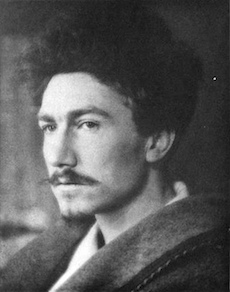
DPE72F  Ezra_Pound_Coburn.jpg


(Lionel Johnson via TLS; Pound c. 1913 by Alvin Langdon Coburn)

Reading Elif Batuman’s novel The Idiot, I came upon this: ‘On the train back, Svetlana told me about a Serbian movie director who had been friends with her father in Belgrade. The director’s wife, an actress, had gone to Paris to make a movie with a young French director. The French director had died tragically by falling off a barstool. “They said it might have been suicide,” Svetlana said.’[1]

The joke here is the improbable means of suicide, of course, but I was reminded of the sixth section of Ezra Pound’s Hugh Selwyn Mauberley, entitled ‘Siena Mi Fe’; Disfecemi Maremma’ [from Dante’s Purgatorio, ‘Sienna made me, Maremma undid me’]:

Among the pickled foetuses and bottled bones,
Engaged in perfecting the catalogue,
I found the last scion of the
Senatorial families of Strasbourg, Monsieur Verog.

For two hours he talked of Gallifet;
Of Dowson; of the Rhymers’ Club;
Told me how Johnson (Lionel) died
By falling from a high stool in a pub . . .[2]

‘Monsieur Verog’ is the poet and critic Victor Plarr, who was librarian of the Royal College of Surgeons from 1897 to his death in 1929, working for much of that time on the library catalogue. He was also a founder member of The Rhymers’ Club, which made him of interest to Pound, having stories to tell of Ernest Dowson (of whom he wrote a memoir), Lionel Johnson, Selwyn Image, Richard Le Gallienne and others.

K. K. Ruthven suggests that Katharine Tynan, the writer and friend of Yeats, ‘seems to have been responsible for the erroneous story that Johnson died after falling from a stool’.[3] Johnson did indeed die of a fall, though it was ‘not in a pub, but on Fleet Street’.[4]

Tynan

(Katharine Tynan via Wikipedia Commons)

Lionel Johnson (1867-1902) was a first cousin of Olivia Shakespear, mother of Pound’s wife Dorothy. His 1889 poem, ‘Lines to a Lady upon her Third Birthday’, is addressed to Dorothy—‘Dear Cousin: to be three years old,/ Is to have found the Age of Gold’[5]—and Pound wrote the preface to Johnson’s Poetical Works (1915). This was excluded from the American edition and also from later English printings, ‘apparently because it included extensive quotations from notes sent by Lionel Johnson to Katherine Tynan and printed by her after his death in the Dublin Review for October 1907.’ Johnson’s critical comments concerned several of his contemporaries, including Arthur Symons and Richard Le Gallienne, both still alive in 1915.[6] His notes are included, though, in ‘Lionel Johnson’, collected in Pound’s Literary Essays: ‘Baudelaire and Verlaine generally ring true, and their horrors and squalors and miseries and audacities have the value and virtue of touching the reader to something of compassion or meditation. Symons no more does that than a teapot. “This girl met me in the Haymarket, with a straw hat and a brown paper parcel, and the rest was a delirious delight: that girl I met outside a music hall, we had champagne, and the rest was an ecstasy of shame.” That is Symons.’

The teapot is a nice touch.

Pound’s praise foregrounds his explicit awareness that Johnson ‘cannot be shown to be in accord with our present doctrines and ambitions. His language is a bookish dialect, or rather it is not a dialect, it is a curial speech and our aim is natural speech, the language as spoken. We would write nothing that we might not actually say in life—under emotion. Johnson’s verse is full of inversions, but no one has written purer Imagisme than he has, in the line

Clear lie the fields, and fade into blue air.

It has a beauty like the Chinese.’[7]

Walking_on_Path_in_Spring

(Ma Yuan, Walking on a Mountain Path in Spring, 13th century)

Plenty to unpack here. Pound’s ‘our aim is natural speech, the language as spoken’ sits a little uncomfortably with some of his earlier pronouncements. ‘[W]e must have a simplicity and directness of utterance which is different from the simplicity and directness of daily speech, which is more “curial”, more dignified’, he wrote in 1912; and, ‘There are few fallacies more common than the opinion that poetry should mimic the daily speech.’ Again, in that same year: ‘Mr Hueffer [Ford Madox Ford] is so obsessed with the idea that the language of poetry should not be a dead language, that he forgets it must be the speech of to-day, dignified, more intense, more dynamic, than to-day’s speech as spoken’.[8] By 1914, then, when Pound was writing this introduction, the case was altered. Imagism had happened, Vorticism was happening and—‘a beauty like the Chinese’—the encounter with the Fenollosa notebooks, which resulted in the Noh plays and Cathay, had also engaged and enlarged Pound’s resources.

And that curious word ‘curial’? ‘Of or pertaining to a royal court; having the manners befitting a court; courtly’, the Oxford English Dictionary says. And, perhaps fittingly, ‘Obsolete’.[9] The papal curia – the administrative institutions through which the Catholic Church’s affairs are conducted – is certainly appropriate enough to the Roman Catholic convert Johnson, who introduced his cousin—Alfred Lord Douglas—to Oscar Wilde in the summer of 1891. He rather regretted it later.[10]

Quoting ‘In Memory. II’, the poem beginning:

Ah! fair face gone from sight,
With all its light
Of eyes, that pierced the deep
Of human night!
Ah! fair face calm in sleep.

Ah! fair lips hushed in death!
Now their glad breath
Breathes not upon our air
Music, that saith
Love only, and things fair

Pound presents it as an example of ‘poems as beautiful as any in English’ – though he leaves out some of Johnson’s ‘poetical’ exclamation marks. Those short lines and rhymes in such close proximity make me wonder if there’s any sense of affinity with the Provençal poems of Arnaut Daniel that Pound was translating, such as ‘Can Chai la Fueilla’:

When sere leaf falleth
from the high forkèd tips,
And cold appalleth
dry osier, haws and hips,
Coppice he strips
of bird, that now none calleth.   (Ezra Pound: Poems and Translations, 482)

He attends closely to Johnson the poet, while the man himself is a ghost transmitted to Pound through the spoken and written words of W. B. Yeats. Johnson is central to ‘The Tragic Generation’, a section of Yeats’s autobiographical The Trembling of the Veil. He recalled Johnson reading or speaking aloud ‘in his musical monotone, where meaning and cadence found the most precise elocution, his poem suggested by the Statue of King Charles at Charing Cross. It was as though I listened to a great speech.’

Charles I

(Equestrian statue of Charles I : Wikipedia Commons)

Comely and calm, he rides
Hard by his own Whitehall:
Only the night wind glides:
No crowds, nor rebels, brawl.

Gone, too, his Court: and yet,
The stars his courtiers are:
Stars in their stations set;
And every wandering star.

Alone he rides, alone,
The fair and fatal king:
Dark night is all his own,
That strange and solemn thing.     (Poetical Works of Lionel Johnson, 14)

Yeats wrote of the alcoholic Johnson’s drinking as well as the report that, ‘at the autopsy after his death’, he was discovered ‘never to have grown, except in the brain, after his fifteenth year’.[11] His 1936 broadcast, ‘Modern Poetry’, open with memories of The Rhymers’ Club: ‘Two members of the Club are vivid in my memory’, that is, Johnson and Ernest Dowson. Johnson was ‘determined, erect, his few words dogmatic, almost a dwarf but beautifully made, his features cut in ivory. His thought dominated the scene and gave the Club its character.’ Yeats recalled Johnson’s stories of all the famous statesmen, ecclesiastics and writers he had met and his eventual discovery that Johnson had never met them but had made it all up, that he would sit at night with a glass of whisky at his elbow, ‘imagining the puppets that were the true companions of his mind.’[12]

In the introduction to his selection for The Oxford Book of Modern Verse, Yeats quoted Johnson (‘Life must be a ritual’) and commenced the next section thus:

‘Then in 1900 everybody got down off his stilts; henceforth nobody drank absinthe with his black coffee; nobody went mad; nobody committed suicide; nobody joined the Catholic Church; or if they did I have forgotten.’[13] Stilts, of course, are not the legs of barstools. . .
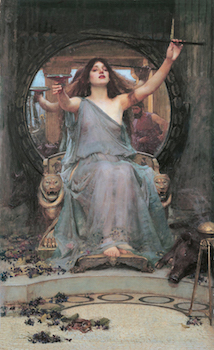
Circe, by John William Waterhouse

(J.W. Waterhouse, Circe Offering the Cup to Odysseus (Gallery Oldham)

Near the end of Pound’s Mauberley, we read of:

The unforecasted beach:
Then on an oar
read this:

“I was
And I no more exist;
Here drifted
An hedonist.”

It’s often noted that Johnson’s barstool fall earlier in Mauberley echoes the fatal descent of Elpenor in Homer’s Odyssey, drunk, tumbling down a ladder in Circe’s house. The youngest of Odysseus’s men, he is the first shade that Odysseus meets in the underworld. Homer’s Book XI is, of course, the one out of twenty-four that Pound selects as basis for his Canto I, in which Elpenor pleads to Odysseus:

‘But thou, O King, I bid remember me, unwept, unburied,
Heap up mine arms, be tomb by sea-bord, and inscribed:
A man of no fortune, and with a name to come.
And set my oar up, that I swung mid fellows.’

Elpenor’s name will be remembered, firstly, through the actions of the hero Odysseus but primarily through the words of the poet Homer. Mauberley’s name will be remembered through the words of the poet, Pound, who sees aspects of himself in Odysseus and wishes—as poet—to evade Mauberley’s fate and leave him far behind. So too the edition of Johnson’s poems, with Pound’s respectful and often laudatory introduction—which has its own afterlife—sets up an oar above Johnson’s own heaped arms.


Notes

[1] Elif Batuman, The Idiot (London: Vintage, 2018), 42.

[2] Ezra Pound: Poems and Translations, edited by Richard Sieburth (New York: Library of America, 2003), 553.

[3] K. K. Ruthven, A Guide to Ezra Pound’s Personae (1926) (Berkeley: University of California Press, 1983), 136.

[4] John Espey, Ezra Pound’s Mauberley: A Study in Composition (1955; Berkeley: University of California Press, 1974), 92.

[5] Poetical Works of Lionel Johnson (London: Elkin Mathews, 1915), 52. See Ezra Pound and Dorothy Shakespear: Their Letters, 1909-1914, edited by Omar Pound and A. Walton Litz (London: Faber and Faber, 1985), 83-84.

[6] Donald Gallup, Ezra Pound: A Bibliography, revised edition (Charlottesville: University of Press of Virginia, 1983), 140.

[7] Literary Essays of Ezra Pound, edited by T. S. Eliot (London: Faber and Faber, 1960), 365, 362. The phrase ‘under emotion’ recalls Pound’s letter to Harriet Monroe, editor of Poetry in January 1915—‘nothing that you couldn’t, in some circumstance, in the stress of some emotion, actually say’—with a 1937 footnote added to the letter: ‘It should be realized that Ford Madox Ford had been hammering this point of view into me from the time I first met him’: Selected Letters, 1907-1941, edited by D. D. Paige (New York: New Directions, 1971), 49.

[8] Ezra Pound, Selected Prose 1909-1965, edited by William Cookson (London: Faber and Faber, 1973), 41; review of Ford’s High Germany in Brita Lindberg-Seyersted, editor, Pound/Ford: The Story of a Literary Friendship (London: Faber & Faber 1982), 10.

[9] Herbert N. Schneidau, Ezra Pound: The Image and the Real (Baton Rouge: Louisiana State University Press, 1969), discusses the changing status of ‘curial’ in Pound’s prose and the shifts in attitude towards the language as spoken.

[10] Richard Ellmann, Oscar Wilde (London: Penguin Books, 1988), 306.

[11] W. B. Yeats, Autobiographies (London: Macmillan, 1955), 301, 310-311.

[12] W. B. Yeats, Essays and Introductions (London: Macmillan, 1961), 491, 492-493.

[13] W. B. Yeats, ‘Introduction’, The Oxford Book of Modern Verse, 1892-1935 (Oxford: Oxford University Press, 1936), x, xi.

Differences and pretexts

Crows

To his brother Julian, two months after the end of the First World War, Aldous Huxley wrote that freedom ‘is the only thing in the world worth having and the people who can use it properly are the only ones worthy of the least respect: the others are all madmen, pursuing shadows and prepared at any moment to commit acts of violence. The prospects of the universe seem to me dim and dismal to a degree.’[1]

The Guardian recently reported the results of a poll jointly conducted by academics from Cardiff University and the University of Edinburgh. They found that a majority of voters in England, Wales and Scotland surveyed ‘believe that the possibility of some level of violence against MPs is a “price worth paying” in order to get their way on Brexit’: of the Leave voters who took part in the study, this was true of 71% in England, 60% in Scotland and 70% in Wales. And all this just a little more than three years after the murder of MP Jo Cox by an extreme right-wing terrorist who shouted ‘Britain first!’ Perhaps even more depressing, the majority of remain voters also felt that the risk of violence towards MPs was worth it if it meant the United Kingdom would stay in the EU – 58% in England, 53% in Scotland and 56% in Wales.

(As a cheering footnote, voters overwhelmingly felt that the potential destruction of the country’s farming and fishing industries would also be a price worth paying for getting the result they wanted in the Brexit negotiations.)

https://www.theguardian.com/uk-news/2019/oct/24/majority-of-voters-think-violence-against-mps-is-price-worth-paying-for-brexit

To-West-Bay-Trees

‘The point to be made about the GREAT TRADE ROUTE’, Ford Madox Ford wrote to E. C. Cumberlege of Oxford University Press on 27 October 1936, ‘is that it is not the book of a meditative gentleman who stands before ruined temples and pours mournful soliloquies on old unhappy things, but as it were the testament of a man usually of action who has spent a long life not only on writing and study but on digging, editing, carpentry, cooking, small holding, fighting both literally and metaphorically and in every kind of intrigue that could advance what he considers to be the cause of good letters…’[2]

Great Trade Route was published by Oxford in January 1937 (and by Allen and Unwin in the United Kingdom). ‘But no sort of civilization is possible’, Ford writes there, ‘when difference of opinions can be considered a pretext for murder . . . or even for physical violence.’[3]

A good many political and social commentators have lately been asking: ‘What sort of country do we want to be?’ Or, perhaps more realistically: ‘What sort of country has this become?’ The answer to the first question must be: better than this. And the second? It’s complicated – at least, we hope so.


Notes

[1] Letters of Aldous Huxley, edited by Grover Smith (London: Chatto and Windus, 1969), 173-174.

[2] Ford Madox Ford, Letters of Ford Madox Ford, edited by Richard M. Ludwig (Princeton: Princeton University Press, 1965), 264.

[3] Ford Madox Ford, Great Trade Route (London: Allen & Unwin, 1937), 291.

Spaniels, Beards, Lapis Lazuli

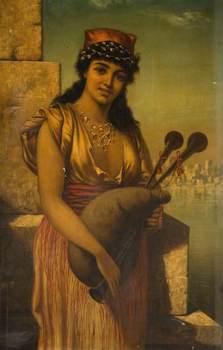
Delort, Charles Edouard, 1841-1895; Girl with Bagpipes . Long, Edwin, 1829-1891; Girl with Bagpipes

(Two examples of ‘Girl with bagpipes’, by Charles Edouard Delort, The Cooper Gallery, Barnsley; and Edwin Long, Wolverhampton Gallery)

Walking round the park, attempting to commit to memory – again, a few lines having fallen out of one ear – Louis MacNeice’s ‘Bagpipe Music’ (‘It’s no go the Yogi-Man, it’s no go Blavatsky,/ all we want is a bank balance and a bit of skirt in a taxi’).

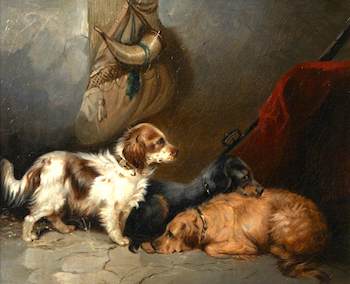
Men with dogs, women with dogs, men with men and with women, women with women, all with dogs. Sometimes, the people in view are outnumbered by the dogs, though all are outnumbered by the trees – a positive feature of a park, I’d say. This was lunchtime. Earlier in the day, I often pass the man with three spaniels—one Springer, I think, and perhaps two Cavalier King Charles. He wears a Fedora that has seen long service rather than a cap but still fits comfortably into my standard image of the sea-captain. An actor named John Hewer played Captain Birdseye in the television adverts for thirty years (he died in 2008) and is probably the version that I best remember, though his beard was far less luxuriant than that of Captain Spaniels.

Armfield, George, 1810-1893; Spaniels in a Barn Interior

(George Armfield, ‘Spaniels in a Barn Interior: Torre Abbey Museum)

Writing to her brother Warner (‘Dear Badger’) in 1915, Marianne Moore reported: ‘I brought home Hueffer’s [Ford Madox Ford’s] Memories and Impressions, a pearl of a book in which Hueffer tells about the Pre-Raphaelites and his grandfather who looked “exactly like the king of hearts on a pack of cards,” and Morris who said “Mary those six eggs were bad. I ate them but don’t let it happen again.” He says they all looked like old fashioned sea captains and Morris was gratified beyond measure on several occasions at being stopped by sailors and questioned with regard to their shipping with him.’[1]

And so he did. In Ancient Lights, the book’s British title, Ford writes that the members of that ‘old, romantic circle’, the Pre-Raphaelites and those associated with them, ‘seem to me to resemble in their lives—and perhaps in their lives they were greater than their works—to resemble nothing so much as a group of old-fashioned ships’ captains.’ He recalls the last time he met William Morris, who told Ford ‘that he had just been talking to some members of a ship’s crew whom he had met in Fenchurch Street. They had remained for some time under the impression that he was a ship’s captain. This had pleased him very much, for it was his ambition to be taken for such a man.’[2]

Of his collaborator Joseph Conrad, Ford wrote that he ‘never presented any appearance of being a bookish, or even a reading man. He might have been anything else; you could have taken fifty guesses at his occupation, from, precisely, ship’s captain to, say, financier, but poet or even student would never have been among them and he would have passed without observation in any crowd. He was frequently taken for a horse fancier. He liked that.’ And: ‘His ambition was to be taken for—to be!—an English country gentleman of the time of Lord Palmerston.’[3]

Now, of course, writers and artists look and dress much the same as anybody else, as you’d expect. But there was a time when some artists wanted to look like artists – while some wanted to look like anything but. What is it, though, about those sea captains? A maritime nation? All the nice girls love a sailor? J. M. W. Turner was another one, in later life compared to a sailor, a farmer, a coachman, a steamboat captain, a North Sea pilot. Robert Bontine Cunningham Grahame, though—writer, adventurer, first president of the National Party of Scotland in 1928—looked, Douglas Goldring remembered, ‘like a Spanish hidalgo.’[4]

Carola-Rackete

(Not all ship’s captains fit the template: this is Carole Rackete, captain of a rescue ship carrying 40 people, who broke a blockade and courageously docked Sea-Watch 3 on the island of Lampedusa after a two-week standoff with the Italian authorities, and in defiance of a ban imposed by the right-wing interior-minister Matteo Salvini (since replaced)
(Photograph : Sea Watch Mediateam via The Guardian)
https://www.theguardian.com/world/2019/jun/29/sea-watch-captain-carola-rackete-arrested-italian-blockade

Conrad had, of course, actually been a ship’s captain; and, if T. S. Eliot looked like a banker or a publishing executive, there was a reason for it. Wallace Stevens no doubt appeared like an insurance executive. Beatrix Potter, after a dozen years of artistic productivity, married and became a farmer, breeding Herdwick sheep and increasingly recognised as an expert in her field: ‘So long as she could live and look like a farmer, she asked no better’.[5]

Ezra Pound, on the other hand, looked like – A Poet. ‘He ordered a snug-waisted full-skirted overcoat of tweed, the blue of delphiniums, and the buttons were large square pieces of lapis lazuli.’[6] Or rather, Ezra ‘would approach with the step of a dancer, making passes with a cane at an imaginary opponent. He would wear trousers made of green billiard cloth, a pink coat, a blue shirt, a tie hand-painted by a Japanese friend, an immense sombrero, a flaming beard cut to a point, and a single, large blue earring.’[7]

Richard Cassell, in conversation with Pound at St. Elizabeths in 1951, recorded that: ‘Ford would take Pound to the drawing rooms of everyone who would accept him, Ford dressed in top hat and swallow-tailed coat, Pound in anybody’s cast-off clothes and old velvet jacket. “The next day, more than likely, Ford would be among his pigs. He was both the lord of the Cinque Ports and a simple farmer.”’[8]

David-Jones.Spectator

(David Jones, via The Spectator)

William Blissett recalled, of one of his visits to David Jones, ‘A couple of anecdotes over tea. Evelyn Waugh (who was very shy and embarrassed if surprised in one of his many kindnesses) took David aside some years ago and remonstrated with him for brushing his hair down over his forehead. “You look like a bloody artist,” he said, to which the only possible reply was, “But I am a bloody artist.”’[9] Waugh, it’s safe to say, did not generally look like a bloody artist. Still, brushing your hair forward certainly requires less financial outlay than tweed or lapis lazuli.

 
Notes

[1] The Selected Letters of Marianne Moore, edited Bonnie Costello, Celeste Goodridge and Cristanne Miller (London: Faber and Faber, 1998), 99.

[2] Ford Madox Ford, Ancient Lights and Certain New Reflections (London: Chapman and Hall, 1911), 17-18.

[3] Ford Madox Ford, Joseph Conrad: A Personal Remembrance (London: Duckworth, 1924), 57-58.

[4] Peter Ackroyd, Turner (London: Vintage 2006), 25-26; Douglas Goldring, South Lodge: Reminiscences of Violet Hunt, Ford Madox Ford and the English Review Circle (London: Constable, 1943), 33.

[5] Margaret Lane, The Tale of Beatrix Potter (1946; Harmondsworth: Penguin Books, 1962), 173.

[6] Brigit Patmore, My Friends When Young, edited with an introduction by Derek Patmore (London: Heinemann, 1968), 61.

[7] Ford Madox Ford, Return to Yesterday: Reminiscences 1894-1914 (London: Victor Gollancz, 1931), 370.

[8] Richard A. Cassell, ‘A Visit with E. P.’, Paideuma, 8, 1 (1979), 67. One or two of these reported facts should be approached warily, and perhaps with the step of a dancer.

[9] William Blissett, The Long Conversation: A Memoir of David Jones (Oxford: Oxford University Press, 1981), 61.


Smelling a rat

H-ratting

(Harry, student of current affairs, smelling a rat)

I was thinking again about rats, prompted not only by the current political situation, though that possesses strong indicators, but, in the first instance, by seeing a brown rat—not the endangered black rat—shoot across the garden and, on a later occasion, help itself to seeds on the bird table, having shinned up a long, smooth pole to reach it. I invited the cat to deal with the situation (perhaps you know the story of James Joyce and Ernest Hemingway out on the town in Paris, where the half-blind Joyce would get into fights, be unable to locate his opponent and simply say ‘Deal with him, Hemingway, deal with him!’)—but Harry showed no inclination to do so. It was not a particularly small rat.

The second instance was my nightly reading to the Librarian, not for the first time, Conan Doyle. Devotees of the Sherlock Holmes stories will recall that, in ‘The Adventure of the Sussex Vampire’, Holmes alludes to the giant rat of Sumatra, ‘a story for which the world is not yet prepared.’ Leslie Klinger notes the discovery made by Guy G. Musser and Cameron Newcomb of a species Sundamys infraluteus, weighing in excess of 22 pounds and 24 inches long (including the tail), a discovery reported in a 270-page article in 1983.

Then too there is ‘The Boscombe Valley Mystery’:

‘The Coroner: Did your father make any statement to you before he died?
Witness: He mumbled a few words, but I could only catch some allusion to a rat.
The Coroner: What did you understand by that?
Witness: It conveyed no meaning to me. I thought that he was delirious.’

Later, Watson asks Holmes: ‘What of the rat, then?’ His friend produces a map of the Colony of Victoria (he has wired to Bristol for it the previous night).

‘He put his hand over part of the map. “What do you read?”
“ARAT,” I read.
“And now?” He raised his hand.
“BALLARAT.”’

Aha! That was Charles McCarthy trying to utter the name of his murderer, John Turner, formerly Black Jack of Ballarat. [1]

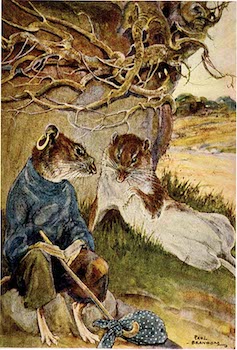
Rats are affectionately observed or referenced by Colette—‘I have a little Rat [Colette de Jouvenel, otherwise Bel-Gazou, born 3 July 1913], and I have paid the price: thirty hours without respite, chloroform and forceps’[2]—and Kenneth Grahame, whose The Wind in the Willows appeared in 1908, though his rat was a water-vole.

Paul-Bransom-Wind-Willows

(Paul Bransom, from The Wind in the Willows)

The First World War, specifically life in the trenches on the Western Front, introduced new rat-perspectives, from David Jones:

You can hear the silence of it:
you can hear the rat of no-man’s-land
rut-out intricacies,
weasel-out his patient workings,
scrut, scrut, sscrut,
harrow out-earthly, trowel his cunning paw;
redeem the time of our uncharity, to sap his own amphibious paradise.[3]

and from Isaac Rosenberg, in ‘Break of Day in the Trenches’ (‘Only a live thing leaps my hand,/ A queer sardonic rat’).

Rats—and ferrets—bulked fairly large in Ford Madox Ford’s war too. When a French Minister in wartime Paris asked how he could be of use to Second Lieutenant Hueffer, Ford expressed his desire for some ferrets. ‘First of everything in the world—of everything in the whole world!—comes your battalion. And the ferrets of my battalion had all died suddenly; and the last thing they had said to me had been: Don’t forget to get us some ferrets. If you had seen the rats of Locre you would have understood.’ But, he adds, ‘the Minister had not seen the rats of Locre so he had not understood…. ’[4] Closer to the time of that ministerial incomprehension—‘“Quoi,” he asked. “What is a ferret?”’—the Francophile Ford wrote: ‘There are no ferrets in France, not in the Ministries, not in the Jardin des Plantes et d’Acclimatation. That is perhaps a defect of France, but I have perceived no other.’[5]

Another species of entente cordiale had emerged in the sixteenth century, with John Florio’s translation of the Essays of Michel de Montaigne. Sarah Bakewell writes: ‘But while Montaigne always moved forward, Florio winds back on himself and scrunches his sentences into ever tighter baroque spirals until their meaning disappears in a puff of syntax. The real magic happens when the two writers meet. Montaigne’s earthiness holds Florio’s convolutions in check, while Florio gives Montaigne an Elizabethan English quality, as well as a lot of sheer fun.’ So, ‘Where Montaigne writes, “Our Germans, drowned in wine” (nos Allemans, noyez dans le vin), Florio has “our carowsing tosspot German souldiers, when they are most plunged in their cups, and as drunke as Rats”’. And, wonderfully, ‘A phrase which the modern translator Donald Frame renders calmly as “werewolves, goblins, and chimeras” emerges from Floriation as “Larves, Hobgoblins, Robbin-good-fellowes, and other such Bug-beares and Chimeraes” – a piece of pure Midsummer Night’s Dream.’

Miranda_-_The_Tempest_JWW

(J. W. Waterhouse, Miranda)

And yes, as she goes on to say, Shakespeare did know John Florio, ‘was among the first readers of the Essays translation’ and left strong traces of that reading in several of his plays.[6] Or, if not Montaigne, then rats:

A rotten carcase of a butt, not rigg’d,
Nor tackle, sail, nor mast; the very rats
Instinctively have quit it (The Tempest, I, ii)


Notes

[1] Arthur Conan Doyle, The New Annotated Sherlock Holmes, 2 volumes, edited with notes by Leslie S. Klinger (New York and London: W.W. Norton and Company 2005), II, 556-557; I, 111, 125.

[2] To Georges Wague, mid-July 1913: Colette, Letters from Colette, selected and translated by Robert Phelps (London: Virago Press, 1982), 36.

[3] David Jones, In Parenthesis (1937; London: Faber, 1963), 54.

[4] Ford Madox Ford, No Enemy (1929; edited by Paul Skinner, Manchester: Carcanet Press, 2002), 133.

[5] Ford Madox Ford, ‘Trois Jours de Permission’, in War Prose, edited by Max Saunders (Manchester: Carcanet Press, 1999), 51. The editor points out in his headnote (49) that the ferrets recur in several other Ford works. The story of ‘Ford’s rat’ is in Joseph Conrad (1924), 40-41.

[6] Sarah Bakewell, How To Live: A Life of Montaigne in one question and twenty attempts at an answer (London: Vintage 2011), 277-279.


The chosen destination

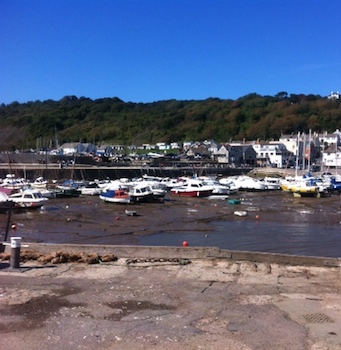
Lyme130919

The first strikingly cold day—when the heating takes an executive decision to fire itself up—renders the summer immediately distant. Complaints about humidity, the constant swallowing of water to ward off dehydration, the absurdity of pocketless clothes—all fled away. As for our last escape to the sea, that final foray in convincing summer weather, was it a week ago, two, more?

Lyme Regis is the chosen destination these days when we retreat to the sea. Retreat or advance? Katabasis or Anabasis? There are the odd days to recover from, or seek to outdistance, the mental breakdown currently being undergone by the United Kingdom. Otherwise, the more durable points are November, for the Librarian’s birthday, and sometimes, in early June, for the birthday, not of Thomas Hardy (nor that of Edward Elgar, Barbara Pym, John Lehmann or the Marquis de Sade) but of the Librarian’s mother. This involves a good deal of driving, or being driven, through Mr Hardy’s county although, as far as I’m aware, he never mentions Lyme in his writings, despite having visited the town twice, possibly three times.

Stretching eyes west
Over the sea,
Wind foul or fair
Always stood she
Prospect-impressed;
Solely out there
Did her gaze rest
Never elsewhere
Seemed charm to be.[1]


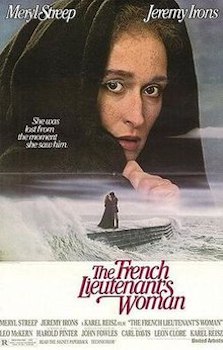
Fowles--french-lieutenants-pb    French_lieutenants_woman-film

The town’s more familiar literary associations now are with John Fowles’ long residence in the town and his 1969 novel The French Lieutenant’s Woman, filmed by Karel Reisz in 1981 with a script by Harold Pinter, starring Meryl Streep and Jeremy Irons. In Jane Austen’s Persuasion, Louisa Musgrove falls from the Cobb and suffers a serious concussion. There is also, on a wall in Church Street, a plaque commemorating the occasion, on 11 November 1725, when the novelist Henry Fielding, with the assistance of his servant, tried to abduct Sarah Andrew (a distant cousin of whom he was enamoured), as she was walking to church with Andrew Tucker and his family. That is also, of course, the Henry Fielding who eventually became London’s chief magistrate and, with his half-brother John, founded the Bow Street Runners, the first police force in London.

We walk to the Cobb, sit or lean against the wall, watch the waves, boats, kayaks, swimmers, dogs, walkers and all those people busily engaged with fish and chips. Some places become uncomfortable very quickly when crowded – but somehow Lyme seems not to, perhaps because of the several beaches. And there is not only the sweeping sea view, the harbour, the Cobb itself, but also the public gardens, the beach huts, the sense of cohesion and singleness deriving in part from the steep roads down into Lyme so there’s never the feeling of its merely being on the way to somewhere else.

Lyme has spectacular scenery all around it and a nice spot from which you’re directed to view Charmouth, West Bay, Golden Cap, Portland. The Cobb is Lyme’s famous curving harbour wall, originally dating back to the thirteenth century, and is where the French Lieutenant’s woman stood; it’s certainly where we take our fish and chips—from Herbie’s, among the best you’ll taste but one portion will cater for two people unless their appetites are matters of record with local or national newspapers.

Lyme is first mentioned in 774, in connection with a manor granted to Sherborne Abbey and received a Royal Charter in 1284 from Edward I (6 feet 2 inches and thus ‘Longshanks’). Edward was also known as the ‘Hammer of the Scots’—and was the conqueror of Wales, which caused the poet and artist David Jones, aged twelve and ‘careful that no one was looking’, to spit on his tomb in Westminster Abbey.[2]

William_Hogarth_Coram

(William Hogarth, Thomas Coram: Foundling Museum)

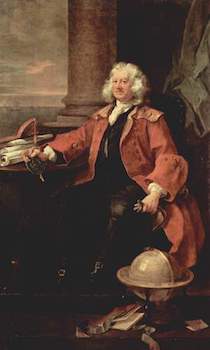
It was the birthplace of Thomas Coram, whose portrait by William Hogarth was presented by the artist in 1740 to the Foundling Hospital which the retired shipwright Coram began , appalled by the numbers of abandoned children in the streets of London. Sir George Somers, discoverer of the Bermudas was also born here: when he died, he was Admiral of the West Virginia Company fleet ‘and accidental inspirer of Shakespeare’s last play, The Tempest.’[3] One of his shipmates, Silvester Jourdain, wrote the first published account of the voyage and the shipwreck, Discovery of the Barmudas: The Isle of Devils, one of the three publications cited by Frank Kermode as being ‘directly relevant to The Tempest.’[4]

The remarkable fossil hunter and palaeontologist Mary Anning is another celebrated Lyme native. Born in 1799 into a poor family, she would operate with marked success in a field dominated by men, at a time when science ‘was still largely the province of the leisured gentleman amateur.’ An increasing numbers of visitors to Lyme, to meet Mary Anning and see her collections included Louis Agassiz and the King of Saxony. Fossil-hunting on the shore there was a hard and often dangerous affair but she had ‘the sharpest eyes in the business’, patience, persistence, courage and physical strength. She discovered Ichthyosaurs, Plesiosaurs, a Pterodactyl, fossil fish and coprolites. She died at the age of 47 and is buried in the churchyard of St Michael the Archangel, which has memorial windows for her and for Thomas Coram.[5]

Mary-Anning-via-BBC

(Mary Anning and her dog Tray via BBC)

On this last visit of the season, Lyme was looking its best, the air clear, the views long, the sea literally dazzling, even distant Portland standing out sharply. On the debit side, the Librarian was the victim of two attacks by Lyme’s already infamous seagulls: bombed once and raided once, the first occasion best not talked about, the second seeing the abrupt and violent theft of her ice-cream, the cornet whittled down to the perfect size and state—then gone, one swoop, one beak.

We already knew that the latest advice was to stare seagulls out – can this really work? But the Lyme seagulls have heard all that stuff in any case: they come from behind or from the side. Try staring me out now, sucker.

Next year: helmets and umbrellas.


Notes

[1] Thomas Hardy, ‘The Riddle’, The Complete Poems, edited by James Gibson (London: Macmillan, 1976), 448. John Fowles uses this stanza as epigraph to the opening chapter of The French Lieutenant’s Woman.

[2] Thomas Dilworth, David Jones: Engraver, Soldier, Painter, Poet (London: Jonathan Cape, 2017), 15.

[3] John Fowles, A Short History of Lyme Regis (Stanbridge: The Dovecote Press, 2004), 18; also his ‘Islands’, in Wormholes: Essays and Occasional Writings, edited by Jan Relf (London: Jonathan Cape, 1998), 304-309.

[4] The Arden edition of Shakespeare’s The Tempest, edited by Frank Kermode (London: Methuen, 1987), xxvii.

[5] Information from Crispin Tickell, Mary Anning of Lyme Regis, with a foreword by John Fowles (Lyme Regis Philpot Museum, 1996), 11, 18.

Not outrunning the Constable

Cottage-Cornfield-VandA

(John Constable, The Cottage in a Cornfield: V & A)

(To outrun the constable: to go too fast or too far—Eric Partridge, A Dictionary of Slang and Unconventional English)

What might we have recourse to, after a week of prime ministerial rabble-rousing and incitement to violence and the continued, programmatic fracturing of a nation? Le vin, ça va sans dire—or a visit to Bristol Old Vic, to see six talented women play twenty-one roles in Pride and Prejudice* (Sort of)*, at which I laughed like a lunatic—perhaps even a slightly morose thinking about Englishness—‘“Englishness”, however, is a term that has no fixed meaning but is instead made and re-made in and through history’.[1]

I was browsing through art books and looking at the pictures of John Constable. The combative Geoffrey Grigson once asserted that Constable ‘remains the artist the English have most reason to be proud of and thankful for, without reservation.’[2]

Constable, in his quietly revolutionary way, painted what was in front of his eyes, usually in localities that he knew intimately and loved greatly. And the local, to a greater or larger extent, containing the universal is a familiar enough theme, from Gilbert White through Thomas Hardy to William Faulkner and William Carlos Williams.

‘How much I wish I had been with you on your fishing excursion in the New Forest!’ Constable wrote in 1831 to his close friend, John Fisher. ‘What river can it be? But the sound of water escaping from mill-dams, etc., willows, old rotten planks, slimy posts, and brickwork, I love such things. Shakespeare could make everything poetical; he tells us of poor Tom’s haunts among “sheep cotes and mills” [King Lear]. As long as I do paint, I shall never cease to paint such places. They have always been my delight [ . . . ] Still, I should paint my own places best; painting is with me but another word for feeling, and I associate “my careless boyhood” with all that lies on the banks of the Stour’.[3]
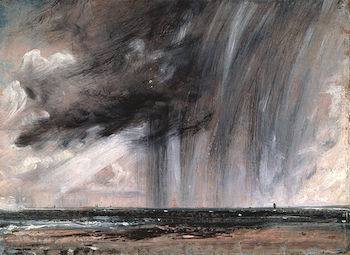
Born in the village of East Bergholt, on the River Stour in Suffolk, son of a prosperous corn merchant, who owned Flatford Mill in East Bergholt and, later, Dedham Mill, Constable painted many pictures of East Bergholt and of Dedham Vale, pictures too of mills, clouds, cottages, cornfields, Hampstead, Brighton, Salisbury Cathedral, and even clouds above cottages in cornfields. He was a great student of clouds.

Constable-Seascape-Raincloud

(John Constable, Seascape Study with Raincloud: Royal Academy of Arts)

During his lifetime, Constable had no great success, not, at least, with an English audience. As late as the last decade of his life, he wrote to his future biographer: ‘Varley, the astrologer, has just called on me, and I have bought a little drawing of him. He told me how to “do landscape,” and was so kind as to point out all my defects. The price of the drawing was “a guinea and a half to a gentleman, and a guinea only to an artist,” but I insisted on his taking the larger sum, as he had clearly proved to me that I was no artist’.[4] Still, though unsold at the 1821 Royal Academy show, The Hay Wain (shown together with View on the Stour Near Dedham and one of Constable’s views of Yarmouth Jetty) was awarded a gold medal at the Paris Salon of 1824, presented by Charles X. The Hay Wain hugely impressed Théodore Géricault and influenced Eugène Delacroix.[5] Originally called Landscape: Noon and produced over a relatively short space of time to meet an exhibition deadline, it has permeated the national consciousness to the extent that a 2005 BBC poll to determine the most popular painting in any British gallery placed it second behind Turner’s Fighting Temeraire.

Constable has certainly suffered more than most from over-familiarity with what are regarded in his work as a quintessential Englishness and scenes of a timeless and untroubled rural world. Peter Kennard’s famous Hay Wain with Cruise Missiles (Chromolithograph and photographs on paper, 1980: Tate) derived much of its power from precisely those perceived qualities. Inevitably, such popularity had its negative effects. In ‘Going to the Pictures’, Alan Bennett remembered that, ‘Besides the Dutch landscapes, which I was exposed to too young, there were other casualties of inept or promiscuous reproduction. I don’t like The Hay Wain because it featured on a table mat at home.’[6]

The Hay Wain

(John Constable, The Hay Wain: National Gallery)

‘The first time I met him was in the year 1844 at the Academy on one of the varnishing days. I am enabled to fix the date because of the picture he exhibited that year, which was that entitled “Rain, Steam and Speed.” I watched him working on this picture. He used rather short brushes, a very messy palette, and, standing very close up to the canvas, appeared to paint with his eyes and nose as well as his hand. Of course he repeatedly walked back to study the effect. Turner must, I think, have been fond of boys, for he did not seem to mind my looking on at him; on the contrary, he talked to me every now and then, and pointed out the little hare running for its life in front of the locomotive on the viaduct. This hare, and not the train, I have no doubt he intended to represent the “Speed” of his title; the word must have been in his mind when he was painting the hare, for close to it, on the plain below the viaduct, he introduced the figure of a man ploughing, “Speed the plough” (the name of an old country dance) probably passing through his brain.’[7]

Turner-Rain-Steam-NG

(J. M. W. Turner, Rain, Steam and Speed: National Gallery)

This is George Dunlop Leslie, RA, genre painter and illustrator—son of Constable’s biographer Charles Robert Leslie—nine years old at the time of which he writes. In fact, the National Gallery website notes that: ‘Turner lightly brushed in a hare roughly midway along the rail track to represent the speed of the natural world in contrast to the mechanised speed of the engine. The animal is now invisible as the paint has become transparent with age, but it can be seen in an 1859 engraving of the painting.’
https://www.nationalgallery.org.uk/paintings/joseph-mallord-william-turner-rain-steam-and-speed-the-great-western-railway

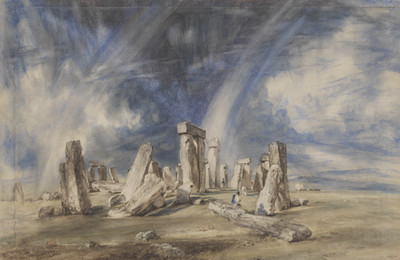
Turner and Constable. Writing to Harman Grisewood in 1972, the poet and artist David Jones wrote of a chance acquaintance that ‘his cut of suit suggested the turf—but then so did that of Sickert, which did not prevent him from being the best English painter since Turner (in my view).’ Still, eleven years earlier, Jones had remembered: ‘I was encamped very near Stonehenge early in the First War, before going to France, and must confess to not finding it very impressive. I like Constable’s picture of it, though.’[8]

2015HW5111

(John Constable, Stonehenge: Victoria and Albert Museum)

‘I have made a beautiful drawing of Stonehenge’, John Constable wrote to Leslie in September 1836, and made several other studies before producing the watercolour now in the Victoria and Albert Museum collection. ‘He always kept the influence of earlier masters on his own work under close control’, Raymond Lister writes, ‘and though Stonehenge, for instance, contains a suggestion of Meindert Hobbema in the plein air rendering, it remains Constable’s conception and could not have been painted by any other artist.’[9]

It was, apparently, in 1819—the birth year of Turner’s great champion, John Ruskin—that a critic first compared Constable’s painting with Turner and, ‘again for the first time a critic attempted to liken Constable’s painting with the great tradition of rustic landscape associated with Ruisdael and Meindert Hobbema.’[10]

Hobbema: painter of trees, mills, woods and cottages. Constable was not uncritical of him but, replying to Fisher’s advice to ‘diversify your subject this year as to time of day’—‘People get tired of mutton at top, mutton at bottom, and mutton at the side, though the best flavour and smallest size’—he wrote that he himself didn’t enter into ‘that notion of varying one’s plans to keep the public in good humour.’ He went on: ‘Change of weather and effect will always afford variety. What if Vander Velde had quitted his sea pieces, or Ruysdael his waterfalls, or Hobbema his native woods. The world would have lost so many features in art’ (Leslie 131). Half a century after Constable’s death, Vincent van Gogh wrote to his brother Theo, then in London:

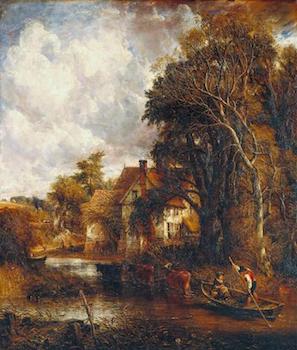
‘Now I for my part have always remembered some English pictures such as “Chill October” by Millais and, for instance, the drawings by Fred. Walker and Pinwell. Just notice the Hobbema in the National Gallery; you must not forget a few very beautiful Constables there, including “Cornfield,” nor that other one in South Kensington called “Valley Farm.”’[11]

The Valley Farm 1835 by John Constable 1776-1837

(John Constable, Valley Farm: Tate)

Unfortunately for Constable, Ruskin, who became the most influential art critic in the country, was consistently highly critical of him, claiming that he could not draw and was not accurate or specific enough in rendering the details of the natural world. A major factor in this evaluation was that he was combatting the great claims made by C. R. Leslie who, by setting Constable higher than Turner, prompted Ruskinian counter-attacks.

‘Unteachableness seems to have been a main feature of his character, and there is corresponding want of veneration in the way he approaches nature herself’, Ruskin asserted. Having found no signs of Constable ‘being able to draw’, this resulted in ‘even the most necessary details’ being ‘painted by him inefficiently.’ Then: ‘His works are also eminently wanting both in rest and refinement: and Fuseli’s jesting compliment[12] is too true for the showery weather, in which the artist delights, misses alike the majesty of storm and the loveliness of calm weather; it is great-coat weather, and nothing more. There is strange want of depth in the mind which has no pleasure in sunbeams but when piercing painfully through clouds, nor in foliage but when shaken by the wind, nor in light itself but when flickering, glistening, restless and feeble. Yet, with all these deductions, his works are to be deeply respected, as thoroughly original, thoroughly honest, free from affectation, manly in manner, frequently successful in cool colour, and realizing certain motives of English scenery with perhaps as much affection as such scenery, unless when regarded through media of feeling derived from higher sources, is calculated to inspire.’[13]

That ‘want of veneration’ and ‘feeling derived from higher sources’ hint at some of the criteria Ruskin was applying – though he would suffer a temporary loss of faith in the next decade, at this stage the recognition and appreciation of beauty was inseparable—and indispensable—in his eyes from the worship of God. Constable was not reverent enough and his painting did not explicitly transfigure. ‘The great vice of the present day is bravura, an attempt to do something beyond the truth’, he wrote to John Dunthorne (Leslie 15) and that ‘truth’ remained his concern, even if this makes his pictures seem undramatic to his audience, too easy at first glance to interpret and digest, We might occasionally wonder ‘where is it?’ when looking at a Constable landscape – but rarely ‘what is it?’ as prompted by some Turner canvases and sketches. There is surely room for both: the viewer, after all, moves through different ages, moods, states of mind, of knowledge, of experience, of taste. We should be able to manage Turner, Constable – and John Ruskin too.

 
Notes

[1] Frances Spalding, John Piper, Myfanwy Piper: Lives in Art (Oxford: Oxford University Press, 2009), 189.

[2] Geoffrey Grigson, Britain Observed: The Landscape Through Artists’ Eyes (London: Phaidon Press, 1975), 93.

[3] Constable to Archdeacon John Fisher, 23 October 1831: C. R. Leslie, Memoirs of the Life of John Constable: Composed Chiefly of His Letters (1845; edited by Jonathan Mayne, London: Phaidon Press, 1951), 85-86.

[4] Leslie, Memoirs of the Life of John Constable, 194.

[5] Constable: The Great Landscapes, edited by Anne Lyles (London: Tate Publishing, 2006), 140, 142.

[6] Alan Bennett, Untold Stories (London: Faber and Faber and Profile Books, 2005), 463.

[7] G. D. Leslie, The Inner Life of the Royal Academy (London: John Murray, 1914), 144-145.

[8] Letter to Juliet and Richard Shirley Smith, 17 August 1961: Anthony Hyne, David Jones: A Fusilier at the Front (Bridgend: Seren, 1995), 30.

[9] Raymond Lister, British Romantic Painting (Cambridge: Cambridge University Press, 1989), Plate 37.

[10] Anne Lyles, ‘Soliciting Attention: Constable, the Royal Academy and the Critics’, in Constable: The Great Landscapes, 36.

[11] The Complete Letters of Vincent van Gogh, second edition, three volumes (London: Thames & Hudson, 1978), II, 300.

[12] ‘Speaking of me, he says, “I like de landscapes of Constable; he is always picturesque, of a fine colour, and de lights always in de right places; but he makes me call for my greatcoat and umbrella.”’ Constable, letter of 9 May 1823: Leslie, 101.

[13] John Ruskin, Modern Painters, Volume 1, edited by E. T. Cook and Alexander Wedderburn (London: George Allen, 1903), 191.


Endings also

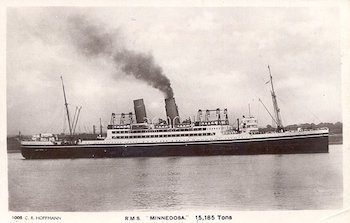
Minnedosa

(The Minnedosa via www.greatships.net )

On the night of 22 September 1927, off Labrador, aboard Canadian Pacific S. S. Minnedosa, Ford Madox Ford wrote to Stella Bowen in Paris: ‘Darling: I finished Last Post ten minutes ago: I am tired out but quite well and awfully happy!’

The fourth and last part of his masterpiece Parade’s End, Last Post, while concerned with new beginnings—for Christopher Tietjens, for Valentine Wannop and the child she is carrying, and for England—is deeply engaged with endings also, both within and without the book itself, not least, the closing of his ten-year life with Stella. She would write to him in New York a few months later, ‘But your letter, & the “Last Post” together, seem to mark the end of our long intimacy, which did have a great deal of happiness in it for me’[1]

stella-bowen

(Stella Bowen: https://www.nationaltrust.org.au )

Exactly thirty-seven years later, 22 September 1964, Hugh Kenner wrote to Guy Davenport that he was reading Evelyn Waugh’s authorized biography of the Catholic theologian and author Ronald Knox. Knox was ‘the darling child of the gone world’ and ‘like so many Englishmen of that generation was the end of something. Literally every single Oxford crony of his fell in W.W.I, having enjoyed only a few months of free manhood and commenced, with Ronnie, to found the future.’ He went on: ‘We are apt to forget how devastated was the landscape over which the Pound Era seized hegemony.’ While Pound and Eliot, as Americans, were noncombatants, the Irish Joyce had sat out the war in Europe and Wyndham Lewis (British mother, American father) had served in the war but survived, ‘the English generation corresponding to theirs was annihilated: how thoroughly, till I read Knox’s life, I had never before realized.’

Kenner and his first wife, Mary-Jo, were received into the Catholic Church that month: Mary-Jo was in her final illness, suffering from spinal cancer, and though she was at home when Kenner wrote again on 28 September, he feared it would be temporary. ‘The statistical likelihood is of course that it has metastasized already. We are all dying, but at different rates.’[2] She died six weeks later.

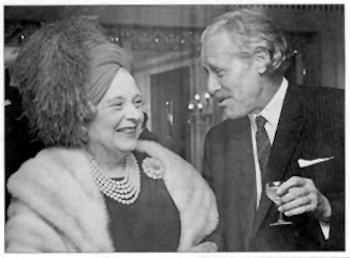
wheeler-cartland

(Sir Mortimer Wheeler with Barbara Cartland)

Then too, ‘every single Oxford crony’ reminded me of Charlotte Higgins writing about Mortimer Wheeler, who became the archaeologist best-known to the British public, not least because of his appearances on the 1950s television show, Animal, Vegetable, Mineral: in 1954, he was the BBC’s first television personality of the year.

Wheeler, Higgins observed, ‘had a good war and emerged a major. But by 1918 his generation, he recalled in his memoir, “had been blotted out”. He wrote: “Of the five university students who worked together in the Wroxeter excavations, only one survived the war. It so happened that the survivor was myself.” The “Oxford Blues” were dead.’ Wheeler himself was not an Oxford man but had studied at University College London, taught Latin by the poet and classicist A. E. Housman.[3]

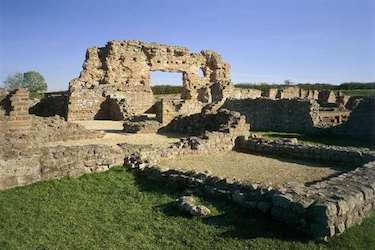
One visitor to the Wroxeter excavations—the village occupies a portion of what was once Uriconium, the fourth largest Roman town in Britain—in the summer of 1913 was Wilfred Owen. He met several of those working there, probably including Wheeler, though he felt ‘miserably jealous of two of them, who were from Oxford.’[4]

Wroxeter-English-Heritage

(Wroxeter via English Heritage)

It lieth low near merry England’s heart
Like a long-buried sin; and Englishmen
Forget that in its death their sires had part.
And, like a sin, Time lays it bare again
To tell of races wronged,
And ancient glories suddenly overcast,
And treasures flung to fire and rabble wrath.[5]

Owen’s end came just five years later on 4 November 1918 as he crossed the Oise-Sambre canal in northern France—the telegram announcing his death arrived at the family home on Armistice Day, one week later.

Before all else, though, the date on the calendar prompts thoughts of my sister. Had she lived, she would have been seventy-four today, so, though there is hardly a need for more reasons to raise a glass in these benighted times – santé, Penny.


Notes

[1] Correspondence of Ford Madox Ford and Stella Bowen, edited by Sondra J. Stang and Karen Cochran (Bloomington: Indiana University Press, 1993), 320, 373.

[2] Questioning Minds: The Letters of Guy Davenport and Hugh Kenner, edited by Edward M. Burns, two volumes (Berkeley: Counterpoint Press, 2018), I, 618, 620. Kenner’s phrase, ‘the gone world’, occurs, of course, in the opening line of The Pound Era (1971), which he first mentioned to Davenport in October 1961. The famous closing line, ‘Thought is a labyrinth’, came from Davenport.

[3] Charlotte Higgins, Under Another Sky: Journeys in Roman Britain (London: Jonathan Cape, 2013), 80.

[4] Dominic Hibberd, Wilfred Owen: A New Biography (London: Weidenfeld & Nicolson, 2002), 106.

[5] Wilfred Owen, opening of ‘Uriconium – An Ode’ (1913): The Poems of Wilfred Owen, edited by Jon Stallworthy (London: Chatto & Windus, 1990), 42; and see Stallworthy’s note (45).


Backward glances

Backward-Glance

(My local backward glance)

Not far into Edith Wharton’s The Spark, one of the novellas in her 1924 volume, Old New York, I came across the young narrator’s query to Jack Alstrop about what Harvey Delane, a figure of great interest to him, has done in his life: ‘Alstrop was forty, or thereabouts, and by a good many years better able than I to cast a backward glance over the problem.’[1]

I was reading Old New York just then because of a hint from Guy Davenport (this story, ‘about a man who had known Whitman in the war’), and my attention had snagged on that phrase ‘backward glance’.[2]

In 1962, Allen Tate published an article responding to a new book of poems, The Long Street, by his friend of long standing, Donald Davidson. Its title was ‘The Gaze Past, The Glance Present: Forty Years After The Fugitive’. This last was the influential journal, published in the early twenties, which centred on poets and scholars at Vanderbilt University in Tennessee. Several of those writers associated with it (Davidson, Tate, Robert Penn Warren) were later part of the group called the Agrarians.

Ford-Gordon-Biala-Tate
(Caroline Gordon; Janice Biala; Ford Madox Ford; Allen Tate: Summer 1937, via Cornell University Library: https://digital.library.cornell.edu/catalog/ss:550910 )

Tate’s title indicated what he regarded as the disproportionate extent of Davidson’s steady backward gazing, his ‘opposition of an heroic myth to the secularization of man in our age’ – though Tate himself tended to see the fall of the South very much in mythic terms.[3]

Nearly twenty years earlier, another piece by Tate, ‘The New Provincialism’, had asserted that, ‘With the war of 1914-1918, the South re-entered the world—but gave a backward glance as it stepped over the border: that backward glance gave us the Southern renascence, a literature conscious of the past in the present.’[4]

That phrase in turn perhaps looked back a decade to Edith Wharton’s 1934 autobiography, A Backward Glance, which itself looked back to Walt Whitman. ‘A Backward Glance O’er Travel’d Roads’ appeared in 1888 as a preface to November Boughs and was incorporated into the collected volume, Leaves of Grass, in the following year.

Wharton-Backward-Glance

Remembering an occasion on which someone had spoken of Whitman in the company of Henry James and herself, Wharton recounts how it was ‘a joy to discover that James thought him, as I did, the greatest of American poets. “Leaves of Grass” was put into his hands, and all that evening we sat rapt while he wandered from “The Song of Myself” to “When lilacs last in the door-yard bloomed” (when he read “lovely and soothing Death” his voice filled the hushed room like an organ adagio), and thence let himself be lured on to the mysterious music of “Out of the Cradle”, reading, or rather crooning it in a mood of subdued ecstasy till the fivefold invocation to Death rolled out like the knocks in the opening bars of the Fifth Symphony.’[5]

Wharton-via-BBC

(Edith Wharton via the BBC)

Whitman would die four years after his 1888 essay. ‘So here I sit gossiping in the early candlelight of old age—I and my book—casting backward glances over our travel’d roads.’ The roads are those to and through and from his great book, the difficulties of publication, the financial failure of his work, the critical attacks that have been made upon it. Yet the glance is just that: as so often, Whitman’s gaze is, in fact, to the future. ‘I look upon Leaves of Grass, now finish’d to the end of its opportunities and powers, as my definitive carte visite to the coming generations of the New World, if I may assume to say so.’[6]

Walt-Whitman

In ‘Crossing Brooklyn Ferry’ (1856), Whitman writes:

Others will enter the gates of the ferry and cross from shore to shore,
Others will watch the run of the flood-tide,
Others will see the shipping of Manhattan north and west, and the heights of Brooklyn to the south and east,
Others will see the islands large and small;
Fifty years hence, others will see them as they cross, the sun half an hour high,
A hundred years hence, or ever so many hundred years hence, others will see them,
Will enjoy the sunset, the pouring-in of the flood-tide, the falling-back to the sea of the ebb-tide.

It avails not, time nor place—distance avails not,
I am with you, you men and women of a generation, or ever so many generations hence,
Just as you feel when you look on the river and sky, so I felt,
Just as any of you is one of a living crowd, I was one of a crowd,
Just as you are refresh’d by the gladness of the river and the bright flow, I was refresh’d,
Just as you stand and lean on the rail, yet hurry with the swift current, I stood yet was hurried,
Just as you look on the numberless masts of ships and the thick-stemm’d pipes of steamboats, I look’d. [7]

As the White Queen remarks in Through the Looking-Glass, ‘“It’s a poor sort of memory that only works backwards”.’[8]

Alice_and_white_queen

(Alice and the White Queen by John Tenniel)

People have occasionally remarked in my hearing that there’s ‘no use in looking back’, that they ‘live in the moment, always in the present tense’. Well, that’s just dandy, they might see a tail or a trunk but they won’t be seeing the whole elephant any time soon. The backward glance is indispensable, I think, as resource, as collaborator, as partner; though best not, perhaps, as master. It’s all in the proportions. Francis Bacon observed that ‘There is no excellent beauty that hath not some strangeness in its proportion.’[9] There are, though, strangenesses that appear to have little or no acquaintanceship with beauty.

It has been, in any case, a remarkable few years for backward glances and gazes, and for fixed, demented backward—and forward—stares too. ‘Those who cannot remember the past are condemned to repeat it,’ George Santayana wrote, this famous aphorism inscribed on a plaque at Auschwitz.[10] In that context, of course, it’s very clear what past is being alluded to and the way in which it is and should be viewed. Elsewhere, though, pasts have a great many questions to answer and are subject to warring interpretations. Some of these are unambiguously wrong but others will continue to brawl like rats in a sack. We can only wait with keen interest, if not a great deal of optimism, to see what is glimpsed and held from now in some future backward glance.

 
Notes

[1] Edith Wharton, The Spark, in Novellas and Other Writings, edited by Cynthia Griffin Wolff (New York: Library of America, 1990),451.

[2] Guy Davenport, ‘Walt Whitman and Ronald Johnson’, The Hunter Gracchus and Other Papers on Literature and Art (Washington: Counterpoint, 1996), 250.

[3] Allen Tate, Memories and Essays Old and New 1926-1974 (Manchester: Carcanet, 1976), 36.

[4] Allen Tate, The Man of Letters in the Modern World (London: Thames and Hudson, 1957), 330-331.

[5] Wharton, A Backward Glance in Novellas and Other Writings, 923.

[6] Whitman: Complete Poetry and Collected Prose, edited by Justin Kaplan (New York: Library of America, 1982), 656.

[7] Whitman: Complete Poetry and Collected Prose, 308-309.

[8] Lewis Carroll, The Annotated Alice: The Definitive Edition, edited by Martin Gardner (London: Allen Lane, 2000), 206.

[9] Bacon, ‘Of Beauty’, Essays, edited by Ernest Rhys (London: Dent, 1932), 129.

[10] Santayana, The Life of Reason. I: Reason in Common Sense (New York: Scribner’s, 1905), 284.


Ditching

Richards, Albert, 1919-1945; Anti-Tank Ditch

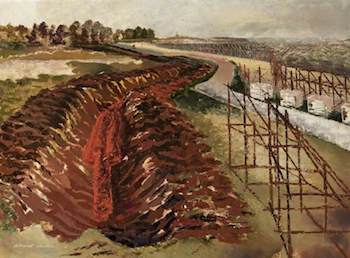
(Albert Richards, Anti-Tank Ditch (1939): © Russell-Cotes Art Gallery & Museum)

In the last few years of my walking to work every day, it became almost as dangerous as crossing the roads. This was only partly to do with the chronic neglect of paths, pavements and walkways by the local council, financially starved as it was by central government; as much, or more, to do with the traffic on the pavement. Almost hit by heedless kids on scooters one morning, I was then almost hit by their mother, who was cycling briskly along the middle of the pavement. Then I had to avoid a small boy fiddling with some game and blind to the world. I remember thinking that it was hardly surprising if heedless kids raised by heedless adults turn into heedless adults themselves. But why, I wondered, sidestepping another heedless fool fiddling with his music selection, do more of these people not simply tumble into ditches? The answer, of course, is was that we have too few ditches. There is so much . . . material, of various kinds, that could be, that should be, tumbled into ditches. I thought then that one of my first reforms, when the time comes, will be to introduce far more ditches.

Old English, of Germanic origin, I gather, related to dyke and, more broadly, both to the trench and the mound of earth produced by the digging.

It was apparently Lord Curzon, ex-Viceroy of India, ‘surely one of the most brilliantly pompous men in England’, who said: ‘We will die in the last ditch before we give in’, when confronting the Parliament Bill which would lessen the power of the House of Lords. This was in May 1911, at the luncheon table of the splendidly-named Lord Willoughby de Broke, who, George Dangerfield commented in his classic The Strange Death of Liberal England, ‘had quite a gift for writing, thought clearly, and was not more than two hundred years behind his time.’[1] The Conservative party would soon divide into Ditchers and Hedgers, the hardliners who refused any compromise and the realists who believed that accepting some reform might avert or at least delay defeat.

A few years later, the narrator of Violet Hunt’s 1918 novel (with many details of interest for those readers closely acquainted with her lover, Ford Madox Ford) remarks: ‘For I suppose we aristocrats are, literally, in the Last Ditch!’[2]

Immodest-Violet

Ditches were on many people’s minds just then, not least those of the survivors of the Western Front. Eric Leed pointed out in his celebrated study No Man’s Land that the soldier was treated ‘as his society customarily treats a corpse – buried, forced to lie immobile in a pit or ditch.’ He is ‘identified with the earth, with pollution and corruption.’ He added that ‘The most unsettling feature of the landscape of war, for many combatants, lay in the constant transgression of those distinctions that preserve both order and cleanliness.’[3]

A hundred years on from the Great War, anyway, ditches are suddenly topical again. Our current Prime Minister, declining to return to Brussels to request an extension beyond 31 October of the United Kingdom’s exiting the European Union, said that he’d ‘rather be dead in a ditch.’ So, somewhere, a ditch is surely being prepared, or furnished or perhaps, as we say far too often these days, curated in readiness for that performance.

 
Notes

[1] George Dangerfield, The Strange Death of Liberal England (London: Constable, 1936), 43, 42. The title of his third chapter is ‘Their Lordships Die in the Dark’.

[2] Violet Hunt, The Last Ditch (London: Stanley Paul, 1918), 14.

[3] Eric J. Leed, No Man’s Land: Combat and Identity in World War I (Cambridge: Cambridge University Press, 1979), 17, 18.