Finished sentences, tied shoelaces

STW_Gdn_stw.com

(Sylvia Townsend Warner in her garden: via the Sylvia Townsend Warner Society)

‘We have just come back from Theodore Powys’s funeral’, Sylvia Townsend Warner wrote to William Maxwell on 28 November 1953. ‘He died sooner, and with less misery than any of us dared expect, probably because he had made up his whole mind to it. I do not mean that he was resigned; but he was resolved. There was a great deal about the funeral that he would have approved of. To begin with, because of the lay-out of his front door, the coffin came out upright, as though it were walking out on its own volition, or rather, as though he were walking it out to its burial. It was a mild grey-skied day, the doors of the village church were open during the service, and while the parson was reading the lesson from St. Paul a flock of starlings descended on the churchyard and brabbled with their watery voices, almost drowning the solitary cawing rook inside the building. The parson, an old man, and a friend of Theodore’s, must have believed every word he said, and after the blessing he stood for some time at the foot of the grave in an oddly conversational attitude, as though, for this once, he had got the better of an argument.’[1]

A longish extract – but why settle for anything less?

Powys-T.F

(Theodore Francis Powys, by Howard Coster, 1934 © National Portrait Gallery)

Sylvia had met Powys (whose brothers included John Cowper and Llewellyn; his sisters the writer Philippa, the painter Gertrude, and the authority on lace and lace-making Marian) in March 1922—annus mirabilis for a good many writers other than James Joyce and T. S. Eliot—after a brief correspondence. Her friend Stephen Tomlin (‘Tommy’) had conveyed his strong interest in Powys, finally prompting Sylvia to read The Soliloquy of a Hermit (1916). Having visited him in East Chaldon—or Chaldon Herring, ‘as it is properly called in the Ordnance map though the postal name is East Chaldon’[2]—Sylvia was given the task of finding a publisher for a Powys manuscript and found her way to Tommy’s ‘only influential acquaintance in the literary world’. This was David Garnett, co-founder of the Nonesuch Press and currently a bookseller, whose novel, Lady into Fox would appear in October, with tremendous success. Garnett sent the story on to Chatto and Windus, who published The Left Leg (1923) when Powys added the title story and one more. The stories were dedicated to Tommy, Garnett and Sylvia.[3] Mr Tasker’s Gods (1925), Mr Weston’s Good Wine (1927) and Unclay (1931) followed in the next few years, as did several further collections of stories. Douglas Goldring commented in Odd Man Out that ‘The Dorsetshire stories of T. F. Powys, which suburban critics find so morbid and unreal, seem to me to give an entirely truthful picture of peasant life as I observed it in Somerset.’[4]

David-Garnett

(David Garnett)

In 1930, Sylvia bought a cottage opposite the inn called The Sailors Return in East Chaldon and, soon afterwards, began the relationship with Valentine Ackland which would last until Valentine’s death nearly forty years later.[5] Garnett, who had first visited the village in the summer of 1922, published his novel, The Sailor’s Return, in 1925.[6] Set in the late 1850s, it concerns an English sailor returning home with his black African wife to rent a Dorset village inn and the prejudice and hostility they encounter from local people. It’s been reprinted by Dorset publisher The Sundial Press: http://www.sundialpress.co.uk/index.html
who also publish books by Powys brothers Theodore, Llewellyn and John Cowper, including Theodore’s Unclay and Kindness in a Corner.

Garnett was instrumental in getting Sylvia Townsend Warner’s early work published and their close friendship produced scores of superb letters. There was a long, slightly mysterious hiatus in their contact, probably due to Valentine’s jealousy, but it resumed and continued until Sylvia’s death.

Near the end of her life, Warner wrote to Garnett: ‘You enjoy my letters, I enjoy yours. We are like those Etruscan couples who sit conversing on their tomb. We belong to an earlier and more conversational world, and tend to finish our sentences and tie up our shoelaces.’ And Garnett, on his travels, sent her vibrant reports filled with tantalising details, such as this from Campeche, Mexico: ‘In the square there is a bust to the lifelong mistress of Porfirio Diaz, the dictator, Señora Romero. He gave her a villa and had the railway line diverted to run in front of the windows because she liked watching trains.’[7] 

References

[1] Michael Steinman, editor, The Element of Lavishness: Letters of Sylvia Townsend Warner and William Maxwell, 1938-1978 (Washington: Counterpoint, 2001), 44-45.

[2] Sylvia Townsend Warner, ‘T. F. Powys and Chaldon Herring’, in With the Hunted: Selected Writings, edited by Peter Tolhurst (Norwich: Black Dog Books, 2012), 54.

[3] Claire Harman, Sylvia Townsend Warner: A Biography (London: Chatto & Windus, 1989), 48-51.

[4] Douglas Goldring, Odd Man Out: The Autobiography of a “Propaganda Novelist” (London: Chapman and Hall, 1935), 47.

[5] Harman, Sylvia Townsend Warner, 96-97.

[6] Richard Garnett, editor, Sylvia and David: The Townsend Warner/ Garnett Letters (London: Sinclair-Stevenson, 1994), 23-25.

[7] Garnett, Sylvia and David, 213, 114.

A feather in the wind

Sea-1

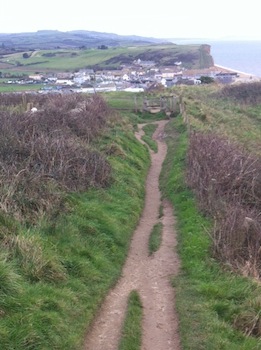
Between Eype and West Bay, a fierce wind rocks us on the cliff path. A couple of days later, at lunch in the Watch House Café, the sound is almost deafening at times, sails flapping on high and rolling seas. On the slope above the shore, you can lean steeply and confidently into the wind. The sea is foaming, furious, tiny tumbleweeds of spume blown in cartwheels across the sand, thinning to threads of washing suds, smears along the beach.

In a high wind, I often feel as I do when watching a raging sea: a sense of awe at such naked strength and power but also extreme pleasure in the knowledge that they are, precisely, irresistible. No matter how misdirected, demented and destructive human behaviour becomes, the wind will blow, the sea will rise and fall. In such a wind, resistant, your feet solidly planted, you feel your body’s strength but also sense its limits.

Back-to-West-Bay

In An Affair of the Heart, Dilys Powell, the celebrated film critic who also wrote several fine books about Greece, remembered a people called the Perachorans. She was married to the archaeologist Humfry Payne, who, in 1929, was appointed director of the British School of Archaeology in Athens. A year later, he initiated an excavation at Perachora, a settlement on the Gulf of Corinth, and Powell spent a good deal of time in and around the area. She wrote, ‘They grow old, they die, but they are the same. And I reflected with astonishment – for in imagination it is always oneself who is stable in an inconstant world – that I was the feather in the wind.’[1]

It’s a resonant image. Sixty years on, the world is a little more inconstant, a little less stable. Just a little. Still, it’s hardly surprising that the wind has always been a favourite literary symbol, from Homer through to the Romantic poets and beyond, seemingly apposite in a staggering variety of contexts, wind as god, wind as breath, wind as inspiration or omen or threat or simply impersonal force.

‘My thoughts were a great excitement’, W. B. Yeats remembered, ‘but when I tried to do anything with them, it was like trying to pack a balloon into a shed in a high wind.’[2] Indeed, we’ve all experienced that, no doubt. Or something like it. Or vaguely resembling it. Although lately it seems that, even when just a little excited, people tend to take to social media. Sometimes, they bring along thoughts with that excitement.

Karen_Blixen_and_Thomas_Dinesen_1920s

(Karen Blixen with her brother Thomas on the family farm in Kenya in the 1920s)

Karen Blixen, writing of her farm at the foot of the Ngong Hills, sited at an altitude of over six thousand feet that ‘the wind in the highlands blows steadily from the north-north-east. It is the same wind that down the coasts of Africa and Arabia, they name the Monsoon, the East Wind, which was King Solomon’s favourite horse.’[3] And it may well have been: he seems to have had 4000 to choose from, or 40000, depending on the version you settle on. A great many horses, in either case; and a great many wives and concubines too.

Having made our effortful way back from the beach—at an angle of something less than ninety degrees—we sit listening to the howling in the chimney, raising our voices a little. That in turn recalls (of course) the narrator of Ford’s The Good Soldier: ‘And I shall go on talking, in a low voice while the sea sounds in the distance and overhead the great black flood of wind polishes the bright stars.’[4] And it occurs to me to wonder, given the level of noise in this wind, just how much the narrator (‘talking in a low voice’) wanted to be heard; or rather, how much it mattered. Without getting too detailed, if his listener is the now-mad Nancy Rufford it probably doesn’t matter much at all: the murmur of a voice amidst the chorus of the wind will do.

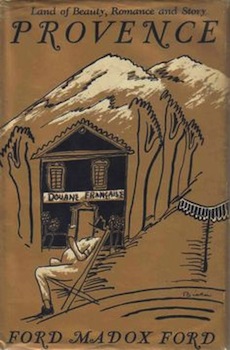
‘Wind in the Work of Ford Madox Ford’. That could be worked up into something, surely. The sentence from The Good Soldier has its traceable ancestry, primarily Ford’s own poem, ‘On Heaven’, which includes the line ‘Through the roar of the great black winds, through the sound of the sea!’[5] And more than twenty years later, at the close of Provence: From Minstrels to the Machine, another strong wind—the mistral this time—plays a central role in the drama, unless it’s a comedy:

Provence.dj

‘And leaning back on the wind as if on an up-ended couch I clutched my béret and roared with laughter. . . .We were just under the great wall that keeps out the intolerably swift Rhone. . . . Our treasurer’s cap was flying in the air. . . . Over, into the Rhone. . . . What glorious fun. . . . The mistral sure is the wine of life. . . . Our treasurer’s wallet was flying from under an armpit beyond reach of a clutching wind . . . . Incredible humour; unparalleled buffoonery of a wind . . . . The air was full of little capricious squares, floating black against the light over the river. . . . Like a swarm of bees: thick. . . . Good fellows, bees. . . .’

A ‘delirious, panicked search’ then begins, for the scattered banknotes (those ‘little capricious squares’), for passports, for citizenship papers. The money that was to finance a year or two of rest has mostly gone. ‘But perhaps the remorseless Destiny of Provence desires thus to afflict the world with my books’, Ford concluded—as if he would ever have willingly stopped writing, mistral or no.[6]

Back in Bristol, it’s oddly calm today. Hardly a flicker in the heaped brown leaves. I type at the top of a page: ‘Calm in the Work of Ford Madox Ford’. Nothing’s come yet.

References

[1] Dilys Powell, An Affair of the Heart (London: Souvenir Press, 1958), 173.

[2] W. B. Yeats, Autobiographies (London: Macmillan, 1955), 41.

[3] Karen Blixen, Out of Africa (1937; Harmondsworth: Penguin 1987), 14.

[4] Ford Madox Ford, The Good Soldier: A Tale of Passion (1915; edited by Max Saunders, Oxford: Oxford University Press, 2012), 18.

[5] Ford Madox Ford, Collected Poems (New York: Oxford University Press, 1936), 8.

[6] Ford Madox Ford, Provence (London: Allen & Unwin, 1938), 367-368.


Passing time, clocking off

harold-lloyd

(Harold Lloyd in Safety Last!)

On 11 November 1918, US pilot Sergeant Charles Veil, still with a French squadron although he had technically become a lieutenant in the United States Army, was greeted on landing with the news that the Armistice had been signed and that the war was over. ‘No more patrols, no more fights in the air. Nothing to do, nothing to live for. . . I found my watch, brought it forth, threw it as far as ever I could. Time would never mean the same thing again. . . .’[1]

It means, of course, different things to different people at different. . . times. It might seem stable enough if you stand still—until you move east or west—a lot more stable than it used to be, for sure. Standard time came in towards the close of the nineteenth century. In the United States, it was the railroad companies rather than governments that were first to institute it: ‘Around 1870, if a traveler from Washington to San Francisco set his watch in every town he passed through, he would set it over two hundred times.’ You’d barely have had time to set the time. And, in fact, it was on this day, 18 November, in 1883, that the railroads imposed uniform time. It was called ‘the day of two noons’ because at midday clocks in the eastern part of each zone had to be set back: ‘one last necessary disruption’.[2]

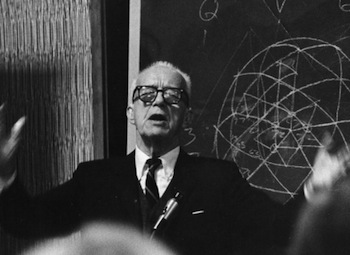
Clock time as a major issue can certainly be demanding. On Robert Scott’s Antarctic expedition of 1910-1913, the young Apsley Cherry-Gerrard (‘Cherry’) ‘kept three clocks and two wristwatches above his bunk to make absolutely sure that he did not miss his shift on deck.’[3] Hugh Kenner wrote of Buckminster Fuller that: ‘He zoomed around the globe in person, bearing his news to audiences in town after town. He wore three watches to tell him (1) the time back home, (2) the time where he was now, and (3) the time at his next stop.’[4]

Bucky

Buckminster Fuller ( https://pacificdomesnews.wordpress.com/happy-birthday-buckminster-fuller/ )

But time is not only clock time, of course: it’s time as experience, time in our heads, the moment that stretches into hours, the days collapsed into a heartbeat. Does time speed up as we age? Is it one of the inescapable problems of ageing, the days ‘flashing by like subway stations passed by the express train’, as Saul Bellow’s narrator remarks? ‘If only we could bring back the full days we knew as kids.’ But ‘[o]ur need for rapid disposal eliminates the details that bewitch, hold, or delay the children.’ Still, ‘Art is one rescue from this chaotic acceleration. Meter in poetry, tempo in music, form and color in painting. But we do feel that we are speeding earthward, crashing into our graves.’[5]

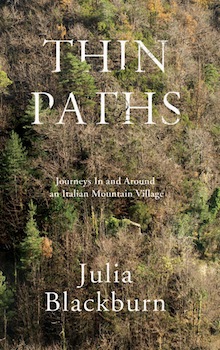
Time; space—or time as space. At a small party to celebrate the completion of her book about the area around the Italian village where she lives, Julia Blackburn writes of saying that: ‘being here in the valley has made me think that time past and time present and time future is like a vast landscape and we are walking through it on a tracery of thin paths.’[6]

thin_paths

Then space as time, in a sense. William Herschel’s 1802 paper considered the idea that deep space must also imply deep time. His telescope had ‘also, as it may be called, a power of penetrating into time past’ — the rays of light conveying the image of a remote nebula to the eye must have been ‘almost two million years on their way’. Therefore the universe was ‘almost unimaginably older than people had previously thought.’[7]

Writers, certainly most of the major modernist writers, have a complex relationship with time: James Joyce, Ford Madox Ford, David Jones, Marcel Proust, T. S. Eliot, Virginia Woolf, Ezra Pound, Dorothy Richardson, William Faulkner, Samuel Beckett, Gertrude Stein. How could they not, given the rupture of the First World War, that ‘crack across the table of History’?[8] Wyndham Lewis devoted a massive volume to opposing and analysing the ‘Time-doctrine’, the stress on the subjective and the interior which he traced to the French philosopher Henri Bergson, ‘the perfect philosophic ruffian, of the darkest and most forbidding description: and he pulls every emotional lever on which he can lay his hands.’[9] Characteristically, Lewis—‘Dogmatically, then, I am for the Great Without, for the method of external approach’[10]—had a pop at a huge range of targets, among them Joyce, Pound, Stein, Proust and a flock of philosophers.

Later writers’ view of time has tended more towards Bergson’s—and less towards Lewis’s—view of the matter. Eudora Welty remarked that ‘The time as we know it subjectively is often the chronology that stories and novels follow: it is the continuous thread of revelation.’[11] Jeanette Winterson wrote that Sigmund Freud, ‘one of the grand masters of narrative, knew that the past is not fixed in the way that linear time suggests. We can return. We can pick up what we dropped. We can mend what others broke. We can talk with the dead.’[12]

Indeed. We don’t need time machines. We are time machines. Possessing memory and imagination, we are masters—or mistresses—of both past and future. It’s just the present that’s so damned tricky.

References

[1] Stanley Weintraub, A Stillness Heard Round the World: The End of the Grest War, November 1918 (New York: Oxford University Press, 1987), 186.

[2] Stephen Kern, The Culture of Time and Space 1880-1918 (Harvard University Press, 1983), 12.

[3] Sara Wheeler, Cherry: A Life of Apsley Cherry-Gerrard (London: Jonathan Cape, 2001), 63.

[4] Hugh Kenner, The Elsewhere Community (New York: Oxford University Press, 2000), 139.

[5] Saul Bellow, Ravelstein (London: Viking, 2000), 191-192.

[6] Julia Blackburn, Thin Paths: Journeys In and Around an Italian Mountain Village (London: Jonathan Cape, 2011), 248.

[7] Richard Holmes. The Age of Wonder: How the Romantic Generation Discovered the Beauty and Terror of Science (London: Harper Collins, 2008), 203.

[8] Ford Madox Ford, A Man Could Stand Up— (1926; edited by Sara Haslam, Manchester: Carcanet, 2011), 17.

[9] Wyndham Lewis, Time and Western Man (London: Chatto & Windus, 1927), 449, 174.

[10] Wyndham Lewis, Men Without Art (London: Cassell, 1934), 128.

[11] Eudora Welty, One Writer’s Beginnings (London: Faber, 1985), 69.

[12] Jeanette Winterson, Why Be Happy When You Could Be Normal? (London: Vintage 2012), 58.

‘The story exists for the scribbled notes in the margin’

Robert-Phelps

(Robert Phelps via Narrative)

‘As for credos, Monroe Wheeler, Glenway, and I were once walking along the gentle ridge above his house and I asked how each would summarise his philosophy. Monroe’s answer was straightforward, prompt: “I never want to be left out of the dance.” After a slow, foxy smile, Glenway reached down and picked up a stone. “I believe everything breathes; even this stone must utter a blissful sigh every millennium.”’

This is Robert Phelps, in the third of ‘three miniature portraits’ which he believed combined to offer a view of the writer Glenway Wescott, whose The Pilgrim Hawk (1940) and An Apartment in Athens (1945) I’ve read and admired.

wescott

Glenway Wescott, photographed by Carl Van Vechten, 1936: Via the Beinecke Library, Yale University: http://beinecke.library.yale.edu/

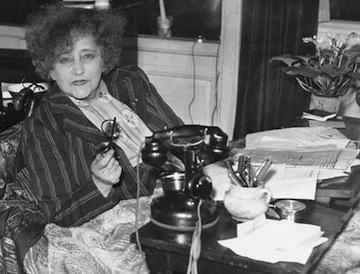
Phelps (born 16 November 1922) did publish one novel, though it was not successful: ‘a serious new writer like Robert Phelps produces in Heroes and Orators (1958) a complex and troubling study of homosexual love that goes unnoticed’, Leslie Fiedler commented.[1] Phelps was one of the co-founders of Grove Press, though he sold his share in it and turned to freelance writing. He’s best remembered now as the editor and translator of, particularly, Colette, introducing a great many readers to her work, primarily through his wonderful compilation of her own writings, superbly fitted together to form an autobiography, Earthly Paradise. He also edited her Collected Stories and worked the same sort of editorial magic on the writings of Jean Cocteau. His other major editing job was the journal of Glenway Wescott or rather, drawn from memos, newspaper clipping and carbon copies of letters, Phelps remarked, ‘in substance as well as appearance it is closer to a scrapbook.’[2] To James Salter, he wrote of his work on this volume: ‘It’s like walking for days along the English coast after the wreck of the Armada. The beach is strewn. You keep running back and forth. Everything glitters, even the eyes of dead men.’[3]

Colette

(Colette)

Phelps died in 1989, aged 66. I’d read a few books by Colette over the years but read quite a few more, especially the Phelps-related ones, after coming across the letters between Phelps and James Salter: two superb writers in love with other writers, in love with each other’s being in the world, to talk and write about books and weather and France and the look of things, the touch and smell of things. ‘Your stories pour over me’, Salter wrote, ‘I am in a different world, one where I recognize myself’ (12). Phelps intensely admired Salter’s writing and, what is less common, was able to articulate the reasons for that admiration. Of Salter’s story, ‘The Cinema’, he observed: ‘The thing that most gratifies me (and I mean gratify literally, as good cheese gratifies me, or a well-hung line of laundry snapping in the wind, or a Cavafy poem) is that if I stop at the end of almost any given sentence, I cannot guess what will come next—neither substance nor syntax. With most writers, there is maximum predictability. You can skim whole paragraphs’ (30). After noting that Salter was ‘a minority of one’ and ‘a new herb in the cabinet’, he remarked that, with ‘wholly different temperaments, Genet and Pasolini do something of the same thing. But you are tender, and unperverse. You are pure, and in the European sense of the word, American’ (31).

He told Salter about Erik Satie: ‘Did you know that after he died, his friends found one hundred unused umbrellas in his room? There was also a piano, which was unplayable and which Braque bought as a souvenir’ (47). He mentioned his hostess at Pound Ridge, in upstate New York, where he was staying. She was ‘an old friend of Philip Roth’ and told Phelps how Roth ‘puts the ms. of his current book in the refrigerator every day—in case of a fire’ (51).

Salter wrote to him, with more than a little urgency, ‘We must catch the train, Robert, we must move, otherwise life takes you, makes you soggy. We’re wearing cheap shoes, we must stay ahead of it’ (53).

Belles-Saisons

So much fascinating, mysterious, stimulating, alluring, irresistible stuff in the world—‘Scrapbooks, footnotes, almanacs, letters, diaries, questionnaires, marginalia, memos, alphabets . . . how I love them’ (38)—to which he brought an insatiable curiosity and in which he took an evident delight: he asks Salter, ‘Did you know that St. Francis of Assisi thought of God “as a melody so sweet it could just be borne”? One of his best friars, Giles, when attacked by theologians, answered their arguments on the flute’ (111).

Just reminding myself of Phelps and his work has prompted me—wanting more of such melodies—to order two books that I found I didn’t have.

There’s a very fine 2009 piece on Phelps in American Scholar by Michael Dirda (who contributed the ‘Foreword’ to Memorable Days:
http://theamericanscholar.org/i-wanted-to-be-robert-phelps/#.UZEHY4ImZUQ

References

[1] Leslie Fiedler, Love and Death in the American Novel (1960; revised edition, Harmondsworth: Penguin Books, 1984), 477.

[2] Continual Lessons: The Journals of Glenway Wescott, edited by Robert Phelps with Jerry Rosco (New York: Farrar, Straus, Giroux, 1990), vii.

[3] Memorable Days: The Selected Letters of James Salter and Robert Phelps, edited by John McIntyre (Berkeley, California: Counterpoint, 2010), 71: other page references to this book in parentheses.


Forty-four: a number to remember

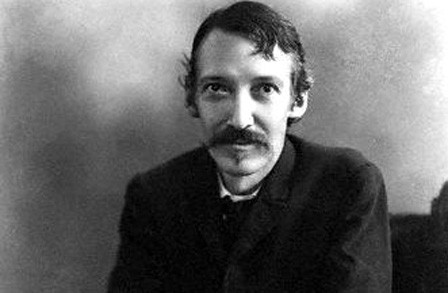
robert-louis-stevenson

(Robert Louis Stevenson)

Here’s a quiz question: what do the following have in common? Henry Thoreau, Billie Holiday, Arshile Gorky, F. Scott Fitzgerald, Maya Deren, Joseph Roth, Anton Chekhov, Antoine de Saint-Exupery, J. G. Farrell, D. H. Lawrence, Gerard Manley Hopkins and Robert Louis Stevenson?

Answer: they all died at the age of forty-four. (Mathematicians – you must have a theory.)  A few by accident or suicide, not surprisingly, but mostly from natural causes, though exacerbated in several cases by alcohol or other drugs. But so short a life doesn’t rule out extraordinary productivity, as witness the cases of Chekhov, Lawrence – or Stevenson.

Stevenson (born 13 November 1850) is the sort of writer whom a lot of bookish people read when they were younger but, if they go back to him later, are apt to murmur about ‘guilty pleasures’. In fact, he’s one of those rare beasts who manages to combine huge popularity with admiration from fellow-writers—Borges, Henry James, Kipling, Proust, Nabokov—(along with some stern dismissals, it has to be said) and who has survived to become the focus of a great deal of critical and scholarly attention. A dozen novels; half a dozen volumes each of stories, essays and travel writing, books of poems—for adults and for children—and letters that fill eight volumes in the Yale University Press edition. Irresistibly attractive to cultural critics, psychoanalytical critics, specialists in Scottish literature, sexual politics and others. The stage and screen adaptations of The Strange Case of Dr Jekyll and Mr Hyde run to some one hundred and twenty; there have been over two hundred biographies of Stevenson.

It wasn’t that long ago that I read through my fat copy of The Stories of Robert Louis Stevenson. Eleven hundred and twenty pages in all, New Arabian Nights, The Dynamiter, The Beach of Falesá, and much more; I had a whale of a time.

RLS-Writing-Table-1885

Stevenson at his writing desk 1885
http://robert-louis-stevenson.org/early-years/

‘“Listen,” said the young man; “this is the age of conveniences, and I have to tell you of the last perfection of the sort. We have affairs in different places; and hence railways were invented. Railways separated us infallibly from our friends; and so telegraphs were made that we might communicate speedily at great distances. Even in hotels we have lifts to spare us a climb of some hundred steps. Now, we know that life is only a stage to play the fool upon as long as the part amuses us. There was one more convenience lacking to modern comfort; a decent easy way to quit that stage; the back stairs to liberty; or, as I said this moment, Death’s private door. This, my two fellow-rebels, is supplied by the Suicide Club.’”[1]

Or this, from John Wiltshire: ‘I was dreaming England, which is, after all, a nasty, cold, muddy hole, with not enough light to see to read by’. And, of the priest: ‘He was a good-natured old soul to look at, gone a little grizzled, and so dirty you could have written with him on a piece of paper.’[2]

‘Now, to be properly enjoyed,’ Stevenson wrote, in Travels With a Donkey in the Cevennes, ‘a walking tour should be gone upon alone. If you go in a company, or even in pairs, it is no longer a walking tour in anything but name; it is something else and more in the nature of a picnic.’[3]

And again: ‘For my part, I travel not to go anywhere, but to go. The great affair is to move; to feel the needs and hitches of our life more nearly; to come down off this feather-bed of civilisation, and find the globe granite underfoot and strewn with cutting flints.’[4]

Here’s the wonderful John Singer Sargent portrait (he did three in all) of Stevenson and Fanny:

Sargent-RLS

John Singer Sargent, Robert Louis Stevenson (Private collection )

Stevenson crops up in an astonishing range of contexts, not least in the customary use of the phrase ‘Jekyll and Hyde’ without reference to, and usually without thought of, the story’s author. In Bristol—the city Jim Hawkins made his way to in order to sign on as a sea cook on the Hispaniola—it’s not uncommon to see groups of eager children taken on tours of Treasure Island–related points about the city by pirate captains armed to the teeth. I recall that, in John Buchan’s novel The Three Hostages (1924), Sandy Arbuthnot’s notes are signed in the names of supposed Derby winners. The first is ‘Buchan’ and the third, genuine this time, is ‘Spion Kop’ (named after the Boer War battle). In between these two came ‘Alan Breck’, which had been the name of Buchan’s own horse when he was in South Africa c.1902; but it was also, more famously, the name of the Jacobite hero of Stevenson’s Kidnapped.[5]

Stevenson was buried on the summit of Mount Vaea, Samoa. The Samoans, led by Lloyd Osbourne, Stevenson’s stepson, had cleared a path to the top of the mountain overnight, to be able to bury Stevenson.
(That detail is taken from the very impressive Robert Louis Stevenson website here:
http://robert-louis-stevenson.org/ )

Why does that remind me of the burial of Ernest Fenollosa? Answers on a million pound note to. . . No, but certainly that sort of respect shown to a figure from quite another culture is a striking image.

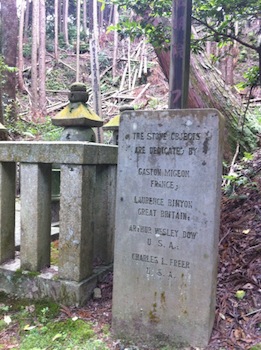
Fenollosa-grave

https://nohtheatre.wordpress.com/2013/06/09/a-visit-to-ernest-fenollosas-grave/

Ernest Fenollosa is best known now as the author of the two-volume Epochs of Chinese and Japanese Art (1912) and as the source of the literal translations from Japanese Noh plays and the Chinese poetry from which Ezra Pound brilliantly fashioned the poems of Cathay (1915). Fenollosa died in London in September 1908 and his ashes were interred in Highgate Cemetery but, on the first anniversary of his death, they were reburied, as he had wished, in Uyeno Park, Tokyo, the hills overlooking Lake Biwa and the gardens of Miidera temple. The legend inscribed on the Fenollosa monument reads: ‘To the merit of our Sensei, high like the mountains and eternal like the water.’[6]

In the closing lines of Pound’s long Canto LXXXIX, we read:

I want Frémont looking at mountains
or, if you like, Reck at Lake Biwa.[7]

Frémont was an explorer who, with four others, climbed the loftiest peak in the Rockies in August 1842. One leading Pound critic remarked that Frémont and Fenollosa are here ‘made to stand at the threshold of the “mountainous” heaven’ of Cantos XC to XCV.[8] Michael Reck wrote of visiting Fenollosa’s grave at a temple overlooking Lake Biwa in June 1954 and describing that visit in a letter to Pound, who ‘recorded it in the last line of his Canto 89.’[9]

References

[1] The Stories of Robert Louis Stevenson (London: Victor Gollancz, 1928), 19-20.

[2] ‘The Beach of Falésa’, The Stories of Robert Louis Stevenson, 620, 621.

[3] Stevenson, Travels with a Donkey in the Cevennes and Selected Travel Writings, edited by Emma Letley (Oxford: Oxford University Press, 1992), 256.

[4] Stevenson, Travels with a Donkey in the Cevennes, 163.

[5] Buchan, The Three Hostages (1924; edited by Karl Miller, Oxford: Oxford University Press, 1995), 106, 126, 120. For Buchan’s horse, see plate 3, in Andrew Lownie, John Buchan: The Presbyterian Cavalier, London: Constable, 1995), 128-129.

[6] Lawrence W. Chisolm, Fenollosa, the Far East and American Culture (New Haven: Yale University Press, 1963), 35.

[7] The Cantos of Ezra Pound, fourth collected edition (London: Faber and Faber, 1987), 604.

[8] Massimo Bacigalupo, The Forméd Trace: The Later Poetry of Ezra Pound (New York: Columbia University Press, 1980), 257.

[9] Michael Reck, Ezra Pound: A Close-Up (London: Rupert Hart-Davis, 1968), 174-175.


Glimpses into the obvious: Paradise, a taxing issue

Swan, Robert John, 1888-1980; William Cowper (1731-1800), Poet

Robert John Swan, William Cowper (copy of George Romney): The Cowper and Newton Museum, Olney, Buckinghamshire
(‘Home life, he thought, was a bit of leftover Eden’: Alexandra Harris, ‘My Hero: William Cowper’, https://www.theguardian.com/books/2013/feb/01/my-hero-william-cowper-harris )

In 1953, Sylvia Townsend Warner wrote to her friend Leonard Bacon about having visited the poet William Cowper’s house the previous summer. ‘I wish someone would write a sensible book about Cowper’, she added, ‘David Cecil’s, that is considered so sensitive and sympathetic, is really shockingly sloppy, and filled with what my grandmother called glimpses into the obvious.’[1]

A useful phrase, its variant—‘stating the bleeding obvious’—used to be uttered frequently in the office as we reviewed the day’s news. We are belaboured with it constantly now, as earnest newsreaders inform us for the very first time that the Brexit negotiations are not going well, that the government is in chaos and that some Americans are not fervent admirers of the 45th President of the United States.

But another feature of news presentation, especially in the case of the BBC, is the nervous rush to offset any implied criticism of government policy in a report by following it immediately with a vacuous statement by an official spokesperson, claiming billions of pounds in extra funding here, the creation of thousands of skilled posts there and the imminent arrival everywhere of miraculous deliverance strapped to the backs of unicorns.

Exposed to the latest bulletins detailing the contents of the Paradise Papers, I was repeatedly reminded that ‘this is legal’, that there was ‘no suggestion of wrongdoing’, that a yawning legal gulf existed between ‘evasion’ and ‘avoidance’. I had constantly to distinguish between, on the one hand, rich greedy people who paid others to engage in grubby deals for the purpose of helping them dodge their fair share of tax and, on the other hand, rich greedy people who paid others to engage in grubby deals for the purpose of helping them dodge their fair share of tax. Some of them just wanted more money, more yachts, more properties, more trinkets; others wanted even more gargantuan profits for their companies, while yet others wanted to pursue such expensive political projects as influencing a referendum or an election.

Martin, John, 1789-1854; The Expulsion of Adam and Eve from Paradise

John Martin, The Expulsion of Adam and Eve from Paradise: Laing Art Gallery. Newcastle-upon-Tyne

As John McDonnell wrote a few days ago, this ‘is not about a few individuals seeking to undermine the system, it is the system.’
https://www.theguardian.com/commentisfree/2017/nov/06/tories-tax-scandal-tory-paradise-papers-labour

Given the obvious social, economic and cultural damage caused by individuals and corporations not paying the taxes that they should, the reasonable response to ‘this is legal’ would seem to be: ‘Why?’ Similarly, the reasonable response to ‘I am not concerned with the day to day running of the company’ is ‘Then you bloody well should be’. If shedloads of money are being shovelled in your particular direction, there is surely a requirement to know where it comes from or at least, where it doesn’t come from.

Nearly a century and a half ago, John Ruskin (‘a violent Tory’) wrote: ‘Whereas, in true justice, the only honest and wholly right tax is one not merely on income, but property; increasing in percentage as the property is greater. And the main virtue of such a tax is that it makes publicly known what every man has, and how he gets it.’[2]

Publicly known: how much and how acquired. That seems about right.

References

[1] Letter of 11 January 1953: Sylvia Townsend Warner, Letters, edited by William Maxwell (London: Chatto & Windus, 1982), 138. The Stricken Deer or The Life of Cowper (1929) was Cecil’s first published book (of more than thirty) and a winner of the James Tait Black Memorial Prize.

[2] John Ruskin, Fors Clavigera: Letters to the Workmen and Labourers of Great Britain, new edition, four volumes (Orpington & London: George Allen, 1896), I, 142; see I, 188: ‘I am, and my father was before me, a violent Tory of the old school’.


‘Depressed by the world but better in ourselves’.

Letters-LM

In a letter of 3 November 1961, Louis MacNeice wrote to Allen Tate and his wife Isabella: ‘We get more & more depressed by the world but better in ourselves.’[1]

(I could write that to any number of people right now: so half of it is optimistic, no?)

MacNeice had recently moved to a half-time contract with the BBC. He’d begun an affair with Mary Wimbush the previous year and, shortly after he and Mary were involved in a car crash that autumn, MacNeice asked his wife Hedli for a divorce. She refused, supposedly on the advice of ‘their mutual friend’, Allen Tate, who had told Hedli that his wife wouldn’t give him a divorce for five years and he was ‘so grateful to her!’[2]

Tate divorced Isabella Gardiner in 1966 and married Helen Heinz, who survived him (he died in 1979); MacNeice died in 1963. So Tate’s extensive experience of marriage and divorce in late 1961 derived from his relationship with the novelist Caroline Gordon. They married in May 1925, divorced in 1945, remarried the next year and finally divorced again in 1959.

caroline-gordon

(Caroline Gordon via http://porterbriggs.com/)

Gordon’s early mentor was Ford Madox Ford, whom she worked for as secretary in New York in the mid-1920s and remained friends with, in Paris, Provence and Tennessee, for the rest of his life. ‘A few days later Ford heaved a sigh and asked me if I had done any writing. I told him that I had started a novel but that I was going to have to throw it away. He heaved another sigh and said, “You had better let me see it.” I brought him the manuscript a few days later. He read the manuscript through, then said: “Why has nobody told me about this? What were you going to say next?” I recited the sentence. He said, “That is a beautiful sentence. I will write it down.” This procedure was repeated several times. It ended with Ford taking my dictation for three weeks. The result was a novel called Penhally.’[3] Or, as she wrote to her friend Sally Wood, a little nearer to the time: ‘Ford took me by the scruff of the neck about three weeks before I left, set me down in his apartment every morning at eleven o’clock and forced me to dictate at least five thousand words, not all in one morning, of my novel to him. If I complained that it was hard to work with everything so hurried and Christmas presents to buy he observed “You have no passion for your art. It is unfortunate” in such a sinister way that I would reel forth sentences in a sort of panic. Never did I see such a passion for the novel as that man has.’[4]

Ford-Gordon-Biala-Tate

Caroline Gordon; Janice Biala; Ford Madox Ford; Allen Tate: Summer 1937, via Cornell University Library: https://digital.library.cornell.edu/catalog/ss:550910

Gordon would publish eight more novels, as well as several volumes of short stories and criticism, including A Good Soldier: A Key to the Novels of Ford Madox Ford, based on a lecture she gave at the University of California, Davis, in which, recalling her first reading of Ford’s 1913 historical romance, The Young Lovell, she remarked: ‘I have since come to feel that this novel, which is almost unobtainable and has been read by comparatively few people, is the key to Ford’s life work.’[5]

Gordon_Coll_Stories

I find this, in my current reading: ‘We impose connections in a futile attempt to find meaning in a maelstrom of possibilities.’[6]

True enough. Last word for MacNeice, then: with such an embarrassment of riches to choose from, try this, which I only came across the other day and have a liking for, ‘Prologue (to The Character of Ireland)’:

‘Facts have their place of course but should learn to keep it. The feel
Of a body is more than body. That we met
Her, not her, is a chance; that we were born
Here, not there, is a chance but a chance we took
And would not have it otherwise.’[7]


References

[1] Letters of Louis MacNeice, edited by Jonathan Allison (London: Faber, 2010), 687.

[2] Jon Stallworthy, Louis MacNeice (London: Faber and Faber, 1996), 457.

[3] ‘Caroline Gordon’, in Sondra Stang, editor, The Presence of Ford Madox Ford (Philadelphia: University of Pennsylvania Press, 1981), 200; see also Brita Lindbergh-Seyersted, A Literary Friendship: Correspondence Between Caroline Gordon & Ford Madox Ford (Knoxville: The University of Tennessee Press, 1999).

[4] Sally Wood, editor, The Southern Mandarins: Letters of Caroline Gordon to Sally Wood, 1924-1937 (Baton Rouge and London: Louisiana State University Press, 1984), 51.

[5] Caroline Gordon, The Good Soldier: A Key to the Novels of Ford Madox Ford (Davis: University of California Library, 1963), 19.

[6] Iain Sinclair, The Last London: True Fictions from an Unreal City (London: Oneworld, 2017), 18.

[7] Louis MacNeice, Collected Poems, edited by Peter McDonald (London: Faber, 2007), 781.


Hallowmas, ducks, poets

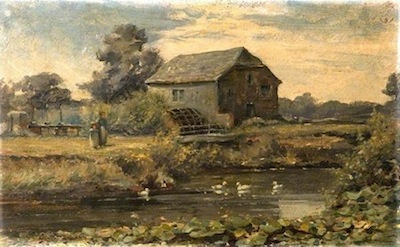
Hodder, Albert, 1845-1911; Bolling Mill near the Brewery, Bridport, Dorset

(Albert Hodder, Bolling Mill near the Brewery, Bridport, Dorset, 1900;
The Coach House: Photo credit: Bridport Museum Trust)

The first of November: All Saints’ Day, Allhallows Day, Hallowmas, Hollantide.

If ducks do slide at Hollantide,
at Christmas they will swim;
if ducks do swim at Hollantide,
at Christmas they will slide.[1]

Briefly: keep an eye on the ducks.

On Tuesday 1 November 1892, Olive Garnett reported to her diary: ‘To-day being All Saint’s Day Mamma called on Christina Rossetti with pink & white heath, her favourite flower. Miss Rossetti wishes nothing to be said about her state of health, life or anything else. She has heart disease & absolute quiet is indispensable. Practically she has left the world already.’[2]

(In fact, she lived another two years, dying on 29 December 1894, aged sixty-four.)

My heart is like a singing bird
Whose nest is in a water’d shoot;
My heart is like an apple-tree
Whose boughs are bent with thickset fruit;
My heart is like a rainbow shell
That paddles in a halcyon sea;
My heart is gladder than all these
Because my love is come to me.[3]

Goblin Market, published in 1862, was an artistic and critical success of the kind dangerously liable to make everything that follows seem something of an anti-climax. The poem continues to provoke an astonishing range of interpretations, from Christian allegories of temptation and redemption through discussions of the marriage market and the constraints on talented and artistic women to debates about lesbian sexuality. There’s a wonderful collision between the way in which Rossetti is often seen—the ascetic  Christian poet who turned down suitors for religious reasons—and the lush and sensual language she uses in Goblin Market:

She cried “Laura,” up the garden,
“Did you miss me?
Come and kiss me.
Never mind my bruises,
Hug me, kiss me, suck my juices
Squeezed from goblin fruits for you,
Goblin pulp and goblin dew.
Eat me, drink me, love me;
Laura, make much of me:
For your sake I have braved the glen
And had to do with goblin merchant men.”[4]

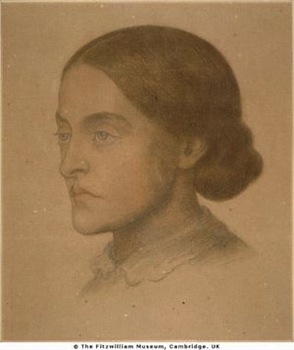
Christina-Rossetti
(Christina by brother Dante Gabriel, c.1866: ©Fitzwilliam Museum, Cambridge)

1 November is also the birthday of two poets with strong connections to the First World War, though both lived on into the 1970s. David Jones was born on this date in 1895. He had begun writing In Parenthesis (though it wasn’t published until 1937) when Edmund Blunden’s Undertones of War, another classic work about the war, appeared in 1928:

‘Fine days succeeded, and moonlit nights, temperate nights with their irresistible poetry creating a silver lake in the borders of Thiepval’s lunatical wood, a yellow harvest on the downs towards Mesnil the mortuary.’[5]

Blunden was born exactly one year after Jones, 1 November 1896. He was awarded the Military Cross in the same month twenty years later.

At the noon of the dreadful day
Our trench and death’s is on a sudden stormed
With huge and shattering salvoes, the clay dances
In founts of clods around the concrete sties
Where still the brain devises some last armour
To live out the poor limbs.[6]

Siegfried Sassoon told David Jones, when they met and talked in 1964, that, however hard he tried, he couldn’t get the Great War out of his system; and that this was also true of Blunden. Jones said it was true for him too. He told his friend Harman Grisewood he was glad that Sassoon thought highly of Undertones of War, ‘which I’ve felt to be one of the very best of those various accounts of that infantry war.’[7]

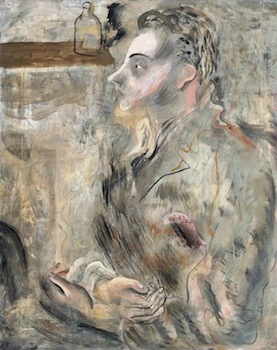
Jones, David, 1895-1974; Portrait of a Maker
David Jones, Portrait of a Maker [Harman Grisewood], 1932 © trustees of the David Jones estate. Photo credit: Amgueddfa Cymru – National Museum Wales

Born within a year of one another, dying in the same year (1974) and both largely shaped by their experiences in the Great War, they yet remained very different writers: Blunden with his devotion to English literature of the eighteenth and nineteenth centuries, to the pastoral tradition, to Englishness in its many forms and guises, whether villages, prose or cricket; Jones emerging as one of the major modernists, in both literature and the visual arts, often drawing on materials less familiar to the general reader: Welsh myth, Arthurian romance, the experiences of Roman legionaries in Britain, details of Catholic ritual.

‘It is extremely difficult, if not impossible, for us to see the wood in which we find ourselves for the trees against which we break our heads and in the tangle of which we break our hearts.’[8] 

References

[1] Bonnie Blackburn and Leofranc Holford-Strevens, The Oxford Companion to the Year (Oxford: Oxford University Press, 1999), 440.

[2] Barry C. Johnson, editor, Tea and Anarchy! The Bloomsbury Diary of Olive Garnett, 1890-1893 (London: Bartletts Press, 1989), 132-133.

[3] Christina Rossetti, ‘A Birthday’, Poems and Prose, edited by Jan Marsh (London: Everyman, 1994), 60.

[4] Rossetti, Poems and Prose, 174.

[5] Blunden, Undertones of War (1928; Harmondsworth: Penguin, 1982), 116.

[6] Blunden, ‘Third Ypres: A Reminiscence’, Selected Poems, edited by Robyn Marsack (Manchester: Carcanet Press, 1993), 50.

[7] Thomas Dilworth, David Jones: Engraver, Soldier, Painter, Poet (London: Jonathan Cape, 2017), 328; René Hague, editor, Dai Greatcoat: A self-portrait of David Jones in his letters (London: Faber and Faber, 1980), 210.

[8] David Jones, ‘Art and Democracy’, in Epoch and Artist (1959; London: Faber, 1973), 96.


Ezra Pound, Stella Bowen and ‘the stylist’

Ford-_E_Pound_Rapallo_1932 Stella-Bowen-photo

(Ford Madox Ford and Ezra Pound, Rapallo, 1932; Stella Bowen, 1920s, Cornell)

On 30 October 1885 Ezra Pound was born in Hailey, Idaho. (‘Here he lies, the Idaho kid,/ The only time he ever did.’)[1] On 30 October 1947, Stella Bowen, painter and writer, died at the age of fifty-four, three weeks after the birth of her grandson, leaving her last painting (‘Still Life with Grapes’) unfinished.[2]

Stella met Pound during the First World War, when the studio she shared with her friend Phyllis Reid was lent for a party, to which Pound came. ‘To me’, Stella remembered, ‘he was at first an alarming phenomenon. His movements, though not uncontrolled, were sudden and angular, and his droning American voice, breaking into bomb-shells of emphasis, was rather incomprehensible as he enlightened us on the Way, the Truth, and the Light, in Art.’[3] Thereafter, largely through Pound, she and Phyllis met everyone: Eliot, Yeats, Wyndham Lewis, May Sinclair, Violet Hunt, Arthur Waley, Edward Wadsworth and others, including Ford Madox Ford.

Solitaire

Stella Bowen, Ford Playing Solitaire, Paris 1927
(Private collection: via https://www.awm.gov.au/visit/exhibitions/stella )

By the autumn of 1917, Stella was exchanging letters with Ford, she in London, he still stationed in Redcar, on the Yorkshire coast. They would live together for almost ten years. The first cottage they shared was Red Ford, in Pulborough, ‘a leaky-roofed, tile-healed, rat-ridden, seventeenth-century, five-shilling a week, moribund labourer’s cottage.’[4] ‘Penny, (not Pound) the goat, the sweet corn, Mrs Ford and the hole in the roof are still, here, going strong’, Ford wrote to Herbert Read in June 1920.[5] That summer, they moved to Bedham, ten miles away, while the indispensable Mr Hunt was still working on Coopers Cottage. Pound visited them there, ‘once, just before he and Dorothy migrated to Paris’, Stella remembered.[6] Or, in Ford’s own, lengthier version: ‘And Mr Pound appeared, aloft on the seat of my immense high dog-cart, like a bewildered Stuart pretender visiting a repellent portion of his realms. For Mr Pound hated the country, though I will put it on record that he can carve a sucking pig as few others can.’[7]

Two months before Pound’s visit to Bedham, the poet John Rodker published at The Ovid Press, in a limited edition of 200 copies, Hugh Selwyn Mauberley by ‘E. P.’ The press’s backers included May Sinclair and Pound himself but was primarily financed by Mary Butts, then married to Rodker.[8] Butts was one of the first friends that Stella made when she moved to London, when they both worked on a Children’s Care Committee in the East End.

Mary_Butts

Mary Butts (Photo by Bertram Park, 1919: Beinecke Library, Yale University)

Hugh Selwyn Mauberley is a long poem or suite of poems, numbering eighteen in all. The centre of the work (poems IX and X) is occupied by two poems contrasting different types of writer. The first, ‘Mr Nixon’, is often taken to refer to Arnold Bennett. Pound wrote to Ford that Rodker ‘thinks both he and I will be murdered by people making personal application of necessary literary constructions verging too near to photography.’ He went on: ‘My defence being that “Mr Nixon” is the only person who need really see red, and go hang himself in the potters field or throw bombs through my window.’[9]

A ‘potter’s field’ is generally applied to a burial place for paupers and unidentified strangers but Bennett, famously, was from ‘the Potteries’, his most celebrated novels (certainly up to 1920) all focusing on the ‘Five Towns’, centres of the pottery industry. In his prose collection Instigations, published in April 1920, Pound wrote of Wyndham Lewis’s Tarr (1918): ‘What we are blessedly free from is the red-plush Wellsian illusionism, and the click of Mr Bennett’s cash-register finish.’ When this essay was reprinted many years later, Pound added a footnote to the effect that he’d ‘rather modified his view of part of Bennett’s writing’ when he finally got around to reading The Old Wives’ Tale.[10] Still, three years before Virginia Woolf’s famous essay ‘Mr Bennett and Mrs Brown’, Pound has the same realist novelists in his sights; and there is a clear imputation to Bennett of predominantly mercenary motives.

HSB-Ovid

What other ‘people making personal application of necessary literary constructions verging too near to photography’ might Pound’s poem suggest? The second type of writer in that central pair of poems, is termed ‘the stylist’:

Beneath the sagging roof
The stylist has taken shelter,
Unpaid, uncelebrated,
At last from the world’s welter

Nature receives him,
With a placid and uneducated mistress
He exercises his talents
And the soil meets his distress.

The haven from sophistications and contentions
Leaks through its thatch;
He offers succulent cooking;
The door has a creaking latch.[11]

‘Unpaid, uncelebrated’: a pretty stark contrast with the famous and successful ‘Mr Nixon’. If this draws—as it surely does—on Ford and Stella in their first Sussex cottage, just what does this imply about Pound’s view of Ford at this juncture? There’s sympathy—as you’d expect in a friendship that extended over thirty years—even an acknowledgement of the justification for that withdrawal, that ‘taking shelter’. But I think there are indications of something more, a taking leave, a sense of retrospect or valediction, for all the prominent use here of the present tense.

For himself, Pound feels, despite all the usual frustrations of shrinking periodical outlets, paltry funding, uncooperative editors and the rest, a sense of burgeoning strength after a hugely productive few years, culminating in Homage to Sextus Propertius (1919) and now Hugh Selwyn Mauberley, with the Cantos too definitely under way. As for the others, the ones who mattered to Pound: T. S. Eliot had published Prufrock and Other Observations (1917) and Poems (1919); Wyndham Lewis, like Ford, had been to the war but had also just published Tarr while, since March 1918, The Little Review had been serialising Ulysses by James Joyce, whose A Portrait of the Artist had appeared in 1916 and his Exiles in 1918. And Ford? Since 1915 and his entry into the British army, he had published only a handful of articles and stories, and one volume of poems, On Heaven and Poems Written on Active Service (April 1918). Pound’s brief review of that book was not a positive one (‘Time was when he held a brief for good writing’).[12]

Poem X is a subtle and artful performance, with its long first sentence and feminine rhymes; the polysyllabic ‘sophistications and contentions’ enacting just what ‘the stylist’ has retreated from, set against the plain language in which the—leaking—‘haven’ is described; these, together with the choice of verbs and the forms those verbs take, combine to suggest passivity and diminution. In fact, this is part of a long-running story, Pound always urging the active, the intense, the harder edge against what he felt to be Fordian impressionism’s softer, vaguer character and reliance on the visual. Still, there are hints here that, in Pound’s eyes, Ford’s strongest creative period might be over. Of course, as David Moody remarks, Pound ‘could not know that growing in the stylist’s mind was the best English novel of the Great War, a work of wide-angled and deep truth-telling that would cut to the heart of the war and culminate in a brilliantly written act of post-war reconstruction based on his life in that Sussex country cottage.’[13]
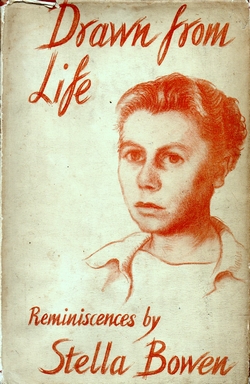
stellabowen-drawnfromlife

But then – a ‘placid and uneducated mistress’. Really? Stella? We may be tempted to see in ‘placid’ further hints of passivity or self-effacement or male constructions of ‘desirable’ qualities, considering at the word’s origins in the verb ‘to please’. And yet. . . the dictionary gives only ‘calm’, ‘not easily upset or excited’. As for education: Stella wrote that Pound ‘took the trouble to occupy himself with our joint education’—Phyllis Reid and Stella herself—and, wondering about his and others’ efforts, she remarked: ‘I can only suppose that they found my complete lack of education something of a novelty! The clean slate.’ Then too, reviewing her relationship with Ford, she recalled that, while he got his cottage, domestic peace and a baby daughter, she herself got out of it ‘a remarkable and liberal education, administered in ideal circumstances’.[14]

In the autumn of 1917, in Imaginary Letters, a series begun by Wyndham Lewis, Pound wrote of an ‘eminently cultured female’ named Elis—and her cousin, ‘who knows “nothing at all” and is ‘ten times better educated.’ She asks him ‘sane’ questions. She is ‘“wholly uneducated”. That is to say I find her reading Voltaire and Henry James with placidity.’[15] In the summer of 1914, Lewis had written that ‘[e]ducation (art education and general education) tends to destroy the creative instinct’ while Pound, in another 1917 piece, wrote that ‘[t]his little American had rotten luck; he was educated – soundly and thoroughly educated’.[16]

No, ‘uneducated’, for both Stella and Pound at this juncture, was not a particularly simple matter. In any case, the friendships continued, apparently untroubled by poems about stylists, mistresses and leaky havens.

References

[1] Rex Lampman’s ‘Epitaph’ is in Pound’s Pavannes and Divagations (1958; New York: New Directions, 1974), vii.

[2] Drusilla Modjeska, Stravinsky’s Lunch (New York: Farrar, Straus and Giroux, 2000), 169: the painting is reproduced as Plate 15.

[3] Stella Bowen, Drawn From Life (London: Collins, 1941), 48.

[4] Ford Madox Ford, It Was the Nightingale (London: Heinemann, 1934), 9.

[5] Ford, Letters of Ford Madox Ford, edited by Richard M. Ludwig (Princeton: Princeton University Press, 1965), 103.

[6] Bowen, Drawn From Life, 81.

[7] Ford Madox Ford, It Was the Nightingale, 138.

[8] See Mary Butts, The Journals of Mary Butts, edited by Nathalie Blondel (New Haven: Yale University Press, 2002), 132 and fn.; Nathalie Blondel, Mary Butts: Scenes from the Life (New York: McPherson & Co., 1998), 71-72.

[9] Brita Lindberg-Seyersted, Pound/Ford: The Story of a Literary Friendship (London: Faber & Faber 1982), 36-37.

[10] Literary Essays of Ezra Pound, edited by T. S. Eliot (London: Faber and Faber, 1960), 429 and footnote. In 1937, a letter to Michael Roberts included a reference to ‘nickle [sic] cash-register Bennett’: Ezra Pound, Selected Letters, 1907-1941, edited by D. D. Paige (New York: New Directions, 1971), 296.

[11] Ezra Pound: Poems and Translations, edited by Richard Sieburth (New York: Library of America, 2003), 555.

[12] Lindberg-Seyersted, Pound/Ford, 27.

[13] A. David Moody, Ezra Pound: Poet: A Portrait of the Man and His Work: Volume I: The Young Genius 1885–1920 (Oxford: Oxford University Press, 2007), 404.

[14] Bowen, Drawn From Life, 50, 52, 64.

[15] Pound, Pavannes and Divagations, 59, 60.

[16] Lewis, ‘Long Live the Vortex!’, Blast: Review of the Great English Vortex, I (20 June 1914), 7; Pound, ‘Stark Realism: This Little Pig Went to Market’, Pavannes and Divagations, 105.
Dylan, Dai Greatcoat and Welshness

Dylan-Caitlin-via-Telegraph

(Dylan Thomas and his wife Caitlin via The Telegraph)

Dylan Thomas (born 27 October 1914) was probably my first poetic crush or obsession or, let’s say, preoccupation. No doubt I had others of a non-poetic kind and it was not solely as a spectator that I approached Thomas: I myself was to be a poet in the Thomas mode – a lord of language but also comedian, raconteur, champion drinker, roaring boy. I can see now that I actually read relatively few of Thomas’s poems: I just read them a lot. They were, for the most part, the ones that remain the best known and most often cited: ‘The force that through the green fuse drives the flower’, ‘Light breaks where no sun shines’, ‘I see the boys of summer’, ‘After the funeral’, ‘When all my five and country senses see’, ‘The hunchback in the park’, ‘A Refusal to Mourn the Death, by Fire, of a Child in London’, ‘Fern Hill’, ‘Do not go gentle into that good night’, and perhaps especially then, ‘Poem in October’ (I won’t worry too much about the indented lines, which will vanish when I post this):

It was my thirtieth year to heaven
Woke to my hearing from harbour and neighbour wood
And the mussel pooled and the heron
Priested shore
The morning beckon
With water praying and call of seagull and rook
And the knock of sailing boats on the net webbed wall
Myself to set forth
That second
In the still sleeping town and set forth.[1]

When I became aware of the scheme in ‘Prologue’, written especially for the 1952 Collected Poems—the two central lines rhyme, then the lines on either side of those and so back to the first and last lines—I admired that excessively for a time. (Then thought it a gimmick, mere ‘technique’ – and now simply like the poem.)

We tend to grow wary of youthful enthusiasms; we may encounter contrary or negative views of their objects; we may hug them protectively to ourselves and try to sustain them; but often other things crowd in to absorb our attention and the early enthusiasms—or infatuations or passions—are deprived of air and light and can’t always be resuscitated. Yet they’re not always gone for good. Sometimes we come back to them, years later, perhaps on quite other terms, and establish different but often surprisingly strong relations.

DJ-outside-Faber

(David Jones outside the Faber offices: http://www.david-jones-society.org/david-jones.html )

My most recent poetic preoccupation, still current in fact, is with David Jones. It’s a point of interest that, while Dylan Thomas was actually Welsh, born in Swansea—though much of his material is not substantially or conspicuously Welsh—David Jones, though he had a Welsh father, was born in Brockley, south-east London, spent very little time actually in Wales, but was hugely interested in Welsh history and literature. A great deal of his work, concerned with ‘the matter of Britain’, deals with themes of Welsh antiquity, mythology, language. Of course, both Dylan Thomas, ‘the Rimbaud of Cwmdonkin Drive’, and David Jones speak in the accents of upper-class Englishmen.

(The remarkable 1965 interview—two hours of film edited down to around twenty minutes—between Jones and Saunders Lewis, produced by Tristram Powell, is available here: http://www.david-jones-society.org/research-resources.html
(Also accessible through this site are the three invaluable films about Jones by the late Derek Shiel)

Despite the prevalence of Welsh matter in David Jones’s work, he tends to be viewed—when he’s not being neglected or overlooked, which is still too often the case—in relation to British modernism. This can seem something of a drawback for those seeking to establish a distinct strain of Welsh modernism and situate Dylan Thomas centrally within it: ‘If modernism in Britain was largely imported – think of James, Conrad, Pound, and Eliot – it was heavily Irish-influenced [presumably Joyce and Yeats]. Predictably, the Welsh variety has been seen solely in terms of its input to the definition of British (i.e., English) modernism, in the shape of David Jones. Although its anomalousness and belatedness are arguably a sign of writing which deals with the condition of Welshness, concentration on Jones’ high modernism (endorsed by Eliot, and publication by Faber) has led critics away from Welsh modernism.’[2]

David Jones told William Blissett that he’d met Dylan Thomas on three occasions: ‘twice he was drunk and unreachable, though amusing, the other time sober, and they talked at some length about Welsh metres, in complete accord.’[3] Thomas Dilworth points out that, on this last occasion, 30 March 1953, David Jones did ‘most of the talking since Thomas knew little about it.’ Thomas regarded Jones with ‘“great reverence”’, and ‘expressed huge admiration for him as a poet’, while Jones thought that Dylan Thomas ‘invigorated English through an underlying sense of Celtic language’.[4]

Both of David Jones’s major poems, In Parenthesis and The Anathemata were dramatised on the BBC, and Dylan Thomas performed in both recordings. In 1946, David Jones went to the basement flat in Albany Street of his friend Douglas Cleverdon to hear the first broadcast of Cleverdon’s adaptation of In Parenthesis; and listened to the following evening’s repeat with his friends Harman and Margaret Grisewood. He felt that the actors, including Richard Burton and Emrys Jones, wrongly stressed words and exaggerated emotions. Jones ‘hated it, broke down, and went to bed for a week.’[5] But Dylan Thomas, who delivered Dai Greatcoat’s boast, seems to have escaped the author’s censure. And in 1954, a year after Dylan’s death, when Douglas Cleverdon’s version of The Anathemata was repeated on Friday 26 November, Jones wrote to his friend Jim Ede: ‘It’s a peculiar thing. They sweated on it, but of course, from my point of view, it is all over-dramatized etc. etc. etc.—one or two bits not so bad—Dylan Thomas said his [pre-recorded] bits beautifully and the Welsh women in Part VII are all right.’[6]

I read In Parenthesis for the first time more than thirty years ago but feel that I’m only now beginning to see David Jones properly for the first time; reading Dylan Thomas and experiencing that intoxication—language as if mainlined, shot straight into the vein—even longer ago than that, I think that seeing him for the second time, though less enthralling than the first, may, in the end, prove even more rewarding.

 
References

[1] Dylan Thomas, The Poems, edited and introduced by Daniel Jones (London: J. M. Dent & Sons, 1971), 176-177.

[2] John Goodby and Christopher Wigginton, ‘Dylan Thomas’ modernism’, in Alex Davis and Lee M. Jenkins, Locations of Literary Modernism: Region and Nation in British and American Modernist Poetry (Cambridge: Cambridge University Press, 2000), 99.

[3] Conversation dated 25 September 1970: William Blissett, The Long Conversation: A Memoir of David Jones (Oxford: Oxford University Press, 1981), 57.

[4] Thomas Dilworth, David Jones: Engraver, Soldier, Painter, Poet (London: Jonathan Cape, 2017), 276.

[5] Dilworth, David Jones, 239.

[6] René Hague, editor, Dai Greatcoat: A self-portrait of David Jones in his letters (London: Faber and Faber, 1980), 164.