Pictures and Cathedral Closes

05:30 on the morning of another named storm, wind gusting like a fanatic and the tall, elaborate scaffolding at a house behind us, and three doors along, grinds and clacks and shrieks. It seems impossible that so much noise can result in no hazardous movement, no damage, no change in look or structure. And yet – collapsed scaffolding would be so absurdly appropriate, so ridiculously, symbolically pitch perfect, that I could never have taken either weather or metalwork seriously again.

Earlier this month, having avoided the news for the previous week, I’d lost track of the days, until I was walking away from coffee with my elder daughter and, halfway along the harbourside path, heard behind me the strains of a piper playing A Long Way To Tipperary. Armistice Day. A lengthy history but feeling a little awry when the world is so excessively out of true. Veterans of one world war utterly gone, veterans of the other all but gone. And, thinking of what the Second World War is believed to have been fought against, and of victory declared, and to look around the world now is. . . a little odd.

The good stuff is elsewhere. Indeed, the Decline of the West, though accelerating madly in recent months, seems oddly absent in West Sussex, where we go to spend a few days in Chichester for the Librarian’s birthday.

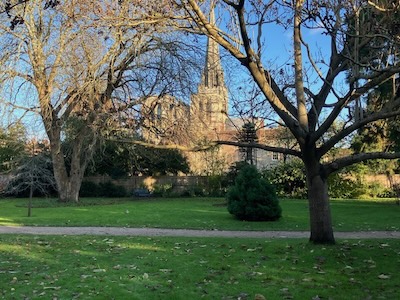
A quick shopping trip. What do we need? Wine and . . . something or other to go with it. And here is the Cathedral Close, Canon Lane, the Bishop’s Palace, St Richard’s Walk and the Deanery, which dates from 1725 and was itself a replacement for an earlier building, damaged in 1642, during the English Civil War. Key in the code and close the door and take in a roomy and well-appointed apartment with, unignorably, a television four or five times the size we’re used to. Could anything make the current dramatisation of Hilary Mantel’s The Mirror and the Light even more remarkable? Apparently so.

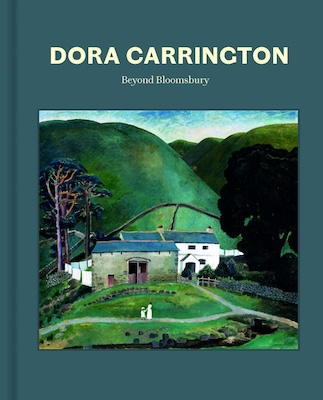
An excellent Carrington exhibition at the Pallant House Gallery: I’ve seen the Lytton Strachey portrait before but am convinced now that his fingers grow even more elongated under cover of darkness. The drawing of her brother is perfect; and the two portraits of Annie Stiles, seen together, are hugely pleasing. A scattering of works by Mark Gertler too, a significant presence in Carrington’s life, both personally and professionally: they include the portrait of Gilbert Cannan and His Mill, familiar from several visits to the Ashmolean in Oxford. Somehow, it strikes me as a little odder every time I see it. A few steps away from the building where we’re staying, we find an arresting anthology of birds, curious plants and extraordinary trees in the Bishop’s Palace Garden. Then a walk, nearly one and a half miles, following the surviving city walls, some traceable to the 3rd century. A bus trip to Selsey. And the Cathedral.

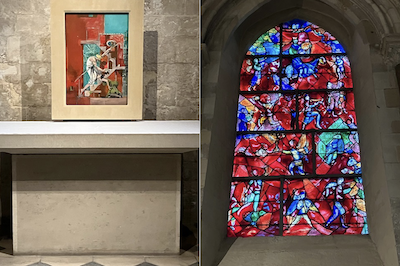
(Sutherland, Noli me Tangere and the Marc Chagall window)

‘I can stand a great deal of gold’, Henry James murmured to Desmond MacCarthy, as they stood in an exceptionally gilded drawing-room.[1] I can, it seems, stand a great deal of cathedrals. Poised on that delicate boundary between agnostic and atheist (finding it ultimately as absurd to state dogmatically that there isn’t as to state dogmatically that there is), I may attend evensong too (we did, liking to be sung to), though declining to recite the Apostle’s Creed, for obvious reasons.

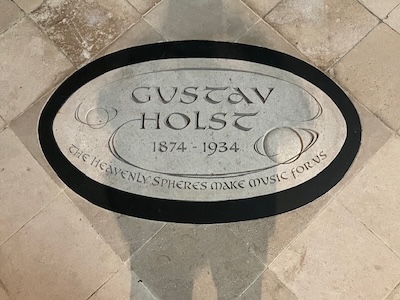
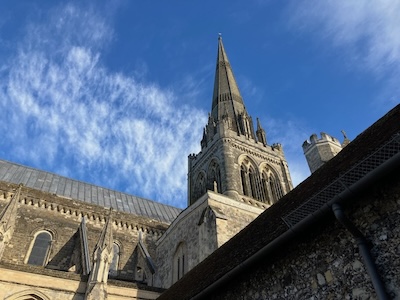
But the Cathedral. I’ve been to Durham, Wells, Exeter, Salisbury, Christchurch, St Paul’s, Hereford, Bristol. Different settings, different grandeurs. Here—among much else, stained-glass windows, statuary, painted panels, altarpieces—is Graham Sutherland’s Noli me Tangere, and two huge tapestries, one by John Piper and the other co-created by Ursula Benker-Schirmer and West Dean College students. There is a stunning Marc Chagall window, installed in 1978, and Gustav Holst’s ashes are buried in the North Transept.

Then Selsey: the Ford Madox Ford connection, of course, Violet Hunt having rented a cottage from Edward Heron-Allen, she and Ford spending much time there before—and during—the war. Little of that remaining in Selsey – but fascinating to learn that the monastery here, founded by St Wilfrid in 681, became the first cathedral in Sussex, until 1076, when the see of Chichester was established.

On the morning we leave: snow. Knowing how bad we continue to be in this country at dealing with any weather event out of the ordinary—even thought the formerly extraordinary is increasingly now the unremarkable—we skip brunch in the Cloisters café and head for the station. And yes, trains cancelled, delayed, signal failures, the whole nine yards, as our American cousins say – to whom we warily extend our sympathy (amidst our total and enduring bafflement). . .

Notes


[1] Leon Edel, The Life of Henry James: Volume 2 (Harmondsworth: Penguin Books, 1977), 680-681.

Pilots, poets, bays

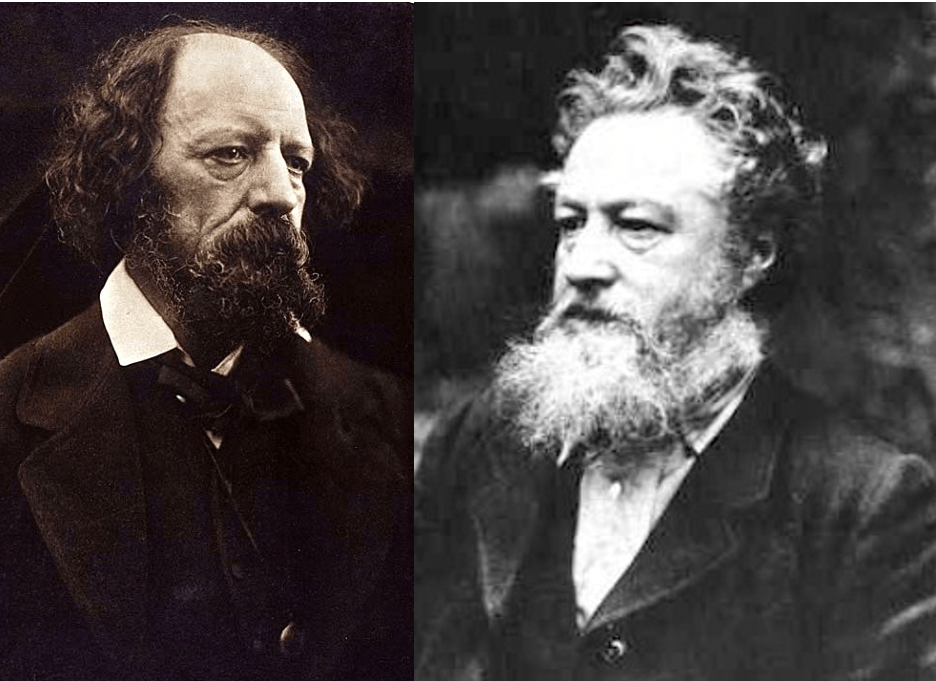
Alfred Lord Tennyson died on 6 October 1892, having served as Queen Victoria’s Poet Laureate for over forty years, the longest ever tenure – though a later octogenarian, John Masefield, came very close. Tennyson’s funeral, which took place six days after his death, was a pretty grand affair. His remains were, the Times reported, ‘consigned to their last resting-place in Poets’ Corner, Westminster’ – the grave of Robert Browning, who had died three years previously, is immediately adjacent to Tennyson’s. All the leading members of the royal family sent representatives (Sir Henry Ponsonby, Sir Dighton Probyn, Lord Edward Cecil) and the place was thronged with bishops, lords and ladies, the pall-bearers including the Duke of Argyll and Lord Kelvin. Conan Doyle, Ellen Terry, John Burns, Frederic Harrison and Henry Irving were among the mourners. In the street outside, vendors were offering, for a penny, copies of the poet’s 1889 lyric, ‘Crossing the Bar’ (author portrait included):

Sunset and evening star,
   And one clear call for me!
And may there be no moaning of the bar,
   When I put out to sea,

But such a tide as moving seems asleep,
   Too full for sound and foam,
When that which drew from out the boundless deep
Turns again home.

Twilight and evening bell,
   And after that the dark!
And may there be no sadness of farewell,
   When I embark;

For though from out our bourne of Time and Place
   The flood may bear me far,
I hope to see my Pilot face to face
When I have crost the bar.[1]

Tennyson was 80 when he wrote it, so unsurprisingly aware that the encounter with his ‘Pilot’ was not that far off.

Edward Burne-Jones was particularly excited that the city of Mantua ‘had sent bay from Virgil’s birthplace to lay in the tomb.’ In fact, ‘bay’ and ‘pilot’ occurred in another ‘literary’ interment context a few years later, though William Morris’s ‘country funeral’, Fiona MacCarthy observes, ‘was the absolute antithesis of Tennyson’s burial in Westminster Abbey in 1892.’[2]

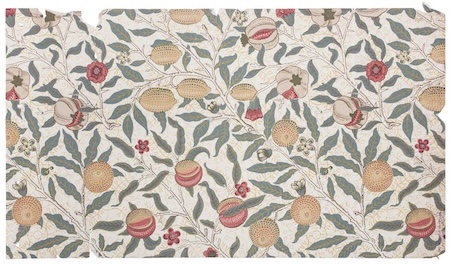
(William Morris, Fruit (Wallpaper): William Morris Society: Kelmscott House)

Morris died on 3 October 1896. He was only 62 but such a tireless worker, such a tireless maker, of pictures, poems, translations, tapestries, stained-glass windows, fabrics, carpets, furniture, illuminated books, wallpapers, prose romances and more that, as is often remarked, the primary cause of his death was simply being William Morris. His funeral took place on 6 October, exactly four years after the death of Tennyson. The body had to be transported from Paddington to Lechlade by train (a form of transport that Morris disliked intensely), then taken by cart to Kelmscott Church.

It was a cold wet morning, and the day turned stormy later. In that week’s issue of the Saturday Review (10 October 1896), there were pieces on Morris by George Bernard Shaw, Arthur Symons – and R. B. Cunninghame Graham, whose account of the day on which ‘the most striking figure of our times’ was buried, began with that weather. ‘As we never associated William Morris with fine weather, rather taking him to be a pilot poet lent by the Vikings to steer us from the doldrums in which we now lie all becalmed in smoke to some Valhalla of his own creation beyond the world’s end, it seemed appropriate that on his burial day the rain descended and the wind blew half a gale from the north-west.’ He noted of the arrival at Lechlade: ‘There, unlike Oxford, the whole town was out’, and added that the open haycart on which the coffin was transported to Kelmscott Church was ‘driven by a man who looked coeval with the Saxon Chronicle.’[3]

‘Over the coffin were thrown two pieces of Oriental embroidered brocade, and a wreath of bays was laid at his head’, the Daily News reported. The mourners included, alongside painters, publishers and printers, workmen from Merton Abbey (where the tapestry, weaving and fabric printing workshops were sited), Kelmscott villagers and members of the Art Workers’ Guild, all in their daily working clothes. The architect William Lethaby wrote: ‘It was the only funeral I have ever seen that did not make me ashamed to have to be buried.’[4]

(William Morris, Kelmscott Press Edition of ‘Godefrey of Boloyne’ by William Caxton: William Morris Society: Kelmscott House)

Morris continues to attract enormous biographical and scholarly interest, and warrants it all. So many arts, so many crafts, so many connections, so widespread and generative an influence, cropping up in all manner of places, often the expected ones, sometimes less so. Ezra Pound read Morris to the young Hilda Doolittle, ‘in an orchard under blossoming—yes, they must have been blossoming—apple trees.’ And: ‘It was Ezra who really introduced me to William Morris. He literally shouted “The Gilliflower of Gold” in the orchard. How did it go? Hah! hah! La belle jaune giroflée. And there was “Two Red Roses across the Moon” and “The Defence of Guenevere.”’[5] Pound read Morris to Yeats too, in Stone Cottage at the edge of Ashdown Forest, his translations of the Icelandic sagas.[6] Yeats would later recall of Morris’s prose romances that they were ‘the only books I was ever to read slowly that I might not come too quickly to the end.’[7]

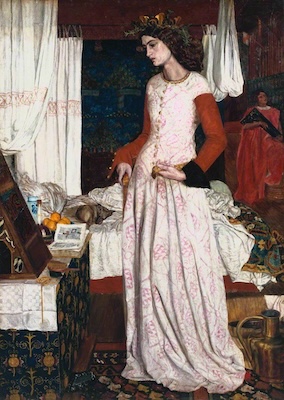
(William Morris, La Belle Iseult: Tate)

Fiona MacCarthy remarks that ‘There was a neurotic basis to his fluency. On a good day he could write 1,000 lines of verse’, and some readers will find some of the longer poems soporific.[8] Penelope Fitzgerald wrote that the lyrics, in her opinion were ‘far the most important part’ of his  poetry and, ‘If I could keep them I would cheerfully sweep all the sagas and Earthly Paradises under the carpet.’[9] Other readers, in Morris’s own time, and since, have felt quite differently. Yeats continued to be one of them. In October 1933, he reported to his old friend (and ex-lover) Olivia Shakespear (Pound’s mother-in-law) his attempt to read Morris’s long poem The Story of Sigurd the Volsung to his daughter and then to his wife: ‘and last night when I came to the description of the birth of Sigurd and that wonderful first nursing of the child, I could hardly read for my tears. Then when Anne had gone to bed I tried to read it to George and it was just the same.’[10]

This is probably the passage he refers to, early in Book II:

Then she held him a little season on her weary and happy breast
And she told him of Sigmund and Volsung and the best sprung forth from the best:
She spake to the new-born baby as one who might understand,
And told him of Sigmund’s battle, and the dead by the sea-flood’s strand,
And of all the wars passed over, and the light with darkness blent.

So she spake, and the sun rose higher, and her speech at last was spent,
And she gave him back to the women to bear forth to the people’s kings,
That they too may rejoice in her glory and her day of happy things.[11]

For other admirers of Morris, it may be the campaigner, the Socialist, or perhaps the designer and producer of stained-glass, fabrics, stories, the late romances, the lectures and the essays:

‘To give people pleasure in the things they must perforce use, that is one great office of decoration; to give people pleasure in the things they must perforce make. That is the other use of it.’
     ‘Does not our subject look important enough now? I say that without those arts, our rest would be vacant and uninteresting, our labour mere endurance, mere wearing away of body and mind.’[12]

Yes, the allusions to damaging and artificial divisions are often wonderfully suggestive of other divisions causing much wider harms – as, of course, they continue to do. And, though I may be prejudiced in this regard, I like his idea, in ‘The Beauty of Life’, of ‘the fittings necessary to the sitting-room of a healthy person’. The first of these is ‘a book-case with a great many books in it’. Oddly, he never seems to mention, let alone recommend, piles of books everywhere else. . .


Notes

[1] Tennyson: A Selected Edition, edited by Christopher Ricks (Harlow: Longman Group, 1989), 665-666.

[2] Fiona MacCarthy, William Morris: A Life for Our Time (London: Faber & Faber, 1994), 631, 673-675.

[3] R. B. Cunninghame Graham, ‘With the North-West Wind’, Saturday Review (10 October 1896), Vol. 82, Issue 2137, 389-390.

[4] Quoted by Philip Henderson, William Morris: His Life, Work and Friends (Harmondsworth: Pelican Books, 1973), 429.

[5] H. D., End to Torment: A Memoir of Ezra Pound, edited by Norman Holmes Pearson and Michael King (Manchester: Carcanet Press, 1980), 22-23.

[6] James Longenbach, Stone Cottage: Pound, Yeats and Modernism (New York: Oxford University Press, 1990), 142-143.

[7] W. B. Yeats, ‘The Trembling of the Veil [1922]: Four Years’, in Autobiographies (London: Macmillan, 1955), 141.

[8] MacCarthy, William Morris, ix.

[9] Penelope Fitzgerald to Dorothy Coles, 5 June [1992], So I Have Thought of You: The Letters of Penelope Fitzgerald, edited by Terence Dooley (London: Fourth Estate, 2008), 460.

[10] The Letters of W. B. Yeats, edited by Allan Wade (London: Rupert Hart-Davis, 1954), 816.

[11] William Morris, The story of Sigurd the Volsung and the fall of the Niblungs (London: Ellis & White, 1877), 80-81.

[12] ‘The Lesser Arts’, in William Morris: The Selected Writings, edited by G. D. H. Cole (London: The Nonesuch Press, 1934), 496.

Leg trouble


Near the top of the hill, I pause.

‘Is it bad?’ the Librarian asks with well-worn concern, referring to my left ankle and lower leg, which have been behaving peculiarly in recent weeks. Ankle arthritis, we’ve decided.

But: ‘No’, I say, ‘higher up, seems to be my hip.’

‘Oh’, she says, clearly envisaging a whole new trajectory of complaint.

‘It’ll get easier, I expect.’ Do I believe this? Of course not. But it may. In any case, walking and its attendant ingredients here, trees, dogs, squirrels, the magpies, the children yelling in the school playground, the sudden panoramic view over Bristol that opens up suddenly on our left-hand side as the path sweeps round to run beneath close branches, all distract attention from a mere hip.

Trouble with legs. I remember the Reverend Francis Kilvert: ‘I preached in some discomfort for although the Vicar had assured me the pulpit would be almost up to my chin it was scarcely above my waist and in order to see to read my sermon I was obliged to crouch down in it and stick one leg out behind.’[1] At least he had two: the writer Colette’s father, an ex-captain of the select Zouave infantry, born in Toulon and trained at Saint-Cyr, had lost his left leg in Italy in 1859.[2] I recall too Theresa Whistler’s account, in her biography of Walter de la Mare, of a surgeon named Kidd offering his solution to the writer’s insomnia: ‘an eccentric Irish hypnotist named Leahy, who had a hot temper and a false leg, which proved a disadvantage. Climbing to his patient’s room, sporting a Leander tie [rowing club] and a little drunk, he would succeed in inducing slumber, and would then descend – step, thump, step, thump. Before he had reached the ground floor the nurse was speeding down to recall him. “The bloody man!” he would explode, and rushed up again, bursting in on the patient: “You bloody well go to sleep!”’[3]

In the First World War, those men unable to distinguish left from right were given a hay band and a straw band to tie round each leg. The drill instructor would call out ‘Hay, straw’ instead of left, right. On the back of the envelope of one of his letters to Edward Chapman, the poet and composer Ivor Gurney wrote: ‘Would you like a hay band or a straw – ? I’ve finished with mine.’[4]

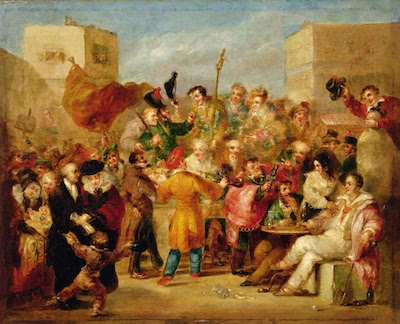
Benjamin Robert Haydon, The Mock Election (Royal Collections Trust)

It’s often noticed that artists have trouble with hands – but often enough there are leg problems too. Alethea Hayter wrote of Benjamin Haydon’s inconveniently small studio—‘and he could never get far enough away really to see the effect of the whole picture, and his defective eyesight produced the errors of proportion—particularly the shortness of leg—which give a fatally ludicrous look to so many of his heroic figures.’[5] And, while artists often sketch their own hands, legs come into it too. On Valentine’s Day, 1938, David Jones writes to Harman Grisewood: ‘I think if I could only get not having the worst type of nerves and could work at painting or writing (Bugger—O did not know this had a drawing on the back—it is my leg. I drew it as a study for a thing I’m doing—bugger! I want it, but can’t write this letter over again—well, I shall have to send it as it is and do my leg again if I want it) I should be quite happy alone always.’[6]

At home, I download ankle arthritis exercises and sternly ignore any promptings from the hip. What a trouper. . .

Notes


[1] Entry for Wednesday 4 October 1871: Kilvert’s Diary, edited by William Plomer, Three volumes (London: Jonathan Cape, 1938, reissued 1969), Volume Two (23 August 1871—13 May 1874), 53.

[2] Colette, Earthly Paradise: An autobiography drawn from her lifetime writing by Robert Phelps (Harmondsworth: Penguin, 1974), 15.

[3] Theresa Whistler, The Life of Walter de la Mare: Imagination of the Heart (London: Duckworth, 2003), 344.

[4] Letter of early 1915: Stars in a Dark Night: The Letters of Ivor Gurney to the Chapman Family, edited by Anthony Boden (Gloucester: Alan Sutton, 1986), 17 fn.

[5] Alethea Hayter, A Sultry Month: Scenes of London Literary Life in 1846 (London: Faber and Faber, 1965), 59.

[6] René Hague, editor, Dai Greatcoat: A self-portrait of David Jones in his letters (London: Faber and Faber, 1980), 84.

Those autumn leaves (turn, turn, turn!)

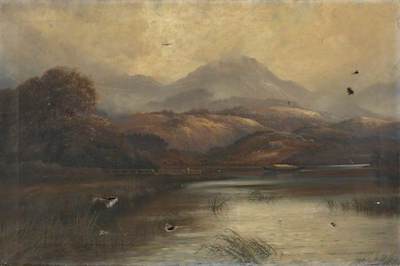
(Henry Robinson Hall, Coniston Lake from Lake Bank: The Dock Museum, Barrow-in-Furness)

As early as 1 August, John Ruskin at Coniston Lake declared that, ‘The summer is ended. Autumn begun.’ Gilbert White, though, also a close watcher of the seasons, the natural world and everything in it that occurred before his eyes, wrote on 9 September 1781: ‘Red-breasts whistle agreeably on the tops of hop-poles etc., but are prognostic of autumn.’[1] We tend to associate that word now with the progress of a disease but it means only ‘knowing before’ and a prognosticator, my dictionary assures me, means a predictor, especially a weather prophet. Looking forward to autumn, anyway.

On this same day in 1767, White had looked back to the previous summer and feeding his tame bat, which would take flies out of a person’s hand. He added that: ‘Insects seemed to be most acceptable, though it did not refuse raw flesh when offered: so that the notion, that bats go down chimnies and gnaw men’s bacon, seems no improbable story.’[2]

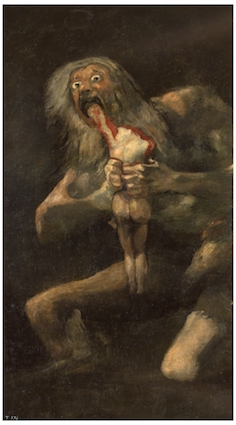
Momentarily, ‘raw flesh’ offers to my suggestible mind the ‘person’s hand’ just mentioned (biting the hand that feeds you, I suppose); while ‘gnaw men’s bacon’ is also oddly disturbing, probably traceable to the word ‘gnaw’. It tends to recall to me the image of Goya’s Saturn Devouring His Son, though, when I look at the painting again (it was first a mural, then transferred to canvas), it’s not what I think of as ‘gnawing’. Werner Hofmann distinguishes Goya’s Saturn from that of Rubens, because there is no delight here: Goya’s cannibal ‘horrifies the observer because he himself is horrified.’ Hofmann also notes that madness has driven him to his crime, ‘like Ugolino devouring his sons in the tower of Gualandi.’[3]

(Francisco Goya, Saturn Devouring his Son: Museo Nacional del Prado)

This is from Dante’s Inferno, the penultimate canto (which T. S. Eliot cites in his notes to The Waste Land). Count Ugolino was head of the Guelf government in Pisa for a time until overthrown by a Ghibelline uprising initiated by the Archbishop Ruggieri, in what John Sinclair refers to as ‘this competition of mutual knavery and intrigue’. Locked in a tower with his children and left without food, he watches his sons die one after another and, deranged by grief, eats them. Now, in Dante’s Hell, he gnaws on the skull of the Archbishop (the word occurs in a reference to a tale from ancient history—one of the seven kings who besieged Thebes, mortally wounded by an assailant whom he killed ‘and gnawed the head with rage’). Having told his story, Ugolino ‘with eyes askance took hold of the wretched skull again with his teeth, which were strong on the bone like a dog’s.’[4] Yes, that to me is gnawing – with a vengeance, you might say.

On 9 September 1929, Sylvia Townsend Warner lay under London plane-trees and experienced a moment of extreme joy. ‘There like a bird I sat and sang. An antediluvian old lady with a bow streaming from the back of her hat sat sketching nearby, two little girls played dodge round a tree, and I heard the swish-swish of dead leaves sweeping. It was a moment for ever. Spring cannot bring me the same ravishment. Spring is strictly sentimental, self-regarding; but I burn more careless in the autumn bonfire.’[5]


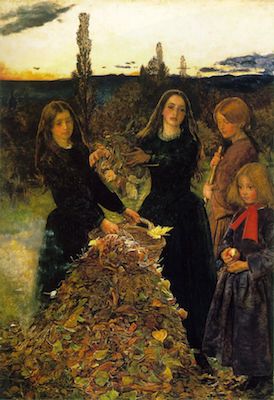
(John Everett Millais, Autumn Leaves: Manchester City Art Gallery)

Yes, if I had to choose, I might well come down on the side of autumn (eschewing all references to the seasons of a life as opposed to the life of the seasons), though why choose? The pleasures of spring are just a little too obvious, perhaps. Here, in autumnal mode, is young Olive Garnett (sister of the more famous Edward), author and diarist, to whom we’re indebted for some of the earliest glimpses of Ford Madox Ford, his wife Elsie, Conrad, James and others of the period. She’s on Hampstead Heath, skirting the heath in fact, ‘gathering blackberries the while & arrived at that delightful little footpath to the Finchley Road. In the field behind the paling were two haystacks, a pig & some cows.’[6]

(What do you do in the autumn? I do this).

And now the rain has stopped, started again, stopped again. Tiring weather. My sympathies stray towards Elizabeth Bishop, who writes to her friend, the writer and editor Pearl Kazin, 9 September 1959. ‘And—oh well, we read and read and read, all the time, and the books pile up, and I remember a little here and there, and the magazines are snowing us under, and what good it all does drifting around in this aging brain I don’t know!’[7]

We are waiting for a gap in the clouds.


Notes


[1] Ruskin, 1884 diary entry and White quoted by Geoffrey Grigson, The English Year: From Diaries and Letters (London: Oxford University Press, 1967), 103, 122.

[2] Gilbert White, The Illustrated History of Selborne (London: Macmillan, 1984), 39.

[3] Werner Hofmann, Goya: ‘To every story there belongs another’, translated by David H. Wilson (London: Thames & Hudson, 2003), 243.

[4] Dante, The Divine Comedy of Dante Alighieri. I: Inferno, Italian text with translation and comment by John D. Sinclair (London: Oxford University Press, 1971), Canto XXXIII, 405-409; Tydeus, one of the leaders of expedition of the ‘Seven against Thebes’, mentioned 402.

[5] Sylvia Townsend Warner, The Diaries of Sylvia Townsend Warner, edited by Claire Harman (London: Virago Press, 1995), 43.

[6] Diary entry, Tuesday 9 September: Tea and Anarchy! The Bloomsbury Diary of Olive Garnett, 1890-1893, edited by Barry C. Johnson (London: Bartletts Press, 1989), 46.

[7] Elizabeth Bishop, One Art: The Selected Letters, edited by Robert Giroux (London: Pimlico, 1996), 376.

Something in the west

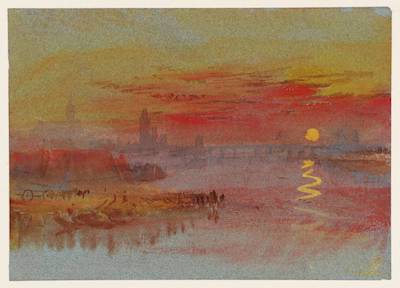
The Scarlet Sunset circa 1830-40 Joseph Mallord William Turner 1775-1851 Accepted by the nation as part of the Turner Bequest 1856 http://www.tate.org.uk/art/work/D24666

‘We could go for a later walk’, the Librarian said, ‘and try to catch a sunset – if there is one. It’s a bright, clear day at the moment.’ The sunset time on the BBC weather site was 16:34. I remembered being on the Dorset coast a couple of years ago, when we could watch the sun slip out of sight at exactly the predicted time. Science: knowledge ascertained by observation and experiment, critically tested, systematised and brought under general principles, derived from the Latin, to know – so not popular with everyone.

I suspect that there are dawn people and sunset people – and, needless to say, a huge number of others that will take both or neither or who, in any case, are never up sufficiently early to take a balanced view of the matter. Wordsworth’s dawn (in which it was bliss to be alive) in The Prelude embraced both youth and the initial promise of revolutionary France. A red sky at night, the proverb says, has shepherds capering about in sheer glee. Certainly my mother, who was a keen amateur painter, could never get enough of sunsets – but then she lived for a few years in the Far East, and a vista of junks picking their way through a dazzling sunset across the South China Sea was absurdly romantic to western eyes. A more prosaic question is probably: does your day stretch awfully ahead of you in some deadening job that barely puts food on the table after a ten-hour stint or is the prospect rather more alluring?


The narrator of Henry Green’s first novel, Blindness, lingers on an approaching sunset. ‘The sun was flooding the sky in waves of colour while he grew redder and redder in the west, the trees were a red gold too where he caught them. The sky was enjoying herself after the boredom of being blue all day.’[1] John Ruskin, writing in the early 1870s, was a little more agitated: ‘I…cannot any more look at a sunset with comfort, because, now that I am fifty-three, the sun seems to me to set so horribly fast; when one was young, it took its time; but now it always drops like a shell, and before I can get any image of it, is gone, and another day with it.’[2]

Guy Davenport observed that ‘Turner’s violent sunsets can be traced to a volcano in the Pacific, which loaded the air with dust and made chromatic changes in the sky. An element in romanticism can thus be traced to tectonic plates. From Turner, Ruskin; from Ruskin, Proust; from Proust, Beckett. Our sense of history can always be activated by such connections, whether they’re dependable or not. Every age’s past is a chosen one, and tells as much about the age as about the history it recovers.’[3]

Writing to his friends Geoffrey and Ninette Dutton, the Australian novelist Patrick White mentioned that his story, ‘Being Kind to Titina’, was based on his partner Manoly’s ‘childhood and youth in Alexandria and Athens’, and that he wanted to write a novel ‘about a boy growing up in those places, in a large family and ending with the German invasion of Greece. I think of it under the title of “My Athenian Family”, and see it as a kind of Greek version of a Turner sunset’. One of his favourite paintings was Turner’s ‘Interior at Petworth’ and, in a letter to Mary Benson (30 June 1971), he wrote that he used to go and look at it almost every Sunday when living in London: ‘besides being a subtle painting, I feel it taught me a lot about writing.’ Late Turners, he told another friend, Penny Coleing (23 June 1971), made him ‘grow breathless with delight every time I see them’.[4]


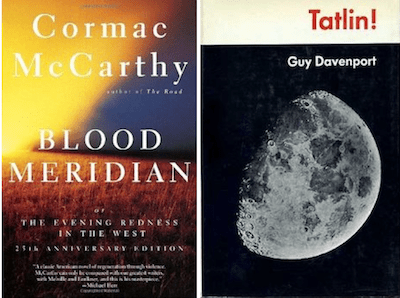
I was trying to remember the title – of a book or a section of a book – to do with sunsets, or the sinking of the sun in the west. I could remember the rhythm: the something of the something in the west but got no further. The Decline of the West seemed a possible part of it – Spengler? David Caute? – but no. The closest I got was the latter half of the title of a Cormac McCarthy novel I’d read years back: Blood Meridian or The Evening Redness in the West – and noticed that he’d written a play called The Sunset Limited. Of the novel, I mainly recalled a great deal of blood, scalping and general mayhem.

To Hugh Kenner, Davenport wrote on 18 January 1974: ‘Cormac McCarthy, the Gothic nuvvlist of Sevier County, Tennessee, has begun sending back his Xerox copy of Tatlin!, page by page, with the socks of my prose pulled up. He is right most of the time, but he has made me feel so unsure of my ability to write even a simple English sentence that I’ve had dark and despairing thoughts of withdrawing the manuscript altogether.’ To which Kenner sent his reassuring reply five days later: ‘Pay no ultimate heed to Cormac McCarthy. No hand is surer than your’n with English syntax and epithet.’[5]

There was, of course, no sunset on our walk: no sun to begin with by the time we went out, barely any light at all in fact. It had become a day determined to give a new edge to the word ‘dull’. Still, it was good exercise.


Notes

[1] Henry Green, Nothing, Doting, Blindness (London: Vintage Books, 2008), 421.

[2] Ruskin, Fors Clavigera (New Edition: 4 volumes, 1896), I, 373.

[3] Guy Davenport, ‘Wheel Ruts’,  Grand Street, 7, 2 (Winter, 1988), 246.

[4] Patrick White, Letters, edited by David Marr (London: Jonathan Cape, 1994), 202, 203n.

[5] Questioning Minds: The Letters of Guy Davenport and Hugh Kenner, edited by Edward M. Burns, two volumes (Berkeley: Counterpoint Press, 2018), II, 1503, 1504.

Orchards – from a distance

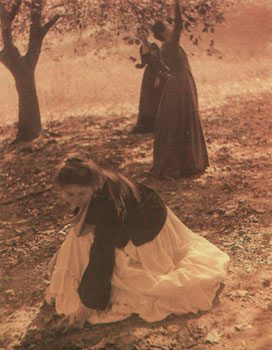
(Clarence Hudson White, The Ring Toss: Yale Visual Resources Collection; William Merritt Chase, The Ring Toss)

I noticed that today is the birthday of the photographer Clarence Hudson White, born in Ohio in 1871 (he died early, aged 54, in Mexico City). He became close friends with Alfred Stieglitz. I’d barely heard of White but, in a brief gallery of his photographs, my eye snagged on ‘The Ring Toss’ because I knew of the 1896 painting by William Merritt Chase, ‘The Ring Toss’. A lot of Chase’s paintings are very reminiscent of John Singer Sargent – who painted a portrait of Chase in 1902 (Museum of Modern Art).[1]

Clarence_White-The_Orchard.1902

(Clarence Hudson White, The Orchard)

This very evocative Clarence White photograph was published in 1905 (Camerawork, 9). Should the women seem to be practising social distancing, that’s probably mere happenstance.

Orchards are certainly evocative for artists and writers, perhaps because of their seeming to balance on the threshold of imposed order and unchecked nature, perhaps because they’re often associated with childhood, a lost paradise, or at least with a rural or semi-rural peace – and thus standing in stark contrast to the destructive forces of war. Edmund Blunden’s classic memoir, Undertones of War, refers to them often.

Early on in his ‘education’, in a chapter called ‘The Cherry Orchard’, he writes: ‘The joyful path away from the line, on that glittering summer morning, was full of pictures for my infant war-mind. History and nature were beginning to harmonize in the quiet of that sector. In the orchard through we passed immediately, waggons had been dragged together once with casks and farm gear to form barricades; I felt that they should never be disturbed again, and the memorial raised near them to the dead of 1915 implied a closed chapter.’ And of Englebelmer, ‘a sweet village scarcely yet spoiled’: ‘Its green turf under trees loaded with apples was daily gouged out by heavy shells; its comfortable houses were struck and shattered, and the paths and entrances gagged with rubble, plaster and woodwork.’[2]

Katherine Mansfield would also borrow the title of Chekhov’s last play, writing to John Middleton Murry from Menton two years after the war’s end: ‘You see it’s too late to beat about the bush any longer. They are cutting down the cherry tree; the orchard is sold—that is really the atmosphere I want.’[3]

In the midst of that war (22 March 1916), Ivor Gurney wrote to Marion Scott, from near Tidworth, in Wiltshire, of his beloved home county, ‘Glostershire where Spring sends greetings before other less happy counties have forgotten Winter and the snow. Where the talk is men’s talk, and eyes of folk are as soft as the kind airs. The best roads in England, the finest cider, the richest blossom in the most magical orchards, beauty content in security, strength quiet in confidence controlled, blood mixed of plain and hill, Welsh and English; are not these only of my county, my home?’[4]

Wilfred Owen never did see the war’s end – though he planned for it, writing in 1917 to his brother Colin, then working on a farm: ‘In my walk this afternoon, considering at leisure the sunshine and the appearance of peace (I don’t mean from the news) I determined what I should do after the war [ . . . ] I should like to take a cottage and orchard in Kent Surrey or Sussex, and give my afternoon to the care of pigs.’[5]

In May 1962, Guy Davenport wrote, in a letter to Hugh Kenner, ‘You see, my ambition is to put down roots and have a real library and workshop, a hearth & orchard, and STAY PUT.’[6]

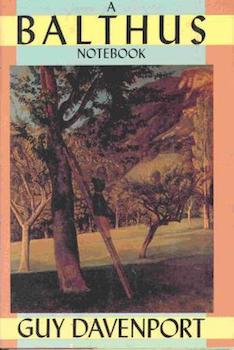
GD-Balthus-Notebook

(The Balthus painting on the jacket is the 1940 The Cherry Tree)

Apples – and pears – were of central and lasting importance to Davenport: ‘Apple and pear, brother and sister’, he writes in the novel-length title story.[7] In Objects on a Table, he stated that: ‘Pear symbolizes a harmony between human and divine; apple an encounter between human and divine. The forbidden fruit in Eden became an apple through linguistic accident, punning on evil and apple. But the inevitability of the accident was ensured by centuries of Greek and Latin pastoral poetry in which the apple was eroticized.’[8] In A Balthus Notebook, he discussed the painter’s Balthus’s use of apples and pears—‘In Christian iconography, a pear symbolizes the Redemption, and apple and pear are frequently together in Madonnas, Mary being the redemption of Eve, Christ of Adam’—noting that apple and pear appeared together for the first time in the 1981 Painter and His Model.[9]

And in ‘Shaker Light’, he tells the story of a pear tree and an apple tree ‘that had grown around each other in a double spiral’ and had stood for over fifty years around the corner from Davenport’s house. Walking past them daily for twenty years, they got into his thoughts ‘and always benignly.’ He saw them as husband and wife, as in Ovid’s poem. ‘They generated in my imagination a curiosity about the myths our culture has told itself about apples and pears. Apple is the symbol of the Fall, pear of Redemption. Apple is the world, pear heaven. Apple is tragic. A golden one given first as a false wedding gift and later presented by a shepherd to a goddess began the Trojan War and all that Homer recorded in the Iliad and the Odyssey. The apple that fell at Newton’s feet also fell on Hiroshima and Nagasaki and is right now embedded in thousands of bombs mounted in the heads of rockets, glowing with elemental fire that is, like Adam and Eve’s apple, an innocent detail of creation if untouched and all the evil of which man is capable if plucked.’ Finally, the trees were cut down by a developer, ‘in full bloom, with a power saw, the whining growl of which is surely the language of devils at their business, which is to cancel creation.’[10]

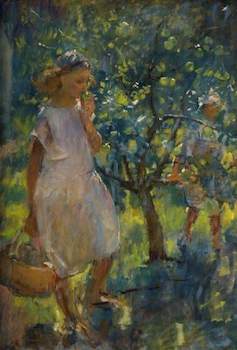
The painting that Stanley Spencer would later call his first ambitious one was called The Apple Gatherers. Spencer was one of that famous generation taught at the Slade by Henry Tonks – other Tonks pupils included Mark Gertler, Harold Gilman, Gwen John, Isaac Rosenberg, Stanley Spencer, David Bomberg, William Orpen, Wyndham Lewis and Winifred Knights. Tonks himself was clearly not immune to the lure of the orchard.

Tonks, Henry, 1862-1937; The Orchard

(Henry Tonks, The Orchard: Birmingham Museums Trust)

And I remember too one of the most memorable and thought-provoking moments in Ford Madox Ford’s The Good Soldier, when the narrator John Dowell says: ‘For I can’t conceal from myself the fact that I loved Edward Ashburnham—and that I love him because he was just myself. If I had had the courage and virility and possibly also the physique of Edward Ashburnham I should, I fancy, have done much what he did. He seems to me like a large elder brother who took me out on several excursions and did many dashing things whilst I just watched him robbing the orchards, from a distance.’[11]

Next time you feel the need to do a dashing thing, then, you might well look out for an orchard. It it won’t be for a good while yet, of course. Best stay safely indoors and read about it for the present, watching from a distance.

 
Notes

[1] See Richard Ormond and Elaine Kilmurray, John Singer Sargent. The Later Portraits. Complete Paintings Volume III (Yale: Yale University Press, 2003), 81-84.

[2] Edmund Blunden’s Undertones of War (1928; edited by John Greening, Oxford: Oxford University Press, 2015), 25, 81.

[3] Quoted by Antony Alpers, The Life of Katherine Mansfield (London: Jonathan Cape, 1980), 327.

[4] Ivor Gurney, Collected Letters, edited by R. K. R. Thornton (Mid Northumberland Arts Group & Carcanet Press 1991), 75.

[5] Quoted by Jon Stallworthy, Wilfred Owen (Oxford: Oxford University Press, 1977), 174.

[6] Questioning Minds: The Letters of Guy Davenport and Hugh Kenner, edited by Edward M. Burns, two volumes (Berkeley: Counterpoint Press, 2018), I, 121.

[7] Guy Davenport, Apples and Pears (San Francisco: North Point Press, 1984), 77.

[8] Guy Davenport, Objects on a Table: Harmonious Disarray in Art and Literature (Washington: Counterpoint, 1998), 63.

[9] Guy Davenport, A Balthus Notebook (New York: Norton, 1989), 53.

[10] Guy Davenport, The Hunter Gracchus and Other Papers on Literature and Art (Washington: Counterpoint, 1996), 59.

[11] Ford Madox Ford, The Good Soldier: A Tale of Passion (1915; edited by Max Saunders, Oxford: Oxford University Press, 2012), 191-192.


Boors carousing

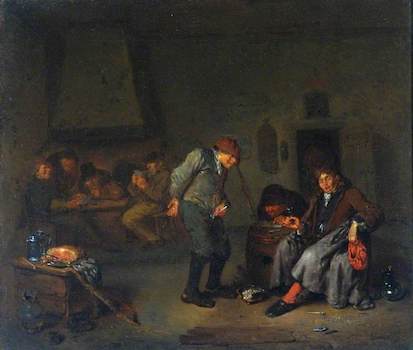
van Heemskerck II, Egbert, 1634/1635-1704; Boors Carousing and Playing Cards

(Egbert van Heemskerck II, Boors Carousing and Playing Cards: The Bowes Museum)

‘It takes reckless resolution now, to admit that one has known a more civilised age than the present’, Sylvia Townsend Warner wrote to Ian Parsons at Chatto and Windus, sympathising with the ‘inadequacy of the reviews’ of their recent Letters of Marcel Proust, translated and edited by Mina Curtiss. ‘It is painful to admit it to oneself, and apparently shameful to mention it to others.’ She went on: ‘At the time when we first knew each other there were the usual number of fools about, I think—but at least those fools did not feel it incumbent on them to be boors too.’[1]

Boor: a rough and bad-mannered person, my concise dictionary says, a bit thinly. Try another: a countryman, a peasant; a Dutch colonial in South Africa; a coarse or awkward person. Derived from the Dutch, boer, ‘perhaps partly from Old English, būr, gebūr, farmer.’ Better. Surely ‘rough’ together with ‘a countryman or peasant’ will serve for all those paintings, almost exclusively Dutch genre pictures of the seventeenth century, entitled Boors Carousing, occasionally preceded by ‘Interior with’ or followed by ‘and Playing Cards’.

In Warner’s case, of course, this use of the word is nicely placed midway between her short story, ‘Boors Carousing’, included in her 1947 collection, The Museum Of Cheats, and her 1954 novel, The Flint Anchor. In that novel’s early pages, the fourth generation of the Barnard family in Loseby has a thriving business; Joseph Barnard has married his second wife, bought Anchor House and ‘laid down a cellar of port wine, for he intended to get more than daughters in his second match.’ Then: ‘One cannot manage a business without becoming literate, one cannot become literate without exposing oneself to the culture of one’s day. Joseph Barnard read Burke on the Sublime, bought a Dutch canvas of Boors Carousing, installed Rumford grates, and sent his elder son to Harrow and Cambridge.’[2]

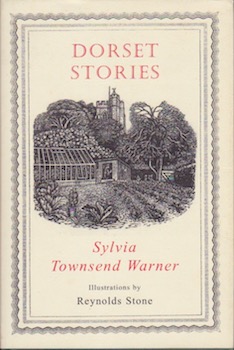
Dorset-Stories

The story, ‘Boors Carousing’, concerns Kinloch, a writer—‘“studied from myself”, according to Sylvia’, her biographer notes[3]—who has the house to himself for a while and has, apparently, ‘found it almost impossible to get on with the novel’ while his sister and her children have been staying; he has, rather, ‘written short stories, a prey to human nature – which is poison and dram-drinking to the serious artist.’ Choosing to put off writing a little longer, he is reading in his library half an hour later while the rain pours down when there is an unwelcome knock at the door. It is Miss Metcalf, daughter of the late rector, who had, Kinloch reflects, ‘drunk himself and his fortune out of existence’. She is asking for help to lift a rabbit hutch on to an outside table since the river is rising. He takes a strong liking to her house: ‘a charming place to live, if one did not object to being flooded from time to time’. The view from the Metcalf house ‘was better than his own; for one thing it included his house, and at exactly the right distance to be seen at its best.’ Then too, ‘No one was likely to come knocking at her door.’

Invited inside for a drink, he finds himself drinking pre-war whisky, ‘strong and smooth as silk’, then another, ‘to keep the cold out’. Miss Metcalf has poured herself ‘a little one too, to keep him company.’ He imagines himself here, where one could be ‘uncommonly cosy’, a house totally unrestored but which, with modest expenditure, could be made a very desirable property. And then, ‘No one would come to stay in such a house as this. They could not. He would turn the second bedroom into a bathroom.’ Miss Metcalf ‘also was keeping the cold out, and it had greatly improved her.’ She draws his attention to a picture above the mantelpiece: ‘It was a large steel-plate engraving, Luridly brilliant. Kermesse, perhaps, or possibly Boors Carousing.’ She informs him that it’s ‘a very fine specimen. And very valuable.’ She’s sometimes thought of taking it down but doesn’t know what she’d put in its place. And, if there were nothing, the patch on the wallpaper would always be there to remind her. True, Kinloch thinks. ‘Absent or present, the boors would always be carousing.’ Reminding her of her father, who had left her ‘stupefied and penniless. Absent or present, it would taunt her with an inherited alcoholism, a desperate maidenly desire for strong drink.’

Walking home, he imagines possible futures, imagines her brief obituary, then himself as attentive neighbour, taking her the odd bottle, sitting in her father’s chair and tippling with her. ‘What a story she would make!’ And, of course, he is already writing it, has already written it. Returned to his house, he enters the library and commences to write it down.[4]

These characters are not boors; nor do they actually carouse—‘to drink freely and noisily’. Yet the picture with that title (perhaps with that title), even if removed from the wall, will remind Miss Metcalf of what her life has become and how it came to be so, and how it has shaped what her life will continue to be; Kinloch is reminded, should he need reminding, that such figures as those in the painting, enjoying themselves, are also the source of enjoyment and satisfaction in others: observed, interpreted, recalled, presented.

‘“You to the life!” he said aloud. “Do nothing for her, but put her into a story.” The admission released him.’ He will, he does, he has, put her into a story. And the ‘admission’, that he will not, in fact, be that attentive neighbour, with cheering visits and bottles to share, does release him, does free him from that merely human response, enabling the artistic one, which always requires a little distance, a touch of iron in the soul, a sliver of glass in the heart.

So Kinloch to Miss Metcalf; so Warner to Kinloch; so the reader to Warner, a fruitful and extended line.

 
Notes

[1] Sylvia Townsend Warner to Ian Parsons, 26 December 1950: Letters, edited by William Maxwell (London: Chatto & Windus, 1982), 124.

[2] Sylvia Townsend Warner, The Flint Anchor (London: Chatto & Windus, 1954), 9.

[3] Claire Harman, Sylvia Townsend Warner: A Biography (London: Chatto & Windus, 1989), 214.

[4] Sylvia Townsend Warner, Dorset Stories, illustrations by Reynolds Stone (Norwich: Black Dog Books, 2006), 191-200.


Not outrunning the Constable

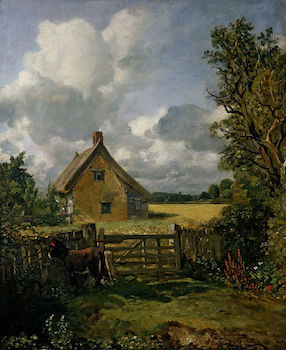
Cottage-Cornfield-VandA

(John Constable, The Cottage in a Cornfield: V & A)

(To outrun the constable: to go too fast or too far—Eric Partridge, A Dictionary of Slang and Unconventional English)

What might we have recourse to, after a week of prime ministerial rabble-rousing and incitement to violence and the continued, programmatic fracturing of a nation? Le vin, ça va sans dire—or a visit to Bristol Old Vic, to see six talented women play twenty-one roles in Pride and Prejudice* (Sort of)*, at which I laughed like a lunatic—perhaps even a slightly morose thinking about Englishness—‘“Englishness”, however, is a term that has no fixed meaning but is instead made and re-made in and through history’.[1]

I was browsing through art books and looking at the pictures of John Constable. The combative Geoffrey Grigson once asserted that Constable ‘remains the artist the English have most reason to be proud of and thankful for, without reservation.’[2]

Constable, in his quietly revolutionary way, painted what was in front of his eyes, usually in localities that he knew intimately and loved greatly. And the local, to a greater or larger extent, containing the universal is a familiar enough theme, from Gilbert White through Thomas Hardy to William Faulkner and William Carlos Williams.

‘How much I wish I had been with you on your fishing excursion in the New Forest!’ Constable wrote in 1831 to his close friend, John Fisher. ‘What river can it be? But the sound of water escaping from mill-dams, etc., willows, old rotten planks, slimy posts, and brickwork, I love such things. Shakespeare could make everything poetical; he tells us of poor Tom’s haunts among “sheep cotes and mills” [King Lear]. As long as I do paint, I shall never cease to paint such places. They have always been my delight [ . . . ] Still, I should paint my own places best; painting is with me but another word for feeling, and I associate “my careless boyhood” with all that lies on the banks of the Stour’.[3]

Born in the village of East Bergholt, on the River Stour in Suffolk, son of a prosperous corn merchant, who owned Flatford Mill in East Bergholt and, later, Dedham Mill, Constable painted many pictures of East Bergholt and of Dedham Vale, pictures too of mills, clouds, cottages, cornfields, Hampstead, Brighton, Salisbury Cathedral, and even clouds above cottages in cornfields. He was a great student of clouds.
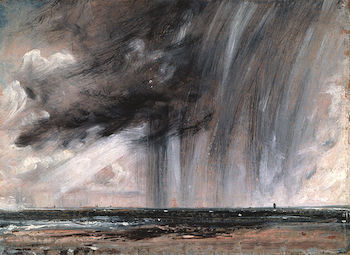
Constable-Seascape-Raincloud

(John Constable, Seascape Study with Raincloud: Royal Academy of Arts)

During his lifetime, Constable had no great success, not, at least, with an English audience. As late as the last decade of his life, he wrote to his future biographer: ‘Varley, the astrologer, has just called on me, and I have bought a little drawing of him. He told me how to “do landscape,” and was so kind as to point out all my defects. The price of the drawing was “a guinea and a half to a gentleman, and a guinea only to an artist,” but I insisted on his taking the larger sum, as he had clearly proved to me that I was no artist’.[4] Still, though unsold at the 1821 Royal Academy show, The Hay Wain (shown together with View on the Stour Near Dedham and one of Constable’s views of Yarmouth Jetty) was awarded a gold medal at the Paris Salon of 1824, presented by Charles X. The Hay Wain hugely impressed Théodore Géricault and influenced Eugène Delacroix.[5] Originally called Landscape: Noon and produced over a relatively short space of time to meet an exhibition deadline, it has permeated the national consciousness to the extent that a 2005 BBC poll to determine the most popular painting in any British gallery placed it second behind Turner’s Fighting Temeraire.

Constable has certainly suffered more than most from over-familiarity with what are regarded in his work as a quintessential Englishness and scenes of a timeless and untroubled rural world. Peter Kennard’s famous Hay Wain with Cruise Missiles (Chromolithograph and photographs on paper, 1980: Tate) derived much of its power from precisely those perceived qualities. Inevitably, such popularity had its negative effects. In ‘Going to the Pictures’, Alan Bennett remembered that, ‘Besides the Dutch landscapes, which I was exposed to too young, there were other casualties of inept or promiscuous reproduction. I don’t like The Hay Wain because it featured on a table mat at home.’[6]
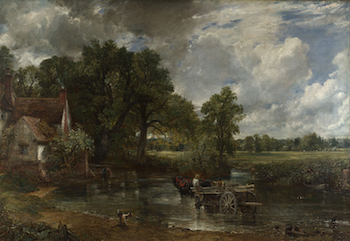
The Hay Wain

(John Constable, The Hay Wain: National Gallery)

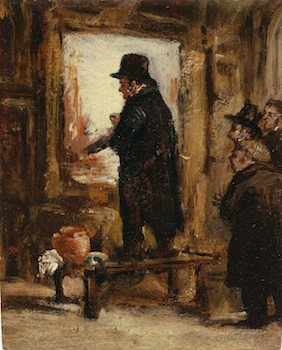
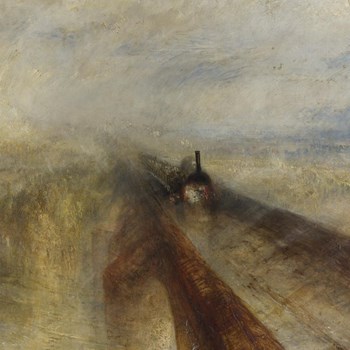
‘The first time I met him was in the year 1844 at the Academy on one of the varnishing days. I am enabled to fix the date because of the picture he exhibited that year, which was that entitled “Rain, Steam and Speed.” I watched him working on this picture. He used rather short brushes, a very messy palette, and, standing very close up to the canvas, appeared to paint with his eyes and nose as well as his hand. Of course he repeatedly walked back to study the effect. Turner must, I think, have been fond of boys, for he did not seem to mind my looking on at him; on the contrary, he talked to me every now and then, and pointed out the little hare running for its life in front of the locomotive on the viaduct. This hare, and not the train, I have no doubt he intended to represent the “Speed” of his title; the word must have been in his mind when he was painting the hare, for close to it, on the plain below the viaduct, he introduced the figure of a man ploughing, “Speed the plough” (the name of an old country dance) probably passing through his brain.’[7]
Turner-Rain-Steam-NG

(J. M. W. Turner, Rain, Steam and Speed: National Gallery)

This is George Dunlop Leslie, RA, genre painter and illustrator—son of Constable’s biographer Charles Robert Leslie—nine years old at the time of which he writes. In fact, the National Gallery website notes that: ‘Turner lightly brushed in a hare roughly midway along the rail track to represent the speed of the natural world in contrast to the mechanised speed of the engine. The animal is now invisible as the paint has become transparent with age, but it can be seen in an 1859 engraving of the painting.’
https://www.nationalgallery.org.uk/paintings/joseph-mallord-william-turner-rain-steam-and-speed-the-great-western-railway

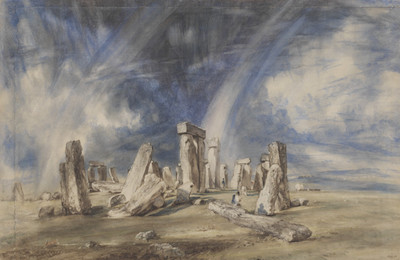
Turner and Constable. Writing to Harman Grisewood in 1972, the poet and artist David Jones wrote of a chance acquaintance that ‘his cut of suit suggested the turf—but then so did that of Sickert, which did not prevent him from being the best English painter since Turner (in my view).’ Still, eleven years earlier, Jones had remembered: ‘I was encamped very near Stonehenge early in the First War, before going to France, and must confess to not finding it very impressive. I like Constable’s picture of it, though.’[8]
2015HW5111

(John Constable, Stonehenge: Victoria and Albert Museum)

‘I have made a beautiful drawing of Stonehenge’, John Constable wrote to Leslie in September 1836, and made several other studies before producing the watercolour now in the Victoria and Albert Museum collection. ‘He always kept the influence of earlier masters on his own work under close control’, Raymond Lister writes, ‘and though Stonehenge, for instance, contains a suggestion of Meindert Hobbema in the plein air rendering, it remains Constable’s conception and could not have been painted by any other artist.’[9]

It was, apparently, in 1819—the birth year of Turner’s great champion, John Ruskin—that a critic first compared Constable’s painting with Turner and, ‘again for the first time a critic attempted to liken Constable’s painting with the great tradition of rustic landscape associated with Ruisdael and Meindert Hobbema.’[10]

Hobbema: painter of trees, mills, woods and cottages. Constable was not uncritical of him but, replying to Fisher’s advice to ‘diversify your subject this year as to time of day’—‘People get tired of mutton at top, mutton at bottom, and mutton at the side, though the best flavour and smallest size’—he wrote that he himself didn’t enter into ‘that notion of varying one’s plans to keep the public in good humour.’ He went on: ‘Change of weather and effect will always afford variety. What if Vander Velde had quitted his sea pieces, or Ruysdael his waterfalls, or Hobbema his native woods. The world would have lost so many features in art’ (Leslie 131). Half a century after Constable’s death, Vincent van Gogh wrote to his brother Theo, then in London:

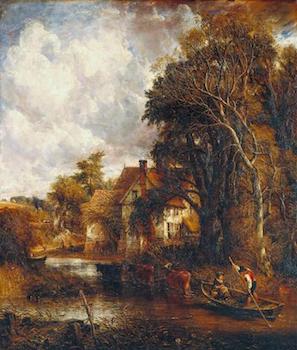
‘Now I for my part have always remembered some English pictures such as “Chill October” by Millais and, for instance, the drawings by Fred. Walker and Pinwell. Just notice the Hobbema in the National Gallery; you must not forget a few very beautiful Constables there, including “Cornfield,” nor that other one in South Kensington called “Valley Farm.”’[11]
The Valley Farm 1835 by John Constable 1776-1837

(John Constable, Valley Farm: Tate)

Unfortunately for Constable, Ruskin, who became the most influential art critic in the country, was consistently highly critical of him, claiming that he could not draw and was not accurate or specific enough in rendering the details of the natural world. A major factor in this evaluation was that he was combatting the great claims made by C. R. Leslie who, by setting Constable higher than Turner, prompted Ruskinian counter-attacks.

‘Unteachableness seems to have been a main feature of his character, and there is corresponding want of veneration in the way he approaches nature herself’, Ruskin asserted. Having found no signs of Constable ‘being able to draw’, this resulted in ‘even the most necessary details’ being ‘painted by him inefficiently.’ Then: ‘His works are also eminently wanting both in rest and refinement: and Fuseli’s jesting compliment[12] is too true for the showery weather, in which the artist delights, misses alike the majesty of storm and the loveliness of calm weather; it is great-coat weather, and nothing more. There is strange want of depth in the mind which has no pleasure in sunbeams but when piercing painfully through clouds, nor in foliage but when shaken by the wind, nor in light itself but when flickering, glistening, restless and feeble. Yet, with all these deductions, his works are to be deeply respected, as thoroughly original, thoroughly honest, free from affectation, manly in manner, frequently successful in cool colour, and realizing certain motives of English scenery with perhaps as much affection as such scenery, unless when regarded through media of feeling derived from higher sources, is calculated to inspire.’[13]

That ‘want of veneration’ and ‘feeling derived from higher sources’ hint at some of the criteria Ruskin was applying – though he would suffer a temporary loss of faith in the next decade, at this stage the recognition and appreciation of beauty was inseparable—and indispensable—in his eyes from the worship of God. Constable was not reverent enough and his painting did not explicitly transfigure. ‘The great vice of the present day is bravura, an attempt to do something beyond the truth’, he wrote to John Dunthorne (Leslie 15) and that ‘truth’ remained his concern, even if this makes his pictures seem undramatic to his audience, too easy at first glance to interpret and digest, We might occasionally wonder ‘where is it?’ when looking at a Constable landscape – but rarely ‘what is it?’ as prompted by some Turner canvases and sketches. There is surely room for both: the viewer, after all, moves through different ages, moods, states of mind, of knowledge, of experience, of taste. We should be able to manage Turner, Constable – and John Ruskin too.

 
Notes

[1] Frances Spalding, John Piper, Myfanwy Piper: Lives in Art (Oxford: Oxford University Press, 2009), 189.

[2] Geoffrey Grigson, Britain Observed: The Landscape Through Artists’ Eyes (London: Phaidon Press, 1975), 93.

[3] Constable to Archdeacon John Fisher, 23 October 1831: C. R. Leslie, Memoirs of the Life of John Constable: Composed Chiefly of His Letters (1845; edited by Jonathan Mayne, London: Phaidon Press, 1951), 85-86.

[4] Leslie, Memoirs of the Life of John Constable, 194.

[5] Constable: The Great Landscapes, edited by Anne Lyles (London: Tate Publishing, 2006), 140, 142.

[6] Alan Bennett, Untold Stories (London: Faber and Faber and Profile Books, 2005), 463.

[7] G. D. Leslie, The Inner Life of the Royal Academy (London: John Murray, 1914), 144-145.

[8] Letter to Juliet and Richard Shirley Smith, 17 August 1961: Anthony Hyne, David Jones: A Fusilier at the Front (Bridgend: Seren, 1995), 30.

[9] Raymond Lister, British Romantic Painting (Cambridge: Cambridge University Press, 1989), Plate 37.

[10] Anne Lyles, ‘Soliciting Attention: Constable, the Royal Academy and the Critics’, in Constable: The Great Landscapes, 36.

[11] The Complete Letters of Vincent van Gogh, second edition, three volumes (London: Thames & Hudson, 1978), II, 300.

[12] ‘Speaking of me, he says, “I like de landscapes of Constable; he is always picturesque, of a fine colour, and de lights always in de right places; but he makes me call for my greatcoat and umbrella.”’ Constable, letter of 9 May 1823: Leslie, 101.

[13] John Ruskin, Modern Painters, Volume 1, edited by E. T. Cook and Alexander Wedderburn (London: George Allen, 1903), 191.
 

A bit of Turner

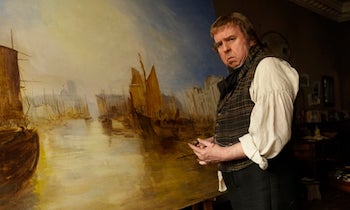
Spall-Turner-Guardian

(Timothy Spall as Turner in Mike Leigh’s 2014 Mr. Turner, via The Guardian)

Reading Greg Gerke’s new collection of essays, I came across the opening lines of ‘Mr. Turner, Boyhood, and Criticism’:

‘Let us begin with difficulties. Mike Leigh’s Mr. Turner, a film as rich as an afternoon in the Louvre, presents an austere and bilious portrait of the great English artist and a ridiculous one of a young John Ruskin, a critic who explicated Turner in many works over the course of different works—a critic who drew and painted, lecturing on both activities with a great avidity.’

He adds that, in Leigh’s film, ‘the drama is the classic case of critic as obnoxious foil to the artist’s majesty and magic’, before bringing in Guy Davenport, a great admirer of Leigh—but also of Ruskin, not only as a titanic figure in his own right but a major influence upon much of the modern movement.[1]

Gerke’s essay, as the title suggests, is concerned with setting his ‘adulation’ for Leigh’s film beside his ‘cool reception’ to Richard Linklater’s widely acclaimed Boyhood (preferring several of Linklater’s other films), but also considering the nature and difficulties of criticism. Still, for the moment, I was thinking about Turner and Ruskin.

Back in April this year, after the Don McCullin exhibition and the Van Gogh in Britain show—and the Ruskin Exhibition at 2 Temple Place the day before—we had a couple of hours to spare before our train. We revisited old friends in the Tate Britain galleries, the Librarian often to be found in front of Vanessa Bell, Carrington, Sargent, Gwen John, me turning aside to Nevinson, Bomberg, Spencer, Gaudier-Brzeska, pausing by Holman Hunt’s Our English Coasts (first called ‘Lost Sheep’ and then ‘Strayed Sheep’), with its too obvious applications to the country’s current travails.

Charles-West-Cope-JMWT-NPG

(Charles West Cope, J. M. W. Turner: National Portrait Gallery)

‘Do you fancy some Turner?’
‘I’m always up for a bit of Turner.’

We walked to the Clore Gallery. The Librarian mentioned wanting to see again the 2014 Mike Leigh film, with its gorgeous opening sequence and its tremendous central performance by Timothy Spall, its only false note for me precisely that grotesque depiction of John Ruskin, Turner’s most famous champion, whose first major work was initially conceived with exactly the intention of praising and promoting the painter.[2]

Our visit was just a few days short of the painter’s birthday, I realise now. Joseph William Mallord Turner was born in Covent Garden, 23 April 1775. I’d read a short biography of him by Peter Ackroyd which quoted Samuel Palmer, recalling his first sight of a Turner painting, ‘Entrance of the Meuse: Orange-Merchant on the Bar, going to Pieces’, in 1819 when Palmer was just fourteen: ‘being by nature a lover of smudginess, I have reveled in him from that day to this’. Ackroyd also notes Ruskin’s emergence as ‘Turner’s most eloquent and knowledgeable supporter’, ‘the principal advocate’ of his art, adding: ‘it can be said with some certainty that no artist has ever had a more profound and articulate explicator.’[3]

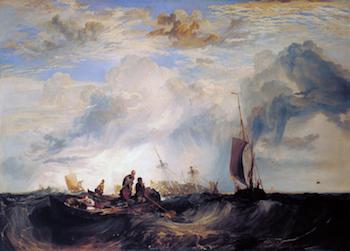
Entrance of the Meuse: Orange-Merchant on the Bar, Going to Pieces; Brill Church bearing S. E. by S., Masensluys E. by S. exhibited 1819 by Joseph Mallord William Turner 1775-1851

(J. M. W. Turner, Entrance of the Meuse: Orange-Merchant on the Bar, going to Pieces: Tate)

John Ruskin was just seventeen when a hostile notice of three paintings by Turner in Blackwood’s Magazine prompted him to draft a reply. Looking back some fifty years later, Ruskin wrote: ‘The review raised me to the height of “black anger” in which I have remained pretty nearly ever since’. In fact, Ruskin’s father deciding that Turner himself should be approached first, the painter wrote back thanking Ruskin but adding: ‘I never move in these matters, they are of no import save mischief’.[4] Ruskin’s reply to the Blackwood’s review was finally printed as an appendix to Modern Painters in the great Cook and Wedderburn library edition—‘Turner may be mad: I daresay he is, inasmuch as highest genius is allied to madness; but not so stark mad as to profess to paint nature. He paints from nature, and pretty far from it, too; and he would be sadly disappointed who looked in his pictures for a possible scene.’[5]

Fifteen years further on, Ruskin famously defended works by the Pre-Raphaelite painters in reaction to the dismissive comments published in notices in The Times.

(The notices together with Ruskin’s letters are gathered together in the superb Rossetti Archive:
http://www.rossettiarchive.org/docs/n.gb1.1851.may.rad.html )

In the famous Thames flood of 6 – 7 January 1926, the waters filled the lower floor of the Tate where Jim Ede (biographer of Henri Gaudier Brzeska and founder of Kettle’s Yard in Cambridge) was keeping 19000 Turner drawings and watercolours, as well as some watercolours by Ede’s friend, the poet and artist David Jones, who had recently completed engravings for a Golden Cockerel Press edition of The Chester Play of the Deluge. The Tate treasures were ‘submerged but kept dry by ark-tight carpentry of a set of cabinets.’

In the following year, Jones spent four weeks, mid-August to September, at Portslade, painting mostly ‘the open sea under an empty sky.’ He was remembering Ruskin writing on Turner, that ‘the sea, however calm, is redolent of storm’. Jones thought this was ‘more than half’ the secret ‘of good painting, of good art . . . it is both peace and war.’[6] Patrick White used to go and look at Turner’s ‘Interior at Petworth’ often when he lived in London, adding to Mary Benson that, ‘besides being a subtle painting, I feel it taught me a lot about writing.’ Late Turners, he told Penny Coleing, made him ‘grow breathless with delight every time I see them’.[7]

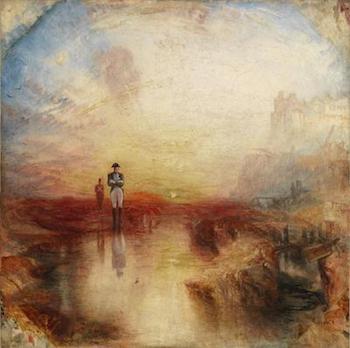
War. The Exile and the Rock Limpet exhibited 1842 by Joseph Mallord William Turner 1775-1851

(J. M. W. Turner, War. The Exile and the Rock Limpet: Tate)

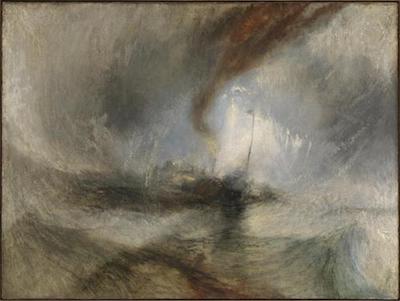
Some of Turner’s pictures are so familiar now that some decrease might seem inevitable in that breathlessness if not the delight. But I don’t know: when I come in sight of Rain, Steam and Speed – The Great Western Railway or The Slave Ship (originally, Slavers Throwing Overboard the Dead and Dying, Typhon coming on), The Fighting Temeraire, War. The Exile and the Rock Limpet or Snow Storm – Steam-Boat off a Harbour’s Mouth, I still catch my breath a little, or articulate that highly technical art-critical term, wow.

Snow Storm - Steam-Boat off a Harbour's Mouth exhibited 1842 by Joseph Mallord William Turner 1775-1851

(J. M. W. Turner, Snow Storm – Steam-Boat off a Harbour’s Mouth: Tate)

‘To understand how the artist felt, however, is not criticism; criticism is an investigation into what the work is good for’, the philosopher George Santayana wrote, a sentence which, Greg Gerke notes, Guy Davenport quotes twice (Gerke also notes how ‘“good for” smacks of the paterfamilias making a pronouncement from 1905’—Reason in Art’s year of publication).[8] An introductory note to one of Davenport’s collections of essays ends: ‘The way I write about texts and works of art has been shaped by forty years of explaining them to students in a classroom. I am not writing for scholars or fellow critics, but for people who like to read, to look at pictures, and to know things.’[9]

Yes.

Near the end of ‘Mr. Turner, Boyhood, and Criticism’, Greg Gerke writes: ‘We all die, so live all you can—if art is good at anything, it’s reminding us of this.’[10]

Yes again.

 
Notes

[1] Greg Gerke, See What I See (Birmingham: Splice, 2019), 315. For Davenport on Ruskin, see particularly ‘The House That Jack Built’ in The Geography of the Imagination (Boston: David R. Godine, 1997) and ‘Ruskin According to Proust’ in The Hunter Gracchus and Other Papers on Literature and Art (Washington: Counterpoint, 1996); but there are references to Ruskin throughout Davenport’s oeuvre.

[2] And see Philip Hoare on both Mike Leigh’s film and Effie Gray, written by Emma Thompson and directed by Richard Laxton: https://www.theguardian.com/artanddesign/2014/oct/07/john-ruskin-emma-thompson-mike-leigh-film-art

[3] Peter Ackroyd, Turner (London: Vintage Books, 2006), 94, 132, 133.

[4] John Ruskin, Praeterita (London: Everyman, 2005), 192.

[5] John Ruskin, Modern Painters, Volume 1, edited by E. T. Cook and Alexander Wedderburn (London: George Allen, 1903), 637.

[6] Thomas Dilworth, David Jones: Engraver, Soldier, Painter, Poet (London: Jonathan Cape, 2017), 98, 107. In ‘Art in Relation to War’, Jones phrases it thus: ‘Ruskin, writing of Turner’s treatment of the sea, says that however calm the sea he painted he always remembered the same sea heavy and full of discontent under storm. That is half the secret, more than half, of good painting, of good art.’ See The Dying Gaul and Other Writings (London: Faber 1978), 140.

[7] Patrick White, Letters, edited by David Marr (London: Jonathan Cape, 1994), 203fn.

[8] Gerke, See What I See, 317; Guy Davenport, Every Force Evolves a Form (Berkeley: North Point Press, 1987), 68, 71.

[9] Guy Davenport, The Hunter Gracchus and Other Papers on Literature and Art (Washington: Counterpoint, 1996), ix.

[10] Gerke, See What I See, 320: he nods here to Lambert Strether in Henry James’s The Ambassadors (‘Live all you can; it’s a mistake not to’). His essay on James’s The Portrait of a Lady, ‘Stylized Despair’, is included here (51-56).

‘Domestic detail come alive’

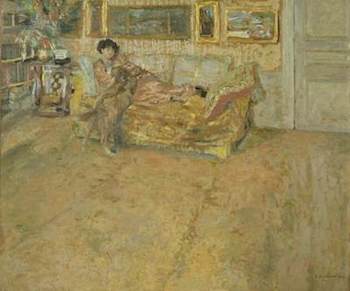
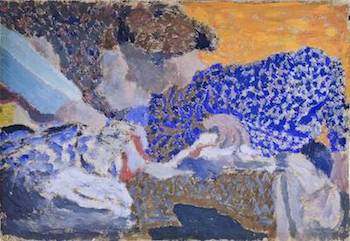
Vuillard, Jean Edouard, 1868-1940; Interior with Madame Hessel and Her Dog

(Jean-Édouard Vuillard, Interior with Madame Hessel and Her Dog, 1910: Photo credit: Bristol Museums, Galleries & Archives)

‘What would you like to do on your birthday?’

The time before last that I lunched with the Librarian, she steered me to the excellent Sotiris Bakery for spanakopita and a Greek coffee (and some halva and cakes to take away), after which I drifted into the Bristol Museum & Art Gallery to visit a few favourites, including Vuillard’s portrait of Lucie Hessel and her dog.

Lucie Hessel—friend, muse, lover of Vuillard—was the wife of the art dealer Joss Hessel: they remained close friends for many years with Vuillard, to whom they offered constant hospitality in their Rue de Rivoli apartment or the Chateau de la Claye near Versailles. Vuillard lived mainly with his mother until her death: he was then sixty.

In 1955, Elizabeth Bishop wrote to Randall Jarrell, thanking him for his review of Poems: North & South—A Cold Spring: he had written that her work was ‘as unmistakable as the first few notes of a Mahler song, the first few patches of a Vuillard interior. (The poems are like Vuillard or Vermeer.)’[1] Bishop wrote that ‘it has been one of my dreams that someday someone would think of Vermeer, without my saying it first, so now I think I can die in a fairly peaceful frame of mind, any old time, having struck the best critic of poetry going that way. . . ’ She continued: ‘Something else rather funny too—I’ve been working on a long poem about an aunt of mine, and when I don’t write on the poem I’ve been trying to use all the same material for either a long story or a short play—and in both of them Vuillard was the person I had in mind for the exact effect I wanted to produce. In fact, in the beginning of the play version I’d already written (in the stage directions) that it was to look like a Vuillard, before I received your clippings. —Well, communication is an undependable but sometimes marvelous thing.’[2]

Vuillard-Seamstresses

(Édouard Vuillard, Deux ouvrières dans l’atelier de couture (Two Seamstresses in the Workroom), 1893, © National Gallery of Scotland / Photo: Antonia Reeve)

And so say most of us. Paris in 1968 was pretty busy with demonstrations, strikes, student occupations of universities, workers’ occupations of factories, running battles with the police and the like; but a little later in the year, Patrick White and Manoly Lascaris were able to indulge in ‘an orgy of paintings and food’, White noted, mentioning ‘[a] marvellous exhibition of Vuillard’. David Marr’s biography quotes another letter of that time: ‘The great joy of Paris was an orgy of paintings, especially little intimate Vuillards “of people sitting over the remains of a meal, women sewing, and nursemaids looking after children in parks. Although he is so very French he is also related to the best 19th century Russian writers in his ability to make domestic detail come alive.”’[3]

What more natural, then, in answer to the Librarian’s question as to what I’d like to do on my birthday than say lunch in Bath, followed by the Vuillard exhibition at the Holburne Museum (Édouard Vuillard: The Poetry of the Everyday, until 15 September)? Alas. Ten minutes before we left I stooped a little to put a book back on a shelf and yelled loudly—not from delight or exultation but because I must have twisted my upper body when shelving it, just enough anyway to wreck my—previously wrecked—back again. Instead of looking at paintings by Vuillard, then, I shouted, winced, clutched at walls and door handles, climbed the stairs on all fours and subsequently spent at least ten minutes getting out of bed, cursing and howling, with the aid of the Librarian and a bemused stare from the cat.

A trip deferred for now. À bientôt, Monsieur Vuillard.

 
Notes

[1] See Randall Jarrell, Kipling, Auden & Co. Essays and Review 1935-1964 (New York: Farrar, Straus and Giroux, 1980), 245.

[2] Elizabeth Bishop, One Art: The Selected Letters, edited by Robert Giroux (London: Pimlico, 1996), 312.

[3] Patrick White, Letters, edited by David Marr (London: Jonathan Cape, 1994), 329; David Marr, Patrick White: A Life (London: Vintage, 1992), 483.