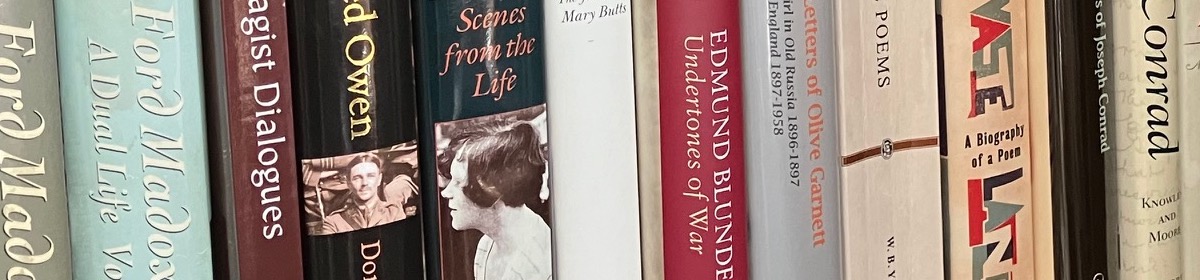
Birth days (and other kinds)

‘Birth, and copulation, and death.
That’s all the facts when you come to brass tacks:
Birth, and copulation, and death.’
            (Fragment of an Agon)[1]

Is T. S. Eliot’s Sweeney a little too concise here? You may be thinking, in some moods yes, in some moods no. You may even be thinking it a little too expansive. But most people, I suspect, might want to add a bit.

Take today, for instance, 17 December. The celebrated translator of Russian literature, Constance Garnett, died at 03:00 on this day in 1946. Over 70 English versions, of Turgenev, Dostoevsky, Chekhov, Goncharov, Tolstoy. Dorothy Sayers, author of superb detective stories and translator of Dante, died in 1957, also on this day.

The middle term: throw in a wedding (and assume a positive). On 17 December 1914, the painter Paul Nash and Margaret Odeh—‘Bunty’—were married in St Martin-in-the-Fields by ‘the young pacifist vicar the Reverend Dick Sheppard.’[2] Cue the opening stanza of W. H. Auden’s Letter to Lord Byron:

Excuse, my lord, the liberty I take
   In thus addressing you. I know that you
Will pay the price of authorship and make
   The allowances an author has to do.
   A poet’s fan-mail will be nothing new.
And then a lord—Good Lord, you must be peppered,
Like Gary Cooper, Coughlin, or Dick Sheppard.[3]

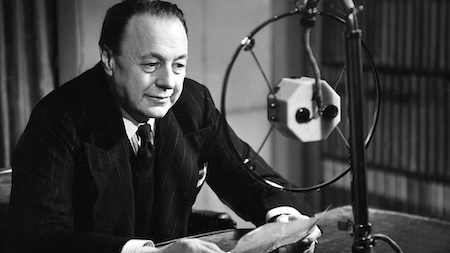
Gary Cooper, at least, will still be a familiar name; the other two, these days, rather less so, though not to historians of the 1920s and 1930s: Sheppard, the priest whose sermons, broadcast by the BBC, made him a national figure, and who later founded the Peace Pledge Union; Charles Coughlin, the Catholic priest who was also a widely-known broadcaster, though his anti-Semitic and pro-Fascist sympathies made his output rather different.

(Dick Sheppard broadcasting from St Martin-in-the-Fields: BBC)

On 17 December 1941, Sylvia Townsend Warner wrote to her friend Paul Nordoff: ‘Luckily, I have a tough memory for what I like, and I have most of it tucked away somewhere behind my ears.’[4] Just ten days after the attack on Pearl Harbor, then, a reminder if one were needed that on another 17 December—1903—Wilbur Wright’s fourth and last flight carried him  852 feet in 59 seconds.

The implications of that pioneering effort emerged with gradually increasing force and clarity a decade or so later. In 1915, Ezra Pound wrote to his parents (17 December): ‘Lewis has enlisted. That about takes the lot.’ He added: ‘I suppose we will go to France after the war. if it ever ends.’[5] Bombardier Wyndham Lewis would later recall that: ‘The war was a sleep, deep and animal, in which I was visited by images of an order very new to me. Upon waking I found an altered world: and I had changed, too, very much.’[6]

A few years on (17 December 1958) and the great Australian novelist Patrick White was writing to his friend and publisher Ben Huebsch—the rock on which White’s career was built, David Marr remarks—about his novel, Riders in the Chariot. ‘I shall want somebody here to check the Jewish parts after a second writing. I feel I may have given myself away a good deal, although passages I have been able to check for myself, seem to have come through either by instinct or good luck, so perhaps I shall survive. After all, I did survive the deserts of Voss.’ And in another letter to Huebsch, five months later, he returned to this: ‘What I want to emphasise through my four “Riders” – an orthodox refugee intellectual Jew, a mad Erdgeist [Earth spirit] of an Australian spinster, an evangelical laundress, and a half-caste aboriginal painter – is that all faiths, whether religious, humanistic, instinctive, or the creative artist’s act of praise, are in fact one.’[7] (I reread all Patrick White’s books seven years ago and I’m damned if I don’t feel almost ready to do it again. . .)

(Ford via New York Review of Books)

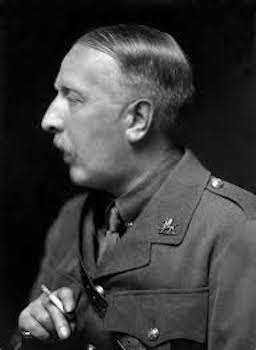
But then – why not celebrate? 17 December birthdays, yes: Humphry Davy, John Greenleaf Whittier, Erskine Caldwell, Paul Cadmus, Penelope Fitzgerald, Jacqueline Wilson, John Kennedy Toole – and the primary focus, or beginning spark, of all this anniversary rambling, Ford Madox Ford, 152 today.

His birthdays weren’t always joyous: at a party in 1901, he nearly choked on a chicken bone ‘and was prostrate for some days’.[8] In 1916, he was in a Red Cross Hospital in Rouen, writing to Joseph Conrad a couple of days later: ‘As for me—c’est fini de moi, I believe, at least as far as fighting is concerned—my lungs are all charred up & gone—they appeared to be quite healed, but exposure day after day has ended in the usual stretchers and ambulance trains’. In 1920, he spent at least a small portion of his birthday writing to Thomas Hardy, asking him to sign a manifesto protesting against British government policy in Ireland. It was published on 1 January 1921 in the Manchester Guardian and other papers. Fifty writers, artists and academics signed it but Thomas Hardy was not among them.

Past lives, past struggles, victories, defeats. Surely there is comfort to be found there, that they were faced with things we recognise only too well—not only the individual battles but the more general ones, against Fascism, vicious racism, authoritarianism, the hijacking of news, of the sources of information, the assaults on free speech, on civil liberties, on democratic rights—and came through. And we?

Optimism, pessimism. One up, one down; Monday, Tuesday; left hand; right hand. I liked Guy Davenport on the judicious estimate of his own make-up, reporting to Hugh Kenner that his friend Steve Diamant’s photographs included one that served as the author photograph on the dust jacket of Tatlin!, Davenport’s first collection of stories, or assemblages: ‘Guy beaming in the Dionysian priest’s chair, the Theatre, Athens. I had no notion such a radiant smile was in me. It cured a third of my paranoia and an eighth of my Calvinist pessimism to see it.’[9]

A whole eighth. Some photograph, some smile.


Notes

[1] T. S. Eliot, The Complete Poems and Plays (London: Faber and Faber, 1969), 122.

[2] Ronald Blythe, First Friends: Paul and Bunty, John and Christine – and Carrington (London: Viking, 1999), 77; David Boyd Haycock, A Crisis of Brilliance (London: Old Street Publishing, 2009), 238-9.

[3] W. H. Auden, The English Auden: Poems, Essays and Dramatic Writings, 1927-1939, edited by Edward Mendelson (London: Faber, 1977), 169.

[4] Sylvia Townsend Warner, Letters, edited by William Maxwell (London: Chatto & Windus, 1982), 76.

[5] Ezra Pound, Ezra Pound to His Parents: Letters 1895–1929, edited by Mary de Rachewiltz, David Moody and Joanna Moody (Oxford: Oxford University Press, 2010), 358.

[6] Wyndham Lewis, Rude Assignment: A narrative of my career up-to-date (London: Hutchinson, 1950), 129.

[7] Patrick White, Letters, edited by David Marr (London: Jonathan Cape, 1994), 151, 153. Marr’s remark about Huebsch’s importance is in ‘The Cast of Correspondents’, 638.

[8] Arthur Mizener, The Saddest Story: A Biography of Ford Madox Ford (London: The Bodley Head, 1972), 73.

[9] Questioning Minds: The Letters of Guy Davenport and Hugh Kenner, edited by Edward M. Burns, two volumes (Berkeley: Counterpoint Press, 2018), I, 630.

Pikes, balloons and a touch of mastiff

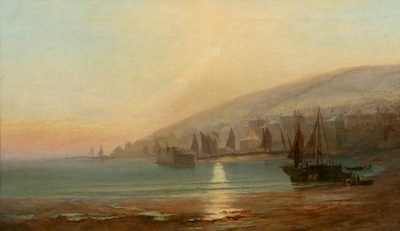
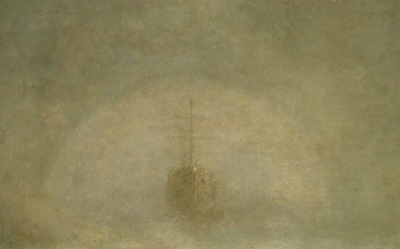
(Henry Martin, ‘A December Morning in Mount’s Bay’: Penlee House Gallery and Museum)

December. Originally, as the name hints, the tenth month of the year. Blackburn and Holford-Strevens quote Richard Saunders’ 1697 Apollo Anglicanus, The English Apollo: ‘In December Melancholy and Phlegm much increase, which are heavy, dull, and cold, and therefore it behoves all that will consider their healths, to keep their heads and bodies very well from cold, and to eat such things as be of a hot quality.’[1] Not a lot to argue with there. Today at least is cold, clear and dry, so proper winter weather.

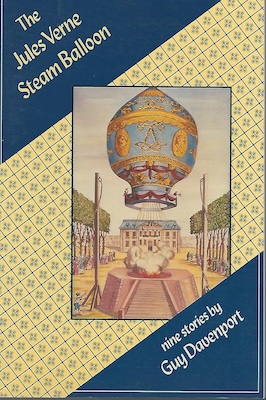
‘North Point has just accepted The Jules Verne Steam Balloon, for next fall’, Guy Davenport wrote to the poet and New Directions publisher James Laughlin on 1 December 1986. ‘Nine stories, dedicated to Humph’s memory, nine being a cat number.’[2] And the book does indeed carry a dedication to Davenport’s recently deceased cat, ‘For my friend Humphry 1971-1986’.

Curiously, on the same date as Davenport’s letter, the first ever ascent in a hydrogen balloon was recorded. This was ten days after the first manned Montgolfier balloon flight, launched from the hill of La Muette on 21 November 1783. It was 70 feet high, and powered by a six-foot open brazier, burning straw. The intrepid voyagers were Pilâtre de Rozier and the Marquis d’Arlandes, a major in the Garde Royale. The later ascent was made by Dr Alexander Charles, who had, in effect, invented ‘nearly all the features of the modern gas balloon in a single brilliant design.’ Launched from Tuileries Gardens on 1 December 1783, with Charles’ scientific assistant M. Robert, it attracted ‘what has been estimated as the biggest crown in pre-Revolutionary Paris, upwards of 400,000 people, about half the total population of the city.’[3]
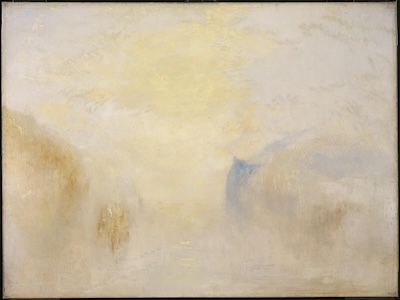
Two hours later, the balloonists landed some 27 miles away and Charles asked Robert to step out of the basket. Then he reached 10,000 feet in ten minutes, observing his instruments and making notes until his hand became too cold to grasp the pen. ‘I was the first man ever to see the sun set twice in the same day. The cold was intense and dry, but supportable. I had acute pain in my right ear and jaw. But I examined all my sensations calmly. I could hear myself living, so to speak.’ Then he gently released the gas-valve and, within 35 minutes, was back on the ground, three miles from the first landing-point: an almost vertical ascent. It was the first solo flight in history. He wrote that: ‘Never has a man felt so solitary, so sublime,—and so utterly terrified.’ Charles never flew again.[4]

From that to. . . this. I was reminded of a passage in Thomas Medwin’s record of talking with Lord Byron at Pisa in 1822: ‘I suppose we shall soon travel by air-vessels; make air instead of sea voyages; and at length find our way to the moon . . . Where shall we set bounds to the power of steam? Who shall say “Thus far shalt thou go, and no farther?” We are at present in the infancy of science.’[5]

In fact, his daughter Ada was then an infant scientist, just six years old: later  Countess Lovelace, she was a mathematician and pioneer computer scientist, associated particularly with Charles Babbage and his Analytical Engine. Ada would, like her father, die in her 37th year—and was buried beside him.

(Hogarth, ‘A Rake’s Progress: 1–The Rake Taking Possession of the Estate’: Sir John Soane’s Museum)

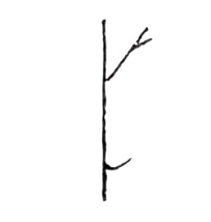
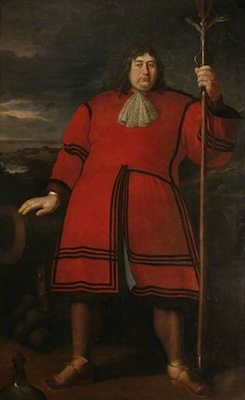
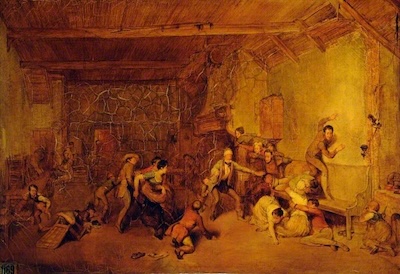
I’ve lately been reading Jenny Uglow’s wonderful Hogarth biography and in his 37th year, Hogarth began 1734 with prints of The Fair (later called Southwark Fair) ready for sale though those of The Rake’s Progress had been delayed. One detail that—inevitably—caught my eye was the reference to the story told by John Nichols, in his Biographical Anecdotes of William Hogarth.[6] He wrote there that Hogarth ‘boasted that he could draw a Serjeant with his pike, going into an alehouse, and his Dog following him, with only three strokes;—which he executed thus:

A. The perspective line of the door.
B. The end of the Serjeant’s pike, who is gone in.
C. The end of the Dog’s tail, who is following him.
There are similar whims of the Caracci.’[7]

In 1914, Ford Madox Ford published ‘On Impressionism’, an essay in two parts, in Harold Monro’s Poetry and Drama, June and December issues). ‘Let us approach this matter historically’, Ford begins the second section of his first article, ‘—as far as I know anything about the history of Impressionism, though I must warn you that I am a shockingly ill-read man. Here, then, are some examples: do you know, for instance, Hogarth’s drawing of the watchman with the pike over his shoulder and the dog at his heels going in at a door, the whole being executed in four lines? Here it is:

Now, that is the high-watermark of Impressionism; since, if you look at those lines for long enough, you will begin to see the watchman with his slouch hat, the handle of the pike coming well down into the cobble-stones, the knee-breeches, the leathern garters strapped round his stocking, and the surly expression of the dog, which is bull-hound with a touch of mastiff in it.’

Apart from the reversing of the image, the three strokes have become four. ‘The Impressionist must always exaggerate.’[8] Though a good many of the pikes I’ve seen pictured have one or more short curved blades at the top. . .

(Godfrey Kneller, Anthony Payne (c.1612-1691), the Cornish Giant: Cornish Museum and Art Gallery)

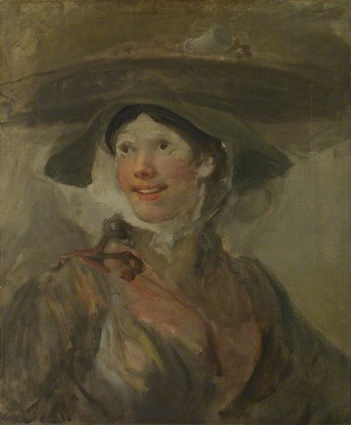
Hogarth has always had his admirers, and often been viewed chiefly as a satirist, like Swift or Pope, an acerbic commentator on the age’s hypocrisy, excesses and corruption. One of those admirers is the extraordinary painter, writer and central figure of Vorticism—‘Vorticism, in fact, was what I, personally, did, and said, at a certain period’—Wyndham Lewis and, interestingly, the single work of Hogarth’s he refers to several times is The Shrimp Girl, a superbly captured street-seller, ‘a moment caught on the wing’, Hogarth succeeding in conveying ‘all the movement in the girl’s body as he loaded his brush with pinks, vermilions and green—the bright colours of the rococo palette—and made fast curving strokes to outline the fall of her shoulders and breasts’.

(William Hogarth, Shrimp Girl: National Gallery)

After his death, Hogarth’s widow Jane ‘would tell visitors who saw The Market Wench, as it was known, “They say he could not paint flesh. There’s flesh and blood for you; – them!”’[9] In a characteristically combative statement late in life, Lewis cited that picture again: ‘Hogarth’s Shrimp Girl shows what splendid painting can be done in England. But since that eighteenth-century explosion there have been only the Pre-Raphaelites, and so it must be admitted that painting is not our forte.’

Lewis’s blindness had ended his five years as art critic of The Listener—see his remarkable final piece there, ‘The Sea-Mists of the Winter’—and there is a poignant closing paragraph to this essay too:

‘The question is not how a thing is done, but the thing that is done. However, unless the thing is beautifully painted, it never comes to life. I have never seen the original of the Shrimp-Girl, but several colour plates of it. I am blind, but, if I could see, I would do a large design of something like a Jabberwock outraging an eagle.’[10]


Notes

[1] Bonnie Blackburn and Leofranc Holford-Strevens, The Oxford Companion to the Year (Oxford: Oxford University Press, 1999), 481.

[2] W. C. Bamberger, editor, Guy Davenport and James Laughlin: Selected Letters (New York: W. W. Norton & Co., 2007), 36.

[3] Julian Barnes, Levels of Life (London: Cape, 2013), 12; Richard Holmes. The Age of Wonder: How the Romantic Generation Discovered the Beauty and Terror of Science  (London: Harper Collins, 2008), 129-131; L. T. C. Rolt, The Aeronauts (London: Longman, 1966), 50.

[4] Holmes, The Age of Wonder, 132.

[5] Thomas Medwin, Conversations with Byron, (1824), quoted by Fiona MacCarthy, Byron: Life and Legend (London: John Murray, 2002), 70.

[6] Hogarth: A Life and a World (London: Faber and Faber, 1997), 55.

[7] See Biographical Anecdotes of William Hogarth, Third edition (London: Printed by and Ford John Nichols in Red-Lion-Passage, Fleet-Street, 1785), 63.

[8] Ford Madox Ford, ‘On Impressionism I’, Poetry and Drama (June 1914), 169-170.

[9] Uglow, Hogarth, 408, 409.

[10] Wyndham Lewis, ‘The Vorticists’, Vogue (September 1956), in Wyndham Lewis On Art: Collected Writings 1913-1956, edited by Walter Michel and C. J. Fox (London: Thames & Hudson, 1969), 457, 458; the earlier quotation is from the introduction to the catalogue of the 1956 retrospective exhibition, Tate Gallery, July-August 1956 in this same volume, 451. For other references to this picture, see 327, 329, 404.

Good Wood

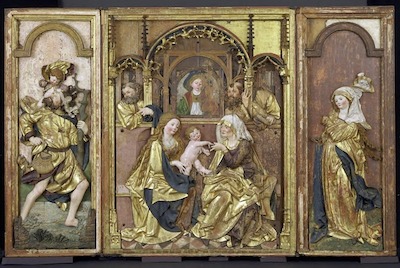
(The Boppard Altarpiece, Panel: limewood, pine, paint & gilt: Victoria & Albert Museum)

Back in the day—not that day, another one—a woman had been on the throne of England for around sixty years.

Walk wide o’ the Widow at Windsor,
For ’alf o’ Creation she owns:
We ’ave bought ’er the same with the sword an’ the flame,
An’ we’ve salted it down with our bones.[1]

Yes, back then, a while and a world ago, when Queen Victoria was not quite gone, Rudyard Kipling had dropped in on the west coast of the United States. ‘There was wealth—unlimited wealth—in the streets’, he wrote of San Francisco, ‘but not an accent that would not have been dear at fifty cents.’ He was disappointed by the disparity between the fine and expensive clothes worn by the women he saw and their voices, ‘the staccato “Sez he”,“Sez I,” that is the mark of the white servant-girl all the world over.’

He felt, that is to say, that ‘fine feathers ought to make fine birds.’ But, ‘Wherefore, revolving in my mind that these folk were barbarians, I was presently enlightened and made aware that they also were the heirs of all the ages, and civilised after all.’ Luckily for this much-travelled traveller, he’s been accosted by ‘an affable stranger of prepossessing experience, with a blue and an innocent eye.’

It’s true that the man has peered into the hotel register and read ‘Indiana’ for the ‘India’ that Kipling has actually come from but, for the moment, the drinks and cigars that he presses upon the famous writer are welcome.[2]

Ford Madox Ford referred numerous times to Kipling, often admiringly, but almost always—and, to me, unaccountably—focusing on the early work. Some of that is wonderful but the later stories, becoming often more complex, more oblique, more modernist, somehow get lost sight of, not only by Ford but by several other major writers of the time, as if Kipling were a known quantity and need not be kept any longer in sight.

But I was thinking mostly of that phrase tucked into the Kipling lines, which recurs several times elsewhere. ‘We are the heirs of all the ages,’ Ford wrote in early September 1913, in an essay which provided the ‘Preface’ to his Collected Poems a few weeks later and in which the same line sits.[3] He had written nearly a decade earlier of ‘all the dead Londons that have gone to the producing of this child of all the ages’, and in his 1910 novel, A Call, Grimshaw remarks to Pauline: ‘We’re the children of the age and of all the ages. . .’[4]

(Kipling/ Tennyson)

Those words look back to ‘Locksley Hall’—‘I the heir of all the ages, in the foremost files of time’—by Alfred Tennyson, a poet that Ford was generally unenthusiastic about, seeing him as one of the stifling ‘Victorian Great’ figures. Yet Tennyson’s work so saturated the second half of the nineteenth century that familiarity with it was unavoidable for any serious reader.[5]

It’s a point so obvious, so banal, so unremarkable, that huge numbers of people must fail utterly to remark it. We are the heirs, the inheritors, of all that has gone before. Not just the books, the music, the paintings—which people like me are only too ready to bang on about—but the housing, the streets, the scars on the landscape, what were the mining villages, what were the dockyards and shipyards, what were the council estates, the public libraries, the youth clubs, the community centres, the rivers, the fields and hedgerows, the birds and the butterflies, the very flavour of the air. And we are also the ones who will, in our turn, bequeath or pass on or let fall the things which others will inherit and be the heirs to. As far as we have influence and agency, what will our legacy to them look like?

After January—the first rule of that month being: survive January!—I venture a little further afield to gauge the State of Things. The news, astonishingly, is Not Good. For weeks, my main focus has been the life and letters of Ford Madox Ford in the 1920s, though, on occasion, I dipped my toes into world news, not wishing to have my leg taken off just above the knee by sharks should I venture too far in.

In the United States, things are evidently shaping up to be as bad as any sane person would expect, far worse, in fact. But there’s enough derangement here to satisfy any eager watchers at the gates of Bedlam, not least a government apparently possessed of a talent to choose every time precisely the wrong policy, facing in the the wrong direction and benefiting the wrong people.

On the bright side, though—O optimist!—the Chinese New Year celebrations have welcomed in the Year of the Snake, are still welcoming it, I suppose, since this involves not only animal but also zodiac elements. This is then the Year of the Wood Snake – also known as the Year of the Green Snake, wood being associated with the colour green. The Spring Festival, I gather, takes place over fifteen days, ending with the Lantern Festival on 12 February, and is estimated to be celebrated by some two billion people in numerous countries, not only China but Indonesia, Malaysia, Singapore, Vietnam and their diasporas.

The snake may have had a bad press—certainly a bad Judaeo-Christian press—but I read that, in Chinese astrology, as a wood animal, it’s understood to represent good luck, renewal, flexibility, tolerance. Wood is good!

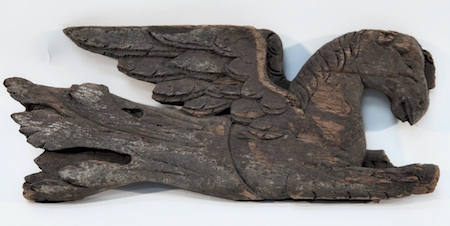
(‘Hippocamp’, a wooden carving in the form of a winged horse, originally part of the panelling inside Stafford Castle: Staffordshire County Museum Service)

This in turn brings to mind the recent piece following the death of David Lynch, which touched on Twin Peaks: The Return, and had a nice quote from Michael Horse, who played the series’ Deputy Sheriff Hawk: ‘When they did the premiere of The Return, the executives had not seen it, and they said: “Mr Lynch, would you say a few words?” And he comes out; he goes: “This project has a lot of wood in it. I like wood.”’
https://www.theguardian.com/tv-and-radio/2025/jan/23/an-oral-history-of-twin-peaks-david-lynch-madchen-amick-joan-chen

We all like wood, no?  Wood nymphs, woodwind, woodbine, woodpeckers, woodlands – as a child, I had a pet woodlouse for a short time, though it didn’t end well. Woodcuts, wood engravings. Albrecht Dürer, Hiroshige, Käthe Kollwitz, Robert Gibbings, Thomas Bewick, Clare Leighton, David Jones, Gwen Raverat. Harriet Baker wrote of woodcuts made by Carrington and Vanessa Bell: ‘Carving directly into soft wood, the markings of tools and the tremors of hands were as much a part of the final pieces as form and composition.’[6]

The French historian Fernand Braudel gave wood a significant role in the lessening of the effects of the Black Death which, he argued, ‘did not, as used to be thought, arrive in Central Europe in the thirteenth century, but in the eleventh at the latest.’ His analysis of the retreat of the disease in the 18th century mentioned stone’s replacing wood in domestic architecture after major urban fires; the general increase in personal and domestic cleanliness, and the removal of small domestic mammals from dwellings, all factors that resulted in the lessening impact of fleas. He also discussed the enormous significance of wood being used everywhere: ‘One of the reasons for Europe’s power lay in its being so plentifully endowed with forests. Against it, Islam was in the long run undermined by the poverty of its wood resources and their gradual exhaustion.’[7]

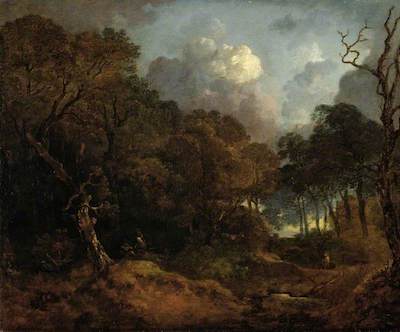
(Thomas Gainsborough, A Forest Road: Fitzwilliam Museum, Cambridge)

The gradual exhaustion of resources. Here we are again. Not so gradual now, I suspect, but in any case a phrase to tingle the tongues of those who, as previously noted, are custodians of the past and guardians of the future. Which is us, of course, even those currently making war on their own children and grandchildren.

In September 1911, Ezra Pound spent a Sunday afternoon with G. R. S. Mead, a scholar of hermetic philosophy, early Christianity and Gnosticism, the occult and theosophy: he had served as private secretary to Madame Blavatsky during her last years. He had founded the Quest Society in 1909 and invited Pound to give a lecture, which would be published subsequently in the quarterly review, The Quest. Pound delivered his lecture early in 1912 and it appeared in the October issue of the review with the title ‘Psychology and Troubadours’. Twenty years later, it was incorporated into Pound’s The Spirit of Romance.[8] It’s years since I read it but one sentence, particularly, lodged in my memory and remains intact: ‘We have about us the universe of fluid force, and below us the germinal universe of wood alive, of stone alive.’[9]

Pound, like Henri Gaudier-Brzeska, Guy Davenport wrote, ‘had conceived the notion that cultures awake with a brilliant springtime and move through seasonal developments to a decadence. This is an ideas from Frobenius, who had it from Spengler, who had it from Nietzsche, who had it from Goethe.’[10]

Yes. Never mind third runways, never mind nuclear power stations on every corner, never mind mimicking anti-immigrant messages from other political parties that run on that sort of fuel. If a body is bleeding to death in front of you—how can I put this?—it may be best, before all else, to try to stop the bleeding.

Touch wood. Good wood. Touch good wood.


Notes

[1] ‘The Widow at Windsor’, Rudyard Kipling’s Verse: Inclusive Edition, 1885-1918 (New York: Doubleday, Page & Co., 1925), 471.

[2] Rudyard Kipling, From Sea to Sea (2 volumes: Macmillan, 1900), I: 479-480

[3] Ford Madox Ford, ‘The Poet’s Eye’,  New Freewoman, I, 6 (1 September 1913), 109; ‘Preface’ to Collected Poems (London: Max Goschen, 1914 [1913]), 20.

[4] Ford Madox Ford, England and the English, edited by Sara Haslam (Manchester: Carcanet Press, 2003), 4; Ford Madox Ford, A Call: The Tale of Two Passions (1910; with an afterword by C. H. Sisson, Manchester: Carcanet Press, 1984), 23.

[5] Alfred Tennyson, Poems: A Selected Edition, edited by Christopher Ricks (London: Longman, 1989), 192.

[6] Harriet Baker, Rural Hours: The Country Lives of Virginia Woolf, Sylvia Townsend Warner & Rosamond Lehmann (London: Allen Lane, 2024), 73.

[7] Fernand Braudel, Civilization and Capitalism, 15th – 18th Century. Volume I: The Structures of Everyday Life: The Limits of the Possible (London: Fontana Books, 1985). Translated from the French; revised by Sîan Reynolds, 83, 84, 363.

[8] Ezra Pound, Ezra Pound to His Parents: Letters 1895–1929, edited by Mary de Rachewiltz, David Moody and Joanna Moody (Oxford: Oxford University Press, 2010), 260; A. David Moody, Ezra Pound: Poet: A Portrait of the Man and His Work: Volume I: The Young Genius 1885–1920 (Oxford: Oxford University Press, 2007), 159.

[9] Ezra Pound, The Spirit of Romance (1910; New York: New Directions, 1968), 92.

[10] Guy Davenport, The Geography of the Imagination (Boston: David R. Godine, 1997), 22.

Dusks and darks

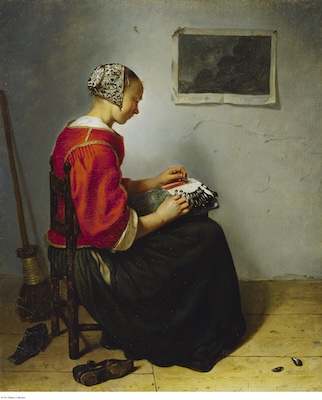
(Caspar Netscher, The Lace Maker, Wallace Collection)

‘In a mid-September twilight’, Ford Madox Ford writes, remembering himself as Second Lieutenant in September 1916, ‘the rain poured down on Pont-de-Nieppe.’ He is bothered by his wet shirt-cuffs and the man assigned to him as temporary batman has clearly decided that Ford is not a man who can be safely left and, ‘though he must have been uncommonly wet and hungry and tired, he followed me to the door of the house in whose dark windows I had seen the luminous patch—the forehead of Rosalie Prudent as she sat sewing, her head bent forward, in the twilight.

‘I don’t know how it is: but from the moment when I first saw that highlight—and it had been certainly three hours before—I had been perfectly sure that that was what it was—the forehead of a quiet woman bending her head forward to have more light from the high window whilst she sewed in the dusk.’

This is Rosalie Prudent of Pont-Nieppe, who has lost her house, her husband and her sons, and is one of the most significant figures that Lieutenant Ford Madox Hueffer—a man at the end of his tether and a writer who cannot write—will encounter during the war. She will sit by the stove in the wash-house, sewing his wristbands. She will cook him an omelette and fried potatoes, talk to his orderly and, ‘looking at Mme. Rosalie—so extremely centred in the work in hand, so oblivious to the very real danger, so brave and so tranquil, I said to myself:
“What the devil! If she can stick it, I too can!”’[1]

And he will. He is one young Australian artist and one five shilling a week cottage away from salvation: ‘The dusk was falling as I approached my isolated, sixteenth century abode that had a leaky, red-tiled roof and defective diamond-framed casements. It stood under a darkling bank. . . . And you think that the half-crown dog was an extravagance! I assure you that he was not. The floors sagged, the paper fell in scrolls from the walls. There was more than a bushel’s bulk of starling’s nest in the downstairs ingle.’[2]

Back in the day—ah, those days—I read, as did half the people I knew at the time, the books of Carlos Castaneda or, at least, the first three or four. Much of it, even the unfolding controversy, is a little cloudy now, but I do recall the assertion that: ‘The twilight is the crack between the worlds.’ Or rather, I recalled it as I made my way around the park a day or two back as the light slipped further down into its last phase before incontrovertible darkness.

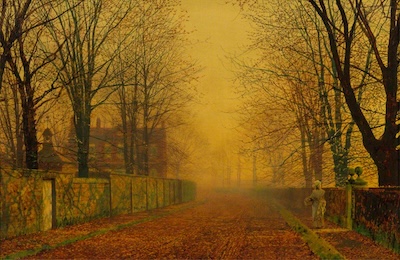
(John Atkinson Grimshaw, Evening Glow: Yale Center for British Art)

If that is in fact the case, some of the denizens of that other world are a little unsettling. As is, of course, the possibility that I myself am, in fact, an inhabitant of the ‘other’ world.

There seem to be more people than usual devoting their time to shouting into phones or at dogs, heard rather than seen, or glimpsed between branches or benches. A man wearing a cloth cap and an alarming neck tattoo scatters broken biscuits from a bag as he walks, to more than a dozen crows and one slightly shifty magpie (‘Yeah, I’m a crow. Who’s asking?’). A second man passes me, marching like a robot, legs thrown out, with a can of beer gripped in each outstretched hand; a teenaged schoolgirl, one of three, having an emotional moment, turns her tearstained face away from me as I pass and one of her friends says: ‘I didn’t meant to hurt you, Lily, but you shouldn’t have said—‘. And on an upper path, a woman running towards me; I cross over to make room for her; she smiles and turns sharply into the play area ten yards ahead, to crouch in front of a swing on which her child is sitting, watched over by a friend.

Vladimir Nabokov mentions ‘soomerki—the lovely Russian word for dusk.’[3] It is, or can be, oddly different, the air itself a different texture or the mind made more receptive to such notions by the slippage in other senses: sounds half-heard and harder to locate, things not quite seen. A Golden Labrador with one of those illuminated collars races through a thick ribbon of trees that borders a lower path, a ghost dog that has me wracking my brains to come up with Jim Jarmusch’s 1999 film, Ghost Dog: The Way of the Samurai, with Forest Whitaker as the hitman. A group of dog-owners I passed earlier did look and sound like contract killers but that may have been down to the special sound qualities of this twilight zone.

(G. F. Watts, A Sea Ghost: Watts Gallery – Artists’ Village)

‘It is the magic hour’, Lawrence Durrell wrote, ‘between two unrealized states of being—the day-world expiring in its last hot tones of amber and lemon, and the night-world gathering with its ink-blue shadows and silver moonlight.’[4] The colours may be a little different in Corfu, as emotional responses might have been a little more accentuated in Emerson’s nineteenth-century New England: ‘Crossing a bare common, in snow puddles, at twilight, under a clouded sky, without having in my thoughts any occurrence of special good fortune, I have enjoyed a perfect exhilaration. I am glad to the brink of fear.’[5]

Richard Garnett (father of Edward and Olive, father-in-law of Constance) wrote about The Twilight of the Gods (as did Richard Wagner); Nietzsche wrote about the Twilight of the Idols; D. H. Lawrence wrote of Twilight in Italy; Edith Wharton was concerned with Twilight Sleep; a volume of Conan Doyle stories was called Tales of Twilight and the Unseen.  ‘I drove carefully’, the private eye Lew Archer says, ‘feeling a little depressed, stalled in the twilight period when day has run down and night hasn’t picked up speed.’[6]

We’re just a week away from the winter solstice, the shortest day, the longest night. Beyond that date, of course, the days get longer, inch by inch. Grounds for optimism, some say. And why not? Just mind the cracks—and, of course, those worlds.


Notes

[1] Ford Madox Ford, No Enemy (1929; edited by Paul Skinner, Manchester: Carcanet Press, 2002), 117, 127, 124.

[2] Ford Madox Ford, ‘Rough Cookery’, New York Herald Tribune Magazine (29 July 1928), 18.

[3] Vladimir Nabokov, Speak, Memory: An Autobiography Revisited (New York: Putnam’s, 1966), 81.

[4] Lawrence Durrell, Prospero’s Cell (London: Faber 1962), 105.

[5] Ralph Waldo Emerson, ‘Nature’, Selected Essays, edited by Larzer Ziff (Penguin American Library, 1982), 38.

[6] Ross Macdonald, The Moving Target (1949; Warner Books, 1990), 98.

Words, things, words for things


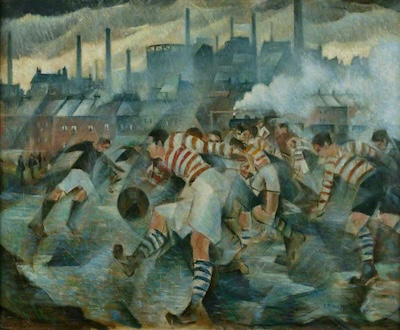
(C. R. W. Nevinson, Any Wintry Afternoon in England: Manchester Art Gallery)

Walking on the wide path in the park, I see a football rolling determinedly towards me over the grass, two boys watching, a long way off. I trap it, nudge and kick. It travels a fair distance but nowhere near the waiting boys. A woman walking towards me on the path says: ‘One of my irrational fears, a ball coming at me like that.’ I say: ‘One of mine too now’, and she laughs. ‘Oh, you did okay.’

Did I, though? Not the kick, that was what it was but. . . irrational fears? If it were now one of mine because of that episode, it’s not irrational but quite rational, reasoned, based on solid, empirical evidence, so. . .Don’t overthink it! the Librarian says, often in person and now in my head. Don’t overthink things!

Ding, ting, chose, cosa, peth, rud, shay, hlutur: thing. . . ‘The distinguished thing’ was Henry James’s famous phrase for death. Did he actually say it? Following a reference to Edith Wharton’s A Backward Glance, I see that there’s an extra link or two: ‘He is said to have told his old friend Lady Prothero, when she saw him after the first stroke, that in the very act of falling (he was dressing at the time) he heard in the room a voice which was distinctly, it seemed, not his own, saying: “So here it is at last, the distinguished thing!”’ Wharton adds: ‘The phrase is too beautifully characteristic not to be recorded.’[1] It’s certainly wonderfully—and characteristically—indefinite, or at least, on a very convoluted path: ‘He is said’ to have told someone else that he heard a voice which wasn’t his own, the word ‘distinctly’ applied only to a negative, ‘not his own’ and, even then, ‘it seemed’.


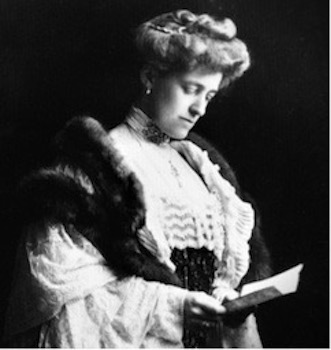
(Edith Wharton via BBC)

Death as ‘the thing’ (Death! Where is thy thing?) – while for Edna St Vincent Millay, death was not the thing but the force engulfing it:

Death devours all lovely things:
   Lesbia with her sparrow
Shares the darkness,—presently
   Every bed is narrow.[2]

The line ‘Every bed is narrow’ I take to refer to coffins (rather than, or as well as, singleness or separation), and it also recalls Pound’s ‘Homage to Sextus Propertius’. ‘We, in our narrow bed, turning aside from battles:/ Each man where he can, wearing out the day in his manner.’[3]

And yet – I was thinking, at the outset, more of things than of death; or rather, words and things, particularly the word ‘thing’. Impressively, its origin seems to embrace both ‘object’ and ‘parliament’. The definitions are lavish: an assembly, court, council, matter, affair, problem, fact, event, action, that which exists or can be thought of, a living creature, a piece of writing; in the plural, clothes, personal belongings. What a word, what a world, ‘thing’ is!

While an inmate of the Disciplinary Training Center at Metato, north of Pisa, in the autumn of 1945, Ezra Pound wrote:

   And for all that old Ford’s conversation was better,
consisting in res non verba,
          despite William’s anecdotes, in that Fordie
   never dented an idea for a phrase’s sake
and had more humanitas [4]

Things, not words for things. Pound was reiterating his belief in those opposing—or complementary—positions, Ford as realist, Yeats as symbolist, that he proposed on more than one other occasion.[5] Poignantly, they were both just six years dead – the length of a world war, say.

That ‘humanitas’ had led the youthful Ford to rashly discuss the conditions of the London poor with a young woman he took out in a boat, only to be reproved the next day by her mother, Lady Cusins: ‘“Fordie, you are a dear boy. Sir George and I like you very much. But I must ask you not to talk to dear Beatrice … about Things!”’[6]

(Iris Barry)

Ford had actually written to Iris Barry (4 July 1918): ‘I have always been preaching to people not to write “about” things but to write things—& you really do it—so I like to flatter myself that you are an indirect product of my preachings—a child of my poor old age.’ (He was still serving in the British Army, having by then reached the ‘poor old age’ of 44.)[7]

Ralph Waldo Emerson also fished in those waters: ‘The corruption of man is followed by the corruption of language’ and ‘new imagery ceases to be created, and old words are perverted to stand for things which are not’. But ‘wise men pierce this rotten diction and fasten words again to visible things’.[8] This linking of words and things would have some later commentators and theorists tearing their hair out, words for them being quite arbitrary marks on the page, the word for something not otherwise  linked to that something. Lord Byron though, as so often, pursued his own path:

But words are things, and a small drop of ink,
Falling like dew upon a thought, produces
That which makes thousands, perhaps millions, think.[9]

And as if by magic, an email just arrived from PN Review offers, from its archive, ‘Holà’, a short poem by C. H. Sisson from 1992, which is also concerned with words and things:

Words do not hold the thing they say: 
Say as you will, the thing escapes 
Loose upon air, or in the shapes 
Which struggle still before the eyes. 
Holà will run upon its way 
And never catch up with its prize.[10]


Later in my park walk, halfway down a steepish path, I see a woman ahead of me with a child in a pushchair and a dog crouched in the grass nearby, with a ball in its mouth. It looks at me inquiringly. ‘I’m afraid not’, I say. ‘You’re not my dog and that ball is covered with slobber, as we both know.’ The woman is partly blocking the path where it meets the wider track, talking on her phone and with her back to me, but moves to one side as I approach. The dog lies down close by her and lets the ball drop from its mouth. She half-turns and kicks the ball, which rockets cleanly away for a good distance – and apparently just where she meant it to go. Damn, I think, she only needed to be a bit better than me to make the point. What point? That I shall not overthink it. . .


Notes

[1] Edith Wharton, Novellas and Other Writings: Madame de Treymes, Ethan Frome, Summer, Old New York, The Mother’s Recompense, A Backward Glance, edited by Cynthia Griffin Wolff (New York: Library of America, 1990), 1055.

[2] Millay, ‘Passer Mortuus Est’ (first of three stanzas), in F. O. Matthiessen, The Oxford Book of American Verse (New York: Oxford University Press, 1950), 886. As is often noted, Millay here references Catullus 2, about the death of his lover Lesbia’s sparrow, her ‘plaything’: The Poems of Catullus, translated with an introduction by Peter Whigham (Harmondsworth: Penguin Books, 1966), 52.

[3] Ezra Pound: Poems and Translations, edited by Richard Sieburth (New York: Library of America, 2003), 535.

[4] Canto LXXXII, The Cantos of Ezra Pound, fourth collected edition (London: Faber and Faber, 1987), 525. I have tried—and failed—to insert the ideogram, ‘jen’.

[5] Ezra Pound, Polite Essays (1937; Plainview, New York: Books for Libraries Press, 1966), 50; Pound/ Williams: Selected Letters of Ezra Pound and William Carlos Williams, edited by Hugh Witemeyer (New York: New Directions, 1996), 187.

[6] Ford Madox Ford, Return to Yesterday: Reminiscences 1894-1914 (London: Victor Gollancz, 1931), 75.

[7] Ford Madox Ford, Letters of Ford Madox Ford, edited by Richard M. Ludwig (Princeton: Princeton University Press, 1965), 87.

[8] Ralph Waldo Emerson, Selected Essays, edited by Larzer Ziff (Harmondsworth: Penguin Books, 1982), 51.

[9] Lord Byron, Don Juan, III:88, edited by T. G. Steffan, E. Steffan and W. W. Pratt (London: Penguin Books, 1996), 182.

[10] PN Review 87 (September–October 1992), 28.

Words made flesh, flash, at a trumpet crash


(‘The Ash Yggdrasil’ from Aasgard and the Gods, by Wilhelm Wägner)

‘I remember going on to think that Ragnarök seemed “truer” than the Resurrection’, the narrator of A. S. Byatt’s story, ‘Sugar’, writes, having known, as a child, the 1880 book Asgard and the Gods.[1]

There’s a peculiar fascination about those moments in a work of art when other practitioners are evoked, quoted or alluded to, especially when the source is altered. Often enough, this is because the writer is quoting from memory: while George Orwell usually announces that he’s about to do so, others engage in the same practice without any such explicit statement, not infrequently getting things almost—but not quite—right. In a letter to G. K. Chesterton (6 July 1928), T. S. Eliot wrote: ‘The last time that I ventured to quote from memory in print, a correspondent [ . . . ] pointed out that I had made twelve distinct mistakes in well-known passages of Shakespeare.’[2] Joseph Conrad used lines from Spenser’s Faerie Queene (I, ix, 359-360) as the epigraph to his novel The Rover (1923), and the same lines were  later incised on his gravestone at Canterbury: ‘Sleep after toyle, port after stormie seas,/ Ease after warre, death after life does greatly please’. When they reappeared at the close of the ‘English’ text of Ford Madox Ford’s No Enemy (there is an appendix with the original French version of an earlier chapter in English), there were a few differences. ‘Sleep’ becomes ‘rest’ (a resonant word in Ford’s writings), ‘ease after warre’ is excluded, even though Ford wrote much of the book in 1919, having just been gazetted out of the British army after serving both at home and in France and Flanders, ‘death after life’ goes too, since he is celebrating survival, if among a number of ghosts. This is far from simple ‘misquoting’ or ‘misremembering’.[3]


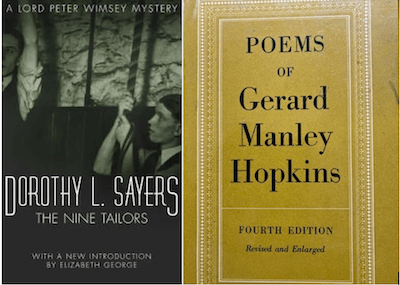
There’s a moment in Dorothy Sayers’ 1934 novel, The Nine Tailors—‘O my, what a lovely piece of work’, Guy Davenport commented, having just read Sayers’ book—when Lord Peter Wimsey, watching a coffin go off up the road, slips into reverie, or stream of consciousness, and suddenly comes up with a chunk of what was immediately familiar to me, though it took a minute or two to identify it as a poem by Gerard Manley Hopkins called ‘That Nature is a Heraclitean Fire’:

                            ‘In a flash, at a trumpet crash,
I am all at once what Christ is, | since he was what I am, and
This Jack, joke, poor potsherd, | patch, matchwood, immortal diamond,
                            Is immortal diamond.’[4]

These are characteristically arresting lines, but the poem’s full title is ‘That Nature is a Heraclitean Fire and of the Comfort of the Resurrection’, and there is a striking gap, an elision, in the passage that occurs in Wimsey’s thoughts: the line, ‘I am all at once what Christ is, | since he was what I am, and’, is missing.[5]

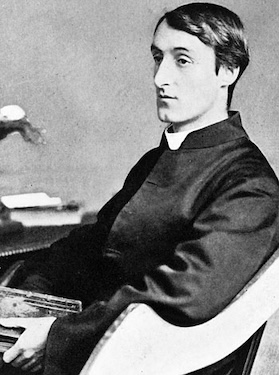
Hopkins wrote to his friend, the poet Robert Bridges, on 25 September 1888, that, while the sonnet he’d recently sent Bridges on the Heraclitean fire had distilled a lot of early Greek philosophical thought, perhaps ‘the liquor of the distillation did not taste very Greek’. He added: ‘The effect of studying masterpieces is to make me admire and do otherwise’—which seems eminently reasonable.[6]


(Gerard Manley Hopkins)

Hopkins—Jesuit priest, classics professor—is, as W. H. Gardner wrote, ‘a religious, not merely a devotional, poet. Religion, for him, was the total reaction of the whole man to the whole of life’ (‘Introduction’ to Poems, xxxv). A good many of his poems are addressed directly and vividly to God, as in the first stanza of the first major poem, ‘The Wreck of the Deutschland’:

Thou mastering me
God! giver of breath and bread
World’s strand, sway of the sea;
Lord of living and dead
Thou has bound bones and veins in me, fastened me flesh,
And after it almost unmade, what with dread,
Thy doing: and dost thou touch me afresh?
Over again I feel thy finger and find thee.

‘The Windhover’ is dedicated ‘To Christ our Lord’, ‘Pied Beauty’ begins: ‘Glory be to God for dappled things’, ‘The Loss of the Eurydice’ is addressed ‘O Lord’ and a late sonnet begins: ‘Thou art indeed just, Lord, if I contend/ With thee’. The ‘terrible sonnets’, evidence of great stress, even ‘desolation’, also centrally concern his relationship with God:

I am gall, I am heartburn. God’s most deep decree
Bitter would have me taste: my taste was me;
Bones built in me, flesh filled, blood brimmed the curse.[7]


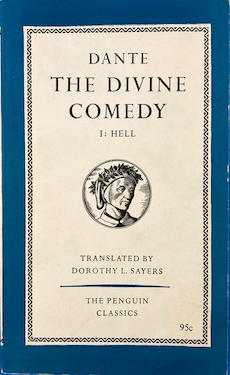
Religious themes featured early in Sayers’ writing life and became more central later, in her many plays and her translation of Dante’s Divine Comedy. This rector’s daughter may have had both father and rectory in mind when she wrote The Nine Tailors. Mr Venables is scholarly, very amiable and extremely absent-minded, and Lord Peter Wimsey comes to regard him with affection and respect. Could Sayers have felt that the line she omitted from Hopkins’ poem might have seemed blasphemous to some readers, an issue further complicated by its occurring in her hero’s thoughts? At one point, Wimsey is confronted by a visiting card on a wreath, purporting to be from him but actually supplied by his manservant Bunter (who had been Sergeant to Major Wimsey in the First World War). The card includes a biblical reference, Luke xii, 6. ‘“Very appropriate,” said his lordship, identifying the text after a little thought (for he had been carefully brought up)’ (The Nine Tailors, 133). It’s probably safe to assume that Sayers too had been ‘carefully brought up’ in that respect.


Notes

[1] A. S. Byatt, Medusa’s Ankles: Selected Stories (London: Vintage, 2023), 37. Her Ragnarok: The End of the Gods was published in 2011.

[2] Quoted in a note to the epigraph of ‘Gerontion’, in The Poems of T. S. Eliot. Volume I: Collected and Uncollected Poems, edited by Christopher Ricks and Jim McCue (London: Faber & Faber, 2015), 469.

[3] Paul Skinner, ‘Just Ford – an Appreciation of No Enemy: A Tale of Reconstruction’, Agenda, edited by Max Saunders, 27, 4/ 28, 1 (Winter 1989/ Spring 1990), 103-109 (105).

[4] Poems of Gerard Manley Hopkins, Fourth edition, revised and enlarged, edited by W. H. Gardner and N. H. Mackenzie (London: Oxford University Press, 1967), 105-106. These are the last lines of the poem.

[5] The Nine Tailors (1934; with an introduction by Elizabeth George, London: New English Library, 2003), 122. Davenport’s enthusiasm (he writes the title as The Nine Taylors) is expressed in a letter to Hugh Kenner, 10 April 1967: Questioning Minds: The Letters of Guy Davenport and Hugh Kenner, edited by Edward M. Burns, two volumes (Berkeley: Counterpoint Press, 2018), II, 888.

[6] The Letters of Gerard Manley Hopkins to Robert Bridges, edited by Claude Colleer Abbott (Oxford: Oxford University Press, 1955), 291.

[7] ‘I wake and feel the fell of dark’, Poems, 101.

Remembering, or forgetting, 4 August


(Selwyn Image, ‘Stained Glass Design’, 1887: © Victoria & Albert Museum)

Looking at the news this 4 August, it’s sobering to reflect that one of the candidates for the Tory leadership recently vowed to ‘turn the tide of Liberalism’, when it is painfully obvious that what is actually – and urgently – needed is to turn the tide of fascism and racist violence.

Today is the 110th anniversary of Britain’s declaration of war, which will be old news to anyone who reads or writes around the First World War, or simply has an average grasp of history, and it has tended rather to dwarf other, personal, events and anniversaries – though not, perhaps, for the individuals concerned.

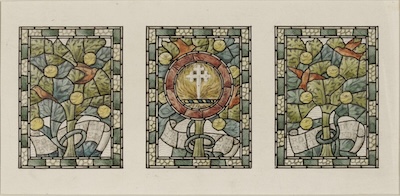
Walter de la Mare (‘Jack’) and Elfrida Ingpen (‘Elfie’) were married privately in the parish church at Battersea on 4 August 1899. D. H. Lawrence’s sister Ada married William Edward Clarke on 4 August 1913.[1] Julian Barnes noted that his grandparents were married on 4 August 1914, the day itself,[2] which also marked the birth of Anthony, Rebecca West’s son by H. G. Wells. It was the birthday of Florence, Stanley Spencer’s sister: she married J. M. Image, Cambridge don and brother to Selwyn Image.[3] Ezra Pound, quite recently arrived in London, went in February 1909 to see Selwyn, ‘who does stained glass. & has writ a book of poems. & was one of the gang with Dowson – Jonson – Symons – Yeats etc. – talks of “when ‘old Verlaine’ came over etc.’[4]


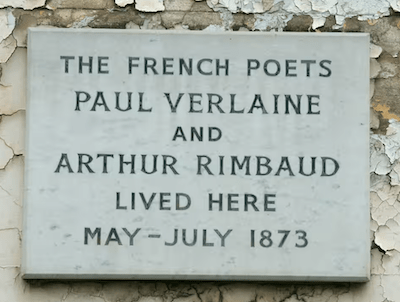
(Plaque, Royal College Street, Camden, via The Guardian: photograph by Frank Baron)

‘Old Verlaine’ came over more than once, firstly in 1872, in the company of Arthur Rimbaud (whom he later shot and wounded, in Brussels, another story), settling for a while in rooms in Howland Street off the Tottenham Court Road and, on a second visit shortly afterwards, in Camden Town. They seem to have dropped in on one of the soirées at the Fitzroy Square home of Ford’s maternal grandfather, the painter Ford Madox Brown and his second wife Emma.[5] In October 1893, at the suggestion of William Rothenstein, Verlaine arrived to lecture and read his poetry, in London and in Oxford. Ernest Dowson recorded that, arriving in the small hours of the morning, Verlaine was greeted by the poet and critic Arthur Symons, ‘bearing a packet of biscuits and a bottle of gin’. He gave his first lecture at Barnard’s Inn on 21 November and two days later arrived in Oxford, to be met by Rothenstein and a man named York Powell, of Christ Church (Icelandic scholar, authority on Roman Law, boxing and Middle High Dutch. He also knew Hebrew and Old Irish). Verlaine lectured on contemporary French poetry ‘in the room behind Mr Blackwell’s shop’ and was so enamoured of the city—‘Ô toi, cité charmante et mémorable, Oxford!’— that prising him out of it necessitated both escorting him to the train and withholding his lecture fee until he was safely on the train for London.[6]

Famously (if not quite famously enough), 4 August is the date threaded through Ford Madox Ford’s The Good Soldier—seventeen occurrences in all—and also the birthdate (4 August 1841) of W. H. Hudson, one of Ford’s most consistently admired writers, to whose work he recurred over more than thirty years, sometimes singling out Nature in Downland but more generally stressing that Hudson’s writing had ‘a tranquillity, a clearness of epithet, and an utter absence of affectation or strain that renders his pages like balm for tired souls’, adding that, as with Turgenev, ‘it is all one whether these writers treat of birds or of South American revolutions, of peasants singing, or of Nihilists at their debates. It is simply that the pages of their books reveal a personality, restful soothing, and itself quite at ease.’[7]


(Edward Heron-Allen in 1927, via The Edward Heron-Allen Society)

On 4 August 1918, the polymath (writer, scientist, linguist, historian) Edward Heron-Allen—very much not a friend of Ford’s—wrote in his journal that: ‘One thing stands out and is certain, and that is, that mentally and physically we are changed, changed as we never dreamed a whole nation could be changed.’ He noted that he had ‘escaped the “Spanish Influenza” of which we hear so much, but it seems to be a real menace. We are told that the German Army is “decimated” by it, and that this accounts for the delay and failure’ of the recent offensive.[8]

A decade and a bit further on, the poet and artist David Jones was making his third visit to his friend Helen Sutherland at Rock Hall, Northumberland, 4 August 1931. At the start and end of each visit, Jones would be driven past the Duke of Northumberland’s castle. Helen told him that this was on the site of Lancelot’s castle, Joyous Guard – and the supposed place of his burial. ‘With this association in mind, Jones referred to the church at Rock as “the Chapel Perilous”, the place of terrifying enchantment that Lancelot enters –­ an episode in Malory that reminded him of his experience at night in Mametz Wood.’[9]

The Battle of Mametz Wood, during the First Battle of the Somme, involved British attacks on 7 and 10-12 July, centrally involving the 38th (Welsh) Division and resulting in huge losses: their casualties were one-fifth of their total strength. David Jones was wounded in the early hours of 11 July, and his great poem In Parenthesis, stops at that point.[10]


(David Jones via The Poetry Foundation)

Lie still under the oak
next to the Jerry
and Sergeant Jerry Coke.
   The feet of the reserves going up tread level with your fore-
head; and no word for you; they whisper one with another;
pass on, inward;
these latest succours:
green Kimmerii to bear up the war.[11]

Ford Madox Ford left Cardiff with the 3rd Battalion on 13 July; and departed for France from Waterloo on 17 July. When 4 August came around this time, he was in a Casualty Clearing Station at Corbie, having been blown into the air and severely concussed by a high explosive shell, ‘so that, as I have said, three weeks of my life are completely dead to me though I seem to have gone about my duties as usual. But, by the first of September I had managed to remember at least my own name…’[12]

Quite a few public figures (not least newspaper columnists) seem to have lost their memories lately – quite selectively and with markedly less excuse.


Notes

[1] Letters of D. H. Lawrence II, June 1913–October 1916, edited by George J. Zytaruk and James T. Boulton (Cambridge: Cambridge University Press, 1981), 38n.

[2] Julian Barnes, Nothing to be Frightened of (Cape 2008), 28.

[3] Kenneth Pople, Stanley Spencer: A Biography (London: Harper Collins, 1991), 55, 49.

[4] Ezra Pound to His Parents: Letters 1895–1929, edited by Mary de Rachewiltz, David Moody and Joanna Moody (Oxford: Oxford University Press, 2010), 160.

[5] Angela Thirlwell, Into the Frame: The Four Loves of Ford Madox Brown (London: Chatto & Windus, 2010), 100. On a later visit, Verlaine lodged at 10, London Street, Fitzroy Square, very close to Howland Street.

[6] Joanna Richardson, ‘’The English Connection: French Writers and England, 1800-1900’, in Richard Faber, editor, Essays by Divers Hands: being the transactions of the Royal Society of Literature. New Series: Volume XLV (Woodbridge: The Boydell Press, 1988), 33-35; Joanna Richardson, Verlaine (London: Weidenfeld and Nicholson, 1971), 317-320.

[7] Ford Madox Ford, ‘Literary Portraits: XXV. The Face of the Country’, Tribune (11 January 1908), 2.

[8] Edward Heron-Allen’s Journal of the Great War: From  Sussex Shore to Flanders Fields, edited by Brian W. Harvey and Carol Fitzgerald (Lewes: Sussex Record Society, 2002), 203. A footnote adds that there were approximately 70 million deaths worldwide in 1918-19, compared to the estimated total of 7.8 million killed in action in the war.

[9] Thomas Dilworth, David Jones: Engraver, Soldier, Painter, Poet (London: Jonathan Cape, 2017), 140-142.

[10] Anthony Hyne, David Jones: A Fusilier at the Front (Bridgend: Seren Books 1995), 37.

[11] David Jones, In Parenthesis (1937; London: Faber, 1963), 187.

[12] Ford Madox Ford, It Was the Nightingale (London: Heinemann, 1934), 175.

Oxford Days (a few)


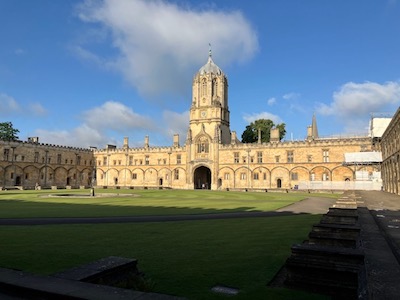
(Tom Quad, Christ Church College)

‘Even when we protested the invasion of Iraq’, I said to the Librarian, recalling that day some twenty years earlier when we shuffled along London streets in company with over a million others, ‘I think we moved more quickly than this.’

‘This’ was our glacial progress up St Aldates in Oxford on a sunny afternoon, together with residents, tourists, American and other participants in the Oxford Experience, or those embarked upon the countless other summer courses and programmes, and many hundreds of—mainly Japanese—children dressed in the Gryffindor house colours of scarlet and gold, concerned to take in the Harry Potter vibrations from New College, the Bodleian Library and Christ Church College. Tour guides in their dozens hoisted small flags or halted in gateways with uplifted arms. Lanyards in their hundreds bobbed or swung. Some individuals, either on home turf or away, looked vague, a little stunned, reminding me of the passage in Rory Stewart’s memoir, where he described Steve Hilton, David Cameron’s director of strategy, moving into the corridor and another room. ‘He seemed to be searching for something – although I couldn’t tell whether it was a cat, an idea, or his shoes.’[1]

On High Street or Broad Street, Broad Walk, Christ Church Meadow, by rivers and canals, on bridges and benches, crowds ebbed and flowed – but mainly flowed. We are soon to be visible in a thousand physical or virtual photograph albums. I said, at one point, ‘Okay, if it’s a child of ten or younger having a photograph taken, we’ll pause. Otherwise, we plough straight on.’ The Librarian agreed but soon lowered the qualifying age to eight, then six. Minutes later, it was down to zero. Thereafter, we ploughed straight on.


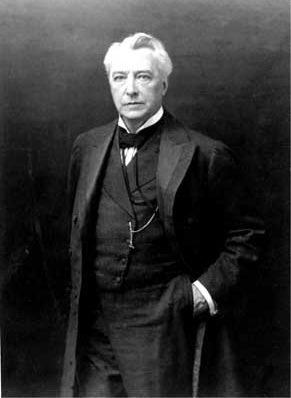
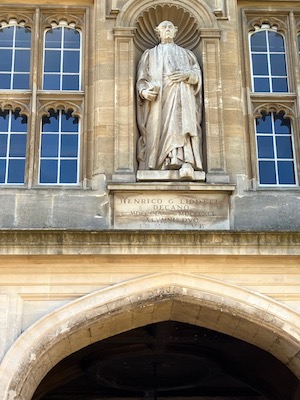
(Alice Liddell’s dad, Henry George Liddell, dean of Christ Church from 1855)

Oxford! The literary references the word throws up are astonishing, even excluding the people that only studied there. Lewis Carroll, or rather, Charles Dodgson, haunts the place, but other names rampage through a distracted memory: Philip Pullman, Dorothy Sayers’ Gaudy Night, John Wain, P. D. James, Iris Murdoch, Hardy’s Jude and Colin Dexter’s Morse, C. S. Lewis and J. R. R. Tolkien. A random footnote fact I gathered since that visit was that Edward De Vere, seventeenth Earl of Oxford, was educated not at Oxford, as one might reasonably expect, but at Queen’s College, Cambridge. Attempts were later made to claim him as the ‘real’ author of Shakespeare’s plays, an idea launched by the splendidly named John Thomas Looney. De Vere was the nephew of Arthur Golding, translator of Ovid, his Metamorphoses ‘the most beautiful book in the language’, in Ezra Pound’s words.[2] A man skilled in ‘fourteeners’ (that many syllables in a line):

Then sprang up first the golden age, which of it selfe maintainde,
The truth and right of every thing unforst and unconstrainde.
There was no feare of punishment, there was no threatning lawe
In brazen tables nayled up, to keep the folke in awe.
There was no man would crouch or creepe to Judge with cap in hand,
They lived safe without a Judge, in everie Realme and lande.

Here Daphne flees from Apollo:

And as shee ran the meeting windes hir garments backewarde blue,
So that hir naked skinne apearde behinde hir as she flue,
Hir goodly yellowe golden haire that hanged loose and slacke,
With every puffe of ayre did wave and tosse behind hir backe.[3]

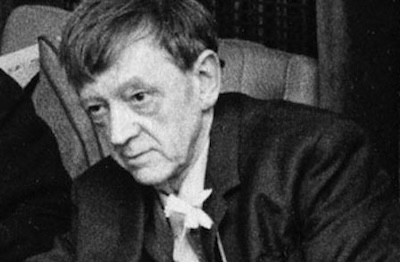
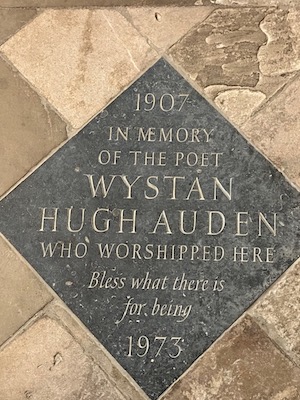
One name occurs on the ground as well as in the mind, the memorial plaque in Christ Church Cathedral (astonishing vaulted ceiling, stained glass by Burne-Jones and others, the St Frideswide Shrine). W. H. Auden came to the College to study biology, switched to English Literature in his second year and graduated (with a third class degree) in 1928. Nearly 30 years later, he became Oxford Professor of Poetry, and returned to Christ Church to live (part of the time) in 1972, the year before his death.


Wot, no Ford Madox Ford notes? Perhaps a sly one. In Some Do Not. . ., Christopher Tietjens, in a mood verging on ‘high good humour’, walks through a Kentish field with Valentine Wannop, a scene, a day, a walk which will recur in both their memories. Among those things that the best people must know are the local names (and the stories behind them) of the plants and flowers they pass. Tietjens—younger son, mathematician, member of the English public official class, who will also, in time, be lover, soldier and antique dealer—tells over to himself the words, the names, the language:

In the hedge: Our lady’s bedstraw: dead-nettle: bachelor’s button (but in Sussex they call it ragged robin, my dear: So interesting!) cowslip (paigle, you know, from the old French pasque, meaning Easter): burr, burdock (farmer that thy wife may thrive, let not burr and burdock wive!); violet leaves, the flowers of course over; black briony; wild clematis: later it’s old man’s beard; purple loose-strife. (That our young maids long purples call and liberal shepherds give a grosser name. So racy of the soil!) …[4]

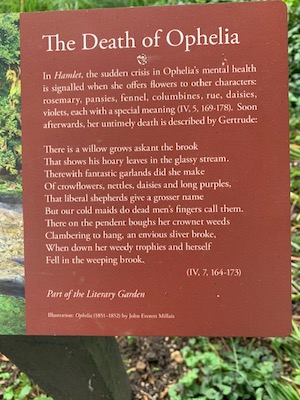
In the wonderful Botanic Garden, the country’s oldest, one section is the Literary Garden, featuring plants that occur in literature, Alice in Wonderland, Agatha Christie (a great user of poisons) and others, including William Shakespeare:

Yes, those liberal shepherds grossly naming again. Modernists though Joyce, Eliot, Woolf, Wyndham Lewis and Ford were, they were not Futurists rejecting the past—a little more selective than that: ‘BLAST years 1837 to 1900’ and, indeed, ‘BLESS SHAKESPEARE for his bitter Northern Rhetoric of humour’—and they all had frequent recourse to that Elizabethan. . .


Notes

[1] Rory Stewart, Politics on the Edge: A Memoir from Within (London: Jonathan Cape, 2023), 100.

[2] Ezra Pound, The ABC of Reading (London: Faber and Faber, 1961), 127

[3] Extracts in The Oxford Book of Classical Verse, edited by Adrian Poole and Jeremy Maule (Oxford: Oxford University Press, 2000), 394; The Oxford Book of Verse in English Translation, Chosen and Edited by Charles Tomlinson (Oxford: Oxford University Press, 1980), 38.

[4] Ford Madox Ford, Some Do Not. . . (1924; edited by Max Saunders, Manchester: Carcanet Press, 2010), 132.

Reliably unreliable


(Horatio McCulloch, Loch Katrine: Perth Art Gallery; managed by Culture Perth and Kinross)

(‘Bussoftlhee, mememormee!’ James Joyce, Finnegans Wake)

I was reading Rosemary Hill’s review of a recent book by Steven Brindle, Architecture in Britain and Ireland: 1530-1830, and the extent to which Henry VIII’s break with Rome was an ‘unmitigated disaster’ for architecture. ‘“The dissolution of the religious houses”, Steven Brindle writes, “tore the heart out of the patronage of … the arts” as it had existed for nine centuries and brought about “the largest redistribution of land since the Norman Conquest”. It would take three generations to begin to recover from this “colossal self-inflicted cultural catastrophe”’.[1]

In the current painful condition of the United Kingdom, the notion of colossal self-inflicted catastrophes brings to mind most readily the ill-conceived and dishonestly presented referendum of 2016, although, with the example in mind of Kipling’s phrase in ‘With the Night Mail’, ‘the traffic and all it implies’,[2] we tend to reflect on Brexit and all it implies. The implications are not pretty. A part-time television critic of my acquaintance, who’d watched a series called ‘The Rise and Fall of Boris Johnson’, observes that it’s very easy to forget how simply and thoroughly ‘a small group of men fucked this country over’. Indeed it is.


Memory is fickle, quite easily manipulated (as is blindingly obvious in our time) but, in any case, a fiction writer of great, if sometimes wayward, abilities. It can also perform extraordinary feats. Katherine Rundell, writing of John Donne’s age, describes how‘ [a] school system which hinged on colossal amounts of memorisation had built a population with the kind of mammoth recall which is, in retrospect, breathtaking’ – listeners returning home to argue over sermons, plagiarise them, make them ‘part of the fabric of their days.’[3] Sylvia Beach recalled reading a line at random from “The Lady of the Lake” – and James Joyce then reciting the whole page and the next ‘without a single mistake’.[4] Scott’s poem is in six cantos, the first of which has 35 stanzas, the second 37 – and the stanzas are not short ones. As for its author’s own powers of recall, James Hogg, in his Domestic Manners and Private Life of Sir Walter Scott, ‘tells of how he once went fishing with Scott and Skene [James Skene of Rubislaw]. He was asked to sing the ballad of “Gilmanscleuch” which he had once sung to Scott, but stuck at the ninth verse, whereupon Scott repeated the whole eighty-eight stanzas without a mistake.’[5]

Jenny Diski wrote that ‘there is nothing so unreliable or delicious as one’s rackety memories of oneself.’[6] And we certainly hear and read a lot about ‘unreliable narrators’. Memory is, of course, both narrator and reliably unreliable. This applies both to ourselves and the wider world (perceived and processed by those same selves). In the ‘Foreword’ to Joan Didion’s South and West: From a Notebook, centred on her trip through the deep South in 1970, Nathaniel Rich discussed how a view of ‘the past’ had been relegated to the aesthetic realm and Didion herself remarked on ‘[t]he time warp: the Civil War was yesterday, but 1960 is spoken of as if it were about three hundred years ago.’[7]

Oddly (though probably not), memory delayed a little in reminding me that my remark about unreliable narrators may be more or less purloined from an essay by Frank Kermode, revisited when I went back to a Conrad novel last year. Nearly one-third of the books I read in 2023 I’d read before, largely due to working on Ford Madox Ford, of course; they were either his own books or Ford-related, directly or tangentially.


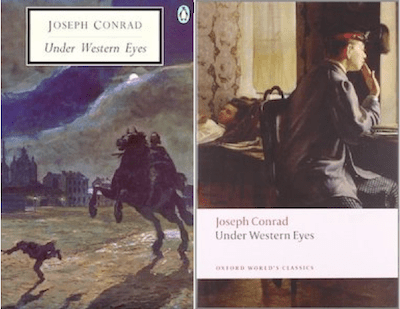
Unsurprisingly, they included ‘that finest novel in the English language’, as Ford once described it. And again: ‘[F]or me, Under Western Eyes is a long way the greatest—as it is the latest—of all Conrad’s great novels.’[8] Once more: ‘That is to say, in common with myself, he regarded the writing of novels as the only occupation for a proper man and he thought that those novels should usually concern themselves with the life of great cities.’ There were two such novels. ‘But although The Secret Agent was relatively a failure, Under Western Eyes with its record of political intrigue and really aching passion has always seemed to me by a long way Conrad’s finest achievement.’[9]

I had read Conrad’s novel of pre-revolutionary politics, betrayal and assassination so long ago that it might almost have been for the first time – almost. It is, no doubt, a tribute to the writing that I found myself consciously offering advice to the student Razumov during his interview with Councillor Mikulin: Shut up! Don’t say another word! Hold your tongue! He can’t, of course. And Ford saw the driving force of much of the book to be personal honour. Of Razumov’s ploy to ‘add a touch of verisimilitude’, having a foolish boy rob his own rich father but then tossing the money from a train window, Ford comments: ‘And the same unimaginative cruelty of a man blindly pursuing his lost honour dignifies Razumov to the end.’[10]

My surviving sense of the book had included Conrad’s known antipathy to Russia (hardly surprising in a Pole born in the Ukraine, part of the Russian Empire but once part of Poland) and his contempt for revolutionaries, which was evident in The Secret Agent. Under Western Eyes was written between two Russian revolutions, published (1911) exactly midway, in fact. But notions of nationality, allegiance and bafflement also shouted aloud ‘Conrad’! Or, perhaps, ‘Konrad Korzeniowski!’ Much of this was to do with that complex process of holding onto a strong sense of one’s native country and culture, while adopting a second language (retaining fluency in the first) – and then a third, while settling in another country and choosing to write in that third language. None of this was made much easier for Conrad by his being attacked on occasion by Polish compatriots for deserting both language and country. Not that migration is ever only a matter of language. H. G. Wells had a couple of digs at Conrad, not only that he spoke English ‘strangely’ but also that ‘[o]ne could always baffle Conrad by saying “humour.” It was one of our damned English tricks he had never learned to tackle.’[11] Under-westernised?

Kermode’s celebrated essay, ‘Secrets and Narrative Sequence’, I’d also read a long time ago.[12] Briefly, he argues that Conrad’s text shows itself obsessed with certain words and images which wholly evade orthodox, ‘common sense’ readings. More, he suggests that the book’s ‘secrets’ are in fact ‘all but blatantly advertised’ (99) and from which, by a curious process of collusion, ‘we avert our attention’ (95). He is pointing to the novel’s constant references to ghosts or phantoms, souls, eyes and, perhaps above all, to the art of writing, more, the materials of writing: black on white, ink on paper, shadows on snow, notebooks, a journal wrapped in a veil. I went back to the essay after reading the novel. It’s true that I found it difficult to see how critics had not seen and grasped – or sought – the significance of the astonishing frequency of such images. Souls, ghosts and related words occur a hundred times, references to eyes more than sixty times, and so on. This is bound to snag the attention of a reader of Ford’s The Good Soldier, an even shorter novel, I think, in which the verb ‘to know’ in its various forms, occurs not far short of three hundred times. ‘What I ask you to believe’, Kermode writes, ‘is that such oddities are not merely local; they are, perhaps, the very “spirit” of the novel’ (97). Difficult not to notice, I said, but cannot be sure of how much that noticeability is related to residual memories of his essay. With a fistful of exceptions, I’m unacquainted with the secondary literature on Conrad which is, I’ve learned, ‘huge, approximately 800 monographs, biographies, edited collections, volumes of letters and catalogues, without counting the hundreds of peer-reviewed papers in the general and specialist literary journals, the untranslated material and the unpublished doctoral theses.’[13]


Richard Parkes Bonington, La Place du Molard, Geneva (Victoria & Albert Museum)

St Petersburg, Geneva. The book is centrally concerned, of course, with Russia: its psychology, Conrad himself suggested, more than its politics. There is also the essential complicating factor of the narrator—‘all narrators are unreliable, but some are more expressly so than others’, as Kermode remarks (yes, that’s the one).[14] A language teacher, English, in love with Natalia Haldin, sister of the executed assassin Victor Haldin, and friendly with their mother. Speaking sometimes in his own voice (whatever the extent to which it’s borrowed) and sometimes through the medium of Razumov’s journal, he repeatedly asserts an inability to understand the Russian character, the Russian soul. He glances down at the letter Natalia is holding, ‘the flimsy blackened pages whose very handwriting seemed cabalistic, incomprehensible to the experience of Western Europe.’ At one point, ‘I could not forget that, standing by Miss Haldin’s side, I was like a traveller in a strange country.’ Again, ‘The Westerner in me was discomposed’ and: ‘I felt profoundly my European remoteness and said nothing, but I made up my mind to play my part of helpless spectator to the end.’ And: ‘To my Western eyes she seemed to be getting farther and farther from me, quite beyond my reach now, but undiminished in the increasing distance.’ One more:  ‘And this story, too, I received without comment in my character of a mute witness of things Russian, unrolling their Eastern logic under my Western eyes.’

Continually asserting his incomprehension, the unfamiliarity of what he is observing, he does, of course recall Ford’s John Dowell, to whom it is all a darkness and who repeatedly asserts: ‘I don’t know’. And yet, and yet. There are many suspicious readings of The Good Soldier, some of which ask if Dowell is as unknowing as he appears to be and also, perhaps, what kind of knowledge he does not possess. It is, unusually for Ford, narrated in the first person. In any case, it is fatally easy, waltzing among thornbushes, to catch one’s sleeve on that knowledge of knowing nothing, to recall the famous moment in Eliot’s The Waste Land—‘I knew nothing,/Looking into the heart of light, the silence’—and, remembering his interest in eastern thought and religion, wonder if that knew should be stressed infinitely more than the nothing.


(J. M. W. Turner, Sunrise with a Boat between Headlands: Tate)

Kermode notes that, when Conrad began the book, he called it Razumov: ‘but when it was done (on the last page of the manuscript, in fact) he changed the title to Under Western Eyes. He had found out what he was doing’ (98). I remember the pleasure with which I came across that last sentence: the recognition of the fact that, so often, we find out not only how to do something but what it is we are actually doing – only by doing it. And this, certainly, not just in art.

The novelist and playwright Enid Bagnold described how: ‘Beauty never hit me until I was nine.’ When she arrived in Jamaica as a child: ‘this was the first page of my life as someone who can “see”. It was like a man idly staring at a field suddenly finding he had Picasso’s eyes. In the most startling way I never felt young again. I remember myself then just as I feel myself now.’ She adds, a little later: ‘And what you remember is richer than the thing itself.’[15]

Well, sometimes.


Notes

[1] Rosemary Hill, ‘Des briques, des briques’, London Review of Books, 46, 6 (21 March 2024), 13.

[2] Rudyard Kipling, Actions and Reactions (New York: Scribner’s 1909), 148.

[3] Katherine Rundell, Super-Infinite: The Transformations of John Donne (London: Faber, 2023), 223.

[4] Sylvia Beach, Shakespeare and Company, new edition (Lincoln: University of Nebraska Press, 1991), 71.

[5] John Buchan, Sir Walter Scott (London: Cassell, 1932), 131. The ballad was included in Hogg’s first book, The Mountain Bard (1807).

[6] Jenny Diski, In Gratitude (London: Bloomsbury, 2017), 187.

[7] Joan Didion, South and West: From a Notebook, foreword by Nathaniel Rich (London: 4th Estate, 2017), xviii, 104.

[8] Ford, Thus to Revisit (London: Chapman & Hall, 1921), 90-91; Return to Yesterday: Reminiscences 1894-1914 (London: Victor Gollancz, 1931), 193.

[9] Ford, ‘Introduction’ to Joseph Conrad, The Sisters, edited by Ugo Mursia (Milan: U. Mursia & Co., 1968), 11-30 (14).

[10] Ford, ‘Joseph Conrad’, English Review, X (December 1911), 68-83 (71).

[11] H. G. Wells, Experiment in Autobiography (1934; London: Faber, 1984), 616, 622.

[12] Frank Kermode, ‘Secrets and Narrative Sequence’, Critical Inquiry, 7, 1 (Autumn 1980), 83-101 (references are to this); reprinted in Essays on Fiction, 1971-1982 (London: Routledge and Kegan Paul, 1983), 133-155.

[13] Helen Chambers, review of Robert Hampson, Joseph Conrad (London: Reaktion Books,  2020), Last Post: A Literary Journal from the Ford Madox Ford Society, I, 4 (Autumn 2020), 124.

[14] Kermode, 89-90; and see footnote 7: ‘The trouble is not that there are unreliable narrators but that we have endorsed as reality the fiction of the “reliable” narrator.’

[15] Enid Bagnold, Autobiography (London: Century Publishing, 1985), 14, 100.

Corner posts and lucky beans


‘When he finally left, his eyes blurry from having stared at printed papers for so long, he felt that something was different’, Georges Simenon (or his translator) wrote of Inspector Jules Maigret. ‘It took a while to dawn on him that it had stopped raining. It felt like a void.’[1]

It has hardly stopped raining here, has barely drawn breath, in fact. No relief. None either in the news, with its daily litany of continuing atrocities, grotesque historical ironies and politicians soiling themselves to degrees remarkable even in our Golden Age of Hypocrisy.

But here the work continues, the ordinary processes of living which, more fortunate than some others, we are able to pursue: in my case, transcribing letters, reading Simenon, William Faulkner, Mary Butts – and feeding the cat.


(Harry the Cat)

When their meals are imminent, some cats have a habit of displaying affection to their owners (their staff) and, often, to the corners of cupboards, the legs of chairs, the edges of tables. Harry rubs his face against various fixtures and fittings but, particularly, the corners of a low table in front of the living-room sofa, where I sit to take off my outdoor shoes after a walk. Several times I’ve watched him work his way around the table – but always nudging three corners and missing one, though the missed one varies.

I mention to the vacant room that, when Doctor Johnson missed touching a post, he had to turn back to remedy the situation before continuing on his way, as reported by a man named Samuel Whyte:

I perceived him at a good distance working along with a peculiar solemnity of deportment, and an awkward sort of measured step…. Upon every post as he passed along, I could observe he deliberately laid his hand; but missing one of them, when he had got at some distance, he seemed suddenly to recollect himself, and immediately returning back, carefully performed the accustomed ceremony, and resuming his former course, not omitting one till he gained the crossing. This, Mr. Sheridan assured me … was his constant practice.[2]


(Joshua Reynolds, Samuel Johnson, National Trust: Knole)

Superstitions. Black cats, lucky beans, touching iron, meeting pigs, replacing chairs after dining, turnips, umbrellas and snails – throwing and divination. I realise that I have not one but two relevant reference books: Steve Roud, The Penguin Guide to the Superstitions of Britain and Ireland (London: Penguin, 2003), and Iona Opie and Moira Tatem, editors, A Dictionary of Superstitions (Oxford: Oxford University Press, 1989). Iona Opie, with her husband Peter, wrote the classic The Lore and Language of Schoolchildren, containing a chapter, ‘Half-Belief’, which assembles an astonishing array of ‘ancient apprehensions’ that, ‘even if only half-believed in, continue to infiltrate their minds’. These range from the likely bad effects of seeing a white horse (and omitting to spit) through the madness resulting from moonlight shining on a sleeping person’s face, screeching owls, dropped photograph frames, the perils of stepping on black beetles, walking under bridges as trains cross them, glimpses of funerals, chimney sweeps, spotted dogs, haycarts, sailors’ collars, nuns and wooden legs.[3]

(Georges Simenon: via Discovering Belgium)

Simenon again:

“Good luck, boys!”
“Break a leg,” grunted Torrence, touching wood.
Lucas, who claimed not to be superstitious, repeated in an almost reluctant whisper, “Break a leg!”[4]

Lucas claiming not to be superstitious but following suit anyway is a sly version of Pascal’s wager: bet on God’s existence and, if you’re wrong, nothing lost; if you bet on his non-existence and he then rolls up at your front door with a couple of heavies, you’re in trouble. I have vague memories of paying childhood lip service to one or two superstitions, just in case, then vigorously reversing. My avoidance of walking under ladders was succeeded by my determinedly walking under every ladder in sight (to demonstrate that I was not superstitious) and I recall an enthusiastic embracing of the number 13 on every possible occasion. Black cats I greeted warmly, was never overly concerned with sneezes or snowdrops, and may have looked askance at pairs of crows or ravens only because of the ballad of ‘The Twa Corbies’.

“Ye’ll sit on his white hause-bane,
And I’ll pike out his bonny blue e’en:
Wie ae lock o’ his gowden hair
We’ll theek our nest when it grows bare.”

Richard Ellmann writes that Paul Ruggiero, whom James Joyce had known in Zurich during the First World War and with whom he renewed acquaintance on returning there following the outbreak of the Second, had the habit of dropping in to see Joyce after work and laying his hat on the bed. Joyce ‘reproved him each time’, believing in the superstition that it meant somebody was going to die.[5]  This one seems connected particularly to cowboys and Italians. Bad luck to anyone that sleeps in the bed, evil spirits spilling out of it – in past times, I gather, priests and doctors would sometimes lay their hat on the bed if the patient in it was on the way out. Joyce, of course, subscribed to a mass of superstitions, ranging from thunder through colours, numbers, months, the arrangement of cutlery and a rat running downstairs.

He also shared Ford Madox Ford’s dismal view of years which added up to 13,[6] and a superstition about numbers must be one of the commonest. Edmund de Goncourt recalled a dinner at the Charpentiers, attended also by Emile Zola and his wife. Zola ‘spoke about his superstitions, saying that he added up the figures of the carriages he noticed, that 7 was his favourite number, and that he tapped the doors and windows a given number of times before going to bed.’[7]

‘I have always been superstitious myself and so remain—impenitently’, Ford wrote in 1931. ‘I cannot bear to sit in a room with three candles or to bring snowdrops, may or marigolds indoors.’ He claimed that, when the Daily Mail requested him to write a sonnet on Samuel Johnson, ‘All I could remember about Johnson at the moment was that he had kept pieces of orange peel and patted corner posts when he walked down Fleet Street.’[8]

Superstitions, the word and the idea, are endlessly malleable, able to fit occasion, character or context. Herman Melville, he of the White Whale, whose dealings with William Shakespeare were complex and extensive, nevertheless asserted that ‘this absolute and unconditional adoration of Shakespeare has grown to be a part of our Anglo-Saxon superstitions. The Thirty-Nine Articles are now Forty. Intolerance has come to exist in this matter. You must believe in Shakespeare’s unapproachability, or quit the country.’[9] Wyndham Lewis remarked that, ‘One of our greatest superstitions is that the plain man, being so “near to life,” is a great “realist.”’[10] Graham Greene presented it, in the case of his Assistant Commissioner, more as a matter of conscious selection, albeit a necessary one, like diet or wardrobe: ‘One had to choose certain superstitions by which to live; they were the nails in the shoes with which one gripped the rock. This was what a war threw up: a habit, a superstition, one more trick by which one got through the day.’[11]

But I like this, what might be termed intelligent tolerance, another threatened species – Dervla Murphy, in another age and another country, noting a traffic policeman in Kabul, abandoning his post to pray at the appointed time: ‘This frank devotion is for me one of the most impressive features of Islamic culture. If we accept that it is more than a superstition then there is something very wonderful indeed about mixing one’s daily deeds and one’s daily prayers in such an unselfconscious fashion, instead of keeping each in an airtight compartment.’[12]


Notes

[1] Georges Simenon Maigret and the Man on the Bench (1953; translated by David Watson, London: Penguin Books, 2017), 108.

[2] Samuel Whyte, Miscellanea Nova (Dublin, 1801), 49: James Boswell, Life of Johnson, edited by G. B. Hill, revised and enlarged by L. F. Powell (Oxford, the Clarendon Press, 1934), I, 485 n1. This and a great deal more is referred to and discussed by Lawrence C. McHenry, Jr., in an article, ‘Samuel Johnson’s Tics and Gesticulations’, Journal of the History of Medicine, 22 (April 1967), 152-168.

[3] Iona and Peter Opie, The Lore and Language of Schoolchildren (1959; New York: New York Review of Books, 2001), 206-231.

[4] Georges Simenon, Maigret, Lognon and the Gangsters (1952; translated by William Hobson, London: Penguin Books, 2017), 140.

[5] Richard Ellmann, James Joyce, new revised edition (Oxford: Oxford University Press, 1983), 739.

[6] Stuart Gilbert, editor, Letters of James Joyce (London: Faber, 1957), 161, n.

[7] Entry for 8 December 1891: Edmund and Jules de Goncourt, Pages From the Goncourt Journal, edited and translated by Robert Baldick (New York: New York Review Books, 2006), 369.

[8] Ford Madox Ford, Return to Yesterday: Reminiscences 1894-1914 (London: Victor Gollancz, 1931), 254-255 and 271; 299.

[9] Herman Melville, ‘Hawthorn and His Mosses’ (1850; in The Portable Melville, edited by Jay Leyda, Harmondsworth: Penguin Books, 1975), 409.

[10] Wyndham Lewis, The Complete Wild Body, edited by Bernard Lafourcade (Santa Barbara: Black Sparrow Press, 1982), 102. 

[11] Graham Greene, It’s a Battlefield (1934; London: Penguin Books, 1980), 170.

[12] Dervla Murphy, Full Tilt: Ireland to India with a Bicycle (1965; London: Century Publishing, 1985), 63.