Getting it on the page: a few notes on Guy Davenport’s ‘The Aeroplanes at Brescia’

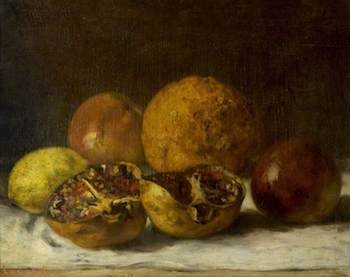
Courbet, Gustave, 1819-1877; Pomegranates

(Gustave Courbet, Pomegranates: People’s Palace and Winter Gardens, Glasgow)

Half a pomegranate, falling from the middle shelf of a refrigerator, has a startling effect upon a kitchen floor. On my hands and knees, I grope under cupboard and table, picking up seeds.

Responding to William Carlos Williams—‘We have/ a microscopic anatomy/ of the whale/ this/ gives/ Man/ assurance’—the Czech poet and scientist Miroslav Holub wrote ‘Wings’:

We have
a map of the universe
for microbes,
we have
a map of a microbe
for the universe.

We have
a Grand Master of chess
made of electronic circuits.

But above all
we have
the ability
to sort peas,
to cup water in our hands,
to seek
the right screw
under the sofa
for hours

This
gives us
wings.[1]

Referring to Ovid’s story of the invention of wings—the master craftsman Daedalus and his lost son—Guy Davenport wrote that the first two stories in Tatlin! ‘are both the tale of Icarus told in different styles’. The first story is ‘Tatlin!’, the second, ‘The Aeroplanes at Brescia.’
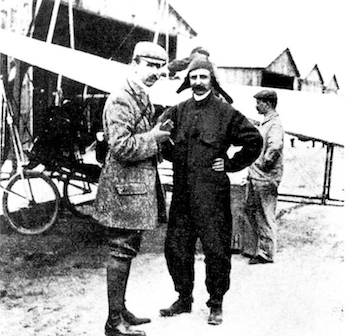
The Air Show at Brescia, 1909

(From Peter Demetz, The Air Show at Brescia, 1909 (Farrar, Straus & Giroux, 2002): Blériot is on the right)

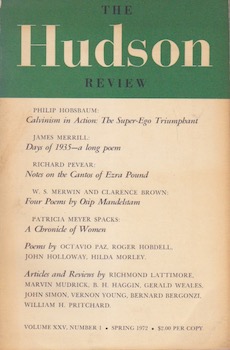
This is probably the most discussed of Davenport’s short fictions, perhaps not least by the author himself, both in interviews and in the discussion of his stories in ‘Ernst Machs Max Ernst’. This is in part because it was based on Kafka’s first published writing, his report of the airshow at Brescia (8–20 September 1909), which appeared in La Sentinella Bresciana, in part because the story represented Davenport’s own first foray into fiction since ‘undergraduate days’: he was forty-three when he wrote it, he says, though that was his age on its first publication – the writing of it was more likely 1967-1969. Edward Burns points to the letter of 10 February 1966, in which Hugh Kenner asked Davenport if he knew of any evidence that Kafka’s novel The Castle drew on the castle at Brunnenberg, Merano, where Ezra Pound’s daughter, Mary de Rachewiltz lived with her husband Boris, and where Pound himself lived for a while after his return to Italy. Not until September 1967 did Davenport mention Kafka’s ‘The Aeroplanes at Brescia’.[2] Davenport’s story first appeared in The Hudson Review, in the issue for Winter 1969-1970.

In ‘Ernst Machs Max Ernst’, he discussed the ways in which he went about assembling material for his story: Kafka’s article,[3] of course, from which he draws several details and phrases, including the passage from La Sentinella Bresciana, describing the forthcoming air display; Max Brod’s biography of him, what Davenport could discover of people who were there (the poet and novelist Gabriele D’Annunzio, the composer Giacomo Puccini), ‘as well as of people who might well have been there (Wittgenstein).’ He studied contemporary photographs, read histories of aviation and built a model of Blériot’s Antoinette CV25. ‘Notice everything’, Franklin, a young character in one of Davenport’s later stories says, ‘Know where everything comes from, a hundred years back.’[4]
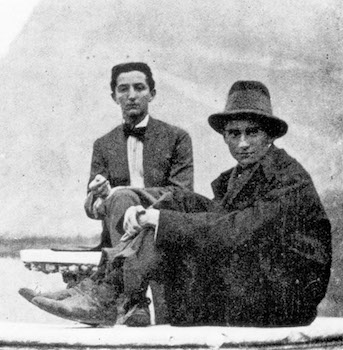
Franz Kafka (right) with Max Brod’s younger brother, Otto, at the Castel Toblino near Trento, Italy, 1909

(Max Brod and Kafka, via New York Review of Books)

‘I knew that Kafka’s first entry in his notebooks that led to writing The Castle was made at Merano, where he would have been gazing at the castle in which Ezra Pound was living at the time I was writing. What kind of symbol (if any) this constructs I do not know, but I felt that something was inside the image. It can be said of all my involucra [anatomical term for envelope] that I hope there is a meaning inside, but do not necessarily know. I trust the image; my business is to get it onto the page.’[5]

One of the most unsettling aspects of reading Davenport’s stories is his own repeated assertions that his fictional art is ‘primitive’—‘This last term is slippery, and has several implications’, as Erik Reece remarks[6]—and references to these writings as his ‘ravings’. Yet they proceed from a breadth and depth of knowledge—historical, artistic, literary, scientific, anthropological—that is consistently astonishing; they also draw upon a vocabulary that frequently evidences an intimate relationship with Webster’s Third New International Dictionary of the English Language, Unabridged, references to which are scattered through Davenport’s essays. There are also words, phrases, sentences, in French, German, Dutch, Latin, Greek, Italian, Danish.
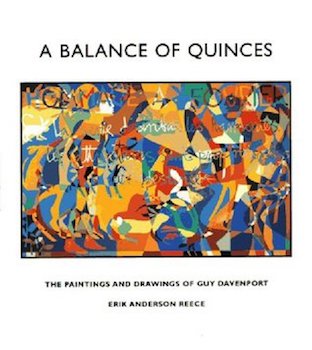
Reece-Balance

The subjects chosen for stories in Tatlin! ‘are all in the position of being, as fact, almost not there’, Davenport writes, noting that he sidestepped verisimilitude of the Gustave Flaubert or Walter Scott kind at the outset, deciding that his ‘best hope of a sustained reality would be one like Max Ernst’s world, which is always of verifiably real things that are not, however, where they are supposed to be’ (Geography, 376, 377). Indeed, that constantly unsettling vocabulary, the jolts and blanknesses and near-misses (your dictionary has that word, more or less, yet not quite in the form that Davenport’s used it), is a major, integral part of disrupting what is sometimes the trance, the state of suspended animation in which we find ourselves with some naturalistic prose. Ford Madox Ford wrote that, ‘Carefully examined, a good—an interesting—style will be found to consist in a constant succession of tiny unobservable surprises.’[7] The surprises in Davenport’s fiction, if not quite constant, are certainly not tiny and inarguably not unobservable.

In ‘The Aeroplanes at Brescia’, which takes place just five years before the beginning of a machine age war of unprecedented destructiveness, Kafka and Max Brod are accompanied by Max’s brother Otto: ‘The newest style, he said, is always in love with the oldest of which we are aware. The next Wiedergeburt [rebirth, regeneration] will come from the engineers.’[8] Present in Davenport’s story, though not in Kafka’s, is ‘[t]he man named Wittgenstein’, who is ‘again holding his left wrist, massaging it as if it were in pain’ (Tatlin! 70). There was, of course, another ‘man named Wittgenstein’, one of Ludwig’s elder brothers, Paul, a concert pianist who lost his right arm in the First World War but afterwards taught himself to play with his left hand so successfully that he was able to continue his career.
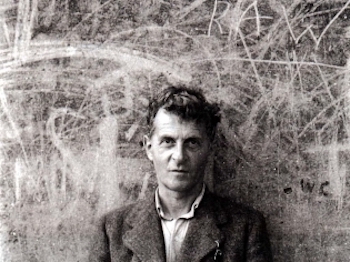
Wittgenstein-New-Statesman

(Ludwig Wittgenstein via The New Statesman)

Since the autumn of 1908, Ludwig Wittgenstein had been registered as a research student in the Engineering Department of Manchester University, where he had gone to study aeronautics. ‘It was his apparent intention to construct, and eventually to fly, an aeroplane of his own design.’[9] He began by experimenting on the design and construction of kites. The Wright Brothers too had so begun. ‘The kite was their beginning, not the bird. That was da Vinci’s radical error’ (Tatlin! 55).

In a 1991 exchange, Laurence Zachar remarked: ‘A proportionately large part of your work is Utopian. It deals with happy people, in an ideal place where there is no violence.’ Davenport responded that ‘The Dawn in Erewhon’ the novella that closes Tatlin! is all about a Utopian vision. Communism is a Utopian vision, first story [‘Tatlin!’]. In “The Aeroplanes at Brescia”, there’s the implicit sense that aeroplanes were going to stop all wars; the Wright brothers wrote a famous letter to the War Department which paid no attention to it, saying: with the aeroplane, there can be no more troop movements because they can be observed from the air, and therefore no more wars.’[10]
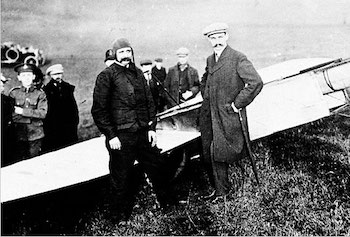
Bleriot-25Jul1909-EngCh.NYT

(Louis Blériot, 25 July 1909, having just flown across the English Channel: via New York Times)

When the story first appeared in the Hudson Review, a paragraph on the final page put that assertion into the mouth of Otto Brod but Davenport must have felt that such an unbearably painful irony was too easy, a little too obvious. It was omitted when revised for book publication.

Nevertheless, like so much of the history of flight itself, Davenport’s story ends in tears:

‘—Franz! Max said before he considered what he was saying, why are there tears in your eyes?
—I don’t know, Kafka said. I don’t know.’ (Tatlin! 70).

Davenport once said that he wanted ‘several transformations of each tale simultaneously, because we have reached this possibility.’ He added: ‘The story about Kafka, for instance, which follows his own account of the event, is based on a scene in Proust, where the aeroplanes are not at Brescia but at Le Bourget. It was Proust, not Kafka, who wept inexplicably when he saw an airplane for the first time.’[11]
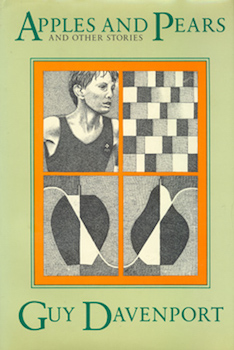
GD_Apples_pears

This has another fictional relation in Davenport’s work. In Apples and Pears, the narrator, Adriaan van Hovendaal, and Sander, on the island where they often spend time, are talking of buying the house on Spiegelgracht: it will be another island but in Amsterdam, their version of Fourier’s Utopia. ‘Adriaan, he said, there are tears in your eyes.’[12]

And, after all, was it actually Proust who wept? Or was it, rather, his narrator, the ‘almost’ Proust, ‘Marcel’:

All of a sudden my horse reared; he had heard a strange noise, I had difficulty in controlling him and not being thrown to the ground, then I raised my tear-filled eyes to the spot from where the noise appeared to be coming, and I saw, fifty metres or so above me, in the sunlight, between two great wings of glittering steel that were bearing him away, a being whose indistinct face I fancied resembled that of a man. I was moved as might a Greek have been setting eyes for the first time on a demigod. I was weeping also, for I had been ready to weep from the moment when I recognized that the noise was coming from above my head – aeroplanes were still a rarity in those days ­ and at the thought that what I was about to see for the first time was an aeroplane.[13]

One final ‘transformation’, perhaps.


References

[1] Miroslav Holub, ‘Wings’, translated by George Theiner, in The Fly, translated by Ewald Osers, George Theiner, Ian and Jarmila Milner (Newcastle: Bloodaxe Books, 1987), 43. In ‘Histology’, this reads ‘There is/ the/ microscopic/ anatomy/ of, the whale/ this is/ reassuring’: William Carlos Williams, The Collected Poems, Volume II: 1939-1962, edited by Christopher MacGowan (Manchester: Carcanet Press, 1988), 419.

[2] Questioning Minds: The Letters of Guy Davenport and Hugh Kenner, edited by Edward M. Burns, two volumes (Berkeley: Counterpoint Press, 2018), I, xii.

[3] Franz Kafka, ‘The Aeroplanes at Brescia’, in The Transformation and Other Stories: Works Published During Kafka’s Lifetime, translated and edited by Malcolm Pasley (London: Penguin Books, 1992), 1-10.

[4] See the title story in The Jules Verne Steam Balloon: Nine Stories by Guy Davenport (San Francisco: North Point Press, 1987), 108.

[5] Guy Davenport, The Geography of the Imagination (Boston: David R. Godine, 1997), 374.

[6] Erik Anderson Reece, A Balance of Quinces: The Paintings and Drawings of Guy Davenport (New York: New Directions, 1996), 45. One such implication is the rebirth of the archaic in modernism, a reminder that industrial and military innovations are ‘not the only indicators of progress’.

[7] Ford Madox Ford, Joseph Conrad: A Personal Remembrance (London: Duckworth, 1924), 197.

[8] Guy Davenport, Tatlin! Six Stories (New York: Scribner’s, 1974), 53.

[9] Ray Monk, Ludwig Wittgenstein: The Duty of Genius (London: Vintage, 1991), 28.

[10] Laurence Zachar, ‘Guy Davenport. Lexington, Kentucky: December 1991’, Effets de voix (Tours: Presses universitaires François Rabelais, 1994).
See: http://books.openedition.org/pufr/3904 (accessed 20 March 2019)

[11] Guy Davenport, ‘From Indifference to Attention’, New York Times Book Review (4 April 1982), 30.

[12] Guy Davenport, Apples and Pears (San Francisco: North Point Press, 1984), 153.

[13] Marcel Proust, In Search of Lost Time. 4: Sodom and Gomorrah, translated by John Sturrock (London: Allen Lane, 2002), 423.
 

Cooking, cleaning, washing the pig

; Chinese People Washing Three Large, White Elephants

(Unknown artist, ‘Chinese people washing three large, white elephants’: Wellcome Collection)

07:30 and my Spelt loaf is underway. But I actually enjoy bread making so can this count as housework? Cooking, fine, washing up and vacuuming, okay; ironing, less so; cleaning, much less so.

When Rudyard Kipling moved into Bateman’s in September in 1902, the house and thirty-three acres costing £9300, he was, Andrew Lycett notes, looking forward to washing his 335 apple trees ‘with oil, limewash, salt and soap’ as recommended in the agricultural textbooks.[1] Would that count as housework? Probably not. Gardening or perhaps, on that scale, farming—‘We began with tenants – two or three small farmers on our very few acres – from whom we learned that farming was a mixture of farce, fraud, and philanthropy that stole the heart out of the land’—and would Kipling have done that work himself? He certainly had views on domestic service – of some of the people he met on his return from India to England: ‘They derided my poor little Gods of the East, and asserted that the British in India spent violent lives “oppressing” the Native. (This in a land where white girls of sixteen, at twelve or fourteen pounds per annum, hauled thirty and forty pounds weight of bath-water at a time up four flights of stairs!)’[2]

Batemans

http://www.kiplingsociety.co.uk/batemans.htm

D. H. Lawrence might turn his hand to sweeping floors and baking bread—and the Skeptic philosopher Pyrrhon of Elis was, apparently, ‘known to dust the house and sweep the floors for his sister, and was once seen washing the pig’[3]—but the real (male) literary demon when it comes to housework is Patrick White, whose letters are littered with references to the daily tasks. ‘I seem to spend all my time washing up and preparing for the next meal’, he wrote to Frederick Glover and, on the eve of a long trip to Europe, remarked to Mollie McKie: ‘Still, it will be a change not to do the washing up for a few months. I did go away for a few days recently. but found myself washing up in self-defence as my hosts were so bad at the sink.’ To Geoffrey Dutton, he confided that: ‘My rheumatics only left after house-cleaning days: I suppose all the stooping and stretching drove them out; so you can tell Max [Harris] that is another good reason not to keep a “char”.’ Later, furious at a review of one of his plays which asked what Patrick White knew about suburbia since he was brought up ‘in a mansion’, he told Mary Benson: ‘I had lived in suburbia for twelve years, between sink and stove, and scrubbing my own floors, before writing that play.’ Again to Dutton, describing a call from a friend, he noted in passing that ‘I was labouring at the house-cleaning when the telephone went’.[4]

White-Letters

When White and Manoly Lascaris moved to the house in Martin Road in October 1964, White’s biographer records, they had a cleaning woman for a short time but White stated that, ‘after doing everything in the way of house-cleaning ourselves over the last fifteen years, I find it a great strain having somebody else about, and I am always relieved when those mornings are over.’ She didn’t last and, ‘Once again, he took up the broom and Hoover himself.’[5]

How long does all this stuff take? How long should it take? Judith Flanders writes that most Victorian houses (above a certain social level, of course) ‘operated a system that ran more or less as follows:

Monday: laundry

Tuesday: servant’s room [if time was allowed for it at all, her note adds], one bedroom

Wednesday: remaining bedrooms

Thursday: drawing room, breakfast room, morning room

Friday: dining room and polishing the silver

Saturday: hall, stairs, kitchen, passageways

Sunday: collect, sort and soak laundry ready for Monday’[6]

Edwardian-maids

http://www.edwardianpromenade.com/occupations/general-servants-time-table/

Lucy Lethbridge, writing of the Edwardian period, notes that ‘Cotton, woven in the great textile factories of the industrial Midlands, needed mangling, starching, bleaching and pressing to keep its appearance. For the working-class housewife, washing her own family’s clothes took up two full days of the week.’ Midway through the twentieth century, ‘In 1950 a survey of full-time housewives showed that they spent an average of seventy hours a week on housework; in a survey in 1970 that average had risen to seventy-seven hours.’[7]

Leaving aside the fact that ‘labour-saving devices’ are assumed to do precisely that—and surely they became more widely available in those twenty years—seventy-seven hours? Really? Eleven hours a day every day of the week? Madness. I shall continue to cook, wash up, hoover and sweep a bit – and make bread. As for the bathroom and shower. . . the Librarian and I will draw lots.

 
References

[1] Harry Ricketts, The Unforgiving Minute: A Life of Rudyard Kipling (London: Chatto and Windus, 1999), 278; Andrew Lycett, Rudyard Kipling (London: Weidenfeld, 1999), 347.

[2] Rudyard Kipling, Something of Myself: For My Friends Known and Unknown, (1936; edited by Robert Hampson, Harmondsworth: Penguin, 1987), 146, 87.

[3] ‘Pyrrhon of Elis’, in The Jules Verne Steam Balloon: Nine Stories by Guy Davenport (San Francisco: North Point Press, 1987), 25.

[4] Patrick White, Letters, edited by David Marr (London: Jonathan Cape, 1994), 123, 125, 352, 436-437, 493.

[5] David Marr, Patrick White: A Life (London: Vintage, 1992), 447.

[6] Judith Flanders, The Victorian House: Domestic Life from Childbed to Deathbed (London: Harper Collins, 2003), 106-107.

[7] Lucy Lethbridge, Servants: A Downstairs View of Twentieth-century Britain (London: Bloomsbury, 2013), 76, 308.


Betwixt and between

Tart

‘A perfect tart to weave together spring and summer’, Anna Jones wrote of her roast tomato and asparagus tart with rosemary.

https://www.theguardian.com/lifeandstyle/2018/may/28/anna-jones-vegetable-tart-recipes

And so it is. While asparagus is available (so long as it’s not flown thousands of miles), I make it every week or so, the cherry tomatoes slowly roasting, the eggs coming slowly to room temperature, the lemons warily eyeing the zester and the Librarian sometimes bringing home the crème fraîche that I’ve forgotten to replace.

Meteorologically speaking, we are a little over halfway through our British Spring. The bright sky lures and the brisk wind bites; today is briefly alluring in between the showers, though yesterday the wind repeatedly lurched into explosive rages, scattering recycling bins along the street and wrecking the Librarian’s mini-greenhouse, spilled plant pots slewing soil across the gravel.

Wind breaking, then, rather breaking wind. Alluding to national habits of hat-tipping in a letter to James Laughlin, Guy Davenport noted that, ‘The French removed the chapeau and swept the air with it. The Elizabethan English swept the ground, after three twirls while making a leg.’ He added: ‘It is told of a provincial mayor that whilst so saluting Elizabeth I, he broke wind. He was thrown into confusion and slunk away. He later received a gracious note from his sovereign, saying, “I have forgot the fart.”’[1]

Salome-Rilke

Seasonally, then, we’re betwixt and between, as Ford Madox Ford wrote to his agent James Pinker about the genre of the manuscript that became No Enemy. ‘For what is going on here, heaven knows, has for three or four days not been spring any more, has been dense, young summer’, Rainer Maria Rilke wrote to Lou Andreas-Salomé from Rome in April 1904:

The hyacinths in my little bed, which have long been hesitating, are flinging open their blossom eyes like one hammered awake by an alarm-clock, and have already been standing there quite long and straight. The elms and oaks by my house are full, the Judas tree has shed its blossoms, and all its leaves will be ready overnight; and a syringa tree that stretched out its clusters only three days ago is already in process of fading and scorching. The nights are scarcely cool any more, and the busy clamor of frogs is their voice. The owls call less often, and the nightingale still hasn’t begun. Will she still sing now that it is summer?[2]

Winter

Yes, good question. What is that song we hear so indistinctly – nightingale or Siren? Nationally, we are, along with a good many other countries suffering political rupture, very much between: in our case, divergent forces wrenched between Little Britain and the wider world. I sense in myself, on some days, that ‘armchair reformist’ Louis MacNeice wrote of, who ‘sits between two dangers–wishful thinking and self-indulgent gloom.’[3] Things are, in some senses, quieter at the moment but the building is still subsiding, the body still nearing the ground at a troubling speed.

As for Ford Madox Ford’s phrase, ‘betwixt and between’: does that imply movement or simply the state of being stranded, neither one thing nor t’other? Ford himself had identified an historical moment when, ‘The old order, in fact, is changing; the new has hardly visibly arrived.’[4]

ER1

Ford was writing towards the end of the reign of Edward VII—you might say ‘Edwardian’ but things get complicated around then, not helped by some of the connotations of the word ‘Georgian’—a juncture anyway to which critics and literary historians are prone to referring as ‘transitional’. Of Ford’s journal The English Review, Malcolm Bradbury once observed: ‘the magazine marks a moment of strong literary transition.’[5] Well, yes: December 1908 to February1910, that phrase seems reasonable enough, so it may be unsurprising—and I’m not sure how ironic—that the word, certainly the idea, of transition, is applied to Ford himself with remarkable frequency. I confess to doing it myself all the time.

Of a slightly later period—a decade or so—Laurence Rainey wrote that ‘by now it should be clear that the publication of The Waste Land marked the crucial moment in the transition of modernism from a minority culture to one supported by an important institutional and financial apparatus.’[6] The avant-garde journal Transition was founded by Eugene Jolas and Maria McDonald in 1927 and ran for a decade; English Literature in Transition, 1880-1920, began in 1957 and remains one of the leading literary journals today.

Macaulay-Told-Idiot

Critics and literary historians, then, find ‘transition’ everywhere, though Stephen Kern sternly declares that, ‘One of the greatest fallacies of historical reconstruction is the characterization of events as transitional.’[7] In her 1923 novel, Told by an Idiot, Rose Macaulay writes ‘Stanley always reflected her time and it was, people said, a time of transition. For that matter, times always are, and one year is always rather different from the last.’ And later in the same book: ‘A queer time! Perhaps a transition time; for that matter, this is one of the things times always are.’[8]

Safe to say, then, that we are probably betwixt and between – and almost certainly in a time of transition.

 
References

[1] W. C. Bamberger, editor, Guy Davenport and James Laughlin: Selected Letters (New York: W. W. Norton & Co., 2007), 165.

[2] Letters of Rainer Maria Rilke, 1892-1910, translated by Jane Bannard Greene and M. D. Herter Norton (New York: Norton, 1969), 148.

[3] Louis MacNeice, The Strings are False: An Unfinished Autobiography, edited E. R. Dodds (Faber paperback 1996), 134.

[4] Ford Madox Ford, The Critical Attitude (London: Duckworth, 1911), 128-129.

[5] Malcolm Bradbury, The Modern British Novel (London: Penguin Books, 1994), 81.

[6] Lawrence Rainey, Institutions of Modernism: Literary Elites and Public Cultures (New Haven and London: Yale University Press, 1998), 91.

[7] Stephen Kern, The Culture of Time and Space 1880-1918 (Harvard University Press, 1983), 142.

[8] Rose Macaulay, Told by an Idiot (1923; Harmondsworth, Penguin, 1940), 55, 150.

Gunmen and bowmen: Don McCullin at Tate Britain

McCullin

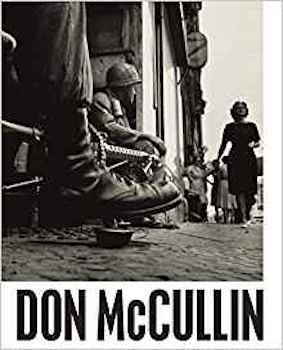
The Don McCullin exhibition at Tate Britain has been receiving five-star reviews in the press. Would we quarrel with this? Hell, no. The photography—together with the magical arts practised in the darkroom—sits perfectly on a level with much of the art that, in the broadest context, surrounds it. The subject matter is often appalling, the quality of construction and composition superb, the result frequently unnervingly beautiful. A large chunk of the second half of the twentieth century, its public history and its private grief, is here. And what a hell of a century that was for so many people.

Part of the way round the exhibition, I was conscious of several strong but distinct strands of feeling. One was a recognisable impulse to weep, at the sheer unstoppable waves of slaughter, suffering, grief, loss and despair, in Biafra, in East Beirut, in Vietnam, in London’s East End, in Cyprus, in Northern Ireland, in Kurdistan, the Congo, Cambodia, Bangladesh, Iraq. I was also getting flashbacks to my reaction to Raoul Peck’s superb 2016 documentary, I Am Not Your Negro, based on a James Baldwin manuscript, when I was struck by how little progress had actually been made in the intervening years and how much of what had been so appalling then remained appalling now. On the walls of the McCullin exhibition were images from the 1970s not only of the many bloody, vicious and pointless conflicts but of homeless and destitute people, house interiors in foul condition because of exploitative landlords, anti-fascist demonstrations in London, vile racist graffiti on exterior walls. Forty years ago, fifty years ago—and those huge stretches of time simply fall away or dissipate like smoke when you open a newspaper or turn on the news now.

Waterloo-Bridge

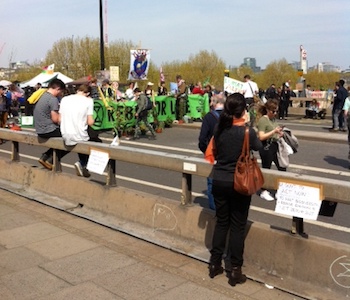
We’d walked along Waterloo Bridge, where a great many people were demonstrating to draw attention to climate emergency here in our last chance saloon, most of them young, since my generation and the one before it have proved themselves so utterly useless in this regard, trashing the planet while wasting twenty or thirty years after a good number of the relevant facts were already known, so the response at this absurdly late stage must necessarily be more radical, more comprehensive, more disruptive, than if intelligently conceived, planned and executed policies had existed before now.

GD-GB

The other response I recognised was a recurrent desire to shout obscenities at the top of my voice, remembering then a moment in a Guy Davenport story, typically highly allusive, sometimes cryptic, culturally wide-ranging, stylistically elegant, which abruptly and shockingly lurches into quite another register. ‘The Bowmen of Shu’ centres on the sculptor Henri Gaudier-Brzeska, killed at Neuville-St.-Vaast on 5 June 1915 at the age of twenty-three, and consists of 42 sections, varying from a single line to several pages, interspersed—in the version included in Apples and Pears—with thirteen drawings, two by Gaudier and the others by Davenport. Section 10 reads: ‘THE SOLDAT’S REMARK TO GENERAL APPLAUSE / Fuck all starters of war up the arse with a handspike dipped in tetanus.’ And yes, I think, yes, I second that emotion. And please include all the suppliers of arms and the political and financial shysters that actively or passively facilitate such slaughters.

Men with guns. Always a particular cause, a particular locality, particular grievances, occasions, pretexts, justifications. But that particularity leaks away, blurs, dilutes, leaving only men with guns. Dead children, grieving parents—and men with guns.

It is, in any case, one of the very best exhibitions, if also one of the most harrowing, I can remember seeing.

Letting in water

Durer-ill-ShipFools

(Albrecht Dürer, illustration to The Ship of Fools)

There was a piece in The Guardian a few days back, which rounded up some foreign views of the state the United Kingdom is in, reminding us, if we needed reminding, that to many people outside this country, such a spectacle must seem extraordinary.

The Washington Post had a piece called ‘Brexit will mark the end of Britain’s role as a great power’, which observed that the UK, ‘famous for its prudence, propriety and punctuality, is suddenly looking like a banana republic’. Here was a country ‘determined to commit economic suicide but unable even to agree on how to kill itself’, led by ‘a ship of fools’ unwilling to ‘compromise with one another and with reality’. The result was an ‘epic failure of political leadership’, Friedman said: scary stuff, but ‘you can’t fix stupid’.

‘Ship of fools.’ That was an adaptation (1509) by the poet Alexander Barclay of a 1494 allegory by the German satirist Sebastian Brant; also the title of an allegorical novel by Katherine Anne Porter, published in 1962. The nautical theme recurs, not only in the header illustration by the Guardian design team, showing the HMS Britain steeply angled in an unfriendly-looking sea, but in one or two other comments. Sreeram Chaulia, dean of the Jindal School of International Affairs, said many Indians saw Brexit as the latest chapter in a ‘sharp decline in the place Britain commands as a great power’. The UK ‘is not a gold standard to look up to’, he said. ‘We get a feeling of a sinking ship, and everybody wants to leave a sinking ship.’

https://www.theguardian.com/politics/2019/apr/06/a-shambles-on-which-the-sun-never-sets-how-the-world-sees-brexit

I was reminded of that stout phrase, ‘the Ship of State’, which I see is traced back to Book Six of Plato’s The Republic. In the old Jowett translation, one section caught my eye: ‘The sailors are quarrelling with one another about the steering—every one is of opinion that he has a right to steer, though he has never learned the art of navigation and cannot tell who taught him or when he learned, and will further assert that it cannot be taught, and they are ready to cut in pieces any one who says the contrary.’

No contemporary parallel there, obviously. Precisely in the middle of the nineteenth century, Henry Wadsworth Longfellow waxed optimistic:

‘Thou, too, sail on, O Ship of State!
Sail on, O UNION, strong and great!’

And:

‘In spite of rock and tempest’s roar,
In spite of false lights on the shore,
Sail on, nor fear to breast the sea!’[1]

Traffic-Hole-Shoe

That of course, was another Union, which, eleven years later, didn’t seem so solid; while ours is certainly lower-case and seems to be letting in water. In another lifetime, Traffic had a hit with a Dave Mason song, ‘Hole in My Shoe’ (‘And all that I knew/ The hole in my shoe/ Was letting in water’) – only a shoe then, so the situation’s clearly deteriorated.

I’ve never been in a shipwreck before—certainly not one caused by the crew and passengers together scuttling the ship—so, while the joy is hardly unconfined, there is at least an element of novelty.

I remembered poor Owen Chase, first mate of the Essex, sunk by a sperm whale in 1820.[2] The survivors in their small boats were finally reduced to eating the bodies of the dead; the next stage, once those supplies were exhausted, was the drawing of lots and the shooting of those who lost. In Captain Pollard’s boat, the man shot was the captain’s own nephew, named Owen Coffin. In later life, Chase apparently developed an obsessive fear of starvation, ‘never wasting a morsel at the dinner table, and frequenting the market to buy supplies that he larded [stuffed] in his attic.’[3] We can perhaps glimpse certain elements of his story in our own too likely future—but not, we hope, all of them.

Turner, Joseph Mallord William, 1775-1851; The Shipwreck

(J. M. W. Turner, The Shipwreck: Tate Britain)

More relevant, perhaps, is Declan Kiberd’s comment on Homer’s epic: ‘The logic of the Odyssey is that of many tales involving shipwreck – the answers to problems will be found only after the act of destruction. The catastrophe must precede clarification.’

And he adds a little later that resurgences, such as modern Ireland’s, ‘often come after a period of trauma – what Gaelic poets called longbhriseadh (shipwreck), a terrible but challenging disaster which becomes the precondition of a change to a new future.’[4] ‘Resurgence’: rising again, basically resurrection which, as I recall, requires death as a precondition. So that’s another cheering thought.

Thoreau queried the sort of impulses that have been driving a number of political developments lately: ‘Why should we be in such desperate haste to succeed, and in such desperate enterprises? If a man does not keep pace with his companions, perhaps it is because he hears a different drummer. Let him step to the music which he hears, however measured or far away. It is not important that he should mature as soon as an apple-tree or an oak. Shall he turn his spring into summer? If the condition of things which we were made for is not yet, what were any reality which we can substitute? We will not be shipwrecked on a vain reality. Shall we with pains erect a heaven of blue glass over ourselves, though when it is done we shall be sure to gaze still at the true ethereal heavens far above, as if the former were not?’[5]

Walden_1854_cover_image

Elsewhere, he suggests that ‘A book should contain pure discoveries, glimpses of terra firma, though by shipwrecked mariners, and not the art of navigation by those who have never been out of sight of land.’[6]

‘In our time’, Guy Davenport’s Dutch philosopher Adriaan van Hovendaal writes in his notebook, ‘we long not for a lost past but for a lost future.’[7] Thirty-five years on, that is true of some of us—but clearly not of others, which at least partly explains how we got here. Wherever here might be.

 
References

[1] ‘The Building of the Ship’, The Poetical Works of Henry Wadsworth Longfellow (London: Ward, Lock: n.d.), 103.

[2] His account was published in 1821. Herman Melville saw him, though not to speak to, in 1841; he did meet Chase’s son, who gave him a copy of his father’s Narrative: Melville, Moby Dick (1851; edited by Harold Beaver, Harmondsworth: Penguin Books, 1972), 17; and ‘Appendix: The Earliest Sources’, 971-979.

[3] Paul Lyons, introduction to Owen Chase, Shipwreck of the Whaleship Essex (London: Pimlico, 2000), xxvii.

[4] Declan Kiberd, Ulysses and Us: The Art of Everyday Living (London: Faber and Faber, 2009), 283, 307.

[5] Henry David Thoreau, Walden, edited by J. Lyndon Shanley (Princeton University Press: Princeton and London, 1974), 326.

[6] Henry David Thoreau, A Week on the Concord and Merrimack Rivers (New York: Library of America, 1985), 80.

[7] Guy Davenport, Apples and Pears (San Francisco: North Point Press, 1984), 63.

Kidneys out of mind

AB-rear-7-Feb-1965

(Anthony Burgess at the rear of 7 Eccles Street, 7 February 1965. From The Listener via James Joyce online notes: http://www.jjon.org/joyce-s-environs/no-7-eccles-street )

‘Cut to ECCLES STREET. Number 7, Bloom’s Ithaca, was being demolished to make way for office blocks, but the destroyers were persuaded to hold off for a day while we filmed in what would have been the Blooms’ bedroom. Much speech was slurred by the need to down much whisky in freezing pubs. Some of my monologues were unacceptable in London, They had to be redone as voice over.’[1]

‘Kidneys were in his mind as he moved about the kitchen softly, righting her breakfast things on the humpy tray.’ This is our first sight of Mr Leopold Bloom in his house at 7 Eccles Street, in James Joyce’s Ulysses. I still find ‘Kidneys were in his mind’ funny when I revisit: it was certainly a point of contention among the translators of Joyce’s novel into French and one of the examples that Valery Larbaud sent to Joyce, suggesting that, in the version by Auguste Morel and Stuart Gilbert, ‘The humourous side of the phrase in the text is lost.’[2]

valery larbaud

(Valery Larbaud)

Crossing the bedroom to the bathroom, I hear Melvyn Bragg signing off from his radio programme, ‘In Our Time’, by mentioning that next week they’ll be discussing the evolution of teeth. Damn, really? I think that’s what he said but could have been unduly influenced by the fact that teeth are in my mind again just lately, biting into it, in fact, with increasing force. Yes, I’ve been to the dentist: and have another appointment for Friday. Can I hang on that long? No. I make a phone call and plead my case. The appointment lurches a little closer to me.

Eyes slammed shut while the drill gets into its stride, I pass the time in the dentist’s chair running through the seventy-nine titles Ford Madox Ford published in his lifetime, going backwards on this occasion, in tune with the current national mood. I’ve barely reached A Little Less Than Gods (1928) before I experience a fierce spasm that lifts me a little out of the chair. It happens twice more. ‘Yes’, my dentist explains later, ‘where you were feeling the most sensitivity in the gums on the far side of that tooth, I had to inject anaesthetic directly into the nerve.’

ALLTG

http://www.fordmadoxfordsociety.org/first-editions-gallery.html

In Anne Carson’s compelling ‘The Glass Essay’, the narrator writes of her visit to her father, in company with her mother, in the hospital where he is cared for, having suffered from dementia for several years:

I notice his front teeth are getting black.
I wonder how you clean the teeth of mad people.

He always took good care of his teeth. My mother looks up.
She and I often think two halves of one thought.
Do you remember the gold-plated toothpick

you sent him from Harrod’s the summer you were in London? she asks.
Yes I wonder what happened to it.
Must be in the bathroom somewhere.[3]

With teeth no longer in my mind—nor kidneys, for sure—I can again eat normally, rather than biting down on precisely the same point with every mouthful. Even better, I can once more take liquids into my mouth without gripping the edge of my seat convulsively or tipping my head tipped steeply sideways as though going fast around a sharp corner in a motorcycle sidecar. Water, tea, coffee, yes. And wine. Red wine. Santé.

 
References

[1] You’ve Had Your Time: Being the Second Part of the Confessions of Anthony Burgess (London: Heinemann, 1990), 100.

[2] James Joyce, Ulysses (1922; London: The Bodley Head, revised edition, 1969), 65; Richard Ellmann, James Joyce, new revised edition (Oxford: Oxford University Press, 1983), 602fn.

[3] Anne Carson, Glass, Irony & God, introduction by Guy Davenport (New York: New Directions, 1995), 26.


Radical calendar, pronouns, rats’ alley

March-poster

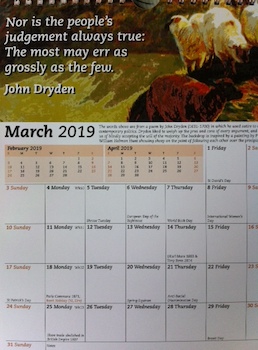
It’s a Radical Calendar for us this year, each page headed by a stirring quotation to put fire into the bellies of those fighting for justice, equality and other unfashionable things. (I have an exhortatory poster on the wall behind me, come to think of it: that particular ‘March’ is not the name of a month.)

https://www.radicalteatowel.co.uk/

January’s legend was from Percy Bysshe Shelley’s ‘The Masque of Anarchy’, written in 1819, after the massacre at Peterloo:

Rise like Lions after slumber
In unvanquishable number,
Shake your chains to earth like dew
Which in sleep had fallen on you –
Ye are many – they are few.

That last line is now more widely familiar because of its adoption as a Labour Party slogan. It’s also one that I’ve tended to misremember as ‘We are many – they are few’. A little risky for the eldest – legitimate – ­ son of the MP Sir Timothy Shelley to designate himself one of the many, you might think. But of course he doesn’t, distancing himself from both the ‘Ye’ and the ‘they’, reasonably enough given his belief that poets, as the unacknowledged legislators of the world, can’t easily be positioned within any conventional constituency.

But then – who can? ‘The others’, no doubt. The deployment of such pronouns – ‘we’, ‘you’, ‘they’, ‘us’ – has probably never been a simple matter. It sure as hell isn’t now. Ironically, as this country becomes more conformist and more tribal and more wedded to willed simplicities, the issue is becoming thornier by the day.

February boasted a mention of Benjamin Lay (1682-1759), the four feet tall Anglo-American Quaker humanitarian and abolitionist, vegetarian and author of around two hundred pamphlets. And that chimed in nicely with the book I was reading at the time, Madge Dresser’s Slavery Obscured: The Social History of the Slave Trade in an English Provincial Port, the port in question being Bristol, of course.

Calendar

March offers a sliver of John Dryden’s Absalom and Achitophel:

Nor is the people’s judgment always true:
The most may err as grossly as the few.

Indeed. Then under 29 March is printed the notice: ‘Brexit Day’. The news has now come through about how well it all went this afternoon. It was diverting to learn that, before that particular piece of parliamentary business, Liam Fox, urging his Westminster colleagues to vote the prime minister’s deal through, was warning that they would undermine faith in mainstream politics by creating a ‘chasm of distrust’ if they failed to do so. Yes, really: that Liam Fox; and ‘would undermine faith in mainstream politics’ and would create distrust. There’s a man with his finger on the pulse of current attitudes towards ‘mainstream politics’.

So where are we (them, us)? One speaker in T. S. Eliot’s The Waste Land remarked:

I think we are in rats’ alley
Where the dead men lost their bones

That’s definitely a possibility. Or is our whole planet a speck of dust beneath the fingernail of a trickster god unimaginably vast? There’s another one.

Will we ever come back from this, whatever happens now? Probably not. Still, I do enjoy having people with mad eyes explain to journalists that if X, Y or Z doesn’t happen, there’s ‘a risk of no Brexit at all’.

I think that’s a risk we’re—me, us, some of them—prepared to take. So why not just revoke Article 50? That, by the way, is called ‘a clean non-Brexit’.


Soil, bones, grass

Buson-narrow-road-deep-north

(Yosa Buson, Narrow Road to the Deep North)

I was reading Bashō, who wrote: ‘I went to see the Atsuta Shrine, but it had been reduced to utter ruins. Walls had crumbled and dry grasses were standing among the falling blocks.’[1]

Grass as witness to decay, deterioration, disappearance. Or grass signifying growth, fertility, recovery. Times, circumstances, characters.

For A. E. Housman, born on this day in 1859, it could be positive, as in ‘Spring Morning’:

Now the old come out to look,
Winter past and winter’s pains,
How the sky in pool and brook
Glitters on the grassy plains.

But, as Nick Laird writes in the introduction to the Penguin edition of Housman’s poems, ‘Like Webster, Housman was much possessed by death’—death and lads would cover a lot of it, in fact—so there is also:

The sigh that heaves the grasses
Whence thou wilt never rise
Is of the air that passes
And knows not if it sighs.[2]

Robert Frost, also born on this day, in 1874, published one of his most famous poems, ‘The Road Not Taken’, in August 1915. It is, as Frost himself said, ‘a tricky poem – very tricky’, and the poet seems to have had his friend Edward Thomas in mind when he wrote it.[3] The narrator of Frost’s poem looks down one path as far as possible before it bends into the undergrowth:

Then took the other, as just as fair
And having perhaps the better claim,
Because it was grassy and wanted wear;
Though as for that, the passing there
Had worn them really about the same.

‘About the same’ – and both paths covered in freshly fallen leaves anyway.[4]

One more: on this day, in 1892, Walt Whitman died, the great poet of Leaves of Grass, thinking not only of graves but also of growth, expansion, burgeoning power.

Buson-Basho

(Yosa Buson, Matsuo Bashō)

For Ezra Pound’s Li Po, in eighth-century China, grass grows over the piled bones of the dead:

Bones white with a thousand frosts,
High heaps, covered with trees and grass;
Who brought this to pass?
Who has brought the flaming imperial anger?
Who has brought the army with drums and with
kettle-drums?
Barbarous kings.[5]

Lucille, in A Place of Greater Safety, Hilary Mantel’s novel about the French Revolution, looks to a future which will evidence recognisably similar signs: ‘With all the desperate passions in our heads and bodies, one day these walls will split, one day this house will fall down. There will be soil and bones and grass, and they will read our diaries to find out what we were.’[6]

rousseau-portrait-of-pierre-loti

(Henri Rousseau, Portrait of Pierre Loti, 1891)

In his translator’s note to Pierre Loti’s 1917 pamphlet, L’Outrage des barbaresThe Trail of the Barbarians (1918), Ford Madox Ford disagreed with Loti’s use of the word ‘irreparable’, believing that the land in France would indeed recover, thanks to its ‘little industries’ and its traditions of husbandry: ‘ . . . I am more sure than Mr Loti that the grass is already moving that shall cover the graveyards and the rusty heaps of recovered provinces.’[7]

Still, circling back to Bashō, I find: ‘When a country is defeated, there remain only mountains and rivers, and on a ruined castle in spring only grasses thrive. I sat down on my hat and wept bitterly till I almost forgot time.’[8]

As we know, not all a country’s defeats are military – nor even caused by external forces.
References

[1] Matsuo Bashō, ‘The Records of a Weather-exposed Skeleton’, in The Narrow Road to the Deep North and other travel sketches, translated by Nobuyuki Yuasa (London: Penguin Books, 1966), 59.

[2] A Shropshire Lad and Other Poems: The Collected Poems of A. E. Housman, edited by Archie Burnett, with an introduction by Nick Laird (London: Penguin Books, 2010), 102, xi, 114.

[3] As discussed by Matthew Hollis, Now All Roads Lead to France: The Last Years of Edward Thomas (London: Faber, 2012), 233-236.

[4] The Poetry of Robert Frost, edited by Edward Connery Lathem (London: Jonathan Cape, 1977), 105.

[5] ‘Lament of the Frontier Guard’, in Cathay (1915): Ezra Pound: Poems and Translations, edited by Richard Sieburth (New York: Library of America, 2003), 254.

[6] Hilary Mantel, A Place of Greater Safety (London: Penguin Books, 1993), 722.

[7] Ford Madox Ford, War Prose, edited by Max Saunders (Manchester: Carcanet Press, 1999), 191.

[8] Bashō, Narrow Road to the Far North, 118.

‘A house is a ship turned upside down’: some notes on Guy Davenport’s ‘Tatlin!’

GD_JW_via_Jacket

(Guy Davenport by Jonathan Williams via Jacket)

Due partly to my prolonged (and continuing) immersion in the Davenport-Kenner letters, partly to the frequent references—and some generously supplied scans of Davenport essays and reviews—in emails exchanged with the writer Greg Gerke, I’ve just begun rereading Guy Davenport’s stories. While I’m forever peering into various volumes of his essays and art criticism, my reading of most of his fiction dates back between fifteen and thirty years. I’d like to think that I know a bit more now than I did then—not just about Davenport or modern literature but things more generally. I certainly know enough to tread warily, one assemblage at a time. So, a few notes suggested by that reading and a strong awareness of the recurring question prompted by all Davenport’s writings: how does he know that? Perhaps two questions, the other being: how does he do that?

‘Tatlin!’—Vladimir Tatlin, the Russian painter, architect and designer—is the title story of Davenport’s first collection (dedicated to the photographer Ralph Eugene Meatyard) and its opening story, though actually the last of the six in order of composition, which was ‘The Aeroplanes at Brescia’, ‘Robot’, ‘The Dawn in Erewhon’, ‘1830’, ‘Herakleitos’, ‘Tatlin!’.[1]

GD_Tatlin

In the summer of 1969, Davenport wrote to Hugh Kenner: ‘I’m at work on a piece of prose not like anything I’ve done before, or anybody else to my knowledge—a breakthrough, I think (I hope), and an invention. It’s the kind of thing I’ve wanted to do for the longest, but have never been able to organize my imagination enough to get ahead with it. It is essentially the biography of Tatlin’.[2]

‘You would seem to have invented a new genre’, Kenner wrote to him in March 1970, ‘the assemblage, as by a postulated consciousness, of the clues to some unnoticed event’, adding, to distinguish Davenport’s perspective from a work by Hilaire Belloc to which he referred, ‘you don’t use the point-of-view of an imaginary spectator, but a “consciousness” as in the Cantos.’[3]

GD-JL-Letters

To James Laughlin, more than twenty years later, Davenport traced the emergence of his fictional strategy: ‘The breakthrough came when I realized that I mustn’t write about anything from my own experience, or anybody I’ve known, but to work with pure imagination, and to work with that hiatus between the mind and the world in which the pragmatic always fails and the imagination has to take over.’[4]

‘Tatlin!’, like a number of other Davenport fictions, includes the author’s drawings, designed as integral parts of the text—‘Tatlin! began as a painting’.[5] Peter Quartermain comments that ‘all his stories are written as though they were drawn and hence call attention to themselves as made works’[6] and Davenport remarked to Laughlin: ‘My fiction is a kind of drawing.’[7] These drawings are beautifully achieved, elegant, detailed, with exquisite cross-hatching: one of Vladimir Tatlin in snazzy striped trousers, holding a straw hat in his right hand (and looking, to my eye, not unlike the young Pablo Picasso), two of Lenin and then a third following five representations of Tatlin’s artworks, some of those reproduced in Camilla Gray’s book on Russian art which Davenport acknowledged on Tatlin!’s title page.[8] But the final three drawings are all of Joseph Stalin and the modernist artists, poets and painters, scientists and Constructivists who had seemed for a while to be in tune with the revolution are by this time dead, dishonoured or in exile.

letatlin-1932.jpg!Large

‘Tatlin!’ begins with a section entitled ‘Moscow 1932’, the artist’s Constructivist works and his flying machine—a glider ‘for everyday use’—hung from the ceiling, like ‘the fossil skeleton of a pterodactyl.’ ‘Tatlin’ is the first and fourth word of the story; by the eight line, Lenin has been mentioned three times. Then we read: ‘This is no place to continue talking about M. N. Ryutin’s remarks concerning Comrade Stalin, mimeographed and running to many pages, said by people who knew to foreshadow a change.’[9] Lenin died in 1924 and Stalin had consolidated his position as supreme leader before the end of that decade. Ryutin’s writings argued against some central Communist policies and for the removal of Stalin. It didn’t end well—though Ryutin wasn’t executed until 1937, as part of the ‘Great Purge’.

The story moves through St. Petersburg’s Bloody Sunday in 1905, when the march led by Father Gapon resulted in at least 200 deaths; Tatlin as busker, as sailor, in Paris meeting Picasso, Chagall and others; Tsiolkovsky, Russian space science pioneer; Tatlin in the classroom; and the dissipation, perversion and betrayal of the revolution.

The second page of text introduces a good many more names and several themes which bulk large in Davenport’s work: not only flight but the crucial link between modernism and the archaic—‘What is most modern in our time frequently turns out to be the most archaic’ (Geography of the Imagination, 21)—the reaching back over great stretches of time common to Pound, Joyce, Gaudier-Brzeska, Picasso, Modigliani, Khlebnikov and others. ‘Tatlin had gone back to Daedalos’ (Tatlin! 3). This will be another recurring theme or motif in Davenport’s essays and stories: the labyrinth, the marriage of art and science and, of course, flight again, while—‘At Teraspol there were cobwebs in the barley, wasps at the panes, and cats in the knitting baskets’ (Tatlin! 10)—wasps, cats and barley will also crop up many times in the Davenport oeuvre. And Tatlin in the classroom? ‘Every force evolves a form, he taught’ (Tatlin! 16)—the title of a volume of Davenport essays and a dictum he took from Mother Ann Lee, founder of the Shakers.

GD_Every_Force

Among names here which will also recur are those of Frank Lloyd Wright, Ruskin, Rousseau, Osip Mandelstam, Fourier, Picasso, Gertrude Stein and Nijinsky. A list like that might in turn prompt a reader to wonder just how many names the story actually includes, either as character or reference. In fact, in a story of fifty pages of good-sized type and generous margins, twelve of which are given over to the drawings already mentioned, there are close on one hundred and forty named painters, sculptors, poets, pianists, engineers, political and historical figures, architects, film-makers, chemists, explorers, aeronauts, dancers, composers and journalists. Some are unfamiliar – but can, of course, be looked up, far more easily than when Davenport first published these stories. A few details I paused over: Marya Ivanovna, apparently a Pravda journalist. Was this also an historical character? Then I realised that it was a patronymic form and there’s really no obvious way of finding out—though somewhere, inevitably, there will be a scholar of 1930s Russian media who will know the answer—in fact, it crops up in a number of literary texts: there are characters so named in Pushkin’s The Captain’s Daughter, Tolstoy’s Childhood, Boyhood, Youth and Resurrection, Grossman’s Life and Fate and Dostoevsky’s The Adolescent. Ivan Alekseyevich threw me for a moment but is, I think, the writer known as Ivan Bunin.

I hesitated too over a reference to the assassination of Tsar Nicholas II in 1881 – did Davenport make mistakes? Answer: very rarely, certainly as far as I’m aware. And was it a mistake – or a private joke or a cunning postmodern playfulness wholly unfamiliar to me? A mistake, apparently – it was, in any case, emended: when I looked at a later printing, the last of the Romanov rulers had indeed become Csar Aleksandr II.[10]

One phrase that came to mind, given Davenport’s lifelong study of Ezra Pound, was ‘Life and Contacts’, the subtitle attached to Pound’s long poem, Hugh Selwyn Mauberley, first published in 1919 – thought, when it appeared, with Homage to Sextus Propertius, in Diptych Rome-London (1958), in a limited edition of 200 copies, the terms were reversed (‘Contacts and Life’). Pound wrote to his publisher: ‘Note inversion in subtitle of Mauberley, NOT Life and Contacts but the actual order of the subject matter.’[11] ‘Tatlin!’ moves freely back and forth in time but it is the ‘contacts’ that inform the intellectual and artistic development and these in turn sketch the outline of the life. And the dozens of names, many but not all of them ones that a reader would recognise, so skilfully and confidently deployed, generate and populate and substantiate that life and the world that contained it.

Davenport was an extremely private man and this extended to his fiction. He wrote to James Laughlin in 1992, ‘I don’t think I have an ego. That is, I have nothing to say for myself, or as from myself. It annoys the hell out of me when reviewers say I like or dislike whatever: they’re always looking at what a character likes or dislikes. In a confessional age I keep my mouth shut (in fiction; not as a critic, natch). . . . ’[12] So friends and relations might be used in his stories but would be moved through vast distances in time and space. ‘Members of my family wearing long Russian beards, walk around in “Tatlin!” and moments of my childhood figure there on Russian porches and against a background of sunflowers and the Black Sea.’[13]

ML-VT

(Mikhail Larionov, portrait of Vladimir Tatlin)

That refers to the time spent by Tatlin with the young Mikhail Larionov in Teraspol. ‘Vladimir and Mikhail edged through the thicket of sunflowers on rainy days to find things, old bits, bottomless wooden pails, snakes, baling wire lizards’ (Tatlin! 10).

It’s a forerunner of what will be fully fleshed out in the short novel which ends this book, The Dawn in Erewhon and in many of Davenport’s fictions thereafter: the utopian vision, drawing on Charles Fourier, of a paradisal world in which people, especially children, explore and learn the physical world’s sensuous beauty and sensual pleasures, focusing not least upon their own—and others’—bodies.

This persistent theme in Davenport’s fictions has provoked hostility, suspicion, even dismissal, some commentators becoming fixated upon it to the virtual exclusion of everything else, responses tending to confirm Davenport’s diagnosis of continuing Comstockery and Puritan frigidity. Erik Reese, though, writes that Davenport ‘believed that attraction is fundamentally amoral. We love what, and who, we love. Period.’ And he points to the review by Wyatt Mason, which suggested that Davenport’s fictions are really asking ‘one persistent question: “What if we were free?”’[14]

The story ends with Tatlin and Viktor Shklovsky talking together, Tatlin explaining that all politicians are mad. ‘A genius has no interest in controlling people with anything so crude as power. The artist has true power. The intellectual may hunger for power as his ideas prove to be weak, but he is for the most part content to live in his mind’ (Tatlin! 48). Stalin is dead – but Tatlin will outlive him by less than three months. ‘They sat in a kind of grief, a kind of joy, stunned.’ Tatlin asks: ‘Will they publish your books, build my tower, open the jails?’ Shklovsky replies: ‘It is only Stalin who is dead.’ To which Tatlin responds: ‘Aren’t we all?’

Viktor leaves. Tatlin sits among his hens and his books, of which he reads the same pages over and over. He and the others are ghosts of themselves, living in their minds, in memory and imagination. The story ends, as it began, with the flying machine. ‘He could ponder the glider strut by strut, and with a soft chirr and dance of hands, imagine it agile as a bat over rivers, lakes, fields’ (Tatlin! 51).


References

[1] Guy Davenport to Nicholas Kilmer, letter of 3 April 1979: ‘Fragments from a Correspondence’, Arion: A Journal of Humanities and the Classics, Third Series, 13, 3 (Winter, 2006), 89-130 (97).

[2] Davenport to Kenner [10 June 1969], in Questioning Minds: The Letters of Guy Davenport and Hugh Kenner, edited by Edward M. Burns, two volumes (Berkeley: Counterpoint Press, 2018), II, 1228.

[3] Questioning Minds II, 1298; see also Guy Davenport, ‘Ernst Machs, Max Ernst’, in The Geography of the Imagination (Boston: David R. Godine, 1997), 380.

[4] Letter of 24 October 1992, in W. C. Bamberger, editor, Guy Davenport and James Laughlin: Selected Letters (New York: W. W. Norton & Co., 2007), 92.

[5] Guy Davenport, ‘Postscript’ to Twelve Stories (Washington D. C.: Counterpoint, 1997), 235.

[6] Peter Quartermain, ‘Writing as Assemblage: Guy Davenport’, in Disjunctive Poetics: From Gertrude Stein and Louis to Zukofsky to Susan Howe (Cambridge: Cambridge University Press, 1992), 176.

[7] Bamberger, Guy Davenport and James Laughlin: Selected Letters, 138.

[8] Camilla Gray’s The Great Experiment: Russian Art 1863-1922 (1962) was revised and enlarged after Gray’s early death by Marian Burleigh-Motley. See her The Russian Experiment in Art, 1863-1922 (London: Thames and Hudson, 1986), 203, for Board No. 1: Old Bosmannaya (1916-1917) and Relief (1917).

[9] Guy Davenport, Tatlin! Six Stories (New York: Scribner’s, 1974), 1.

[10] Davenport, Twelve Stories, 13. Is a ‘mistake’ possible in fiction? Davport addresses the question himself in ‘Ernst Machs, Max Ernst’: The Geography of the Imagination, 376.

[11] Ezra Pound: Poems and Translations, edited by Richard Sieburth (New York: Library of America, 2003), 1308 n.549.2.

[12] Bamberger, Guy Davenport and James Laughlin: Selected Letters, 97.

[13] See Guy Davenport, ‘From Indifference to Attention’, New York Times Book Review (4 April, 1982), 30.

[14] ‘Afterword: Remembering Guy Davenport’, in The Guy Davenport Reader, edited by Erik Reese (Berkeley: Counterpoint, 2013), 414, 415. See Wyatt Mason, ‘There Must I Begin to Be: Guy Davenport’s heretical fictions’, Harper’s Magazine (April 2004): ‘If the language of fiction is to be of any lasting use, as Davenport cajoles us again and again to see, it must struggle to define–and, in so doing, attain–moments of liberty. In his own fiction, Davenport has succeeded in that regard, finding new ways to dramatize one, suggestive question: What if we were free?’


Gentleman farmer, amiable grouch, Jonathan Williams

JW

(JW via http://thisrecording.squarespace.com/today/tag/jonathan-williams)

Today is the birthday of Jonathan Williams (1929-2008), poet, publisher, photographer, essayist, ‘gentleman farmer and amiable grouch’, as Thomas Meyer phrased it—he would have been 90. His last unpublished manuscript, Walks to the Paradise Garden, has just been released by Institute 193, the non-profit arts organisation based in Lexington, Kentucky—yes, Guy Davenport country—which collaborates with artists, musicians, and writers to produce exhibitions, publications, and projects that document the cultural landscape of the modern South. The 240-page book chronicles Williams’ road trips across the Southern United States with photographers Guy Mendes and Roger Manley ‘in search of the most authentic and outlandish artists the South had to offer.’

Walks-Paradise-Garden

More information here: https://www.kickstarter.com/projects/801455684/walks-to-the-paradise-garden-a-lowdown-southern-od?ref=email

The exhibition associated with the book has just opened: Way Out There: The Art of Southern Backroads at the High Museum of Art in Atlanta, March 2 – May 19, 2019.

https://www.high.org/exhibition/way-out-there-the-art-of-southern-backroads/

A post about Williams last year brought me into contact with the poet Jeffery Beam, co-editor with Richard Owens of Jonathan Williams: The Lord of Orchards, (Wesport: Prospecta Press, 2017).

Here—and why not?—is a Williams poem, ‘An Omen for Stevie Smith’, which caught my eye earlier today.

this is your aunt, Stevie,
and oh you must hurry!

The Man in Black
who waits tonight along the Lyke Wake Walk
has a gown for you
the colour of rowan berries;

a gown borne in air by hornets,
hagworms, and ants, riding
the backs of great bustards and herons. . .

your cats,
Brown and Fry and Hyde,
yes, Stevie, they too
shall come at last
to Whinny-Moor. . .

the five of you
shall dance that heath
to Death!

Stevie Smith has a poem called ‘My Cats’:

I like to toss him up and down
A heavy cat weights half a Crown
With a hey do diddle my cat Brown.

I like to pinch him on the sly
When nobody is passing by
With a hey do diddle my cat Fry.

I like to ruffle up his pride
And watch him skip and turn aside
With a hey do diddle my cat Hyde.

Hey Brown and Fry and Hyde my cats
That sit on tombstones for your mats.

Spectral-Pegasus

Jeffery Beam has a new book out, which I’ve just begun reading, a collaboration with the Welsh painter Clive Hicks-Jenkins, Spectral Pegasus / Dark Movements: Poems by Jeffery Beam; Paintings by Clive Hicks-Jenkins (Higganum, Connecticut: Kin Press, 2019, ISBN 9780998929316) A limited edition CD of the poems and songs is included with the first 500 copies and available thereafter through Beam’s website: www.jefferybeam.com

Jeffery has a series of readings and launch events coming up, mostly in the United States, but he’ll be at MOMA, the Museum of Modern Art in Machynlleth, Powys, Wales on 15 May 2019.