Golden lads and girls

Bishop

On Wednesday afternoon, 5 September 1929, the eighteen-year-old Elizabeth Bishop was writing to Frani Blough, whom she’d met at the Walnut Hill boarding school in Massachusetts: they became lifelong friends. Bishop was, she said, halfway through Cymbeline: ‘I had no idea it was so good—I never thought of Shakespeare except in terms of Macbeth and Hamlet, but don’t you like this?’ And she quoted:

Fear no more the heat o’ the sun,
Nor the furious winter’s rages;
Thou thy worldly task hast done,
Home art gone, and ta’en thy wages:
Golden lads and girls all must,
As chimney-sweepers, come to dust.[1]

Don’t you like this? Yes, we do. We also like the passage in Hugh Kenner’s The Pound Era, discussing those lines. ‘“Golden,” magical word, irradiates the stanza so that we barely think to ask how Shakespeare may have found it.’ Kenner thinks to ask – or rather, puts to good use what a friend has passed on to him: ‘Yet a good guess at how he found it is feasible, for in the mid-20th century a visitor to Shakespeare’s Warwickshire met a countryman blowing the grey head off a dandelion: “We call these golden boys chimney-sweepers when they go to seed.”’[2]

But yes, ‘golden’, certainly a word magical enough to fascinate and gravitate to many title pages. Before Penelope Fitzgerald’s The Golden Child, David Garnett’s The Golden Echo or Carson McCullers’ Reflections in a Golden Eye, Kenneth Grahame wrote The Golden Age, a phrase that would later resound in Raymond Williams’ The Country and the City as he explored the ‘myth’ of the golden age, pointing out that, as early as Hesiod, ‘at the beginning of country literature, it is already far in the past.’ He sees the ‘escalator of golden ages’ always moving backwards in time, always receding.[3] Every generation, in fact, or a proportion of it, looks back to that supposed idyllic period.

Frida_Uhl

(Frida Strindberg, née Uhl)
https://commons.wikimedia.org/w/index.php?curid=17944741

Then, as Ronald Blythe recalls, ‘One of the first night-clubs was opened in 1913 by Strindberg’s second wife, a beautiful ex-actress with a Viennese reputation. It was called the Cave of the Golden Calf and Epstein and Wyndham Lewis decorated its walls and columns. It was haunted by artists, the demi-monde, and guardsmen who went there, so they said, to listen to the accordions of Galician gypsies and hear Lilian Shelly singing “Popsie-wopsie”.’[4]

‘Popsie-wopsie’? It seems so, though I’ve seen it mentioned as ‘My Little Popsy-Wopsy’. She was born in Bristol and apparently posed for both Jacob Epstein and Augustus John.

Eric Gill carved a bas-relief of the golden calf – obviously the central motif – which was hung up beside the entrance (and reproduced on membership cards) ‘and finally carved in three dimensions in Hoptonwood stone and erected on a pedestal’. Madame Strindberg being unable to pay for it, Gill then lent it to Roger Fry for the second Post-Impressionist show at the Grafton Gallery.[5]

And then: The Golden Bowl by Mr Henry James. Writing to his aunt Laura from Alexandria in 1916, E. M. Forster wrote: ‘Work here is quieter again, which leaves me time for reading, and while you were at H. J.’s Portrait of a Lady I was tackling his latter and tougher end in the person of What Maisie Knew. I haven’t quite got through her yet, but I think I shall: she is my very limit—beyond her lies The Golden Bowl, The Ambassadors and similar impossibles. I don’t think James could have helped his later manner—is a natural development, not a pose. All that one can understand of him seems so genuine, that what one can’t understand is likely to be genuine also.’[6] A careful cloud of unknowing.

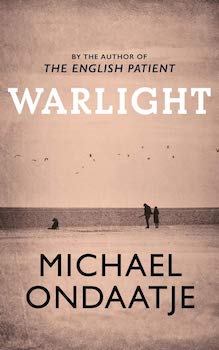
Warlight

Three years later, in John Buchan’s Mr Standfast, the chapter entitled ‘‘I take the Wings of a Dove’ includes the phrase ‘golden bowl’.[7] But my favourite recent reference is in Michael Ondaatje’s fine novel Warlight (‘The Moth’ is a name conferred by the narrator and his sister): ‘One night when Rachel had been unable to sleep, he pulled a book called The Golden Bowl from my mother’s shelf and began reading to us. The manner of the paragraphs, as the sentences strolled a maze-like path towards evaporation was, to the two of us, similar to The Moth’s when he was being drunkenly magisterial. It was as if language had been separated from his body in a courteous way.’[8]


References

[1] Elizabeth Bishop, One Art: The Selected Letters, edited by Robert Giroux (London: Pimlico, 1996), 5. Cymbeline, IV, ii, 258-263.

[2] Hugh Kenner, The Pound Era (London: Faber and Faber, 1972), 122. His endnote (570) reads: ‘A visitor to Warwickshire: W. Arrowsmith, reported by Guy Davenport.’ Further elucidated in Questioning Minds: The Letters of Guy Davenport and Hugh Kenner, edited by Edward Burns, two volumes (Berkeley: Counterpoint Press, 2018), I, 639, 641, 643.

[3] Raymond Williams, The Country and the City (New York: Oxford University Press, 1973), 14, 10.

[4] Ronald Blythe, The Age of Illusion: England in the Twenties and Thirties 1919-40 (Harmondsworth: Penguin Books, 1964), 28.

[5] Fiona MacCarthy, Eric Gill (London: Faber and Faber, 1990), 108-109.

[6] Selected Letters of E. M. Forster, Volume One: 1879-1920, edited by Mary Lago and P. N. Furbank (London: Collins, 1983), 240.

[7] John Buchan, Mr Standfast (1919; edited by William Buchan, Oxford: Oxford University Press, 1993), 133.

[8] Michael Ondaatje, Warlight (London: Jonathan Cape, 2018), 61.


‘Now it is time’ – revisiting Rilke

rilke-clara-1906
(Rilke and Clara, 1906)
http://fondationrilke.ch/rainer-maria-rilke/

‘Where to begin? And am I the one to give the Elegies their proper explanation? They pass infinitely beyond me.’[1] Yes, I’ve been revisiting Rilke, having read a good deal of his work decades ago, and always in translation, but nothing at all recently. In that long interval, though, I often noticed his name cropping up in all sorts of contexts in other books I was reading. Here was Lewis Hyde, writing about Rilke on art as a way of life, referring to his ‘wise blindness’.[2] Then W. H. Auden explaining to Alan Ansen that he wouldn’t mind Yeats’s ‘crazy mythology if he took it more seriously’, or, conversely, tipped a wink at the end to say the whole thing was a hoax; adding: ‘I like really crazy people like Rilke, yes, and D. H. Lawrence.’[3]

There are four versions of Rilke poems in Robert Lowell’s Imitations and, in History, a poem called ‘Rilke Self-Portrait’.[4] In Vernon Watkins’s poem, ‘Discoveries’, ‘Rilke bears all, thinks like a tree, believes,/ Sinks in the hand that bears the falling leaves.’ In the early summer of 1941, Watkins stayed with Dylan Thomas in Laugharne. ‘We had read Rilke’s Duino Elegies to each other in the look-out of Laugharne Castle perched on the wall over the estuary. The poems excited Dylan deeply, though he called Rilke “a very odd boy indeed”.’[5]

Here is Ted Hughes writing to Anne Stevenson in the autumn of 1986, pointing out the very wide range of Sylvia Plath’s reading in modern poetry, particularly European poets. ‘She was saturated with Rilke, of course’, Hughes notes, ‘she was perpetually studying German and used Rilke as a text. She regarded Rilke and [Zbigniew] Herbert as much more her “fellow-countrymen” than other US poets.’[6]

There are almost twenty Rilke translations in Randall Jarrell’s published work:

‘One star in the dark pass of the houses,
Shines as if it were a sign
Set there to point the way to—
But more beautiful, somehow, than what it points to,
So that no one has ever gone on beyond
Except those who could not see it, and went on
To what it pointed to, and could not see that either.’[7]

And then—Guy Davenport. Discussing Eliot’s Four Quartets, he suggests that they are, ‘in one sense Eliot’s emulation, and rivalry, of Rainer Maria Rilke’s Duino Elegies [1923]. Both are the greatest poems of our century about time, mortality, and our tragic incomprehension of existence. Both negate time for an eternal present containing the past and the future.’[8]

Schloss-Duino

In his essay on Ezra Pound published a few months after the poet’s death, Davenport recalled, on a visit to Venice, learning that Pound was then reading aloud to Olga Rudge Jean Paul Sartre’s recently published Les Mots. ‘A book less likely to interest Pound cannot be imagined’, Davenport observes, ‘and yet he was always capable of surprising our notions of what he did and didn’t like. His last journey was by yacht to the Schloss Duino. Rilke! Who could have foreseen that act of homage?’[9]

This finds its echo or enlargement in an August 1972 letter from Davenport to Hugh Kenner, in the wonderful edition of their correspondence forthcoming from Counterpoint Press next month: ‘Last report is that Ezra, Olga, and some well-heeled friend with a yacht are off to the Schloss Duino to inspect the ramparts from which Rilke, gazing into the storm, heard the angel cry, or shriek, or whistle. It is news to me that Ezra Pound ever looked into a copy of the Duineser Elegien.’ Edward Burns’ note informs us that Davenport is thinking of ‘the opening of the first elegy’, which Davenport translates as ‘“What eye among the rungs and hordes / of angelkind would turn and find / my long call through the storm of time?”’[10]

J. B. Leishman begins his translation of that first elegy like this:

Who, if I cried, would hear me among the angelic
orders? And even if one of them suddenly
pressed me against his heart, I should fade in the strength of his
stronger existence. For Beauty’s nothing
but beginning of Terror we’re still just able to bear,
and why we adore it so is because it serenely
disdains to destroy us. Every angel is terrible.[11]

I think, though, that what really jolted me back to Rilke was happening across this translation by Michael Hamburger of a poem, dated ‘October, 1925’, that begins, ‘Jetzt wär es Zeit, daß Götter träten aus / bewohnten Dingen…’

Now it is time that gods came walking out
of things inhabited. . .
And then demolished every wall inside
my house. New page. For nothing but the wind
that would be raised by such a wind in turning
could turn the air as shovel turns a sod:
a brand-new field of air. O gods, you gods,
the often come, who are asleep in things,
cheerfully rise, at wells that we conjecture
wash wide awake their faces and their necks
and add their restedness to that which seems
full as it is, our lives already full.
Another morning make your morning, gods!
We’re the repeaters, only you the source.
Your rising is the world’s, beginning shines
from every crack within our patched-up failure. . . .[12]

An extraordinary poem, an extraordinary translation and, surely, both. All those gods! And angels! Yet, referring to the scepticism of Nietzsche, Charles Tomlinson remarks that it was ‘a disbelief that found its most lasting poetic embodiments in the Duino Elegies of Rainer Maria Rilke’.[13] And Rilke himself wrote, in the letter first quoted, ‘The angel of the Elegies has nothing to do with the angel of the Christian heaven (rather with the angelic figures of Islam. . . .) The angel of the Elegies is that Being in whom the transmutation of the Visible into the Invisible, which we seek to achieve, is consummated.’

PMB-Rilke

(Paula Modersohn-Becker, Rainer Maria Rilke, 1906)

Drusilla Modjeska Stravinsky’s Lunch, largely devoted to the study of two Australian women painters— Grace Cossington-Smith and Stella Bowen, one of the most important people in the life of Ford Madox Ford—briefly traces in the early pages the life and career of Paula Modersohn-Becker, who painted most of her significant pictures, and eighty in all, in one year, 1906-1907, the year in which she died at the early age of thirty-one. Modjeska mentions that Modersohn-Becker sold only one painting in her lifetime (in fact, it seems to have been three) and that one to her friend Rilke. She was a close friend of the artist Clara Westhoff, who did in fact marry Rilke.[14] After Modersohn-Becker’s death, Rilke wrote a long, remarkable ‘Requiem for a Friend’, though without naming her.

‘Are you still there? Still hiding in some corner? —
You knew so much of all that I’ve been saying,
and could so much too, for you passed through life
open to all things, like a breaking day.
Women suffer: loving means being lonely,
and artists feel at times within their work
the need, where most they love, for transmutation.’[15]

B opener Moderson-BeckerSelfPortrait.jpg

(Paula Modersohn-Becker, Self-Portrait on the 6th Wedding Day, 1906)

Naturally, I became interested in Modersohn-Becker: the recent fine biography of her by Marie Darrieussecq—‘And, through all these gaps, I in turn am writing this story, which is not Paula M. Becker’s life as she lived it, but my sense of it a century later. A trace’—was largely responsible for the major retrospective of Paula Modersohn-Becker’s work at the Musée d’Art Moderne in Paris in 2016, for which Darrieussecq wrote the catalogue texts.[16]

Rilke arrives in Worpswede in Northern Germany in September 1900, initially to visit his friend, the painter Heinrich Vogeler. ‘Rilke thinks that painters know how to live, always. They depict anxiety. In hospital, Van Gogh paints his hospital room. The bodies of painters and sculptors are active. Their work is given over to this movement. He, the poet, doesn’t know what to do with his hands. He doesn’t know how to be alive.’ Then: a painter and a sculptor. Rilke ‘is in two minds. Paula, Clara. His heart is torn. He has a preference for threesomes, which will continue his whole life’ (Being Here 27, 28). In 1901, in preparation for her marriage to Otto Modersohn, Paula Becker is sent to Berlin, to take a cookery course. Rilke is also there and they meet. ‘As soon as she leaves, he writes to her again. It is midnight under his green lamp; he doesn’t touch a thing, in order to retain her presence’ (Being Here 49). They have dinner together for the last time in Paris, 27 July 1906. She dies of an embolism in November 1907: she is thirty-one years old. A year after her death, Rilke will write the ‘Requiem for a Friend’ over ‘three haunted nights in Paris’, at the Hotel Biron, 77 rue de Varenne, ‘a building Clara located for him and which will become the Musée Rodin.’ (Being Here 136).

‘Do not return. If you can bear it, stay
dead with the dead. The dead are occupied.
But help me, as you may without distraction,
as the most distant sometimes helps: in me.’[17]

So yes—intrigued, baffled, astonished, bemused, exhilarated—I am reading Rilke.


References

[1] Rainer Maria Rilke, Selected Letters of Rainer Maria Rilke, 1902-1926, translated by R. F. C. Hull (London: Macmillan, 1946), 392.

[2] Lewis Hyde, The Gift: Imagination and the Erotic Life of Property (New York: Vintage, 1983), 150.

[3] Alan Ansen, The Table Talk of W. H Auden, edited by Nicholas Jenkins (London: Faber and Faber, 1991), 72.

[4] Robert Lowell, Collected Poems, edited by Frank Bidart and David Gewanter (New York: Farrar, Straus and Giroux, 2003), 273-279, 497.

[5] Vernon Watkins, ‘Discoveries’. Selected Poems (London: Faber and Faber, 1967), 8; Dylan Thomas, Letters to Vernon Watkins, edited by Vernon Watkins (London: J. M. Dent and Sons and Faber and Faber, 1957), 105.

[6] Letters of Ted Hughes, selected and edited by Christopher Reid (London: Faber and Faber, 2007), 516-517.

[7] Randall Jarrell, ‘The Evening Star’, The Complete Poems (New York: Farrar, Straus and Giroux, 1969), 485.

[8] Guy Davenport, ‘Civilization and its Opposite in the 1940s’, The Hunter Gracchus and Other Papers on Literature and Art (Washington: Counterpoint, 1996), 80: Davenport had the date as 1921 but appears to have been two years out.

[9] Guy Davenport, The Geography of the Imagination (Boston: David R. Godine, 1997), 171.

[10] Questioning Minds: The Letters of Guy Davenport and Hugh Kenner, edited by Edward Burns (Berkeley: Counterpoint Press, 2018), II, 1413; 1447, n.105.

[11] Rainer Maria Rilke, Selected Works. Volume II: Poetry, translated by J. B. Leishman (London: The Hogarth Press, 1980), 225.

[12] German Poetry, 1910-1975, an Anthology translated and edited by Michael Hamburger (Manchester: Carcanet New Press, 1977), 22-23.

[13] Charles Tomlinson, American Essays: Making It New (Manchester: Carcanet Press, 2001), 59.

[14] Drusilla Modjeska, Stravinsky’s Lunch (New York: Farrar, Straus and Giroux, 2000), 6-13.

[15] Rilke, Poetry, 204.

[16] Marie Darrieussecq, Being Here: The Life of Paula Modersohn-Becker, translated by Penny Hueston (Melbourne, Australia: Text Publishing, 2017), 44, 154, n.34.

[17] Rilke, Poetry, 205.
 

Taking some lines for a walk: Ford, Conrad, Novalis

(Ford by Hoppé; Conrad via New York Public Library)

On this day in 1913, Ford Madox Ford published an essay in The New Freewoman, the middle incarnation of three journals edited wholly or in part by the suffragist and radical activist Dora Marsden. She started The Freewoman: A Weekly Feminist Review (1911-1912) with her friend Mary Gawthorpe; in the latter half of 1913, she edited what had become The New Freewoman – Rebecca West (who had got her start in The Freewoman) was literary editor; finally, it became The Egoist, with Harriet Weaver as editor (and primary financial backer) and Marsden as contributing editor, running from January 1914 to December 1919 and famously publishing some key modernist texts (by Joyce, Wyndham Lewis, Pound and Eliot).[1]

Dora-Marsden

Dora Marsden apparently necessitating the attention of several big strong men:
http://spartacus-educational.com/WmarsdenD.htm

Ford’s essay, ‘The Poet’s Eye’, unsurprisingly bore a strong resemblance to the ‘Preface’ to his Collected Poems, published towards the end of that year. Much of it discussed his view of the differences between poetry and prose, the first being for him quite uncontrollable, ‘words in verse form’ coming into his head from time to time and being written down ‘quite powerlessly and without much interest, under the stress of certain emotions.’ With prose, ‘that conscious and workable medium’, it was ‘a perfectly different matter.’

Ford is actually arguing that the ‘literary jargon’ to which English poetry is wedded, together with the narrow assumptions of what constitutes the suitable material of poetry, renders it incapable of dealing with modern life, ‘so extraordinary, so hazy, so tenuous with, still, such definite and concrete spots in it’. Poetry in English was, of course, on the cusp of extraordinary change: Pound’s Ripostes the previous year had included ‘The Return’ and T. E. Hulme’s poems; Des Imagistes would follow in 1914, as would W. B. Yeats’s Responsibilities; Cathay and Eliot’s ‘The Love Song of J. Alfred Prufrock’ in 1915. But, at the time of his writing, there was still a strong and widespread adherence to what Ford termed ‘the sure cards of the poetic pack’.

‘I may really say’, Ford asserted, ‘that for a quarter of a century I have kept before me one unflinching aim—to register my own times in terms of my own time, and still more to urge those who are better poets and better prose writers than myself to have the same aim. I suppose I have been pretty well ignored; I find no signs of my being taken seriously. It is certain that my conviction would gain immensely as soon as another soul could be found to share it. But for a man mad about writing this is a solitary world, and writing—you cannot write about writing without using foreign words—is a métier de chien.’[2]

Ford was precocious—but perhaps not to quite that degree: a literal ‘quarter of a century’ would have made him fourteen. His first book was published shortly before his eighteenth birthday. But there are some splendidly recurrent phrases here, I mean ones that resonate in minds that have grazed in Fordian fields. I remember Donald Davie writing about a phalanx of details in Pound’s Canto 80, pausing to remark that ‘Anyone is free to decide that life is too short for such unriddlings; others (I speak from experience) may develop a taste for them.’[3] This is not such an unriddling but certainly a related pleasure—or vice.

Novalis

(Friedrich von Hardenberg: Novalis)

‘It is certain that my conviction would gain immensely as soon as another soul could be found to share it.’ Yes, ‘recurrent’ is an apt word here. In 1900, William Blackwood published Lord Jim by Joseph Conrad, its epigraph reading: ‘“It is certain my conviction gains infinitely, the moment another soul will believe in it.”—Novalis.’ Cedric Watts’ note points out that in the German original, the word means ‘opinion’ rather than ‘conviction’, that Conrad was probably using the translation by Thomas Carlyle in On Heroes, Hero-Worship and the Heroic in History, and that an alternative version appears in another Carlyle book, Sartor Resartus, which Conrad has his character Marlow read in his novella Youth. Watts also notes that Conrad quotes Novalis’ aphorism again in A Personal Record.[4]

Lord Jim was published during the intense period of collaboration between Ford and Conrad which eventually produced The Inheritors (1901), Romance (1903) and The Nature of a Crime (1909; 1924). It was in the September of 1898 that the two men met and , in the following month, Conrad and his family moved into Pent Farm, Postling, Kent, sublet to them by Ford. A quarter of a century later, Ford recalled of that time: ‘Conrad’s conviction restored life to the fainting Pent: it breathed once more: the cat jumped off the window sill; the clock struck four’: this immediately preceding the arrival of W. H. Hudson—their first meeting—who would be of immense importance to Ford, though in less immediately evident ways than Conrad.[5]

Use what’s at hand: ‘pent’, wonderful. Ford’s fictional ambitions were both fired and freed in the course of the collaboration, while ‘the bulk of [Conrad’s] greatest fiction—the completed Lord Jim, Heart of Darkness, Nostromo, and The Secret Agent—was written while collaborating with Ford.’[6]

In 1915, in the second of Ford’s propaganda books, he notes in the ‘Preface’, ‘It is certain that my conviction gains immensely as soon as another soul can be found to share it.’[7] The following year, writing to Conrad from a Red Cross hospital in Rouen, he commented, ‘Since I have been out here this time I have not had one letter from one living soul. So one’s conviction does not get much from wh[ich]. to gain anything!’ By 1921, when Ford was writing to Harriet Monroe to acknowledge the Poetry prize awarded to him for A House (1921), the quote from Novalis (not named here) had become ‘the immortal dictum: “It is certain that my conviction gains immensely as soon as another soul can be found to share it”’[8] and the precise wording recurs in a 1927 essay about Ford’s memories of New York.[9]

One clear implication of these instances is that, while Ford—at least trilingual—could have read, and translated for himself, the lines from Novalis, he didn’t: though perhaps, even if he’d done so, he might have persisted with the version he associated with Conrad. But it’s also very striking, and surely poignant, that Ford, editor as well as writer, closely connected with so many groups of writers and artists, from the late 1890s through the English Review crowd, Imagism, Vorticism, Paris in the 1920s, New York and Tennessee in the 1930s, had that constant need for another soul to share his conviction. ‘He needed more reassurance than anyone I have ever met’, Stella Bowen remembered.[10] ‘Until the arrival of such “uncomfortables” as Wyndham Lewis, the distressful D. H. Lawrence, D. Goldring, G. Cannan, etc., I think Ford had no one to play with’, Ezra Pound wrote—an oddly selected cast but with a grain of truth, nevertheless.[11]

Hokusai

Those phrases, ‘a man mad about writing’ and ‘a métier de chien’ in Ford’s essay also have their histories. Describing himself as ‘an old man mad about writing’, Ford pointed to the artist Hokusai who called himself ‘an old man mad about painting’: he used the phrase or variations on it several times.[12] That ‘métier de chien’ is, again, associated particularly with Conrad: ‘For Conrad hated writing more than he hated the sea. . . . Le vrai métier de chien. . . . ’ but employed and alluded to in various contexts.[13] Then later references to the Shepherd’s Bush Exhibition and that phrase, ‘We are the heirs of all the ages’. . . But no, the comments on the essay would threaten to rival, in length at least, the essay itself. Perhaps another time, another walk, another conviction. ‘Taking a line for a walk’ – that was Paul Klee, I think. Another kind of line but the phrase would probably serve: taking a few Fordian lines for a walk. Yes, why not?

 
References

[1] Detailed on the indispensable Modernist Journals Project website: http://modjourn.org/index.html

[2] Ford Madox Ford, ‘The Poet’s Eye’, New Freewoman, I, 6 (1 September 1913), 107-110.

[3] Donald Davie, ‘Ezra Pound Abandons the English’ (1975), reprinted in Studies in Ezra Pound (Manchester: Carcanet Press, 1991), 236.

[4] Joseph Conrad, Lord Jim, edited by Robert Hampson with an introduction and notes by Cedric Watts (London: Penguin Books, 1989), 41, 353; see also Ian Watt, Conrad in the Nineteenth Century (Berkeley: University of California Press, 1979), 40 and n.

[5] Ford Madox Ford, Joseph Conrad: A Personal Remembrance (London: Duckworth, 1924), 155.

[6] Max Saunders, Ford Madox Ford: A Dual Life, two volumes (Oxford: Oxford University Press, 1996), I, 117. Alan Judd observes that, ‘Most of Conrad’s best work was written during periods of their intimacy’: Ford Madox Ford (London: Collins, 1990), 63.

[7] Ford Madox Ford, Between St. Dennis and St. George: A Sketch of Three Civilisations (London: Hodder and Stoughton, 1915), vi.

[8] Ford Madox Ford, Letters of Ford Madox Ford, edited by Richard M. Ludwig (Princeton: Princeton University Press, 1965), 80, 136. E. M. Forster was at it too, quoting the same aphorism of an unnamed ‘mystic’: Howards End (1910; edited by Oliver Stallybrass, London: Penguin Books, 1989).

[9] Ford Madox Ford, New York Is Not America (London: Duckworth, 1927), 91.

[10] Stella Bowen, Drawn From Life (London: Collins, 1941), 80.

[11] Ezra Pound, ‘Ford Madox (Hueffer) Ford; Obit’, in Selected Prose 1909-1965, edited by William Cookson (London: Faber and Faber, 1973), 433.

[12] Ford Madox Ford, The March of Literature: From Confucius to Modern Times (London: Allen & Unwin, 1939), vi: Conrad is named on the last page (850) of the text. Nicholas Delbanco’s essay on this book is titled ‘An Old Man Mad about Writing’: Joseph Wiesenfarth, History and Representation in Ford Madox Ford’s Writings (Amsterdam: Rodopi, 2004), 219-231. In A Mirror to France (London: Duckworth, 1926), for instance, Ford is ‘an old man mad about Provence’ (208).

[13] Ford Madox Ford, Joseph Conrad, 113, 255; Thus to Revisit (London: Chapman & Hall, 1921), 57; Return to Yesterday: Reminiscences 1894-1914 (London: Victor Gollancz, 1931), 292; The Simple Life Limited by ‘Daniel Chaucer’ (John Lane, 1911), 73.


Sleep and his brother Death

Turner, Joseph Mallord William, 1775-1851; Death on a Pale Horse (?)

(Turner, Death on a Pale Horse (?): Tate Britain)

On 28 August 1967, after hearing the news of her friend Alyse Gregory’s death, Sylvia Townsend Warner wrote in her diary, ‘As for me, I think sadly that my store of congenial minds is running very low. Never mind, so am I. And she is safe at least. Sleep and his brother Death have seen to that.’[1]

‘Sleep and his brother Death’. That sibling naming, though not the sentiments, recall David Jones’ In Parenthesis: ‘But sweet sister death has gone debauched today and stalks on this high ground with strumpet confidence, makes no coy veiling of her appetite but leers from you to me with all her parts discovered.’[2]

Allyson Booth writes of the etymological relationship between sleep and death—‘bed’ derived from the word meaning ‘to bury’, ‘cemetery’ derived from a word meaning ‘a place to sleep’, and of how the First World War literally undermined ‘a soldier’s confidence in the stability of death and a corpse’s embodiment of death’ in the churned-up ground of the Western Front as men walked and slipped and fought on the bodies of the fallen.[3]

But this is, so they say, a time of peace; and the fact is that, certainly once we reach a certain age, we are increasingly likely to witness or commemorate the death that is viewed as relief rather than tragedy. Some deaths, seeming to occur absurdly early, can still fall into that category – though some, of course, are simply an affront, a spitting in the eye of the universe and an insult to nature.

Only with the 18th century did the number of births gain over that of deaths; and this became the pattern regularly thereafter.[4] It was in 1918 that deaths overtook births again. ‘Coffins that had been stockpiled during the war, as there were no bodies to put in them, were suddenly in short supply. The Leicester railway workshops turned to coffin manufacturing and Red Cross ambulances were employed as hearses.’[5]

Self-Portrait 1914 by Sir Stanley Spencer 1891-1959

(Stanley Spencer, Self-Portrait: Tate Gallery)

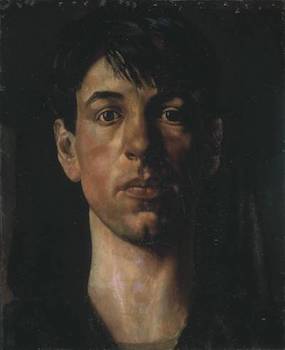
Sometimes, death constitutes no serious interruption to a process possessing its own rules and impetus. Stanley Spencer’s correspondence with his former wife Hilda continued after her death, beginning with a December 1950 letter and continuing until his own death nine years later. There was never any reference to her being dead and some of his letters ran to scores of pages.[6]

And the approach of death is sometimes neither feared nor unwelcome. In Patrick White’s novel The Riders in the Chariot, though Himmelfarb is near death in Mrs Godbold’s house, ‘He was as content by now as he would ever have allowed himself to be in life. Children and chairs conversed with him intimately.’[7] The importance of chairs – and tables – as solid, honest, real is a recurrent motif in White’s work.

Walter Savage Landor does a nice line in stoic acceptance of the inevitable ending:

To my ninth decad I have tottered on,
And no soft arm bends now my steps to steady;
She, who once led me where she would, is gone,
So when he calls me, Death shall find me ready.

Landor

And perhaps one more:

I strove with none, for none was worth my strife;
Nature I loved, and next to Nature, Art;
I warmed both hands before the fire of life;
It sinks, and I am ready depart.[8]

And Ali Smith writes of how ‘many things get forgiven in the course of a life: nothing is finished or unchangeable except death and even death will bend a little if what you tell of it is told right’.[9]

That’s something to aim for: bend death a little. Tell it right.

 
References

[1] Sylvia Townsend Warner, The Diaries of Sylvia Townsend Warner, edited by Claire Harman (London: Virago Press, 1995), 312.

[2] David Jones, In Parenthesis (1937; London: Faber and Faber, 1963), 162.

[3] Allyson Booth, Postcards From the Trenches: Negotiating the Space Between Modernism and the First World War (New York: Oxford University Press, 1996), 59-63

[4] Fernand Braudel, Civilization and Capitalism, 15th – 18th Century. Volume I: The Structures of Everyday Life: The Limits of the Possible, translated from the French and revised by Sîan Reynolds. (London: Fontana Books 1985), 73.

[5] Juliet Nicolson, The Great Silence, 1918-1920 (London: John Murray, 2009), 94.

[6] Maurice Collis, Stanley Spencer: A Biography (London: Harvill Press, 1962), 214.

[7] Patrick White, Riders in the Chariot (1961; Harmondsworth: Penguins Books, 1964), 432.

[8] Nick Rennison and Michael Schmidt, editors, Poets on Poets (Manchester: Carcanet Press, in association with Waterstones, 1997), 231; Daniel Karlin, editor, The Penguin Book of Victorian Verse (London: Penguin Books, 1997), 18.

[9] Ali Smith, How to be both (London: Hamish Hamilton, 2014), 95.

Thin crusts, modern girls: John Buchan

JB_Buchan_in_library

John Buchan in the library
https://archives.queensu.ca/exhibits/buchan/family

‘You may say that everyone who had taken physical part in the war was then mad’, Ford Madox Ford wrote a dozen years after the Armistice. Objects that ‘the earlier mind labelled as houses’, that had seemed to be ‘cubic and solid permanences’, had been revealed as thin shells that could be crushed like walnuts, he went on. ‘Nay, it had been revealed to you that beneath Ordered Life itself was stretched, the merest film with, beneath it, the abysses of Chaos. One had come from the frail shelters of the Line to a world that was more frail than any canvas hut.’[1]

In John Buchan’s Huntingtower (1922), the poet John Heritage remarks to Dickson McCunn, ‘I learned in the war that civilization anywhere is a very thin crust.’[2] And here is Andrew Lumley in The Power-House: ‘“You think that a wall as solid as the earth separates civilisation from barbarism. I tell you the division is a thread, a sheet of glass. A touch here, a push there, and you bring back the reign of Saturn.”’[3]

On the face of it, the two novelists could hardly appear less alike, one a modernist with a markedly artistic background, whose work sold poorly for most of his life; the other a hugely successful writer of popular fiction, keen sportsman, son of a minister of the Free Church of Scotland, very traditional, a seemingly paradigmatic establishment figure: Lord Tweedsmuir, Governor General of Canada, born in Perth on this day, 26 August, 1875. Still, they were almost exact contemporaries: Buchan published his first book at the age of nineteen—Ford’s was published shortly before his eighteenth birthday—and produced more than a hundred in total (as against Ford’s eighty). I’ve read around a quarter of Buchan’s titles, ten of them more than once, I see. The ‘shockers’ like The Thirty-Nine Steps are by far the best-known but those made up a relatively small part of Buchan’s huge output: even fiction comprises barely one-third of it.

Walton

(Izaak Walton: Dean & Co © National Portrait Gallery, London)

In a more detailed sense, even confining the matter to Huntingtower, a reader infected with the Ford Madox Ford virus might be pencilling faint marks in the margin against such lines as ‘Finally he selected Izaak Walton’ and ‘the seeing eye’ (16), ‘Poetry’s everywhere, and the real thing is commoner among drabs and pot-houses and rubbish-heaps than in your Sunday parlours’ (26)[4] and ‘a white cottage in a green nook’ (31), as well as the editor’s citing of a passage in Buchan’s autobiography dealing with his feelings about the war (xx). Buchan writes there, ‘I acquired a bitter detestation of war, less for its horrors than for its boredom and futility, and a contempt for its panache. To speak of glory seemed a horrid impiety.’[5]

Before all else, Buchan writes a rattling good yarn and I enjoy his books enormously for themselves. Those thrillers and adventure stories and romances largely achieve exactly what they set out to do, while their limitations are fairly obvious, not least to Buchan himself. Writing to his sister Anna about her second novel The Setons (she wrote under the name of O. Douglas), Buchan remarked: ‘In Elizabeth you draw a wonderful picture of a woman (a thing I could about as much do as fly to the moon).’[6]

The_39_Steps_1935_British_poster

Oh Carroll! (character added by Hitchcock) https://en.wikipedia.org/w/index.php?curid=38053736

Of course, hundreds of other writers have written rattling good yarns, made a living and duly faded from view; but many of Buchan’s books have not only survived but seem to be in a state of constantly improving health. They certainly possess qualities or contain features, often hard to pin down and specify, which have enabled that continued vitality. David Daniell refers to Buchan’s writing novels ‘with a mixture of surface pace of action and a deeper density of content which have a timeless quality’.[7]

For me, one of the pleasures is noticing the many ways in which a writer superficially so different from the usual modernist cast list overlaps with them, inhabits a recognisably similar world. His writing may be aimed at an audience quite unlike those aimed at by Joyce or Woolf or Ford; and he may not be fragmenting narratives or operating tricky timeframes or incorporating extra-literary discourses or multilingual puns but the overlap is certainly there for me.

This is largely because much of his work is set in and around the First World War, particularly in the years following it, perhaps my main area of interest. And although Buchan himself inhabited a world of prominent political and diplomatic figures, there remained a touch of the outsider, not least because of the war. Rejected for the army on grounds of both age and health, he visited France and Flanders as correspondent for The Times and took increasingly senior roles in information and intelligence but, as Andrew Lownie writes, Buchan ‘emerged from the First World War physically and emotionally shattered. Many of his closest friends had been killed and this loss of his immediate circle reinforced his sense of being displaced.’[8]

A good deal of his writing, then, is concerned with the terrain that most engages me: with the effects of the war both on individuals who were actively engaged in the fighting and those who were not, with shifting perceptions and understanding of shell-shock, with radical jolts in social relations, the rising threat of fascism, the ‘new Vienna doctrine’ and shifts in fashion and femininity, as the Edwardian ‘hourglass’ shape was replaced with the ‘tubular look’.[9]

Flapper
https://www.collectorsweekly.com/

This last is an example of the fascinating detail that can be followed for a short stretch or for many, many miles. While there is never (to my mind) any convincing strain of homoeroticism, here in Huntingtower is Saskia: ‘her slim figure in its odd clothes was curiously like that of a boy in a school blazer’ (70); in Mr Standfast, Mary is described as moving ‘with the free grace of an athletic boy’.[10] In John Macnab, Janet’s face ‘had a fine hard finish which gave it a brilliancy like an eager boy’s’ and later she looks to Sir Archie ‘like an adorable boy.’[11] Finally, in The Dancing Floor, Mollie Nantley says of Koré that she is ‘utterly sexless – more like a wild boy’, while Leithen reflects that, ‘These children [both youths and girls] looked alert and vital like pleasant boys, and I have always preferred Artemis to Aphrodite.’[12]

Artemis: virginal, eternally young, independent of men, athletic, the huntress. In C. E. Montague’s Rough Justice, Molly, ‘the young Artemis’, has a job as ‘games mistress’,[13] as does Valentine Wannop in Ford’s A Man Could Stand Up–, though a good many other male novelists and poets of the period would far rather, I think, have embraced Aphrodite. Trudi Tate mentions Lawrence and Faulkner as seeming ‘to disapprove of these androgynous figures’,[14] and one would immediately add Joyce. All non-combatants, I notice, which is either irrelevant or a thought for another time.

Catherine Carswell

Writing of her single meeting with Buchan in the summer of 1932, Catherine Carswell, novelist and friend (and biographer) of D. H. Lawrence, observed that, ‘A traditionalist in so many respects, he was yet a champion of the modern girl, delighting in her independences, even in her defiances, frowning neither upon her sometimes extravagant make-up nor upon her occasions for wearing trousers. As among the goddesses, his preference was for Artemis.’[15]

Ah, the modern girl. In The Dancing Floor (213), Buchan writes: ‘Virginity meant nothing unless it was mailed, and I wondered whether we were not coming to a better understanding of it. The modern girl, with all her harshness, had the gallantry of a free woman. She was a crude Artemis, but her feet were on the hills. Was the blushing, sheltered maid of our grandmother’s days no more than an untempted Aphrodite?’

Buchan is not a modernist novelist and not a part of any literary movement, though he doesn’t seem as wholly removed from the literary world as Kipling, who sometimes seems not to have known any writers other than Rider Haggard. Buchan and his wife knew Elizabeth Bowen, Rose Macaulay, Hugh MacDiarmid, Walter de la Mare, Robert Graves, T. E. Lawrence – and Virginia Woolf, whose novels Buchan admired. Woolf had known Buchan’s wife Susan for many years and one of her last letters was written to Susan, though unposted: Leonard Woolf sent it on in the month following Virginia’s death.[16]

There have, naturally, been recurrent complaints about Buchan as racist, anti-Semitic, sexist: the usual fare. There have been equally recurrent rebuttals and, indeed, what a lot of it comes down to seems to be complaints that people a hundred years ago didn’t wholly share the social attitudes that we – that most of us, we hope – share today. Still, one clue to his books lasting is, I suspect, the way that certain artists fall out of fashion because of their content or attitudes or language but then, after a further period of time has elapsed, come into focus again, far enough back now to be viewed objectively and enjoyed without fretting about ‘relevance’ or current orthodoxies. Here’s Graham Greene, looking back to the 1930s:

‘An early hero of mine was John Buchan, but when I re-opened his books I found I could no longer get the same pleasure from the adventures of Richard Hannay. More than the dialogue and the situation had dated: the moral climate was no longer that of my boyhood. Patriotism had lost its appeal, even for a schoolboy, at Passchendaele, and the Empire brought first to mind the Beaverbrook Crusader, while it was difficult, during the years of the Depression, to believe in the high purposes of the City of London or of the British Constitution. The hunger-marchers seemed more real than the politicians. It was no longer a Buchan world.’[17]

Not a Buchan world; yet, although the attitudes towards the threats may have changed over the years, some of the current threats themselves—the threat of fascism, attempts to subvert democracy, ‘fake news’ (that blood relation of propaganda)—seem worryingly familiar. But, alas, Richard Hannay, Edward Leithen, Sandy Arbuthnot and Archie Roylance will not be saving us this time around.


References

[1] Ford Madox Ford, It Was the Nightingale (London: Heinemann, 1934), 48, 49.

[2] John Buchan, Huntingtower (1922; edited by Ann Stonehouse, Oxford: Oxford University Press, 1996), 116.

[3] John Buchan, The Power-House (1916; Edinburgh: B&W Publishing, 1993), 38.

[4] See Ford Madox Ford on ‘the portable zinc dustbin’, in the ‘Preface’ to Collected Poems (London: Max Goschen, 1913 [dated 1914]), 16-17.

[5] John Buchan, Memory Hold-the-Door (London: Hodder and Stoughton, 1940), 167.

[6] Quoted by Janet Adam Smith, John Buchan: A Biography (Oxford: Oxford University Press, 1985), 284.

[7] David Daniell, The Interpreter’s House: A Critical Assessment of the Work of John Buchan (London: Thomas Nelson, 1975), 209.

[8] Andrew Lownie, John Buchan: The Presbyterian Cavalier (London: Constable, 1995), 297.

[9] Martin Pugh, ‘We Danced All Night’: A Social History of Britain Between the Wars (London: The Bodley Head, 2008), 171.

[10] John Buchan, Mr Standfast (1919; Oxford: Oxford University Press, 1993, edited by William Buchan), 11.

[11] John Buchan, John Macnab (1925; edited with an introduction by David Daniell, Oxford: Oxford University Press, 1994), 125, 182.

[12] John Buchan, The Dancing Floor (1926; edited with an introduction by Marilyn Deegan, Oxford: Oxford University Press, 1997), 57, 51.

[13] C. E. Montague, Rough Justice (London: Chatto & Windus 1926), 171.

[14] Trudi Tate, Modernism, History and the First World War (Manchester: Manchester University Press, 1998), 115n.

[15] Catherine Carswell, ‘John Buchan: A Perspective’, in John Buchan by His Wife and Friends (London: Hodder and Stoughton, 1947), 160.

[16] Virginia Woolf, Leave the Letters Till We’re Dead: Collected Letters VI, 1936-41, edited by Nigel Nicolson and Joanne Trautmann Banks (London: The Hogarth Press, 1994), 483 and n.

[17] Graham Greene, Ways of Escape (London: Vintage, 1999), 69.

Temperature normal – sometimes

Borogroves-toves-raths

(Sir John Tenniel, ‘Borogroves, toves, raths’)

‘Delirium would seem to be the fate of all societies which become content in secured wealth and gradually forget the conditions of labour and service upon which alone that security can be maintained.’[1]

 
Writing to Eudora Welty in 1996, William Maxwell told her that he was sending ‘a lifetime of correspondence’ to the University of Illinois Library but couldn’t bear to dispose of his letters from Charles and Susan Shattuck without rereading them.

‘Reading the letters has plunged me into such a fit of remembering, not only of them but of almost everything else, that I couldn’t sleep because my mind was racing so. It made me realize that remembering can be a kind of illness, and perhaps I have it.’[2]

It can be; I may have it too. But if it’s the other way around, I’ve had a touch of that too lately, encountering people I’ve not seen for years, some of them dead, of course, but also with the tendency to turn into others or, indeed, into narrow staircases or resistant thickets or animals—among them, white rabbits, though not, to my recollection, Grace Slick.

Even though I’ve been luckier than a great many other people in the matter of general health, I’ve still had far more serious medical conditions than this in my life—‘I want you to go to hospital’, my doctor said once, years ago and, when I mumbled vaguely about dates and appointments, he said, ‘I mean now. Immediately.’ So peritonitis was happily avoided—but I can’t remember feeling so generally ill. And yes, the nights have been the worst but I’m still frustrated by the sheer physical effort involved in such major undertakings as putting on clothes or lifting a dropped spoon from the floor. (For the most part, the Librarian, visibly puzzled by the circumstances which have landed her with this most unnatural role, buckles to and tends.)

‘Space the doses evenly throughout the day.’

We all experience illness; some are never free of it; a part of ordinary life, it also offers the means of luring or urging the poet, the painter, the storyteller into strange and often arresting terrain. Illness is so various, involves its own related places, its own rituals, its own company. If we are not ill now, we have been and we will be.

The Centurion's Servant 1914 by Sir Stanley Spencer 1891-1959

Stanley Spencer, The Centurion’s Servant: Tate Gallery
© Estate of Stanley Spencer

Discussing Stanley Spencer’s The Centurion’s Servant —‘a person walking only it is lying down’, the painter remarked— Kenneth Pople notes that, in Spencer’s childhood Cookham, it was the custom to pray round the sickbed. Family recollections included an episode in which one of the older Spencer boys developed pneumonia. The illness reached a stage at which the anxiously watching women dispatched young Sydney Spencer to run to his father, then working across the Thames at Hedsor, ‘to tell him that “the crisis has come”; a message which reached Pa’s ears as ‘“Christ has come.”’[3]

Alethea Hayter quotes Coleridge—‘“I appear to myself like a sick physician, feeling the pang acutely, yet deriving a wonted pleasure from examining its process and developing its causes”’—and comments that, ‘He was speaking metaphorically, but illness, like anything else for him, could become an allegory and was interesting for that reason. Anything, however intrinsically repugnant, could be used as a symbol which would make a poem.’[4]

The warring elements of my recent nights have been the sleeplessness for hours at a time but, on the other hand, a seething and feverish onslaught of images tap-dancing on the insides of my eyelids. Lying still can, of course, be a quite exhausting business.

‘This medicine may colour your urine. This is harmless.’

Kipling-via-BBC

Edmund Wilson’s assertion that ‘[t]he theme of inescapable illness dominates the whole later Kipling’ is a reminder of just how many impressive stories this applies to, when postwar trauma is included, as it must be.[5] Yet, as J. M. S. Tompkins points out, the theme of healing predates the war, emerging in Actions and Reactions (1909), with its opening story ‘An Habitation Enforced’ and its concluding one, ‘The House Surgeon’.[6] In later stories, it is sometimes the ritual and fellowship of the masonic lodge that is the healing power: ‘In the Interests of the Brethren’, ’Fairy-Kist’, ‘The Janeites’.

‘Ah!’ Conrad’s Marlow says, ‘but it was something to have at least a choice of nightmares.’ (I think we can all wholeheartedly second that.) And: ‘I admit my behaviour was inexcusable, but then my temperature was seldom normal in these days.’[7]

My own temperature promises to be—and, importantly, to stay—normal, any day now. Yes. I think so. Any day now.


References

[1] C. F. G. Masterman, The Condition of England (London: Methuen, 1911), 34.

[2] Suzanne Marrs, editor, What There Is to Say, We Have Said: The Correspondence of Eudora Welty and William Maxwell (Boston and New York: Houghton Mifflin Harcourt, 2011), 441.

[3] Kenneth Pople. Stanley Spencer: A Biography (London: Harper Collins, 1991), 63.

[4] Alethea Hayter, Voyage in Vain: Coleridge’s Journey to Malta in 1804 (1973; London: Robin Clark, 1993), 152.

[5] Edmund Wilson, ‘The Kipling That Nobody Read’, in Andrew Rutherford, editor, Kipling’s Mind and Art (Stanford: Stanford University Press, 1964), 67.

[6] J. M. S. Tompkins, The Art of Rudyard Kipling, second edition (Lincoln: University of Nebraska Press, 1965), Chapter Six, ‘Healing’.

[7] Joseph Conrad, Heart of Darkness with The Congo Diary, edited by Robert Hampson (London: Penguin Books, 1995), 103, 114.


Following up

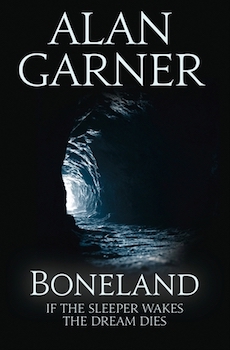
Where-Shall-we-run-to . Boneland

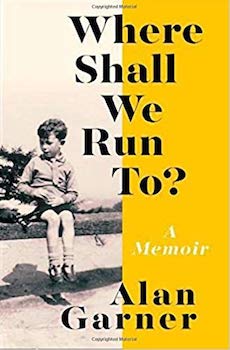
I’ve recently bought—but am not yet reading—the new book by Alan Garner, called Where Shall We Run To? – A Memoir. I’m not reading it yet because my epic revisiting of the Patrick White canon is only now nearing its close; then, too, some major deadlines are approaching for the first issue of the new Ford Madox Ford Journal; and in any case, I was just in time to glimpse the Librarian carrying the book away to some other part of the house. First dibs, as they say.

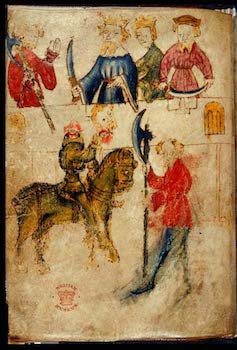
The publication of this new Garner recalled for me the previous one, Boneland, a novel which appeared in 2012. It’s short, powerful and cryptic, as much of Garner’s work tends to be, not through obfuscation but compression. Some of his readers are extraordinarily knowledgeable not only about Garner’s entire oeuvre but also the mythologies and belief systems that underlie so much of his writing; and I remember that the medieval text, Sir Gawain and the Green Knight, was mentioned and cited several times in online comments about the book. So I followed up.

 sir-gawain-green-knight-decapitated-head-f94v

(Via The British Library)

I’d certainly read Gawain at some stage over the years. I’d never taken the kind of course of study that included it, though the University of Bristol had the supreme good fortune to have on its staff John Burrow, a brilliant critic and editor of medieval literature (and one of the most delightful people I’ve ever come across). He published a classic study of the poem in 1965, and an edition of it for Penguin in 1982. Following up, though, the edition I read was the one at hand in the office, a modern English version with a critical introduction by John Gardner from the University of Chicago Press, reissued in 2011. Ninety pages of introduction and commentary allow for a fair bit of jousting with other critics and commentators, while demonstrating an impressive familiarity with the relevant secondary literature as well as the poem itself. The alliterative verse rollicks along at a pleasing lick:

Now comes the season of summer; soft are the winds;
The spirit of Zephyrus whispers to seeds and green shoots.
Joyful enough is that herb rising up out of earth,
When the dampening dew has dropped from all her leaves,
To bask in the blissful gaze of the bright sun.

John-Gardner-Paris-Review

(John Gardner, via The Paris Review)

John Champlin Gardner Jr. died nearly forty years ago in a motorcycle accident at the early age of 49. He’d published more than a dozen works of fiction, half a dozen critical works, children’s books, and translations of the Alliterative Morte d’Arthur and Other Middle English Poems as well as the complete works of the Gawain poet. He’s probably still best-known for his novel Grendel, a retelling of the Beowulf story from the monster’s point of view.

That phrase, ‘following up’, I always associate with an essay by Guy Davenport on the extraordinary photographer Ralph Eugene Meatyard (in The Geography of the Imagination):

He was an unfailing follower-up, which is why I think of him as the best educated man I have ever known. As a professor I must work with people for whom indifference is both a creed and a defense of their fantastic narrowness of mind, but Gene knew nothing of this. When he met Louis and Celia Zukofsky at my house, he went away and read Zukofsky. Not that he was an enthusiast. He simply had a curiosity that went all the way, and a deep sense of courtesy whereby if a man were a writer he would read what he had written, if a man were a painter he would look at his paintings.

Davenport was himself a follower-up of impressive proportions. He remembered a walking trip in Italy and France with Christopher Middleton, the two of them armed only with a collected John Donne and Pound’s Cantos, ‘a rich, barely comprehensible poem’, Davenport commented. He continues: ‘My first response was to learn Italian and Provençal, and to paint in the quattrocento manner. All real education’, he adds, ‘is such unconscious seduction.’

That’s quite a response; quite a follow-up.


An ethical dimension/ unethical dementia

Robin-Cook-Guardian

(Robin Cook via The Guardian)

I’m old enough to remember Robin Cook’s ‘mission statement’, more than twenty years ago now. Of course, we know how things worked out there but still, but still. ‘Our foreign policy must have an ethical dimension and must support the demands of other peoples for the democratic rights on which we insist for ourselves.’ And, towards the close: ‘Today’s Mission Statement sets out new directions in foreign policy. It makes the business of the Foreign and Commonwealth Office delivery of a long-term strategy, not just managing crisis intervention. It supplies an ethical content to foreign policy and recognises that the national interest cannot be defined only by narrow realpolitik. It aims to make Britain a leading partner in a world community of nations, and reverses the Tory trend towards not so splendid isolation.’
https://www.theguardian.com/world/1997/may/12/indonesia.ethicalforeignpolicy

Goodbye to all that, then. In Yemen, where war has been raging for several years, the latest atrocity is the dozens of deaths and injuries in a Saudi-led coalition attack on a bus full of children. An official Saudi press agency statement termed this ‘a legitimate military action’.
https://www.theguardian.com/world/2018/aug/09/dozens-dead-in-yemen-as-bus-carrying-children-hit-by-airstrike-icrc

Of an earlier offensive, the Conservative MP Andrew Mitchell observed that, ‘The problem for Britain is that we are complicit in this attack. It is part of the coalition that supports Saudi Arabia in its war in Yemen.’
https://www.theguardian.com/commentisfree/2018/jun/13/britain-complicit-saudi-arabia-war-yemen-hodeidah

You could say that. You could, indeed, say more than that. Several months ago, David Mepham, UK Director of Human Rights Watch, remarked that the British government ‘has been one of the strongest backers of the Saudis and their Gulf-led coalition. It has provided largely uncritical support for Saudi’s role in the war, as well as selling the Saudis £4.6 billion of military equipment over this period, seemingly ignoring its own rules about not selling arms when they are likely to be used unlawfully.’ As for British ministers, they ‘insist that staying close to the Saudis and offering advice privately is the most effective way to influence Saudi actions, alongside military advice and practical support through arms sales.’
https://www.hrw.org/news/2018/03/23/britains-policy-saudi-arabia-has-worsened-suffering-yemen

Well, well. Try this. ‘For many civilians, the realisation that one’s nation might be immoral or duplicitous was profoundly disturbing’, Trudi Tate writes, discussing Rudyard Kipling’s story, ‘Mary Postgate’, having commented a little earlier that, ‘Widespread literacy made it easier to spread lies.’ Yup. And she cited an essay by Sigmund Freud, ‘The Disillusionment of the War’, dating from 1915.[1]

Freud begins by writing that, ‘In the confusion of wartime in which we are caught up, relying as we must on one-sided information, standing too close to the great changes that have already taken place or are beginning to, and without a glimmering of the future that is being shaped, we ourselves are at a loss as to the significance of the impressions which press in upon us and as to the value of the judgements which we form.’

Take away ‘of wartime’ from his opening sentence and the essay could have been written this week.

sigmund-freud

Sigmund Freud
(‘when they were yung and easily freudened’—James Joyce, Finnegans Wake
Sometimes a psychoanalyst is just a psychoanalyst)

I see I marked another, later passage, about how, when a village grows into a town or a child into an adult, the earlier forms become lost in the later; but that it’s ‘otherwise with the development of the mind’. Succession, Freud writes, also involves co-existence and every earlier stage of development persists alongside the later stages. It may well happen, he suggests, that ‘a later and higher stage of development, once abandoned, cannot be reached again. But the primitive stages can always be re-established; the primitive mind is, in the fullest meaning of the word, imperishable.’[2]

So this is where we’ve got to. Our current, carefully selective and discriminating arms trade policy appears to boil down to this: ‘If they have the money, we’ll sell to anyone that asks.’ Appendix 1, no doubt, reads: ‘when, as is bound to happen, you use the weapons we’ve supplied to slaughter civilians, with a particular appetite for children, we agree to say nothing whatever about it. So long as your cheque is in the post.’

 
References

[1] Trudi Tate, Modernism, History and the First World War (Manchester: Manchester University Press, 1998), 39, 5.

[2] Sigmund Freud, ‘Thoughts for the Times on War and Death’, Civilization, Society and Religion, Penguin Freud Library Volume 12, edited by Albert Dickson (London: Penguin Books, 1991), 61, 73.


Bees, tea towels, staying at home

tolpuddle-martyrs

With a new tea towel to prompt me, I should at least finally commit to memory the names of the Tolpuddle Martyrs. It was a part of, let’s call it, a bulk purchase of Radical Tea Towels, made by the Librarian on our recent trip to Manchester.

https://www.radicalteatowel.co.uk/

With limited time at our disposal, we hared off to the People’s History Museum – or intended to. Twenty-minute walk, my note said. Perhaps, if you’re a champion athlete, know the city like the back of your hand and don’t start off by coming out on the wrong side of Manchester Piccadilly station. After fifteen minutes, we made our way back to where we’d begun and climbed into a taxi.

Match-Girls

We might have stayed the night in Manchester had the Librarian not already been committed to a professional trip to London and Oxford the next day. So we arrived back in Bristol around midnight in order that, on Finland’s National Sleepy Head Day, I might roll out of bed at five o’clock, an hour earlier than usual.

Suffragette-Teatowel

’We went to Europe’, Flannery O’Connor wrote to Elizabeth Bishop in 1958, ‘and I lived through it but my capacity for staying at home has now been perfected, sealed & is going to last me the rest of my life.’ Yes. I recalled the painter Hurtle Duffield’s initial reaction as his Greek lover persuades him onto a flying boat for the first leg of their journey, in Patrick White’s The Vivisector: ‘In the air he huddled in his overcoat and longed for his abandoned house; nobody would coax him out of it again. In any case after childhood, or at most, youth, experience breeds more fruitfully in a room.’

We are home now, anyway, in the resurgent hot weather. The bees are entranced by African blue basil, lavender, roses and Skylover. The gabbiest magpie of the four regulars perches on the fence and sounds off. The neighbour’s cat is still digesting the news that the recent arrivals in the house beyond our back wall have rabbits in a hutch by their kitchen door. We, in turn, are digesting the news that, after several years of quiet, those recent arrivals subscribe to the new twenty-first century conventions: make as much noise as you can. Still, the hot weather will pass; windows will close; the novelty of careering loudly around a shared house and garden will wear off.

Birds

So we are left with the recent news items which have—certainly not comforted but, perhaps, diverted—such as Government ministers drawing up plans to investigate whether the government’s own policies are to blame for the sharp rise in the use of food banks.
https://www.theguardian.com/society/2018/aug/01/revealed-ministers-plan-to-research-effect-of-policies-on-food-bank-use

Could they possibly be connected? As has already been pointed out several times, this is something of an ‘is the Pope Catholic?’ query. I remember thinking the same thing when, two or three months ago, after the deaths of many unarmed protesters, there was a headline on the BBC website: ‘Did Israel use excessive force at Gaza protests?’

And one which has caused extreme discomfort: the assault on Bookmarks, the Bloomsbury Street shop.
https://www.theguardian.com/uk-news/2018/aug/05/far-right-protesters-ransack-socialist-bookshop-bookmarks-in-london

There have been a good many recent attempts to suggest that we are seeing a rerun of the 1930s and, usually, I find the differences far outweigh the similarities. But masked thugs attacking a radical bookshop? That brings us a little closer, I think.

As easy as pie – sometimes

Basil

‘Basil returned with the two pies. He was wearing the expression of a man who has laid hands on a symbol of his boyhood: it made him look somewhat ponderous.’[1] This seems a pretty straightforward example of a symbol (pie = boyhood), though the passive construction of those verbs (‘He was wearing’ and ‘it made him look’) must be seen a little warily in the context of ‘Basil’ being the ‘great actor’, Sir Basil Hunter, come back from England to Australia to ease his dying mother into an old folks’ home, secure as much of the loot as he can, and play whatever roles are required.

EyeOfTheStorm.jpg

In the opening paragraph of her second novel, Penelope Fitzgerald writes of her central character, Florence Green: ‘She had once seen a heron flying across the estuary and trying, while it was on the wing, to swallow an eel which it had caught. The eel, in turn, was struggling to escape from the gullet of the heron and appeared a quarter, a half, or occasionally three-quarters of the way out. The indecision expressed by both creatures was pitiable. They had taken on too much.’ Bracketing this description, there are passages of studied ambiguity: it is one of the nights when Florence is ‘not absolutely sure whether she had slept or not’; and ‘Florence felt that if she hadn’t slept at all – and people often say this when they mean nothing of the kind – she must have been kept awake by thinking of the heron.’

A little later, we read that, ‘The weather was curious, and reminded her of the day she saw the flying heron trying to swallow the eel.’ One more reference, a dozen pages further on, seems to emphasise dreaming rather than thinking in that first instance: ‘Completely tired out by the time she went to bed, she no longer dreamed of the heron and the eel, or, so far as she knew, of anything else.’[2]

Some fifteen years later, in an essay on the voices of fictional characters, Fitzgerald quoted from that opening and commented, ‘I now think this was a mistake, because dreams in fiction are just as tedious as people’s dreams in real life.’[3] True enough: but the reference to the form rather than the content seems a little disingenuous – or am I oversimplifying by seeing the heron and the eel as a symbolic conjunction relevant to Fitzgerald’s entire corpus? One of her critics, enlarging on this ‘remarkable, predatory image’, remarks that, ‘As if borrowed from the sphere of sleep’s hauntings, the image, Darwinian and predacious, will be recalled more than once in the course of the novel, and it sets up, right at the start, the theme of survival—and the challenges that make survival, especially for the less fit and self-assertive, a chancy matter.’[4]

Blue-Heron-via-Telegraph

(Blue heron, via The Telegraph)

Yes, just before the second reference to the heron and eel, we find: ‘She blinded herself, in short, by pretending for a while that human beings are not divided into exterminators and exterminatees, with the former, at any given moment, predominating.’ And elsewhere, reflecting on V. S. Pritchett’s warning against writing one’s life away, Fitzgerald wrote: ‘This is a warning that has to be taken seriously. I can only say that however close I’ve come, by this time, to nothingness, I have remained true to my deepest convictions – I mean to the courage of those who are born to be defeated, the weaknesses of the strong, and the tragedy of misunderstandings and missed opportunities which I have done my best to treat as a comedy, for otherwise how can we manage to bear it?’[5]

The heron and the eel—together—comprise then an image, and surely a symbol, of the battle that life entails for a certain kind of person, with that particular balance of courage and confidence, who will never triumph yet will never quite give up either. How conscious, how deliberate must the use of a symbol be to qualify as a symbol? It seems absurdly patronising to suggest that so accomplished a writer wouldn’t have been perfectly aware of what she was doing. Nevertheless, I wonder if some writers—having produced such images, or symbols, capable of such strong and varied interpretations—hold them at a distance, play down their ownership with its implied rights of sustained control, concerned to allow those images room to breathe, to expand and flower in their readers’ minds.

‘I think you are playing a dangerous game,’ Patrick White wrote to Manfred Mackenzie in 1963, ‘fascinating to the player, no doubt – in all this symbol-chasing. Most of the time, I’m afraid, it leads up the wrong tree!’ He added, ‘I am sorry not to be able to confess to most of the influences you suggest. I may have arrived at certain conclusions via other writers who had read those you mention. Otherwise I suppose symbols can pop out of the collective unconscious.’ Two years earlier, replying to James Stern’s queries about his religious development, White replied: ‘Certainly in my own case I did not return to orthodox Anglicanism, but the Anglican church is a feeble organisation compared with the Jewish faith. I made the attempt, found that Churches destroy the mystery of God, and had to evolve symbols of my own through which to worship.’[6]

White did sometimes use symbols quite deliberately, often foregrounding them, as with the mandala that becomes part of the title of one of his novels, though circles and other figures of wholeness are everywhere in his books (as are roses). Linked to this, a sense of the wholeness of the world, certainly the artist’s world, perhaps not rationally apprehended but felt, sensed, known, is conveyed by the figure of the dance: Arthur Brown dancing the mandala for Mrs Poulter, or the young musician when she first enters Hurtle Duffield’s house: ‘As she continued turning within the conservatory’s narrow limits, she began also to hum. A golden tinsel of light hung around her lithe, mackerel body; while out of the dislodged tiles and shambles of broken glass her shuffling feet produced discordancies, but appropriate ones: Kathy Volkov would probably never teeter over into sweetness.’[7] William Butler Yeats, mindful of the interconnectedness of every part of both a tree and a work of art, famously asked at the end of ‘Among School Children’, ‘How can we know the dancer from the dance?’[8] And the novelist Richard Hughes, in his introduction to an edition of a William Faulkner novel, mentioned the story told of ‘a celebrated Russian dancer, who was asked by someone what she meant by a certain dance. She answered with some exasperation, “If I could say it in so many words, do you think I should take the very great trouble of dancing it?”’[9] It occurs to me that the title of Poussin’s painting that Anthony Powell adopted for his novel-sequence, A Dance to the Music of Time, could hardly have comprised three terms more mysterious and more difficult to grasp with confidence and conviction.

Dance_to_the_music_of_time

(Nicolas Poussin, A Dance to the Music of Time: Wallace Collection)

The gap that uncertainty—as to whether a literary image or motif is deliberately designed to perform a more substantial symbolic function—allows can carry a good deal of force. I’ve reflected more than once on Ford Madox Ford’s multiple references to cooking and gardening. They are almost always, in the first instance, actual cooking and actual gardening—both arts that Ford practised and regarded as hugely important. But, of course, they also offer extraordinary scope for symbolic interpretation. Ford uses more explicitly symbolic images too, which occur less often but with a more focused aim. So Christopher Tietjens characterises his wife and his lover thus: ‘If you wanted something killed you’d go to Sylvia Tietjens in the sure faith that she would kill it: emotion: hope: ideal: kill it quick and sure. If you wanted something kept alive you’d go to Valentine: she’d find something to do for it . . . The two types of mind: remorseless enemy: sure screen: dagger . . . sheath!’ Later, the suffragette and pacifist Valentine Wannop will acknowledge her ‘automatic feeling that all manly men were lust-filled devils, desiring nothing better than to stride over battlefields, stabbing the wounded with long daggers in frenzies of sadism.’[10]

For literary critics, psychoanalysts and many others, the world is a seething mass of symbols—in the index to my Penguin edition of Freud’s The Interpretation of Dreams, ‘symbol’ runs into three columns, offering no end of joyous examples: asparagus, burglar, nail-file, zeppelin—but they would probably be the first to agree that sometimes a cigar is just a cigar, a pipe a pipe, a rose a rose. And surely sometimes a pie is just a pie.


References

[1] Patrick White, The Eye of the Storm (London: Penguin Books, 1975), 452.

[2] Penelope Fitzgerald, The Bookshop (1978; London: Everyman, 2001), 5, 29, 40.

[3] Penelope Fitzgerald, ‘Hearing Them Speak’ (1993), in A House of Air: Selected Writings, edited by Terence Dooley with Mandy Kirkby and Chris Carduff (London: Harper Perennial, 2005), 499-500.

[4] Christopher J. Knight, ‘The Second Saddest Story: Despair, Belief, and Moral Perseverance in Penelope Fitzgerald’s The Bookshop’, Journal of Narrative Theory, 42, 1 (Spring 2012), 70, 71.

[5] Fitzgerald, ‘Curriculum Vitae’, in A House of Air, 480.

[6] Patrick White, Letters, edited by David Marr (London: Jonathan Cape, 1994), 216, 217, 196.

[7] See Patrick White, The Solid Mandala ( Harmondsworth: Penguin Books, 1969), 265-267; The Vivisector (London: Jonathan Cape, 1970), 443-444.

[8] W. B. Yeats, Collected Poems, second edition (London: Macmillan, 1950), 245.

[9] Hughes, ‘Introduction’ to William Faulkner, The Sound and the Fury (London: Chatto and Windus, 1966), vii.

[10] Ford Madox Ford, Some Do Not. . . (1924; edited by Max Saunders, Manchester: Carcanet Press, 2010), 160, 284. Related images occur in many of Ford’s other works.